A strong tattoo drawing starts before anyone touches skin. The sketch has to read clearly at the size you want, fit the body placement, and leave enough breathing room for the lines to age well. I look at silhouette first: if the design is weak as a simple black shape, extra texture will not save it.
Use these five tattoo drawing ideas as starting points, not finished flash you copy without thinking. Each one gives you a different design problem to solve: symmetry, line economy, realism, color flow, or sleeve movement. Sketch it in pencil, test the scale, then clean the best version with ink before you take it to a tattoo artist.
- What makes a good tattoo drawing?
- Tattoo drawing reference guide
- 1) Geometric mandala tattoo drawing
- 2) Minimalist line art flower tattoo drawing
- 3) Realistic animal portrait tattoo drawing
- 4) Watercolor galaxy tattoo drawing
- 5) Tribal sleeve tattoo drawing
- Tattoo design principles to check before you commit
- How to choose the right tattoo drawing style
- Common tattoo drawing mistakes
- FAQ about tattoo drawing
- Q: What is a tattoo drawing?
- Q: How do I start a tattoo drawing as a beginner?
- Q: What tattoo drawing style is easiest to sketch?
- Q: Can I bring my own tattoo drawing to an artist?
- Q: How detailed should a tattoo drawing be?
- Q: Are tattoo drawing references okay to use?
- Q: What should I ask before choosing a tattoo drawing?
- Sources and further reading
What makes a good tattoo drawing?
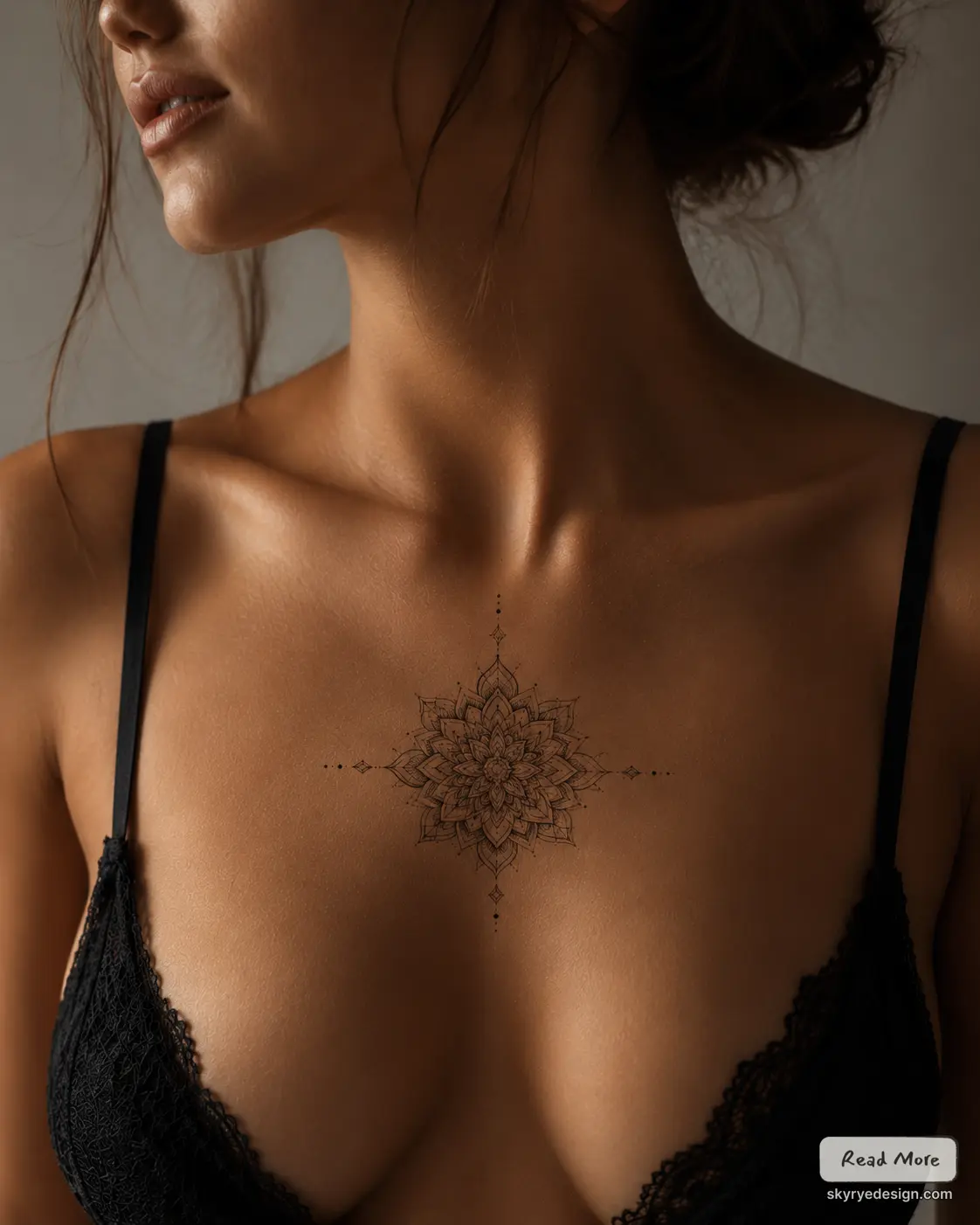
A good tattoo drawing is readable, balanced, and built for the body. Clear focal point. A silhouette that holds from a few feet away. Line weights that still make sense after the tattoo heals — because they will change, and designs that don’t account for that age badly.
Tiny details can look stunning on paper and be gone within a year. Too small, wrong placement, too much movement in the skin underneath. All three will do it.
Before committing to a design, run three checks: can you recognize it in one second, does the shape fit the placement, does every detail support the main idea rather than compete with it? That last one is harder than it sounds. A mandala needs clean symmetry or the whole thing reads as noise. A flower needs graceful rhythm — not just petals arranged in a rough circle and called done. An animal portrait is almost entirely value control; get that wrong and you lose the face. Watercolor style needs soft edges, not hard outlines trying to look loose. And a sleeve needs to flow around the arm. The moment it starts looking like a flat sticker wrapped around a cylinder, the design wasn’t drawn for a body — it was drawn for a page.
Tattoo drawing reference guide
| Design idea | Best placement | Drawing focus | Beginner warning |
| Geometric mandala | Forearm, sternum, back, thigh | Symmetry, spacing, repeated shapes | Do not make the center too busy. |
| Minimalist line flower | Wrist, ankle, inner arm, collarbone | Continuous line flow and negative space | Thin lines need confident spacing. |
| Realistic animal portrait | Upper arm, chest, back, thigh | Eyes, fur direction, values | Do not shrink realism too much. |
| Watercolor galaxy | Forearm, shoulder, calf, ribs | Color wash, contrast, star placement | Soft color still needs a clear ink anchor. |
| Tribal sleeve | Shoulder to forearm | Body flow, bold black shapes | Research cultural origins before using motifs. |
1) Geometric mandala tattoo drawing
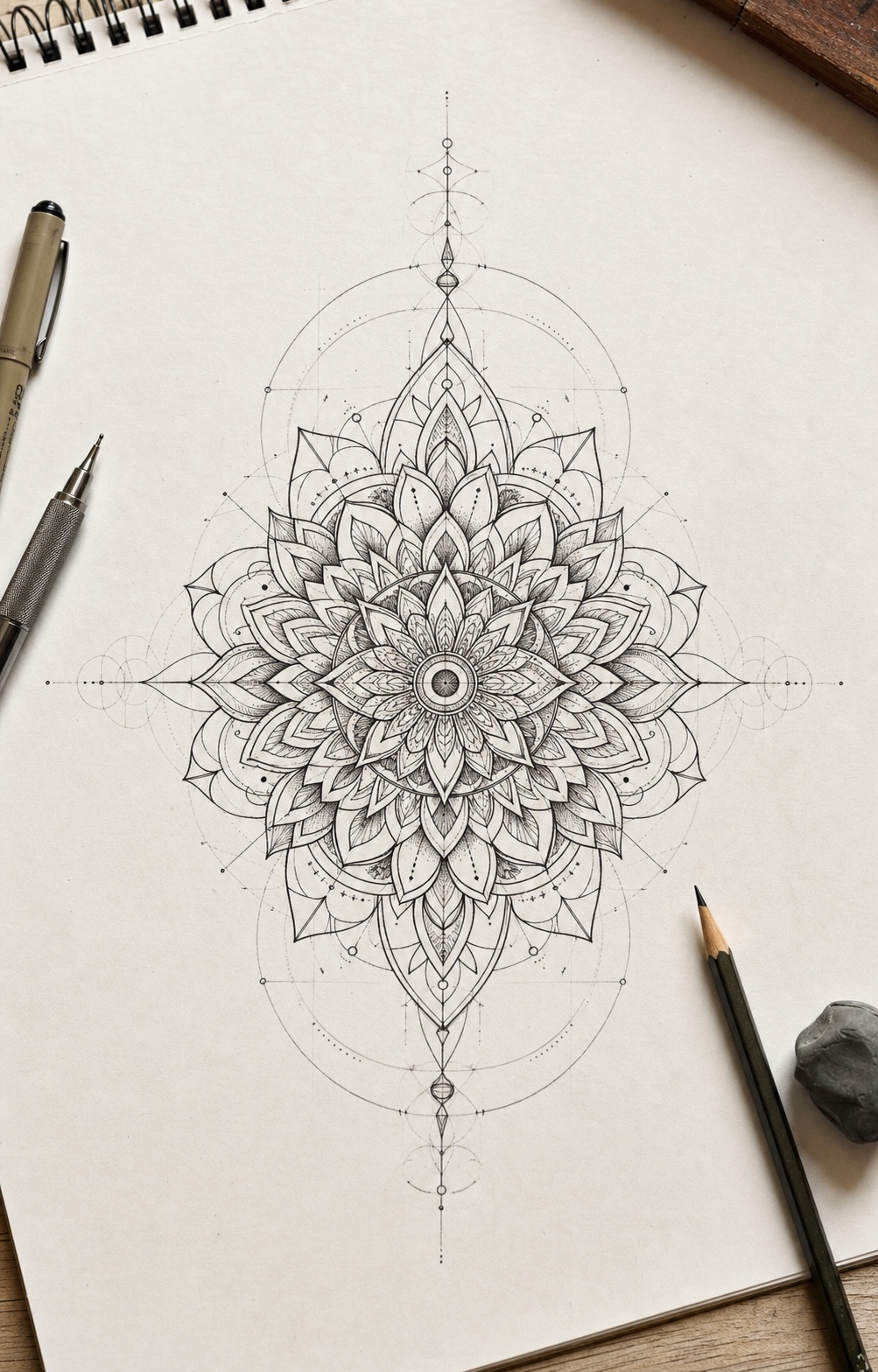
A geometric mandala tattoo drawing works because the viewer can feel the order instantly. Start with a center point, build the design in rings, and keep checking that the petal shapes, dots, and triangles repeat with the same rhythm. I would sketch this lightly with a compass or circle template first, then ink only after the spacing feels calm.
For tattoo use, leave more open skin than you think you need. Dense mandala details can blur together if the design is squeezed onto a small wrist or ankle. Forearms, thighs, backs, and sternum placements usually give this style enough room to breathe.
- Best for: balanced, ornamental, meditative designs.
- Sketch cue: check the outer silhouette before adding inner decoration.
- Line note: use a heavier outline on the main petals and lighter detail lines inside.
2) Minimalist line art flower tattoo drawing
A minimalist flower drawing looks simple, but the line has to be intentional. One stiff curve can make the whole tattoo feel awkward. Start with the gesture of the stem, then place the flower head so the design has a natural lean instead of standing straight like a diagram.
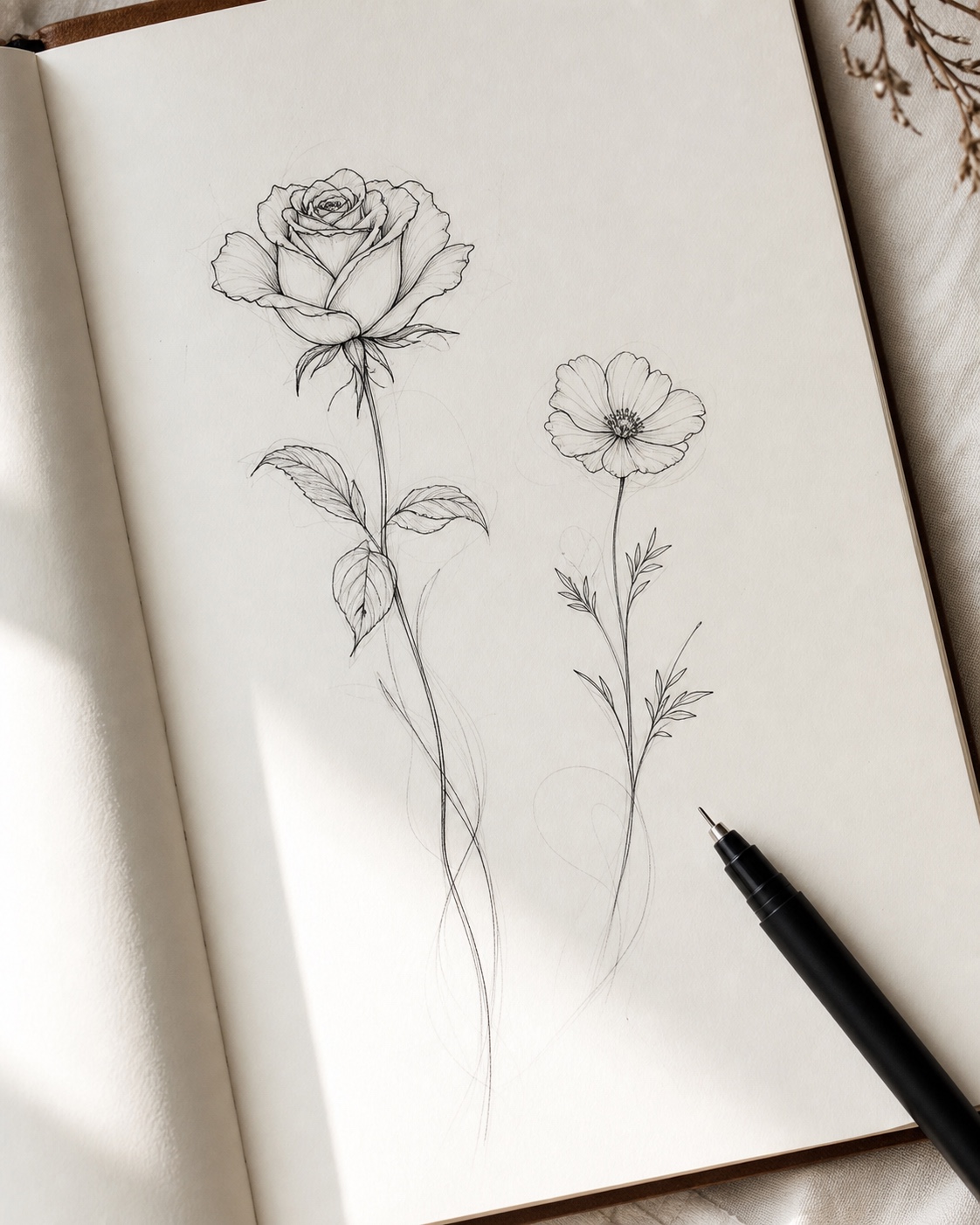
Rose, daisy, poppy, lily, and wildflower sketches all work in this style. Keep the petals open and avoid cramming tiny veins into every leaf. If the tattoo will sit on the wrist, ankle, or collarbone, negative space matters more than detail.
- Best for: subtle tattoos, first tattoos, and small placements.
- Sketch cue: draw the stem in one confident motion before building petals.
- Line note: vary the pressure slightly so the drawing does not look like clip art.
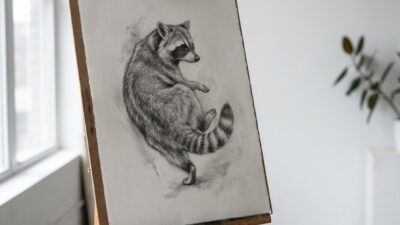
3) Realistic animal portrait tattoo drawing
Realistic animal portraits depend on value more than outline. The eyes, nose, and main shadow shapes must be right before the fur texture starts. When I sketch realism, I block the dark masses first, because soft fur marks cannot fix a face where the skull structure is wrong.
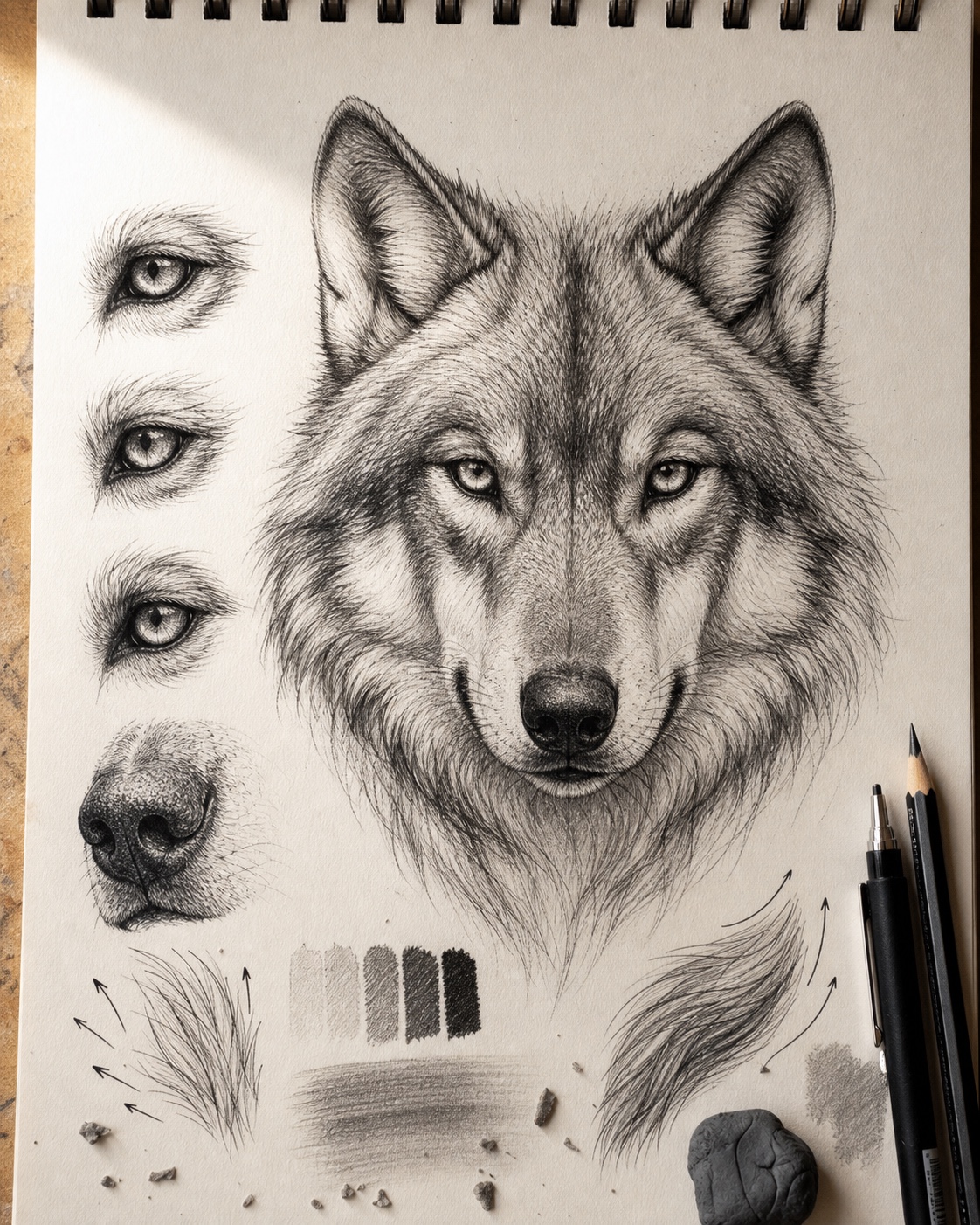
Pets, wolves, lions, tigers, birds, and horses all need enough size for the details to survive. A tiny realistic portrait usually turns muddy. Ask for a placement with room for soft gradients, especially if the design includes whiskers, feathers, or pale fur.
- Best for: memorial tattoos, wildlife pieces, and detailed black-and-gray work.
- Sketch cue: compare the angle of both eyes before drawing fur.
- Line note: let the values carry the form; avoid outlining every hair.
4) Watercolor galaxy tattoo drawing
A watercolor galaxy tattoo drawing needs a strong ink structure under the color. Without a moon, planet, star map, or clean silhouette, the wash can look like a random stain. Plan the black elements first, then let the blues, purples, pinks, and soft edges move around them.
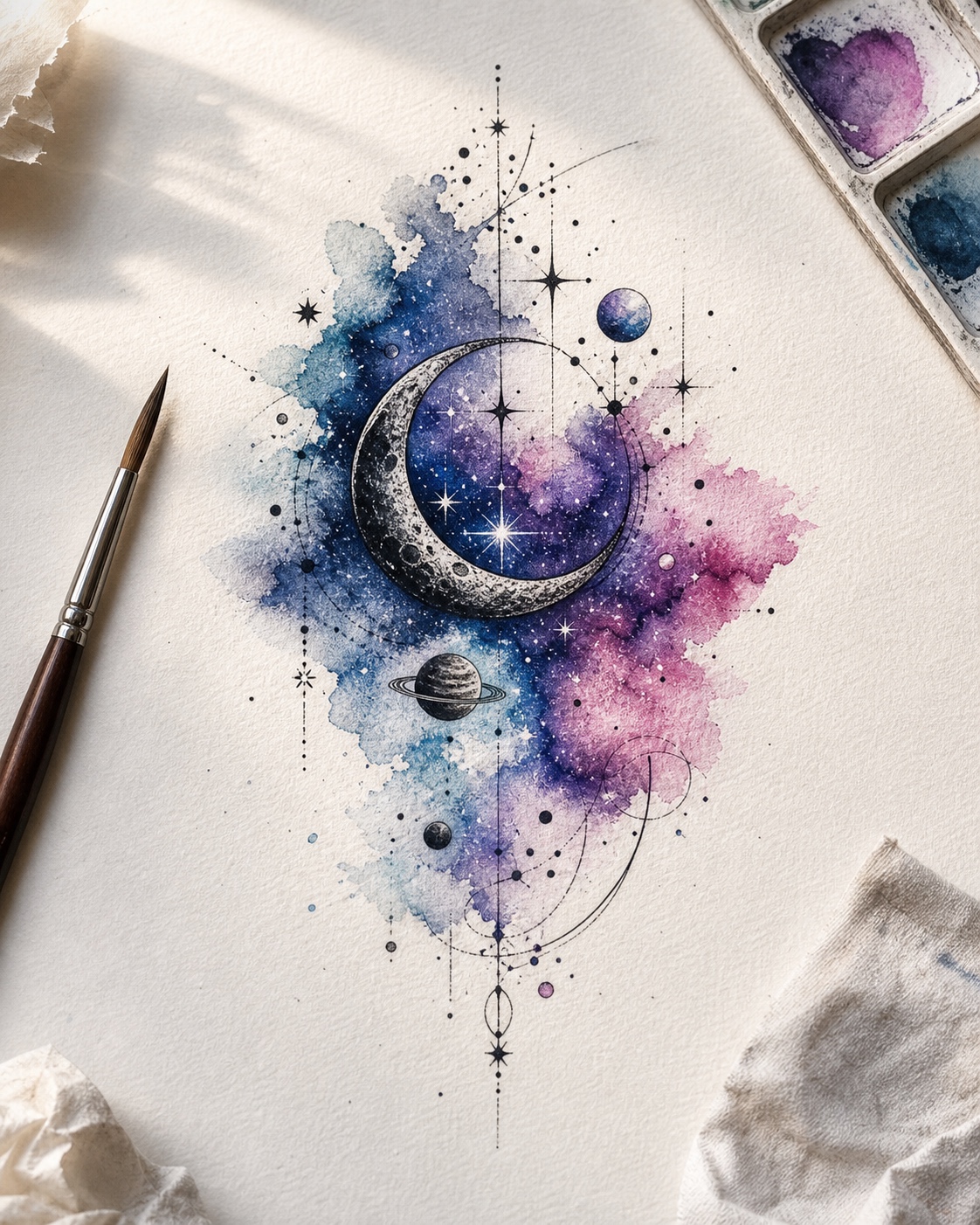
This style works well when the color fades outward and the darkest ink sits near the focal point. If you want stars or planets, keep them uneven in size. Perfectly even dots can make the design feel decorative instead of atmospheric.
- Best for: cosmic tattoos, dreamy color pieces, and soft abstract designs.
- Sketch cue: make one clear focal point before adding splashes.
- Line note: pair soft watercolor edges with a few crisp black accents.
5) Tribal sleeve tattoo drawing
A tribal sleeve drawing is mostly about flow. The shapes should move with the shoulder, bicep, elbow, and forearm instead of sitting flat across them. Start with the largest black shapes, then carve negative space through the design so the arm still has movement.
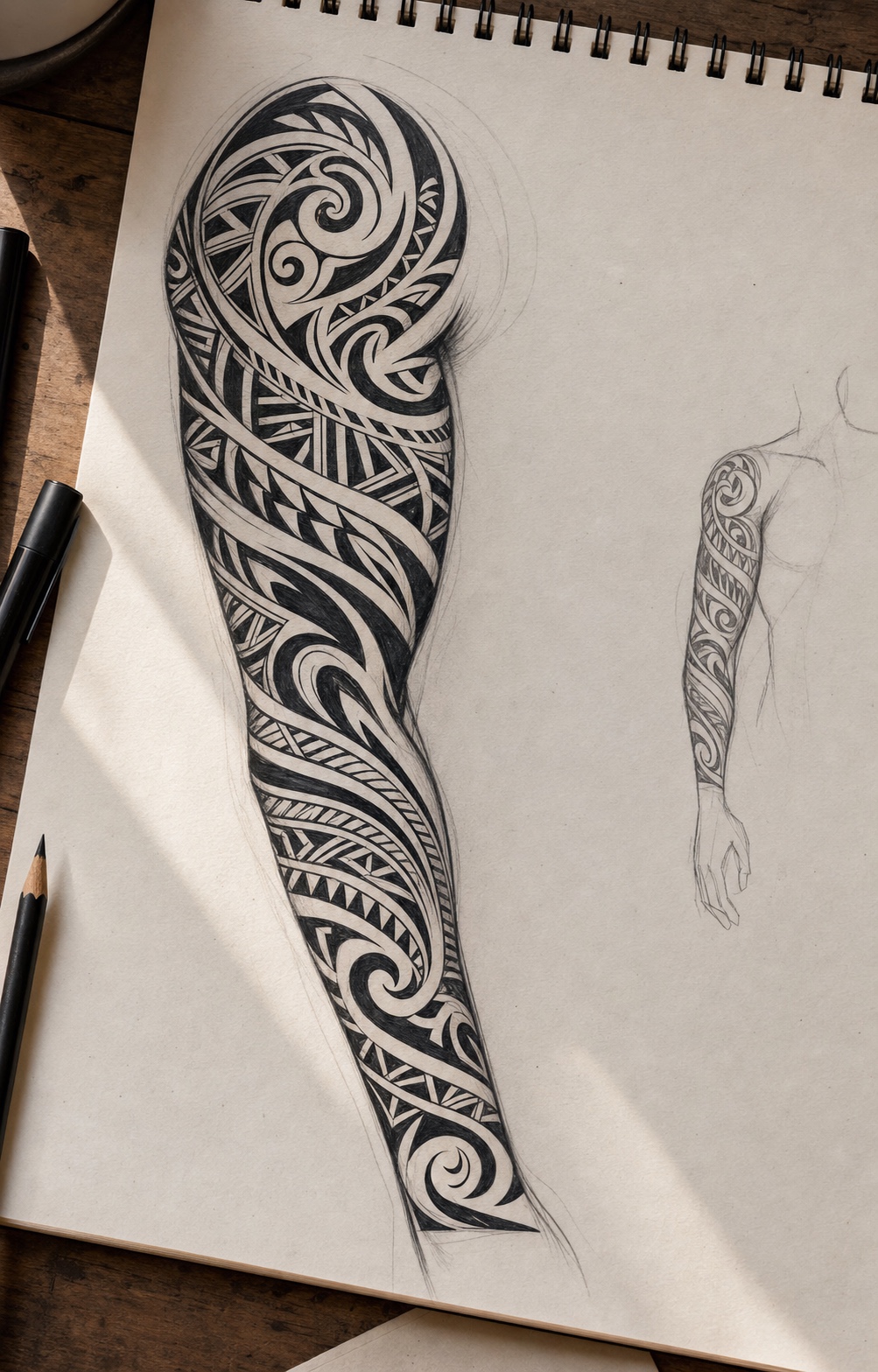
This is also the section where research matters. Many tribal and Polynesian-inspired motifs have cultural meaning, family meaning, or sacred use. If you want that visual language, work with an artist who understands the tradition instead of lifting patterns from a random image board.
- Best for: bold sleeves, arm bands, and high-contrast blackwork.
- Sketch cue: draw the arm shape first, then wrap the pattern around it.
- Line note: keep black masses clean and avoid tiny filler that weakens the flow.
Tattoo design principles to check before you commit
Tattoo drawings are different from ordinary sketchbook drawings because they have to survive scale, skin texture, movement, healing, and time. A design that looks beautiful at full-page size can fail as a two-inch tattoo. Before you commit, print the drawing at the real size and look at it from across the room.
- Silhouette: the main shape should be recognizable without shading.
- Scale: delicate detail needs enough room to heal cleanly.
- Placement: curved areas change how straight lines and circles look.
- Contrast: black-and-gray designs need a clear value range.
- Meaning: symbols, cultural motifs, names, and dates deserve extra checking.
History of tattoo art
Tattooing is old enough that it should never be treated as a passing trend. Otzi the Iceman, who lived around 3300 BCE, had preserved tattoos on his body, and many cultures have used tattooing for status, protection, ritual, beauty, punishment, or memory. That history does not mean every modern design needs to be heavy with symbolism, but it does mean the marks deserve care.
Symbolism in tattoo designs
Symbolism works best when it is specific. A rose can mean love, grief, beauty, or family, depending on how it is drawn and where it sits. An animal portrait can be a memorial, a personality marker, or a connection to nature. Before choosing a symbol, write down the meaning in one plain sentence. If the sentence feels vague, the drawing probably needs a sharper idea.
How to choose the right tattoo drawing style
Choose the style by matching three things: your subject, the placement, and the amount of detail you can realistically support. Minimal line art is better for small quiet placements. Realism needs size. Mandalas need symmetry. Watercolor needs color contrast. Sleeve designs need movement across the body.
Traditional tattoo styles usually rely on bold lines, readable silhouettes, and color blocks. Modern styles can be softer or more experimental, but they still need structure. If you are unsure, ask the artist to show the design as a stencil and as a shaded version. The stencil tells you whether the tattoo drawing can stand on its own.
Common tattoo drawing mistakes
- Making the design too small for the amount of detail.
- Choosing a placement before testing the actual shape on that body area.
- Using thin lines everywhere with no hierarchy.
- Adding color before the black structure is clear.
- Copying cultural patterns without understanding their context.
- Approving a drawing that only looks good as a close-up photo.
Tattoo design sketches often benefit from clearer symbol research and stronger value contrast For a deeper visual breakdown, see this guide to Chicano art style references.
FAQ about tattoo drawing
Q: What is a tattoo drawing?
A: A tattoo drawing is the artwork or sketch used to plan a tattoo before it becomes a stencil or final piece on skin. It can be a pencil sketch, ink drawing, digital concept, or cleaned-up flash design. The important part is that it shows the subject, placement, scale, line weight, and main value pattern clearly enough for a tattoo artist to adapt it safely.
Q: How do I start a tattoo drawing as a beginner?
A: Start with the simplest readable version of the idea. Draw the silhouette first, then add the focal point, then test the design at the size you actually want. Use pencil for the rough sketch and a fineliner for the cleaned version. Do not start with tiny decoration. If the big shape is weak, the details will only make the tattoo harder to read.
Q: What tattoo drawing style is easiest to sketch?
A: Minimalist line art is usually the easiest style to begin with because it uses fewer values and less texture. That does not mean it is careless. The curves still need rhythm, and the spacing needs to feel deliberate. Simple flowers, small symbols, stars, moons, and clean botanical shapes are good beginner subjects.
Q: Can I bring my own tattoo drawing to an artist?
A: Yes, you can bring your own tattoo drawing to an artist, but expect them to adjust it. A good artist may simplify details, change line weight, resize parts, or reshape the design so it works better as a tattoo. Treat your drawing as a strong brief, not a locked file that must be copied exactly.
Q: How detailed should a tattoo drawing be?
A: The detail level depends on size, placement, and style. Realistic portraits need more space, while small wrist or ankle tattoos need cleaner shapes and fewer tiny marks. As a quick test, shrink the drawing to the final tattoo size. If the important details disappear on paper, they will probably disappear faster on skin.
Q: Are tattoo drawing references okay to use?
A: Tattoo drawing references are useful for studying composition, line weight, shading, and placement. They should not be copied directly from another artist or client without permission. Use references to understand the design problem, then redraw the idea with your own proportions, symbols, and placement decisions.
Q: What should I ask before choosing a tattoo drawing?
A: Ask where it will sit, how large it needs to be, whether the details will age well, and what the symbol means to you. Also ask whether the artist has experience with that style. A mandala artist, a realism artist, and a watercolor artist may all solve the same tattoo drawing in very different ways.
Sources and further reading
- South Tyrol Museum of Archaeology on Otzi tattoos
- American Academy of Dermatology tattoo aftercare basics
- Sky Rye Design guide to popular tattoo styles
For more starting points, browse the full tattoo ideas hub on Sky Rye Design. It is a useful next stop if you want to compare placements, meanings, and visual styles before narrowing your sketch.
Sketches are useful before any appointment; this guide to tattoo ideas for women before you sketch can help you test scale and placement.
If you are sketching before booking, try a phoenix tattoo sketch idea to test wing shape, tail flow, flames, and body placement.
If you are sketching a design that should glow only under blacklight, start with a simple UV tattoo sketch idea so the shape stays readable after the ink heals.
- 1.6Kshares
- Facebook0
- Pinterest1.6K
- Twitter1
- Reddit0