My first serious attempt at a sunflower drawing lasted forty minutes and produced something that looked more like a cheerful cartoon than a plant. The petals were evenly spaced — perfectly, mathematically even — arranged around a brown circle filled with random scribble. It was recognisable as a sunflower the way a child’s drawing of a house is recognisable as a house: you understand what it’s meant to be, but nothing about it suggests the actual object.
The problem was that I’d been drawing my idea of a sunflower rather than a sunflower. The even petal spacing was wrong — real sunflowers have petals at irregular angles and varying sizes. The flat brown circle was wrong — the disk is a slightly domed, densely textured surface with a specific mathematical structure. The petals themselves were wrong — each one curves from its base, angles slightly downward, and has a character that varies depending on where it sits in relation to the viewer. None of this was in my drawing because I’d never looked carefully at an actual sunflower.
- Understanding the Sunflower Before You Draw It
- How to Draw a Sunflower: Six-Step Construction
- The Disk Center: The Most Common Failure Point
- Four Styles of Sunflower Drawing
- Six Common Sunflower Drawing Mistakes
- Materials for Sunflower Drawing
- FAQ: Sunflower Drawing
- Cara Mewarnai Bunga Matahari — Step by Step
What changed everything was fifteen minutes with a real sunflower from a market stall and a sketchbook. Not drawing it — just looking at it. The structure I noticed in those fifteen minutes transformed every sunflower drawing I’ve made since. This guide passes on what I saw: the biological structure that makes sunflowers draw the way they do, a six-step construction process that produces convincing results from the first attempt, the specific challenge of the disk center and how the Fibonacci spiral solves it, four style variations with their techniques, and the common mistakes that keep sunflower drawings reading as generic rather than real.
Understanding the Sunflower Before You Draw It
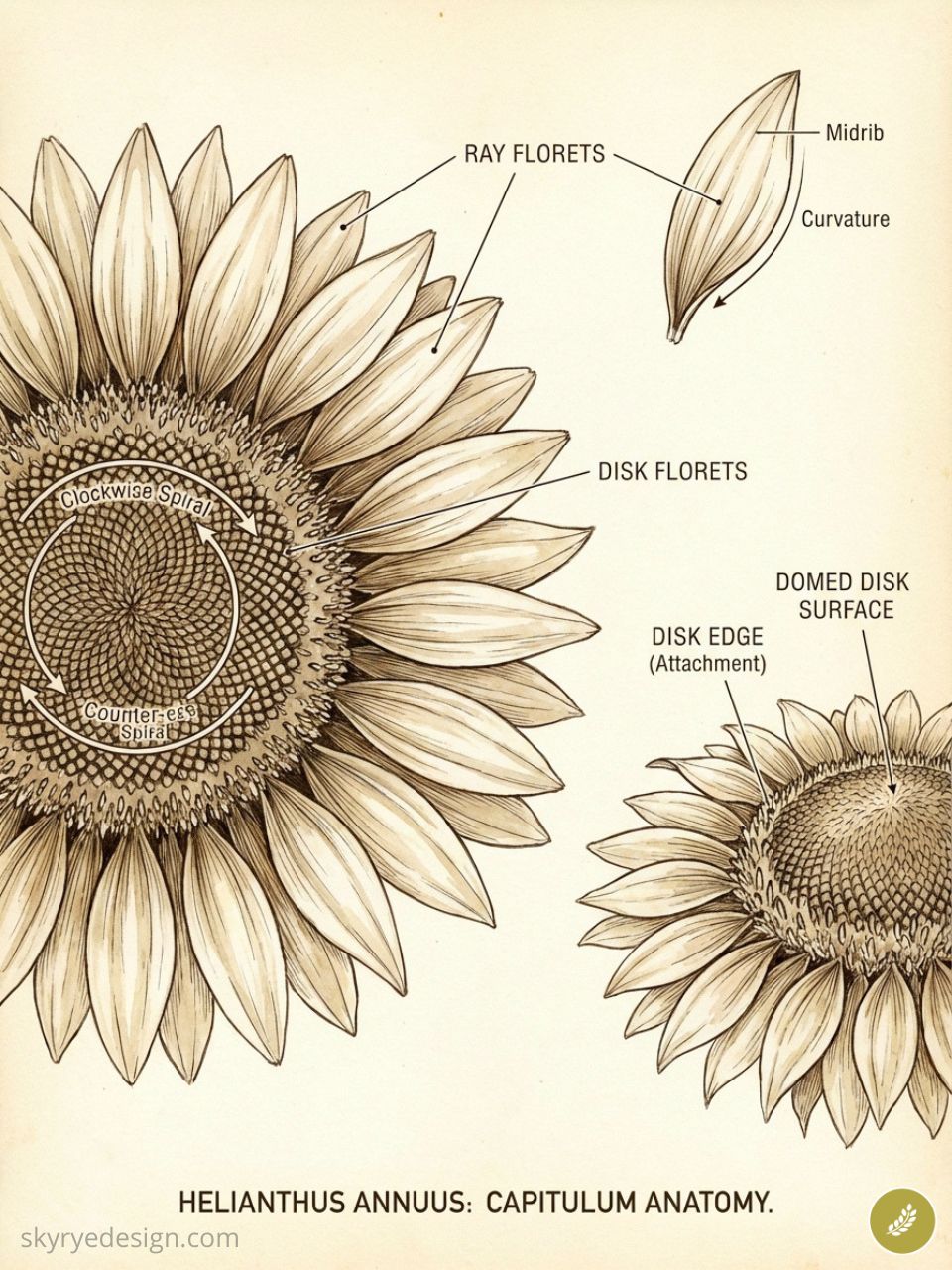
Helianthus annuus — the common sunflower — is not a single flower. It is a composite flower head containing hundreds of individual flowers called florets, organised into two distinct zones that you need to understand separately before drawing them. Getting this biological distinction right is what makes the difference between a sunflower drawing that looks studied and one that looks generic.
Ray Florets: What Everyone Calls the Petals
The yellow structures radiating from the disk are not botanically petals — they are ray florets: individual sterile flowers that have been modified into elongated, petal-like structures by evolution to attract pollinators. Structurally, each ray floret is a single modified flower fused into a flat, elongated form. They attach at the outer edge of the disk and angle slightly downward from that attachment point, which is why looking at a sunflower from a slightly elevated angle shows the underside of the outer petals rather than their faces.
For drawing, the critical observation: ray florets are not flat. They have a midrib — a subtle central vein running from base to tip — and the petal surface curves slightly around this midrib, giving each petal a gentle curvature rather than the flat surface a beginner typically draws. The tip of each ray floret is notched or slightly wavy, not cleanly pointed. The petal is narrower at the base (where it attaches to the disk) and wider toward the middle before tapering to its tip.
Disk Florets: The Mathematical Center
The central brown or dark yellow disk contains hundreds of individual disk florets tightly packed in a specific mathematical arrangement. Each floret is a tiny tubular flower, and as they mature, they develop into the seeds. What makes this structure distinctive to draw is the arrangement: the florets follow two sets of interlocking logarithmic spirals — typically 34 spirals curving one direction and 55 curving the other. These numbers are adjacent terms in the Fibonacci sequence, and this arrangement is one of the most efficient packing patterns in nature.
You don’t need to draw every floret or map the spirals precisely. But understanding that the arrangement is spiral rather than random means you can suggest the texture with marks that curve in two directions simultaneously — which reads as structurally correct to the viewer even when it’s only approximated. Random marks don’t have this quality.
Leaves: Broader Than You Expect
Sunflower leaves are large, broadly heart-shaped or ovate, with serrated edges and a rough texture created by stiff surface hairs. The primary vein (midrib) is clearly visible, with secondary veins branching off it in a feathered pattern. Leaves attach alternately along the stem — not in pairs directly opposite each other. The stem itself is notably thick and hairy, with a rough surface texture that distinguishes it from the smooth stems of other garden flowers. Both the stem and leaf surface have a quality of slight roughness that can be suggested in drawing through texture marks rather than smooth outlines.
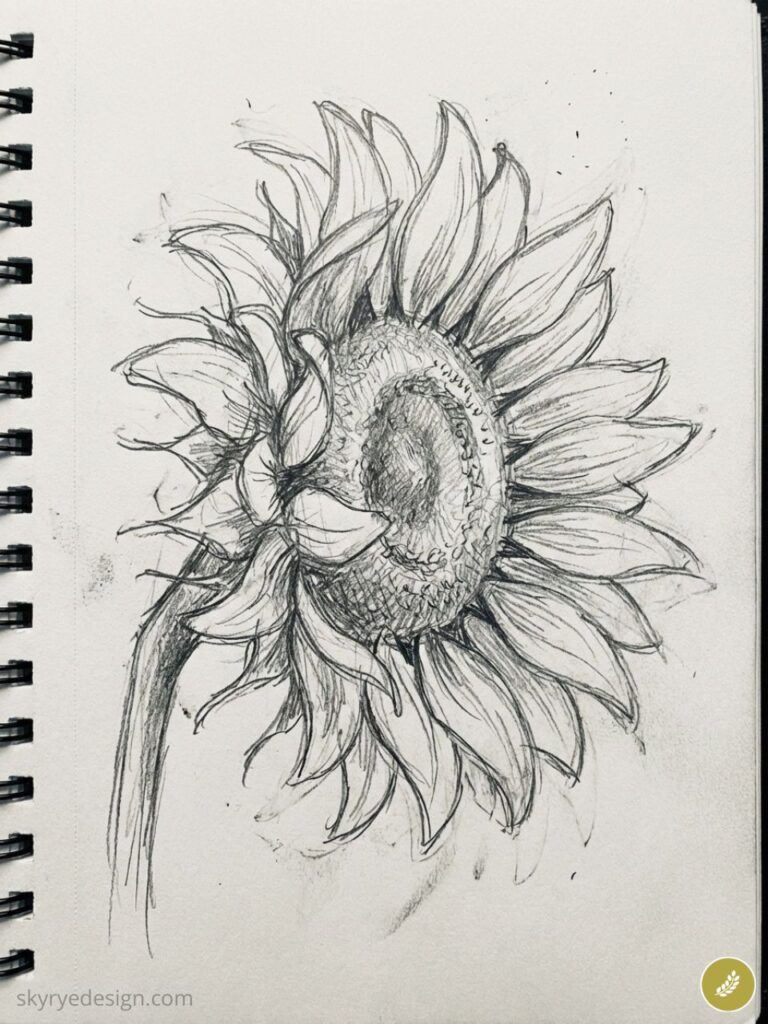
✏ Artist note: Before drawing anything, spend five minutes observing a real sunflower or a high-resolution photograph from multiple angles. Specifically look for: the curvature of individual ray florets, the domed quality of the disk surface, the variation in petal size around the head, and which petals partially conceal others. These observations — none of which are visible in the simplified diagrams of most drawing tutorials — are what make the difference between a drawing that looks studied and one that looks copied from a symbol.
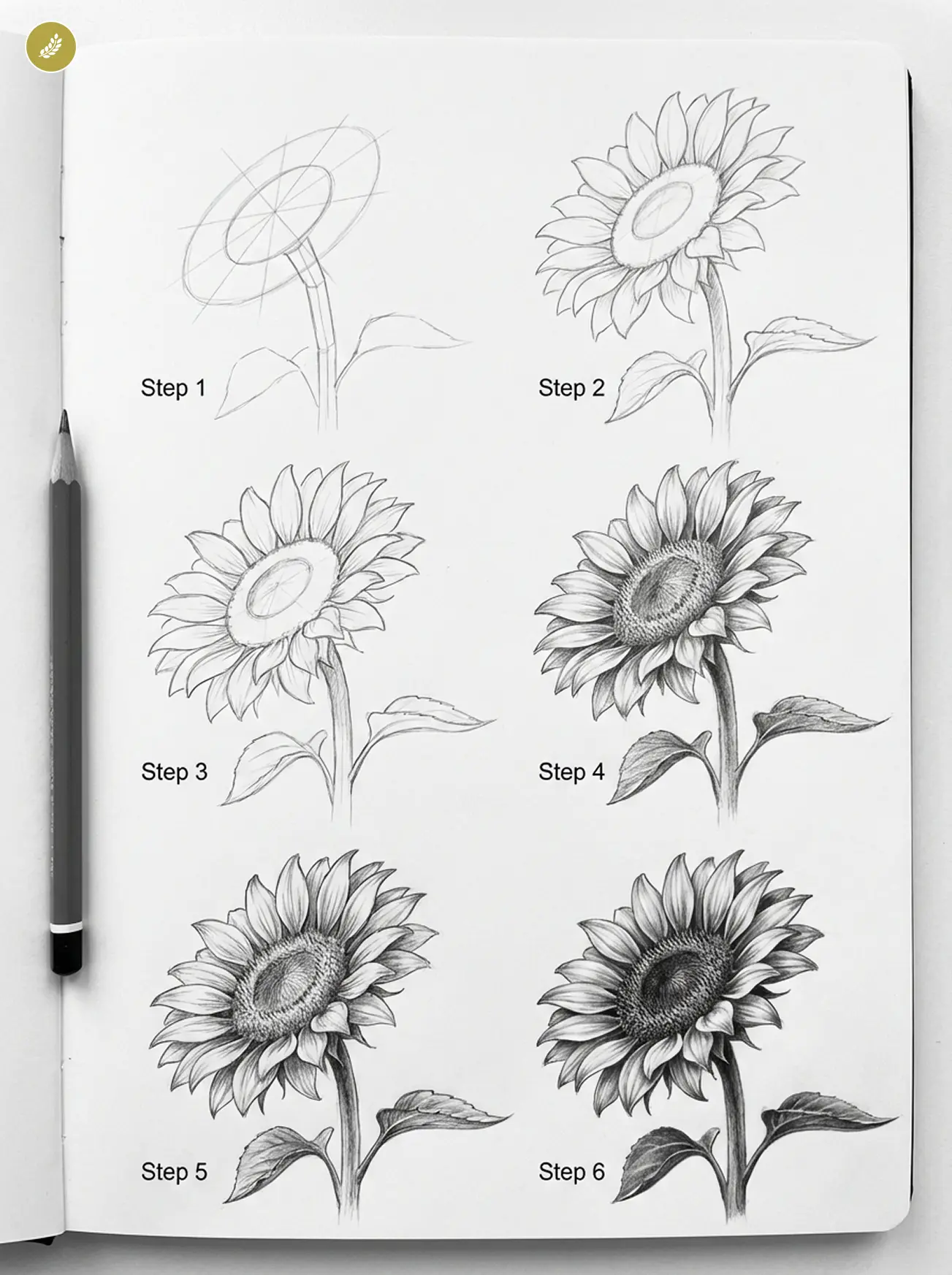
How to Draw a Sunflower: Six-Step Construction
This process builds the sunflower in the correct structural sequence — structure first, detail last. Every mark made in the early steps is a construction guide that gets erased or absorbed into the final drawing.
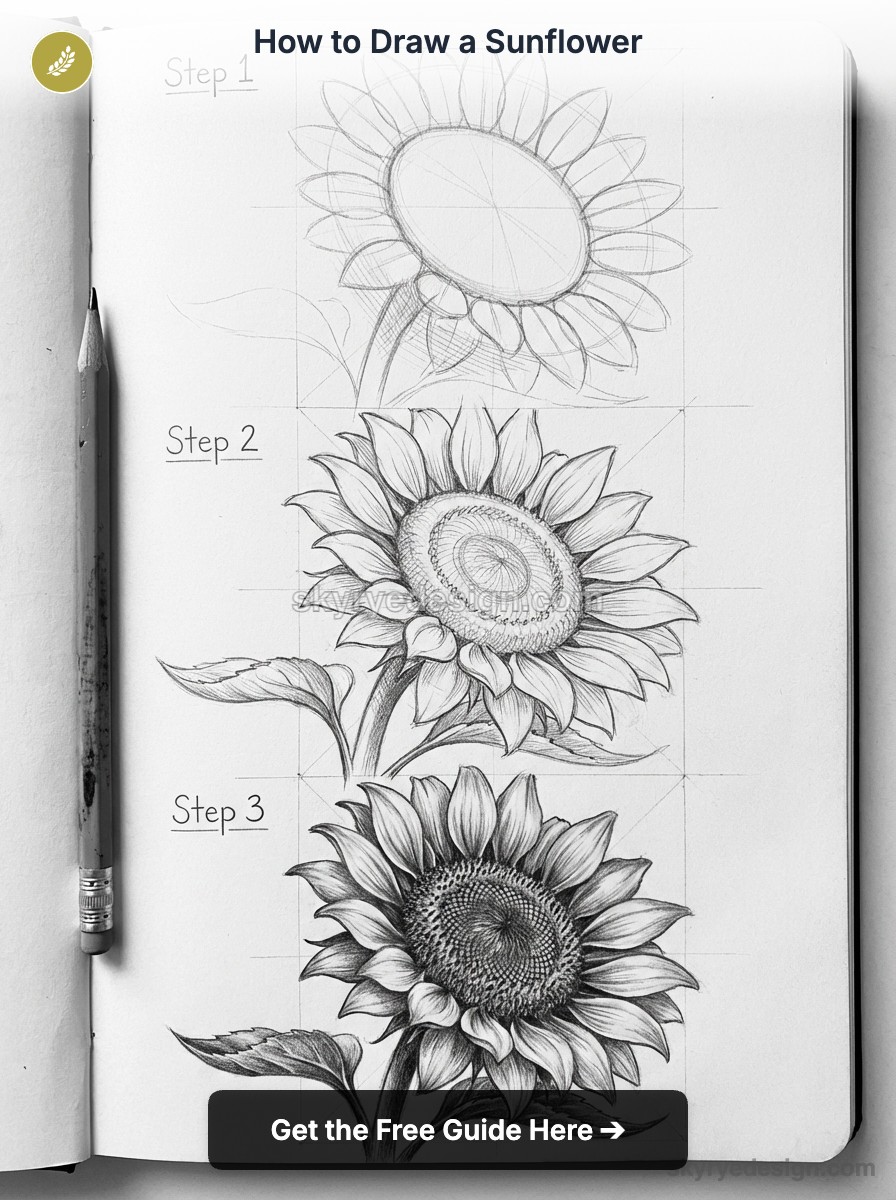
Step 1: Three Concentric Circles
Draw three circles with very light HB pencil pressure. The outer circle defines the full petal reach — this is your maximum diameter.
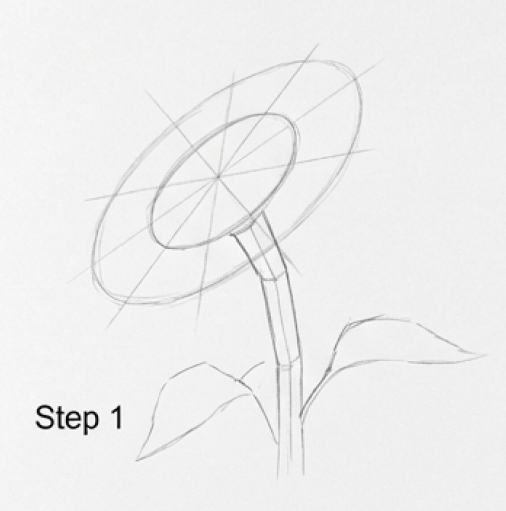
The middle circle, at approximately 65% of the outer circle’s radius, marks where the ray florets attach: petals start here and reach to the outer circle. The inner circle, at roughly one-third of the outer diameter, defines the disk — the central dark area. Keep all three circles lightly drawn; they’re guides, not final lines. The proportions matter: if the inner circle is too large, the petals will be too short and the flower will look stunted; too small and the petals will be too long relative to the disk, which reads as wrong against any reference.
Step 2: Ray Floret Placement — First Layer
Draw the first layer of ray florets as elongated oval shapes extending from the middle circle to the outer one. Crucially: make them irregular.
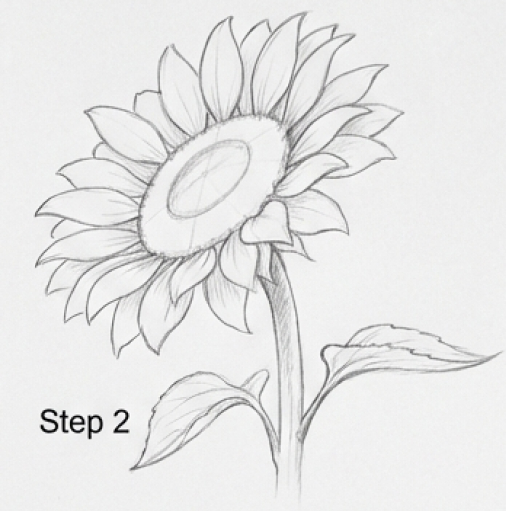
Vary their widths, their angles, their exact lengths. Some should be slightly wider in the middle than others. Some should angle slightly to one side rather than pointing directly outward. Leave deliberate gaps between some petals — the second layer will fill these. The common mistake at this step is making perfectly even, perfectly symmetrical petals at perfectly equal intervals. This produces the cartoon sunflower, not the real one. Real ray florets vary because they grew, not because they were designed.
Step 3: Second Layer — Behind and Between
Draw a second layer of ray florets visible behind and between the first layer. These are shorter — they don’t reach as far as the front-layer petals — and slightly narrower.
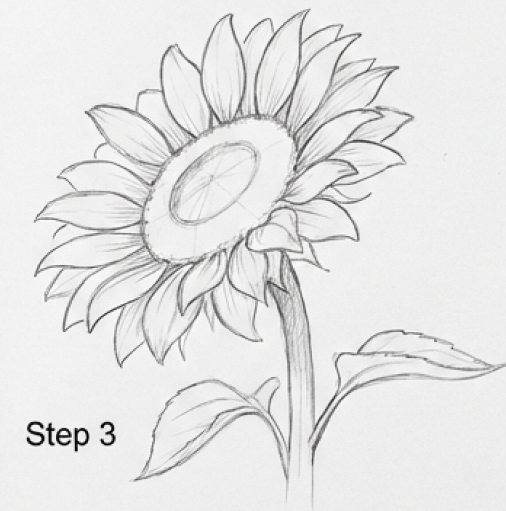
They appear between the gaps you left in the first layer, and partially behind the first-layer petals where they overlap. This overlapping is what gives the sunflower head its fullness and depth. The second-layer petals also angle slightly differently — they’re not perfectly aligned with the first layer’s axis, which adds to the sense that this is a three-dimensional flower head rather than a flat diagram.
Step 4: Disk Texture — The Spiral Center
The disk is the step that most beginners rush and most drawings fail at. Work from the outer edge of the disk inward.
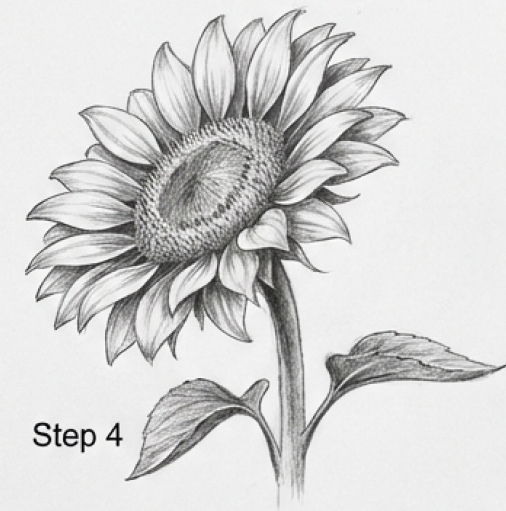
Using a 2B pencil, draw small C-shaped or reversed-C-shaped marks at the outer edge of the disk, packing them closely and letting them curve slightly to suggest the spiral structure. Move inward in concentric rings, making the marks progressively smaller and slightly more compressed as you approach the center. The outer rows of florets are the most developed and therefore largest; the center florets are smaller and more tightly packed. Don’t fill the disk with uniform hatching — this looks like shading, not texture. The marks need to be individual, varying slightly in their curvature direction.
Step 5: Stem and Leaves
Draw the stem as two slightly curved parallel lines — not a perfectly straight tube, but with the gentle S-curve of a real plant stem under the weight of a large flower head.
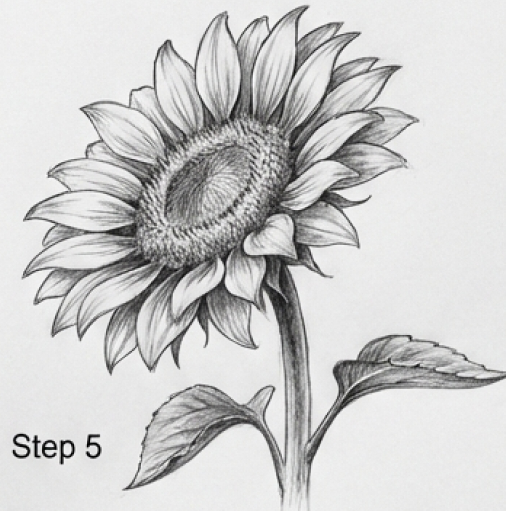
The stem should be notably thick: for a standard-sized sunflower drawing, the stem is wider than most beginners draw it. Add texture lines along the stem to suggest the hairy surface. Leaves attach alternately along the stem, each one large and broadly heart-shaped with the widest point in the middle third of the leaf. Add the midrib as a central line, secondary veins branching from it at approximately 45-degree angles, and a serrated edge along the leaf perimeter. The leaf surface is rough — add a light hatching texture rather than leaving it as a clean outline.
Step 6: Shading and Final Detail
Establish the light source direction first, then shade consistently. For a front-lit sunflower, the disk center is the darkest area, deepening toward the center with a 4B pencil.
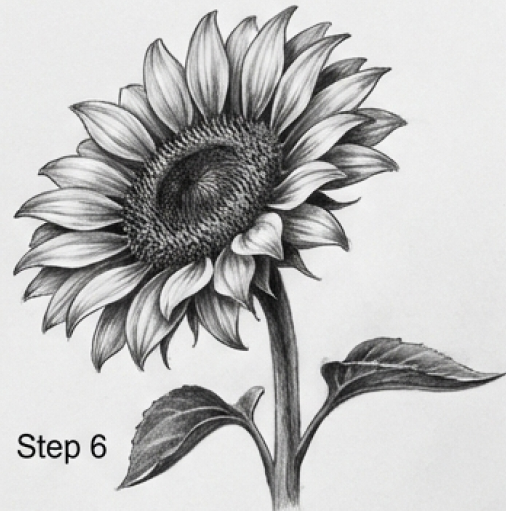
Individual ray florets are lighter at their tips (catching the most light) and darker at their bases (where the disk casts a shadow). The undersides of curving petals are slightly darker than their faces. Use your kneaded eraser to lift highlights along the midrib of each ray floret — this single step creates the three-dimensional curvature that transforms flat petal outlines into believable plant forms. The leaf midribs should be slightly lighter than the leaf surface around them.
✏ Artist note: The kneaded eraser is not just for mistakes — it’s a drawing tool for sunflowers specifically. After shading the ray florets with a 2B pencil, press the kneaded eraser gently along each petal’s midrib to lift a thin highlight strip. This creates the petal’s three-dimensional curvature more effectively than any amount of careful pencil shading. Similarly, press gently into the shaded disk to lift small irregular highlights from the floret tops. The eraser is creating light, not removing errors.
The Disk Center: The Most Common Failure Point
The disk is where most sunflower drawings reveal their weaknesses, and it’s the element that most separates a convincing sunflower drawing from a generic one. The problems are consistent: the disk is drawn too flat (it should be slightly domed), filled with random marks (it has a specific spiral structure), or made uniformly dark (it has tonal variation from lighter outer rings to deeper center).
The Fibonacci Spiral in Practice
You don’t need to calculate or precisely map the Fibonacci spirals — but understanding that they exist changes how you make marks. When filling the disk, your C-shaped floret marks should curve in two different directions simultaneously: some curving clockwise and some counterclockwise, creating the impression of two interlocking spiral systems.
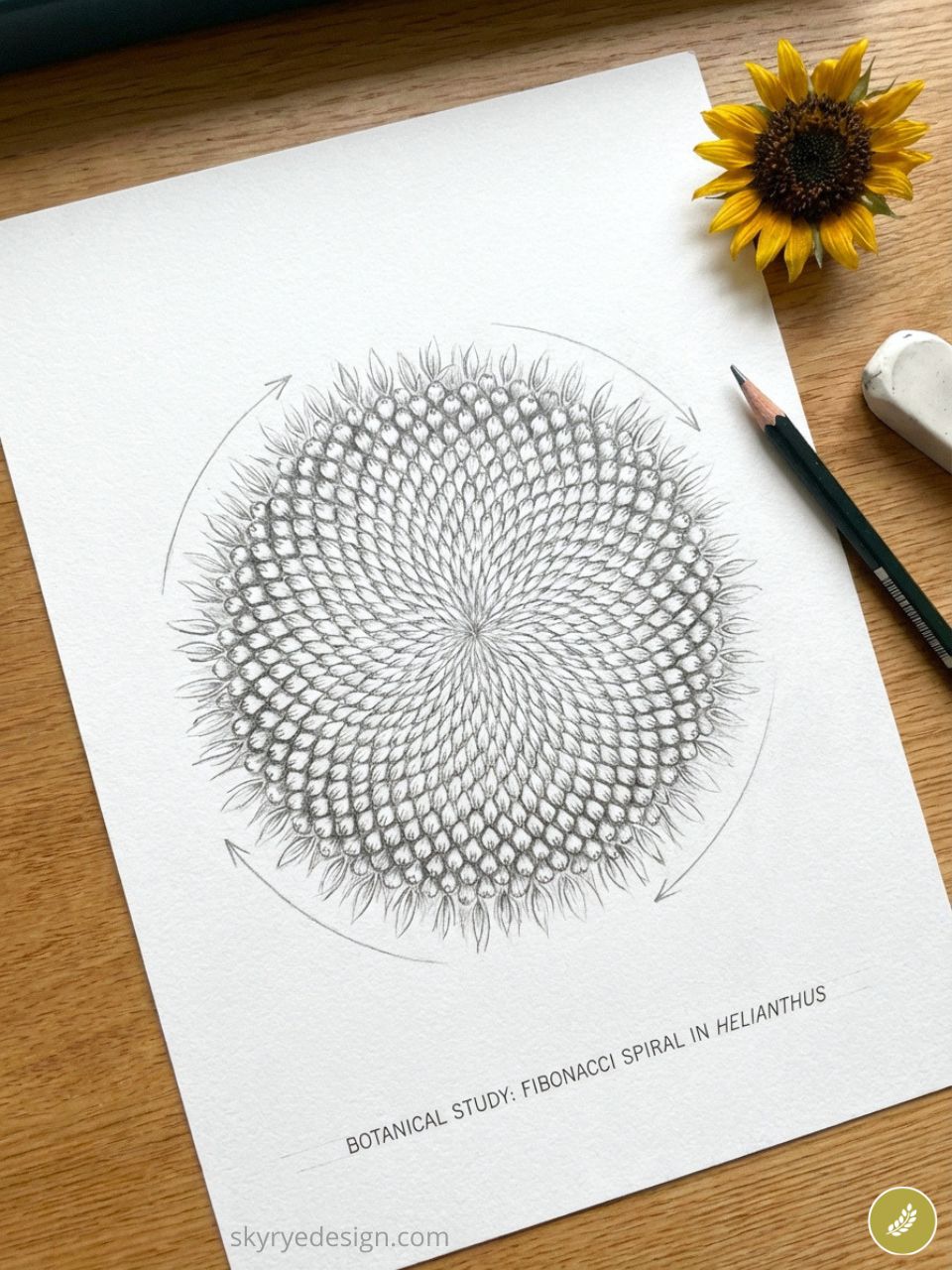
Even approximately suggesting this produces a disk that reads as structurally ordered rather than randomly textured. Compare the results of random marks versus marks that consistently curve in two general directions — the difference is immediately visible even to viewers who don’t know what the Fibonacci sequence is.
Tonal Gradient in the Disk
A sunflower disk is not uniformly dark. The outer ring of florets is the most mature and most developed — it catches the most light and reads as the lightest area of the disk. Moving toward the center, the florets are progressively less developed and more compressed, and the tone deepens. The very center of a mature sunflower disk is the darkest point. This radial tonal gradient — light at the edge, dark at the center — is what gives the disk its sense of depth and domed quality. Drawing it as uniformly dark produces a flat, coin-like disk. Drawing the gradient correctly produces a surface that appears to curve away from the viewer.
The Disk Edge and Petal Attachment
The junction between the disk and the ray florets is a specific area that most beginners blur past. The disk edge should show the small green bracts (modified leaves) that cup the underside of the flower head — visible as a slightly lighter, differently textured ring at the very outer edge of the disk where the petals attach. Drawing this transitional zone, even roughly, immediately improves the structural believability of the junction between disk and petals.


Four Styles of Sunflower Drawing
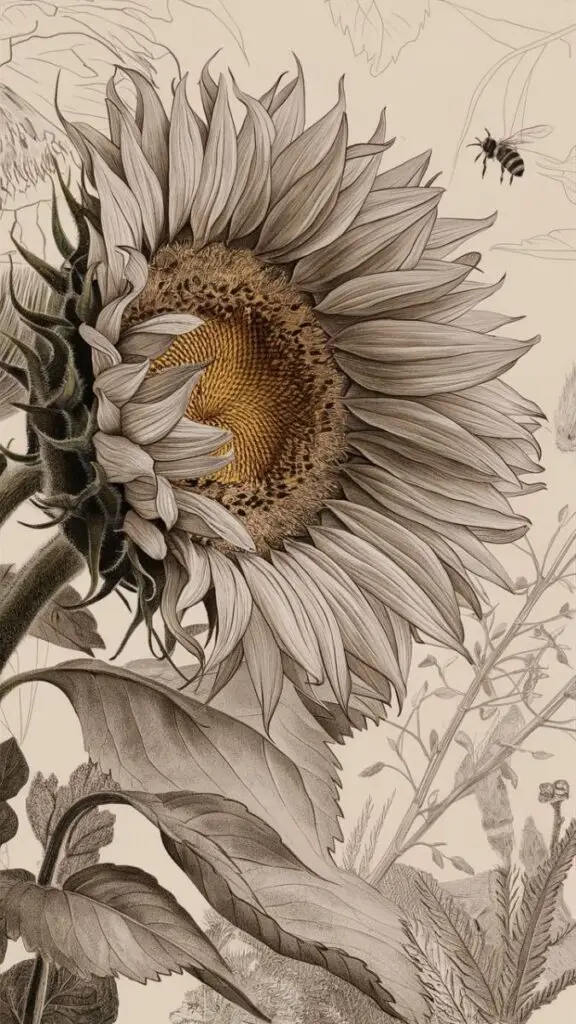
Botanical Illustration Style
Tools: HB-4B pencils, Strathmore Bristol smooth pad (~$18), kneaded eraser, 0.3mm ink liner for final outlines
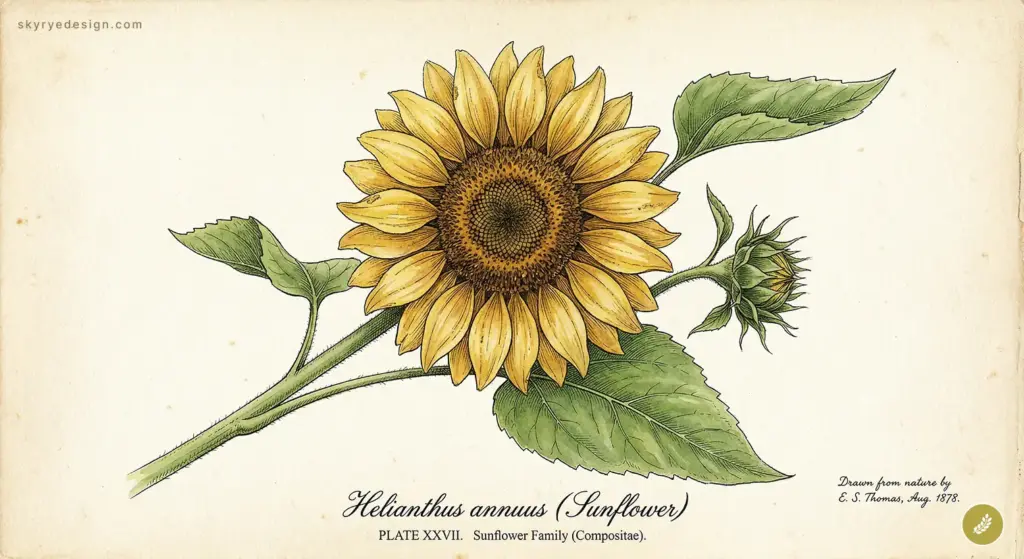
Key technique: Every element drawn from observation, not symbol. Disk florets individually suggested with spiral-aware C-marks. Petals show midrib, surface curvature, and variation. Leaf venation accurately mapped. Shading builds through multiple light pencil passes rather than heavy single strokes.

Reference: Wendy Hollender’s ‘Botanical Drawing in Color’ (~$28) — the most comprehensive reference for sunflower botanical technique. Vintage botanical prints (freely available in public domain archives) show historical approaches to disk and petal rendering.
Van Gogh Expressive Style
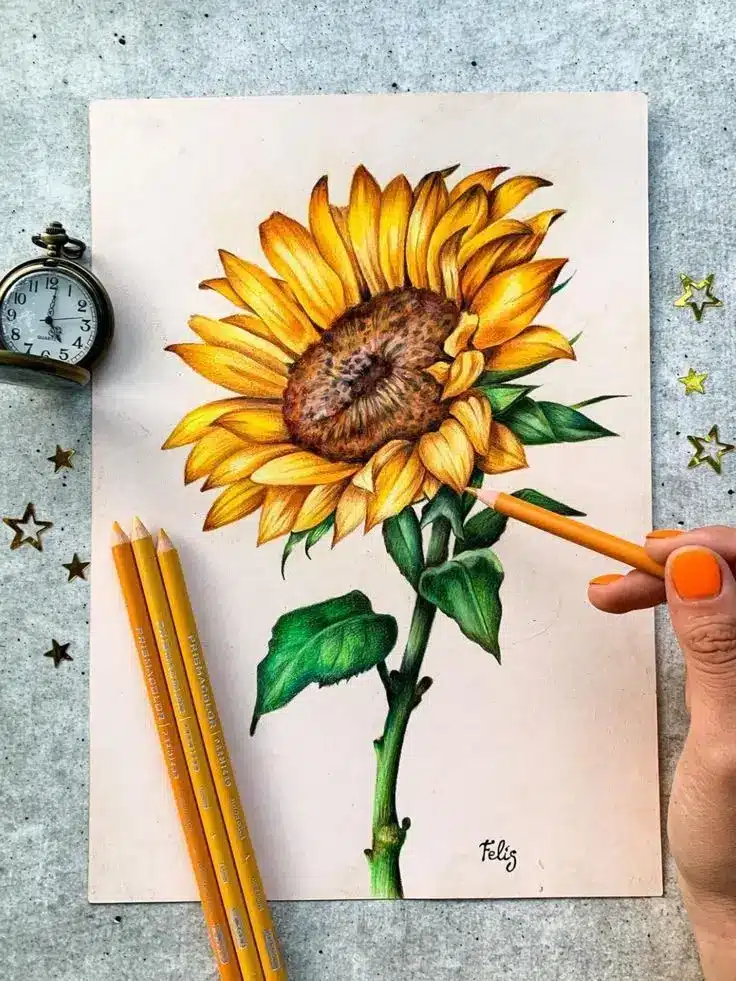
Tools: Oil pastels or coloured pencils (Faber-Castell Polychromos set ~$45), textured paper (Canson Mi-Teintes ~$1-2/sheet), short directional stroke technique
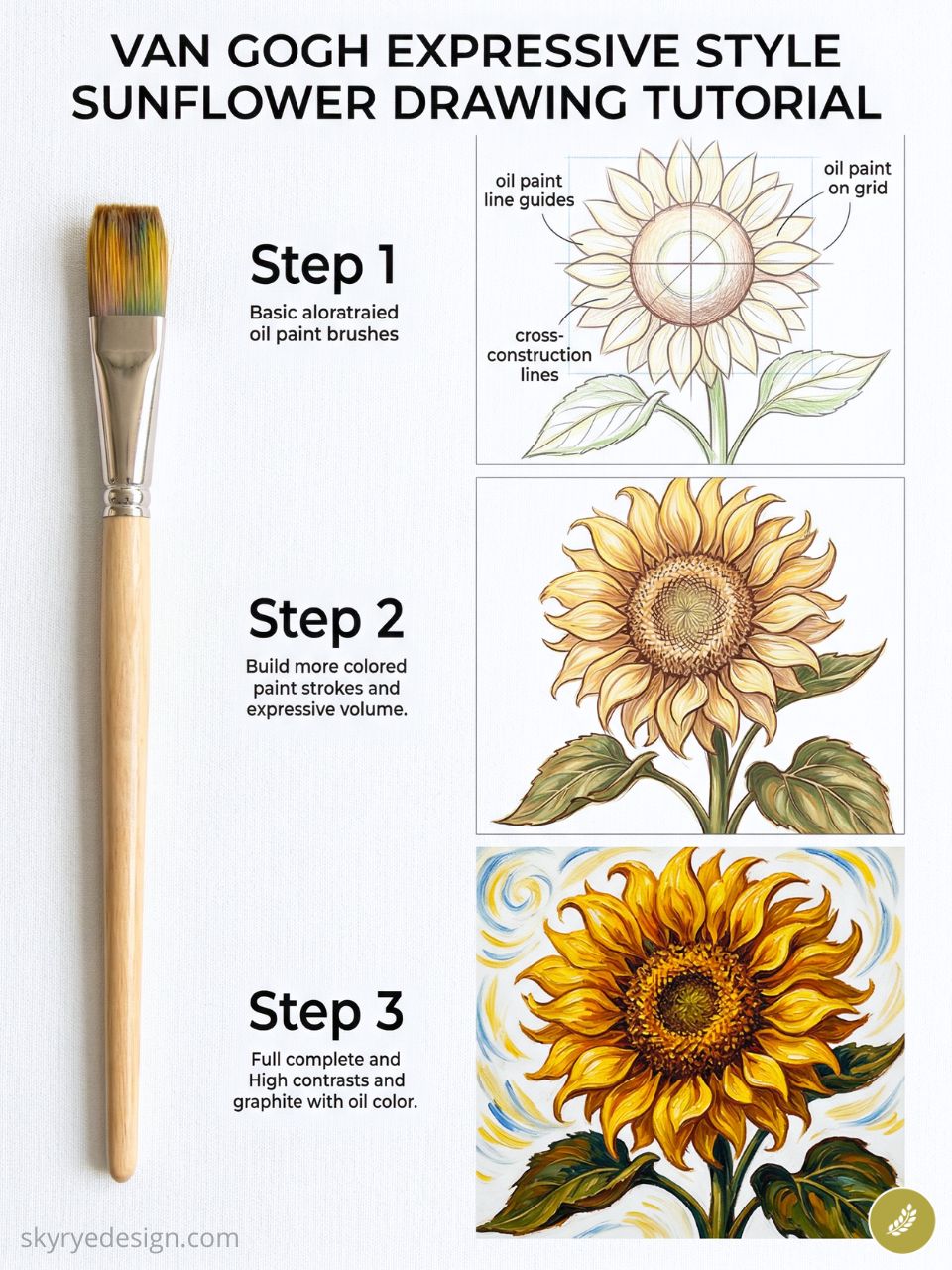
Key technique: Van Gogh’s series of sunflower paintings (1888-1889, National Gallery London) used short, thick, directional brushstrokes that follow the structural direction of each element — along the petal length, around the disk in spiral marks. In drawing, this translates to coloured pencil strokes that follow petal direction rather than filling areas uniformly. Pressure variation creates the colour intensity shifts between petal base and tip.
Reference: Van Gogh’s Sunflower Series: Sunflowers (August 1888), now in the National Gallery, London. His specific colour choices — cadmium yellow, yellow ochre, raw sienna — for petals at different stages of maturity are a complete colour theory lesson in themselves.
Watercolour Wash Style
Tools: Arches 140lb cold-press watercolour paper (~$20 for a small block), Winsor and Newton Cotman watercolours, round brushes sizes 4 and 8, pencil for under-drawing
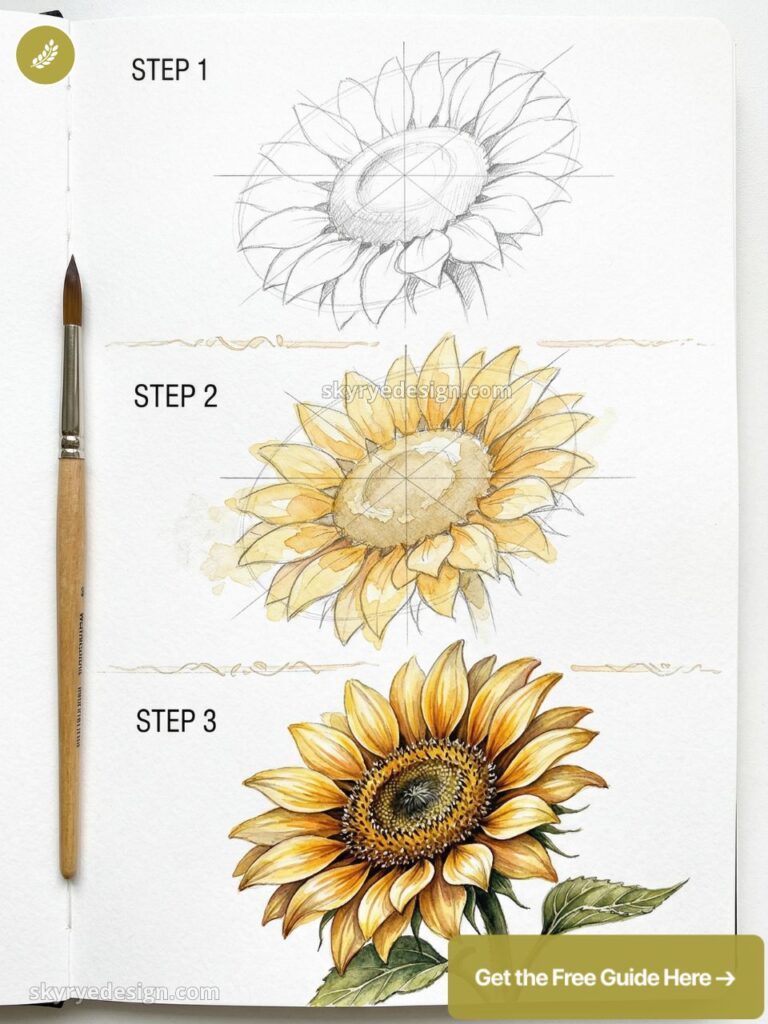
Key technique: Apply a pale Yellow Ochre wash as the petal base — wet on wet for soft edges, wet on dry for defined petal boundaries. Once dry, glaze Cadmium Yellow over highlighted petal areas. Disk built with Brown Madder and Burnt Sienna in multiple wet-on-dry layers, using a nearly dry brush for the final floret texture. Resist the temptation to overwork — watercolour sunflower petals look best when each petal is completed in one or two sessions rather than repeatedly reworked.
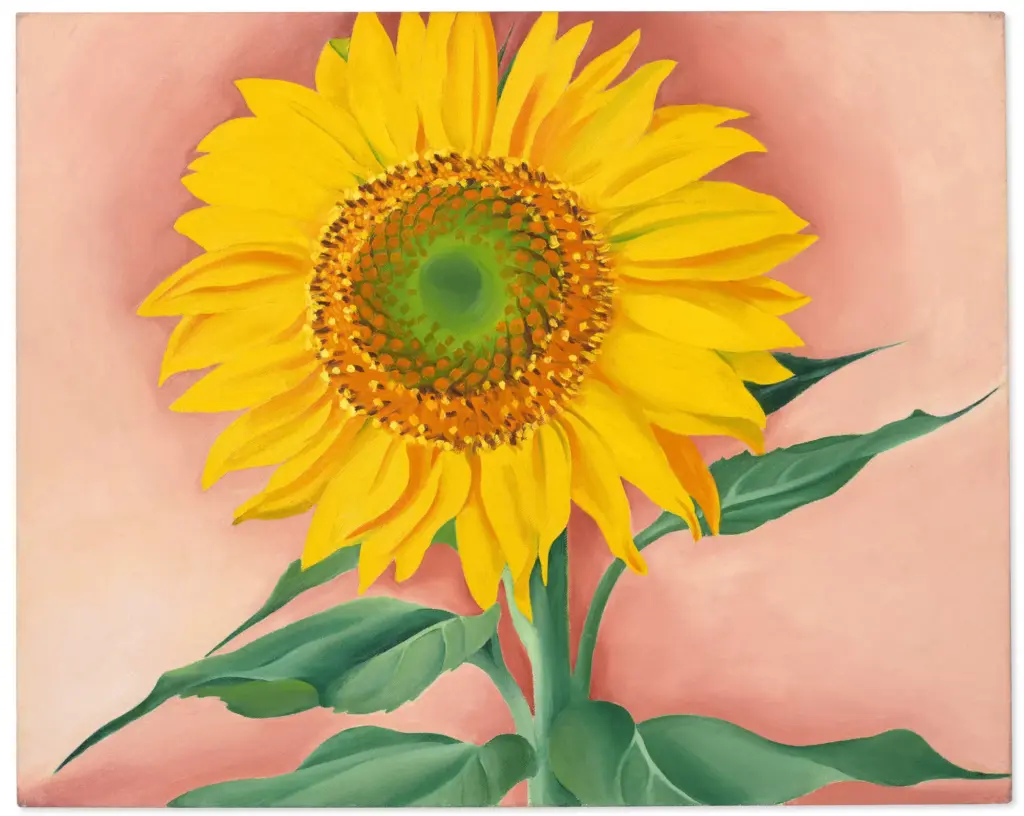
Reference: Georgia O’Keeffe’s botanical works offer a more abstracted approach to flower watercolour — less about accuracy, more about the essential form and the quality of light on the surface. Her approach to simplifying while maintaining botanical character is directly applicable to sunflower watercolour work.
Quick Sketch / Journaling Style
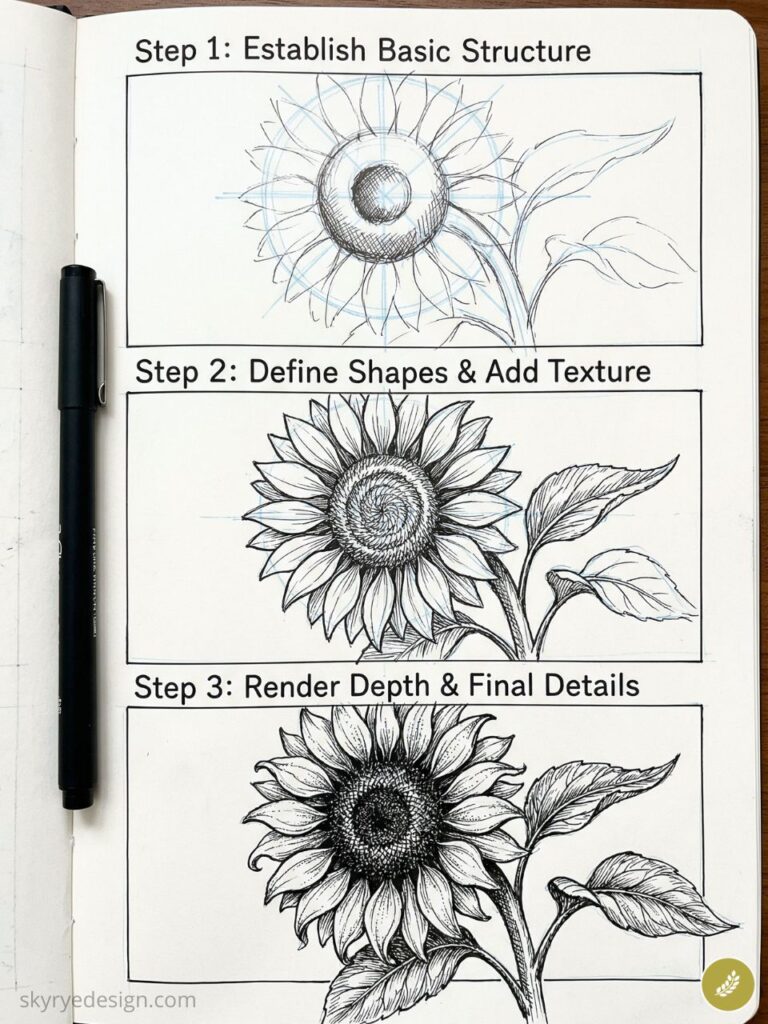
Tools: Staedtler Pigment Liner 0.3mm and 0.5mm (~$4 each), sketchbook with smooth paper, watercolour pencils optional
Key technique: Ink directly without underdrawing once you’re comfortable with the proportions. Start with the outer disk circle, then the inner disk edge, then petals working clockwise from one anchor petal. The disk is suggested with irregular dots and small curved marks rather than fully rendered C-shapes. Speed is the point — a convincing five-minute sunflower sketch from observation is more valuable as a practice habit than a two-hour finished piece.
Reference: Keeping a nature journal with quick botanical sketches is a practice with a long tradition — from Albrecht Dürer’s plant studies (1503) to contemporary nature journaling communities. The ‘Keeping a Nature Journal’ book by Clare Walker Leslie (~$20) covers this approach in detail.
Six Common Sunflower Drawing Mistakes
- Even petal spacing. Real sunflower ray florets are not evenly distributed around the disk. They cluster and vary in density, with some areas having petals closer together and others showing gaps. Perfect even spacing produces the cartoon sunflower immediately.
- Flat disk. The disk is slightly domed — it curves gently away from the viewer at the edges. Drawing it as a flat filled circle eliminates this three-dimensional quality. Suggest the dome by making the disk edge marks slightly lighter than the center.
- Random disk texture. Unstructured random marks in the disk look like shading, not florets. The marks need to show some awareness of the spiral structure — curved in two general directions — even if not precisely mapped.
- Flat petal outlines without midrib. Petal outlines alone produce flat shapes. The kneaded eraser lifted along the petal midrib after shading creates the three-dimensional curvature that makes individual petals read as plant forms rather than drawn shapes.
- Stem too thin and too straight. Sunflower stems are thick, slightly hairy, and gently curved under the flower head weight. A thin straight stem reads as a generic flower stem, not specifically a sunflower stem.
- No second petal layer. A single layer of petals around the disk produces a flat, simple flower silhouette. The second layer visible behind and between the first layer is what gives the sunflower its characteristic fullness and suggests the three-dimensional structure of the flower head.
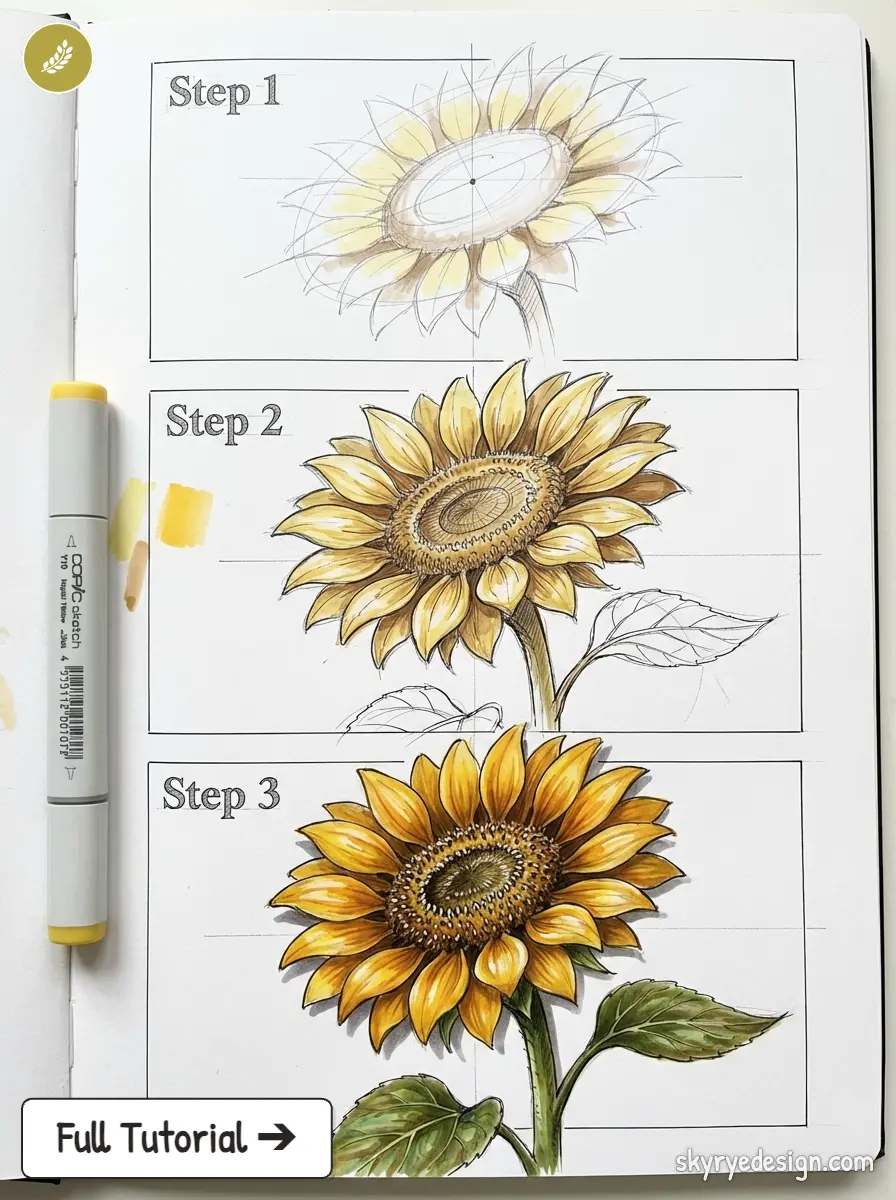
Materials for Sunflower Drawing
- Pencils: Faber-Castell 9000 Art Set HB to 4B (~$15) — the full tonal range. HB for construction circles, 2B for confirmed petal outlines and stem, 4B for disk center and deepest petal shadows.
- Paper: Strathmore 300 Series Bristol smooth pad (~$18, 9×12 inch) for detailed pencil or ink work. Canson Mi-Teintes (~$1-2/sheet) for coloured pencil or pastel. Arches 140lb cold press (~$20 for small block) for watercolour.
- Erasers: Faber-Castell kneaded eraser (~$3) — essential for petal midrib highlights and disk floret highlights. Standard vinyl eraser for construction line removal.
- Ink (optional): Staedtler Pigment Liner 0.3mm for petal detail and disk texture marks, 0.5mm for stem outline. The contrast between fine and slightly heavier line weights adds structural clarity.
- Coloured pencils (optional): Faber-Castell Polychromos (~$3-4 per pencil) — Cadmium Yellow, Yellow Ochre, Burnt Sienna, Dark Sepia, Sap Green, Dark Green for a complete sunflower palette. The Polychromos set in 36 colours (~$65) covers all sunflower needs with room for other botanical subjects.
- Reference: iNaturalist app (free) for identifying sunflower varieties and accessing community-uploaded reference photographs from multiple angles. The Ring of Fire variety (golden edges with red ring around chocolate brown center) and the Autumn Beauty variety (multi-coloured petals) offer interesting drawing alternatives to the standard common sunflower.


FAQ: Sunflower Drawing
Q: How do you draw a sunflower step by step for beginners?
Start with three concentric circles: outer (petal boundary), middle at 65% radius (petal base), inner at one-third diameter (disk). Draw ray florets as irregular elongated ovals from middle to outer circle — vary their sizes and angles. Add a second shorter layer behind the first. Fill the disk with spiral-aware C-shaped marks from edge to center. Add stem with gentle curve and large heart-shaped leaves. Shade with the tip lighter than the base on each petal. Full six-step process is in the construction section above.
Q: What are ray florets and disk florets?
A sunflower is a composite flower head containing hundreds of individual florets. Disk florets are the small tightly packed flowers in the central dark circle — they develop into seeds and are arranged in Fibonacci spirals (typically 34 × 55). Ray florets are the elongated yellow structures we call petals — technically individual sterile flowers modified into petal-like forms. They attach at the outer disk edge and angle slightly downward, which is why petals near the edge show their undersides in a front view.
Q: How do you draw the sunflower disk realistically?
Work from the outer disk edge inward with small C-shaped marks that curve in two general directions to suggest the Fibonacci spiral arrangement. The outer rows should be slightly larger and lighter; marks become smaller and more compressed toward the darker center. Don’t use uniform hatching — individual curved marks produce texture, hatching produces shading. A kneaded eraser pressed gently into the shaded disk lifts small highlights from the floret tops that complete the surface quality.
Q: What pencils should I use for sunflower drawing?
HB for construction lines (erased later), 2B for confirmed petal outlines and stem, 4B for disk center and deep petal shadows. Strathmore Bristol smooth pad (~$18) for the paper. A kneaded eraser is essential — not just for mistakes but as a drawing tool for lifting petal midrib highlights after shading. Faber-Castell 9000 Art Set (~$15) covers the full pencil range needed.
Q: How do you add colour to a sunflower drawing?
Coloured pencil: Cadmium Yellow from petal base outward, leaving tips lighter. Add Burnt Sienna where petals overlap for shadow. Dark Brown for disk base with Yellow Ochre dots on floret highlights. Watercolour: Yellow Ochre first wash, glaze Cadmium Yellow on highlights when dry. Disk built with wet-on-dry Brown Madder layers. Van Gogh’s method — short directional strokes following petal structure — translates directly to both oil pastel and coloured pencil work.
Q: Why do my sunflower petals look flat?
Because they’re outlines without midrib highlights. After shading any petal with a 2B pencil, press a kneaded eraser gently along the petal’s central axis to lift a thin highlight strip. This creates the three-dimensional curvature that makes the petal read as a plant form rather than a drawn shape. It takes about two seconds per petal and is the single most impactful technique step for sunflower realism.


Cara Mewarnai Bunga Matahari — Step by Step


- 956shares
- Facebook0
- Pinterest956
- Twitter0
- Reddit0