
The first magical garden I tried to draw looked like a normal garden with mushrooms added. The flowers were real-looking. The path was correctly perspectived. There was a stone wall with an arched gate. All of it was technically competent and completely lacking in atmosphere — because I’d approached it as a garden drawing with fantasy details on top, rather than as a space that operates by different rules from the observable world.
- What Makes a Garden Magical: The Three Atmospheric Principles
- Building the Composition: Horizon Line, Three Layers, and the Path
- Six Magical Garden Elements: How to Draw Each One
- Drawing Light, Mist, and Atmospheric Depth
- The Six-Step Drawing Process
- Materials: What You Actually Need
- FAQ: How to Draw a Magical Garden Scene
The distinction matters. A magical garden isn’t a realistic garden with glowing accents. It’s a space where light has no obvious source, where scale contradicts expectation, where something lies just beyond what the picture shows. The path curves out of sight. The door in the wall leads somewhere the viewer can’t see. The fog at the back edge of the composition suggests depth while hiding what’s there. These are compositional and atmospheric decisions made before a single leaf is drawn — and they’re what separates a garden drawing from an enchanted one.
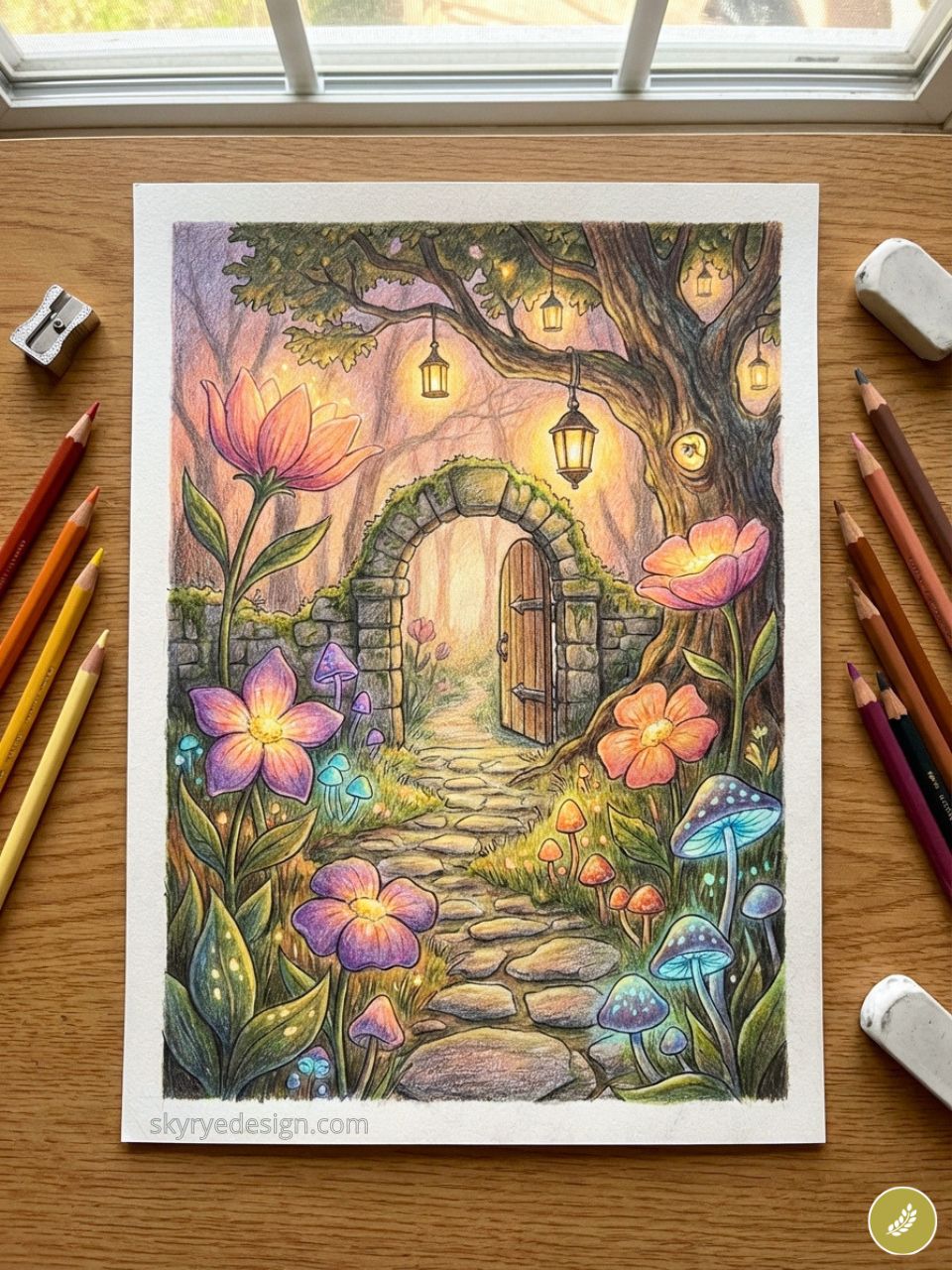
This guide covers the complete process: how to plan a magical garden composition from the horizon line outward, how to build the three-layer depth structure that makes a flat page feel like three-dimensional space, the six specific elements that most effectively create a fantasy atmosphere, how to draw glowing light, and the materials that make the difference between a sketch that looks like a school exercise and one that feels genuinely transportive.
What Makes a Garden Magical: The Three Atmospheric Principles
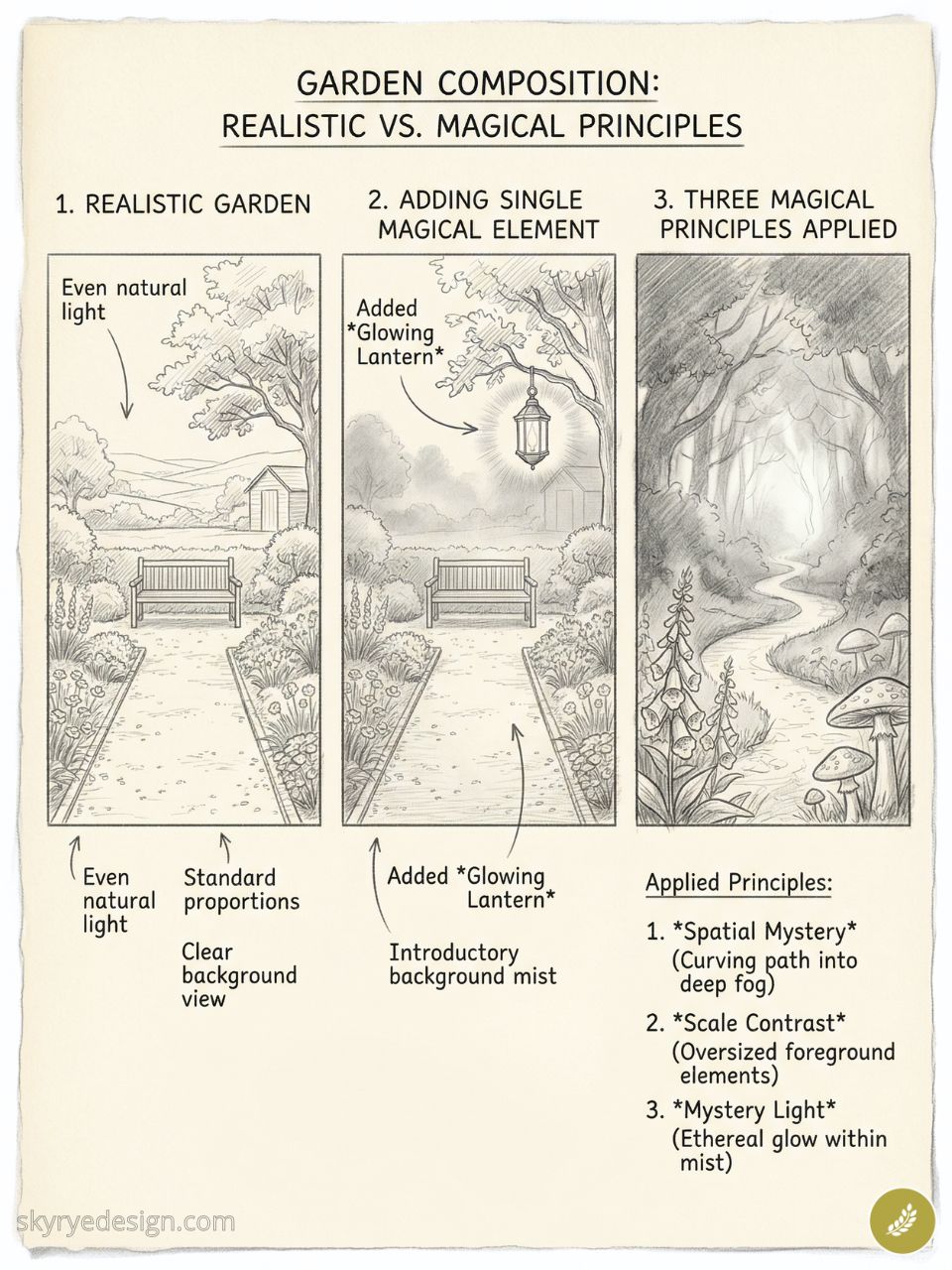
Before any drawing begins, understanding what atmospheric qualities create the magical feeling prevents the most common mistake: treating fantasy as a layer to add rather than a quality to build in from the first mark.
Mysterious Light
Magical spaces have light that doesn’t fully explain itself. In a realistic daytime garden, every shadow is cast by the sun from a single consistent direction. In a magical garden, there are secondary light sources that exist within the scene — a lantern, a glowing mushroom cluster, the luminous edge of a flower petal — and these create pools of warm light that conflict gently with the cooler ambient light. This light conflict is what creates atmosphere. The viewer’s eye is drawn to the warm light sources, and the areas between them feel more mysterious for being neither fully lit nor fully dark.
Spatial Mystery
A magical garden always implies that something lies beyond what the picture shows. The path must curve out of sight — not run to the edge of the composition. The arched gate must show only darkness beyond it, not the next garden section. The fog or mist at the background edge should hide the furthest trees rather than reveal them. This ‘incomplete revelation’ is what makes a viewer feel that the garden continues — that there is more to discover. A garden scene that shows everything it contains is a diagram. A garden scene that suggests more than it shows is an invitation.
Scale Contrast
Fantasy spaces break the relationship between object size and viewer scale that governs realistic scenes. An oversized flower — drawn at 1.5-2x its realistic proportion relative to the path width — immediately signals that this is not the observable world. A tiny cottage visible in the middle ground, small enough for a creature rather than a person, creates the same disorientation of familiar proportions. Scale contrast doesn’t require explanation — the viewer’s visual system processes it as magic without needing to understand how it works.
✏ Sketch note: Establish all three principles before drawing any detail. Mark on your rough composition: where will the mystery light sources be? Where does the path disappear? Which element will be at an unusual scale? Answering these three questions in the planning phase ensures they’re structurally embedded rather than added as afterthoughts.
Building the Composition: Horizon Line, Three Layers, and the Path
Composition is the decision about where things are in the frame — and in a magical garden scene, it’s also a decision about what the viewer’s eye travels toward and what draws them into the imagined space.
Setting the Horizon and Eye Level
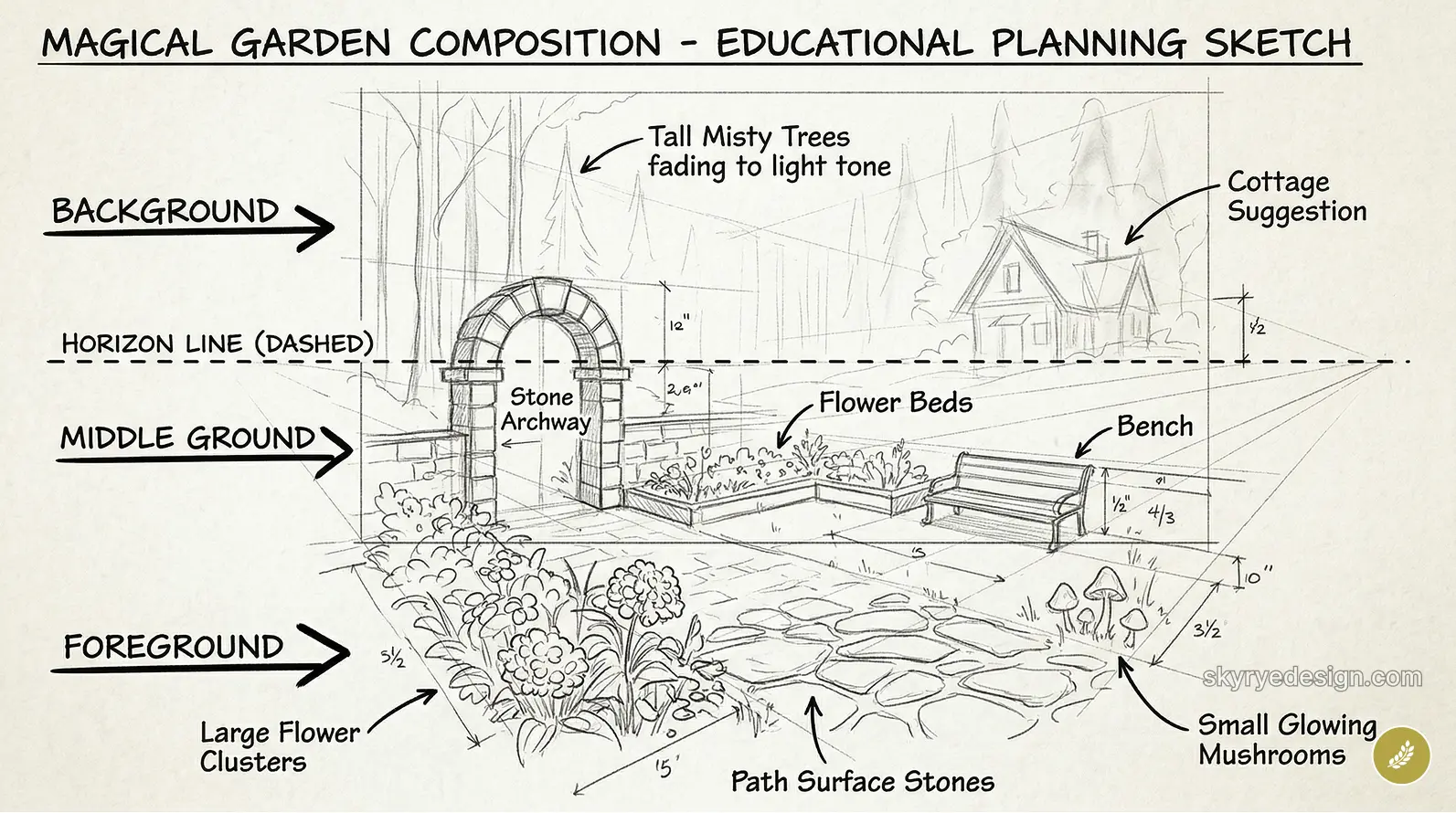
The horizon line determines the viewer’s position relative to the garden. A low horizon — at ground level or just above — places the viewer at ground level, which makes large flowers tower dramatically and creates an immersive sense of being inside the garden. A higher horizon — at mid-frame — gives a slight elevated view, showing more of the garden layout and path system. For magical garden scenes, a low to mid-low horizon is most effective: it makes the foreground elements feel large and enveloping, and it creates the sense of looking up at trees and arches rather than down at the garden as a whole.
The Three-Layer Rule
Every convincing garden scene has three spatial layers, each treated differently. Foreground: the closest zone, drawn with the heaviest line weight, the most contrast between light and shadow, and the most visible surface texture — individual petal veins, stone surface marks, grass blade clusters. Middle ground: the garden’s main feature zone — the path, the archway, the flower beds, the bench or well or cottage. Moderate line weight, less detail texture. Background: the furthest zone — trees, distant hills or walls, the mist that suggests depth without revealing what lies beyond. Lightest line weight, no texture marks, elements fading toward the paper tone.
Overlapping elements between layers is what creates the depth illusion. A foreground flower that partially covers the middle-ground archway tells the viewer’s visual system that the flower is in front of the archway — more convincingly than any amount of size reduction or tonal fading could achieve alone.
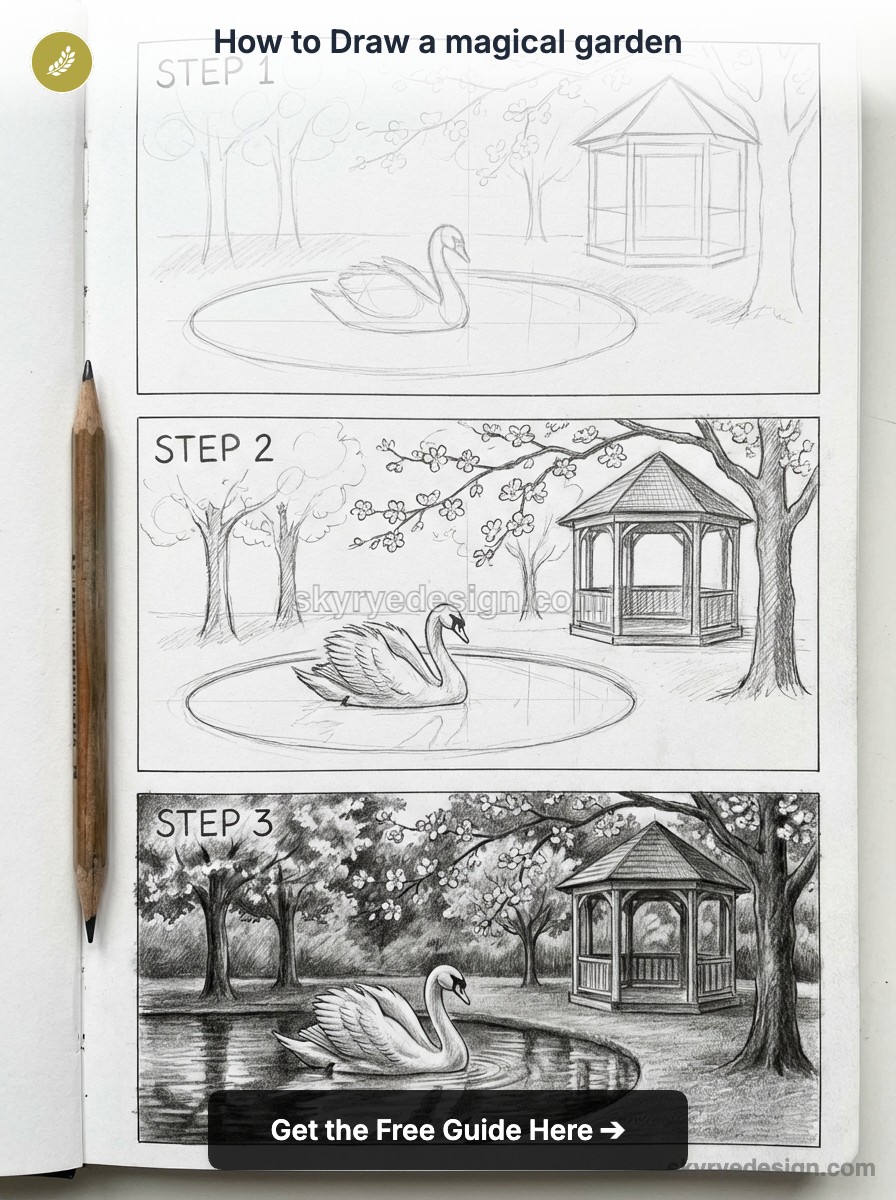
The Path as Visual Conductor
In almost every magical garden composition, the path is the primary visual conductor — it leads the eye from the foreground into the scene and carries it toward the disappearing point. A stone path drawn in one-point perspective narrows as it recedes, creating depth automatically.
A curved path — one that bends left or right before disappearing — creates more mystery than a straight one because the viewer cannot see where it leads. The curve of the path and the place where it disappears should be placed at roughly the golden ratio point — approximately two-thirds of the way up the composition from the bottom — not at the geometric centre, which produces a static, symmetric result.
✏ Sketch note: Draw the path before drawing anything else in the composition. It establishes the ground plane, the perspective logic, and the focal point (where the path disappears). Every other element — flowers, trees, archways — is placed in relation to where the path goes. Build from the path outward, not from the border inward.
Six Magical Garden Elements: How to Draw Each One
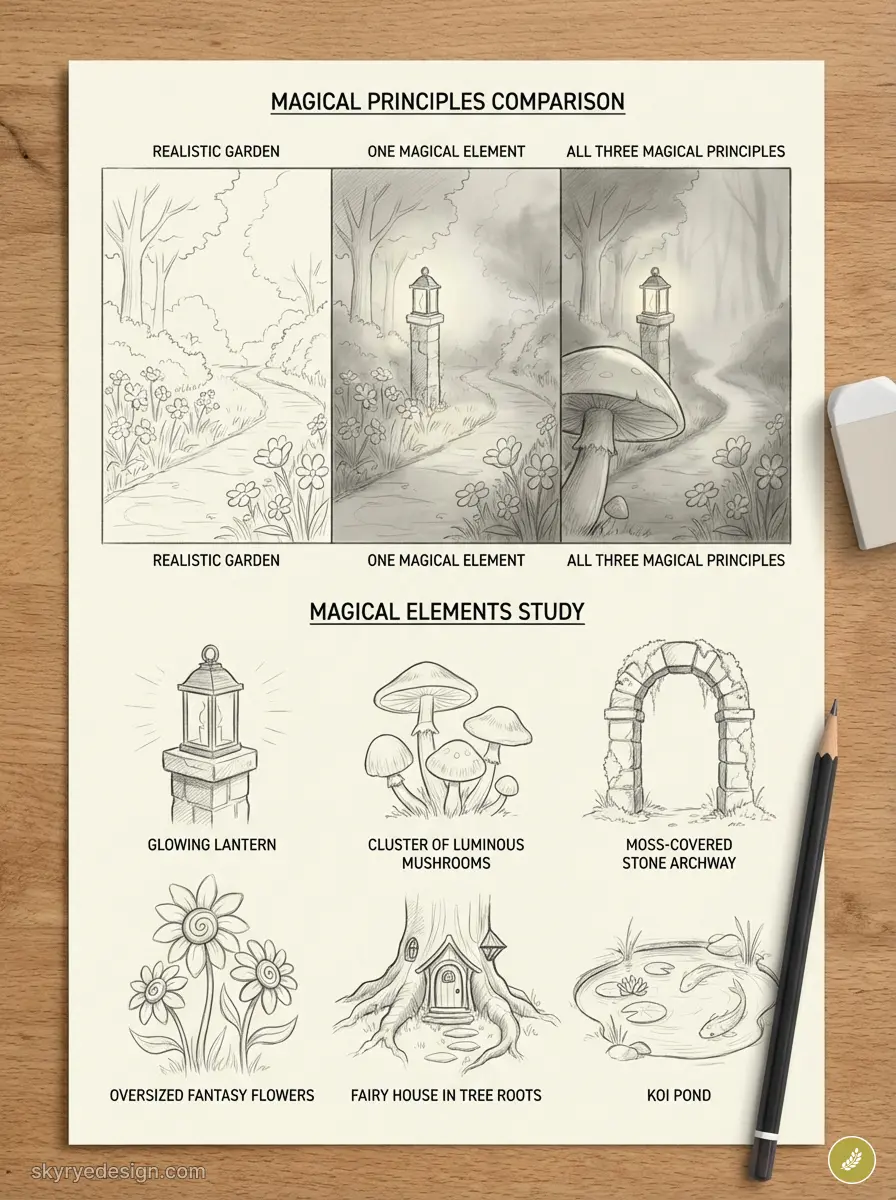
Stone Archway and Gate
How to draw it: Draw two vertical rectangular pillars of stacked irregular stones — no two stones the same size, each with subtle surface texture lines and light stippling for weathered texture. The arch curves from the top of each pillar, drawn as a single smooth curve.
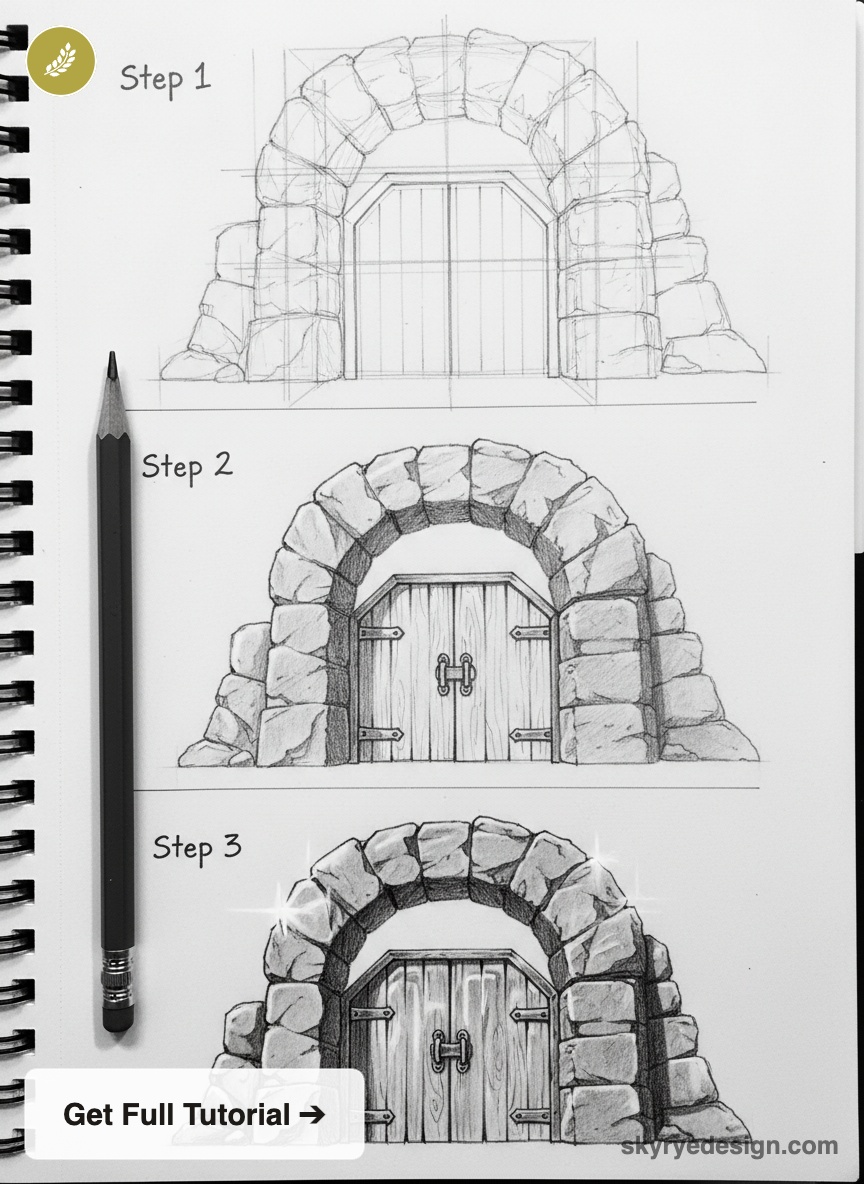
The wooden gate shows vertical plank lines with two horizontal bracing boards. Leave the darkness beyond the gate as deep shadow — the darkest mark in the composition.
Magic detail: The half-open gate is the most effective single mystery element in a garden scene. A gate standing wide open invites; a gate standing closed excludes. A gate half-open suggests that something just passed through, or that something is waiting on the other side.
Drawing tip: The keystone at the top of the arch — a single wedge-shaped stone at the apex — is the detail that makes an arch read as structurally real rather than decorative. Draw it slightly larger than the surrounding stones and with a clear vertical joint on each side.
Glowing Lanterns
How to draw it: Draw the lantern body as a rectangular cage of thin metal bars — four vertical bars meeting at a pointed or domed top cap, with horizontal bars at regular intervals creating a grid. The glass panels between the bars are left lighter than the surrounding scene. The hanging hook or mounting post is drawn in simple geometric line.
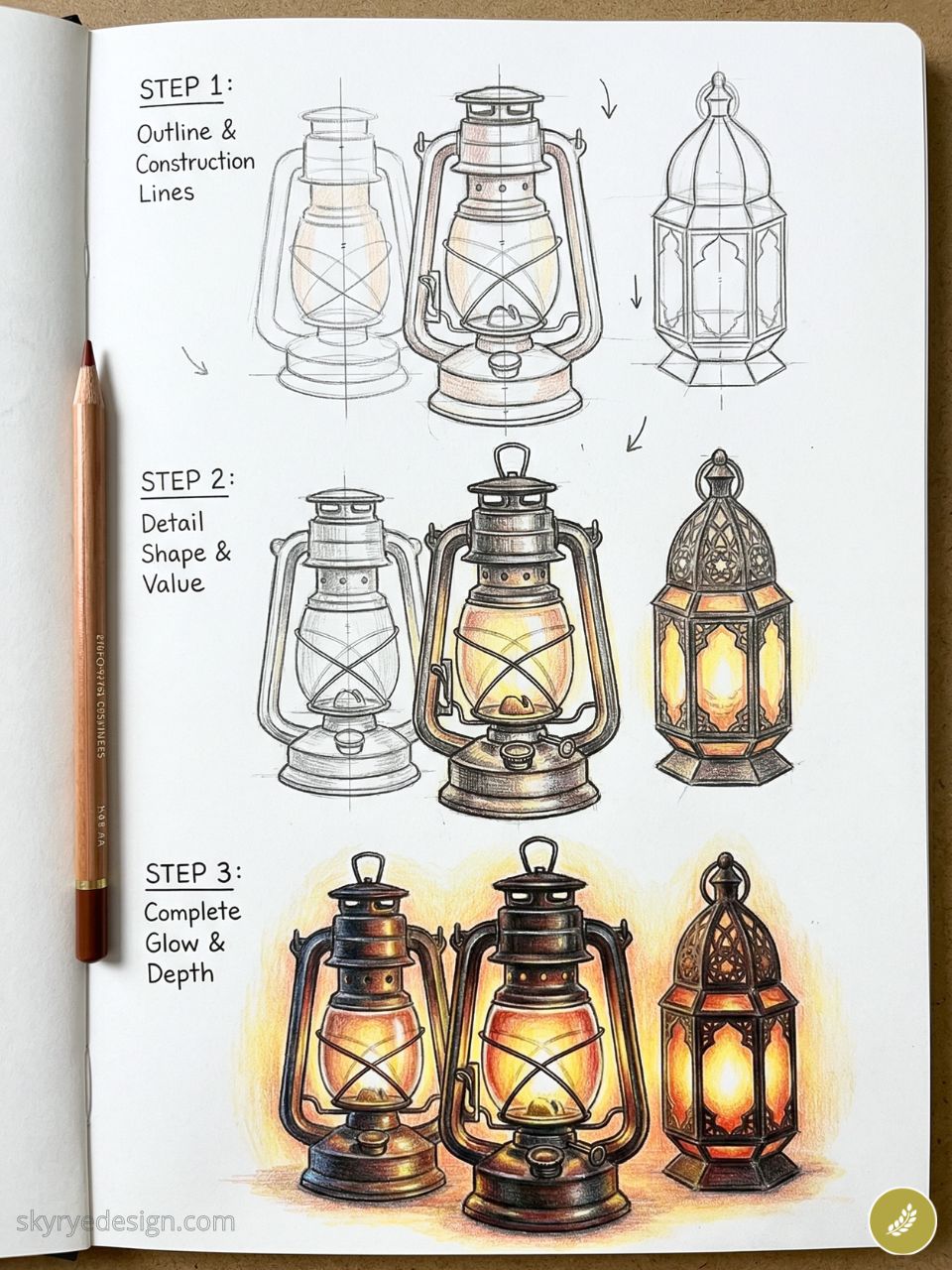
Magic detail: The glow effect: shade the area directly behind and below the lantern to a darker tone than the surrounding scene, then use a kneaded eraser to lift a soft, circular warm-toned glow from the lantern glass area. The glow should bleed outward from the lantern in an irregular halo — not a clean circle, which reads as a graphic rather than a natural light effect.
Drawing tip: Draw at least two lanterns at different distances in the scene — one in the foreground at large scale, one in the middle ground at smaller scale. The recession in lantern size along the path reinforces perspective depth while distributing the warm light sources through the composition.
Oversized Fantasy Flowers
How to draw it: Begin with a central circle for the flower head, then draw petals radiating from it — for a magical garden, petals can be elongated and slightly curved, or round and full, or pointed like a star. What makes them fantasy: the scale (drawn 3-4x the size they would be relative to the path width), and the centre detail (a spiral pattern, a glowing interior, small geometric forms suggesting seeds or stamens).
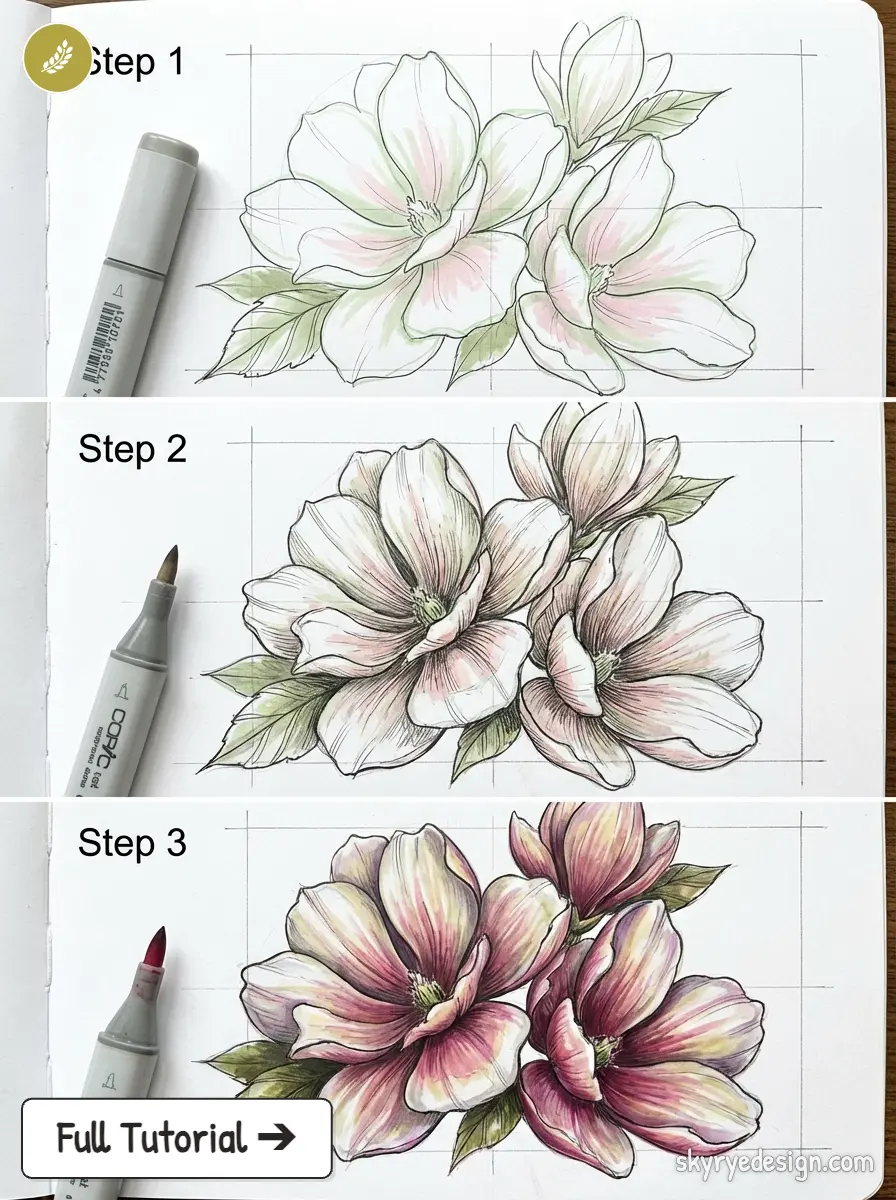
Magic detail: Overlapping petals at different stages of rotation — some facing forward, some angled to one side, some visible only as their edge — creates a sense of three-dimensional volume in a single flower head. A flat flower drawn in profile reads as a symbol; a flower drawn with overlapping petals at varied angles reads as a real form.
Drawing tip: Vary the number of petals between flower species in the same scene — some with 5, some with 7, some with 12 — to prevent the garden reading as a single repeated unit. Mix petal shapes: pointed, rounded, ruffled edge, elongated. The botanical variety makes the scene feel explored and observed rather than invented at the desk.
Glowing Mushrooms
How to draw it: Draw the mushroom cap as an organic dome shape — not a perfect semicircle but slightly irregular, perhaps with one side lower than the other. The stem is cylindrical, widening slightly at the base. For a cluster: three or four mushrooms at different heights, the tallest at the back, the smallest in front.
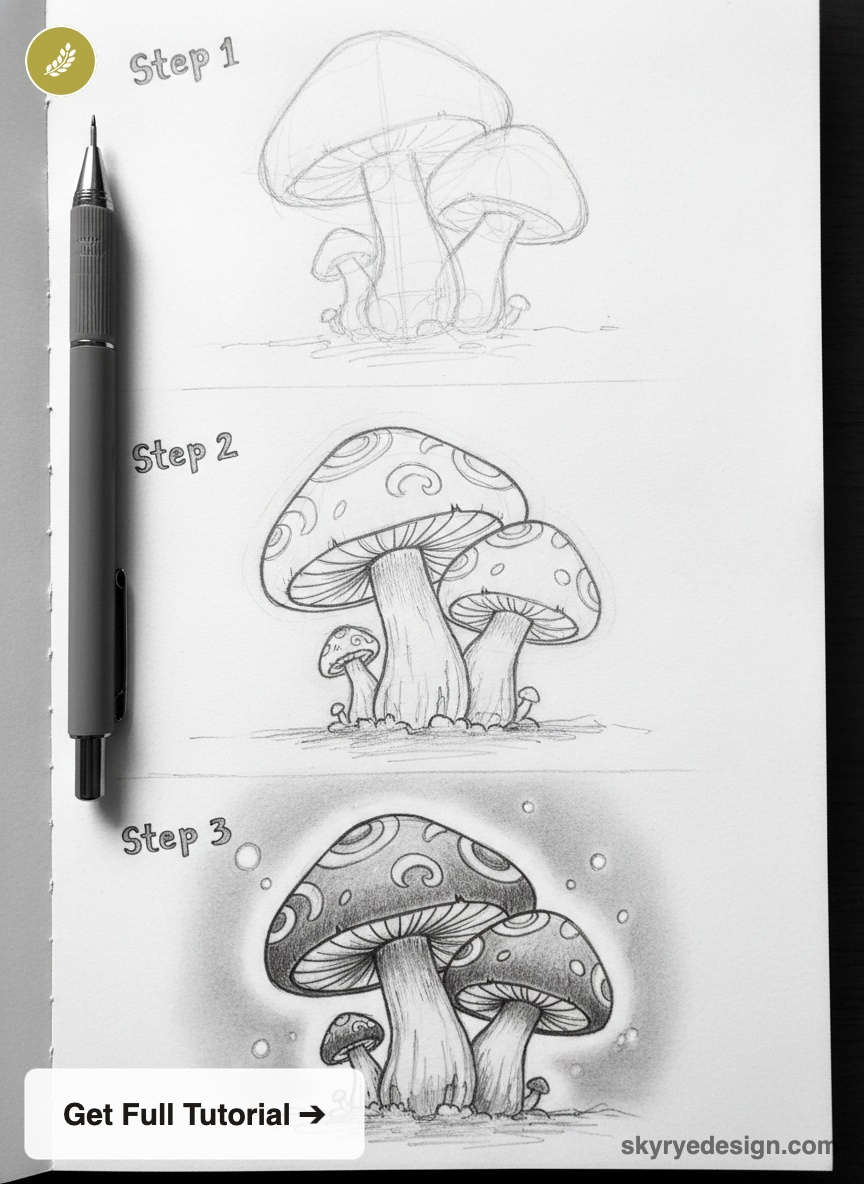
The gills under the cap are suggested by thin radiating lines from the centre of the cap edge.
Magic detail: The bioluminescent glow effect: shade the ground immediately around the mushroom base darker than the surrounding earth. The cap itself is left lighter than the environment. Use a kneaded eraser to lift a soft upward glow from the top of the cap — light radiating upward into the air above the mushroom rather than casting a shadow downward.
Drawing tip: Glowing mushrooms placed at the base of a large tree trunk read immediately as a magical element because the scale contrast between the massive trunk and the small glowing fungi amplifies both the sense of age (the tree) and the sense of enchantment (the unexpected light source).
Fairy House in Tree Roots
How to draw it: The fairy house uses the tree root system as its architectural foundation — a small round doorway (an arched opening 4-5cm wide in your drawing) is cut into the largest root, with a tiny door of vertical planks visible within. A window with a warm light visible through it sits above and to one side of the door. Moss and small plants grow on the roof of the root system above.
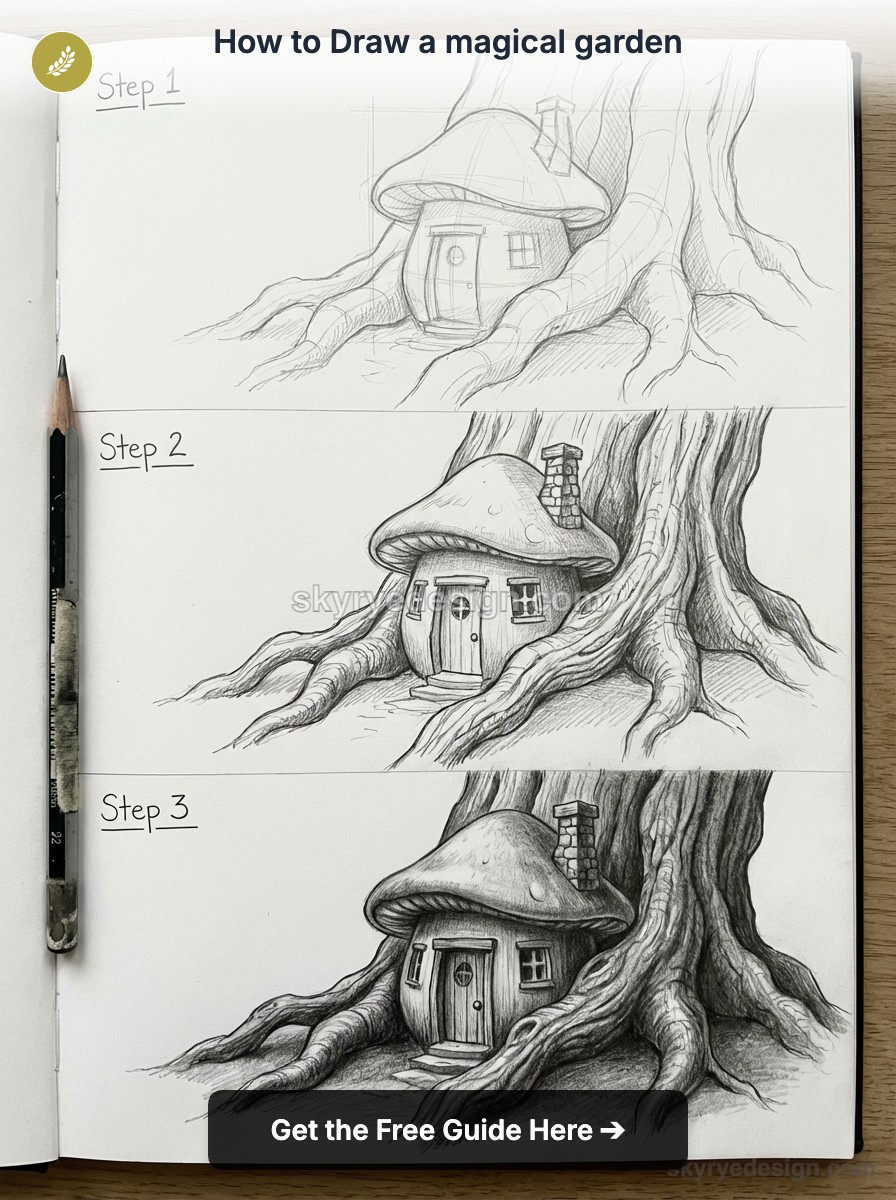
Magic detail: The scale relationship between the fairy house and the tree it lives in determines the implied creature size. If the door is 1/8th of the tree trunk diameter, the inhabitants are mouse-sized. If the door is 1/20th, they’re insect-sized. Choose the scale that suits your scene’s narrative and maintain it consistently with any other scale references in the drawing.
Drawing tip: The most convincing detail for a fairy house: the warm light visible through the tiny window. A tiny rectangle of warm tone inside a dark window opening, with a very small soft glow lifting from the kneaded eraser around it, immediately communicates habitation and coziness.
Stone Path with Moss
How to draw it: Draw the path edges as two converging lines toward the horizon (one-point perspective) or as curves that disappear around a bend. Within the path: irregular stone shapes, no two identical — some larger, some smaller, some slightly tilted. The joints between stones: thin, irregular gaps with small marks suggesting moss or creeping plants. Each stone has a light zone (upper surface, catching ambient light) and a slightly darker zone (the near edge, in slight shadow).
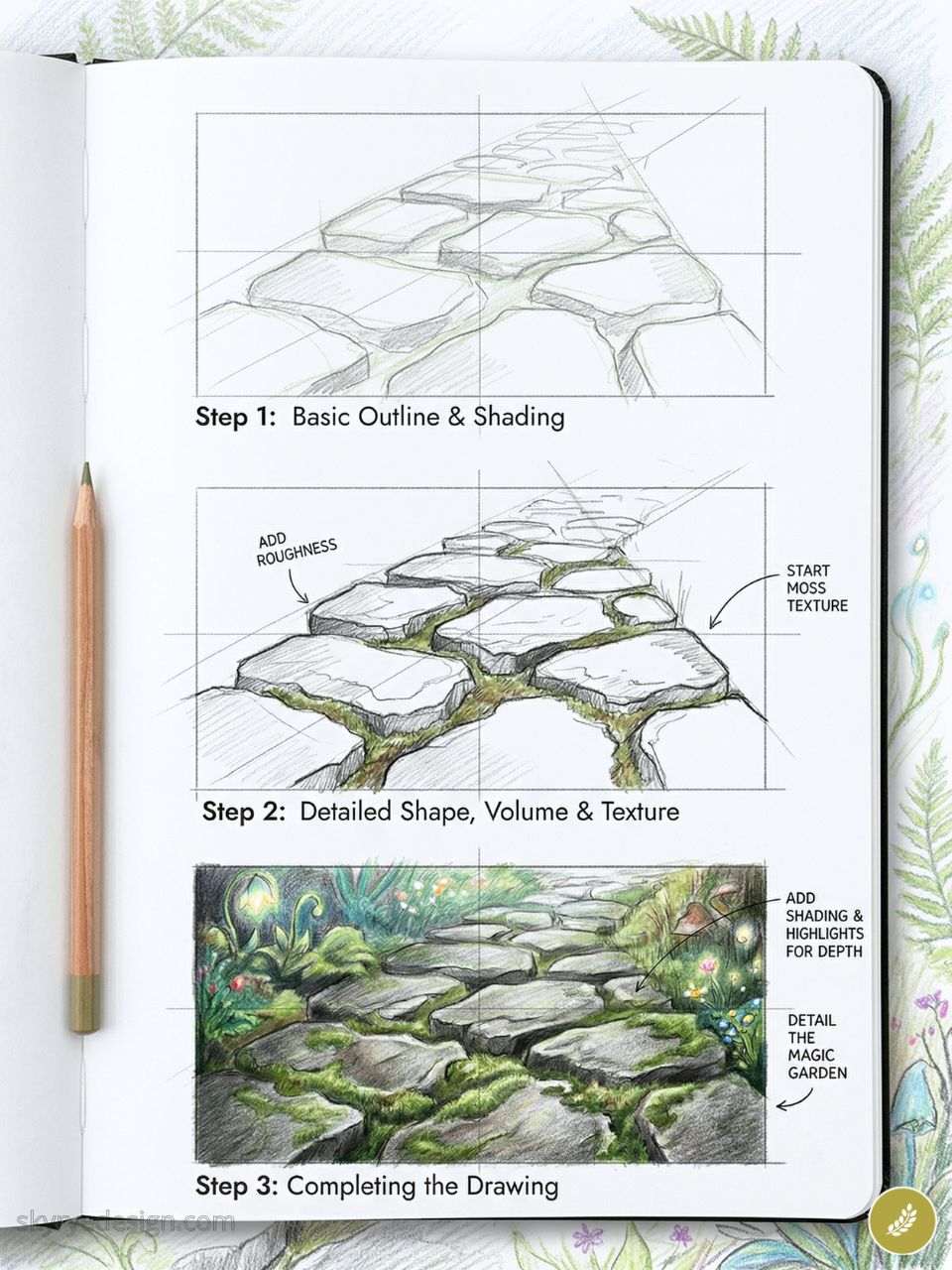
Magic detail: Moss growing in the path joints is the single detail that transforms a stone path from a constructed element into something old and belonging to the natural world. Draw it as small irregular clusters of very fine marks in the joints — some joints with heavy moss growth, some barely visible, to create organic variation rather than uniform coverage.
Drawing tip: The stones closest to the viewer (foreground path) should be drawn noticeably larger than the stones further along the path (middle ground). This size reduction is the most convincing perspective indicator for a curved path — it reads as depth even when the path curves and formal perspective lines can’t easily be drawn.
✏ Sketch note: Draw each magical element as a separate study on a separate piece of paper before placing it in the composition. Understanding how a lantern looks from the front, from a slight angle, and from below — before you need to place it in a specific position in the scene — means the element reads convincingly in context rather than being drawn tentatively in situ.
Drawing Light, Mist, and Atmospheric Depth
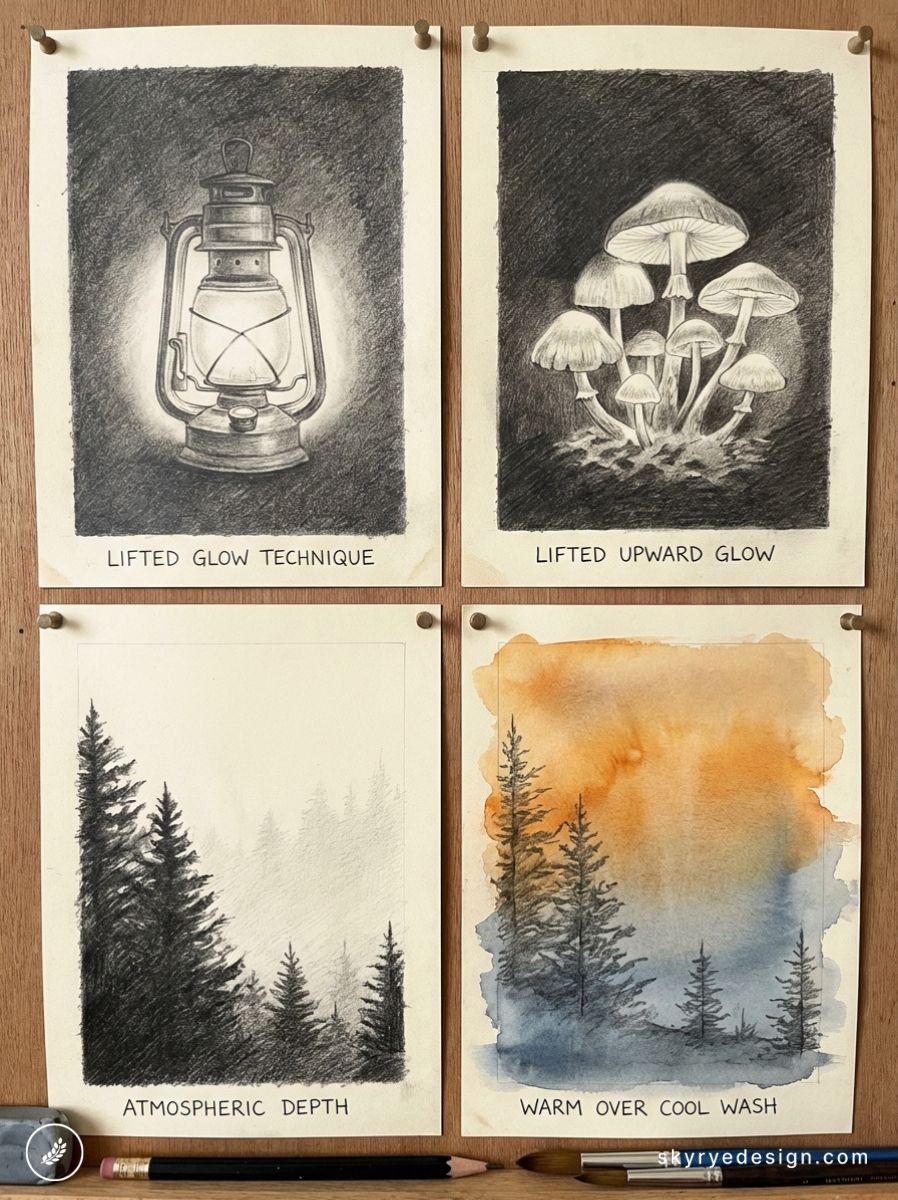
Atmosphere in a magical garden drawing is created by tonal contrast management — specifically, by controlling how dark the darks are and where they’re placed relative to the light sources in the scene.
The Glow Technique
Every light source in the magical garden — lanterns, glowing mushrooms, fairy house windows, fireflies — uses the same drawing technique: surround with dark, then lift the light with a kneaded eraser. This seems counterintuitive — you’re drawing the absence of pencil rather than the presence of it.
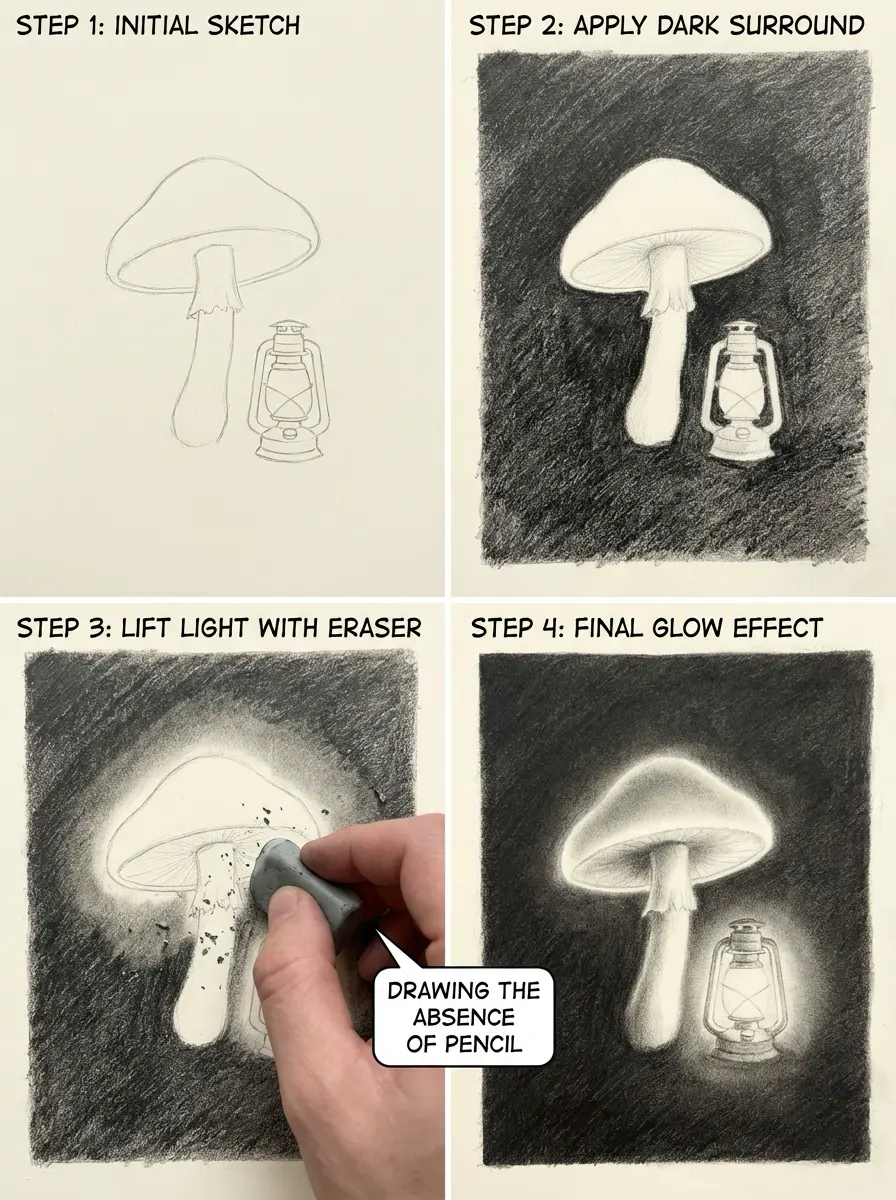
But it’s how light actually works in a dark environment: the eye perceives the surrounding darkness as evidence of the light source’s power. A glowing mushroom in a brightly lit garden reads as slightly luminous. The same mushroom with its immediate surroundings darkened to near-black reads as the primary light source in the scene.
Mist and Atmospheric Perspective
Mist at the background of a garden scene creates depth by concealing rather than revealing. The technique: apply a light, even HB pencil tone to the background tree area — lighter than the mid-ground, significantly lighter than the foreground. Don’t draw individual leaf or bark texture in the background — just the silhouette of tree forms, softened at the edges where they meet the mist zone. The horizon area itself should be nearly paper-tone, with only the faintest indication of form. This tonal gradient from dark foreground to nearly white background is the most effective single depth technique available to a pencil artist.
Dusk vs. Moonlight vs. Enchanted Midday
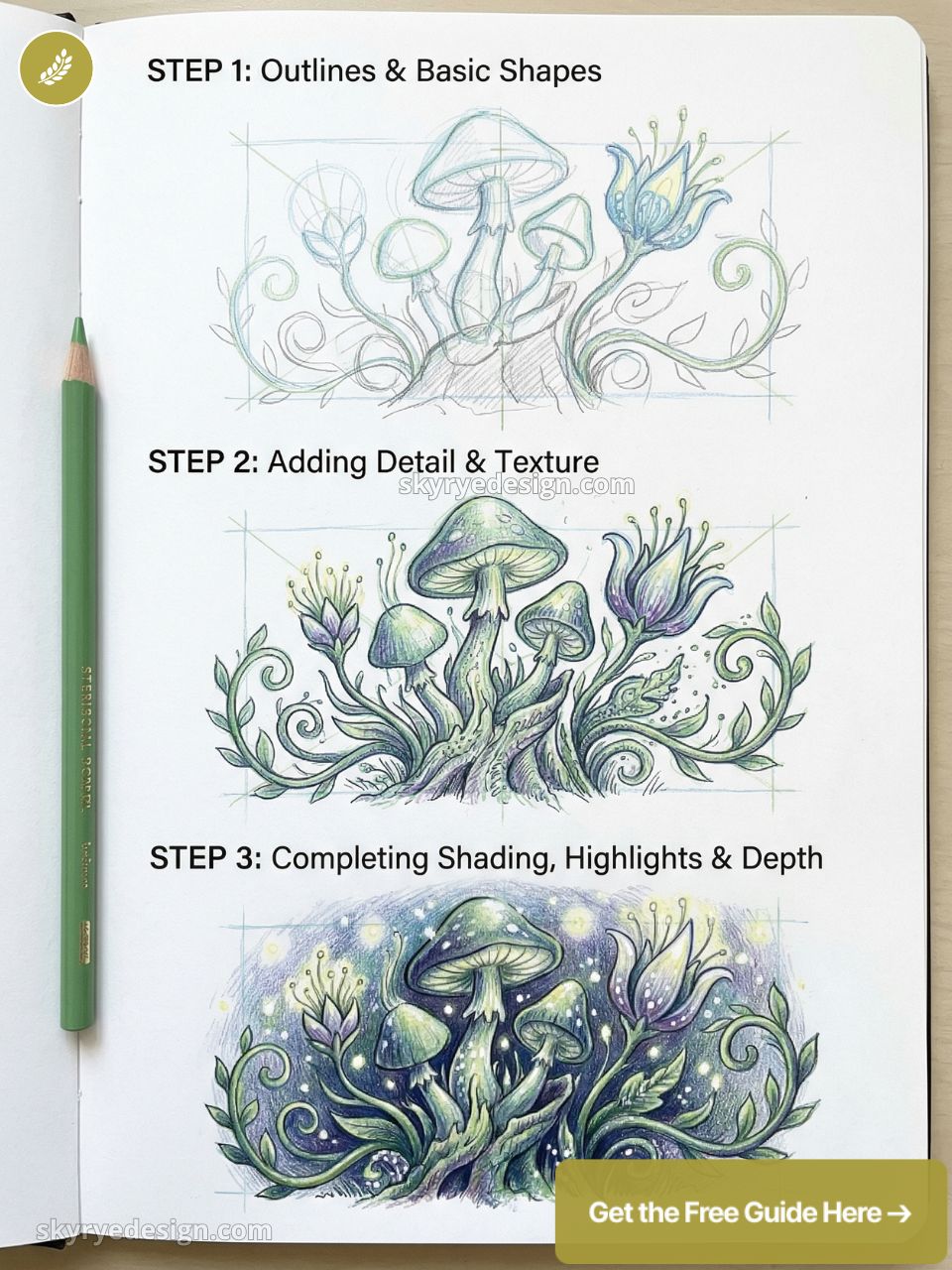
The time of day you choose for the scene determines the light palette. Dusk: warm amber light from lanterns competing with the cool blue-grey of fading natural light — the most dramatic and cinematic option for a magical garden. Moonlight: cool, high-contrast, silvery tones — shadows are crisp and blue-white highlights read as cold light. Enchanted midday: bright but with an unusual colour saturation — grass greener than realistic, flowers brighter, the sky a more intense blue. For beginners, dusk is the most forgiving choice because the mixture of warm and cool light sources creates natural interest without requiring precise colour theory knowledge.
The Six-Step Drawing Process
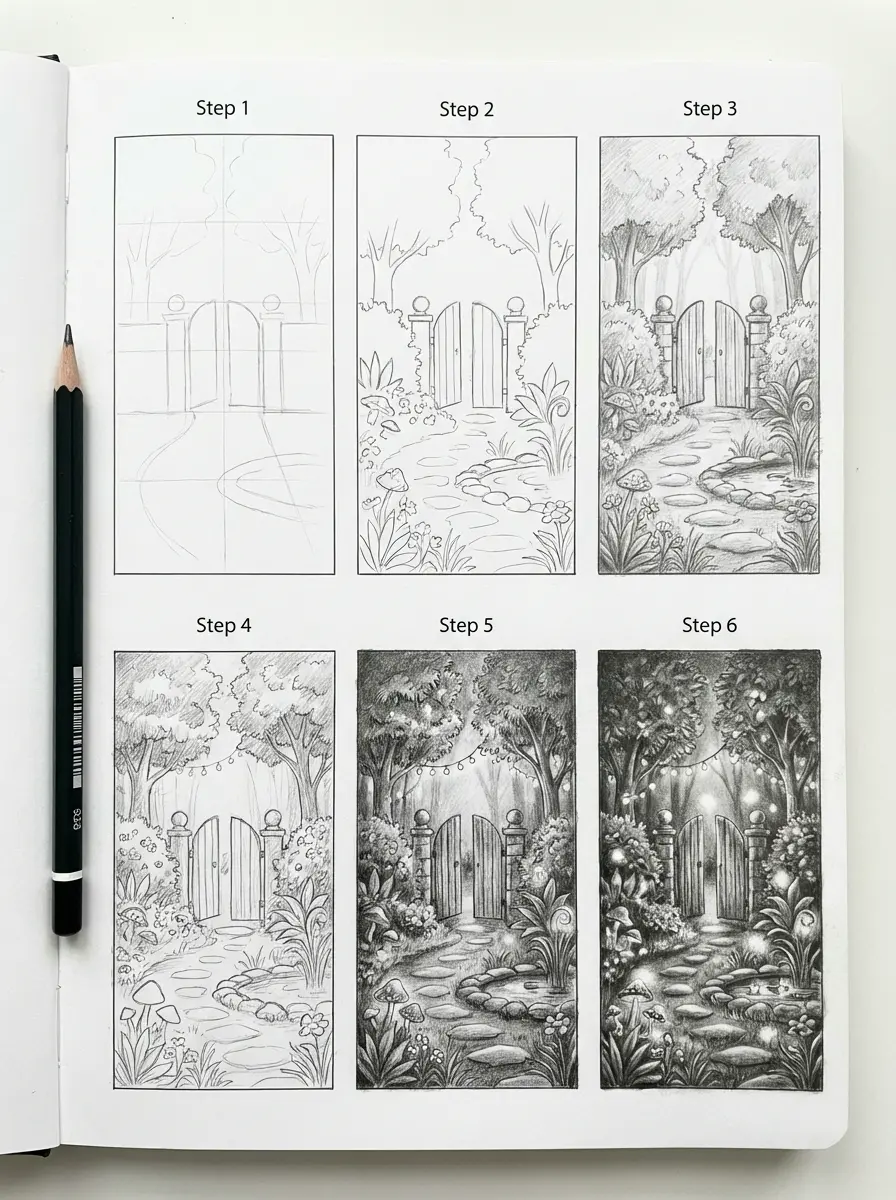
Step 1: Horizon Line and Vanishing Point
Draw a light horizontal line at approximately one-third of the way up the page — this is your low horizon, placing the viewer at ground level in the garden. Mark a vanishing point on this horizon line, slightly left of centre (this off-centre placement creates a more dynamic composition than a central VP). All path edges and horizontal architectural elements converge to this point.
Step 2: Path Construction
From the vanishing point, draw two diverging lines that widen as they come forward in the picture plane — these are the path edges. The path should be approximately 30% of the frame width at the foreground edge, narrowing to a point at the vanishing point. If you want a curving path, the two path edge lines curve left or right simultaneously before converging — but they must still converge at the same vanishing point.
Step 3: Major Structural Elements
Place the archway straddling the path at the middle-ground position — approximately two-thirds of the way up the composition. Place the primary tree or trees to one or both sides of the path in the middle ground. Sketch the cottage or fairy house suggestion in the distant background as a simple shape. At this stage, all elements are rough geometic shapes — don’t draw detail yet.
Step 4: Foreground Elements
Add the foreground elements around and beside the path entrance in the lower portion of the frame: large flower clusters on each side, mushroom groups at the path edge, stones on the path surface, roots or low plants. These foreground elements should overlap the path edges and the base of the middle-ground elements slightly. This overlapping is what commits the foreground layer to being in front.
Step 5: Confirm Outlines and Erase Construction
With a 2B pencil, draw the confirmed outlines of all elements — with confident, slightly varied line weight. Foreground elements get the heaviest lines; background elements the lightest. Erase all construction lines that are no longer needed. At this stage the drawing should read clearly as a coherent garden scene even before any shading is applied.
Step 6: Shading, Glow, and Atmosphere
Work from background to foreground for shading. Apply the misty light tone to the background first. Add mid-tones to the middle ground — deeper shadows in the archway interior, moderate shading on tree trunks. Foreground last: the deepest shadows under the large leaves and at the path edges, the stone surface texture. Final step: darken the areas around each light source (lanterns, mushrooms, fairy house window) and lift the glow with a kneaded eraser. The glow step transforms a finished drawing into a magical one.
Materials: What You Actually Need
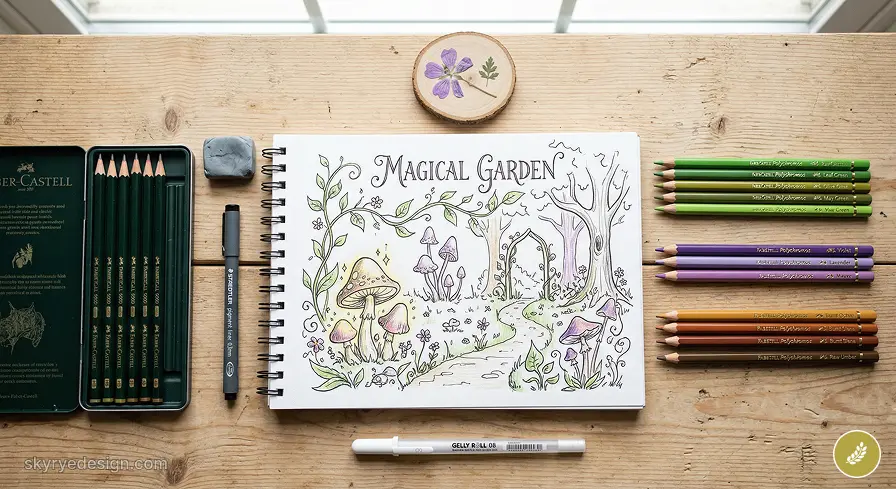
- Pencils: Faber-Castell 9000 in HB, 2B, 4B (~$15 for the art set). HB for construction and horizon line, 2B for all confirmed element outlines, 4B for deepest shadows and the dark zones around light sources.
- Paper: Strathmore 300 Series Bristol smooth pad (~$18, 9×12 inch) for pencil or ink work. Arches 140lb cold press (~$20 for a small block) if adding watercolour washes for colour. The smooth surface of Bristol allows the kneaded eraser to lift graphite cleanly for glow effects.
- Kneaded eraser: Faber-Castell kneaded eraser (~$3) — essential for the glow technique. Shape it to a point for small lantern glows; flatten it to a soft pad for larger mushroom or sky glow effects.
- Ink liner (optional): Staedtler Pigment Liner 0.3mm for foreground element outlines, 0.1mm for background elements and fine detail (fairy house window frames, mushroom gill lines). The line weight hierarchy between 0.3mm foreground and 0.1mm background reinforces atmospheric perspective.
- Coloured pencils (optional): Faber-Castell Polychromos for botanical elements — Sap Green, Dark Green, May Green for foliage layers; Cadmium Orange and Dark Cadmium Yellow for lantern glow warm tones; Blue Violet and Permanent Violet for shadow zones and magical flower accents.
- White gel pen: Uni-ball Signo broad (~$4) for the brightest point at the centre of each light source — the small white dot that reads as the hottest part of the glow. Apply last, after all other marks are complete.


A garden scene feels magical only after the space works. Use this perspective drawing practice guide when paths, arches, fences, or distant trees need to recede more convincingly.
A magical garden becomes stronger when it connects to a larger setting, so keep a few fantasy landscape drawing ideas nearby: hidden gates, floating islands, mossy ruins, or a path that bends toward a castle.
FAQ: How to Draw a Magical Garden Scene
Q: What makes a garden scene look magical in a drawing?
Three things: mysterious light (sources that exist within the scene — lanterns, glowing mushrooms — competing with ambient light), spatial mystery (a path that disappears, a gate showing only darkness beyond), and scale contrast (oversized flowers, tiny houses, creatures at unexpected sizes). Any one of these elements shifts a realistic garden into fantasy. All three create the immersive quality that makes a viewer want to step into the picture.
Q: How do you create depth in a garden scene drawing?
Three layers treated differently: foreground (heavy line weight, strong contrast, visible texture), middle ground (moderate weight and contrast), background (lightest weight, no texture, fading toward paper tone). Overlapping between layers — foreground elements partially covering middle-ground elements — creates more convincing depth than perspective grids alone.


Q: What pencils are best for a magical garden drawing?
HB for construction lines, 2B for confirmed element outlines, 4B for deepest shadows and the dark zones around light sources. A kneaded eraser is as important as the pencils — it’s the tool that creates the glow effect by lifting graphite from the areas around light sources. Faber-Castell 9000 Art Set (~$15) covers the full range needed.
Q: How do you draw glowing light effects?
Glow is created by contrast: shade the surrounding area dark with 4B, then lift a soft-edged bright zone at the light source centre with a kneaded eraser. The darker the surrounding area, the more intense the perceived glow. A white gel pen dot at the very centre of the light source adds the hottest highlight point. Apply this technique to lanterns, glowing mushrooms, fairy house windows, and any magical light source in the scene.
Q: How do you draw a stone path in a garden scene?
Draw the path edges as two converging lines toward the vanishing point. Within the path: irregular stone shapes — no two identical, joints between stones filled with moss marks. Each stone: lighter on the upper surface, slightly darker at the near edge. Stones in the foreground are noticeably larger than stones further along the path — this size reduction is the most effective single perspective indicator for the path surface.




- 4.3Kshares
- Facebook0
- Pinterest4.3K
- Twitter1
- Reddit0