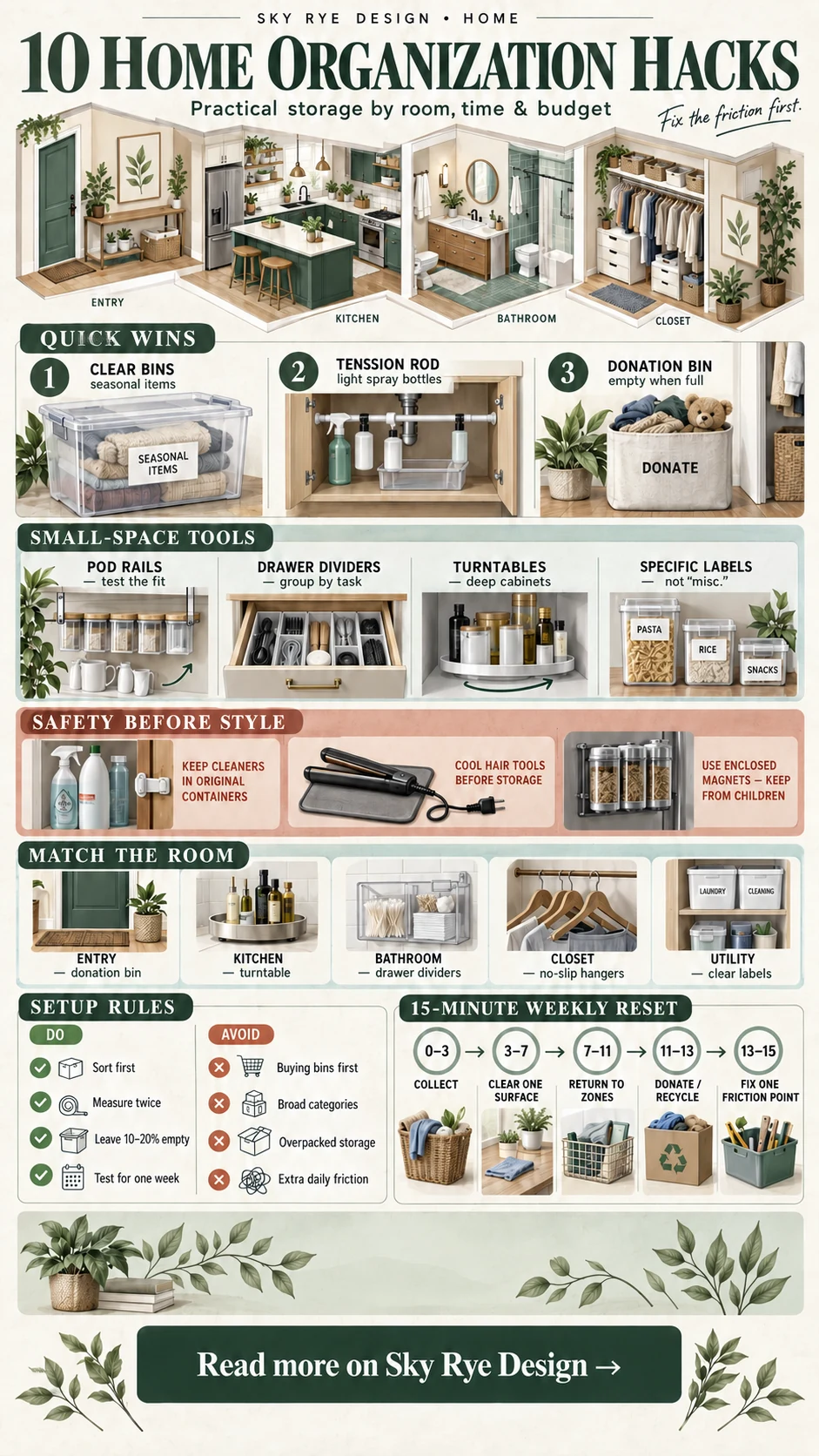
Home organization hacks work best when they remove a repeated point of friction: the bottle that falls over, the drawer you cannot search, or the seasonal box you open three times. You do not need to reorganize the entire house at once. Choose one problem area, measure it, assign every item a home, and test the setup for a week before buying more containers.
The ten ideas below are practical starting points for kitchens, bathrooms, closets, and utility spaces. Each one includes a realistic setup time, an illustrative USD budget, and a common mistake to avoid. Prices vary by store and location, so measure first and treat the ranges as planning estimates rather than fixed costs.
- Home organization hacks at a glance
- 1. Use clear bins for seasonal items
- 2. Add a tension rod under the sink
- 3. Build a coffee-pod rail only after a fit test
- 4. Keep a permanent donation bin
- 5. Give hair tools individual holders
- 6. Divide a junk drawer by task
- 7. Use magnetic spice storage with a safety check
- 8. Put turntables in deep cabinets
- 9. Write labels that explain the system
- 10. Convert or replace slippery hangers
- Choose the right hack for each room
- Common organization mistakes to avoid
- A 15-minute weekly reset
- Home organization hacks FAQ
- Make the system easier than the clutter
Home organization hacks at a glance
| Hack | Best place | Setup time | Typical budget | Best for renters? |
|---|---|---|---|---|
| Clear labeled bins | Closet, garage, utility room | 30–60 minutes | $10–$40 | Yes |
| Under-sink tension rod | Kitchen or utility cabinet | 15–25 minutes | $8–$20 | Usually |
| T-molding pod rails | Coffee cabinet | 45–90 minutes | $15–$35 | Only if mounted without damage |
| Permanent donation bin | Closet or entry | 10 minutes | $0–$15 | Yes |
| Hair-tool holders | Bathroom cabinet | 30–60 minutes | $10–$30 | With removable mounting |
| Drawer dividers | Desk, kitchen, entry | 20–40 minutes | $8–$30 | Yes |
| Magnetic spice storage | Kitchen | 30–60 minutes | $20–$45 | Sometimes |
| Turntables | Pantry, cabinet, vanity | 15–30 minutes | $10–$35 | Yes |
| Specific labels | Any storage zone | 15–45 minutes | $3–$25 | Yes |
| No-slip hangers | Closet | 15–30 minutes | $3–$35 | Yes |
Start with the hack that fixes the most frequent annoyance, not the one that looks best in a photograph. If floor space is limited, these practical storage solutions offer more ways to use doors, walls, and vertical space.
1. Use clear bins for seasonal items
Clear bins are most useful for items you access only a few times a year: holiday decorations, guest bedding, winter accessories, or outdoor supplies. Group by activity rather than filling containers with unrelated leftovers. “Tree ornaments,” “gift wrap,” and “winter gloves” are easier to retrieve than one broad “seasonal” category.
- Measure the shelf depth and height before choosing a bin.
- Keep each filled container light enough for one person to lift safely.
- Label the short and long sides so the name stays visible when the bin is turned.
- Place the heaviest containers at waist height or below, never on the top of an unstable stack.
Common mistake: buying many matching boxes before sorting. Edit the contents first, then purchase only the sizes that fit both the items and the shelf. When clothing rotates with the weather, pair the bins with a simple seasonal home checklist.


2. Add a tension rod under the sink
A tension rod can lift lightweight trigger bottles above the cabinet floor, leaving room for a shallow tray below. Measure the cabinet at the exact height where the rod will sit, choose a rod rated for the span, and test it with one bottle before adding more. If the rod bows, slips, or presses into weak cabinet panels, use a freestanding caddy instead.
Keep household chemicals in their original labeled containers and separate them from food. In homes with children, the EPA room-by-room poison-prevention checklist recommends high storage or safety latches and warns against putting cleaners into cups, bottles, or other food and drink containers.
Common mistake: treating the rod as a heavy-duty shelf. Hang only compatible lightweight bottles, keep caps closed, use a leak-catching tray, and check the cabinet periodically for moisture or pipe leaks.


3. Build a coffee-pod rail only after a fit test
T-molding can form slim rails for compatible coffee pods, but pod profiles differ. Before cutting a full set, take one pod and a short molding sample to test the fit. The rim should slide without catching and remain secure when the cabinet door closes. If the fit is loose, a shallow drawer insert is the safer choice.
- Choose an area that does not interfere with hinges, shelves, heat, or the coffee maker.
- Mark equal rail spacing with the actual pod as a guide.
- Cut and smooth the molding, following the tool maker’s instructions.
- Use mounting hardware suitable for the cabinet material and the expected load.
- Load a few pods and operate the door several times before filling the system.
Common mistake: assuming one rail works with every pod format. For a complete beverage station rather than a single storage trick, plan a compact home coffee corner around cups, beans or pods, water, and waste.

4. Keep a permanent donation bin
A dedicated donation container turns decluttering into a small ongoing decision. Place it near the closet, laundry area, or entry—somewhere easy to use but not in the walking path. Add only clean, usable items that the intended organization accepts. Recycle or dispose of damaged objects according to local rules instead of passing the problem along.
Set a clear trigger for emptying the bin: when it reaches the marked fill line, or on the first Saturday of each month. Keep a small bag beside it for items that belong to friends or family so returns do not get mixed with donations.
Common mistake: moving the full box into a car or garage indefinitely. Put the drop-off date on the calendar. If one area has become overwhelming, use this step-by-step decluttering plan instead of emptying the entire room at once.


5. Give hair tools individual holders
Separate holders can stop a dryer, straightener, and curling iron from tangling together. PVC sections may work for fully cooled tools, provided the diameter fits and all cut edges are smooth. Mount them inside a cabinet only where cords will not be pinched by hinges or doors.
Do not place a hot tool into ordinary PVC unless the holder is specifically designed and rated for that temperature. Unplug the tool, set it on a manufacturer-approved heat-resistant surface, and wait until it is cool before storing it. Keep electrical items away from water and follow the appliance instructions.
Common mistake: choosing a holder from appearance alone. Check the barrel or handle diameter, cord route, ventilation, cabinet depth, and mounting method. For non-DIY alternatives, compare these bathroom storage ideas.


6. Divide a junk drawer by task
Remove everything, wipe the drawer, and make four groups: used here, belongs elsewhere, donate, and discard responsibly. Then organize the “used here” group by task. A tape measure, picture hooks, and pencil can form a small hanging-kit zone; stamps and envelopes can share a mailing zone.
Use shallow modular bins or adjustable dividers so every compartment has a purpose. Leave about 10–20% of the drawer open. A completely packed organizer is difficult to maintain and gives new objects nowhere to go.
Common mistake: buying an organizer that prevents the drawer from closing. Measure width, depth, and internal height, including any screw heads or rails. Batteries and electronics need appropriate storage and disposal; do not treat them as ordinary loose drawer filler. These junk-removal mistakes are also worth checking before a larger clear-out.


7. Use magnetic spice storage with a safety check
Magnetic jars can reclaim a small amount of shelf space, but the system must be designed around the filled weight of each jar. Prefer a purpose-built magnetic rack or jars with permanently enclosed magnets. Test one filled container over a counter for several days before installing the full set, and keep it away from heat, steam, and areas where a falling jar could break.
Loose high-powered magnets are not suitable for homes where children may reach them. The U.S. Consumer Product Safety Commission’s magnet safety alert explains that swallowed high-powered magnets can attract through body tissue and cause severe injury.
Common mistake: relying on glue alone without checking the adhesive, surface, magnet enclosure, and cure time. A drawer insert or standard spice riser is the better option when the mounting surface is uncertain. If the shelf itself needs attention, see these ideas for organizing and styling a shelf.


8. Put turntables in deep cabinets
A turntable is useful when you can reach the front of a shelf but not the back. Measure the usable width, depth, and height with the cabinet door closed; hinges and door frames often reduce the apparent opening. Choose a diameter that can rotate without striking the sides.
Group by use—oils and vinegars, breakfast spreads, skincare, or cleaning cloths—instead of mixing unrelated small items. Put tall containers toward the center and low items around the edge so they remain visible. A raised rim or nonslip surface helps prevent tipping.
Common mistake: placing a turntable in every cabinet. It wastes space for square boxes, plates, and large appliances. Reserve it for bottles and jars that otherwise disappear at the back. For more compact layouts, combine it with these small-kitchen design ideas.


9. Write labels that explain the system
A useful label tells someone what belongs in the container without opening it. “Winter hats and gloves” is clearer than “clothes”; “picture-hanging tools” is clearer than “hardware.” Add a date only when it helps, such as food storage, tax documents, or a donation deadline.
- Use removable labels while testing a new category.
- Place labels where they are visible from the normal viewing angle.
- Use large, high-contrast text that is easy for everyone in the household to read.
- Rename or remove the label as soon as the contents change.
Common mistake: labeling before deciding where an item should live. First group, edit, and assign the storage zone; label last. A neat label cannot rescue a category that is too broad for the available container.


10. Convert or replace slippery hangers
Garments with smooth fabrics or narrow straps often slide from standard hangers. The simplest long-term fix is a hanger with a flocked surface, silicone grip, or strap notches. If you want to adapt existing hangers, removable silicone bands or carefully wrapped pipe cleaners can add friction without contacting a large area of fabric.
Test the material on one hanger and one garment first. Avoid exposed adhesive or rough edges that could transfer residue, snag fabric, or leave pressure marks. Heavy knits are usually better folded because hanging can distort their shape.
Common mistake: forcing too many garments onto the rail. Even no-slip hangers need enough spacing to remove clothing without pulling neighboring items down. These DIY clothing hacks provide more options for everyday wardrobe problems.


Choose the right hack for each room
| Room | Start here | Success test after one week |
|---|---|---|
| Entry | Donation bin and one tray for daily carry items | Keys, mail, and returns have obvious homes |
| Kitchen | One turntable or one measured pod/spice solution | No duplicates were bought because an item was hidden |
| Bathroom | Drawer dividers and cooled-tool storage | The counter can be cleared in two minutes |
| Closet | No-slip hangers and one seasonal bin | Garments are visible and easy to return |
| Utility area | Clear labels and a leak-catching caddy | Supplies remain upright and safely stored |
If a room is especially tight, begin with the pathways and the most-used surface. This guide to clutter-free small-space organization covers furniture and layout choices that go beyond containers.
Common organization mistakes to avoid
- Buying storage before sorting: you may organize things that should leave the home or choose containers that do not fit.
- Using categories that are too broad: “miscellaneous” simply hides future decisions.
- Filling every inch: a system needs spare capacity for easy returns and occasional new items.
- Ignoring the user: children, guests, and other household members need labels and storage heights they can understand and reach safely.
- Adding friction: lids, stacks, and distant storage fail when an item is used several times a day.
- Forgetting safety: cleaning products, batteries, hot tools, magnets, glass, and heavy bins need more than an attractive setup.
A 15-minute weekly reset
- Minutes 0–3: collect items that belong in another room.
- Minutes 3–7: clear one high-use surface, such as the entry console or kitchen counter.
- Minutes 7–11: return loose items to their labeled zones and note any category that is overflowing.
- Minutes 11–13: move donation items to the donation bin and remove obvious rubbish or recycling.
- Minutes 13–15: choose one small repair for the coming week: a new label, a better divider, or a safer location.
The order matters less than consistency. If 15 minutes is too long, reset one zone for five minutes. A sustainable system should make daily life easier, not create a second housekeeping schedule. For a broader cadence, adapt these year-round decluttering strategies to your home.
Home organization hacks FAQ
What is the best home organization hack to start with?
Start with the smallest problem you encounter almost every day. A drawer that will not close, an under-sink cabinet where bottles fall, or an entry where keys disappear is a better first project than an entire garage. A quick result also shows whether the storage method fits your habits.
Should I buy organizers before decluttering?
No. Sort the contents, remove what does not belong, group the remaining items, and measure the space first. Then buy only the dividers, bins, or turntables required for those exact categories. This prevents wasted money and storage containers that become clutter themselves.
How can I organize my home on a small budget?
Rearrange and label what you already own before buying anything. Repurpose sound boxes as temporary category tests, use a donation bin, and focus on one high-friction zone. Spend first on safety or access problems; matching containers can wait until the system has worked for a few weeks.
How do I keep an organized home from becoming cluttered again?
Make each item easy to return, leave some empty capacity, and use a short weekly reset. When a container repeatedly overflows, edit the category or give it more appropriate space instead of stacking loose items beside it. A permanent donation bin also keeps small decisions moving forward.
Are clear bins better than opaque bins?
Clear bins are helpful when visibility speeds retrieval, especially for seasonal or utility items. Opaque bins can look calmer in open living areas and protect light-sensitive contents. Either type works when it fits the shelf, has a specific category, and carries a readable label.
How often should I declutter each room?
Use the room’s behavior rather than a universal schedule. Reset high-traffic surfaces weekly, review clothing and seasonal supplies when the weather changes, and address any category as soon as it overflows. A five-minute correction at the first sign of failure is usually easier than a fixed quarterly overhaul.
Once storage is working, use these home styling tips for beginners to rebuild the room in order: layout first, then color, lighting, art, textiles, and smaller decorative objects.
Make the system easier than the clutter
The strongest home organization hacks are simple enough to survive a busy week. Measure before buying, match the solution to the item’s real frequency of use, and test one zone before repeating it across the house. Keep what works, adjust what causes friction, and remove any setup that creates a safety concern or takes longer to maintain than the problem it solved.
Next, use these ten tidy-room tips for everyday upkeep or follow this declutter-and-recycle plan when a room needs a deeper reset.
- 887shares
- Facebook0
- Pinterest887
- Twitter0
- Reddit0