Ocean drawing gets easier when you stop copying random wave outlines and start building the scene from light, value, and movement. A believable sea sketch needs a horizon, a simple tonal plan, and foam that is protected as white paper instead of filled in later.
The first time I seriously tried drawing the ocean, I spent forty minutes on a wave that looked like it was slowly collapsing into itself. Not water. More like melted soft-serve with attitude.
- Ocean drawing quick start
- Why Ocean Drawing Trips Up Beginners
- Materials: What to Use and Why
- Understanding Ocean Anatomy Before You Draw
- How to Draw the Ocean: 5 Steps
- Four Ocean Scenes to Draw
- 5 Ocean Drawing Mistakes (and Their Fixes)
- Resources Worth Having
- The Blank Page and the Horizon
- FAQ: Ocean Drawing
- Q: How do you draw the ocean step by step for beginners?
- Q: What's the hardest part of ocean drawing?
- Q: What pencils do you use for ocean drawing?
- Q: How do you draw realistic water and waves?
- Q: What is the best medium for ocean drawing?
- Q: How do you draw ocean waves in ink?
- Q: What are easy ocean drawing ideas for beginners?
- Q: How do you make an ocean drawing look deeper?
Ocean drawing quick start
To draw the ocean, place the horizon first, divide the sea into light, middle, and dark value zones, then build one main wave with a curved crest, sloping face, dark trough, and reserved white foam. Work from large value shapes to small texture. If the drawing feels flat, the problem is usually not detail; it is missing contrast between the foreground water, wave face, crest, and distant horizon.
| Part of the ocean drawing | What to draw first | Common mistake |
|---|---|---|
| Horizon | A light, level guide about one-third from the top | Making it the darkest line in the picture |
| Main wave | An uneven curved crest with a sloping face | Drawing every wave as the same repeating arc |
| Foam | White paper with small shadow shapes around it | Coloring foam gray instead of reserving highlights |
| Depth | Darker, sharper marks in the foreground | Using the same detail level from front to back |
The shape was technically there. Curved crest, foam at the bottom, blue pencil underneath. But it felt dead. No weight. No transparency. Nothing about it suggested actual water moving through space.
My instructor looked at it and asked one question:
“Where’s the light coming from?”
Honestly? I had no idea.
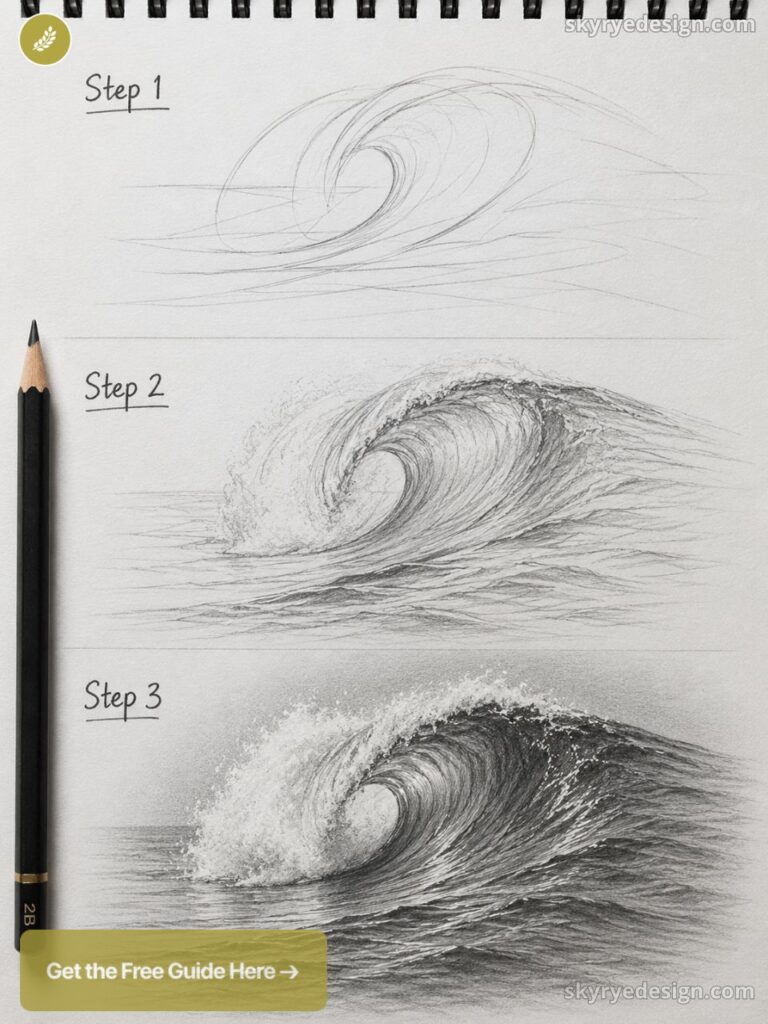
That was the issue. I was treating the ocean like a pattern instead of a subject. Repeating wave shapes across the page. Filling gaps with blue. Calling it done. But water doesn’t work like that. Light passes through thinner parts of a wave and turns them translucent. Foam isn’t really white — it looks white because the water around it is darker. And the horizon almost never sits at the same tonal value as the foreground.
For a slower study of value, cast shadows, and reflected light, this value and shadow shading guide pairs well with ocean drawing practice.
Those details sound small until you leave them out. Then suddenly the whole thing stops looking like an ocean and starts looking like blue squiggles.
That’s what this guide fixes.
We’ll start simple: horizon lines, calm water, basic wave shapes. If the scene needs a foreground subject, a palm tree drawing step by step pairs naturally with ocean practice because the trunk, sand line, and horizon all support the same composition. Then build toward the harder stuff — breaking surf, foam, spray, darker water underneath. Storm scenes work differently than calm seas. Underwater scenes are their own headache entirely. So they’re covered separately.
And materials matter more than people think. Graphite handles subtle value shifts beautifully. Ink forces you to simplify. Colored pencils can make water glow… or look muddy if you overwork them. I learned that one the annoying way.
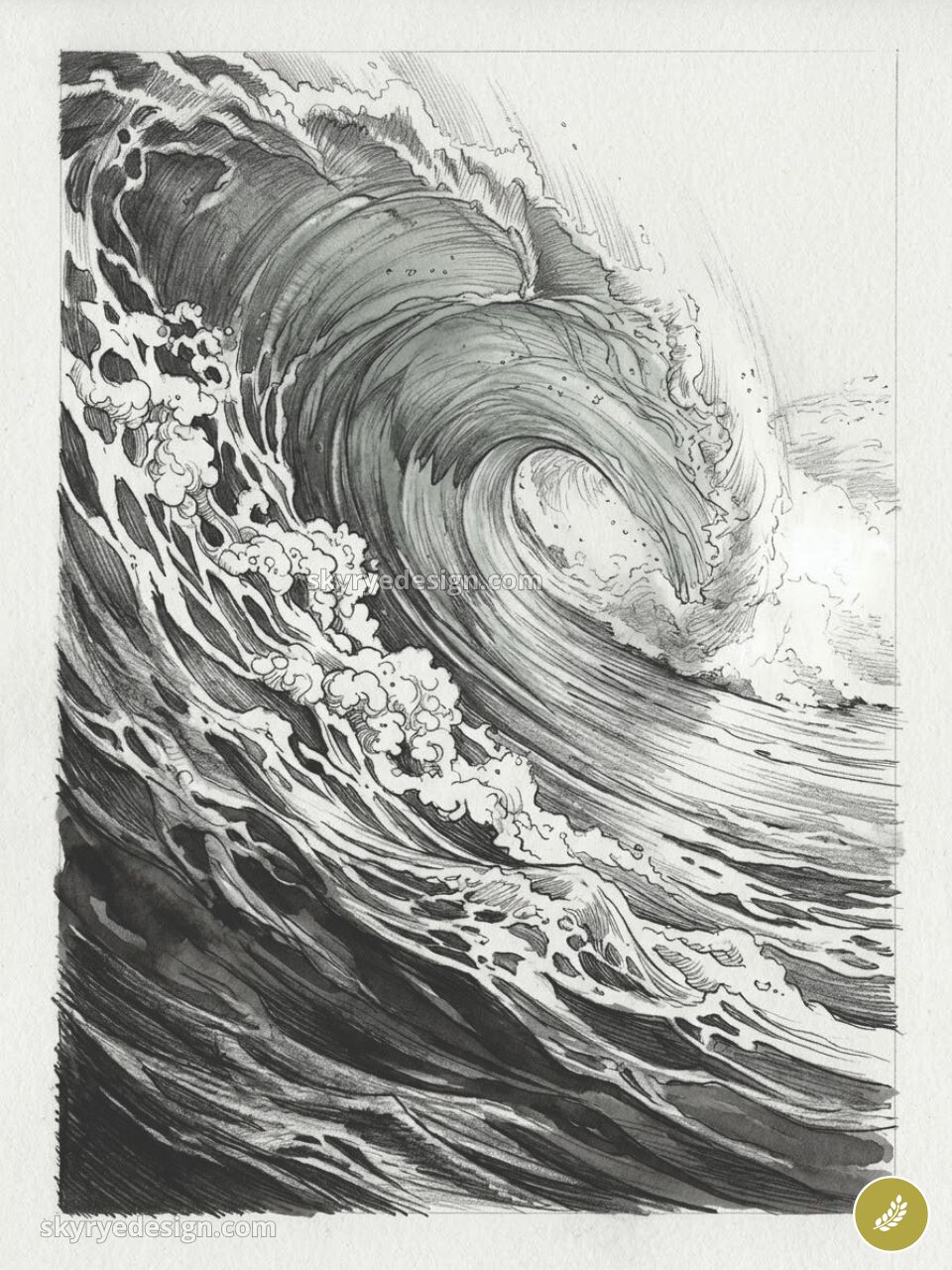
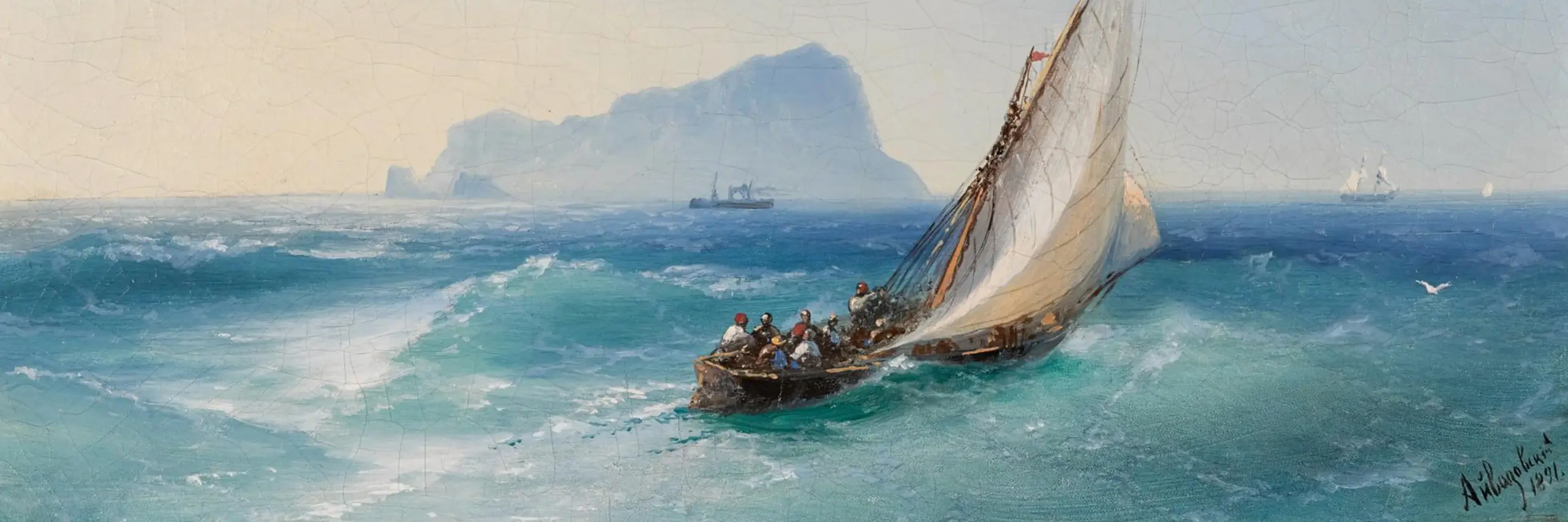
When I study drawing water, I try to simplify the ocean into three questions before adding detail: where is the light, where is the deepest value, and which edges should stay soft? That habit matters more than copying every ripple. Aivazovsky paintings are useful to study here because the drama often comes from big value masses first, then small foam and spray notes on top.
Why Ocean Drawing Trips Up Beginners
Most things you draw follow a pretty simple agreement.
Find the edges. Shade the form. Figure out where the light hits. Done.
The ocean refuses to cooperate.
That’s partly why it’s frustrating. A chair stays shaped like a chair. A mountain sits still. Even messy things like trees have structure you can lock onto. Water changes every second. It reflects light and lets light through at the same time. Sometimes the edge of a wave is sharp. Sometimes it practically disappears.
And if you draw it like a solid object, it immediately starts looking wrong.
I see three mistakes come up over and over in ocean drawings. Same problems, different skill levels. Beginners hit all three at once. More experienced artists usually wrestle with one of them.
These are the things that tend to break the illusion.
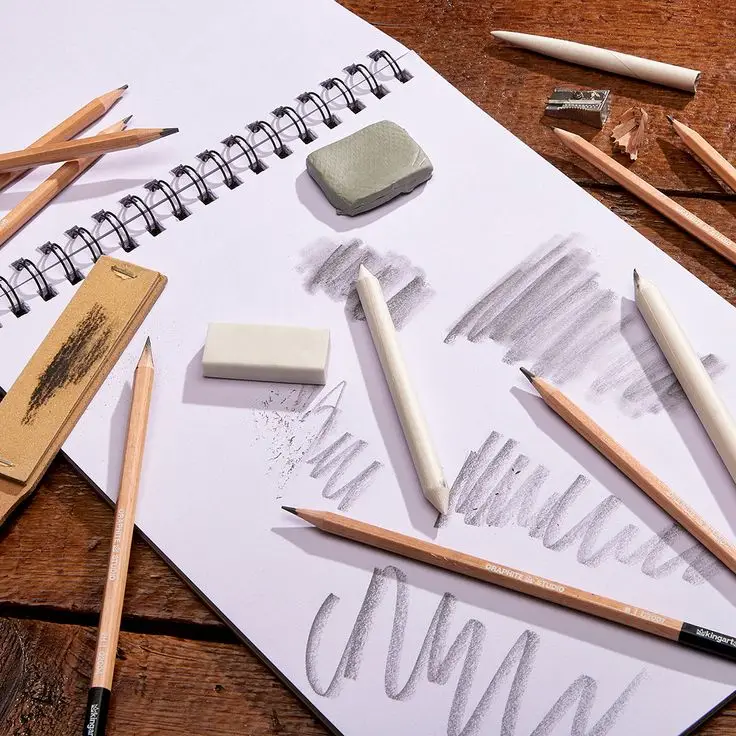
Wave studies rely on soft transitions, so your pencils, paper, and blending tools will affect the final texture as much as the drawing steps.
Water Has No Fixed Form
A wave only holds its shape for a moment before turning into something else. That’s part of what makes ocean drawing weirdly difficult. You can memorize the proportions of a face or the silhouette of a tree, but waves don’t really repeat themselves.
A lot of beginners try copying the outline of a single wave and wonder why the next one looks wrong. The better approach is understanding what a wave is actually doing.
A wave isn’t just water pushing forward. It’s energy moving through water. The water itself rotates in loose circular patterns as the energy passes through. Once you understand that movement, the structure of a wave starts making more sense — where the curve thickens, why the crest folds over, why some areas catch light and others stay dark.
That shift matters. Instead of copying one photo exactly, you can start building believable waves from scratch because you understand what the water is doing underneath.
Light Behaves Differently in Water
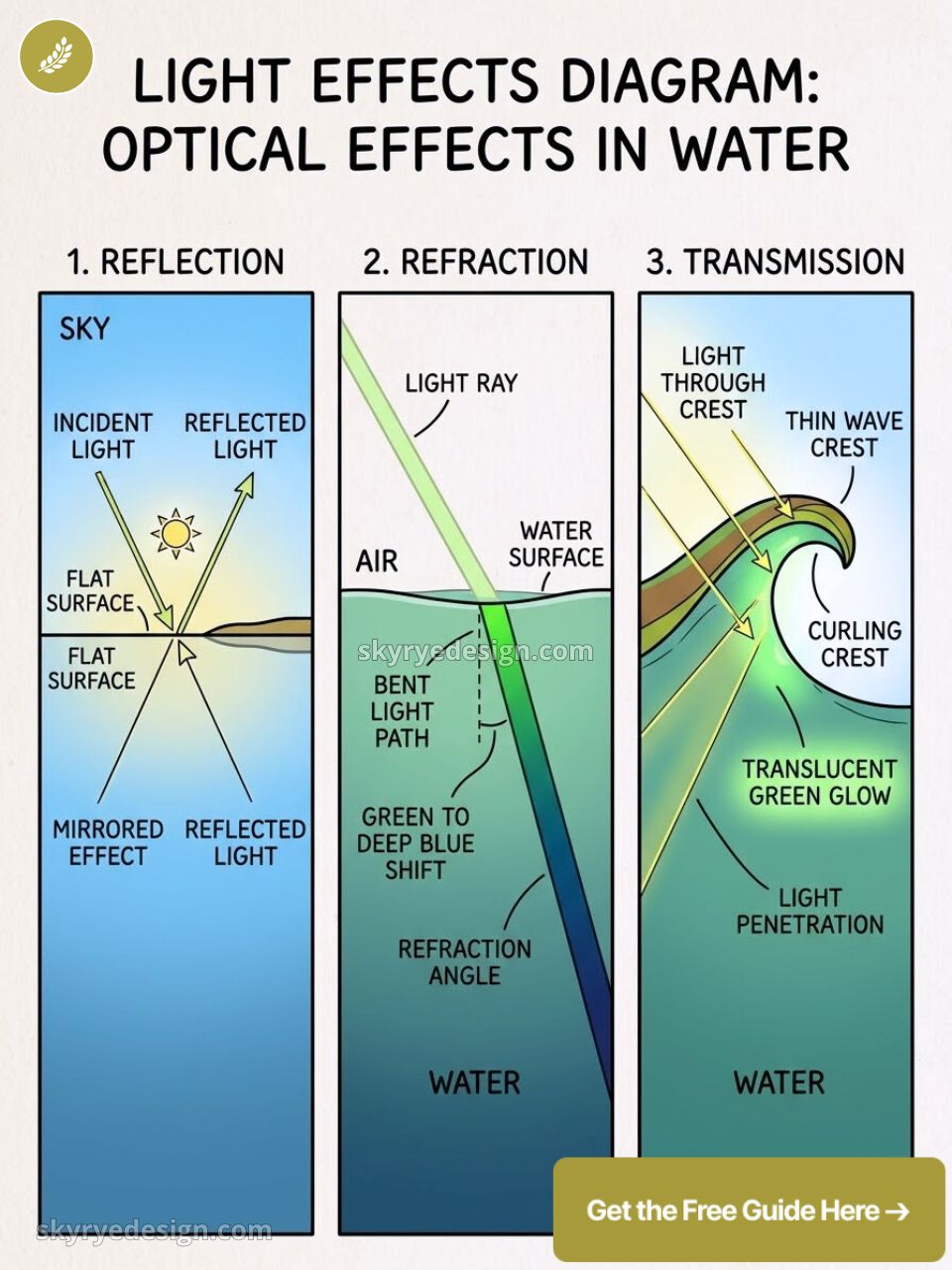
Ocean drawing requires understanding three optical effects simultaneously: reflection (the sky and surroundings mirrored on the surface), refraction (light bending as it enters and exits the water, causing the apparent colour shift from green at the surface to deep blue-black below), and transmission (light passing through the wave crest, making thin sections translucent). Most beginners apply a flat blue colour to everything and wonder why it doesn’t look like water. Differentiating these three effects — even roughly — is what makes the drawing read as ocean rather than blue paint.
Foam and Spray Are Subtractive, Not Additive
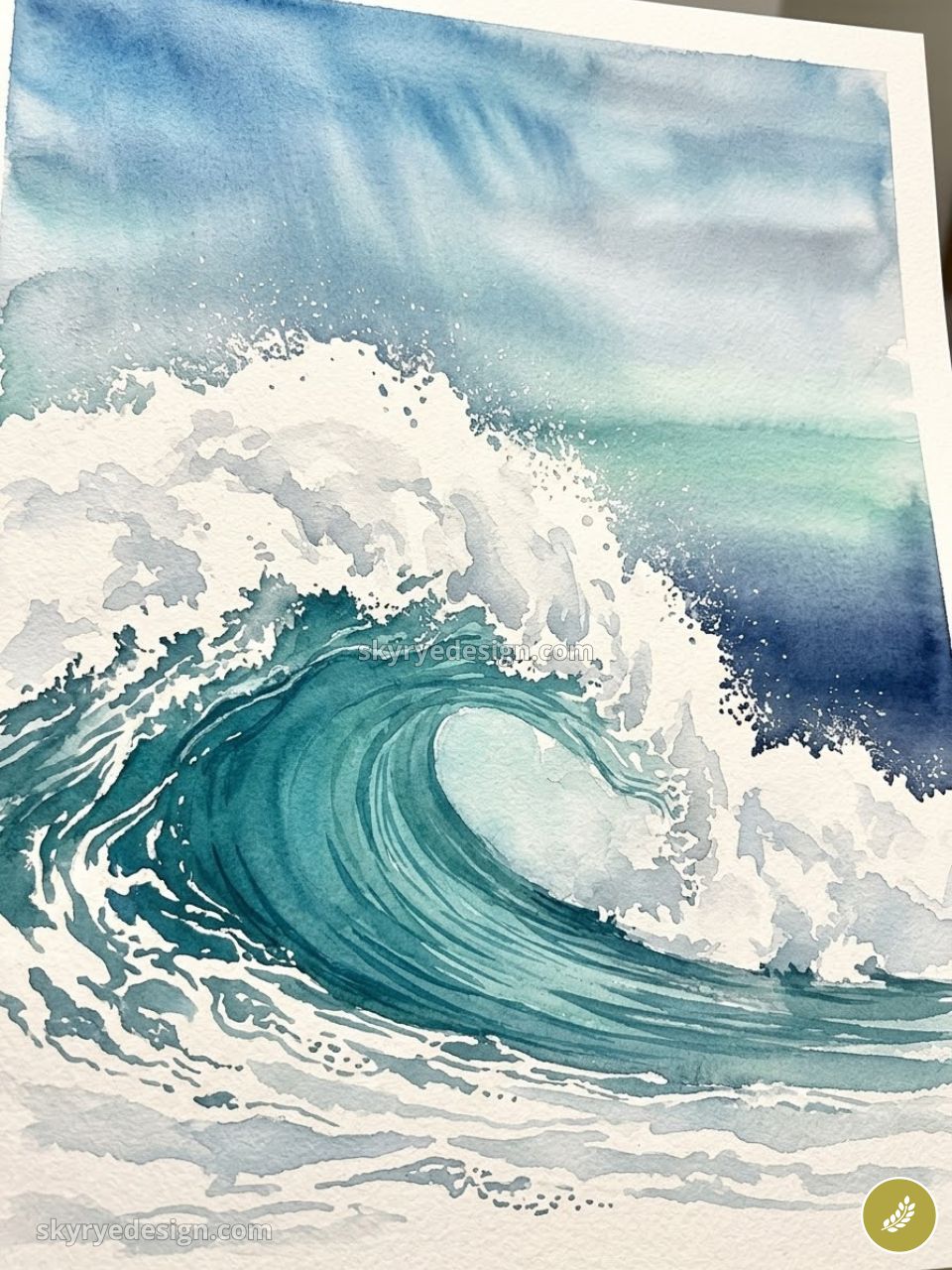
Beginners try to draw foam by adding white marks on top of blue water. This produces a flat, unconvincing result. The absence of dark water creates real sea foam — it’s where the water has been aerated into millions of tiny bubbles that scatter light in all directions. In pencil or ink work, foam is created by reserving white paper (or lifting colour) and then applying mid-tone and shadow within the foam mass to give it three-dimensional form. The white of the paper is the foam; the drawn marks define its shape.
✏ Pro tip: Before starting any ocean drawing, spend two minutes deciding on three things: light source direction, time of day (which determines colour temperature and contrast), and water state (calm, choppy, breaking, stormy). These three decisions determine every tonal and colour choice that follows. Change any one of them, and you have a different drawing.
Materials: What to Use and Why
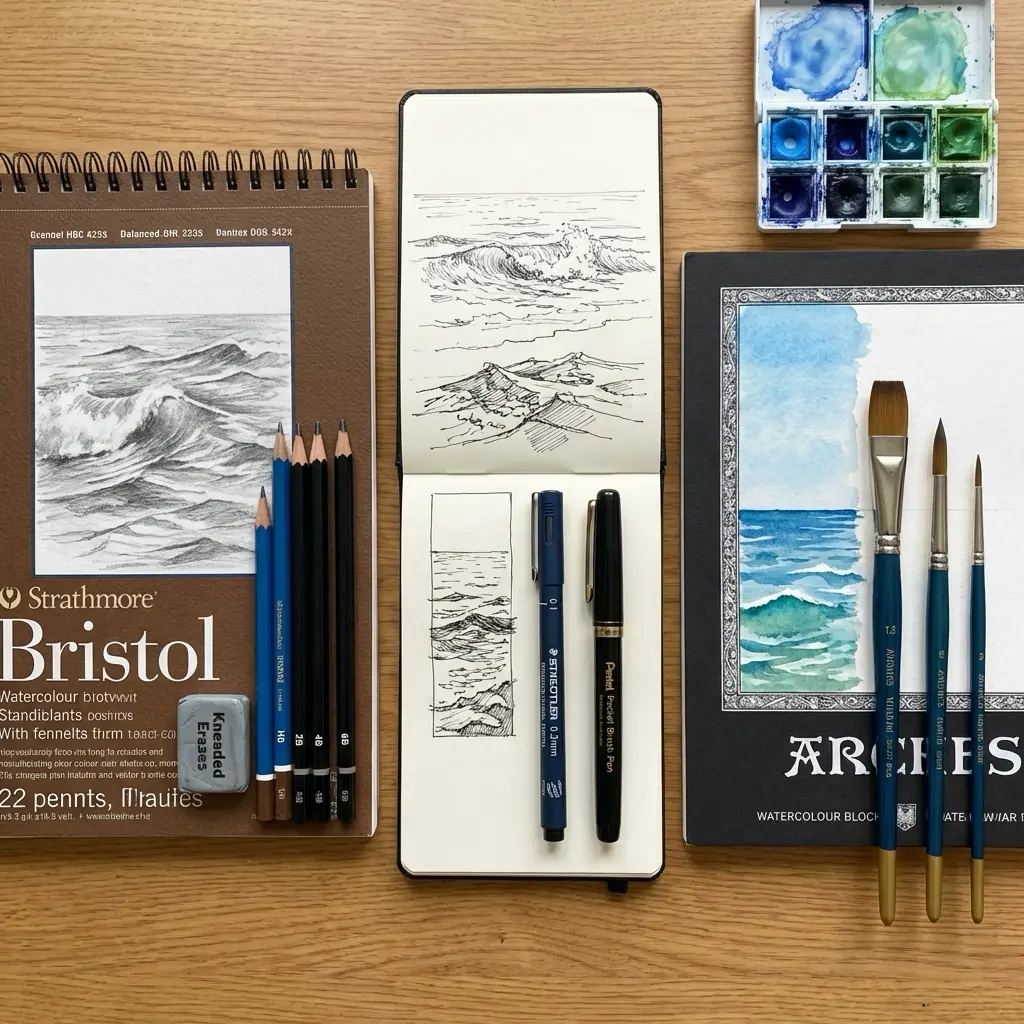
Medium choice matters more in ocean drawing than in almost any other subject, because different media have fundamentally different approaches to white (foam, spray, highlights). Here’s what works for each approach:
Beginner drawing kit
Want to turn these ideas into real sketchbook practice?
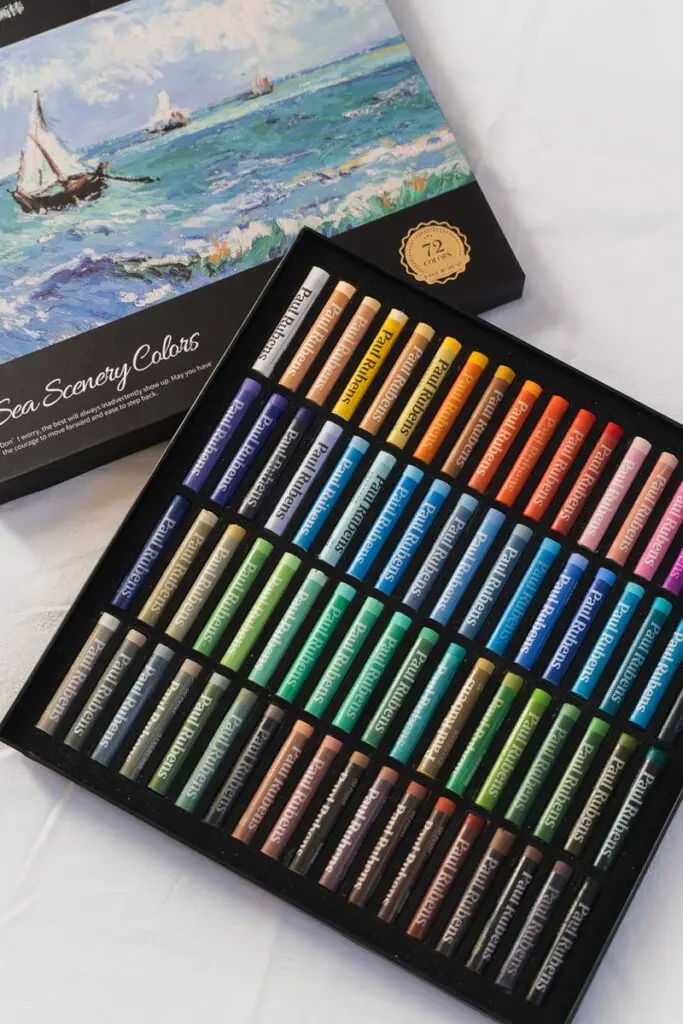
If you are working through this list, a few simple supplies will make the process easier: a sketchbook, graphite pencils, eraser, fineliners, and optional colored pencils for finishing your favorite drawings.
This article may contain affiliate links. As an Amazon Associate I earn from qualifying purchases.
Pencil (graphite)
Best for studies, wave structure practice, and tonal work. Use HB for light construction lines, 2B–4B for mid-tones, and 6B for deep water and shadow. A kneaded eraser (Faber-Castell, ~$3) is essential — you’ll use it to lift marks and create foam texture by pressing it into the 2B layer. Strathmore Bristol 300 (~$18 for a 9×12 pad) or Canson XL are the right paper choices; smooth surface for clean tonal blending, heavy enough (270gsm for Bristol) to handle eraser work without surface damage.
Ink and Pen
Ink gives the cleanest, most graphic ocean drawings. Use a Staedtler Pigment Liner 0.3mm (~$4) for wave structure and 0.1mm for foam detail. A brush pen (Pentel Pocket Brush Pen, ~$12) handles tonal variation in the deep water areas beautifully. The key technique: work from light to dark, leaving white paper for foam and wave crests. You can’t correct ink mistakes, which forces you to plan the tonal structure before drawing — a discipline that actually improves ocean drawings significantly.
Watercolour
Watercolour is the natural medium for ocean drawing — fluid, transparent, and capable of the colour shifts from surface to depth in a single wet wash. Use 140lb cold-press watercolour paper (Arches or Fabriano, ~$20 for a small block) minimum; lighter paper buckles when wet and ruins wash effects. The white foam problem is solved by reserving white paper during the initial wash, then adding mid-tone shadows within the foam to model it three-dimensionally. A size 12 flat brush for the sky and large water areas; a size 6 round for wave detail; a size 2 for foam edges and spray.
✏ Pro tip: For beginners, start with a pencil on smooth Bristol paper. The ability to erase and rework construction lines is more valuable in the early stages than the expressive qualities of ink or watercolour. Move to ink or watercolour once you can draw a convincing wave outline in pencil without erasing more than twice.
Understanding Ocean Anatomy Before You Draw
These are the structural facts about waves and water that will inform every drawing decision:
Wave Anatomy
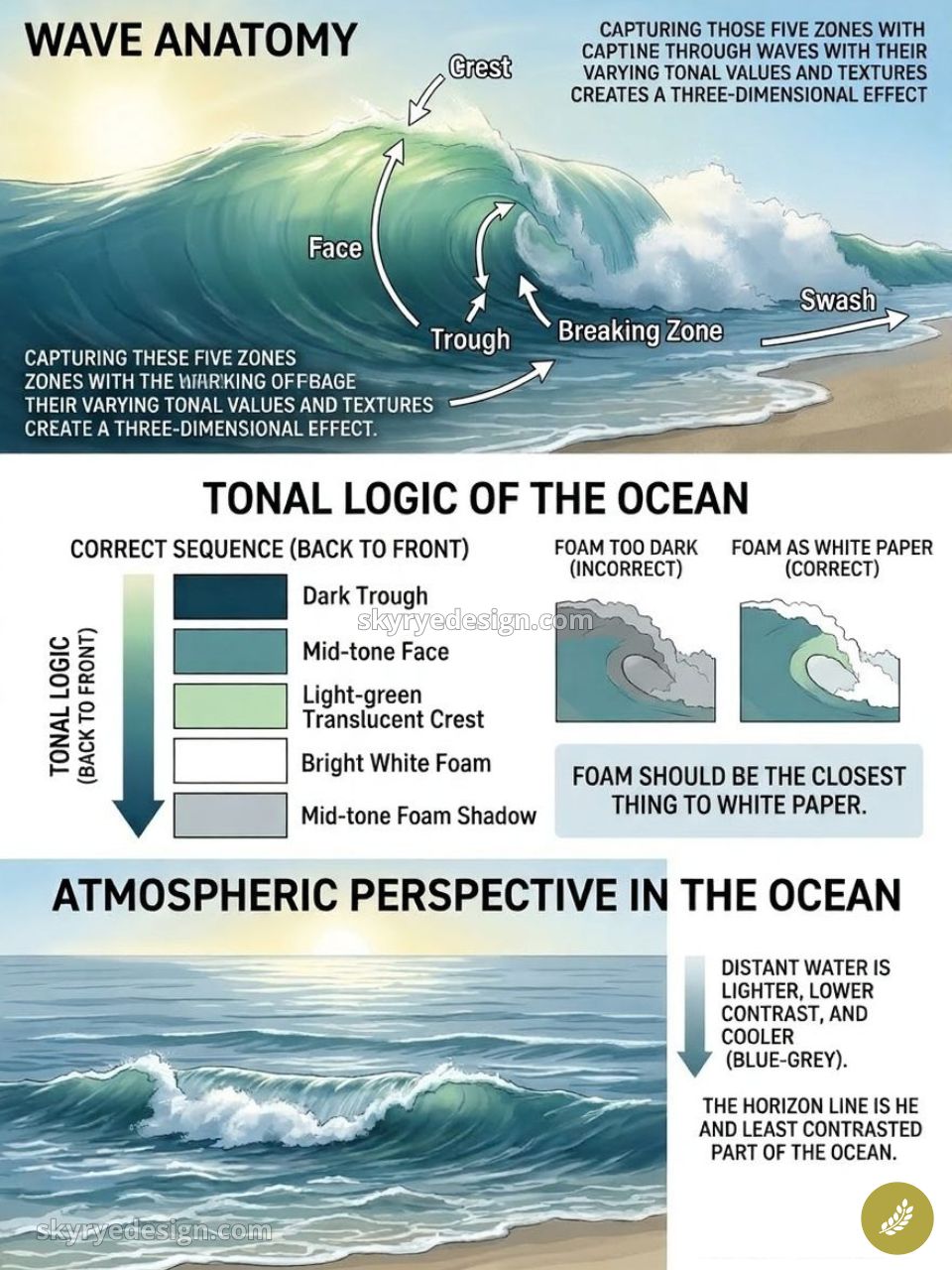
Every wave has five distinct zones: the crest (the highest point, often translucent in sunlight), the face (the forward-sloping surface of the wave), the trough (the lowest point between waves, darkest in tone), the breaking zone (where the wave curls over and foam forms), and the swash (the thin sheet of water that runs up the beach after breaking). Each zone has a different tonal value, different texture, and behaves differently in light. Drawing all five accurately is what makes a wave drawing read as three-dimensional rather than flat.
Tonal Logic of the Ocean
The most important tonal rule in ocean drawing: deep water is dark, shallow crests are light, and foam is the lightest value of all. This means the tonal sequence from back to front of a breaking wave is roughly: dark trough → mid-tone face → light-green translucent crest → bright white foam → mid-tone foam shadow. The same value logic appears in waterfall drawing: foam and falling water should stay lighter than the rock shadows around them. If this sequence is reversed anywhere in the drawing, the water starts to look muddy instead of reflective.
Atmospheric Perspective in the Ocean
Just as in landscape drawing, the ocean follows atmospheric perspective: distant water is lighter in tone, lower in contrast, and cooler (more blue-grey) in colour than foreground water. The horizon line itself is typically the lightest and least contrasted part of the ocean.
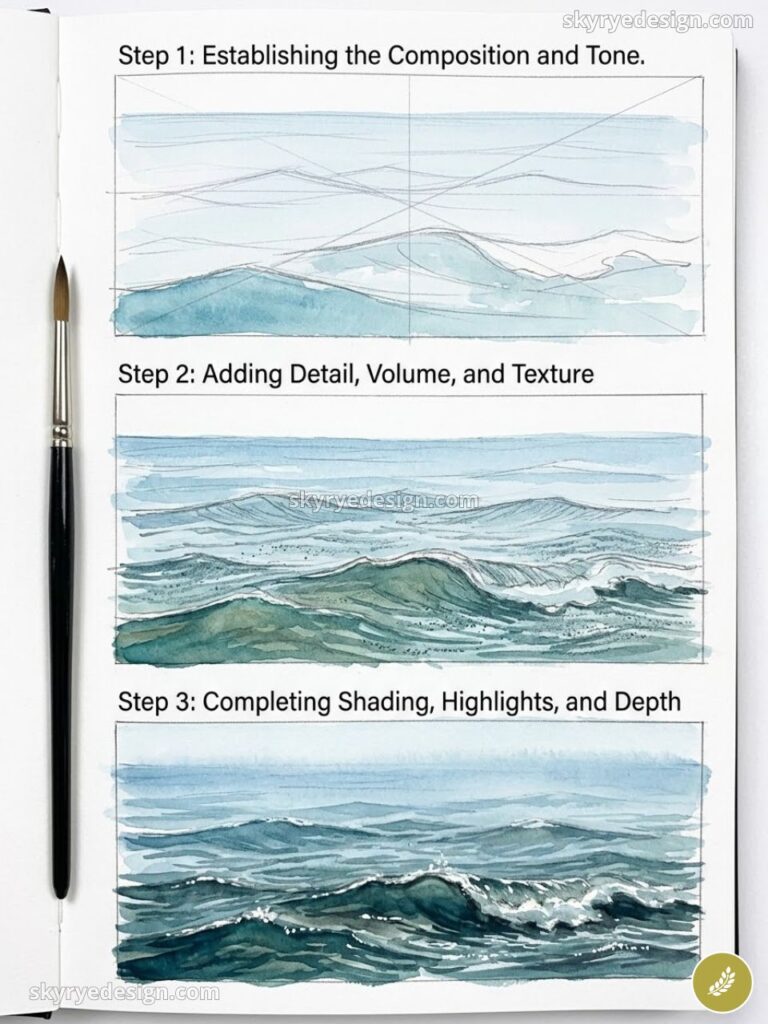
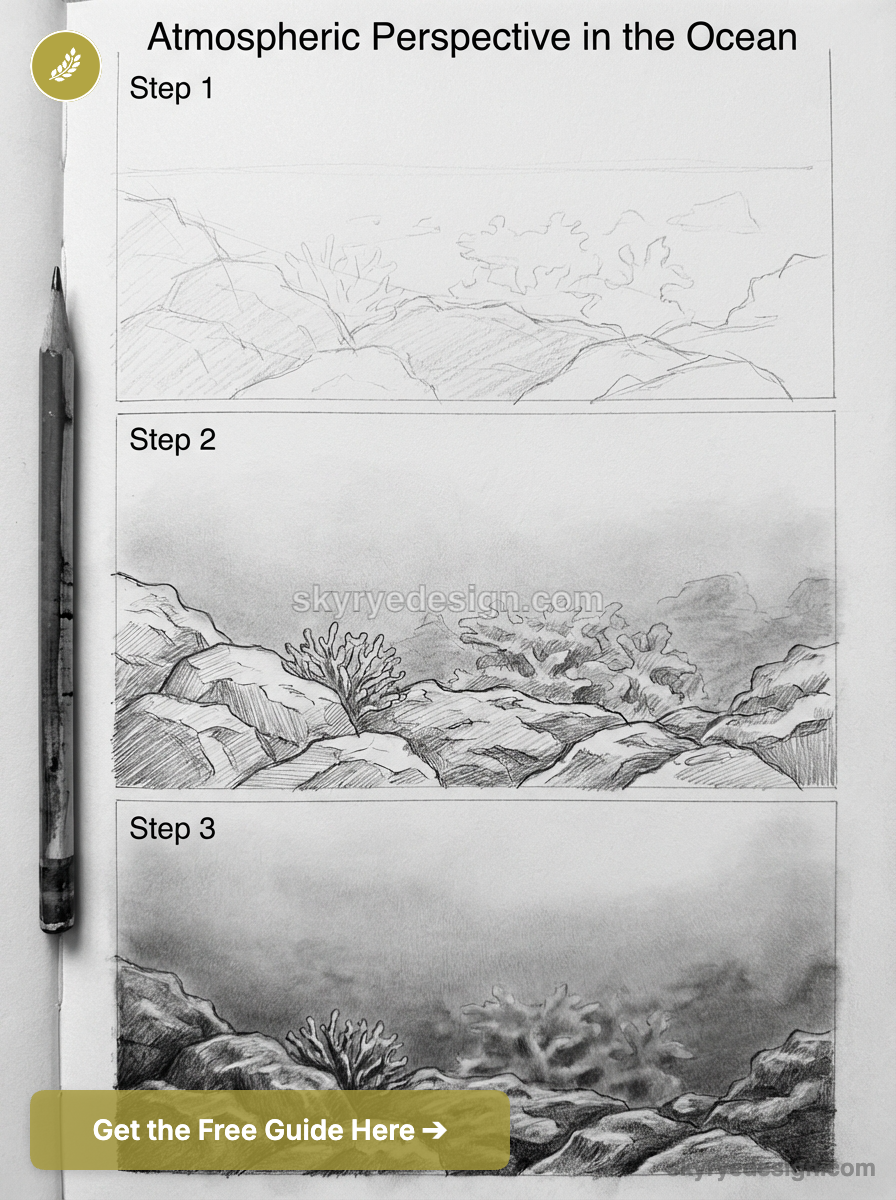
Waves in the distance appear as thin horizontal bands with minimal texture; foreground waves show full volume, texture, and tonal range. Ignoring this gradient — drawing all waves with equal detail and contrast — is what makes ocean drawings look flat and schematic.
Turn these ideas into real sketchbook practice
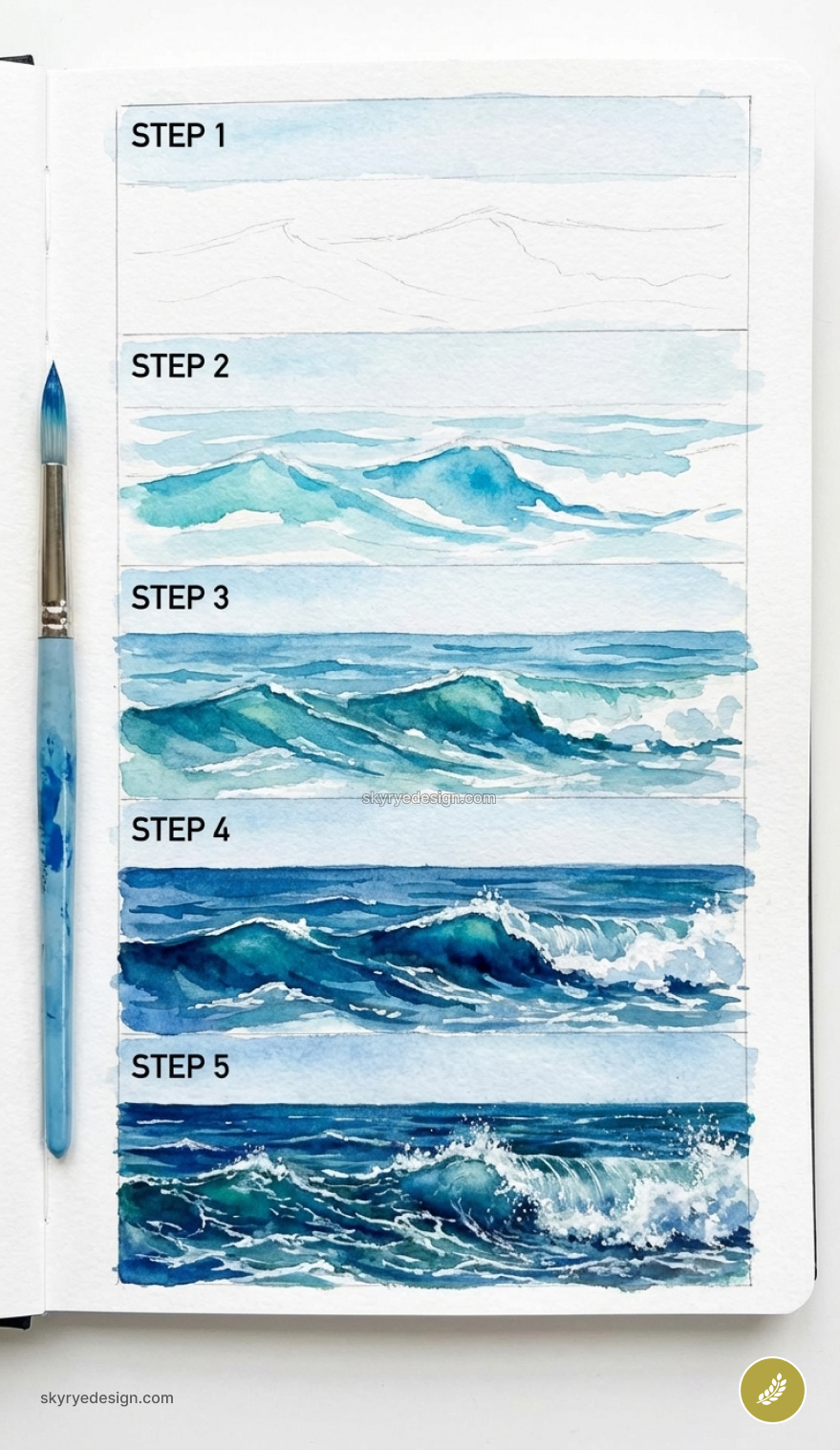
How to Draw the Ocean: 5 Steps
This sequence works for a pencil drawing of a breaking wave from a beach-level viewpoint — the most common and most useful composition for building ocean drawing skills.
Step 1: Establish the Horizon and Tonal Zones
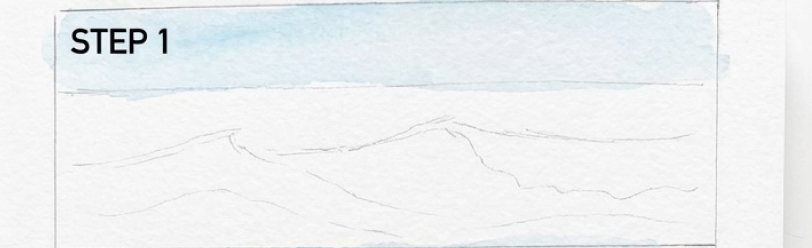
Draw a single horizontal line roughly one-third from the top of your paper. This is the horizon — the dividing line between sky and sea, and the lightest tonal area in the drawing. Now lightly indicate three tonal zones below it with horizontal banding: the distant ocean (lightest, just below the horizon), the mid-ground (medium tone), and the foreground water (darkest, with the most contrast and texture).
These bands don’t need to be neat — they’re just reminders of the tonal logic. Above the horizon, leave the sky largely blank for now; you’ll return to it last. The horizon’s height on the page determines your viewpoint: high horizon = looking down at the water; low horizon = near water level, which gives a more dramatic, immersive feeling.
Step 2: Sketch the Wave Structure
In the mid-ground or foreground band, draw the main wave. Start with the wave’s spine — a single curved line that defines the crest from one edge of the paper to the other. This line is not a simple arc; it rises, peaks, and drops unevenly, because no wave is perfectly symmetrical. From the crest, sketch the face of the wave as a curved surface dropping away from the viewer.
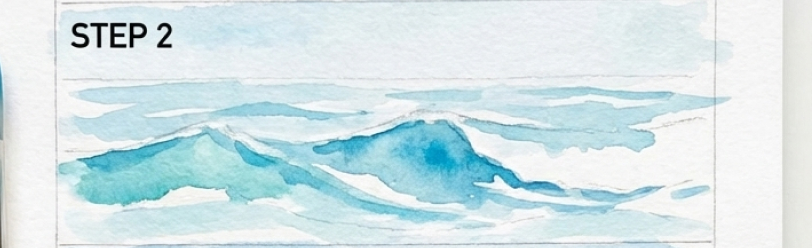
The face angles backward slightly at the top (just before the crest curls over) and forward toward the bottom. The trough in front of the wave is a shallow, curved depression. Mark the breaking zone at the crest — the point where the wave curls forward to form foam. At this stage, you have a structural skeleton: crest line, face surface, and trough. No foam yet, no texture yet, no shading.
✏ Pro tip: The most common wave structure mistake: drawing the crest as a flat horizontal line. A real wave crest has a pronounced three-dimensional curve — it’s higher in the centre and lower at the edges, and it angles forward at the top where it’s about to break. Sketch the crest as a ribbon folding forward, not a flat edge.
Step 3: Build Tone — Deep Water First
Begin tonal work with the deep water: the trough in front of the wave, and the ocean behind it. These are the darkest areas in the drawing. Use your 4B or 6B pencil with directional strokes following the water surface — horizontal for flat water, slightly curved following the wave surface for the face. Don’t press hard; build tone in layers.
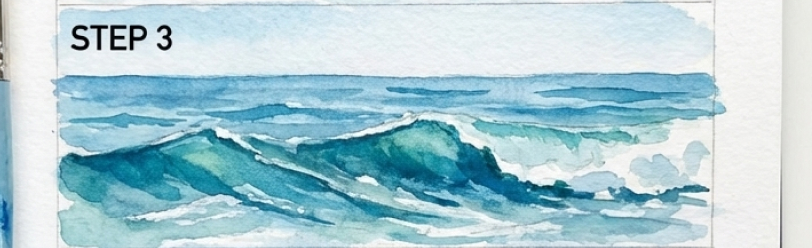
The ocean behind the wave (above the crest) should be significantly lighter than the trough — it’s in the distance. The wave face itself is mid-tone, lightening toward the crest where the water thins and becomes translucent. At the crest, the paper should be almost bare — leave it white. This is the counterintuitive part: the highest point of the wave is the lightest, not the darkest.
Step 4: Draw the Foam
Foam is drawn by defining its shadows, not its lit surfaces. The white paper is the foam. Your job is to add mid-tone and shadow values within the foam mass to give it three-dimensional form. Foam in a breaking wave is not a flat sheet — it cascades in irregular lobes and channels, with some areas raised above others.
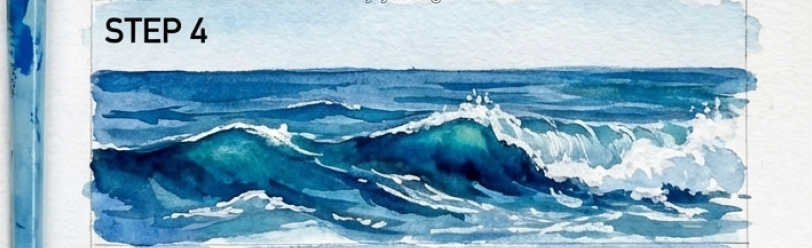
Use your 2B pencil to sketch the shadow side of each foam lobe (the underside and the sides facing away from the light). The foam at the base of the wave — where it runs across the beach or the trough — picks up reflected light from the wet sand underneath and is slightly warmer in tone than the foam at the crest. Use your kneaded eraser pressed into the 2B layer to lift soft highlights within the foam where light hits the bubble surfaces directly.
Step 5: Atmospheric Depth and Final Detail
Now pull the drawing together with three finishing operations. First: deepen the foreground water.
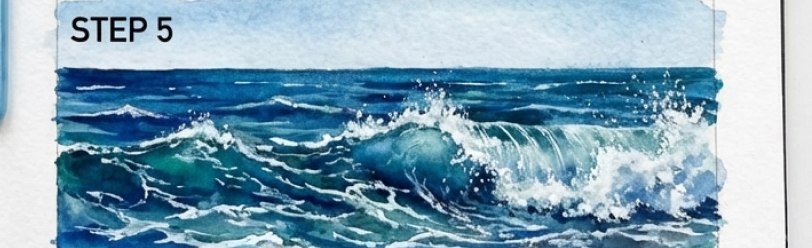
The water between the viewer and the breaking wave should be the darkest, most textured area in the drawing — add short, quick horizontal marks to suggest surface chop, and deepen the trough with your 6B. Second: lighten and simplify the background.
Four Ocean Scenes to Draw
1. Calm Sea at Sunset
The calm sea is the most forgiving ocean scene for beginners — and the most dependent on tonal subtlety. The defining visual element is the sun path: a vertical strip of light on the water’s surface that runs from the horizon toward the viewer, widening as it approaches. This path is the lightest area of the drawing; everything on either side of it is darker.
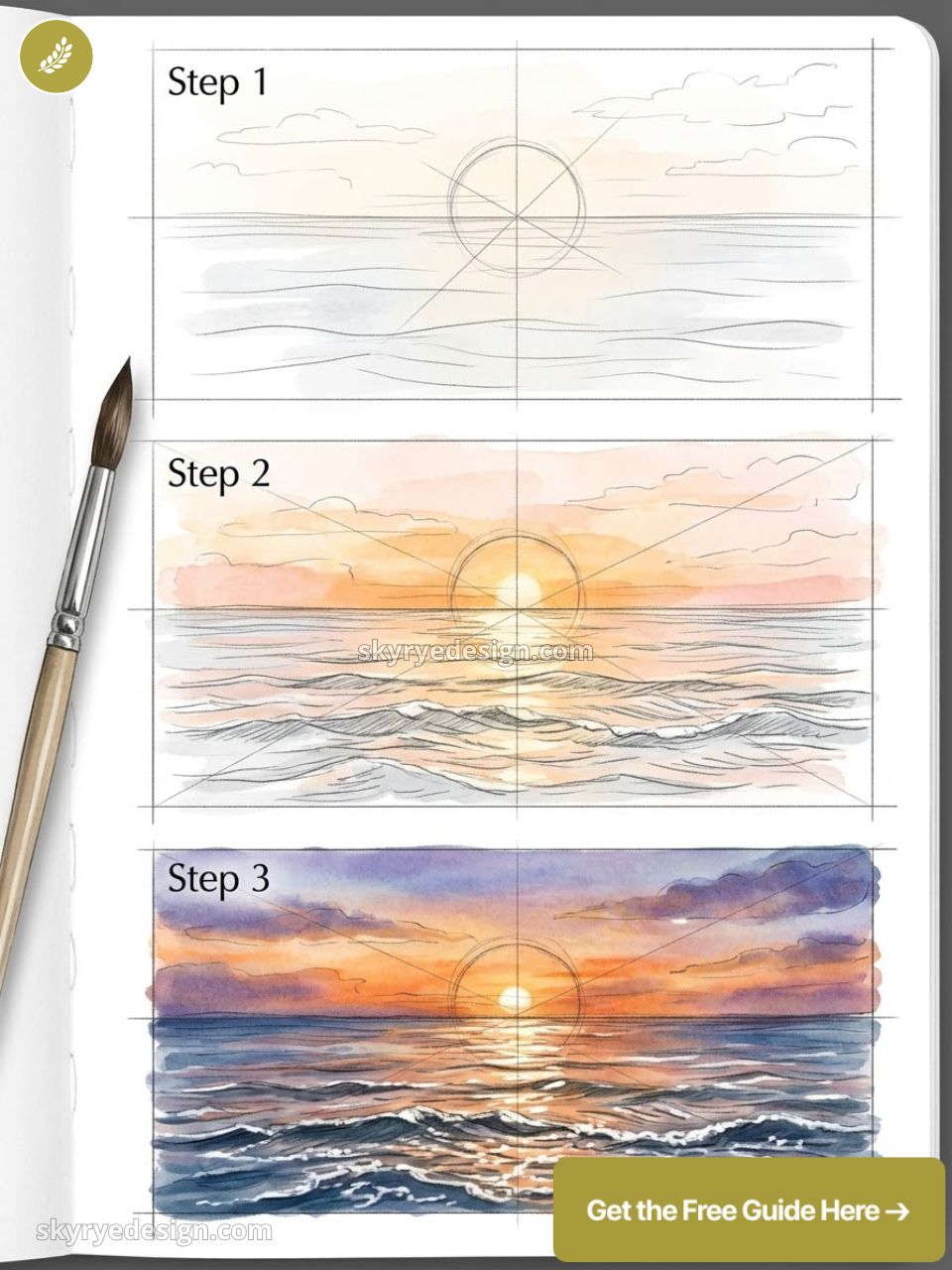
The horizon in a calm sea scene is the sharpest, most defined line in the drawing; as you move toward the foreground, the surface becomes slightly more textured with small ripples. Warm colours (orange-gold sky, warm reflections) contrast with cool shadow areas (blue-grey water away from the sun path). In pencil: the sun path is reserved on white paper; the surrounding water is 2B with gentle horizontal strokes.
2. Breaking Wave from Shore
This is the scene covered in the five-step section above, and the most technically demanding.
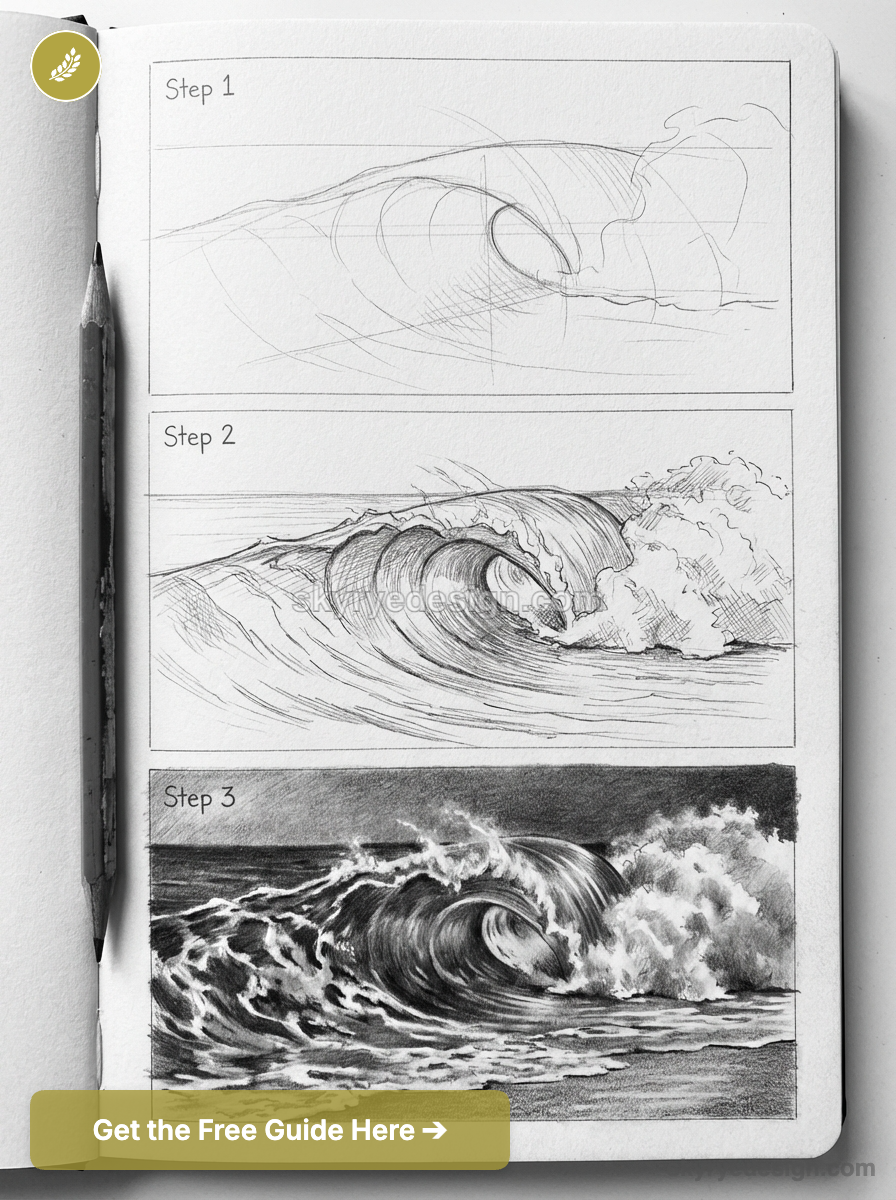
The key additional detail for this scene: the wet sand in the foreground. Wet sand reflects the sky — it’s significantly darker than dry sand and mirrors the colour of the water above it. The swash (the thin sheet of foam running up the beach) leaves a curved, slightly irregular edge where it meets dry sand, and within it, you can see refracted sky colour. The beach recedes in perspective, with the receding lines converging at the horizon.
3. Storm at Sea
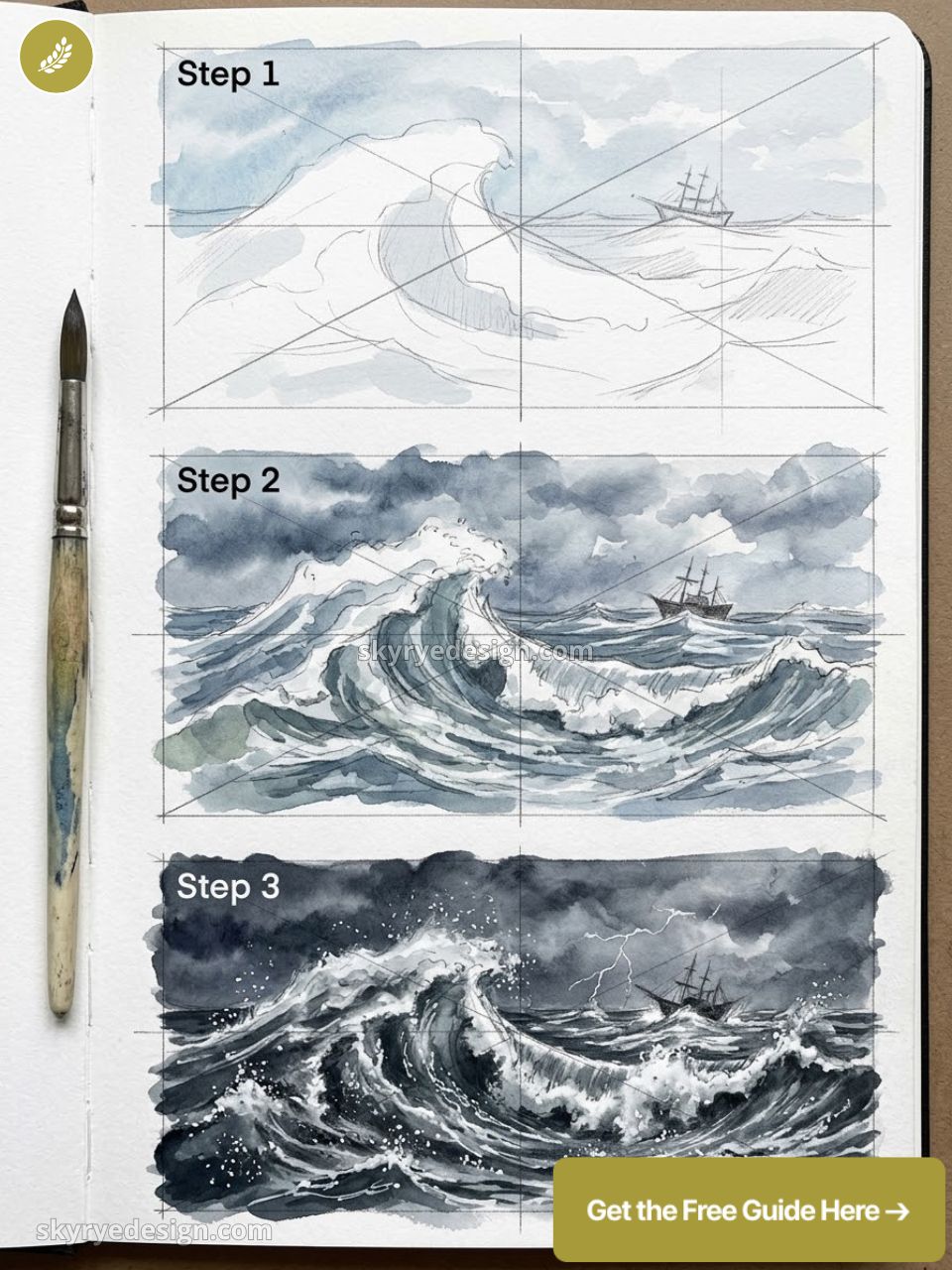
Storm ocean drawing is primarily a tonal exercise. The dominant value is dark — heavy cloud cover eliminates the translucent crest effect and flattens everything to a narrow tonal range between dark mid-tone and deep black. Waves in storm conditions are steeper, more chaotic, and topped with white spray driven horizontally by wind rather than falling vertically. Spray becomes a major visual element: horizontal streaks of white across the wave crests, drawn by reserving white paper or using a white gel pen. The horizon is indistinct — lost in haze or spray — which paradoxically makes the composition more dramatic by removing the stable reference line.
4. Underwater View
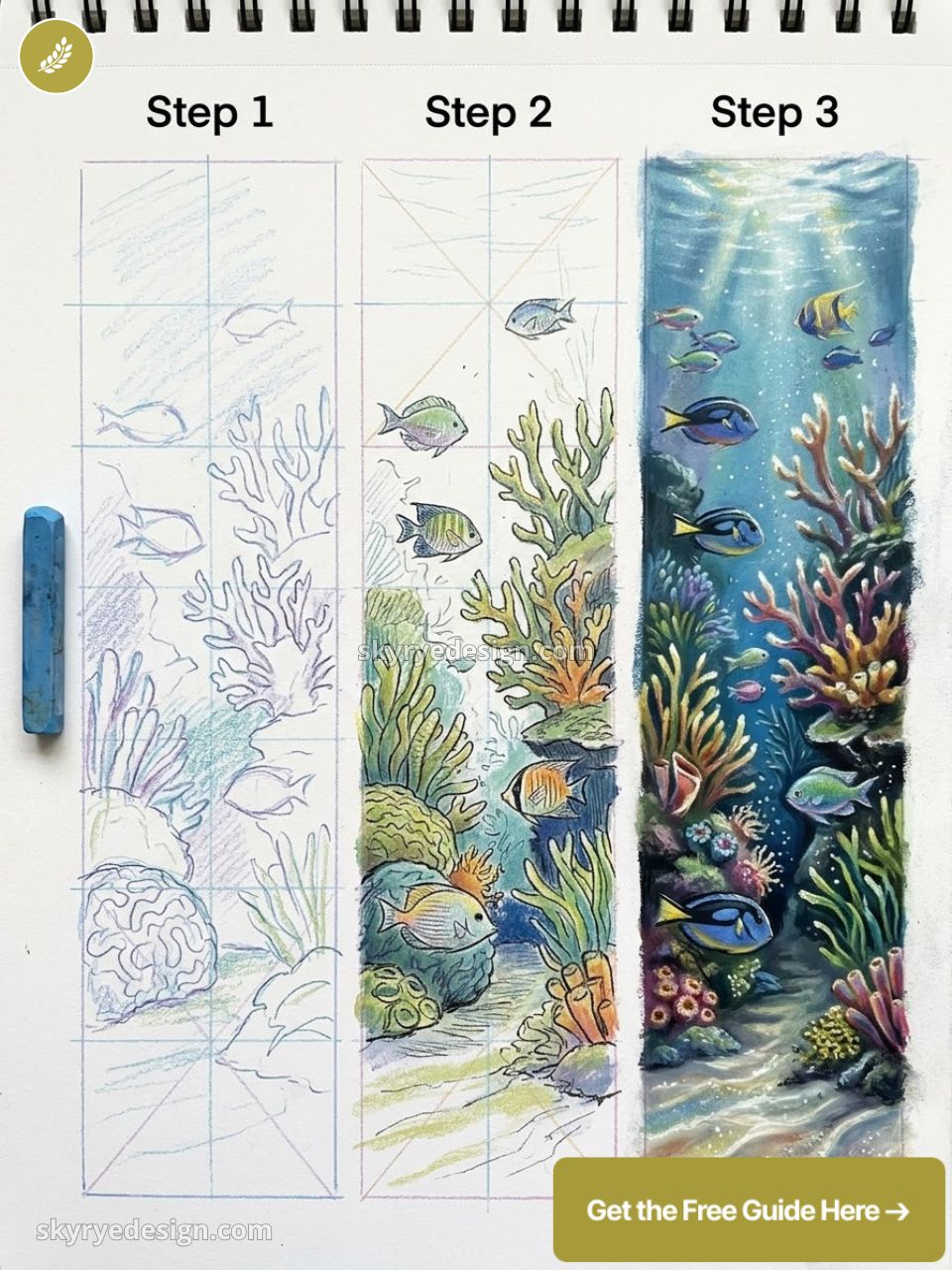
The underwater ocean drawing inverts most of the rules: the light source is above rather than behind, and the surface of the water is what’s above you, seen from below. Light enters from above as shimmering caustic patterns — the lace-like moving patterns on the seafloor caused by refraction at the surface.
Once the water and light feel believable, add one moving subject. This tutorial on how to draw a shark shows how a curved gesture line and offset fins keep the animal from looking pasted into the scene.
Draw caustics as irregular, slightly curved shapes of lighter value against the deeper background. Objects in the foreground (fish, coral, rocks) are more saturated in colour and higher in contrast than those in the distance, which fade to blue-grey. The surface from below appears as a bright, slightly wobbly plane in shallow water, or as a dark ceiling in deep water.
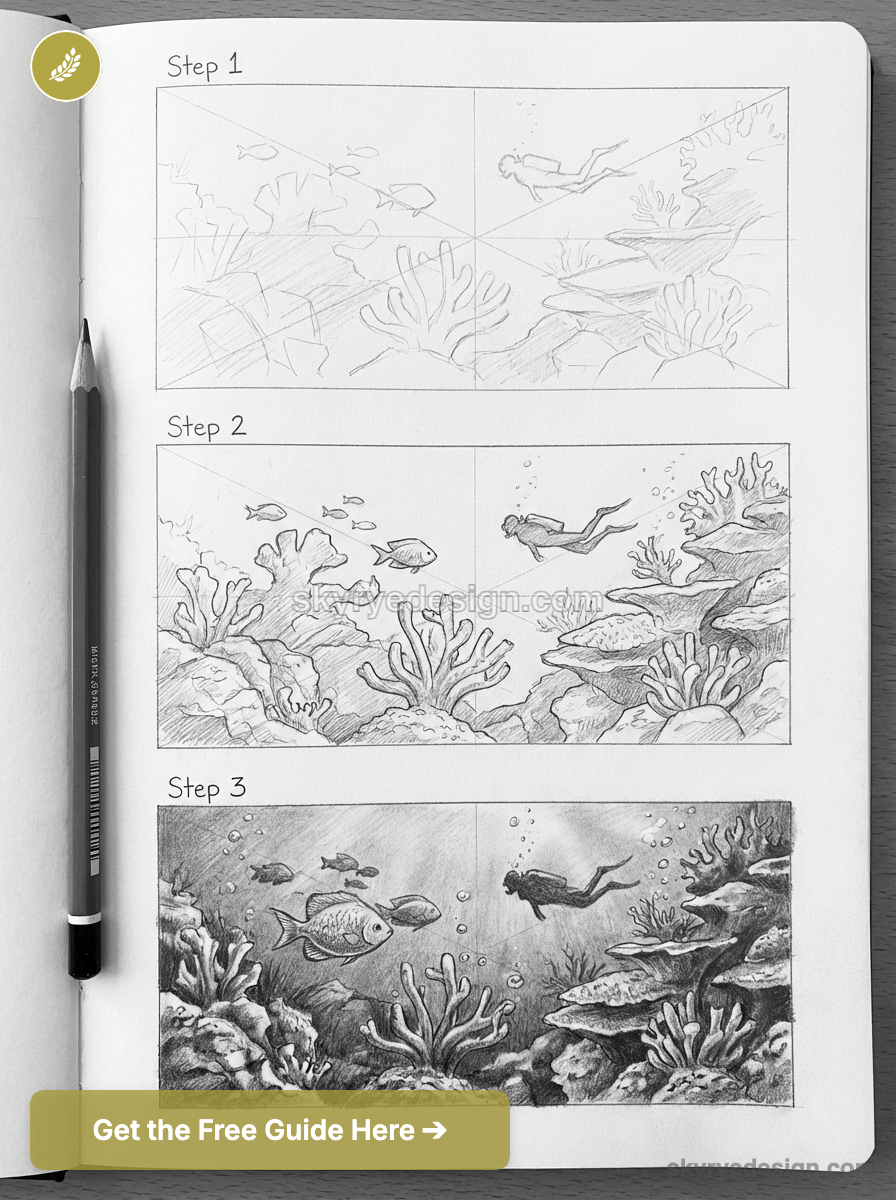
✏ Pro tip: For an underwater scene in pencil: establish the deepest water first (darkest background tone), then work forward. Draw the caustic light patterns by lifting marks with your kneaded eraser rather than leaving white paper — the soft edges of the lifted marks read as the shifting, diffused quality of underwater light more convincingly than hard-edged reserved white.
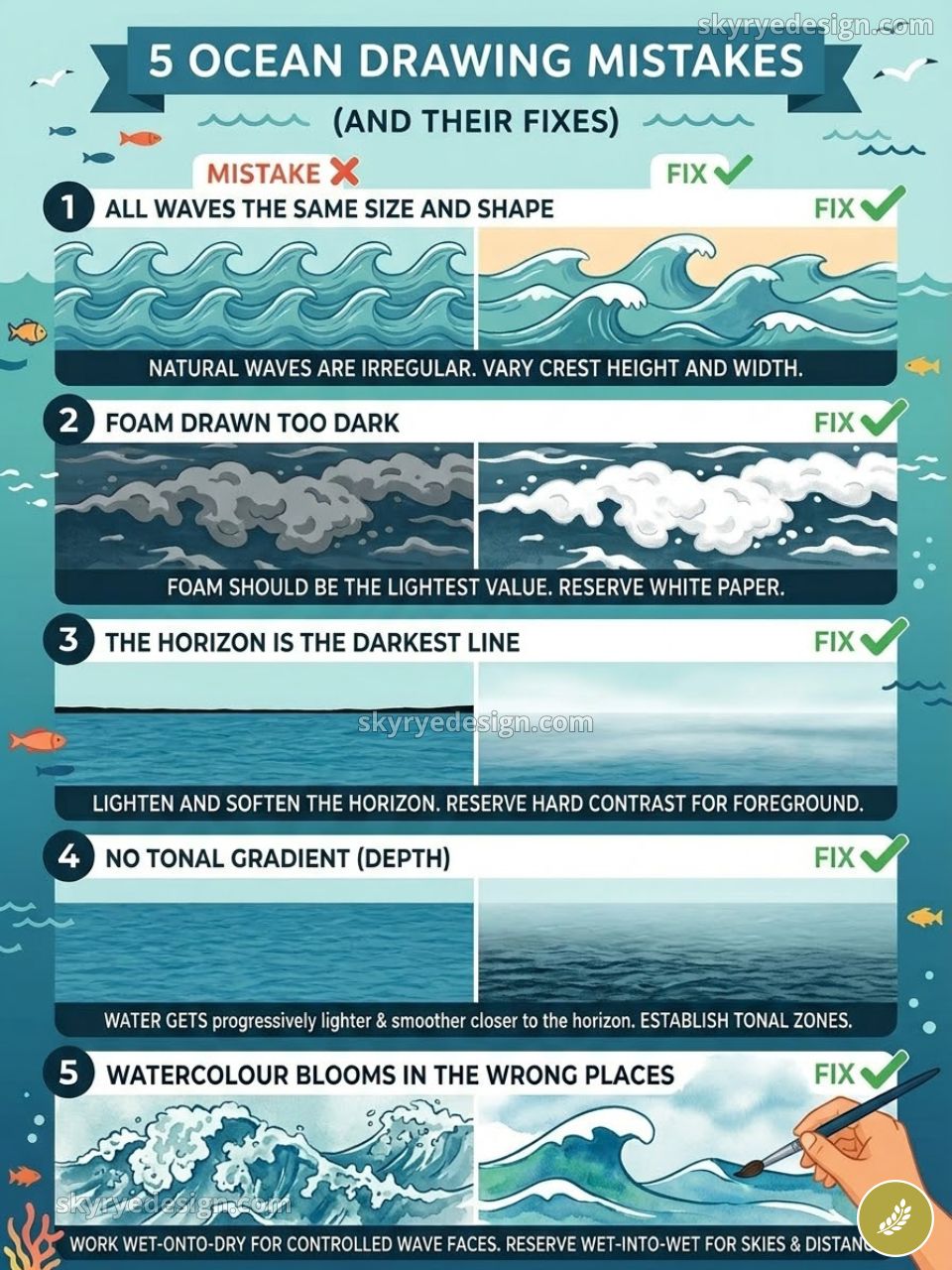
5 Ocean Drawing Mistakes (and Their Fixes)
1. All Waves the Same Size and Shape
Natural wave patterns are irregular. Waves vary in height, width, and break point even within the same swell. Drawing uniform, evenly spaced wave shapes produces a wallpaper pattern rather than an ocean. Fix: vary the crest height deliberately — some waves taller and rounder, some flatter and wider — and leave occasional gaps where one wave runs into another.
2. Foam Drawn Too Dark
Foam should be the lightest value in the drawing — lighter than the sky in most cases. If you’ve drawn foam by adding white marks over a dark base, the result will inevitably be too grey. Fix: reserve the white paper for foam from the start, then add shadow values within the foam to model its three-dimensional form. The lit surfaces of foam should be the bare paper.
3. The Horizon Is the Darkest Line in the Drawing
The horizon should be one of the lightest, least-contrasted elements in an ocean drawing — it’s the furthest point, most affected by atmospheric haze. If you’ve drawn a hard, dark horizon line, the depth of the scene collapses. Fix: lighten the horizon area with a kneaded eraser and soften the line; reserve hard contrast for the foreground.
4. No Tonal Gradient from Foreground to Background
Foreground water and distant water drawn at the same tonal value produce a flat, map-like result. The ocean should get progressively lighter, smoother, and less textured as it approaches the horizon. In my experience, beginners apply equal pressure to every part of the drawing without considering depth. Fix: Establish your tonal zones before beginning the wave detail and don’t deviate from them.
5. Watercolour Blooms in the Wrong Places
In watercolour ocean work, wet-into-wet blooms (cauliflower-shaped marks where wet paint touches a wet area) are a common accident. In some places, they’re a useful tool for cloud texture; in wave faces, they’re a disaster. Fix: for wave faces and water surfaces, work wet-onto-dry for controlled edges, reserving wet-into-wet technique for skies and distant ocean where soft edges are an advantage.
Resources Worth Having
- ‘Keys to Drawing with Imagination’ by Bert Dodson (~$20) — best single book on translating observed reality into drawing logic. The chapter on water is directly applicable.
- ‘Sea and Sky in Watercolour’ by Ronald Jesty (~$18) — the clearest treatment of atmospheric perspective and tonal structure in marine painting. Techniques translate to pencil and ink work.
- Arches 140lb Cold Press Block (~$20, 10-sheet) — worth the investment if you’re moving to watercolour. Cheap watercolour paper ruins the wash technique; the paper buckles and pigment pools in the creases.
- Uni-ball Signo White Gel Pen (~$4) — for spray and foam highlights in ink or graphite work. Use sparingly — overuse makes drawings look digitally edited.

The Blank Page and the Horizon
The ocean is one of the few subjects where the same two lines — a horizon and a wave crest — can produce completely different drawings depending on tonal decisions. That’s what makes it endlessly interesting to draw and initially frustrating to learn.
The soft-serve cone wave was about eighteen months into my drawing practice. A year after that, I understood what was wrong with it — no tonal logic, no transparency, no atmospheric gradient — and I could identify the same problem in other people’s ocean drawings at a glance. That diagnostic ability is what practice actually produces. You don’t get better at drawing the ocean by drawing it more times in the same way. You get better by understanding what the drawing is doing wrong and correcting the specific thing.
Start with the horizon line. Decide where the light is coming from. Leave the foam white.
If you want to turn wave practice into a fuller coastal scene, this beach drawing ideas guide gives you prompts for shells, palm trees, shorelines, sunsets, and beach figures.
FAQ: Ocean Drawing
Q: How do you draw the ocean step by step for beginners?
Start with a horizontal line one-third from the top of the paper — this is your horizon. Lightly indicate three tonal zones in the ocean below it: light near the horizon, medium in the mid-ground, dark in the foreground. Sketch the wave crest as an uneven curved line, the face as a sloping surface below it, and the trough as a dark curved depression in front. Apply tonal values dark-first (trough and deep water), leave the crest white, add foam shadows to model the white area three-dimensionally, then finish with atmospheric lighting toward the horizon and foreground texture. The five-step process in this guide covers each stage with specific pencil grades and techniques.
Q: What’s the hardest part of ocean drawing?
Foam. Most beginners try to draw foam by adding white marks on dark water, which produces a flat, grey result. Real foam is created by reserving the white of the paper and then adding shadow values within the foam mass to give it three-dimensional form. The second most common difficulty is the tonal gradient — making the water progressively lighter, smoother, and less textured as it recedes toward the horizon. Beginners tend to apply equal detail and contrast everywhere, which produces a flat, schematic result.
Q: What pencils do you use for ocean drawing?
HB for all construction lines and initial wave structure. 2B–4B for mid-tones on the wave face and distant water. 6B for the darkest areas — deep water troughs, shadow beneath the foam, the ocean floor in underwater scenes. A kneaded eraser (Faber-Castell, ~$3) is essential for lifting tone to create foam texture and spray. For paper: Strathmore Bristol 300 (~$18 for a 9×12 pad) or Canson XL. If adding fine white spray marks: Uni-ball Signo white gel pen (~$4)
Q: How do you draw realistic water and waves?
Realistic water drawing depends on three optical effects: reflection (the sky mirrored on the surface), refraction (the colour shift from green-blue at the surface to dark blue-black below), and transmission (light passing through thin wave crests making them translucent). Apply each effect to its corresponding zone — transmission at the crest (lightest, almost bare paper), reflection on the flat mid-ground water (sky colour), deep water tones in the trough and background. The tonal sequence for a breaking wave from back to front: dark trough, mid-tone face, light translucent crest, white foam with shadow modelling.
Q: What is the best medium for ocean drawing?
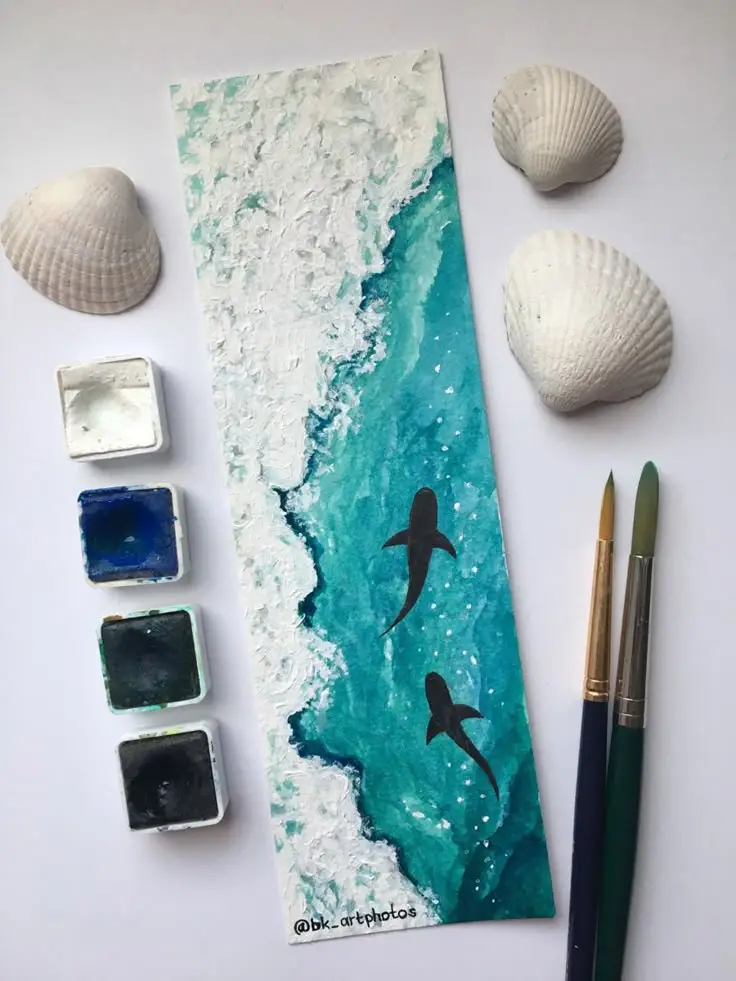
For beginners: graphite pencil on smooth Bristol paper (Strathmore 300). The ability to erase and rework is more valuable early on than the expressive advantages of ink or watercolour. For graphic, high-contrast ocean illustrations: ink with a Staedtler Pigment Liner 0.3mm and a brush pen for tonal areas. For full colour and the most fluid water effects: watercolour on 140lb cold-press paper (Arches or Fabriano). Each medium has a different approach to foam: pencil uses eraser lifting, ink uses reserved white paper, and watercolour uses reserved white paper or masking fluid.
Q: How do you draw ocean waves in ink?
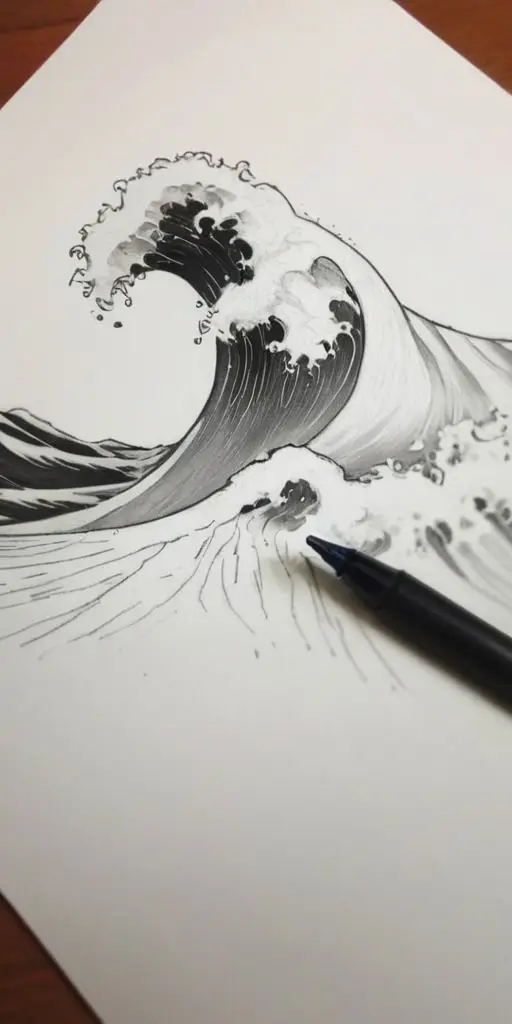
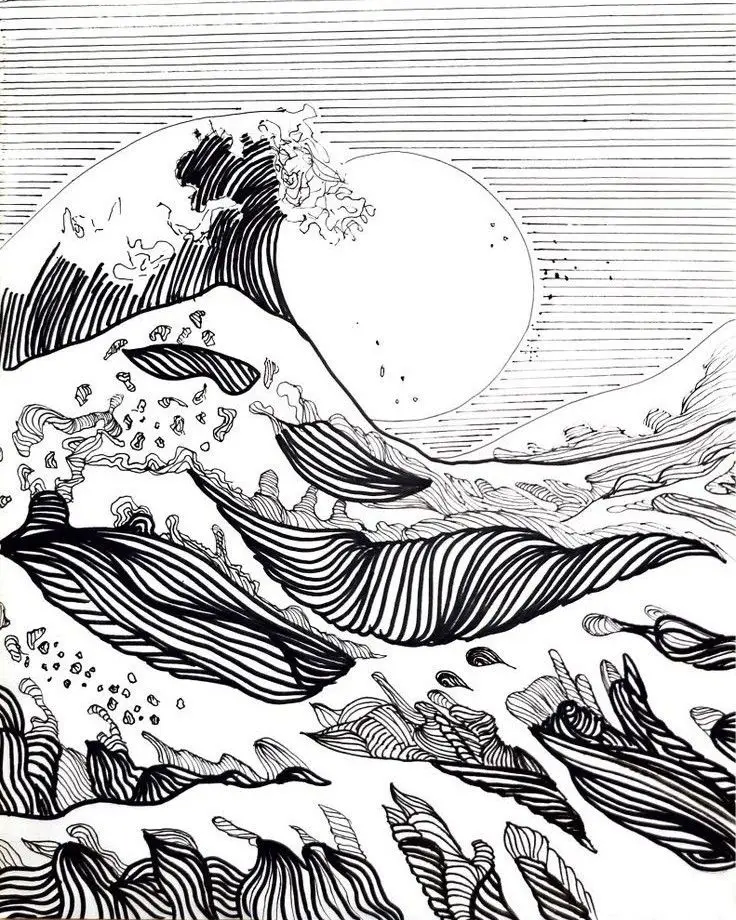
In ink, work from light to dark and never from dark to light — you can’t correct ink mistakes. Start by lightly sketching the wave structure in pencil, then ink the outline with a 0.3mm liner. Build tone in the deep water and wave face with parallel hatching lines (horizontal strokes follow the water surface). Leave white paper for the wave crest and all foam. Add deeper shadow tones with a brush pen or by increasing hatching density. Foam edges are defined by the contrast between the white paper and the inked water beside them — draw the water, not the foam.
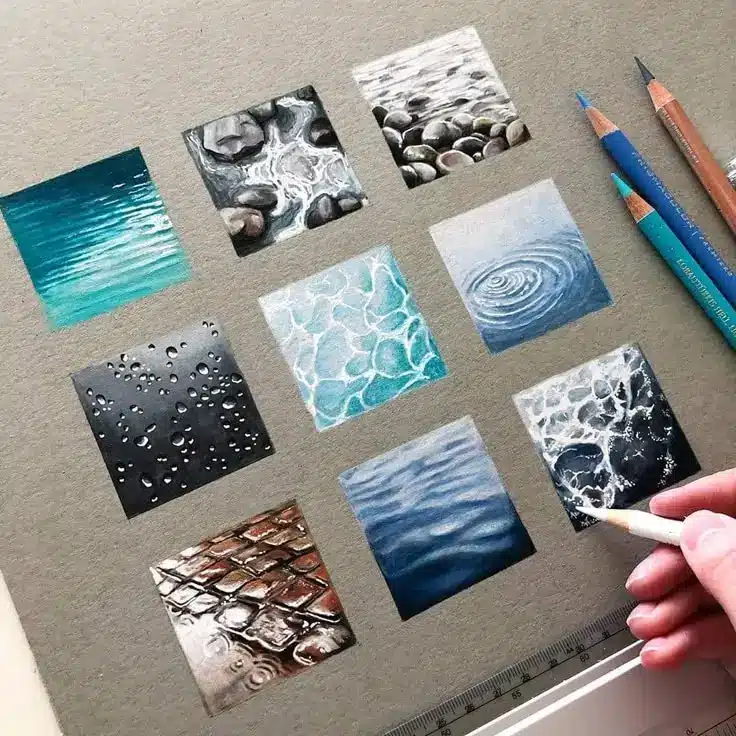
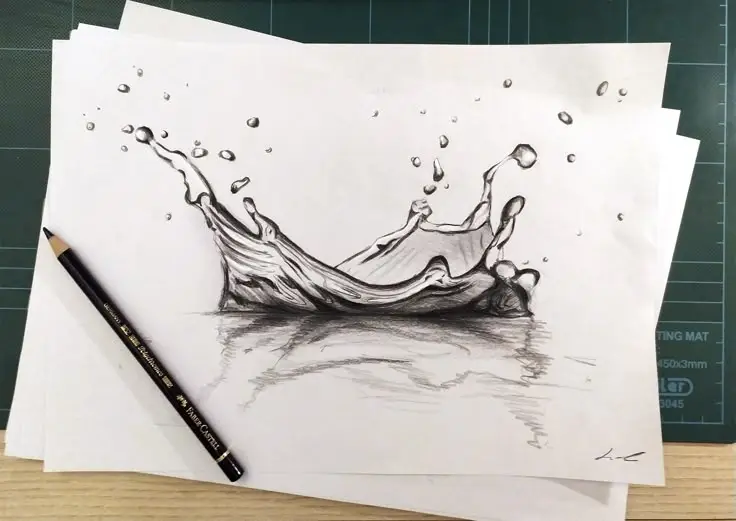
Q: What are easy ocean drawing ideas for beginners?
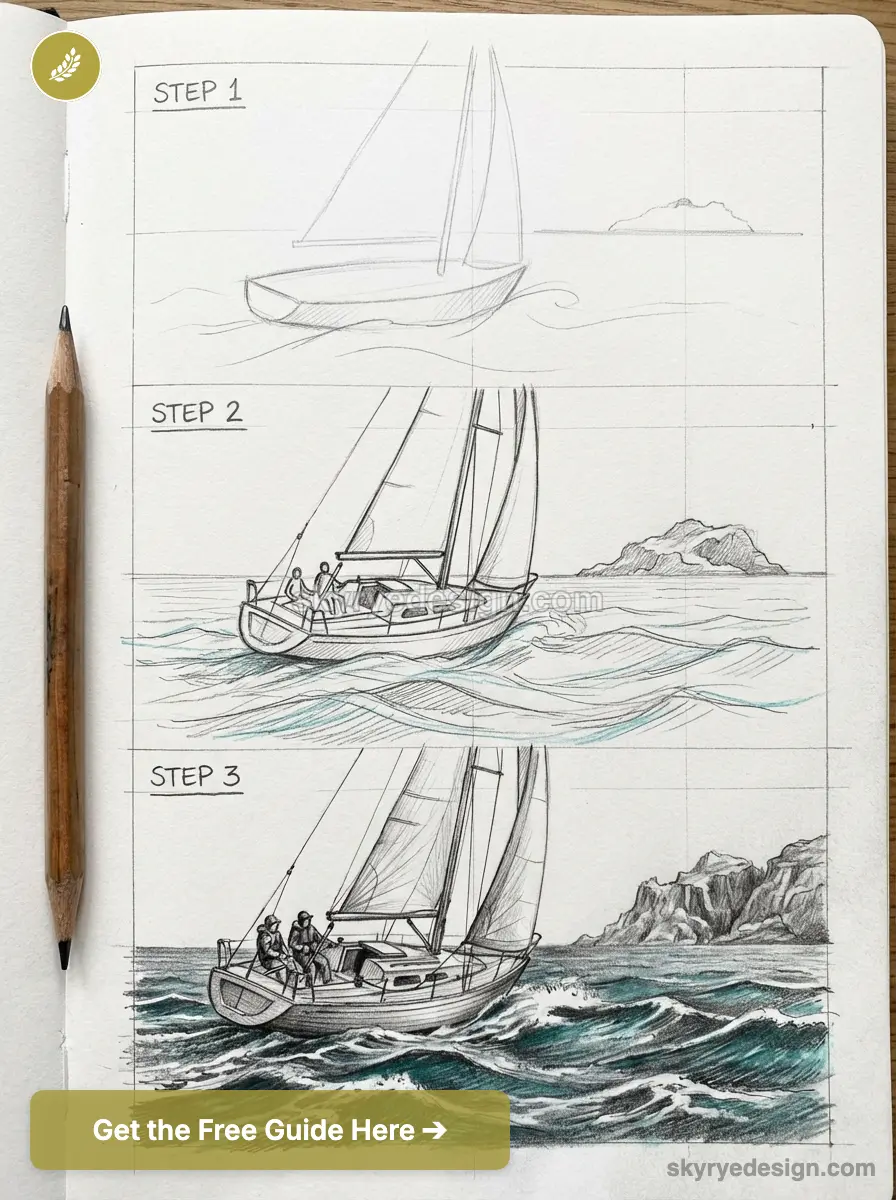
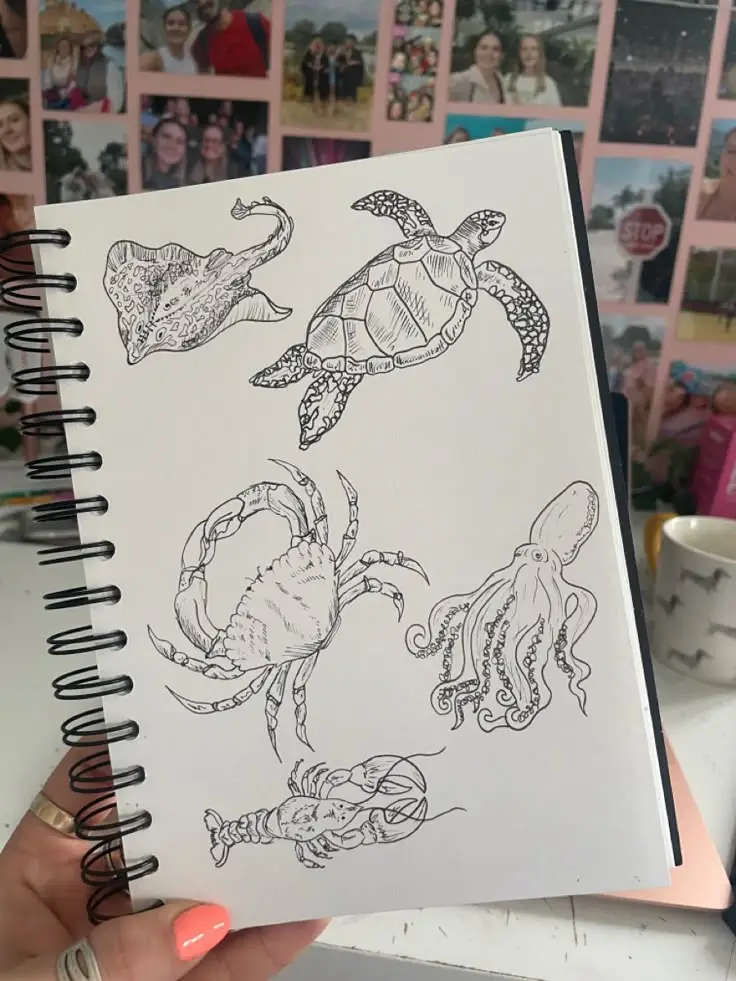
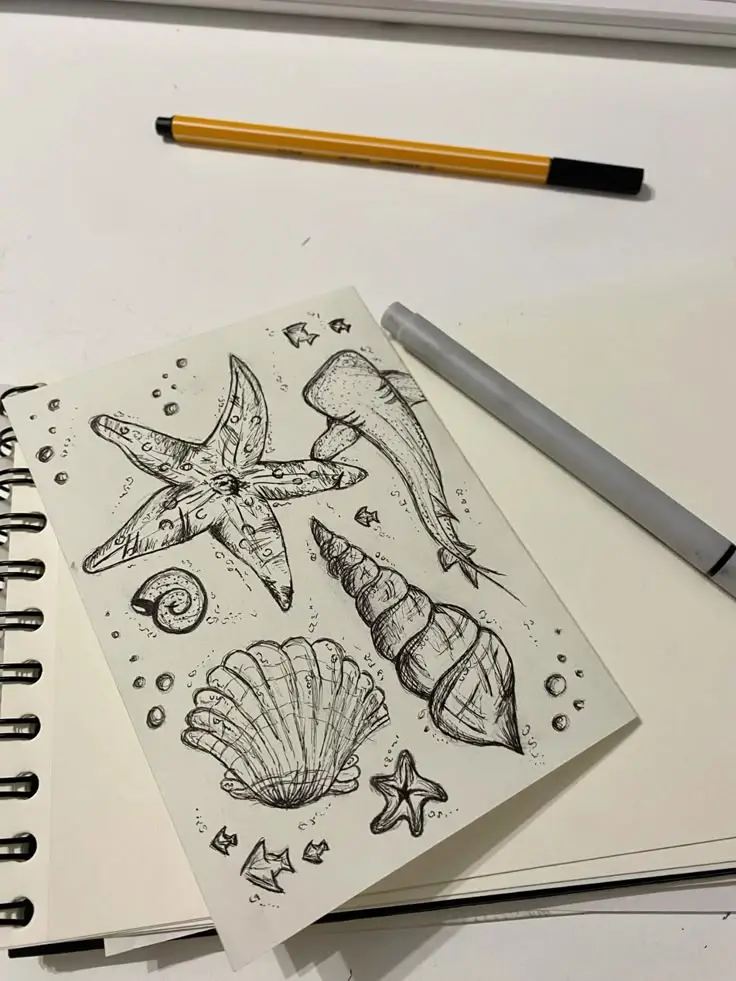
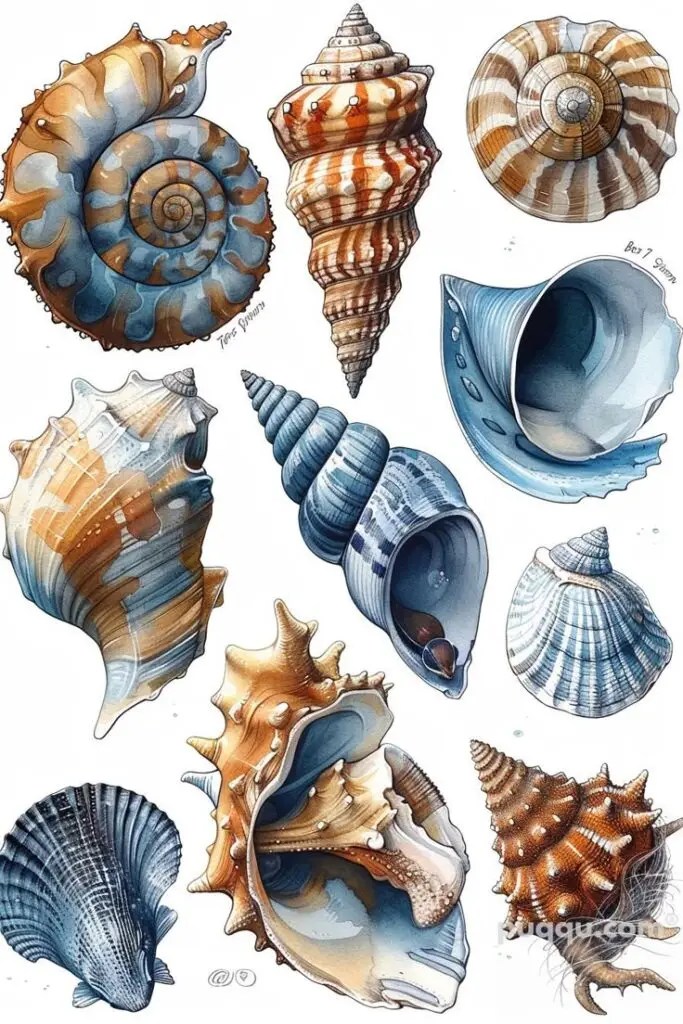
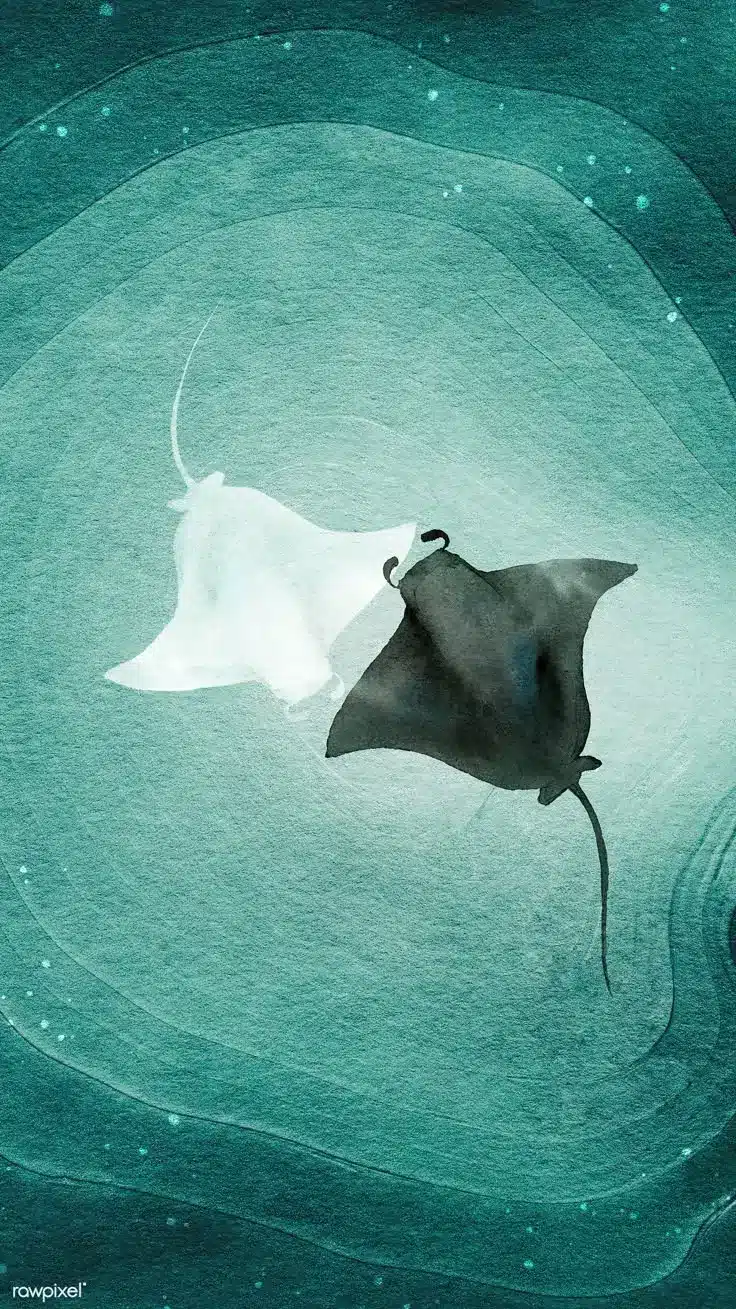
Start with a calm horizon, a single breaking wave, a sunset sea, a small sailboat on water, or a simple underwater scene with rocks and fish. These subjects keep the composition clear while still teaching the main ocean drawing skills: value, soft edges, foam, atmospheric depth, and reflected light.
Q: How do you make an ocean drawing look deeper?
Use atmospheric perspective: make distant water lighter, cooler, softer, and less detailed than the foreground. Put the darkest values in the near troughs and the sharpest texture closest to the viewer. The ocean usually looks flat when every wave has the same contrast, size, and edge sharpness.
For extra landscape depth practice, try the mountain drawing guide after this ocean study. Water and mountains use different textures, but both rely on softer distant shapes and stronger foreground contrast.
When your wave studies start feeling too technical, step sideways into artists inspired by the sea and study how painters turn the ocean into mood, color, and composition.
- 17.3Kshares
- Facebook0
- Pinterest17.3K
- Twitter3
- Reddit0