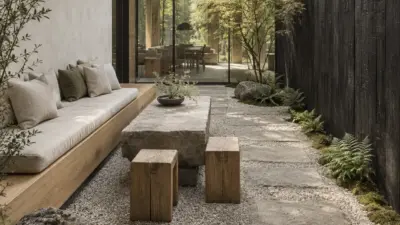
I walked a client’s new deck at dusk a few months back, the same deck that had looked sharp in every daytime photo we’d taken for the file. The sun dropped, and the whole thing went flat: a dark rectangle with a vague shape where the stairs used to be. Beautiful proportions, the kind of clean rail lines and sightlines that architectural deck design rules are built around, and none of it readable after sunset.
That gap is what this piece is about. Layout and proportion get covered elsewhere, including in our own breakdown of small deck design ideas for tighter footprints. Lighting is a different layer entirely: it is what makes a well-designed deck actually function once the sun is down, and it is the layer most decks skip or get wrong.
- Why deck lighting matters after sunset
- Recessed step lights for safety and rhythm
- Under-rail lighting for a clean modern edge
- Wall sconces near doors and seating zones
- Pergola lighting for outdoor dining
- Low landscape lights around the deck perimeter
- Warm LED strips under built-in benches
- Solar deck lights: where they work and where they look cheap
- How to avoid overlighting a modern deck
- A simple lighting plan before installation
- Want to get more deliberate about outdoor lighting design?
- Frequently asked questions
- What is the best light temperature for deck lighting?
- Do I need an electrician for deck lighting, or can I DIY it?
- How many lumens does deck step lighting need?
- Are solar deck lights worth it?
- What is the difference between low-voltage and line-voltage deck lighting?
- How do I avoid glare from deck lights?
- Can deck lighting be added after the deck is already built?
- How much does professional deck lighting installation typically cost?
What follows are seven specific lighting types worth using, where each one belongs, the one mistake that undoes all of them, and a simple plan to work from before you call in best deck builders or an electrician to actually install anything.
Why deck lighting matters after sunset
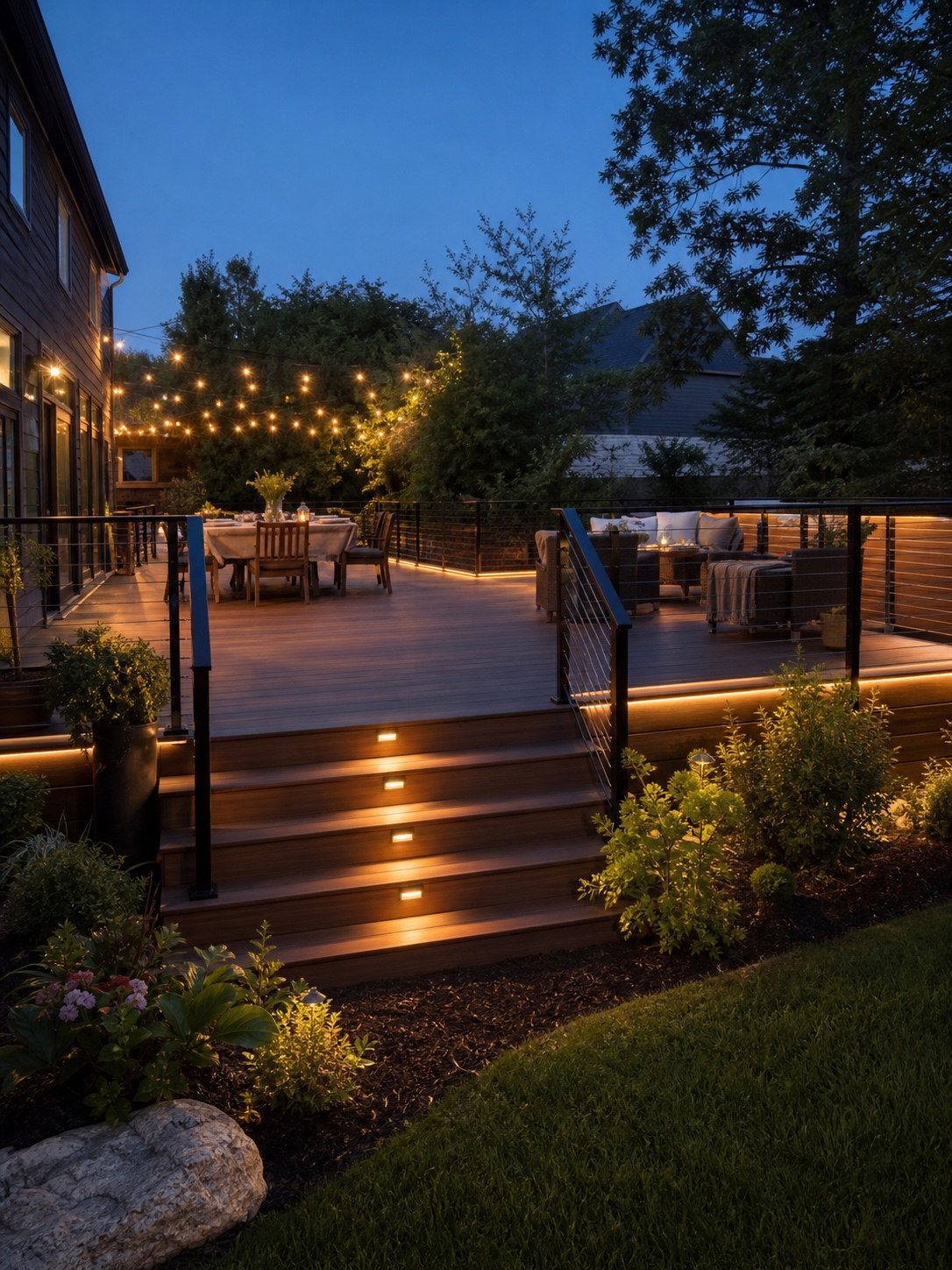
A deck gets designed and photographed almost entirely in daylight, but most of its actual use, dinner, drinks, the last hour before everyone goes inside, happens after the sun is down. Skip the lighting plan and you have designed for the wrong half of the day.
Safety is the part nobody argues with: an unlit stair edge or a low rail in the dark is a real fall risk, not a hypothetical one. The part that gets less attention is how much light shapes whether a space feels finished at all. I trained as an academic painter before I trained as an industrial designer, and the lesson that never stopped applying is that form reads through light and shadow, not through color or material alone. A deck with beautiful joinery and no light on it after dark is a dark shape with good bones nobody can see.
Good deck lighting does three jobs at once: it marks the edges people need to see (stairs, rail height changes), it extends how many hours a day the space actually gets used, and it reads as a deliberate design decision from the yard or the street rather than an afterthought bolted on later.
There is a simple usable-hours argument here too. A deck that goes dark at sunset gets maybe three or four hours of evening use a day in summer before everyone retreats indoors. Light the stairs, the seating zone, and the perimeter properly, and that same deck stays comfortable well past dark, which is the cheapest square footage expansion a home can get: no new construction, just a handful of fixtures and a transformer.
Recessed step lights for safety and rhythm
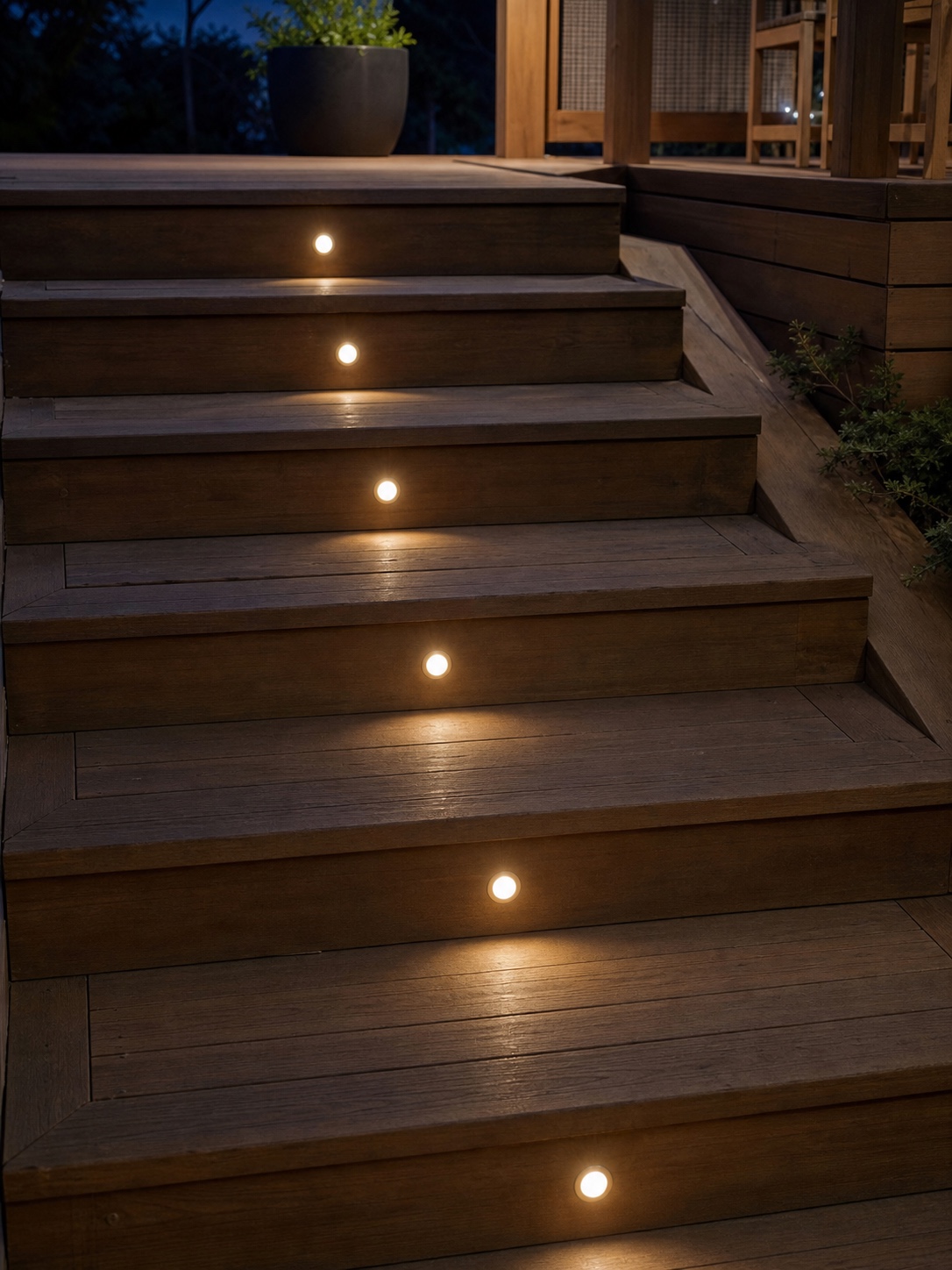
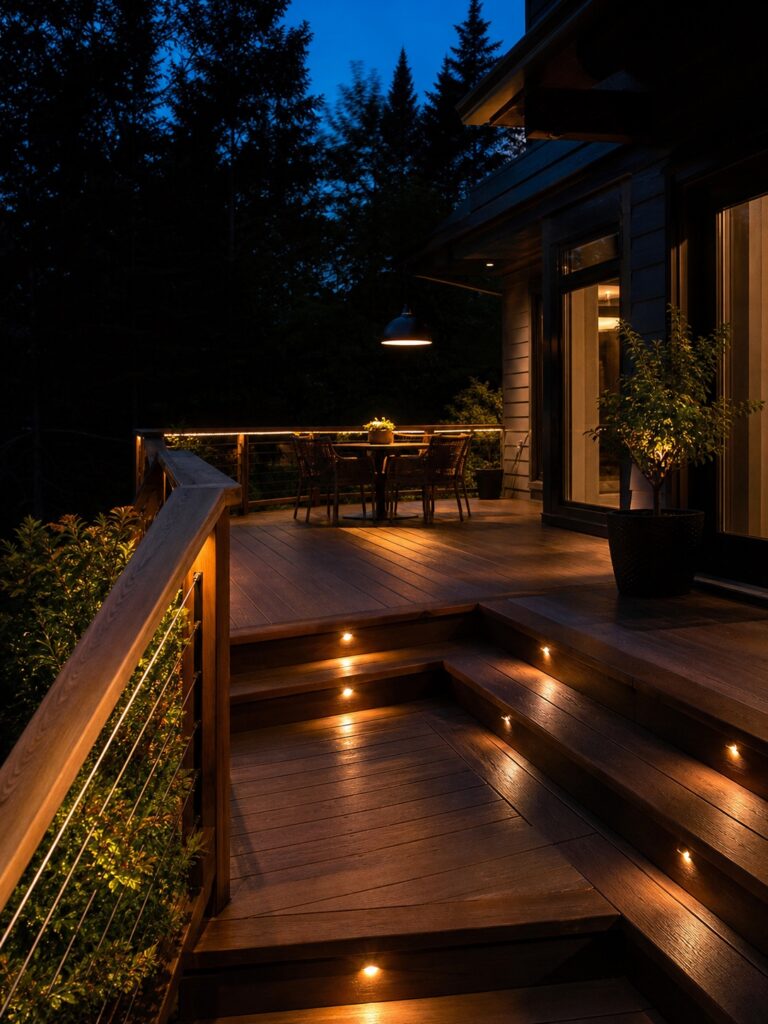
Stair treads and risers are where deck lighting earns its keep first. A small recessed puck light set into the riser, or under the nose of the tread, marks exactly where one step ends and the next begins, which is the single most useful thing deck lighting can do from a pure safety standpoint.
Beyond safety, evenly spaced step lights create a visual rhythm that leads the eye down the stairs the way punctuation leads the eye through a sentence. Stick to warm white, 2700K, low-voltage puck fixtures; most run off a single transformer plugged into an existing outdoor outlet, which keeps the whole step-lighting run a realistic weekend project rather than an electrician callout.
A typical kit, the kind sold by outdoor lighting brands like Kichler or Hinkley’s landscape lines, runs on a 60 to 100 watt transformer and handles eight to twelve small fixtures comfortably; check the total wattage of whatever you buy against the transformer’s rated capacity before assuming you can just keep adding lights to the same run. Going over that limit is the most common reason a perfectly good step-lighting kit ends up dim or flickering after the third or fourth fixture gets added.
TIP: Space step lights on every other riser rather than every single one. Full coverage on every step usually ends up looking like an airport runway instead of a staircase.
Under-rail lighting for a clean modern edge
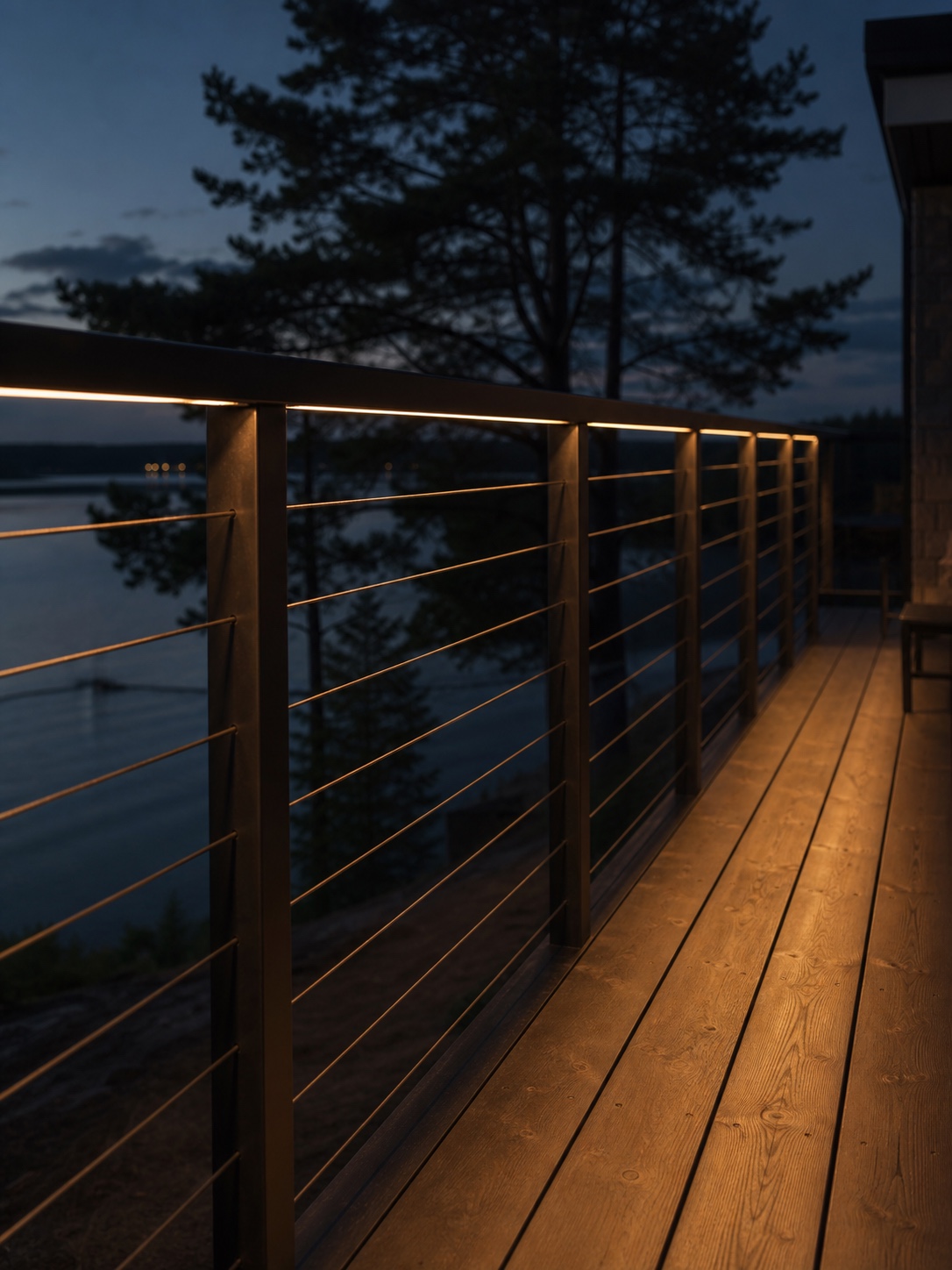
Mount a slim LED strip under the top cap rail, or inside the rail itself, and the light washes down onto the deck surface without a single visible fixture. From a few feet away, the rail just appears to glow softly along its top edge, which is about as clean a lighting effect as a modern deck can pull off.
This one matters more than people expect on a deck designed around clean proportion and minimal rail detailing, since adding a row of visible post-cap lanterns undoes exactly the restraint a well-proportioned rail line is going for. A diffused linear strip, rated for outdoor use, keeps the light source hidden and avoids the glare problem that comes with anything brighter sitting at seated eye level.
One technical detail worth getting right: buy a strip with a diffusion lens or channel, not bare LEDs glued under the rail. Bare diodes create visible hot spots, little bright dots instead of an even wash, the moment you look at the rail from any angle other than straight on. The diffusion cover costs a little more and solves the problem entirely.
Wall sconces near doors and seating zones
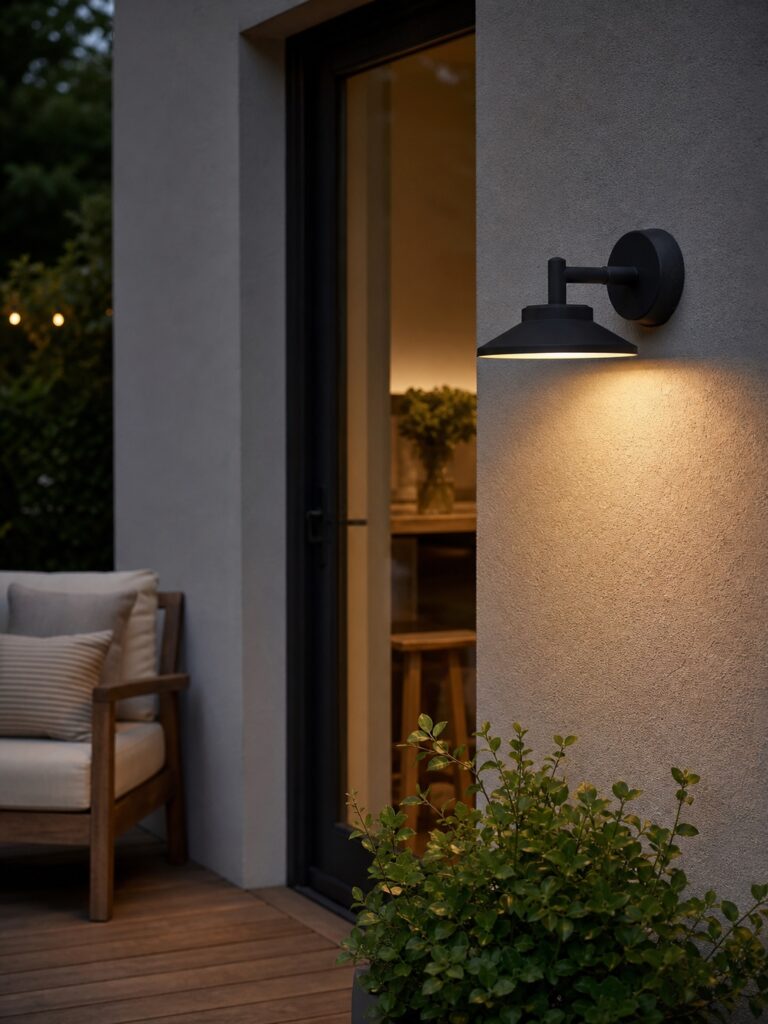
A sconce at the door and one or two more near a seating cluster do the job overhead string lights cannot: marking the entrance and grounding a specific zone with a fixed point of light, the outdoor equivalent of a hallway light by a front door.
Pick a fixture with a shielded or downward-facing lens rather than an exposed bulb. I always check sconce height against a seated eye line before finalizing a plan, not just a standing one; a fixture that looks fine from standing height can shine straight into someone’s eyes the moment they sit down nearby. Simple half-cylinder or half-moon wall-wash sconces in a dark bronze or black finish tend to disappear into a modern facade during the day and only announce themselves once it is dark.
Pergola lighting for outdoor dining
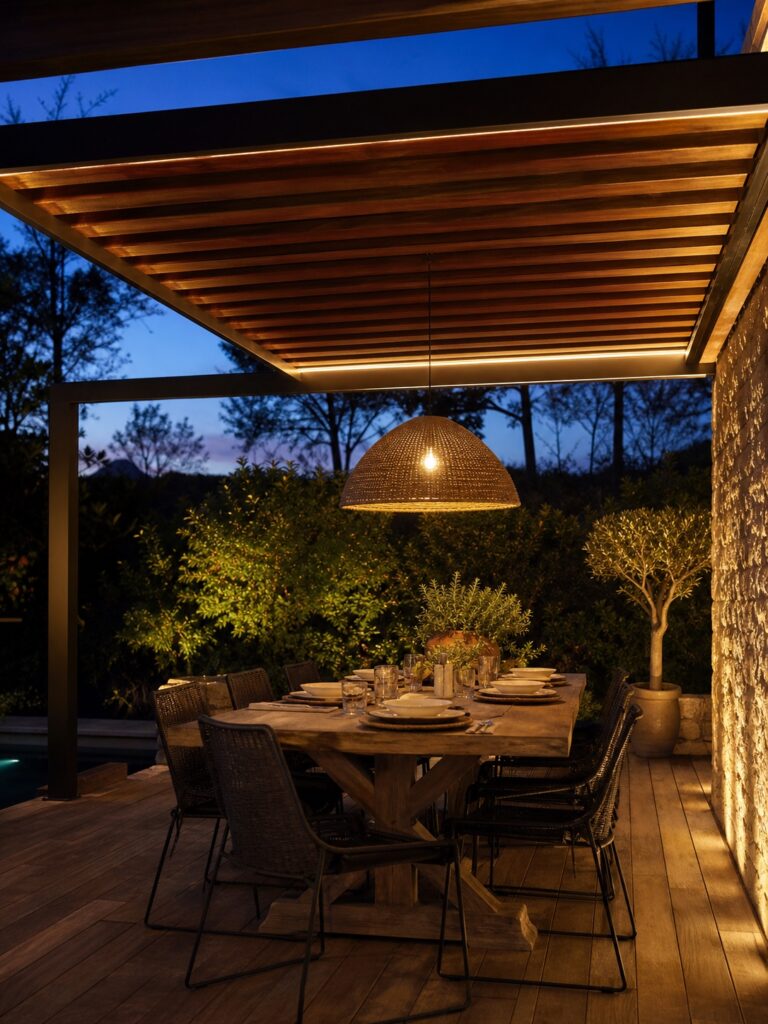
A pergola over a dining area calls for two distinct layers, not one. Ambient light, warm string lights woven along the beams or a slim LED channel routed directly into the structure, sets the overall mood. A single pendant or small cluster hung lower over the actual table adds the task light people need to see their plates without squinting.
Routing an LED channel into the beam itself reads considerably more modern than visible festoon bulbs if the pergola was built with clean, minimal lines in mind; visible string lights lean more relaxed and rustic. Either is legitimate, it just depends which direction the rest of the deck is already leaning. Make sure whatever you choose is dimmable, since a dinner party and a solo evening coffee call for two very different brightness levels in the same spot. Before choosing fittings, compare the roof and frame choices in our UK pergola design guide so lighting, drainage, and maintenance access can be planned together.
A basic plug-in dimmer module handles this for under thirty dollars on most string-light and LED-channel setups, no smart-home integration required, though a smart plug works just as well if the rest of the house is already wired that way. The point is having one switch that moves between “dinner party” and “winding down alone,” not running both at the same fixed brightness every night.
Low landscape lights around the deck perimeter
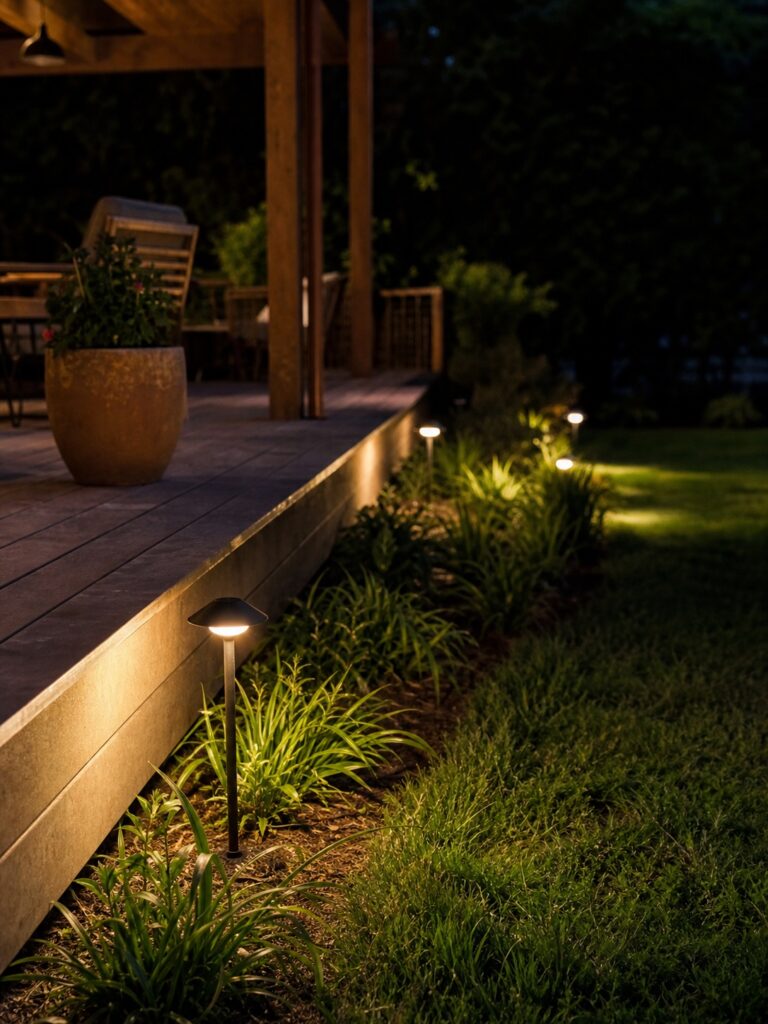
Decks with an open edge, no rail required because the drop to grade is low, lose their boundary entirely once it gets dark, which becomes a real hazard rather than just a style choice. Low landscape lights staked into the ground along that edge, or surface-mounted post lights where there is a structural post to use, mark the boundary without competing with the main social lighting on the deck itself.
Keep these dimmer than the step and rail lighting; their job is a soft, secondary glow that says “the deck ends here,” not a second layer of bright light pulling attention away from the actual gathering space.
Warm LED strips under built-in benches
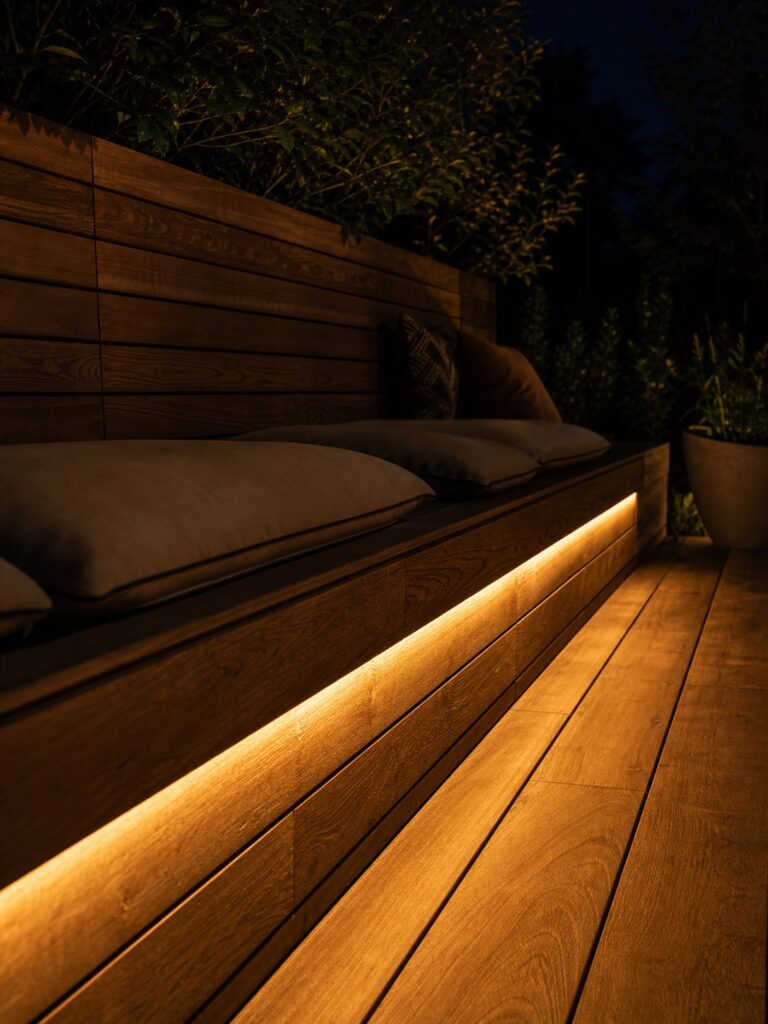
A built-in bench with an LED strip tucked under the seat lip throws a soft glow along the deck surface in front of it, the outdoor version of under-cabinet kitchen lighting. It defines the seating zone, adds just enough fill light to keep the area from going completely dark, and shows off the joinery of a bench that was likely built specifically for that spot.
Use an IP65-rated strip at minimum since this one lives outside permanently, exposed to rain and temperature swings the way an indoor strip never has to handle. It is a small detail, but it is the kind of detail that separates a bench that reads as built-in furniture from one that reads as an afterthought.
Solar deck lights: where they work and where they look cheap
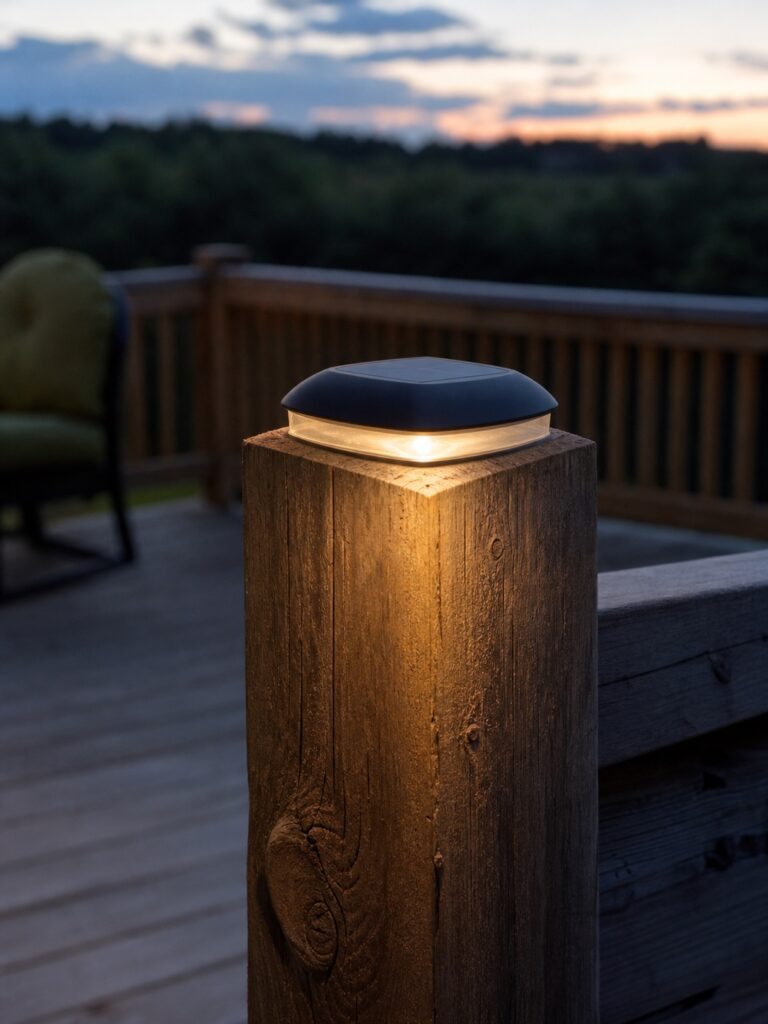
Solar deck lights are not a scam, but they are not a universal answer either, and pretending otherwise is how a lot of decks end up with a row of dim, flickering post caps within a year.
They work fine for low-stakes, low-expectation spots: a perimeter path marker, a fence post cap, anywhere a soft accent glow is the entire job. They start looking cheap the moment they are asked to do real work, under-rail washing, dining task light, anywhere people expect consistent, controllable brightness, because most solar fixtures suffer from weak output, inconsistent charge depending on the week’s weather, and a visible plastic dome that reads as budget hardware up close.
TIP: If a fixture needs to look intentional after dark rather than just present, wire it. Save solar for the spots where “there is some light there” is genuinely the whole requirement.
How to avoid overlighting a modern deck
Every idea above works as a layer, not as a competition for who can be brightest. The most common mistake on a newly lit deck is turning every fixture up to full and calling it finished, which usually produces something closer to a parking lot than an evening living room. To carry the same approach beyond the deck, compare lighting ideas for the whole backyard before adding garden and path fixtures.
Mixed color temperature is the other half of the overlighting problem: a cool 4000K motion-sensor security light next to warm 2700K step lights and string lights reads as two unrelated decisions rather than one plan, no matter how good either fixture is individually. Put dimmers on whatever circuits allow it, and treat full brightness as the setting for cleanup, not for the evening itself.
Fixture count creeps up the same way clutter does, one reasonable addition at a time that adds up to something nobody planned. A deck that started with step lights, picked up rail lighting the next summer, then a few solar accents, then a string-light run for a birthday party that never came down, often ends up with five different light qualities running simultaneously and no single decision behind any of it. Pulling that back to two or three coordinated layers, on a dimmer, almost always looks better than the sum of every well-intentioned addition.
A genuinely well-lit deck usually has more fixtures turned low than turned high. The light should reveal the space, not replace daylight with an equally flat substitute.
A simple lighting plan before installation
Three steps cover almost every deck before a single fixture goes in.
Just as well-placed deck lights expand the usable hours of a deck, strategic eaves in passive solar heating expand the comfort of a home across changing seasons.
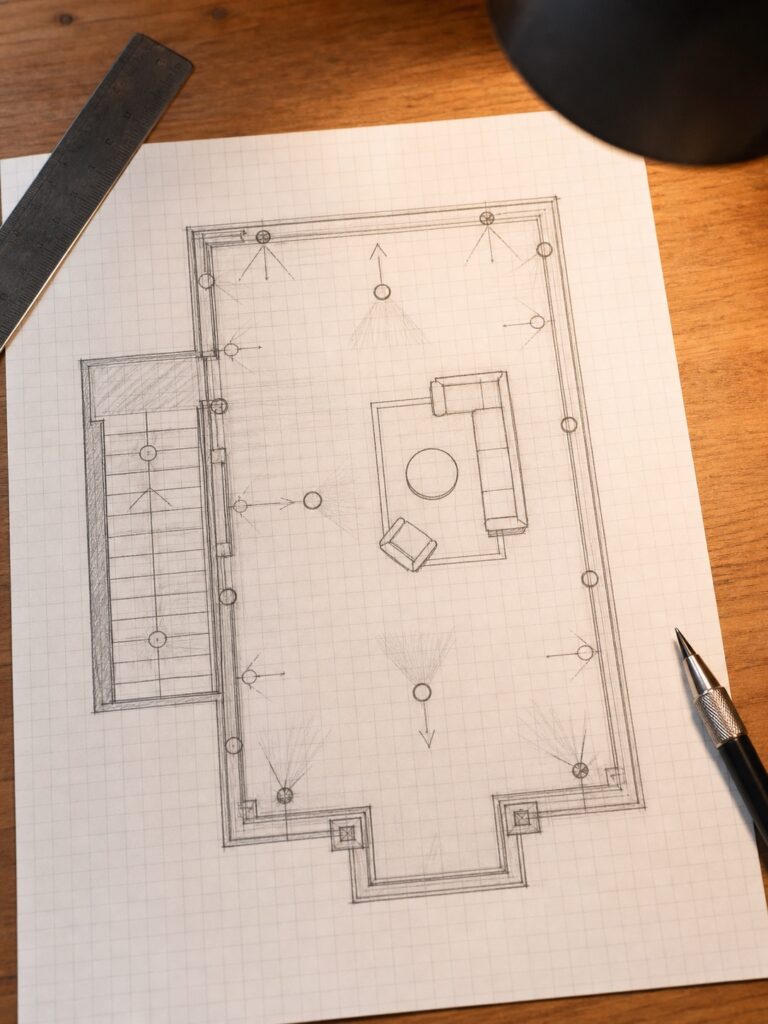
First, map the zones: stairs and rail edges need safety lighting, the dining or seating cluster needs task and ambient lighting, and the perimeter needs a soft secondary glow if the edge is not otherwise marked. Second, pick one color temperature, 2700K, and hold every fixture to it; this single decision does more for a cohesive result than any individual fixture choice. Third, decide scope: a low-voltage transformer kit covers steps, rails, and perimeter accents as a realistic DIY project, while anything needing a new circuit or permanently wired sconces is the point to bring in a licensed electrician or best deck builders who already handle that scope regularly.
Sketch the three zones on a simple top-down drawing of the deck before buying anything. It takes ten minutes and prevents the single most common and expensive mistake: discovering halfway through installation that the transformer is undersized for everything you actually wanted lit.
On budget specifically: a basic low-voltage step and perimeter package, transformer, eight to ten fixtures, cable, usually lands somewhere in the low hundreds of dollars in materials. That is a reasonable place to start even on a tight budget, since stairs are the safety-critical zone anyway. Pergola integration, dedicated circuits for sconces, or anything needing an electrician add cost in proportion to how much new wiring is actually involved, which is exactly why mapping the zones first, before pricing anything, keeps the plan from becoming three separate unrelated purchases.
None of these seven ideas need to happen at once. Start with the stairs, since that is the one safety item that should not wait, then layer in the rest as time and budget allow. A deck that is lit thoughtfully, even partially, already reads as more finished than one that is fully built and entirely dark after sunset.
Want to get more deliberate about outdoor lighting design?
Skillshare has dedicated courses on landscape and outdoor lighting design that go further than any single article can. Use code AFF30D25 for a discount on your first month. Search for “outdoor lighting design” or “landscape lighting basics” once you are in.
Frequently asked questions
What is the best light temperature for deck lighting?
Stick to 2700K to 3000K, the warm-white range, across every fixture on the deck: steps, rails, sconces, and string lights alike. Anything closer to 4000K or above reads as cold, clinical security lighting rather than an evening living space, and mixing temperatures on the same deck is one of the fastest ways to make the lighting look unplanned.
Do I need an electrician for deck lighting, or can I DIY it?
Low-voltage kits, the kind that run off a single transformer plugged into an existing outdoor outlet, are genuinely DIY-friendly for step lights, under-rail strips, and perimeter accents. Anything that requires new line-voltage wiring, a new circuit, or fixtures wired directly into the home’s electrical panel should go to a licensed electrician rather than a weekend project.
How many lumens does deck step lighting need?
Somewhere between 12 and 50 lumens per fixture is plenty for stair treads and rail caps; the goal is to define the edge, not floodlight the stairs. Brighter than that and the fixture itself becomes the focal point instead of the step it is supposed to be marking.
Are solar deck lights worth it?
For low-stakes accents, capping a fence post or marking a perimeter path, solar lights are a reasonable, no-wiring option. For anything that needs to look intentional after dark, under-rail washes, dining task light, sconces by the door, the weak and inconsistent output of most solar fixtures tends to look cheap rather than designed.
What is the difference between low-voltage and line-voltage deck lighting?
Low-voltage systems run on 12 volts through a transformer, are safer to install yourself, and cover most deck lighting needs: steps, rails, perimeter accents. Line-voltage systems run on standard household 120-volt circuits, need a licensed electrician, and are typically reserved for permanently wired fixtures like exterior sconces tied into the home’s main wiring.
How do I avoid glare from deck lights?
Choose fixtures with a shielded or recessed lens rather than an exposed bulb, and aim every fixture down or sideways rather than letting it shine straight out at eye level for someone seated. A fixture you can stare directly into from a normal seated position is doing it wrong, no matter how good the light temperature is.
Can deck lighting be added after the deck is already built?
While choosing your lights, keep in mind how they fit into your overall outdoor fall decorating ideas to keep the space inviting.
Yes, in almost every case. Low-voltage step and rail kits clip or surface-mount onto existing decking and railing without structural changes. Adding recessed fixtures that need a cavity cut into existing boards is the one exception that gets noticeably harder after the fact, so it is worth planning for during a build or a major resurface if at all possible.
How much does professional deck lighting installation typically cost?
A basic low-voltage step and perimeter package usually falls in the few-hundred-dollar range for materials plus a half day of labor. Adding line-voltage sconces, a dedicated circuit, or pergola-integrated lighting pushes the total higher depending on how much new wiring is involved. Getting a quote from a local deck builder alongside the lighting plan is the most reliable way to get an accurate number for a specific deck.
Lighting only feels useful after the furniture has a clear purpose. This guide to outdoor pergola seating helps map the lounge, dining, and walkway zones before you decide where each fixture belongs.
- 157shares
- Facebook0
- Pinterest157
- Twitter0
- Reddit0