
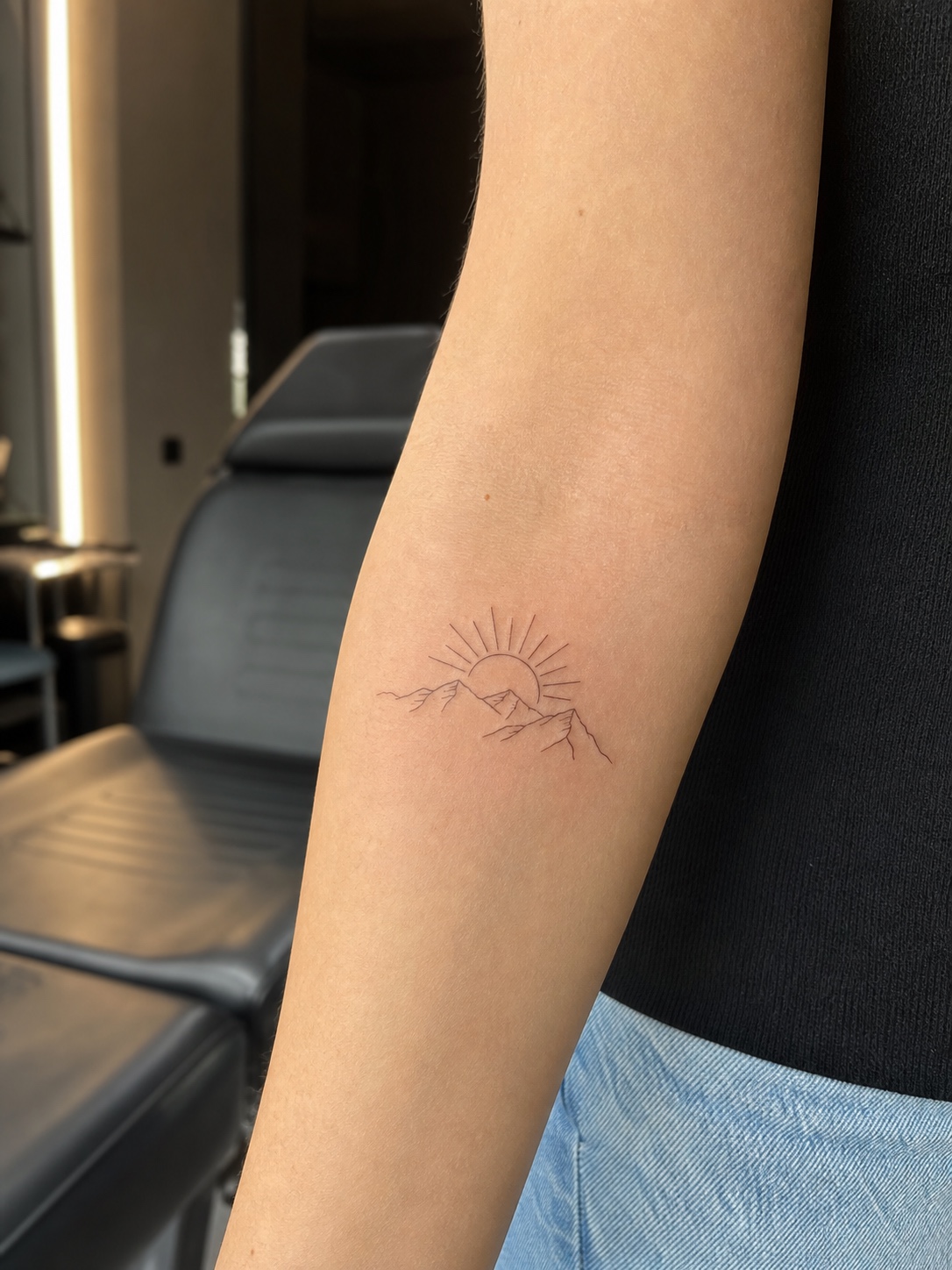
The first time I paid close attention to a sunrise tattoo was on a design colleague in Berlin, a woman who’d spent three years going through chemotherapy. She had a delicate fine-line sun rising over mountain peaks on her inner forearm. No color. Just the arc of the sun, a few rays, and the clean silhouette of ridgelines. She said the artist took forty minutes. She said she’d wanted something she could look at every morning.
That’s what a sunrise tattoo does when it’s done right. It’s not decorative noise. It means something specific to whoever is wearing it, and it carries that meaning every time they see it.
- What a sunrise tattoo really means
- Sunrise tattoo styles: which one is right for you
- Where to place a sunrise tattoo: body zones mapped
- Design elements that work with a sunrise
- How to choose a tattoo artist for a sunrise design
- Healing, aftercare, and long-term care
- 70+ sunrise tattoo ideas by category
- Frequently asked questions
- Before you book: the questions that matter
The symbolism behind the rising sun goes back further than any modern tattoo trend. Japanese irezumi tradition treated the rising sun as a statement of national identity and personal strength. Polynesian tatau incorporated solar imagery as spiritual protection. Maori moko used solar motifs to mark status and lineage. What contemporary tattoo artists are doing now is pulling from all of that history while finding new ways to render it.
This guide covers what sunrise tattoos mean, which styles hold up best over time, where they work on the body, how to choose an artist, and what to expect during healing. Whether you’re planning a small wrist piece or a large back composition, the design decisions you make before the needle touches skin are the ones that matter most.
What a sunrise tattoo really means
The rising sun has carried the same core meaning across cultures that never had contact with each other: something is beginning, something dark has ended. That consistency suggests the symbolism isn’t cultural — it’s human.
New beginnings and cycles
If the rebirth symbolism is the main reason you like sunrise imagery, compare it with phoenix tattoo ideas; both symbols work around renewal, fire, and starting over, but the visual language is very different.
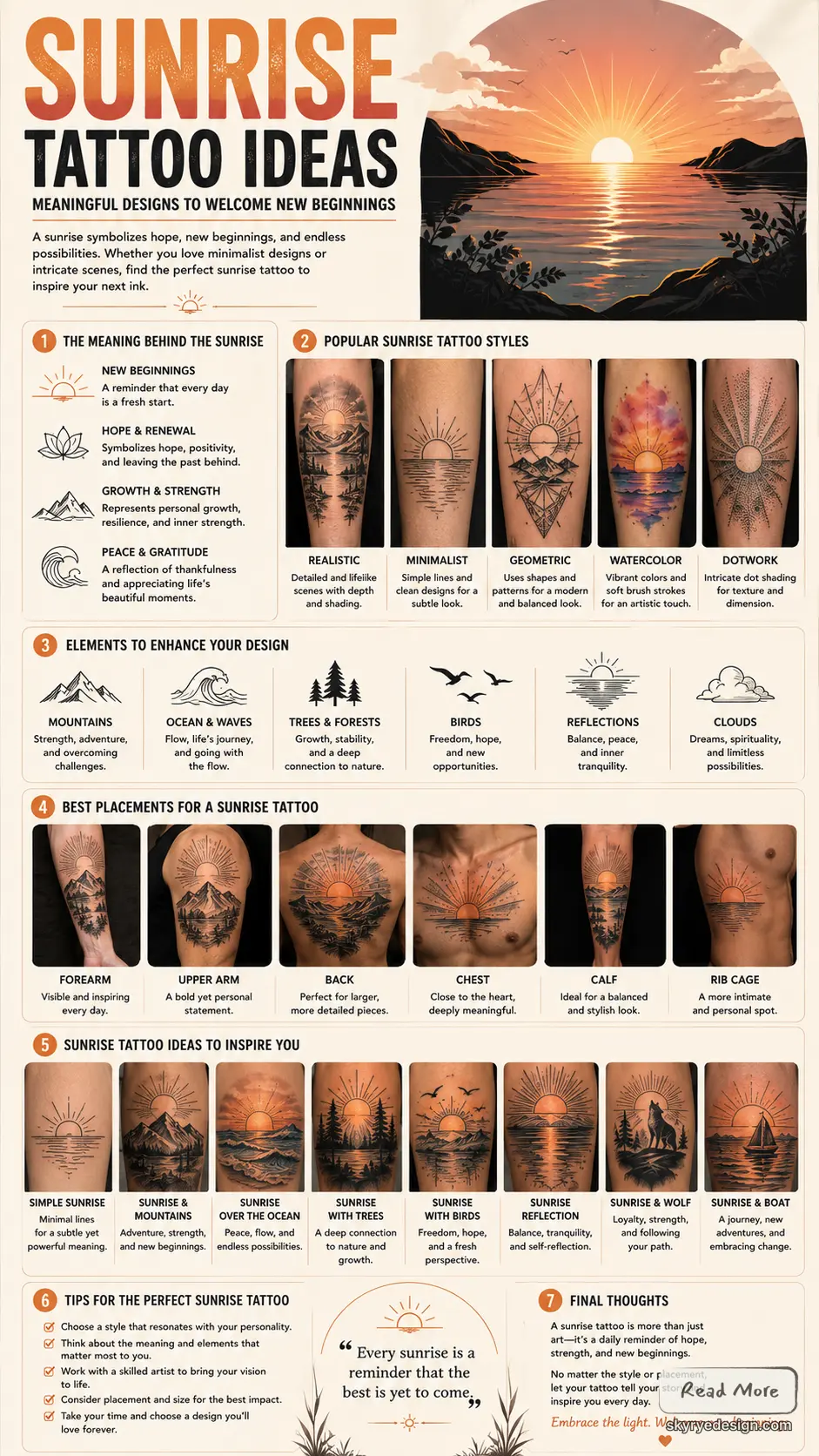
The most common reading is also the most literal. A sunrise follows the darkest point of night. People who’ve come through illness, loss, addiction, or a period of serious difficulty often choose a sunrise because the image tracks what they actually lived through. It’s not hope as an abstraction. It’s hope as a documented event that happens every single morning whether you notice it or not.
The cyclical aspect matters too. A sun doesn’t rise once — it rises daily. For some clients, that repetition is the point. Not one triumphant moment, but the ongoing practice of starting again. I find that interpretation more interesting than the one-time-victory reading, and it tends to produce better design concepts because the artist has more to work with compositionally.
Spiritual and cultural references
For a softer celestial contrast, moon tattoo ideas pair naturally with sunrise designs when the concept is about night turning into morning, cycles, or emotional balance.
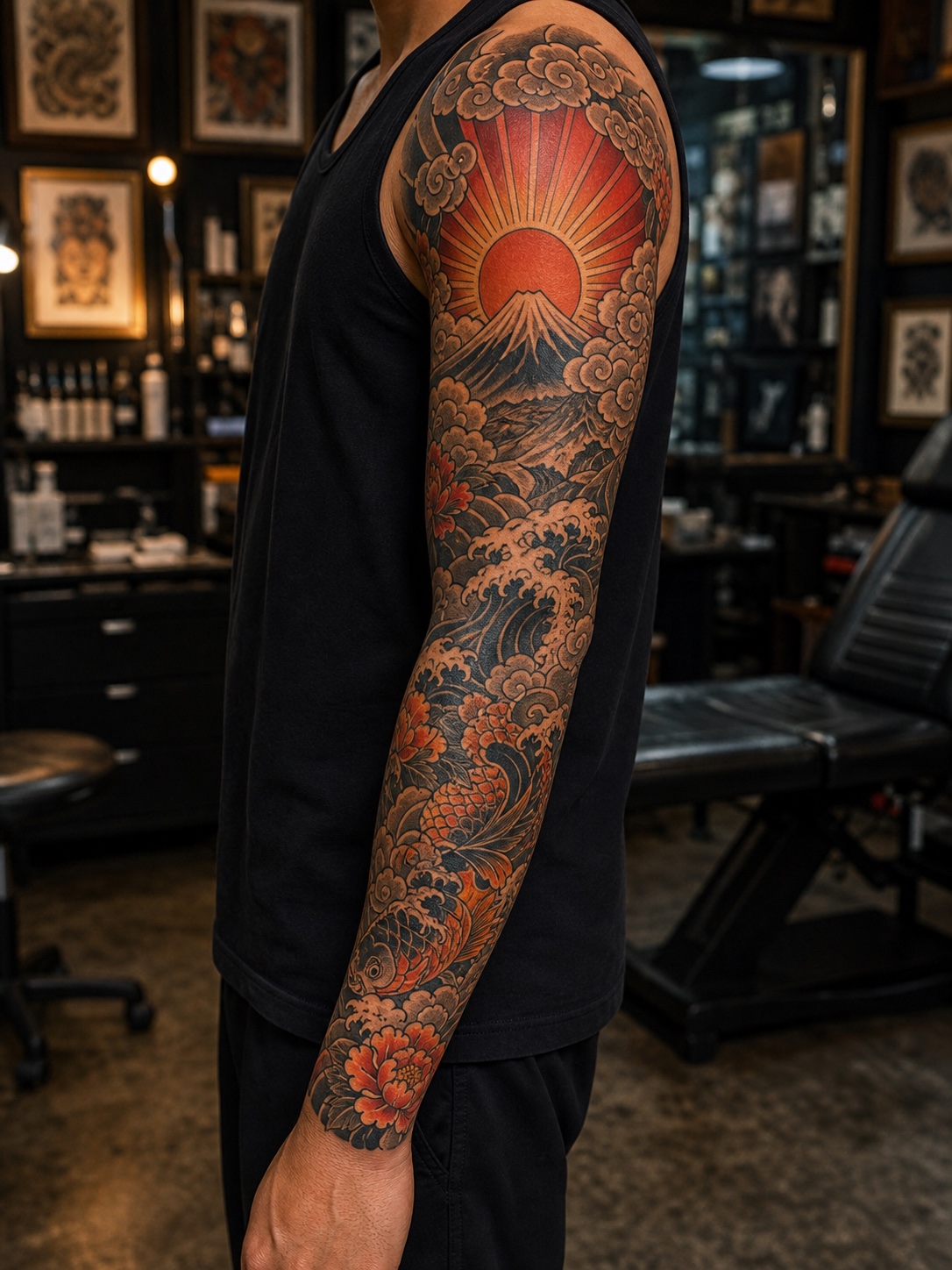
In Japanese tradition, the rising sun (hi no de) is one of the oldest symbols in the visual vocabulary. Katsushika Hokusai painted it. Utagawa Hiroshige made careers from dawn compositions. The Hinomaru flag renders it in its most reduced form. When contemporary Japanese tattoo masters like Horiyoshi III or Gakkin incorporate sunrise elements, they’re working within centuries of established visual grammar.
Polynesian and Maori traditions used solar motifs differently — less about the moment of sunrise and more about the sun’s path as a navigation tool and divine reference point. The Aztec calendar stone centers on a sun face. Indigenous North American traditions from the Plains to the Pacific Coast treated the sunrise direction (east) as sacred.
None of this means your sunrise tattoo has to carry all of that weight. But knowing the cultural context helps you make more deliberate design choices and helps your artist place the imagery accurately when cultural specificity matters to you.
Personal meaning: what clients bring to the symbol
In my experience following tattoo culture and talking to people with them, the most resonant sunrise tattoos are the ones where the client brought a specific story and the artist built the image around that story. A woman who hiked the Camino de Santiago and watched the sunrise from O Cebreiro. A man who marked his ten years sober. A couple who got matching half-sunrises that only complete when they stand together.
The symbol is flexible enough to hold all of those specific meanings without becoming generic. That’s rare in visual iconography and it’s part of why sunrise tattoos have grown steadily without becoming a trend that dates badly.
Reference: Symbolism reference: Cirlot, J.E. (1971). A Dictionary of Symbols Dover Publications. | Tattoo history: Kazez, D. (2019). The Art of Japanese Tattoo. Prestel.
Sunrise tattoo styles: which one is right for you
The style decision is as important as the placement decision. A sunrise rendered in fine-line single-needle work looks completely different from the same composition executed in bold Japanese traditional — and will age completely differently too. Here’s how the main styles stack up.
A sun rising over a quiet lake or ocean fits beautifully with other outdoor motifs. For more water-inspired designs, check out our guide to fishing tattoos.
| Style | Best placement | Size | Ink complexity | Healing notes |
|---|---|---|---|---|
| Fine-line sunrise | Wrist, collarbone, ankle | 5–10 cm | Low — single needle | Fades faster in sun; annual touch-up recommended |
| Geometric sunrise | Upper arm, shin, back | 10–20 cm | Medium | Crisp lines; avoid stretchy skin areas |
| Blackwork / woodcut | Forearm, thigh, chest | 12–25 cm | High | Deep saturation; peeling phase is intense |
| Watercolor sunrise | Shoulder, ribcage, calf | 8–18 cm | High — blends and gradients | No black outline = faster color shift over time |
| Japanese traditional | Back, sleeve, thigh | 15 cm+ | Very high — bold outlines + fill | Most durable style; holds for decades |
| Minimalist dot-work | Behind ear, inner wrist | 3–7 cm | Low | Subtle; may need refresh at 5 years |
Fine-line and single-needle
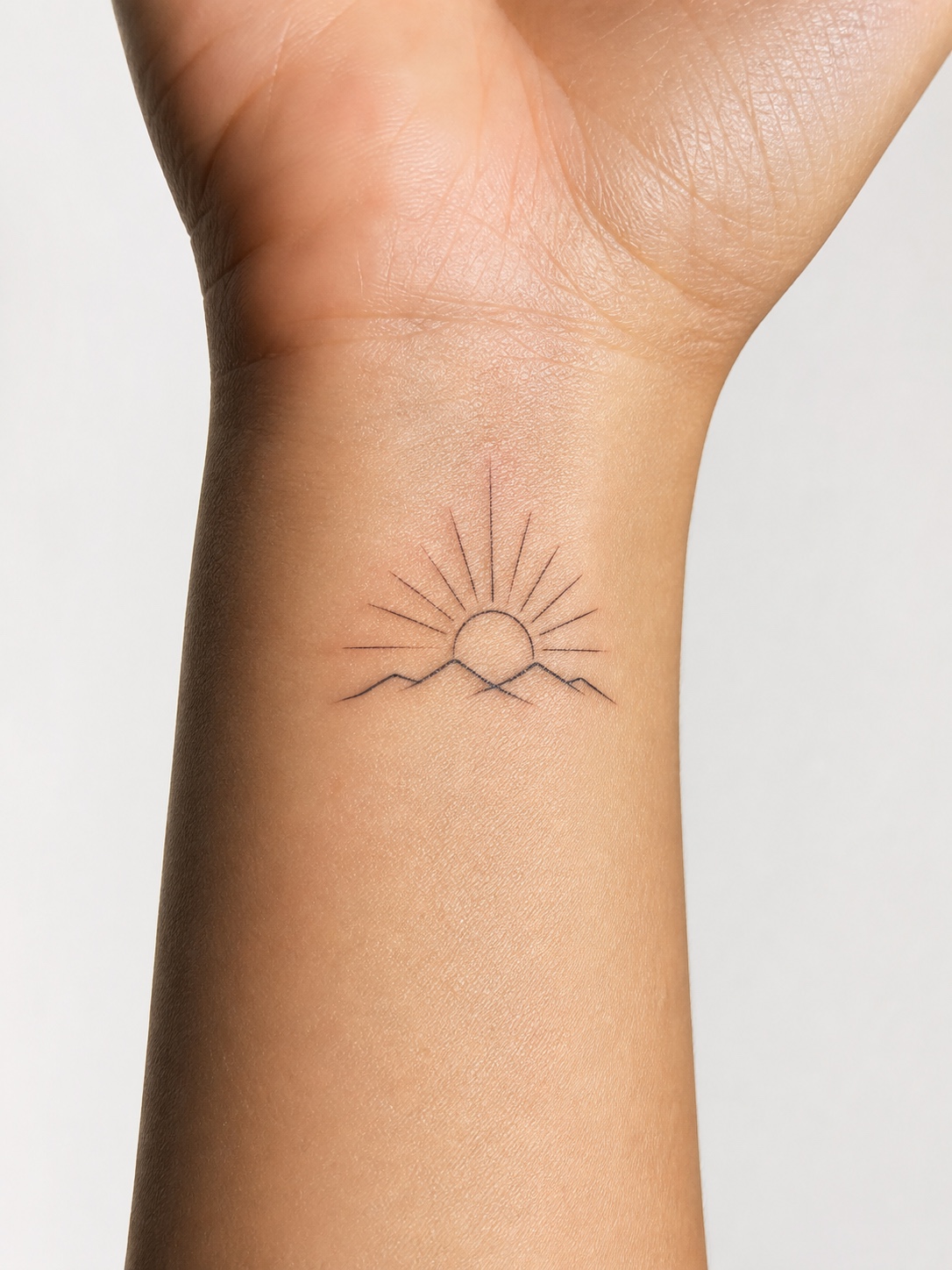
This is the style that’s dominated contemporary tattoo feeds for the past five years. Clean, delicate lines, often without any fill or shading, sometimes with the subtlest watercolor wash. Artists like Dr. Woo in Los Angeles and Bang Bang NYC’s fine-line specialists have defined the aesthetic for a generation.
For a sunrise, fine-line works best in small-to-medium sizes (5 to 12 cm) on stable skin with good texture — inner forearm, collarbone, upper chest. The weakness is longevity. Single-needle work is the first style to show age because the lines are so thin. Plan for a touch-up within 5 years, especially on areas exposed to daily UV.
Japanese traditional
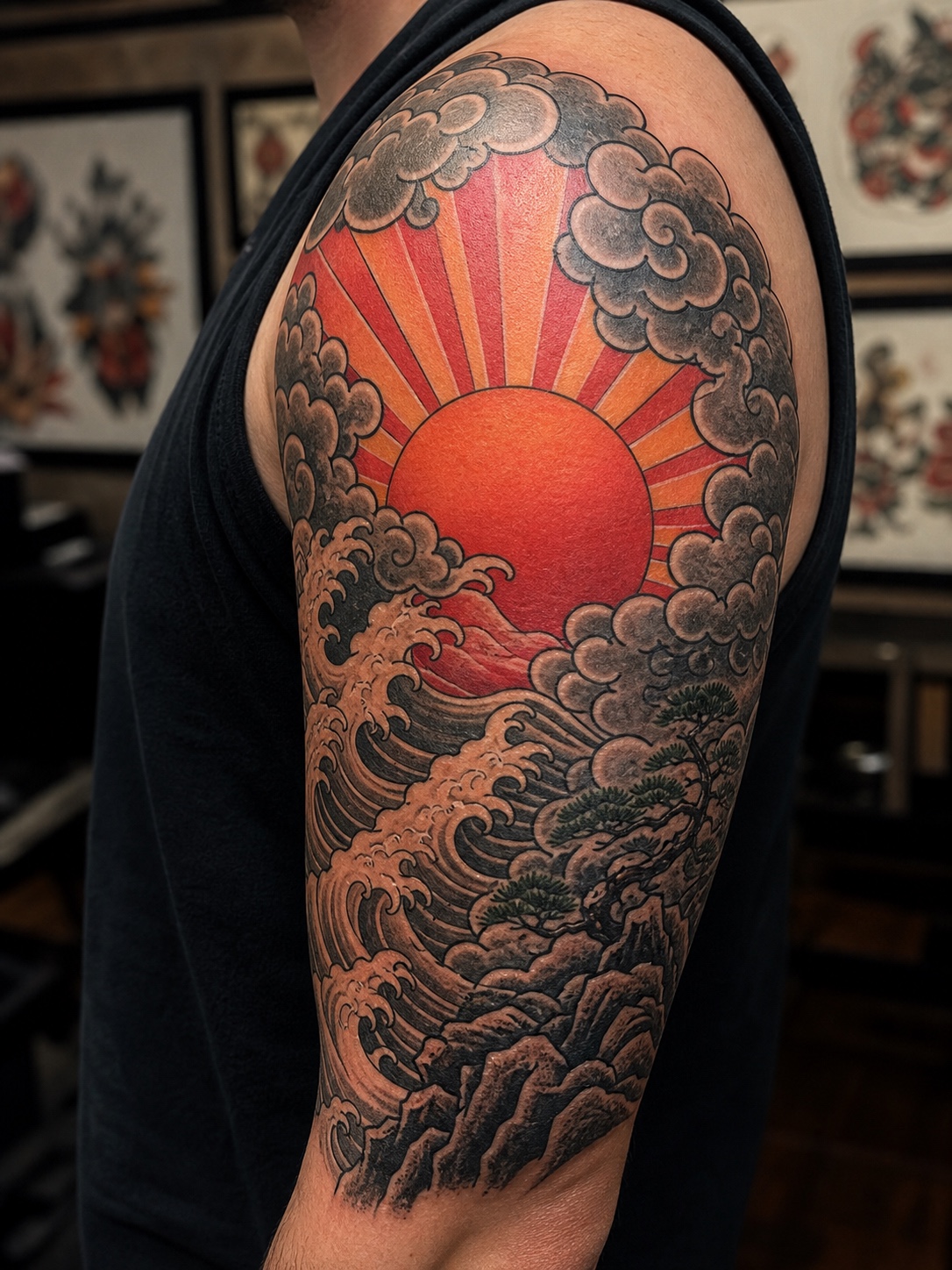
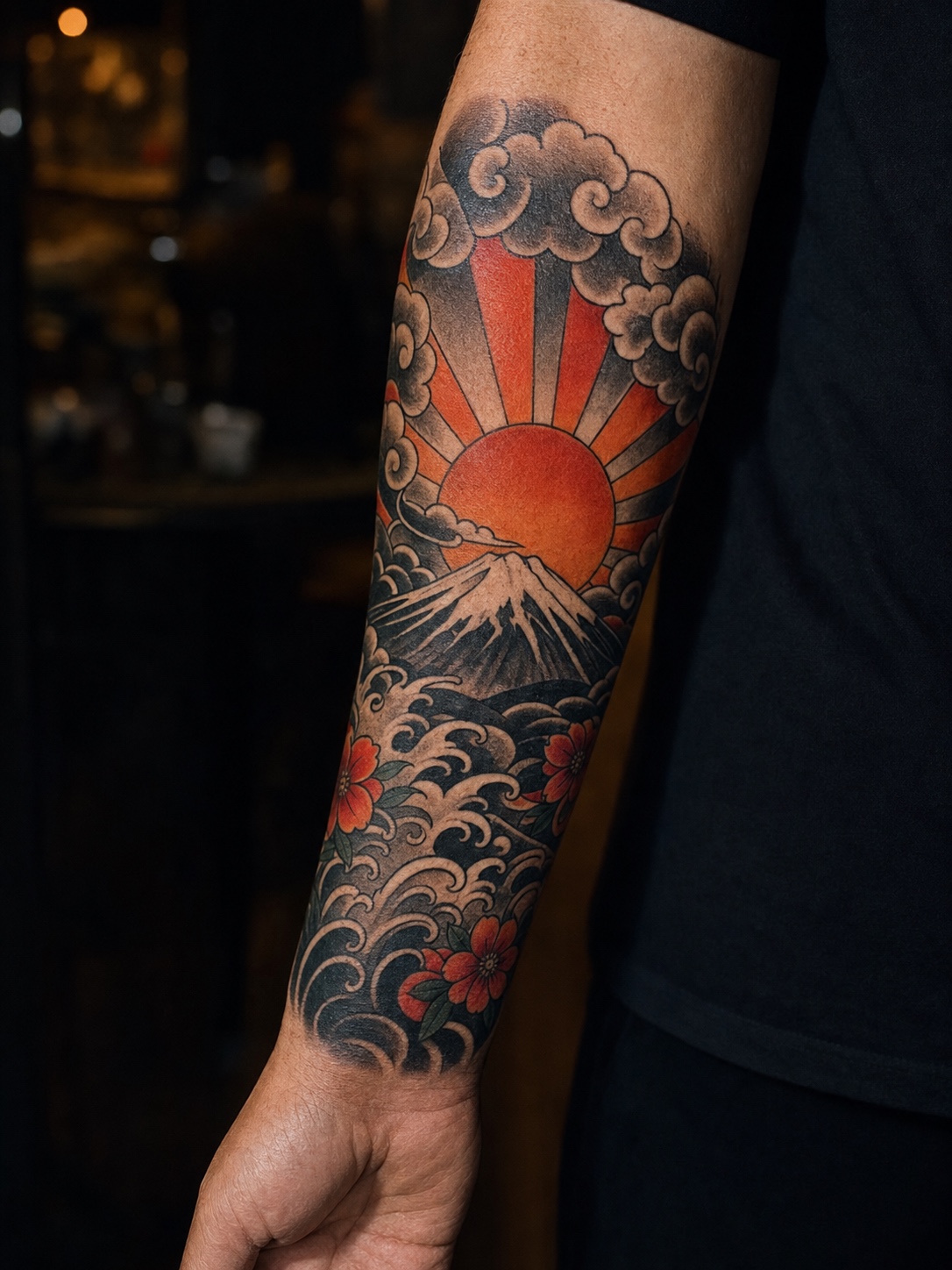
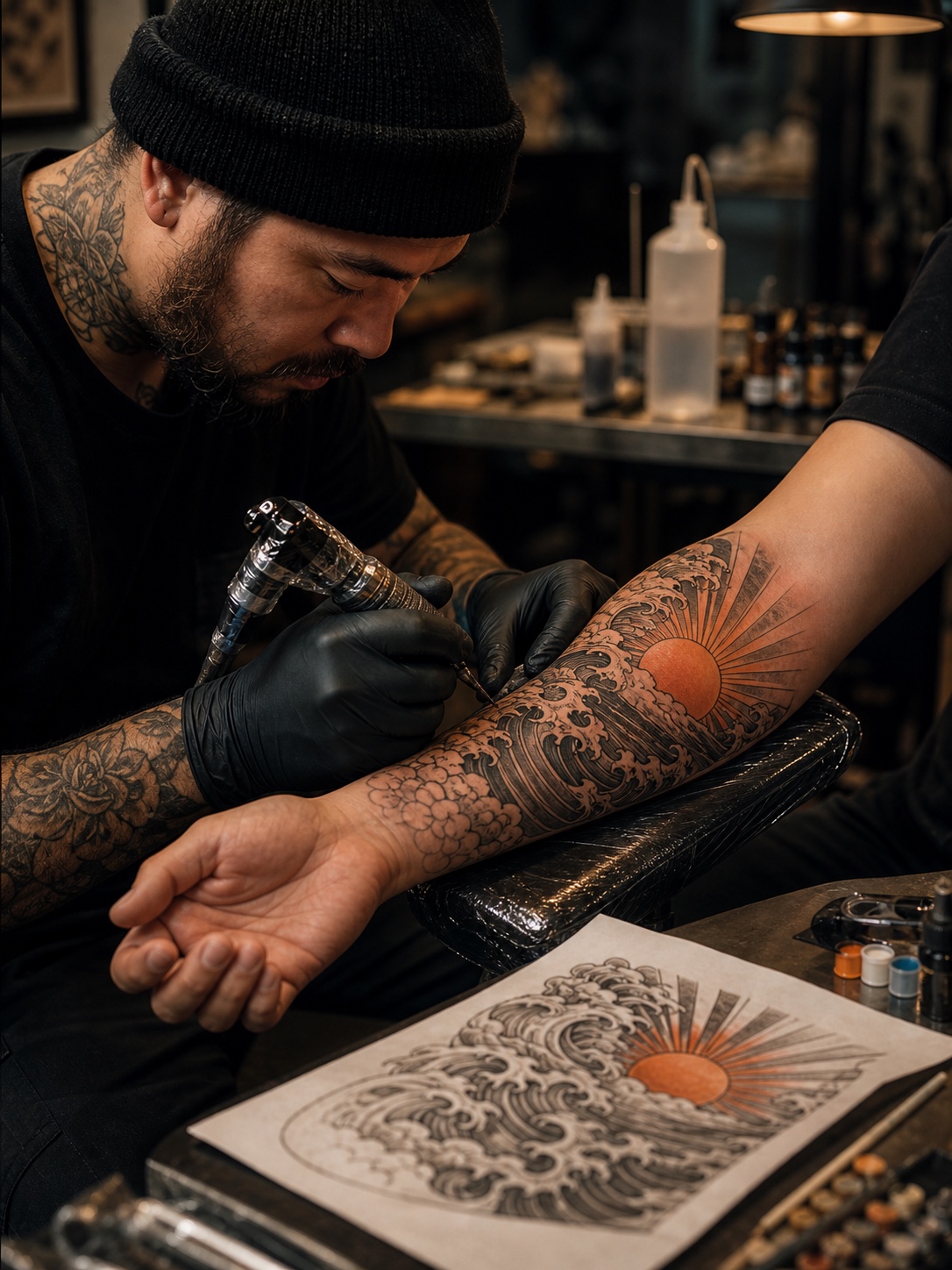
Bold black outlines filled with saturated color, stylized clouds (kumo), and rays rendered in classic red and orange. This style originated in 19th-century Japan and was brought to the West by Sailor Jerry and then refined by artists like Ed Hardy and Horiyoshi III. It’s the most durable tattoo style that exists — bold lines age into slightly softer versions of themselves rather than degrading.
A Japanese traditional sunrise works at almost any size and looks best as part of a larger composition: a sleeve, a back piece, or at minimum a shoulder cap. It demands an artist trained specifically in the style. Don’t hire a generalist for traditional Japanese work.
Blackwork and geometric
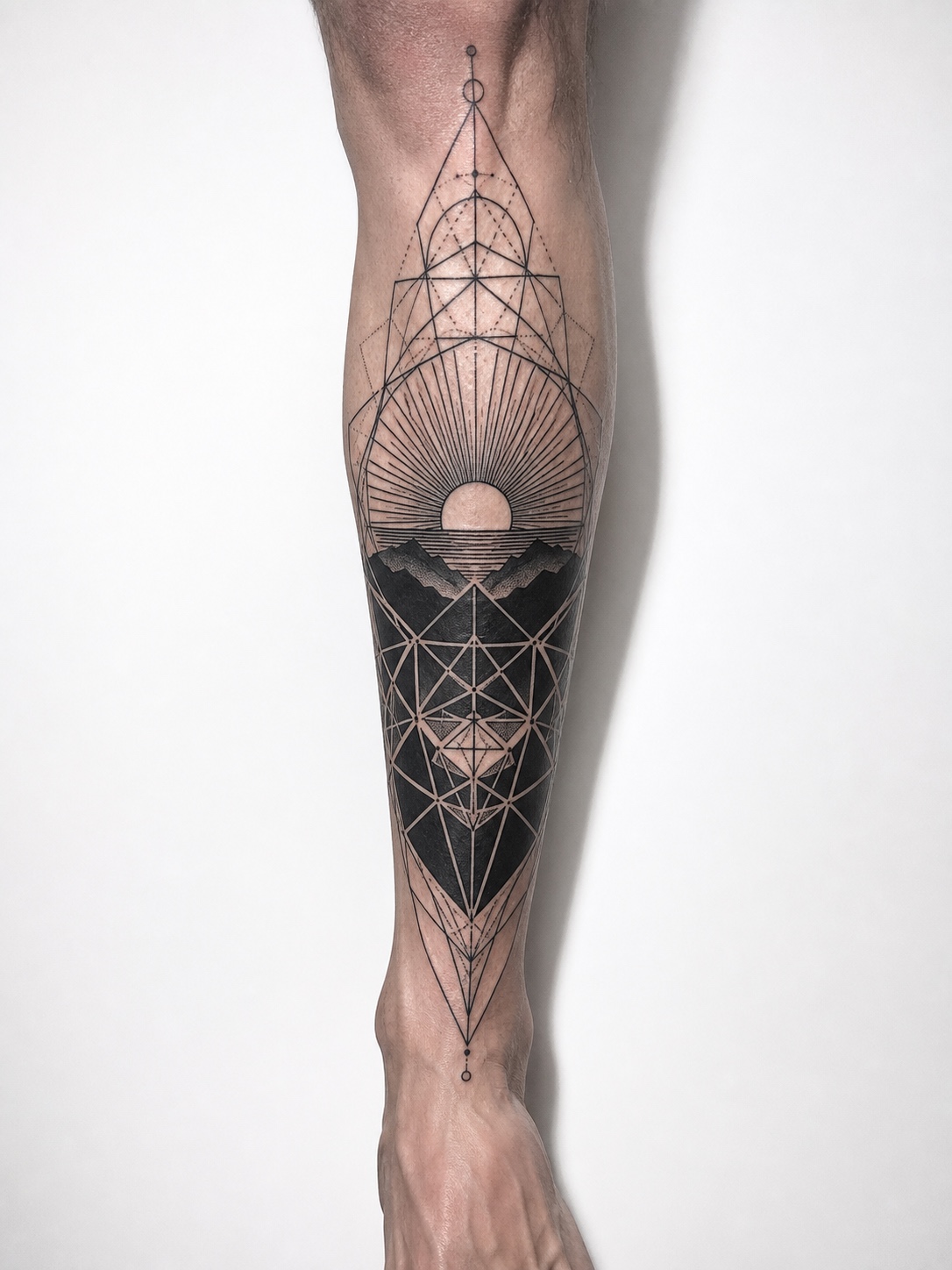
Geometric sunrise tattoos use mathematical precision (polygons, Fibonacci arcs, sacred geometry grids) as a frame for the rising sun image. The result is something between a mandala and an astronomical diagram. Artists like Maxime Buchi and Roman Abrego have pushed this aesthetic significantly in the last decade.
The blackwork version goes heavier: deep black fills, woodcut-style rendering, high contrast. Both work well on the forearm, shin, and chest. The geometric version needs an artist with technical drafting ability. Ask to see their linework under magnification before committing.
Watercolor style
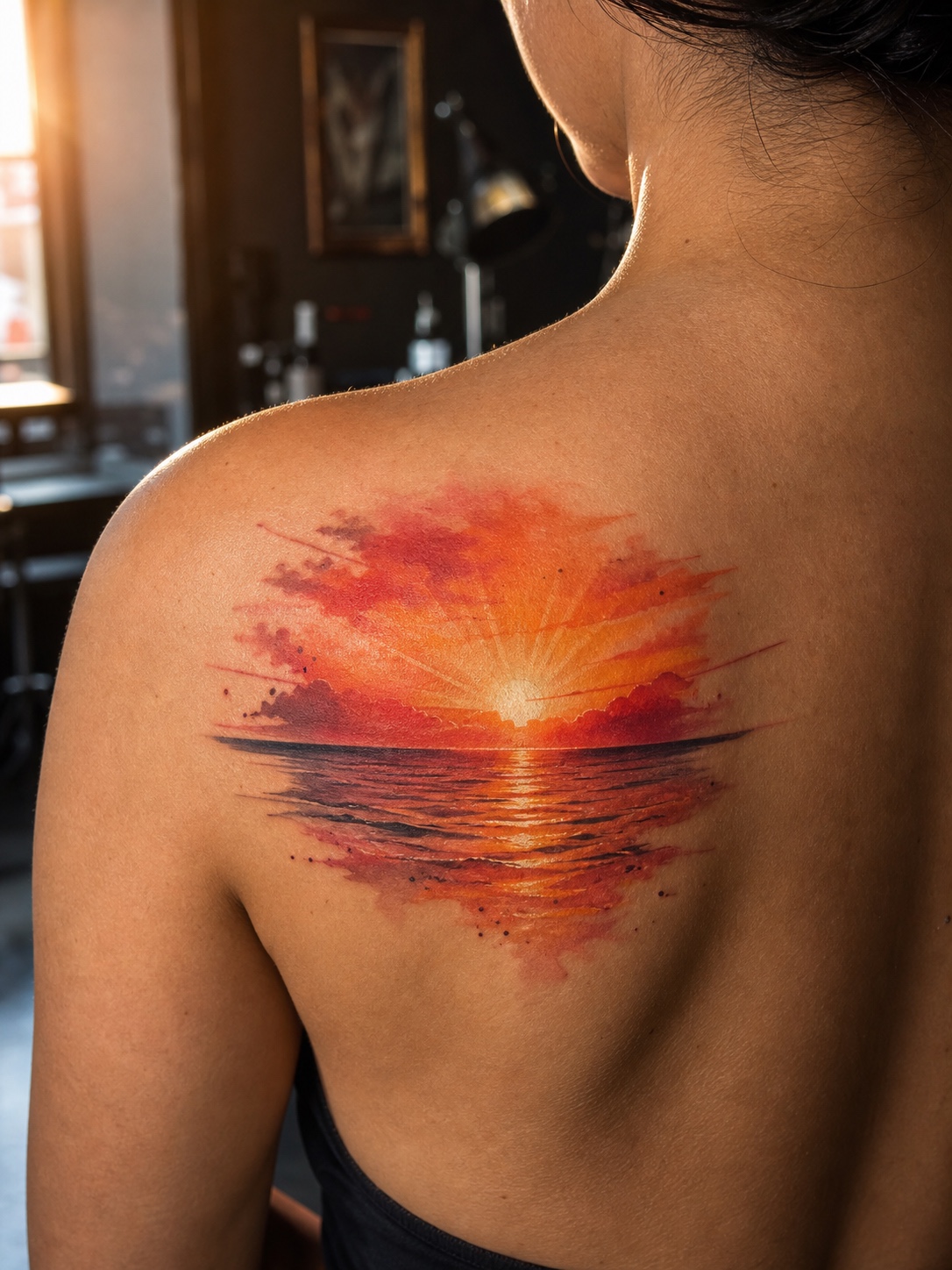
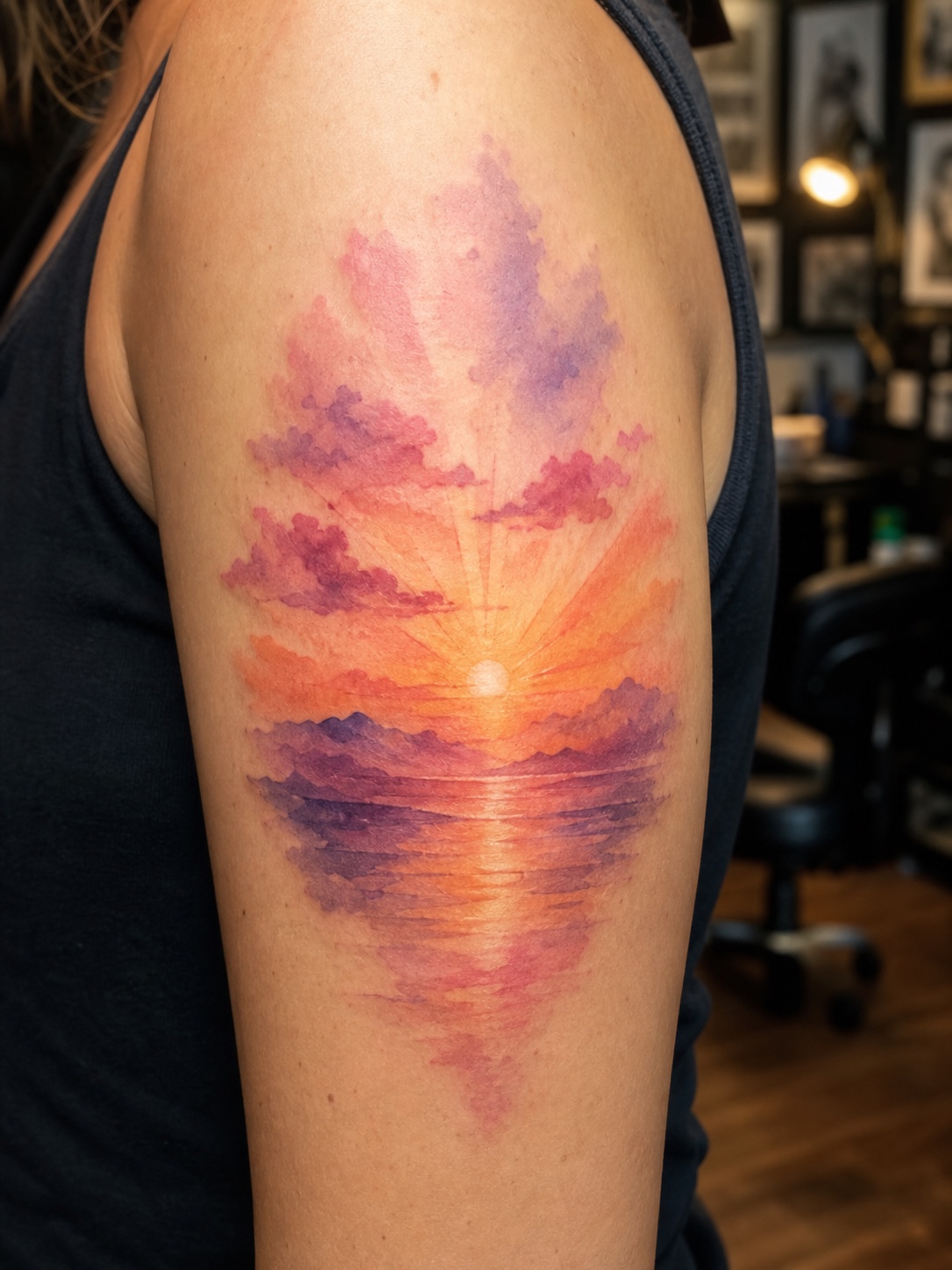
Watercolor tattoos mimic the transparency and bleeds of actual watercolor painting — no hard outline, color fading into skin. Sunrise subjects are obvious candidates because dawn color gradients are the defining visual property of the moment. Artists like Amanda Wachob pioneered the technique in New York around 2009.
The honest caveat: watercolor tattoos without a supporting black outline fade significantly faster than outlined work. The color diffuses into the skin over 5 to 8 years. Some artists now use a subtle black framework under the color to extend longevity without losing the watercolor effect. Ask about this specifically when consulting.
Where to place a sunrise tattoo: body zones mapped
Placement affects how the design reads, how painful it is to get, how well it heals, and how quickly it ages. These are separate considerations and they don’t always point toward the same answer.
Forearm: the default choice for a reason
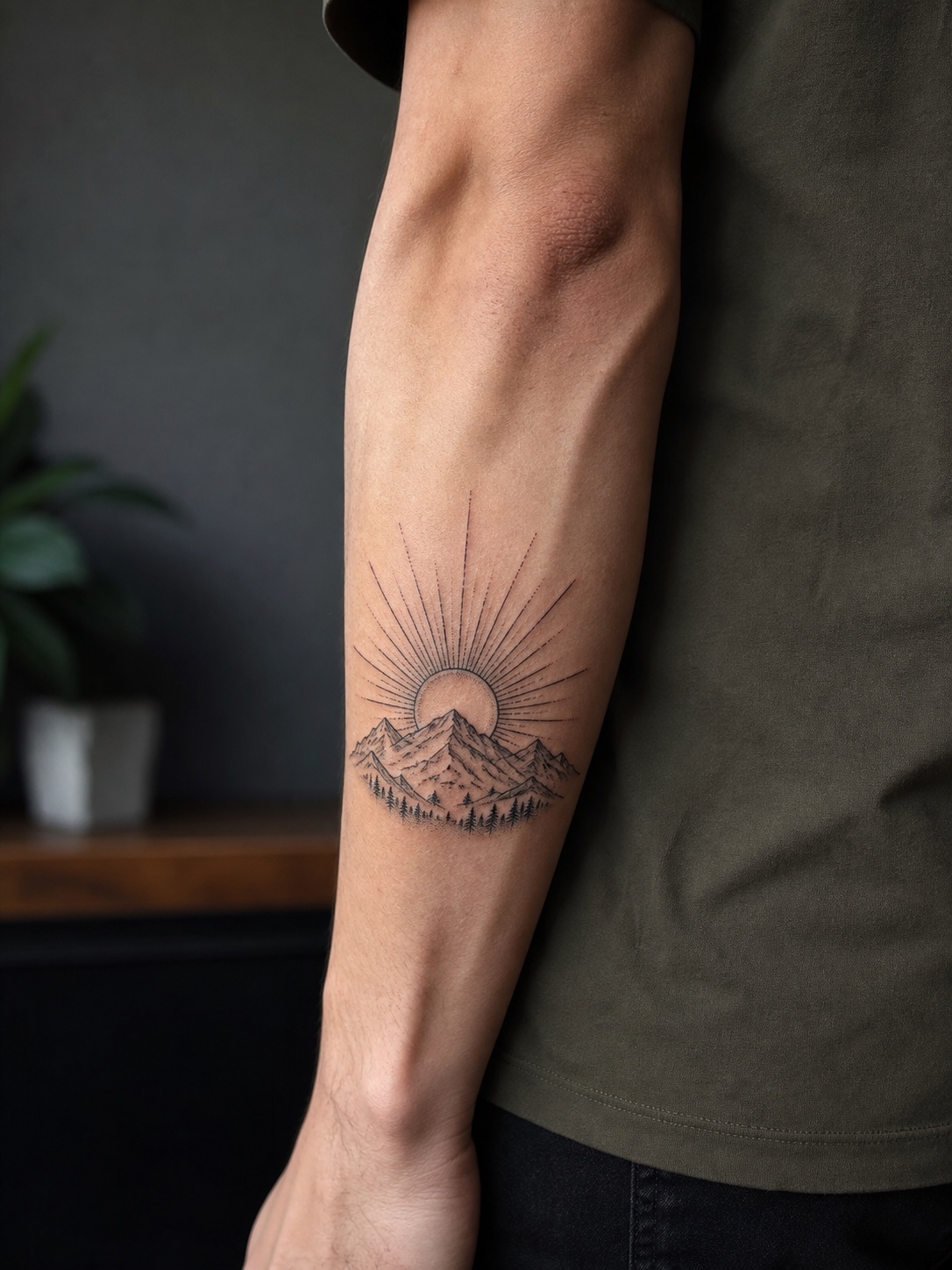
The outer forearm is the most popular placement for sunrise tattoos right now, and the reasoning is practical. You can see it easily. The skin is stable and relatively flat. It takes detail well. It heals consistently. Healing time on the forearm is typically 2 to 3 weeks for the surface and 3 months for the deep layers.
The inner forearm is slightly more sensitive but works for fine-line designs. The wrist end of the forearm fades faster due to constant movement and sun exposure. If you work with your hands in water regularly (cooking, healthcare, swimming), factor that into the healing timeline because moisture complicates the first two weeks.
Shoulder and upper arm: canvas for larger work
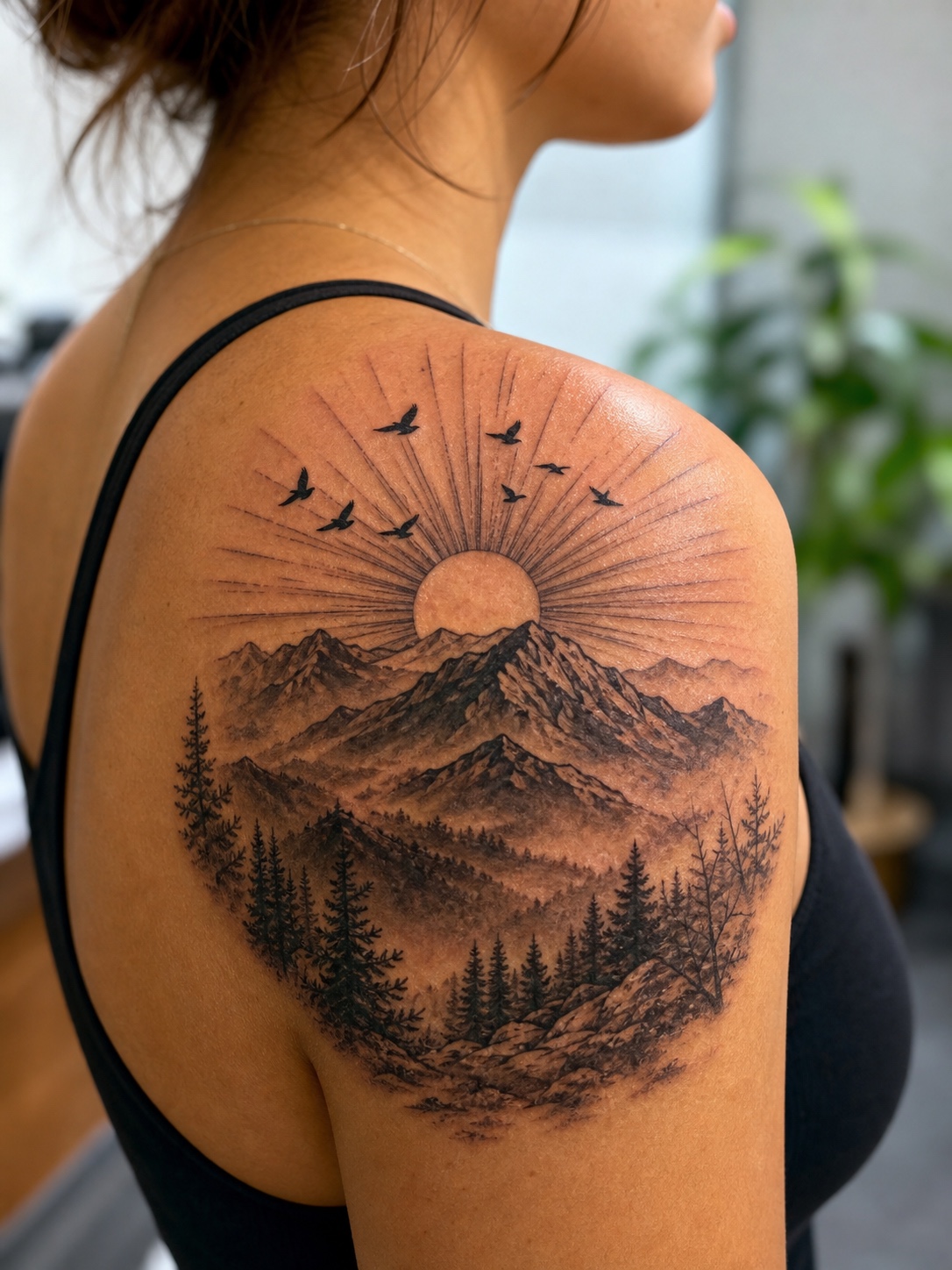
The shoulder cap and upper arm offer the most usable surface area for a sunrise composition with surrounding elements — mountains, birds, clouds, botanical details. A design that feels crowded on a forearm breathes properly at shoulder scale. The deltoid specifically takes bold saturated work well because the skin is dense and consistent.
The outer upper arm is one of the least painful placement zones. The inner arm is significantly more sensitive. Artists often recommend starting with the outer arm for clients who are unsure about their pain tolerance.
Back and spine: for panoramic compositions
A sunrise across the upper back or spanning the full back is among the most ambitious placement options and among the most visually powerful. The horizontal scale of a dawn sky maps perfectly to the width of the back. Upper back placements between the shoulder blades are especially effective for medium-to-large compositions.
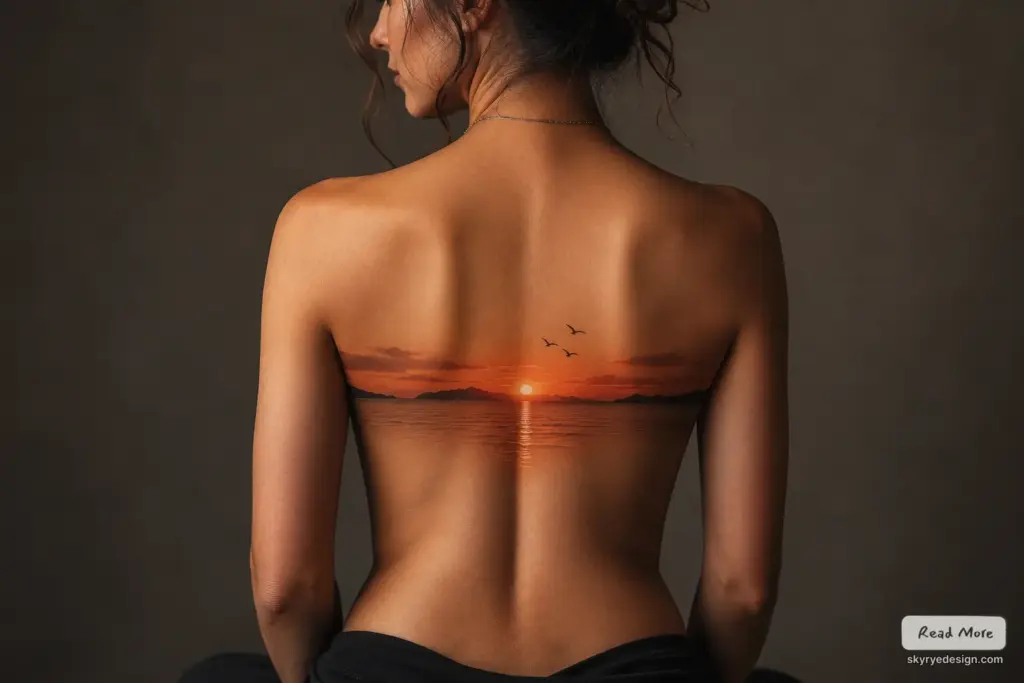
Spine placements are a different category. A vertical strip of sun rays or a rising sun centered on the spine reads well but this is among the most painful placements on the body. If you’ve never been tattooed before, don’t start here. If you have significant existing work and a high pain tolerance, a spine sunrise can be extraordinary.
Ankle, wrist, and small placements
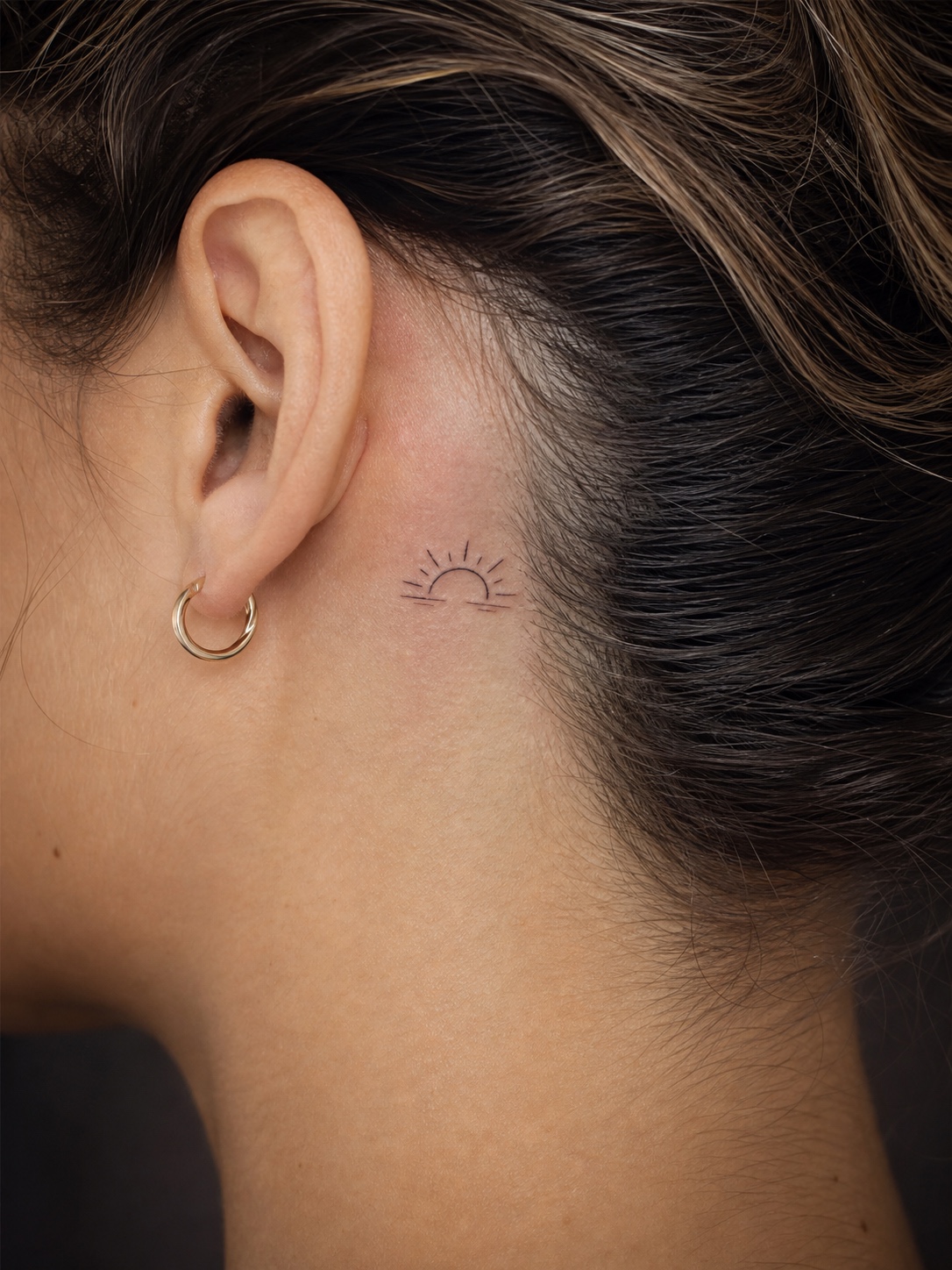
Small sunrise tattoos (3 to 7 cm) work well on the ankle, wrist, behind the ear, and on the inner bicep. The design has to be simplified at this scale — a full mountain range with detailed sun rays becomes a muddy mess at 4 cm. The best small sunrise tattoos use radical reduction: just the arc of the sun and 3 to 4 rays, or a single horizon line with a circle above it.
The trade-off for small placements is longevity. Hands, wrists, and feet experience constant movement and more sun exposure than other body areas. Fine-line work here will need refreshing more often than the same design on the forearm or shoulder.
Design elements that work with a sunrise
For more nearby motifs, the nature and animal tattoo ideas hub gathers landscapes, wildlife, flowers, ocean scenes, and other elements that can support a sunrise composition without making it feel random.
A sunrise tattoo rarely works in complete isolation — the image needs context, ground, or framing to read as a composition rather than a floating graphic. Here’s how the most common companion elements actually function.
Mountains and landscapes
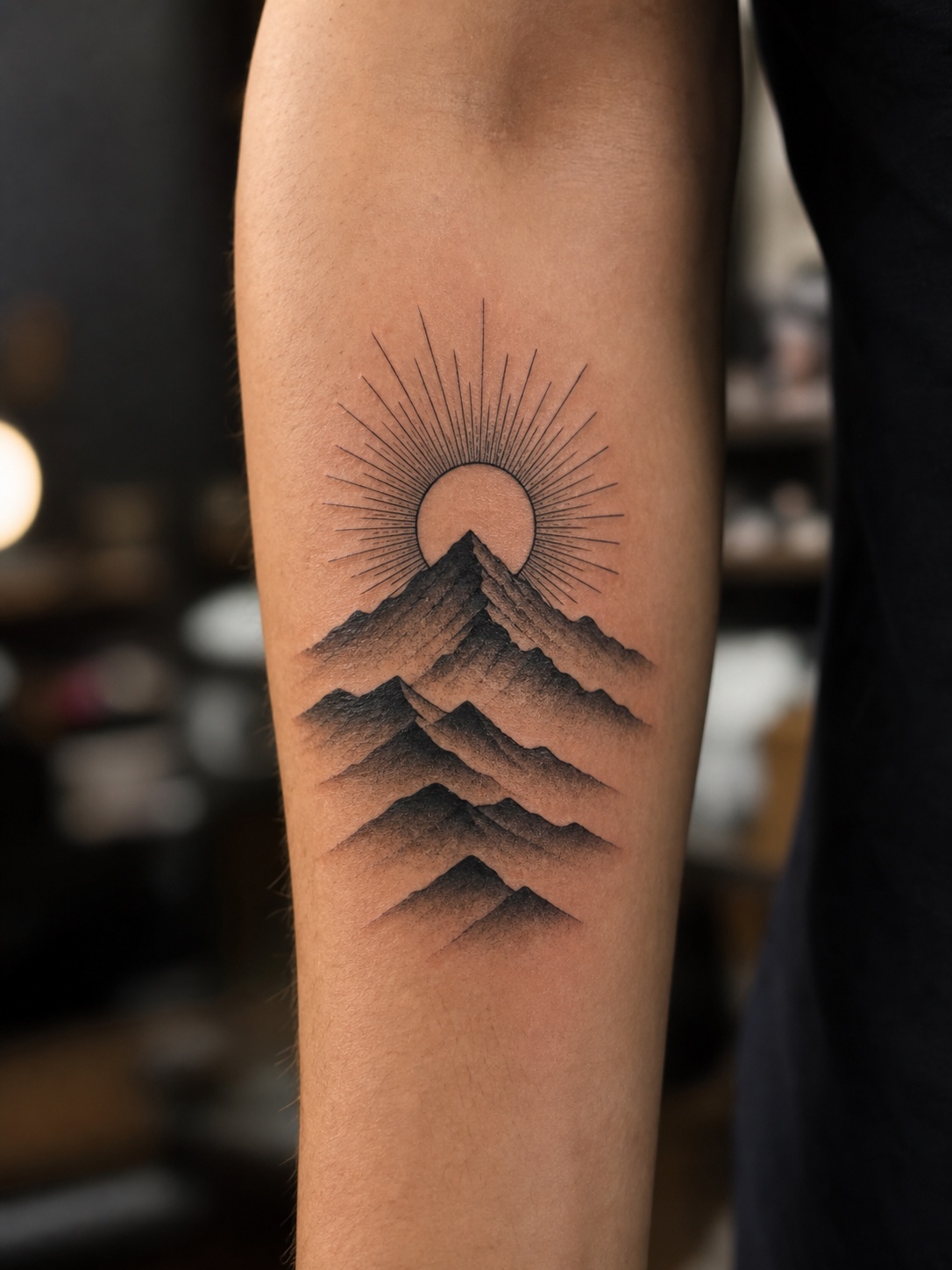
Mountain silhouettes beneath a rising sun are the single most common combination in the genre, and they work because the visual logic is sound. Mountains make the sunrise happen in a specific place. They give the composition a stable horizontal base. They add layers of meaning: journey, perseverance, the difficulty of climbing toward light.
The best mountain-and-sunrise tattoos treat the silhouette as a design element rather than a literal landscape. Simplified ridgelines, geometric mountain shapes, and single peak compositions all read better at scale than hyper-detailed photorealistic geology.
Reference: Artist reference: Horiyoshi III — traditional Japanese master, Yokohama. | Contemporary: Dr. Woo, Shamrock Social Club, Los Angeles (fine-line). | Geometric: Maxime Buchi, Sang Bleu London. | Watercolor: Amanda Wachob, NYC.
Ocean and water horizons
If the horizon line is the part you love most, look through ocean tattoo ideas and small beach tattoos before your consultation; waves, shells, and coastal silhouettes can make a sunrise feel specific instead of generic.
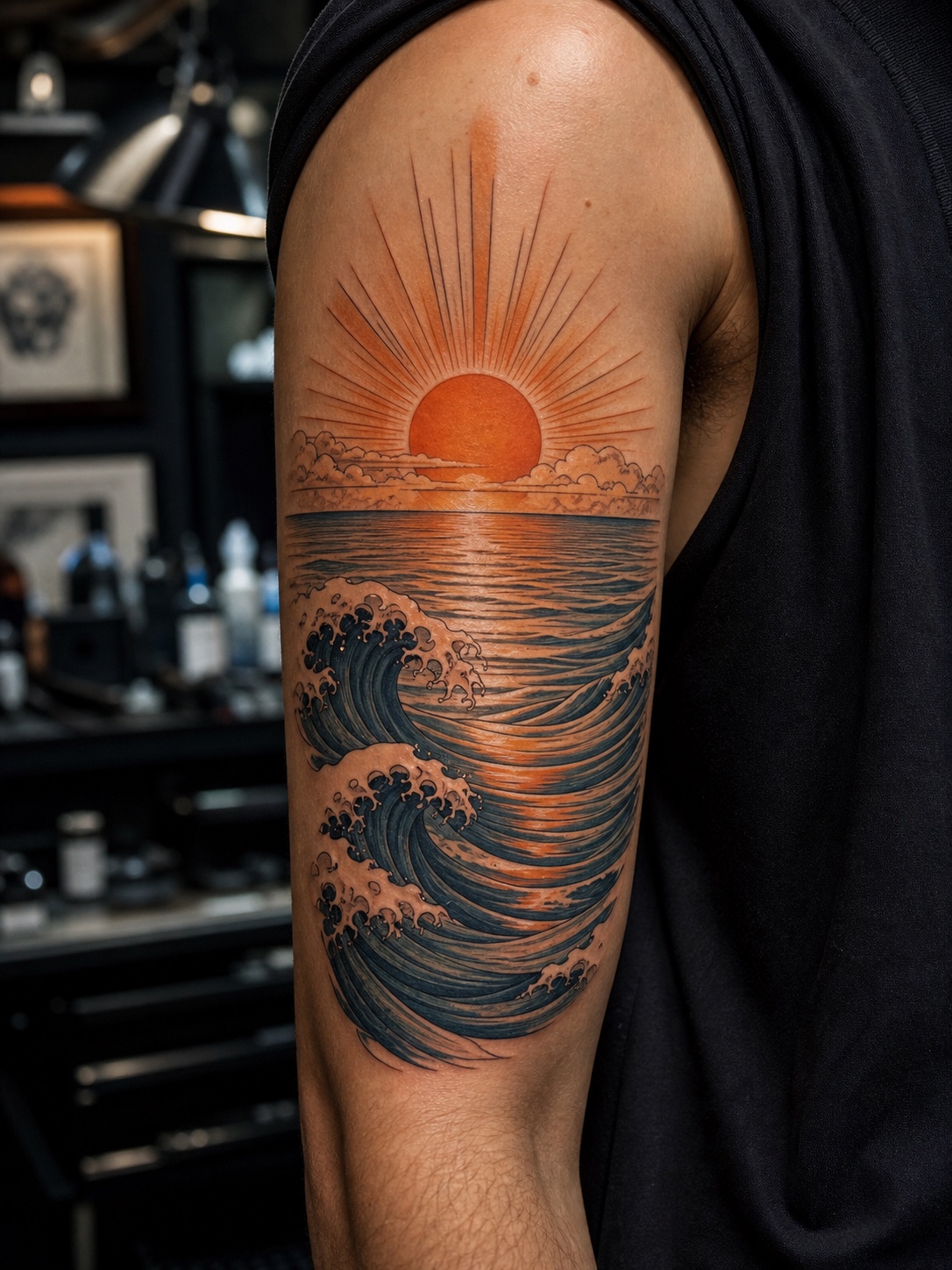
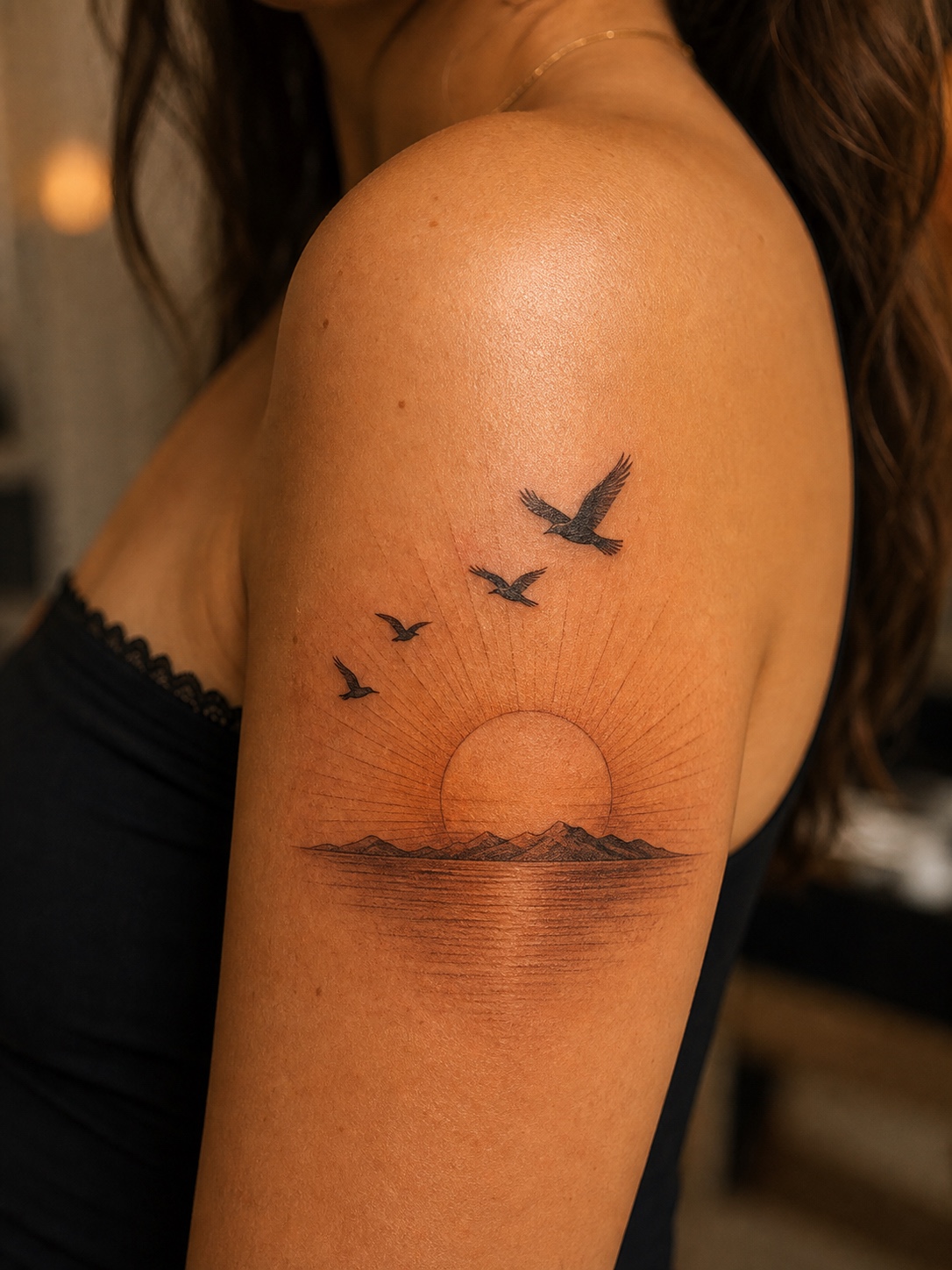
A sun rising over an ocean horizon carries a specific kind of openness that mountain compositions don’t have. There’s no obstacle between the sun and the viewer. Artists use this to suggest freedom, release, and possibility. The technical challenge is rendering water without it looking like a stock clipart wave.
The best ocean sunrise tattoos either go abstract (a flat line suggesting the horizon, nothing more) or commit to a specific visual reference: a Hiroshige-style woodblock wave with a sun rising behind it, or a Polynesian-influenced rendering using traditional geometric fill patterns in the ocean element.
Birds, florals, and additional elements
For floral pairings, sunflower tattoo ideas keep the sun theme bright and direct, while broader flower tattoo meanings can add softer symbolism around growth, memory, or personal milestones.
Birds in flight against a sunrise sky are almost a cliche at this point, but they still work when the execution is precise. The key is reducing the birds to pure silhouette — detailed wing anatomy at sunrise scale becomes visual noise. Three to five birds as simple stroke silhouettes, sized consistently, against a rising sun with minimal surrounding detail is the version that ages well.
Floral elements (lotus, cherry blossom, wildflowers) integrate naturally with sunrise compositions in Japanese and botanical styles. The lotus specifically has been paired with sunrise imagery across Buddhist iconography for a thousand years because both symbolize emergence and daily renewal. If you’re combining flowers with a sunrise, the style consistency between the two elements matters more than the choice of flower.
How to choose a tattoo artist for a sunrise design
The style you want should determine who you hire. This sounds obvious. Most people don’t do it. They find an artist they like and ask that artist to execute a style the artist doesn’t actually specialize in. The result is a tattoo that’s technically competent but not what the reference images promised.
Match the artist to the style
Fine-line sunrise work requires an artist with documented single-needle portfolio pieces. Ask to see healed work, not fresh tattoos — fresh linework looks sharp on everyone; healed work shows how the artist’s technique holds. Japanese traditional requires an artist trained specifically in that lineage. The bold outlines and saturated fills of traditional Japanese work are skills learned over years of dedicated practice.
For geometric and blackwork, ask the artist about their drafting process. Geometric tattoos done by eye rather than by measured construction drift in ways that become obvious once the piece is healed. An artist who can’t explain their construction method is an artist working by approximation.
Reading a portfolio and booking a consultation
Look for portfolios that show multiple completed pieces in the same style. An artist with 30 fine-line pieces in their portfolio is a different proposition than an artist who has done 3. Look specifically for sunrise or solar compositions because the ability to render radiant light (rays spreading outward from a central point) is a specific technical skill not all artists have developed.
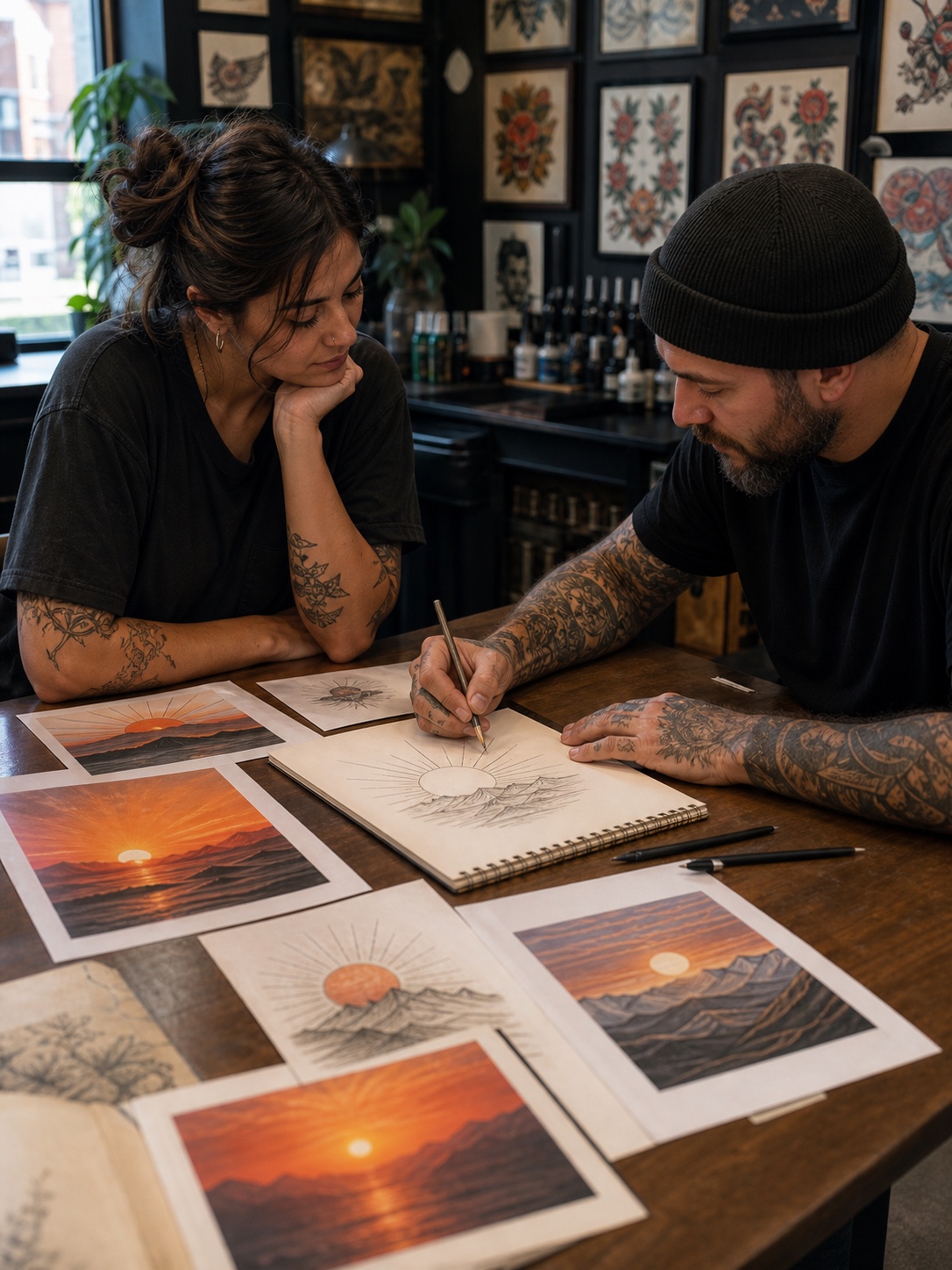
Book a consultation before committing to a deposit. A good consultation is 20 to 30 minutes where the artist asks about your meaning, looks at your reference images, and proposes an approach. An artist who quotes a price and books a slot without asking any questions is an artist who’s not thinking about your specific design.
What to prepare for your consultation
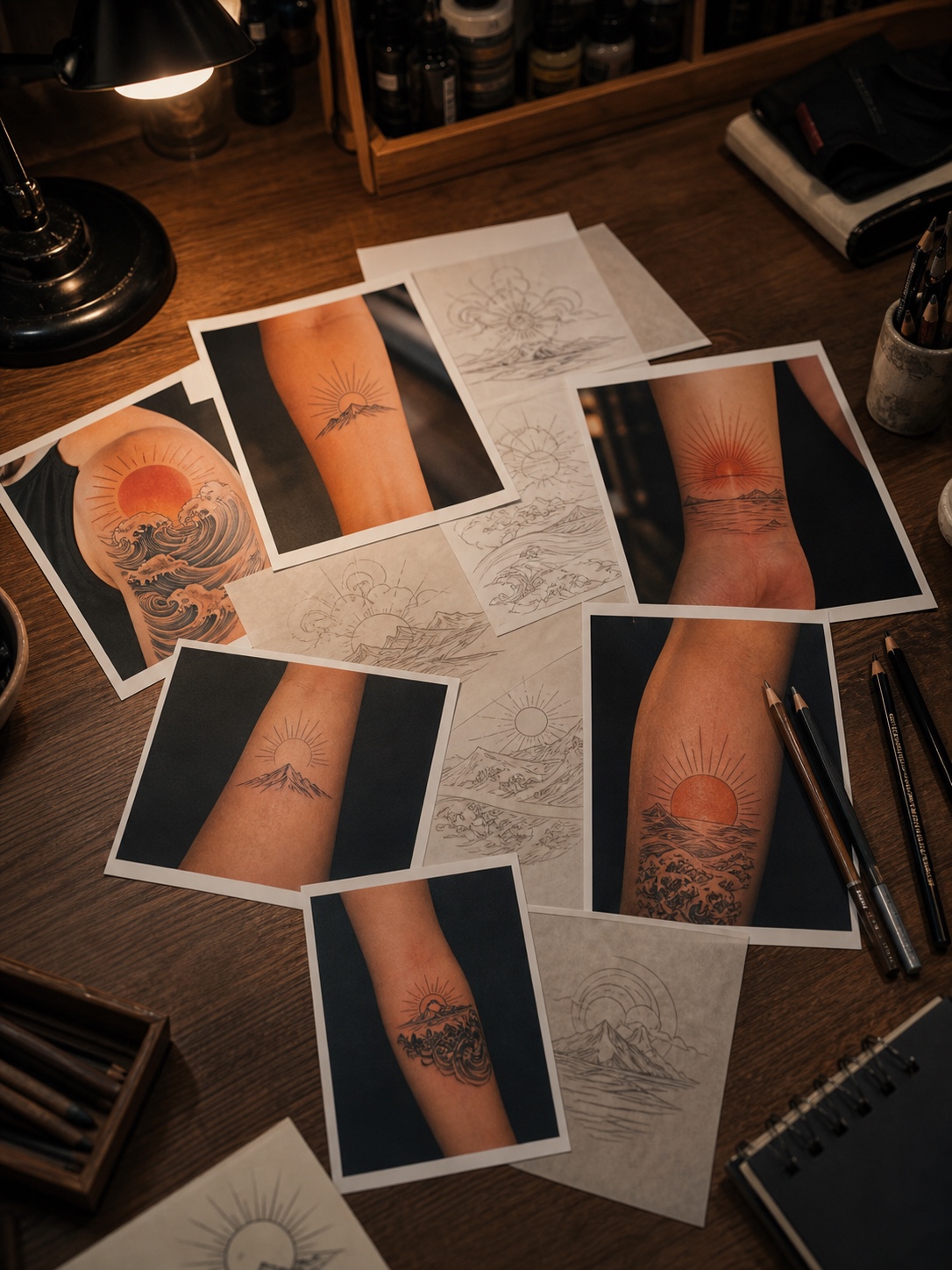
Bring 5 to 8 reference images that represent the style and composition you want. Not all from the same artist — variety shows the artist what specific elements appeal to you. Bring references that show your target placement on a body (even stock anatomy photos help the artist understand scale). Know the rough dimensions you want and be honest about them.
Be clear about your healing commitment. If you swim daily, work outdoors in the sun, or are in healthcare (frequent handwashing), tell the artist. These factors affect which placements and styles they’ll recommend.
Healing, aftercare, and long-term care
The tattoo you get on the day is not the tattoo you’ll have at the end of month three. Healing changes the appearance significantly — lines sharpen, colors settle, the slight blur of fresh ink resolves. What you do in the first two weeks determines which version of the tattoo you end up with.
The first two weeks
The artist will wrap the fresh tattoo in either cling film or a breathable medical film (brands like Saniderm or Tegaderm). If it’s standard cling film, remove it after 2 to 4 hours, wash gently with unscented soap, pat dry, and apply a thin layer of unscented moisturizer (Lubriderm, Aveeno, or a dedicated tattoo aftercare balm like Hustle Butter). Repeat 2 to 3 times per day.
Avoid direct sun exposure entirely for the first two weeks. No swimming, no soaking in baths, no saunas. The skin needs to close and you need the ink to stay where it was placed. If the tattooed area is on your forearm and it’s summer, wear a loose long sleeve whenever you’re outside.
The peeling phase and what it looks like
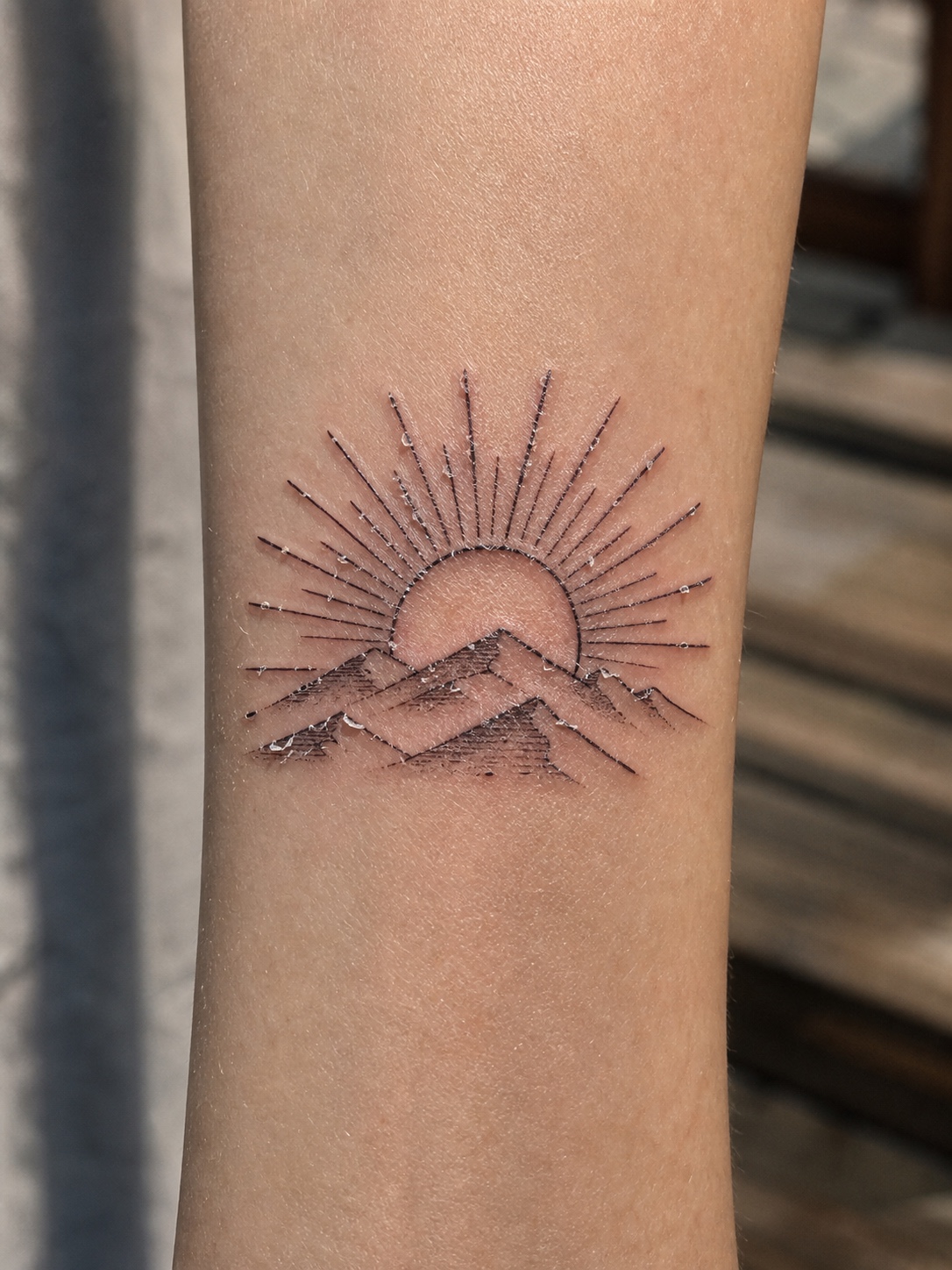
Around days 5 to 10, the tattoo will peel like a sunburn. This is normal. The flaking skin will carry some pigment with it and the tattoo will look dull and faded during this stage. Don’t pick at the peeling skin. Let it lift on its own. Premature picking pulls ink out of the dermis and creates patchy areas that need touching up.
After peeling, the tattoo will look slightly milky for another 2 to 4 weeks as the deeper skin layers finish healing. This is sometimes called the “cloudy” or “ghost” stage. It resolves on its own. Most artists won’t assess a tattoo for touch-up needs until at least 3 months post-session because the final result isn’t visible before then.
Long-term care and sun protection
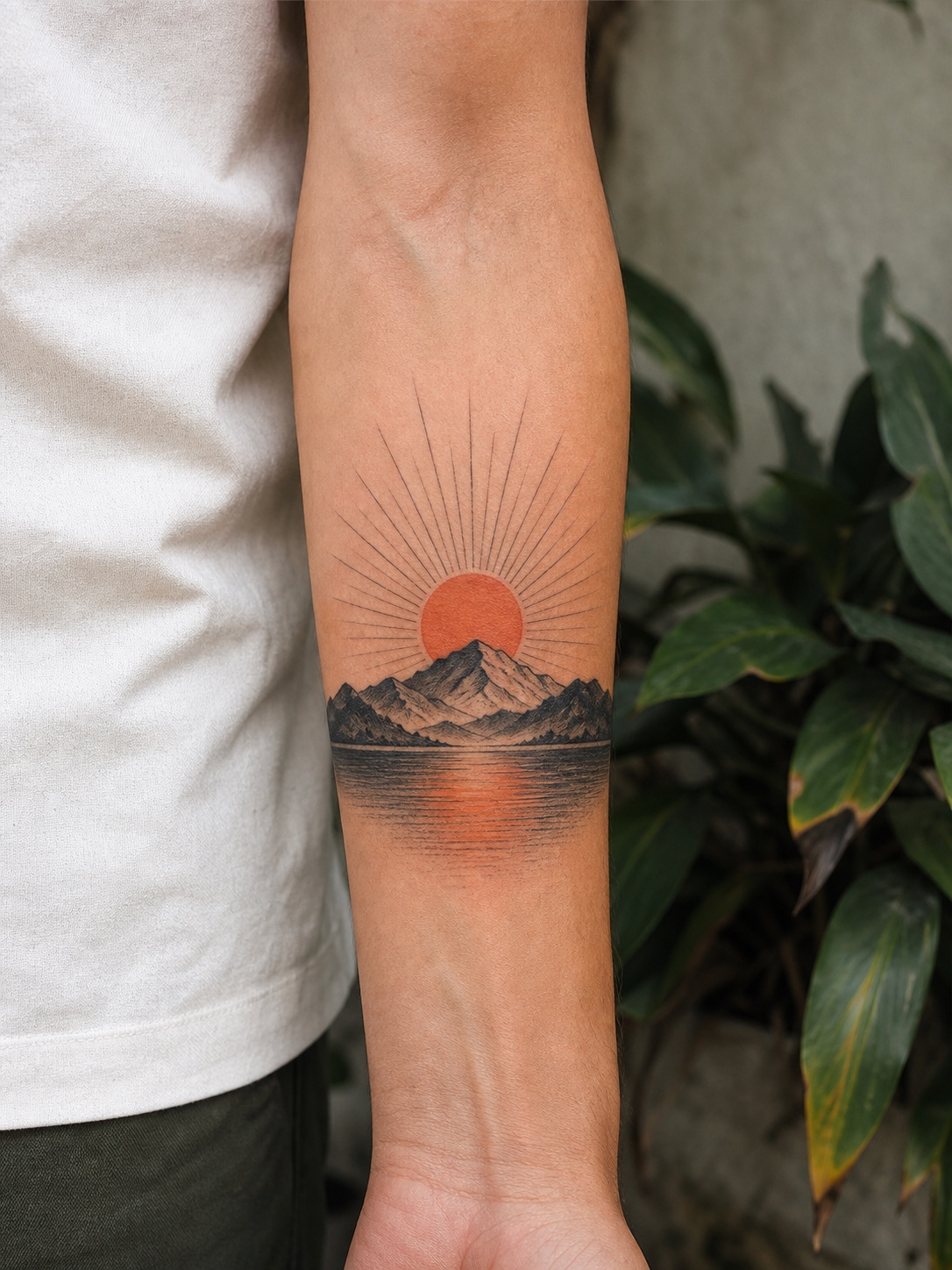
After full healing, SPF 50 applied to the tattoo every time it’s exposed to sunlight is the single most effective thing you can do to extend the life of the design. UV radiation breaks down tattoo pigment faster than any other environmental factor. Fine-line and watercolor tattoos are especially vulnerable because they rely on thin deposits of ink.
Moisturizing the tattooed skin regularly (unscented lotion, daily) also helps by keeping the surrounding tissue healthy. Dry, cracked skin makes tattoo lines appear to fragment. The difference between a well-maintained 5-year-old fine-line tattoo and a neglected one is significant.
Reference: Aftercare reference: Association of Professional Piercers. (2023). Aftercare Guidelines. | Sun protection: Skin Cancer Foundation recommendations for tattooed skin available at skincancer.org.
70+ sunrise tattoo ideas by category
The following reference list covers the main design directions people request. Use this as a starting point for building your reference folder before a consultation.
Small and minimalist sunrise designs
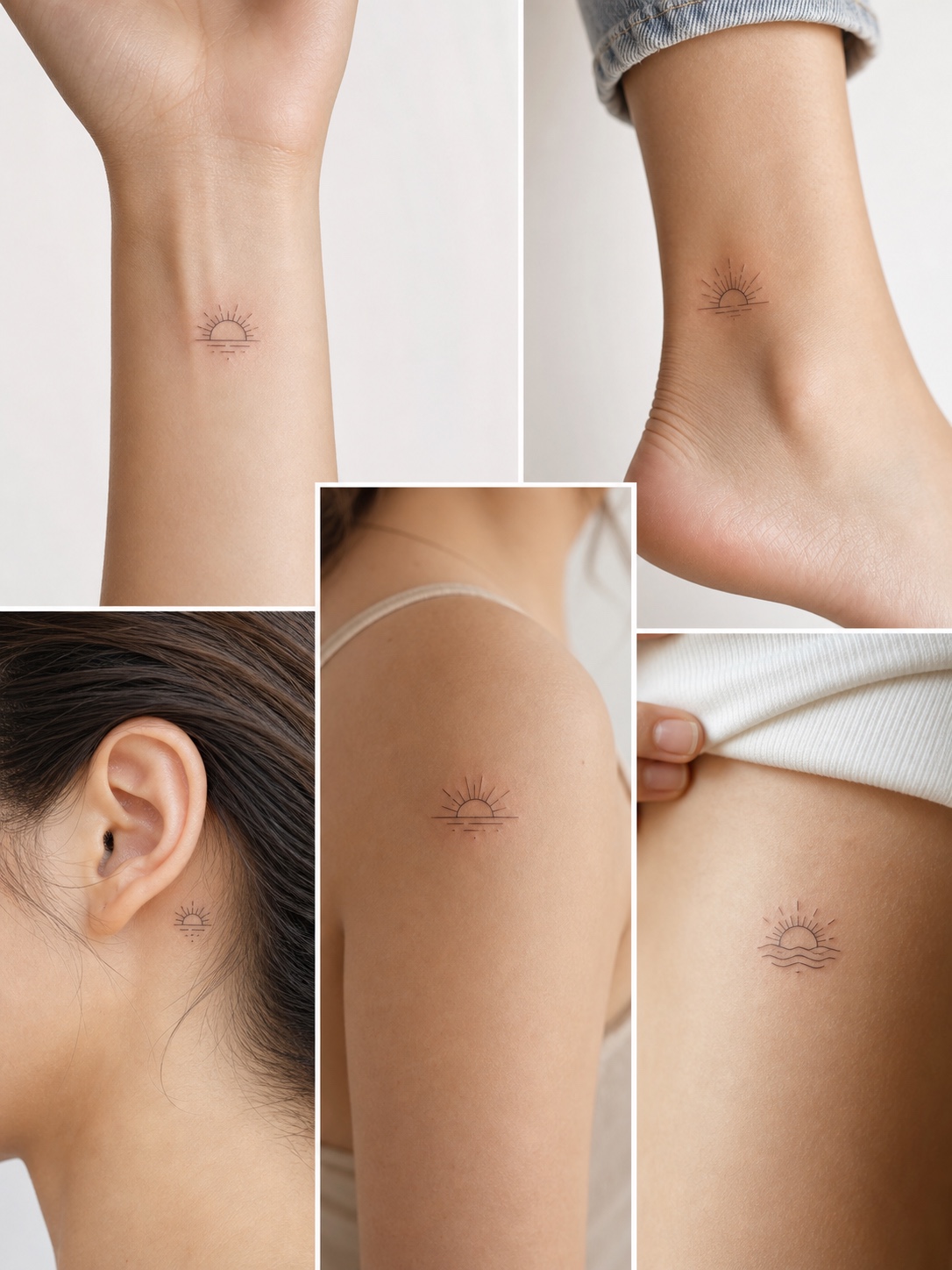
A 3 to 5 cm circle with 4 to 6 rays and nothing else. A single line horizon with a semicircle above it. A tiny geometric sun in polygon form. These work best behind the ear, on the inner wrist, or at the ankle. The design constraint is a creative opportunity — radical reduction forces clarity. The best small sunrise tattoos have exactly the right number of lines and not one more.
- Single arc above a straight horizon line (3 cm)
- Dot-work sun circle with scattered ray dots (4 cm)
- Geometric polygon sunrise with 5 rays (5 cm)
- Fine-line sun over mountain, single needle, no fill (6 cm)
- Crescent to full sunrise progression in three stages (wrist band format)
Medium compositions (forearm and upper arm)
This is the most versatile size range. At 10 to 15 cm, a sunrise composition can include a mountain silhouette, ocean horizon, or 2 to 3 surrounding elements without becoming crowded. Most of the styles in the comparison table above perform optimally at this size range.
- Sun rising over three-peak mountain silhouette, blackwork, forearm
- Japanese traditional sunrise with kumo clouds, upper arm
- Watercolor dawn sky with loose botanical border, upper arm
- Geometric sunrise inside a circle frame with constellation dots, forearm
- Ocean horizon with stylized Hiroshige wave, inner forearm
- Sunrise through forest treeline, fine-line, forearm
Large compositions and sleeve concepts
If the sunrise is only one part of a larger arm scene, study sleeve tattoo ideas for flow, filler, and how large landscape elements wrap around the forearm or upper arm.
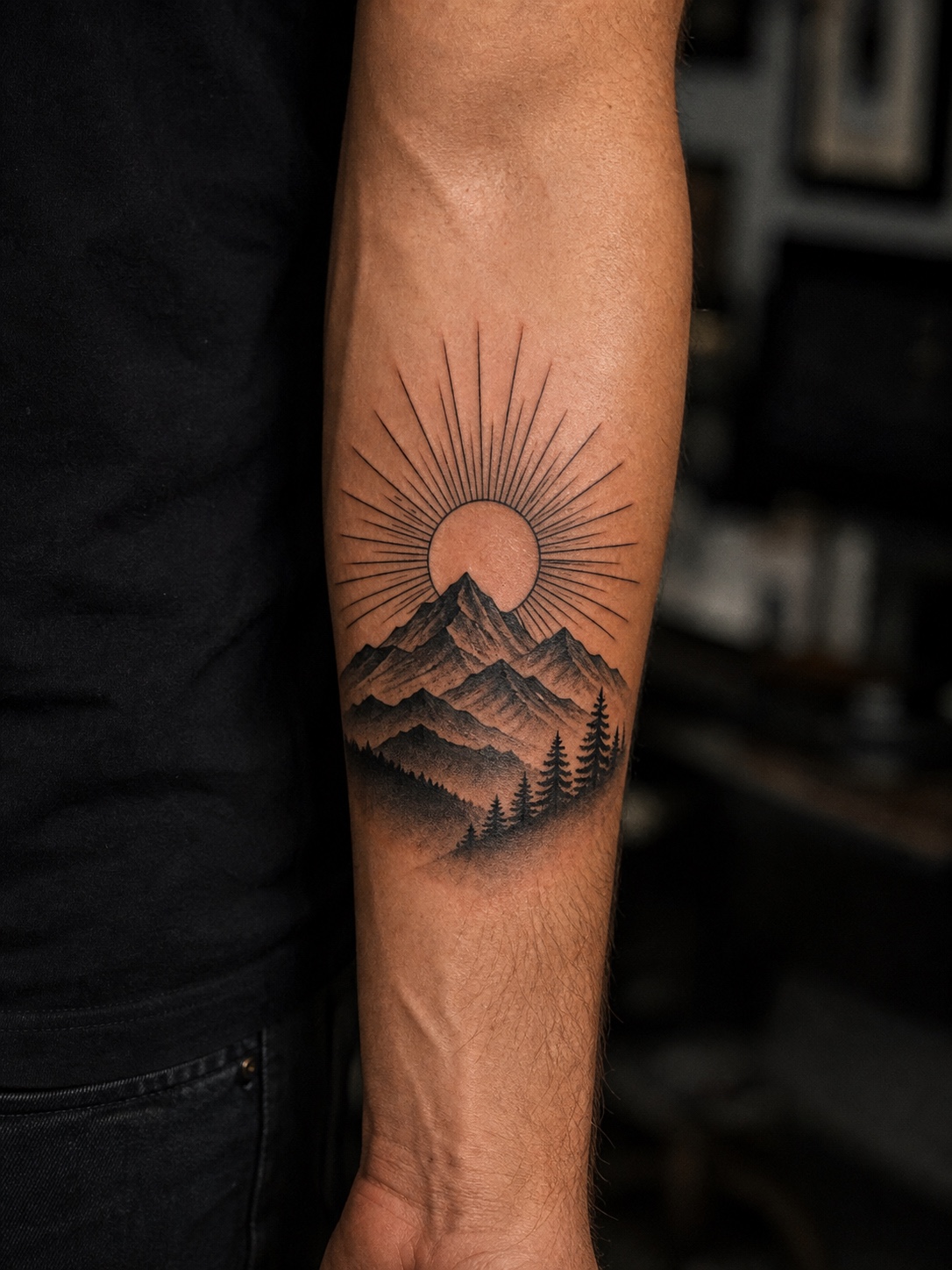
At 20 cm and above, a sunrise composition becomes a scene. The sun can be partially obscured by clouds, the landscape can include foreground detail, and surrounding elements (birds, botanicals, geometric frames) can breathe properly. Japanese traditional and neo-traditional styles dominate at this size.
- Full sleeve: dawn to dusk sun progression from wrist to shoulder
- Back piece: panoramic sunrise over ocean with whale silhouette below
- Chest spread: sunrise with wings and floral frame
- Japanese traditional full upper arm: sun, kumo clouds, koi beneath
- Neo-traditional upper back: sunrise with raven and pine forest
Sunrise tattoos often mark a threshold moment; this psychic reading as reflection offers another way to think through life transitions with clearer questions and healthier limits.
Frequently asked questions
What does a sunrise tattoo mean?
A sunrise tattoo typically represents new beginnings, hope, resilience, and the end of a difficult period. Across Japanese, Polynesian, Maori, and Native American traditions, the rising sun has carried this meaning for centuries. The specific meaning shifts with what elements the artist adds: mountains lean into journey and perseverance; ocean horizons suggest freedom and change. Most people who choose a sunrise design have a specific personal event that the image references.
Where is the best placement for a sunrise tattoo?
The outer forearm is the most practical choice for most people — stable skin, good healing, easy to see. Larger compositions work better on the shoulder cap, upper arm, or upper back. Small designs belong on the wrist, ankle, or behind the ear. Avoid inner elbow creases and the sides of fingers for detailed linework, as these areas experience constant movement and the ink fades much faster.
How much does a sunrise tattoo cost?
A small fine-line sunrise (5 to 8 cm) runs approximately $80 to $200 at most reputable studios. A medium design with detail and color runs $300 to $600. A large back piece or Japanese-style full-color composition can reach $800 to $2,000 depending on the artist’s hourly rate and session count. Prices vary significantly by city and artist experience. A lower quote from an unvetted artist is not a saving.
Does a sunrise tattoo hurt?
Pain depends on placement. The outer thigh, shoulder, and upper arm are the most manageable. The ribcage, spine, inner elbow, and wrist are among the most painful. A small fine-line design takes 1 to 2 hours. A large detailed piece spans multiple sessions of 3 to 5 hours each. Most people describe tattoo pain as consistent scratching or burning, not sharp stabbing pain.
How long does healing take?
Surface healing takes 2 to 3 weeks. Full dermal healing takes 3 to 6 months. During the first two weeks: wash gently twice a day with unscented soap, apply a thin layer of unscented moisturizer, avoid sun exposure, pools, and saltwater entirely. After healing, SPF 50 applied every time the tattoo is in the sun significantly slows color fade — especially important for fine-line and watercolor styles.
Which style ages best?
Japanese traditional with bold black outlines holds color and form the longest — decades with minimal degradation. Blackwork and geometric styles with clean linework are the second most durable. Fine-line and single-needle work is the most fragile style and typically needs refreshing within 5 years on high-exposure placements. Watercolor without black outlines fades the fastest. If longevity is the priority, choose a style with clear defined linework.
Can I combine a sunrise with other elements?
Yes — mountains, ocean horizons, birds in flight, lotus flowers, and geometric frames all combine cleanly with sunrise imagery. The key is style consistency between elements. A fine-line sun with a bold-outline traditional wave looks jarring. Choose elements that were designed in the same visual language and scale them so the piece reads as one composition rather than separate images sharing space.
Before you book: the questions that matter
The design decisions you make before the needle touches skin are the ones that will matter for decades. Not just the image — the style, the placement, the size, and who you hire. A well-chosen sunrise tattoo on the right placement in the right style is still going to read clearly and mean something specific in thirty years. A rushed decision at a walk-in shop because you were in the right neighborhood is not.
Three things to do before booking. First: build a reference folder of 5 to 8 images that show the specific style and composition you want, not just sunrises you find generally appealing. Second: find 2 to 3 artists who have documented healed work in that style and book consultations with all of them before committing to a deposit. Third: settle on your placement and confirm it works at the scale you want by having the artist sketch the outline on your skin before the session starts.
The sunrise has been rising every morning for longer than any of us have been paying attention. A tattoo of it made well, on the right part of your body, in a style built to last, will age the same way the real thing does: steadily, reliably, and better than you expected.
If you love organic themes, blending a rising sun with trailing, nature-inspired vine tattoo ideas is a perfect way to represent new beginnings and vitality.
For more placement and style references, browse the broader tattoo ideas guide on Sky Rye Design.
If you are exploring themes of rebirth, combining a sunrise with a lotus can be very powerful; you can read more about the lotus flower tattoo meaning to see how they pair.
- 234shares
- Facebook0
- Pinterest234
- Twitter0
- Reddit0