When I was working on an automotive showroom concept in Kyiv, the client wanted full-height south-facing glass across a 40-meter facade. Beautiful idea on a sketchbook. The first question from the structural engineer was direct: “What’s your glazing specification?” I didn’t have one. I had a rendering. Full-height glazing in tropical architecture makes the same issue more demanding: the glass needs to preserve views and openness without turning the room into a heat trap.
- What a Building Envelope Actually Does
- Insulating Glass Units: The Specification That Matters Most
- Low-E Coatings: What the Numbers Mean
- Passive Solar Design: Where Specification Meets Strategy
- Indoor Air Quality and What Bad Glazing Actually Does to a Building
- Certifications: What LEED and Passive House Actually Require
- Summary: What to Specify and Why
- FAQ: Insulating Glass in Architecture
- What is an IGU and why does it matter?
- What are Low-E coatings and what do they actually do?
- Why do IGUs fog up and how is it prevented?
- What is passive solar design and how does glazing fit into it?
- What does thermally broken frame mean?
- What is the difference between LEED and Passive House certification?
- The Specification Is the Design
That’s where projects bleed money and performance — when the spec hasn’t caught up to the vision. Insulating glass looks effortless in CGI. In practice it’s a thermodynamic problem you solve with invisible technology: gas fills, molecular sieves, metallic coatings measured in nanometers, calculated overhang ratios. Get the specification wrong and the design doesn’t work, no matter how good the rendering looked.
Coastal glass specification becomes more demanding on exposed sites; see the private island architecture guide for the broader environmental context.

This piece covers the material science behind insulating glass. What goes inside an IGU. Why moisture control is the failure point most clients never see coming. How Low-E coatings change the thermal math, and where passive solar strategy connects to all of it. Designer’s perspective, not a product brochure.
Glazing choices become even more important in a modern wood house, where large panes, shaded timber cladding, and wall insulation have to work together instead of fighting each other.
What a Building Envelope Actually Does
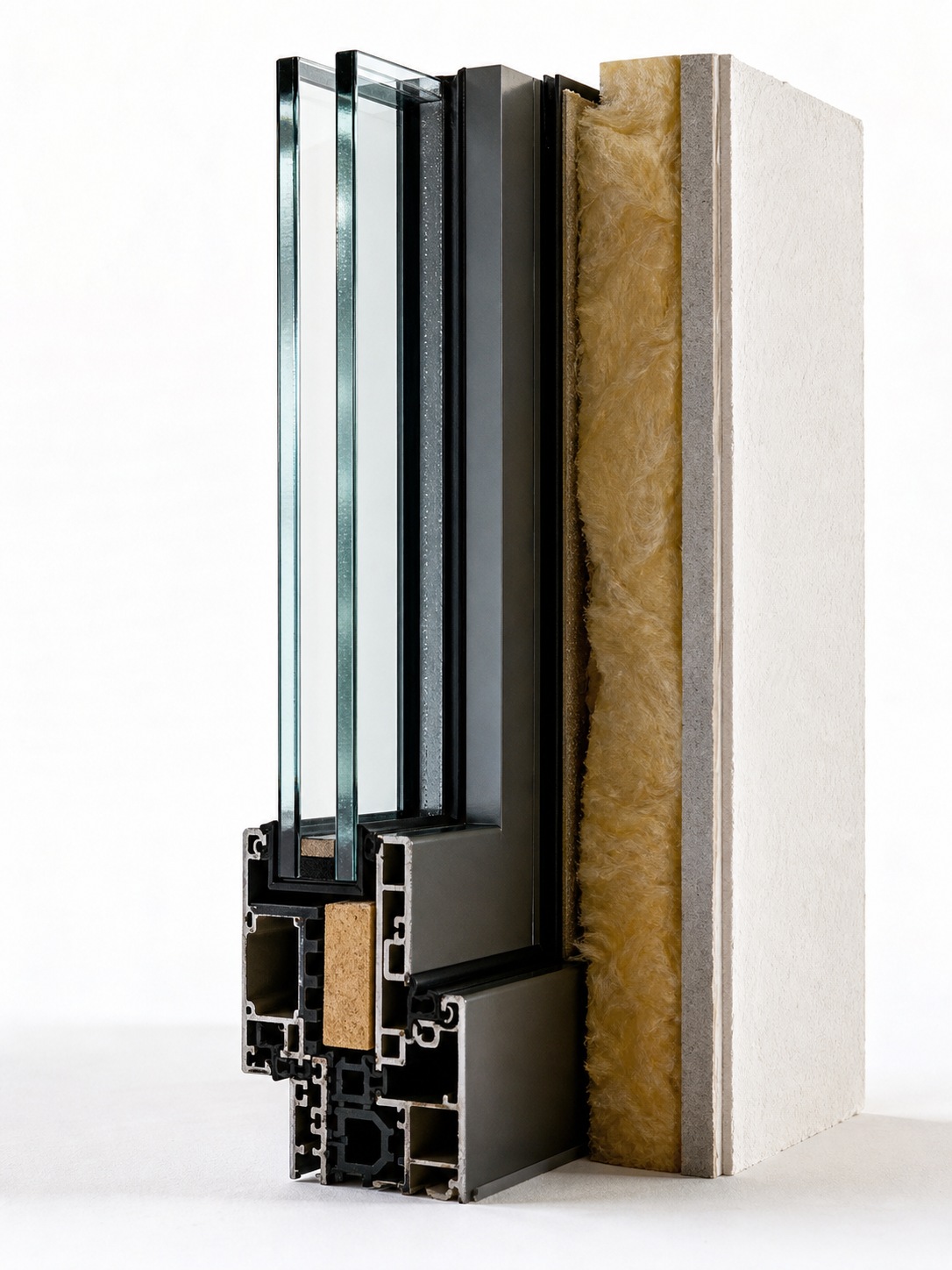
The thermal envelope is every surface that separates conditioned space from the outside world: walls, roof, floor, and glazing. Its job is to slow heat transfer in both directions — keeping warmth in during winter and blocking solar gain in summer. How well it does that job is measured by the U-value, which is thermal transmittance per square meter per degree of temperature difference. Lower U-value means better insulation.
For most of architectural history, the limiting factor was glass. A single pane of 6mm float glass has a U-value around 5.8 W/m²K. A solid masonry wall with insulation sits around 0.3 to 0.5. That gap is why the first generation of glass buildings were energy disasters: beautiful to look at from the street, brutal to heat and cool from inside.
The material innovations that closed that gap are what make contemporary glass architecture possible. They’re not visible in the finished building, which is exactly why clients rarely ask about them until something goes wrong.
The Three Heat Transfer Problems to Solve
Heat moves through a building envelope in three ways, and a well-specified glazing system has to address all three.
Radiation is electromagnetic energy transfer — the sun’s infrared heat passing through glass. This is what Low-E coatings address.
Conduction is heat moving through a solid or gas by molecular contact. This is why argon-filled IGUs outperform air-filled ones: argon conducts heat roughly 34% less efficiently than air.
Convection is heat carried by moving air or gas currents within the IGU cavity. This is why the gap width between panes matters. The optimal width for argon-filled double glazing is 15 to 18mm — narrow enough to suppress convection currents, wide enough to insulate effectively. Below 10mm, conductance rises. Above 20mm, convection begins.
U-Value Reference for Designers
Single glazing: ~5.8 W/m²K. Standard double glazing (air-filled): ~2.8. Double glazing with argon + Low-E: ~1.0 to 1.4. Triple glazing with krypton + Low-E: ~0.5 to 0.8. Passive House standard for windows: ≤0.8. Thermally broken frame adds 0.2 to 0.4 improvement over standard aluminium.
Insulating Glass Units: The Specification That Matters Most
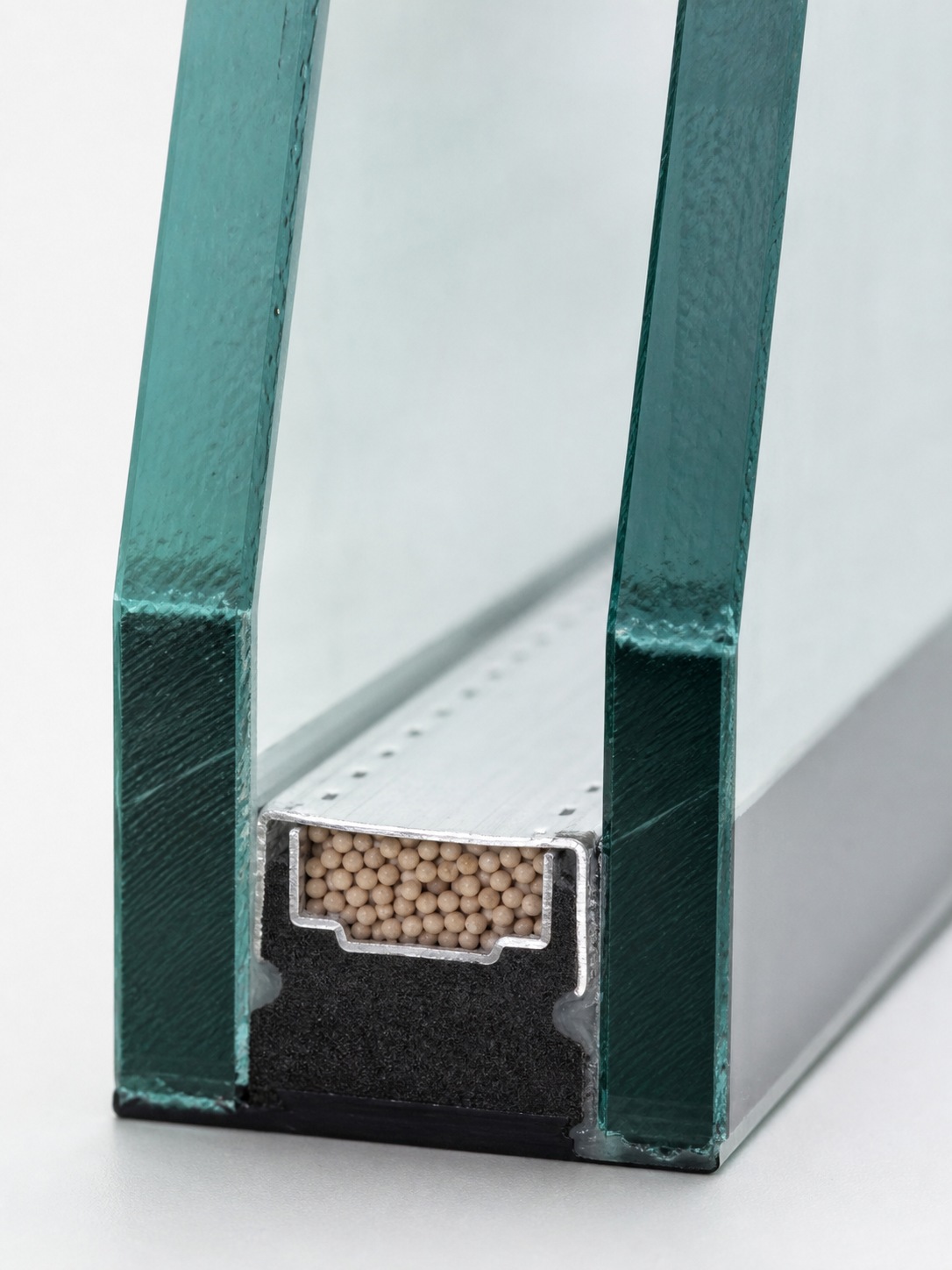
An IGU is a hermetically sealed assembly of two or three glass panes held apart by a spacer, filled with inert gas, and sealed against moisture infiltration. The panes can be standard float glass, tempered, laminated, or any combination. The performance comes from the assembly, not the glass type alone.
The gas fill is the first performance variable. Argon is standard in most commercial IGUs — it’s inert, non-toxic, and widely available. Krypton offers better thermal performance (lower conductivity) but costs significantly more and is typically specified only where frame depth is constrained. Some manufacturers offer argon-krypton blends as a cost-performance compromise.
Triple glazing adds a third pane and a second gas-filled cavity, which drops U-values below 0.8 W/m²K when combined with Low-E coatings. This is the standard required by Passive House certification in cold climates. The weight penalty is real: a 1m² triple-glazed unit can weigh 40 to 50kg versus 20 to 25kg for double glazing, so structural and framing implications need to go into the specification from the start.
The Moisture Problem Nobody Talks About in Presentations
Every IGU is sealed at manufacture to keep moisture out of the gas-filled cavity. Over time, that seal is subjected to pressure cycling from temperature changes, UV degradation at the sealant edges, and in poorly specified units, thermal bridging through metal spacers that creates cold spots where moisture can condense on the inner glass surface.
When moisture does get in, the result is permanent fogging between the panes. There is no fix short of replacing the unit. In a facade with dozens of large-format panels, that failure reads as both a performance failure and an aesthetic one — misted glass in a glass building is unmistakable.
The protection mechanism is the desiccant inside the spacer bar: a material that absorbs any residual moisture during manufacture and any trace moisture that permeates the seal over the unit’s lifetime. The standard solution is 3A molecular sieve zeolite, an aluminosilicate mineral with pore sizes precisely matched to capture water molecules (3 ångströms) while allowing argon molecules to pass through unabsorbed. The specificity matters: a desiccant that absorbs argon would degrade the very property you’re specifying the gas fill to provide.
This is a component-level specification decision that most architects delegate entirely to the window manufacturer. The better approach is asking which desiccant system is in use and where it’s sourced. Manufacturers like Jalon produce 3A zeolites that meet the precision requirements for high-performance IGU applications — consistent pore sizing, stable absorption capacity across the unit’s 25 to 30-year intended lifespan. It’s a detail most specification meetings skip entirely, which is exactly when it tends to become a warranty claim.
When specifying IGUs for a project, ask the fabricator for the desiccant type and its conformance to EN 1279 (European standard for IGU gas-filled units). A fabricator who can’t answer this question is not the right partner for a high-performance facade.
Low-E Coatings: What the Numbers Mean
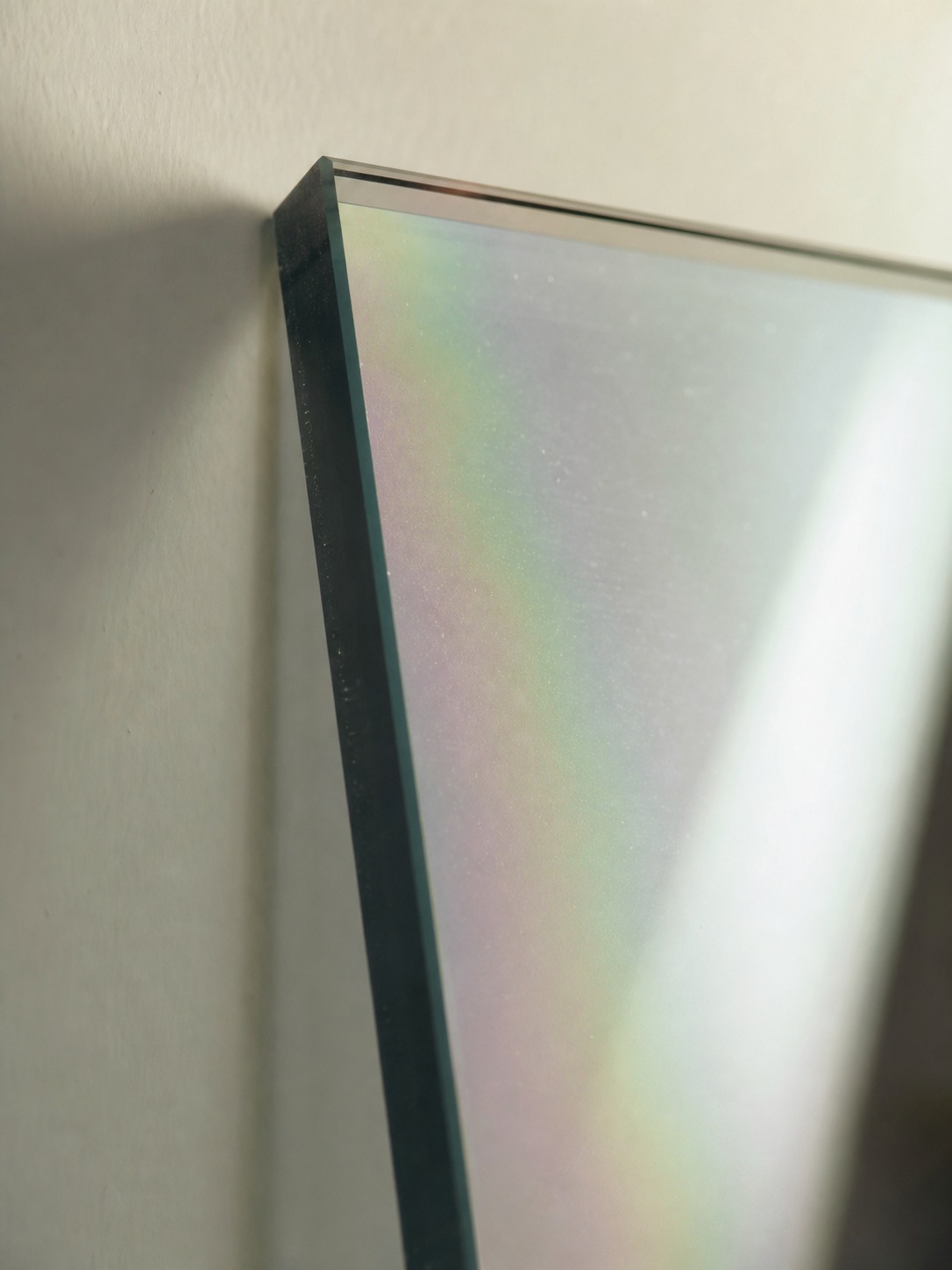
Low-emissivity coatings are thin metallic or metal-oxide layers, roughly 500 times thinner than a human hair, applied to the glass surface during manufacture. Their function is selective: they reflect long-wave infrared radiation (heat) while allowing short-wave visible light to pass.
The practical effect is that a Low-E coated IGU with argon fill can reduce radiant heat transfer by 30 to 50% compared to uncoated double glazing, according to data from the U.S. Department of Energy. Windows with Low-E coatings typically cost 10 to 15% more than standard units but reduce overall energy loss by up to 30 to 50%.
There are two primary Low-E coating types with different climate logic:
Hard-coat (pyrolytic) Low-E: Applied during float glass manufacture while the glass is still hot. More durable, can be used in single-pane applications, but lower performance than soft-coat. Less common in high-specification facade work.
Soft-coat (sputtered) Low-E: Applied in vacuum chambers after manufacture. Higher performance, lower emissivity values (down to 0.02 versus 0.10 for hard-coat), but requires the sealed environment of an IGU to survive — exposure to air degrades the coating. This is the standard for most high-performance facade specifications.
Solar Heat Gain Coefficient: The Variable Most Specs Get Wrong
Low-E coatings are often specified by U-value alone, which measures insulation but not solar control. The Solar Heat Gain Coefficient (SHGC) is the other critical number: it measures how much solar energy passes through the glazing as heat, on a scale from 0 to 1. A lower SHGC blocks more solar heat.
The design error I’ve seen repeated on south-facing elevations is specifying a low-SHGC coating for thermal control without accounting for the loss of passive solar gain in winter. In a cold climate, a well-oriented south facade with high SHGC glass can contribute meaningfully to heating loads through solar gain — that gain disappears if you specify the coating for a hot-climate solar rejection scenario.
The correct approach is climate-specific and orientation-specific: high SHGC (0.50+) for north-facing and shaded facades in cold climates; low SHGC (0.25 to 0.35) for west-facing unshaded facades in mixed or hot climates; and moderate SHGC with calculated overhangs for south-facing facades where passive solar strategy is part of the design intent.
Coating Placement in an IGU
Surface 1: exterior face of outer pane. Not used for soft-coat Low-E (exposure degrades it). Surface 2: interior face of outer pane. Common for solar control coatings. Surface 3: interior face of inner pane. Most common position for thermal insulation Low-E. Surface 4: interior face, innermost surface. Newer fourth-surface Low-E improves U-values further; growing use in triple-glazed passive house specifications.
Passive Solar Design: Where Specification Meets Strategy
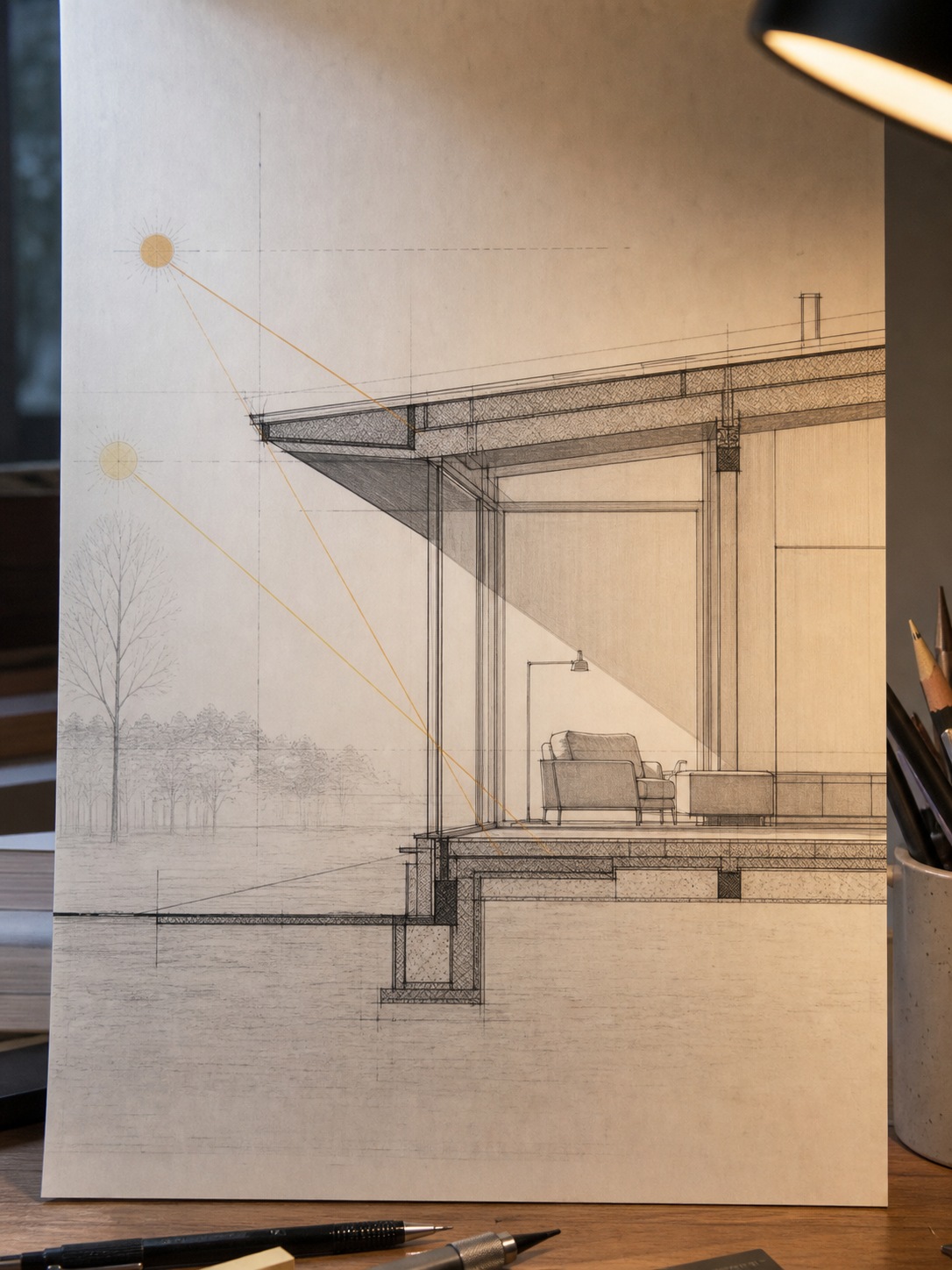
Material science gets you a well-specified window unit. Passive solar design gets you a building that uses that unit intelligently. The two need to be specified together from the earliest design stage, not added to each other in sequence.
The basic passive solar geometry is straightforward: the sun sits low in winter and high in summer. A horizontal overhang sized correctly for the latitude will shade south-facing glass in summer (when the sun is high) while allowing winter sun to enter below it (when the sun is low). The depth of that overhang is a calculation, not an aesthetic choice. For a latitude of 50°N (roughly Central Europe or Southern Canada), an overhang depth equal to roughly 50 to 60% of the window height blocks summer sun while admitting roughly 80% of winter solar gain.
When glass areas face strong sun, passive solar glazing decisions should be planned together with overhangs, insulation, and room use.
Thermal mass works alongside glazing. When winter sun enters through south-facing glass and strikes a concrete floor, stone wall, or water feature, that mass stores the heat and releases it slowly over hours. Without adequate thermal mass, a south-facing glass room overheats by midday and loses the accumulated warmth by midnight. With it, the temperature curve flattens and the solar gain does real heating work.
The Thermal Bridge Problem at the Frame
An IGU with excellent U-values mounted in a thermally unbroken aluminium frame is a compromised system. Aluminium conducts heat 1,000 times faster than glass. An unbroken metal frame creates a direct conductive pathway between outside and inside at every window perimeter, condensing moisture, lowering edge-of-glass temperatures, and dragging down the whole-window U-value significantly below the center-of-glass figure you specified.
Thermally broken frames interrupt this pathway with a low-conductivity material (typically polyamide) inserted between the interior and exterior aluminium profiles. This reduces frame conductance from around 10 W/mK to 1 to 2 W/mK. On a large glazed facade, the difference in measured whole-window U-value between thermally broken and standard frames can be 0.4 to 0.6 W/m²K — significant when Passive House certification requires the whole window to hit 0.8 or below.
Whole-window U-value is always worse than center-of-glass U-value because it includes the frame conductance and the edge-of-glass effect. When comparing window products, ask for certified whole-window U-values from an accredited testing laboratory, not manufacturer center-of-glass claims.
Indoor Air Quality and What Bad Glazing Actually Does to a Building
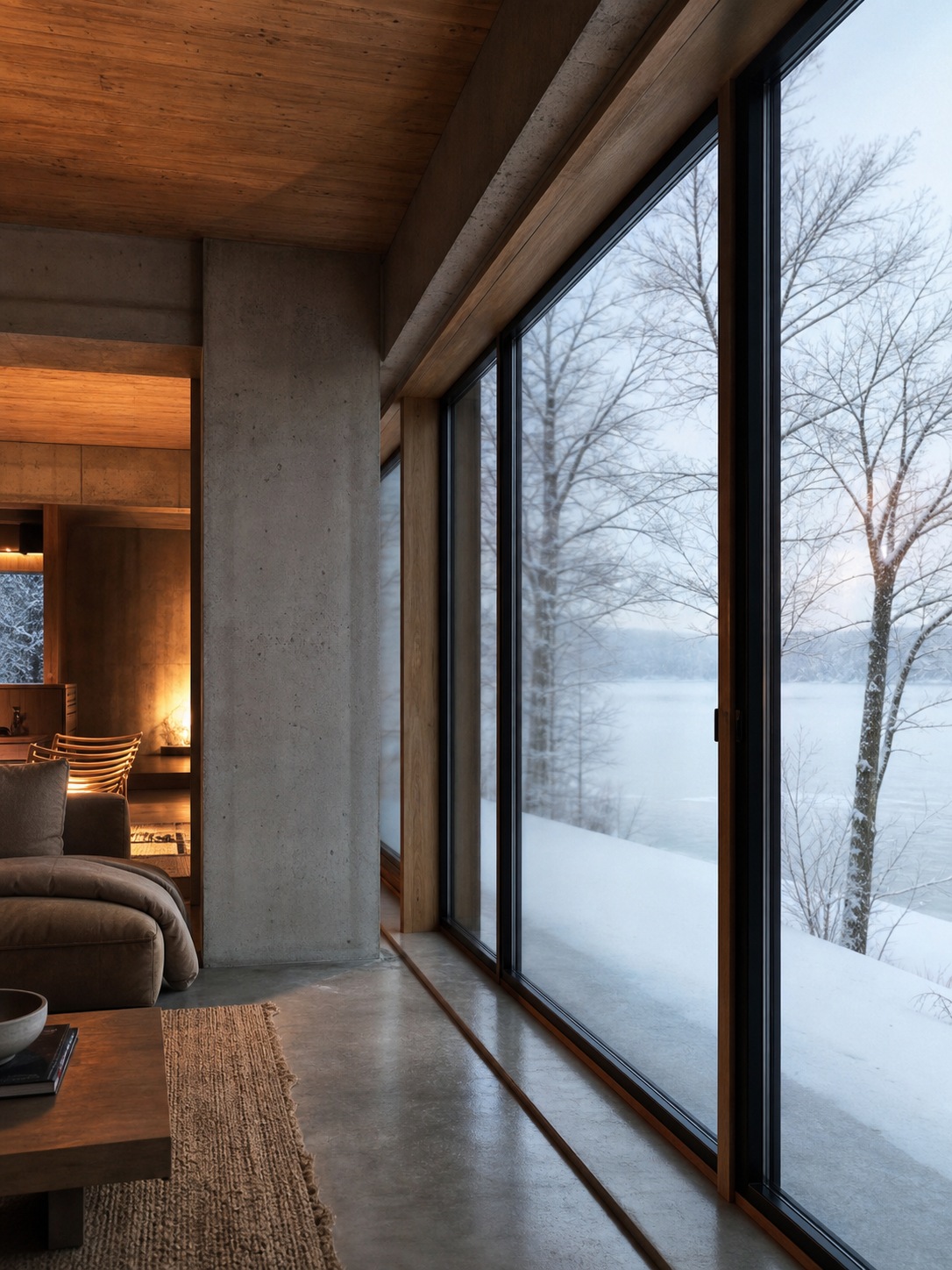
The consequences of under-specified glazing show up in the building’s air before they show up in the energy bill. Cold interior glass surfaces cause localized condensation when warm interior air contacts them. Persistent condensation on frames and sills promotes mold growth. That mold affects indoor air quality in ways that are measurable and, in some cases, serious.
Thermally broken frames and high-performance glazing keep interior glass and frame temperatures above the dew point of normal interior air. This isn’t a luxury specification. It’s the difference between a building that meets its occupancy conditions and one that generates warranty claims, remediation costs, and in residential projects, real health consequences for the people living there.
Breathable membranes and controlled ventilation work alongside glazing to manage moisture. A highly airtight building envelope (which high-performance glazing contributes to) requires deliberate mechanical ventilation to maintain air quality — usually heat recovery ventilation (HRV) that extracts stale air while recovering 75 to 90% of its heat before exhausting it. This is where Passive House design methodology is most coherent: it treats the envelope and the ventilation as a single integrated system rather than separate specifications.
Certifications: What LEED and Passive House Actually Require
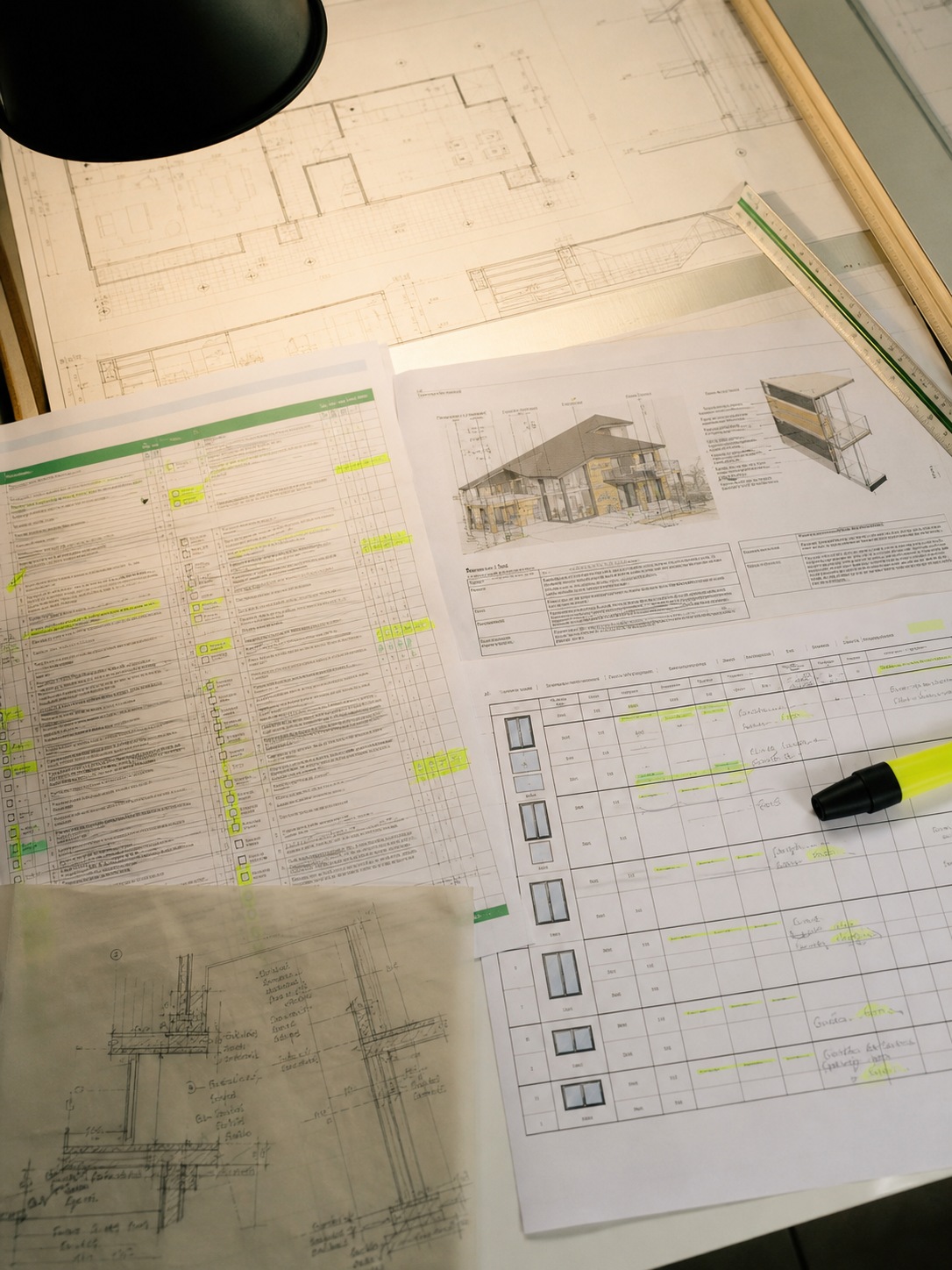
LEED (Leadership in Energy and Environmental Design) and Passive House are both performance certification systems, but they operate on different logics.
LEED awards points across multiple categories (energy, water, materials, indoor environment quality, innovation) and certifies buildings at Bronze, Silver, Gold, or Platinum levels depending on total points accumulated. Energy performance contributes significant points but isn’t the only path to certification. A LEED Gold building might have relatively ordinary glazing but excellent water recycling and a green roof.
Passive House is energy-focused and threshold-based. A building either meets the standard or it doesn’t. The primary requirements are: annual heating demand below 15 kWh/m² per year, total primary energy demand below 120 kWh/m² per year, and air leakage below 0.6 air changes per hour at 50 Pascal pressure differential. Meeting these numbers in a cold climate with significant glazing area requires whole-window U-values at or below 0.8, careful thermal bridge elimination, and passive solar strategy built into the orientation from the site planning stage.
Both certifications push in the same direction for glazing specification: high-performance IGUs with Low-E coatings, inert gas fills, thermally broken frames, and deliberate attention to moisture control. The difference is that Passive House makes these requirements mandatory while LEED makes them point-generating.
Certification at a Glance
LEED: points-based, multiple categories, graduated levels (Certified/Silver/Gold/Platinum). Passive House: threshold-based, energy-focused, binary (certified or not). Both: require high-performance thermal envelope, but PHI standard is more prescriptive on U-values and airtightness limits. For glazing-heavy projects, Passive House requirements are the more demanding specification target.
Summary: What to Specify and Why
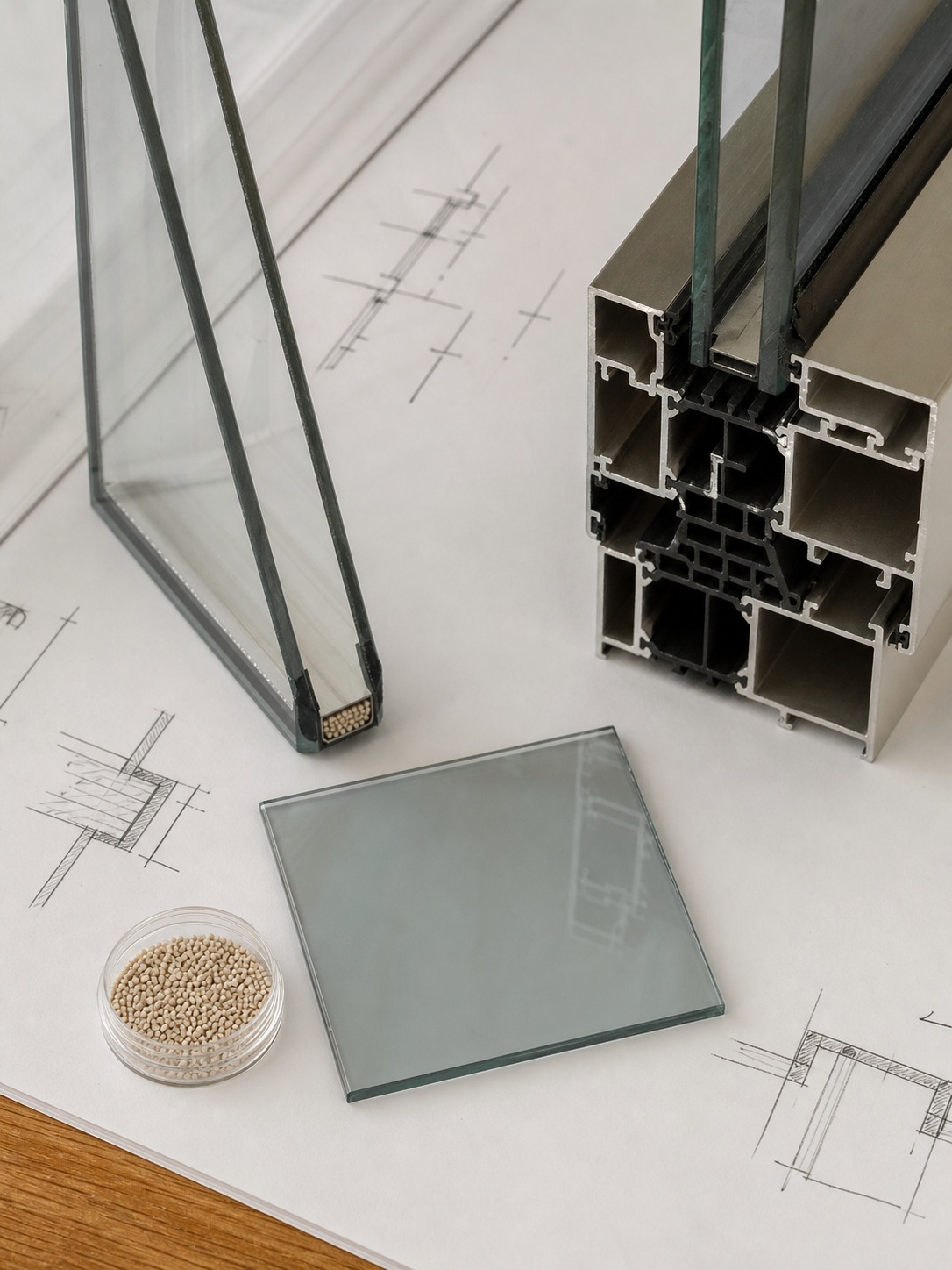
The table below summarizes the specification decisions that make the difference between a glass building that performs and one that just looks good in the rendering.
| Area | Key Takeaway | What It Solves |
|---|---|---|
| IGU Glazing | Two or three panes + argon fill | Single-pane heat loss |
| Moisture Control | 3A zeolite desiccants in spacer bars | IGU fogging over time |
| Low-E Coatings | Reflects infrared, passes visible light | Heat gain and UV fading |
| Passive Solar Design | South-facing glass + calculated overhangs | Seasonal solar imbalance |
| Thermal Frames | Thermally broken aluminium profiles | Cold bridging and condensation |
| LEED / Passive House | Performance envelope certification | Regulatory compliance |
Glass is difficult to photograph because it reflects, flares, and shifts color; this glass architecture photography guide gives practical ways to use those reflections instead of fighting them.
FAQ: Insulating Glass in Architecture
What is an IGU and why does it matter?
An Insulating Glass Unit (IGU) is a sealed assembly of two or three glass panes separated by spacers and filled with inert gas (typically argon or krypton). It reduces thermal transmittance through windows dramatically compared to single glazing. A standard double-pane IGU with argon and Low-E coating achieves U-values around 1.0 to 1.4 W/m²K versus 5.8 for single glass. For any building with significant glazed area, the IGU specification is the single most impactful envelope decision.
What are Low-E coatings and what do they actually do?
Low-emissivity coatings are metallic thin films applied to glass surfaces that reflect long-wave infrared radiation (heat) while allowing short-wave visible light to pass. They reduce radiant heat transfer across the glazing by 30 to 50% and protect interiors from UV fading. They don’t significantly affect visible light transmission when correctly specified. Soft-coat (sputtered) Low-E coatings on surface 3 of a double-pane IGU is the standard position for thermal insulation performance in cold climates.
Why do IGUs fog up and how is it prevented?
Fogging between the panes happens when moisture infiltrates the sealed IGU cavity. Once inside, moisture condenses on the cooler inner glass surface and cannot escape. The primary prevention mechanism is the desiccant inside the spacer bar, which absorbs residual moisture during manufacture and trace permeation over the unit’s lifetime. 3A molecular sieve zeolite is the standard desiccant because its pore size captures water molecules without absorbing argon, preserving the gas fill’s insulating function.
What is passive solar design and how does glazing fit into it?
Passive solar design uses building orientation, glazing placement, overhang geometry, and thermal mass to manage heating and cooling loads without mechanical systems. South-facing glazing (northern hemisphere) admits winter sun when the sun is low and is shaded by calculated overhangs in summer when the sun is high. High-performance IGUs with appropriate SHGC values for each facade orientation are the material foundation of the strategy. Without correct glazing specification, passive solar geometry doesn’t deliver its calculated performance.
What does thermally broken frame mean?
A thermally broken frame has a low-conductivity insulating insert (typically polyamide) between the interior and exterior aluminium profiles. This interrupts the direct metal-to-metal conductive pathway that would otherwise transfer heat rapidly through the frame. Without thermal breaking, an aluminium frame can conduct 10 times more heat per unit area than the glass it holds. Thermally broken frames are required for whole-window U-values below 1.4 W/m²K and are mandatory for Passive House window certification.
What is the difference between LEED and Passive House certification?
LEED is a points-based multi-category rating system that awards certification levels (Certified, Silver, Gold, Platinum) based on accumulated performance across energy, water, materials, indoor environment quality, and other categories. Passive House is energy-focused and threshold-based: a building either achieves the specific heating demand, total energy demand, and airtightness numbers or it doesn’t. For glazing performance, Passive House requirements are more prescriptive and demanding than LEED, particularly on whole-window U-values and airtightness limits.
The Specification Is the Design
The showroom facade got built. The final specification was 6mm tempered outer pane with soft-coat Low-E on surface 2, 18mm argon cavity with 3A zeolite desiccant in a warm-edge spacer, 6mm tempered inner pane, thermally broken aluminium mullions, and a continuous overhang at the roofline calculated at 55% of the facade height for the latitude. The building passes energy audit. The glass doesn’t fog.
What the client sees is a floor-to-ceiling glass wall that brings the showroom together with the street. What’s actually there is a thermal engineering problem solved at the component level, invisible and functioning exactly as specified.
That’s what contemporary architecture with insulating glass requires: the discipline to treat the specification as seriously as the form. The material decisions that don’t show in the rendering are the ones that determine whether the building performs, ages well, and stays off the warranty call list. The design only works if the specification underneath it does.
- 115shares
- Facebook0
- Pinterest115
- Twitter0
- Reddit0