I spent three years working from a corporate office that had been designed, as far as I could tell, primarily to demonstrate that the company owned a significant amount of floor space. Open-plan rows of identical workstations under flat fluorescent light, a kitchen that was really a corridor with a kettle, and meeting rooms that required a room-booking system that nobody had been fully trained on. The space was functional in the way a hospital waiting room is functional: you could sit in it and perform certain tasks, but it didn’t help you do either particularly well.
- What Workplace Design Actually Does to the People Inside It
- The Melbourne Approach: Design as Competitive Differentiation
- Zone-by-Zone Design: What Each Area of a Coworking Space Should Do
- Wellness, Technology, and the Infrastructure That Makes It Work
- Coworking Precincts: Design Character by Neighbourhood
- How to Choose a Coworking Space: A Design-Led Evaluation Framework
- The Standard Has Been Set. The Question Is Who Meets It.
- FAQ: Modern Coworking Space Design
- Q: What makes a coworking space well-designed?
- Q: How does coworking space design affect productivity?
- Q: What is the difference between a hot desk and a dedicated desk?
- Q: Why do companies use coworking instead of traditional offices?
- Q: What should I look for when choosing a coworking space in Melbourne?
The first time I worked from a well-designed coworking space — a converted warehouse in Collingwood with acoustic baffles, warm pendant lighting, a genuine coffee bar, and a mix of open collaborative benches and enclosed focus pods — I understood something that the corporate interior design conversation had been circling around for years without quite landing on.
The best workplace design is not about status or square footage. It’s about the relationship between spatial environment and cognitive performance. And the spaces that had figured this out most completely were not the corporate headquarters with the big refurbishment budgets. They were the coworking spaces competing for members one day pass at a time.
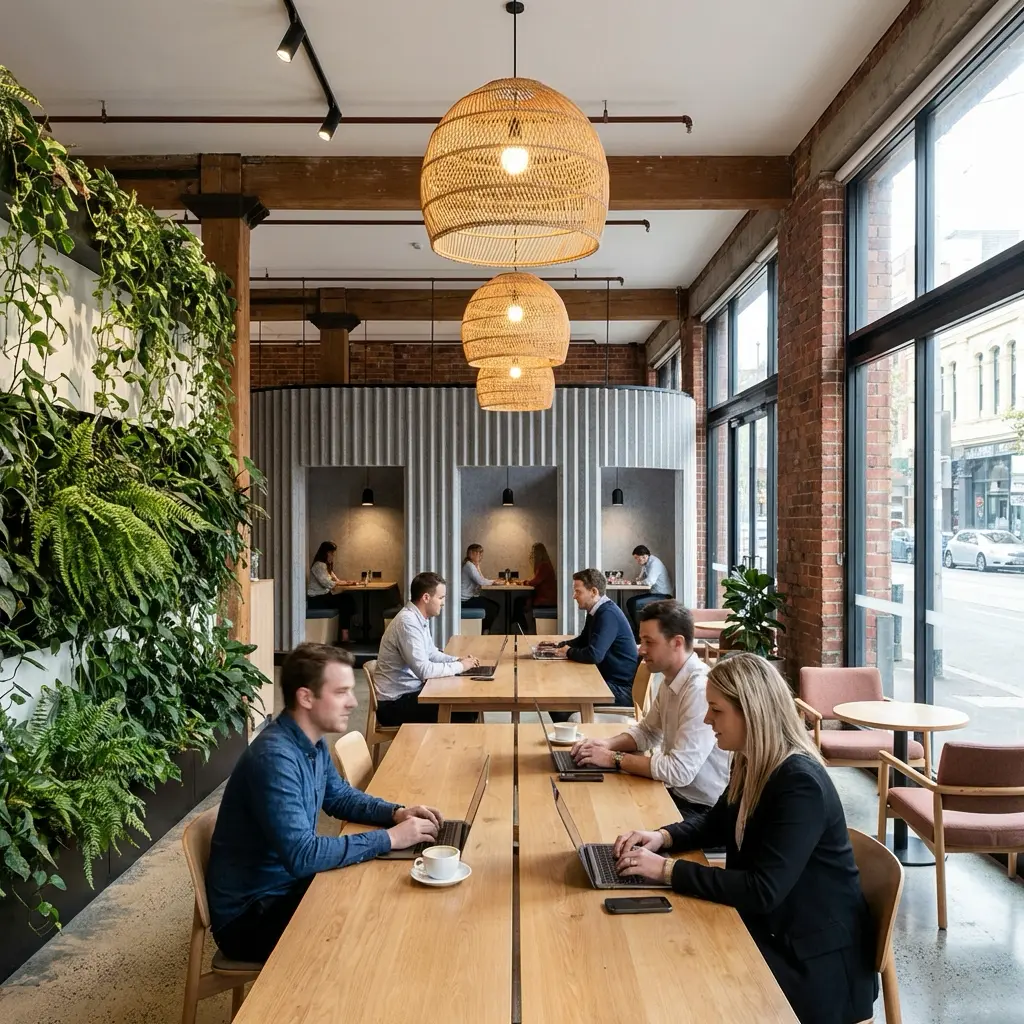
Melbourne has become one of the clearest demonstrations of this principle in the world. The city’s coworking market — driven by its cultural density, its startup ecosystem, and a professional population with genuinely high expectations for design quality — has produced a generation of shared workspaces that set the standard for what productive, well-designed professional environments should feel like. This article examines what those spaces do differently, why it produces better outcomes for the people working in them, and what the design principles behind Melbourne’s best coworking spaces reveal about the future of workplace design more broadly.
What Workplace Design Actually Does to the People Inside It
The argument for investing in workplace design is not aesthetic. It’s cognitive. The environment in which people work has measurable effects on their attention, their stress levels, their collaborative behaviour, and their sense of connection to the organisation they work for. These are not subtle effects — they’re large enough to show up consistently in controlled studies and large enough to matter economically to any organisation that depends on knowledge work.
Acoustic Control: The Factor Most Offices Get Wrong
The single most impactful environmental variable for knowledge work is acoustic control. Open-plan offices without acoustic management produce measurably higher distraction, lower deep-work performance, and greater cognitive fatigue than acoustically managed environments. The mechanism is well-understood: the human auditory system cannot fully habituate to intelligible speech — when you can hear someone else’s conversation, your brain allocates processing resources to it whether you want it to or not. This is why open-plan offices without acoustic intervention produce the worst of both worlds: the social isolation of private offices without the acoustic protection, combined with the noise exposure of collaborative environments without the actual collaboration.
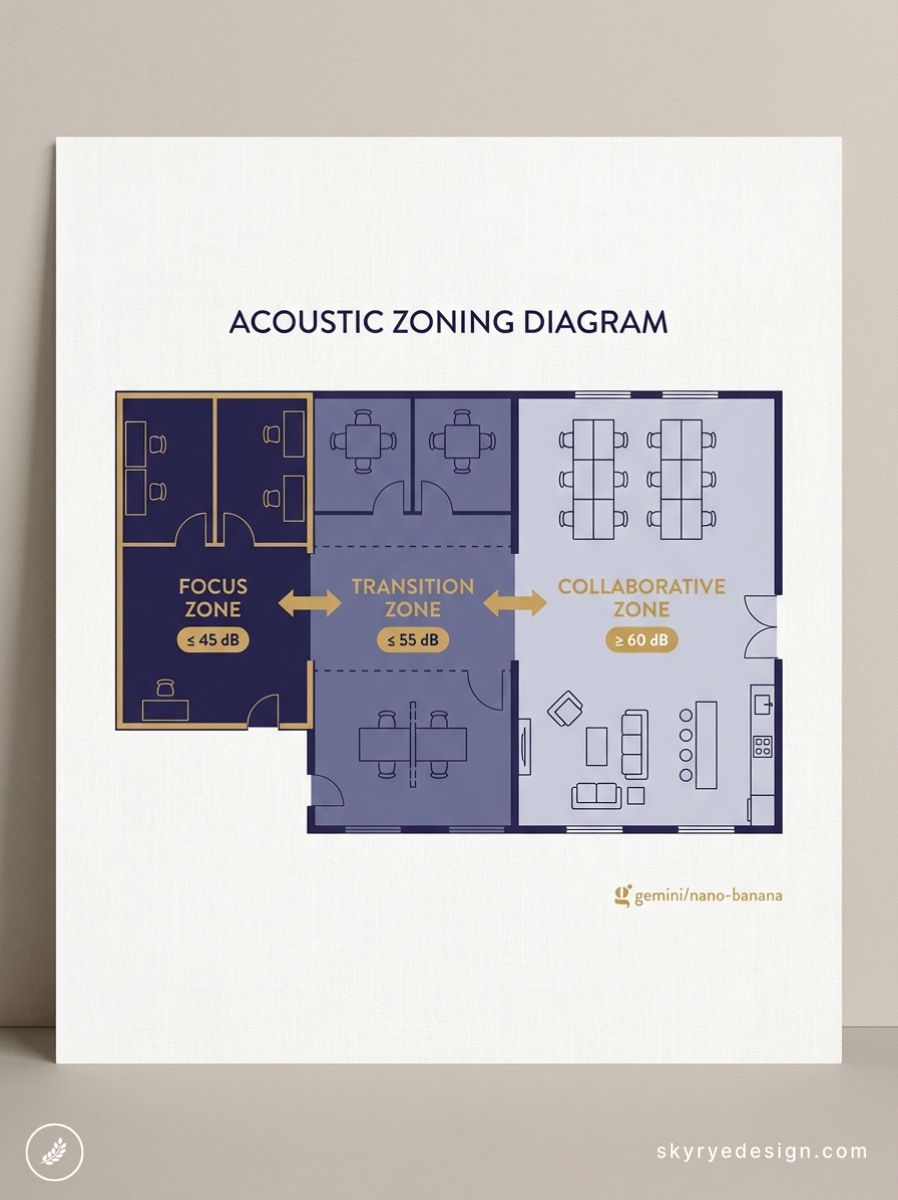
Melbourne’s best coworking spaces address this through spatial zoning — separating loud collaborative areas from quiet focus zones with distance, barriers, acoustic material treatment, or all three. The design principle is simple: match the acoustic environment to the cognitive task. Deep focus work requires near-silence; collaborative work benefits from ambient social energy; calls and video meetings require both acoustic absorption and privacy. A well-designed coworking space provides all three zones, clearly differentiated.
Natural Light and Biophilic Design
Natural light affects circadian rhythm, alertness, and mood in ways that artificial lighting cannot fully replicate. Exposure to natural light during working hours is associated with better sleep quality, higher reported wellbeing, and improved afternoon concentration. Biophilic design — the incorporation of natural elements (plants, natural materials, views of nature, natural light patterns) into built environments — reduces cortisol levels and self-reported stress, and is associated with faster cognitive recovery from mentally demanding work.
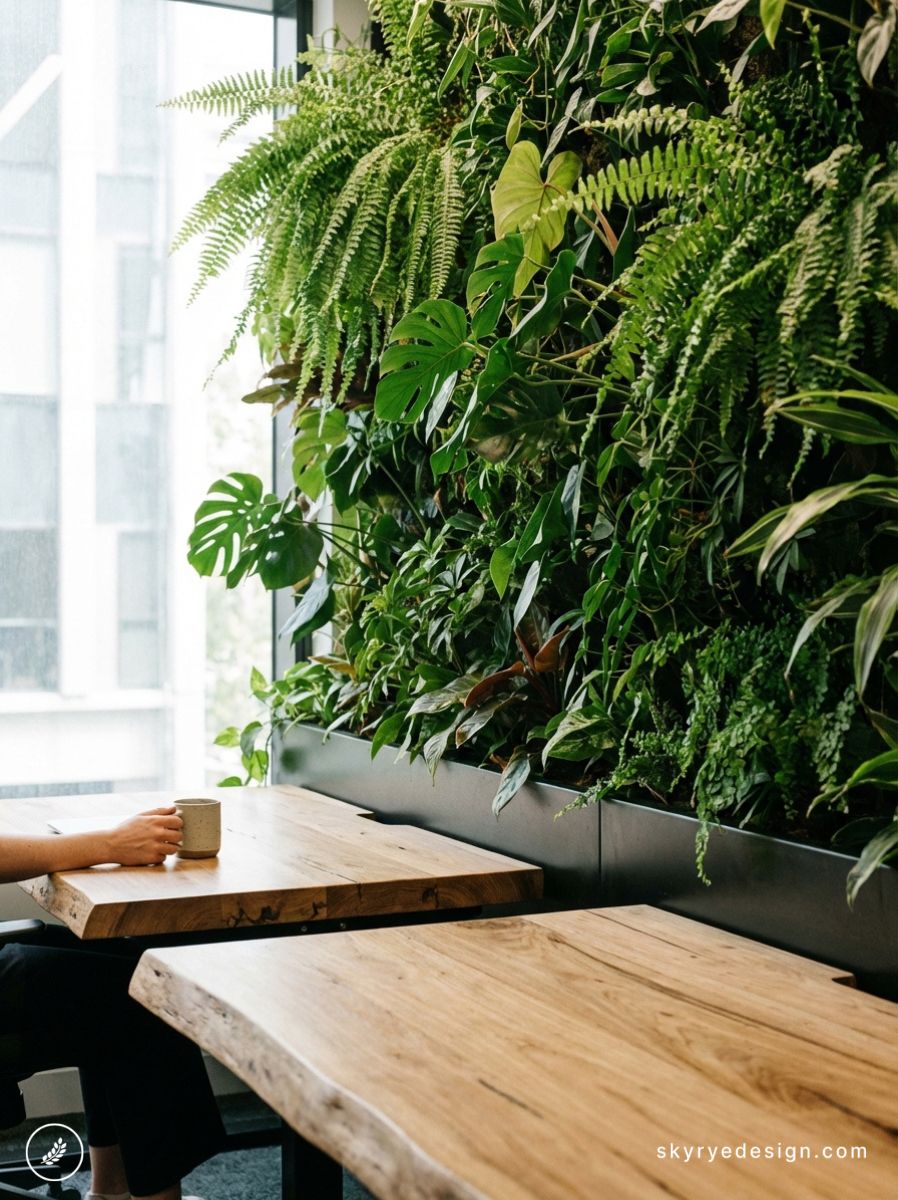
In Melbourne’s coworking spaces, biophilic design is standard rather than exceptional: planted walls, natural timber surfaces, generous glazing, and potted plants distributed through the space. These are not decorative gestures. They’re evidence-based design decisions that make the environments more functional for sustained professional work.
Thermal Comfort and Air Quality
Thermal discomfort — too hot, too cold, or poorly ventilated — is one of the most consistent predictors of reduced workplace satisfaction and cognitive performance. Research links CO₂ levels above 1,000 ppm with measurably reduced decision-making quality. Good ventilation and thermal control are cognitive performance decisions, not just comfort preferences. Melbourne’s better coworking operators invest in HVAC systems and ventilation rates that go beyond regulatory minimums — this shows up in how the spaces feel and perform in afternoon sessions when cheap ventilation systems begin to fall behind demand.
✏ Design note: When evaluating a coworking space, visit at peak occupancy — typically between 10am and 2pm on a Tuesday or Wednesday. Assess the acoustic environment at that time, not during a quiet morning or weekend tour. The acoustic quality at peak occupancy is the acoustic quality you’ll experience daily. If you can clearly hear multiple conversations from your prospective workstation, the acoustic design is insufficient for sustained focused work.
The Melbourne Approach: Design as Competitive Differentiation
Melbourne’s coworking market is genuinely competitive. The city has a high density of quality operators across its CBD, inner-north suburbs (Collingwood, Fitzroy, Richmond), and bayside neighbourhoods, which means members have real choice and operators who don’t deliver on their design promises lose members to those who do. This competitive pressure has produced a market where design quality is treated as a primary business requirement rather than a secondary consideration.
The Hospitality-Design Crossover
The most distinctive quality of Melbourne’s leading coworking spaces is their debt to hospitality design. Howard Schultz’s ‘third place’ concept — a space that is neither home nor workplace but a professionally designed environment for productive social life — is the theoretical foundation, but Melbourne operators have taken it significantly further. The best Melbourne coworking spaces borrow from hospitality not just the visual language of premium service environments but the operational logic: welcoming arrival sequences, genuinely good coffee as a standard amenity, staff who function as community managers rather than receptionists, event programming that creates reasons for members to engage with each other beyond transactional proximity.
This hospitality approach is not cosmetic. It changes the experience of arriving at and spending a day in the space. Members of well-run Melbourne coworking spaces consistently report a stronger sense of community and professional connection than members of purely functional shared offices — because the design and programming are specifically structured to produce those outcomes.
Neighbourhood Character as Design Ingredient
Melbourne’s coworking spaces don’t design in isolation from their neighbourhoods — they treat neighbourhood character as a design resource. A coworking space Melbourne in Collingwood or Fitzroy draws on the creative energy of those precincts — street art, independent retail, gallery culture — and incorporates that aesthetic register into the space’s material palette, artwork, and programming. The effect is that the space feels rooted in its context rather than parachuted into it. Members of those spaces are not just renting a desk; they’re accessing a professional environment that’s connected to the broader creative community of the neighbourhood.
This neighbourhood sensitivity has parallels elsewhere in the world. Creative districts in other cities — like Florida’s Eau Gallie Arts District, where arts infrastructure has anchored a productive professional community — demonstrate the same principle: when workspace design aligns with neighbourhood identity rather than imposing a generic corporate aesthetic, it attracts and retains a more engaged, more productive, and more community-oriented membership.

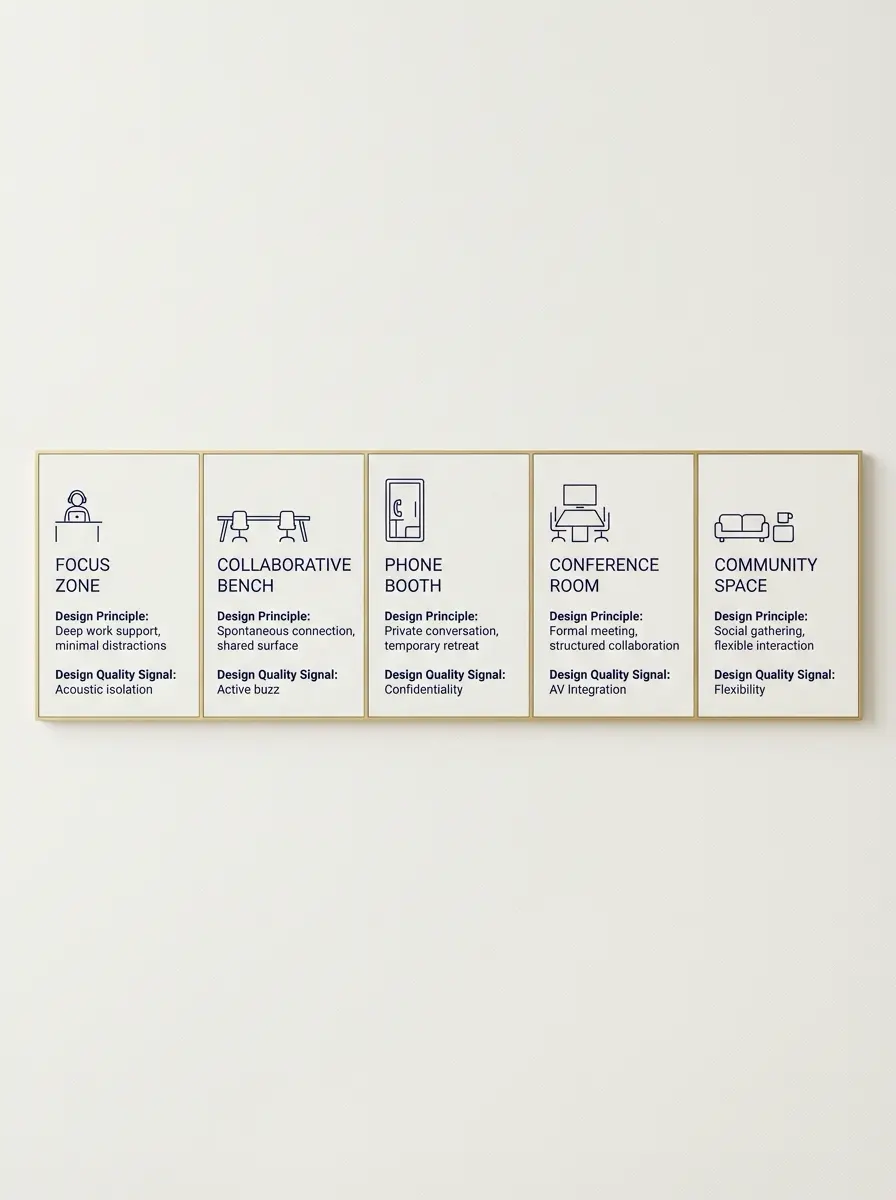
Zone-by-Zone Design: What Each Area of a Coworking Space Should Do
Focus Zones
Design principle: Acoustic separation from social areas through distance, barriers, or absorptive material treatment. Individual workstations with ergonomic seating, task lighting, and power access. Visual separation (partial screens, change in floor level, or enclosed pod configuration) that signals ‘quiet zone’ to other members.
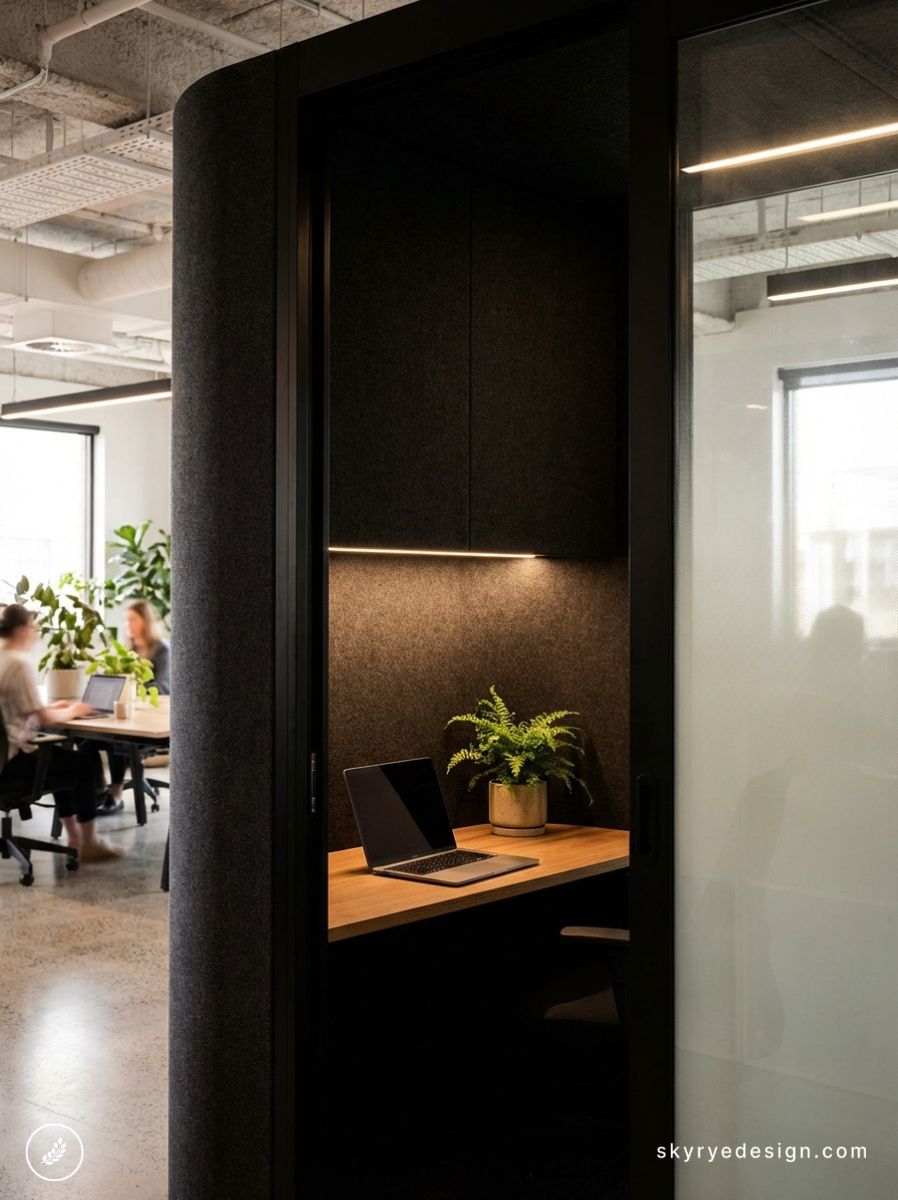
Why it works: Sustained deep work — writing, analysis, coding, design — requires a cognitive environment that minimises involuntary attention switching. The acoustic and visual separation of a dedicated focus zone is what makes deep work possible in a shared environment without the isolation of a private office.
Melbourne application: Acoustic pods and focus rooms in Melbourne CBD operators provide near-private acoustic environments within open-plan spaces. Screens and planting buffers in Fitzroy and Collingwood spaces create focus zones that feel distinct from collaborative areas without requiring full physical enclosure.
Collaborative Benches and Open Tables
Design principle: Long communal tables or cluster arrangements that facilitate both solo work and spontaneous group interaction. Higher acoustic ambient energy acceptable — these areas are not designed for deep focus. Writable surfaces, centrally accessible power, and visible whiteboards or screens for group work.

Why it works: Serendipitous collaboration — the unplanned conversation that produces an unexpected solution or connection — is one of the primary value propositions of coworking over home working. This requires spatial arrangements where members are physically proximate and encounters are natural rather than engineered.
Melbourne application: The long communal bench is the signature furniture piece of Melbourne’s coworking scene. In Southbank and South Melbourne spaces, these areas are designed to create genuine cross-industry interaction — a media producer at one end, a SaaS founder in the middle, and a designer at the other end is not an accident of seating; it’s the product of a deliberately social spatial arrangement.
Phone Booths and Call Pods
Design principle: Acoustically enclosed single-person booths for calls and video meetings. Ventilated to prevent overheating during extended sessions. Bookable or drop-in available. Positioned at the perimeter of open-plan areas so members can move between them and their workstation quickly.
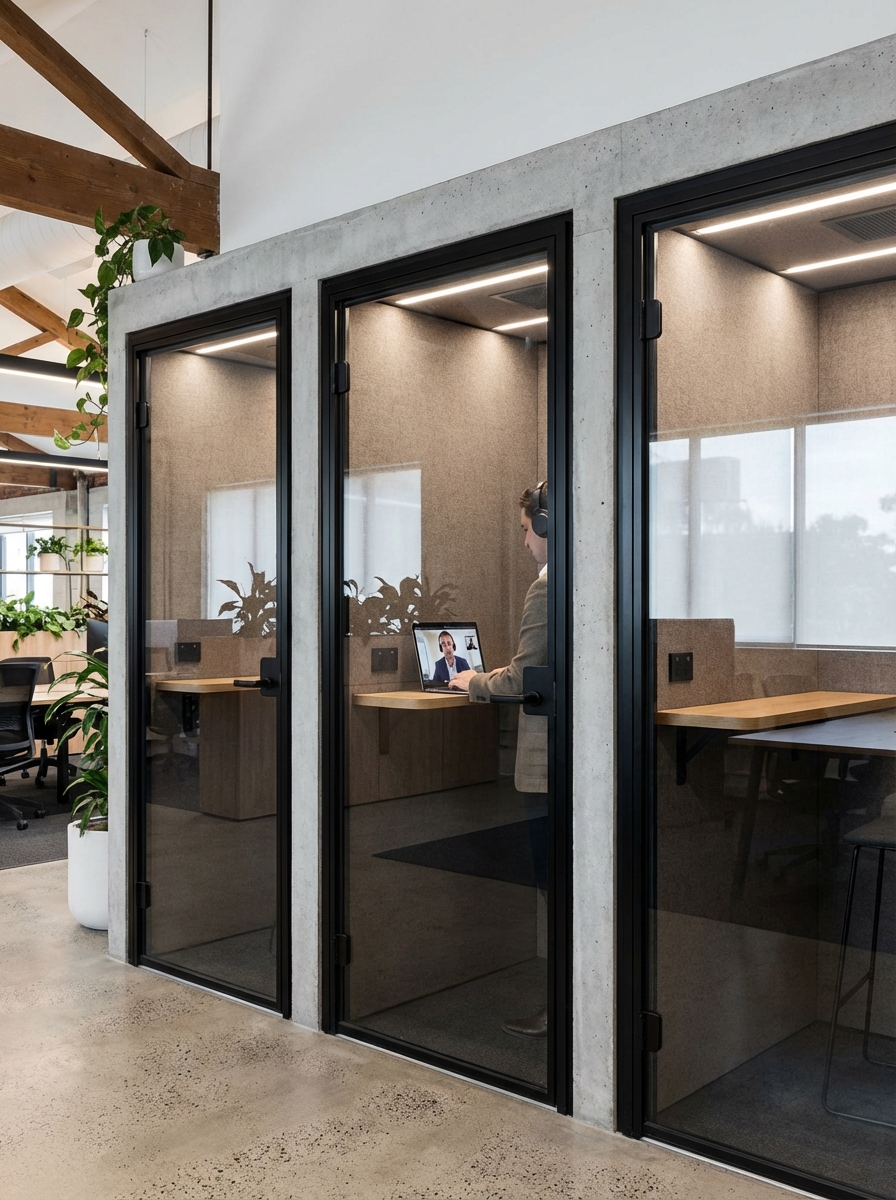
Why it works: Video meetings require bidirectional acoustic isolation — the member needs to hear their call clearly, and the surrounding space needs to not be disrupted by the member’s voice. Without dedicated call infrastructure, members either take calls in disruptive open areas or leave the space entirely, both of which degrade the coworking experience.
Melbourne application: Phone booths are now standard in quality Melbourne coworking spaces. The distinction between operators is in their number relative to membership density — a space with twelve booths and four hundred members provides a meaningfully different experience than one with twelve booths and eighty members.
Conference and Meeting Rooms
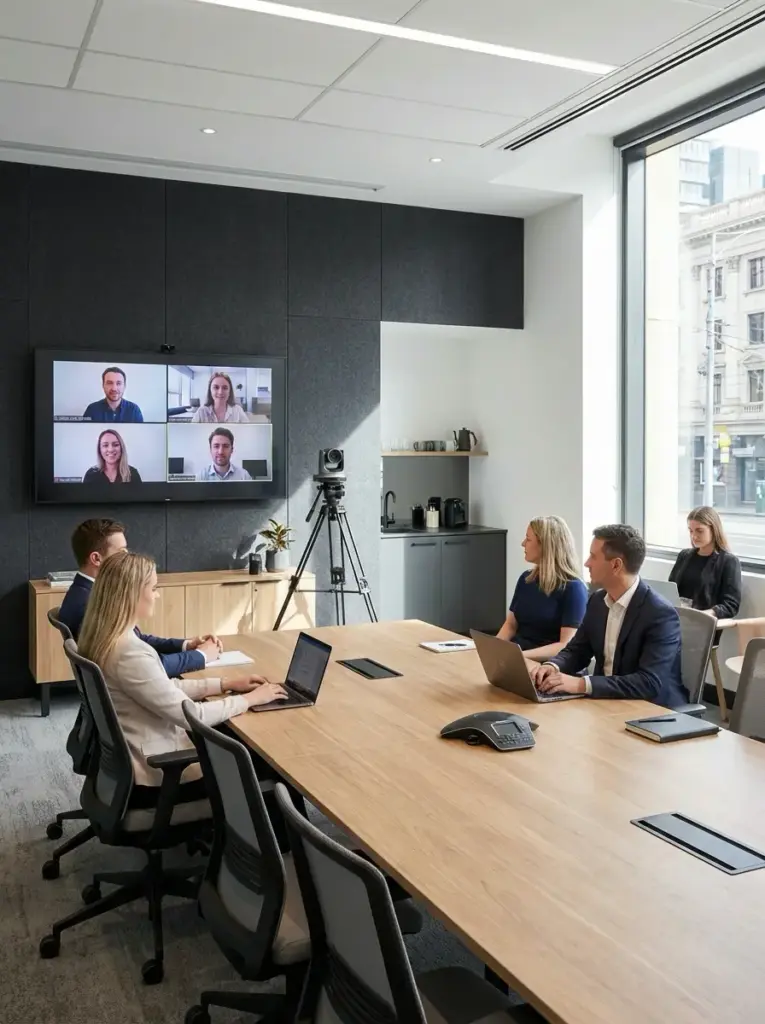
Design principle: Fully enclosed, acoustically isolated rooms for group meetings and client-facing work. Professional AV including screen sharing, camera, and microphone systems suitable for hybrid meetings. Bookable by the hour with transparent pricing. Available to day pass members as well as monthly subscribers.
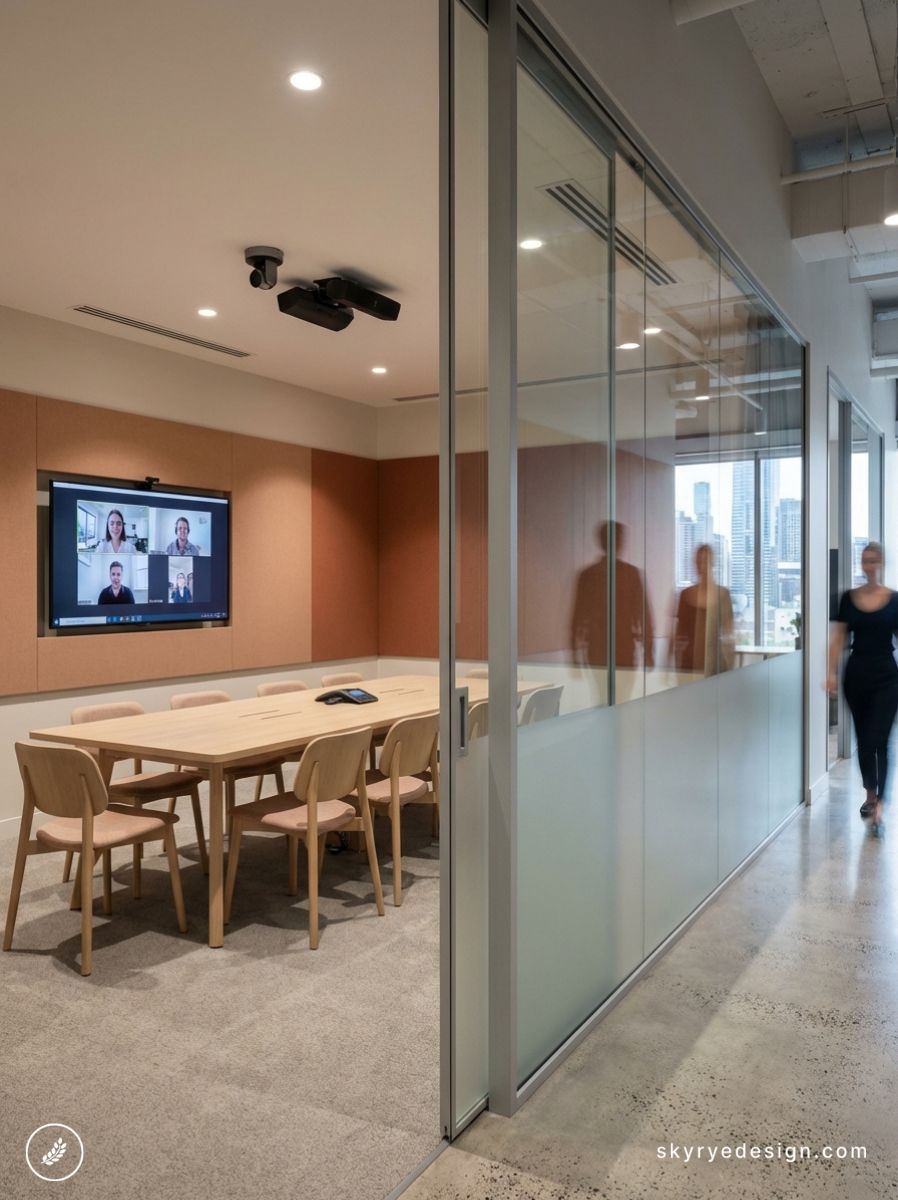
Why it works: Client meetings and team presentations require a professional environment that the open-plan workspace cannot provide. Members who cannot access quality conference room facilities for client meetings often consider their coworking space inadequate regardless of its other qualities.
Melbourne application: Richmond and CBD spaces offer the broadest conference room inventory in Melbourne. The design standard has risen significantly — broadcast-quality meeting rigs for hybrid calls are increasingly standard rather than exceptional, reflecting the hybrid work reality that most Melbourne professionals are now navigating.
Community and Event Space
Design principle: Flexible open area that can be reconfigured for standing events, seated presentations, or workshop formats. Good acoustics for large-group speech. Access to catering infrastructure. Positioned to be visible from the main working areas — event energy should be perceptible to members without being disruptive.
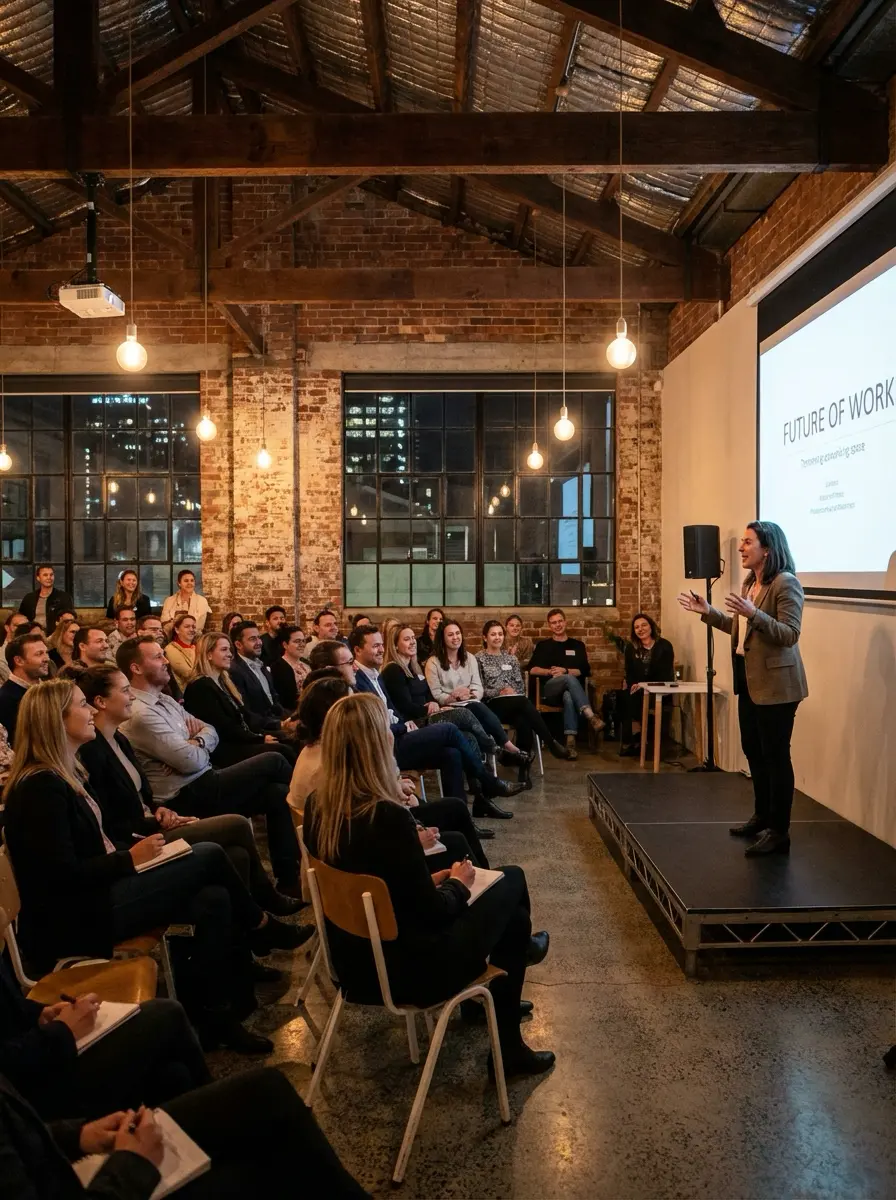
Why it works: Events are the mechanism by which coworking spaces deliver community value beyond desk space. A well-run events programme creates professional connections that members could not access through their individual networks — which is the coworking value proposition that most directly competes with traditional offices.
Melbourne application: Melbourne’s leading operators — including spaces like LIV Co-Working that have built reputations for their programming — run investor Q&As, mentor office hours, and cross-industry workshops that create real professional relationships. The community value is part of the design: spaces that don’t invest in community programming convert members to desks; spaces that do convert members to advocates.
Wellness, Technology, and the Infrastructure That Makes It Work
Wellness Features as Standard
The wellness amenities that were considered premium additions five years ago — end-of-trip facilities (showers, bike storage, lockers), sit-stand desks, meditation or quiet rooms, outdoor areas — are now baseline expectations in quality Melbourne coworking spaces. This shift reflects a broader understanding that physical and mental health are productivity factors, not separate concerns. A member who cycles to work and needs to shower before client meetings will choose a space with end-of-trip facilities over an equivalent space without them. A member who takes a ten-minute meditation break midday is more productive in the afternoon than one who doesn’t — which makes the meditation room a productivity amenity, not a luxury.
The integration of health programming into coworking is one of the most interesting cross-industry developments in the sector. Operators partnering with health technology platforms — similar to how healthcare companies like GoodRX have made health information more accessible to everyday consumers — are beginning to offer member health benefits, mental health resources, and wellness programming as part of the membership value proposition. The coworking space of 2026 is increasingly a professional services platform, not just a furnished room with internet.
Technology Infrastructure: What ‘Good Internet’ Actually Means
Reliable internet is the non-negotiable baseline of coworking value — but ‘reliable’ means something more specific than most space marketing communicates. Enterprise-grade coworking internet means: redundant connections from at least two providers (so a single outage doesn’t take the space offline); managed Wi-Fi infrastructure with capacity planning that accounts for peak occupancy rather than average occupancy; wired ethernet available at or near workstations for members who need it; and traffic management that prevents one heavy user from degrading performance for the whole space.
Ask for speed test results at peak times, not the contracted specification. A 1Gbps connection is only useful if the Wi-Fi infrastructure and network management deliver consistent performance under full member load — and the gap between the marketed specification and the delivered experience is where many coworking spaces disappoint members they’ve already committed.
Keyless Entry and 24/7 Access
Keyless entry and round-the-clock access are now standard in well-run Melbourne spaces. For members working across time zones — common in Melbourne’s startup and professional services communities — 24/7 access is a functional requirement, not a premium feature. Keyless entry (smartphone or fob-based) eliminates the physical key bottleneck and simplifies onboarding for new members and day pass visitors. The back-end data from keyless systems also allows operators to understand occupancy patterns accurately, which informs both capacity planning and event scheduling.
Coworking Precincts: Design Character by Neighbourhood
CBD: Enterprise Grade and Transit-Connected
Melbourne’s CBD concentrates the highest-specification coworking options: private offices with city views, enterprise-grade conference room inventory, virtual office services with a credible business address, and transit connections that suit nationally distributed teams. The design language tends toward polished contemporary — less raw industrial character than the inner north, more attention to client-facing presentation. For teams whose work involves frequent external meetings, coworking space Melbourne CBD options provide the professional backdrop and logistical convenience that Richmond or Fitzroy spaces may not.
Collingwood and Fitzroy: Creative and Cross-Industry
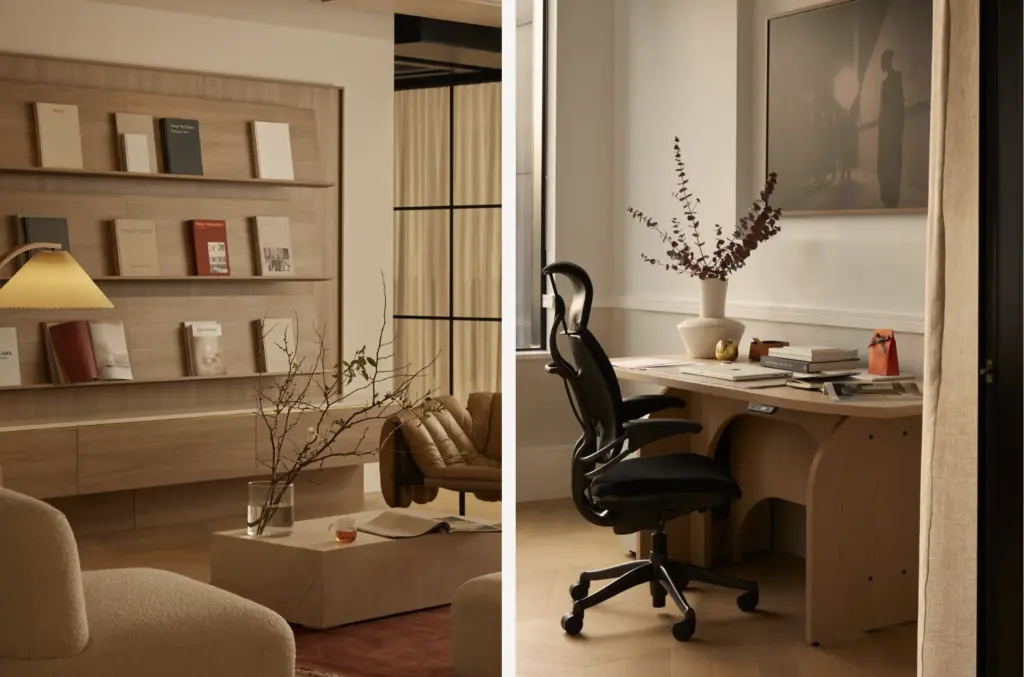
Collingwood and Fitzroy define Melbourne’s creative coworking aesthetic — and have exported that aesthetic globally. Converted warehouses with exposed structure, natural light through generous industrial glazing, maker studios alongside shared office floors, and a membership that runs from film editors to SaaS founders to industrial designers. The cross-industry character of these precincts is not accidental. The spaces are designed and programmed to mix disciplines — the spatial arrangement encourages interaction, and the events programming creates structured opportunities for cross-pollination.
Richmond: Growth-Stage Startups
Richmond’s coworking spaces serve a specific professional profile: companies that have moved past the founding stage and need more than hot desks but aren’t ready for a traditional lease. Dedicated office suites alongside open-plan zones, podcast rooms and video production facilities, and day pass access for visiting collaborators. The design language is contemporary and professional without the raw industrial character of the inner north — Richmond spaces are designed for companies presenting to clients and investors as much as building products.
Southbank and South Melbourne: Media and Arts Adjacent
Proximity to Melbourne’s gallery and theatre precinct shapes Southbank and South Melbourne’s coworking membership — media producers, arts administrators, creative agencies, and the broader creative economy cluster here. Operators in this precinct invest in event-ready spaces and production-friendly amenities: broadcast-capable meeting rooms, podcast infrastructure, and event lounges that serve both professional and cultural programming. The design character tends toward sophisticated and material-rich — spaces that could host a product launch or a gallery opening without reconfiguration.
St Kilda: Coastal Pace, Professional Standards
St Kilda offers a distinctly different register: light-filled, wellness-oriented, and slightly calmer than the inner-city precincts without sacrificing professional quality. Coworking spaces here tend to prioritise natural light, comfortable communal areas, and outdoor space where the climate permits. The membership profile leans toward independent professionals, creative practitioners, and lifestyle-oriented founders who value the coastal character of the neighbourhood as much as the workspace quality.
How to Choose a Coworking Space: A Design-Led Evaluation Framework
The membership decision should be made on the basis of a site visit during peak hours, not a tour at 9am on a quiet Monday. The space you experience during that tour is not the space you’ll work in daily.
- Acoustic quality at peak occupancy. Can you hear multiple conversations from the workstation you’d use? Is the focus zone genuinely quieter than the collaborative zone? Acoustic quality is the single most impactful variable for daily productive use.
- Natural light at your prospective workstation. Is the desk you’d use naturally lit or dependent on artificial lighting? Can you see outside, or are you looking at an interior partition? Natural light quality has a measurable effect on afternoon performance and general wellbeing.
- Conference room availability at your typical meeting times. During your site visit, check the room booking system. If rooms are routinely fully booked at the times you need them, the space’s meeting room capacity is insufficient for your use pattern.
- Internet performance at peak time. Ask for a speed test. Run your own if the operator won’t provide one. Check latency as well as throughput — high latency makes video calls unreliable even when download speeds look acceptable.
- Community activity. Ask to see the events calendar for the past three months. A space with genuine community programming will have a rich, varied calendar with good attendance. A space with community as a marketing talking point will have a sparse, infrequent events history.
- Trial before committing. Every quality Melbourne coworking space offers a day pass or free trial. Use it on a representative working day — Tuesday or Wednesday at full occupancy. The trial day is the most reliable information source available about what working there actually feels like.
✏ Design note: The best coworking spaces in Melbourne are not the ones with the most impressive photography on their websites. They’re the ones where members renew their memberships at high rates and refer colleagues. Ask the operator for their member retention rate and, if possible, speak to a current member independently. Retention data reveals what the design photography cannot: whether the space delivers on its promise over time.
The Standard Has Been Set. The Question Is Who Meets It.

The corporate office hasn’t disappeared — but it has a much more formidable competitor than it did a decade ago. Melbourne’s coworking spaces have demonstrated that professional environments can be acoustically controlled, beautifully designed, community-rich, and genuinely pleasant to spend time in simultaneously. They’ve done this by treating design as a functional requirement rather than an aesthetic preference, and by understanding that the environment in which people work is not separate from the quality of work they produce.
The design principles behind Melbourne’s best coworking spaces — acoustic zoning, biophilic integration, community programming, neighbourhood responsiveness — are not specific to the coworking model. They’re the principles of good workplace design, and they’re applicable to any professional environment. The coworking space became the laboratory where those principles were tested under real competitive pressure and proven to work. The lessons belong to anyone designing spaces where people need to think, create, and collaborate.
For professionals choosing where to base their work in Melbourne — whether they’re freelancers, founders, or distributed team members — the quality of available coworking space Melbourne has never been higher. The spaces that have earned that quality have done so through sustained investment in design, community, and operational excellence. Finding one that matches your work pattern is the exercise worth most of your attention in the decision.
FAQ: Modern Coworking Space Design
Q: What makes a coworking space well-designed?
Spatial zoning that matches environments to tasks: acoustically treated focus zones for concentrated work, open collaborative areas for group work and spontaneous interaction, and semi-enclosed transition zones for calls. Biophilic elements — natural light, plants, natural materials — reduce cognitive fatigue. Ergonomic furniture supports sustained physical comfort. The best spaces feel purpose-built for productive professional life, not adapted from another use.
Q: How does coworking space design affect productivity?
Acoustic control is the most impactful single variable — intelligible speech in the background allocates cognitive resources involuntarily, measurably reducing focus and increasing fatigue. Natural light affects circadian rhythm and afternoon alertness. Biophilic elements reduce cortisol. Thermal comfort affects concentration. A well-designed coworking space addresses all of these simultaneously, which is why professionally designed shared offices typically outperform home offices and coffee shops for sustained knowledge work.
Q: What is the difference between a hot desk and a dedicated desk?
A hot desk is unassigned — available to any member on arrival, ideal for intermittent users who value flexibility of location. A dedicated desk is assigned exclusively to one member, typically with personal storage and a stable, predictable work environment. Hot desks are less expensive; dedicated desks suit daily users who need to leave equipment set up or who value the psychological consistency of the same workspace.
Q: Why do companies use coworking instead of traditional offices?
Flexibility and capital efficiency. Traditional leases run 3-10 years and require significant fit-out investment. Coworking memberships scale with business needs, require no fit-out, and include all infrastructure in the membership cost. For hybrid teams, coworking also provides a professionally designed environment that home offices cannot replicate — which matters for both employee experience and client meetings.
Q: What should I look for when choosing a coworking space in Melbourne?
Evaluate: location relative to clients and collaborators; acoustic quality during a peak-hour site visit; internet performance (ask for speed test results, not just the stated specification); natural light quality; meeting room availability; community and events programming; and membership flexibility. A trial day pass is the single most reliable evaluation method before committing to a membership.
- 102shares
- Facebook0
- Pinterest102
- Twitter0
- Reddit0