My first Mazda drawing was an RX-7 that looked like a bar of soap with wheels. The proportions were off, the roofline too tall, the rear haunches completely absent. I crumpled it, started again, and this time paid attention to one thing: the silhouette. That second drawing wasn’t great either — but it was recognizably a car. A third attempt later, something clicked.
For a quick construction refresher, use this how to draw cars step-by-step guide before sketching Mazda proportions.
Drawing Mazda cars is a specific skill because Mazda’s design language, Kodo — Soul of Motion — is built on tension and movement. These aren’t cars with boxy panels and straight lines. Every surface curves. Every highlight flows. Get those curves slightly wrong and you’ve drawn a Toyota. Get them right and there’s an unmistakable energy to the page.
- Why Mazda Is One of the Best Brands to Draw
- 10 Mazda Models Worth Drawing — From Easiest to Most Challenging
- 1. Mazda RX-7 FD3S (1991–2002)
- 2. Mazda MX-5 Miata NA (1989–1997)
- 3. Mazda MX-5 Miata ND (2015–present)
- 4. Mazda RX-8 (2003–2012)
- 5. Mazda 3 BP Fastback (2019–present)
- 6. Mazda CX-5 (2017–present)
- 7. Mazda 6 GJ (2012–2023)
- 8. Mazda CX-30 (2019–present)
- 9. Mazda 2 / Demio (2014–present)
- 10. Mazda Vision Coupe (2017 concept)
- Understanding Kodo Design Before You Draw
- How to Draw a Mazda Step by Step: 5-Stage Method
- Model-Specific Drawing Tips for the Top 5 Mazdas
- Art Supplies and Digital Tools for Mazda Car Drawing
- Common Mistakes When Drawing Mazda Cars
- FAQ: How to Draw a Mazda
- Q: What is the easiest Mazda to draw for beginners?
- Q: How do I draw a Mazda RX-7 step by step?
- Q: What is Kodo design and how does it affect drawing Mazda cars?
- Q: What art supplies do I need to draw a Mazda car?
- Q: How do I draw Mazda car wheels correctly?
- Q: How do I render Mazda Soul Red Crystal paint in a drawing?
- Q: Which Mazda model is the hardest to draw?
This guide covers 10 Mazda models worth drawing — from the beginner-friendly MX-5 NA to the brutally difficult Vision Coupe concept — plus a universal 5-step method that works for every single one of them.
Why Mazda Is One of the Best Brands to Draw
There’s a reason car design students fill sketchbooks with Mazdas. The brand’s commitment to Kodo design since 2010 means every model since the CX-5 first generation shares the same vocabulary: flowing tensioned surfaces, a strong shoulder line, cab-rearward stance, and minimal surface decoration.
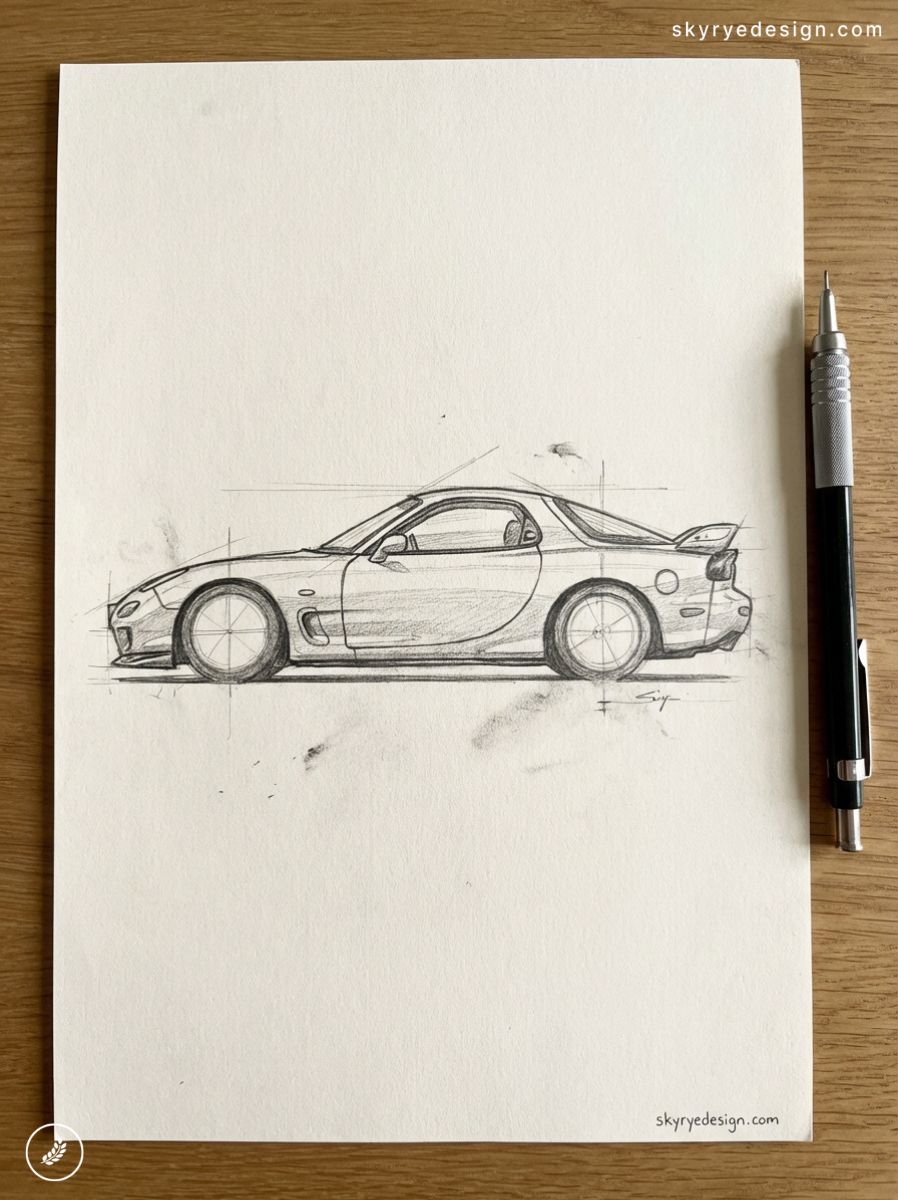
What that means for drawing: once you understand the Kodo system, you can draw any modern Mazda. The shoulder highlight line — that single crease-free arc running from headlight to taillight — is your guide. Nail that line and the rest of the car organizes itself around it.
Mazdas also photograph beautifully from the side, which makes reference gathering easy. The Mazda 3 fastback, the MX-5 ND, and the RX-7 FD all have iconic side-profile silhouettes that are immediately recognizable even as rough sketches. That recognizability is satisfying when you’re learning — you know when you’ve got it right.
| Tip: Search ‘Mazda [model] press photo side profile’ for clean, distortion-free reference images. Press shots are lit and positioned specifically for illustrators and designers. |
10 Mazda Models Worth Drawing — From Easiest to Most Challenging
Not all Mazdas are equal drawing challenges. Here’s the full lineup ranked by difficulty, with notes on what makes each one worth your time.
1. Mazda RX-7 FD3S (1991–2002)
Difficulty: Intermediate
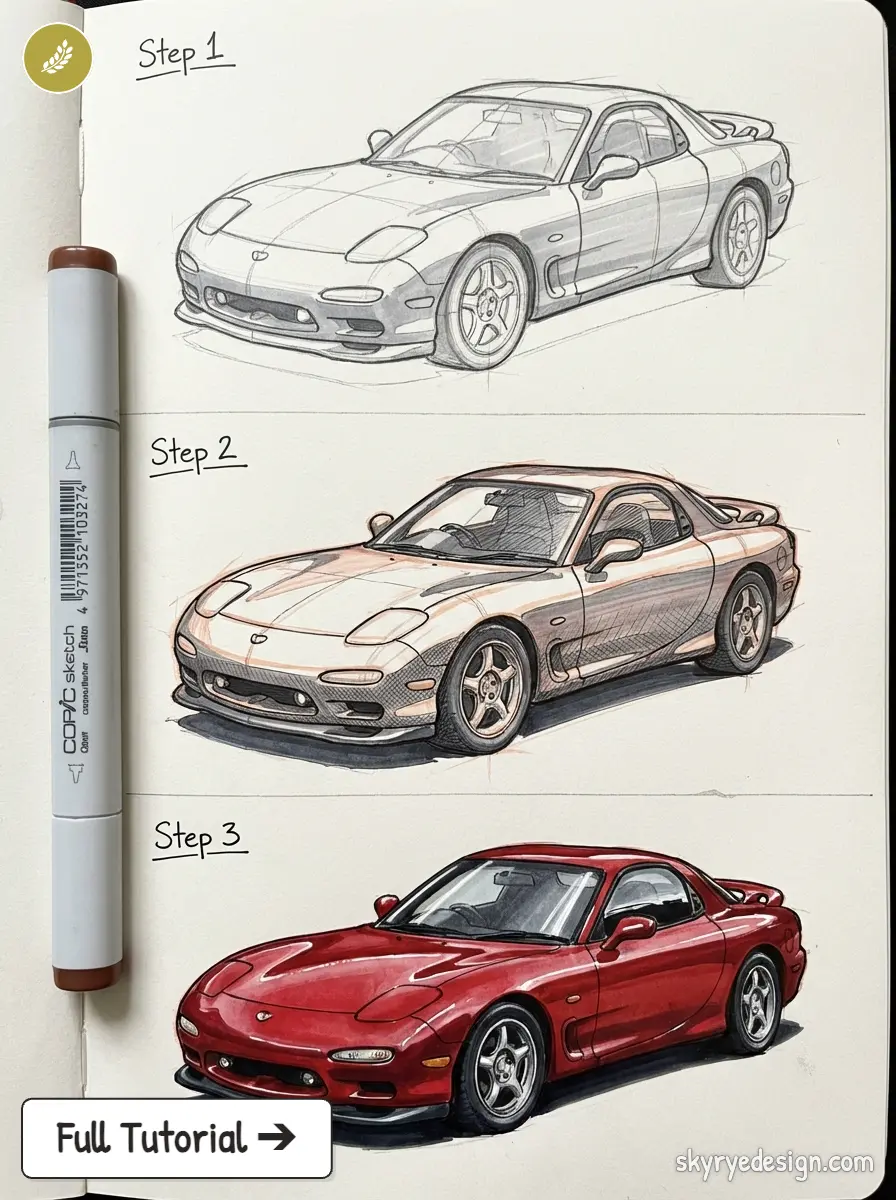
The most iconic JDM sports car ever drawn. Twin-turbo rotary, pop-up headlights, legendary fastback silhouette. If you only draw one Mazda, make it this one.
✏ Drawing tip: The FD is only 1,285mm tall — dramatically lower than most cars. Nail the low bounding box and flat fastback roofline first. The rear haunches flare wider than the front arches, giving the car its planted, rear-heavy stance.
2. Mazda MX-5 Miata NA (1989–1997)
Difficulty: Beginner
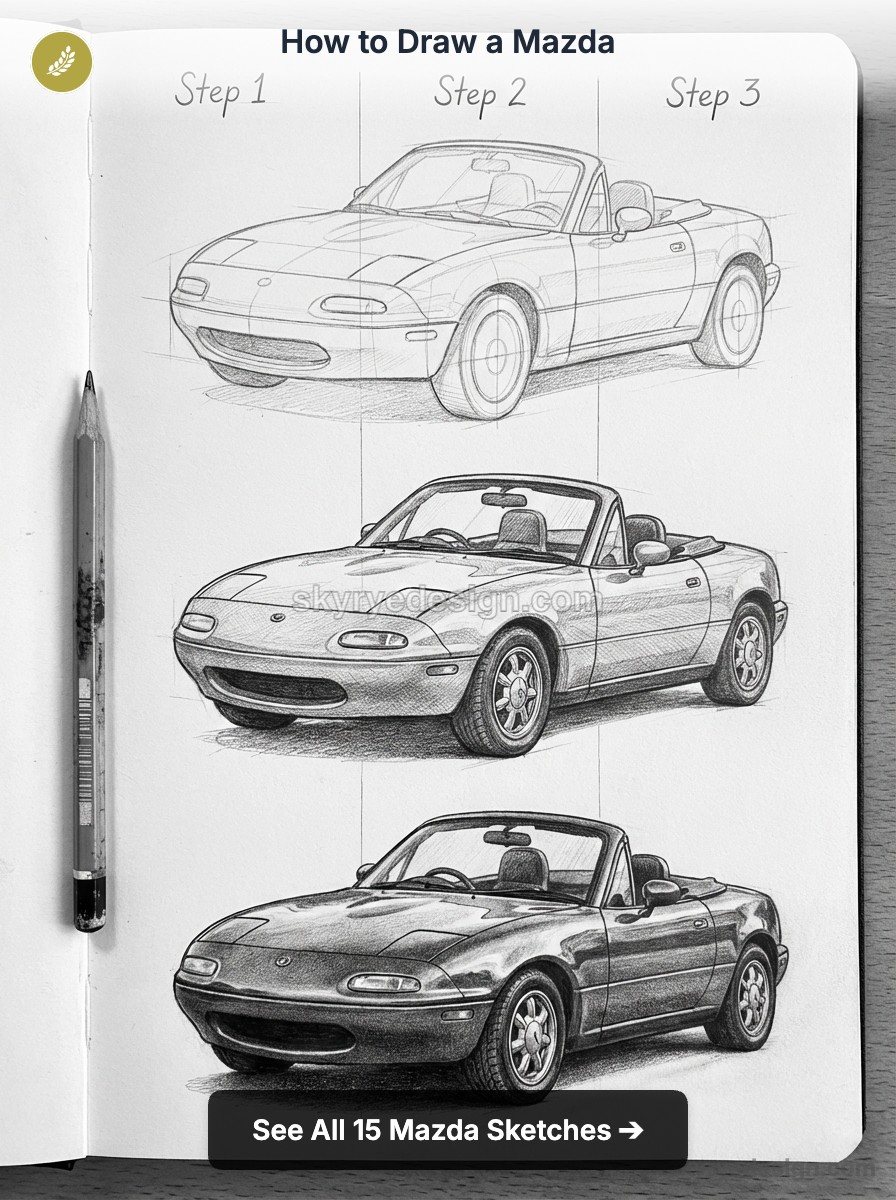
The friendliest Mazda to draw. Round body, simple surfaces, iconic round pop-up headlamps. Perfect for learning basic car proportion ratios before moving to more complex models.
✏ Drawing tip: Think of it as two arcs — one for the hood, one for the soft-top — connected at the windscreen. The rear overhang is very short: the rear wheel sits almost at the corner of the car.
3. Mazda MX-5 Miata ND (2015–present)
Difficulty: Beginner–Intermediate
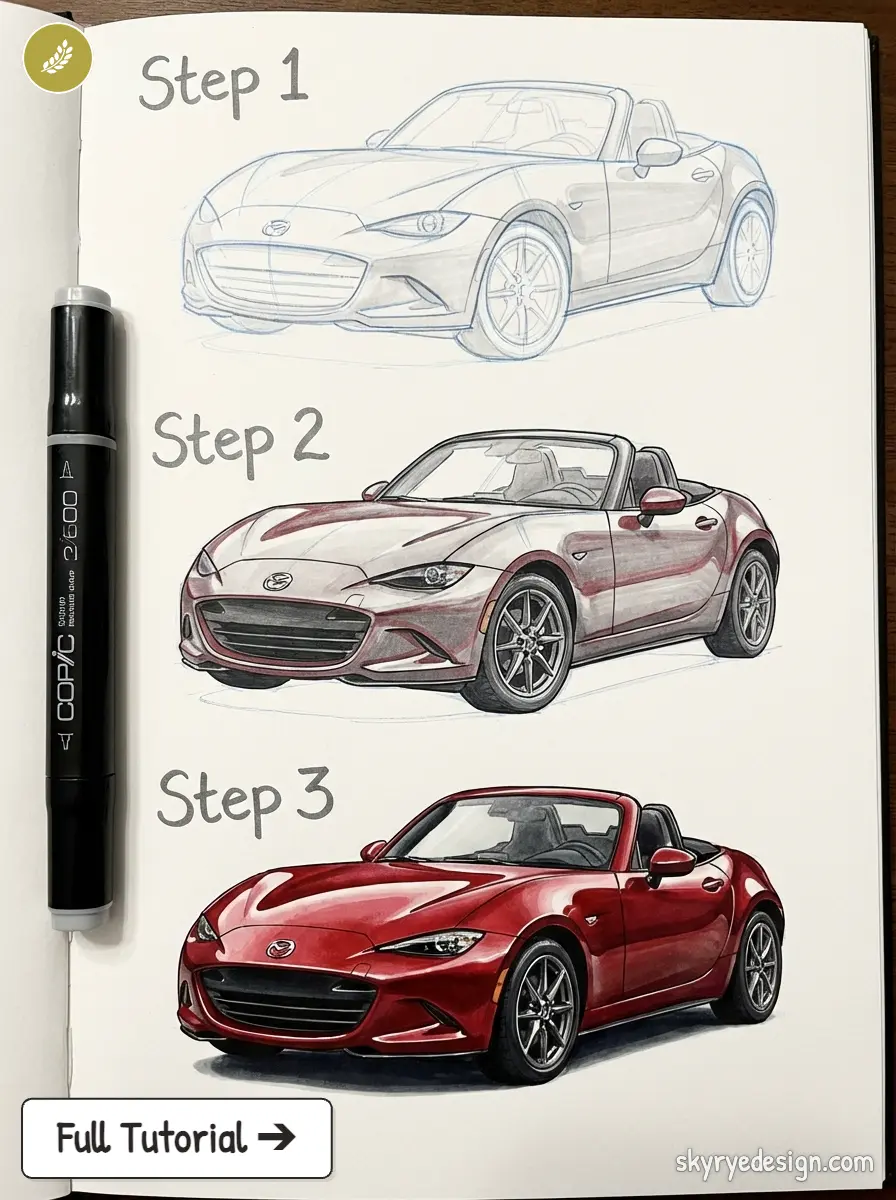
The current-generation Miata brings Kodo design to the roadster formula. Sleeker and more sculpted than the NA, it’s excellent for studying how Kodo tension transforms a simple car.
✏ Drawing tip: Same fundamental proportions as the NA but with sharper, more defined surfaces. The ND’s shoulder line is the key Kodo element to capture — a smooth convex arc, not a hard crease.
4. Mazda RX-8 (2003–2012)
Difficulty: Intermediate
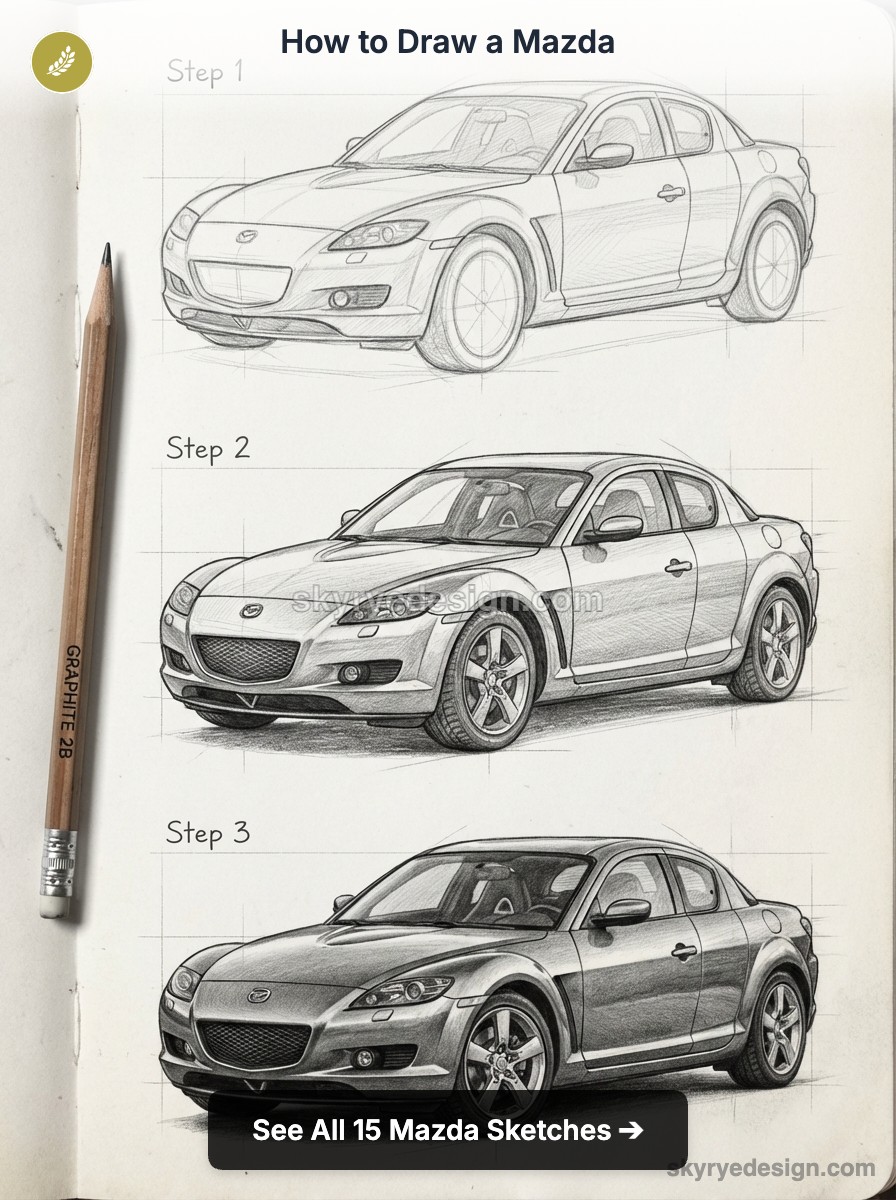
Unique freestyle doors (no B-pillar), wider stance than the RX-7, and a quad-rotor styling language all its own. More complex to draw but enormously satisfying.
✏ Drawing tip: The most unusual feature is the door layout: front-hinged front doors and rear-hinged rear doors meet at a center point with no pillar. Getting that panel gap geometry right is the key challenge.
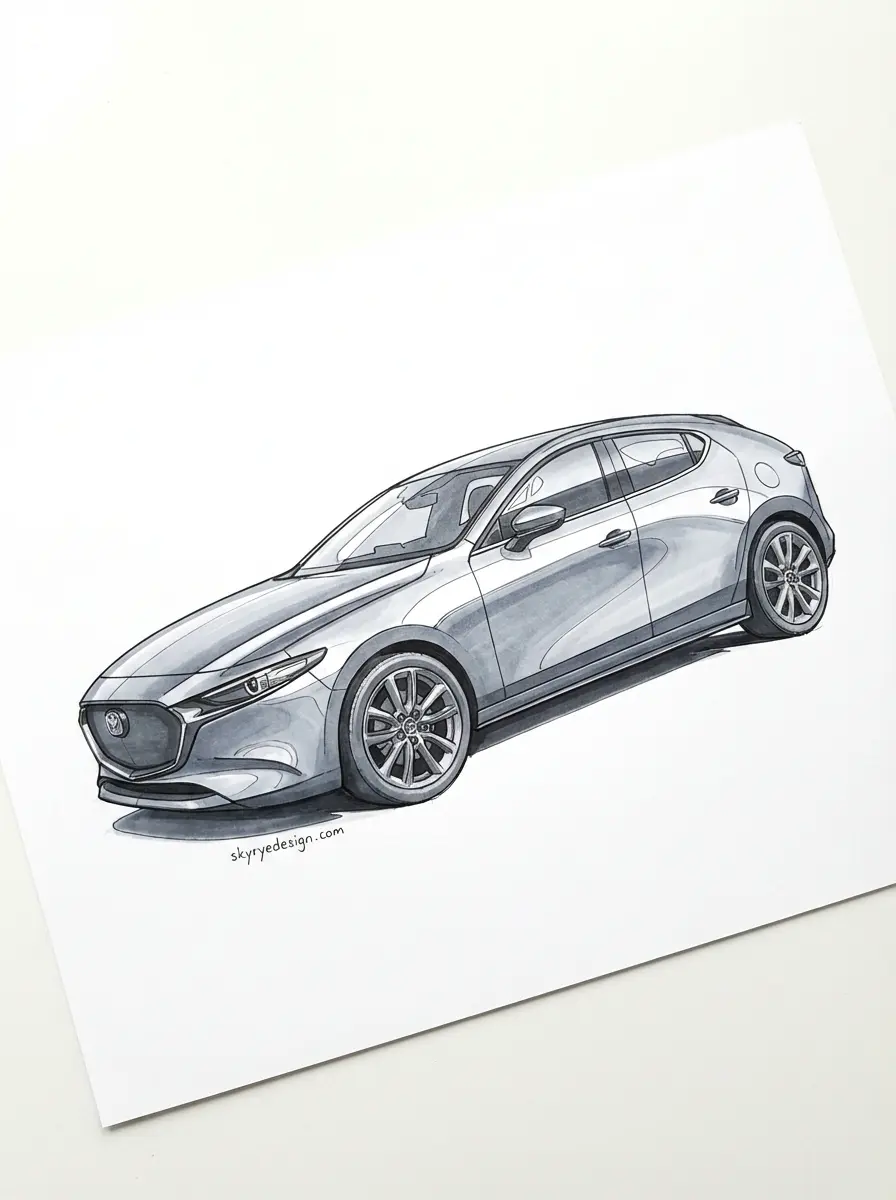
5. Mazda 3 BP Fastback (2019–present)
Difficulty: Intermediate–Advanced

The purest production expression of Kodo design. Flush surfaces, no visible creases, no unnecessary decoration. A masterclass in automotive surface design — and a deceptively difficult drawing subject.
✏ Drawing tip: The flush, crease-free surfaces mean any proportion error is immediately obvious. Use the Mazda 3 BP as a study model even when drawing other Mazdas — understanding its surface language unlocks the whole brand.
6. Mazda CX-5 (2017–present)
Difficulty: Beginner–Intermediate
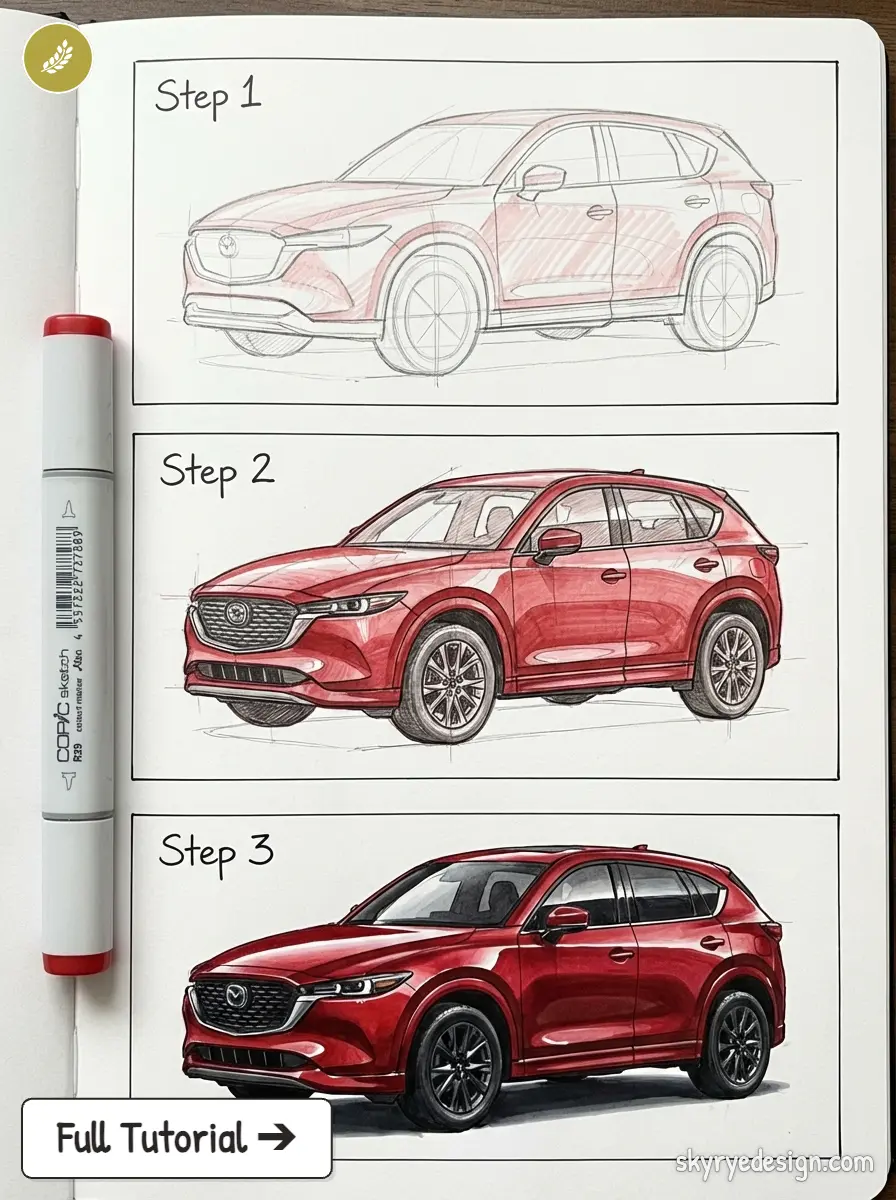
Mazda’s best-selling model worldwide. Higher roofline and pronounced squared wheel arches make it excellent practice for SUV proportions within the Kodo design system.
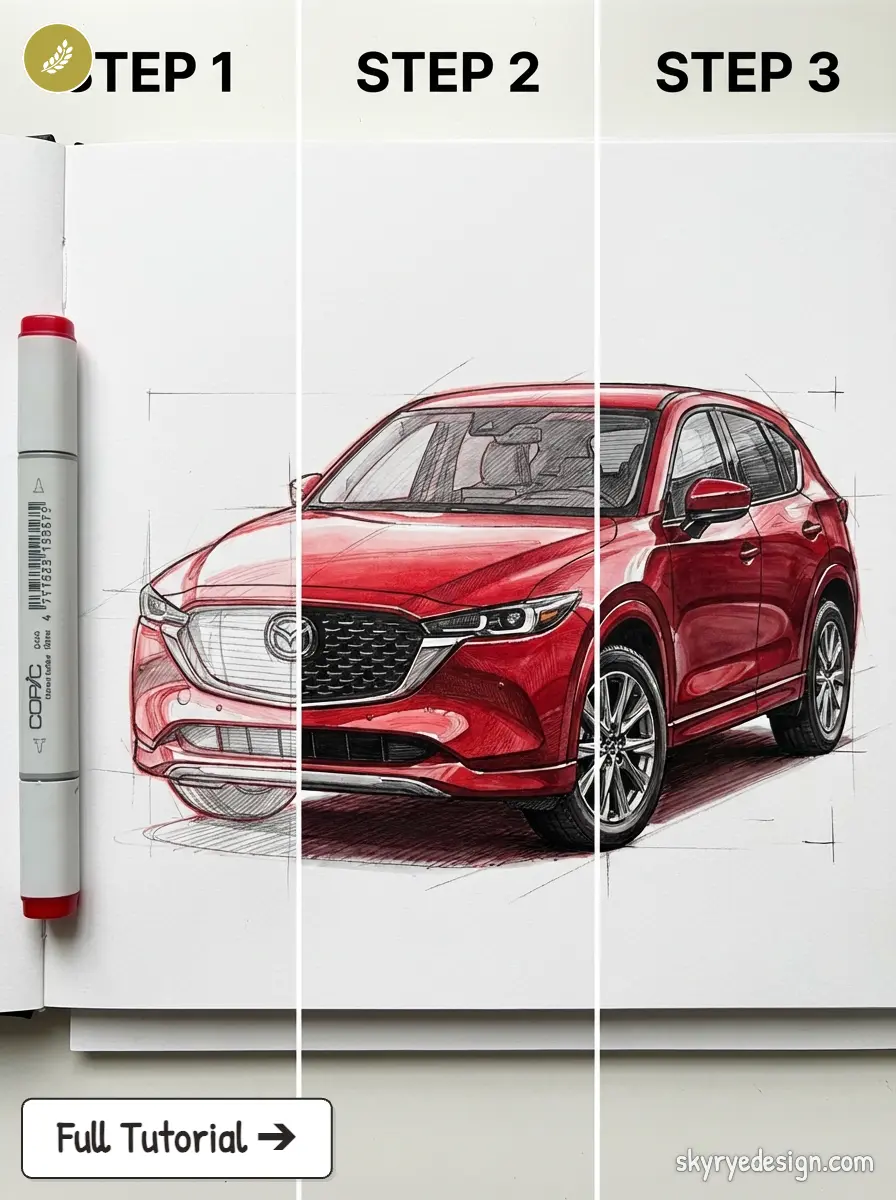
✏ Drawing tip: Draw the greenhouse (glass area) as a near-rectangle first, then work the body surfaces below it. The hood is long for an SUV — Mazda’s cab-rearward principle applies even here.
7. Mazda 6 GJ (2012–2023)
Difficulty: Intermediate
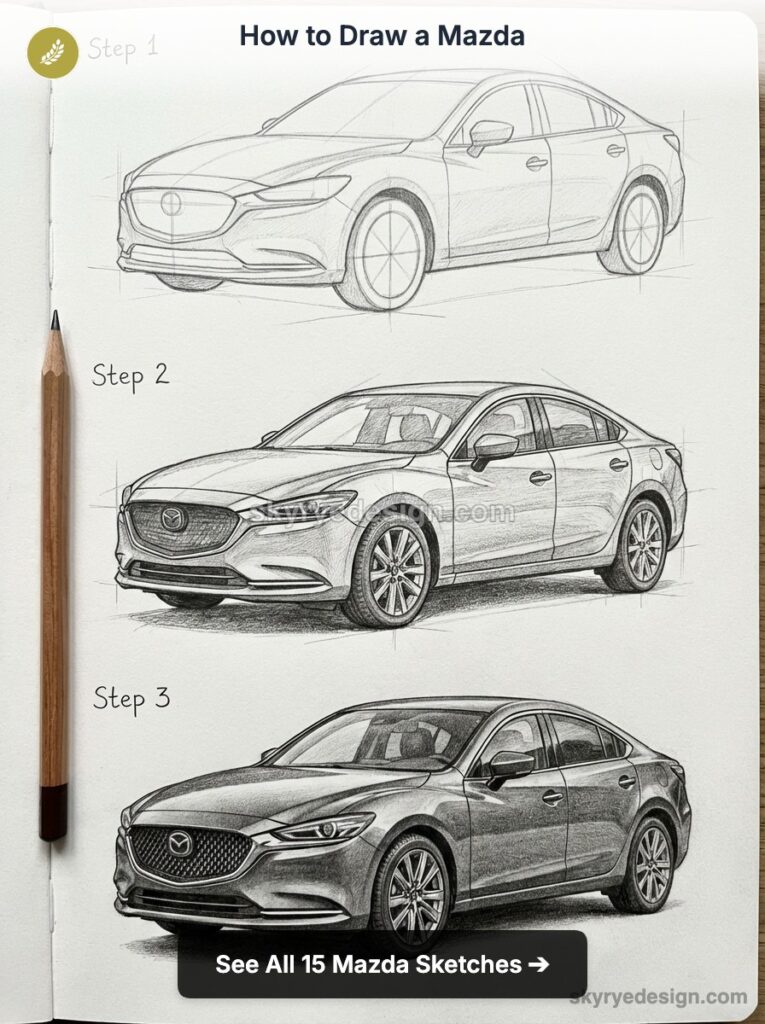
Executive sedan with long hood, sweeping roofline, and elegant narrow greenhouse. Excellent for practicing perspective drawing and understanding how a high beltline creates upmarket proportions.
✏ Drawing tip: Draw the beltline high — cutting across the door windows at about 2/3 height — then keep the glass area slim above it. That high-belt, slim-glass relationship is what gives the Mazda 6 its premium character.
8. Mazda CX-30 (2019–present)
Difficulty: Beginner–Intermediate
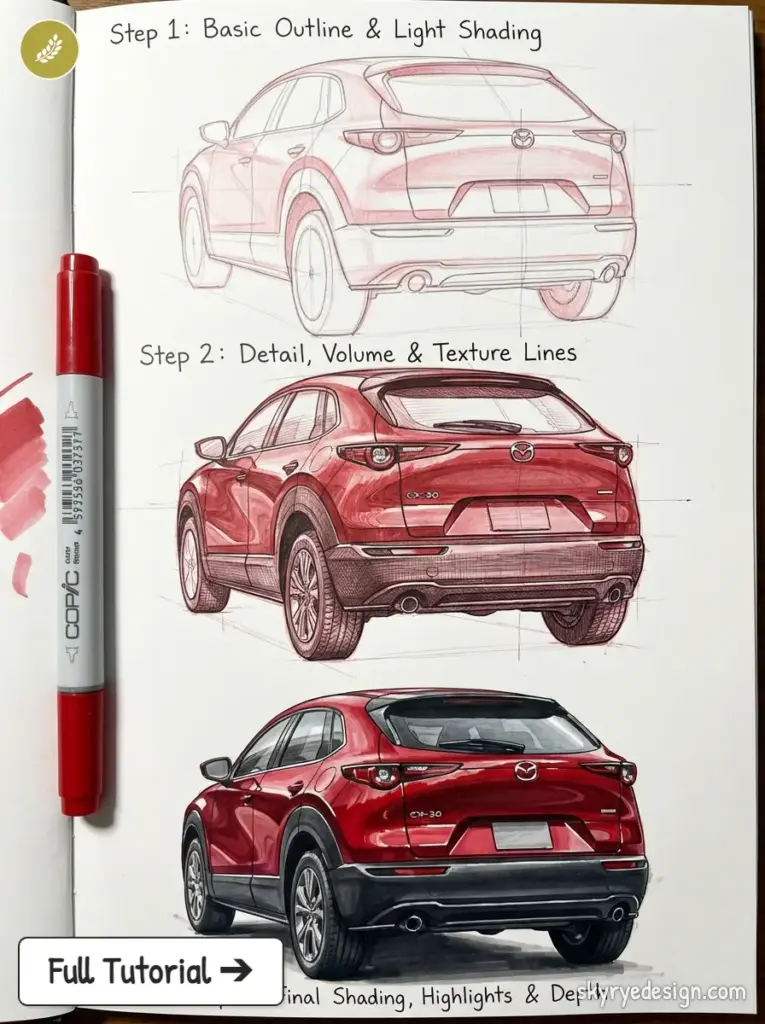
Compact crossover sitting between hatchback and SUV. Coupe-ish roofline, very photogenic side profile. Useful for understanding how Kodo scales across different body types.

✏ Drawing tip: The CX-30’s sloping roofline makes it look sportier than the CX-5. Sketch the roofline arc first — it drops more steeply toward the rear than most crossovers, giving the car its distinctive silhouette.
9. Mazda 2 / Demio (2014–present)
Difficulty: Beginner
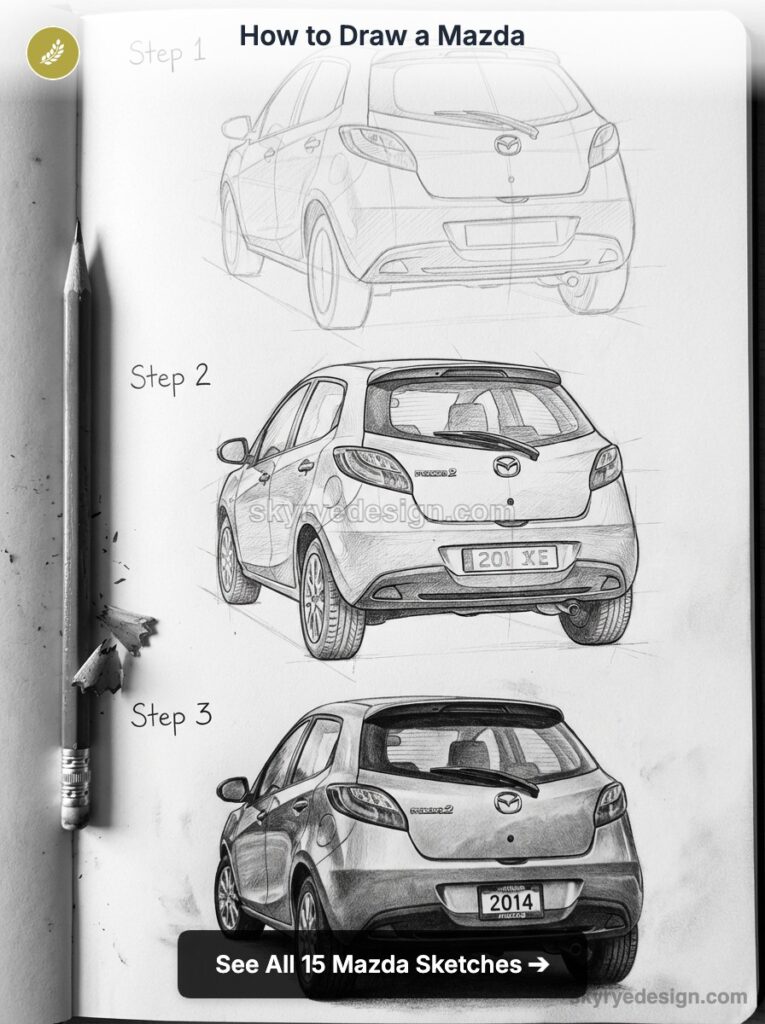
Subcompact hatchback with simple, clean forms. The most accessible entry point for learning Mazda’s proportion language before tackling more complex models.
✏ Drawing tip: Despite its small size, the Mazda 2 uses the full Kodo vocabulary. It’s an ideal study subject because the simplified forms make each design principle easy to isolate and understand.
10. Mazda Vision Coupe (2017 concept)
Difficulty: Advanced
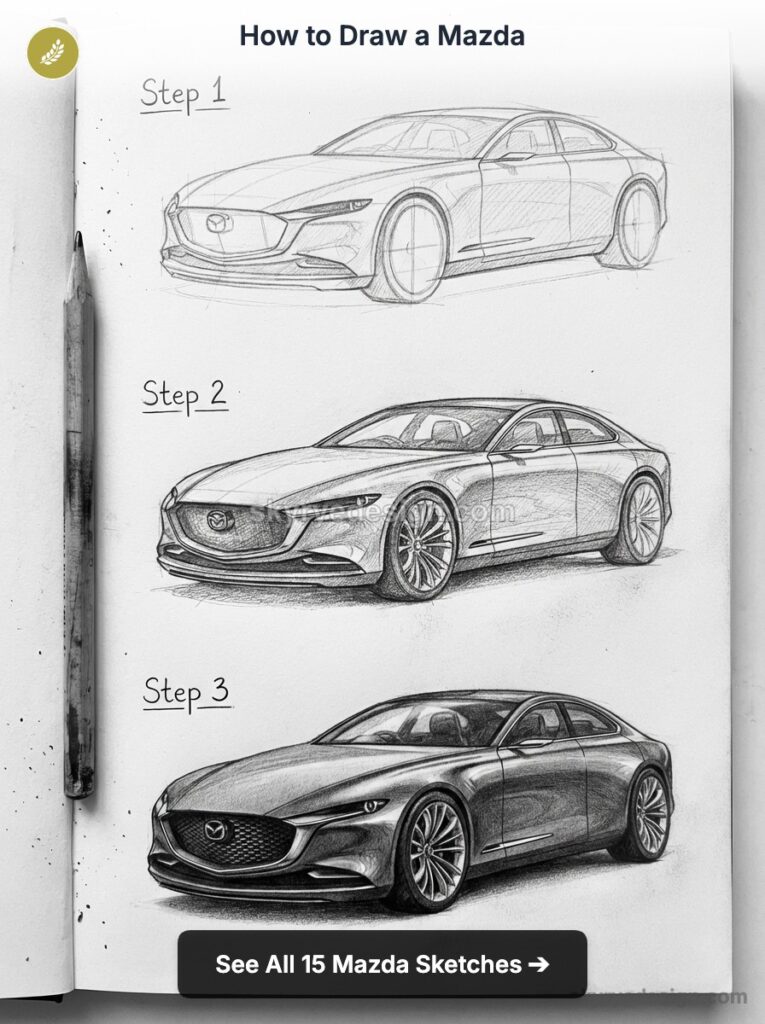
The ultimate Kodo design statement. Extreme cab-rearward proportions, razor-thin surfaces, invisible panel gaps. The most challenging and rewarding Mazda drawing exercise.
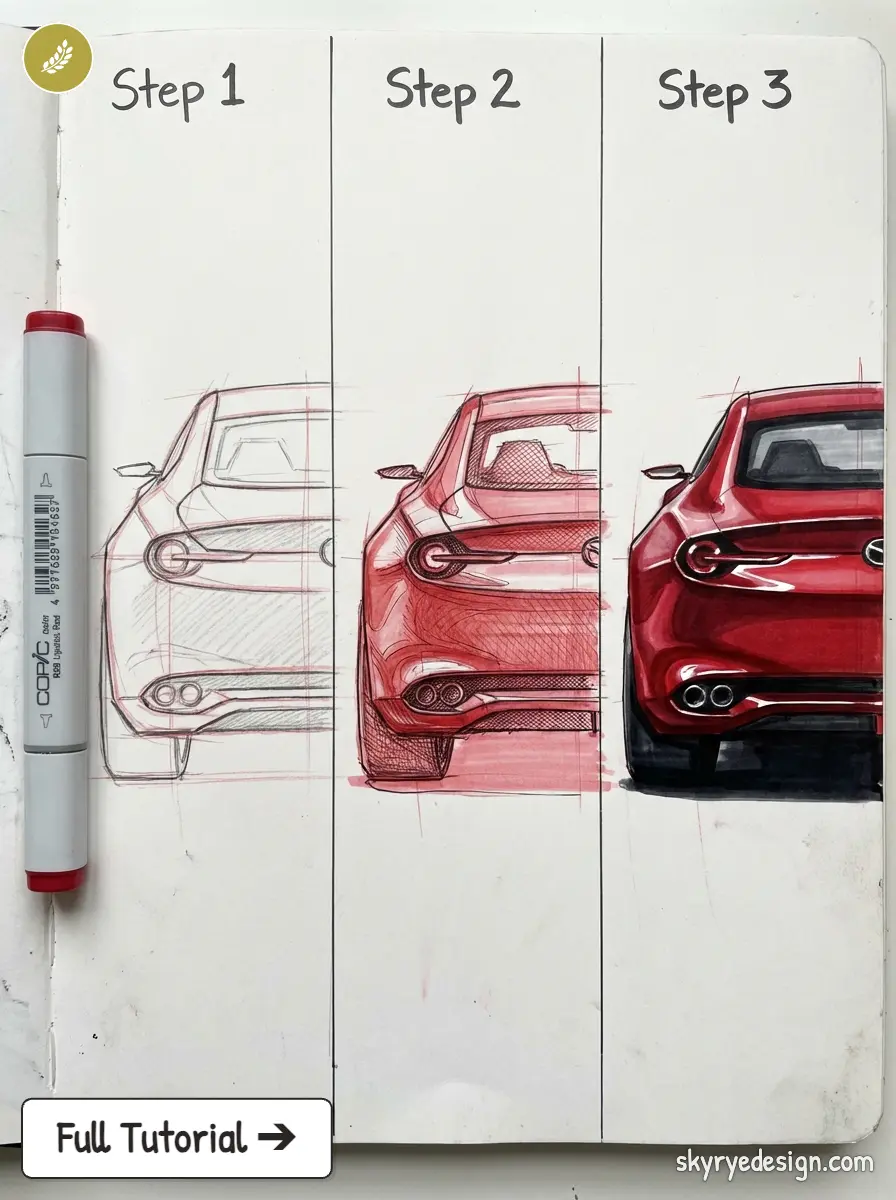
✏ Drawing tip: Start with the silhouette and do nothing else in your first session. The proportions are so extreme — enormous hood, tiny greenhouse, near-zero rear overhang — that every detail depends on getting the gesture right first.
I’d recommend starting with the MX-5 NA or Mazda 2 for your first attempt, moving to the RX-7 FD or Mazda 6 once you’re comfortable with basic car proportions, and saving the Vision Coupe or Mazda 3 BP for when you want a serious challenge.
Understanding Kodo Design Before You Draw
Kodo (Soul of Motion) was introduced by Mazda’s chief designer Ikuo Maeda in 2010.
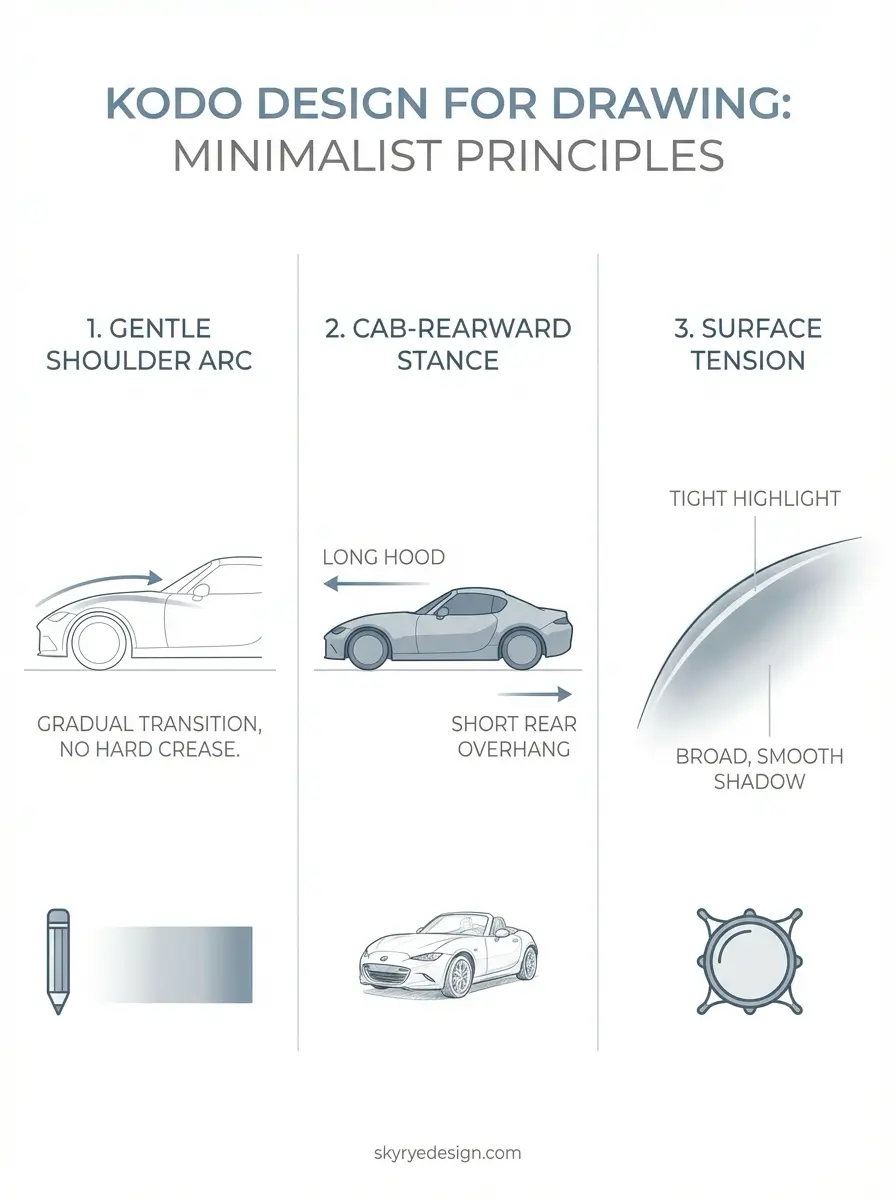
The concept draws from Japanese aesthetics and the visual energy of an animal coiling before it springs. Every surface is meant to store tension, not sit flat.
The Three Kodo Principles That Matter for Drawing
First: the shoulder line. Unlike most cars that use a physical crease for their highlight, Kodo cars use a convex surface that gradually transitions to shadow. There’s no hard line — just a gentle arc that catches the light. In drawing terms, this means your shading transitions must be gradual, not abrupt.
Second: cab-rearward stance. Mazda pushes the cabin toward the rear of the car, creating a long hood and short rear overhang. The RX-7 FD and MX-5 ND both demonstrate this perfectly. When drawing, establish the cabin position first, then build the hood forward from there — most beginners put the cabin too far forward.
Third: surface tension. Panels bow outward very slightly, like the skin stretched over a drum. On paper, you render this by keeping highlights tight and thin, with broad, smooth shadow transitions beneath them. Avoid hard panel-line shadows — they’ll make your Mazda look like a different brand.
| Tip: The Mazda 3 BP (2019+) is the purest expression of Kodo design in a production car. Use it as your reference study even when drawing other models — the surface language translates directly. |
How to Draw a Mazda Step by Step: 5-Stage Method
This sequence works for every model in the list above. The first three stages are pencil only and fully erasable — spend most of your time here. Stage 4 is where the drawing commits.
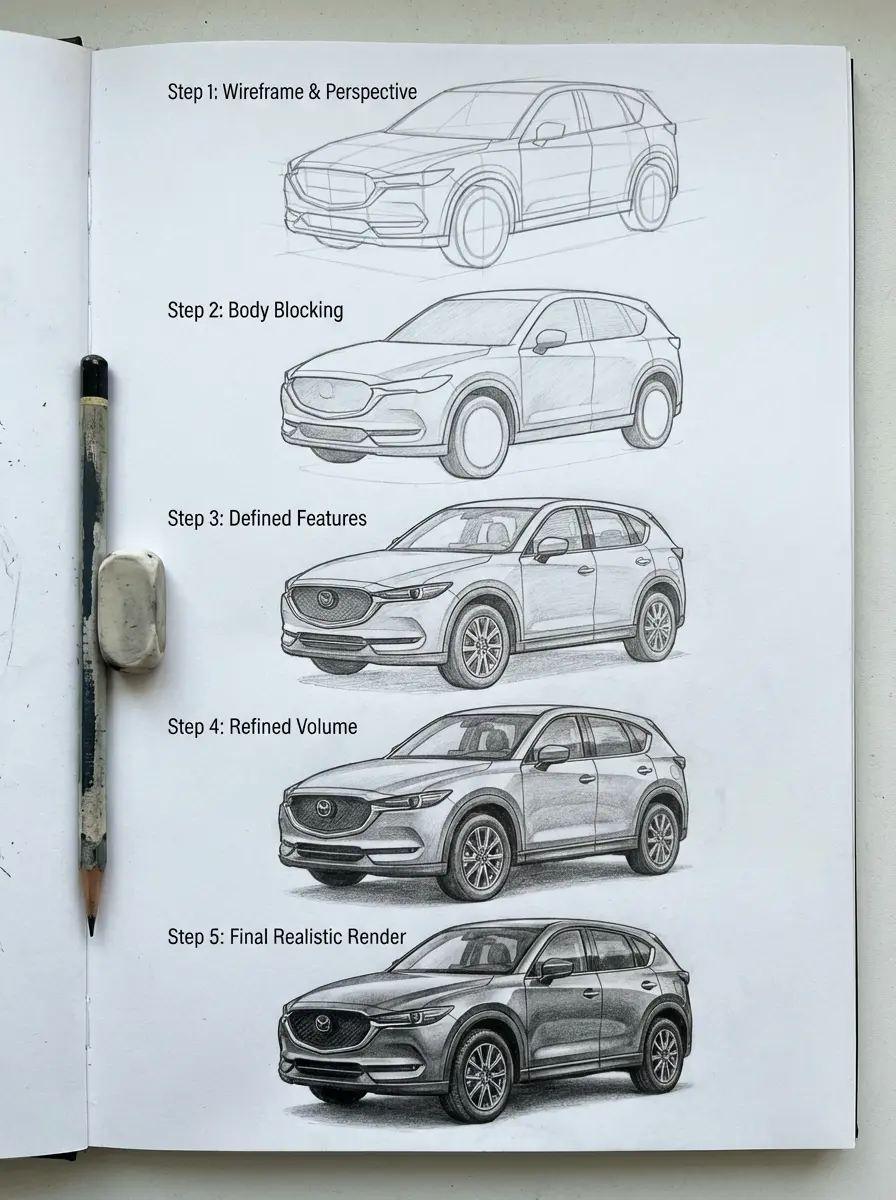
| Step | Stage | What to do |
| 1 | Gesture & silhouette | Lightly sketch the overall car silhouette as a single flowing line — roof arc, hood slope, trunk. No details yet. This gesture line defines character before any box or wheel appears. For Mazdas, the roofline is everything: RX-7 fastback vs. MX-5 roadster vs. CX-5 SUV all start differently here. |
| 2 | Bounding box & proportions | Draw a light rectangle around your silhouette. Divide it: the wheel center height is roughly 1/4 of total car height. Wheelbase (distance between wheel centers) is your key ratio — for the RX-7 it’s long and low; for the CX-5 it’s taller and shorter. Mark wheel centers with small crosses before drawing the wheels themselves. |
| 3 | Major planes & Kodo surfaces | Mazda’s Kodo design uses tensioned, sculpture-like surfaces — not flat panels. Sketch the major plane breaks: hood surface, A-pillar angle, door surface tension line (the subtle ridge that runs the length of the car). The Mazda 3 and MX-5 ND are excellent models for studying how these surfaces catch light. |
| 4 | Details: lights, grille, wheels | Now add character details. Mazda’s signature five-point grille is a wide pentagonal shape — wider at the bottom. Headlights are thin and wrap slightly around the front corner. Wheels: sketch a circle first, then add the rim design inside. Mazdas typically run 17–19 inch alloys with multi-spoke or turbine-fan designs. |
| 5 | Ink, shade & render | Switch to fine liner (0.3mm outlines, 0.05mm panel lines). Add shade using hatching on the underside, wheel arches, and below the beltline. For Mazda’s Soul Red Crystal or Machine Grey paint, a single strong highlight line running along the shoulder of the car creates the metallic sheen effect. Erase pencil, add the light source reflection last. |
For the RX-7 specifically: pay extra attention to Stage 2 — the long low bounding box defines the car’s character before a single curve is drawn. The FD3S is only 1,285mm tall, making it dramatically lower than most modern cars. Capture that low stance in your bounding box and the rest follows naturally.
Model-Specific Drawing Tips for the Top 5 Mazdas
Mazda RX-7 FD3S
The FD is all about the fastback silhouette and the rear haunch. From the side, the roofline sweeps almost uninterrupted from the A-pillar down to the rear bumper — there’s very little vertical rear window.
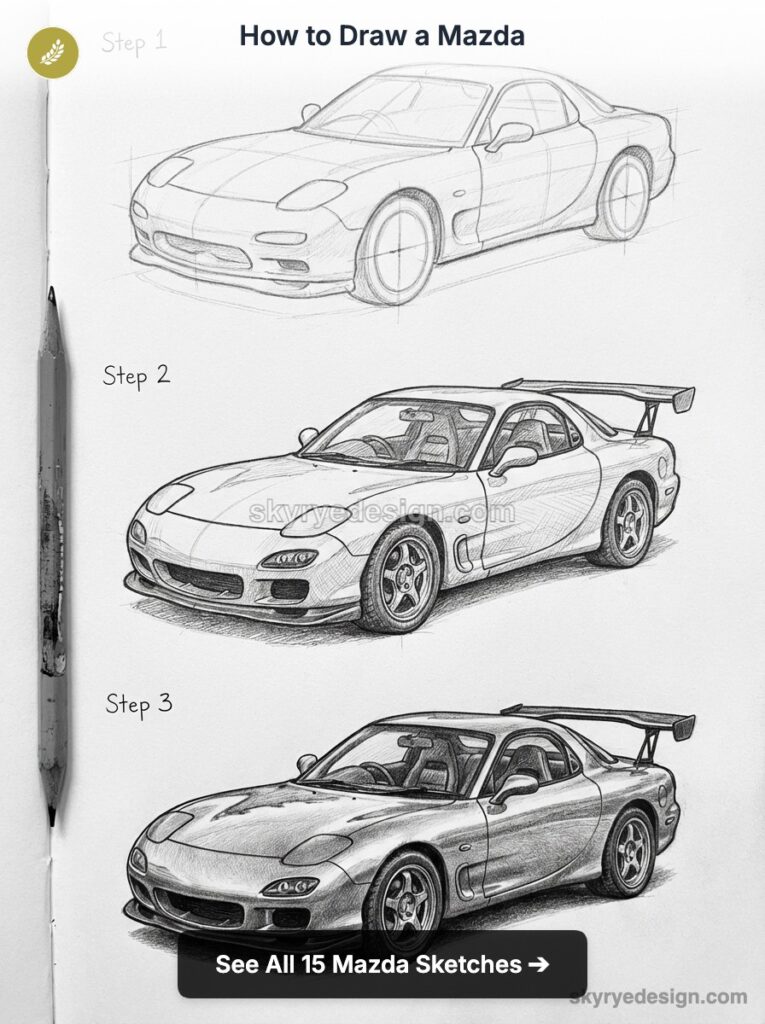
The pop-up headlight housing is a rectangular bump at the front, not round. Most beginner mistakes: making the car too tall, drawing the rear too upright, forgetting the subtle lip spoiler at the base of the hatch.
For the wheel arches: the rear arch flares out noticeably wider than the front. That rear-wide stance is a signature of the FD. Draw the rear arch first, then proportion the front arch to be slightly narrower.
Mazda MX-5 Miata (NA & ND)
The NA (1989–1997) is the friendliest Mazda to draw. Round front headlamp pods, simple blister arches, very little surface complexity.
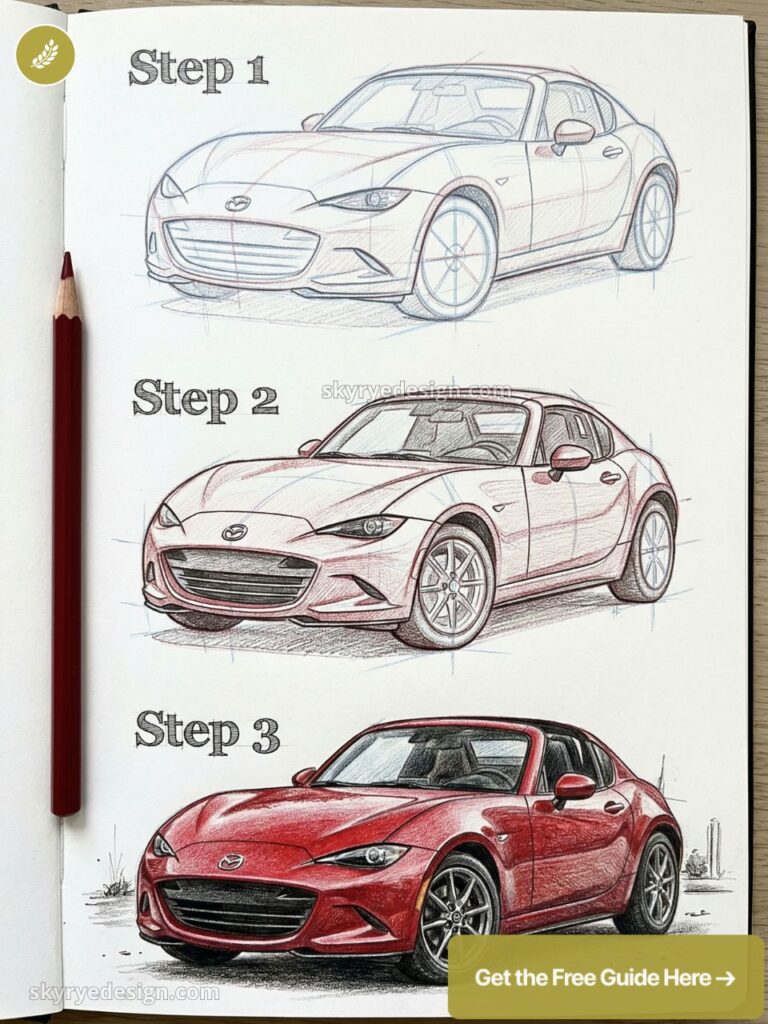
Think of it as two arcs — one for the hood and one for the soft-top — connected at the windscreen. The ND (2015+) uses the same fundamental proportions but replaces the roundness with Kodo tension: same size, sharper character.
Key detail: both generations have a very short rear overhang. The rear wheel sits almost at the corner of the car. If your MX-5 drawing has a long trunk, the proportions are off.
Mazda CX-5
The CX-5 is a useful model for learning SUV proportions. The roofline doesn’t drop like a coupe — it’s relatively flat until the D-pillar, then descends sharply.
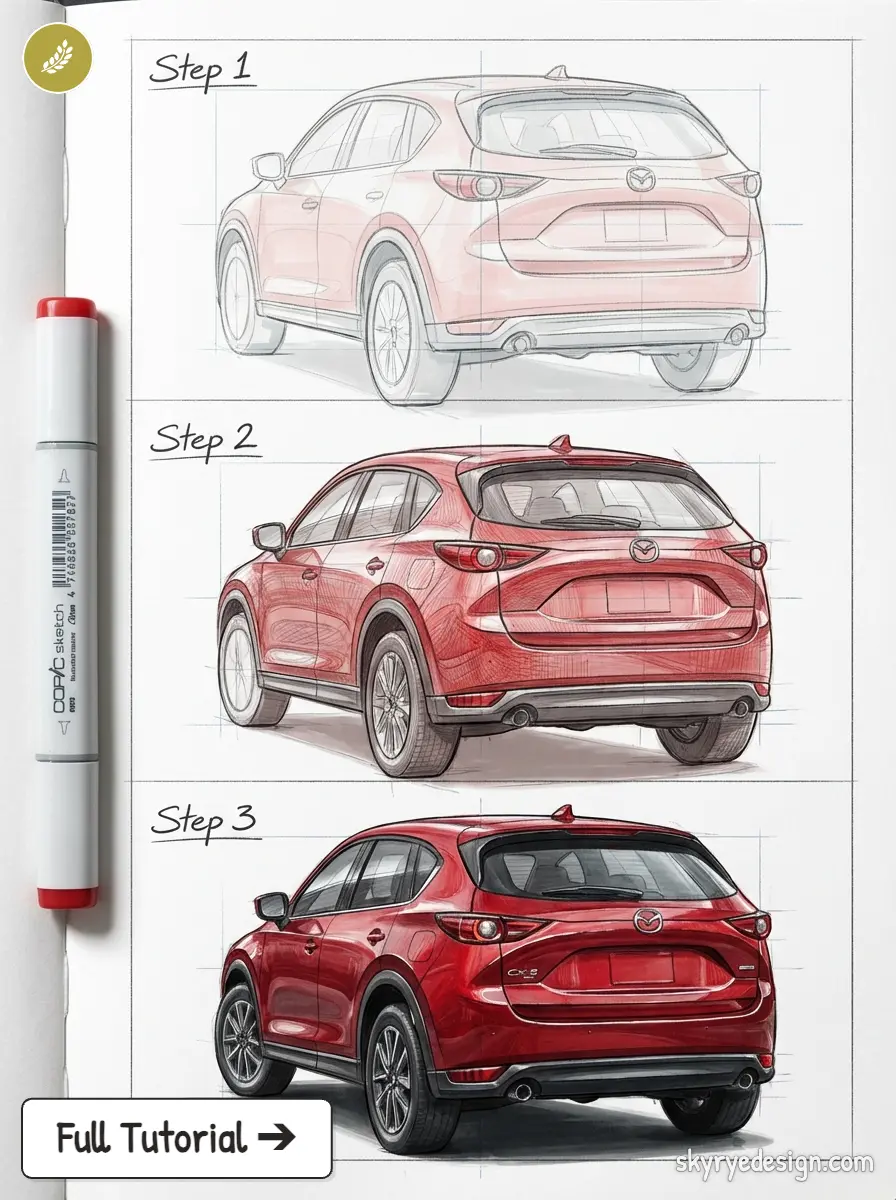
The wheel arches are pronounced and squared at the top rather than perfectly round. The hood is long for an SUV (Mazda’s cab-rearward principle again). Draw the greenhouse (glass area) as a near-rectangle, then work the body surfaces below it.
Mazda 6 GJ
The Mazda 6 is the sedan to draw when you want to practice elegant proportions.
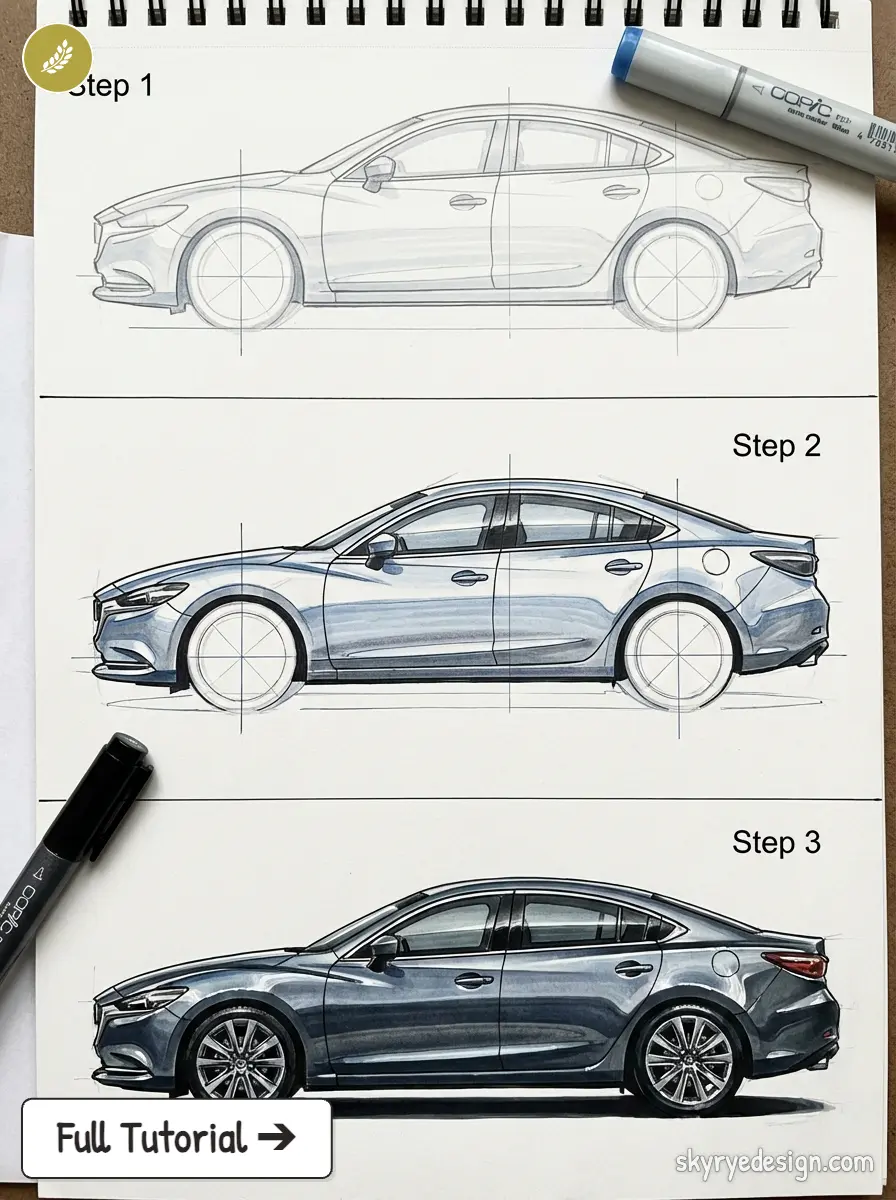
The hood is long, the roofline sweeps, and the greenhouse is narrow — a visual effect achieved by a high beltline. In drawing terms: draw the beltline high (cutting across the door windows at about 2/3 height), then keep the glass area slim above it. That high-belt, slim-glass relationship is what gives the 6 its upmarket feeling.
Mazda Vision Coupe
This 2017 concept is for when you want a serious drawing challenge. The proportions are extreme: the cabin sits almost at the rear of the car, the hood is enormously long, and the roofline is impossibly low — lower than any production car.
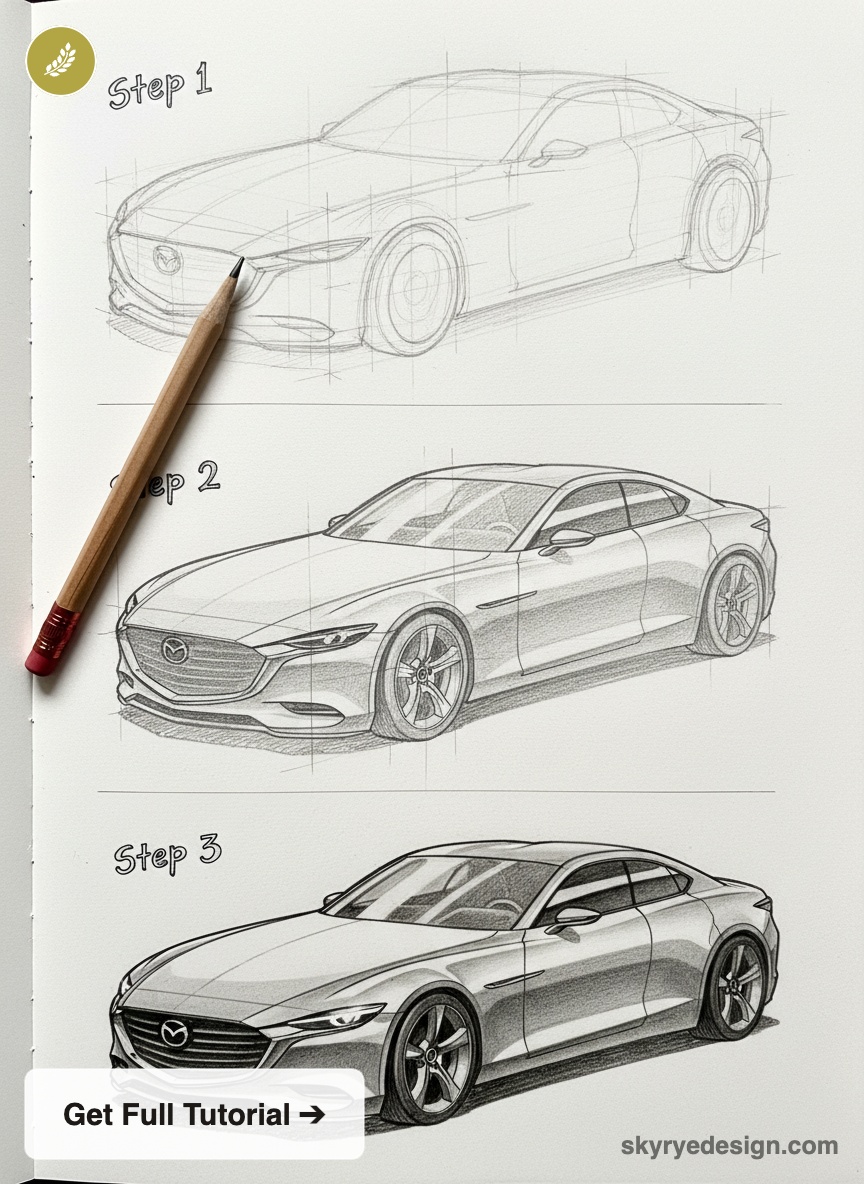
There are almost no panel lines visible. The whole car is one continuous surface. Start with the silhouette and do nothing else for the first session. Get that right before touching any detail.
Art Supplies and Digital Tools for Mazda Car Drawing
Traditional Media
For sketching: a 0.5mm mechanical pencil with HB lead for initial gesture, moving to 2H for construction lines. For inking: Pigma Micron 0.3mm for outlines and main lines, Micron 0.05mm for panel gaps, stitching, and interior detail.
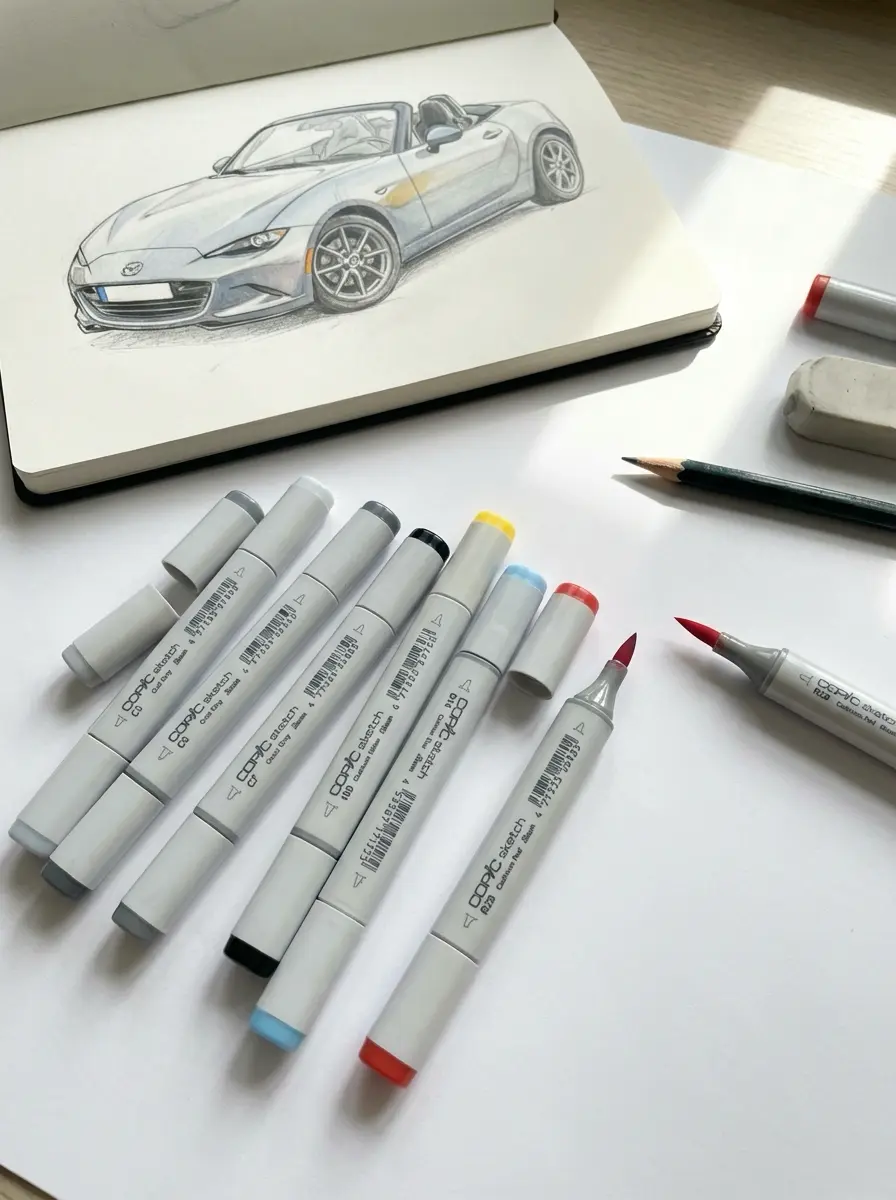
For color rendering, Copic Sketch markers are the industry standard for car illustration. A practical Mazda palette: C3 Cool Grey (midtone), C5 Cool Grey (shadow), C7 Cool Grey (deep shadow), 100 Black (tires and deep shadow), and model-specific colors: Y15 Cadmium Yellow (MX-5 yellow), B14 Light Blue (blue MX-5 ND), R29 Cadmium Red (Soul Red base). A full Copic set runs $350+, but five to seven markers will cover most Mazda renderings.
Paper: Canson Bristol Smooth (270gsm) handles both pencil and marker without bleed-through. For ink-only work, Rhodia dot-pad (A4) is excellent for keeping proportions accurate.
Digital Tools
Procreate on iPad is the most popular digital car sketching tool in 2026. For Mazda drawing specifically: use the 6B Pencil for gesture sketching, Technical Pen for inking, and the Dry Ink brush for rendering paint surfaces. The Symmetry Guide helps with the front three-quarter view, though turn it off before finalizing — perfect symmetry looks mechanical.
Adobe Illustrator suits vector car drawings — useful if you plan to scale the image for print or merchandise. The Live Paint bucket and offset path tools speed up car panel construction significantly. Clip Studio Paint is worth considering for manga-influenced car illustration, which has a devoted following for JDM cars like the RX-7.
| Tip: For Procreate car rendering, the YouTube channels Car Design Academy and Sketch Like an Architect both have Mazda-specific tutorials. Spencer Nugent’s car sketch tutorials are also worth studying for marker technique. |
Common Mistakes When Drawing Mazda Cars
Mistake 1: Cabin too far forward. Kodo design is cab-rearward. If your Mazda looks like a Honda, the cabin is probably placed too centrally on the wheelbase. Push it back.
Mistake 2: Wheels too small. Modern Mazdas run large wheels — 17 to 19 inches. Undersized wheels make the car look tall and floaty. The wheel diameter should be about 25–28% of the car’s total height.
Mistake 3: Hard shoulder crease. Kodo doesn’t use a sharp crease line — it uses a convex surface highlight. Drawing a hard line along the shoulder makes your Mazda look like a Ford. Use gentle hatching that fades into light, not a solid stroke.
Mistake 4: Flat hood. Mazda hoods have a subtle central crown — a very gentle convex rise along the centerline. Draw two planes meeting at a nearly invisible ridge. Flat hoods look unrendered.
Mistake 5: Ignoring the A-pillar angle. Mazda windscreens are steeply raked — the A-pillar angle is much more dramatic than average family cars. Getting this angle right is what makes a sketch feel sporty and Mazda-specific.
FAQ: How to Draw a Mazda
Q: What is the easiest Mazda to draw for beginners?
The Mazda MX-5 Miata NA (1989–1997) is the most beginner-friendly Mazda. Its rounded, simple body with circular pop-up headlights and minimal surface complexity makes it ideal for learning car proportions. The Mazda 2 hatchback is also a great starting point for practicing basic car form ratios.
Q: How do I draw a Mazda RX-7 step by step?
Start with the long fastback silhouette as a flowing line — it’s the whole character of the car. Add a very low bounding box (the FD is only 1,285mm tall). Mark wheel centers, then sketch the pop-up headlight housing, the wide rear haunches, and the near-invisible roofline transition to the hatch. Ink with 0.3mm liner, add the shoulder highlight, and shade the underside.
Q: What is Kodo design and how does it affect drawing Mazda cars?
Kodo (Soul of Motion) is Mazda’s design language since 2010, built on tensioned, sculpture-like surfaces. For drawing, it means: no flat panels, no hard shoulder creases, and a cab-rearward stance. The most important Kodo drawing technique is rendering the shoulder highlight as a smooth convex arc rather than a crisp line.
Q: What art supplies do I need to draw a Mazda car?
Traditional: 0.5mm mechanical pencil, Micron liners 0.05mm and 0.3mm, Copic Sketch markers in Cool Grey (C3, C5, C7) plus your chosen body color. Canson Bristol 270gsm paper handles both pencil and marker. Digital: Procreate (iPad) or Adobe Illustrator for vector work.
Q: How do I draw Mazda car wheels correctly?
Sketch a circle using a compass or coin template first. Mazda alloys are typically 17–19 inches with multi-spoke or turbine designs. Tire thickness should be about 15–20% of total wheel diameter. Add a subtle ground shadow beneath the tire for realistic contact, and a thin highlight arc at the top of the rim.
Q: How do I render Mazda Soul Red Crystal paint in a drawing?
Soul Red Crystal is a deep metallic red with unusual depth. With Copics: R29 as base, R27 for warm shadows, leave a clean white strip for the shoulder highlight. With pencil on toned paper: a sharp white gel pen (Uni-ball Signo) on mid-red toned paper creates the crystal clarity effect convincingly. With watercolor: burnt sienna base, cadmium red glaze, white gouache highlights.
Q: Which Mazda model is the hardest to draw?
The Mazda Vision Coupe concept is the most challenging — extreme proportions, invisible panel gaps, and a single continuous surface with no drawing shortcuts. Among production cars, the Mazda 3 BP fastback is deceptively hard because its flush, crease-free Kodo surfaces make any proportion error immediately visible.
- 1.1Kshares
- Facebook0
- Pinterest1.1K
- Twitter0
- Reddit0