I bought a sofa I couldn’t return and spent three weeks trying to make it work in a room it never belonged in. It wasn’t that the sofa was wrong — it was a good sofa. It was that I’d made the decision based on how it looked in the showroom, not on how it would sit in my actual living room with its specific dimensions, its doorway at an awkward angle, and its window that pulled all the natural light toward one corner.
The sofa was 240cm wide. The wall I’d planned to put it against was 280cm. Plenty of room, I’d thought. What I hadn’t sketched — hadn’t even drawn on the back of an envelope — was the 90cm doorway opening that meant you’d have to squeeze sideways to get from the sofa to the kitchen.
- Why Sketching Before Spending Is the Most Valuable Design Habit
- Drawing a Usable Floor Plan: Scale, Proportion, and What to Mark First
- Scale and Proportion: The Design Principles That Make Rooms Feel Right
- Light and Traffic Flow: The Two Invisible Constraints
- Moving to Three Dimensions: One-Point Perspective for Interior Spaces
- When Your Sketch Is Ready: Briefing a Designer With Your Drawings
- The Sketch Is the Beginning, Not the End
- FAQ: Architectural Sketching for Interior Design
Or the radiator that sat precisely where one end of the sofa would have to go. None of this was invisible information. All of it was in the room, measurable in five minutes with a tape. I just hadn’t looked at it on paper before I’d looked at it in a showroom.
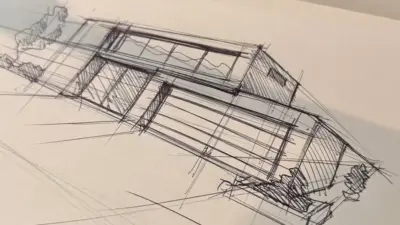
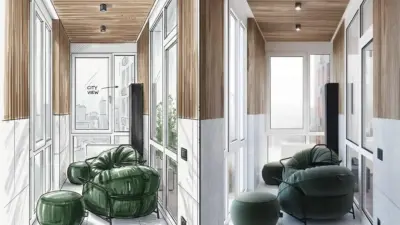
Architectural sketching is not a skill reserved for architects. It’s the habit of externalising spatial thinking onto paper before committing to spatial decisions in reality — and it costs nothing except the time it takes to measure a room and pick up a pencil.
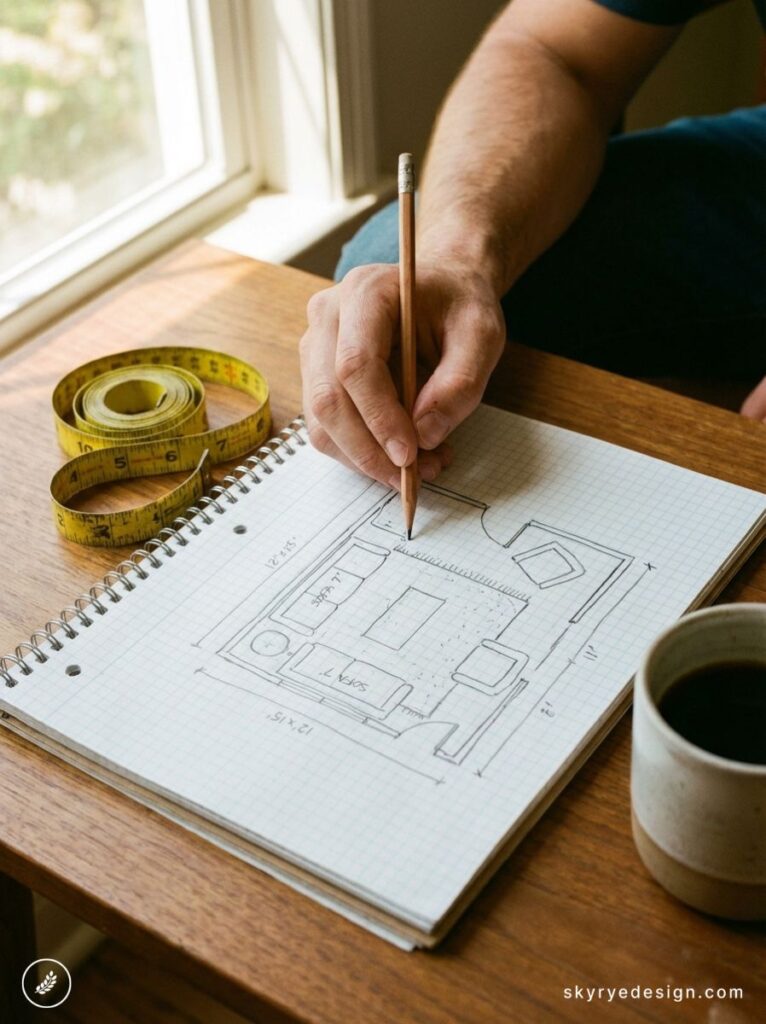
This guide covers the specific techniques that matter for interior planning: how to draw a usable floor plan, how to establish scale correctly, how to think about light and traffic flow before furniture placement, how to use perspective to visualise vertical space, and when your sketches are ready to hand over to a professional who can take them further than you can alone.
Why Sketching Before Spending Is the Most Valuable Design Habit
Every renovation project has two phases: the phase where changes are free and the phase where they’re expensive. In the free phase — which is entirely on paper — you can move walls, relocate the sofa, rotate the dining table, and discover that the layout you were certain would work creates a traffic bottleneck between the kitchen and the back door. In the expensive phase — which is everything that happens after you’ve ordered materials, hired contractors, or bought furniture — the same changes cost money, time, and often significant disruption.
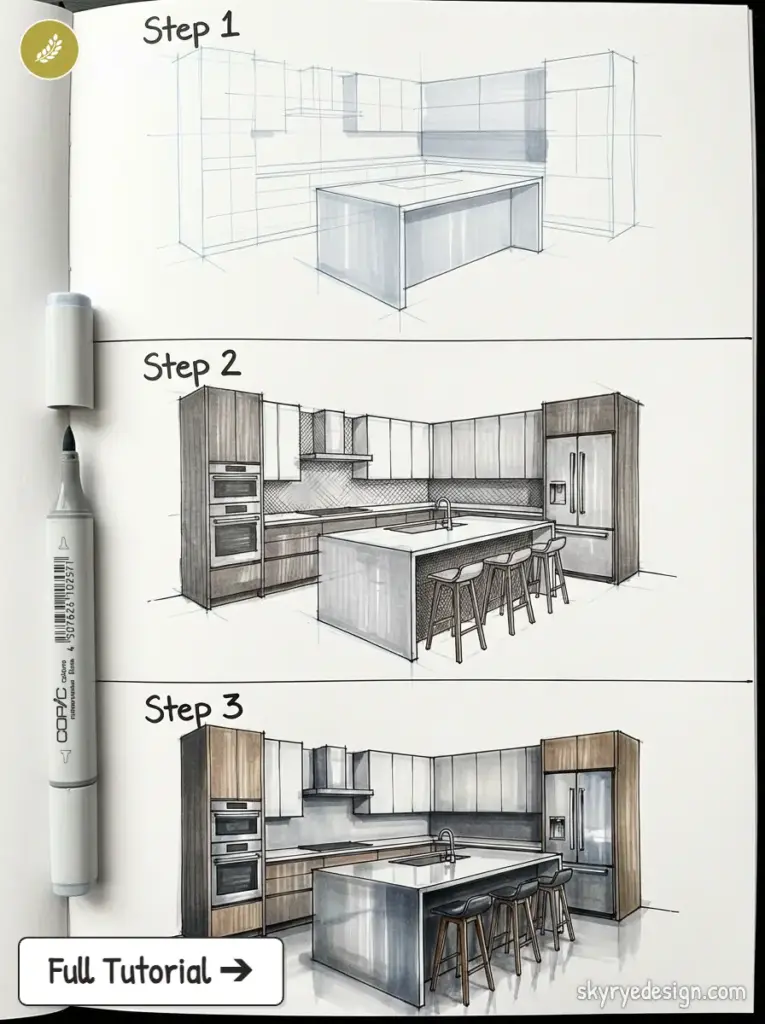
The sketch is the tool that keeps you in the free phase longer. Not because it prevents you from making decisions, but because it allows you to make more of them — quickly, reversibly, at zero cost — before the physical and financial commitments begin.
A homeowner who has sketched three different furniture arrangements for their living room and evaluated each one against the actual dimensions of the room has made a better decision than one who ordered the first arrangement that looked good on a showroom floor. The quality of the decision isn’t about talent. It’s about having externalised the problem onto paper, where it can be evaluated rather than imagined.
The other value of sketching that most renovation guides underemphasise: it makes you a better client. Whether you’re working with an architect, a contractor, or an interior designer, the quality of the brief you give them directly affects the quality of the result you get. A rough sketch that shows your vision — even imperfectly — communicates spatial priorities, lifestyle preferences, and design intent in a way that verbal descriptions rarely achieve with the same precision. The sketch is not the final design. It’s the starting point for a conversation that produces one.
For spatial planning before money is spent, compare interior sketching with this private island design guide, where the first sketch has to include access, utilities, and reef protection.
✏ Sketch note: Before drawing anything, measure everything. Walls, doorways, window openings, and their sill heights, the depth of any alcoves, the position of radiators, and electrical outlets. Write the dimensions directly onto your sketch as you go. A sketch without dimensions is a picture. A sketch with dimensions is a planning document.
Drawing a Usable Floor Plan: Scale, Proportion, and What to Mark First
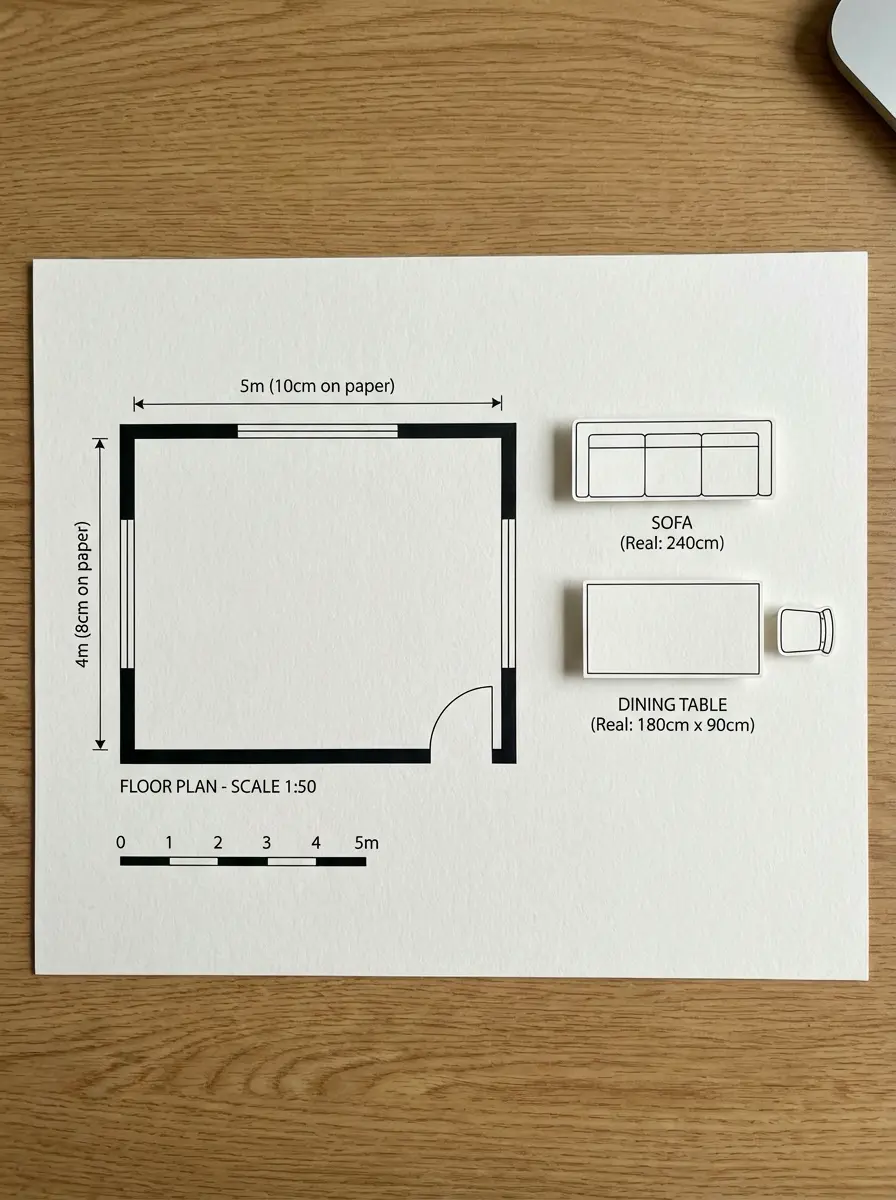
A floor plan is a top-down view of a room at a consistent scale — that is, every element drawn in the same proportional relationship to its real-world dimensions. The most practical scale for residential rooms is 1:50, where 1 centimetre on paper represents 50 centimetres in reality. At this scale, a typical living room of 5m × 4m occupies a 10cm × 8cm rectangle on the page — large enough to be legible, small enough to fit on an A4 sheet with space for annotations.
The Correct Drawing Sequence
The most common floor plan mistake is drawing furniture before drawing constraints. The correct sequence: structure first, then fixed elements, then furniture last. Draw the walls first, including their thickness (typically 100-150mm for internal walls, 250-300mm for external walls). Mark windows as gaps in the wall with thin lines indicating the glass pane. Mark doors as gaps with a quarter-circle arc showing the swing direction — this arc defines the zone that must remain clear, which is one of the most frequently overlooked constraints in furniture planning.
Once structural walls are drawn, mark fixed elements that cannot move: the fireplace, any built-in shelving, the kitchen island if present, bathroom fixtures. Then mark services: electrical outlets (small squares on the wall), light switches, radiator positions. Only after all of these constraints are mapped should you begin testing furniture placement — because furniture placed before constraints are known will almost certainly need to move when the constraints become apparent.
Furniture as Paper Cutouts
The most practical technique for testing furniture placement in a scale floor plan: cut out paper rectangles at the same scale as your furniture and physically move them around on the plan rather than drawing and erasing. A three-seat sofa at 1:50 is a rectangle approximately 4.8cm × 1.8cm. A dining table for six is approximately 3.6cm × 1.8cm. This physical manipulation is faster than drawing, requires no erasing, and allows you to try ten arrangements in the time it would take to draw and erase three.
Standard furniture dimensions worth knowing for scale planning: three-seat sofa 220-240cm wide × 90cm deep; armchair 85-90cm square; dining table for six 180cm × 90cm; double bed 140cm × 200cm; queen bed 160cm × 200cm; desk 140cm × 60cm minimum for comfortable use. Allow 90cm of clear circulation space around major furniture pieces — this is the minimum comfortable walkway width, and it’s the dimension most frequently violated when furniture arrangements are planned by eye rather than at scale.
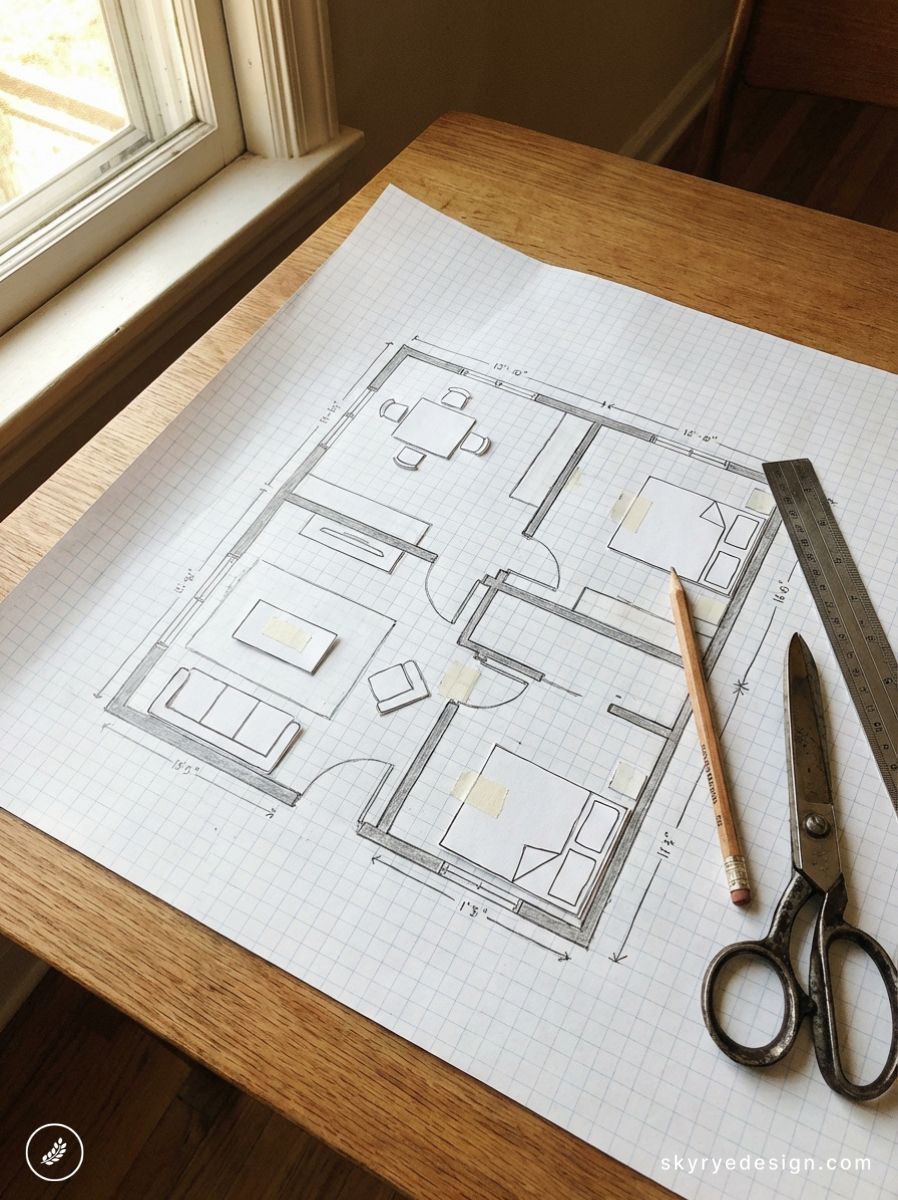
✏ Sketch note: Le Corbusier’s Modulor system — which established proportional relationships based on average human dimensions — is the formal theoretical foundation for the practical principle that room layout should be evaluated against human body size, not room size alone. A sofa that fills the room impressively in a showroom may make the room feel cramped when a human body tries to move around it. Scale drawing forces you to confront this relationship before purchase.
Scale and Proportion: The Design Principles That Make Rooms Feel Right
A room can have excellent furniture, good materials, and interesting architectural features and still feel wrong. The most common cause is a proportion problem — elements that are correctly sized in isolation but incorrectly sized in relation to each other and to the room itself. Understanding why proportion matters, and how to evaluate it at the sketch stage, prevents the expensive discovery that a room feels off after it’s been furnished.
Room Proportions and the 60-30-10 Rule
The 60-30-10 rule is the most practically useful proportion guideline in interior design: 60% dominant colour (walls, large upholstery), 30% secondary colour (secondary furniture, rugs, curtains), 10% accent colour (cushions, artwork, accessories). Applied to your floor plan sketch: identify the largest surfaces (walls, floor, primary seating) and assign them the dominant colour. The secondary colour appears in medium-scale elements. The accent colour is used sparingly in the smallest pieces. This distribution produces visual coherence without monotony — the room has a clear hierarchy rather than equal competition between multiple colours.
Ceiling Height and Vertical Proportion
Floor plan sketches show horizontal relationships but miss vertical ones. A room with a 2.4m ceiling requires different furniture and lighting choices than the same floor area with a 3m ceiling. Tall furniture in a low-ceilinged room makes the ceiling feel lower. Low furniture in a high-ceilinged room makes the room feel cavernous. Mark the ceiling height on your floor plan sketch as an annotation, and when you move to a perspective drawing, check that your furniture selections are proportionally appropriate to the ceiling height — not just to the floor area.
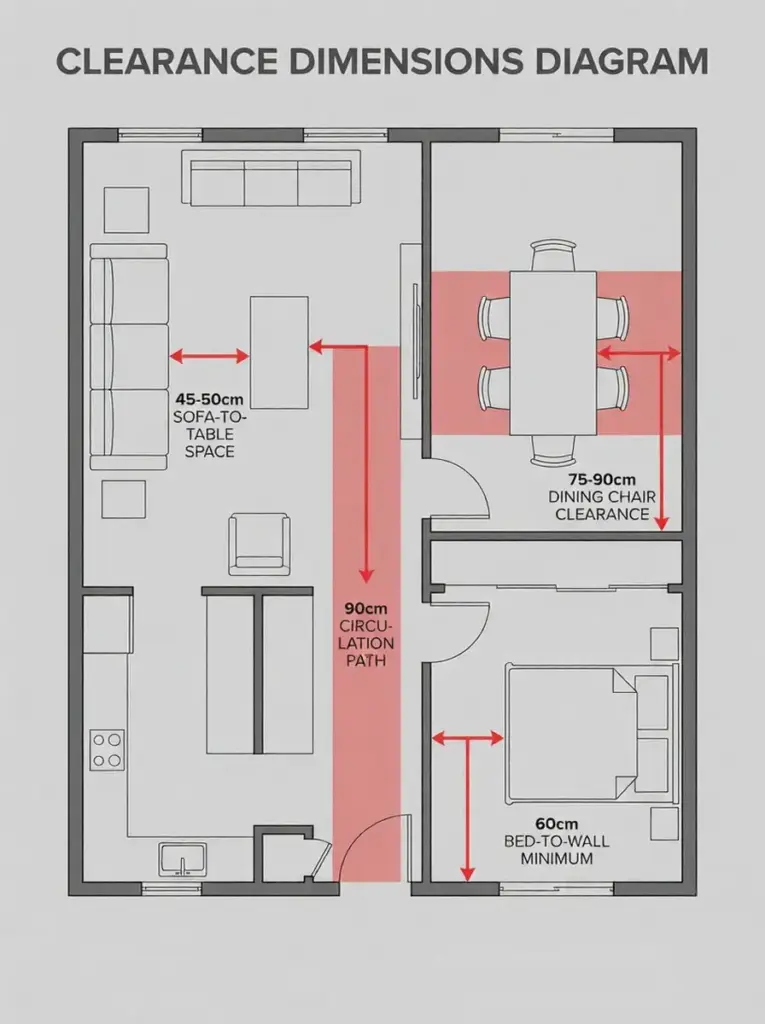
The Clearance Dimensions That Define Comfort
- Main circulation paths: 90cm minimum — the width needed for two people to pass or for one person to carry objects comfortably.
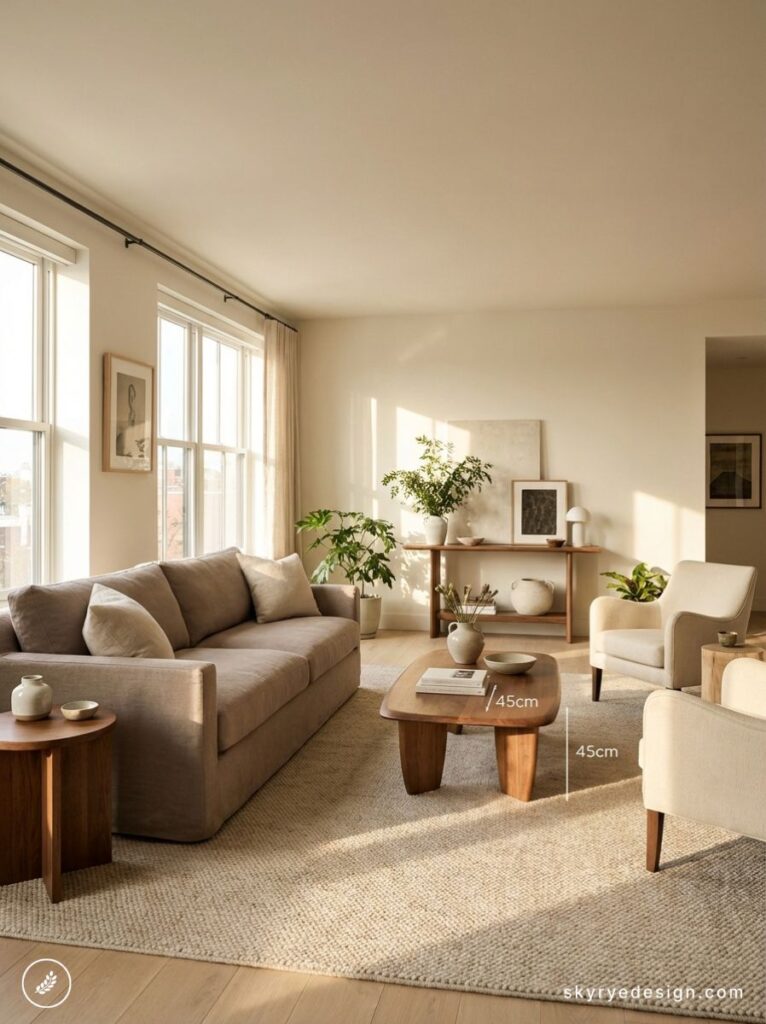
- Sofa to coffee table: 45-50cm — close enough to reach drinks and books without effort; far enough to cross comfortably.
- Dining chair clearance: 75-90cm from table edge to wall — enough space for a chair to be pushed out and for a person to walk behind a seated diner.
- Bed to wall or wardrobe: 60cm minimum on the non-primary side; 90cm on the primary side where you dress and make the bed.
- Kitchen work triangle: Each leg 120-270cm; total perimeter 400-800cm. The work triangle connects cooker, sink, and refrigerator. Within these parameters, the kitchen is ergonomically functional.
Light and Traffic Flow: The Two Invisible Constraints
Mapping Natural Light
Natural light is the most transformative design element in any interior and the one most frequently planned around rather than planned with. On your floor plan, mark the compass orientation — north, south, east, west — and note which windows receive morning light (east-facing), afternoon light (west-facing), and the consistent but softer light of north-facing glazing in the northern hemisphere. This orientation determines where to place primary seating (facing the best light, not with backs to windows), where to position work surfaces (side-lit for task work, never directly back-lit), and where artwork should not go (direct sunlight causes fading and glare on glass-framed pieces).
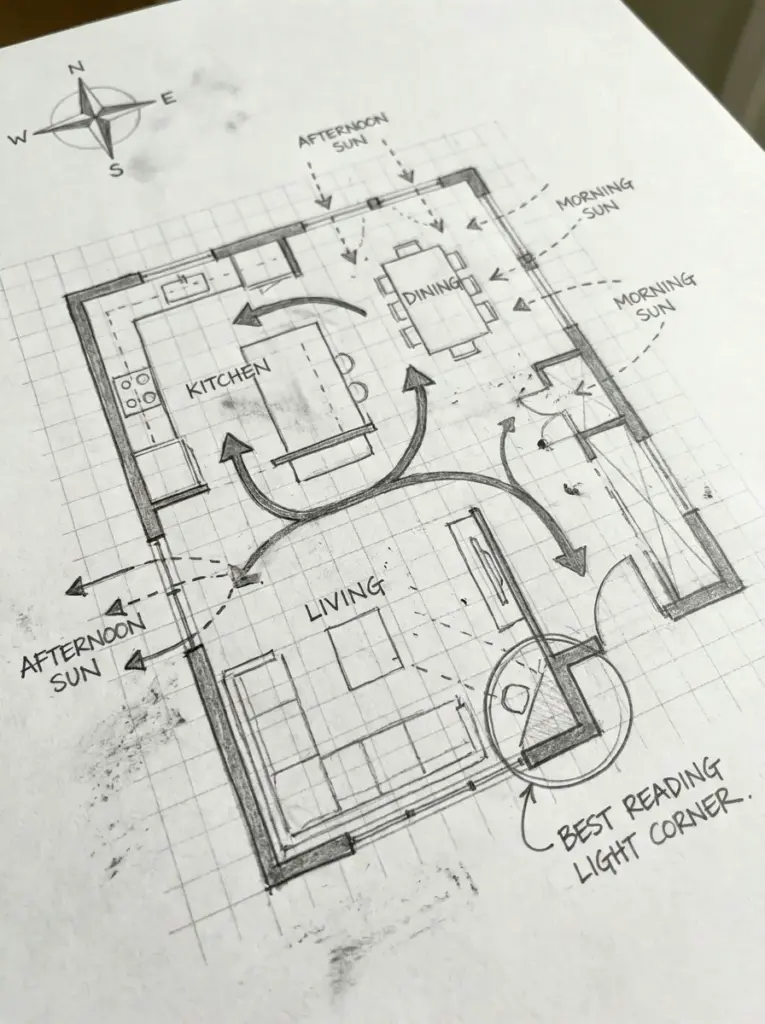
Mark how light moves across the room at different times of day with simple arrows and time annotations on your floor plan. A room that receives direct sun from 8am to noon across its east wall will have very different light conditions at midday than at 4pm. This seasonal and diurnal variation should influence both furniture placement and material selection — highly polished surfaces that look beautiful in morning light may create uncomfortable glare in afternoon sun.
Traffic Flow as a Design Constraint
Traffic flow — the paths people naturally take through a space — is the most frequently violated constraint in residential interior planning. Draw arrows on your floor plan showing the routes between: the main entrance and the kitchen; the kitchen and the dining area; the living area and the access to bedrooms or bathrooms; any secondary access points. Every furniture arrangement should be tested against these routes before it’s considered viable. An arrangement that creates a 60cm bottleneck on the route between the kitchen and the dining table is not a comfortable arrangement, regardless of how well the individual pieces are proportioned to each other.
Moving to Three Dimensions: One-Point Perspective for Interior Spaces
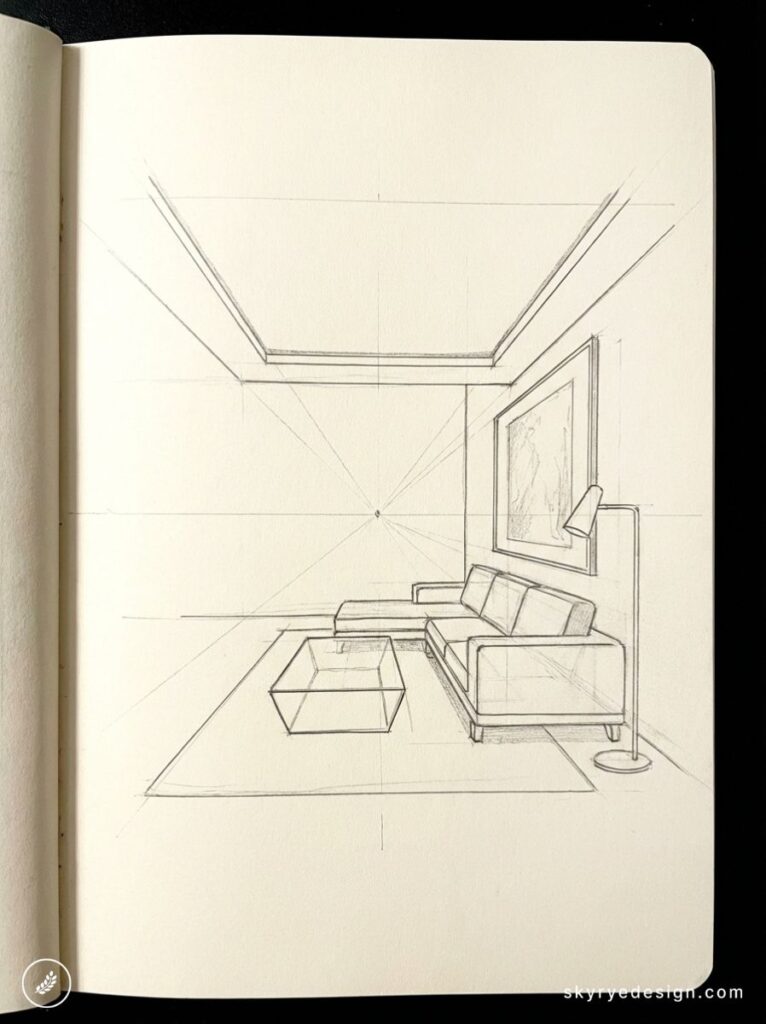
The floor plan shows you what fits. The perspective drawing shows you what it feels like. The two drawings together give you a complete picture of a space that neither can provide alone — the floor plan shows spatial relationships and dimensions; the perspective shows vertical relationships, light quality, and the visual experience of moving through the room.
How to Draw a Room in One-Point Perspective
- Draw a rectangle representing the back wall of the room in its correct proportions (width to height ratio). For a room 4m wide with 2.6m ceilings, the rectangle’s width should be approximately 1.5× its height.
- Place a single dot — the vanishing point — near the centre of the back wall rectangle. This represents the viewer’s eye level, typically 1.5-1.6m above the floor.
- Draw lines from each corner of the back wall rectangle to the vanishing point. These four lines become the ceiling plane (top two lines), floor plane (bottom two lines), and side walls (the lines themselves).
- Establish the room’s depth by drawing a vertical line across the converging lines — this line defines where the side walls end and the viewer’s position begins.
- Add furniture as boxes — all horizontal edges of furniture run parallel to the vanishing point lines, all vertical edges remain vertical. A sofa is a low wide box; a dining table is a slightly taller narrower box with thinner legs.
- Add windows and doors on the back wall as rectangles, and on the side walls as trapezoids whose sides follow the vanishing point lines.
One-point perspective is accurate enough for interior planning purposes and requires no specialist software or drafting equipment — just a ruler, a pencil, and the room dimensions from your floor plan. Its primary limitation is that it shows the room from one fixed viewpoint, which means elements near the edges of the drawing are distorted. For views that include elements close to the viewer — a seating area in the foreground, for instance — two-point perspective (with two vanishing points at the left and right edges of the drawing) produces a more accurate representation. But for most interior planning purposes, one-point perspective is sufficient to evaluate the vertical relationships that the floor plan cannot show.
✏ Sketch note: The most common one-point perspective mistake: placing the vanishing point too high or too low on the back wall. The vanishing point represents the viewer’s eye level — for a standing adult, that’s approximately 1.6m; for a seated adult, approximately 1.1m. In a room with 2.6m ceilings, a standing-viewer vanishing point should sit about 60% of the way up the back wall rectangle. A vanishing point at the centre (50%) produces a slightly bird’s-eye view; too high produces a worm’s-eye view. Match the vanishing point height to the viewing experience you want to evaluate.
When Your Sketch Is Ready: Briefing a Designer With Your Drawings
There’s a specific point in the planning process where a homeowner’s sketch has done everything it can do and professional expertise becomes the faster and more economical path forward. That point is not the beginning of the process — arriving at a designer’s studio with no sketch and no spatial thinking transfers all the discovery work to the professional’s fee. But it’s also not the end — carrying a sketch to completion without professional input misses the expertise in specification, spatial optimisation, and supplier relationships that designers bring to a project.
The sketch’s job is to communicate your lifestyle priorities and spatial preferences clearly enough that a professional can take them further. A homeowner who hands over a dimensioned floor plan with furniture placement tested, light conditions annotated, and a clear indication of which zones matter most has given a brief that a professional can act on rather than interpret. For homeowners in competitive markets where design quality significantly affects both liveability and property value — where working with experienced interior design Dallas TX professionals means access to specification expertise, trade supplier relationships, and spatial problem-solving that extends well beyond what a sketch can achieve alone — arriving with a developed sketch is the difference between a productive first meeting and an exploratory one.
What to Include in a Sketch Handover
- Dimensioned floor plan: All walls, doorways, windows, and fixed elements with measurements marked.
- Furniture placement options: At least two tested arrangements with clearance dimensions checked. Notes on which you prefer and why.
- Light annotations: Window orientations, times of peak sun, any problematic glare conditions you’ve observed.
- Traffic flow: The key routes through the space, any bottlenecks identified.
- Priority zones: Mark which area of the room matters most to you — the dining table, the reading corner, the kitchen work zone — so the designer knows where to concentrate quality.
- Reference images: Not as mandates, but as indicators of aesthetic direction. A few images showing materials, colours, or spatial atmospheres you’re drawn to.
The designer’s job is not to execute your sketch. It’s to take the spatial intentions your sketch communicates and translate them into specific products, materials, spatial adjustments, and technical decisions that your sketch couldn’t have reached alone. The better your sketch, the faster and more precisely that translation happens — and the more the result reflects the home you were imagining when you first picked up the pencil.
The Sketch Is the Beginning, Not the End
The sofa I couldn’t return eventually found the right room — a different arrangement, a rotated angle, the radiator covered by a low console table that turned a constraint into a feature. I got there by sketching. Not a beautiful drawing: a rough floor plan on grid paper with furniture cutouts, dimension annotations in pencil, and three crossed-out arrangements before the fourth one worked.
None of the techniques in this guide require art school. They require a tape measure, some grid paper, a pencil, and the discipline to measure before you commit. The floor plan before the showroom visit. The perspective sketch before the paint chip decision. The traffic flow arrows before the furniture placement. That sequence — drawing before doing — is the habit that prevents expensive mistakes and produces interiors that feel considered rather than assembled.
Start with one room. Measure it completely. Draw the walls. Mark the fixed elements. Cut out paper furniture. Move the furniture around until the clearances work and the light makes sense. Then — and only then — start looking at products.

FAQ: Architectural Sketching for Interior Design
Q: Do I need drawing skills to sketch my own interior layout?
No. Interior sketching for planning is about spatial communication, not artistic quality. A rough floor plan drawn to approximate scale on grid paper is entirely sufficient for planning furniture placement, traffic flow, and zone relationships. Professional designers regularly work from rough client sketches — what matters is that the spatial intentions are clear, not that the drawing looks polished.
Q: What scale should I use for a floor plan sketch?
1:50 is the most practical scale for residential floor plans — 1cm on paper represents 50cm in reality. At this scale, a 5m × 4m living room fits as a 10cm × 8cm rectangle on A4 paper. Cut out paper furniture rectangles at the same scale and move them physically around the plan rather than drawing and erasing — this is significantly faster for testing multiple arrangements.
Q: What is one-point perspective for interior sketching?
One-point perspective is a drawing technique where all horizontal lines in the room converge to a single vanishing point on the horizon line. Draw the back wall as a rectangle, place the vanishing point near its centre, draw lines from each corner to the vanishing point — these become your ceiling, floor, and side walls. Add furniture as boxes whose horizontal edges follow the vanishing lines. It requires only a ruler and pencil and produces a credible three-dimensional interior view without specialist software.
Q: What should I mark on a floor plan before placing furniture?
Mark in order: (1) structural walls with thickness; (2) windows with sill height; (3) doors with swing arc; (4) fixed unmovable elements; (5) electrical outlets and radiators. Only after all constraints are mapped should furniture placement begin. Constraints placed after furniture placement almost always require rearrangement.
Q: When should I involve a professional designer?
When the renovation involves structural changes, plumbing or electrical reconfiguration, or when the budget is significant enough that specification errors would be costly. Your sketches remain valuable when working with a professional — they communicate spatial preferences and lifestyle priorities more precisely than verbal descriptions. A developed sketch brief produces a better first meeting and a faster, more accurate result.
- 301shares
- Facebook0
- Pinterest301
- Twitter0
- Reddit0