My first bee drawing looked like a lemon with antennae. Fuzzy body, sure — but the wings came out as sad little crescents, and the stripes dissolved into a smudge. I tried again. Same result. It wasn’t until I broke the bee into geometric shapes — an egg for the thorax, a rugby ball for the abdomen — that something clicked and an actual bee appeared on the page.
- Start With Shapes: The Foundation Every Bee Drawing Needs
- How to Draw Bee Wings That Actually Look Like Wings
- Stripes, Fuzz, and Surface Detail: Making Your Bee Look Real
- Three Styles, One Bee: Adapting Your Drawing for Different Looks
- How to Draw a Bee Step by Step: 5 Stages From Blank Page to Finished Drawing
- Common Mistakes and How to Fix Them
- Digital Bee Drawing: Procreate and Illustrator Tips
- FAQ: How to Draw a Bee
- Q: What shapes do I start with when drawing a bee?
- Q: How many wings does a bee have, and how do I draw them?
- Q: How do I draw realistic bee fur texture?
- Q: What's the difference between drawing a honeybee and a bumblebee?
- Q: What art supplies do I need to draw a bee?
- Q: How do I draw a bee for beginners — is there a simpler version?
- Q: How long does it take to learn to draw a bee well?
- Wrapping Up
That’s the thing about drawing bees: they look deceptively simple until you’re staring at a blank paper wondering where the second pair of wings goes. In 2026, bees are everywhere in design — showing up in botanical tattoo flash sheets, ceramics printmaking, sketchbook challenges on Pinterest and Procreate communities. If you’ve been meaning to draw one but keep putting it off, this is your complete walkthrough.
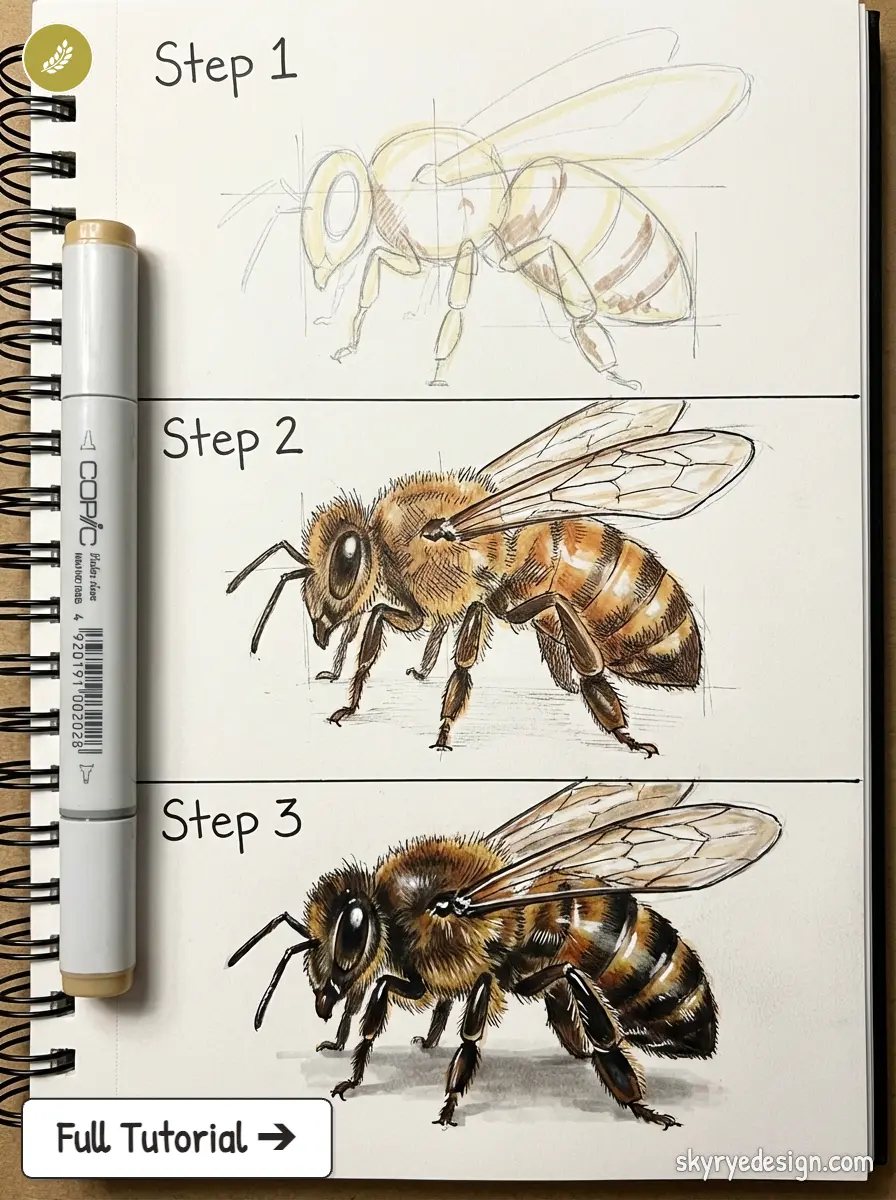
By the end of this guide, you’ll know how to draw a bee from scratch using basic shapes, how to add realistic texture and detail, and how to adapt the same structure for cartoon, realistic, and botanical illustration styles.
Start With Shapes: The Foundation Every Bee Drawing Needs
Here’s a secret professional illustrators don’t broadcast enough: every animal drawing starts with ugly geometry. For bees, that geometry is two overlapping ovals.
The Two-Body System
A honeybee’s body has three parts — head, thorax, and abdomen — but for drawing purposes, you work with two dominant masses. The thorax is roughly round, like a fat circle or short egg. The abdomen is longer, tapered at the rear end, like a stretched oval or rugby ball. Draw those two shapes first, lightly, in pencil. They should overlap slightly — the abdomen’s blunt end tucks behind the thorax.
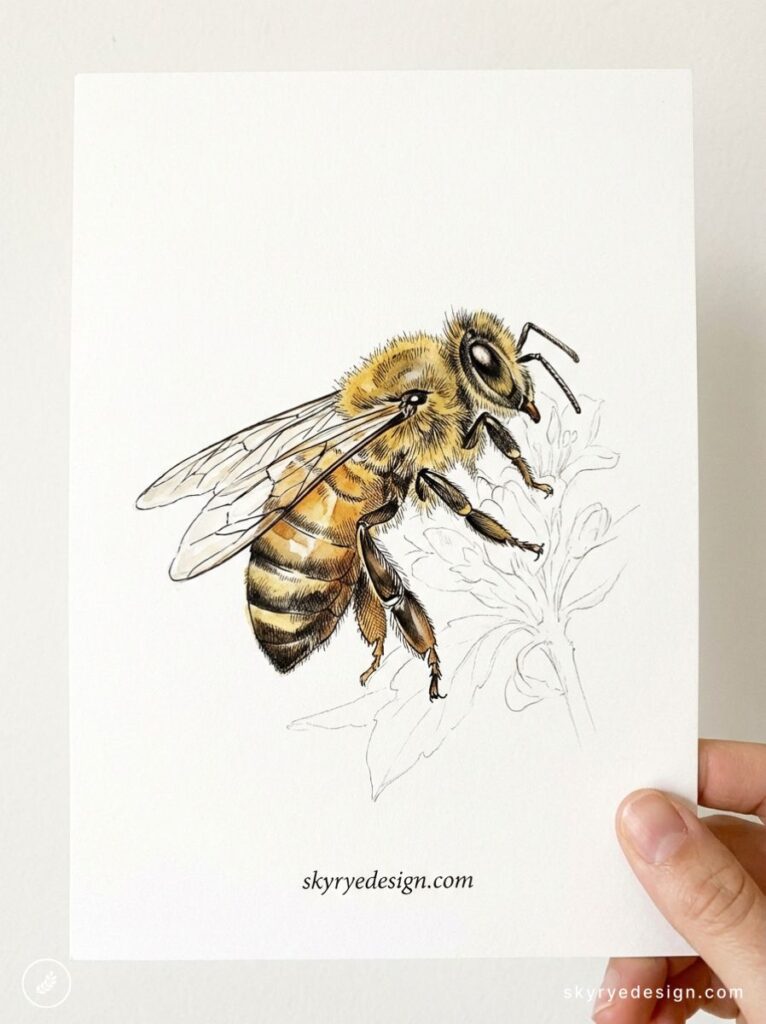
The head is a smaller circle, sitting in front of and slightly above the thorax. Don’t skip this step even in cartoon styles; the head placement determines where your eyes and antennae land.
Getting the Proportions Right
Honeybees (Apis mellifera) are roughly 15mm long, which matters if you’re aiming for naturalistic reference. In drawing terms: the abdomen is about 1.5x the length of the thorax. The head is about half the width of the thorax. Keep those ratios and you’ll avoid the #1 beginner mistake — drawing an abdomen that’s too small, making the bee look like a flying grape.
| Tip: Lightly sketch a horizontal centerline through both body masses before drawing anything else. It keeps your bee from accidentally flying uphill. |
How to Draw Bee Wings That Actually Look Like Wings
Wings are where most beginner bee drawings fall apart — and it’s usually because people try to draw “wing shapes” from memory instead of observing what bee wings actually do.
The Wing Structure
Honeybees have four wings: two large forewings and two smaller hindwings. In a resting or flying pose, the forewings are the dominant visual element. Each one is a long, narrow teardrop — widest near the attachment point on the thorax, tapering to a rounded tip. They angle backward and outward at roughly 30–45 degrees from the body.
The hindwings sit partially beneath the forewings and are shorter and rounder. In most illustration styles — including botanical and tattoo flash — you only hint at the hindwings, letting the forewing dominate.
Drawing Wings in Steps
Start with a straight guideline from the thorax at your chosen angle. Build the wing around that line: a gentle curve on the leading edge, a slightly more curved line on the trailing edge. The two lines meet at the wingtip. Mirror the angle on the other side.
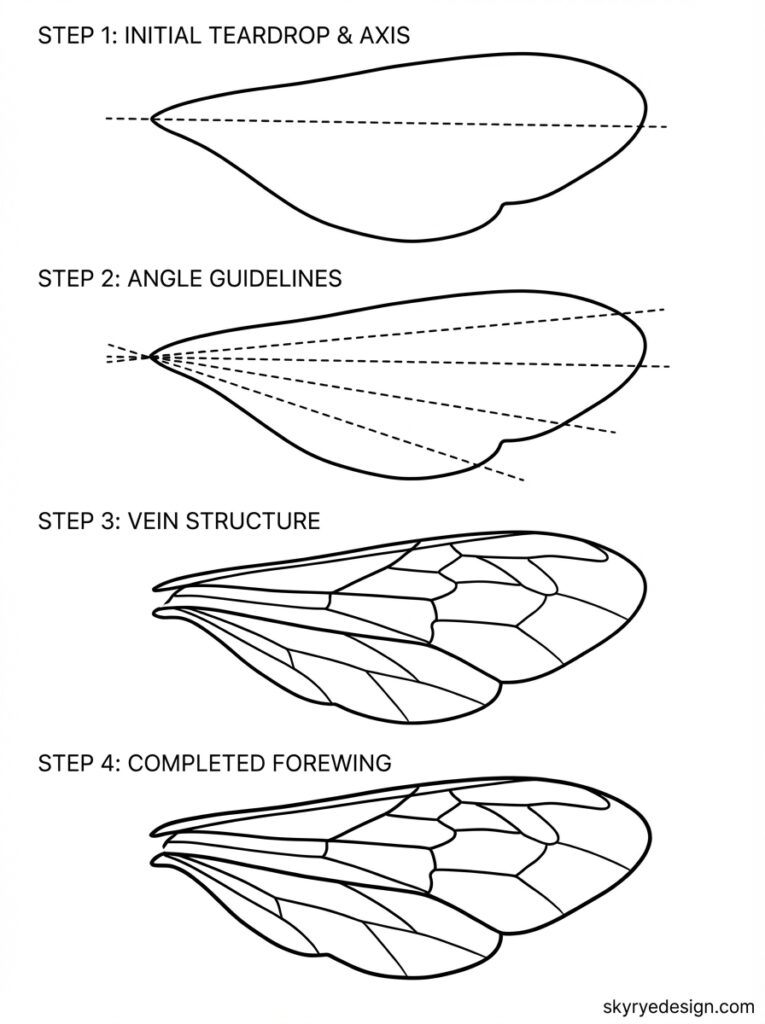
For the hindwing, draw a smaller version of the same shape tucked just behind and slightly beneath the forewing. In pencil sketch, this looks almost like a parenthesis mark — just a hint.
Once you’re inking, wings are usually left partially or fully unfilled. A light wash of grey-blue (for watercolor) or a gentle crosshatch pattern (for pen) suggests the translucent membrane without making the wings look solid.
Stripes, Fuzz, and Surface Detail: Making Your Bee Look Real
This is the section that separates a diagram from a drawing. A bee without texture is a logo. A bee with texture is a character.
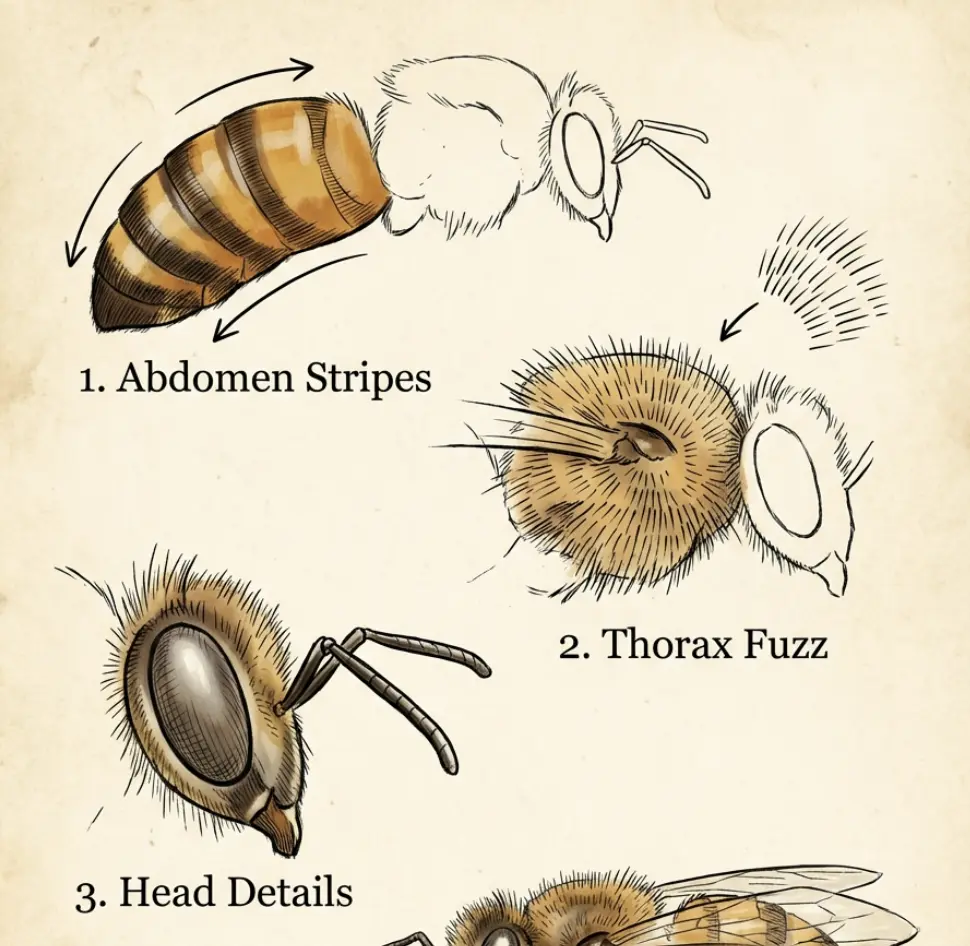
Drawing the Stripes
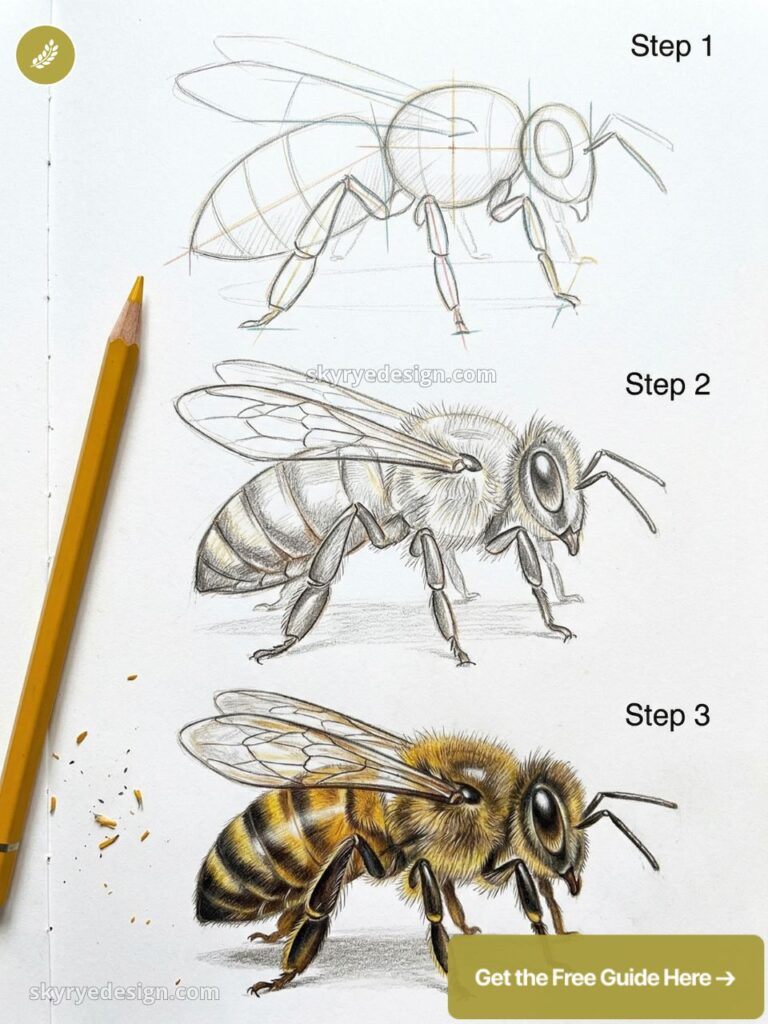
The abdomen stripe pattern on a honeybee alternates: amber/golden bands, then dark brown or near-black bands. There are typically four to five stripe segments visible on the abdomen from the side.
Don’t draw stripes as straight horizontal lines — they curve gently to follow the rounded form of the abdomen, like stripes on a barrel. Sketch the center of each stripe first, then arc the ends downward slightly on each side. This single adjustment — curving the stripes — is what makes an abdomen look three-dimensional versus flat.
The thorax doesn’t have stripes, but it has something better: dense, short fur. In illustration terms, that means small radiating lines following the contour of the body. Use a fine-tipped pen (a Micron 005 or a Staedtler 0.1mm works perfectly) and draw short, slightly curved lines pointing outward from the center of the thorax.
Eyes, Antennae, and Legs
The compound eye is a large oval on the side of the head, taking up a significant portion of the face — bigger than most people expect. Fill it solid for cartoon styles; use subtle radiating lines for realism.
Antennae emerge from between the eyes: two thin lines that angle forward, then bend with a slight elbow about two-thirds up, ending in a slightly thickened tip (the antennal club). The bend is important — straight antennae look wrong.
Legs. Six of them. For most drawings, you’ll only show three on the visible side. They attach to the thorax in pairs. The first pair extends forward, the middle pair is roughly horizontal, and the hind pair angles backward and downward. The hind legs on worker bees carry pollen baskets (corbiculae) — small rounded structures on the outer surface of the tibia — a wonderful authentic detail to include if you’re working at larger scale.
Three Styles, One Bee: Adapting Your Drawing for Different Looks
The same construction method — two ovals, four wings, six legs — can produce completely different aesthetic results depending on your finishing choices.
Realistic Botanical Illustration
This is the style used in field guides, botanical prints, and high-end art prints that sell well on Society6 and Redbubble. You want anatomical accuracy but also warmth.
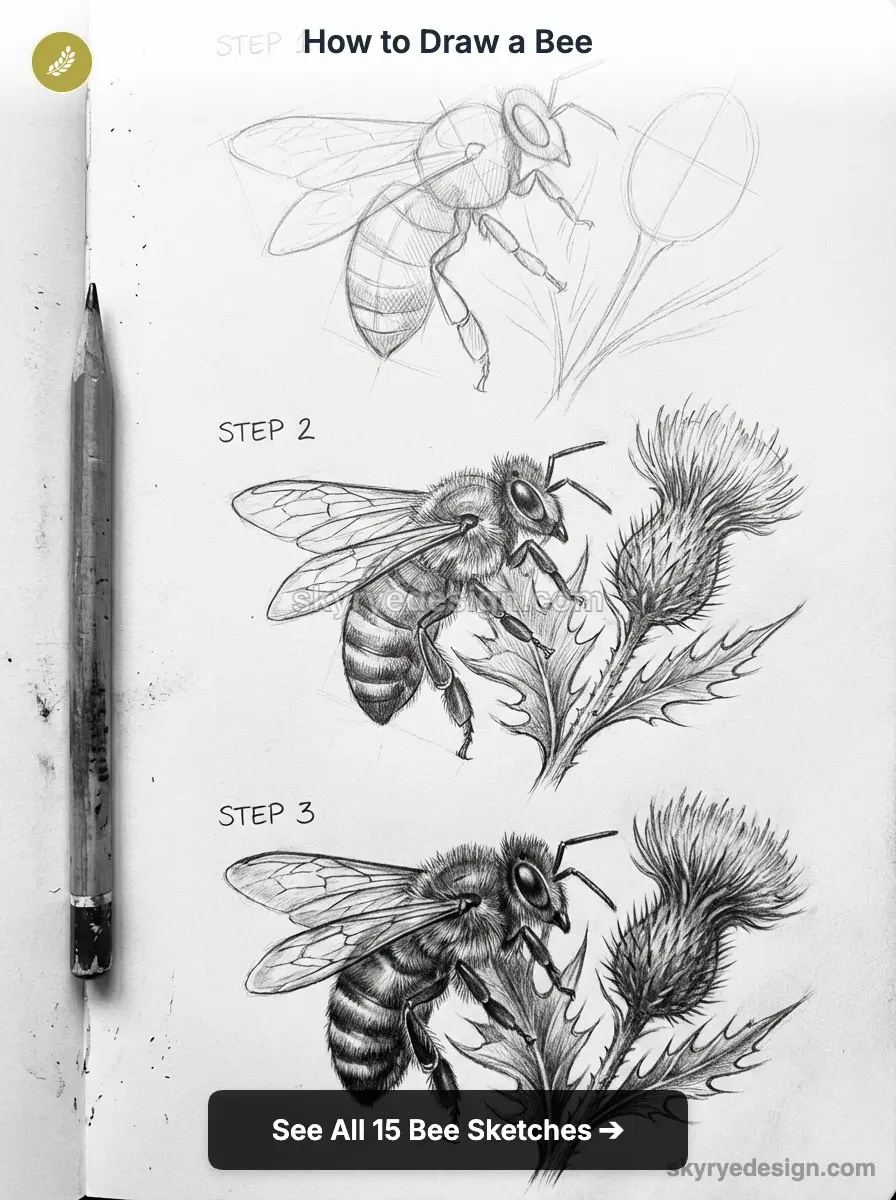
Work in a fine liner (Pigma Micron 01–05), and use hatching for shadow — short parallel lines that follow the form. For color, watercolor over ink is the classic combination: a diluted raw sienna or yellow ochre base on the abdomen, then a second layer of burnt umber for the dark bands. Winsor & Newton Cotman pan sets include both colors for under $25.
The key move in botanical style: leave small white gaps in your ink lines where the light hits. A bee drawn this way has a luminous quality that solid fill never achieves.
Cartoon / Graphic Style
Think Maya the Bee, or the Honey Nut Cheerios mascot. Simplified geometry, exaggerated features (huge eyes, small body), and clean outlines. Drop the hindwings entirely. Make the stripes thick and bold. Eyes become two large circles with a small white highlight dot. No hatching, no texture — just flat fill or simple gradients.
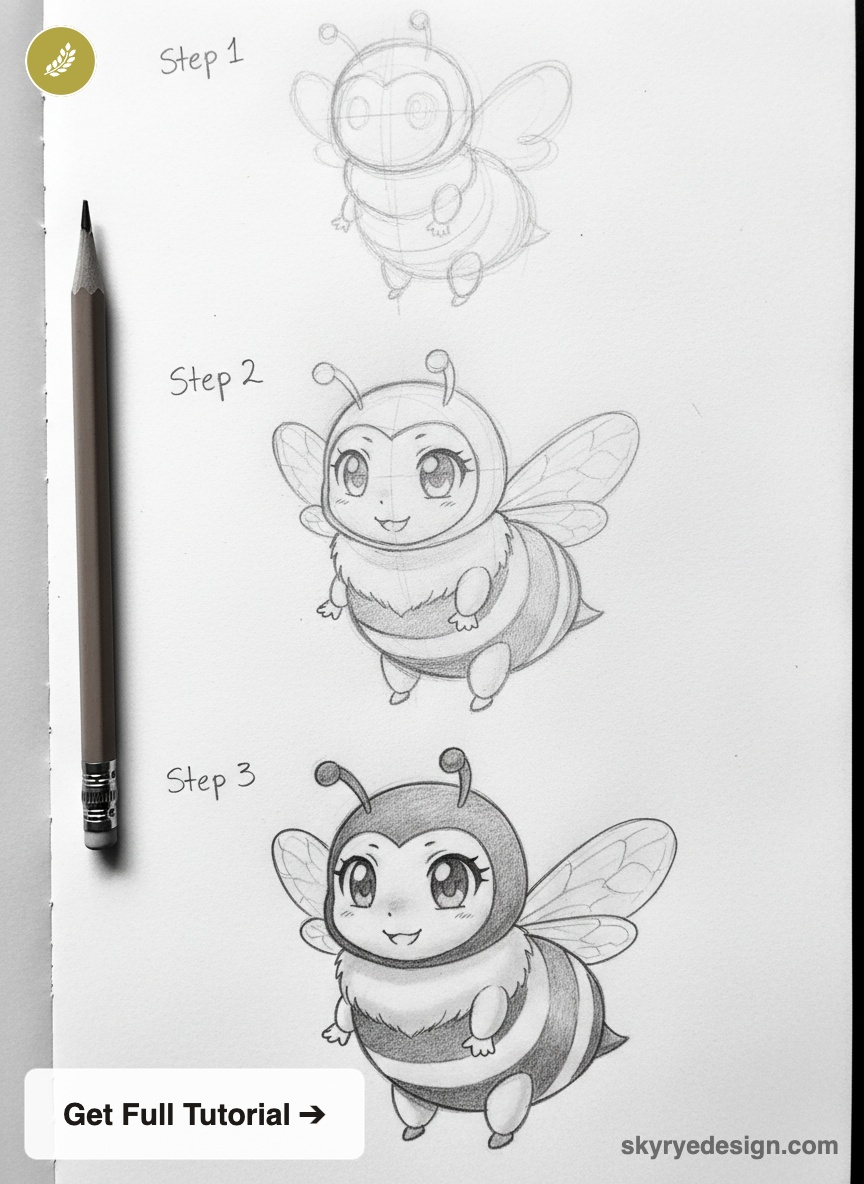
Adobe Illustrator and Procreate both handle this style well. If you’re doing it with traditional tools, a set of Copic Sketch markers (Y15 Cadmium Yellow, E07 Light Mahogany, and 100 Black) will give you clean, professional cartoon color in minutes.
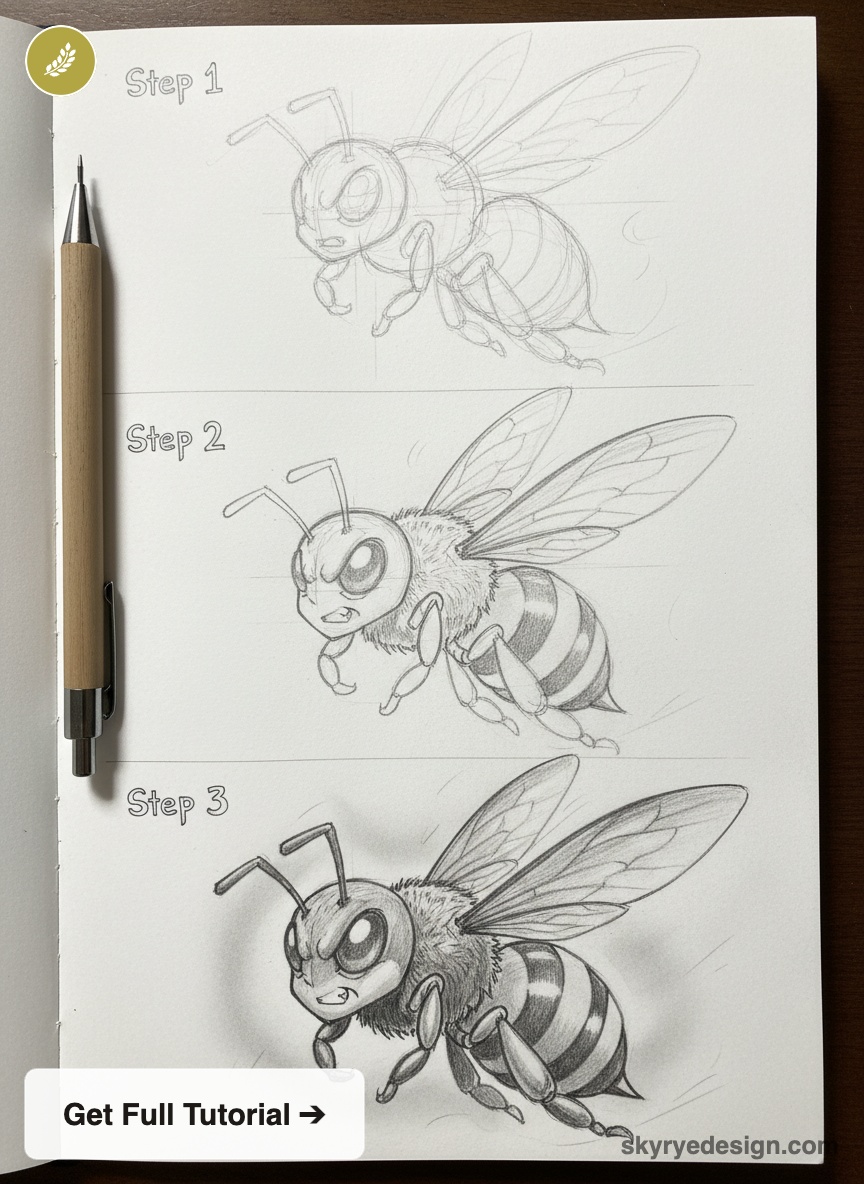
Tattoo Flash Style
Tattoo bee drawings are having a serious moment in 2026 — particularly neo-traditional and fine-line botanical flash. The neo-traditional version uses thick outer outlines with thinner interior detail lines, bold color fills (no gradients), and often includes decorative elements: small flowers, dotwork backgrounds, and geometric frames. Fine-line tattoo style is closer to botanical illustration but with even finer linework and minimal color.
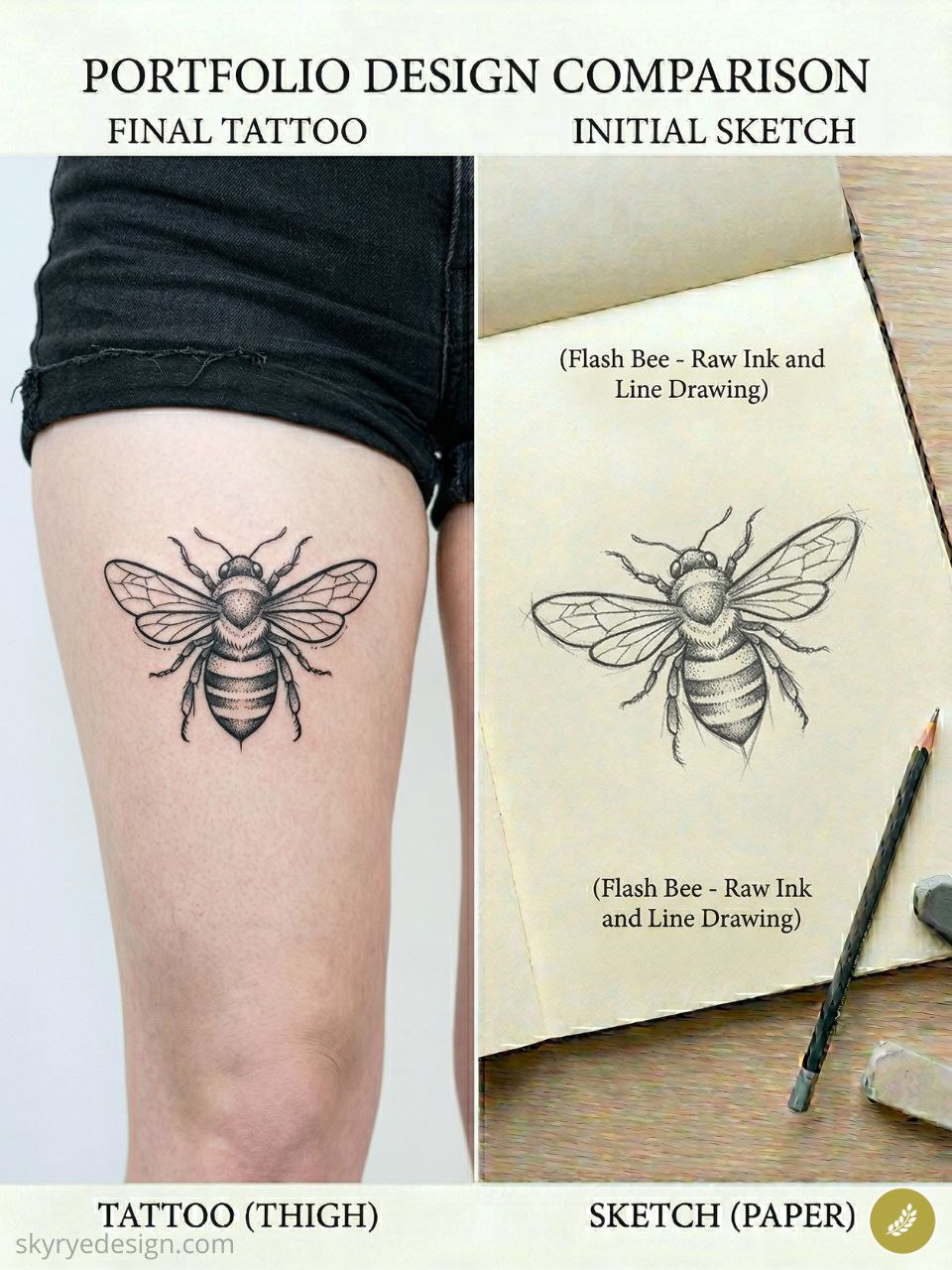
For sketching tattoo flash designs, I’ve found Rhodia dot-pad paper (A5, around $9) to be ideal — the dot grid helps with symmetry and the paper handles fine liner beautifully without bleed-through.
How to Draw a Bee Step by Step: 5 Stages From Blank Page to Finished Drawing
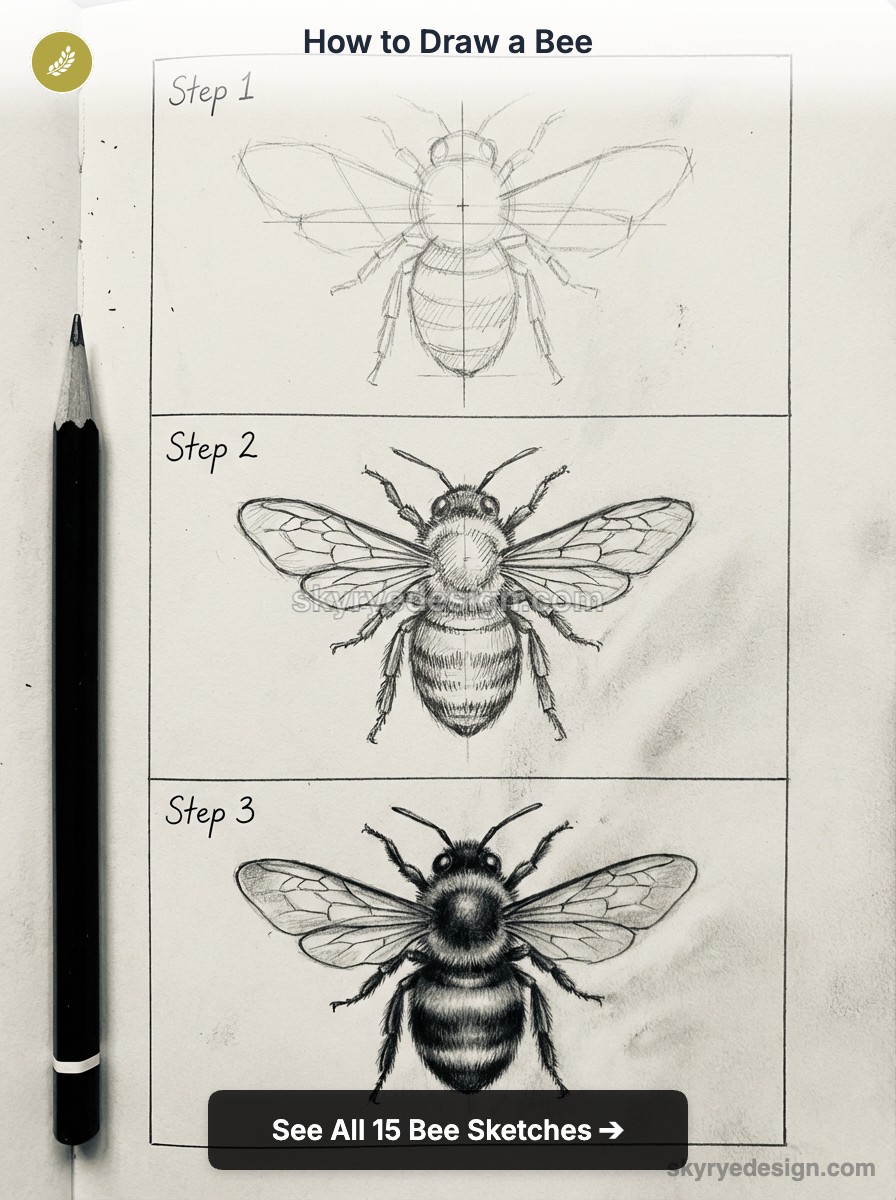
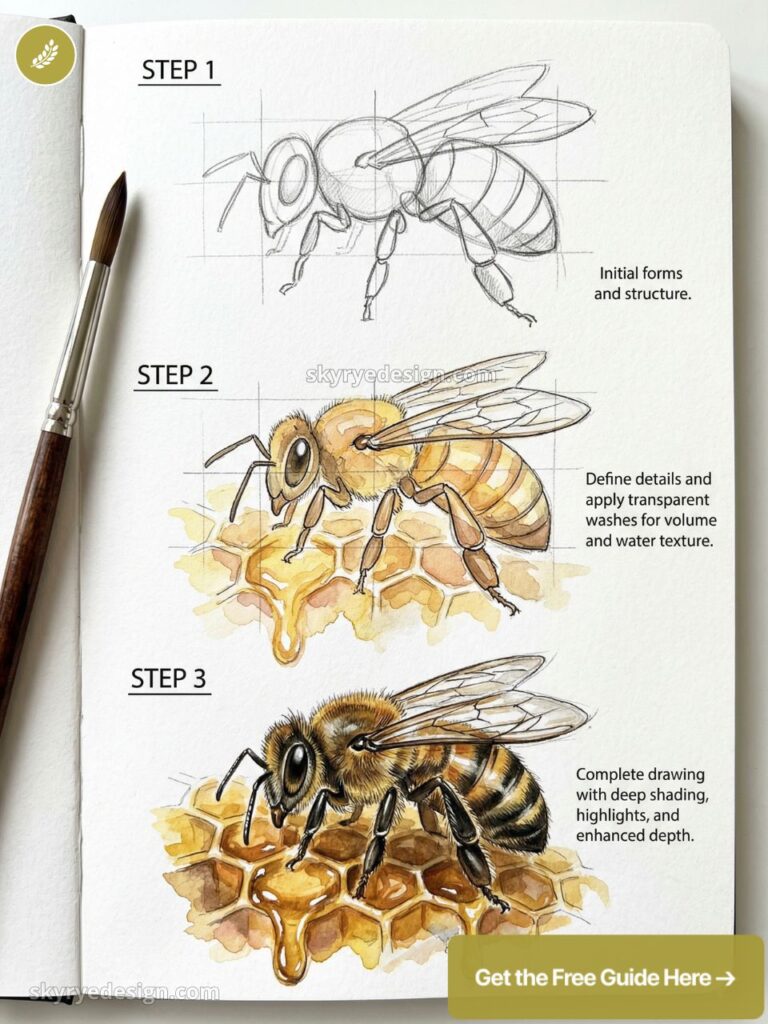
Theory is useful. A numbered process is better. Here’s the exact sequence I use every time I draw a bee — whether it’s a quick sketchbook doodle or a finished piece for print. Follow these five stages in order and you won’t get stuck.
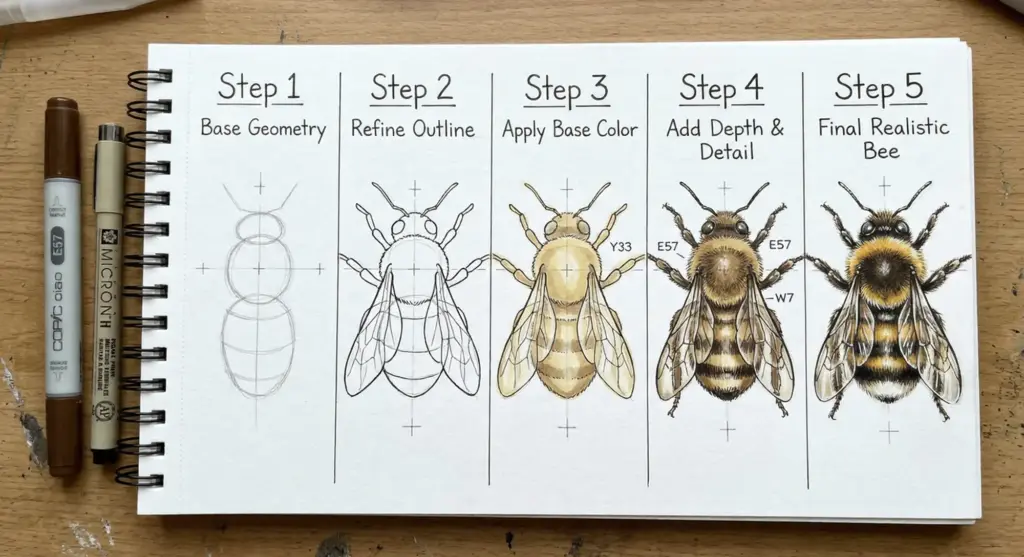
| Step | Stage | What to draw |
| 1 | Basic shapes | Draw a horizontal centerline. Add a small circle (head), a round oval for the thorax overlapping it, and a longer tapered oval for the abdomen behind the thorax. These three shapes are your entire skeleton — everything else attaches here. Keep the pencil pressure very light. |
| 2 | Wings and antennae | From the top of the thorax, draw two guideline angles at 30–45°. Build a long tapered teardrop around each for the forewings. Add a smaller teardrop tucked beneath each forewing for the hindwings. On the head, draw two thin lines for antennae — each bends at two-thirds height and ends in a small thickened club. |
| 3 | Stripes and legs | On the abdomen, lightly sketch 4–5 curved ellipses to mark the stripe bands — they arc downward at the sides to follow the rounded form. Then add six legs from the thorax: front pair angling forward, middle pair horizontal, hind pair angling back and down. Three visible legs per side is standard for side-view drawings. |
| 4 | Ink and detail | Switch to your fine liner (0.3mm for outlines, 0.05mm for detail). Trace the final body contours confidently. Add the large compound eye on the side of the head. Draw short radiating fur strokes across the thorax — 20–30 small lines pointing outward. Fill the dark stripe bands. Leave wings unfilled or add very light parallel hatching. |
| 5 | Color and erase | Erase all pencil construction lines. Apply color starting with the lightest value first: yellow ochre or cadmium yellow on the amber bands, then burnt umber or black on the dark bands. Leave the wings white or wash them very lightly with a cool grey. A tiny white highlight dot on the eye brings the whole drawing to life. |
The whole process takes about 20–30 minutes for a clean first attempt. Stages 1–3 are pencil only and fully erasable — don’t rush them. The ink work in Stage 4 is where the drawing commits, so wait until your pencil structure genuinely looks right before picking up the liner.
Common Mistakes and How to Fix Them
I’ve watched beginners (and myself) make the same four errors on repeat.
Mistake 1: Wings too small. Bee wings are large relative to the body — each forewing is nearly the full length of the abdomen. If your bee looks like it couldn’t possibly fly, the wings are almost certainly undersized.
Mistake 2: Stripes too straight. Curve them around the form. Use a light pencil ellipse to guide each stripe before inking.
Mistake 3: Missing the thorax fur. Without the fuzzy texture on the thorax, bees look like wasps. Wasps are sleek. Bees are cozy. The fur is the whole vibe.
Mistake 4: Symmetrical wings. Real wings (and convincing drawn wings) have slight variation between sides. One wing tip a millimeter lower makes the drawing feel alive. Perfect mirror symmetry makes it feel mechanical.
Digital Bee Drawing: Procreate and Illustrator Tips
Digital tools have changed how a lot of artists approach insect illustration, and bees are a natural fit for both vector and raster approaches.
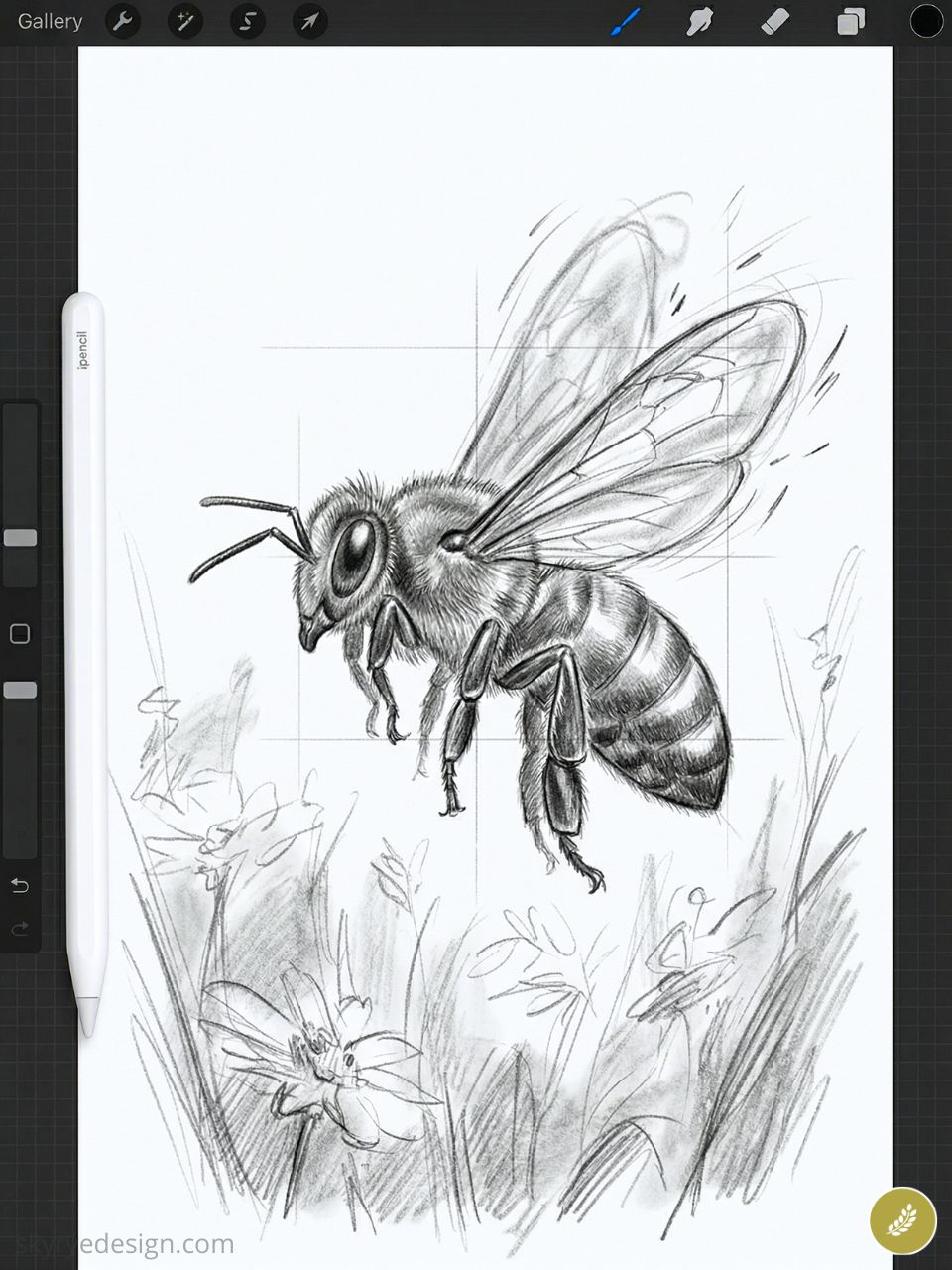
In Procreate
Set up two layers: one for the pencil sketch (opacity around 40%), one for inking. Use the 6B Pencil brush for sketching — its texture mimics real graphite. For inking, the Technical Pen or Studio Pen brushes at 2–4% size give clean lines that still feel hand-drawn.
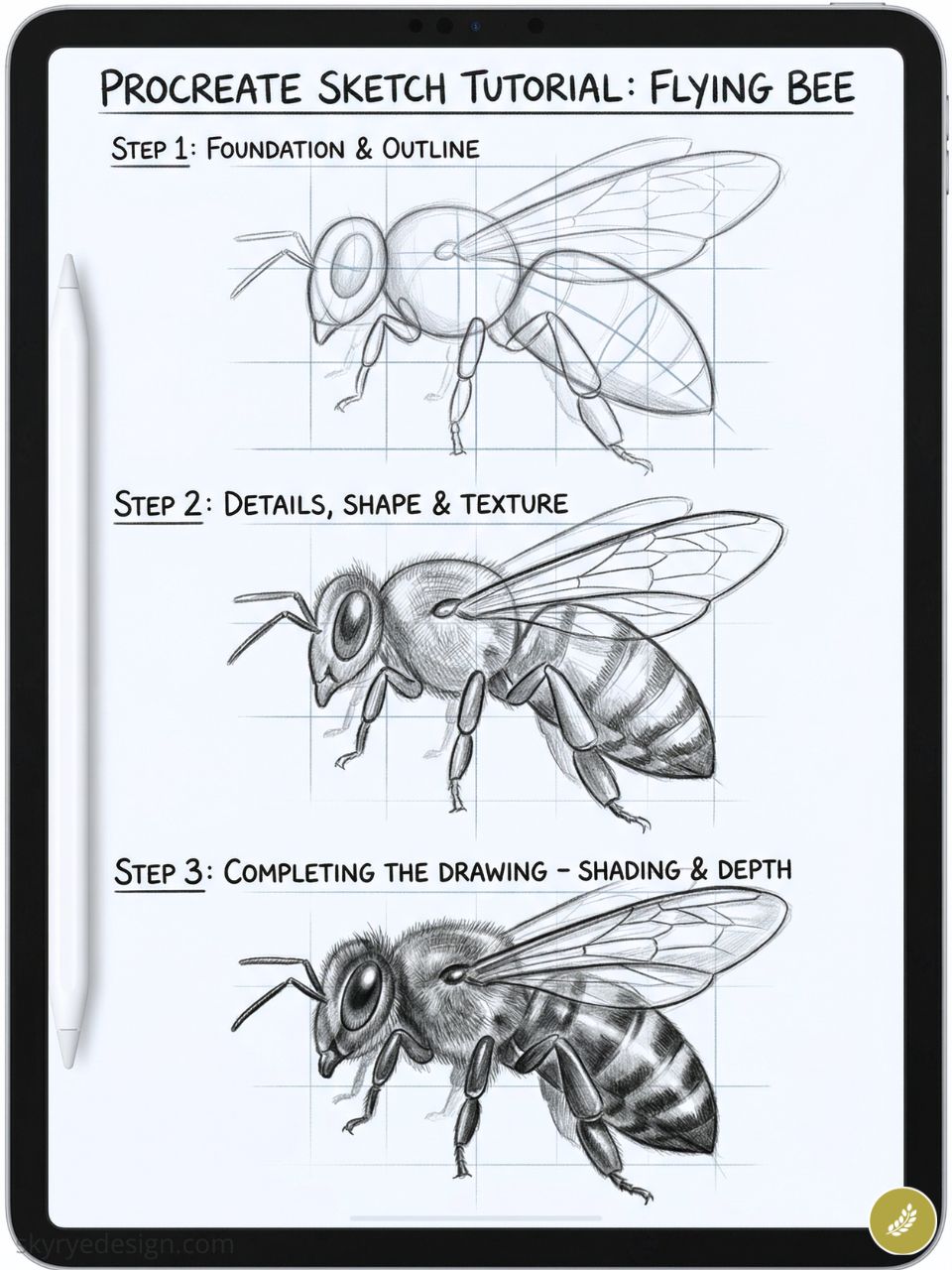
The Symmetry Guide (under Canvas settings) is genuinely useful for wing symmetry — turn it on, draw one wing, get the mirror automatically, then turn it off and adjust the second wing manually for natural variation.
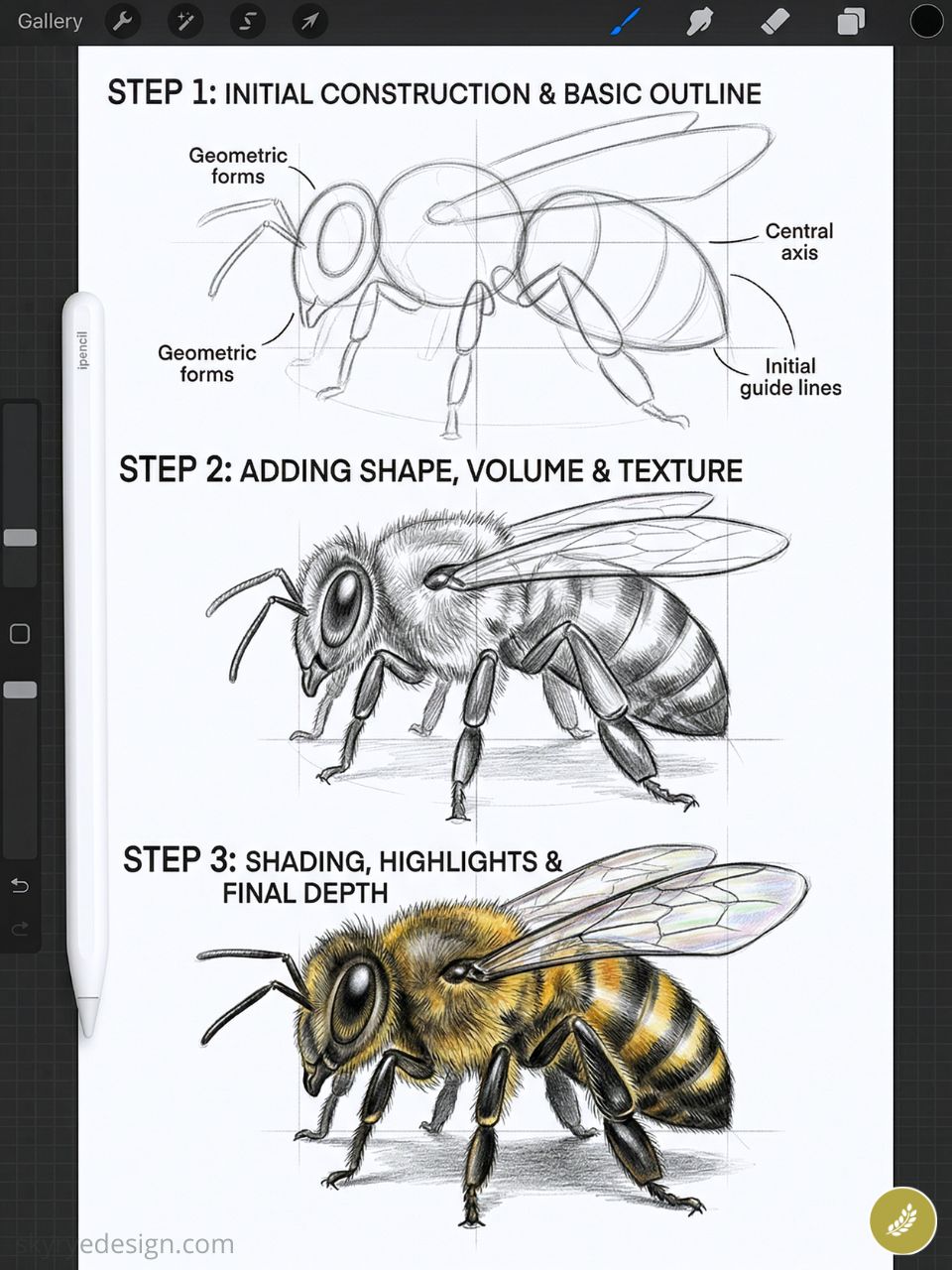
For the fuzzy thorax texture in Procreate, try the Wet Mix > Nikko Rull brush at very small size (3–5px) and low opacity, building up short strokes from the center outward. It mimics real fur without being laborious.
In Adobe Illustrator
Vector bees are worth the extra setup time if you plan to scale the drawing for prints, merchandise, or pattern repeats. Use the Pen tool for the main body shapes, then Offset Path (Object > Path > Offset Path, with -2px) to create an inner line for stripe details.
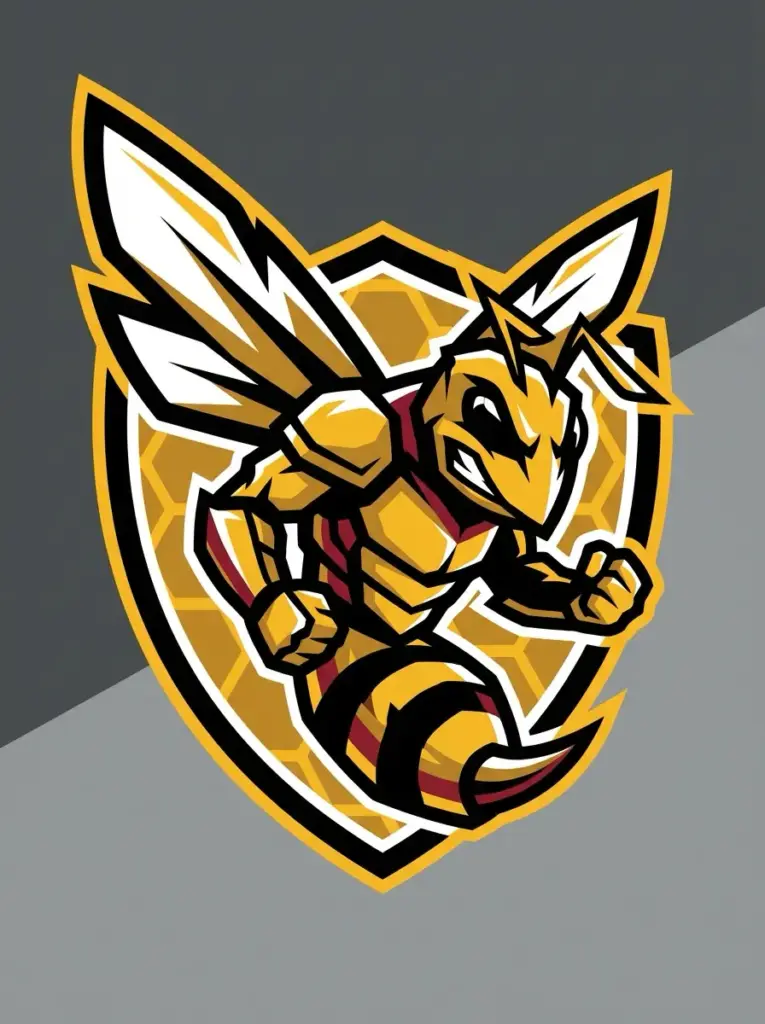
The Appearance panel lets you stack multiple fills on the same shape, useful for building the stripe pattern without creating separate objects for each band.
FAQ: How to Draw a Bee
Q: What shapes do I start with when drawing a bee?
Start with two overlapping ovals — a rounder one for the thorax and a longer, tapered one for the abdomen. Add a smaller circle in front for the head. These three shapes are your construction framework for any bee style. Once those are right, everything else slots into place.
After the bee, switch to how to draw a butterfly so you can compare two winged insects with very different body shapes.
Q: How many wings does a bee have, and how do I draw them?
Bees have four wings, but in most drawings you show the two large forewings prominently and hint at the smaller hindwings beneath them. Draw each forewing as a long narrow teardrop shape angled back at about 30–45 degrees from the thorax. Leave wings lightly shaded or unfilled to suggest translucency.
Q: How do I draw realistic bee fur texture?
Use a fine-tipped pen (0.05mm–0.1mm) and draw short, slightly curved lines radiating outward from the center of the thorax. Keep the lines close together but not uniform — vary the length slightly. For the abdomen, shorter stiffer lines at the band edges add realism without overwhelming the stripe pattern.
Q: What’s the difference between drawing a honeybee and a bumblebee?
Bumblebees (Bombus species) are significantly rounder and fuzzier, with a much less tapered abdomen. Their fur is longer and denser. For a bumblebee drawing, make both body ovals more circular, extend the fur lines to be longer, and reduce the visible segmentation — bumblebees look fluffier and less striped than honeybees.
Q: What art supplies do I need to draw a bee?
For traditional media: a mechanical pencil (0.5mm), a fine liner in at least two weights (0.05mm and 0.3mm), and either watercolor or colored pencils for finish. Prismacolor Premier colored pencils (Spanish Orange, Black, Warm Grey) work beautifully for bees. For digital: Procreate on iPad or Adobe Illustrator covers everything from rough sketch to finished illustration.
Q: How do I draw a bee for beginners — is there a simpler version?
Yes. Simplify to a single rounded oval body, add two large teardrop wings on top, a tiny circle head, two bent antennae, and three legs on each side. Fill with yellow and add three to four curved black stripes. That’s a recognizable, charming bee drawing achievable in under ten minutes with zero drawing experience.
Q: How long does it take to learn to draw a bee well?
A clean, recognizable bee drawing is achievable in your first session. A convincing realistic bee — with accurate proportions, texture, and detailed wings — typically takes 3–5 practice drawings spread over a few days. The bottleneck is usually wings and stripe curvature; once those click, everything else comes quickly.
Wrapping Up
Drawing a bee comes down to geometry, observation, and one honest practice session. Start with your two overlapping ovals, build the wings using angled guidelines, curve the stripes around the form, and add a few dozen short fur strokes to the thorax. That’s the whole system.
The best thing about bee drawings is their versatility — the same construction method produces a field-guide illustration, a cartoon character, or a tattoo design. Once you’ve drawn one bee confidently, you’ve unlocked a broader skill set around insect illustration that applies to dragonflies, butterflies, moths, and beetles.
Sketch it once today. It’ll look better than you expect.
If you are practicing bees, it helps to step back and study the whole bug family too. This how to draw insects guide breaks down the head, thorax, abdomen, and six-leg structure so your bee sketches feel less guessed.
For a taller animal study with very different proportions, try this giraffe drawing guide; it is especially useful for practicing long necks, small heads, and coat patterns that need to follow the body form.
- 5.1Kshares
- Facebook0
- Pinterest5.1K
- Twitter0
- Reddit0