Your capybara looks like a beaver having a bad day. Or maybe a pregnant guinea pig. Or some kind of dog-potato hybrid that nature never intended.
I’ve drawn all of these. My first capybara attempt? A lumpy blob with a flat tail that my friend politely called “a very creative rat.” The problem wasn’t my drawing skills — it was that I had no idea what actually makes a capybara look like a capybara.
These chunky legends are everywhere right now. The “OK I Pull Up” meme era turned them into internet royalty. They’re starring in cozy video games, popping up on sticker sheets, and dominating Instagram with their hot spring photos. Everyone wants to draw them — but most tutorials just say “draw an oval” and call it a day.
Here’s what you’ll actually learn: the specific shapes that make capybaras instantly recognizable, a 6-step process for drawing a cute cartoon capybara, and — most importantly — how to capture that legendary chill vibe that makes these animals so lovable.
No art degree required. No fancy supplies. Just a pencil, some paper, and maybe 20 minutes for your first proper attempt.
The secret? Capybaras are basically potatoes with tiny ears and zero stress. Once you see it, you can’t unsee it.
Let’s figure out why these guys are trickier than they look — and then make it easy.
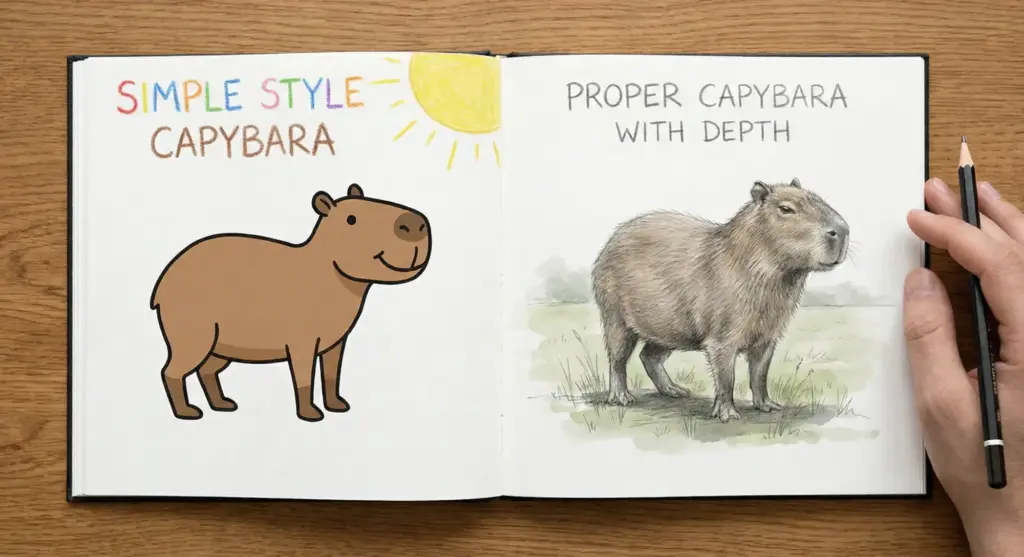
Why Capybaras Are Surprisingly Tricky to Draw
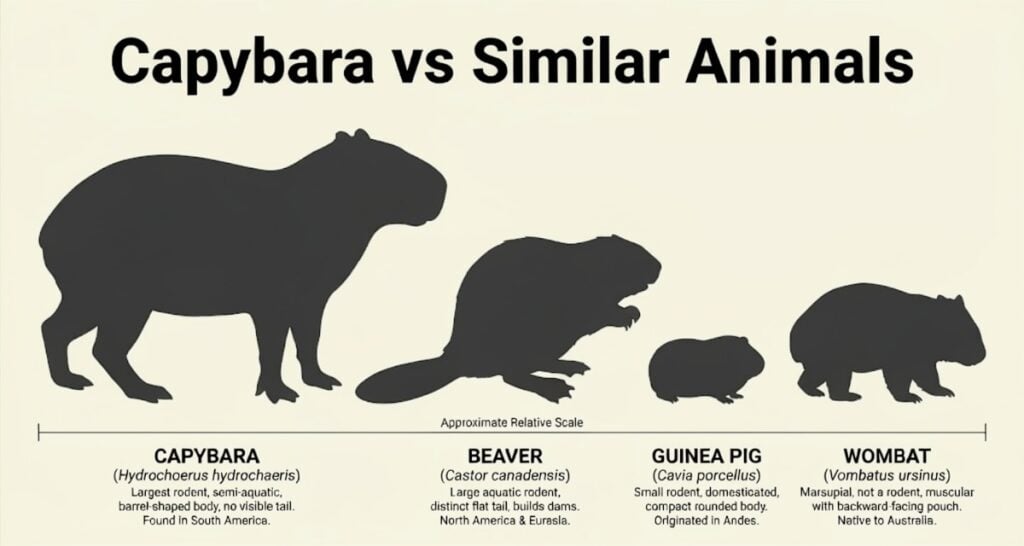
Here’s the weird thing about capybaras: you’ve seen hundreds of them online, but your brain has no idea how to draw one.
Try it. Close your eyes and picture a capybara. Now picture a dog. See the difference? Dogs have clear mental blueprints — pointy ears, wagging tail, four legs, snout. We’ve drawn them since kindergarten. Capybaras? Your brain just shows you a vague brown blob with vibes.
The Identification Problem
When you sit down to draw an unfamiliar animal, your brain panics. It starts grabbing bits from animals it does know. A beaver’s body. A guinea pig’s face. A dog’s legs. A pig’s snout.
The result? A Frankenstein rodent that looks like nothing in particular.
I spent my first few attempts drawing what I now call “confused beavers.” Flat tail, pointy face, completely wrong proportions. The drawings were technically fine — they just weren’t capybaras.
What Makes a Capybara a Capybara
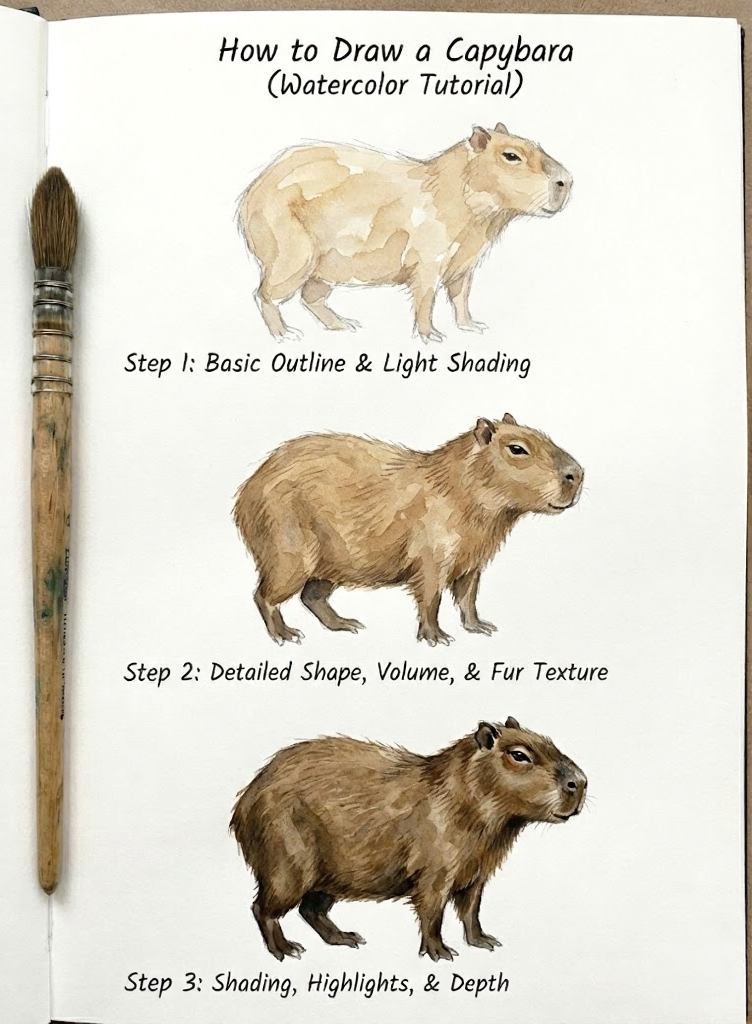
Forget what you think you know. Here’s what actually defines them:
The head: Rectangular and boxy, not round. Almost like a brick with rounded corners.
The body: Massive potato. Capybaras are the largest rodents on the planet, weighing up to 66 kg. That thiccness isn’t optional.
The features: Tiny ears sitting on top of the head. Small eyes placed weirdly high. Giant blunt nose dominating the lower face.
The legs: Hilariously short. These guys are built like coffee tables — wide load, low to the ground.
The vibe: Permanent state of “zero worries.” This isn’t just personality — it shows in their relaxed posture and half-closed eyes.
Once you see capybaras as “chill potato with a brick head,” everything clicks.
The Capybara Shape Formula (Your Cheat Sheet)
Every complex animal breaks down into simple shapes. Capybaras? They’re one of the easiest once you know the formula.
I call it the Potato-Brick Method. Stupid name, but it works. A friend of mine went from “what is this creature” to “that’s definitely a capybara” in one afternoon using these exact shapes.
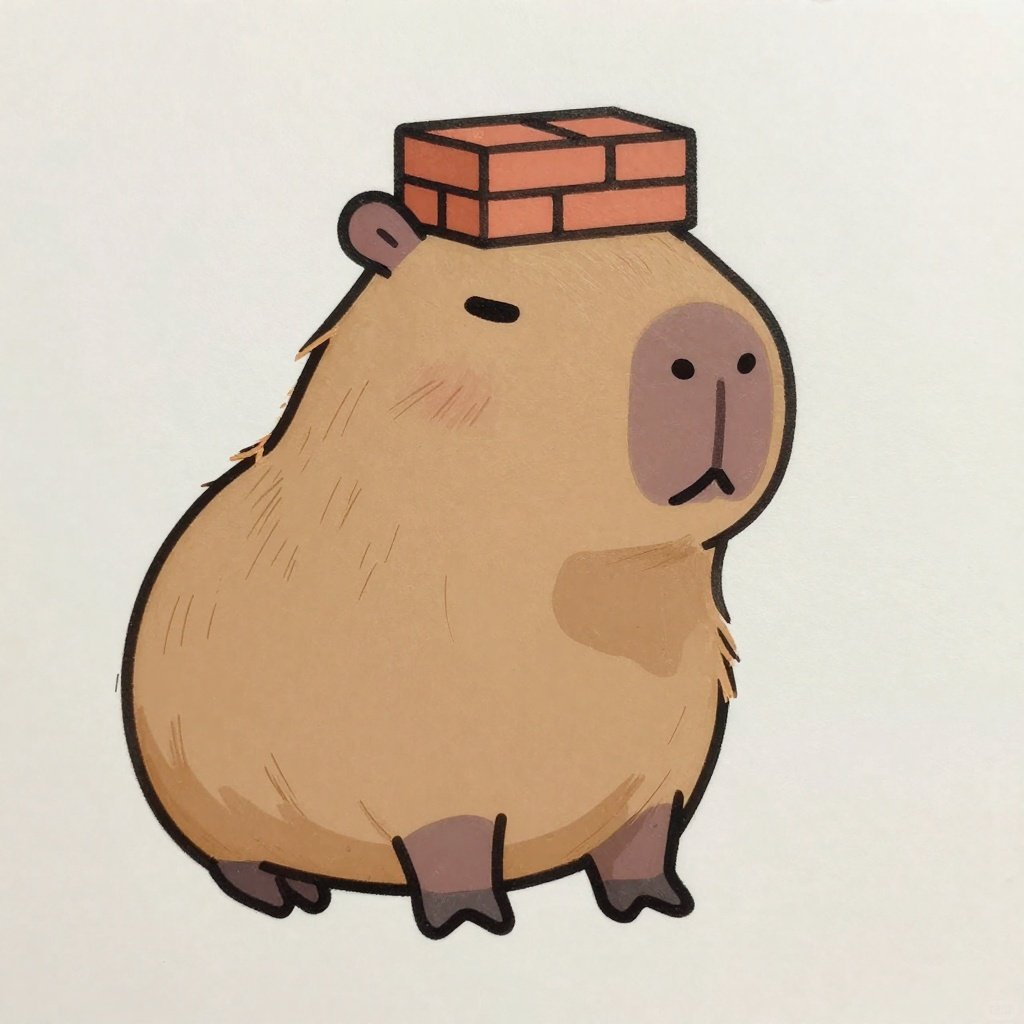
Body = Potato (or Bean)
Not a circle. Not an oval. A potato.
Draw a rounded rectangle that’s longer than it’s tall. Slightly tapered toward the back end, fuller in the middle. Think of a russet potato lying on its side — that’s your capybara body.
The key? Keep it CHUNKY. Every beginner makes the body too slim. Capybaras are absolute units. When you think it’s thick enough, make it thicker.
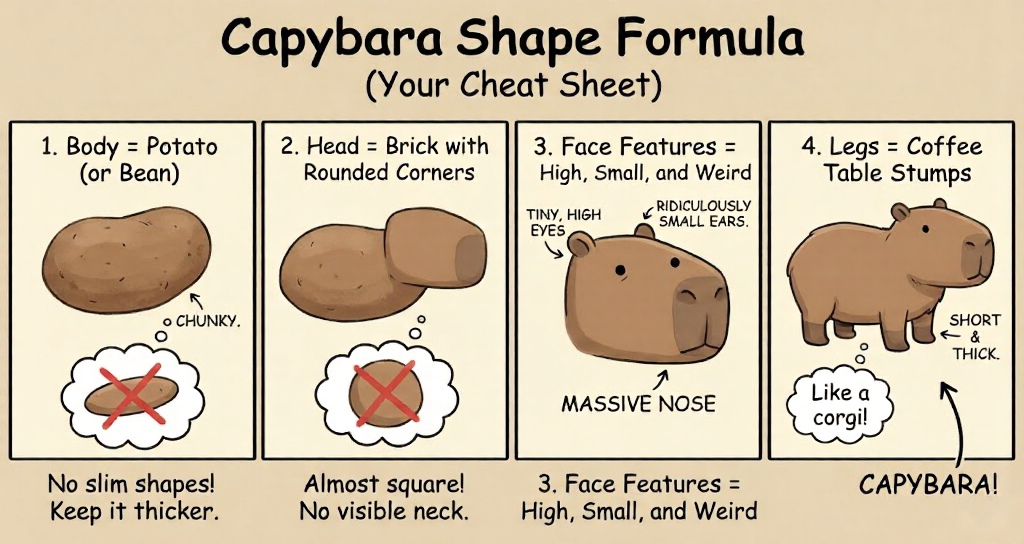
Head = Brick with Rounded Corners
This is where most people mess up. They draw a cute round head. Wrong animal.
Capybara heads are surprisingly boxy. Almost rectangular, with soft edges. The head is nearly as wide as it is tall — more square than oval.
Connect it to the body with almost no visible neck. Capybaras look like their head is just… attached directly. Like a Lego piece clicking into place.
Face Features = High, Small, and Weird
Here’s the placement trick that changes everything:
Eyes: Tiny dots placed HIGH on the head. Not centered — practically at the top third. This is the #1 mistake I see. Centered eyes = cartoon dog. High eyes = capybara.
Nose: Absolutely massive. Takes up the entire bottom half of the face. Blunt, wide, with two nostril dots.
Ears: Ridiculously small. Two tiny rounded bumps on the top corners of the head. If your ears look “normal sized,” shrink them.
Legs = Coffee Table Stumps
Four short, thick cylinders. That’s it.
Front legs slightly thinner, back legs chunkier. All of them short enough that the belly almost touches the ground. Capybaras have the proportions of a corgi — long body, stubby legs, maximum charm.
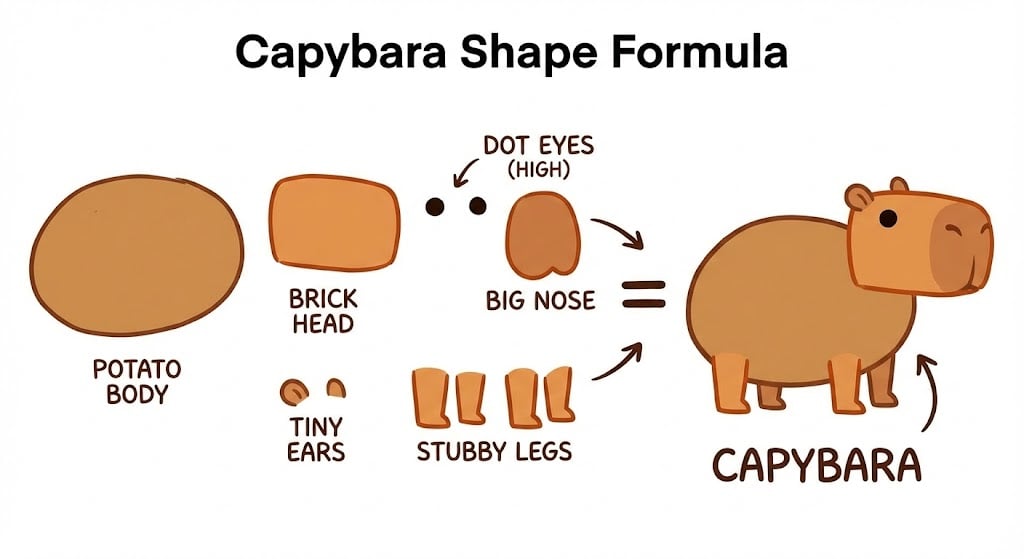
Quick Exercise: Grab scrap paper. Draw 5 potato shapes in a row. Add brick heads. Boom — five capybara bodies in under two minutes. Details come later. Shapes come first.
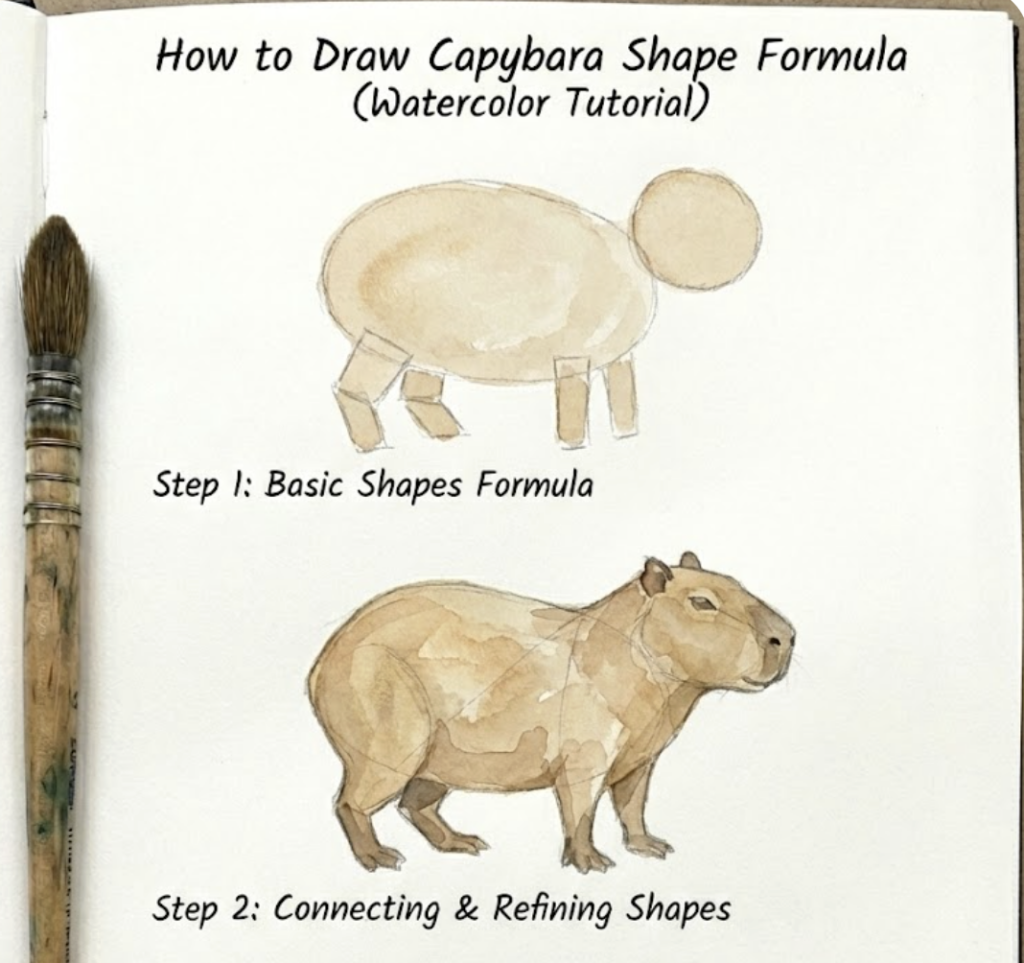
How to Draw a Cute Capybara: 6-Step Process
Enough theory. Time to draw an actual capybara.
This is the exact process I use for cute cartoon capybaras — the style that works for stickers, social media, greeting cards, and pretty much anything that needs to make people smile. Simple, charming, recognizable.
Grab a pencil. We’re doing this in 6 steps.
Step 1 — Draw the Potato Body
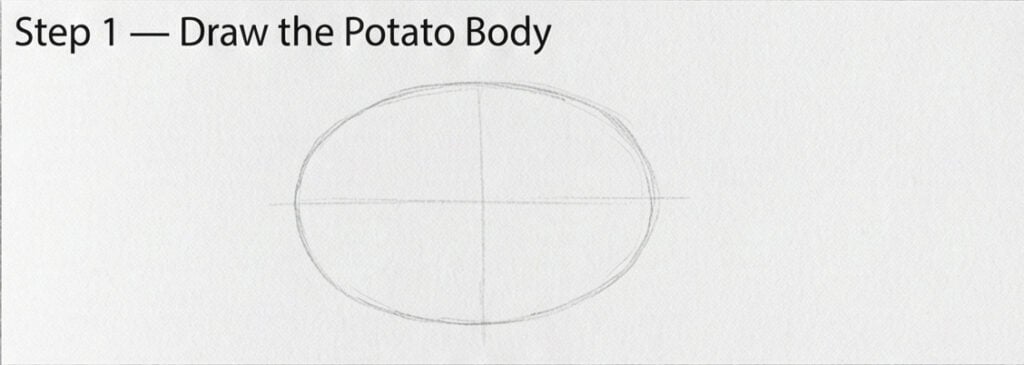
Start with your potato shape. Rounded rectangle, horizontal, slightly wider on the left side (that’s the chest area).
Keep your lines light — this is construction, not final art. You’ll erase and adjust.
Proportion check: Make it about twice as wide as it is tall. If it looks like a circle, stretch it. If it looks like a sausage, fatten it up.
Here’s my rule: when you think it’s chunky enough, add 10% more chunk. Beginners always go too slim. Embrace the thiccness.
Step 2 — Attach the Brick Head
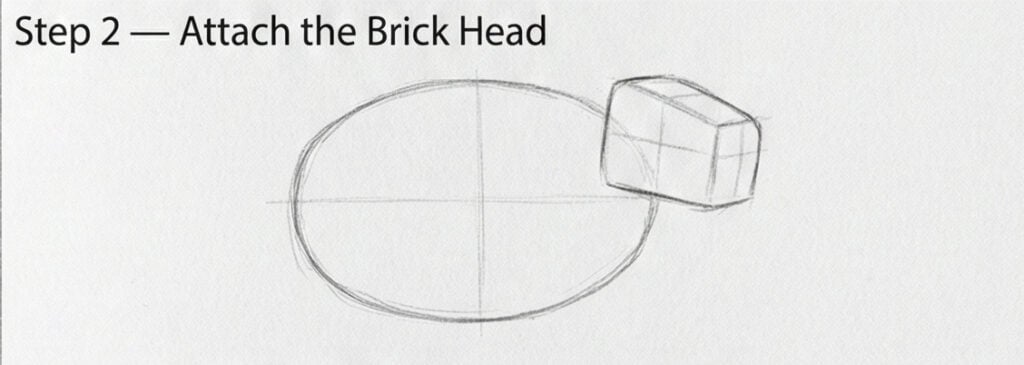
Draw a smaller rounded rectangle overlapping the left side of your potato. This is the head.
Angle it slightly upward — maybe 10-15 degrees. This subtle tilt adds personality and sets up that chill expression later.
Key detail: Almost no neck. The head connects directly to the body like they’re one continuous form. Leave just a tiny indent where they meet, or skip the neck entirely.
Size check: Head should be roughly one-third the length of the body. Too big = baby capybara (cute, but different). Too small = weird alien rodent.
Step 3 — Place the Face (This Is Where Magic Happens)
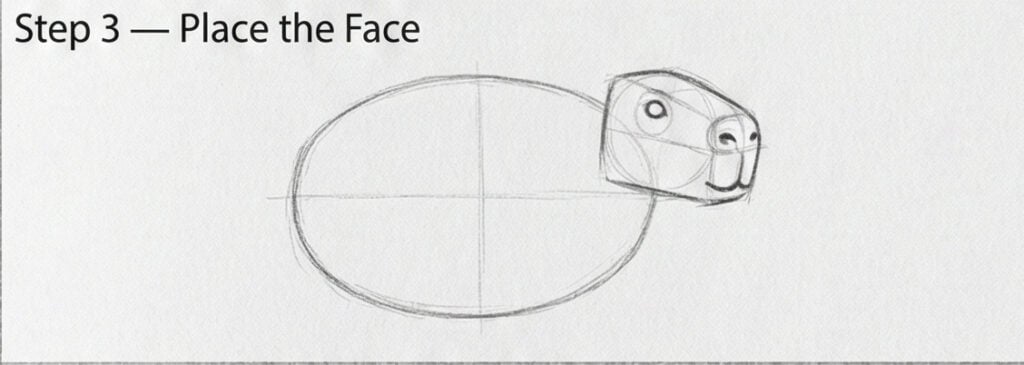
Most capybara drawings fail right here. Get this step right, and you’re 80% done.
Eyes first: Draw a horizontal guideline across the UPPER third of the head. Not the middle — the upper third. Place two small dots or circles on this line. Keep them small. Tiny. Like two chocolate chips pressed into dough.
Nose next: Draw a large rounded shape filling the bottom half of the face. This is the snout. Add two dots for nostrils near the bottom.
Ears last: Two tiny rounded bumps on the top corners of the head. If they look like normal animal ears, they’re too big. Capybara ears are almost comically small.
[Image: Progress shot — Steps 1-3 side by side, showing construction lines and feature placement]
Step 4 — Add the Stubby Legs
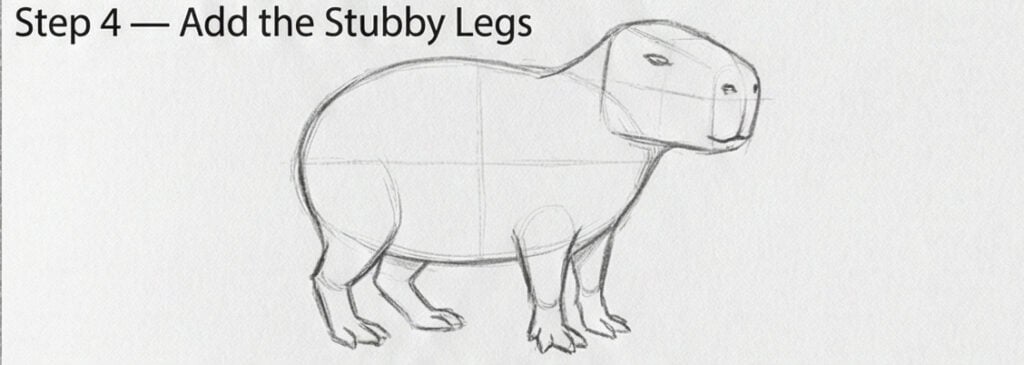
Four short cylinders. That’s all legs are at this stage.
Front legs: Drop two slightly thinner cylinders from the chest area. They can be close together or slightly apart.
Back legs: Two chunkier cylinders from the back half of the body. Space them a bit wider than the front legs.
Length check: Legs should be short enough that there’s barely any gap between belly and ground. Think corgi, think dachshund, think coffee table. If your capybara looks like it could run fast, the legs are too long.
Add small rounded feet at the bottom. For cute style, simple bumps work fine — no need for detailed toes.
Step 5 — Refine Your Silhouette
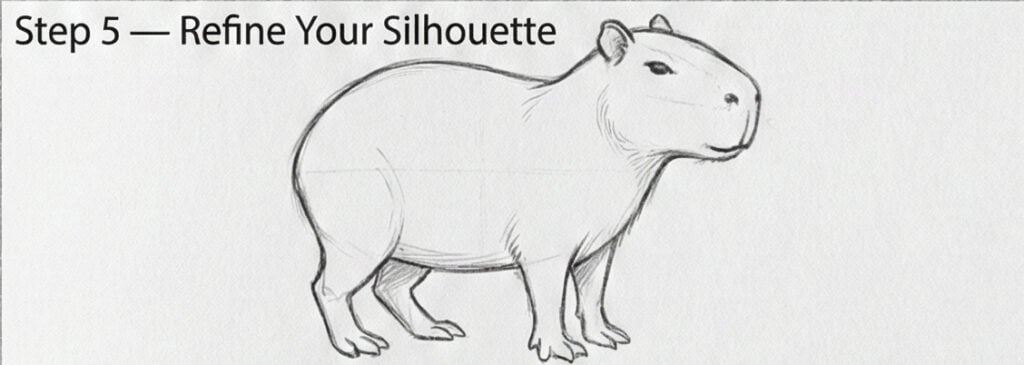
Time to clean up the construction mess.
Grab your eraser and a slightly darker pencil (or just press harder). Start tracing a smooth outline around your shapes.
Refinements to make:
- Round off the rump with a slight curve
- Smooth the transition between head and body
- Add a tiny bump for the chest
- Make sure the back has a gentle curve, not a flat line
Silhouette test: Squint at your drawing. Can you instantly tell it’s a capybara? If it could be a dog, beaver, or hippo, adjust your proportions. The boxy head and potato body should read clearly even as a solid black shape.
Step 6 — Details, Expression, and the Chill Factor
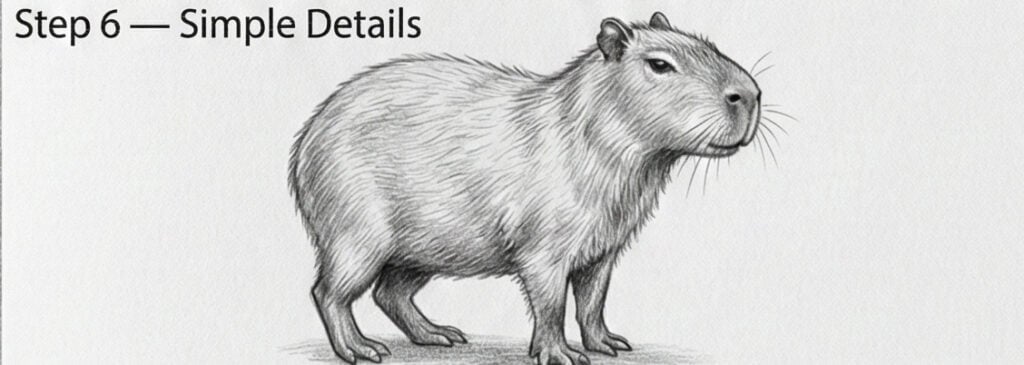
Now for the personality injection.
Mouth: Add a small curved line under the nose. Slight upward curve = content. Straight line = neutral chill. Avoid downward curves unless you want a sad capybara.
Expression hack: Take those eyes you drew and add a heavy upper eyelid — basically draw a curved line covering the top 30-50% of each eye. Instant chill. Instant relaxation. This single detail transforms “alert rodent” into “zen master.”
Fur texture: Optional for cute style, but a few short strokes around the edges — especially on the cheeks and back — add life without overwhelming the simplicity.
Final touch: Add a tiny highlight dot in each eye (leave a white speck or add it with white pen). This makes your capybara look alive rather than like a stuffed toy.
Done. You just drew a capybara.
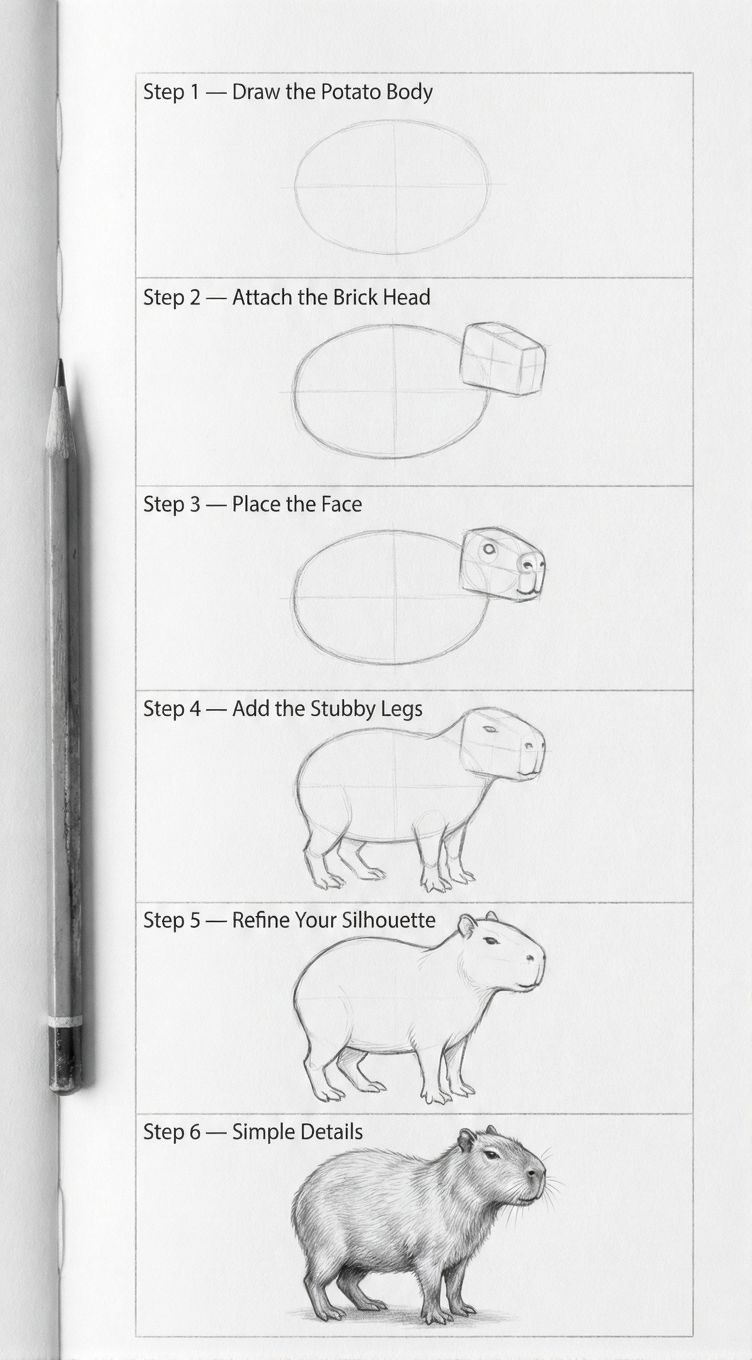
Wasn’t as scary as that first beaver-dog-potato hybrid, right?
3 Capybara Styles to Try
You’ve got the basic cute capybara down. Now let’s talk about where you can take it.
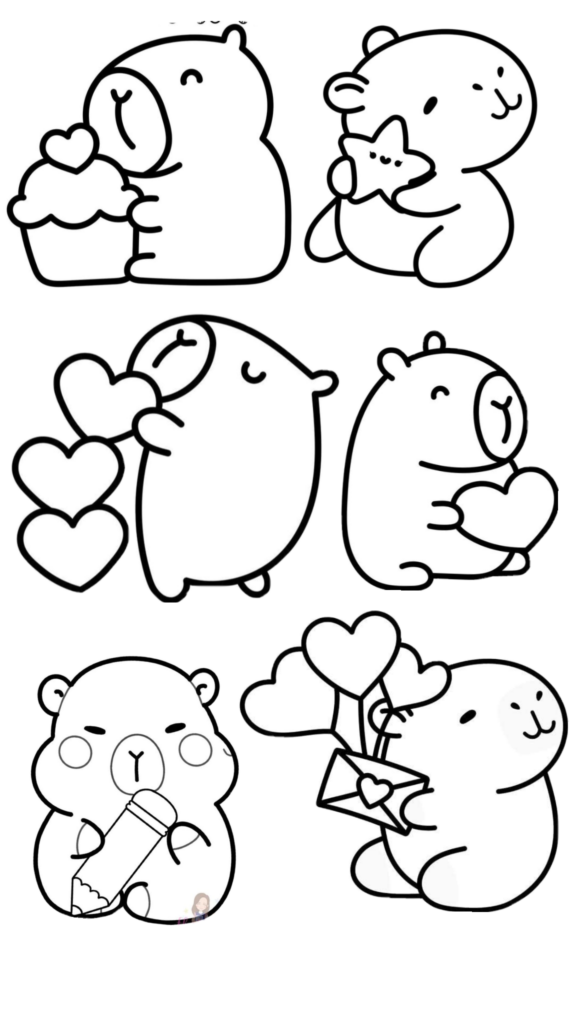
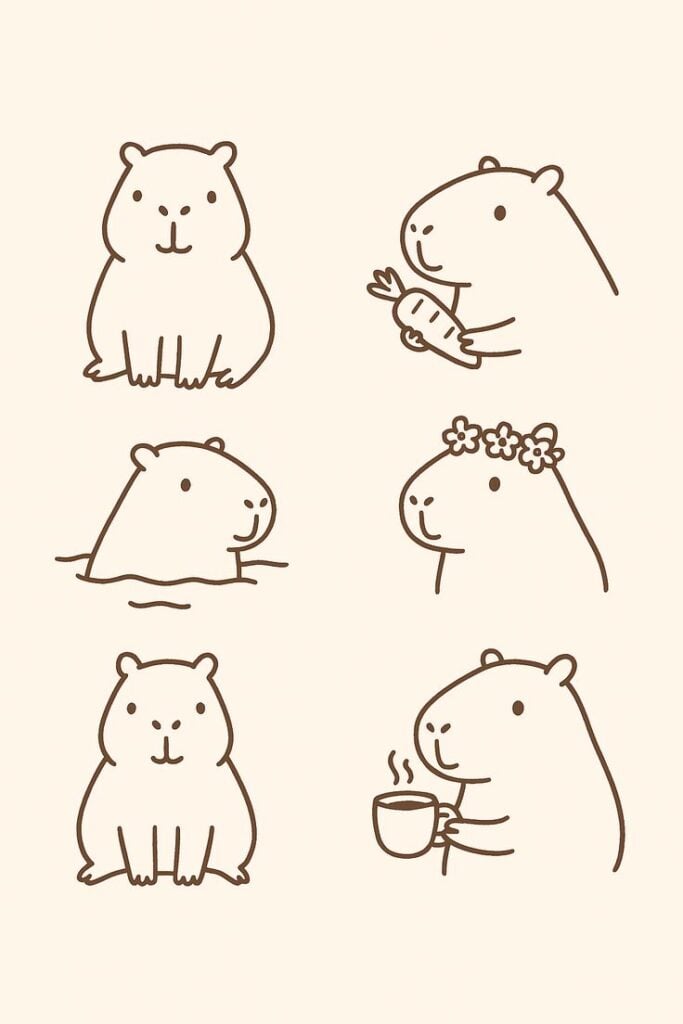
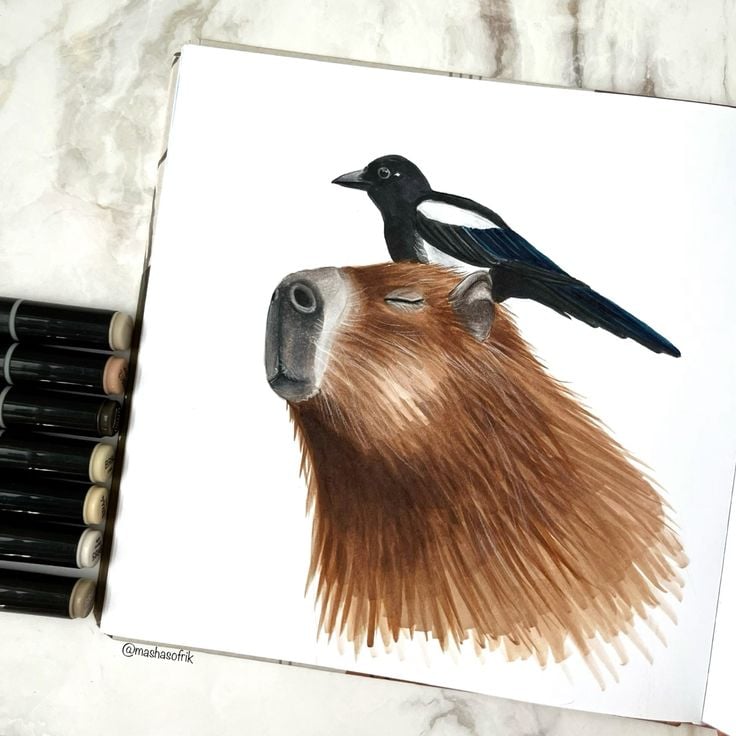
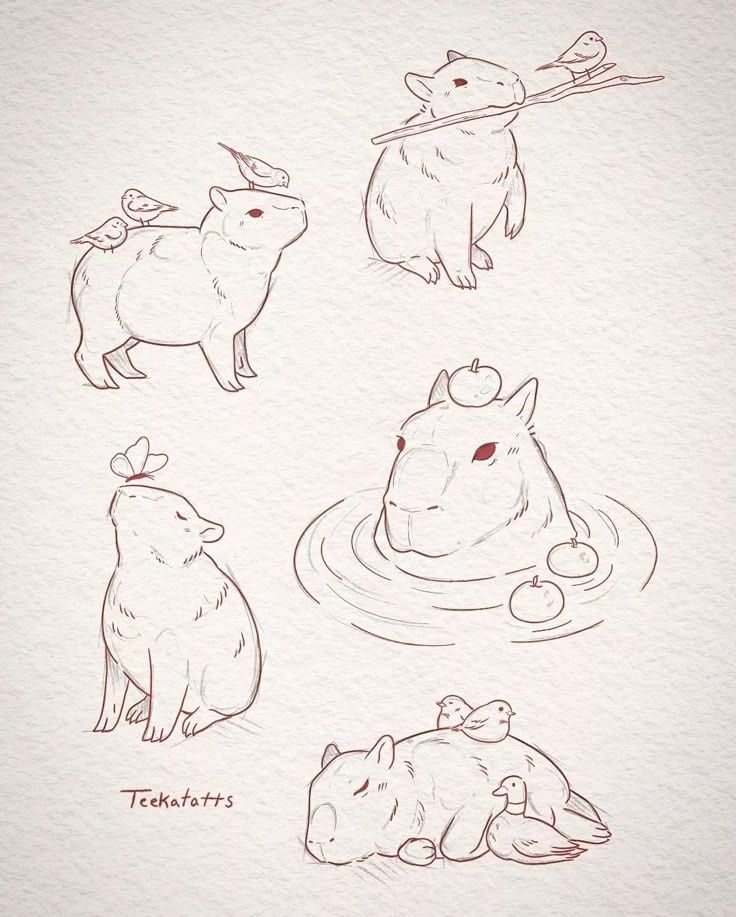
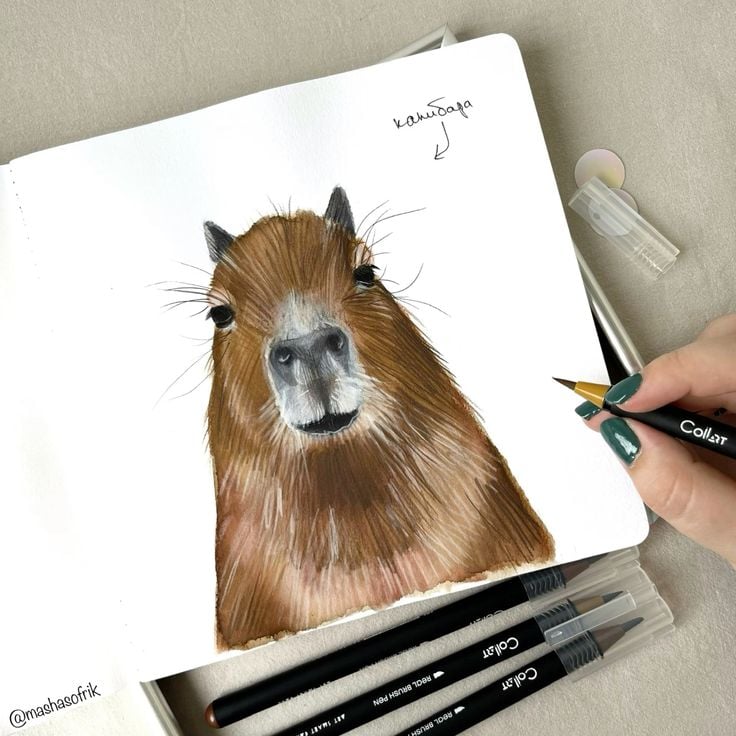
The tutorial we just covered sits right in the middle of the style spectrum. But capybaras work beautifully across different approaches — from ultra-simple kawaii to detailed wildlife illustration. I’ve tried all three, and each taught me something different.
Kawaii/Chibi Style
Maximum cuteness, minimum complexity.
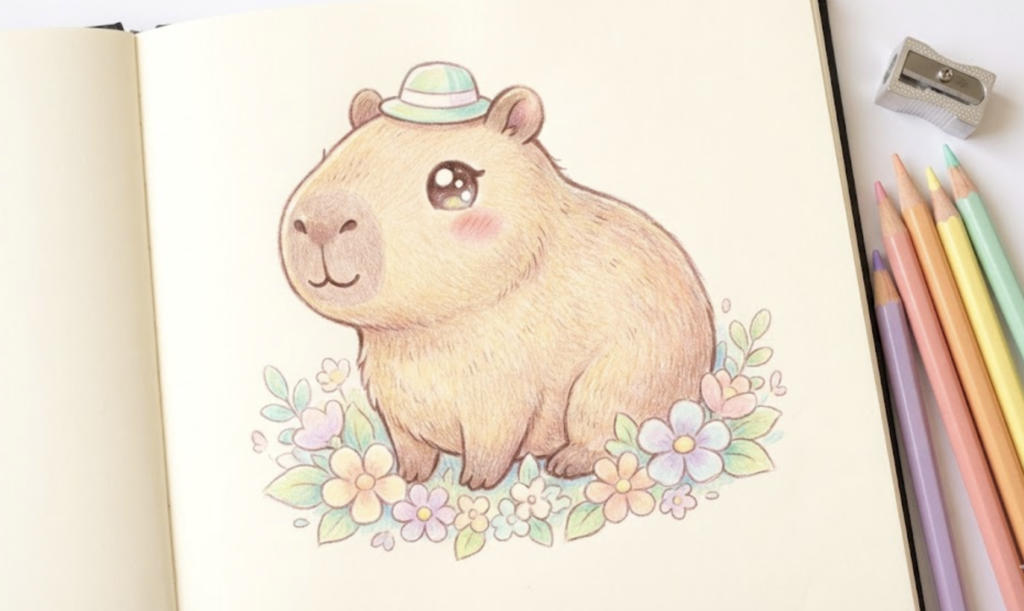
The rules change here: head and body become almost equal size (1:1 ratio). Eyes get slightly bigger — still small compared to other animals, but larger than realistic. Add pink blush circles on the cheeks. Round EVERYTHING.
Details? Basically none. No fur texture, no anatomical accuracy. Just pure, simplified charm.
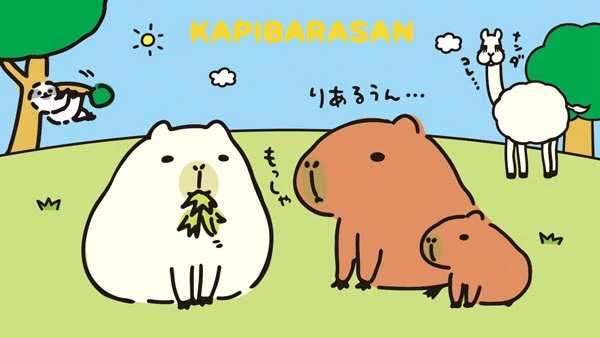
Reference: Look up Kapibarasan — the Japanese character franchise that turned capybaras into a merchandising empire. That’s the kawaii blueprint.
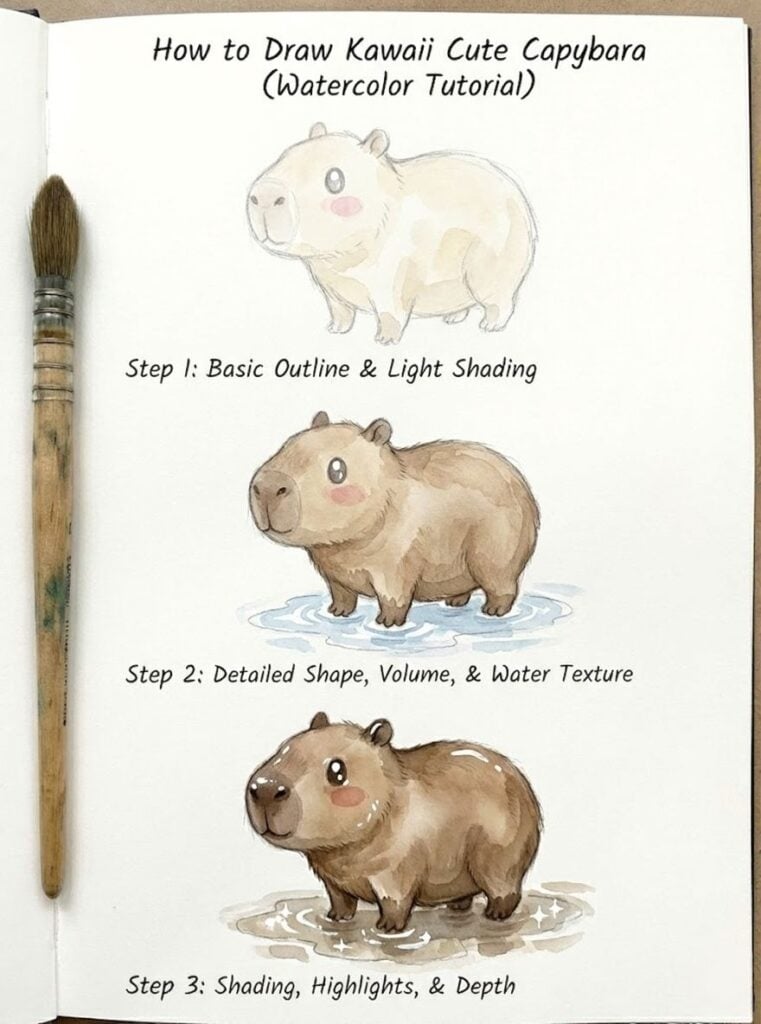
Perfect for: Stickers, emojis, phone wallpapers, quick doodles when you’re bored in meetings.
Cartoon/Illustrated Style
This is what we drew in the 6-step tutorial. Balanced proportions, recognizable anatomy, but still stylized and appealing.
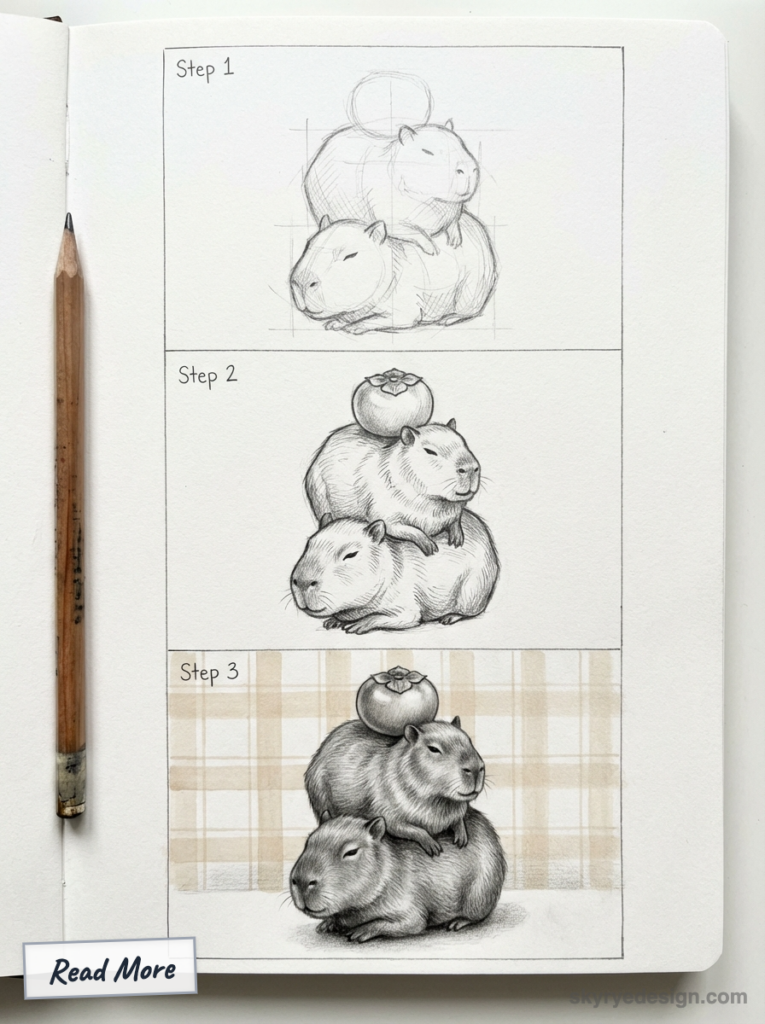
You can push expressions further here. Add accessories — a tiny hat, an orange on the head, a coffee cup. Create scenes and stories. The style has room for personality without demanding realistic rendering.
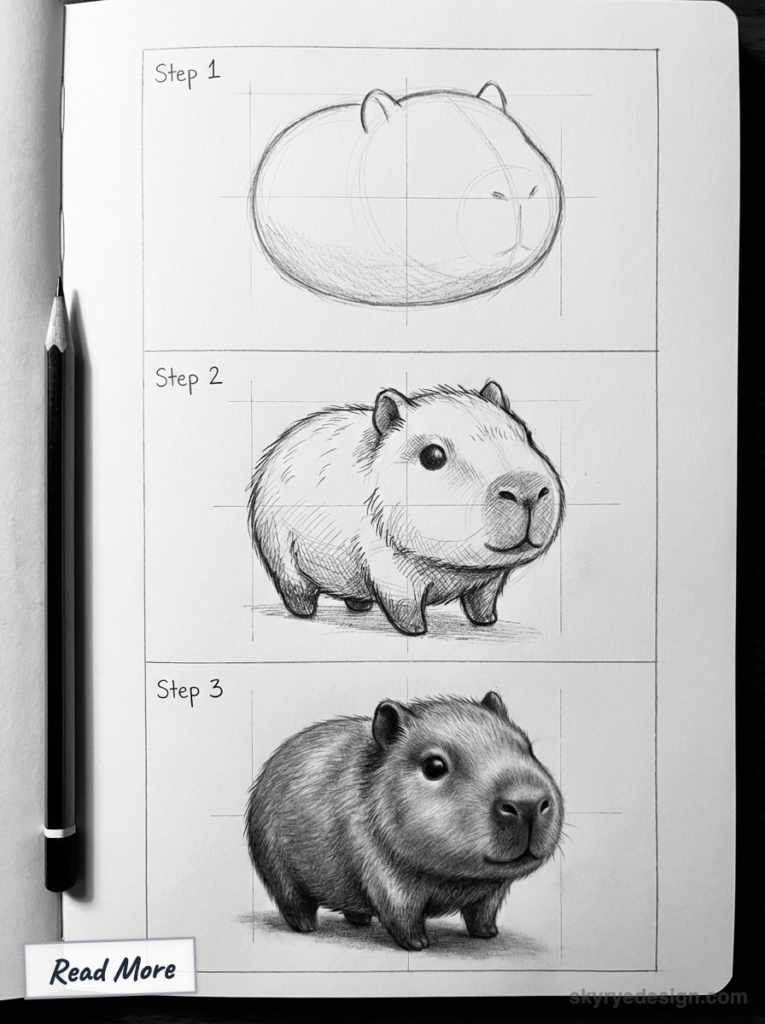
Reference: Children’s book illustrations, indie game art, greeting cards. Artists like Sydney Hanson nail this balance.
Perfect for: Prints, merchandise, social media content, children’s books, editorial illustration.
Semi-Realistic Style
Now we’re getting serious.
Accurate proportions based on actual capybara anatomy. Detailed fur rendering with directional strokes. Natural poses and expressions studied from photo references. The eyes, nose, and ears sit exactly where they do on real capybaras.
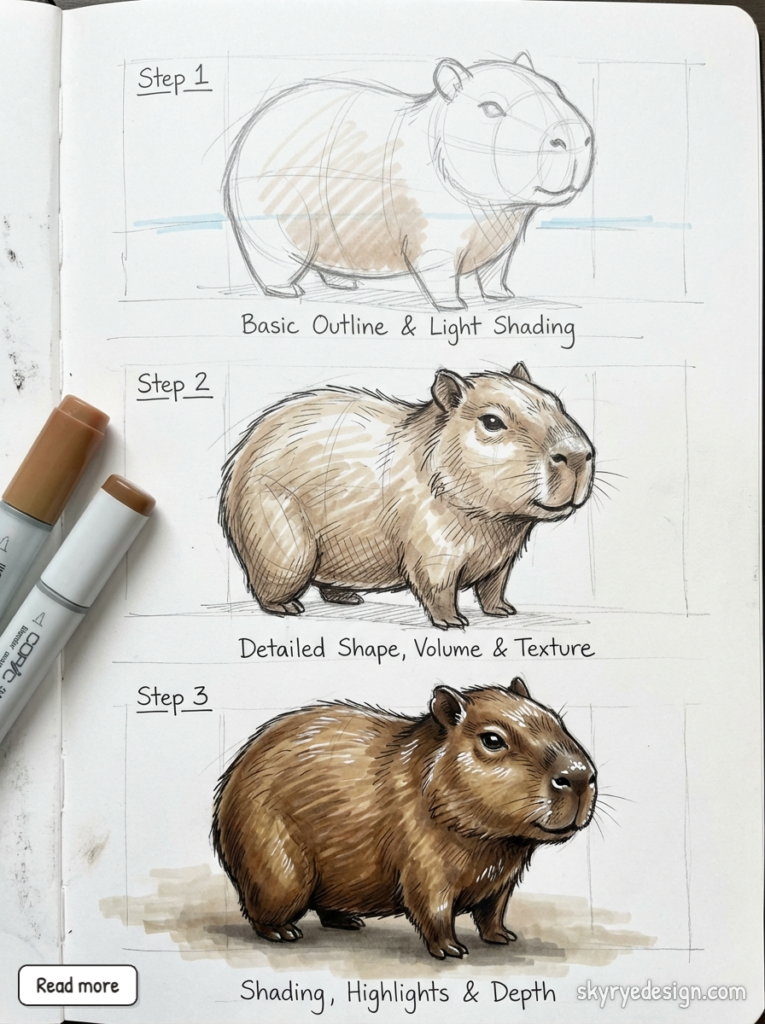
This style takes longer — a single piece might need 2-4 hours — but the results feel alive.
Reference: Wildlife illustrators, nature journal artists, scientific illustration. The Nagasaki Bio Park photos make excellent study material.
Perfect for: Tattoo designs, editorial work, portfolio pieces, nature journals.
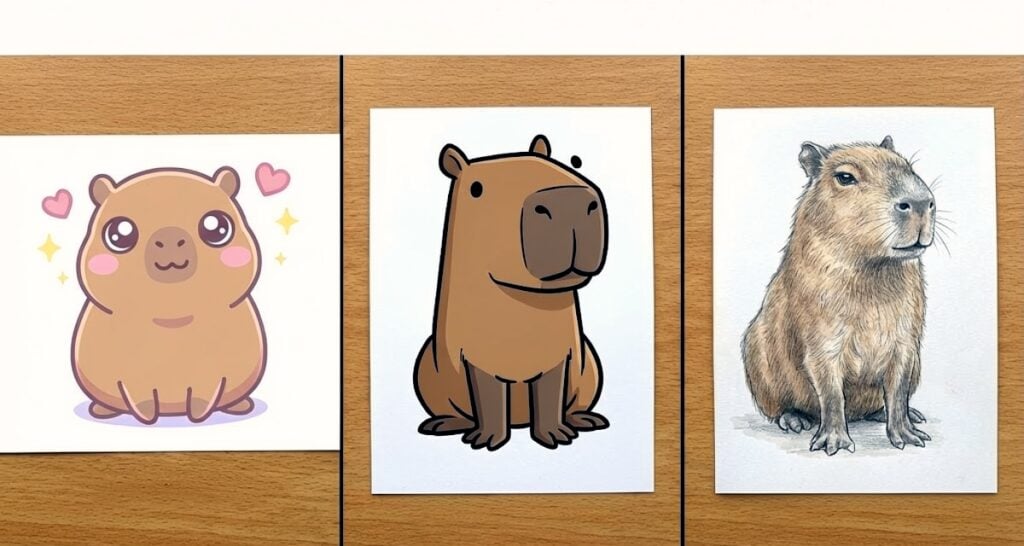
My personal journey? Started with kawaii for quick wins and dopamine hits. Moved to cartoon when I wanted more expression. Still practicing semi-realistic — fur rendering is humbling.
There’s no “best” style. Just the one that fits your project and brings you joy.
5 Mistakes That Make Your Capybara Look Like a Beaver
You followed the steps. Something still looks off. Your capybara has beaver energy and you can’t figure out why.
I’ve diagnosed this problem dozens of times — in my own drawings and in DMs from followers asking “why does mine look weird?” It’s almost always one of these five culprits.
Let’s play spot the problem.
Mistake #1 — The Beaver Tail
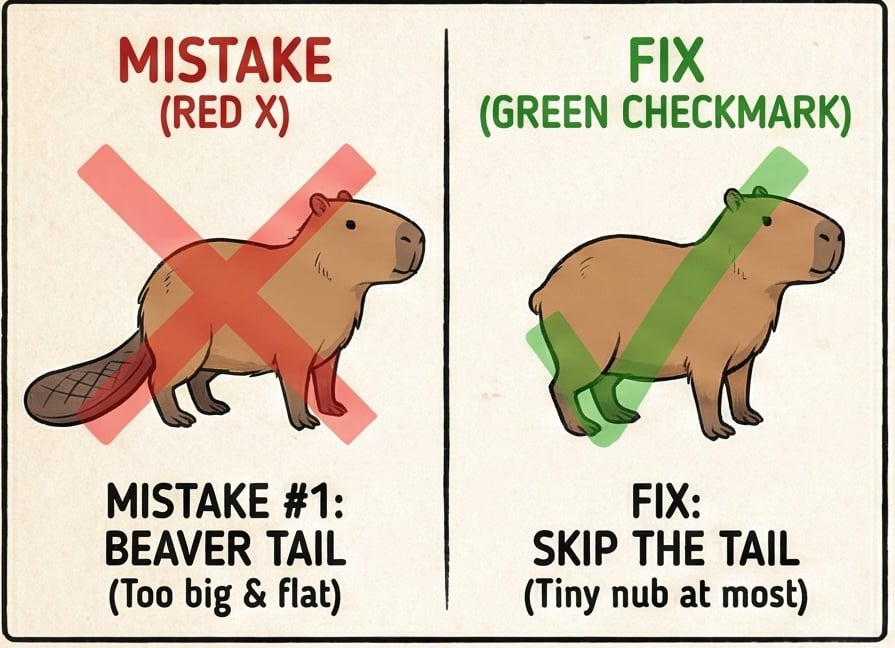
The problem: You added a flat, paddle-shaped tail because… rodents have tails, right?
The reality: Capybaras barely have a tail. It’s a tiny vestigial nub, practically invisible. Most photos you won’t even see it.
The fix: Skip the tail entirely. Or add the tiniest bump at the back — so small it almost doesn’t exist. If anyone can clearly see your capybara’s tail, it’s already too big.
Mistake #2 — Eyes in the Middle
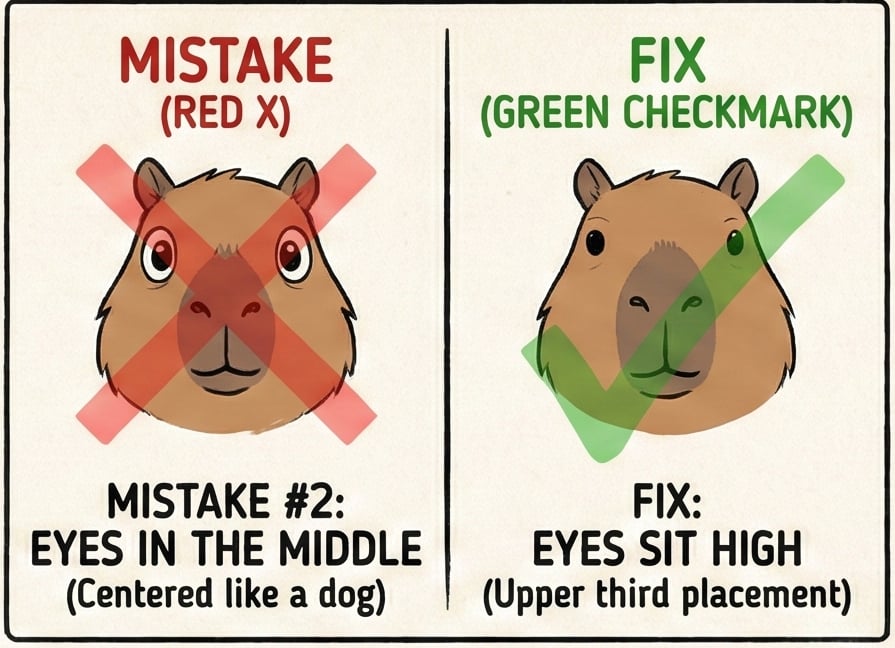
The problem: You placed the eyes in the center of the face, like you would for a dog or cat.
The reality: Capybara eyes sit weirdly HIGH — almost at the top of the head. It’s an evolutionary thing; they’re semi-aquatic and need to see while mostly submerged.
The fix: Draw an imaginary line across the upper third of the head. Eyes go there. Feels wrong at first, looks right when you’re done. I resisted this for weeks before finally trusting the placement.
Mistake #3 — The Pointy Snout
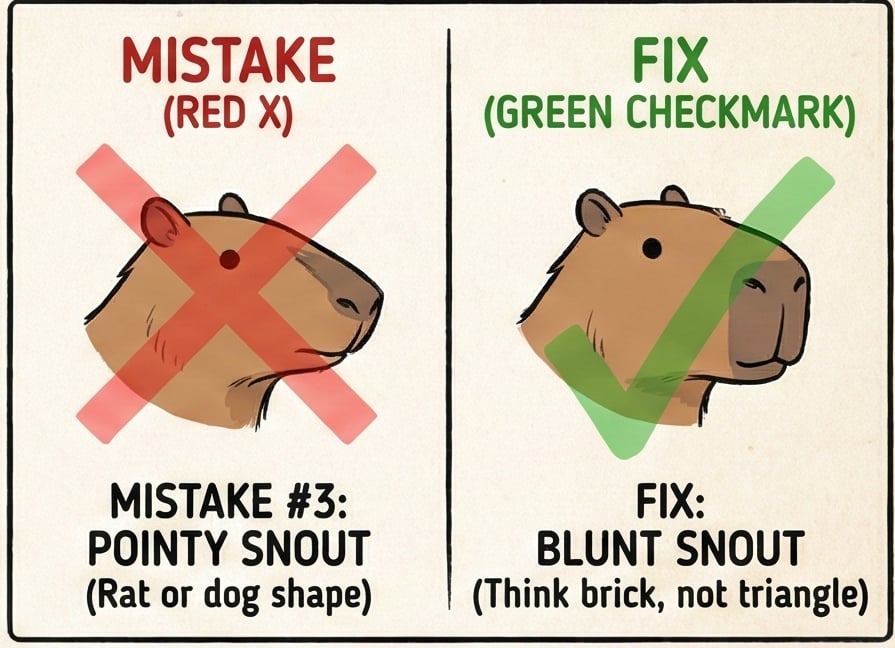
The problem: You drew a tapered, pointy nose like a dog or rat.
The reality: Capybara snouts are BLUNT. Wide. Boxy. More like a hippopotamus than a rat.
The fix: Think brick, not triangle. The snout should be almost as wide at the front as it is at the base. When in doubt, make it blunter.
Mistake #4 — Normal-Sized Ears
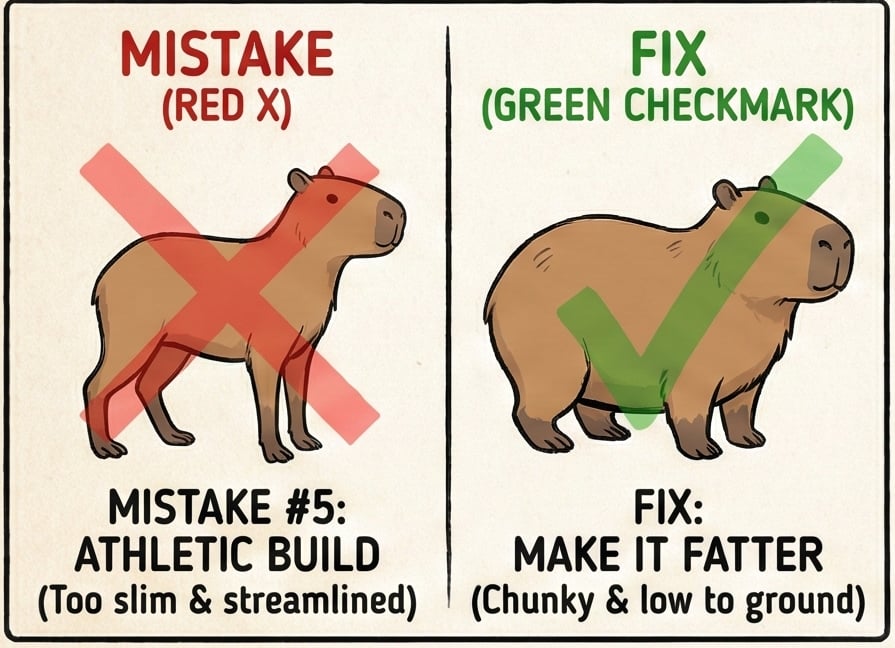
The problem: You drew cute, visible, reasonably-sized ears.
The reality: Capybara ears are ridiculously tiny. Like, “did someone shrink these in Photoshop?” tiny.
The fix: Draw what feels right, then shrink it by 50%. Those little nubs on top of the head should barely register as ears. They’re more like small bumps than actual ear shapes.
Mistake #5 — Athletic Build
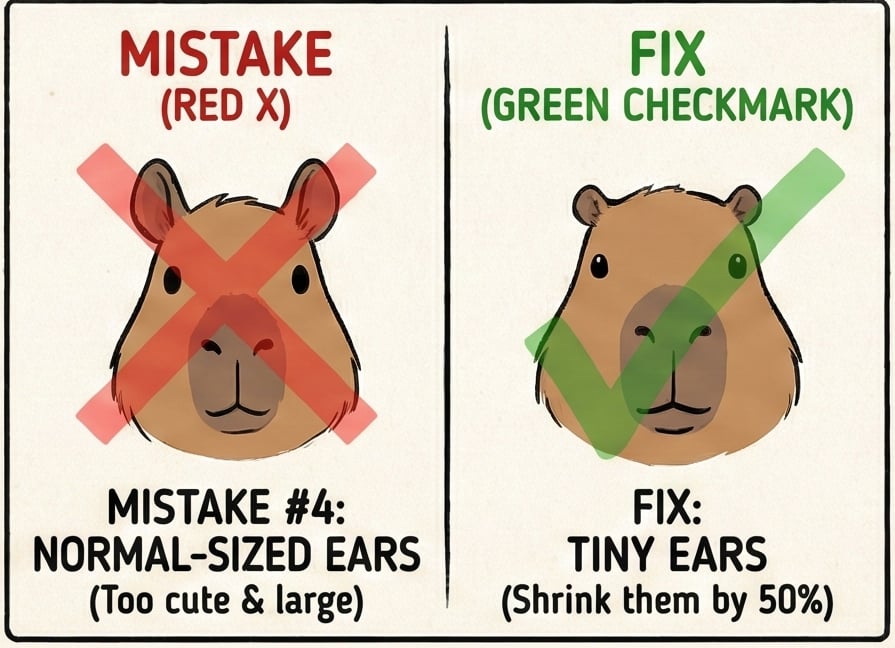
The problem: Your capybara looks like it does cardio. Slim body, defined legs, streamlined shape.
The reality: Capybaras are CHUNKY. Barrel-shaped. Built for lounging in hot springs, not running marathons. They weigh up to 66 kg of pure unbothered mass.
The fix: Make it fatter. Seriously. Shorter legs, wider body, lower to the ground. If your capybara looks like it could chase anything, it’s too fit. These animals have achieved peak relaxation body type.
Quick self-diagnosis: look at your drawing. Which of these did you accidentally do? Fix that one thing. I bet your capybara transforms instantly.
Capturing the Legendary Capybara Chill
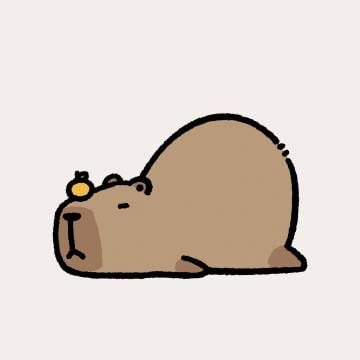
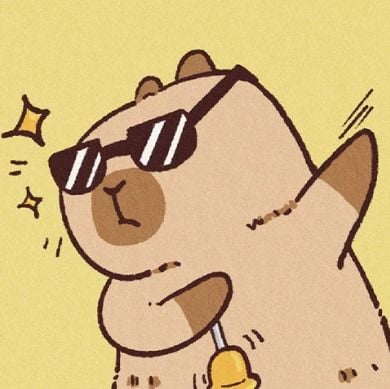
You can nail every proportion perfectly and still end up with a capybara that looks… stressed. Alert. Like it has a mortgage and three deadlines.
That’s not a capybara. That’s a guinea pig with anxiety.
The real magic isn’t anatomy — it’s vibe. Capybaras are famous for their supernatural ability to not care. Birds sit on their heads. They don’t care. Crocodiles swim past. They don’t care. The entire internet watches them soak in hot springs. Still don’t care.
Your drawing needs that energy.
The Eyes Have It
Half-closed eyes are your secret weapon.
Draw the full eye shape first — small circles, placed high like we practiced. Then add a heavy upper eyelid covering 40-50% of each eye. That’s it. Instant zen master.
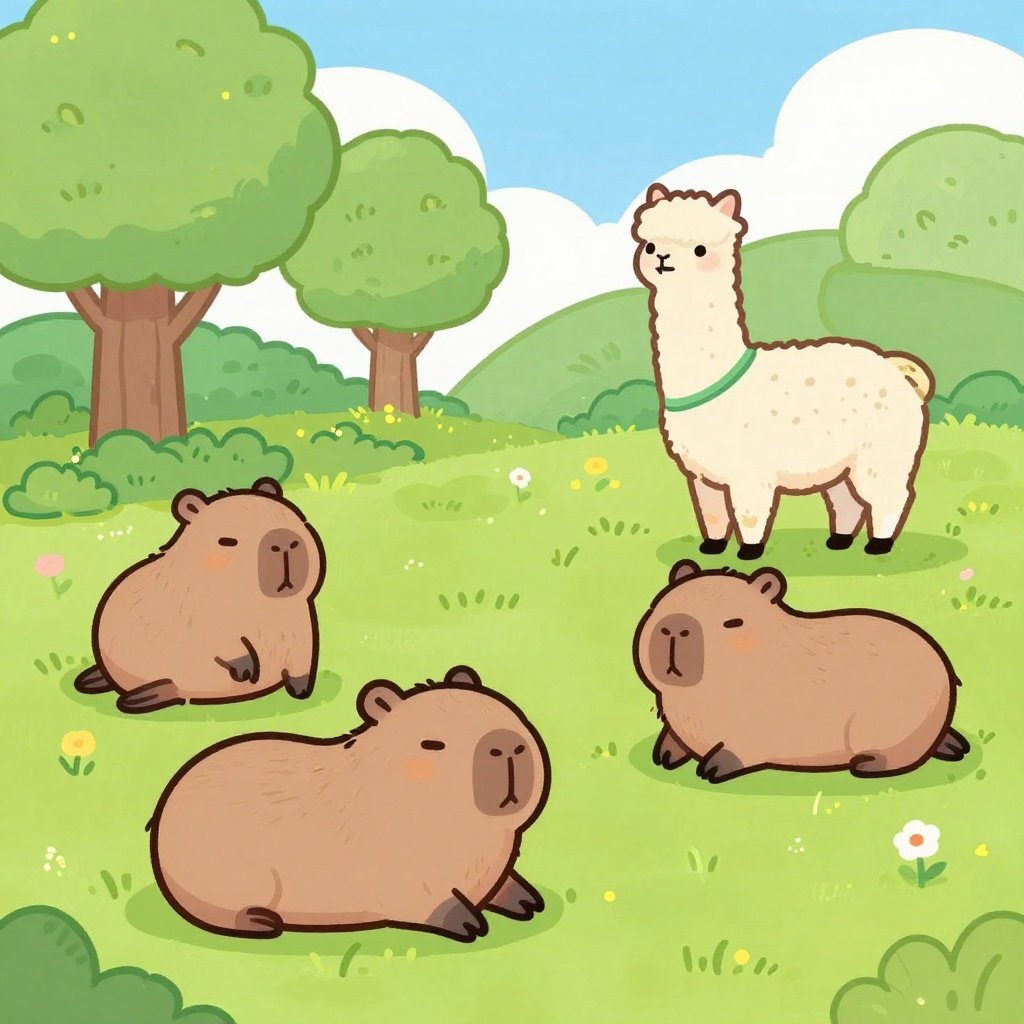
Wide-open eyes = alert, scared, or surprised. Half-closed eyes = “life is good and nothing matters.” The difference is one curved line, but it changes everything.
Relaxed Body Language
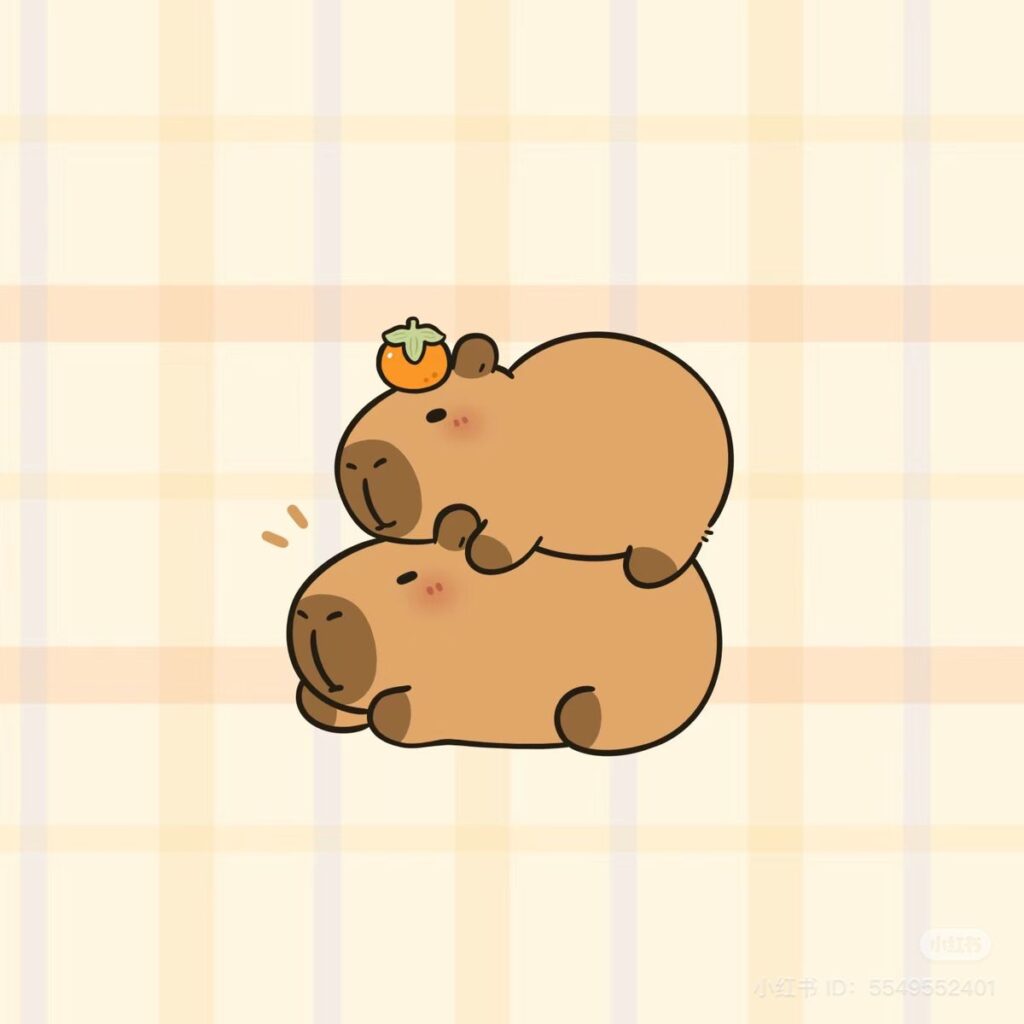
Capybaras don’t DO tension. Their poses should reflect that.
Best chill poses:
- Lying down with legs tucked underneath (loaf mode)
- Sitting in water with only head visible
- Standing but with a slight slouch
- Splayed out flat like a furry pancake
Avoid: Action poses, raised heads, alert stances, anything that suggests this capybara has somewhere to be.
Scene Setups That Amplify Chill
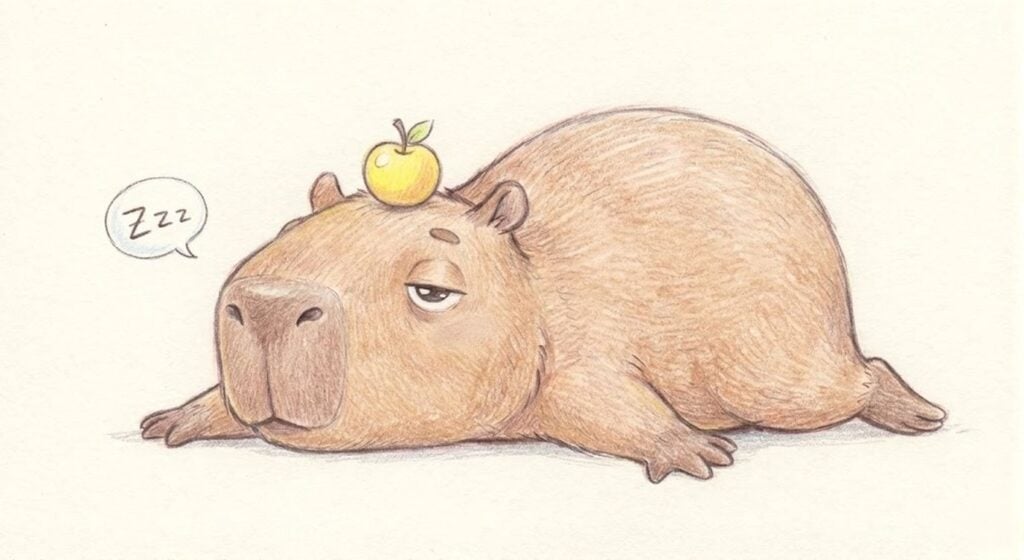
Context matters. Put your capybara in relaxing situations:
- Hot spring/onsen: Steam lines, water ripples, pure bliss
- Orange on head: The classic meme. Don’t question it, just draw it
- Surrounded by friends: Birds perching on back, other capybaras nearby — they’re social animals
- Simple water setting: Even just a wavy line suggesting water adds instant spa energy
Expression Cheat Sheet
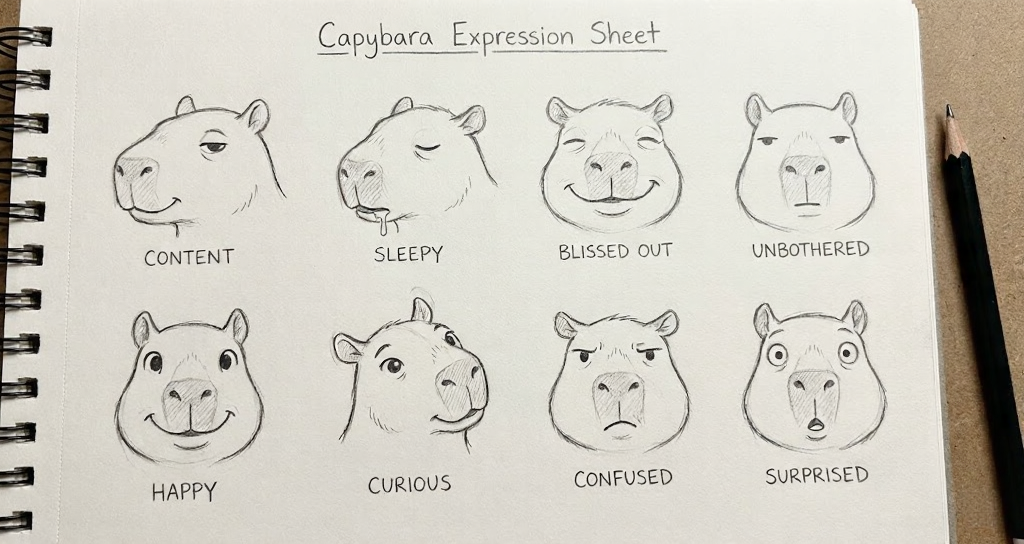
Content: Slight smile + half-closed eyes Sleepy: Eyes nearly closed + no mouth line Blissed out: Eyes fully closed + tiny smile + head tilted slightly back Unbothered: Neutral mouth + half-closed eyes looking slightly away
The vibe test: Look at your finished capybara. Ask yourself: does this animal look like it pays taxes? If yes — relax those eyelids, soften that pose, add some water.
Real capybaras have achieved enlightenment. Your drawing should reflect that.
FAQ: Capybara Drawing Questions Answered
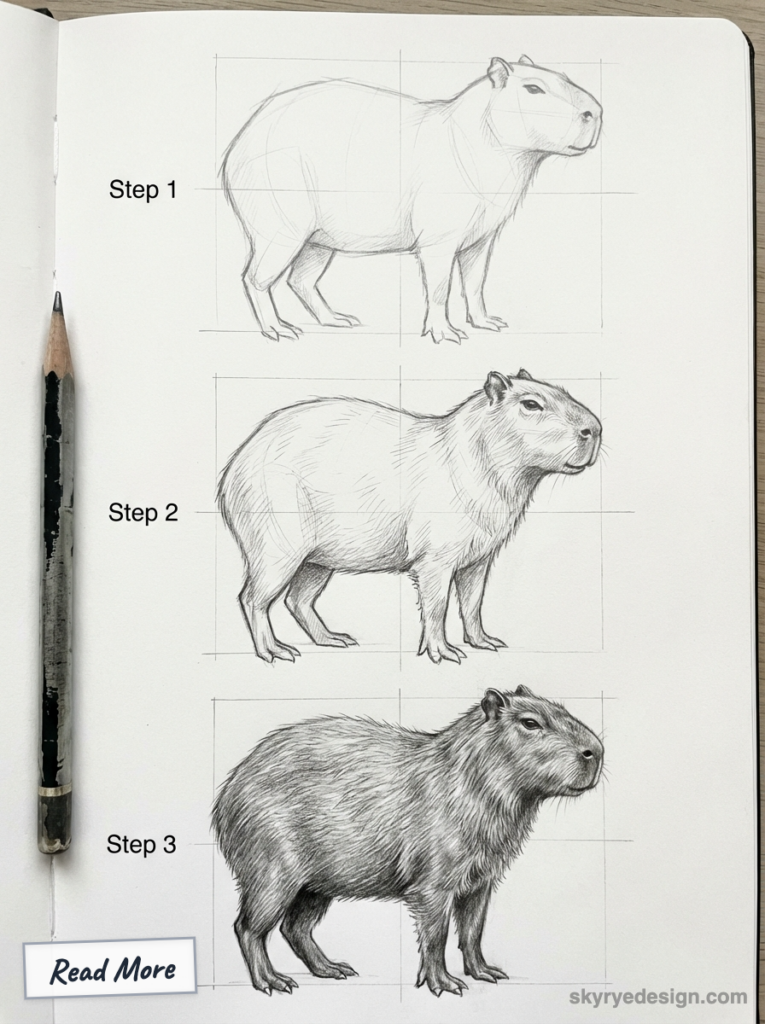
What’s the easiest capybara pose for beginners?
A: Side view, standing still. You see all four legs, the full potato body, and that distinctive boxy head in profile. Even easier? Swimming — just draw the head and a wavy water line. Half the capybara, half the work, 100% the chill.
How do I draw a baby capybara?
Same shapes, different ratios. Make the head bigger relative to body — about 1:2 instead of 1:3. Eyes can be slightly larger (babies get away with this). Shorter snout, rounder everything, extra fluffiness around the edges. Think “potato nugget” instead of “full potato.”
What colors should I use for a capybara?
Base coat: warm brown, like milk chocolate or wet sand. Darker brown for the nose, around the eyes, and shadow areas. Inner ears get a pinkish-brown. Eyes are dark brown, almost black. Important: avoid cool grays — capybaras are warm-toned animals. Even in shadows, keep it warm.
How do I draw a capybara in water?
Draw a horizontal line for the water surface. Only the head and a small curve of the back show above. Add 2-3 simple curved lines around the body for ripples. Optional: steam lines above the water for that hot spring aesthetic. This pose is actually easier than standing because you’re drawing less capybara.
Why does my capybara look sad?
Check three things. First: mouth. Downturned line = sad. Keep it straight or slightly upturned. Second: eyes. Too low on the face reads as droopy and depressed. Move them higher. Third: posture. Hunched or tense body language creates sad energy. Relax those shoulders, round that back.
How do I draw the capybara with an orange on its head?
Draw your capybara first, looking content (half-closed eyes help). Add a simple circle on top of the head — slightly flattened where it touches the head. Two small leaves on top, a tiny dot for the stem. The capybara should look completely unbothered by this citrus situation. That’s the whole joke.
How long does it take to draw a capybara?
Kawaii doodle: 3-5 minutes. Cute cartoon style (our tutorial): 15-25 minutes. Detailed illustration: 1-3 hours. My advice? Do ten 5-minute capybaras before one 30-minute capybara. Speed builds confidence, and confidence builds skill.
Conclusion
So, when it comes to drawing a capybara, it all boils down to three simple things – a potato body, a brick head, and this – zero stress, total chill.
Give up on the beaver comparisons – they’re just going to confuse things. And put the guinea pig notion out of your head – we’re going for something unique here. What it really comes down to is chunky proportions, teeny little features stuck in odd places, and that iconic laid-back vibe that gets people smitten with capybaras all over the web.
Let’s run through the essentials: keep that body nice and plump, pop the eyes high on the head, make those ears tiny, & for goodness sake, give it a tail that bobs around rather than lies flat. And if all else fails – make it even more chunky and relaxed.
Your first attempt might look a bit like a confused spud, that’s alright. Your fifth will be making people smile. And by the time you hit ten, you’ll be drawing capybaras lounging in hot springs with oranges on their heads without breaking a sweat.
Here’s your homework: draw five capybaras within the next 20 minutes – don’t worry if they’re rubbish, just stick ’em up. Post your fave and tag @skyryedesign, I want to see what you come up with.
Now stop reading. Start drawing potatoes with tiny ears.
- 2.8Kshares
- Facebook0
- Pinterest2.8K
- Twitter0
- Reddit0