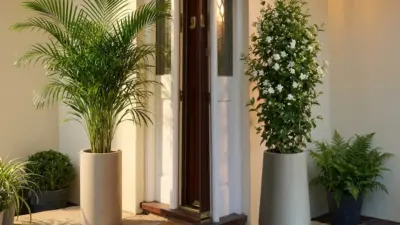
The house I grew up in had a back door that opened onto a concrete step, a one-metre drop to the patio, and a different material underfoot the moment you went outside. Inside were timber boards. Outside was rough, grey concrete. The step meant you couldn’t carry things easily, the drop meant small children and older relatives negotiated it carefully, and the material change made it feel like leaving the house rather than extending it. Nobody sat outside because sitting outside felt like being outside, separate from the life happening inside.
I didn’t understand what was wrong with it until I spent a week in a house in coastal New South Wales where the living room floor — honed limestone, warm grey — continued at the same level onto a covered terrace, then onto an open deck, then to within a metre of the water. The boundary between inside and outside was a glazed wall that stacked completely to one side. When it was open, the living room and the terrace were one space. When it was closed, you could see the water from the sofa as if there were no wall at all. It felt twice the size of a house with the same floor area. It felt like the site, not like a box sitting on the site.
- 1. The Opening: Why the Glass Wall Is Not Enough by Itself
- 2. Floor Continuity: The Most Underestimated Design Decision
- 3. The Covered Outdoor Room: Between Inside and Outside
- 4. Landscaping and Architecture: Why They Should Be Designed Together
- 5. Passive Performance: Airflow, Shade, and the Thermal Boundary
- Five Design Moves: Quick Reference
- FAQ: Indoor-Outdoor Architecture for Spring
That gap — between a house that sits on its site and a house that feels like part of it — is an architectural problem with specific, teachable solutions. This guide covers five of them. They apply to new builds and to renovations, to houses with modest budgets and to significant projects. They’re ordered from the most impactful to the most often overlooked, and each one has specific material and detail implications worth understanding before you start.
1. The Opening: Why the Glass Wall Is Not Enough by Itself
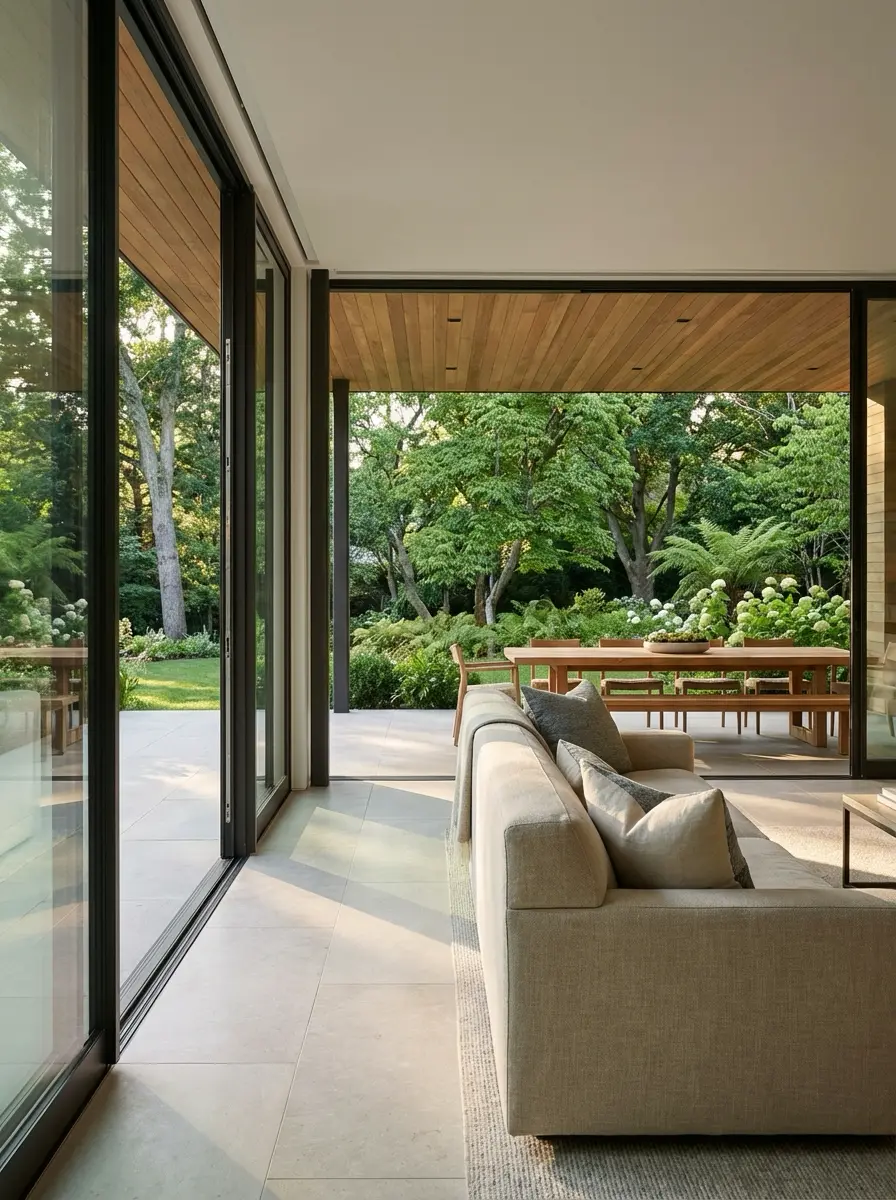
The large glazed opening is the most visible element of indoor-outdoor architecture and the one that appears first on every mood board. It’s also the most commonly misunderstood. The glass wall is not the design move — it’s the enabler of the design move. What determines whether it works is everything around it: the level, the threshold detail, the depth of the covered zone beyond it, and whether the glazing system actually opens to a clear span or leaves posts and frames in the way.
Glazing System Types and Their Specific Properties
Stacking sliding doors (or ‘lift-and-slide’ systems at the premium end) stack completely to one side when open, leaving a clear span of 3 to 6 metres with no structural interruption. This is the system most commonly specified for living areas opening to a main entertaining terrace — the clear opening is wider than any other residential door type, and when closed, the slim sightlines of a quality European lift-and-slide system (Schüco, Cortizo, or Internorm at the upper end) allow the view to read as uninterrupted glass rather than framed panels.
Bi-fold doors are the alternative most often seen in residential renovations. They fold accordion-style and can open more of the wall than a single-slide system, but they leave the folded panels stacked at one or both ends — which means the opening is not fully clear and the stacked panels can interrupt circulation. Bi-folds work well for wider openings where the entire wall is intended to disappear rather than a specific portion of it. The structural requirement — a long-span beam above to carry the load without intermediate columns — should be confirmed with a structural engineer before the design is committed.
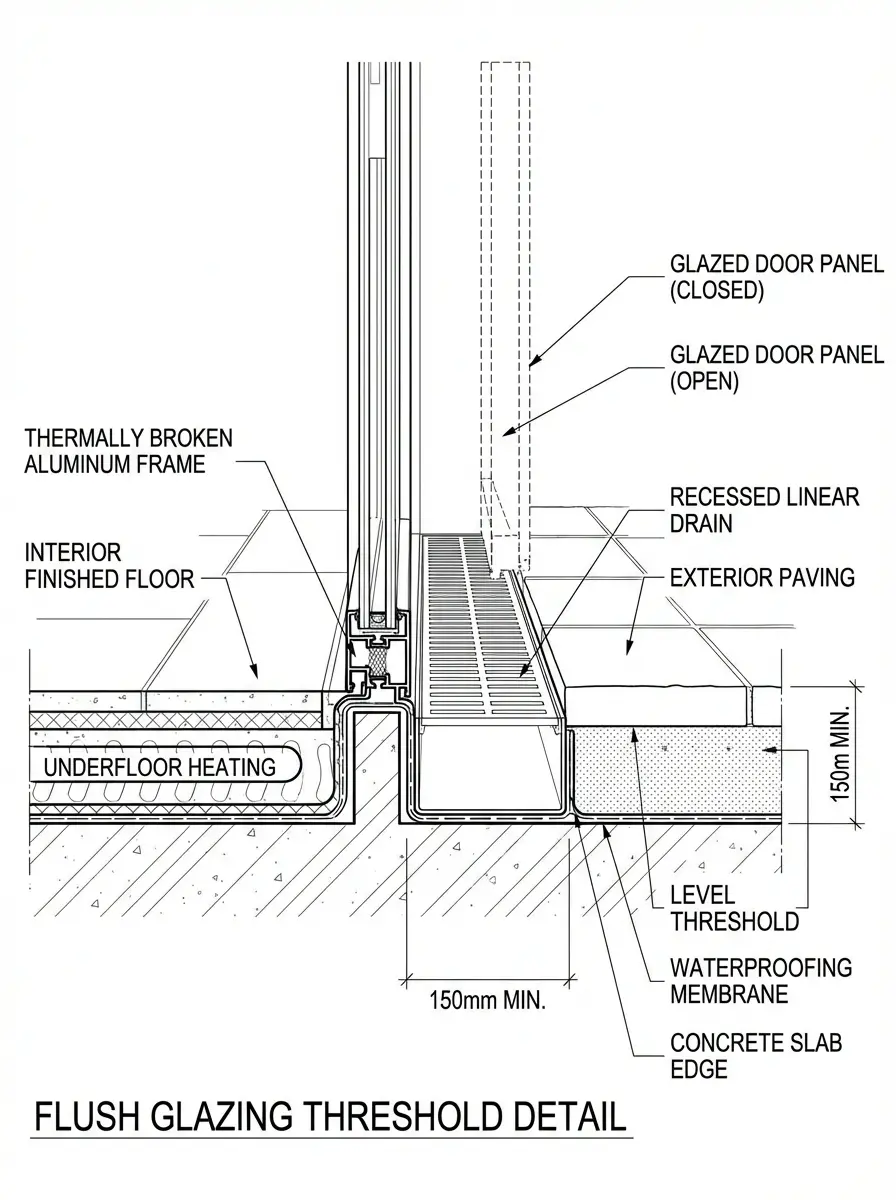
The detail that most residential glazing installations get wrong: the threshold. A small lip, a rubber seal that sits proud of the floor, a 10mm level change between inside and outside — any of these interrupts the visual and physical continuity that the glass wall is supposed to create. A truly flush threshold requires either a recessed drainage channel outside (to prevent water tracking back into the room) or a properly specified weathered sill that sits at floor level without a raised barrier. It costs slightly more to do correctly. It changes the feeling of the space every time you walk through it.
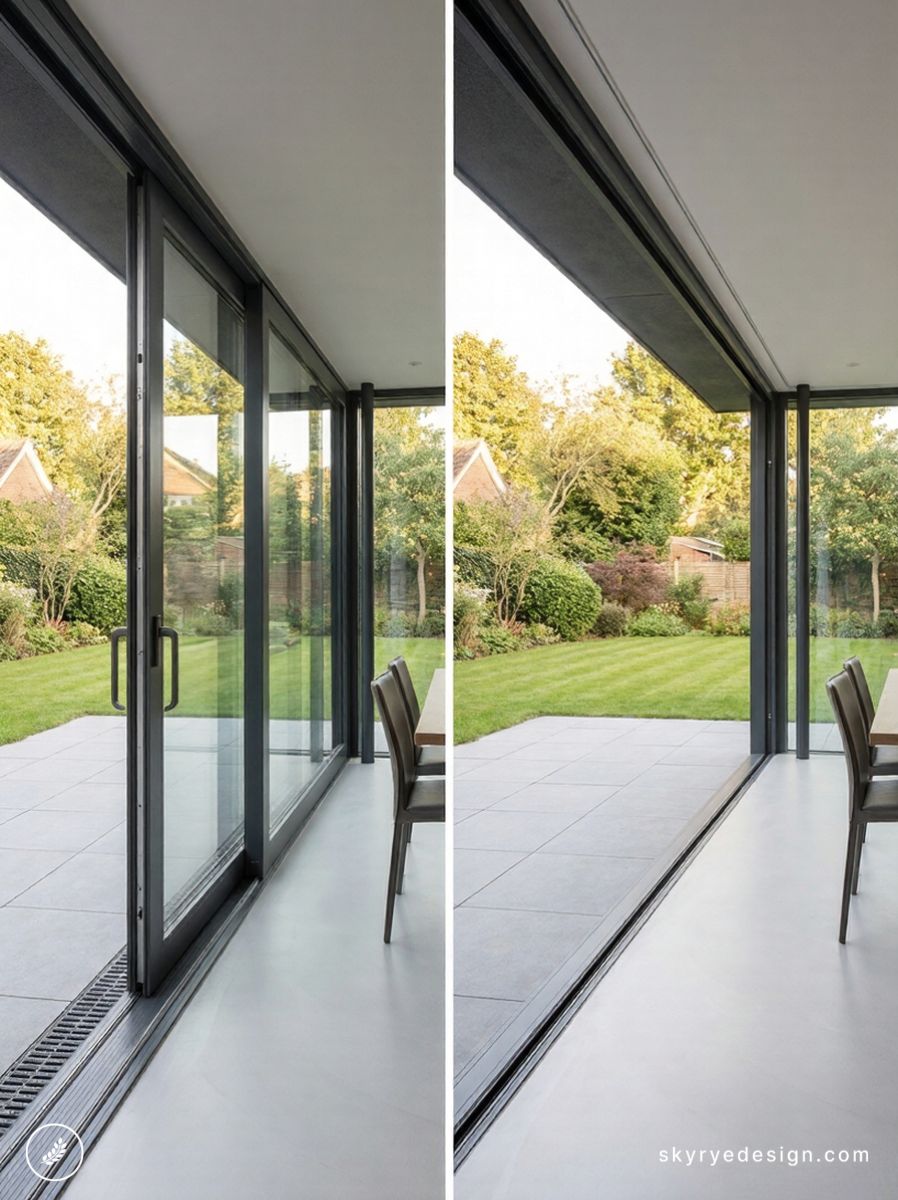
✏ Design note: The most cost-effective way to improve an existing sliding door installation without replacing the frame: replace the standard aluminium threshold strip with a recessed stainless steel drainage channel and a matching floor finish on the exterior side. This eliminates the level change and the visual interruption of the aluminium strip at roughly 15% of the cost of replacing the door system. The detail reads as intentional rather than default.
2. Floor Continuity: The Most Underestimated Design Decision
The floor is the surface you’re always in contact with. It’s also the surface that most directly communicates whether inside and outside are the same space or two different ones. Matching or closely coordinating the floor finish across the threshold — from the living room to the terrace to the pool deck — is the single design move with the highest visual impact relative to its cost.
The principle sounds simple. The execution has specific material requirements. The interior finish must be suitable for outdoor use (or the outdoor material must be suitable for interior use), the levels must align without a step, and the grout or joint between pavers must account for the different expansion rates between interior and exterior conditions.
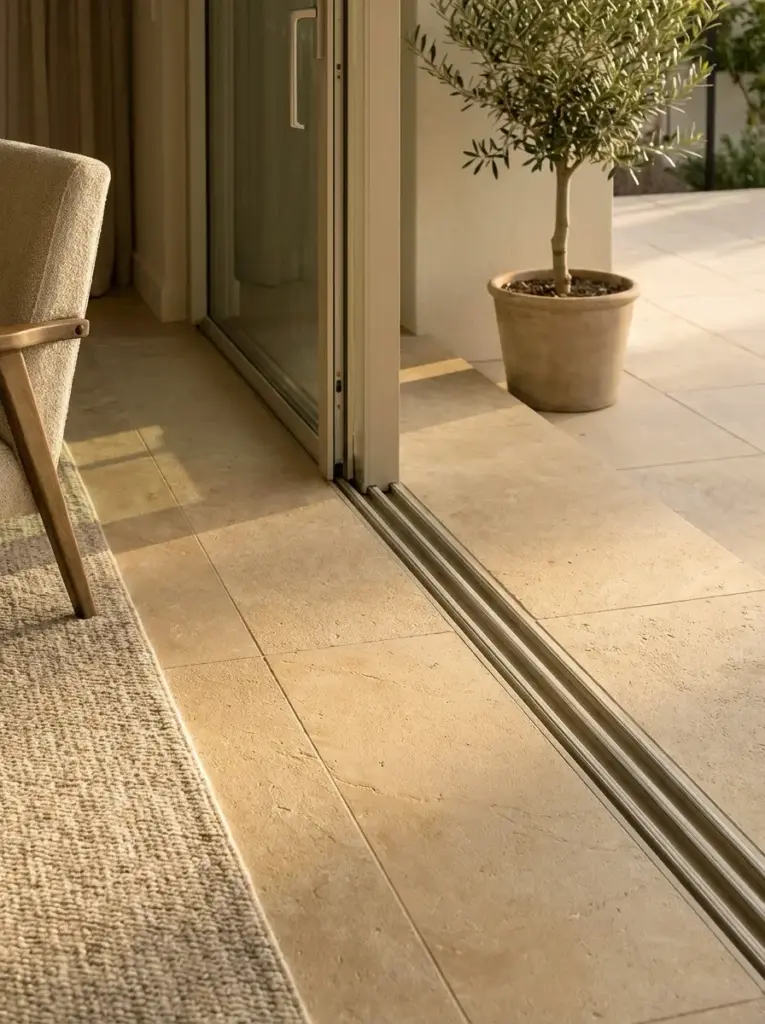
The materials that work best for this move are the ones that age honestly in both contexts: honed or brushed limestone, sandblasted concrete pavers, large-format porcelain (rated for outdoor use), brushed timber decking laid at the same height as interior boards, and riven slate. Polished marble and unsealed terracotta — beautiful inside — are both impractical for continuous indoor-outdoor use.
The Level Problem
Achieving a flush threshold between interior floor and exterior paving requires coordination between structural slab level, insulation, underfloor heating (if present), floor finish thickness, and exterior paving build-up — all resolved to a common finished floor level. In a renovation, this coordination is hardest because the existing slab level may not support the required build-up. The most common solution: a small external step down (100-150mm) that reads as a deliberate threshold rather than an accidental level change. A step into the garden is not the same as a flush threshold, but it is significantly better than an abrupt step of arbitrary height.
For homeowners with one eye on the market, floor continuity is one of those quiet details that separates properties that feel designed from ones that feel assembled. Real estate data consistently shows that cohesive indoor-outdoor presentation shortens time on market — it’s a recurring theme in practical guidance on the fastest way to sell a house: buyers respond to the sense of a larger, more considered home, and the flush threshold is one of the clearest signals of that quality.
✏ Design note: If you’re matching floor materials across an indoor-outdoor threshold, order both the interior and exterior finishes from the same batch or dye lot. Natural materials — stone, timber, concrete — vary between production runs. Matching tile from two different batches will read as two different colours in direct adjacency, which undermines the continuity effect the move is designed to create.
3. The Covered Outdoor Room: Between Inside and Outside
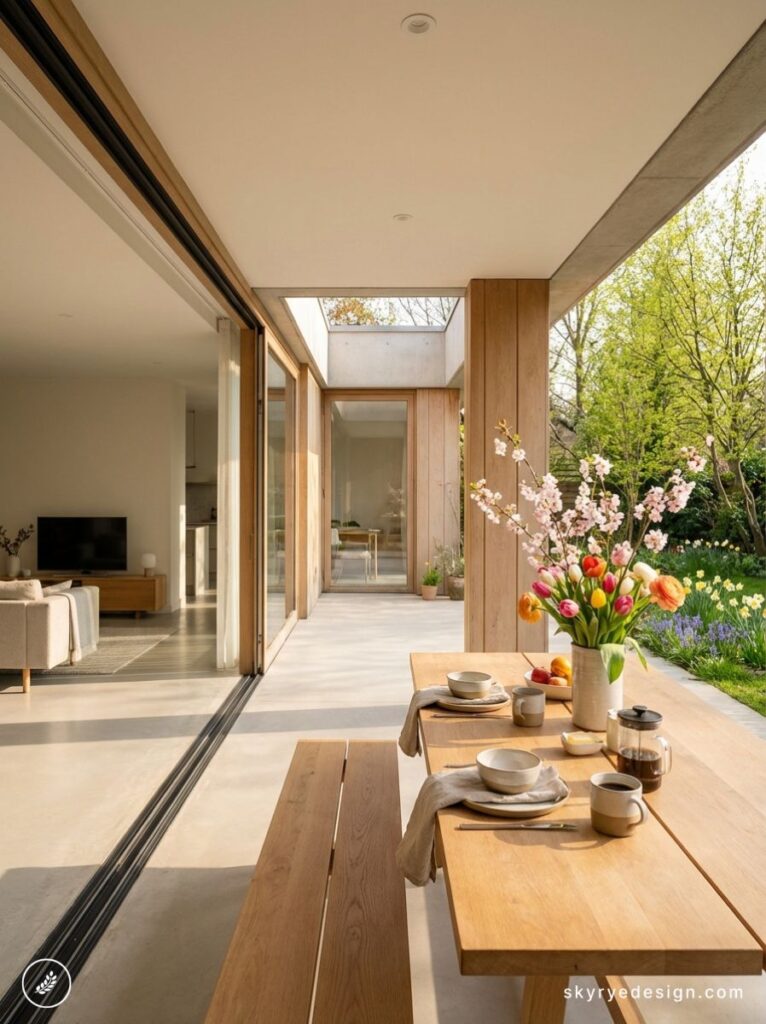
The most livable indoor-outdoor houses have a transitional zone between the fully enclosed interior and the open garden — a covered space that is neither wholly inside nor wholly outside. This is the covered outdoor room: a terrace, veranda, or pergola structure that provides protection from rain and direct sun while remaining connected to both the interior and the garden.
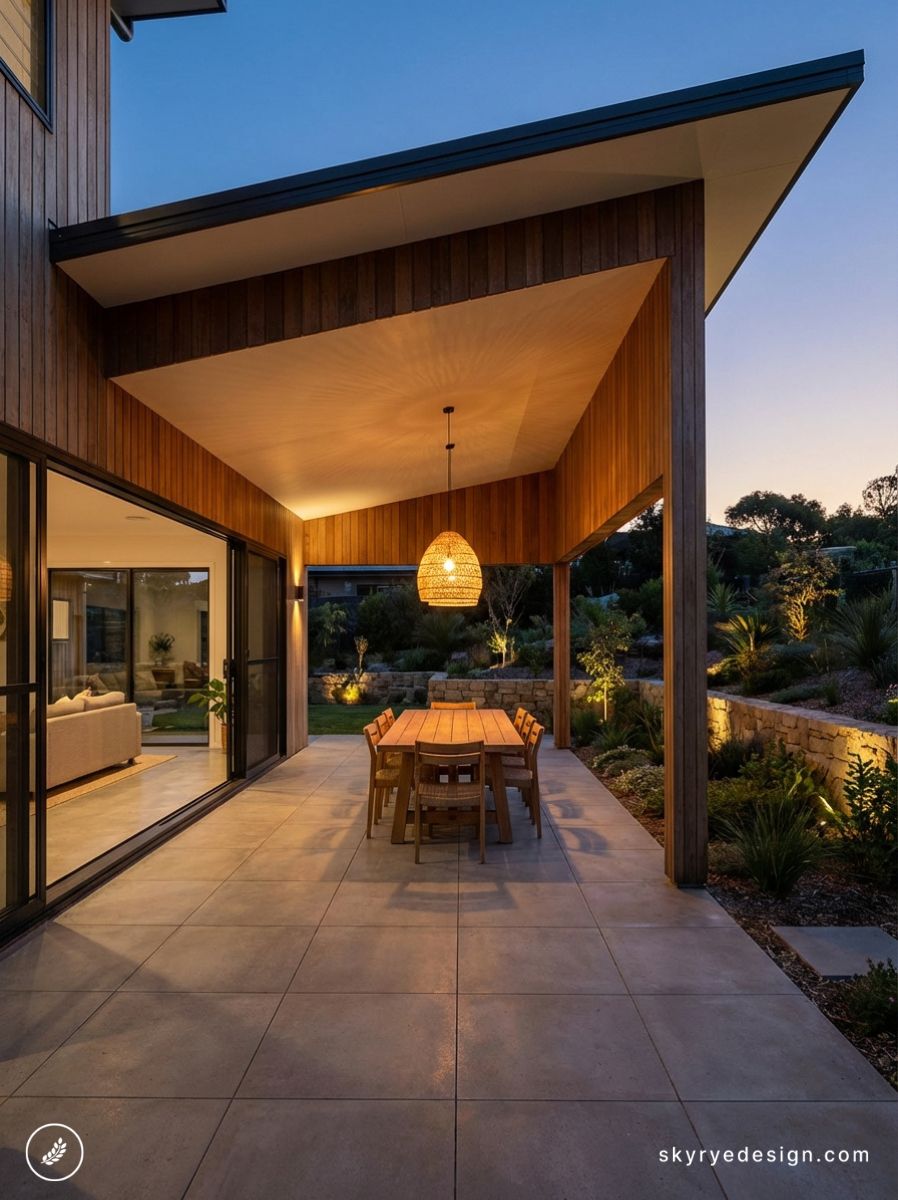
The architectural value of this zone is that it extends the usable living area across seasons. A covered outdoor dining area is usable on a hot summer day (shade), a warm spring evening (open to the breeze), a rainy autumn afternoon (protected from rain), and a cool winter lunch (sun penetration when the low sun angle clears the roof edge). An uncovered terrace is usable in a much narrower range of conditions.
The covered outdoor room is not an added luxury — it’s the difference between an outdoor space that’s used daily and one that’s used occasionally. This kind of flexibility matters beyond the design brief, too: homeowners who sell their home and rent it back while planning their next move consistently report that a well-designed outdoor room makes the rental period feel genuinely livable rather than temporary — the space absorbs daily life in a way that a bare patio simply doesn’t.
Roof Structure Options
The cleanest architectural solution is a skillion (mono-pitch) roof extension that reads as a continuation of the main house roofline rather than a separate structure. This requires the structural engineer to confirm that the existing roof can accept the extension load and that the new roof slope drains away from the house wall effectively. A skillion extension typically costs $800-1,500 per square metre in Australia depending on materials and complexity — significantly less than enclosed additional floor area, with a comparable improvement in usable living space.
The pergola alternative — timber or steel post-and-beam structure with open or battened roof — provides shade without rain protection. A quality pergola with a retractable fabric or polycarbonate roof panel gives the flexibility of both: open to the sky in good weather, protected when needed. The material choice matters for both aesthetics and maintenance: powder-coated aluminium requires almost no maintenance and holds its colour over decades; untreated timber requires periodic oiling or staining; galvanised steel develops a characteristic patina that reads well against natural garden planting.
Lighting the Covered Outdoor Room
After-dark usability is what separates a well-designed covered outdoor room from one that’s only functional in daylight. Recessed downlights in the roof soffit provide ambient illumination without visible fittings. A pendant or cluster of pendants over the dining table creates the same intimate light quality as an interior dining space. String lights along the structural beams give a warmer, more casual register. The most effective outdoor lighting schemes layer all three: ambient (downlights), task (pendant over table), and decorative (string lights or garden uplighting at the perimeter).
4. Landscaping and Architecture: Why They Should Be Designed Together
The most common mistake in residential outdoor design: the architecture is designed first, the building is constructed, and the landscaping is added afterward as a separate project by a different professional. This sequence produces gardens that fill the space left by the building rather than gardens that are part of the same spatial composition.
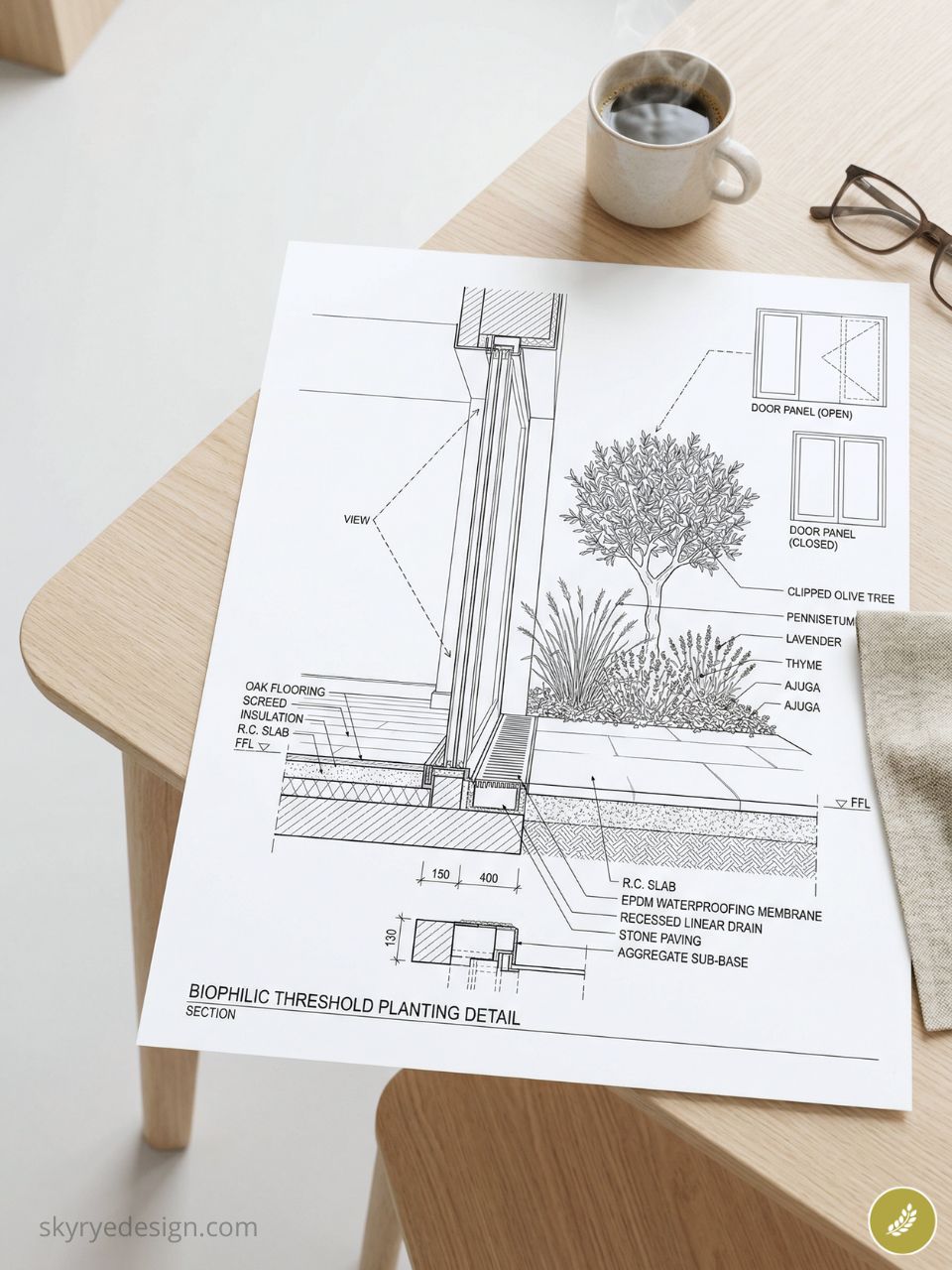
When architecture and landscape are designed together — which requires the landscape architect or garden designer to be engaged during the design development phase, not after practical completion — the garden frames views from interior rooms rather than obscuring them, planted areas reinforce the geometry of outdoor living zones rather than contradicting it, and plant selection considers the building’s aspect and the shadow patterns it casts rather than being specified in isolation.
Biophilic Principles at the Threshold
Biophilic design — the incorporation of natural elements to support human wellbeing — applies most directly at the indoor-outdoor threshold. Research associates views of natural planting with measurable reductions in cortisol levels and self-reported stress, particularly when the planting is visible from primary work and living areas. The design implication: a planted border at the edge of the covered terrace, visible from the main living area through the glazed wall, is not decoration — it’s a deliberate wellbeing intervention.
The specific planting that works best at the threshold: medium-height grasses and perennials that move in the breeze (providing kinetic interest), low ground cover that softens the paving edge without obscuring it, and one or two structural plants (a mature olive, a clipped box ball, a flowering magnolia) that provide year-round form. Native plantings have the additional advantage of requiring significantly less water and maintenance once established — an important consideration in Australian climates where summer water restrictions are increasingly common.
Water Features as Acoustic Design
A water feature at or near the indoor-outdoor threshold does more than look attractive. Running water masks urban noise — traffic, neighbours, mechanical plant — in a way that planting alone cannot.
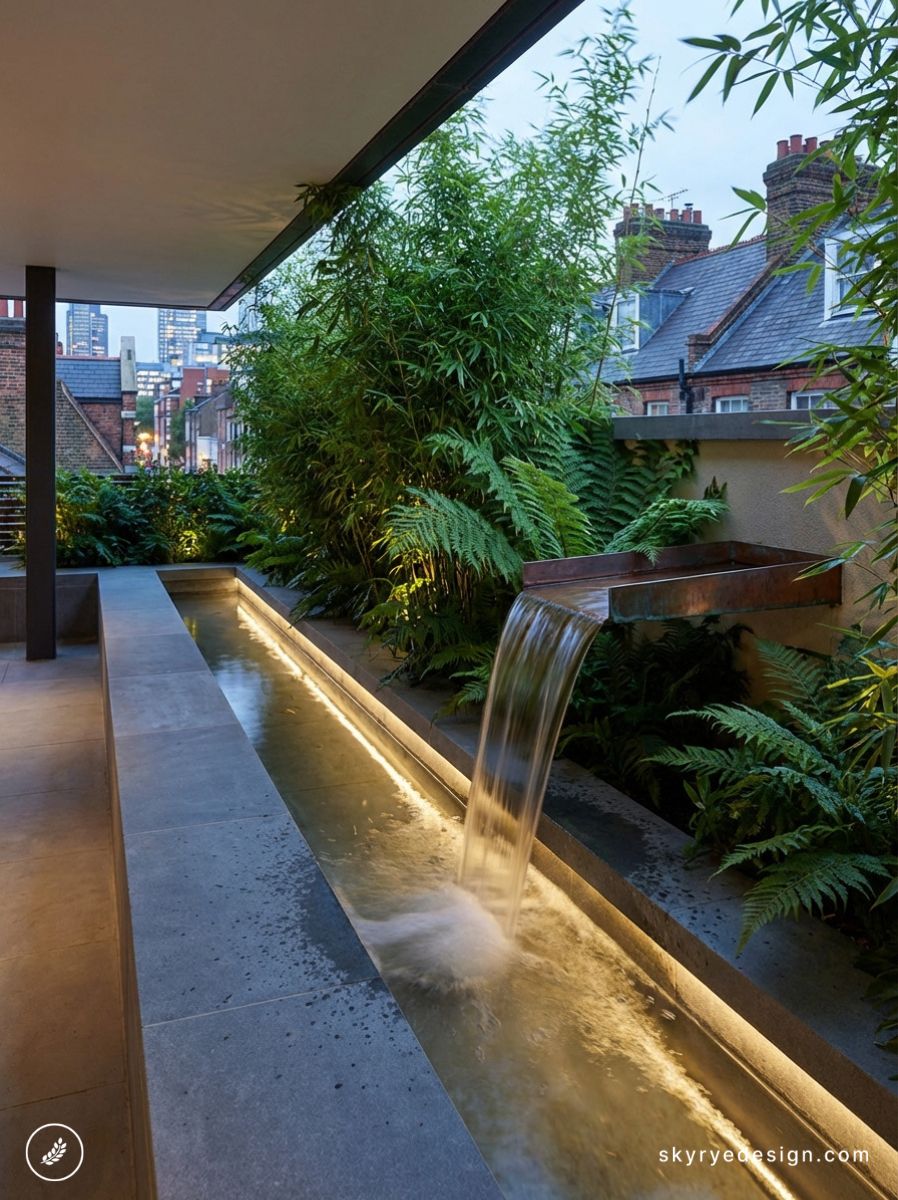
Even a modest recirculating water feature (a wall-mounted spout into a trough, a narrow rill running along the edge of the terrace) produces enough ambient acoustic coverage to make the outdoor space feel quieter and more private. In urban settings where outdoor privacy is limited, this acoustic quality can be the difference between an outdoor room that’s used as a regular living space and one that feels too exposed to be comfortable.
5. Passive Performance: Airflow, Shade, and the Thermal Boundary
The indoor-outdoor architecture that looks beautiful in photographs but is uncomfortable to use has failed at the level of environmental design. A glazed wall facing west produces an overheated interior every afternoon from October to April. A covered terrace with no overhead fans or cross-ventilation path is unusable on still summer days. A kitchen that opens to the north-facing terrace but has no operable window on the south side cannot generate the cross-flow needed to keep it cool.
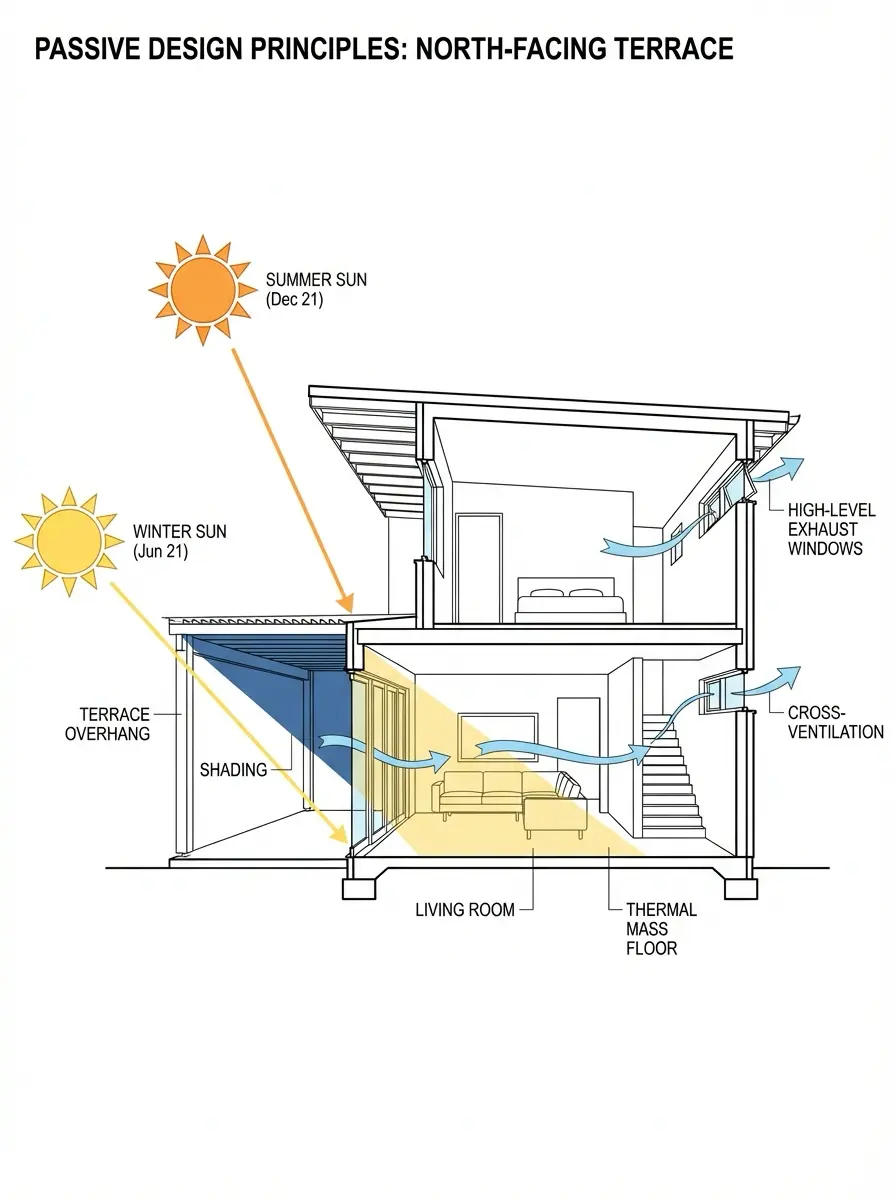
The environmental design of indoor-outdoor architecture starts with orientation. In Australia, north-facing living areas and terraces receive winter sun (low angle, penetrating deep into the room) and can be shaded from summer sun (high angle, excluded by a correctly sized overhang). The rule of thumb for overhang sizing: divide the window height by 2 to get the overhang depth required to shade the window at midday on the summer solstice while allowing winter sun to penetrate.
A 2.4m floor-to-ceiling window requires a 1.2m overhang. These numbers are approximations — a shadow analysis in the design software confirms the specific geometry for the site latitude.
Cross-Ventilation and Stack Effect
Natural ventilation through a house requires openings on both sides of the prevailing breeze path — inlet and outlet in the correct relationship. A large glazed wall that opens to the garden but has no complementary opening on the opposite side of the room creates a pocket of warm air rather than a cross-ventilation path. The simplest solution: operable highlight windows on the internal walls of the main living area, positioned high on the wall where warm air accumulates. When the outdoor glazing is open and the highlight windows are open, the warm air exits at high level and cooler outdoor air is drawn in through the low-level terrace opening.
Thermal Mass at the Threshold
Stone and concrete flooring at the indoor-outdoor threshold serves a double function: it provides the material continuity that makes the space feel connected, and it acts as thermal mass — absorbing heat during the day and releasing it slowly through the evening. In climates with significant temperature variation between day and night, this thermal flywheel effect keeps the covered outdoor room comfortable for longer after sunset.
Honed limestone and polished concrete are the most effective thermal mass materials that also read well aesthetically at the residential scale.
✏ Design note: The orientation of the outdoor room matters more than its size. A 12m² covered terrace facing north-east, catching the morning sun and the afternoon breeze, will be used more than a 30m² terrace facing west, which is unbearable from midday onwards. Assess the sun path and prevailing wind direction before fixing the location and orientation of the outdoor room in plan — these environmental factors determine usability far more than area alone.

Five Design Moves: Quick Reference
- Glazed opening: Stacking slide or lift-and-slide for the clearest span. Flush threshold with recessed linear drain. Slim sightline system (Schüco, Internorm) for maximum glass-to-frame ratio. Level coordination resolved with structural engineer before documentation.
- Floor continuity: Same material or closely coordinated finish inside and out. Honed limestone, brushed concrete, outdoor-rated large-format porcelain, or brushed timber decking. Order from same batch. Coordinate levels across threshold during design development, not at construction.
- Covered outdoor room: Skillion roof extension as the cleanest solution. Confirm structural capacity with engineer. Layer lighting: ambient downlights, task pendant, decorative string or garden lights. Retractable roof panel for flexibility in pergola structures.
- Landscape and architecture together: Engage landscape designer during design development phase. Planted border at terrace edge visible from interior. Native species for low maintenance. Water feature for acoustic privacy in urban settings. Views from primary living areas framed, not obstructed, by planting.
- Passive performance: North-facing orientation for Australian sites. Overhang depth = window height ÷ 2 as rule of thumb. Cross-ventilation requires inlet and outlet — operable highlight windows on opposite wall. Thermal mass at threshold: stone or concrete for heat storage.
FAQ: Indoor-Outdoor Architecture for Spring
Q: What is indoor-outdoor flow in architecture?
Indoor-outdoor flow is the architectural quality that makes the transition between interior rooms and exterior spaces feel continuous rather than abrupt. It requires aligned floor levels, material continuity, large glazed openings, and a covered transitional zone between the fully enclosed interior and the open garden. Good indoor-outdoor flow makes a house feel larger, more connected to its site, and significantly more usable across seasons.
Q: What glass doors work best for indoor-outdoor connection?
Stacking sliding doors and lift-and-slide systems provide the largest unobstructed opening — 3 to 6 metres of clear span with no intermediate posts. Bi-fold doors open more of the wall but leave panels stacked at the ends. For maximum visual connection when closed, slim-sightline European systems (Schüco, Internorm, Cortizo) allow the view to read as continuous glass rather than framed panels. The threshold detail — flush with no lip or level change — matters as much as the glazing system itself.
Q: Does indoor-outdoor design increase property value?
Research consistently shows that cohesive indoor-outdoor design increases both perceived and appraised property value. The improvements with the strongest return: an outdoor entertaining area connected to the main living zone, material continuity across the threshold, and covered outdoor space that extends usability across seasons. Properties with strong indoor-outdoor flow generate more buyer interest and shorter days on market — though as any agent will confirm, the design quality needs to be supported by good timing and presentation to translate into the best outcome.
Q: What is biophilic design?
Biophilic design incorporates natural elements — light, plants, water, natural materials, views of nature — into the built environment to support human wellbeing. Research associates biophilic environments with reduced cortisol levels, improved focus, and lower self-reported stress. In spring renovations, it applies most directly to maximising natural light through larger glazed openings, introducing framed garden views from primary living areas, selecting natural materials that age honestly, and integrating planting at the indoor-outdoor threshold.
Q: What roofing works best for a covered outdoor room?
A skillion (mono-pitch) roof extension that reads as a continuation of the main house roofline is the cleanest architectural solution — it reads as part of the house, not an addition. Insulated panel roofing provides the best thermal comfort for year-round use. Polycarbonate or clear glazed panels allow light while providing rain protection. A retractable fabric system over a pergola structure provides the most flexibility: open to the sky in good weather, protected when needed.
- 5shares
- Facebook0
- Pinterest5
- Twitter0
- Reddit0