Safety on the road is paramount, especially when it comes to sharing it with motorcycles. Motorcycles are agile and quick, which often makes them more difficult to spot. As a result, it’s crucial to adapt driving habits and maintain a keen awareness of motorcyclists to ensure everyone’s safety. This article provides essential tips to share the road safely with motorcycles, focusing on alertness, maintaining adequate distances, and anticipating movements.
- Staying Alert and Checking Blind Spots
- Maintaining Safe Following and Passing Distance
- Anticipating Motorcycle Movements and Road Conditions
- The Design Intelligence Behind Motorcycle Visibility
- Road Design and the Motorcycle Safety Problem
- FAQ: Sharing the Road Safely with Motorcycles
- Q: How much following distance should I keep behind a motorcycle?
- Q: Why are motorcycles so hard to see in traffic?
- Q: What should I do before changing lanes near a motorcycle?
- Q: Why do motorcyclists move around within their lane?
- Q: Is it safe to pass a motorcycle on a two-lane road?
- Q: Do motorcycles need more stopping distance than cars?
Staying Alert and Checking Blind Spots
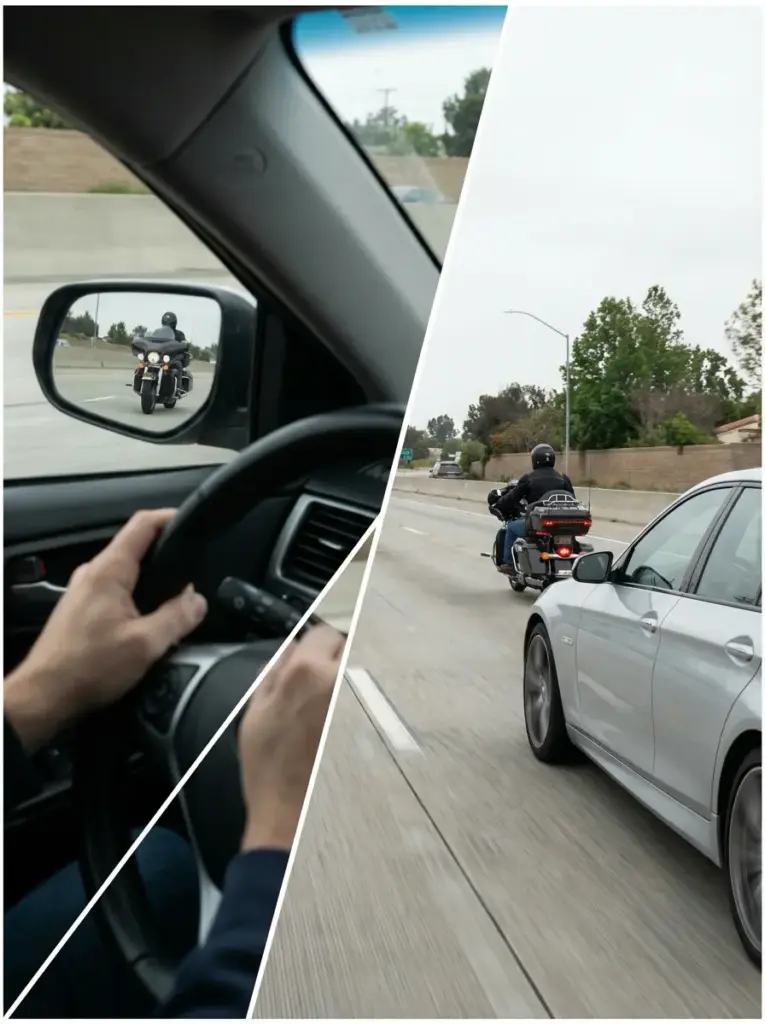
When driving, staying alert is not just about observing the road ahead; it involves being aware of the surroundings on all sides. Motorcycles, being smaller than other vehicles, can easily slip into a driver’s blind spot. Hence, every driver should cultivate the habit of regularly checking their mirrors and turning their head to check blind spots before changing lanes.
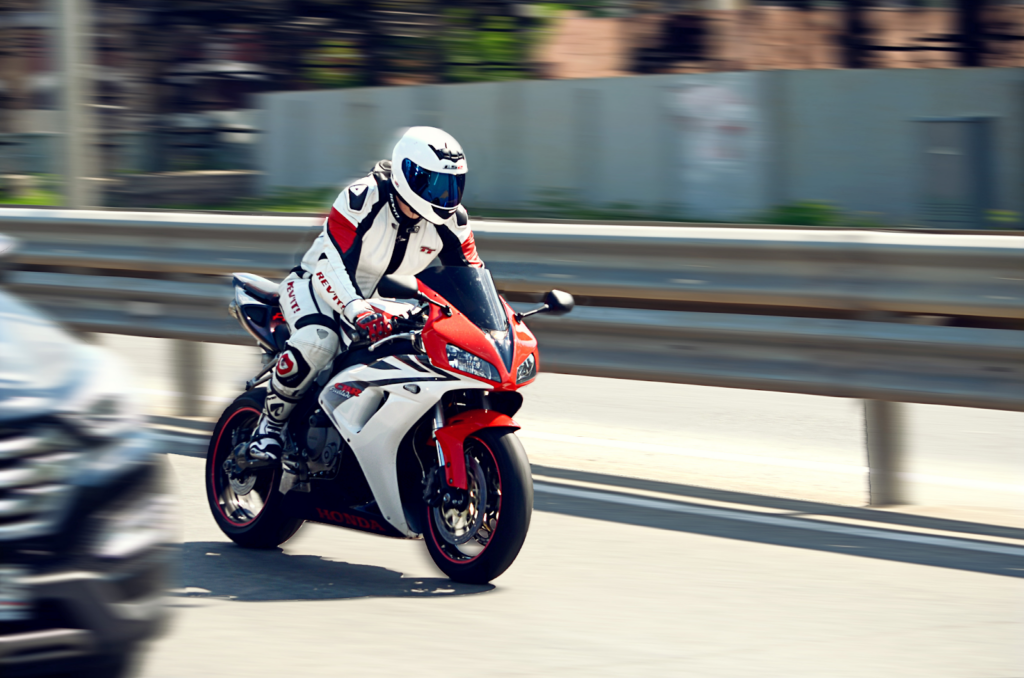
A significant advantage of motorcycles is their ability to maneuver through traffic; however, this can be a double-edged sword. Although motorcycles make up only 3 percent of all registered vehicles in the U.S., they account for 15 percent of traffic fatalities. Thus, drivers need to be extra vigilant, and anticipate that a motorcycle might be closer than expected when planning a lane change.
It’s important for drivers to avoid distractions inside the car, concentrate on the road, and focus on spotting motorcycles. According to Wisconsin.gov, no person may operate a motorcycle when carrying a passenger under 18 years of age unless the passenger is wearing protective headgear. This underscores the importance of protective measures, and drivers of other vehicles can complement these efforts by maintaining vigilance.
Maintaining Safe Following and Passing Distance
Keeping a safe distance when following a motorcycle is critical. Motorcycles can stop more suddenly than larger vehicles, and following too closely might not allow enough time to react safely. A good rule of thumb is to maintain at least a four-second following distance to ensure ample time to respond if the motorcyclist needs to brake unexpectedly.
When overtaking a motorcycle, treat it as you would any other vehicle, giving it a wide berth. Angling the rear-view mirror to better spot motorcycles can enhance spatial awareness. Passing too closely can be intimidating for motorcyclists, potentially affecting their balance or causing them to swerve.
Drivers should apply measured speed adjustment when passing motorcycles to avoid sudden maneuvers that could unsettle a nearby rider. Utilize indicators well in advance to communicate intentions clearly. Such practices not only ensure adherence to safe automotive conduct but enhance road compatibility amongst different vehicle types.
Anticipating Motorcycle Movements and Road Conditions
Understanding the unique challenges motorcyclists face can significantly enhance road-sharing abilities. They are more vulnerable to weather changes and road conditions than cars. Anticipating their reactions to potholes, puddles, and obstacles by giving them space and time can prevent accidents.
Motorcycles are more sensitive to changes in road surfaces and can become unstable over gravel or slippery patches. According to HG.org, auto accidents are one of the most common types of personal injury cases in Texas. Proactive and defensive driving ensures an accommodating environment for all road users, reducing accident risks.
Being aware that motorcycles may need to avoid sudden hazards by swerving can help drivers maintain proper space and understanding. Approaching intersections with caution helps account for motorcyclists potentially accelerating quickly to merge or switch lanes. Taking these precautions promotes a safer driving environment for all parties involved.
In conclusion, sharing the road safely with motorcycles requires constant alertness, maintaining appropriate distances, and understanding their potential movements. By being proactive and considerate, you contribute not just to the safety of motorcyclists but also enhance your own security and that of other road users. A collective effort towards adopting cautious driving habits leads to a more harmonious and fewer accident-prone road experience for everyone.
The Design Intelligence Behind Motorcycle Visibility
There’s a reason automotive designers spend considerable effort on motorcycle visibility — and it’s not purely aesthetic. The visual footprint of a motorcycle is approximately 1/8th the frontal area of a standard car, which means the cognitive processing load required to detect one in peripheral vision is fundamentally different from detecting another car. This is not a failure of attention; it’s a predictable outcome of how the human visual system processes objects by size and contrast.
Contemporary motorcycle design has responded to this challenge directly. High-visibility colour strategies — the distinctive acid yellow of many European traffic police motorcycles, or the retroreflective panel integration on modern sportsbikes — are engineering decisions as much as aesthetic ones. Headlight signature design has become a primary brand differentiator for manufacturers like Ducati and BMW Motorrad, partly because a distinctive light pattern is more quickly processed by the human visual system than a generic round or rectangular lamp. The DRL (daytime running light) signatures on the BMW R 1250 GS or the Ducati Panigale V4 are designed to be recognisable at distance specifically because recognition speed translates directly to reaction time.
For drivers of other vehicles, understanding this design context is practically useful: the more distinctive a motorcycle’s light signature, the more quickly your visual system will identify it in traffic. A motorcycle with a strongly differentiated headlight pattern — an angular LED signature, an asymmetric DRL — is easier to spot in your peripheral vision than one with a conventional round headlight. Training yourself to recognise these signatures makes you a more responsive driver in mixed traffic.
Road Design and the Motorcycle Safety Problem
Much of what makes shared road use dangerous for motorcyclists is not the behaviour of other drivers but the physical design of the road infrastructure itself — designed primarily around four-wheeled vehicle dynamics, often to the detriment of two-wheeled ones.
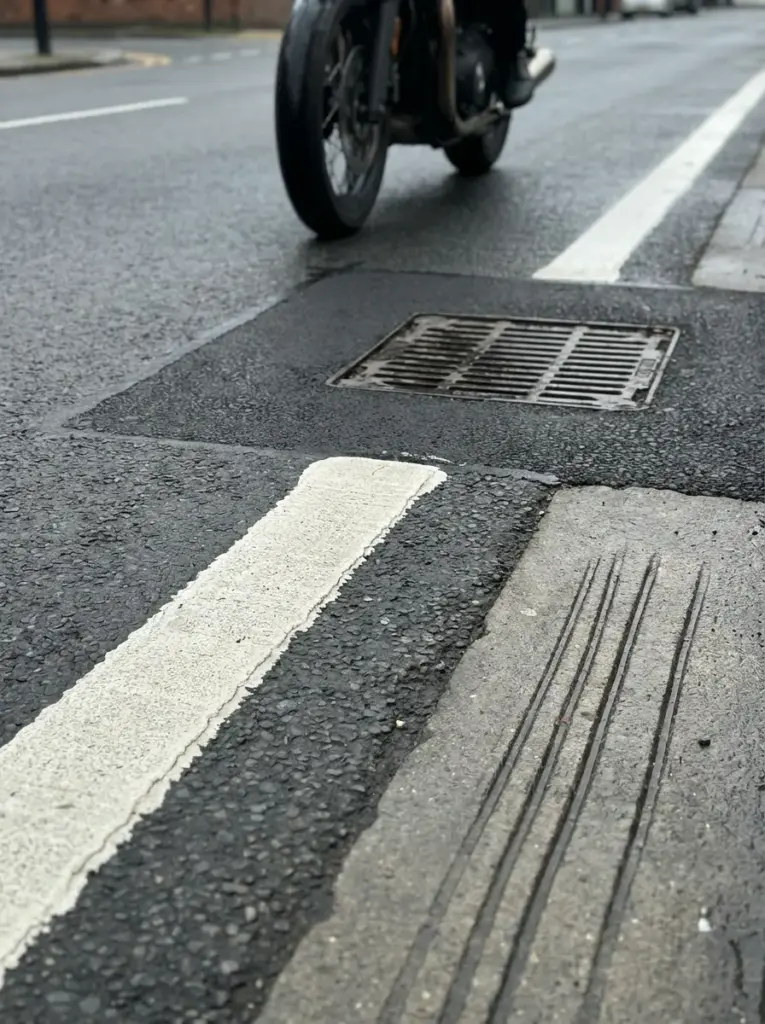
Road surface quality is the clearest example. The longitudinal grooves cut into concrete highway surfaces to improve car traction in wet conditions create a lateral instability problem for motorcycles — the grooves cause the front wheel to track unpredictably, requiring constant countersteering input that fatigues riders over distance. Similarly, the expansion joints between concrete road sections that cars cross without noticing can cause significant front wheel deflection on a motorcycle at highway speed.
Lane markings and paint are another underappreciated hazard. Thermoplastic road markings — the white lines and arrows painted on road surfaces — become extremely slippery when wet, approaching the friction coefficient of ice at certain temperatures. A driver in a car crossing a painted stop bar in the rain loses almost no traction. A motorcyclist braking across the same surface in the same conditions may experience front wheel lockup.
Understanding these infrastructure realities makes sharing the road more intuitive. When a motorcyclist moves laterally within their lane to avoid a drain cover, a painted line, or a surface change — a movement that can appear erratic to drivers expecting straight-line tracking — they’re responding to real physical inputs. The design of the road is communicating with the motorcycle in ways it simply doesn’t communicate with a car. Recognising this changes how you interpret motorcycle movement and allows you to anticipate rather than react.
FAQ: Sharing the Road Safely with Motorcycles
Q: How much following distance should I keep behind a motorcycle?
Maintain at least a four-second following distance — more than you’d keep behind a car. Motorcycles can brake faster than most drivers expect, and their brake lights are smaller and easier to miss in bright daylight. In wet conditions or on roads with poor surface quality, extend this to six seconds. Count from when the motorcycle passes a fixed point (a road sign, a lamppost) to when your front bumper reaches the same point.
Q: Why are motorcycles so hard to see in traffic?
The frontal area of a motorcycle is approximately 1/8th that of a standard car, which means your visual system processes it differently — it registers more slowly in peripheral vision and can disappear completely into a car’s A-pillar or door frame at certain angles. Motorcycles also move through gaps in traffic that your brain doesn’t expect a vehicle to occupy, which is why the most common driver error in motorcycle accidents is “looked but failed to see” — the driver checked the mirror but the motorcycle wasn’t where their expectation was focused.
Q: What should I do before changing lanes near a motorcycle?
Check your mirrors, signal, wait two seconds, then physically turn your head to check the blind spot — in that order, every time. The physical head turn is non-negotiable because mirrors have a blind spot that is exactly the size and shape of a motorcycle at typical following distances. Signal early to give the motorcyclist time to adjust their position before you begin the lane change.
Q: Why do motorcyclists move around within their lane?
Lane positioning is an active safety tool for motorcyclists, not erratic behaviour. They move to improve their own visibility to other drivers, to avoid road surface hazards (drain covers, painted markings, expansion joints, gravel), to maximise their own sightline around bends, and to position themselves where they’re least likely to be in another driver’s blind spot. When a motorcyclist shifts laterally, they’re responding to something — give them space rather than closing the gap.
Q: Is it safe to pass a motorcycle on a two-lane road?
Only when you have a clear, long sightline ahead and sufficient space to give the motorcycle a full car-width of passing clearance — not just enough to technically fit past. Passing too closely at speed creates a pressure wave that can destabilise the motorcycle. Use your indicator well in advance, pass at a consistent speed (don’t accelerate hard mid-pass), and don’t pull back in front of the motorcycle until you can see both headlights in your rear-view mirror.
Q: Do motorcycles need more stopping distance than cars?
Not necessarily — a well-maintained modern motorcycle with ABS can stop in a shorter distance than many cars. The issue is that motorcycle braking is less visible to following drivers: the brake light is smaller, the rear of the vehicle doesn’t dip noticeably like a car’s, and the motorcycle may be stopping from a speed that didn’t look fast because the vehicle is small. The four-second following rule accounts for your reaction time, not the motorcycle’s stopping distance.
- 0shares
- Facebook0
- Pinterest0
- Twitter0
- Reddit0