Start with a clear pallet furniture plan
If you are drawn to pallet furniture DIY, you are in good company. Pallets are everywhere, the wood is usually free, and you can turn a single stack into benches, tables, planters, and more. With a little planning, your pallet projects can look intentional, not like leftovers from a loading dock.
You will walk through a full pallet furniture DIY process in this guide, from finding safe pallets to finishing your first garden seat. Along the way you will see specific tools, safety checks, and build steps drawn from hands-on tutorials and real makers.
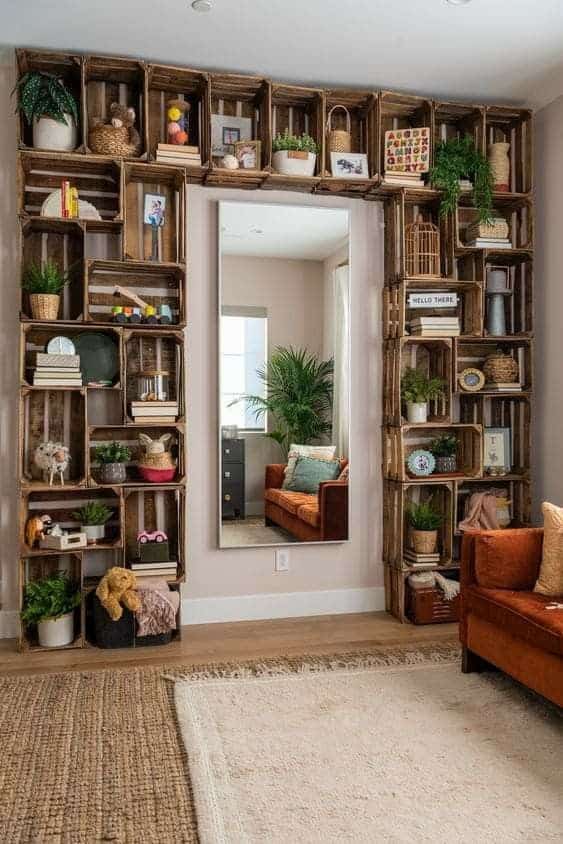

By the end, you will be ready to:
- Pick safe, usable pallets for indoor or outdoor furniture
- Break them down with or without power tools
- Prep and treat the wood so it lasts outside
- Build a simple pallet garden sofa as your first project
- Finish, paint, or stain your piece so it looks polished
Keep a notebook or notes app handy. As you read, jot down which pallet ideas you want to try first: a bench, a coffee table, a planter, or a full outdoor lounge set.
Gather your pallet DIY tools and safety gear
Before you pick up your first pallet, set yourself up with the right pallet furniture DIY tools. You do not need a full carpentry shop, but you do need basic gear for safety, deconstruction, building, and finishing.
DIY educator Vashon Borich-Leach, known as The T.U.F.F. Momma, breaks essential pallet tools into phases like safety, deconstruction, measuring, building, finishing, and saws (T.U.F.F. Momma Blog). Use that same structure as a checklist.
Safety gear first
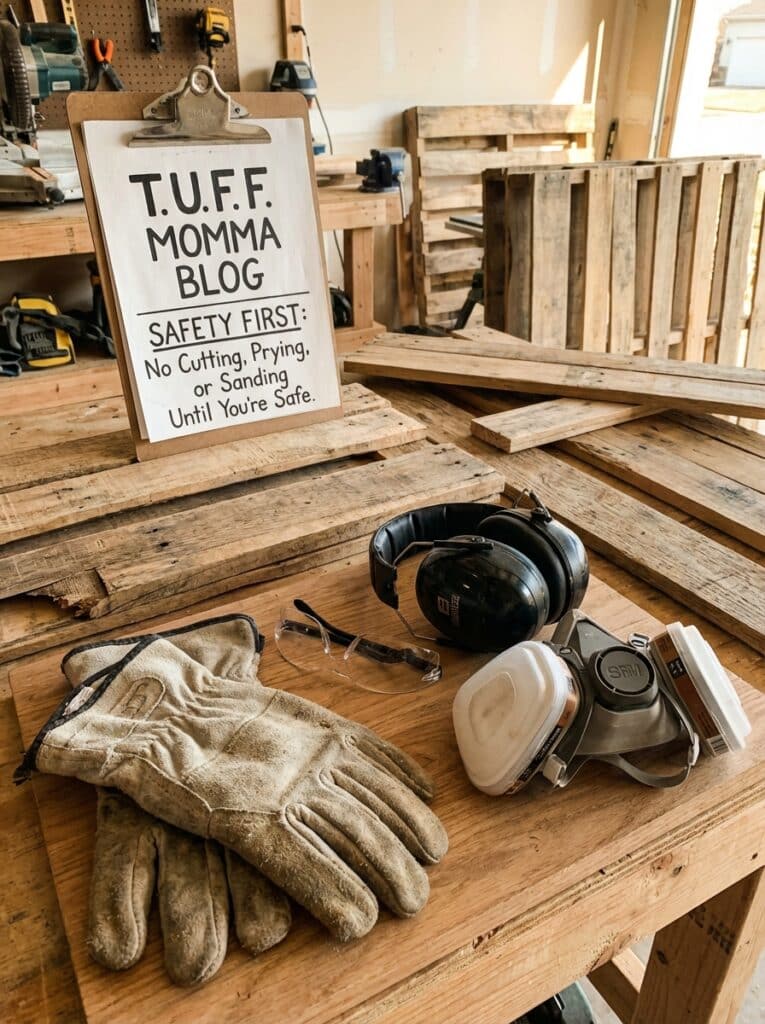
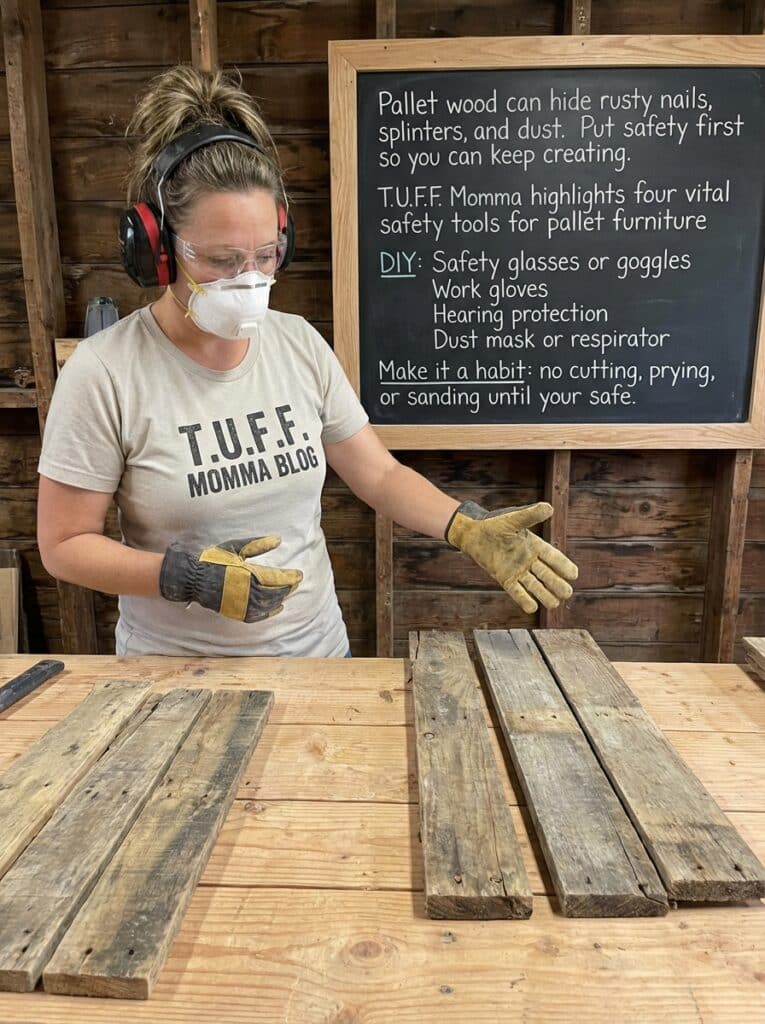
Pallet wood can hide rusty nails, splinters, and dust. Put safety first so you can keep creating. T.U.F.F. Momma highlights four vital safety tools for pallet furniture DIY (T.U.F.F. Momma Blog):
- Safety glasses or goggles
- Work gloves
- Hearing protection for saws and nail guns
- Dust mask or respirator for sanding and cutting
Make it a habit: no cutting, prying, or sanding until your safety gear is on.
Tools for deconstructing pallets
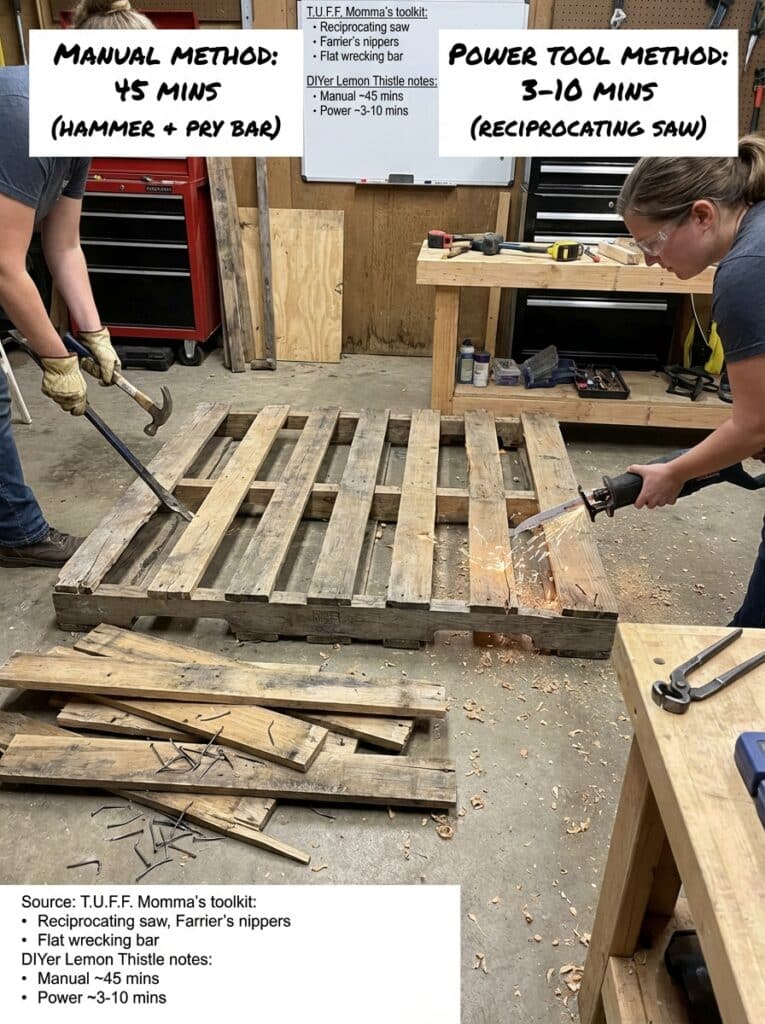
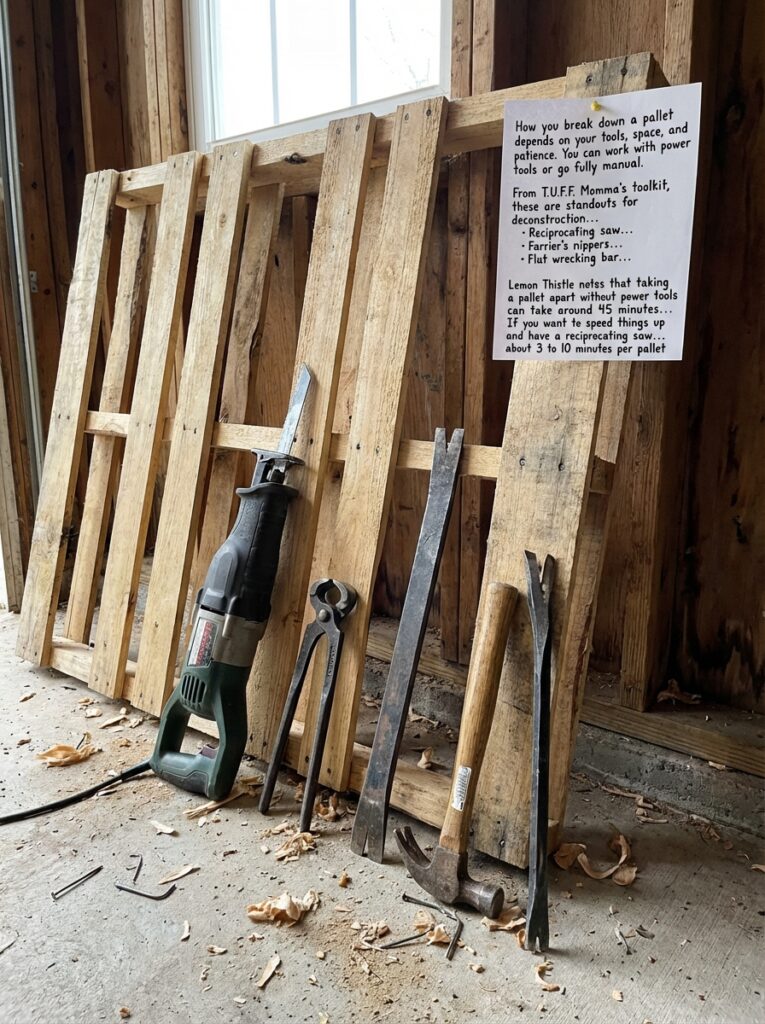
How you break down a pallet depends on your tools, space, and patience. You can work with power tools or go fully manual.
From T.U.F.F. Momma’s toolkit, these are standouts for deconstruction (T.U.F.F. Momma Blog):
- Reciprocating saw (often sold as a Sawzall) with metal cutting blades
- Farrier’s nippers for pulling or snipping stubborn nails
- Flat wrecking bar for prying boards with less damage
DIYer Lemon Thistle notes that taking a pallet apart without power tools can take around 45 minutes with mainly a hammer and pry bar (Lemon Thistle). That is slow but practical if you do not have space or budget for bigger tools.
If you want to speed things up and have a reciprocating saw, you can cut through the nails and drop that time to about 3 to 10 minutes per pallet (Lemon Thistle).
Core building tools

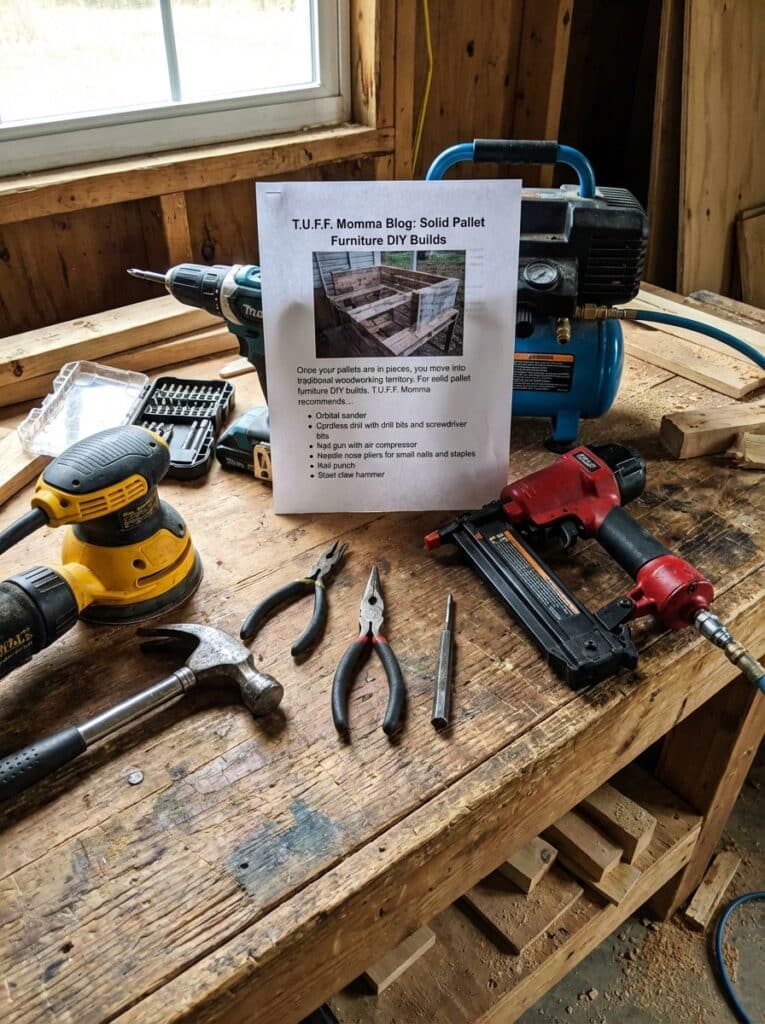
Once your pallets are in pieces, you move into traditional woodworking territory. For solid pallet furniture DIY builds, T.U.F.F. Momma recommends (T.U.F. Momma Blog):
- Orbital sander
- Cordless drill with drill bits and screwdriver bits
- Nail gun with air compressor, if your budget allows
- Needle nose pliers for small nails and staples
- Nail punch
- Steel claw hammer
You can build an entire project with just a drill, hammer, and screws. A nail gun simply makes the process faster once you are comfortable.
Saws to make clean cuts
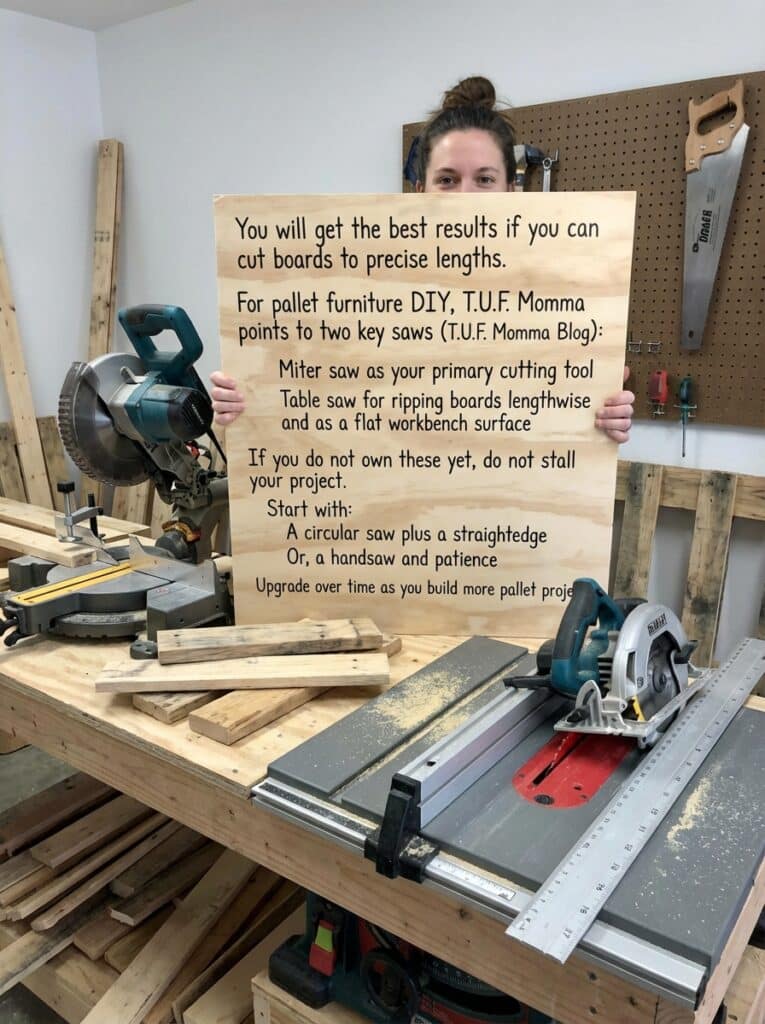
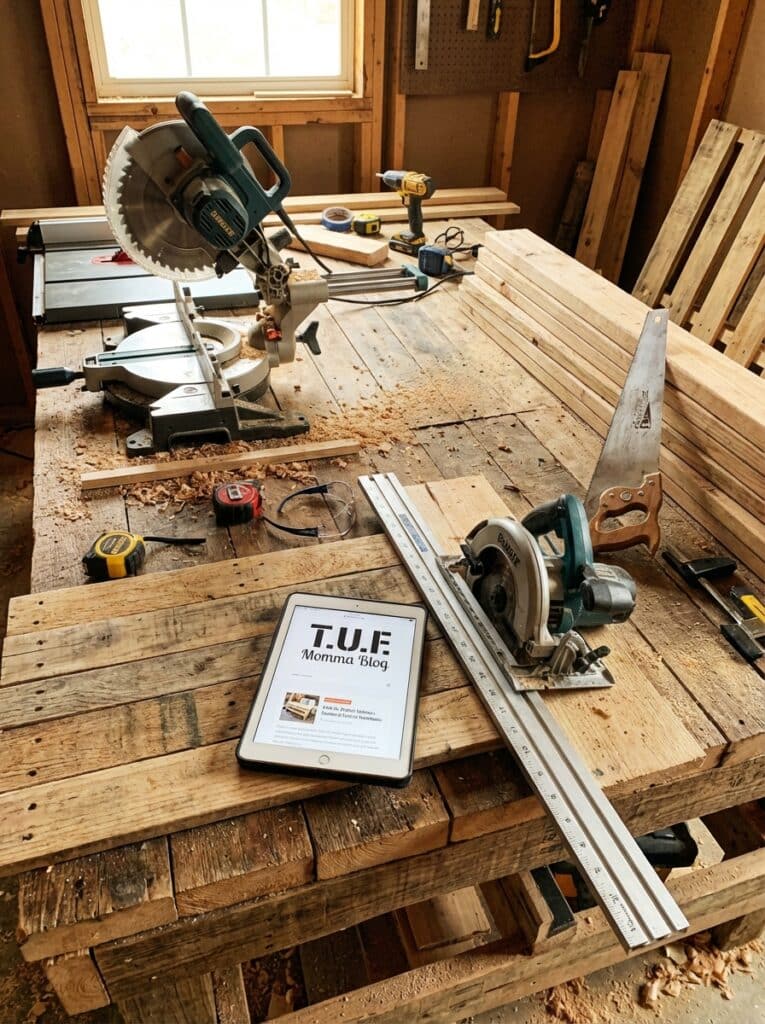
You will get the best results if you can cut boards to precise lengths. For pallet furniture DIY, T.U.F. Momma points to two key saws (T.U.F. Momma Blog):
- Miter saw as your primary cutting tool
- Table saw for ripping boards lengthwise and as a flat workbench surface
If you do not own these yet, do not stall your project. Start with:
- A circular saw plus a straightedge
- Or, a handsaw and patience
Upgrade over time as you build more pallet projects.
Choose safe, high quality pallets
Not all pallets are safe or pleasant to work with. Before you bring any home, look them over as carefully as you would a piece of lumber at a store.
A 2024 pallet furniture DIY guide from GardenBenches.com calls out two straightforward safety rules (GardenBenches.com):
- Prefer pallets made of pine or oak. They absorb paint well and are easier to handle.
- Avoid pallets marked “MB” and bright, painted pallets. These can contain harmful chemicals.
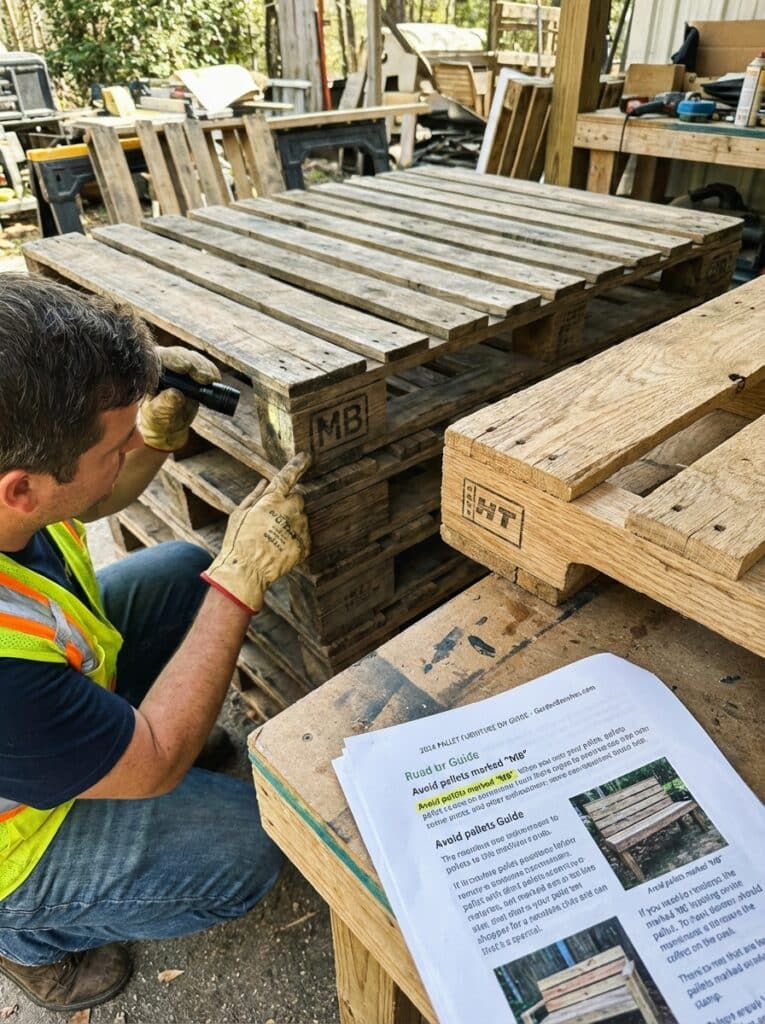

Decode pallet stamps
Look for a stamp on the side of the pallet stringer. It often shows:
- Country code
- Treatment type
- Other handling info
The key code to look for is the treatment type.
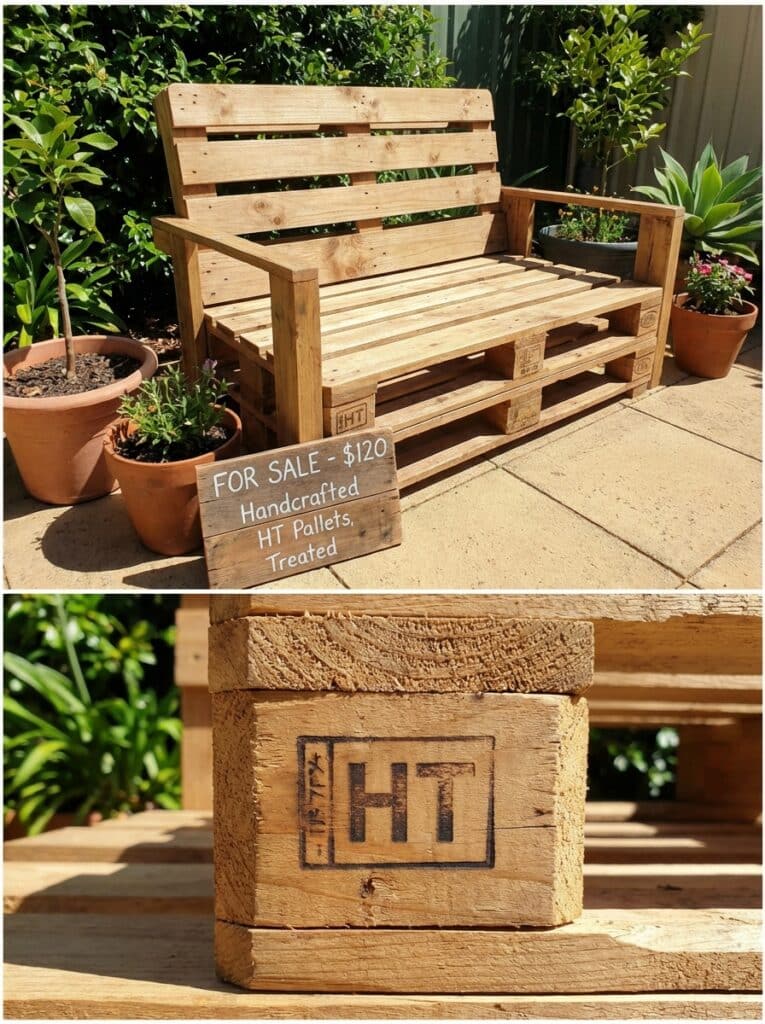
- “HT” means heat treated. These pallets are safer for garden furniture and many indoor projects, since they are not treated with chemical fumigants (GardenBenches).
- “MB” means methyl bromide. Skip these completely, especially for anything that will sit in your yard or near food (GardenBenches.com).
If you cannot read a stamp and the pallet looks heavily stained, soaked, or painted bright colors, do not use it. There are plenty of cleaner options.
Inspect wood quality
Once you have passed the safety checks, look closer at the physical condition. Avoid pallets that are:
- Cracked through main structural boards
- Rotten or soft to the touch
- Warped so badly they will never sit flat
- Packed with nails that have torn the wood to shreds
Save heavily damaged pallets for small projects like planters or rustic wall art where short, imperfect pieces work fine.
Break down pallets without ruining the boards
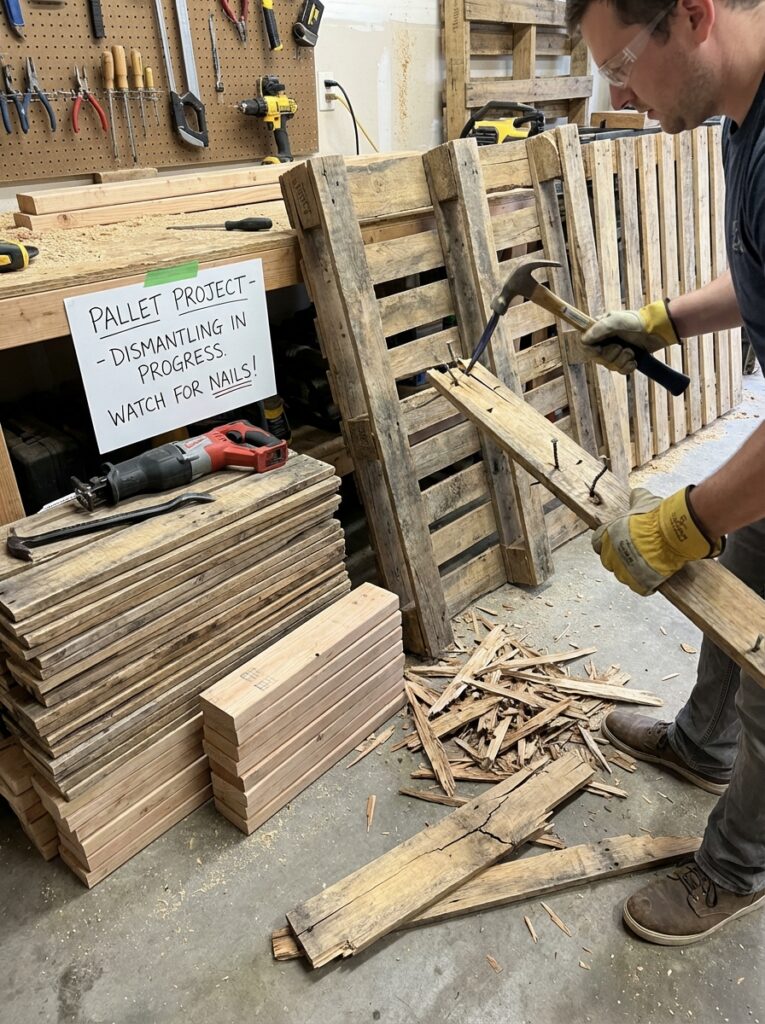
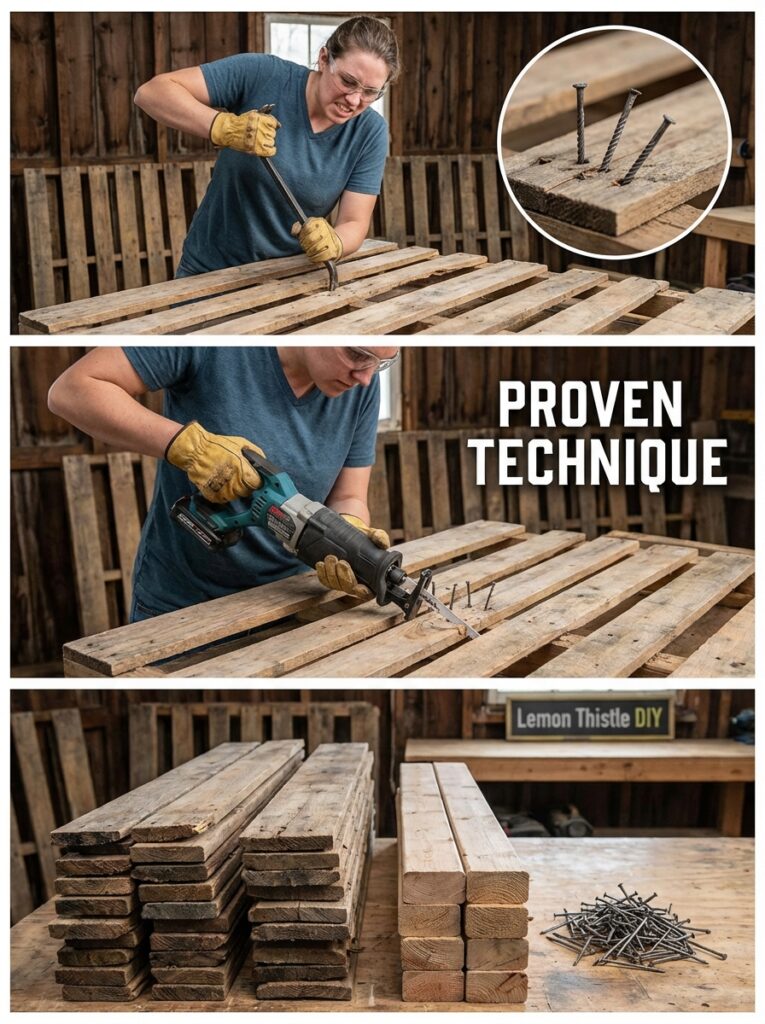
Pallet furniture DIY starts to feel real when you turn that bulky pallet into neat stacks of boards and 2x4s. This step can be frustrating because of the nails and brittle wood, so use proven techniques.
As Lemon Thistle points out, two things make dismantling pallets tricky (Lemon Thistle):
- Many pallets use spiral or ring shank nails that grip hard and resist pulling.
- The thin deck boards crack easily under pressure.
You want the nails gone, but you also want as many intact boards as possible.
Method 1: Fast disassembly with a reciprocating saw
If you have a reciprocating saw and metal cutting blades, this is the least fussy option.
- Put on your safety gear.
- Lay the pallet flat on the ground or a sturdy work surface.
- Slide the saw blade between the deck board and the supporting 2×4.
- Cut through the nails, working your way down each joint.
- Flip the pallet and repeat if needed.
This method keeps boards intact by sacrificing the nails. It can cut your disassembly time down to a few minutes per pallet (Lemon Thistle).
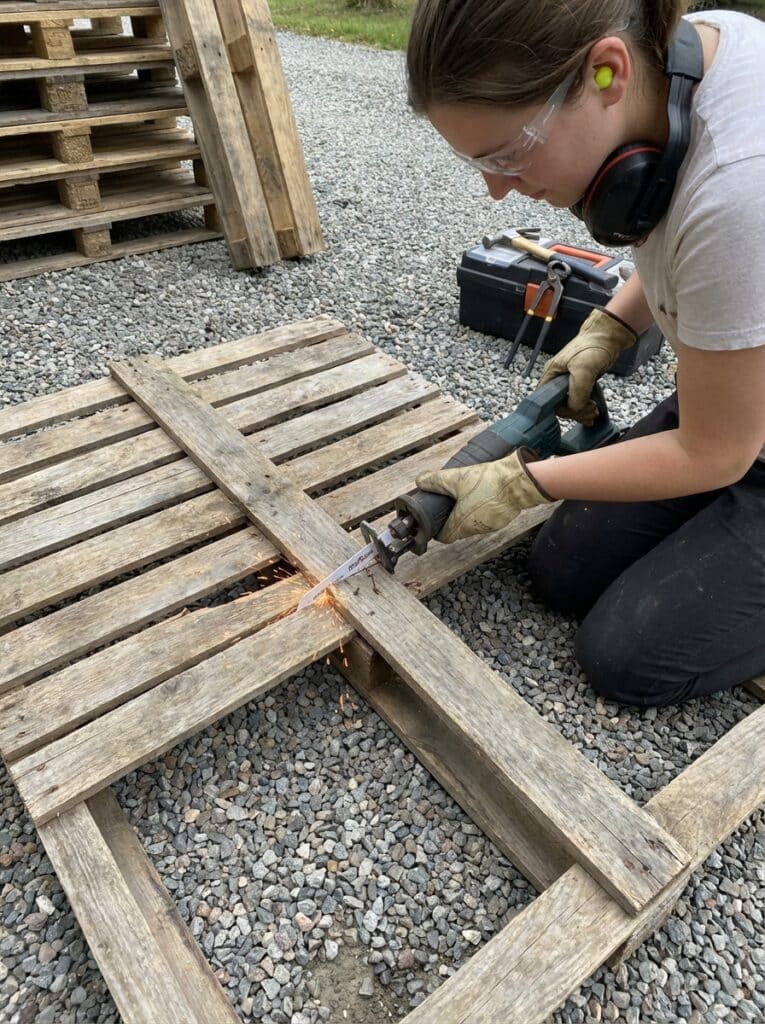
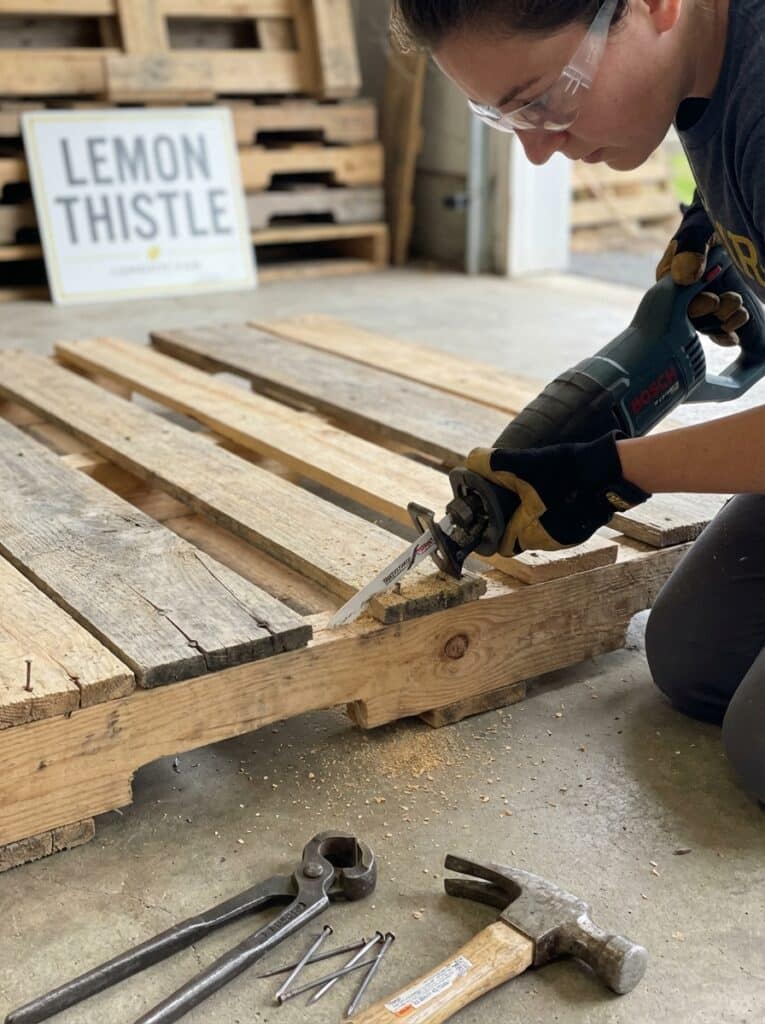
Afterwards, use:
- Farrier’s nippers
- Nail puller or claw hammer
to remove or flush-cut any leftover nail heads.
Method 2: Manual disassembly with pry bar and hammer
If you do not own a saw or prefer a quiet, low-cost method, go manual. It takes longer, but it works.
- Put on gloves and eye protection.
- Start with a small pry bar and tap it between the deck board and stringer with a hammer (Lemon Thistle).
- Rock the pry bar by hand to begin lifting the board.
- Move a few inches at a time, alternating sides, so you lift evenly and reduce cracking.
- Use a nail puller claw bar or hammer claw to extract nails as they loosen.
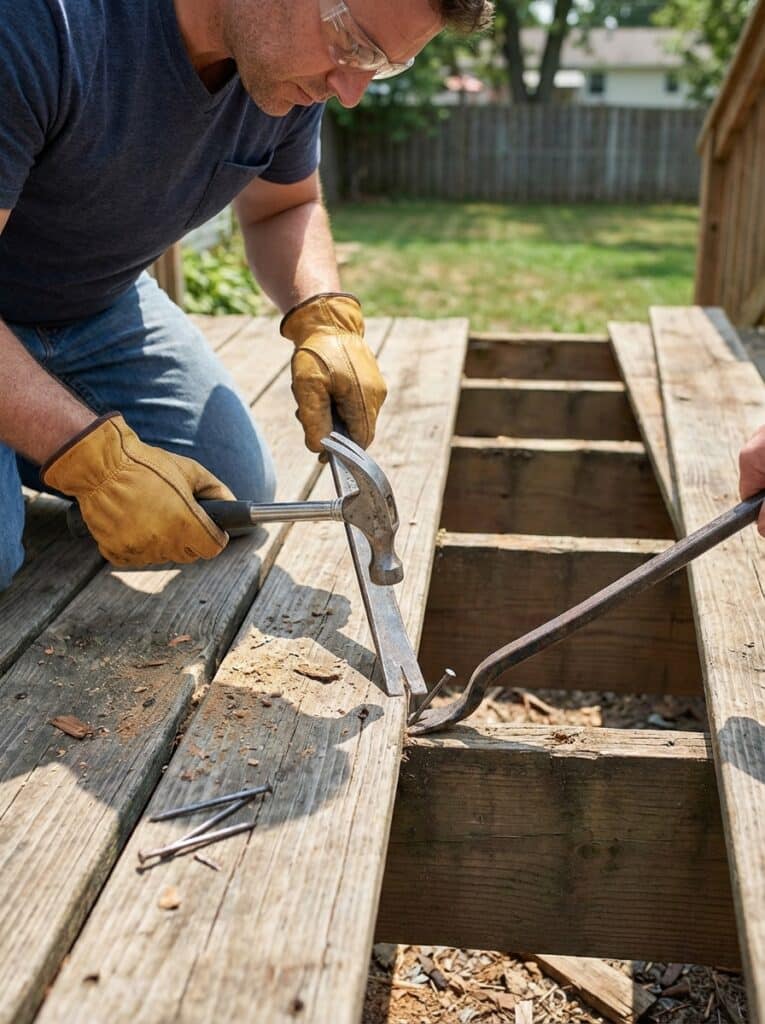
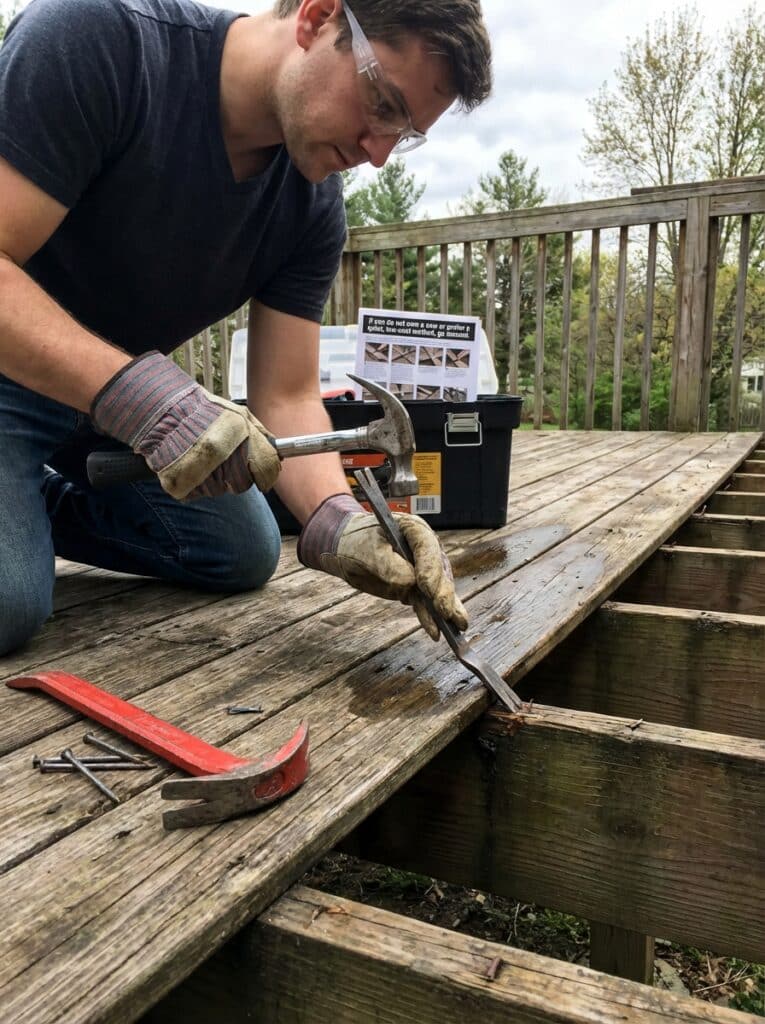
Expect around 45 minutes per pallet at first (Lemon Thistle). As your technique improves, you will waste fewer boards and move faster.
Save your offcuts wisely
As you work, keep two piles:
- Long, crack free deck boards for visible surfaces
- 2×4 notched pieces and short offcuts for hidden structure
Lemon Thistle notes that those notched 2×4 supports are especially useful for strong internal framing, such as the core of end tables or bench supports (Lemon Thistle).
Prepare pallet wood for smooth, safe furniture
Raw pallet boards are rough, splintery, and dusty. Before you build, you need to prep your wood. This is where your projects shift from “free pallets” to “real furniture.”
GardenBenches.com outlines a simple preparation flow that you can follow for most pallet furniture DIY builds (GardenBenches).
Step 1: Sand every surface

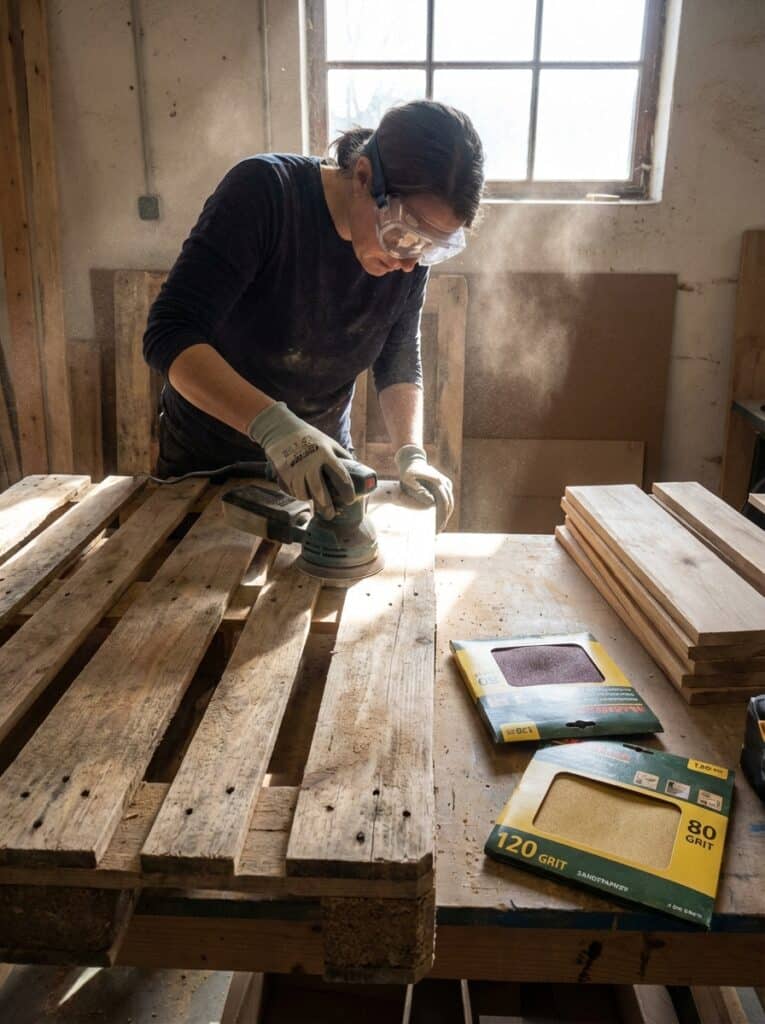
Use an electric or orbital sander on all faces, edges, and corners of your boards. This does three things:
- Removes splinters and rough spots
- Creates a smoother base for paint or stain
- Makes your furniture safer and more comfortable to touch
Sand with the grain of the wood rather than against it. For most pallets, starting around 80 grit and finishing at 120 or 150 grit is enough.
Wear goggles and gloves while sanding. Dust can irritate your eyes and lungs, and pallet splinters are no joke (GardenBenches.com).
Step 2: Treat the wood if it is going outside
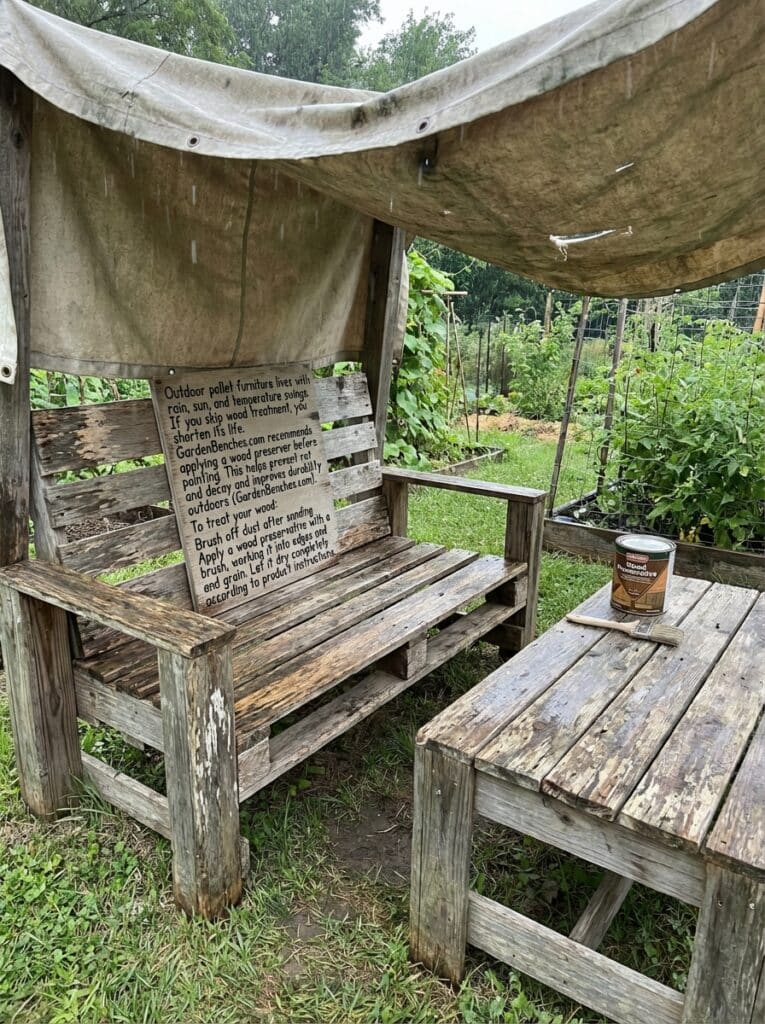
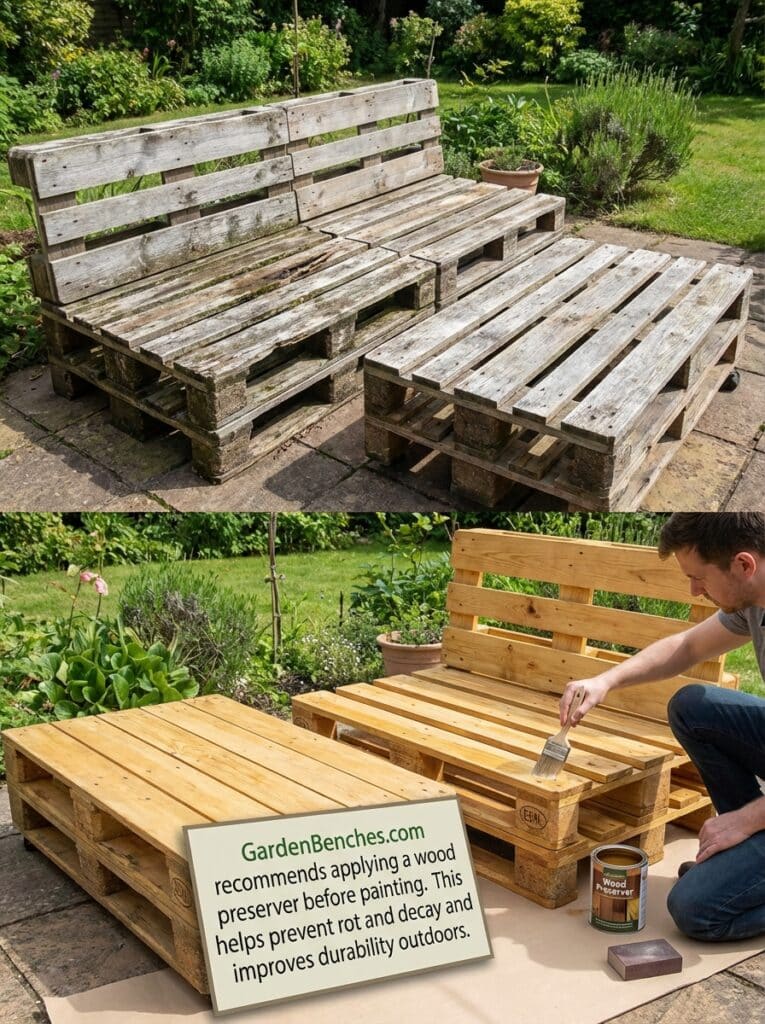
Outdoor pallet furniture lives with rain, sun, and temperature swings. If you skip wood treatment, you shorten its life.
GardenBenches.com recommends applying a wood preserver before painting. This helps prevent rot and decay and improves durability outdoors (GardenBenches.com).
To treat your wood:
- Brush off dust after sanding.
- Apply a wood preservative with a brush, working it into edges and end grain.
- Let it dry completely according to product instructions.
This step is worth doing even if you plan to stain instead of paint.
Step 3: Choose your finish
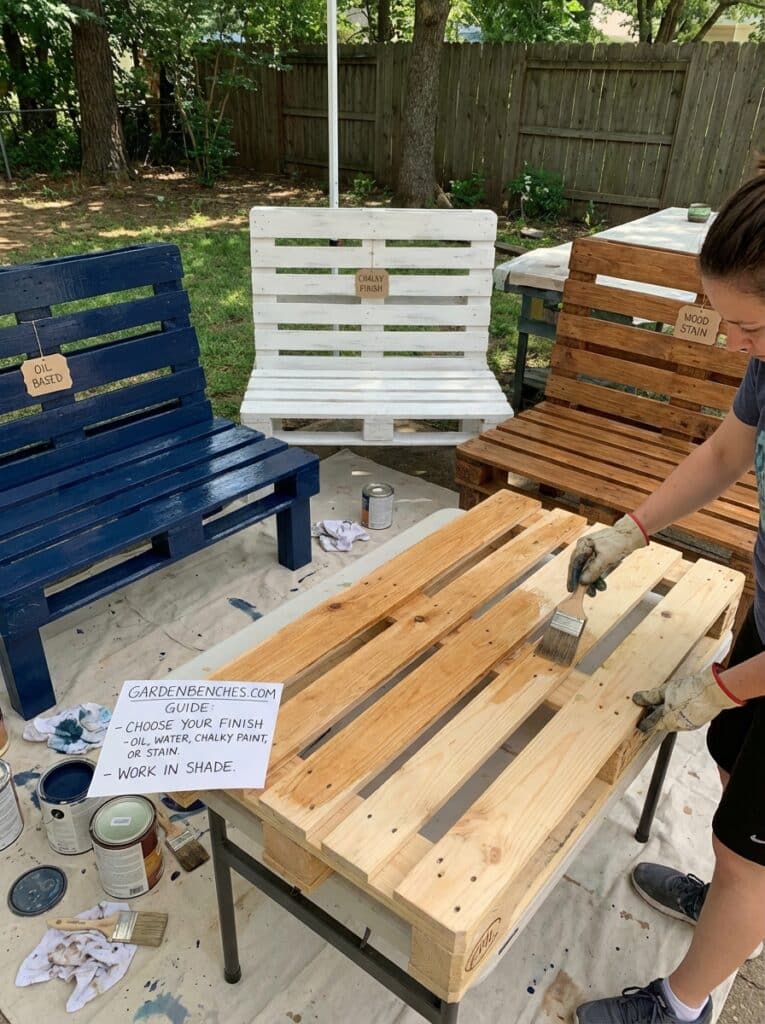
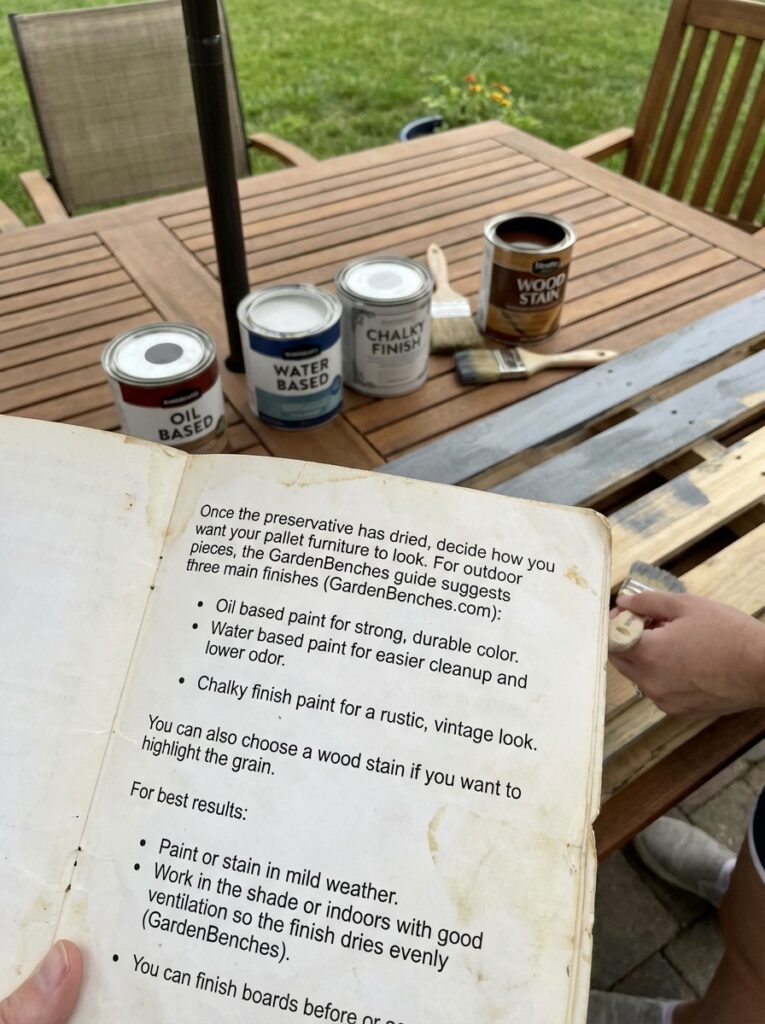
Once the preservative has dried, decide how you want your pallet furniture to look. For outdoor pieces, the GardenBenches guide suggests three main finishes (GardenBenches.com):
- Oil based paint for strong, durable color
- Water based paint for easier cleanup and lower odor
- Chalky finish paint for a rustic, vintage look
You can also choose a wood stain if you want to highlight the grain.
For best results:
- Paint or stain in mild weather
- Work in the shade or indoors with good ventilation so the finish dries evenly (GardenBenches)
You can finish boards before or after assembly. Pre finishing is easier for hard to reach spots, but some people prefer to build first, then paint once they see the final form.
Pick a beginner friendly pallet furniture project
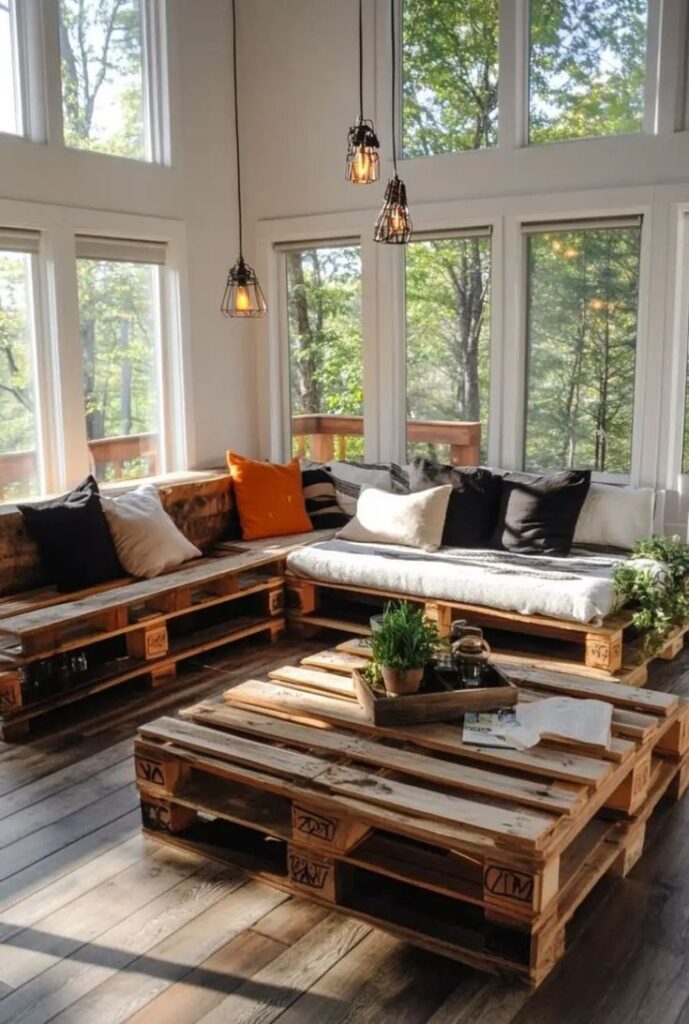
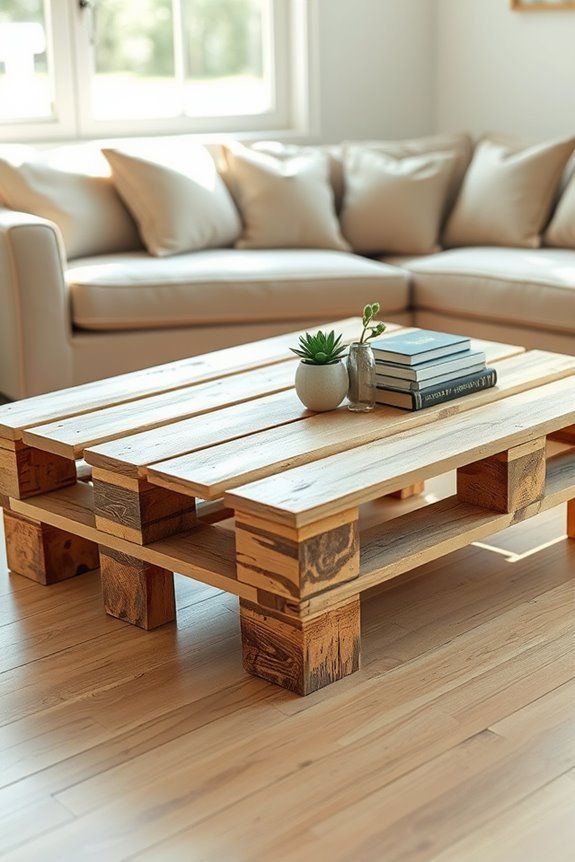
You can build almost anything from pallets, from tiny wine racks to full garden sofas. Instructables has an extensive collection of pallet furniture projects that shows just how versatile these boards can be (Instructables).
Some of the ideas you will find there include (Instructables):
- Dining tables and coffee tables
- Lounge chairs and couches
- Adirondack chairs
- Garden benches and seating with retaining walls
- Shelves, desks, and planters
- Compost bins and vertical garden racks
- Smaller accessories like coat racks, wine racks, nightstands, and lamps
If this is your first pallet furniture DIY attempt, start with something that:
- Uses full or half pallets
- Requires straight cuts only
- Has a simple rectangular shape
A pallet garden sofa or bench checks all of those boxes and gives you a big, satisfying result.
Build a simple pallet garden sofa
This section walks you through a basic outdoor pallet sofa, adapted from the 2024 step by step instructions at GardenBenches.com (GardenBenches.com). Adjust the dimensions to fit your yard or balcony.
Step 1: Plan your sofa size and layout
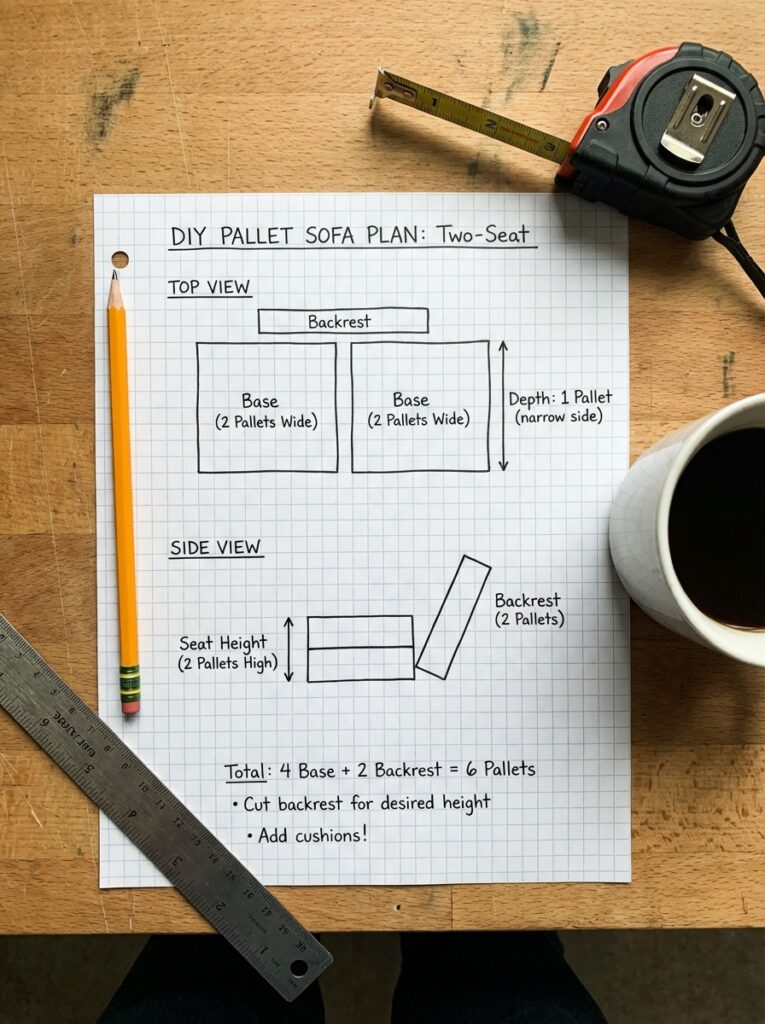
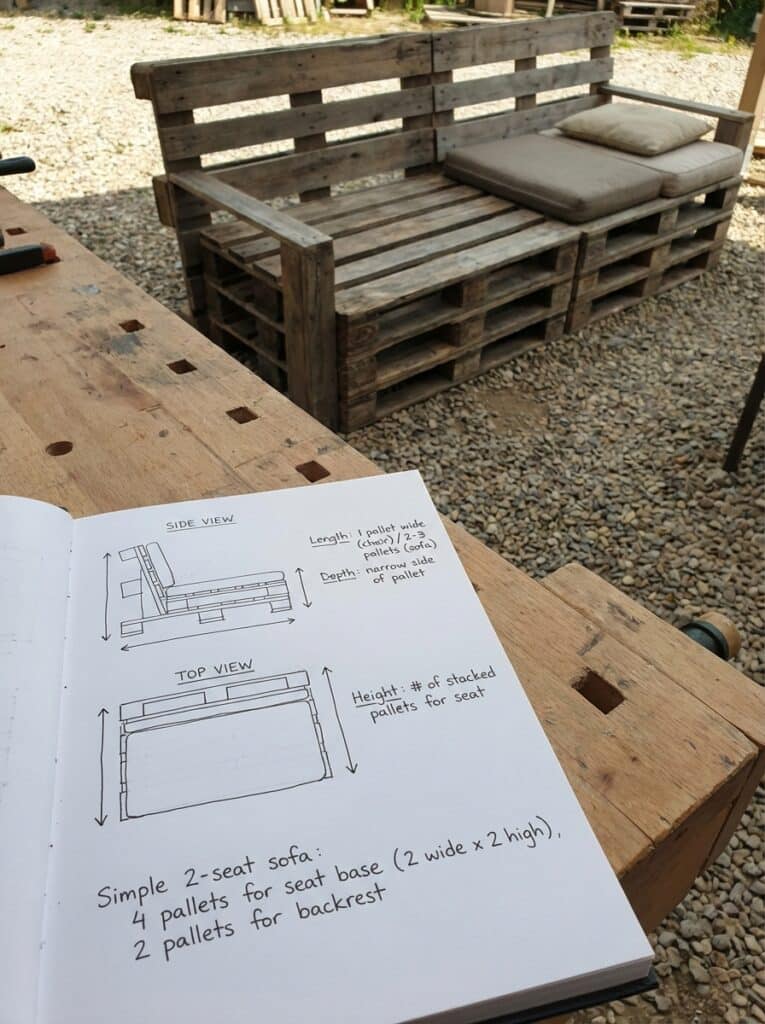
Decide on:
- Length: one pallet wide for a chair, two or three pallets for a sofa
- Depth: usually the narrow side of the pallet
- Height: number of pallets you will stack for the seat
Sketch a side view and top view. This makes the build much easier.
For a simple two seat sofa you might use:
- 4 pallets for the seat base (2 wide by 2 high)
- 2 pallets for the backrest (cut or whole, depending on height)
Step 2: Prepare your pallets
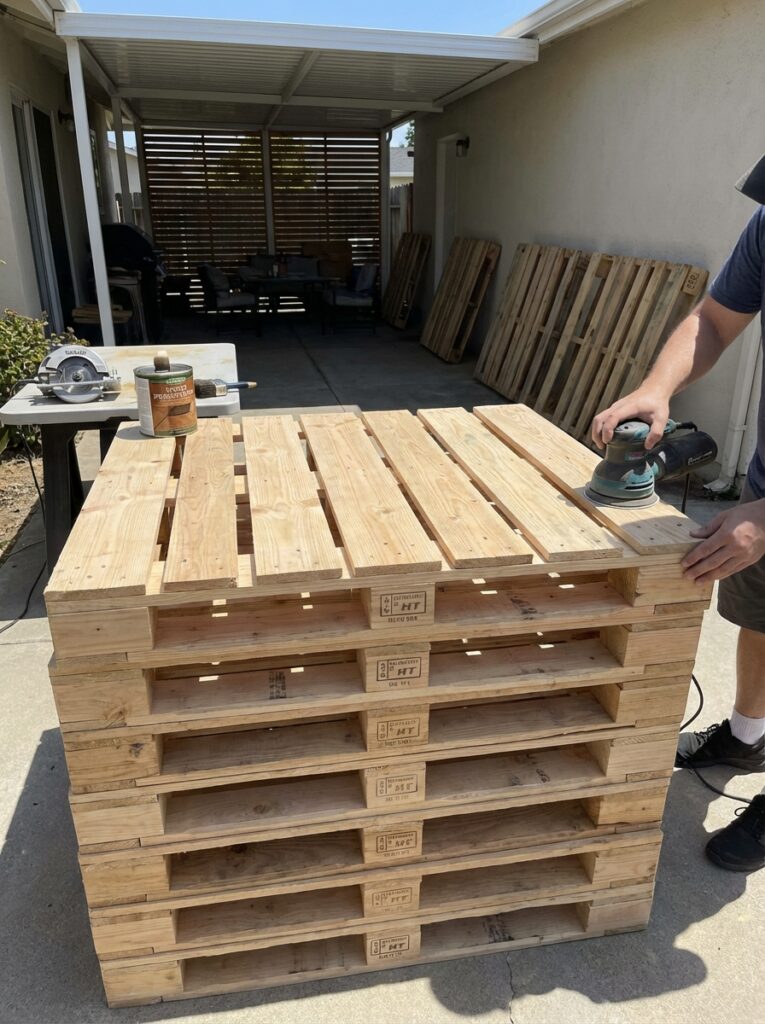
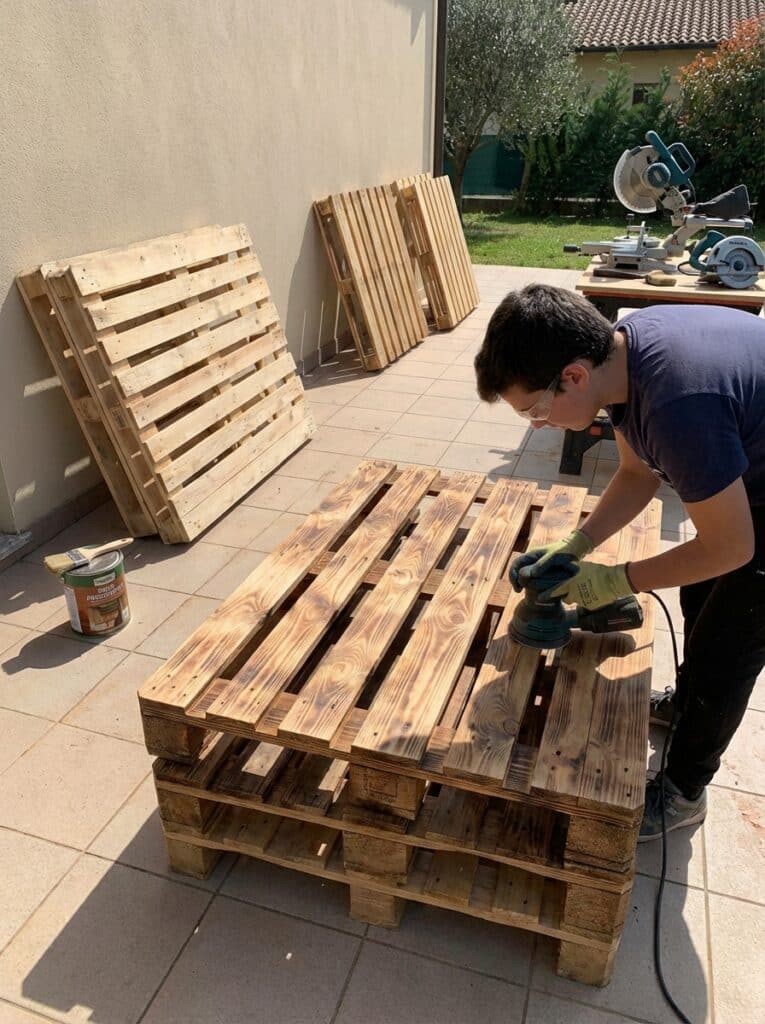
Use your earlier selection rules: heat treated, clean, not badly warped. Then:
- Sand all surfaces, edges, and corners while the pallets are still whole.
- Apply wood preservative if the sofa will live outdoors.
- Let everything dry completely.
You can cut pallets at this stage if you need a shorter width or back height. A miter saw or circular saw will give you straight, clean cuts.
Step 3: Stack and secure the seat base
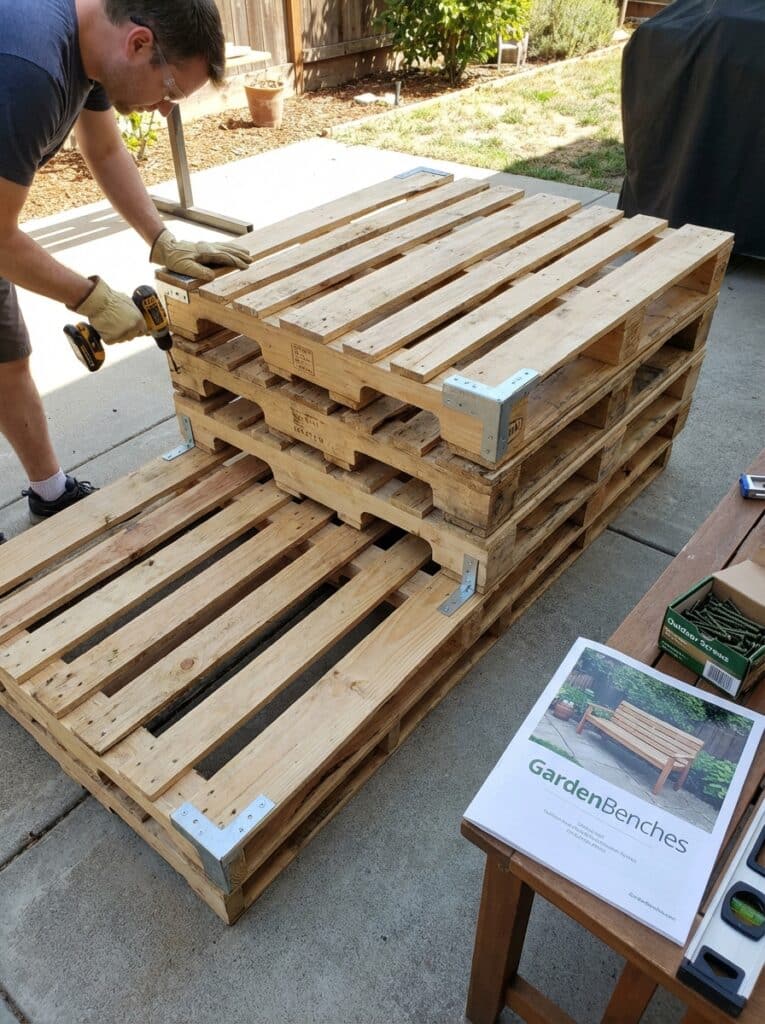
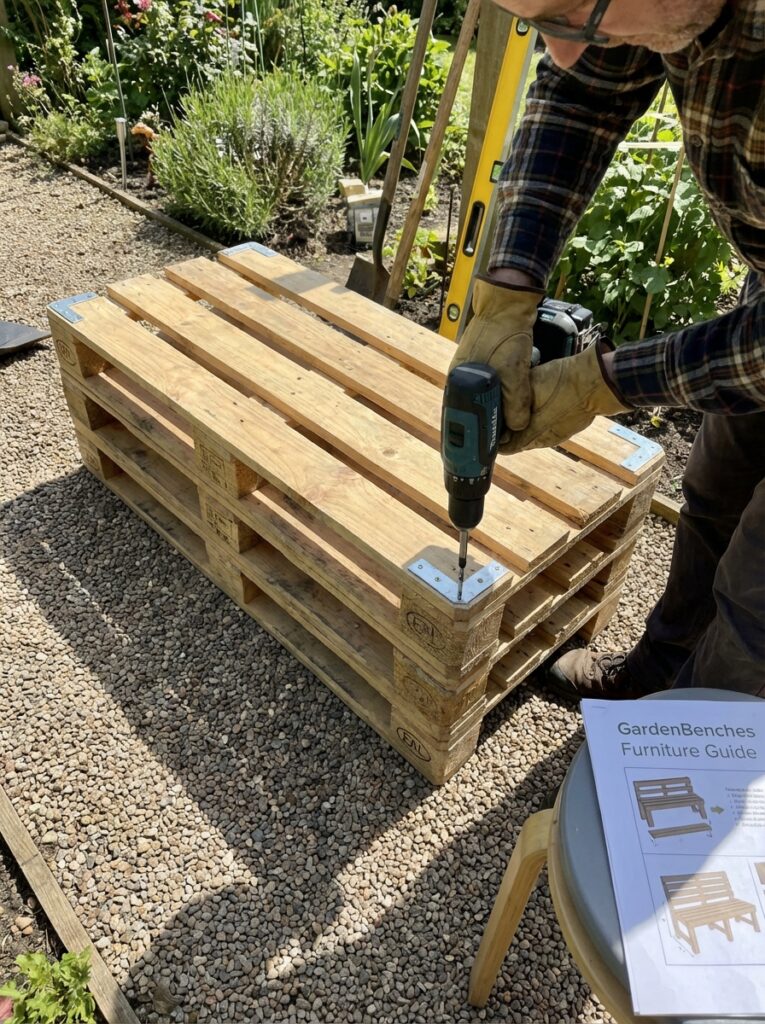
According to the GardenBenches furniture guide, stacking pallets and securing them with screws and panels is a reliable way to build stable outdoor seating (GardenBenches).
- Lay two pallets side by side on a level surface to form the base.
- Place two more pallets directly on top to reach your desired height.
- Align corners and edges carefully so the stack is square.
- Use metal brackets or wooden connector plates at each corner.
- Drive outdoor rated screws through each bracket into both pallet layers.
Check for wobble. If the ground is uneven, shim under the base until it feels solid.
Step 4: Attach the backrest
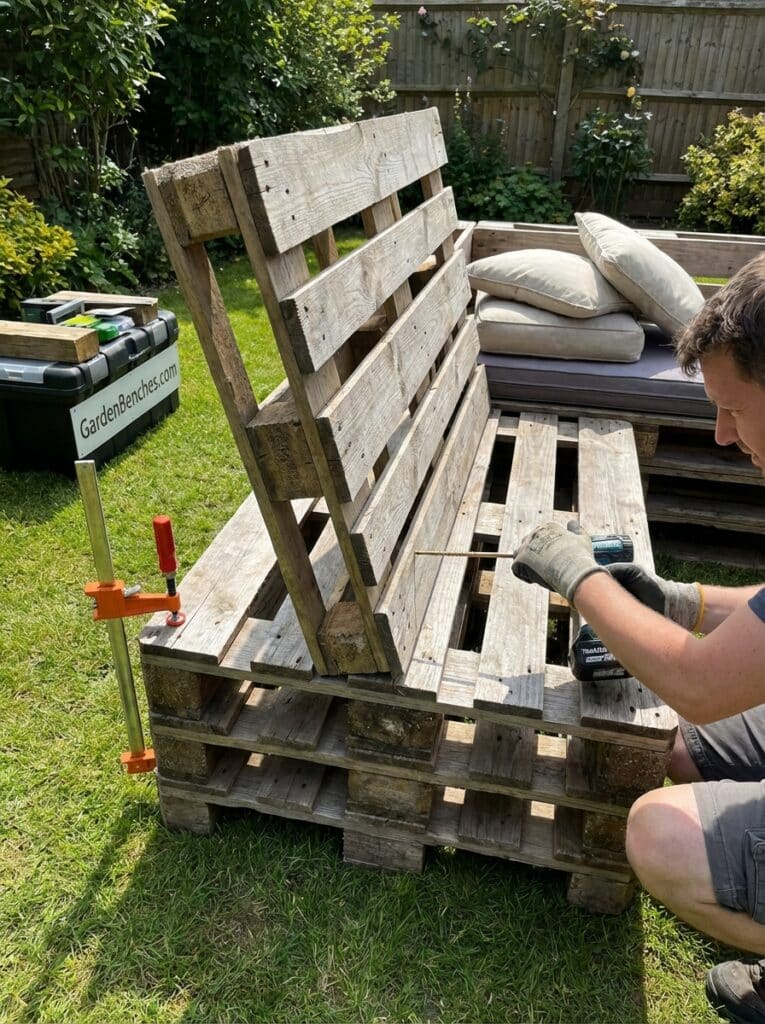

The backrest turns your pallet stack into an actual sofa. GardenBenches suggests securing a pallet vertically to create a comfortable garden seat (GardenBenches.com).
To do this:
- Stand one or two pallets on their long edge behind the seat base.
- Angle them slightly backward for comfort if you like, or keep them vertical.
- Clamp them temporarily in position.
- Fix them to the base using:
- Long structural screws driven through the backrest into the base
- Or, heavy duty brackets at each corner
For a stronger connection, add internal blocks cut from pallet 2x4s, then screw through both pieces into the blocks.
Step 5: Add cross bracing if needed
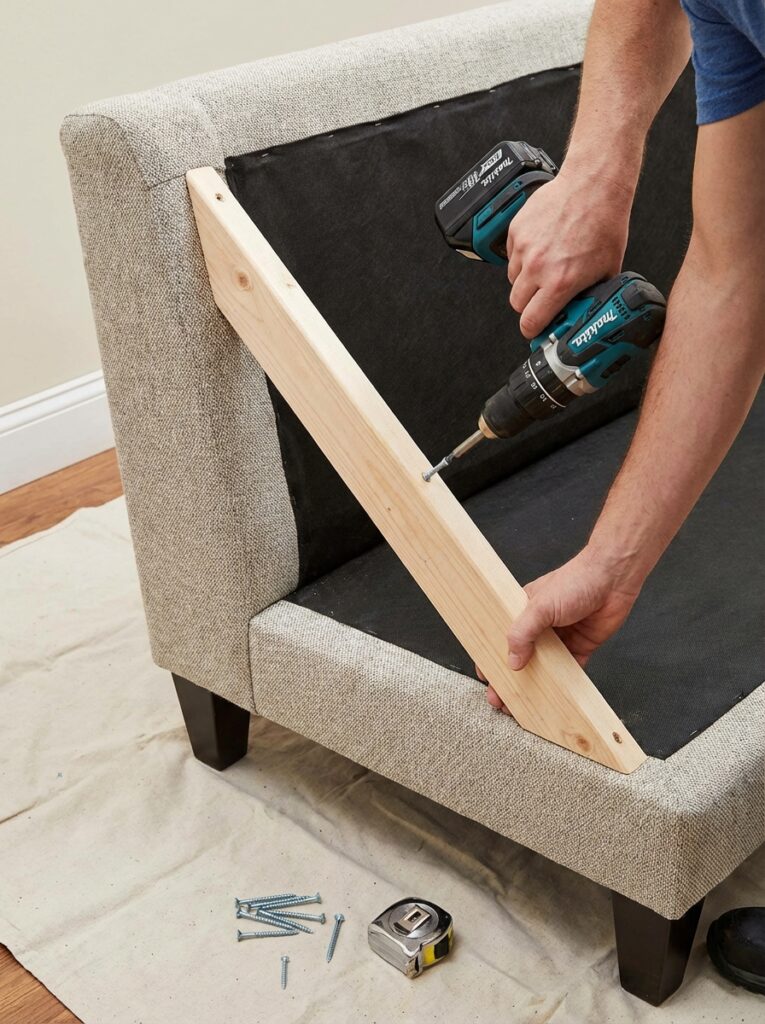
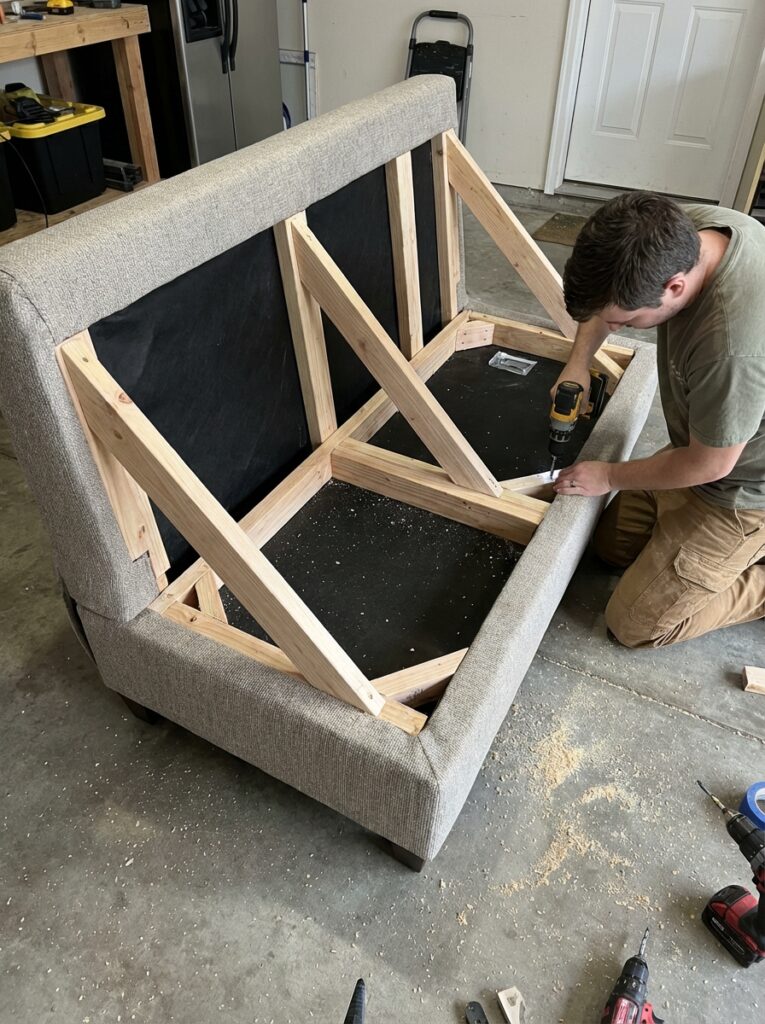
If your sofa flexes when you lean back, reinforce it:
- Add diagonal braces from the backrest down to the seat base using 2×4 pieces.
- Screw through the braces into both surfaces.
This simple triangle bracing makes a big difference in stability, especially for taller backrests.
Step 6: Paint or stain your sofa

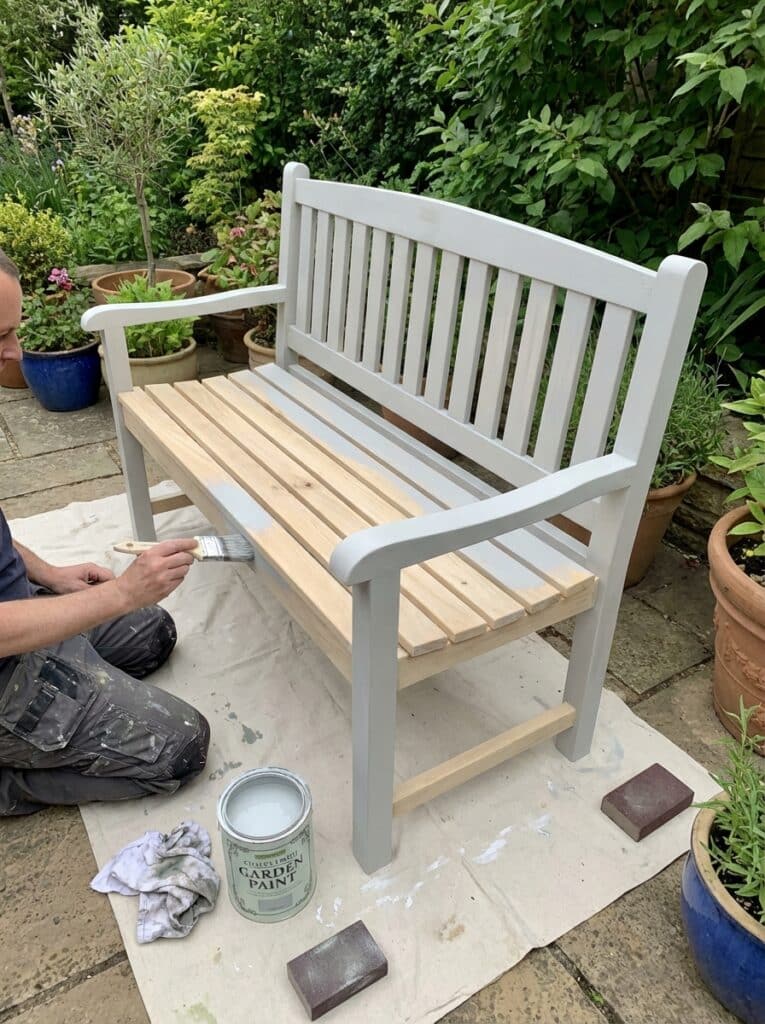
With the structure solid, you are ready for color. Drawing from the GardenBenches finishing advice (GardenBenches):
- Wipe down dust from sanding and construction.
- Apply your chosen paint or stain in thin, even coats.
- Let each coat dry fully before adding the next.
- Focus extra on end grain and joints where water might sit.
For a rustic look, chalky finish paint in a muted color looks great on pallet slats and plays well with outdoor cushions.
Step 7: Add cushions and details
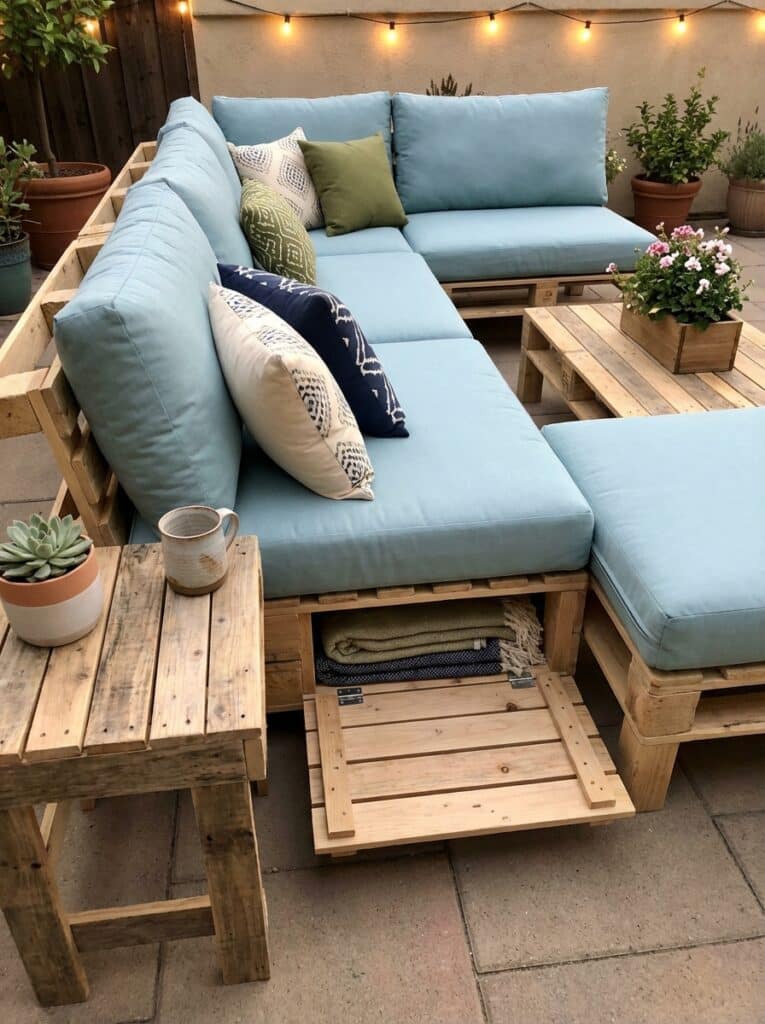
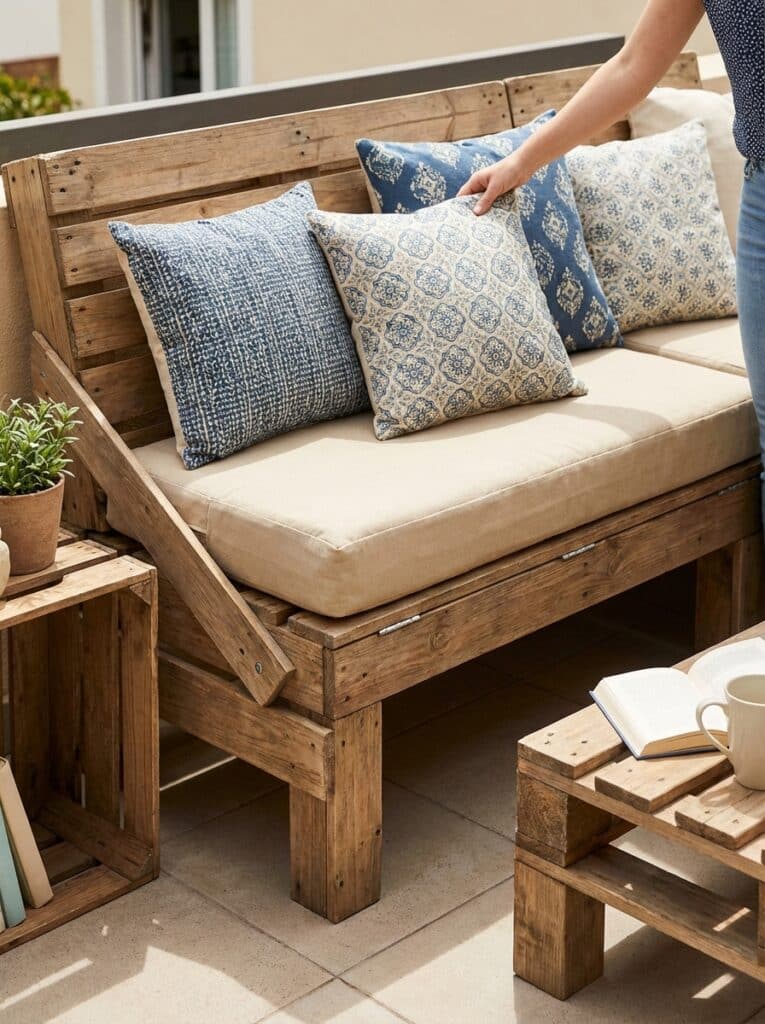
Finally, soften your build so it is comfortable to use.
You can:
- Use ready made bench cushions sized to your pallet top
- Make custom cushions to fit your exact width
- Add throw pillows for back support
If you want to push the project further, borrow ideas from Instructables and add features like:
- Hidden storage under the seat
- Side tables built from extra pallets
- Matching pallet coffee table or planter (Instructables)
You now have a complete pallet furniture DIY project under your belt.
Explore more creative pallet DIY ideas
Once your first sofa or bench is in place, it is easy to see what should come next. You can keep using full pallets or move into more involved builds using the loose boards.
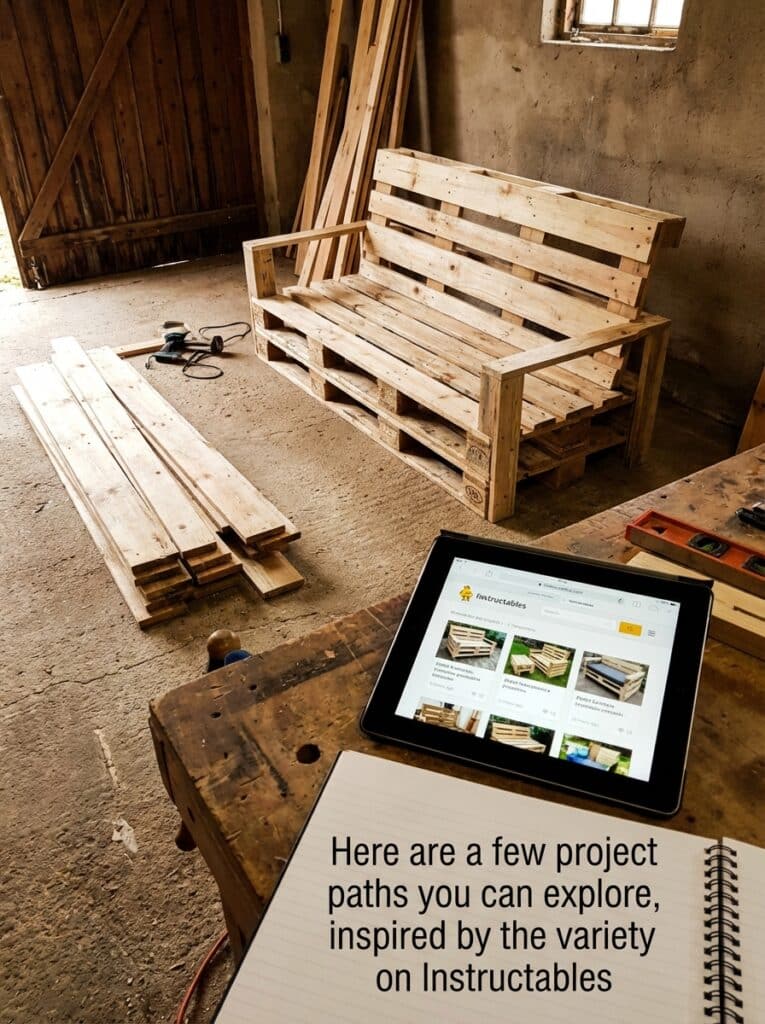
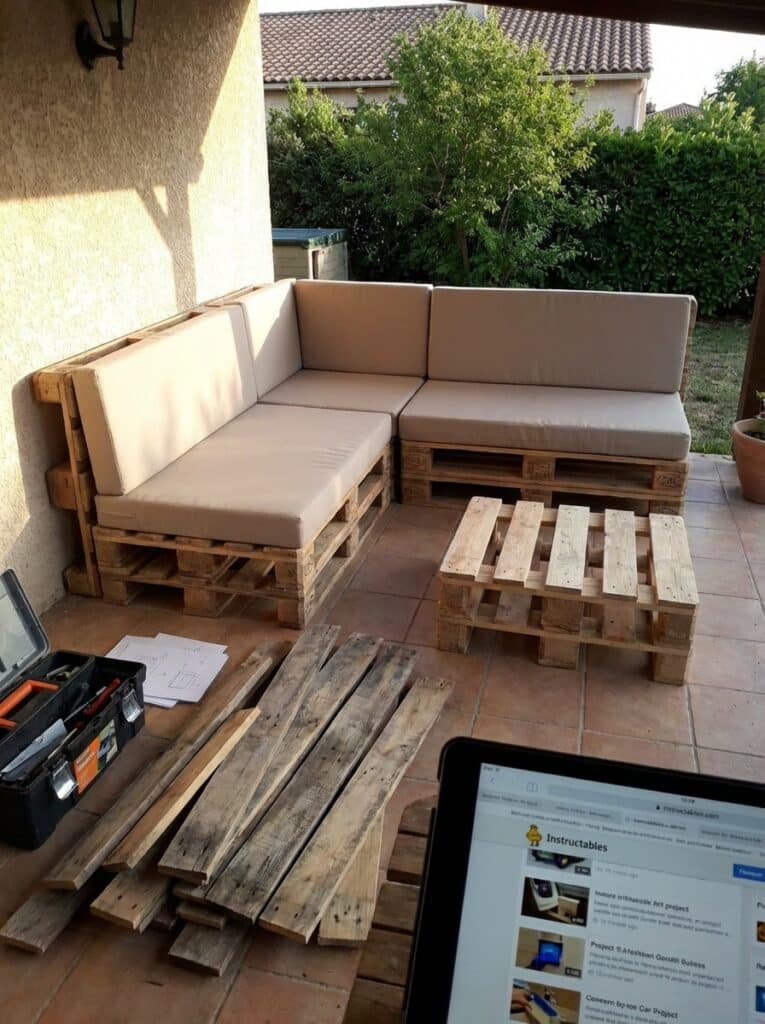
Here are a few project paths you can explore, inspired by the variety on Instructables (Instructables):
Simple weekend builds
- Pallet coffee table
- Pallet wine rack
- Pallet coat rack with cubbyholes
- Pallet nightstand or side table
These mainly require cutting boards to length and screwing them into a simple frame.
Intermediate indoor furniture
- Dining table with pallet top and 2×4 frame
- Pallet desk with storage shelves
- Lounge chair made from contoured pallet boards
You will practice layout, measuring, and stronger joinery.
Outdoor and garden projects
- Garden bench with planters at the ends
- Vertical pallet planter for herbs or flowers
- Compost bin made from pallet sides
- Garden seating built into a retaining wall (Instructables)
Many of these use full pallets, which keeps build time down.
Advanced and custom pieces
When you are ready to experiment, pallet furniture DIY can go beyond simple shapes. The Instructables collection even includes projects like:
- Coffee table with a lifting top and landing gear
- Themed table builds, like a Game of Thrones game table
- Secret storage end tables and custom lamps (Instructables)
Those builds prove you can push pallet wood as far as your imagination and patience will take you.
Turn your pallet hobby into income
If you enjoy the process and start stacking up finished pieces, you can sell some of your pallet furniture locally.
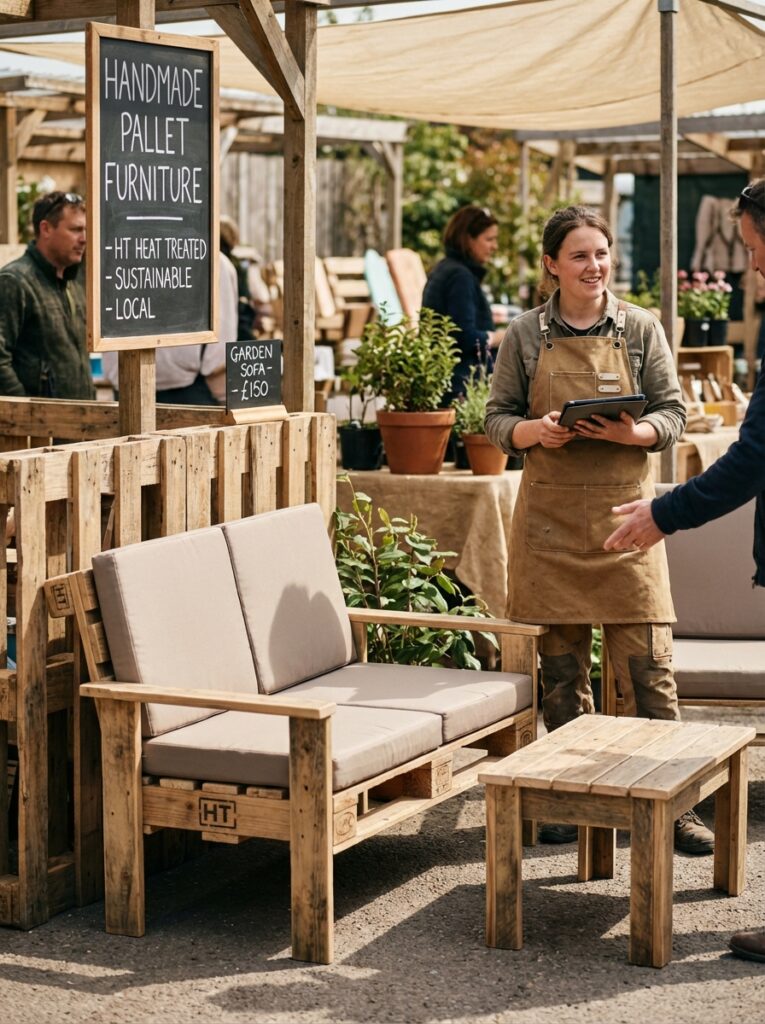
The GardenBenches guide notes that pallet armchairs and sofas made from heat treated pallets can have good resale potential on platforms like Facebook Marketplace and eBay, as many buyers look for sustainable, handmade furniture (GardenBenches.com).
If you want to test the waters:
- Start with a single style, such as a two seat garden sofa.
- Track your material and time costs.
- Take clear photos in natural light.
- Mention that you use “HT” marked pallets and wood preservative in your listings.
Even a few sales can fund better tools or more ambitious projects.
Keep your pallet projects safe and long lasting
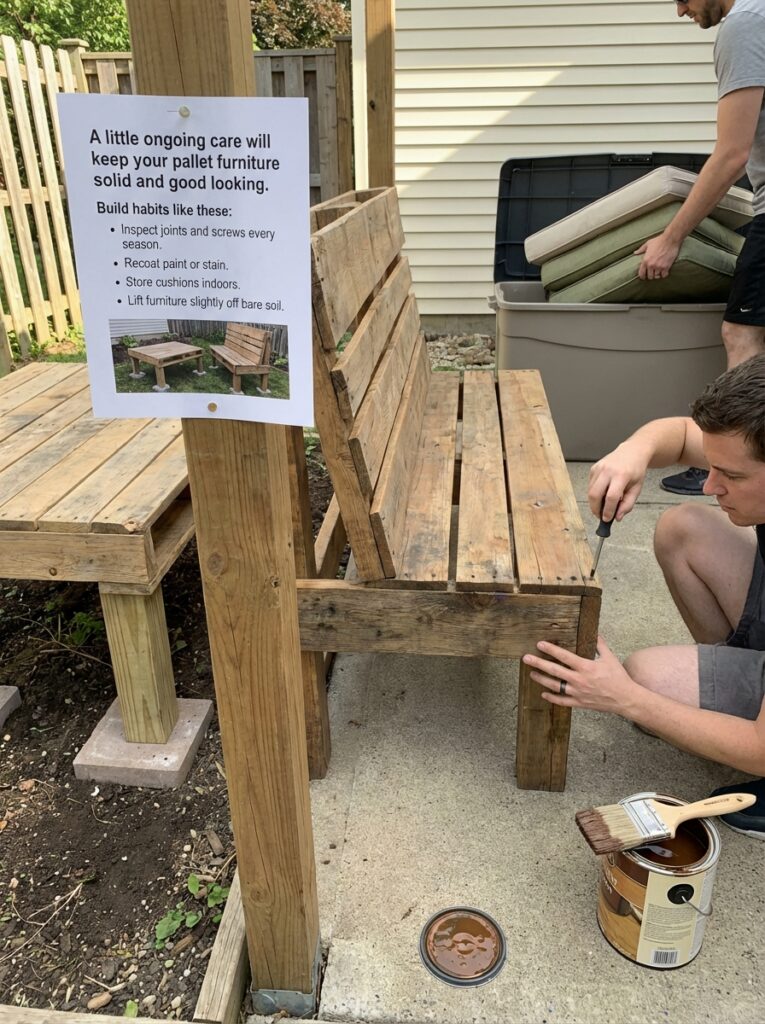
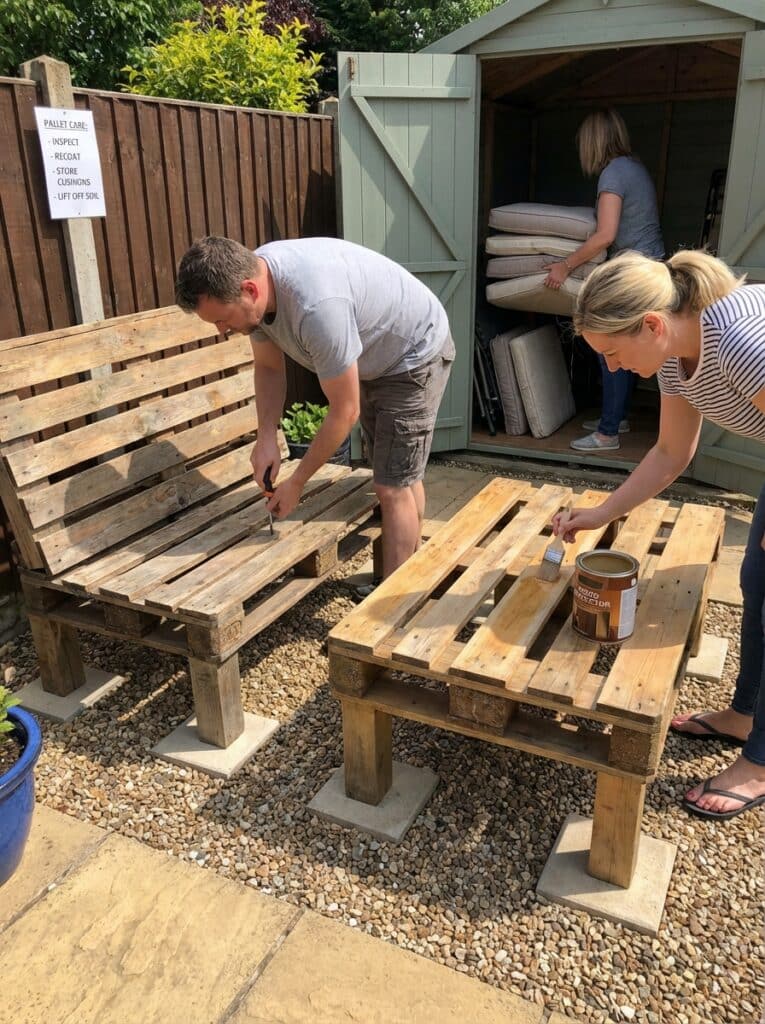
A little ongoing care will keep your pallet furniture solid and good looking.
Build habits like these:
- Inspect joints and screws every season, especially for outdoor pieces.
- Recoat paint or stain if you see peeling, flaking, or bare wood.
- Store cushions indoors when not in use to reduce moisture damage.
- Lift furniture slightly off bare soil using pavers or feet to avoid rot.
With that maintenance in place, you can treat your pallet builds like any other piece of outdoor furniture.
Frequently asked questions about pallet furniture DIY
1. Are pallet furniture DIY projects safe for indoor use?
Yes, they can be safe if you start with appropriate pallets. Look for heat treated pallets marked “HT,” avoid any stamped “MB” for methyl bromide, and skip brightly painted pallets that might contain harmful chemicals (GardenBenches.com). Sand thoroughly to remove splinters and finish the wood with paint or sealant.
2. What is the easiest pallet furniture project for beginners?
A low garden bench or sofa made from stacked pallets is one of the easiest starting points. You mainly need to:
- Stack whole pallets
- Secure them with screws and brackets
- Attach a pallet backrest
- Add cushions
This avoids complex cuts and joinery, but still gives you a useful, good sized piece.
3. Do you have to treat pallet wood before painting?
If your furniture will live outdoors, you should treat the wood before painting. Applying a wood preserver before paint or stain helps protect against rot and decay and improves durability in the elements (GardenBenches.com). For indoor pieces, treatment is still helpful but not always essential.
4. Can you do pallet furniture DIY without power tools?
Yes. Lemon Thistle shows that you can dismantle pallets in about 45 minutes each using mainly a hammer and pry bar (Lemon Thistle). You can then cut boards with a hand saw and assemble with a screwdriver and hammer. Power tools like a reciprocating saw and drill simply speed up the process and make repeated builds more comfortable.
5. Where can you find detailed pallet furniture plans?
You can find a broad mix of pallet furniture DIY plans on Instructables, including tables, chairs, benches, shelves, desks, and more specialized projects like storage tables and lamps (Instructables). Combine those step by step guides with the safety and prep steps in this article to customize builds for your space.
You are ready to start. Pick one project, gather your tools and pallets, and block out a weekend. Every piece you build teaches you something new, and your next pallet idea will feel that much easier.
- 3shares
- Facebook0
- Pinterest0
- Twitter3
- Reddit0