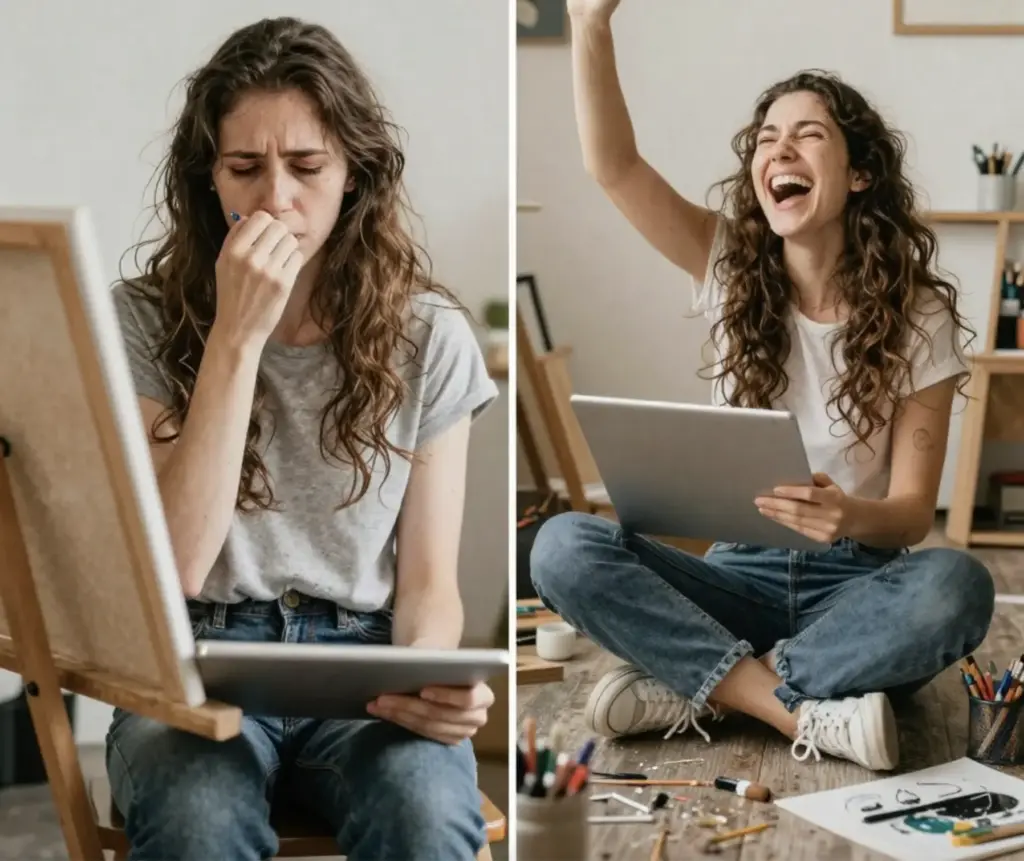
You sat down to practice figure drawing for three hours. By hour two, you hated everything you made. By hour three, you hated drawing itself.
Sound familiar?
We’ve all been fed the same lie: real artists practice for hours daily. Grind through the pain. Fill sketchbooks like your life depends on it. If you’re not suffering, you’re not serious.
That’s not dedication. That’s a recipe for burnout.
Here’s what nobody told me when I started: the artists I admired weren’t white-knuckling through marathon sessions. They had sustainable systems. They protected their energy. They actually — shocking concept — enjoyed the process.
- Why 3-Hour Sessions Are Killing Your Progress
- The Sustainable Practice Framework
- Warm-Ups That Feel Like Play (Not Punishment)
- Defeating the Perfectionism Monster
- Your Workspace Is Making You Burn Out
- Already Burned Out? Here's Your Recovery Protocol
- FAQ: Figure Drawing Practice Questions Answered
- Conclusion
The art community is finally having this conversation. Anti-hustle creativity is having a moment, and thank god for that. Turns out you can improve without destroying your love for drawing in the process.
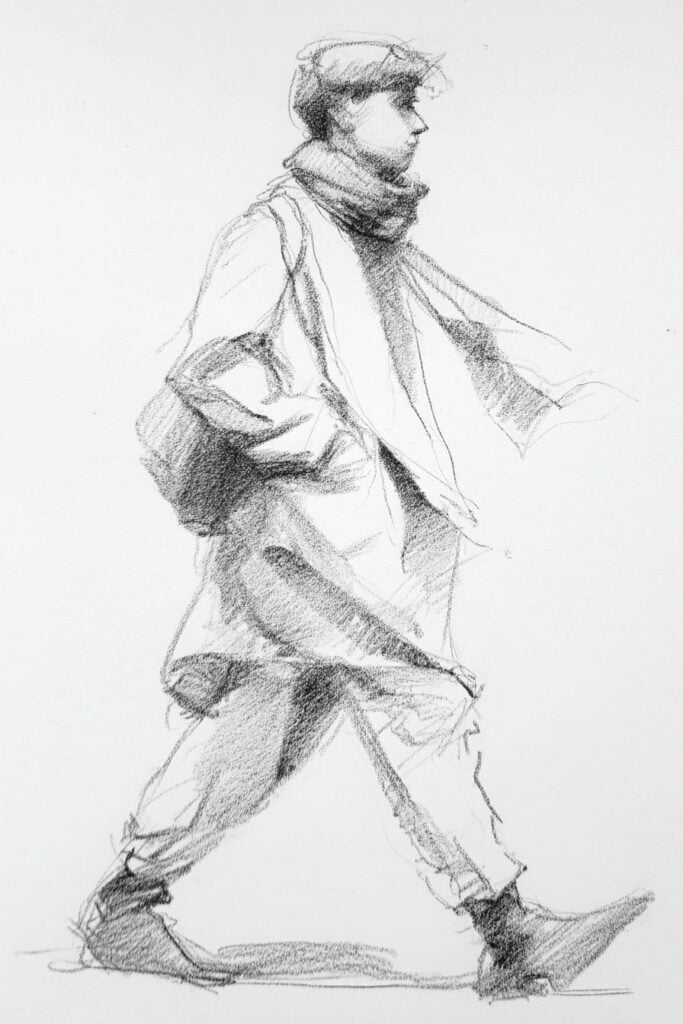
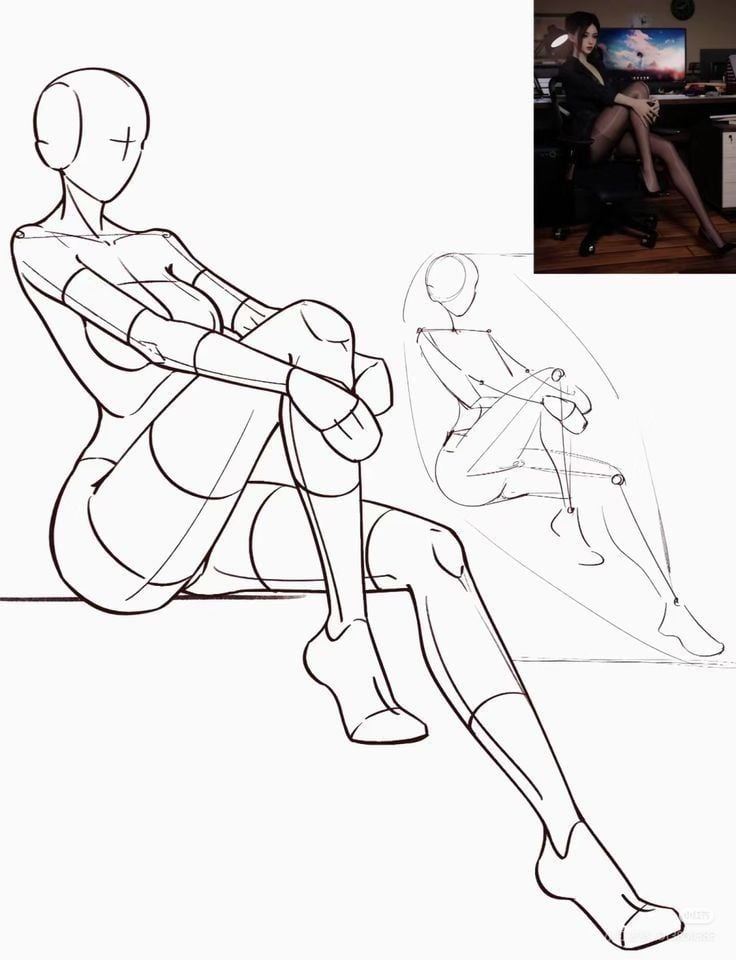
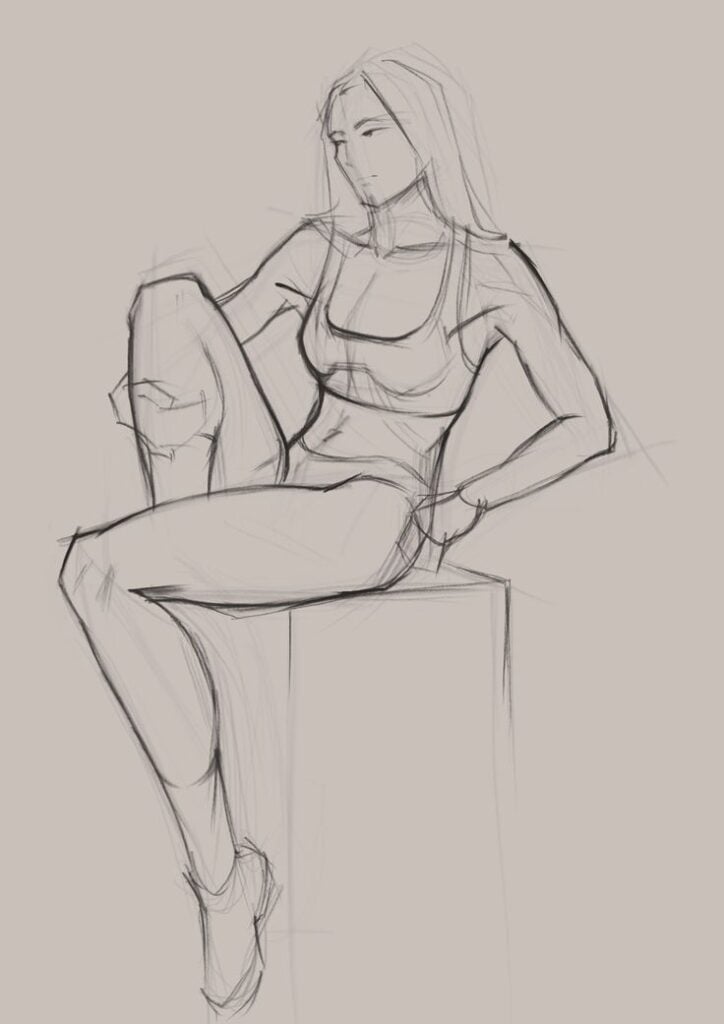
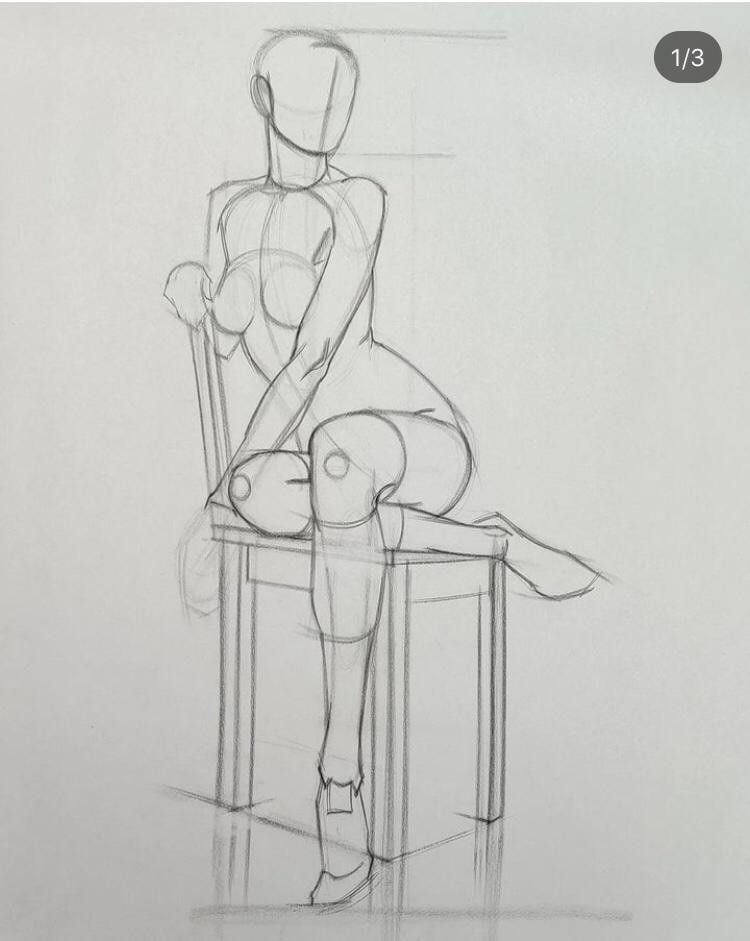
This isn’t another anatomy tutorial. I won’t teach you how to draw muscles or measure proportions in heads. Instead, we’re talking about something more fundamental — how to practice figure drawing without burning out, losing motivation, or dreading your sketchbook.
You’ll learn: time management that actually works, warm-up exercises that feel like play, practical ways to defeat perfectionism, and what to do if you’re already running on empty.
Fifteen minutes of smart practice beats three hours of exhausted grinding. Let me show you why.
Why 3-Hour Sessions Are Killing Your Progress
Let’s start with some uncomfortable math.
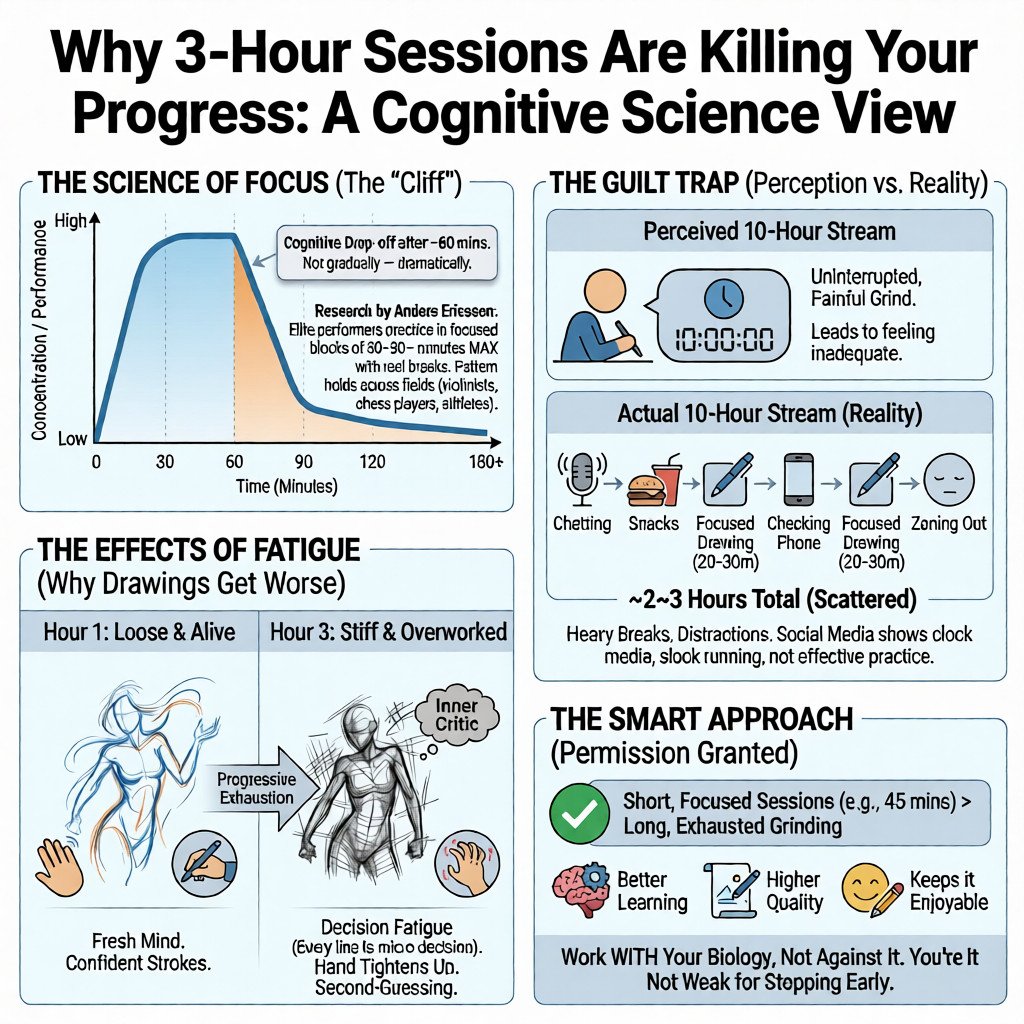
After 45-60 minutes of focused work, your brain’s ability to concentrate drops off a cliff. Not gradually — dramatically. This isn’t opinion. It’s cognitive science.
Anders Ericsson, the researcher behind the “10,000 hours” concept everyone misquotes, found something crucial: elite performers don’t practice for endless hours. They practice in focused blocks of 60-90 minutes maximum, with real breaks between. Violinists, chess players, athletes — the pattern holds across fields.
Yet somehow artists decided we’re exempt from human biology.
Why You Hate Your Drawings After Hour Two
Ever notice how your first sketches feel loose and alive, but later ones turn stiff and overworked?
That’s decision fatigue in action. Every line you draw is a micro-decision. After hundreds of them, your brain is running on fumes. Your inner critic gets louder. Your hand tightens up. You start second-guessing every mark.
The drawings aren’t getting worse because you’re bad. They’re getting worse because you’re exhausted.
I used to blame myself for this. “Why can’t I maintain quality?” Turns out I was asking my brain to do something it literally cannot do.
The Guilt Trap
But what about those artists streaming 10-hour drawing sessions?
Watch closer. They’re chatting with viewers, checking phones, getting snacks, zoning out. The actual focused drawing time? Probably 2-3 hours total, scattered throughout.
Social media shows the clock running. It doesn’t show effective practice time.
Meanwhile, you’re comparing your painful, uninterrupted 3-hour session to their casual, heavily-broken 10-hour stream. No wonder you feel inadequate.
Permission Granted
Here’s your official pass: short, focused sessions aren’t lazy. They’re smart.
Forty-five minutes of engaged practice beats three hours of exhausted grinding — for learning, for quality, and for keeping drawing enjoyable.
You’re not weak for stopping early. You’re working with your biology instead of against it.
The Sustainable Practice Framework
Knowing long sessions don’t work is step one. Having something better is step two.
I spent years bouncing between marathon grinding and guilty avoidance. Practice felt like an all-or-nothing gamble — either I drew for hours, or I failed as an artist. No middle ground existed in my head.
Then I discovered time frameworks. Not rigid schedules — flexible structures that protect both your energy and your progress.
Here are three that actually work.
The 15-15-15 Method (For Busy Days)
This one saved my practice when life got chaotic.
First 15 minutes: Warm-up. Gesture drawings, loose sketches, whatever gets your hand moving without pressure.
Second 15 minutes: Focused study. Pick ONE thing to work on — hands, weight distribution, foreshortening. Not everything. One thing.
Third 15 minutes: Play. Draw whatever you want. Fan art, silly doodles, random characters. No goals, just fun.
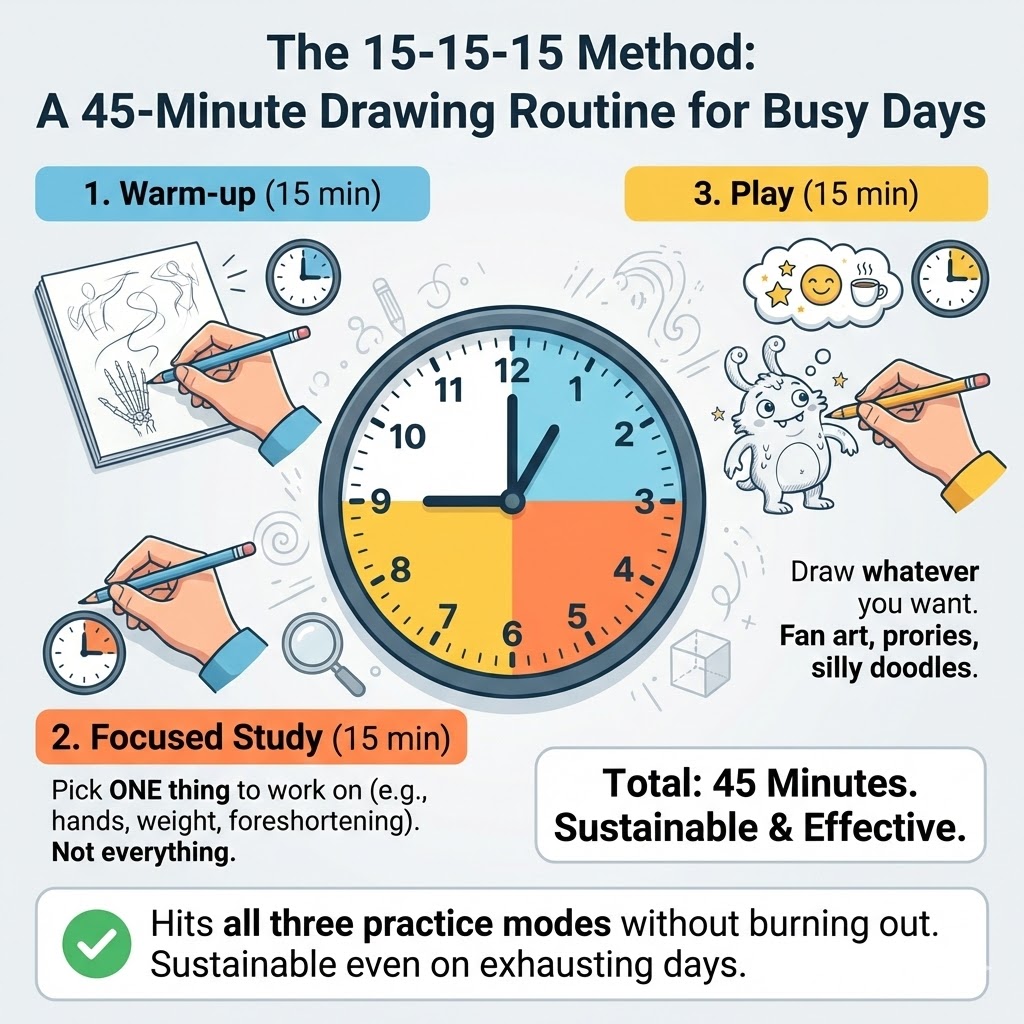
Total investment: 45 minutes. Sustainable even on exhausting days. And surprisingly effective — you’re hitting all three practice modes without burning out on any of them.
The Pomodoro Variation (For Deeper Sessions)
When you have more time and energy, the classic 25-5 split works beautifully.
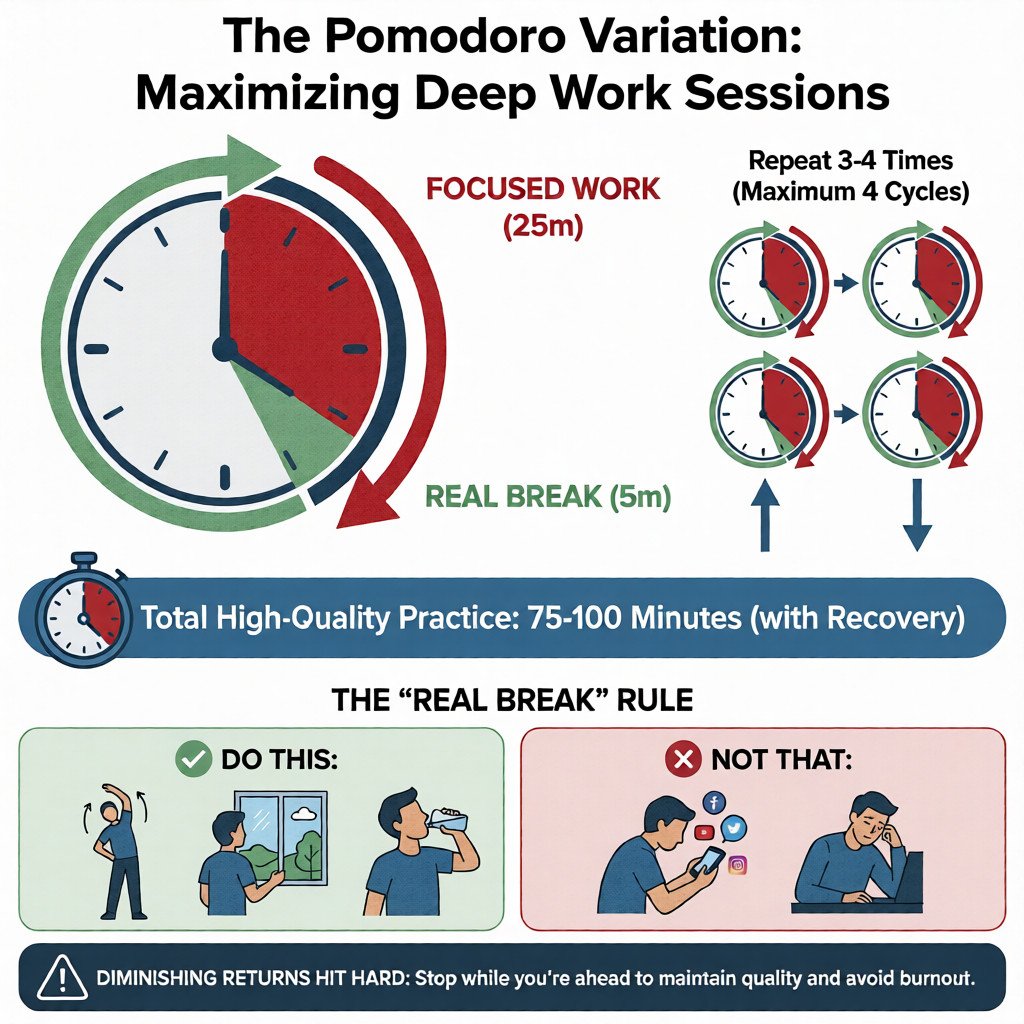
Twenty-five minutes of focused work. Five minutes of real break — not phone scrolling, actual rest. Stand up, stretch, look out the window.
String together 3-4 of these maximum. That’s 75-100 minutes of high-quality practice with built-in recovery. After that, diminishing returns hit hard. Stop while you’re ahead.
Weekly Rhythm Over Daily Grind
Here’s the mindset shift that changed everything for me: not every day needs to be practice day.
Sample week that works:
- Monday, Wednesday, Friday: Focused study sessions
- Tuesday, Thursday: Play and experimentation
- Weekend: Complete rest or light sketching if inspired
Rest days aren’t failure. They’re when your brain consolidates what you learned. Skipping rest doesn’t make you dedicated — it makes you slower at improving.
Finding Your Sustainable Number
Maybe 45 minutes daily feels perfect. Maybe you’d rather do 90 minutes every other day. Maybe three 20-minute sessions scattered throughout the day suits your life better.
There’s no universal “correct” amount. The best practice schedule is one you can maintain for years, not one that looks impressive for two weeks before you crash.
Track your energy, not just your output. Notice when you feel engaged versus drained. Adjust accordingly.
Consistency beats intensity. Every time.
Warm-Ups That Feel Like Play (Not Punishment)
Most artists skip warm-ups. I get it — feels like wasting precious practice time on something that “doesn’t count.”
But here’s the secret: warm-ups can be the most enjoyable part of your session. Not tedious preparation. Actual play that happens to make your focused work better.
The exercises below share one thing: they make perfectionism nearly impossible. When you can’t be precious, you can finally be loose.
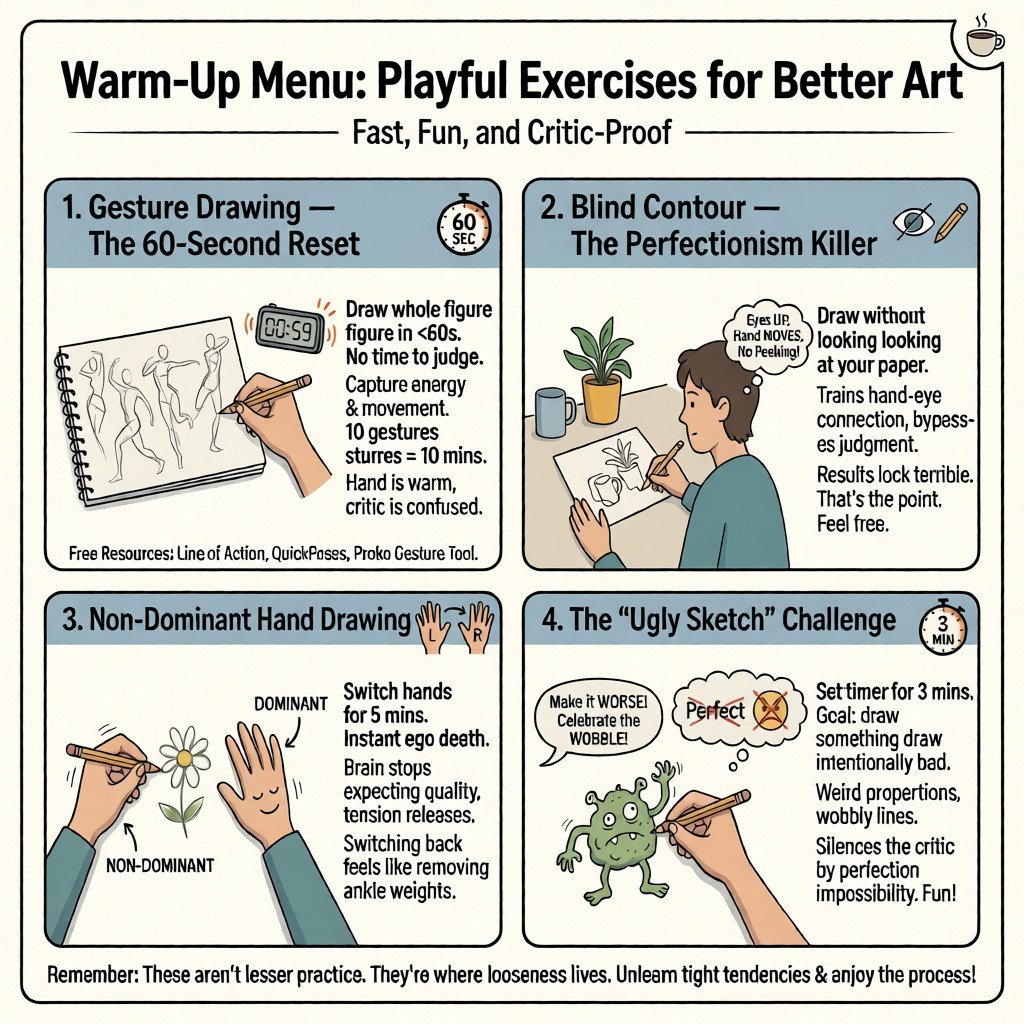
Gesture Drawing — The 60-Second Reset
Set a timer. Draw the whole figure in 60 seconds or less. When the timer beeps, move on. No exceptions.
You physically cannot overthink a 60-second drawing. There’s no time to judge, fix, or second-guess. Just capture the energy, the movement, the essence — and let go.
Ten gestures takes ten minutes. By the end, your hand is warm, your brain is engaged, and your inner critic is still trying to figure out what just happened.
Free resources: Line of Action and QuickPoses serve up pose references on timers. Proko’s gesture tool works great too.
Blind Contour — The Perfectionism Killer
Draw without looking at your paper. Eyes on subject only. Hand moves, you trust it, you don’t peek.
The results look terrible. Always. That’s the entire point.
Blind contour trains your hand-eye connection while completely bypassing your judgment center. You can’t criticize what you’re not allowed to see. The exercise feels oddly meditative — frustrating for about 30 seconds, then strangely freeing.
I was skeptical for years. Now it’s my go-to when I feel tight and precious before a session.
Non-Dominant Hand Drawing
Switch hands for five minutes. Left hand if you’re right-handed, vice versa.
Instant ego death. Your brain immediately stops expecting quality, which means you stop tensing up. You’re suddenly a beginner again — and weirdly, that feels like relief.
Bonus: when you switch back to your dominant hand, everything feels easier. Like taking off ankle weights.
The “Ugly Sketch” Challenge
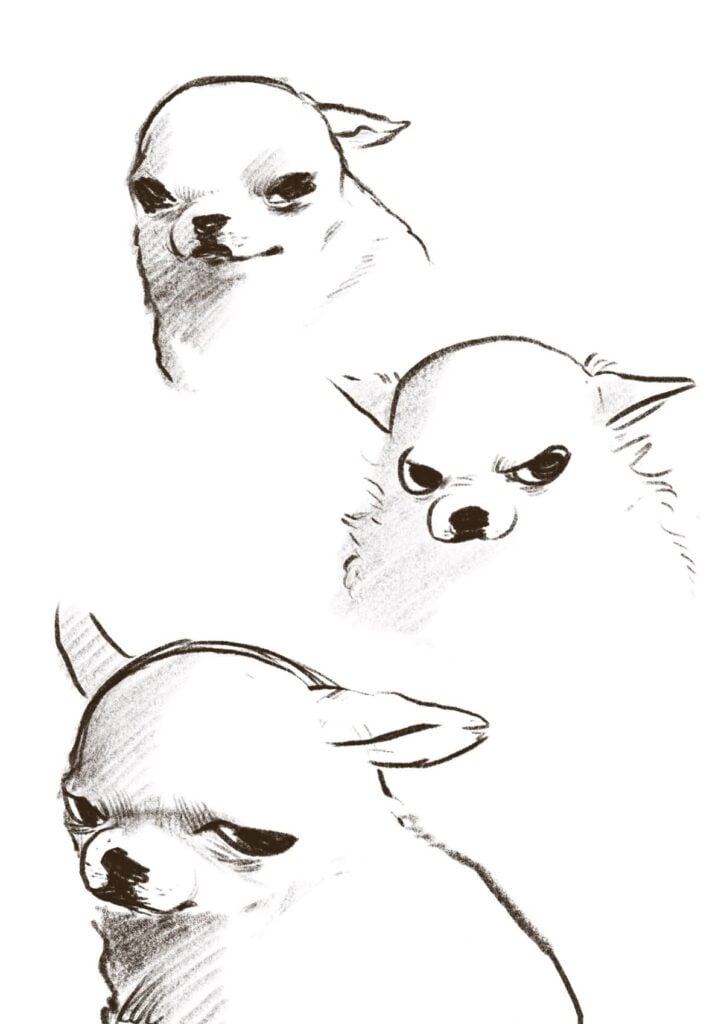
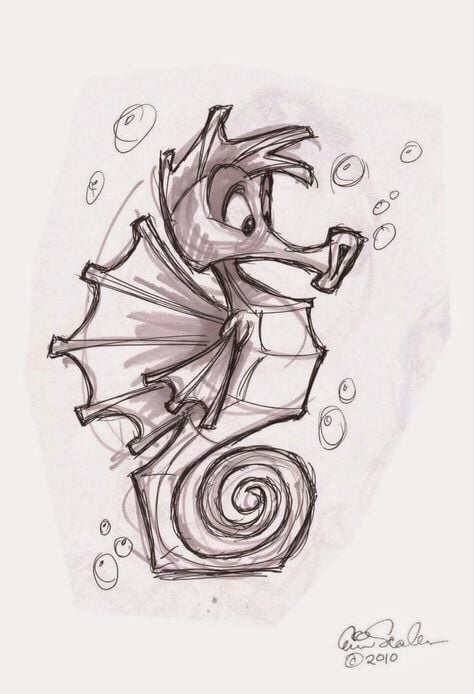
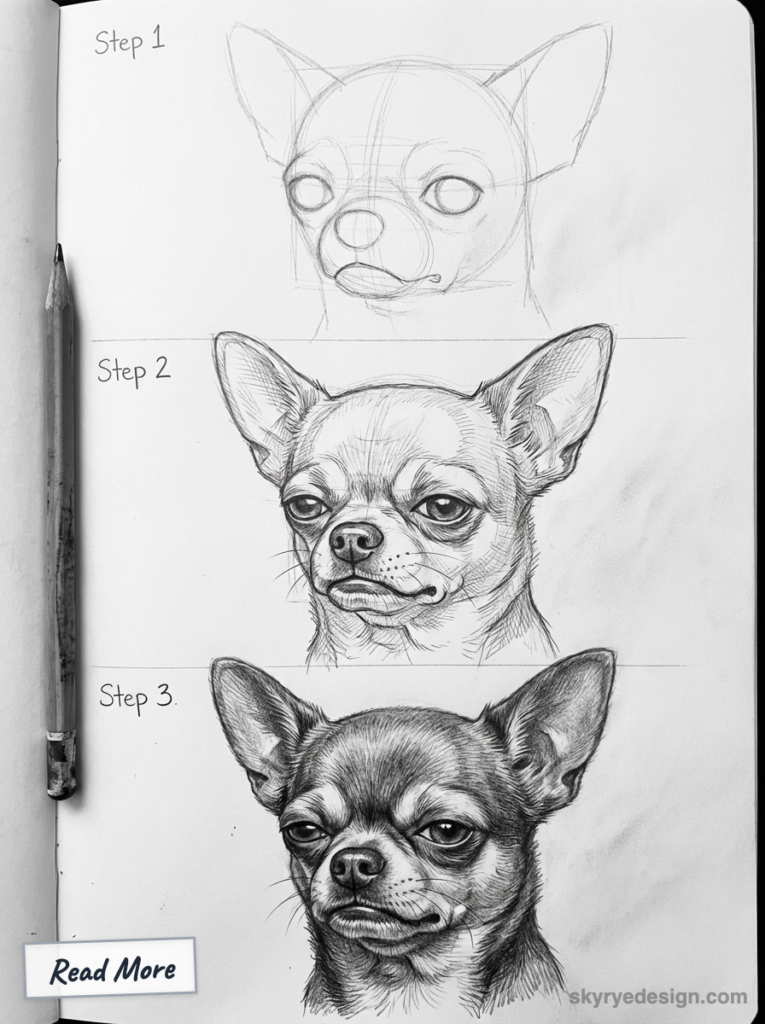
Set a timer for three minutes. Goal: draw something intentionally bad.
Weird proportions encouraged. Wobbly lines celebrated. The worse, the better.
This sounds ridiculous. It works ridiculously well. You’re giving your perfectionist brain an impossible task — it can’t make something ugly AND judge it for being ugly. System overload. Critic goes quiet.
After three minutes of deliberate garbage, “regular” drawing feels low-stakes by comparison.
The bigger point: These exercises aren’t lesser practice. They’re where looseness lives. Many professional artists do nothing BUT warm-up style drawing on some days — and those days aren’t wasted. They’re maintenance.
Your tight, precious, overworked tendencies? This is where they unlearn themselves.
Defeating the Perfectionism Monster
Let’s be honest: perfectionism isn’t about high standards. It’s about fear wearing a fancy mask.
Fear of being judged. Fear of wasting time. Fear that this drawing will finally prove you’re not talented enough. So you tighten up, overwork everything, and end up hating the result anyway.
I’ve lost entire sketchbooks to this. Pages I never finished because they weren’t “good enough” to continue. Drawings I scrapped after one wrong line. The perfectionism wasn’t protecting my work — it was strangling it.
Here’s what actually helps.
The “10 Sketches” Rule
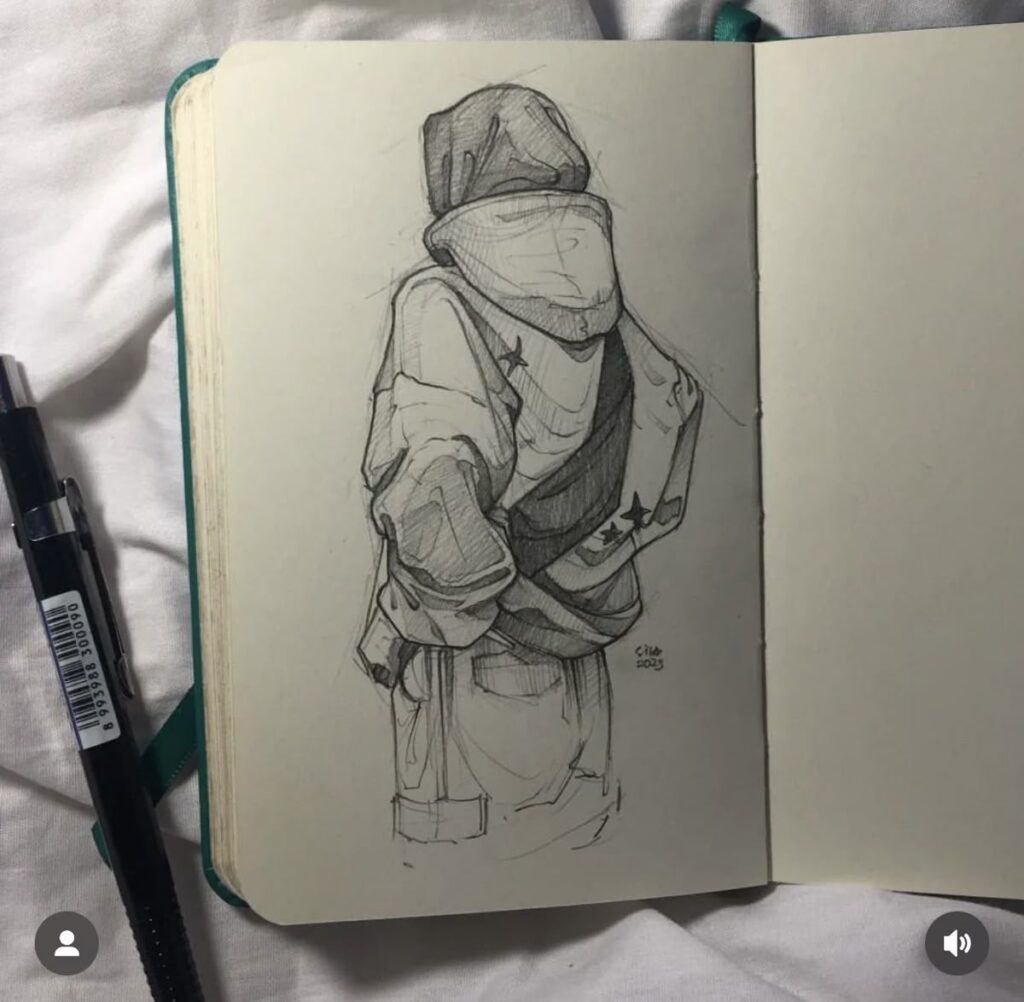
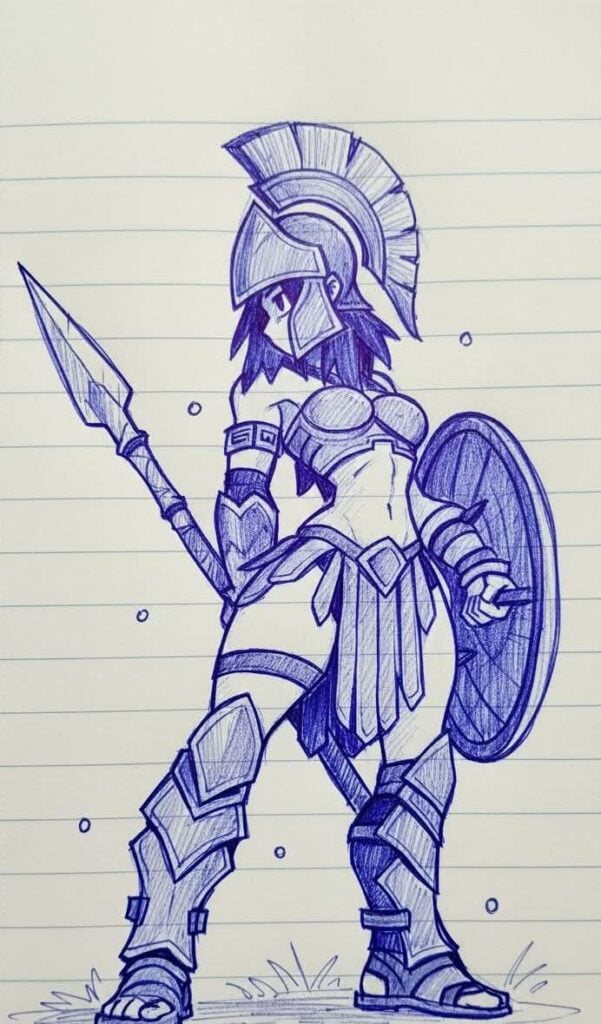
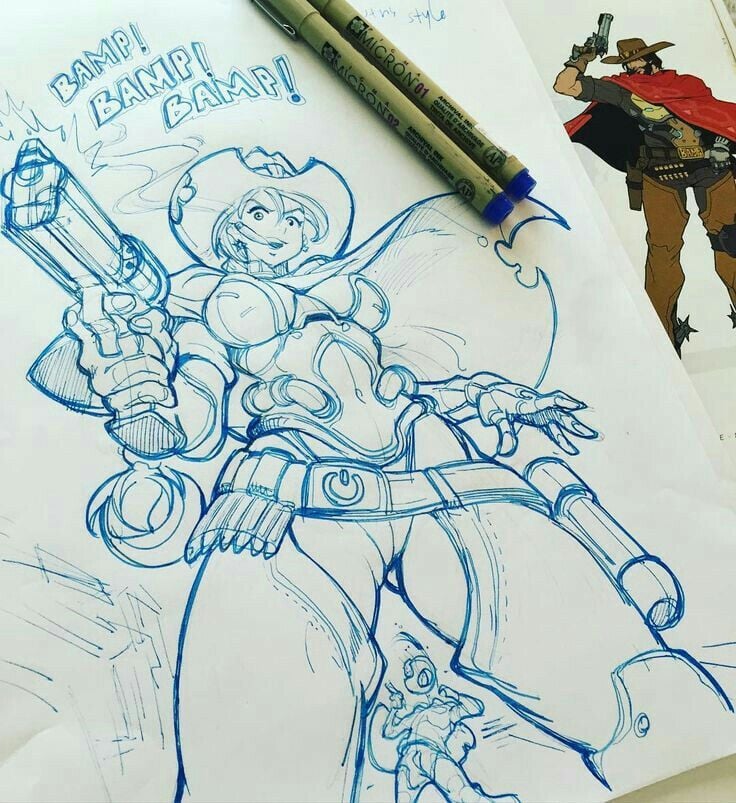
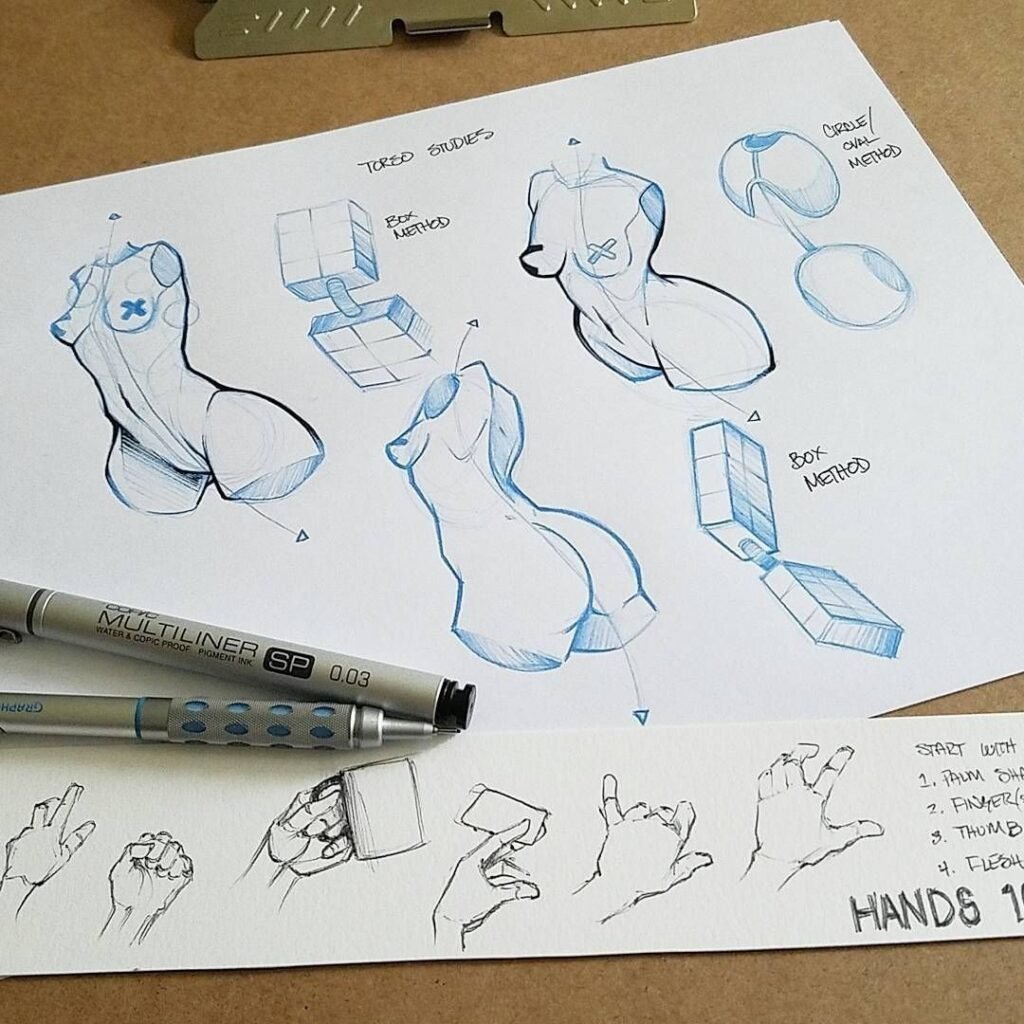
Before judging anything, fill a page with 10 small drawings.
Tiny thumbnails, quick studies, whatever fits. Most will be mediocre. Some will be bad. One or two might surprise you.
The magic: you can’t be precious about sketch #7 of 10. There’s not enough emotional real estate. Quantity drowns the perfectionist voice in sheer volume.
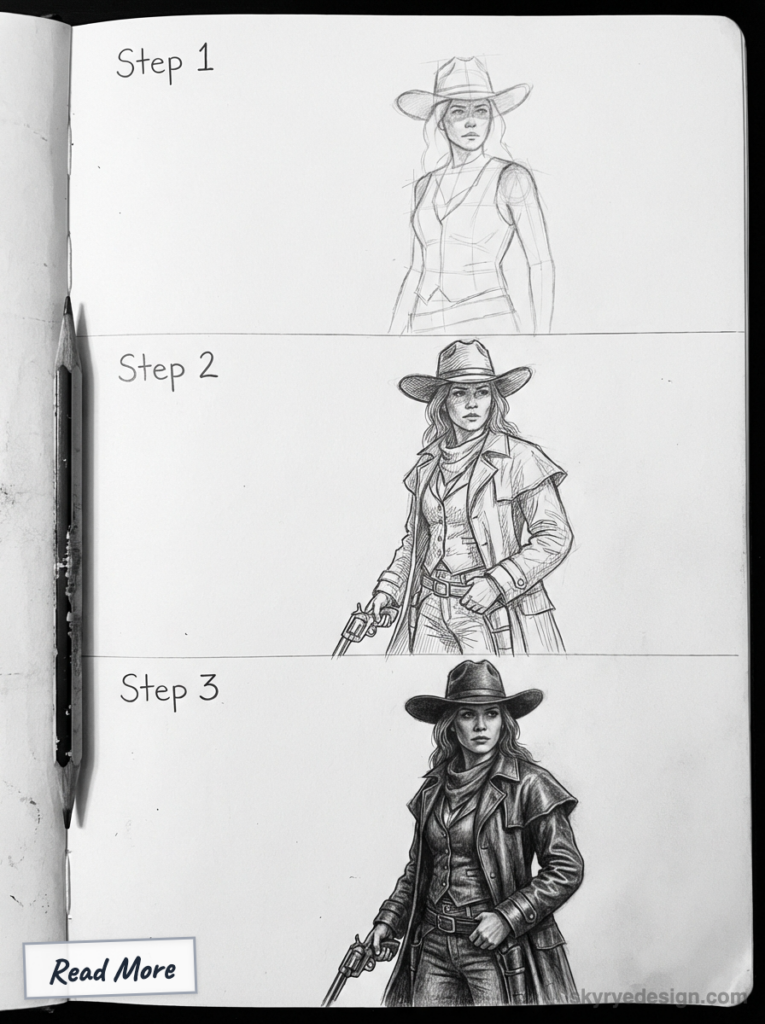
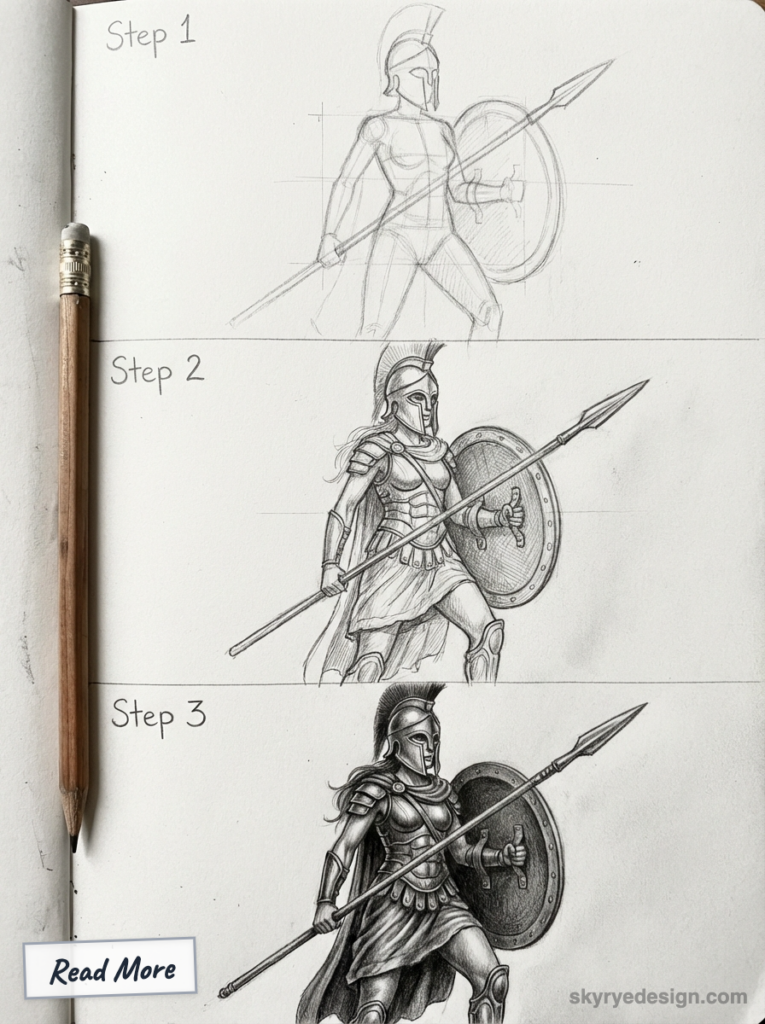
I use this constantly. Bad drawing? Doesn’t matter — nine more coming. The pressure evaporates.
The Ugly Sketchbook
Buy the cheapest sketchbook you can find. This is now your ugly sketchbook.
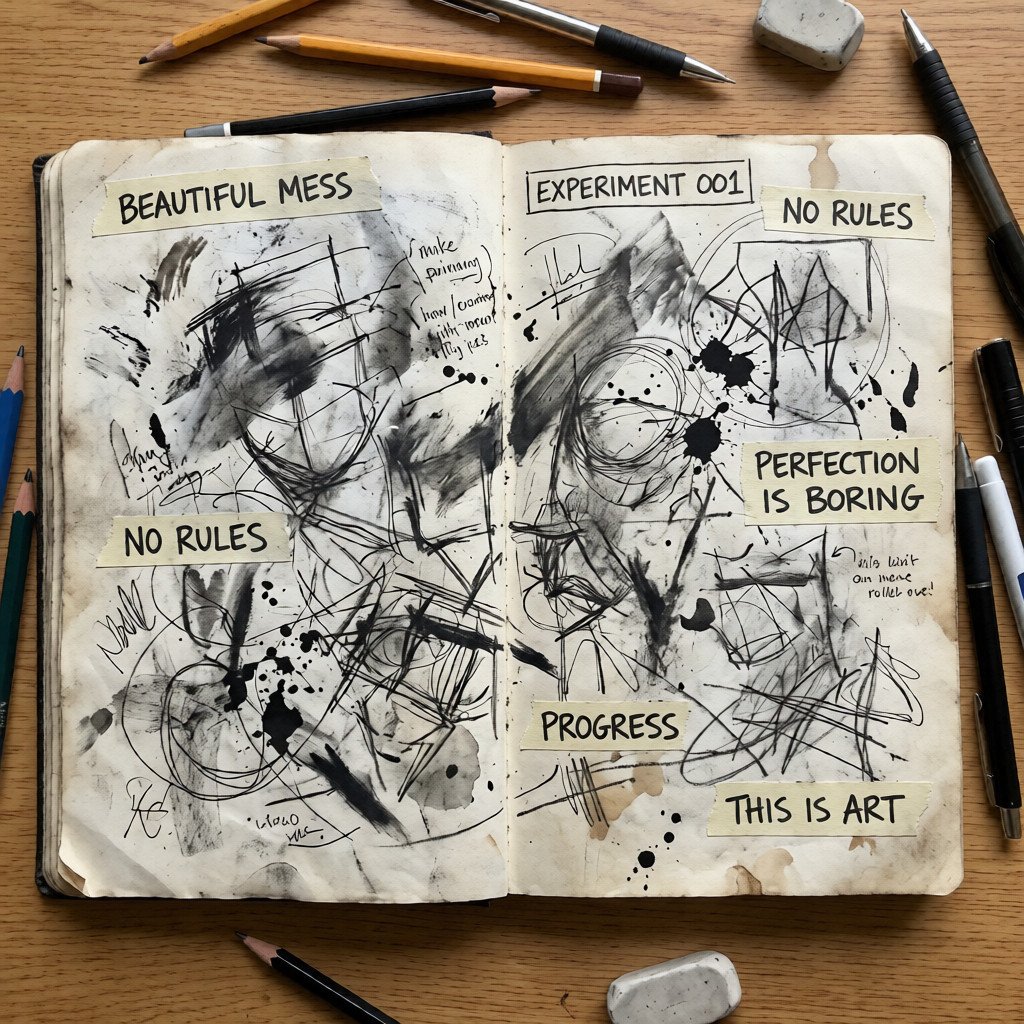
Rules: No one sees it. Nothing leaves it. Every experiment, every failure, every “what if” goes here. This is where growth happens — messy, embarrassing, alive.
Your public work can be curated. Your practice cannot.
Expensive supplies amplify perfectionism. That $30 Moleskine whispers “don’t waste me” every time you open it. A $3 drugstore notebook doesn’t care. Cheaper paper, freer lines.
The Comparison Detox
Your sketches versus their finished illustration isn’t a fair comparison. You know this intellectually. Your brain ignores it anyway.
Try this: unfollow accounts that make you feel bad. Temporarily. Not forever — just until your relationship with drawing stabilizes.
Set specific “inspiration time” and “practice time.” Don’t scroll Instagram while drawing. The comparison spiral starts small and swallows your whole session.
The “Already Ruined” Technique
Before starting, make a mark that “ruins” the page. Scribble in the corner. Splatter some water. Draw an ugly shape right in the middle.
Page is now imperfect. Pressure’s off. You’re not protecting precious white paper anymore — you’re working on something already flawed.
Sounds stupid. Works immediately. I’ve recommended this to dozens of artists and the response is always the same: “I can’t believe that actually helped.”
Redefine “Good Practice”
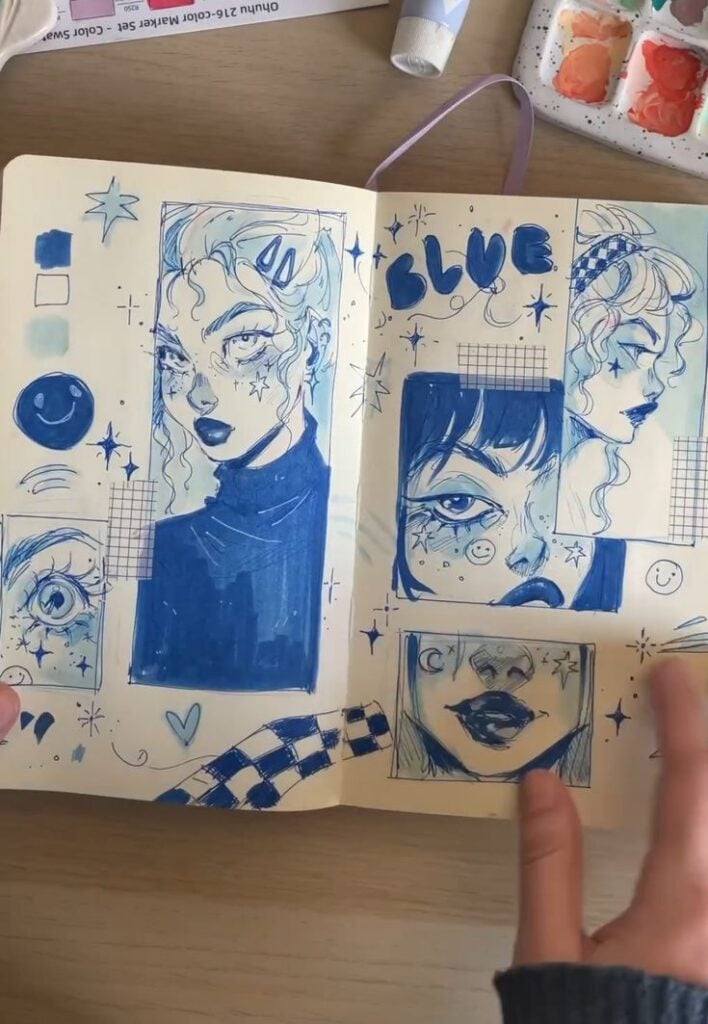
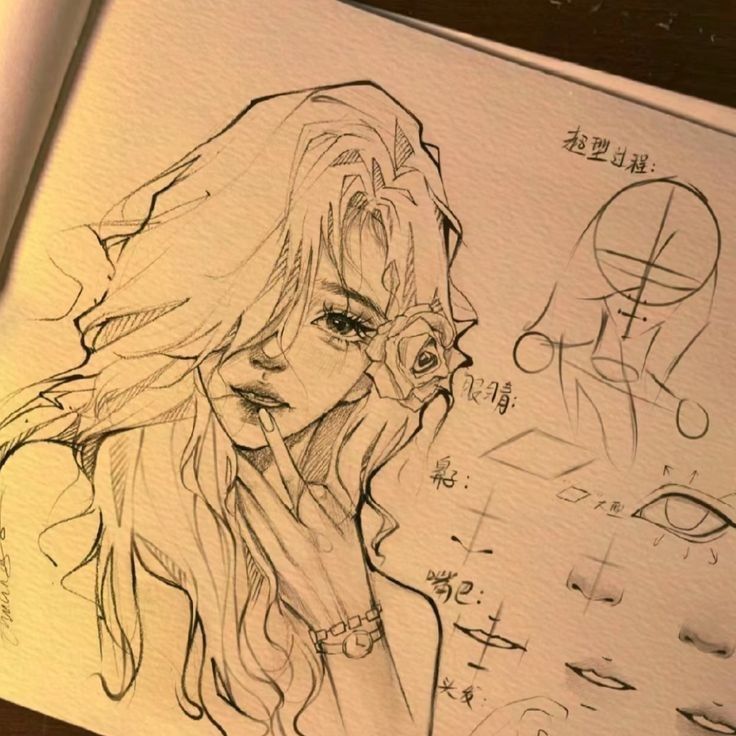
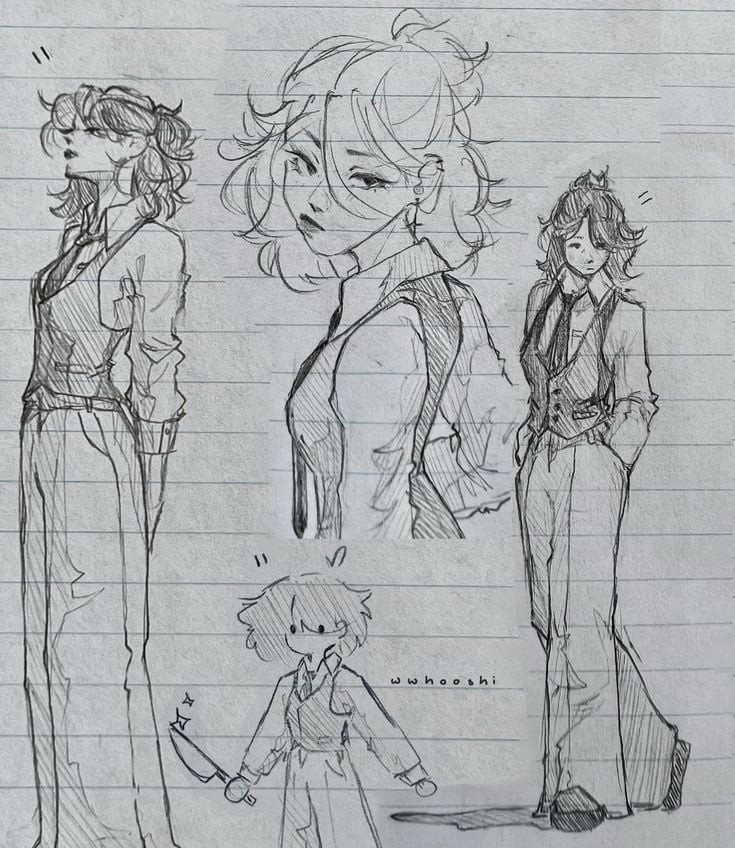
Here’s the mindset shift underneath all these techniques:
Good practice means you showed up and engaged. That’s it.
Good practice doesn’t mean good-looking results. Some of your biggest breakthroughs will happen on your ugliest pages. The learning is invisible. Trust the process anyway.
Your Workspace Is Making You Burn Out
Sometimes what feels like burnout is actually your body screaming for help.
That drained, can’t-focus, need-to-stop feeling? Might not be mental exhaustion. Might be neck pain you’ve normalized. Eye strain you’ve ignored. A posture that’s slowly wrecking you.
I blamed myself for “lack of discipline” for years before realizing my setup was the problem. Fixed my desk angle, added proper lighting, started taking breaks — suddenly I could draw twice as long without fatigue.
Your workspace isn’t just about comfort. It’s about sustainability.
The Posture Problem
Hunching over a flat tablet or sketchbook for hours destroys your neck and back. Those muscles weren’t designed for that position. The resulting pain feels like tiredness — but it’s actually injury in slow motion.
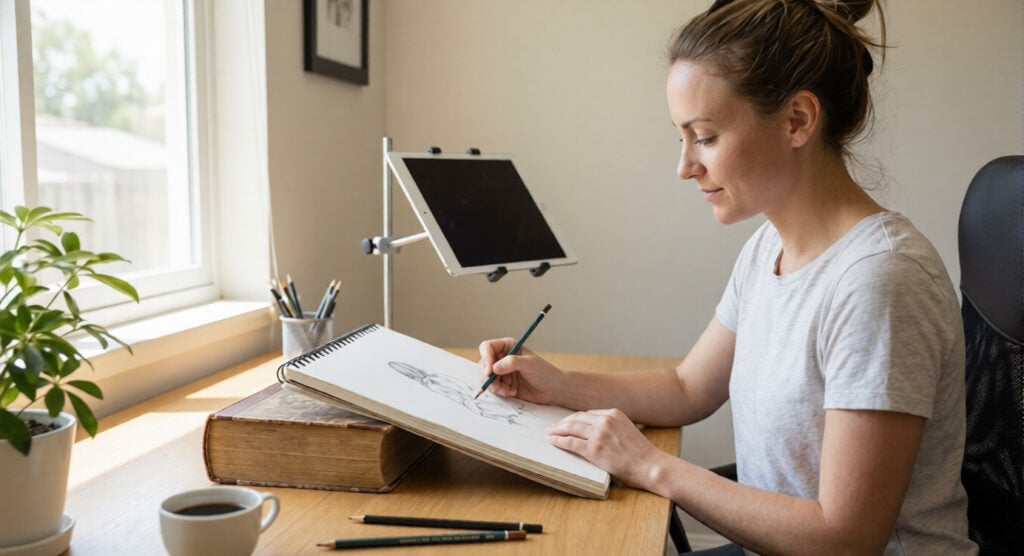
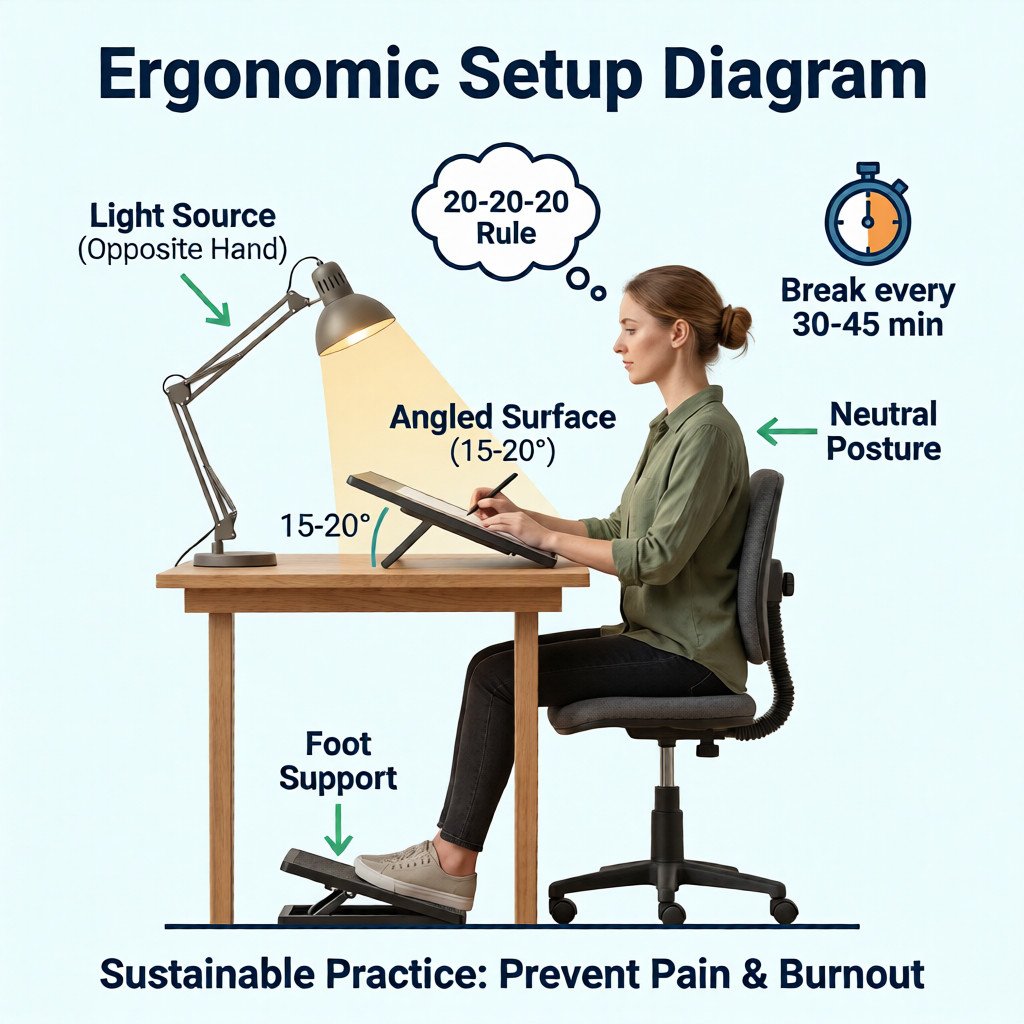
Simple fix: Angle your drawing surface 15-20 degrees. Prop your sketchbook on a thick book. Get a cheap tablet stand. Your neck should stay relatively neutral, not craned forward like a vulture.
This single change extended my comfortable drawing time by an hour. Not exaggerating.
Eye Strain Is Sneaky
Headaches after drawing? Dry, tired eyes? Difficulty focusing? That’s eye strain, not “pushing through” territory.
The 20-20-20 rule: Every 20 minutes, look at something 20 feet away for 20 seconds. Set a timer if you have to. Your eyes need distance focus breaks.
Digital artists: match screen brightness to room lighting. Enable warm color filters after sunset. Your retinas will thank you.
Lighting Nobody Talks About
Shadows falling across your work force your eyes to constantly adjust. This creates fatigue you don’t consciously notice — until you’re exhausted an hour in.
Position your light source opposite your drawing hand. Right-handed? Light comes from the left. Left-handed? Light from the right. No shadows on your work area.
A $15 desk lamp positioned correctly beats an expensive setup positioned wrong.
Movement Is Non-Negotiable
Stand up every 30-45 minutes. Not optional. Non-negotiable.
Wrist circles. Shoulder rolls. Walk to another room. Refill your water.
This isn’t wasting practice time. This is extending your practice career. Artists who ignore their bodies don’t become dedicated masters — they become people with chronic pain who can’t draw anymore.
The truth: Many artists quit not because they lost passion, but because drawing became physically uncomfortable. Don’t let preventable pain end your practice.
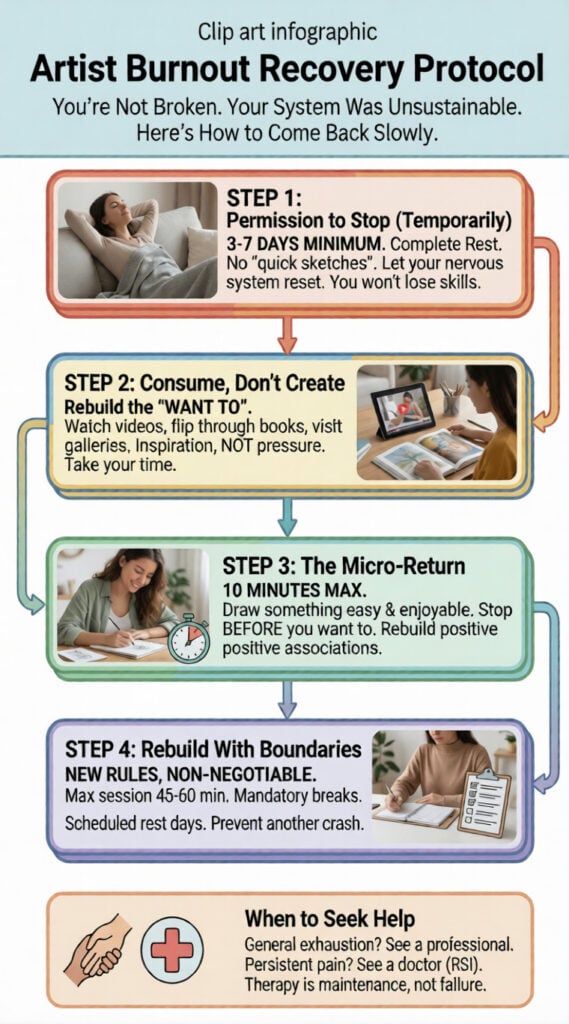
Already Burned Out? Here’s Your Recovery Protocol
Maybe you’re reading this too late. The burnout already happened. Drawing feels like a chore, or worse — something you actively dread.
First: you’re not broken. You’re not lazy. You ran a system that wasn’t sustainable, and your mind pulled the emergency brake. That’s protective, not pathetic.
Here’s how to come back. Slowly, carefully, without repeating the same mistakes.
Step 1 — Permission to Stop (Temporarily)
Full stop. Not “just quick sketches.” Not “only fun stuff.” Complete rest for 3-7 days minimum.
This feels terrifying. Your brain screams that you’ll lose skills, fall behind, waste time. Do it anyway.
You won’t forget how to draw. Your neural pathways don’t evaporate in a week. What you’re doing is letting your nervous system reset — and that requires actual space.
Step 2 — Consume, Don’t Create
Watch art videos. Flip through art books. Visit museums or browse virtual galleries. Let yourself be inspired without any pressure to produce.
You’re rebuilding the “want to” before forcing the “have to.”
This phase takes as long as it takes. Could be days, could be weeks. You’ll know it’s working when looking at art starts feeling exciting again instead of exhausting.
Step 3 — The Micro-Return
First session back: 10 minutes maximum. Not 11. Ten.
Draw something easy. Something you actually enjoy — not what you “should” practice. Stop before you want to stop.
Leave the session wanting more. That feeling is everything. You’re rebuilding positive associations with drawing, rewiring the dread response.
If 10 minutes felt okay, try 15 tomorrow. Build up like you’re recovering from injury. Because you are.
Step 4 — Rebuild With Boundaries
New rules, non-negotiable:
- Maximum session length (45-60 minutes)
- Mandatory breaks every 25-30 minutes
- Scheduled rest days (not “if needed” — scheduled)
These aren’t suggestions. They’re the guardrails that prevent another crash.
If old patterns creep back — the marathon sessions, the guilt spirals, the “just one more hour” — return to Step 1 immediately. Relapse is part of recovery. Catching it early is the skill.
When to Seek Help
If the exhaustion extends beyond art into your whole life — that’s not art burnout. That’s general burnout or depression. Different beast, needs professional support.
If physical pain persists after rest — see a doctor about repetitive strain injury.
Talking to a therapist isn’t dramatic. Many professional artists work with mental health support. It’s maintenance, not failure.
FAQ: Figure Drawing Practice Questions Answered
Q: Is 15 minutes of practice really enough?
A: For building a sustainable habit, absolutely. Fifteen focused minutes daily beats three scattered hours weekly. Consistency compounds — your brain learns better from regular short sessions than occasional marathons. That said, 15 minutes is a floor, not a ceiling. If you have energy for more, go for it. Stop before exhaustion, not after.
Q: How do I stay motivated when I don’t see improvement?
A: Stop looking day-to-day. Improvement is invisible at that scale. Compare your work from six months ago — that’s where progress shows. Also, flip the motivation myth: motivation follows action, not the reverse. Start with one gesture drawing. Just one. Motivation often shows up after you begin, not before.
Q: Should I practice figure drawing every single day?
A: No. Rest days help your brain consolidate learning — that’s when neural connections actually strengthen. Five days on, two days off works great. Some artists thrive on three or four practice days weekly. “Every day” culture creates guilt, not growth. Find your rhythm and protect your rest.
Q: What if I only have energy for “fun” drawing, not “real” practice?
A: Fun drawing IS real practice. You’re building hand control, visual library, and positive associations with your sketchbook. Not everything needs to be deliberate study. Play keeps you in the game. Burned-out artists who forced “serious” practice wish they’d allowed more play.
Q: How do I know if I’m burned out or just lazy?
A: They feel completely different. Lazy is “I don’t feel like it today” — fixed by simply starting. Burnout is dread, exhaustion, and loss of joy in something you used to love. Rest doesn’t fix lazy. Rest is essential for burnout. Trust your gut — you know which one you’re feeling.
Q: My wrist hurts when drawing. Should I push through?
A: Absolutely not. Pain is a stop signal, not a challenge. Pushing through leads to repetitive strain injury that can sideline you for months. Address the cause: check your grip pressure, wrist angle, break frequency, and workstation setup. Ice, rest, and if it persists — see a doctor. Your career depends on functional hands.
Conclusion
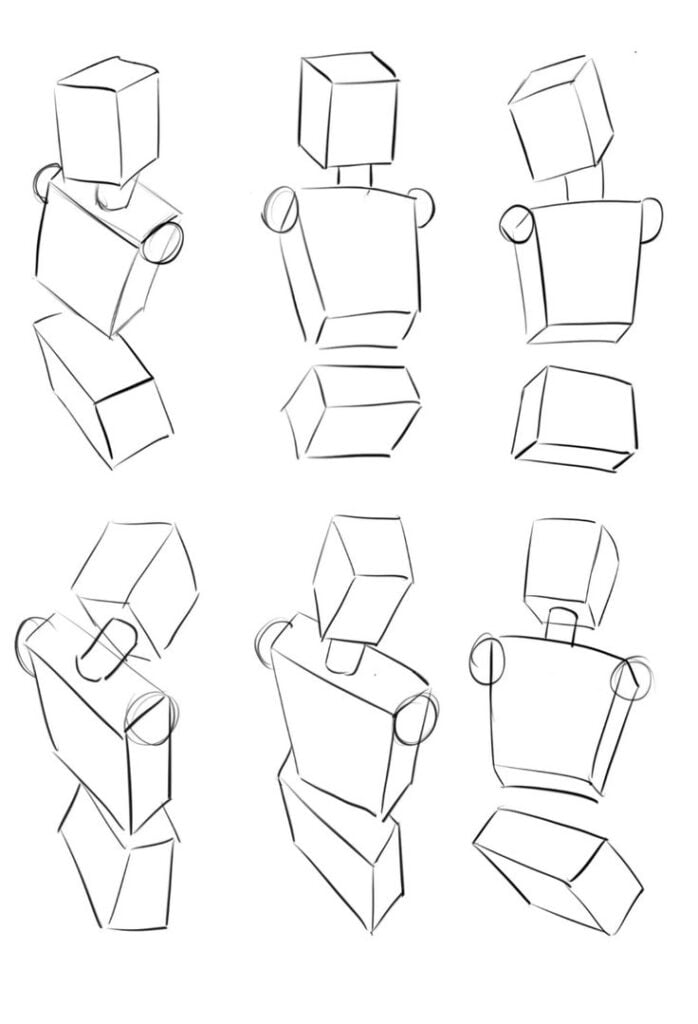
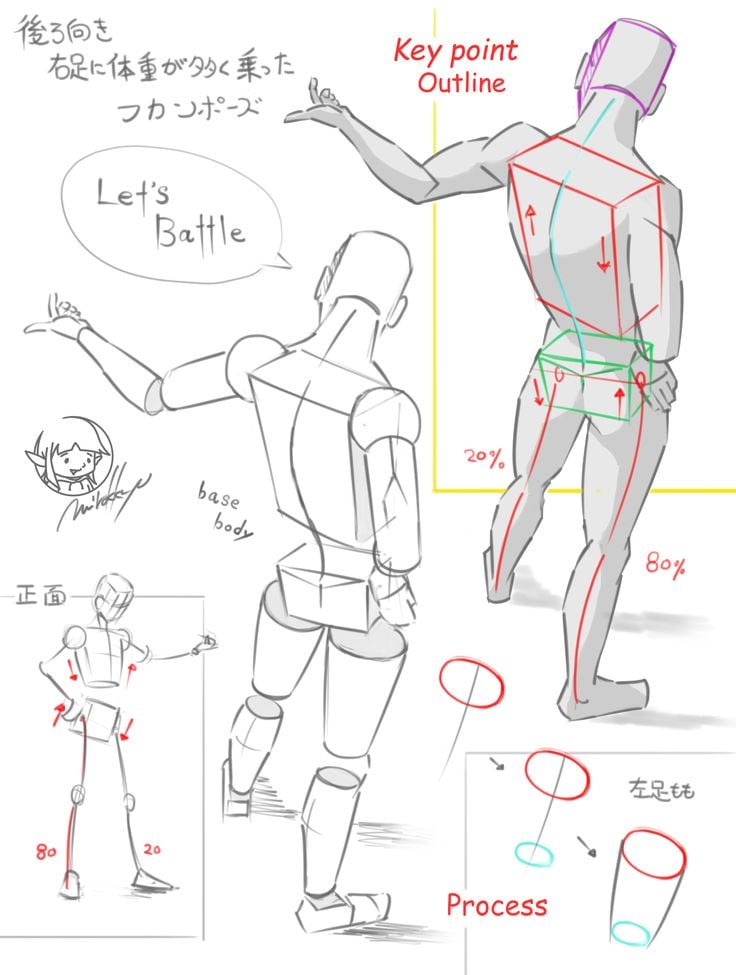
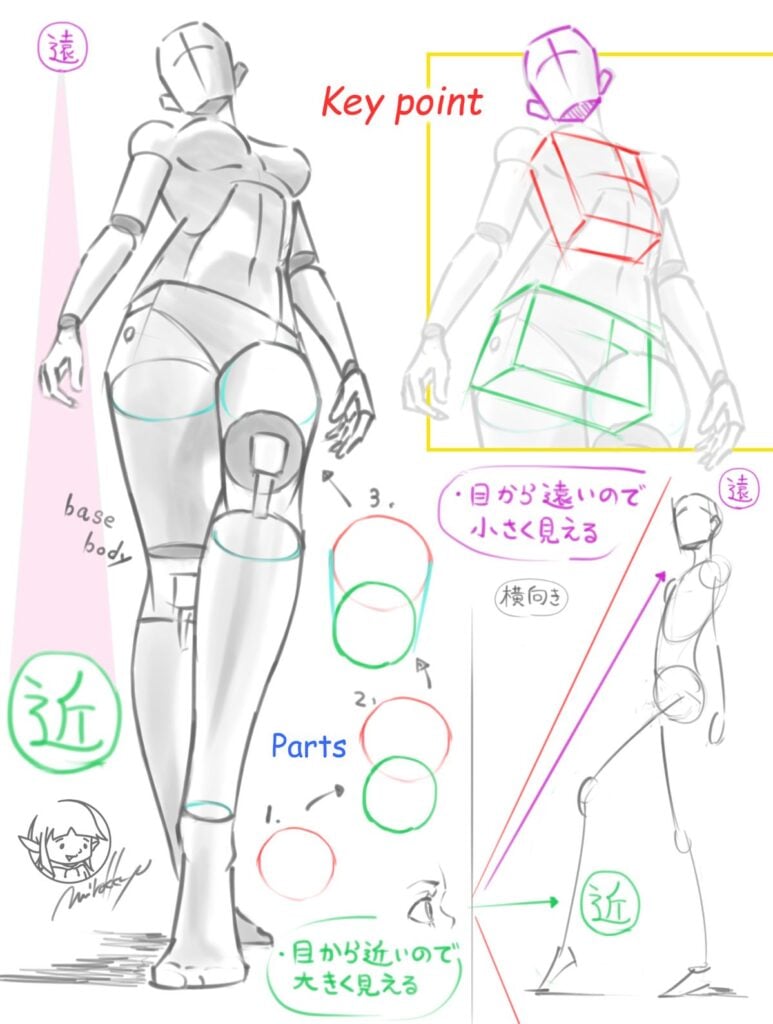
Sustainable figure drawing practice isn’t about logging more hours. It’s about protecting your energy, showing up consistently, and keeping drawing enjoyable enough to do for years.
Here’s what actually matters: sessions under 60 minutes, warm-ups that feel like play, giving perfectionism less oxygen, a workspace that doesn’t wreck your body, and rest before you need it.
The artists you admire aren’t grinding themselves into dust. They’ve built systems that let them keep creating — decade after decade, without burning out, without losing the joy that started everything.
You don’t need to suffer for your art. That myth has hurt enough people.
Start tomorrow with 15 focused minutes. Just 15. Notice how it feels to stop before exhaustion instead of after. Build from there.
Your practice should sustain you, not drain you. Now you know how to make that happen.
- 2.3Kshares
- Facebook0
- Pinterest2.3K
- Twitter0
- Reddit0