I kept a list of bird drawing ideas in my notes app for almost two years before I actually used any of them. Every time I sat down to sketch and couldn’t decide what to draw, I’d open Pinterest, spend 40 minutes scrolling through beautiful work, and end up drawing nothing. The problem wasn’t a lack of inspiration — it was too much of it, with zero structure.
This list is built differently. Each idea comes with specific guidance on what makes it worth drawing, which technique it trains, and what to watch out for. Sorted by medium and difficulty, so you can open this, pick something in 30 seconds, and actually start.
Graphite realism, loose watercolor, ink studies, tattoo flash, minimalist line — it’s all here. With honest notes from someone who’s drawn a lot of birds and failed at most of them the first time.
Pencil & Graphite Bird Drawing Ideas
Graphite is where most bird artists begin — and it’s where the fundamentals live. You can build up tone gradually, correct mistakes without consequence, and focus entirely on structure before committing to color. Strathmore Bristol 300 Series smooth (around $12 a pad) is the standard surface here: fine enough for precise feather detail, sturdy enough for heavy shading.
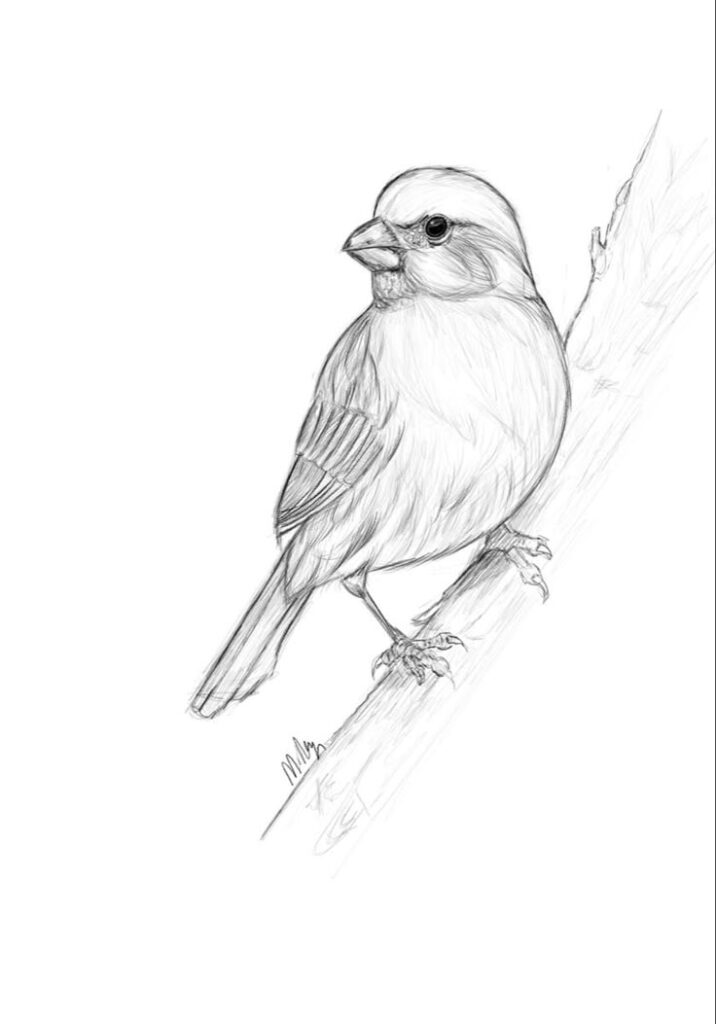
1. Perched Sparrow, Front View
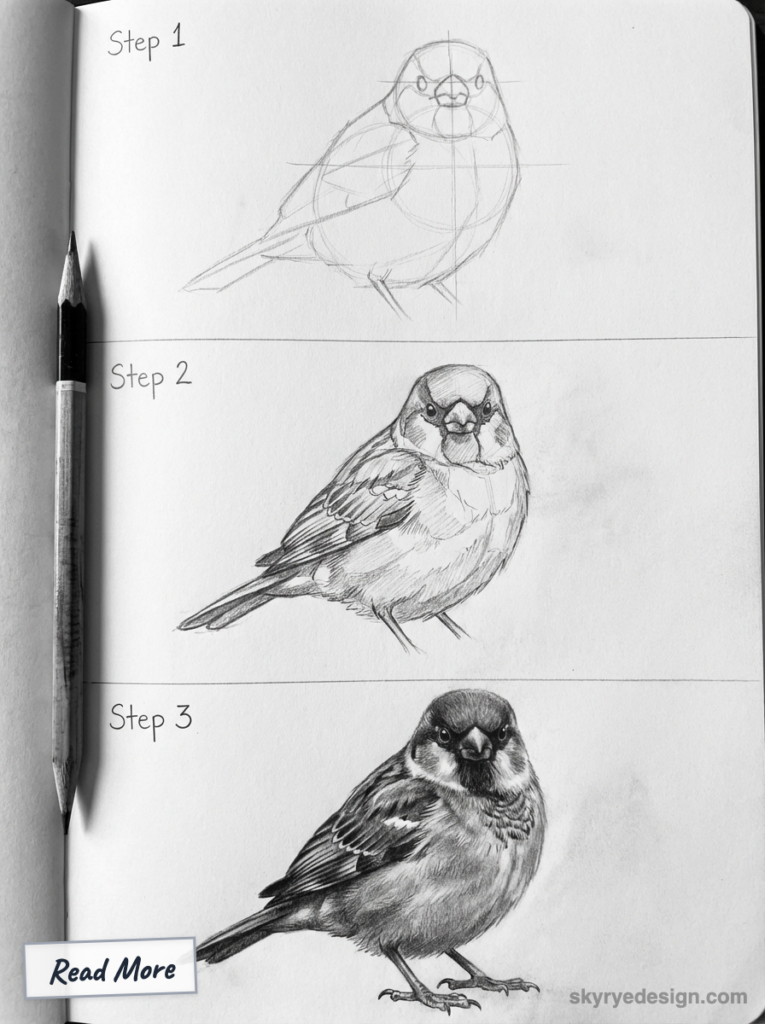
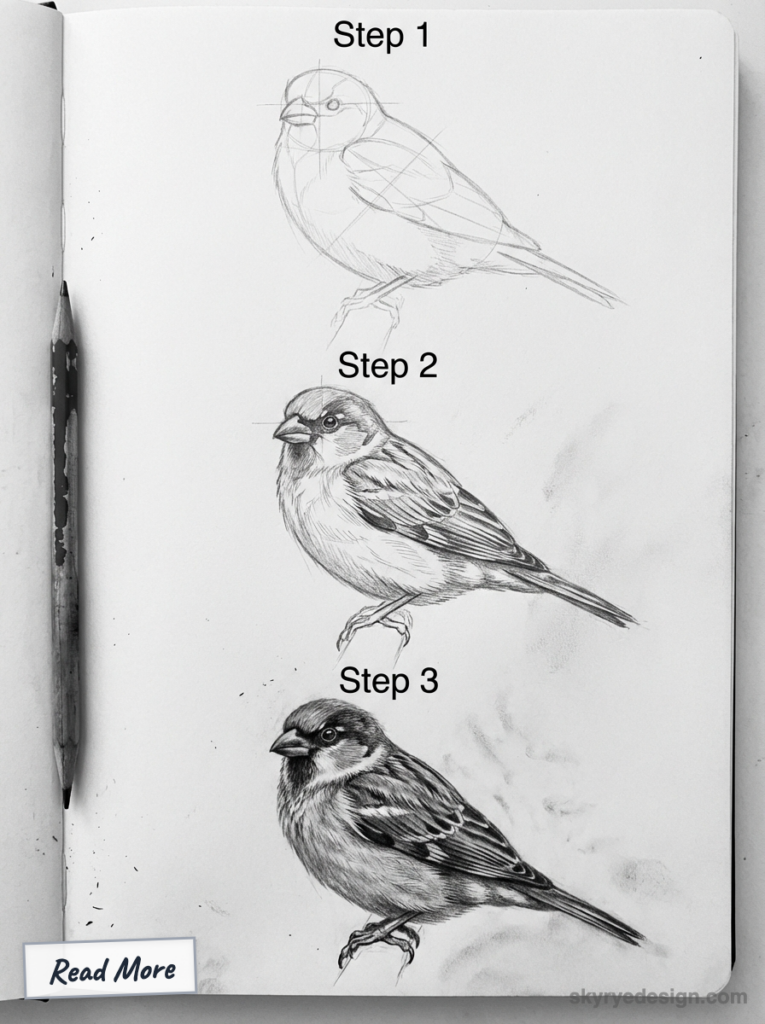
The front view is underused and underrated. It forces you to nail symmetry and understand how a bird’s body reads from straight on — the rounded keel pushing forward, the chest depth that a profile view completely hides. Use a 4B for the dark eye and beak edges, HB for building feather groups across the breast. Expect to spend most of your time on the face: getting both eyes at the same height is harder than it sounds.
2. Robin, Three-Quarter Pose
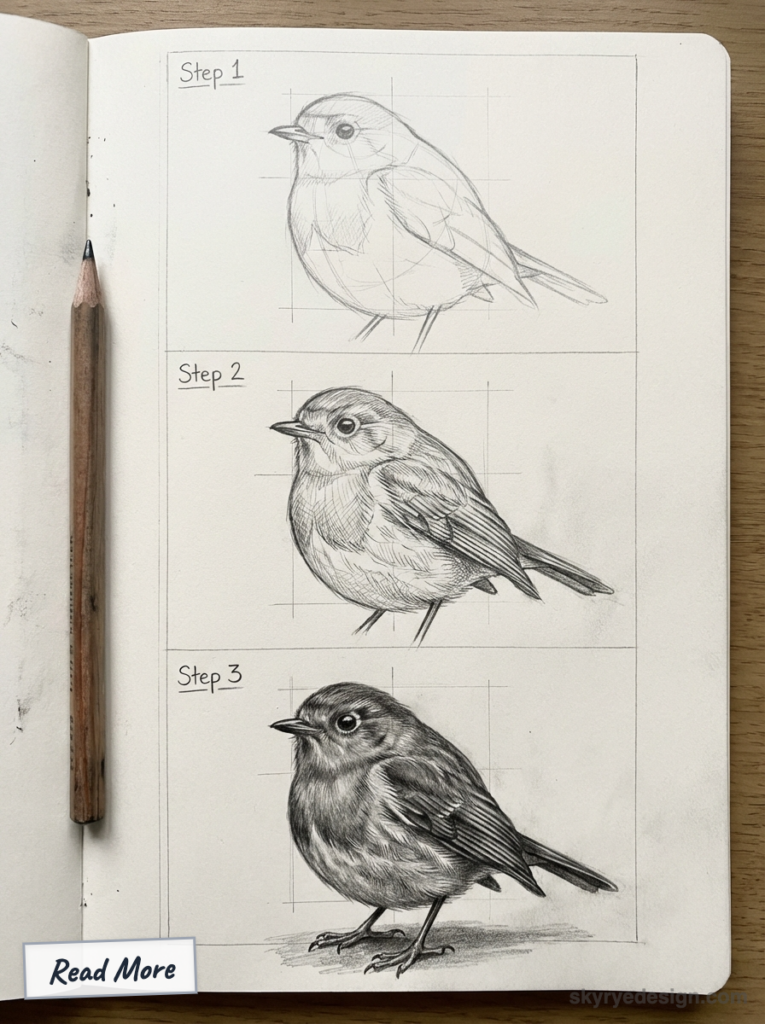
More interesting than a flat profile, and more instructive. The three-quarter angle reveals chest roundness and body depth simultaneously — it’s the pose that makes a robin look like a solid creature instead of a cut-out. I’ve noticed beginners almost always draw the head too large in this view; the head should sit noticeably smaller than the body mass when you’re at 45 degrees.
3. Crow on a Wire, Silhouette Study
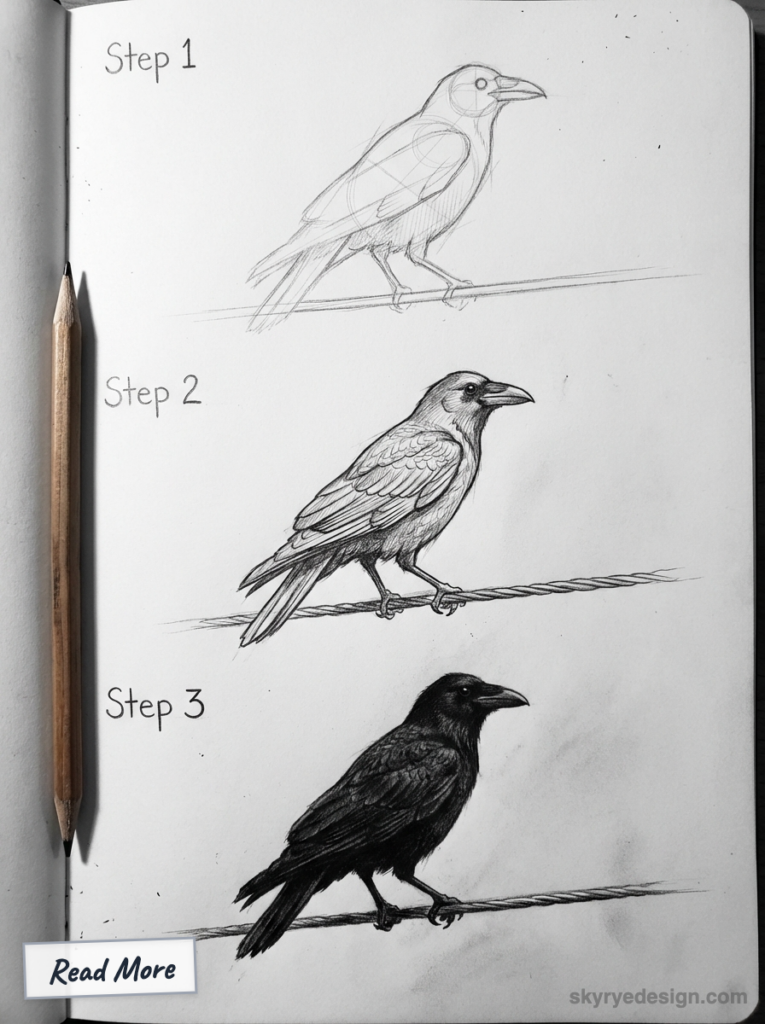
Draw it twice. First as a pure black silhouette — no interior detail at all, just the shape filled in solid. Then, as a fully rendered drawing with feathers and shading. Comparing them afterward shows exactly how much information lives in outline alone. Crows have one of the most instantly recognizable silhouettes of any bird, which makes this exercise genuinely satisfying: the silhouette version reads as a crow immediately, even though it’s five minutes of work.
4. Barn Owl Face, Graphite Realism
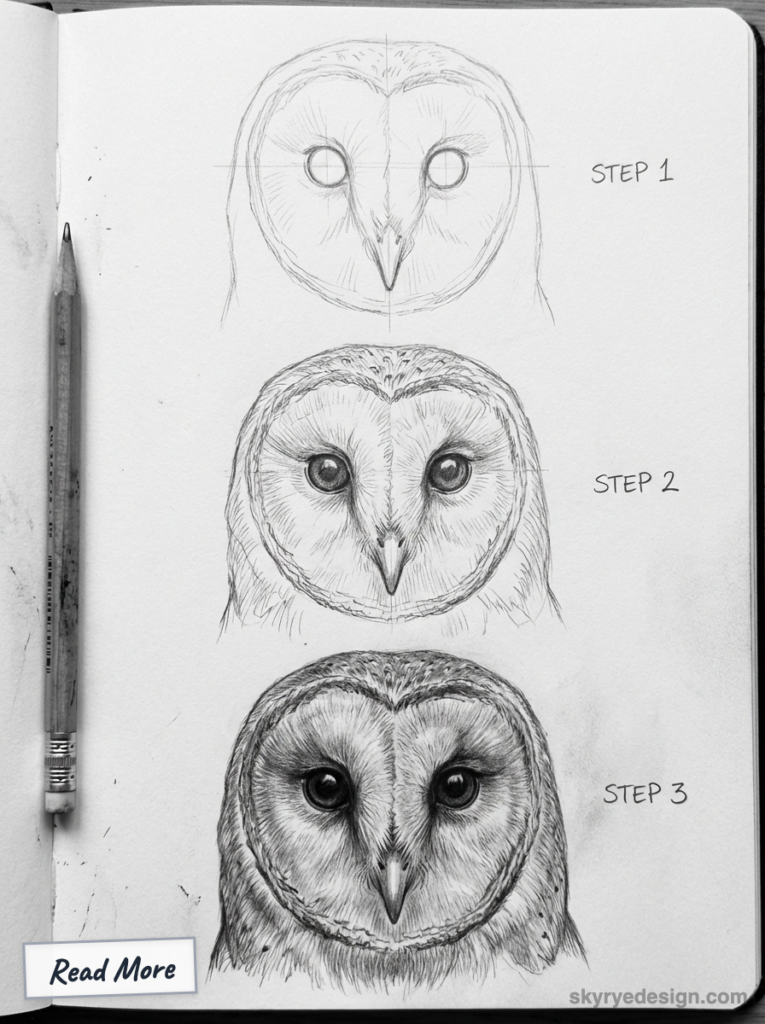
The facial disc is a masterclass in radial feather patterns: every strand flows outward from the beak like a biological starburst. Start from the center and work outward in directional strokes, softening as you move toward the disc edge. The dark eyes sit in shallow cups that need crisp value contrast — pure black iris ring against a pale face. Prismacolor Turquoise HB gives you the smoothest tonal range for this level of subtlety. Block at least two hours.
5. Hummingbird Hovering, Construction Lines Visible
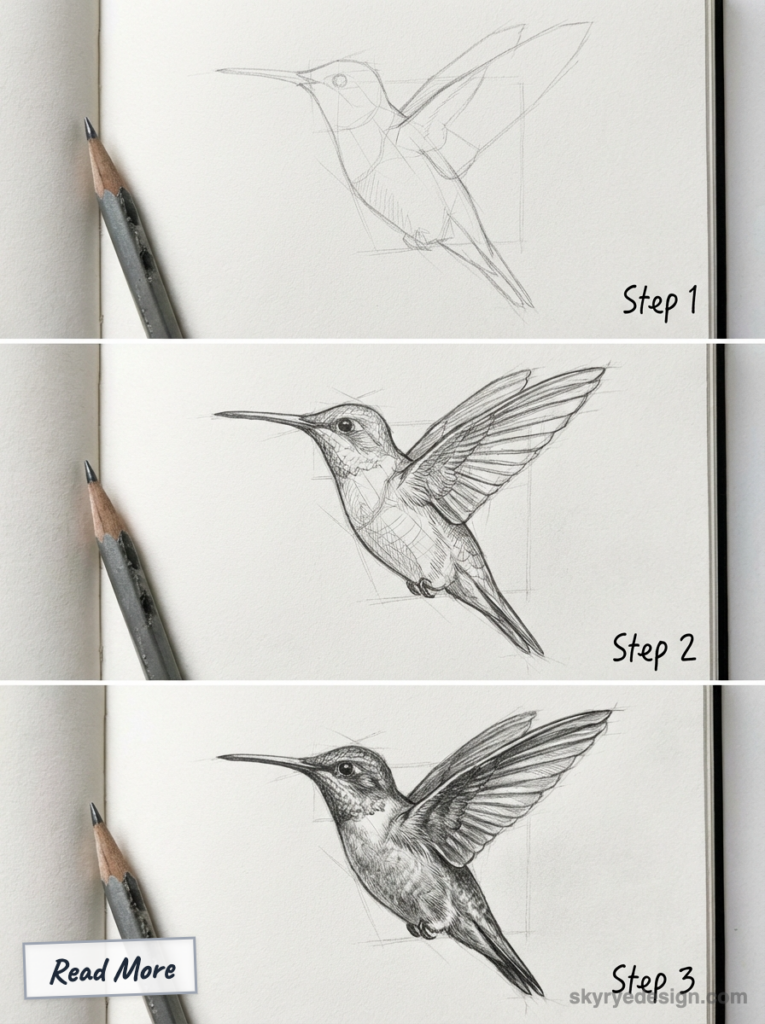
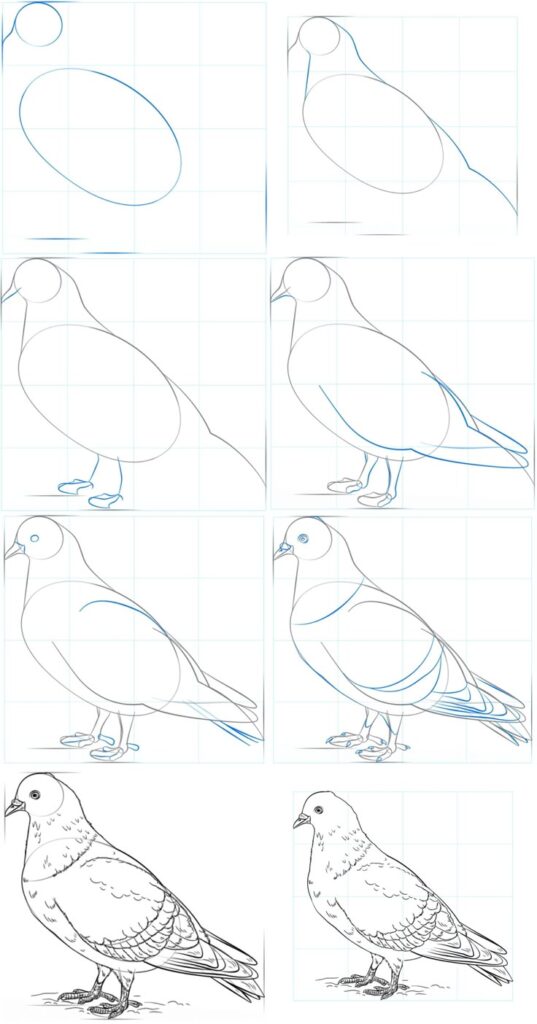
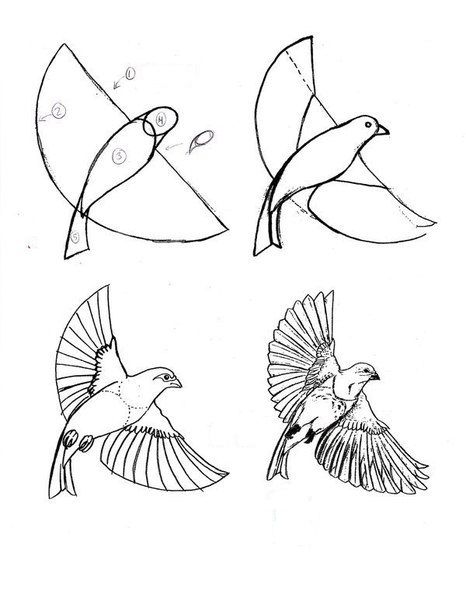
Build the full skeleton — the two-egg body, the spine axis, the wing attachment points — and then render the final bird on top without erasing the structure. Leave the construction visible. The contrast between the geometric skeleton and the delicately finished bird makes a striking study piece, and it’s one of the most saved formats on art Pinterest because it makes the process legible to viewers who want to learn.
6. Eagle Talon, Isolated Close-Up
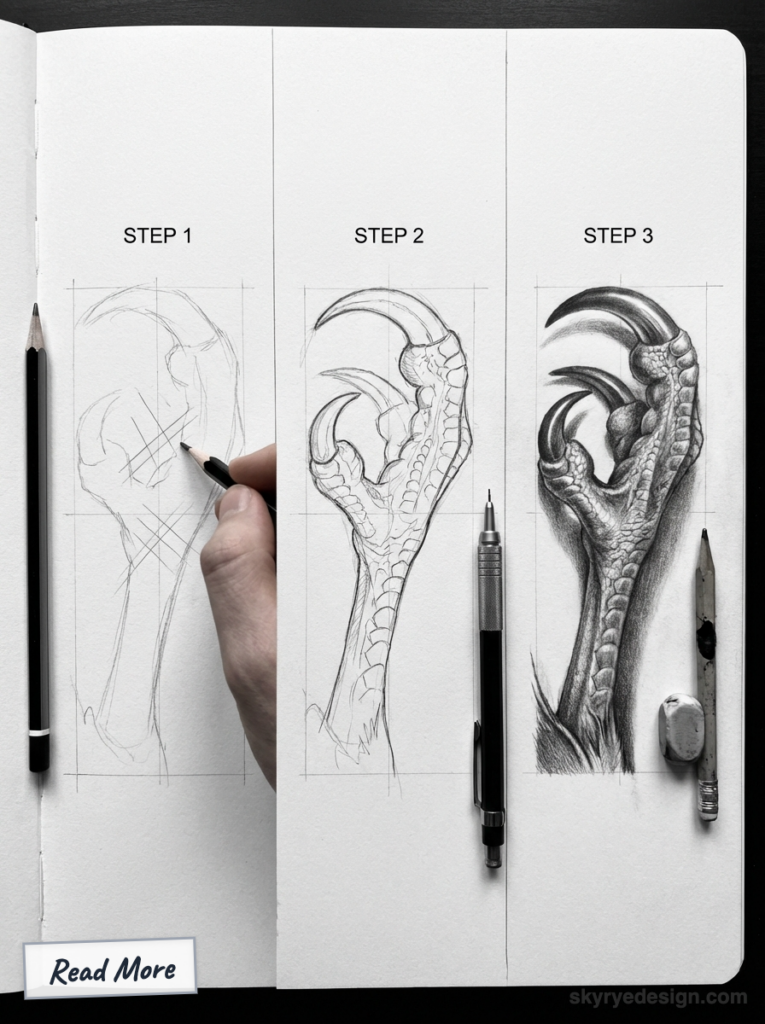
Forget the whole bird. Draw one talon at three times actual size. Isolation plus enlargement teaches you more about texture and value contrast than a full eagle drawn small ever will. Go heavy with a 6B under each scale, light HB on the ridge and claw tip. The dark-to-light transition on each scale is the whole challenge — get that right and the rest almost draws itself.
7. Single Feather, Actual Size Then 2x Enlarged
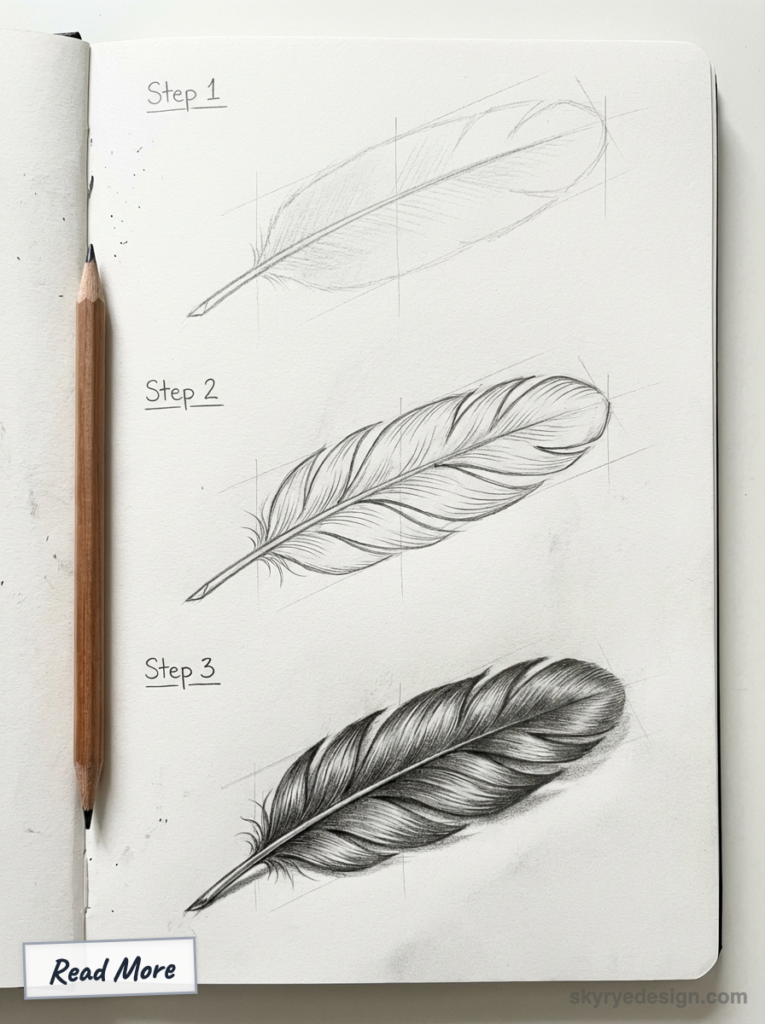
Find a fallen feather — pigeon, jay, whatever’s available — and draw it actual size first. Then draw it again at double scale. The difference in what you observe between the two is remarkable. You’ll notice the way the barbs split near the tip, the slight color shift from shaft to edge, and the asymmetry most feathers have. This is the single exercise I recommend most to beginners who struggle with feather texture.
8. Pelican Profile, Minimal Line
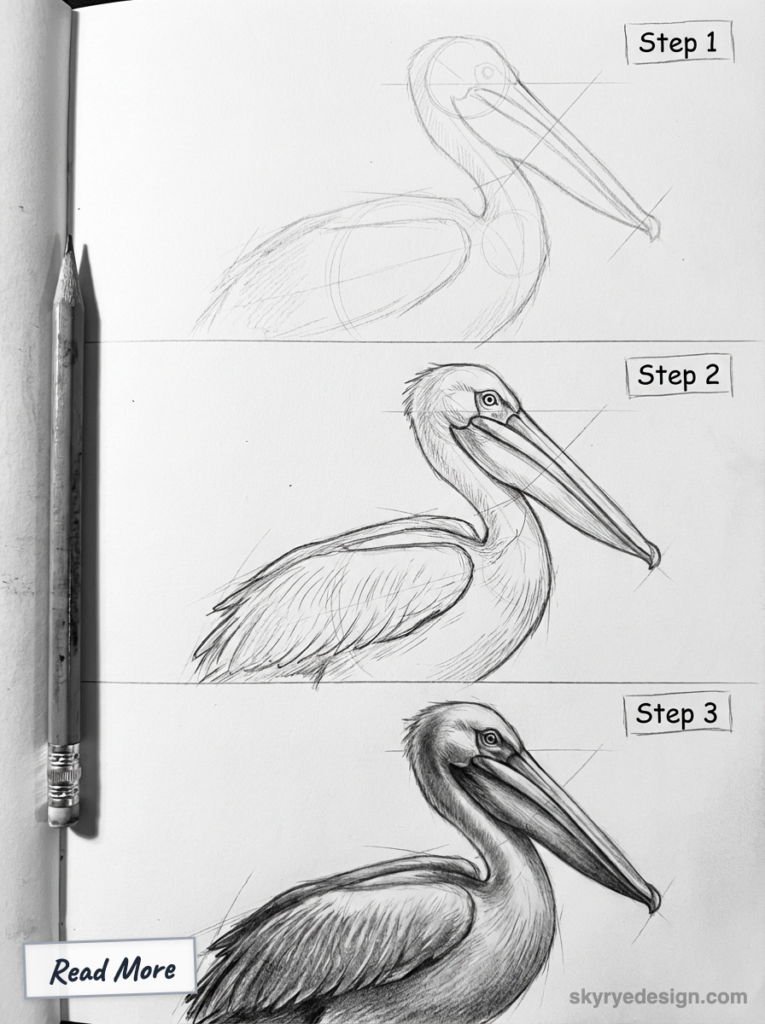
Use as few marks as possible. Pelicans have such a powerful shape — that enormous bill pouch, the prehistoric silhouette — that over-rendering kills the impact. Practice economy of line. Where can you imply feather texture with one stroke rather than twenty? The constraint is the lesson: figure out the minimum information your eye needs to read ‘pelican,’ and stop there.
Watercolor Bird Drawing Ideas
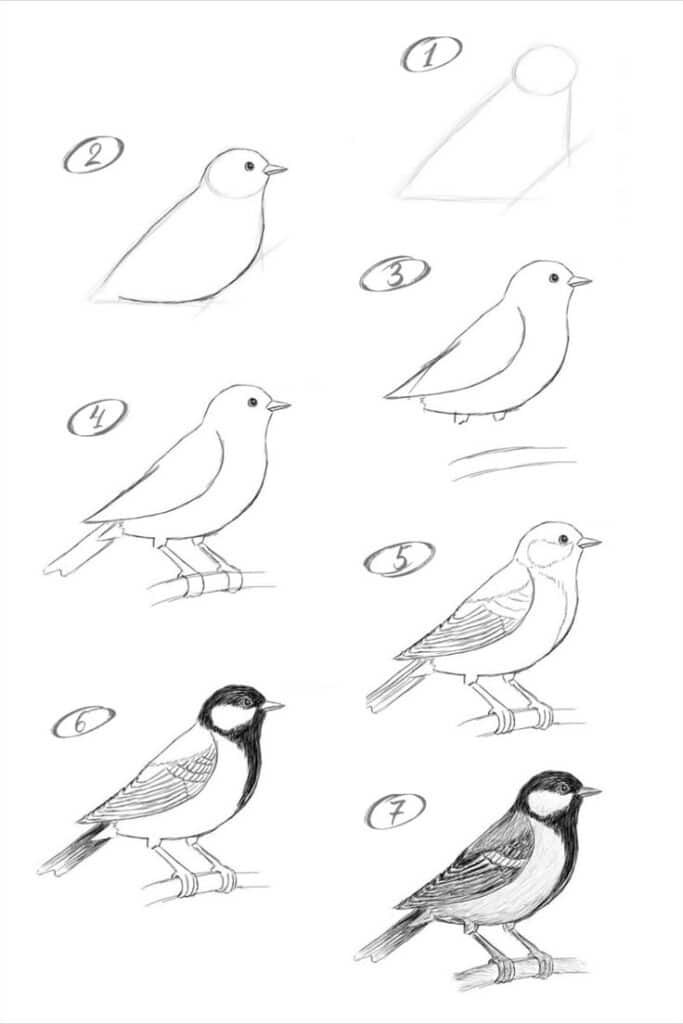
Watercolor suits birds better than almost any other subject. The wet-on-wet bleed naturally mimics soft plumage, and the medium’s unpredictability forces you to loosen up — which is exactly what bird drawing needs. Use Canson XL Watercolor 300gsm minimum so your paper doesn’t buckle under multiple washes. Anything lighter warps irreversibly after the first wet layer.
9. Kingfisher, Wet-on-Wet Color Bloom
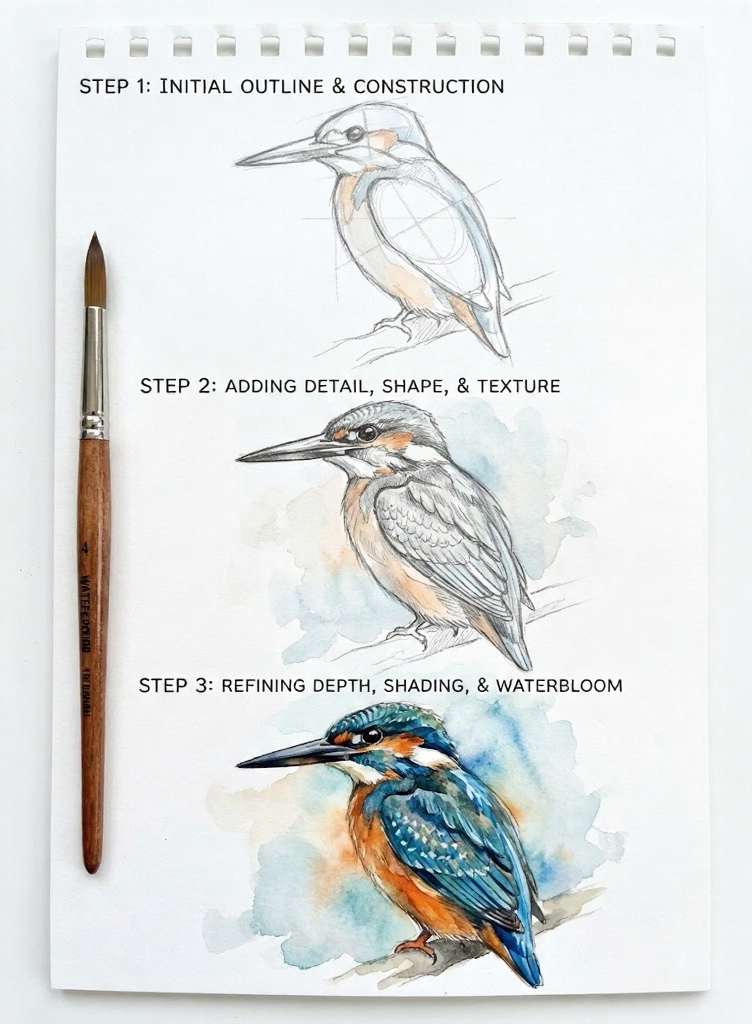
The common kingfisher’s cobalt blue back and burnt sienna underside might as well have been designed for watercolor. Load your blue wet-on-wet while the orange is still damp and let them bleed together at the boundary. Don’t fix it, don’t correct it. That soft blur where teal meets copper is the painting. Hard-edging the same transition with a dry brush kills everything that makes this species electric.
10. Flamingo, Single Gestural Wash
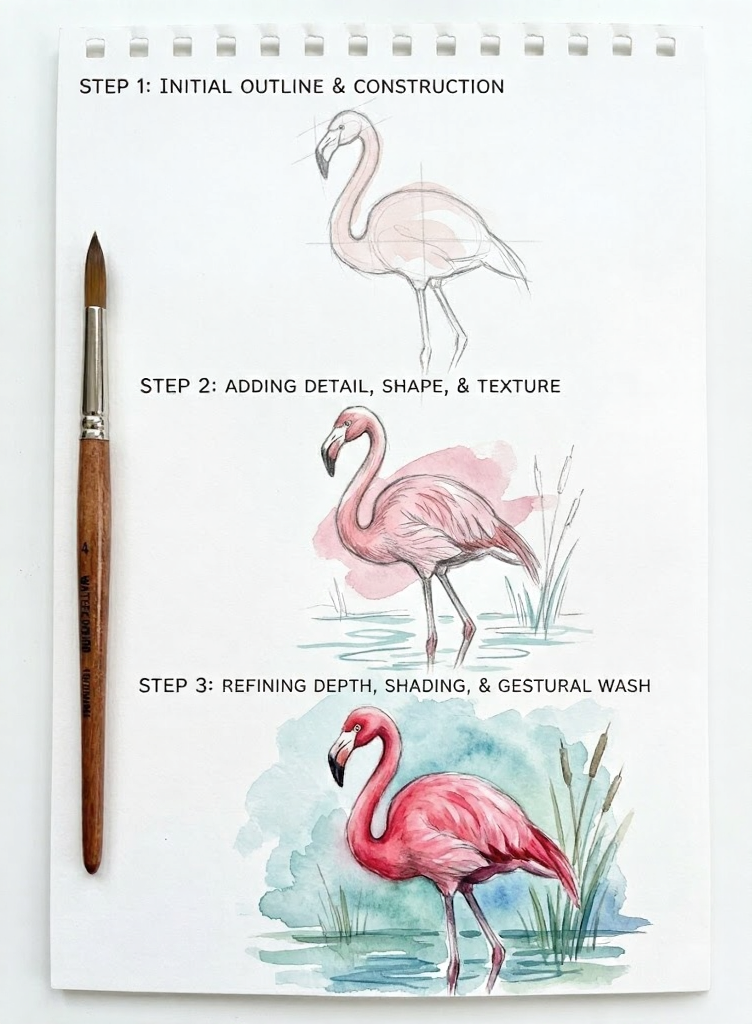
One continuous wet wash in rose quinacridone or opera pink, leave white paper for the breast highlight, drop in the dark wingtip dry once it’s fully set. The whole thing should take under fifteen minutes. Flamingos reward speed: slow, careful watercolor produces a stiff bird. Fast and loose produces the effortless grace the subject demands. If it looks too tidy, you’ve worked it too long.
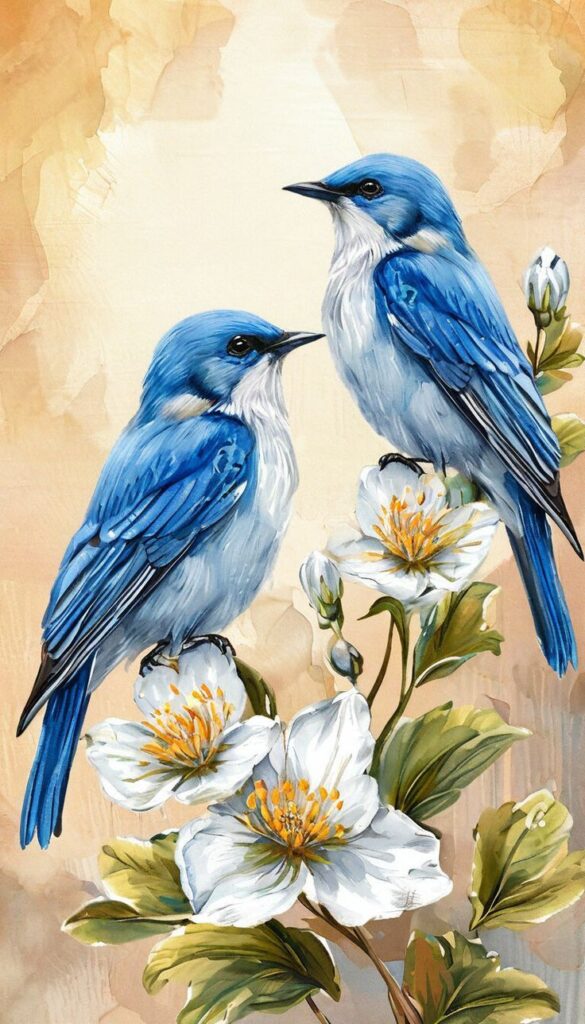
11. Blue Jay Portrait, Layered Washes
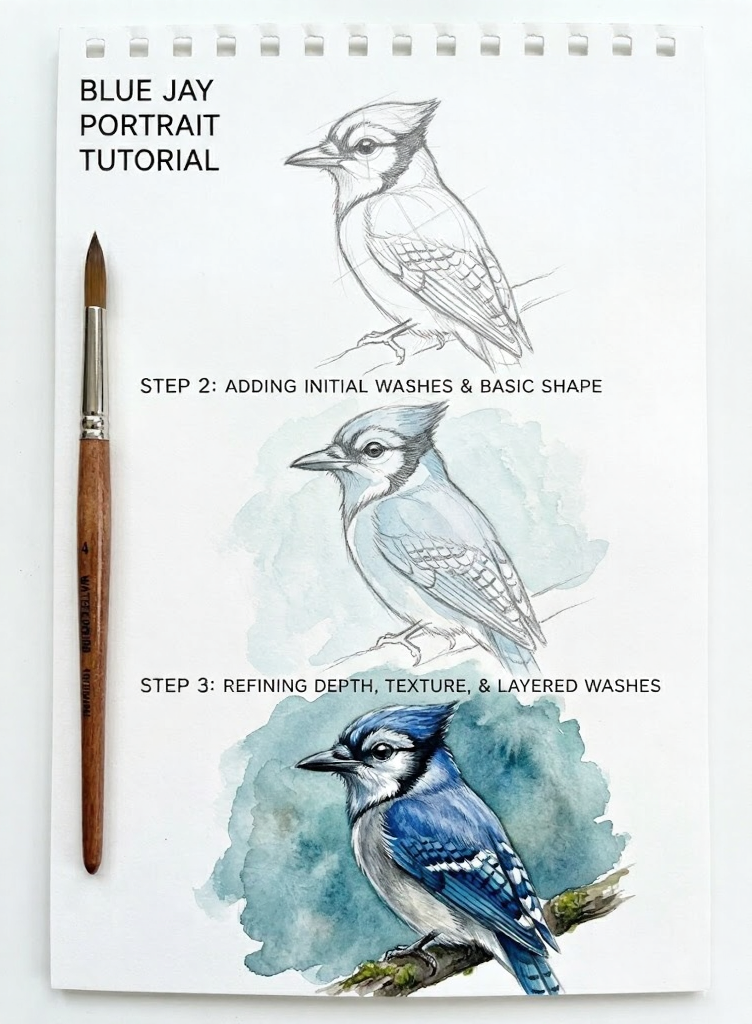
Three separate layers, each fully dry before the next. Pale cerulean as the base across the entire wing and crest. A second layer of ultramarine on the shadowed areas. Prussian blue or indigo at the darkest feather edges and under the wing. The layering builds a depth that a single blue wash — no matter how saturated — never achieves. The white face and breast stay as bare paper throughout.
12. Swallow in Flight, Negative Space Technique
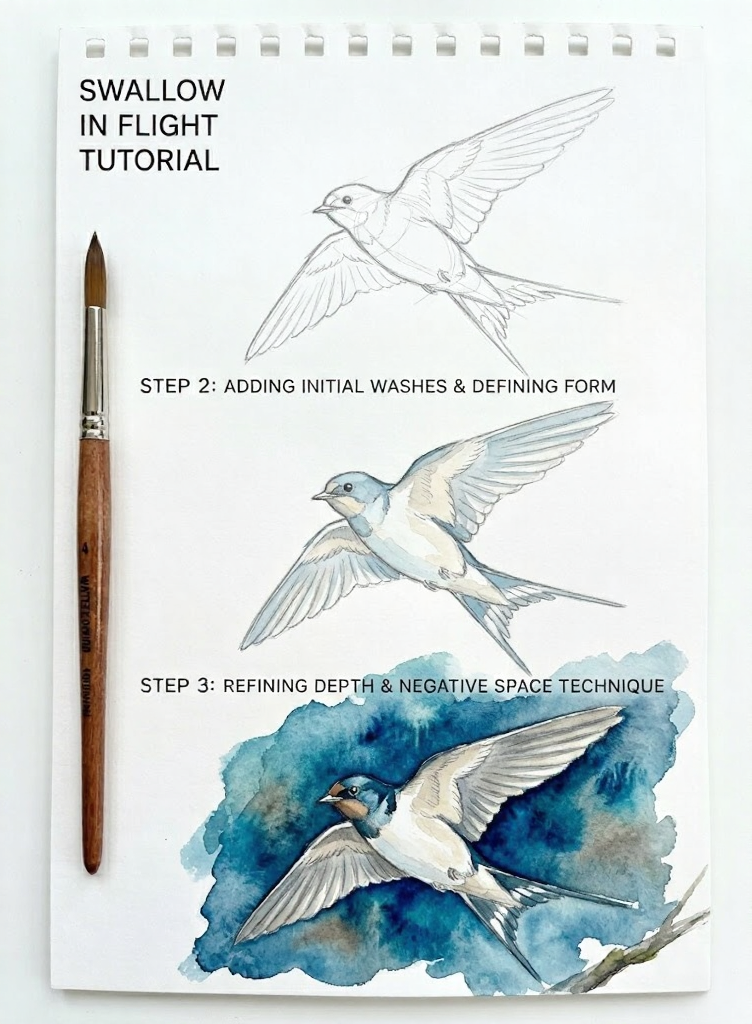
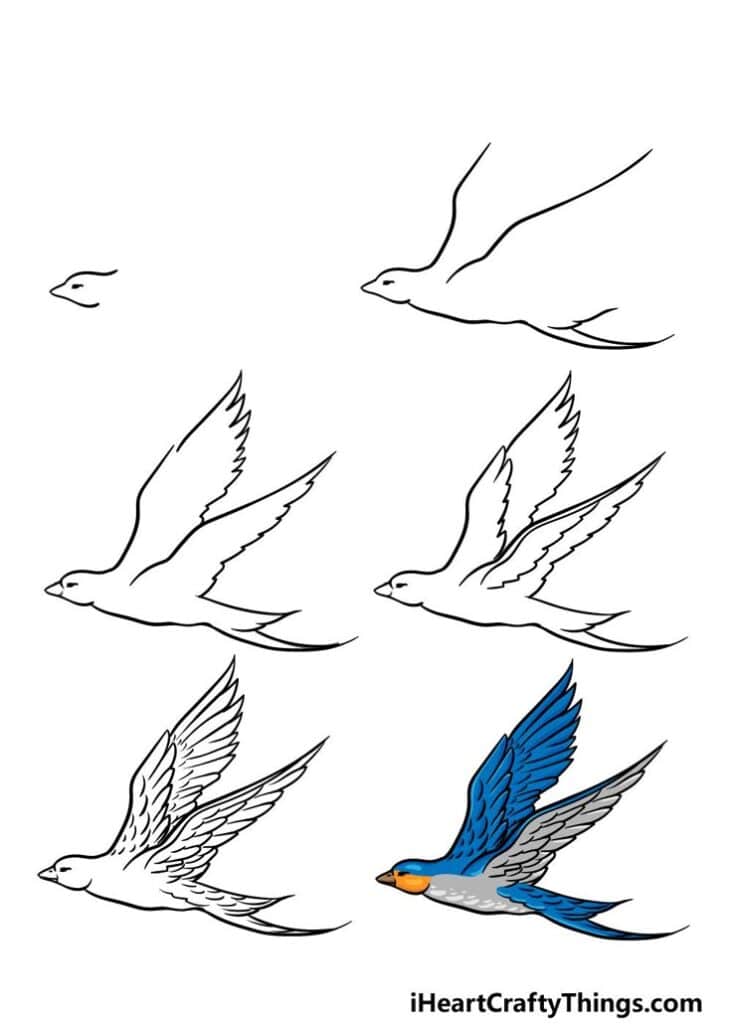
Paint the sky around the bird, not the bird itself. Mix a mid-blue grey wash and work carefully around the swallow’s silhouette, leaving the body as untouched white paper. The result looks advanced and reads as confident — but it’s actually more forgiving than trying to paint a tiny, detailed bird, because any slight wobble in the sky wash looks like atmospheric texture.
13. Five Tropical Birds, Color Chart Study
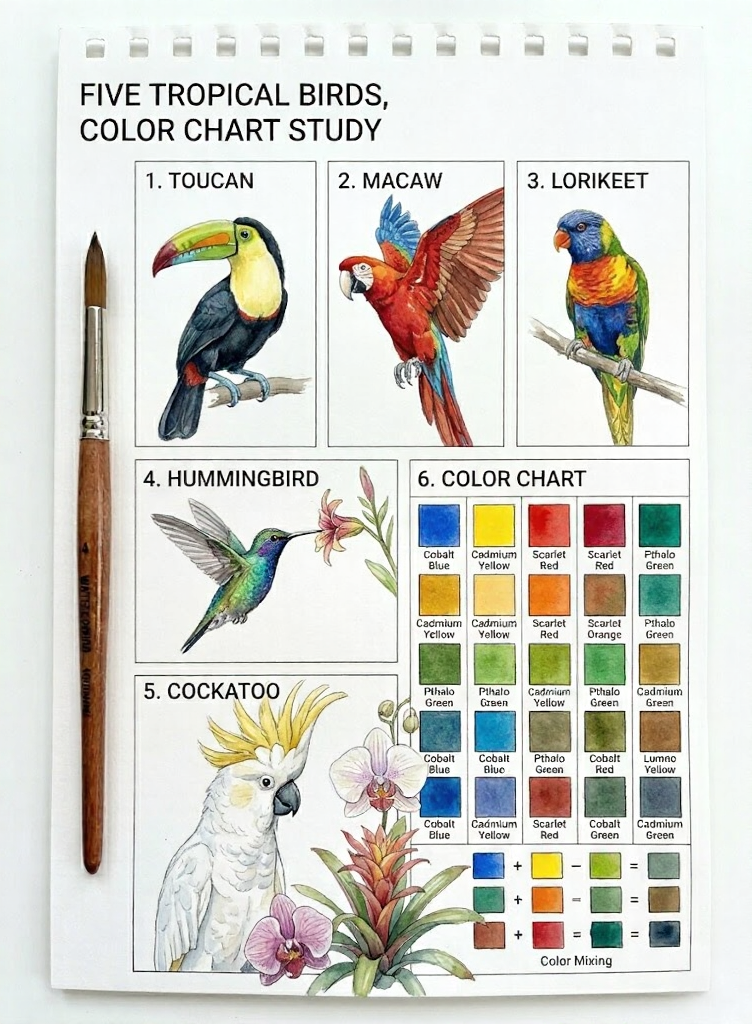
Scarlet macaw, toucan, paradise tanager, peacock, golden pheasant. Don’t aim for detail — paint each as a small gestural color swatch study, just enough form to identify the species. The goal is accurate color mixing: clean cadmium red that doesn’t go orange, saturated teal that doesn’t go grey, deep purple-black that doesn’t go muddy. This is the most practical exercise I know for learning to mix vibrant hues under control.
14. Wren on Branch, Botanical Illustration Style
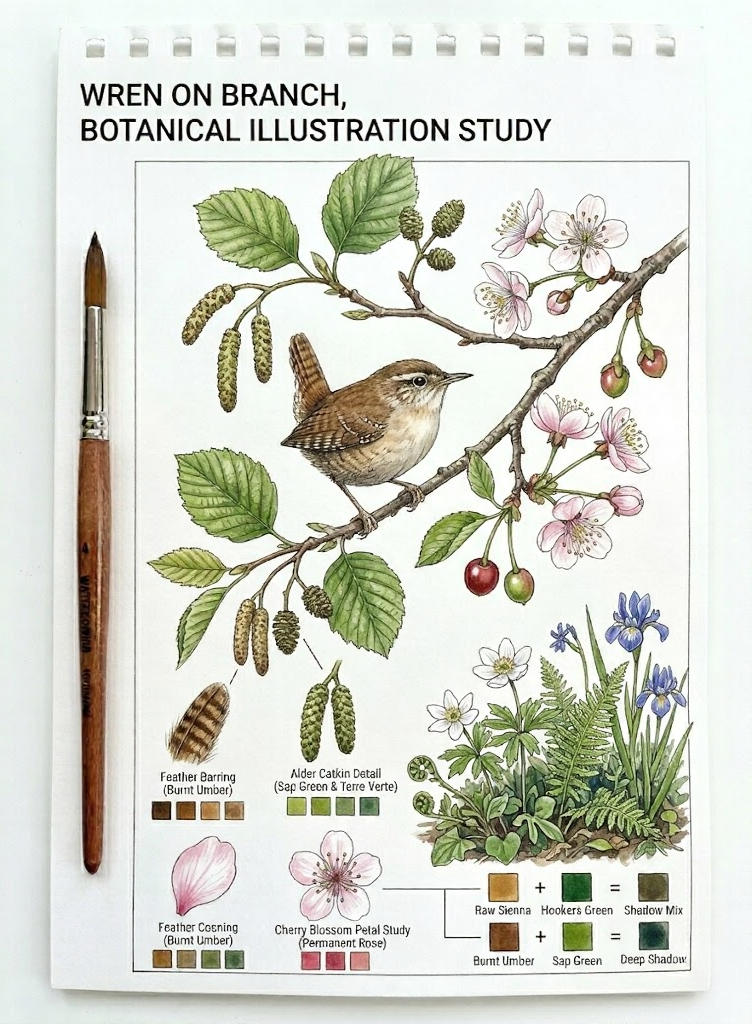
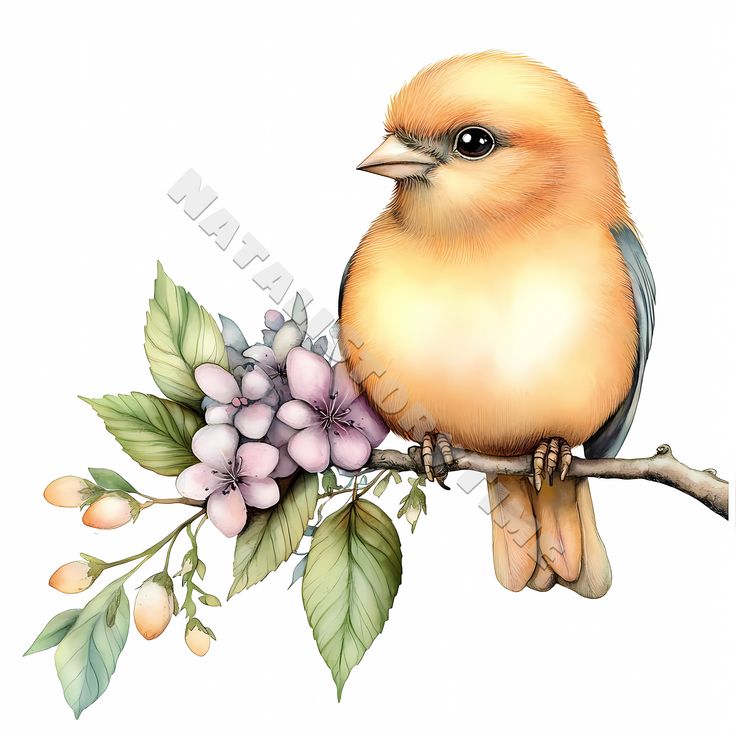
Combine the bird with a precisely drawn botanical element — specifically, a plant the species actually inhabits. Wrens favor bramble and hawthorn; paint a detailed bramble spray in fine linework, then add the wren loosely above it. The contrast between tight botanical precision and relaxed bird watercolor is a style that gets saved constantly on Pinterest and translates directly to prints and cards.
15. Night Heron, Monochrome Study
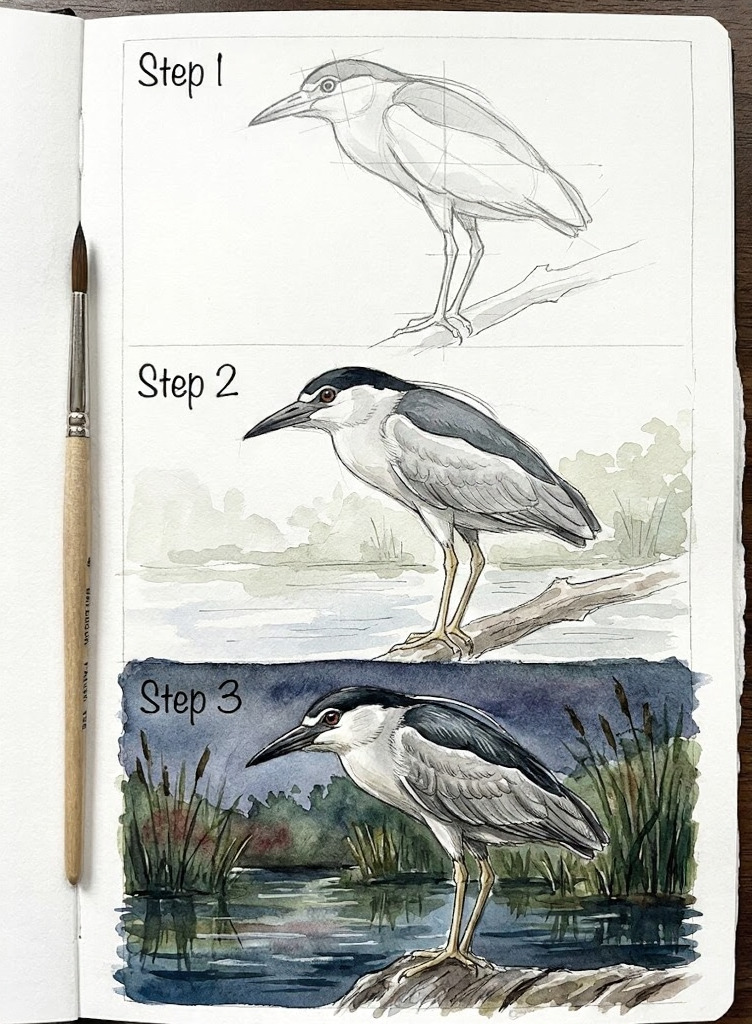
One pigment only. Payne’s grey or sepia. Night herons have a dramatic posture — hunched, heavy, prehistoric — and working monochromatically forces you to think entirely in value, not color. Every decision is about light and dark, nothing else. Surprisingly relaxing once you accept the constraint. The finished piece often looks more sophisticated than full-color work because there’s no color confusion to hide behind.
Ink & Line Art Bird Drawing Ideas
Ink is commitment. No erasing, no blending away a bad stroke. That’s exactly why it builds confidence faster than any other medium — you learn to plan before you mark, and you learn to live with imperfection. Micron 0.05 for feather texture and fine detail, Micron 0.3 for body outlines and strong shadow edges. Keep both on your desk.
16. Raven, Stippling Technique
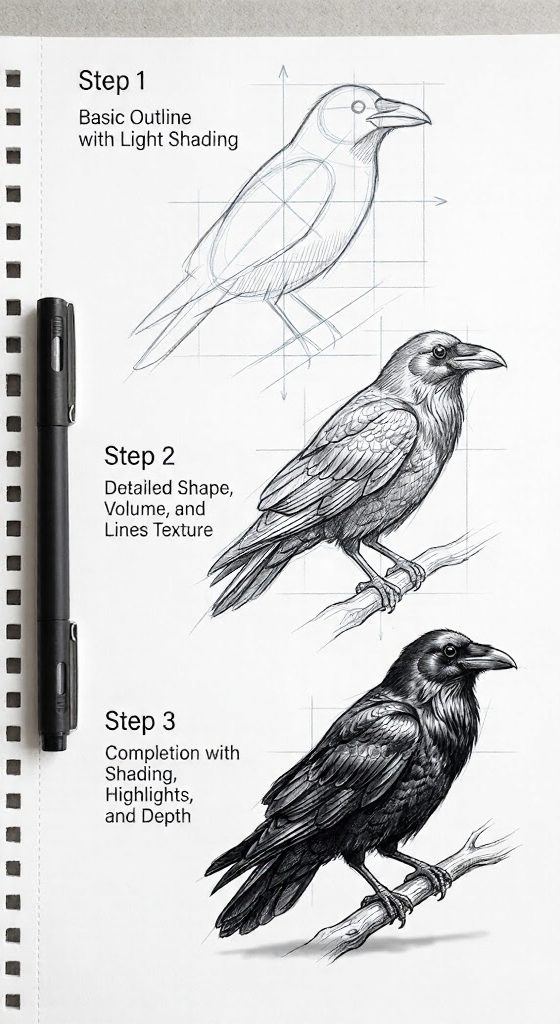
Pure dots, no lines anywhere. Build your darkest values — around the eye, under the wing, at the beak base — with extremely dense stippling, and leave almost bare paper for highlights on the crown and beak tip. Ravens are ideal for this because their high-contrast black plumage dramatizes the density difference between shadow and light. A finished raven stipple drawing, done properly, looks like a photograph from a distance.
17. Owl, Directional Crosshatch
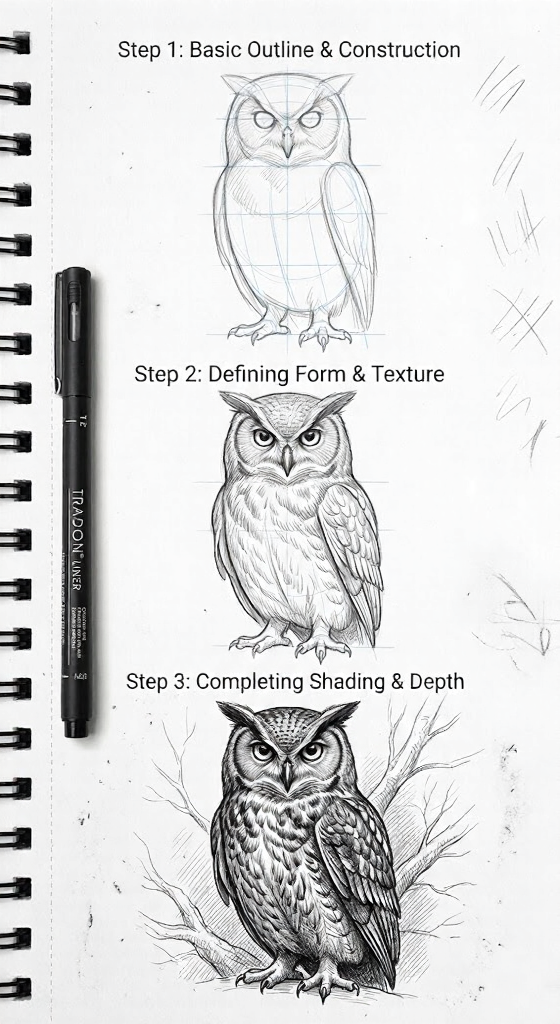
The keyword is directional: your hatch marks should follow the grain, not run at arbitrary angles. Horizontal hatches across the breast, diagonal on the wings, and fine radial marks on the facial disc. When crosshatching respects anatomy, the texture reads as plumage. When it doesn’t, it reads as pencil marks. That distinction is everything in inkbird work.
18. Hummingbird, Single Continuous Line
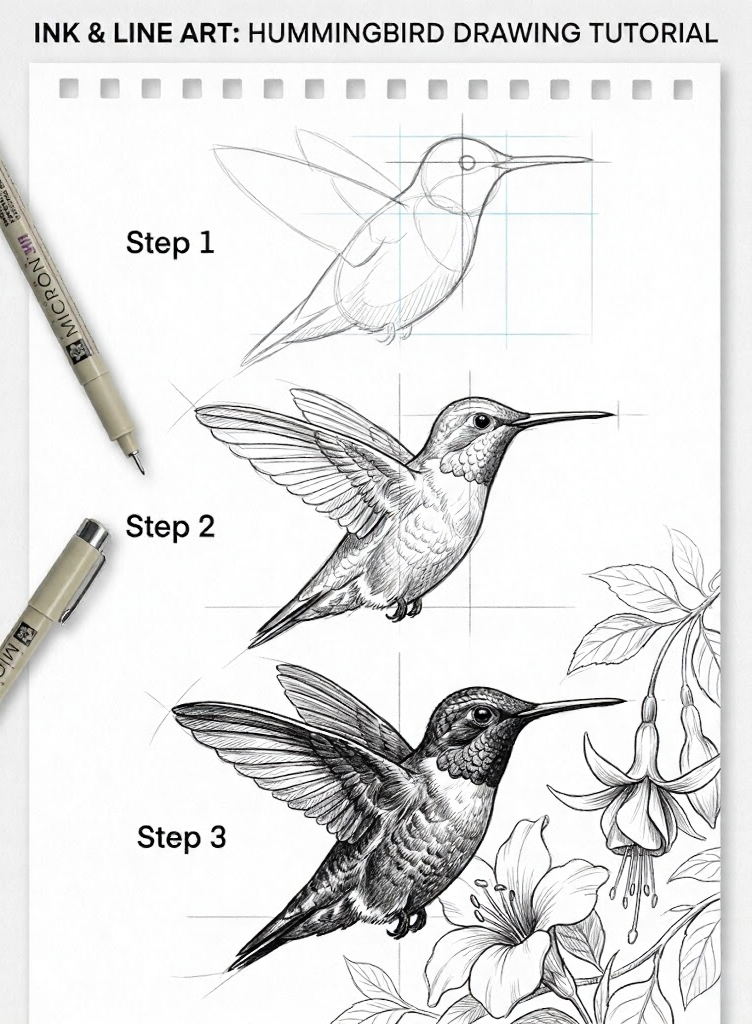
One line, pen never lifting the paper, drawing the entire silhouette and the few key interior details that make it recognizably a hummingbird. It sounds like a gimmick. It isn’t. You have to plan your entire route before your pen touches the page, which forces a level of pre-visualization that improves all your drawing — not just this exercise.
19. Bird Skull, Scientific Illustration Style
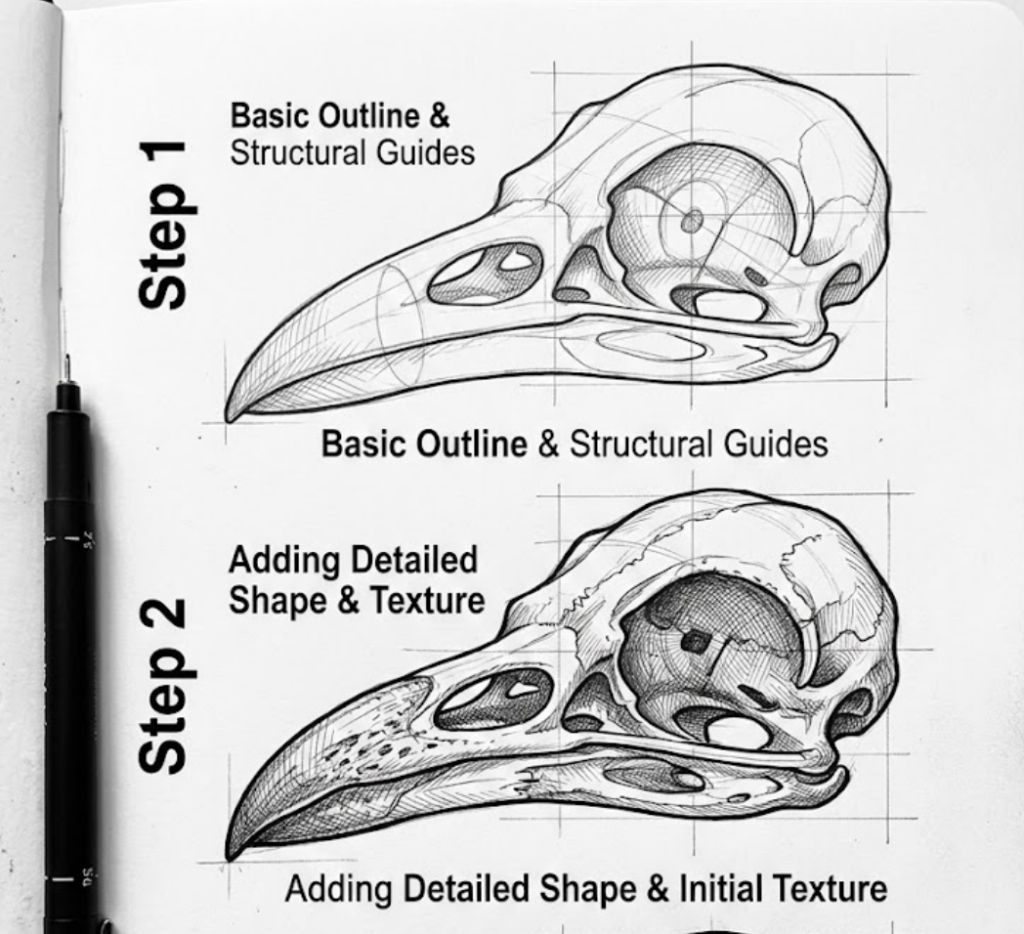
Natural history museum aesthetic: clean, precise linework, hand-lettered labels pointing to specific structures, aged cream or toned paper background. Skulls reveal the structural logic of the beak in a way that a feathered portrait hides — you’ll understand why different species have different beak shapes when you see the bone architecture underneath. The Cooper Hewitt’s natural history collection is an excellent reference for this.
20. Murmuration, Gestural Ink
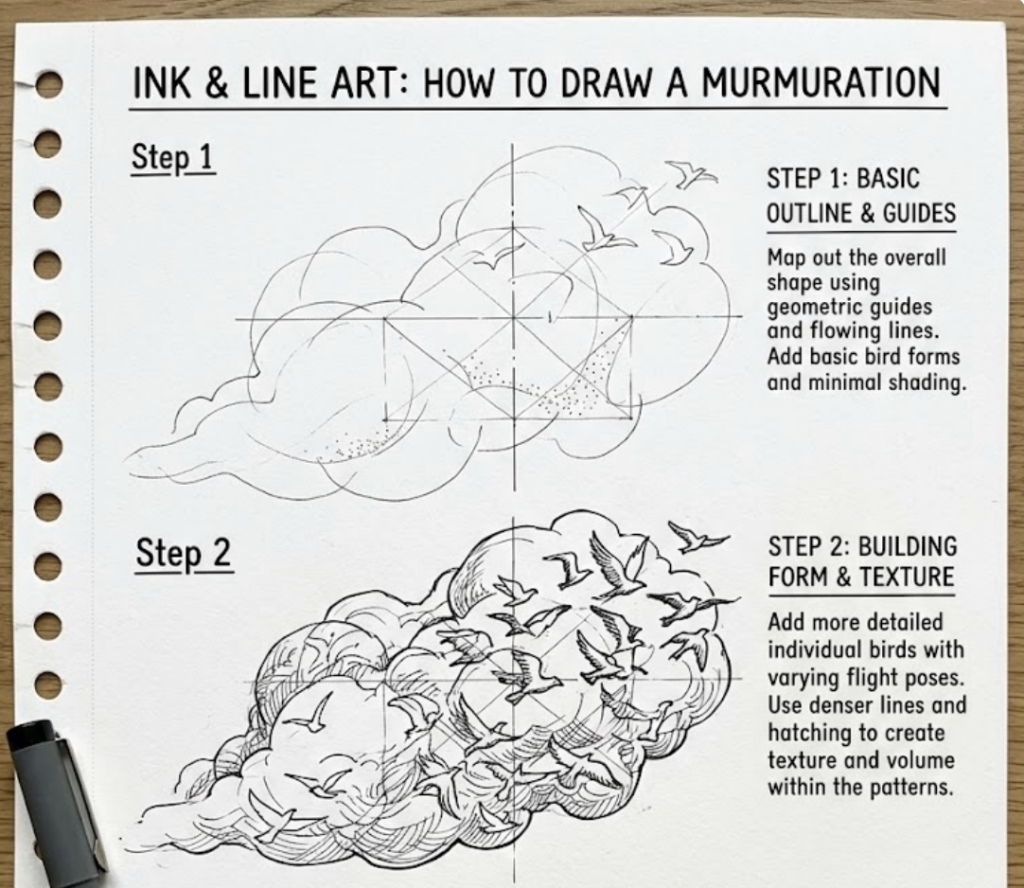
Thirty birds, loose and fast, all in flight at different scales, suggesting depth. The goal isn’t accuracy per individual bird but rhythm and movement across the whole composition. Use broad, fast strokes for distant birds — almost abstract marks — and slightly more defined shapes for the nearest ones. Starling murmuration reference footage (search YouTube, BBC has excellent slow-motion clips) is the right starting material.
21. Peacock Tail, Decorative Pattern
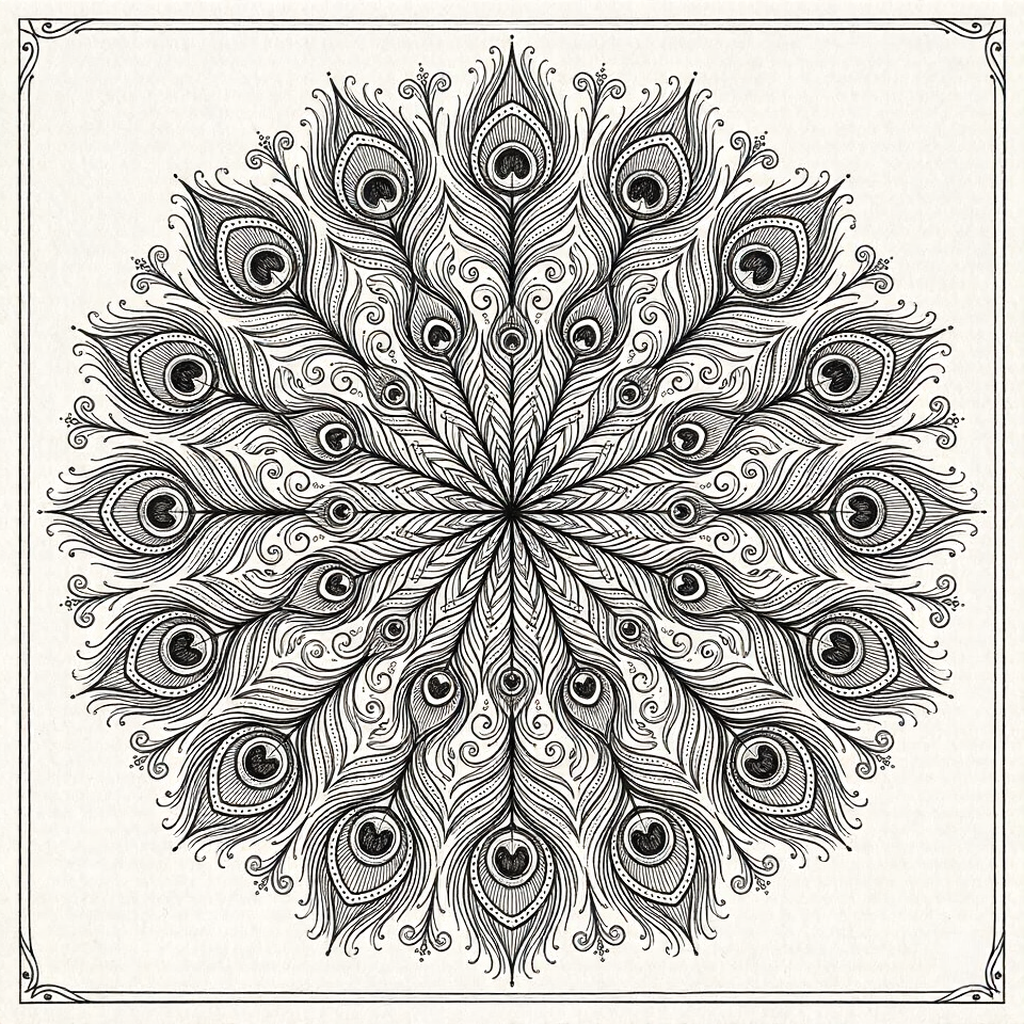
Abstract the tail feather’s eyes into a repeating decorative pattern rather than a realistic rendering. This bridges fine art and surface design in a way that makes the finished piece genuinely usable: it translates directly to textile prints, wallpaper mockups, or product design. The more you abstract the original form while keeping it recognizable, the more commercially interesting the result.
Easy Bird Drawing Ideas for Beginners
Easy doesn’t mean pointless. Each idea here is designed to teach something specific — a proportion principle, a mark-making habit, a spatial relationship. I’ve recommended these to students who’d never drawn a bird before and watched them produce work they were genuinely proud of inside a single session.
22. Duck, Pure Basic Shapes
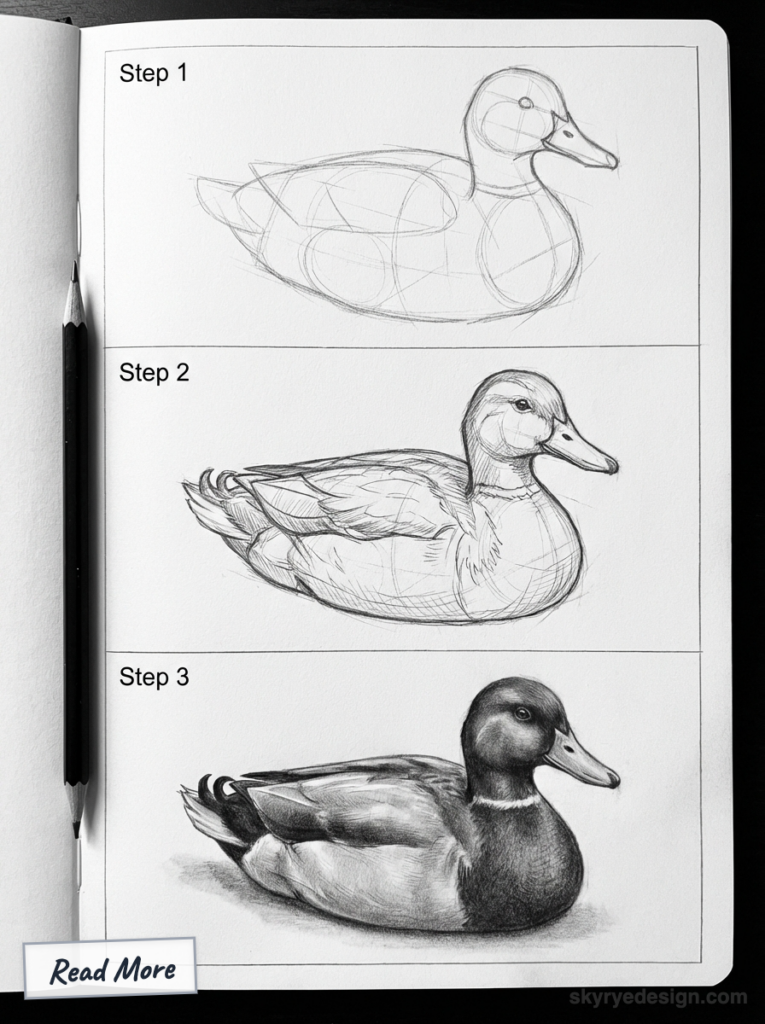
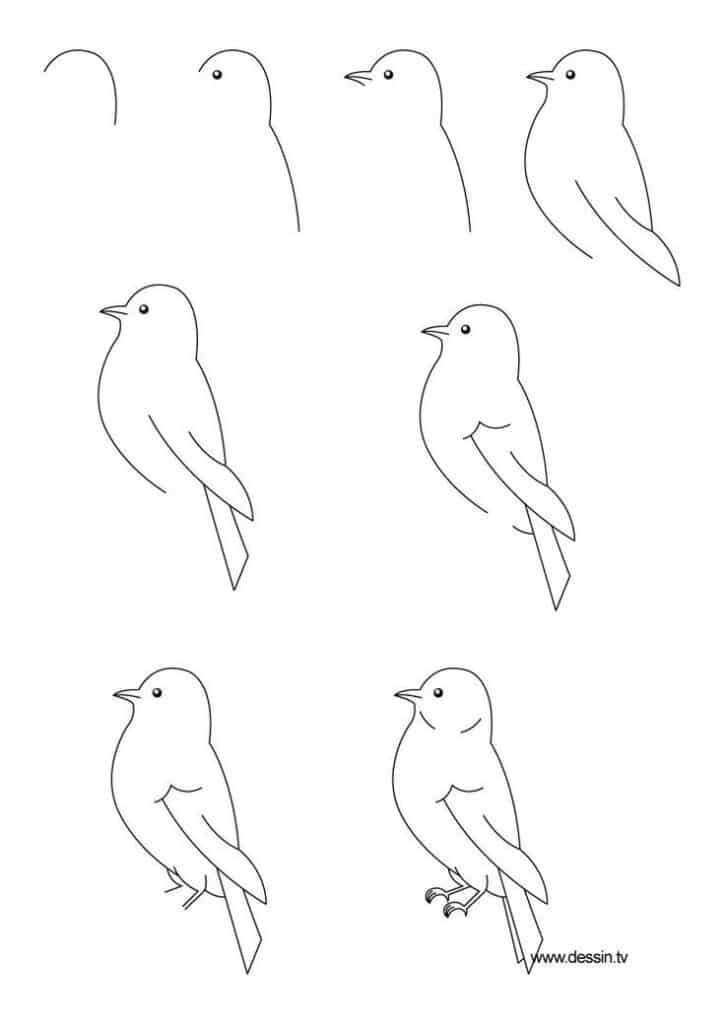
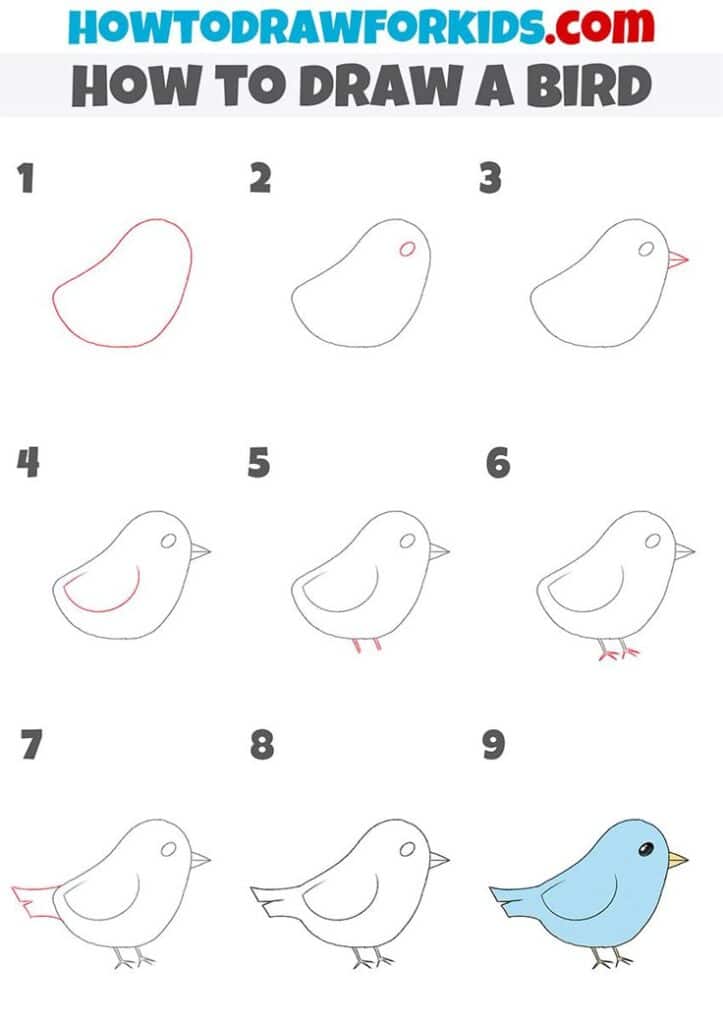
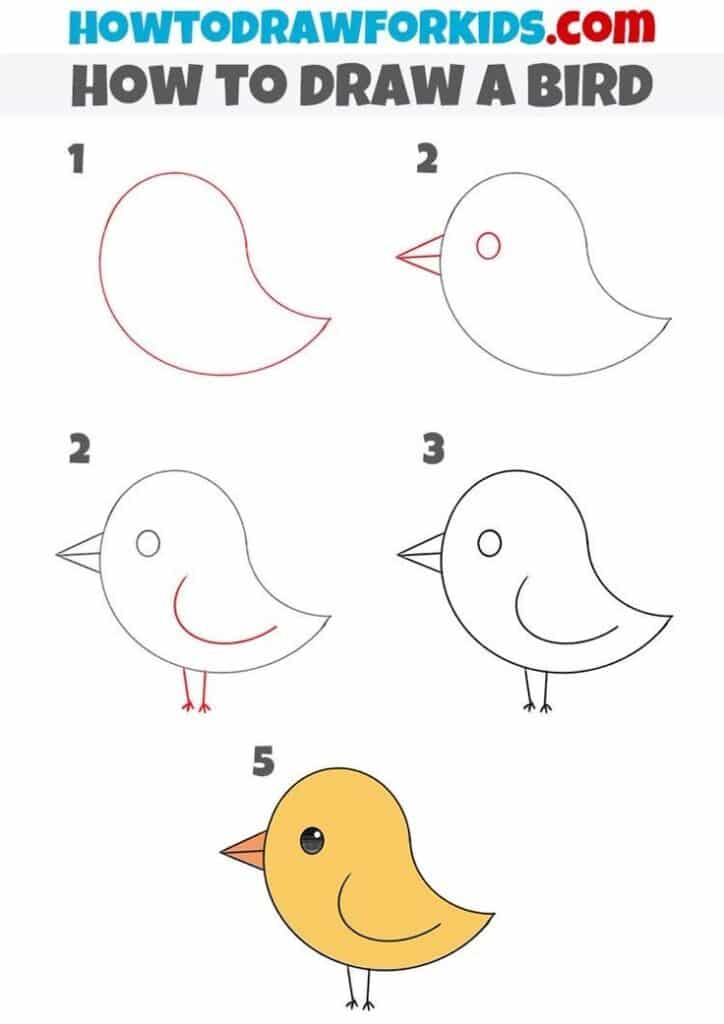
Oval body, smaller oval head, triangle beak, two straight lines for legs. That’s the entire drawing. The duck is beside the point — the exercise is training your eye to see any bird as a group of simple forms before it’s anything else. Every advanced bird drawing begins with this same mental decomposition, even if the artist’s hand moves too fast to see it.
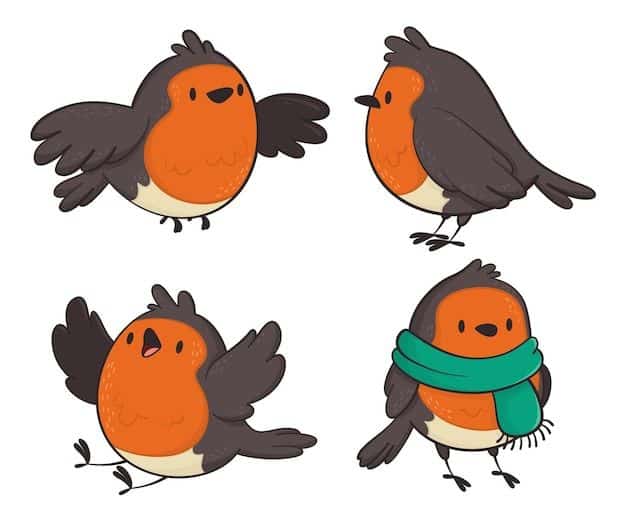
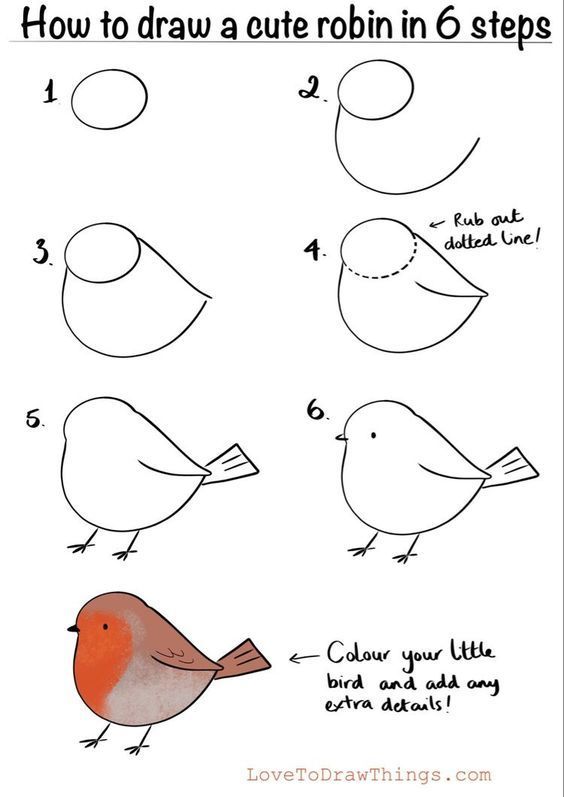
23. Cartoon Robin
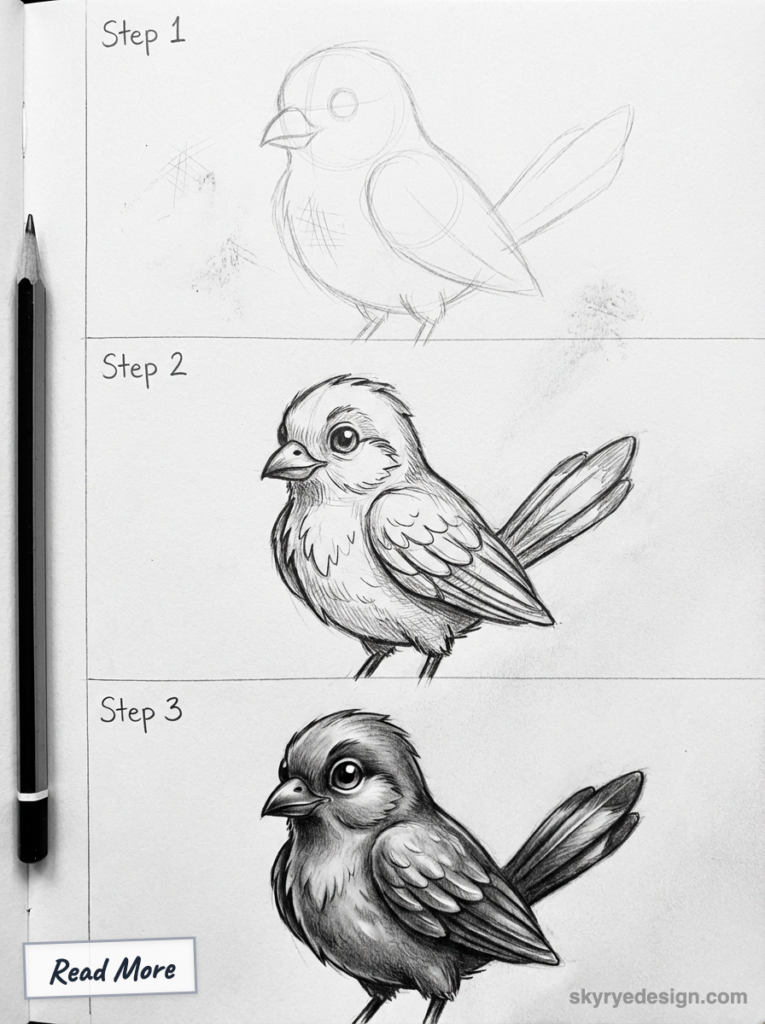
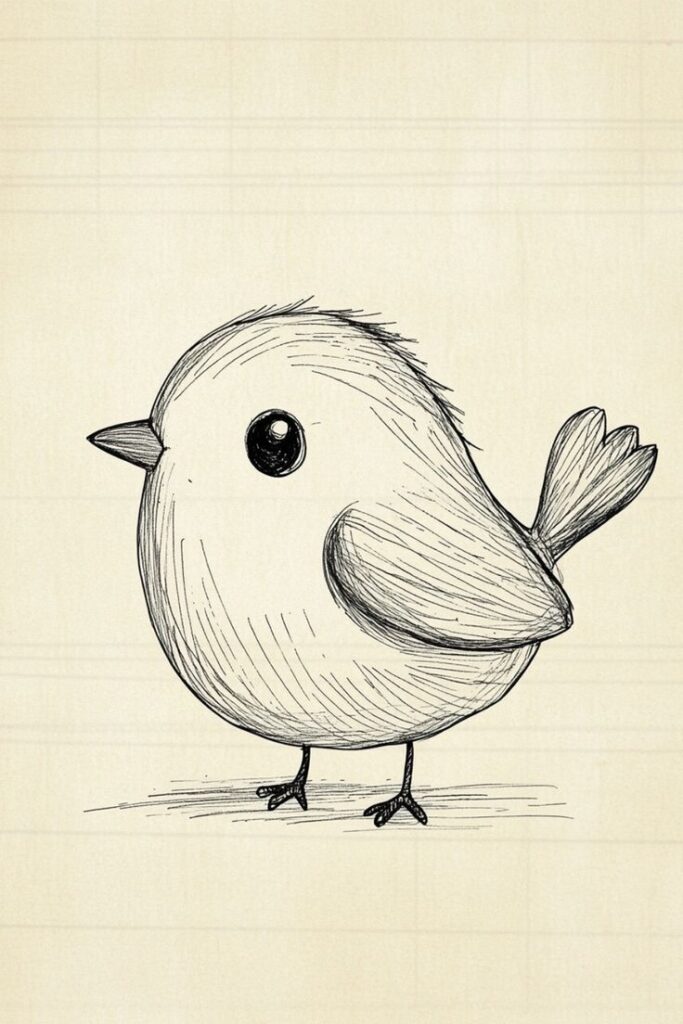
Exaggerate the red breast into a massive circle, simplify the head into a perfect sphere, and make the eye comically large. Cartoon drawing teaches proportion and expression faster than realism because mistakes are read as deliberate style choices rather than failures. You also learn what makes a robin a robin: the round chest and the color contrast are the two essential features. Everything else is secondary.
24. Perched Bird from Behind
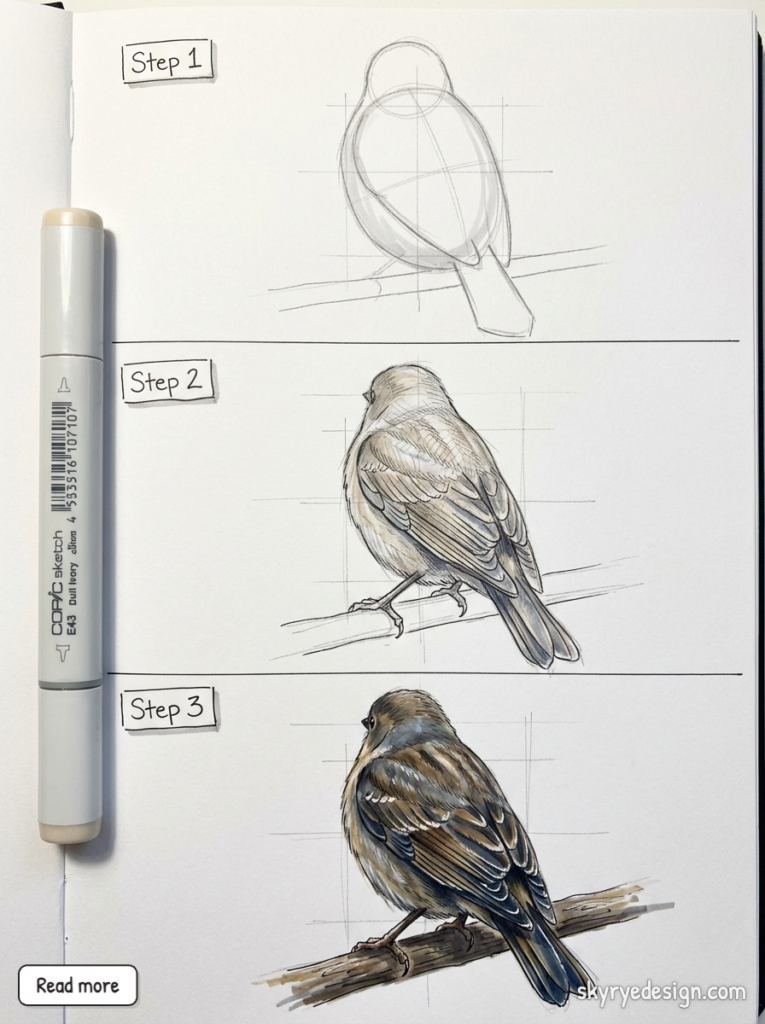
The back view is dramatically simpler than the front: no face symmetry to worry about, no expression to get right, fewer distinct features to manage. The primary challenge is the wing fold pattern — how the folded primaries stack over the secondaries over the scapular feathers. Get that overlap sequence right, and you’ll use it in every bird you draw afterward.
25. Penguin, Geometric Block-In
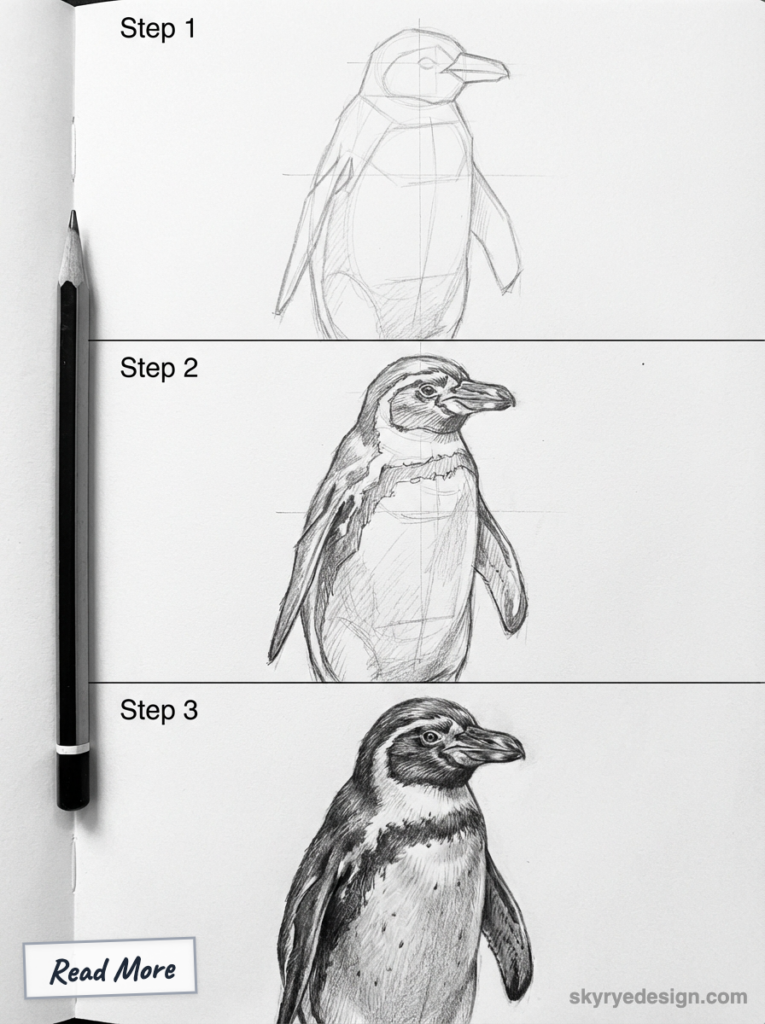
A penguin’s body is essentially a black-and-white oval with two small flipper rectangles and a stubby wedge beak. Working with geometric simplicity isn’t just a beginner shortcut — it’s exactly how professional illustrators block in complex subjects. The penguin makes the geometry visible because the species’ shape is already so close to pure form.
26. Swallow in Flight, Three Marks
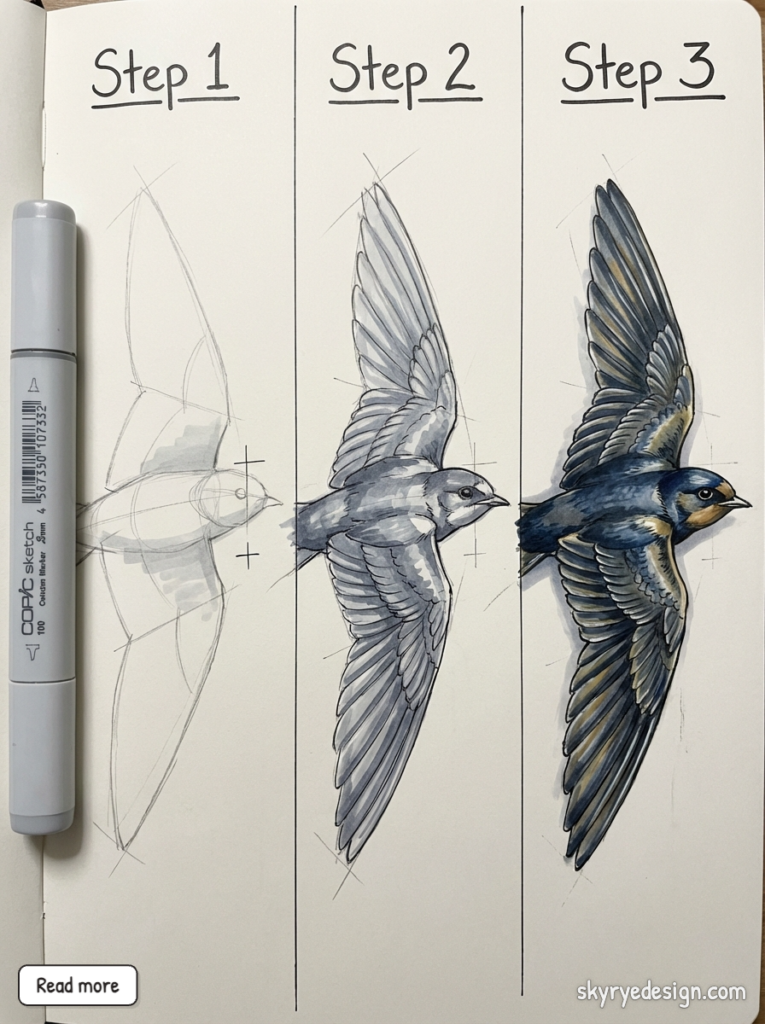
The body is a comma shape. Two curved lines for the wings. A forked V for the tail. Three marks, total. Then study the negative space between the wings. The white space defined by that arc is what gives the swallow’s silhouette its speed and elegance. This minimalist exercise regularly produces more graceful results than a fully rendered flight drawing.
27. Bird Eye, Enlarged Close-Up
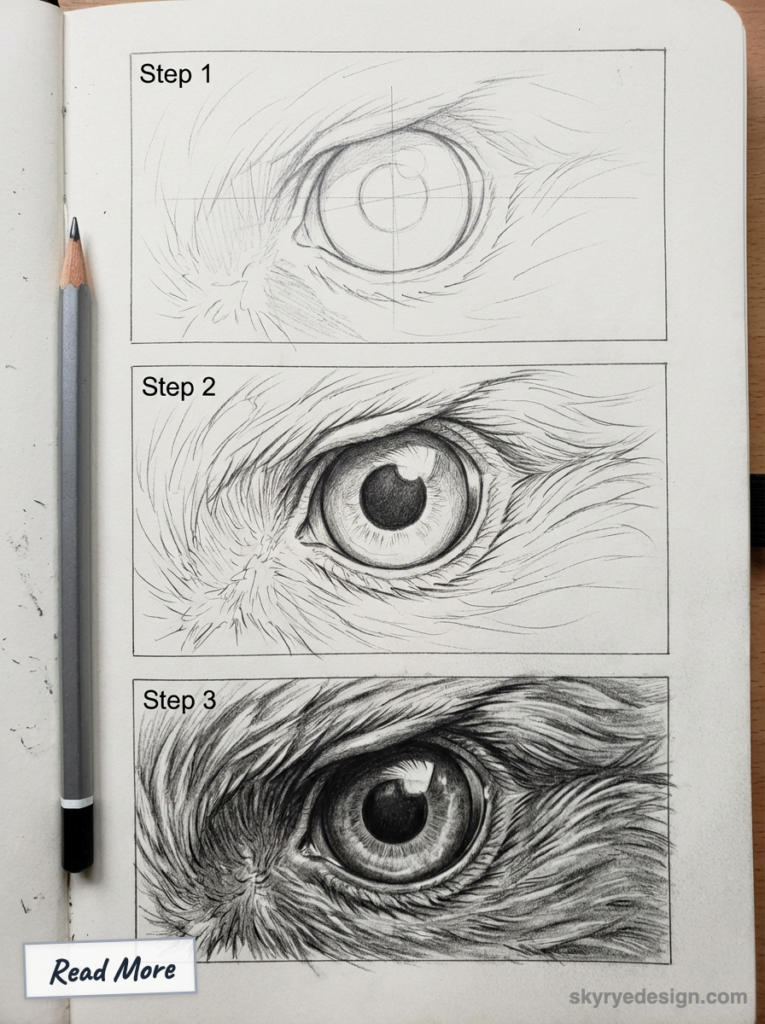
Draw only the eye, filling a quarter of your page. The eye is the hardest single element in bird drawing — the iris ring, the precise highlight placement, the ring of fine feathers around the socket, the way the lid sits. Giving it this much scale forces genuine observation. Most beginners draw a generic ‘eye shape’ from memory. Draw one this large and you can’t.
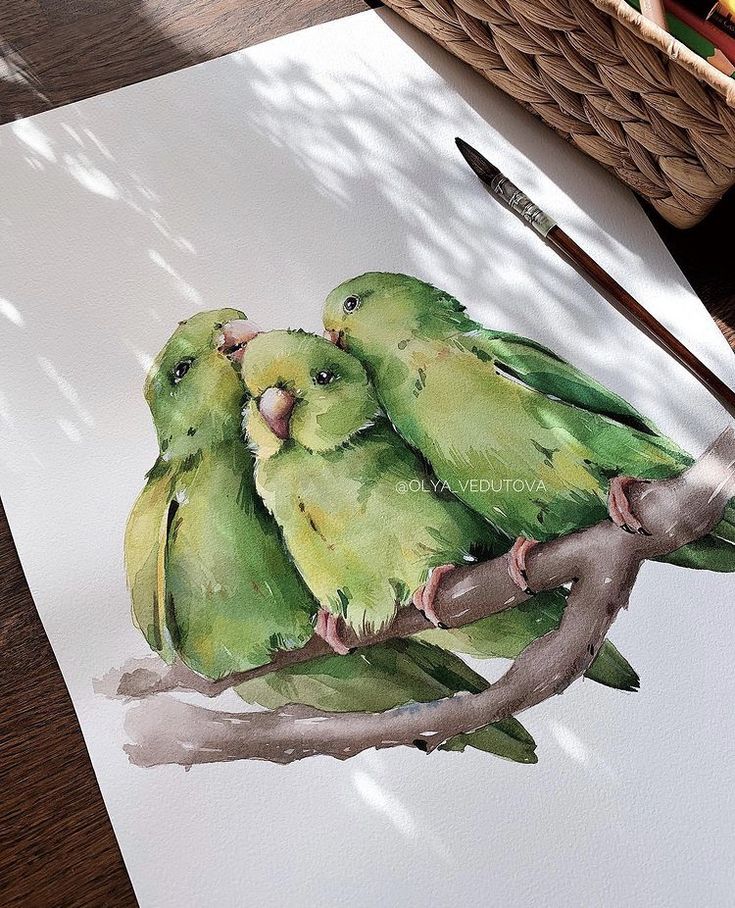
28. Parrot on a Branch, Bold Color
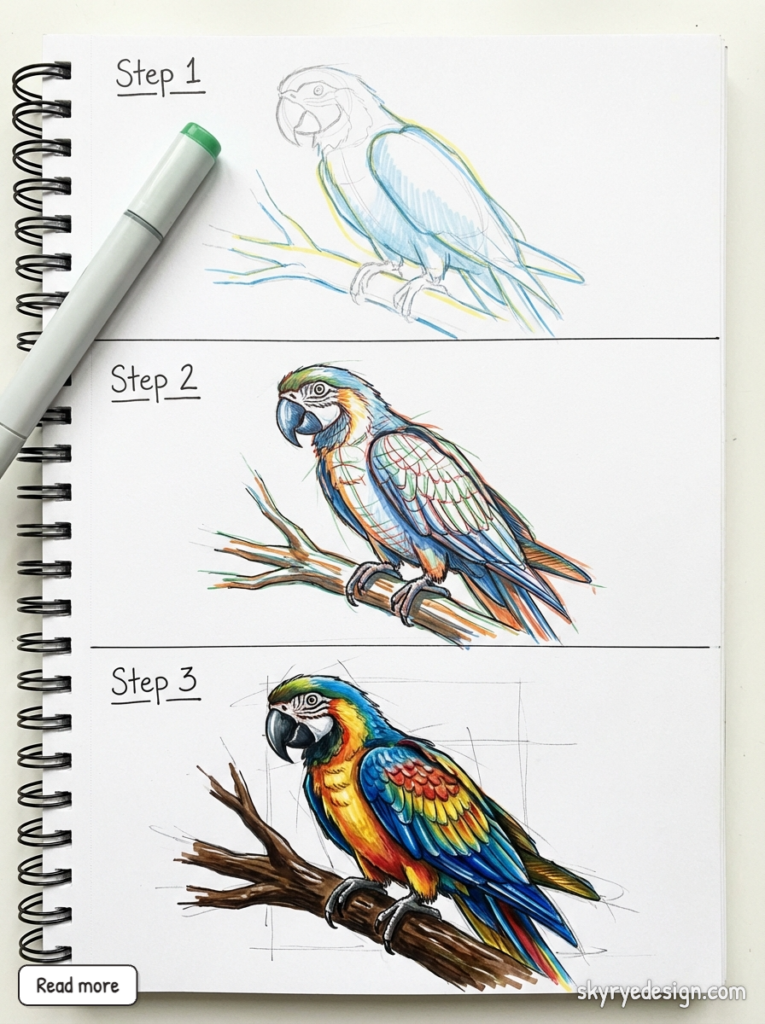
Beginners often avoid color because mixing feels intimidating. A parrot dissolves that barrier — the colors are bold, unmixed primaries. Red wing, green body, yellow face. No mixing required, no subtle gradients to manage. The result is bright, confident, and satisfying — exactly the kind of finished piece that makes you want to sit down and draw another one.
Advanced Bird Drawing Ideas for Realism
These target specific skill gaps that separate competent bird drawings from genuinely impressive ones. Each one takes time — two to four hours done properly, sometimes more. That’s not a warning, it’s the point. Slow and deliberate is how realism actually develops.
29. Golden Eagle Portrait, Colored Pencil
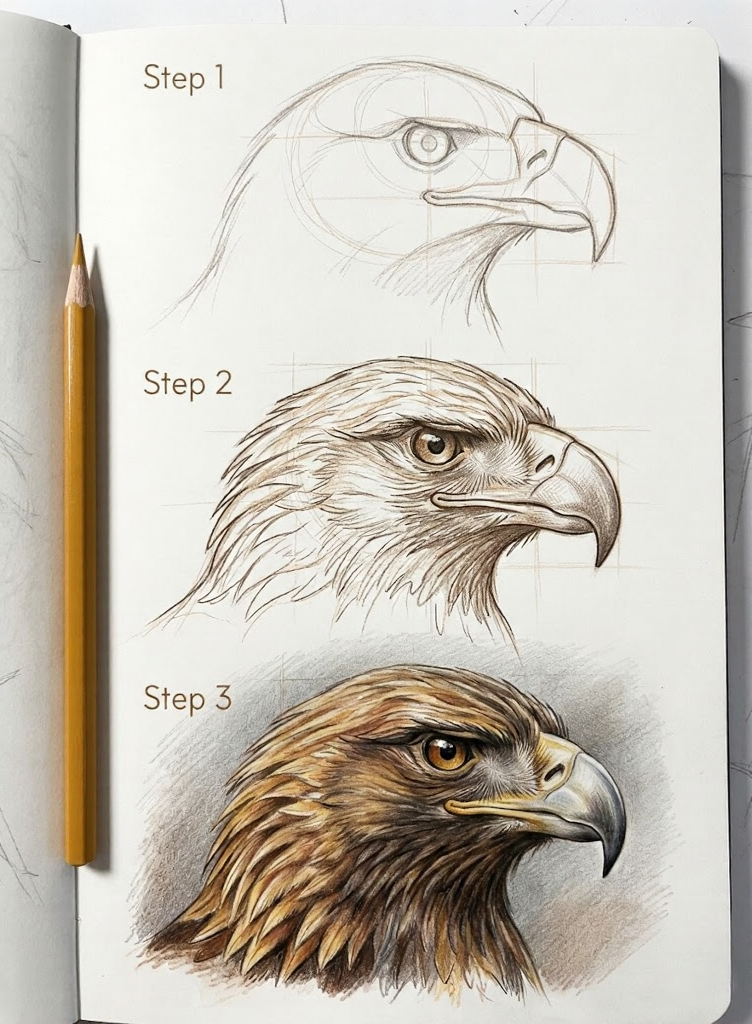
Layer burnt sienna, raw umber, yellow ochre, and white in four to six passes on Canson Bristol 250gsm — the surface takes layering pressure without pilling. The challenge is the mottled, irregular head feather pattern: no two marks are the same weight, no mechanical repetition. Prismacolor Premier Soft Core is the standard here because the wax-based pigment blends across layers in a way that harder pencils won’t.
30. Kingfisher Diving, Foreshortened
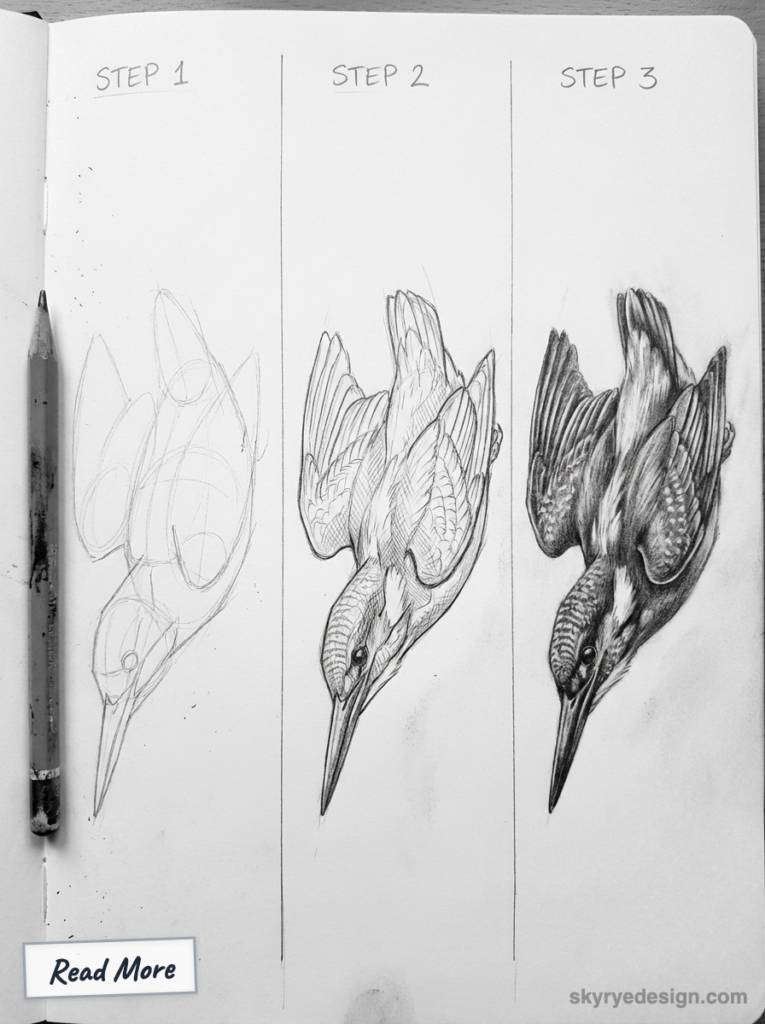
The entry posture — wings fully tucked, beak extended straight forward, body compressed into a torpedo — requires genuine foreshortening of the torso. The body that reads as a long oval in profile becomes a near-circle from this angle. Cornell Lab has excellent flight sequence photography for this species. Spend twenty minutes with reference before touching the paper.
31. Owl in Flight, Underlit
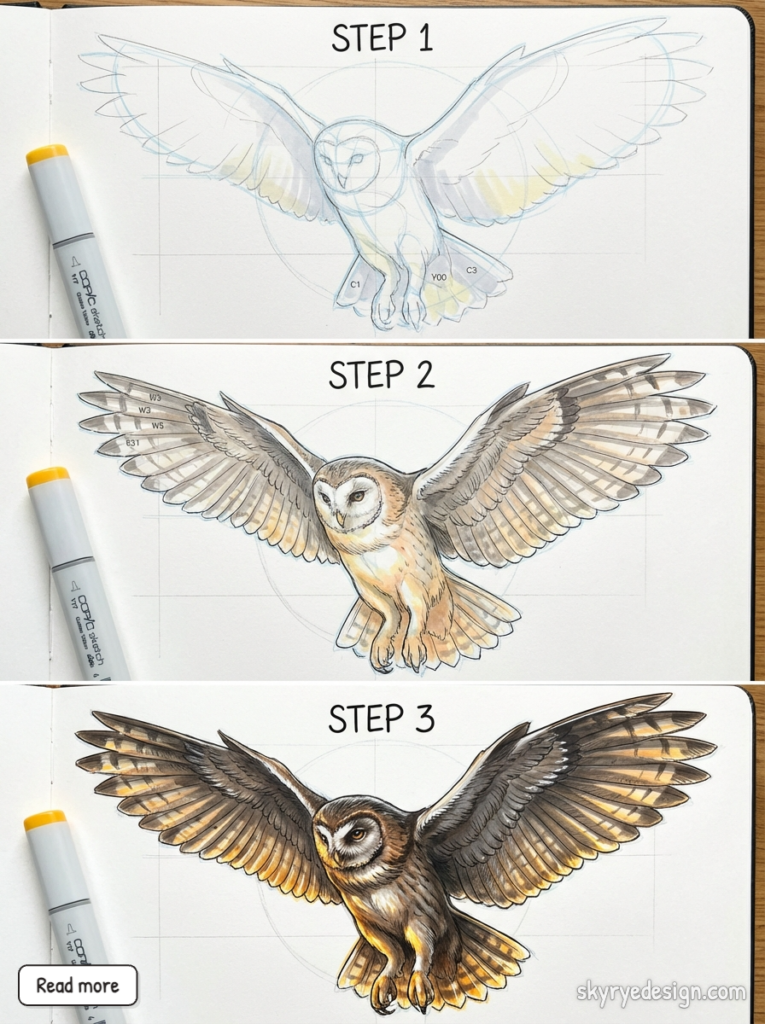
Place the light source directly below the bird — imagine an owl caught in moonlight reflected off snow. This reverses all normal shadow logic: the belly is lit, the back is in shadow, the undersides of the wing feathers catch light while the tops are dark. Every value decision you make on instinct will be wrong. That’s the entire value of the exercise.
32. Iridescent Feather, Colored Pencil
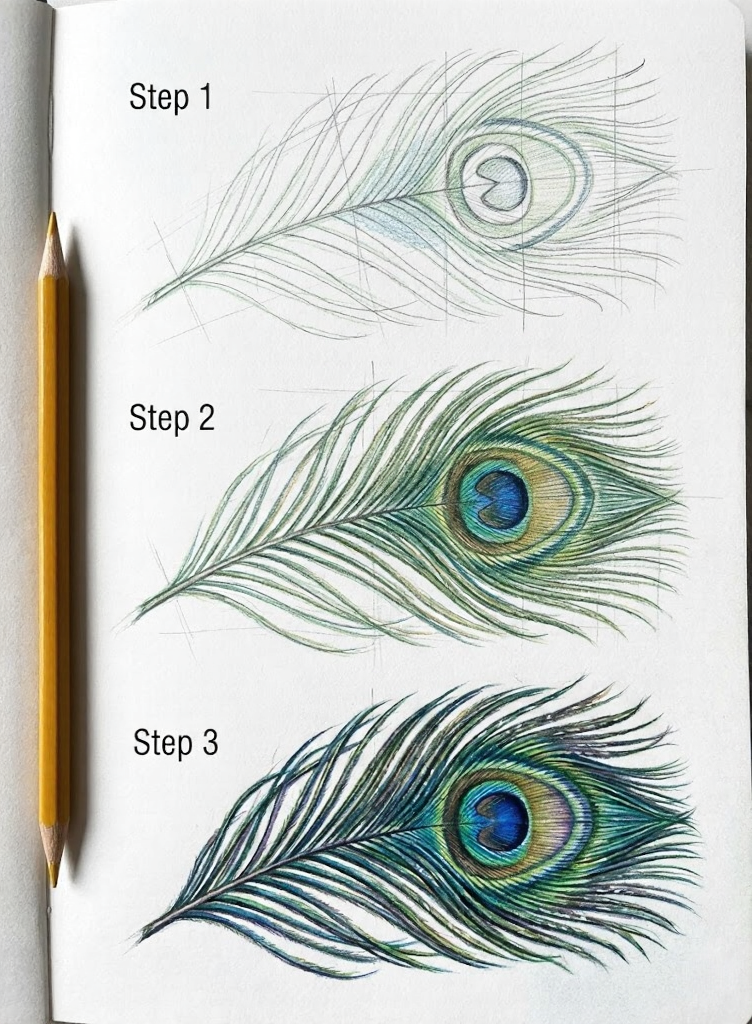
Starling or peacock feather. The color shifts from green to purple to bronze depending on viewing angle, and you have to render that shift convincingly on flat paper. Layer Prismacolor violet over metallic copper over sap green, then burnish everything with a white pencil to blend and increase luminosity. The burnishing step is what produces the iridescent quality — skipping it leaves the colors looking chalky.
33. Bird in Habitat, Full Composition
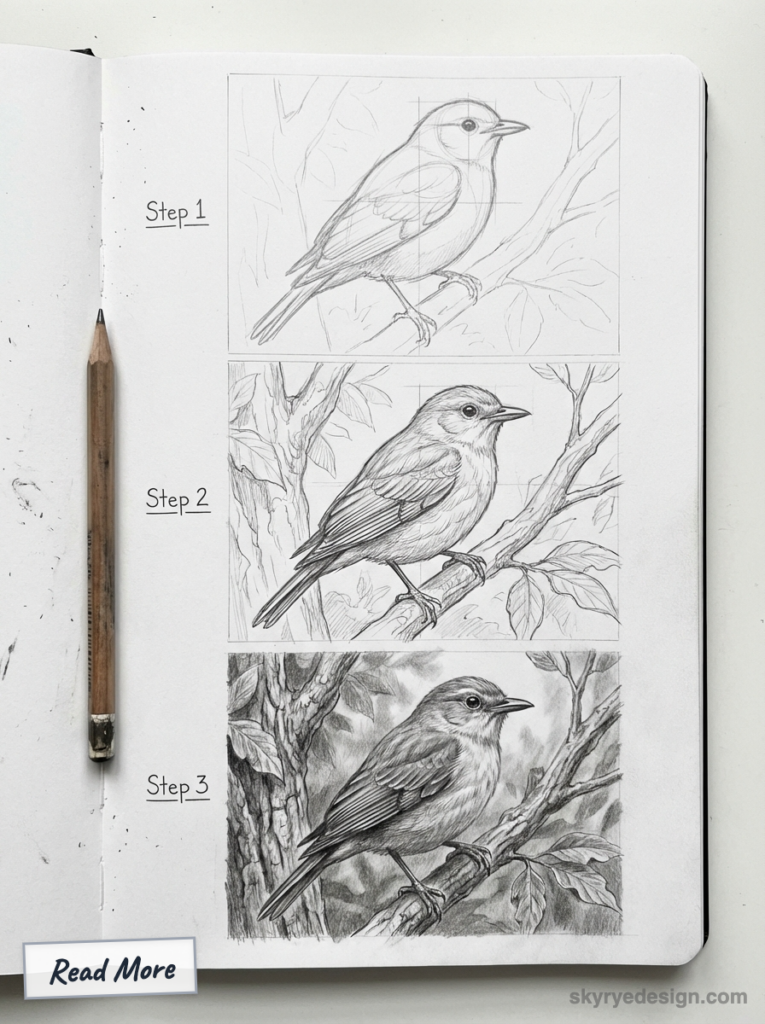
Don’t isolate the bird. Place a great blue heron in a reed marsh at dusk, or a red-tailed hawk on a weathered fence post with a winter field stretching behind. The relationship between bird and environment is what separates illustration from ornithological study — and it’s what makes a drawing feel like a moment rather than a specimen.
34. Three Birds, Atmospheric Depth
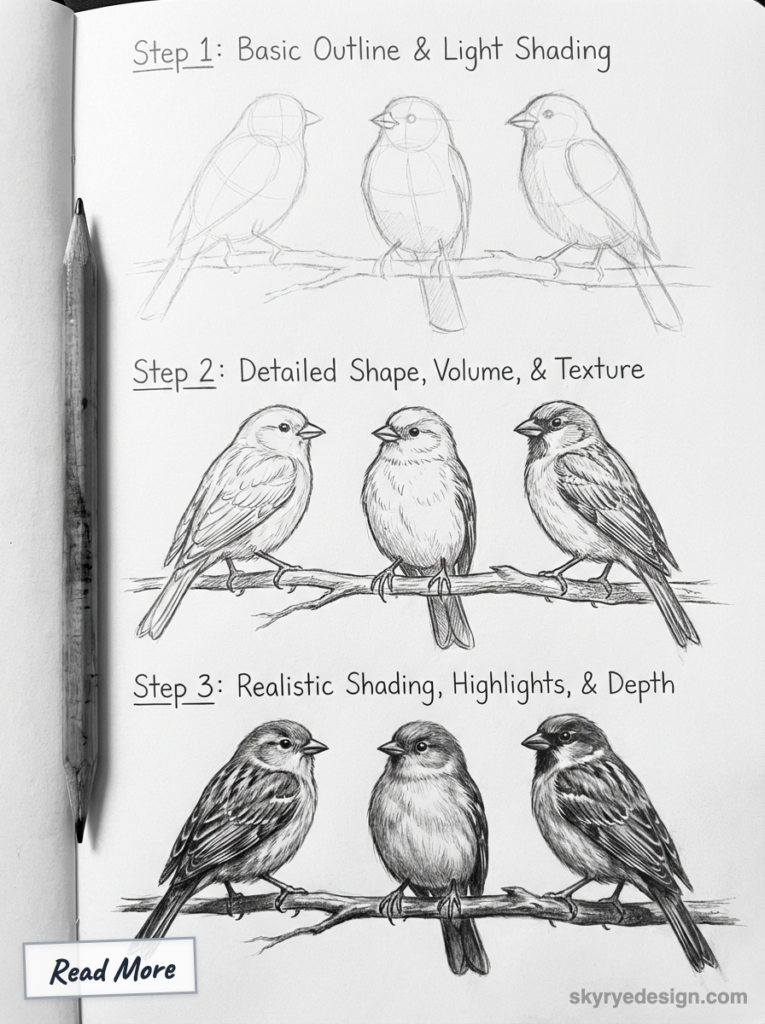
Same species, three distances. The nearest bird is large, fully detailed, and high contrast. The middle bird is partially obscured by something — a branch, another bird, a reed — medium size, slightly softened. The furthest is near-silhouette, small, minimal contrast. This is the foundational exercise for atmospheric perspective in nature drawing. The brain reads depth from the relationship between the three, not from any individual element.
Bird Drawing Ideas by Style
Same species, radically different result. I find it genuinely useful to draw the same bird — a crow works well because its form is simple enough not to fight the style — in three different visual languages back to back. You’ll understand more about your own aesthetic preferences in that single session than in months of unfocused work.
Tattoo-Style Bird Drawings
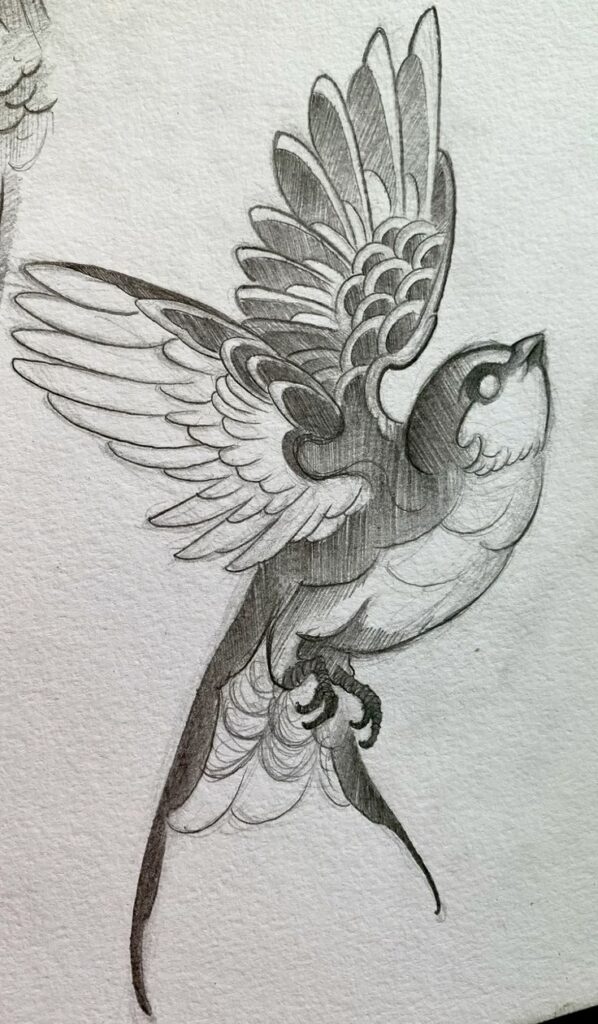
35. Traditional Swallow Flash Sheet
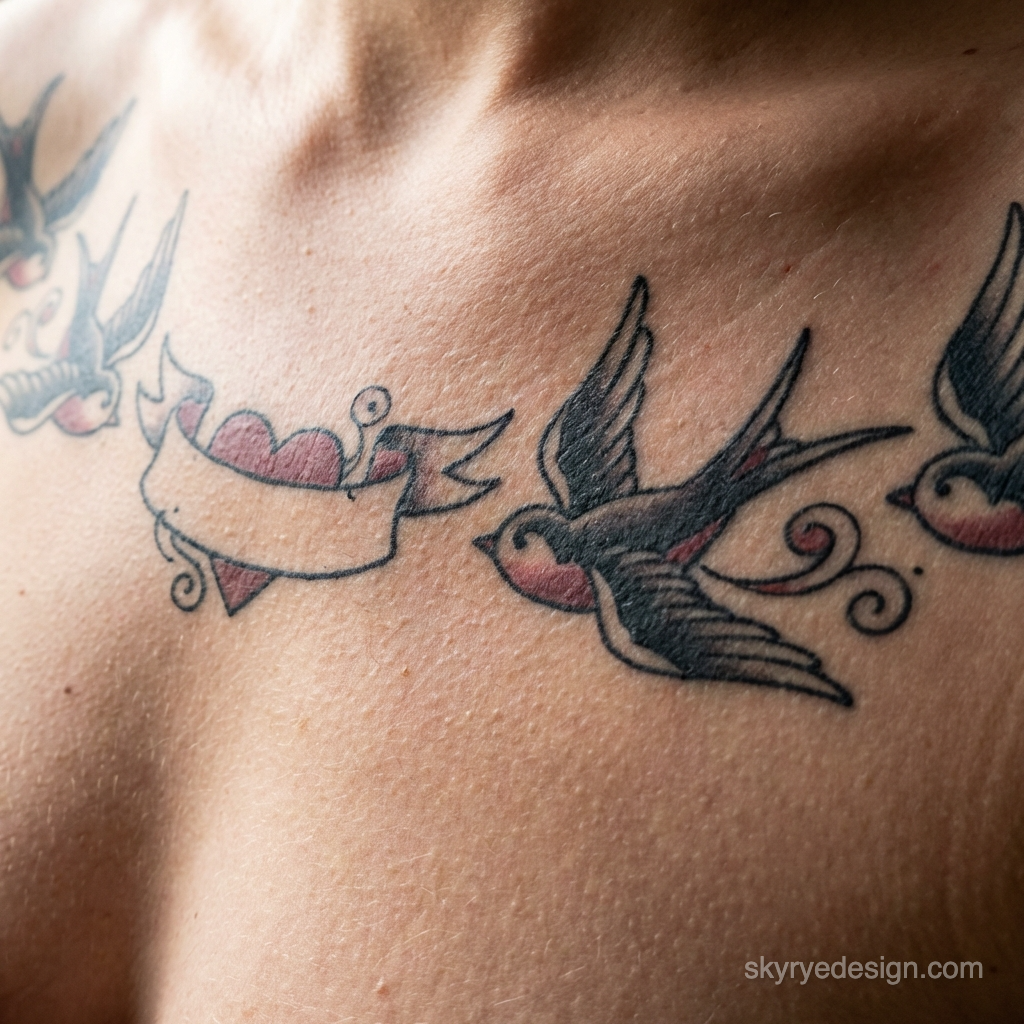
Classic American traditional: bold black outline, flat red and blue fill, zero gradients, high contrast. Swallows have been a staple of traditional tattooing since Sailor Jerry’s 1930s flash sheets, and the form hasn’t changed much for good reason — the species’ elegant silhouette reads perfectly at the scale and contrast constraints of skin. Research original vintage flash art for authentic reference rather than modern digital interpretations.
36. Fine Line Sparrow
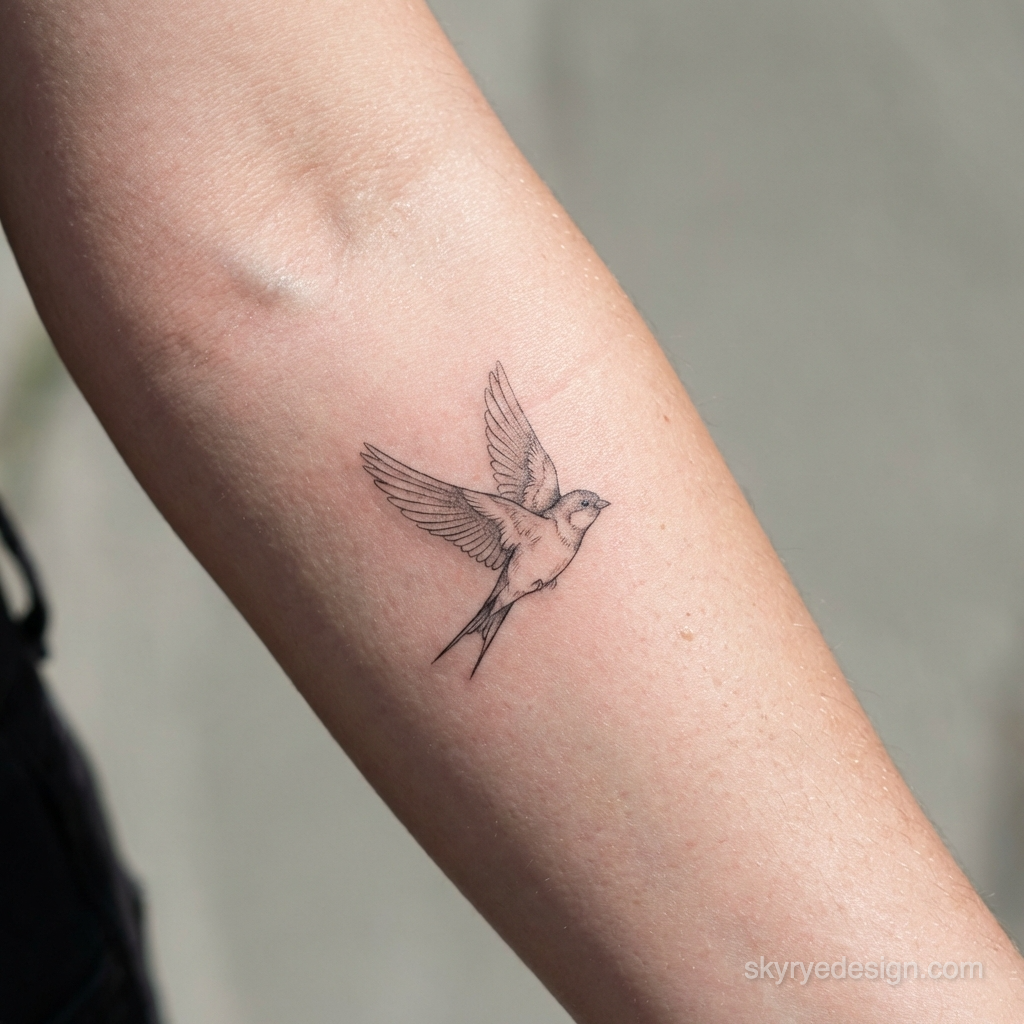
Single weight line throughout, minimal fill, no shading gradients. The restraint is the entire challenge — every mark has to justify its existence. Micron 0.05 on white Bristol cardstock. The hardest part is resisting the urge to add more when it starts to look sparse. Sparse is the style. Trust the line.
37. Blackwork Owl
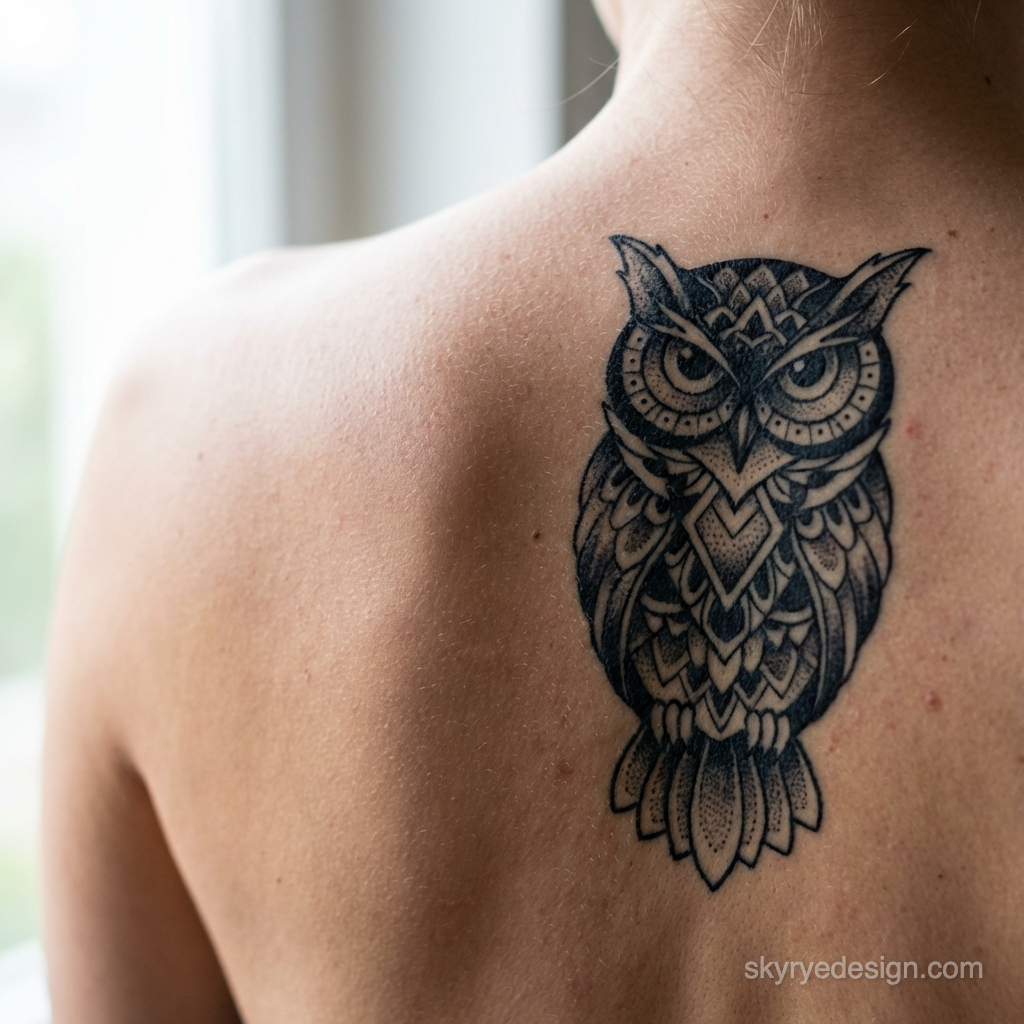
Heavy solid fill, no color, maximum contrast. The negative space defines the form: the white areas around the facial disc, the pale eye rings, the light belly — all achieved by controlling where the black fill stops, not by adding white. This style translates directly to actual tattoo work and reads powerfully as a standalone print or embroidery pattern.
38. Neo-Traditional Peacock
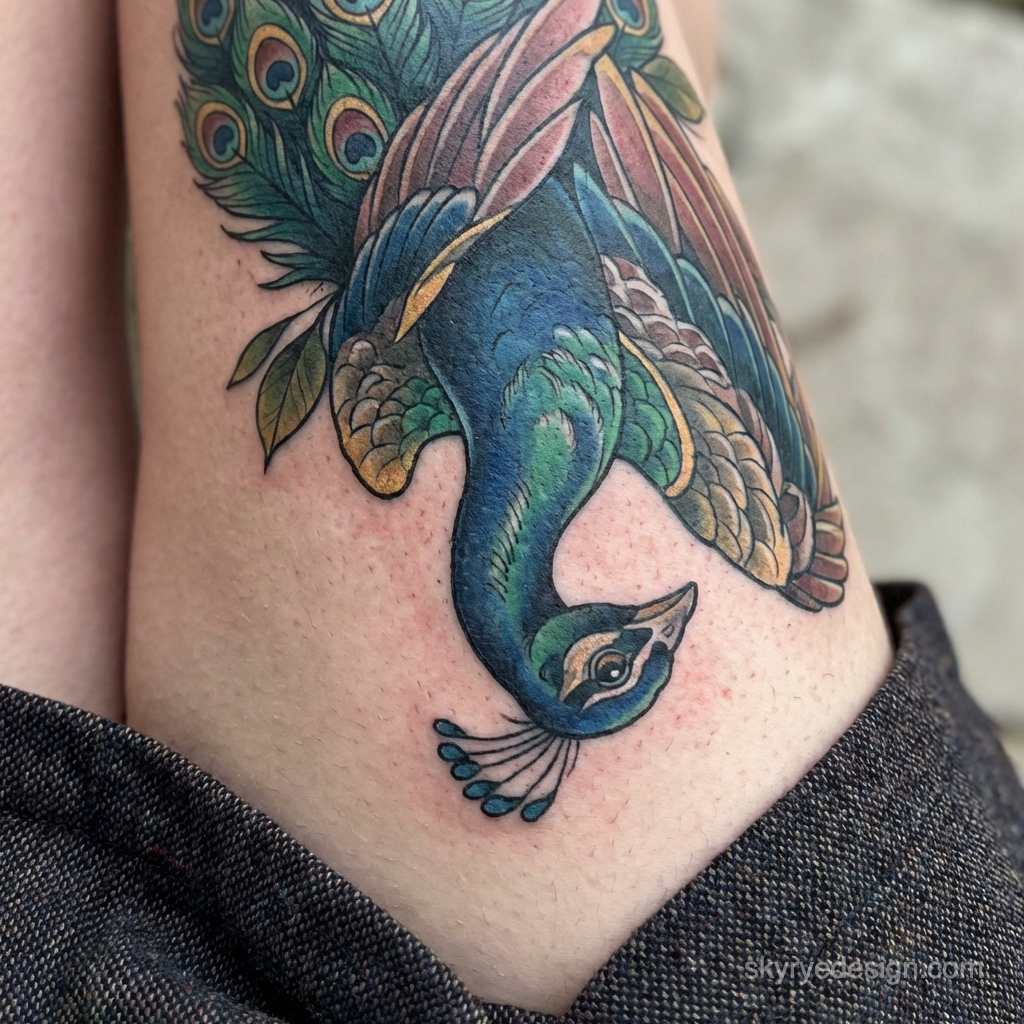
Where classic tattooing meets contemporary illustration: the peacock’s tail becomes a field of jewel-tone fills with strong black linework borders and subtle illustrative shading. Ohuhu alcohol markers in peacock teal, antique gold, and deep violet work well for mockups. The neo-traditional style allows more dimensional shading than the strict traditional, while keeping the bold outline structure.
Minimalist Bird Drawings
39. Single-Line Bird Series
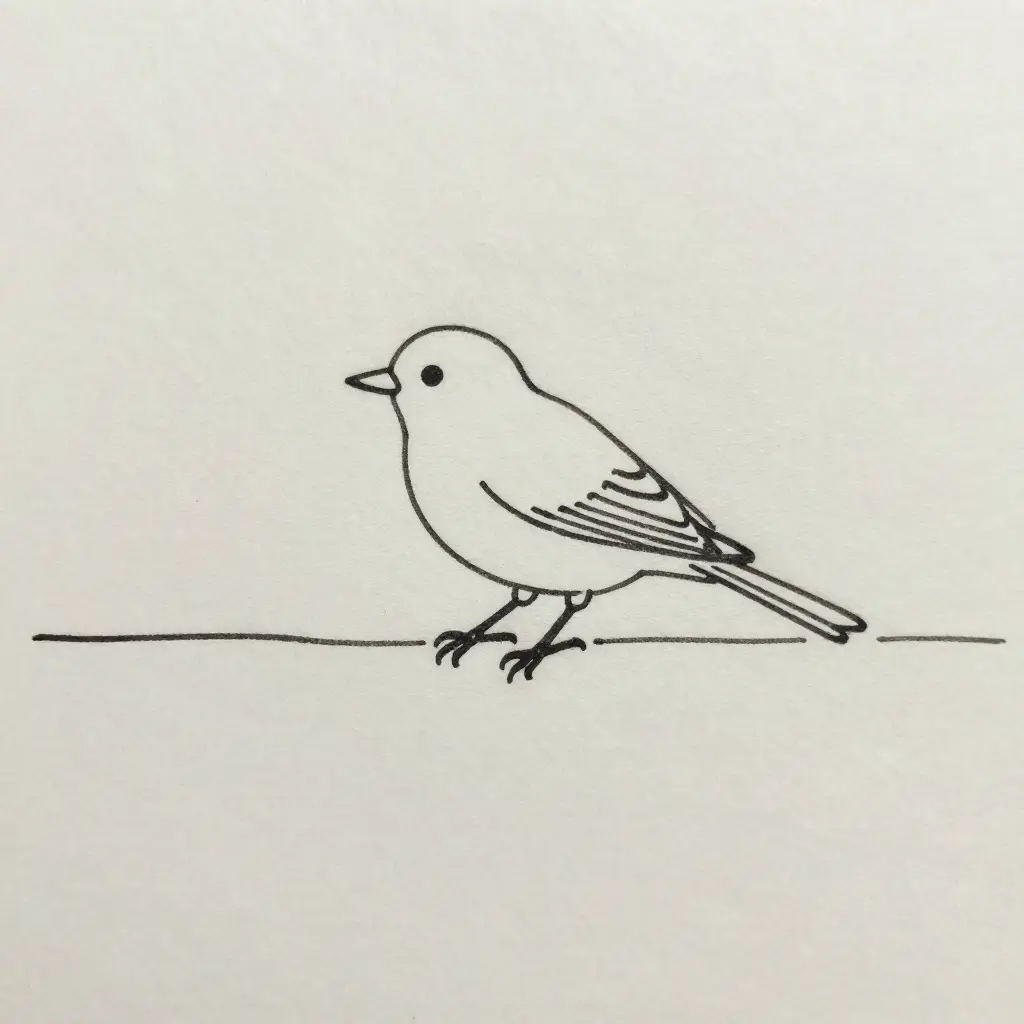
Ten different species, each drawn as one continuous line without lifting the pen. Frame them together as a set. The constraint forces you to find the single most essential gesture of each species — what’s the minimum path the line can take and still read as a hummingbird? A crane? A puffin? Each answer is different, and finding it is the real lesson.
40. Geometric Low-Poly Bird
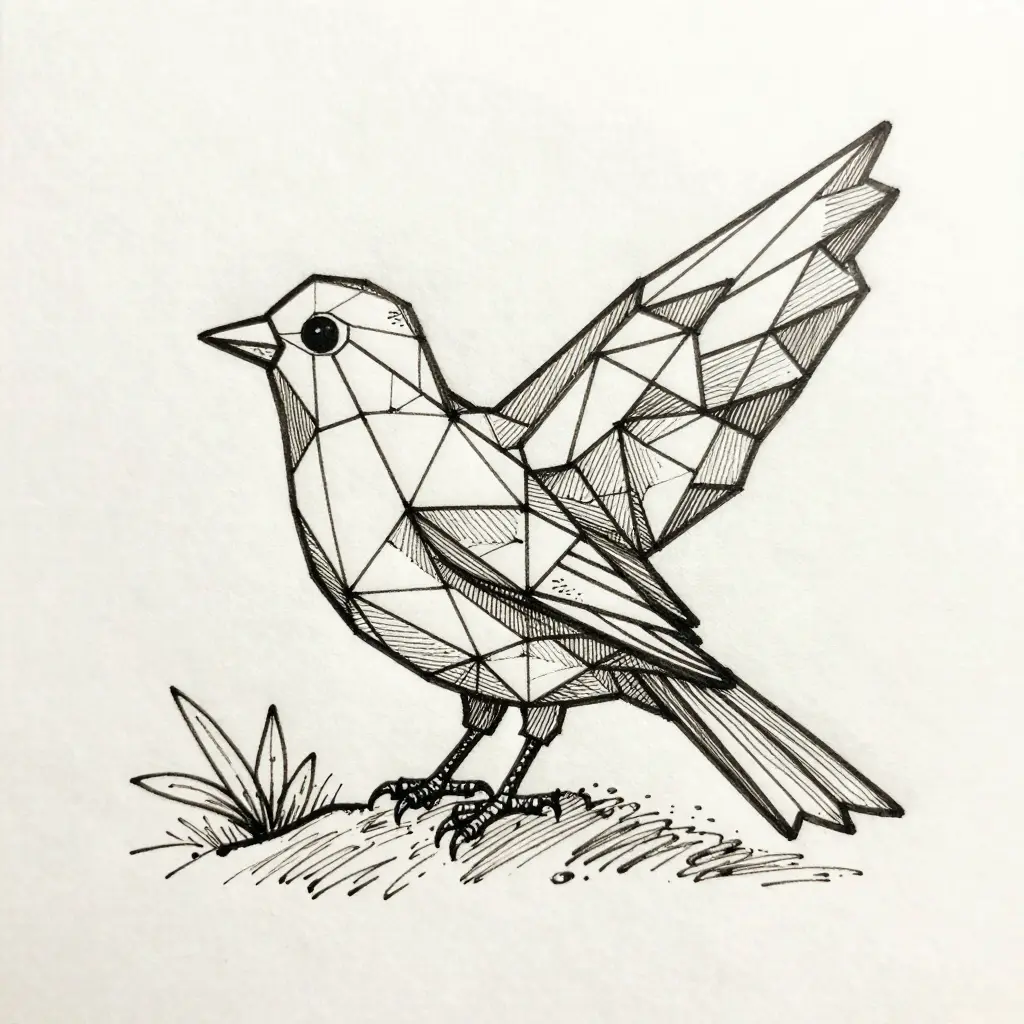
Deconstruct a bird into pure triangular facets — low-poly 3D illustration style applied to a flat drawing. Map your light direction first, then shade each facet as a uniform value determined by its angle to the light source. The result is striking as a print, and the exercise teaches planar thinking that feeds back directly into conventional shading.
41. Negative Space Bird in a Circle
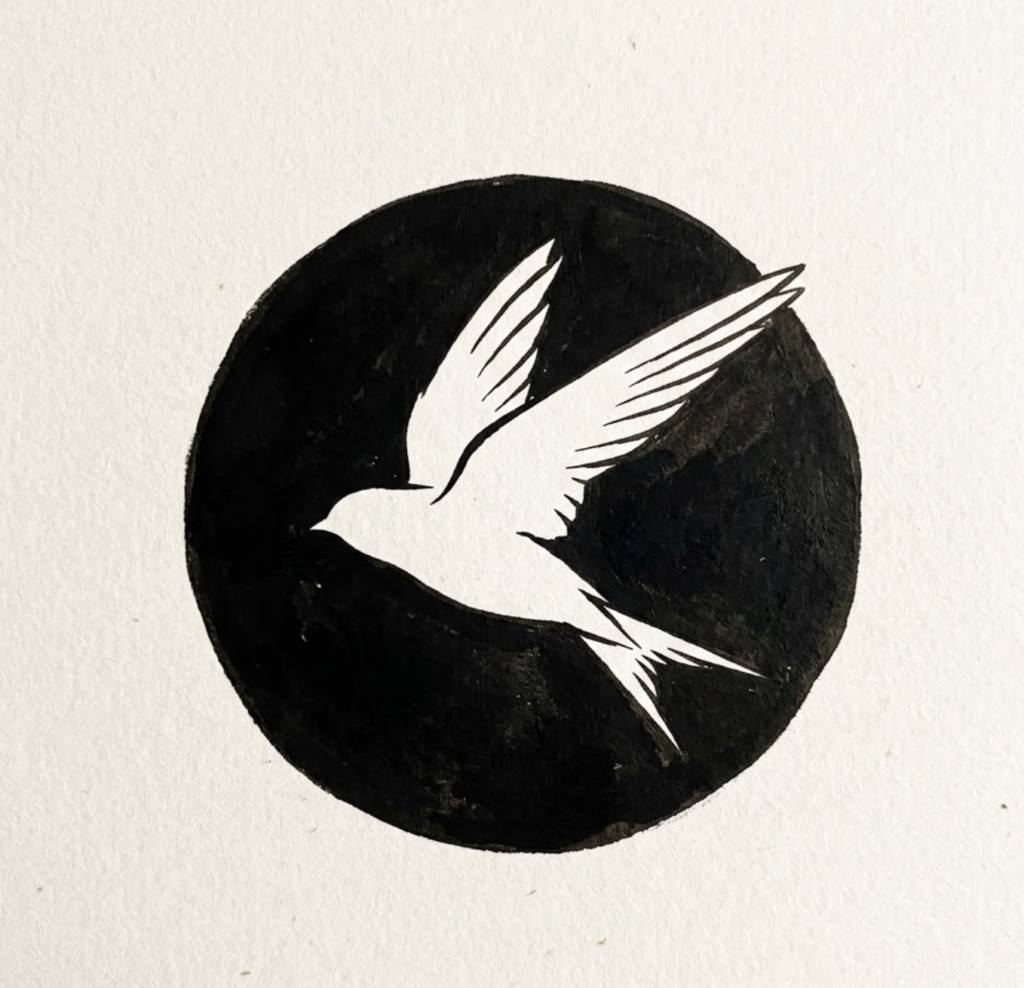
The bird exists only as white paper. Paint a dark circular wash and work around the bird’s silhouette, leaving it untouched. Simple to describe, genuinely tricky to execute cleanly at the edges. Strong graphic impact, immediately readable composition. The circle format also makes it ideal for stickers, pins, and embroidery hoops if you want to take it further.
42. Typography Bird
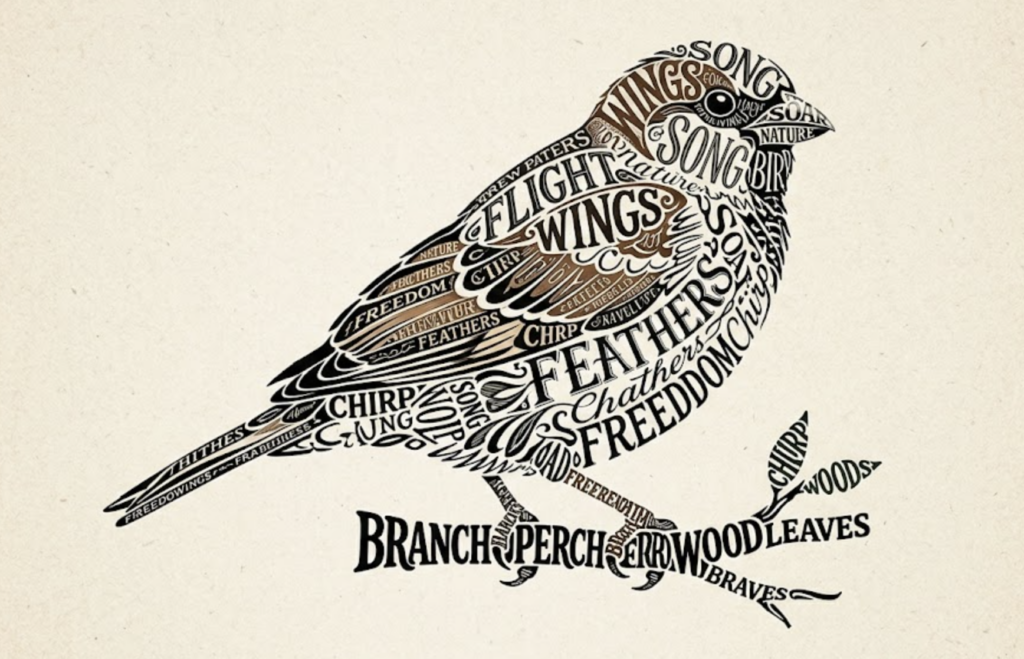
A word — the species name in Latin, a short line of poetry, the common name — forms the outline of the bird’s body. Typography-as-illustration. Requires planning the letterform path on paper before any ink touches the final surface. The planning sketch is half the work. This format bridges graphic design and illustration in a way that’s genuinely unusual and extremely Pinterest-friendly.
Best Reference Resources for Bird Drawing
The difference between a bird drawing that looks convincingly alive and one that’s technically fine but somehow off usually comes down to reference quality. Here’s what I actually use, in order of how often I reach for them.
Cornell Lab — All About Birds
Free, high-resolution photography of almost every North American species in every posture imaginable. The flight photo galleries are the most useful part: multiple shots of the same species in different wing positions, from multiple angles. Default starting point for any species study. allaboutbirds.org.
RSPB Photo Library
The European equivalent. Excellent coverage of UK and continental species that are underrepresented in American resources. Subscription for full resolution, but the preview images are often sufficient for proportion and posture reference. rspb-images.com.
Macaulay Library
Cornell’s full media archive, including video. Watching a heron land in slow motion teaches more about leg articulation than any photograph can. Essential for drawing flight and movement. macaulaylibrary.org.
Sibley’s Birds of North America
David Sibley’s illustrated guides (~$40) show species variation across sex, age, and season systematically — something photographs rarely capture in organized form. The illustrations also show the ‘average’ specimen more usefully than photographs, which always show one specific individual. The standard reference book recommendation is for a reason.
iNaturalist
Community-contributed photography often captures behavior and environmental context that professional wildlife photography misses. Particularly good for uncommon species, regional color variations, and juvenile plumages. Free. inaturalist.org.
FAQ: Bird Drawing Ideas
Q: What are the most popular birds to draw?
Owls, hummingbirds, crows, eagles, and peacocks consistently dominate Pinterest and DeviantArt for bird art. For beginners, robins and sparrows are the most practical starting points — their proportions are forgiving, and reference is everywhere. For advanced realism, raptors offer the most rewarding challenge: complex plumage, dramatic proportions, and strong compositional presence.
Q: How do I make bird drawings look less stiff?
Stiffness almost always comes from outlining and establishing structure. Instead, place the body mass first (two overlapping egg shapes), determine the spine axis tilt, add the head position, and only then move to the contour. A body axis tilt of even ten degrees transforms a taxidermy pose into a living bird. Also: draw the legs last. Legs drawn early anchor the composition before you’ve established where the weight actually sits.
Q: What bird is easiest to draw realistically?
The crow. Monochromatic plumage means you only manage value, not color mixing. The body shape is robust and forgiving. Posture varies expressively. And the strong silhouette means even an imperfect drawing reads as unmistakably crow-like — which matters enormously for motivation. Start with a perched crow in three-quarter view.
Q: Should I draw from reference or imagination?
Reference first, always — until the structural logic becomes automatic. Drawing from imagination without a foundation produces generic ‘bird shapes’ that lack species character and anatomical believability. The path to confident imagination drawing runs directly through sustained reference work. Most professional illustrators still use reference for complex poses after a decade of practice. That’s not a limitation; it’s professional practice.
Q: How many bird drawing ideas should I attempt per week?
One fully finished drawing beats five abandoned sketches every time. If you’re building a practice, commit to one idea per session — one 30 to 60-minute session, three times a week. After a month of that, you’ll have twelve finished pieces and a clear sense of which subjects and media pull you forward. Breadth comes later. Depth first.
Pick One. Draw It Today.
Lists like this are only useful if they turn into actual drawings. So here’s the only thing that matters after reading this: pick the single idea you’ve been most drawn to — not the easiest, not the most impressive-sounding, but the one you genuinely want to see on paper — and draw it before the week ends.
Set a timer for 30 minutes. Use whatever you have at hand. The drawing doesn’t need to be good. It needs to exist. You’ll learn more from one bad drawing than from another hour of reading about technique.
The best bird drawing you’ll ever make is the next one you actually start.
- 11.7Kshares
- Facebook0
- Pinterest11.7K
- Twitter1
- Reddit0