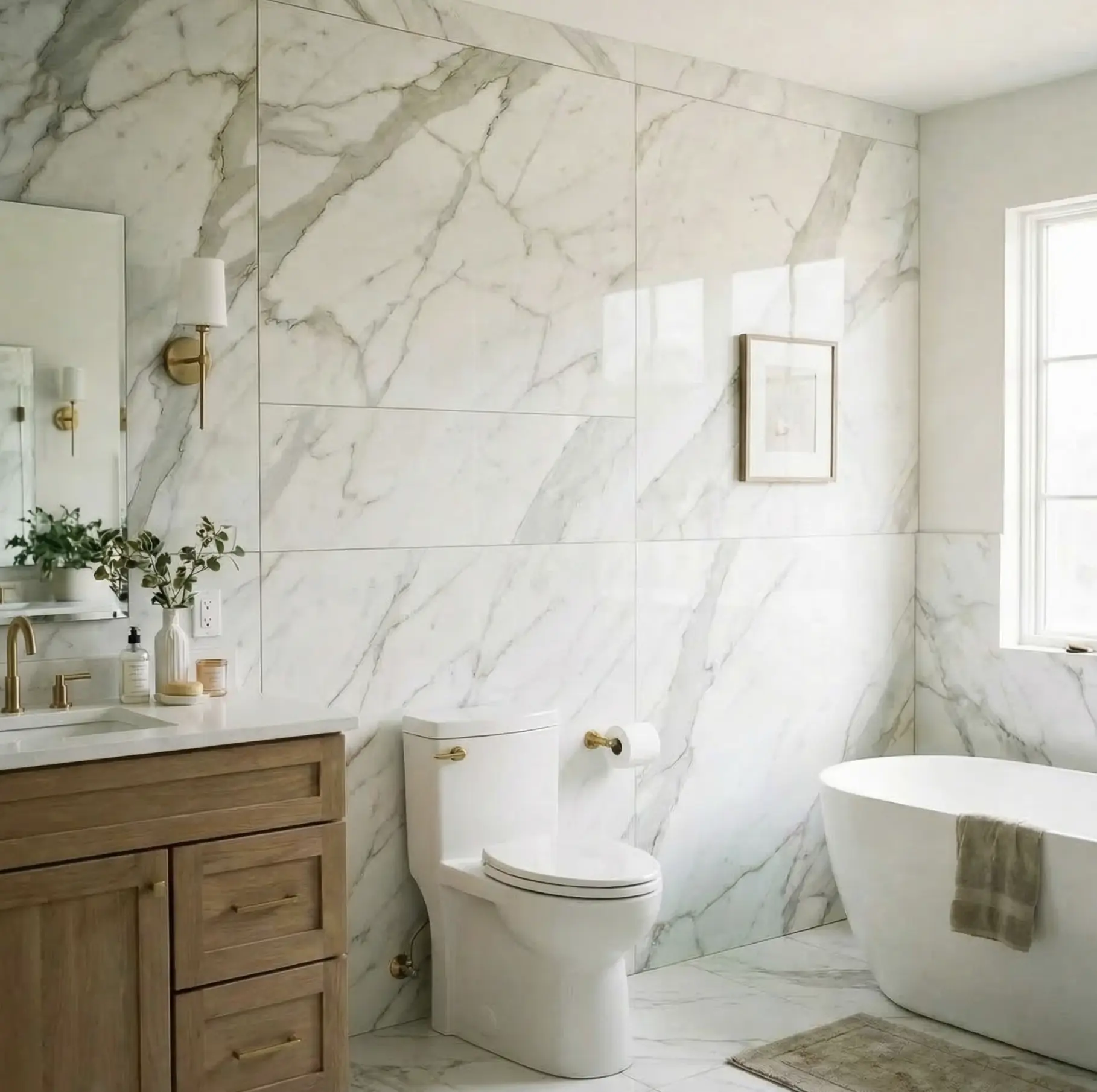
The most expensive bathroom renovation I’ve ever seen fail cost the client just under $40,000. Heated limestone floors. Freestanding tub sourced from a small Italian manufacturer. Custom vanity in smoked oak with hand-made brass hardware. The photography looked extraordinary. Six months later, the entire wall cavity behind the shower had to be opened up because a poorly installed pipe joint had been weeping silently since day one. The limestone came up. The vanity was damaged. The brass hardware was replaced because the moisture had reached it.
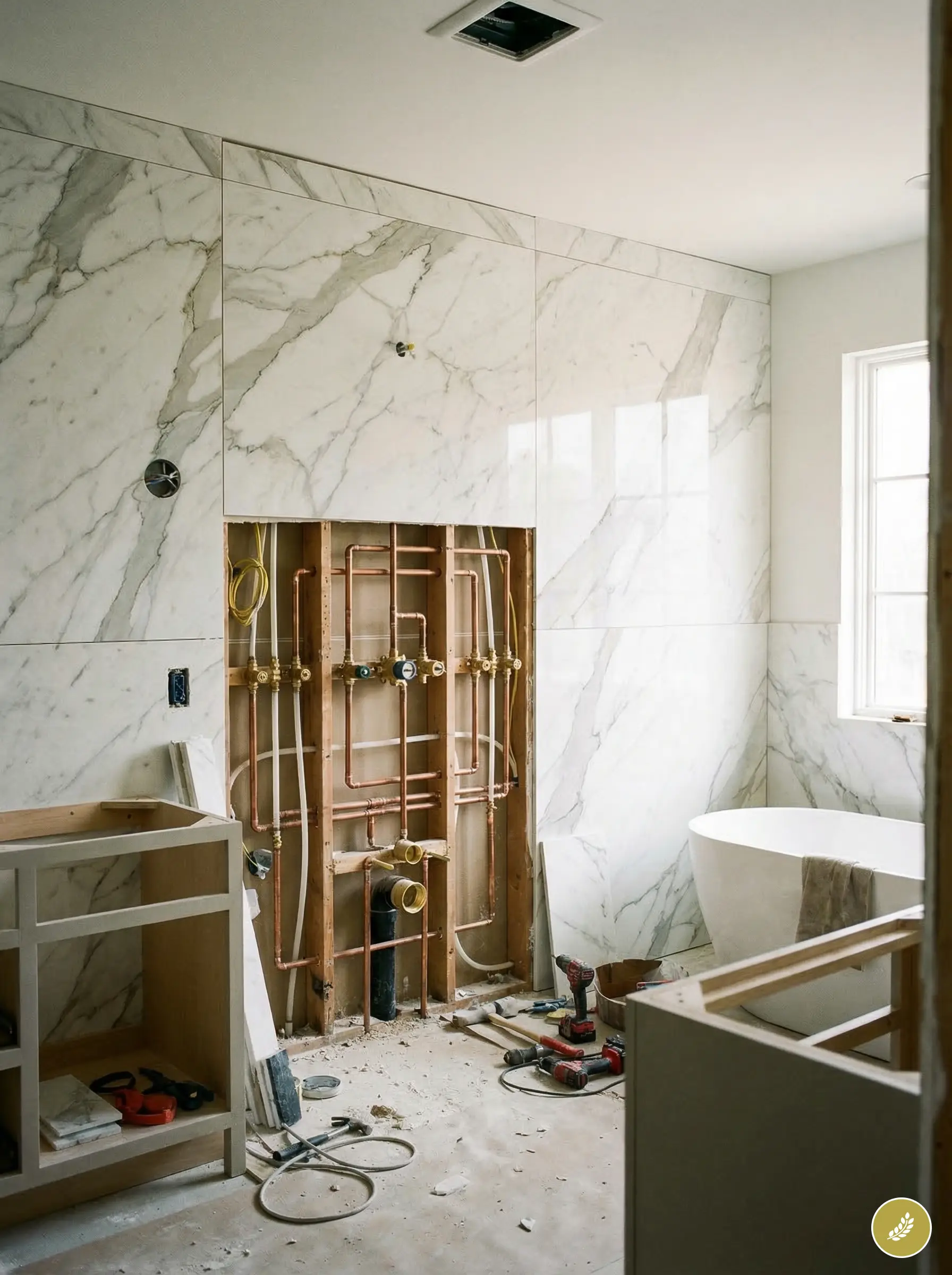
Nobody had looked behind the walls before the renovation started. Nobody had thought to.
- The Plumbing Infrastructure Is the Design Foundation
- What the Walls Are Hiding: The Pre-Renovation Assessment
- The Sutherland Shire Context: Older Stock, Specific Challenges
- When Small Signs Mean Bigger Problems
- Moisture, Mould, and the Hidden Cost of Delay
- Hot Water Systems: The Specification Most Designers Underestimate
- Five Bathroom Projects Where Infrastructure Became the Design
- 1. The Wet Room With No Threshold — London Victorian Terraced House
- 2. The Concealed Cistern Niche — Sydney Sandstone Apartment Conversion
- 3. The Double Shower With Independent Temperature Zones — Swiss Alpine Chalet
- 4. The Freestanding Tub on a Concrete Slab — Melbourne New Build
- 5. The Recirculating Hot Water Loop — New York Loft Apartment
- The Design Brief That Starts Underground
This is the central misunderstanding in premium bathroom design: the quality of what you see is ultimately determined by the quality of what you can’t. The tile selection, the fixture specification, the lighting design — all of it sits on top of a plumbing infrastructure that either supports or undermines everything above it. And in 2026, with renovation costs at record levels and client expectations for longevity higher than ever, starting the design conversation with what’s behind the walls isn’t just sensible. It’s the only approach that makes sense.
The Plumbing Infrastructure Is the Design Foundation
Architects and interior designers who work in luxury residential know this instinctively: the brief for a premium bathroom renovation starts with a plumbing audit, not a mood board.
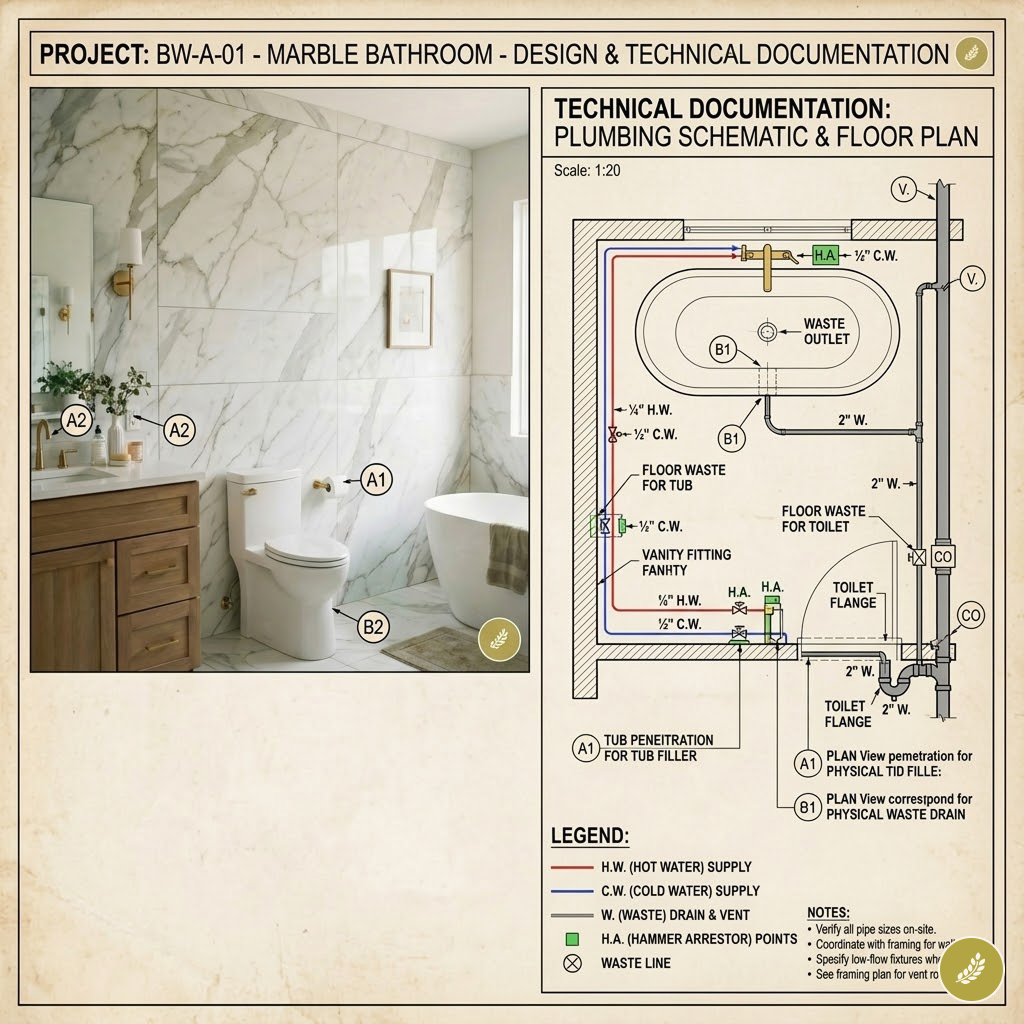
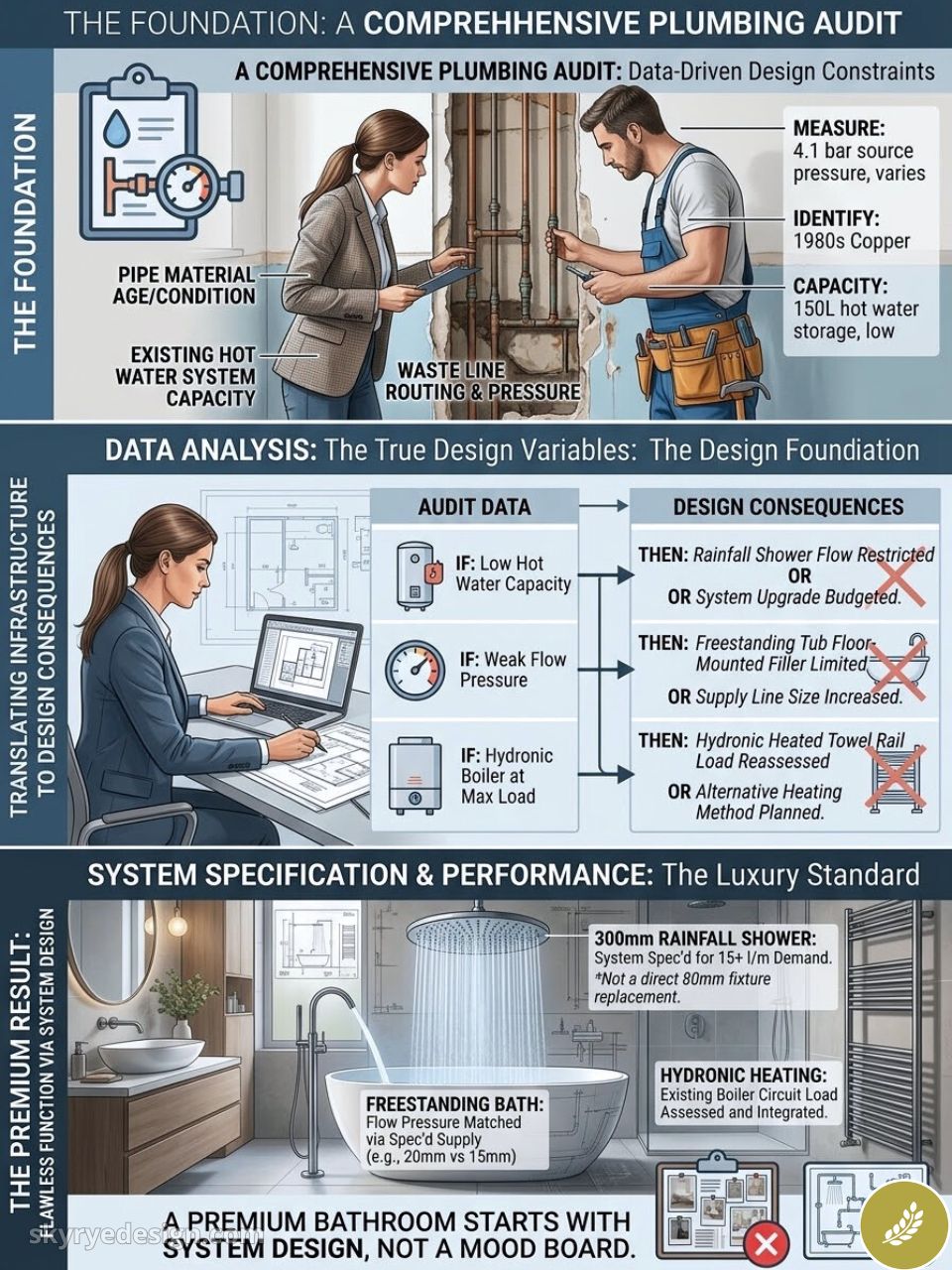
Before a single tile is specified or a fixture is ordered, the existing infrastructure needs to be understood. What’s the pipe material? How old is it? Where do the waste lines run? What’s the water pressure at the source, and does it vary across the day? Is there an existing hot water system serving this bathroom, and what’s its condition and capacity relative to the specified flow rates of the new fixtures?
These aren’t plumbing questions. They’re design questions — because the answers determine what’s actually possible. A freestanding bath with a floor-mounted spout requires adequate flow pressure to function as designed. A rainfall shower head with a 300mm diameter needs a supply line and hot water system spec’d for its demand, not the 80mm overhead fixture it’s replacing. A heated towel rail on a hydronic system requires the existing boiler circuit to be assessed before it’s added as a load.
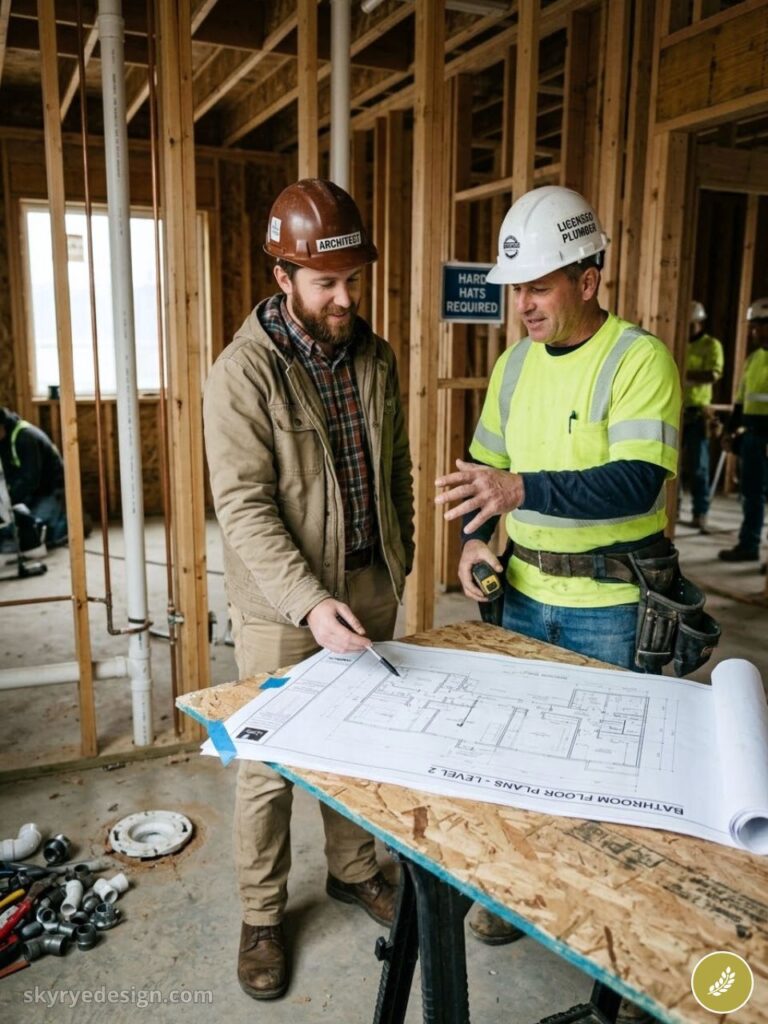
I’ve noticed that the bathroom projects which hold their quality over ten years are invariably the ones where a qualified plumber was in the room during the design development phase — not called in after the drawings were issued, but contributing to them.
What the Walls Are Hiding: The Pre-Renovation Assessment
There’s a particular kind of damage that renovation work regularly uncovers in bathrooms that have been performing without obvious complaint for years. Pipe joints that have been weeping at a rate too slow to show up as a visible leak, but fast enough to have saturated the timber framing behind the wall over a decade.
Waste lines running at gradients that are just sufficient under normal use, but which back up under the flow rates of a new high-performance shower. Old copper supply lines with internal scale buildup that restricts pressure below what a new thermostat mixer requires to operate correctly.
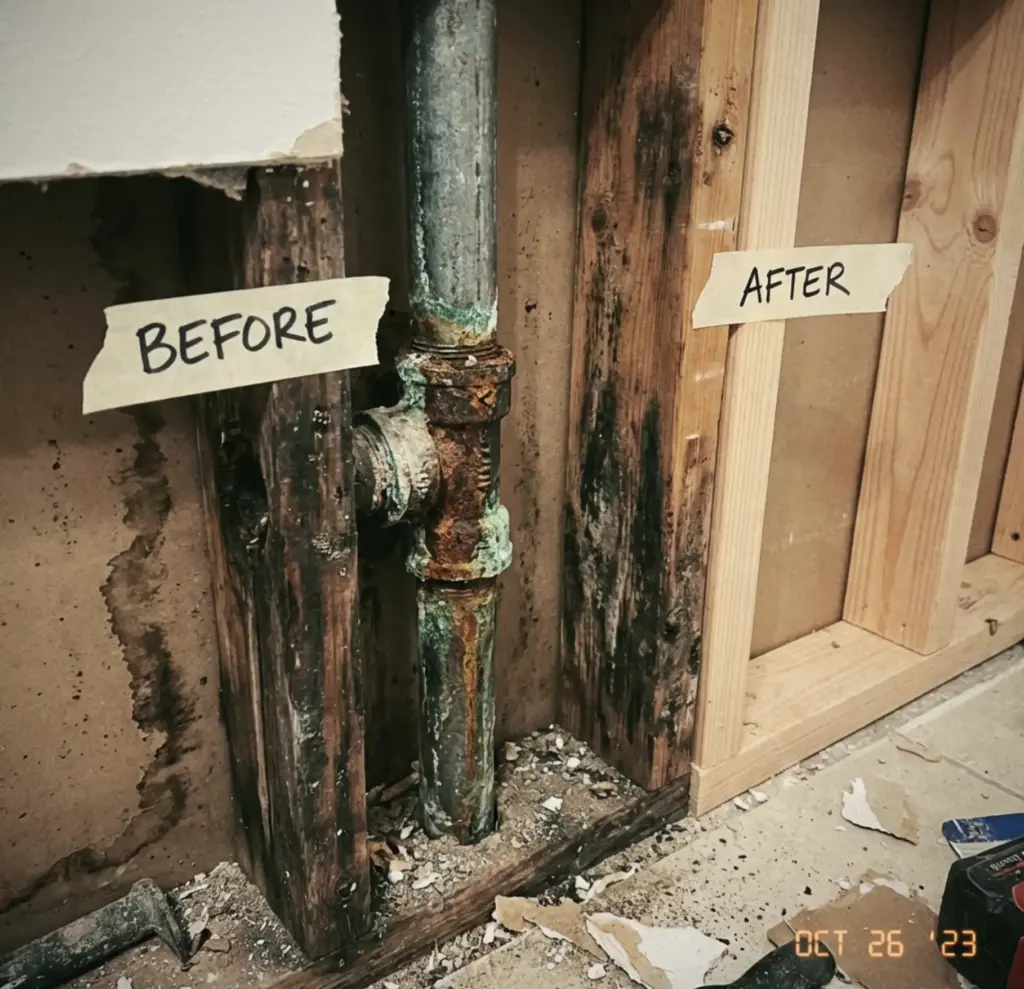
None of these issues announce themselves before the renovation starts. They announce themselves after — when the new tiles are grouted, the fixtures are installed, and the client has already paid.
This is why the pre-renovation assessment by a licensed plumber isn’t optional on a quality build. Slow-running or blocked drains that don’t clear with standard household measures indicate a blockage sitting deeper in the waste line than surface treatments reach — the kind of issue that manifests as a backed-up shower three weeks after the renovation completes, requiring the new floor to be lifted to access the drain. Identifying it before the work starts costs a fraction of identifying it after.
The assessment should also cover water pressure testing, pipe material identification, and hot water system capacity relative to the new fixture specification. In older properties — Federation homes, interwar bungalows, 1960s brick veneer — it’s common to find galvanised steel supply lines that have corroded internally to a fraction of their original bore. They may still deliver water. They won’t deliver it at the pressure a contemporary thermostatic shower valve requires.
The Sutherland Shire Context: Older Stock, Specific Challenges
The residential character of the Sutherland Shire is predominantly mid-century and older — a housing stock that carries specific plumbing conditions worth understanding before any renovation scope is set.
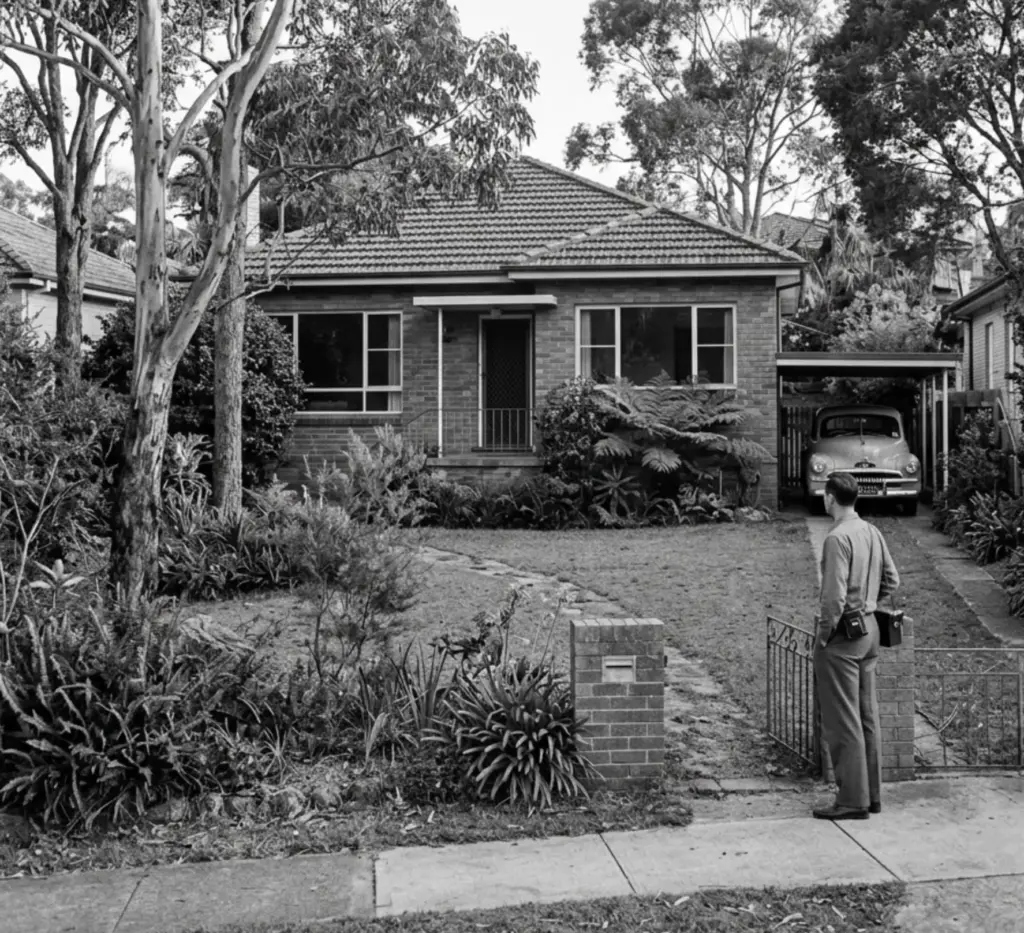
Clay or cast iron waste lines from pre-1970s construction are common in the area. These materials perform well when intact but are vulnerable to root intrusion in the presence of established garden trees — a defining feature of many Sutherland Shire blocks — and to joint failure as they age. The failure mode is gradual and invisible: slow drainage that gets progressively worse, occasional backflow, odors that appear and disappear. All of it attributable to other causes until a camera inspection reveals the actual condition of the line.
Water pressure in some parts of the area can also vary more than homeowners realise, particularly on elevated sites where the mains pressure at the property boundary is lower than the standard residential supply. This matters when specifying fixtures: the thermostat mixer that performs beautifully at 350 kPa behaves differently — and sometimes outside specification — at 200 kPa.
Working with plumbers in Sutherland Shire who know the local housing stock, the area’s common pipe materials and failure patterns, and the specific pressure and drainage conditions of the district is a meaningful advantage on a renovation project. General knowledge of plumbing practice and specific familiarity with what’s actually inside the walls of a 1952 brick veneer in Cronulla are genuinely different things.
When Small Signs Mean Bigger Problems
The clients who get the best outcomes from premium bathroom renovations are the ones who have been paying attention to their existing bathrooms in the years before the renovation starts. Not obsessively — but noticing the things that change.

A tap that develops a persistent drip isn’t just a tap issue. It can indicate a washer failure, but it can also indicate a water hammer problem in the supply line, or pressure fluctuation that’s stressing the seat. A drain that begins running slowly when it previously ran clear is rarely just a surface blockage — it’s a symptom of something further down the waste system, either a developing obstruction or a gradient problem beginning to manifest. A toilet that runs briefly after flushing — or runs continuously — signals a fill valve or flapper issue that, left unattended, can add hundreds of litres a day to your water bill and indicate the kind of ongoing moisture presence inside the cistern assembly that shortens its service life.
None of these are dramatic. All of them are worth calling a plumber for before they develop — and certainly before a renovation is planned around infrastructure that has a developing fault built into it. The renovation doesn’t fix the fault. It conceals it.
Moisture, Mould, and the Hidden Cost of Delay
The consequence of ignoring small plumbing issues in a bathroom isn’t just an escalating repair cost. It’s what happens to the building fabric in the meantime.
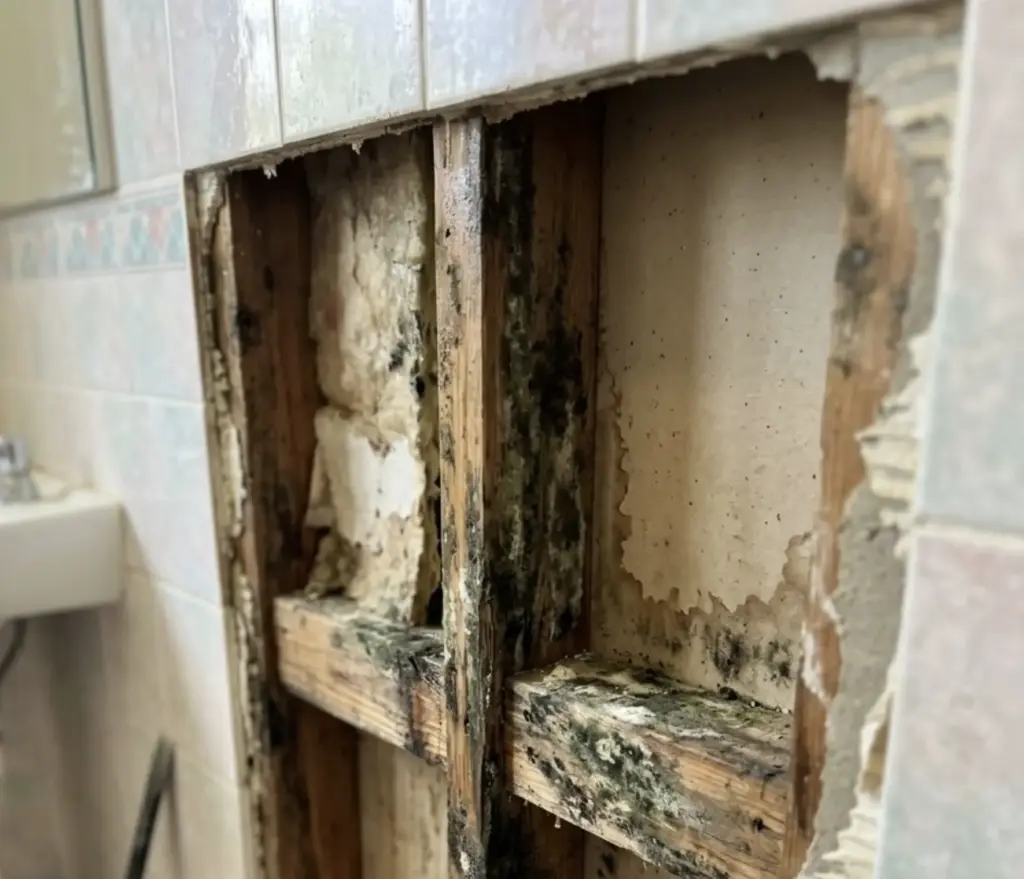
Bathrooms generate moisture by design — steam from showers and baths, condensation on cold surfaces, water that misses the waste and finds its way into grout lines and onto floor surfaces. A well-designed, well-ventilated, properly waterproofed bathroom manages this moisture load without accumulation. A bathroom with a slow leak behind the wall, or a waterproofing membrane that failed at a penetration point, accumulates moisture in the one place it can’t be seen.
Timber framing and substrate materials that remain damp create exactly the conditions under which preventing mould at home becomes genuinely difficult — because the mould isn’t in the bathroom, it’s behind it, growing on surfaces that no cleaning regime can reach. By the time it becomes visible at grout lines or cornice junctions, it has typically been established in the wall cavity for months. The remediation at that point involves opening the wall, treating the affected framing, replacing any compromised substrate, and relaying the waterproofing and tiling.
In a standard bathroom, this is disruptive and expensive. In a premium renovation where the tiling is natural stone, the substrate is fibre cement board laid over a custom height floor former, and the wall tiles are imported large-format porcelain — it is catastrophically expensive.
The design implication is straightforward: moisture management in a premium bathroom is not primarily a surface issue. It is a structural waterproofing, substrate, and ventilation issue that needs to be resolved in the design documentation before a single surface material is specified. The specification of a beautiful tile cannot compensate for a waterproofing membrane that doesn’t extend correctly to the floor waste penetration.
Hot Water Systems: The Specification Most Designers Underestimate
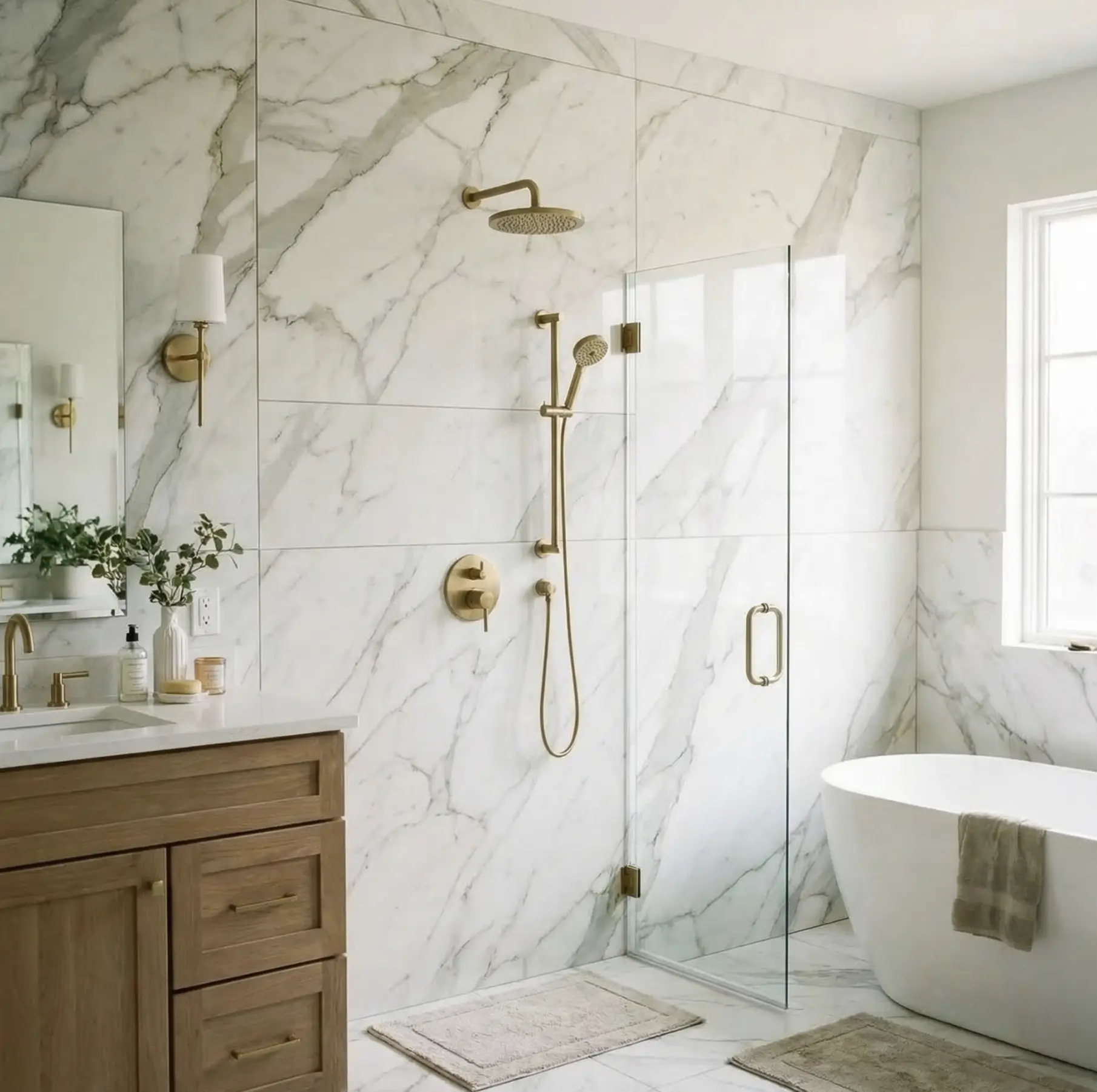
The hot water system serving a bathroom is the component most frequently underspecified relative to the fixtures it’s being asked to supply — and the most frequently blamed for disappointing performance after a renovation that was, by every other measure, executed correctly.
A contemporary premium bathroom specification might include a rainfall overhead at 20 litres per minute, a handshower at 9 litres per minute, and a freestanding bath tap at 15 litres per minute. Those fixtures don’t typically run simultaneously, but the hot water system needs to be capable of supplying the peak demand scenario without a temperature drop that triggers the thermostatic mixer’s safety cutoff.
An existing continuous flow system rated for the previous 80mm overhead shower is not the same as a system capable of supplying a 300mm rainfall head at a consistent temperature over a 15-minute shower. This is a plumbing specification question with direct design consequences — the answer might require relocating the hot water unit, upgrading the supply line diameter, or specifying a recirculating system to eliminate the dead-leg delay that makes an expensive tap feel cheap in daily use.
Hot water units that have begun making unusual sounds, delivering inconsistent temperatures, or producing discoloured water at first draw are signalling internal component wear — heat exchanger scaling, sacrificial anode depletion, valve wear — that will not improve with a renovation. Replacing the unit as part of the bathroom renovation scope, rather than inheriting a failing system behind new walls, is one of the more straightforward decisions in the design brief.
Five Bathroom Projects Where Infrastructure Became the Design
The gap between a bathroom that looks good in photographs and one that performs flawlessly for fifteen years almost always comes down to how seriously the infrastructure was treated as a design problem from the start. These five projects — across different scales, budgets, and typologies — each resolved a specific plumbing or structural challenge in a way that shaped the final design rather than being hidden by it.
1. The Wet Room With No Threshold — London Victorian Terraced House
The brief was a wet room in a first-floor bathroom of an 1890s Victorian terrace in Islington. The constraint: original floor joists running in the wrong direction for a conventional linear drain, a ceiling below that was a period plaster cornice the client refused to damage, and no acceptable route for a standard waste stack within the room’s dimensions.
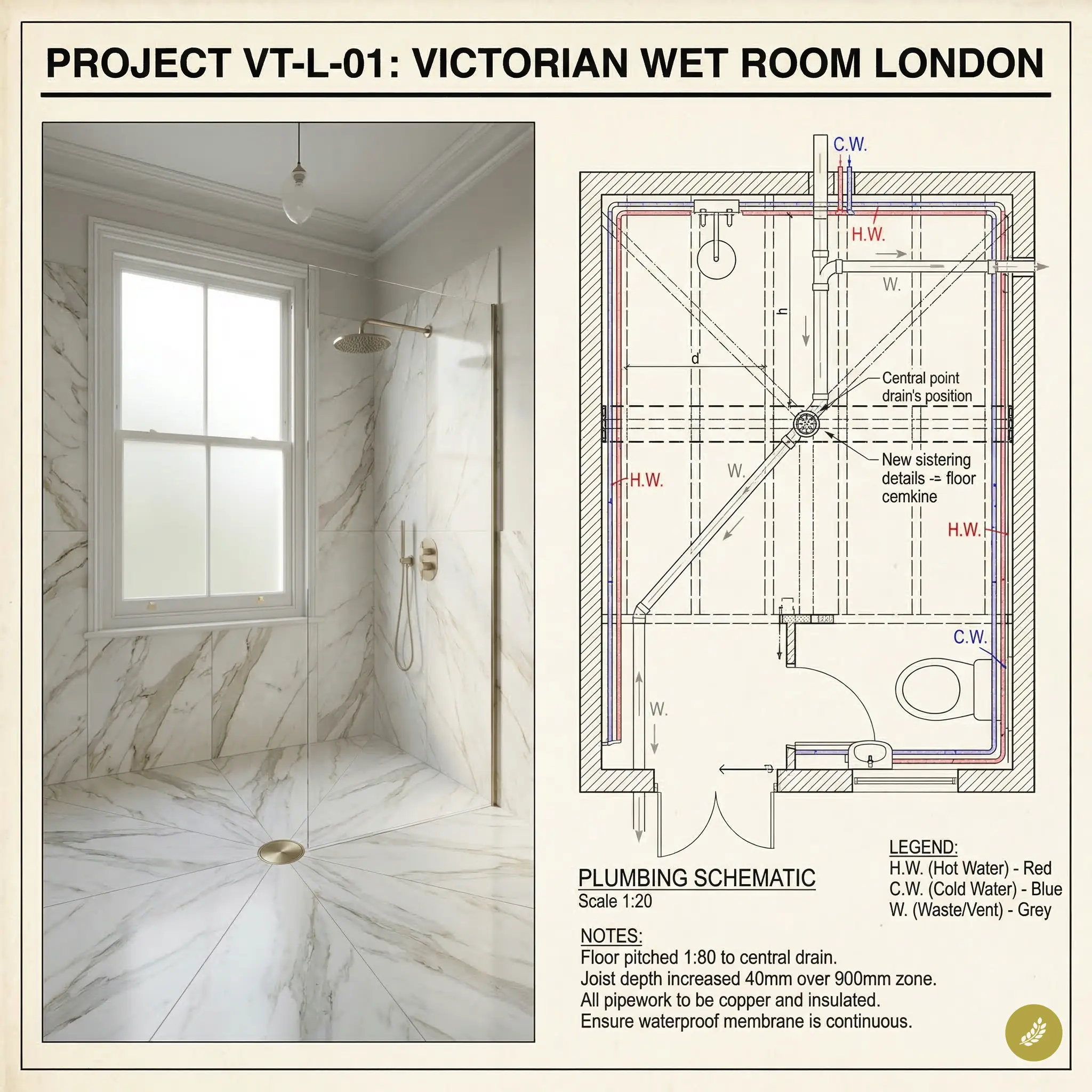
The solution came from treating the floor structure as a design opportunity rather than an obstacle. The joists were sistered and locally deepened over a 900mm zone to create sufficient fall toward a central point drain — a circular brushed brass outlet that became the bathroom’s visual anchor point. The entire floor plane pitched almost imperceptibly toward it, the fall so gradual it reads as flat. The central drain also allowed the tile pattern — large format Calacatta marble — to radiate from the center of the room without the interrupt of a linear channel that would have cut across the stone’s veining.
The structural engineer and the plumber were briefed before the designer finalised the floor plan. The drain position wasn’t chosen for aesthetics and then engineered. It was established by the structural solution and the aesthetic followed it.
2. The Concealed Cistern Niche — Sydney Sandstone Apartment Conversion
A heritage-listed sandstone warehouse conversion in Pyrmont, Sydney, presented the classic conservation constraint: no surface-mounted pipework visible on the original stone walls, no chasing into the sandstone fabric, and a heritage officer who reviewed every technical submission.
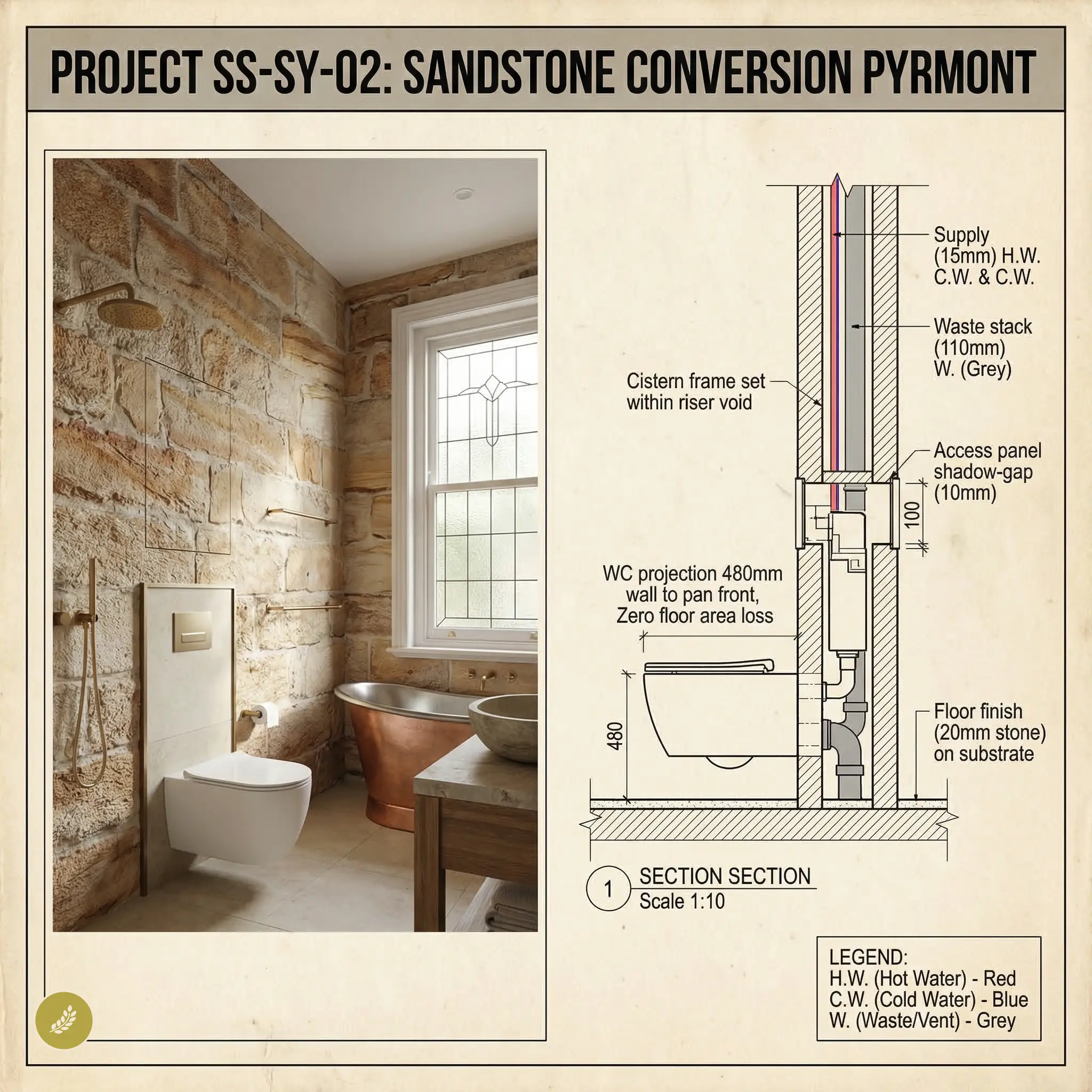
The wall-hung WC and concealed cistern are now standard responses to this brief — but the standard response requires a framed-out wall to house the cistern frame, which in a room with 600mm sandstone walls and a small footprint reduces the usable floor area by 150–200mm. The designer’s solution was to recess the entire cistern frame into a purpose-built niche formed in the new partition wall that housed the room’s services riser — so the cistern depth was absorbed by space that already had to exist for the waste stack and supply pipes. The finished wall face sat flush with the original stone reveal, the cistern access panel was set in a shadow-gap frame that read as a deliberate architectural detail, and the floor area loss was zero.
The WC projection from wall to front of pan was reduced to 480mm — 70mm less than a standard floor-mounted unit. In a 2.2m × 1.8m bathroom, 70mm is the difference between the space feeling tight and feeling considered.
3. The Double Shower With Independent Temperature Zones — Swiss Alpine Chalet
A private chalet renovation in Verbier required a master bathroom with a double shower — two separate showering positions within a single enclosure, capable of operating simultaneously at independent temperatures. Standard thermostatic mixer installations running from a single hot water supply create a pressure and temperature conflict when both positions run simultaneously: the second person to turn on gets cooler water and lower pressure as the system responds to the doubled demand.
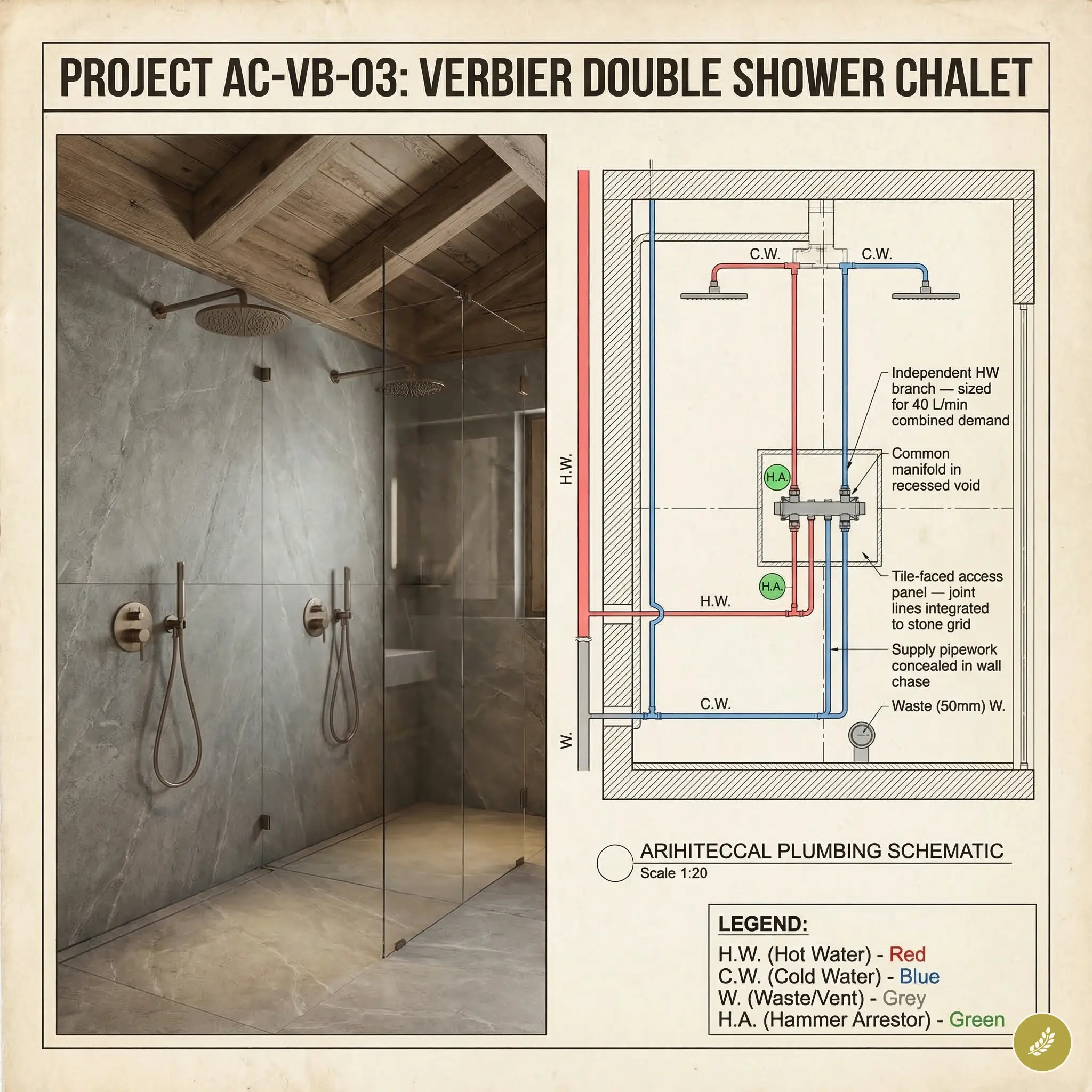
The resolution required a dedicated hot water supply branch to the shower enclosure — sized for the combined peak demand of both positions running simultaneously at full flow — with two independent thermostatic valves drawing from a common manifold rather than sequential inline supply. The manifold itself was housed in a recessed service void behind the shower’s back wall, accessible via a tile-faced panel whose joint lines were integrated into the stone grid pattern of the shower interior.
The result from the outside: a seamless stone enclosure with two sets of controls and two overhead positions. No visible difference from a conventional installation. From an infrastructure perspective, an entirely separate plumbing branch specifically engineered for the application. The design is invisible. The performance — consistent pressure and temperature at both positions under simultaneous use — is the proof that it’s there.
4. The Freestanding Tub on a Concrete Slab — Melbourne New Build
Floor-mounted bath spouts require a supply line that emerges from the floor at a precise position — the center point between the tub’s two tap holes, offset by whatever the manufacturer specifies from the tub’s rim. On a timber floor with accessible sub-floor space, this is a straightforward rough-in. On a poured concrete slab — standard in most Melbourne new builds — it requires the floor supply position to be set in concrete before the slab is poured, from a drawing that specifies the exact tub position, before the tub is necessarily confirmed or the room’s detailed layout is finalised.
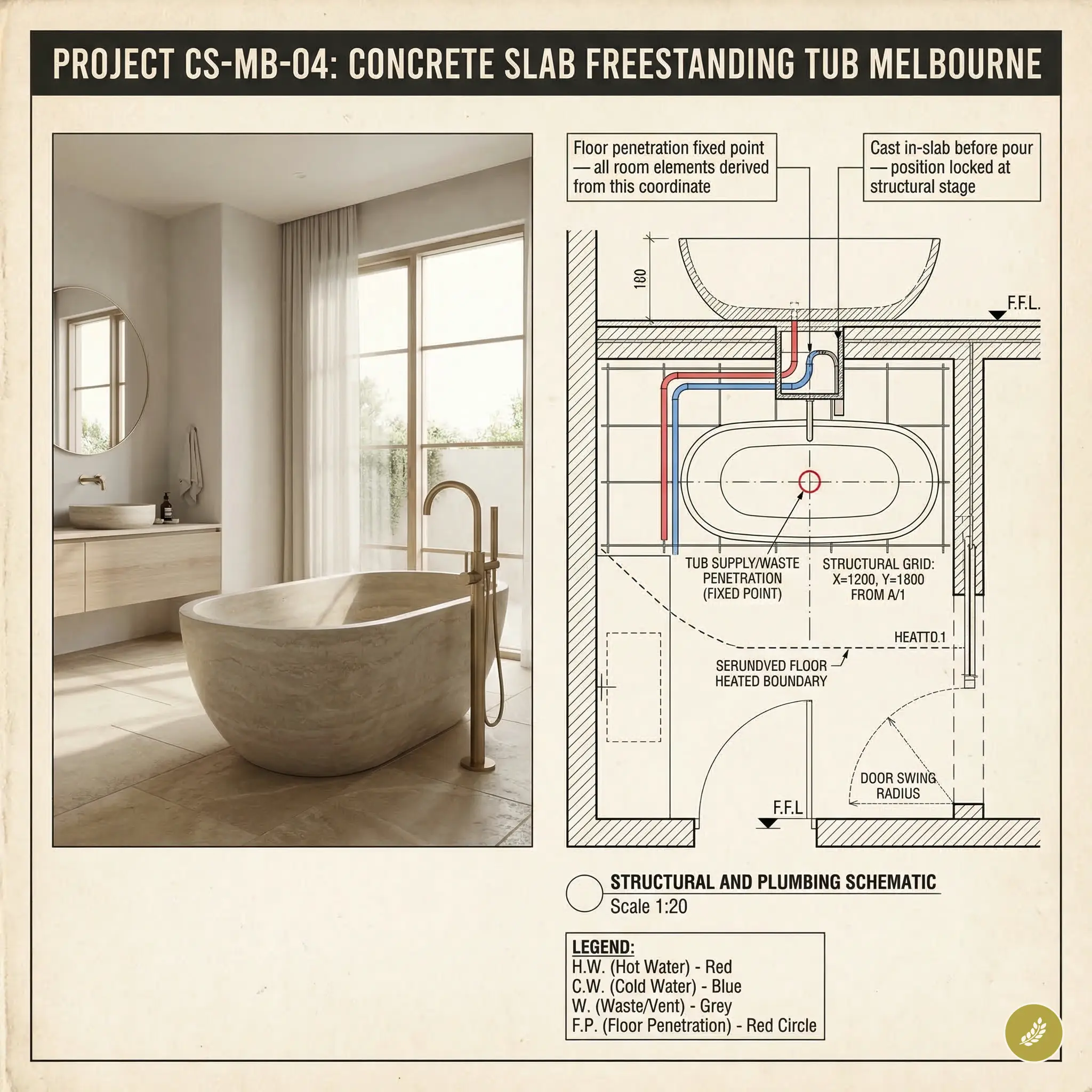
The project resolved this by locking the tub position and floor connection rough-in as the first fixed point in the bathroom design — establishing it in the structural documentation before finishes, fixtures, or fittings were confirmed for any other element. Everything else in the room was designed around the fixed constraint of that floor penetration. The vanity position, the door swing, the heated floor zone boundary, the window sill height — all derived from the tub’s structural anchor point.
The finished bathroom reads as a room designed around the tub as its centrepiece. It was, but not primarily for the aesthetic reason that description implies. The tub’s centrality was a structural consequence that the designer chose to celebrate rather than work around.
5. The Recirculating Hot Water Loop — New York Loft Apartment
A gut renovation of a 280m² loft on Manhattan’s west side included a master bathroom positioned approximately 22 metres from the building’s hot water riser — a dead-leg distance that meant the tap ran cold for 35–40 seconds before hot water arrived. For a single basin tap, this is a minor inconvenience. For a rainfall overhead at 20 litres per minute, it represents 10–13 litres of cold water wasted before every shower and a user experience that undermines every other quality decision in the room.
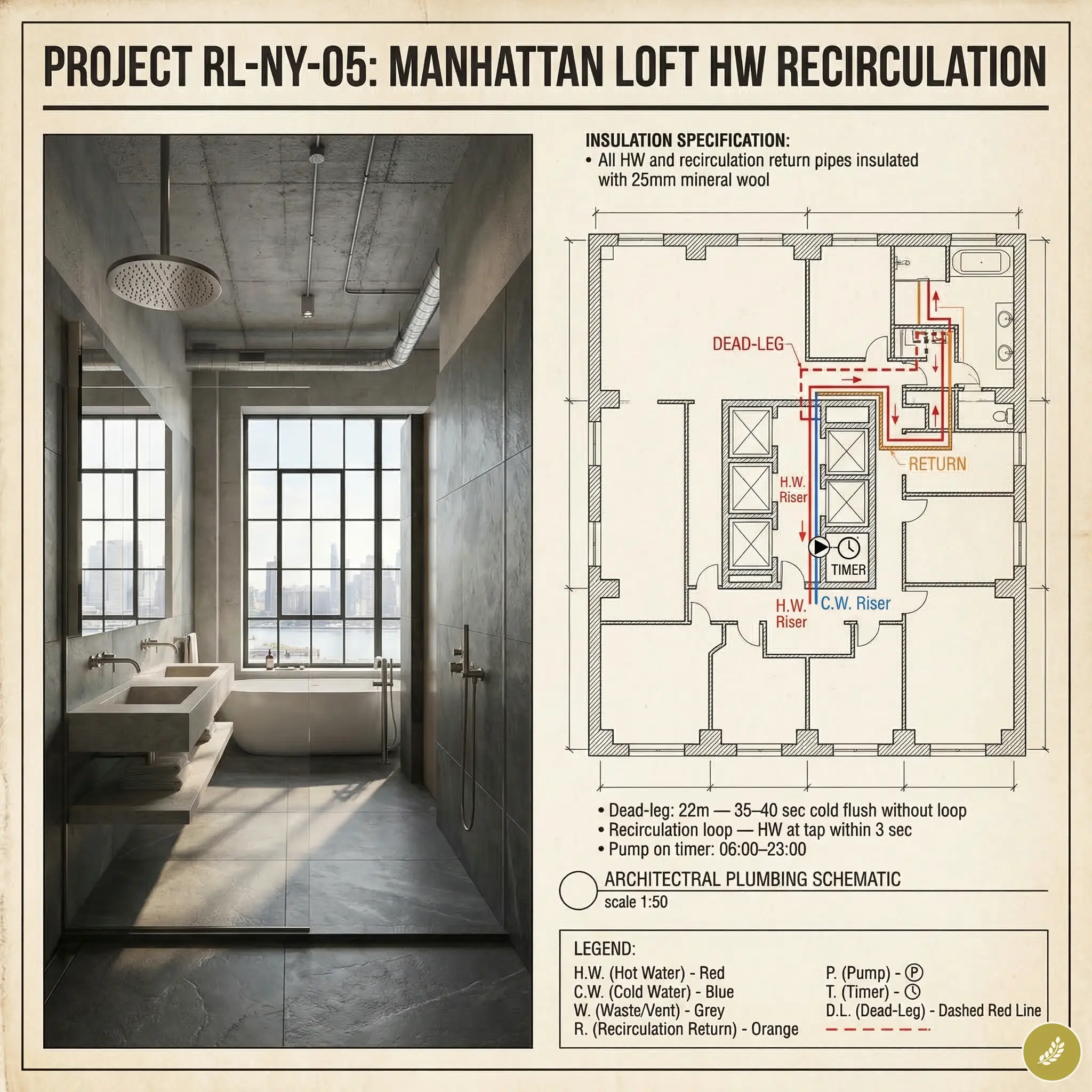
The solution was a dedicated hot water recirculation loop running from the riser to the bathroom and back — a continuous circulation that keeps hot water at the tap at all times, with a pump controlled by a timer set to the household’s actual usage pattern to avoid running continuously overnight. The loop added approximately $1,800 to the plumbing scope and required co-ordination between the plumber and the insulation contractor to ensure the return pipe was properly insulated throughout its run.
The design impact: the tap delivers hot water within three seconds. The 10-litre cold flush is eliminated. A bathroom that cost in excess of $180,000 to complete doesn’t have the one user experience failure that would have undercut every other quality decision in it — the moment when an expensive fixture behaves like a cheap one.
The recirculation loop is invisible. That’s the point. Every infrastructure decision that works correctly becomes invisible. The ones that don’t become the only thing the client notices.
The Design Brief That Starts Underground
The bathroom renovations that look best in five years, ten years, and twenty years are the ones where the design process treated the plumbing infrastructure as architecture — not as a given, not as someone else’s problem, but as a design variable with direct consequences for everything above it.
That means pre-renovation assessment before design development begins. A plumber who understands the specific housing stock and local conditions. Hot water specification matched to the fixture demand. Waterproofing treated as a structural requirement, not a line item in the tiler’s scope.
The limestone floor and the Italian freestanding tub and the smoked oak vanity — these are the visible expression of a premium bathroom. Behind them, in the walls and under the floor, is the architecture that determines whether they perform as designed for a decade or become very expensive casualties of something that should have been caught before the renovation started.
The best design decisions in a premium bathroom renovation are the ones the client never has to think about again.
- 10shares
- Facebook0
- Pinterest10
- Twitter0
- Reddit0