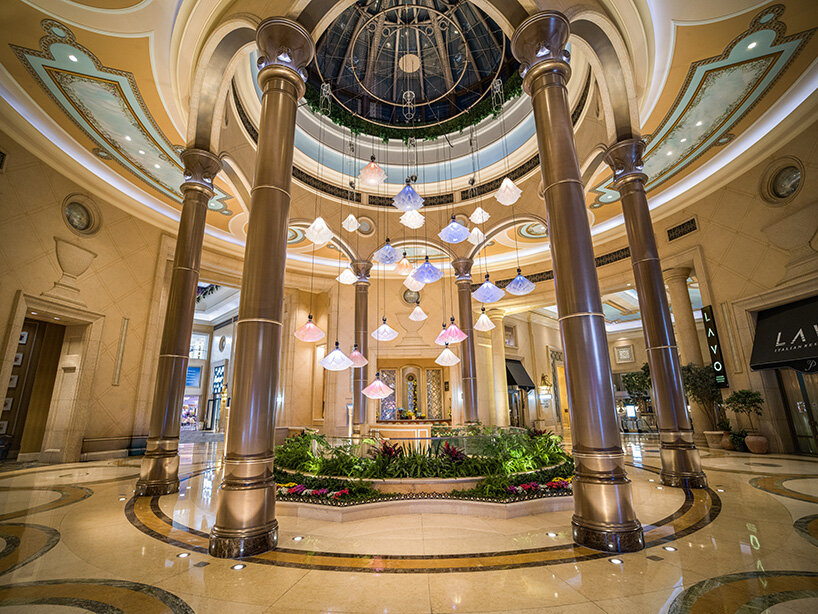
Twenty-seven glowing forms open and close above a Las Vegas lobby. Some move like solitary flowers. Others travel as a coordinated field. This is kinetic sculpture at architectural scale: art that changes the room by changing through time.
DRIFT’s Shy Society Palazzo is a useful place to understand why moving art can feel strangely alive. The answer isn’t hidden inside one clever motor. It comes from the full sequence: energy enters a mechanism, the mechanism shapes a path, and timing turns that path into behavior.
My industrial design training made me attentive to that sequence. You can read the stance of a car before you know its horsepower, and you can read a figure’s weight before the pencil reaches the details. Kinetic art works the same way. Movement reveals weight, balance, tension, hesitation, and intent.
What makes kinetic sculpture feel alive
A kinetic sculpture is a three-dimensional artwork in which real movement forms part of the piece. Wind may turn it. Gravity may pull it. A visitor may push it, or a motor may run a programmed sequence. The work is incomplete without change.
That separates moving sculpture from a static object that merely suggests action. A carved runner can look fast, but the material remains fixed. Op Art can make a flat pattern appear to vibrate, yet the surface doesn’t physically move. Kinetic art brings time into the object itself.
Movement gives sculpture a fourth dimension
A conventional sculpture has height, width, and depth. A kinetic installation adds duration. You may see one shape on arrival and another thirty seconds later. Walk away too early and you miss part of the composition.
This changes the designer’s job. Form can no longer be judged from a single hero angle. Every transition matters, including the awkward half-open state that a polished photograph might hide. The resting position matters too. A public artwork can spend more time paused than moving.
Living motion contains variation
Perfect repetition quickly exposes a machine. Biological movement is less obedient. A flower slows near the end of its opening cycle. A bird changes direction before the flock catches up. Breathing includes tiny differences in depth and timing.
Good kinetic sculpture borrows those clues. It can use an easing curve instead of a hard stop, stagger several elements by half a second, or allow wind and gravity to introduce chance. The mechanism remains engineered, but the result doesn’t feel trapped inside a loop.
Try this when you watch any moving artwork: ignore the decorative surface and follow the silhouette. Where does it accelerate? Where does it pause? Does the weight appear to lead the motion or follow it? Those three questions reveal more than a long technical description.
Shy Society Palazzo turns a lobby into moving architecture
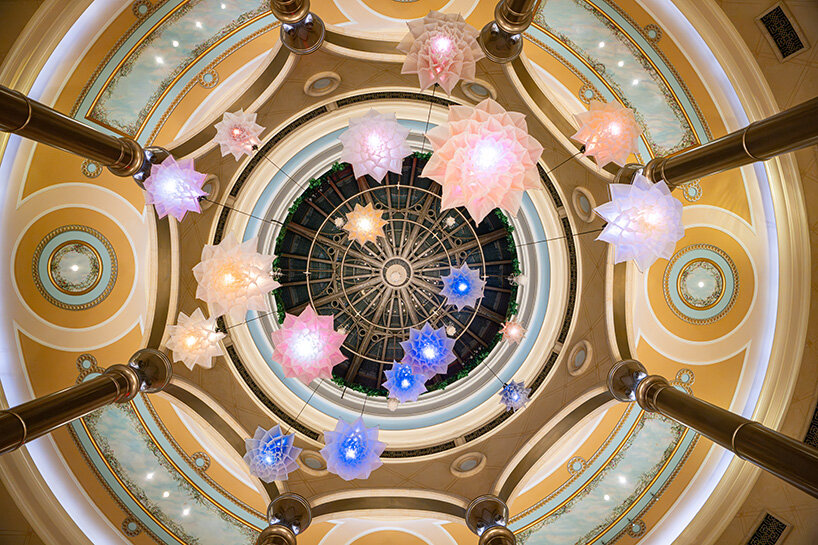
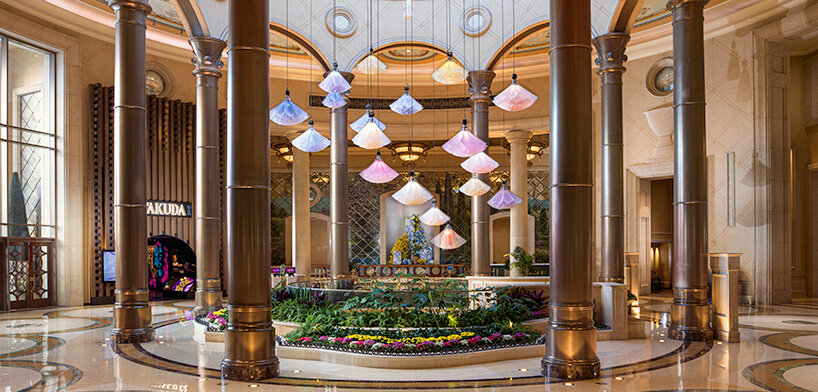
DRIFT created Shy Society Palazzo for the Palazzo lobby at The Venetian Resort Las Vegas in 2026. The installation combines nine Shylight sculptures with eighteen Meadow elements. They form one suspended group, but the two families behave differently.
Shylight presents the individual. Each large form descends, opens, closes, and rises with the presence of a dancer. Meadow works through the group. Its smaller flowers produce waves, clusters, and shared patterns. Together, the 27 elements move between independence and coordination.
Nature supplies the behavior
The choreography refers to nyctinasty, the process through which certain flowers close at night and open again with daylight. DRIFT doesn’t copy a botanical specimen petal by petal. The studio translates a natural response into opening, folding, retreating, and resting.
That distinction matters. Biomimicry becomes shallow when it stops at a leaf-shaped shell. As with other nature-inspired patterns in design, the useful lesson lies in the rule behind the form. Here, the biological reference lives in the timing. The elements appear to conserve energy, wake, breathe, and react as a group.
For most of the day, the installation runs in a calm continuous flow. Once an hour, the sculptures perform a complete sequence with music tied to bodily rhythms such as breathing and heartbeat. A visitor can catch a brief change while crossing the lobby or wait for the full composition.
The ceiling becomes an active part of the interior
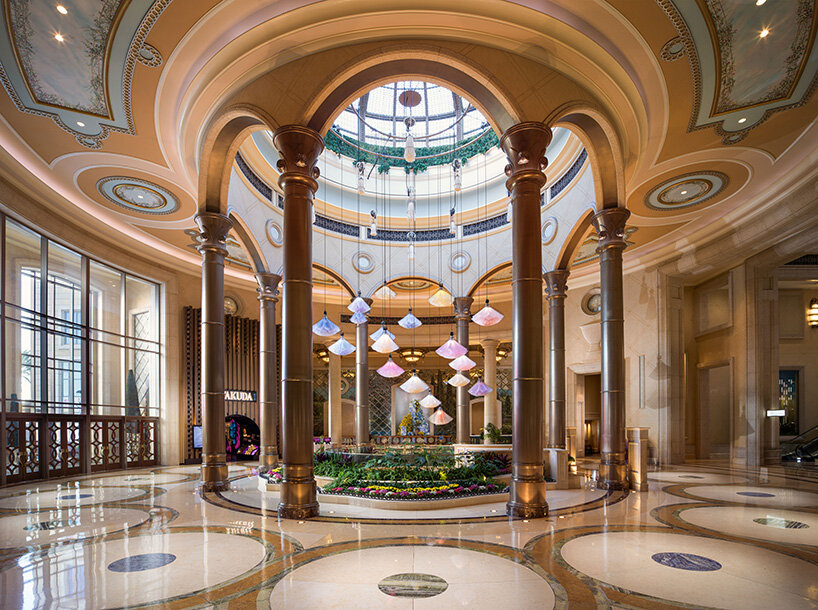
A hotel lobby usually directs attention toward reception, circulation, lighting, and material finishes. Shy Society Palazzo pulls the eye upward. The unused volume above the floor becomes occupied space, and the arrival route gains a changing tempo.
This is why I see the work as interior architecture rather than suspended decoration. It affects how long people pause, where they look, and how they understand the scale of the room. The installation doesn’t divide the lobby with walls. It organizes attention through time.
How kinetic sculptures create movement
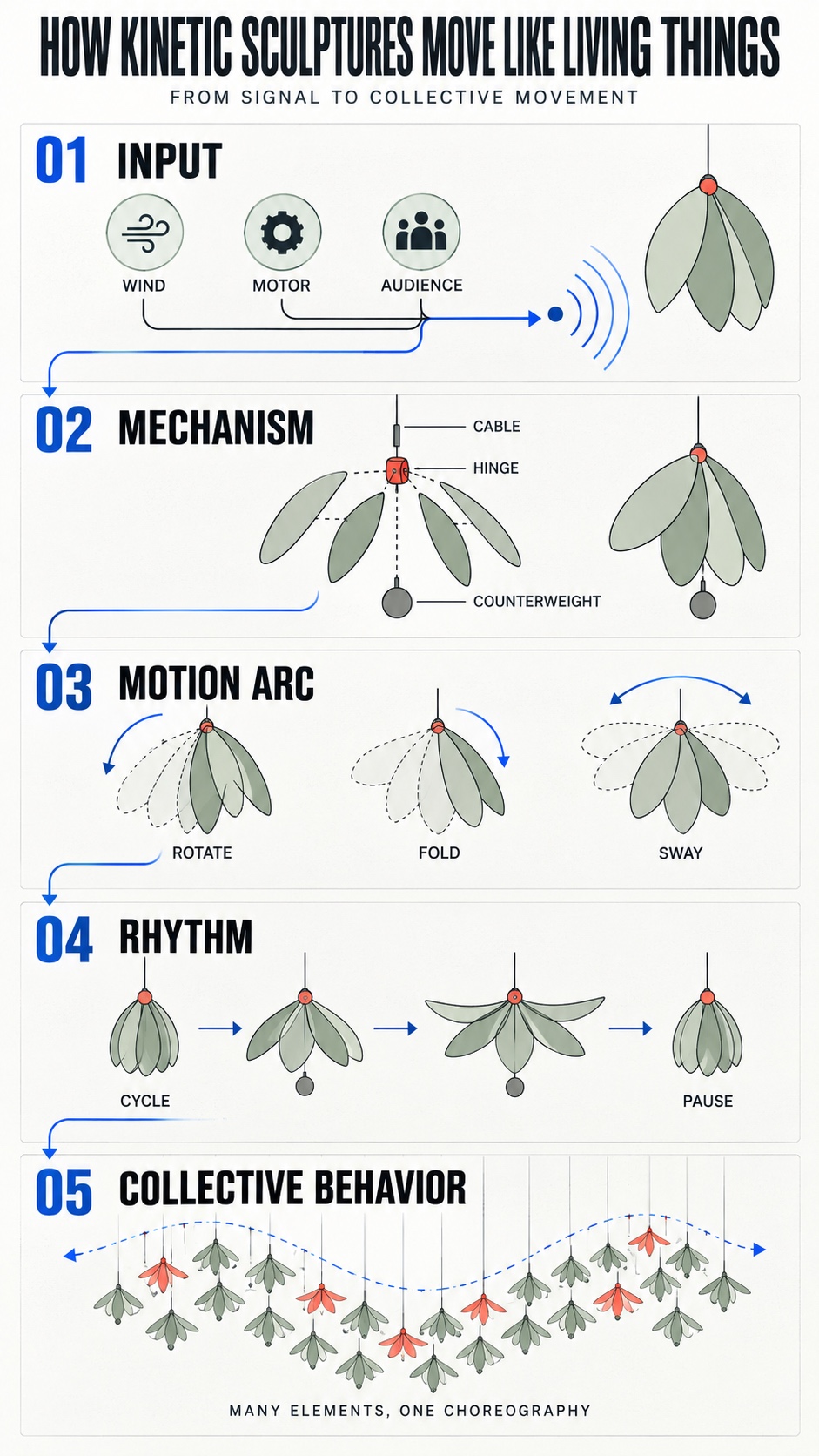
Every moving artwork has an energy path. Something supplies force, a mechanism transfers it, and a joint allows a controlled change of position. The visual result may look weightless, but the system underneath deals with mass, friction, inertia, and wear.
| Input | Typical mechanism | Character of movement | Known example |
|---|---|---|---|
| Wind | Balanced arms, bearings, vanes, linkages | Variable and weather-dependent | Alexander Calder, Anthony Howe, Theo Jansen |
| Gravity | Pendulum, counterweight, suspended mass | Slow, readable, sometimes unpredictable | Mobiles and pendulum installations |
| Stored energy | Spring, elastic element, escapement | Timed cycles that gradually lose energy | David C. Roy’s wall sculptures |
| Electric motor | Gear, belt, cam, crank, cable, linear actuator | Repeatable and precisely controlled | Jean Tinguely and DRIFT |
| Viewer or sensor | Touch, camera, pressure pad, proximity or biometric input | Responsive and participant-dependent | DRIFT’s Unfold and interactive sculpture |
Mechanisms translate one motion into another
A rotating motor doesn’t limit the artwork to rotation. A cam can turn that spin into a rise and fall. A crank can create a repeating stroke. Cables can distribute one drive across many suspended forms, while separate actuators allow each element to follow its own timing.
Balance reduces the effort required. If a counterweight offsets much of a petal’s mass, the motor only needs to overcome the remaining imbalance and friction. That can produce a slower, quieter movement with less energy. It also reduces stress on the structure.
Control software shapes the personality
Programmed kinetic art needs more than start and stop commands. The controller determines speed, acceleration, delay, synchronization, operating limits, and fault behavior. Sensors can add environmental or human input, but more input doesn’t guarantee better art.
I learned a similar lesson while working across automotive concepts and interface design: hidden systems are felt through behavior. A poorly tuned response makes the whole object feel cheap, even when the surface looks expensive. With moving sculpture, a harsh stop or a noisy reversal can destroy the illusion of lightness.
A practical way to read the engineering is to trace the energy path with your finger: input, transmission, joint, moving mass, stop. If one step remains mysterious, look for a concealed cable, counterweight, or bearing rather than assuming magnetic levitation.
Rhythm matters more than speed
Fast movement attracts attention, but speed alone rarely creates a convincing sense of life. Rhythm does. The eye looks for preparation, action, recovery, and rest.
Think about a flower opening. It doesn’t jump from closed to open at a constant rate. It starts slowly, gathers motion, and settles near the end. Replace that curve with a uniform mechanical sweep and the same petals begin to resemble an automatic umbrella.
Pause creates anticipation
A pause lets the viewer register the current form and predict the next one. Too little pause turns the work into visual noise. Too much makes visitors wonder if it has broken.
DRIFT uses stillness as part of the cycle. Calder reached a similar richness through air currents: his mobiles could hang quietly, react to a small draft, and settle into a different balance. Jean Tinguely often chose the opposite character. His machines rattled, shook, drew, and occasionally failed in public. Both approaches feel alive because their timing has consequence.
Small delays create collective behavior
When 27 elements begin at precisely the same millisecond, the result can resemble a factory test. Shift the timing and a wave appears. Delay the outer elements, vary the travel distance, or let one cluster close while another opens, and the group starts to behave like a flock.
This is a useful design rule for any repeated installation: establish one clear motion phrase, then introduce controlled differences. Randomness without structure looks messy. Perfect synchronization looks rigid. The interesting zone sits between them.
Five kinetic sculpture artists who changed how art moves
Alexander Calder: balance and air
Alexander Calder created his first fully kinetic sculpture in 1931. Marcel Duchamp gave his moving works the name “mobiles,” a French word connected to both motion and motive. Calder initially tried motors, then moved toward balanced constructions animated by air currents.
That change replaced prescribed repetition with chance. A Calder mobile has a designed range of behavior, but the room chooses the exact sequence. Temperature, ventilation, passing bodies, and small drafts alter the composition. The Calder Foundation documents this shift from motor-driven objects to air-powered movement.
Jean Tinguely: machinery with flaws exposed
Jean Tinguely made machines that drew, clattered, performed, and mocked industrial efficiency. His Méta-Matic drawing machines from the late 1950s used motors and unstable linkages to produce marks. The mechanism didn’t disappear behind a clean shell. It was the visual subject.
His 1960 Homage to New York assembled motors, bicycle parts, steel tubes, a piano, a radio, and other found objects into a machine designed to destroy itself in the Museum of Modern Art’s sculpture garden. Much of the performance went off-plan. That failure became part of the event, as described by Museum Tinguely.
Theo Jansen: wind becomes walking
Theo Jansen has developed his Strandbeests since 1990. Built largely from yellow plastic electrical conduit, these large skeletal creatures use linked legs to turn wind input into a walking gait. Some versions store compressed air in plastic bottles, giving the creatures a reserve when the breeze changes.
Jansen treats each generation as part of an evolutionary process. The failures matter because they reveal which proportions, joints, and materials survive the beach. You can follow that family tree on the official Strandbeest site.
Anthony Howe: wind and optical rhythm
Anthony Howe builds stainless-steel wind sculptures from repeated curved elements. Several layers rotate in opposing directions, producing expanding and collapsing patterns that appear more complex than the individual parts.
His best-known public commission framed the flame of the 2016 Olympic cauldron in Rio de Janeiro. The large reflective structure turned a small flame into a shifting solar image. It is a good reminder that scale doesn’t require visual weight; repetition can fill space while leaving air between every part.
DRIFT: nature translated into code
Lonneke Gordijn and Ralph Nauta founded DRIFT in Amsterdam in 2007. Their work moves between sculpture, installation, robotics, light, and performance, but natural systems remain the common thread.
Shylight studies flowers that close for protection. Meadow studies the intelligence of a group. Drift Us, shown with Audi during Milan Design Week 2025, responded to people passing through a robotic field. And Unfold translated a visitor’s heartbeat into AI-generated botanical imagery and sound. The technology changes from project to project. The focus stays on behavior.
When a kinetic installation becomes interior architecture
A large kinetic installation shares space with people, structure, lighting, ventilation, and building services. That makes it part artwork and part machine integrated into a public interior.
The suspension points must carry static weight and changing loads. Moving elements need a safe envelope that remains clear of visitors, sprinklers, luminaires, signage, and one another. Motors and bearings need access for inspection. Controls need a safe shutdown state. Even a quiet mechanism can become irritating if the ceiling turns vibration into a low-frequency hum.
Design the resting state first
Every kinetic work stops. Power fails, maintenance begins, or the programme enters a quiet period. If the sculpture only looks resolved at peak movement, the interior will spend hours displaying an unfinished composition.
I would start with the resting silhouette, just as I would start an automotive concept with stance and proportion before adding surface detail. The same principle shapes proportion in interior design. Then test the widest movement envelope. This catches collisions, awkward gaps, and blocked views while changes are still cheap.
Prototype the motion in physical space
A screen animation hides friction, backlash, material flex, cable stretch, noise, and air resistance. A rough full-scale module reveals them quickly. The prototype doesn’t need the final finish. It needs the final mass, joint position, travel distance, and approximate speed.
Watch it from below, from the entrance, and while walking past. Record slow-motion video. Listen with the room quiet. Then leave the prototype running long enough for heat and wear to appear. One elegant cycle proves almost nothing about a machine expected to repeat that movement thousands of times.
For interior designers, the practical takeaway is simple: put the kinetic artist, structural engineer, lighting designer, controls specialist, and facilities team in the same conversation early. It follows the same coordination needed when interior design supports an architectural idea. Movement changes all of their work.
Design behavior, not motion
A spinning part is movement. A sequence with weight, hesitation, response, and rest becomes behavior.
That is why Shy Society Palazzo belongs in a discussion about architecture. Its 27 forms don’t merely fill the void above a lobby. They give that void changing density, color, rhythm, and attention. The room has a different character at each stage of the cycle.
If you want to understand the next kinetic sculpture you encounter, don’t begin by asking where the motor is. Watch the pause before the direction changes. Look for the part that appears to lead the group. Notice how the work behaves when almost nothing moves. That is where the living quality usually hides.
Kinetic sculpture FAQ
What is a kinetic sculpture?
A kinetic sculpture is a three-dimensional artwork that uses real movement as part of its form or meaning. It may move through wind, gravity, water, stored energy, motors, magnets, or viewer input. Unlike a static sculpture that only suggests action, a kinetic work changes while you watch it.
How do kinetic sculptures move?
Most use an input, a transmission mechanism, and one or more joints. Wind can turn a vane connected to balanced arms. A motor can drive gears, cams, belts, cables, or linear actuators. Springs store energy, while sensors and software decide when a responsive installation should move.
Can kinetic art move without electricity?
Yes. Calder’s mobiles respond to air currents, Anthony Howe’s sculptures turn in the wind, and Theo Jansen’s Strandbeests walk through wind-powered linkages. Gravity, flowing water, hand pressure, pendulums, and wound springs can also produce movement without an electrical supply.
What is the difference between kinetic art and Op Art?
Kinetic art usually includes physical movement or a changing relationship between the artwork and viewer. Op Art can remain completely still while patterns, contrast, and color create the illusion of vibration or motion. Some artists cross the boundary by combining moving parts with optical effects.
Why does DRIFT’s Shy Society look alive?
The forms open, fold, pause, and retreat at changing speeds. DRIFT also separates individual movement from group choreography, so one flower can appear independent before joining a larger wave. The timing refers to nyctinasty, breathing, and heartbeat rather than the constant speed of a basic motor.
What materials are used in kinetic sculpture?
Common materials include steel, aluminum, wire, fabric, plastics, bearings, cables, motors, gears, LEDs, and electronic controls. Artists choose them for weight and stiffness as well as appearance. Repeated motion introduces fatigue, friction, heat, and surface wear that a static sculpture may never face.
Are kinetic installations safe in public interiors?
They can be, but safety must shape the design from the beginning. Engineers calculate changing loads and suspension redundancy, while control systems limit speed and travel. Public installations also need safe clearances, emergency stops, fault detection, maintenance access, and a predictable position after a power failure.
Sources and image credits
- Designboom: DRIFT takes its suspended garden of moving flowers to Las Vegas
- The Venetian Resort: Shy Society Palazzo press announcement
- DRIFT: Shy Society
- DRIFT: Unfold
- DRIFT: Drift Us at Milan Design Week 2025
- Calder Foundation: Introduction to Alexander Calder
- Museum Tinguely: Jean Tinguely biography
- Theo Jansen: Strandbeest
- 0shares
- Facebook0
- Pinterest0
- Twitter0
- Reddit0