My first palm tree drawing looked like a green lollipop glued to a brown stick. I was maybe nineteen, doing botanical studies as part of the foundation year at IED, and I’d jumped straight to drawing individual leaflets without establishing the form underneath. The instructor walked over, looked at it for about two seconds, and said: “You’re decorating, not drawing.”
- How to draw a palm tree step by step
- Types of palm trees and how each one is drawn differently
- Tools and materials: what actually matters
- The silhouette method: faster and often more striking
- Composition: putting the palm in a scene
- Common mistakes when drawing palm trees
- The three things that fix most palm drawings
- Frequently asked questions
- Q: What's the easiest starting point — trunk or fronds first?
- Q: How many fronds should a palm tree have in a drawing?
- Q: How do I make palm leaves look natural instead of stiff?
- Q: What pencils do I actually need for a palm tree drawing?
- Q: How do I draw a coconut palm vs a fan palm?
- Q: Can I get a good result with just a ballpoint pen?
That stuck. Palm trees look deceptively simple — just a trunk and some leaves at the top, right? But there’s a structural logic to them that most tutorials skip entirely, and that’s exactly why so many palm drawings end up stiff, flat, or weirdly cartoon-like. Get the logic first and the drawing follows fast. Miss it, and no amount of careful line-work saves it.
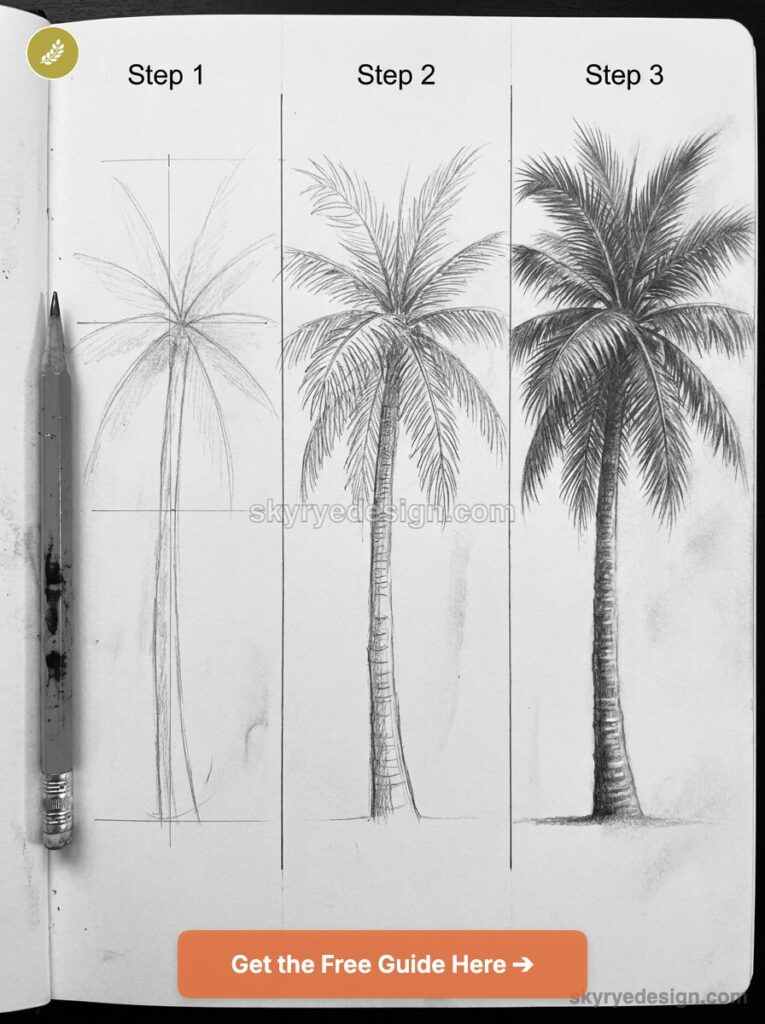
This guide covers how to draw a palm tree from the ground up — the full pencil process, the tools worth using, the different species and how each one is drawn, the silhouette ink method for quick results, and the five mistakes that ruin most beginner attempts. Two methods, one article. Let’s get into it.
How to draw a palm tree step by step
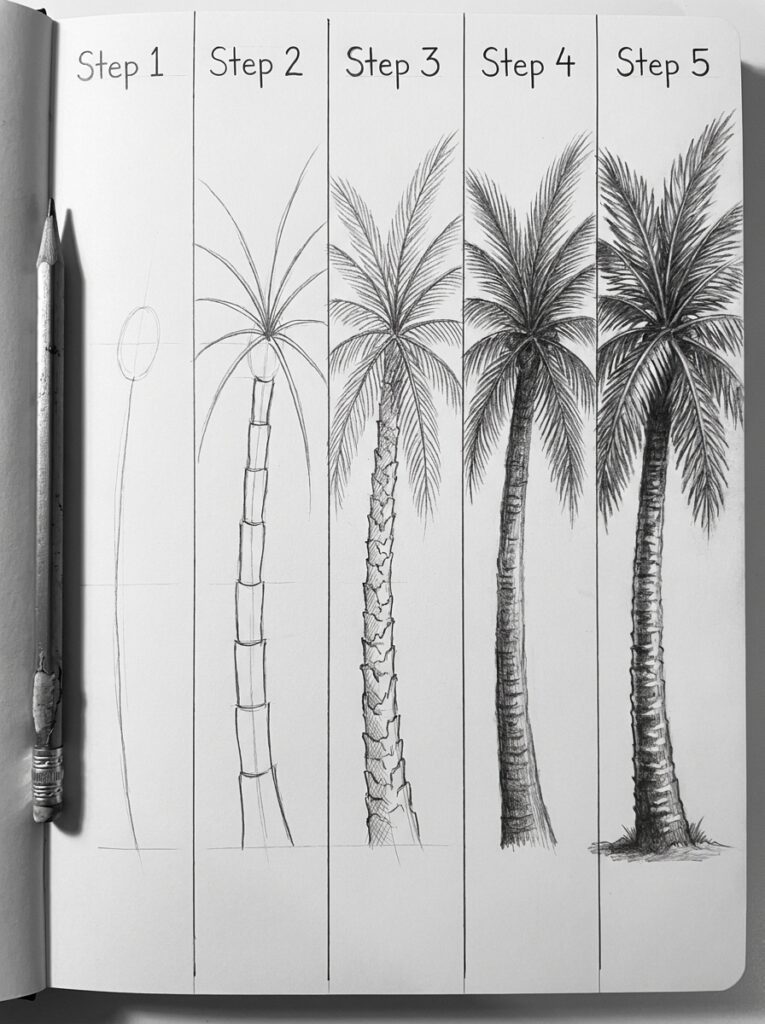
Start with the gesture line and trunk
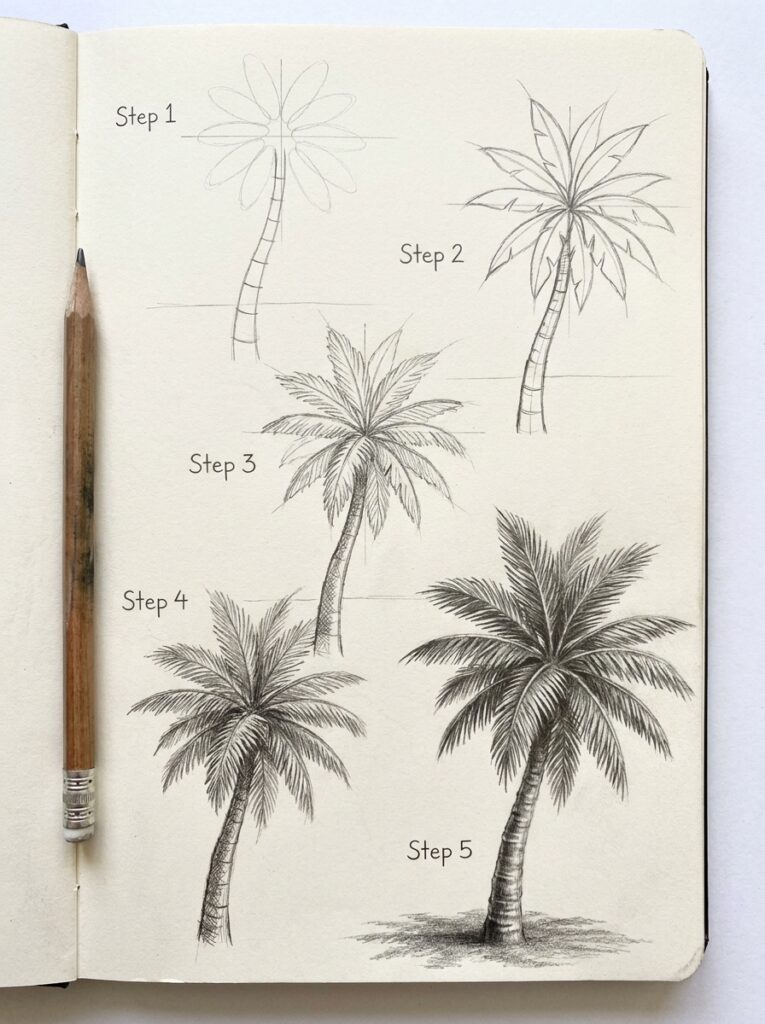
Before the trunk, before the fronds, before anything — draw a single curved line. This is the spine of the tree, the gesture. It determines the lean, the height, the personality of the whole drawing. A palm that leans slightly right already has more life in it than one that stands perfectly vertical.
Once your gesture line is down, build the trunk around it. Draw two lines that follow the curve of your spine — slightly closer together at the top, widening just a touch at the base where the roots begin. Don’t make it a perfect parallel. Real palm trunks taper unevenly, and that irregularity is part of what makes them read as organic rather than architectural.
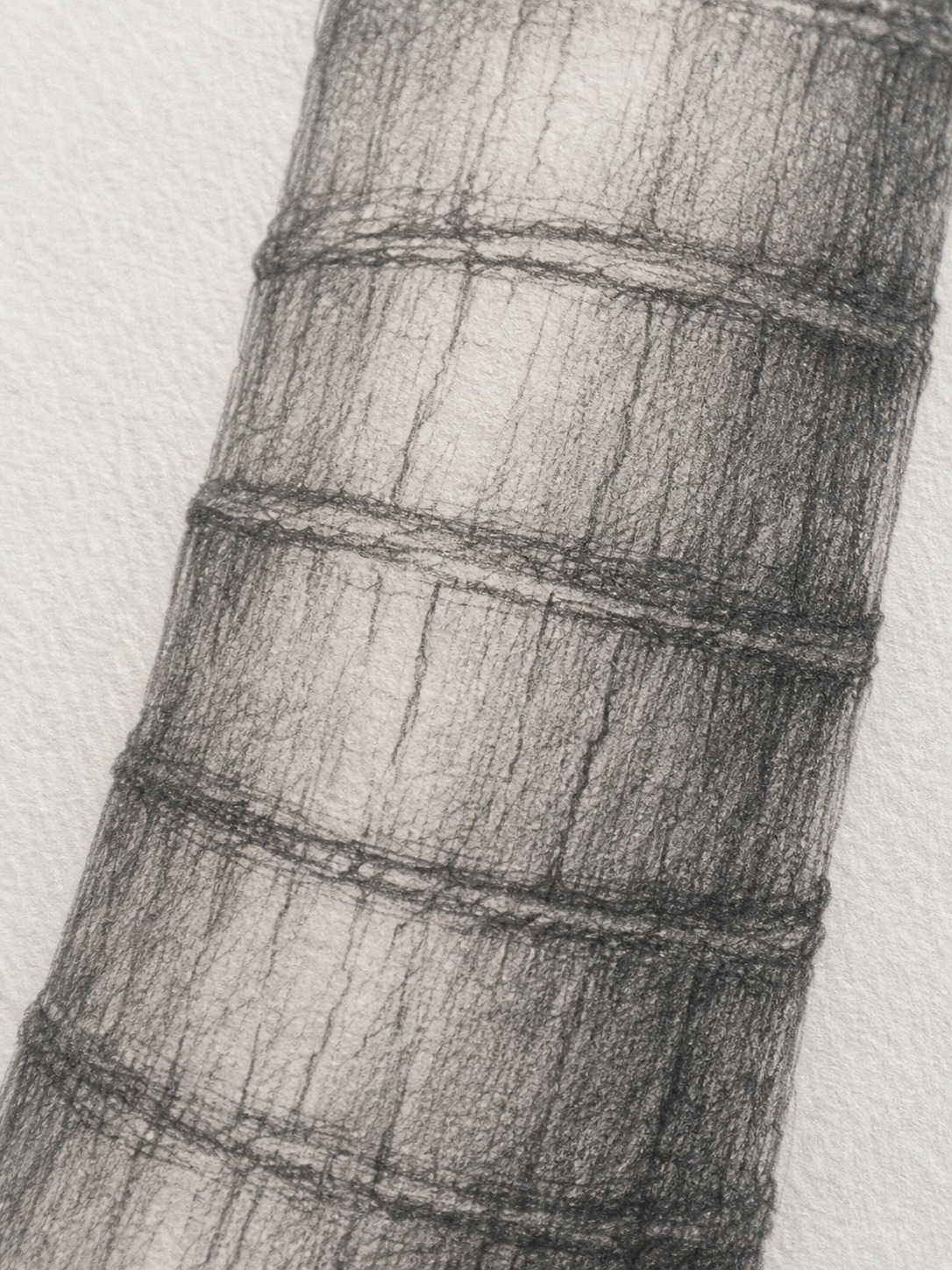
Now add the trunk rings. These are the scars left behind by old frond bases as the tree grows, and they’re what give a palm trunk its distinctive segmented look. Draw them as curved horizontal lines that follow the cylindrical form of the trunk — not flat straight marks, but lines that arc slightly with the surface, like lines on a barrel. Space them irregularly: closer together toward the top of the trunk, more spread out lower down. That spacing alone adds a lot of realism. Use an H pencil for this whole stage — light enough to revise, dark enough to see.
Place the frond guidelines using the 3-tier system
This is the single insight that changed how I draw palms. Most beginners place fronds randomly or make them all radiate at similar angles — and that’s what produces the stiff, pinwheel look. Real palm crowns have three distinct tiers, and drawing them intentionally is the fix.
From the crown at the top of the trunk, draw 7 to 9 radiating lines. These aren’t the finished fronds yet — they’re the rachises, the central stems each frond grows along. Think of them as guidelines you’ll build on.
The upper tier (2 to 3 lines) angles upward at 45 to 70 degrees — these are the young, vigorous fronds pointing toward the light. The middle tier (3 to 4 lines) spreads roughly horizontally with just a slight droop at the tips. The lower tier (2 to 3 lines) angles downward between 30 and 50 degrees — these are the older fronds, heavier, beginning to hang. Every line curves gently toward its tip. None of them are straight.
If you’re drawing a palm in wind, all three tiers lean the same direction — but the lower tier’s droop becomes much more pronounced, almost vertical in a strong gust. That’s the detail that makes a windy palm look windy rather than just tilted.
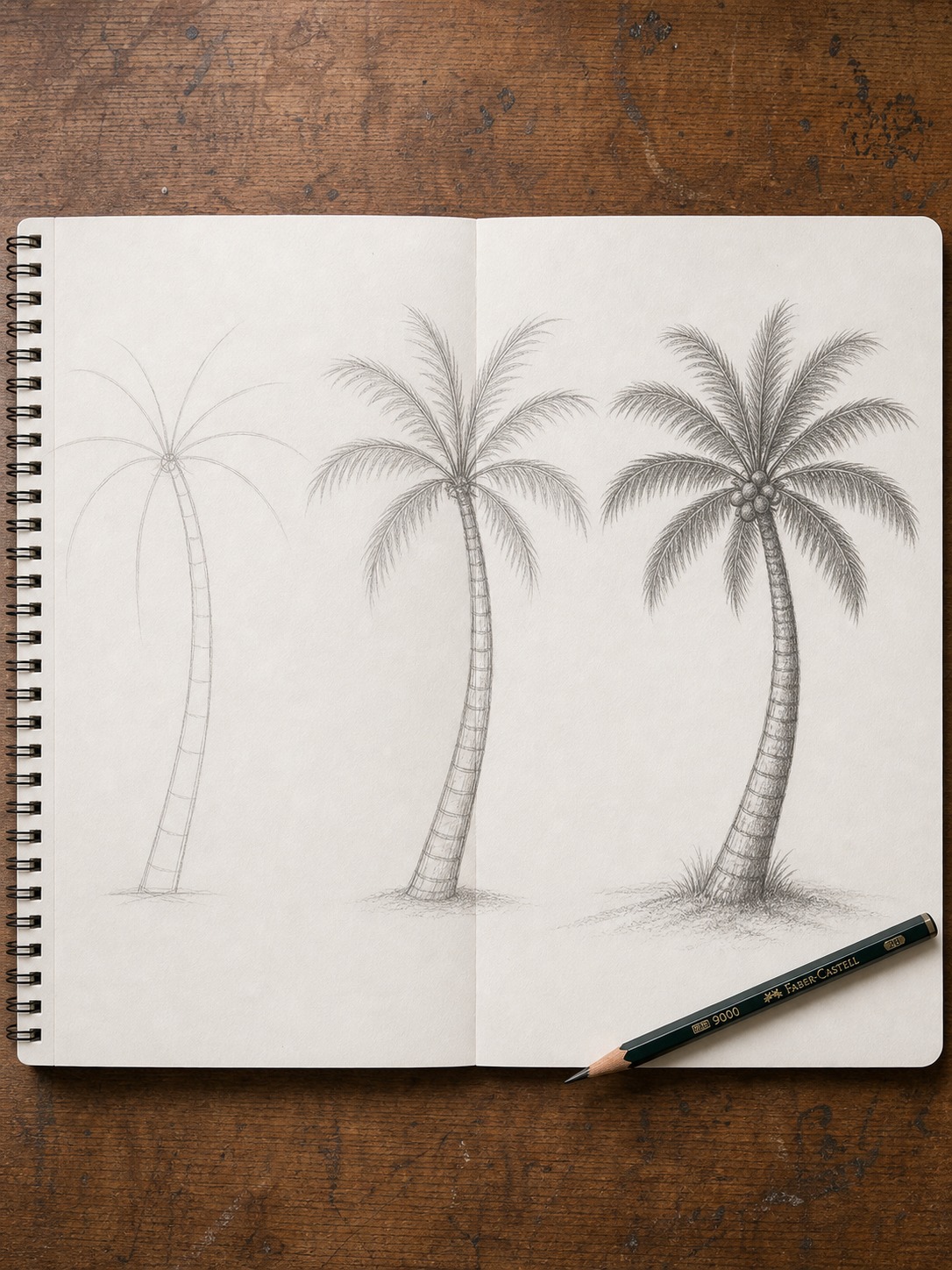
Build frond shapes and add leaflets
Now you have structure. Time to put flesh on it.
For each rachis guideline, sketch the frond silhouette first — a long, narrow shape that’s widest roughly in its middle third and narrows to a point at both ends. Don’t go straight to leaflets yet. Getting this overall shape right is what keeps fronds from looking like combs or bottle brushes.
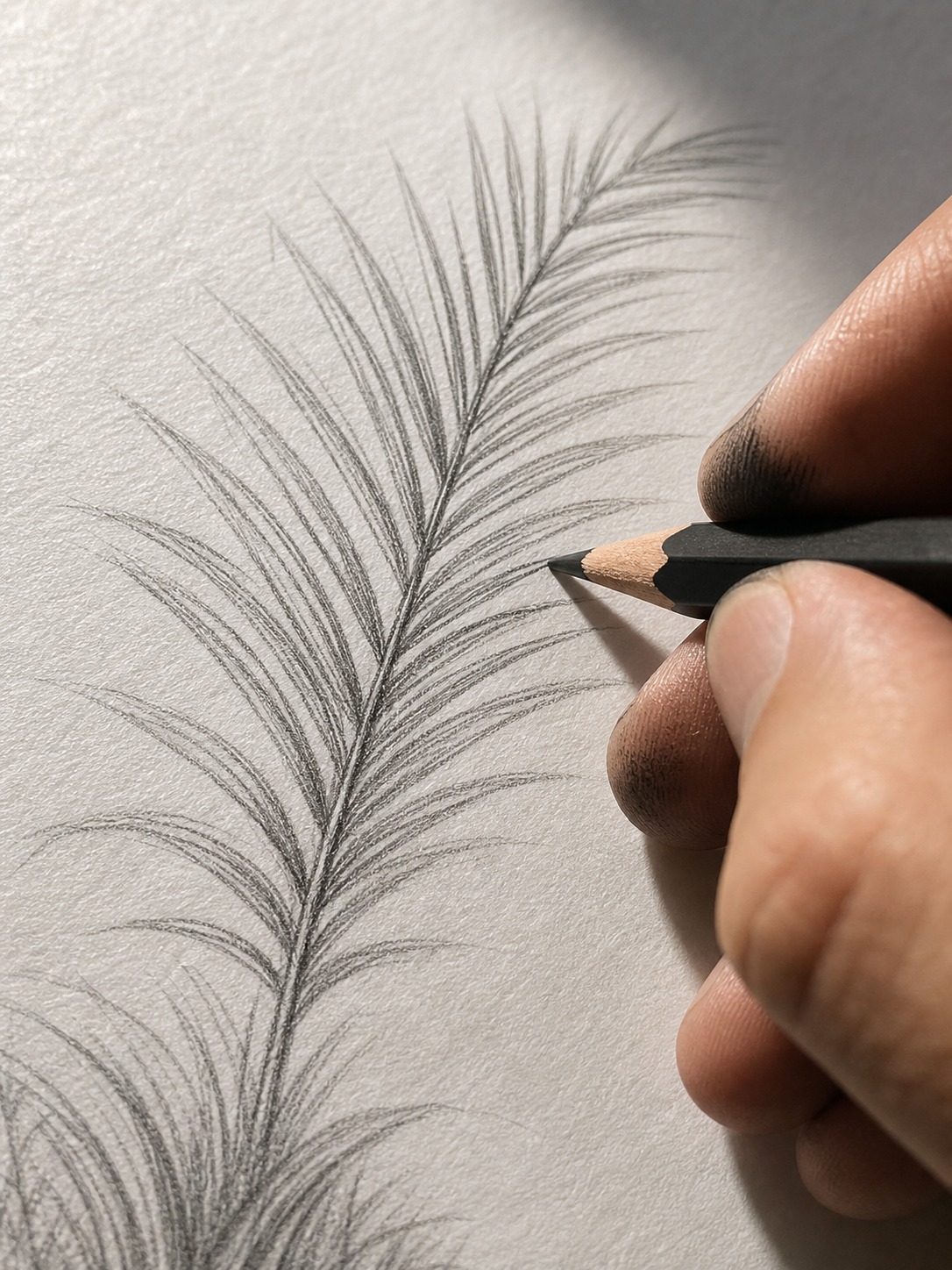
Once the silhouette is there, add the leaflets (pinnae) — short diagonal strokes coming off both sides of the rachis. The key variable: they’re not uniform. Leaflets near the base of the frond are longer; they shorten progressively toward the tip. The angle they come off the rachis also shifts slightly — more perpendicular near the center, angling back toward the tip as you move outward.
Vary the strokes. Some leaflets split at the end. Some overlap their neighbors. The older lower fronds especially — add a few torn or missing leaflets there. That kind of damage is exactly what a real palm frond looks like after a few weeks in the sun, and it reads as authentic immediately.
Use HB for the leaflet lines. Firm enough to be clear, but not so heavy that they dominate the overall form.
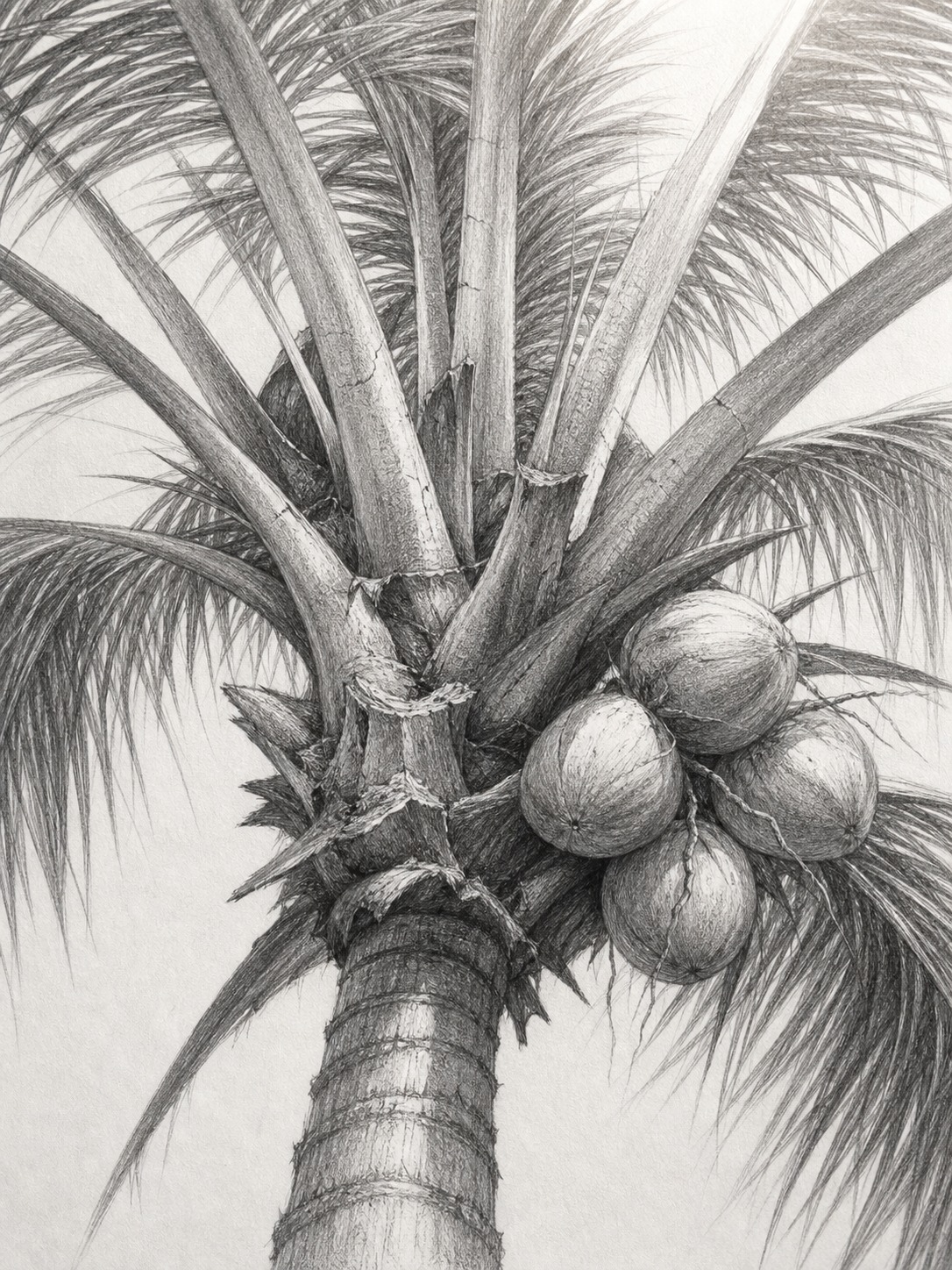
Crown detail and coconuts
Most beginner tutorials jump from fronds straight to the trunk, skipping the crown entirely. That’s why so many palm drawings look oddly bare at the top — like the fronds are just floating above the trunk with nothing connecting them.
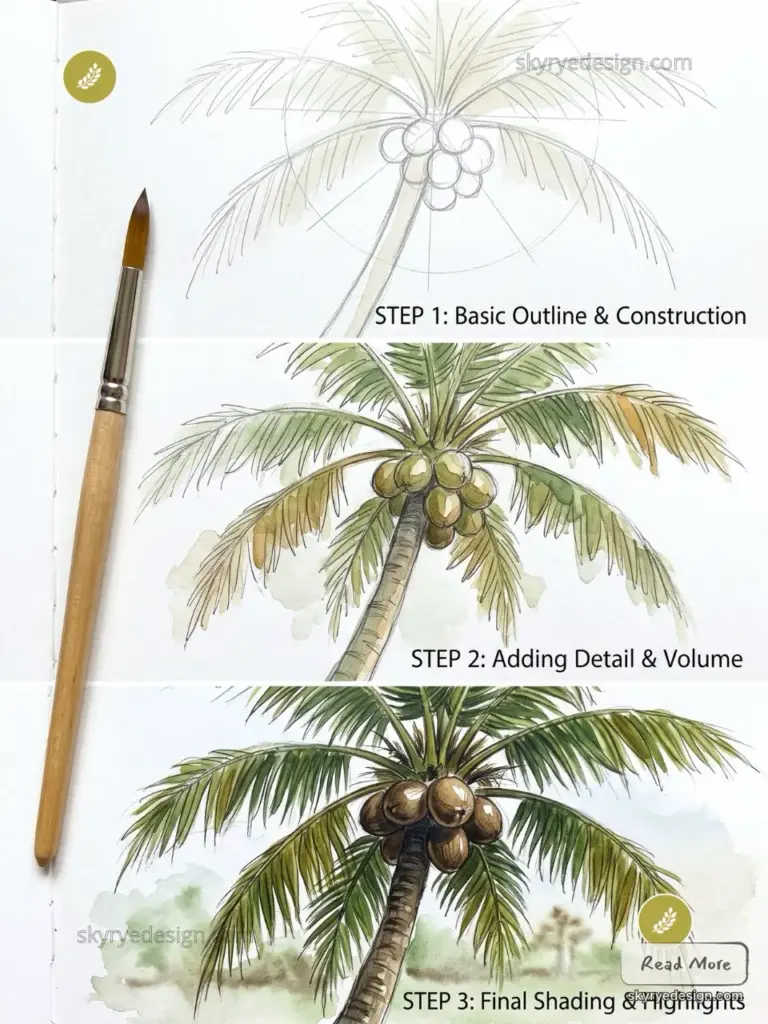
The crown is a dense cluster: new frond shoots pushing upward, coconuts nestled in the middle, compressed stubs of old frond bases forming a rough ring around everything. Draw it before you finalize the fronds — it gives you an anchor point and makes the frond placement more believable.
For coconuts: three overlapping spheres at the crown base. Don’t make them identical. Vary the size, offset them slightly, let one partially hide behind a frond. Real coconuts grow in clusters and they’re never perfectly round or evenly spaced. Around the coconuts, add short blunt stubs — 4 or 5 of them — representing the compressed old frond bases. These are small, maybe a centimeter in your drawing, but they’re the detail that makes the crown read as solid and full rather than empty.
Shading the trunk and fronds
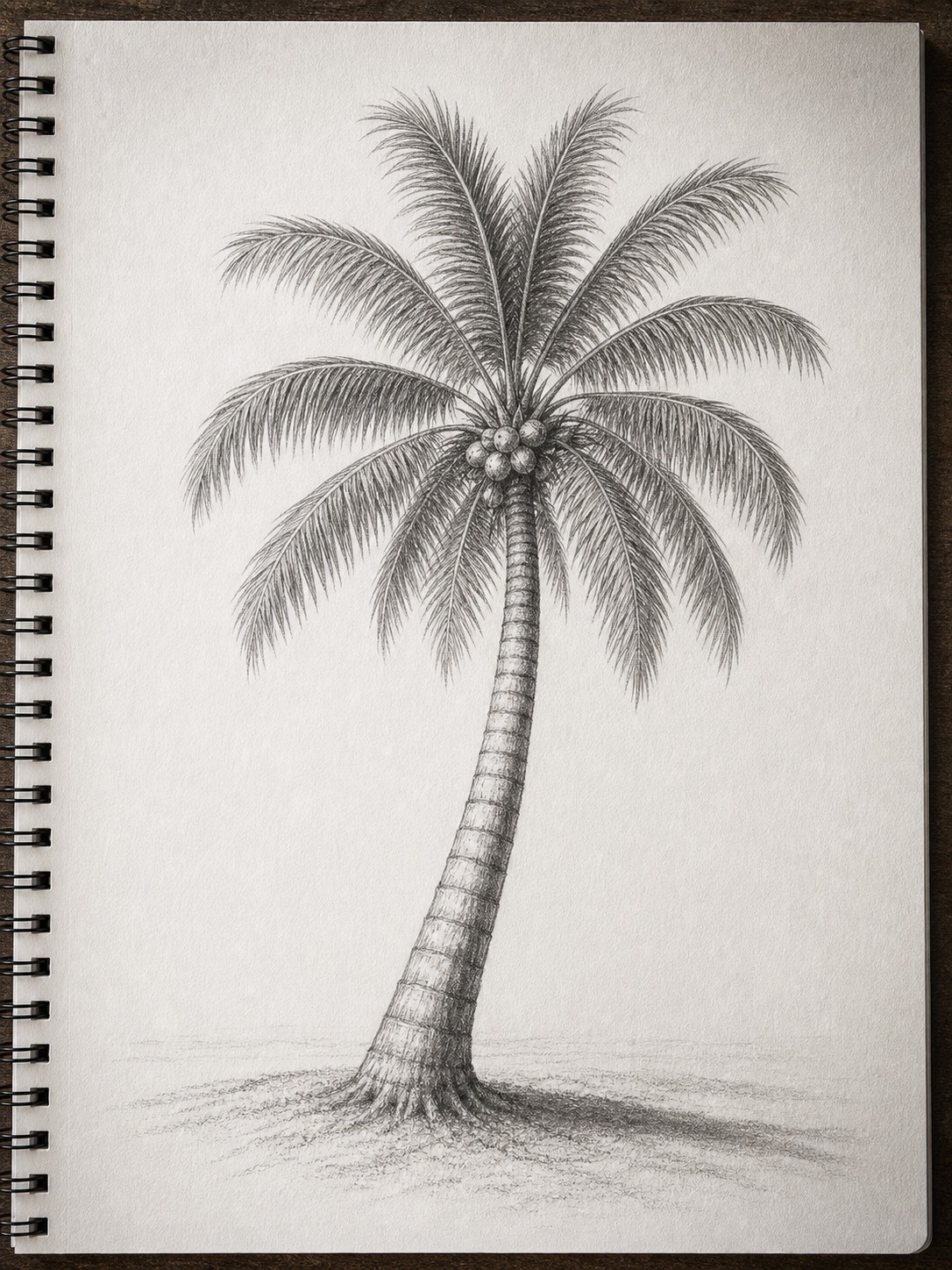
Pick a light source and commit to it. I almost always put it upper-left — it’s the most natural reading for Western eyes, and it’s how most botanical illustration light falls. Everything that follows comes from that one decision.
The trunk: on the shadow side (right, if your light is upper-left), apply 2B in long vertical strokes following the curve of the cylinder. Don’t fill it flat — leave the very edge slightly lighter to suggest the form wrapping around rather than cutting off. Then go back with 4B and place a short horizontal stroke just under each ring line. That tiny shadow under each ring is what turns a flat textured surface into something that reads as three-dimensional. It takes thirty seconds and it changes everything.
For the fronds: the upper surfaces facing the light stay relatively pale — HB at most. The undersides get 2B, especially where leaflets point downward or where one frond overlaps another. Selectively darkening those overlapping areas is what creates the sense of depth in the crown. You don’t need to shade every leaflet. Pick the ones that matter — usually the fronds in the lower tier and any frond passing behind another.
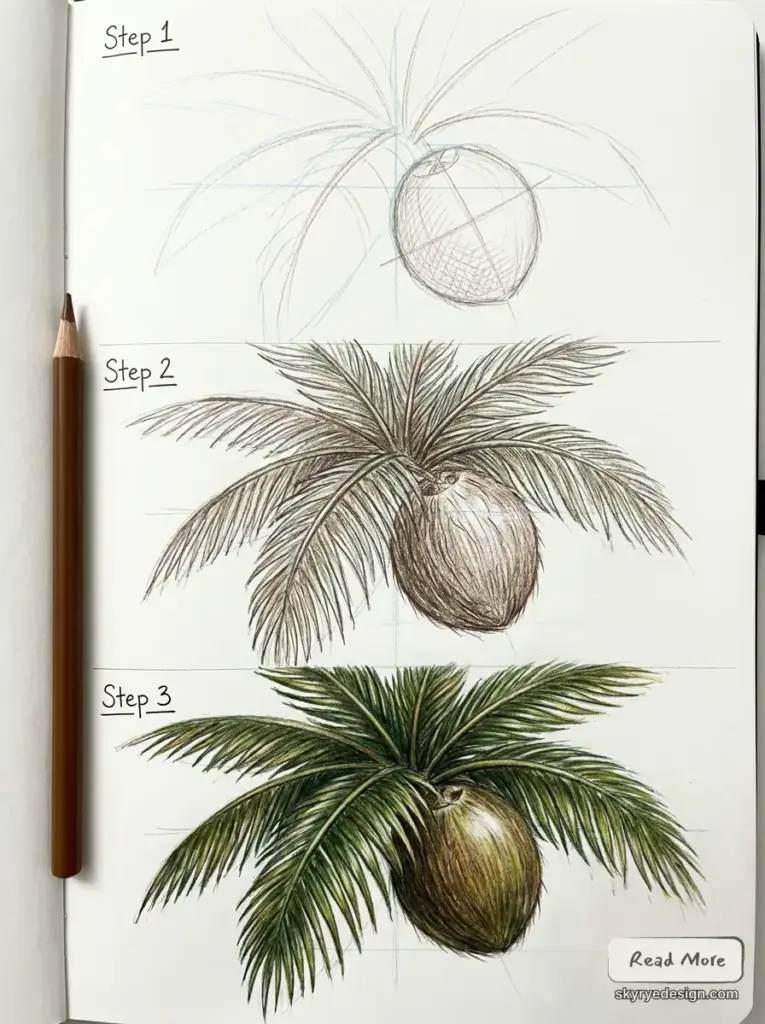
A kneaded eraser is useful here for pulling back highlights along the trunk and on the upper surface of prominent fronds. The Faber-Castell 9000 series handles all five pencil grades in this drawing comfortably — it’s the set I’ve had in the Kyiv studio for years and the one I’d recommend without hesitation.
Types of palm trees and how each one is drawn differently
Most tutorials treat “palm tree” as one single thing. Draw a curved trunk, add some fronds, done. But there are over 2,600 species of palms, and while you don’t need to know all of them, understanding the two main structural types changes how you approach the subject entirely.
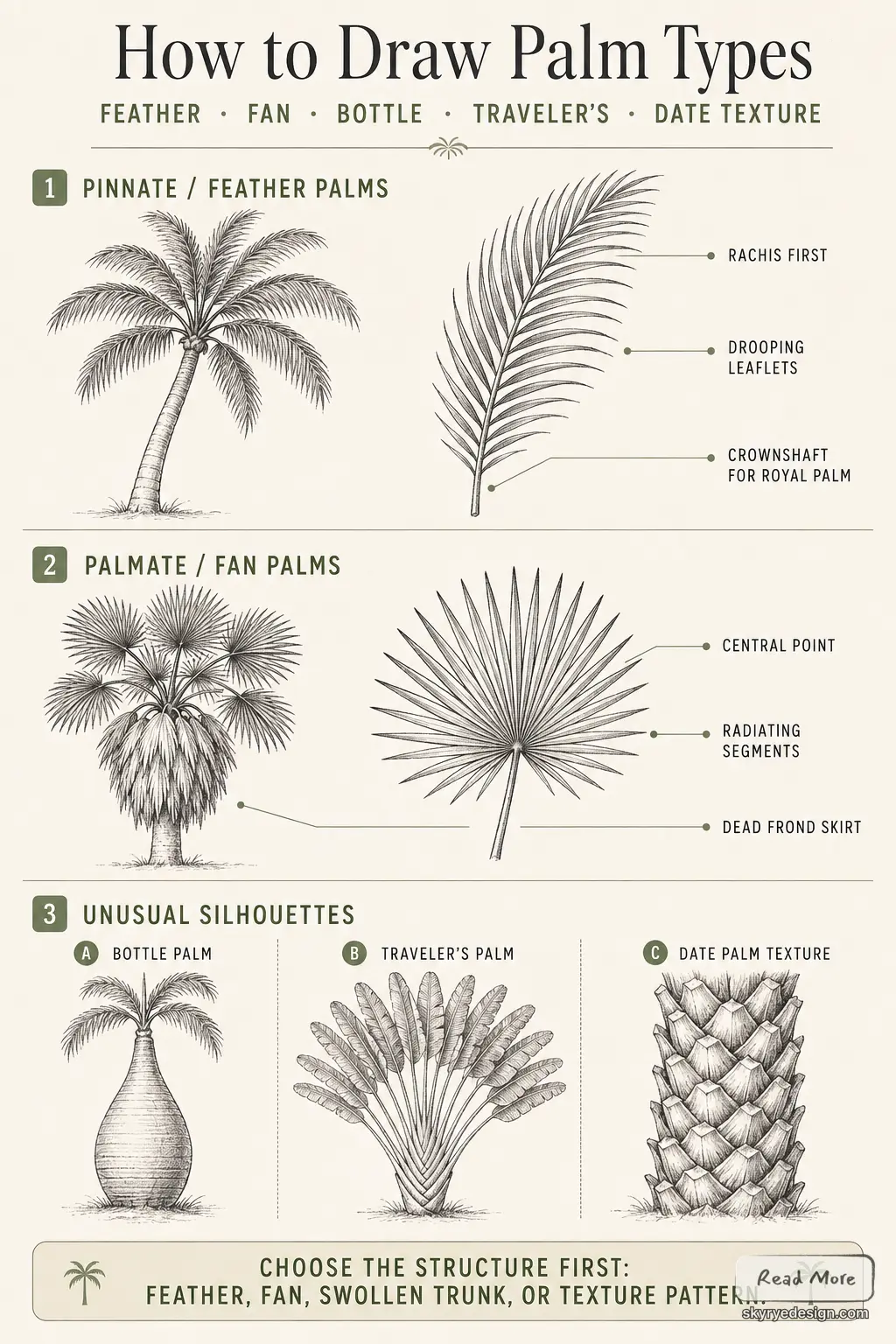
Draw a fan palm using pinnate logic and the result looks wrong — not because your technique is bad, but because the underlying form is different.
Pinnate (feather) palms — coconut, date, royal
This is the palm most people picture. Long trunk, fronds that arch outward and droop at the tips, a silhouette that reads as tropical from fifty meters away. The defining feature is the rachis — the central stem that runs the full length of the frond, with leaflets (pinnae) coming off both sides like a feather. Coconut palms, date palms, royal palms — all pinnate.
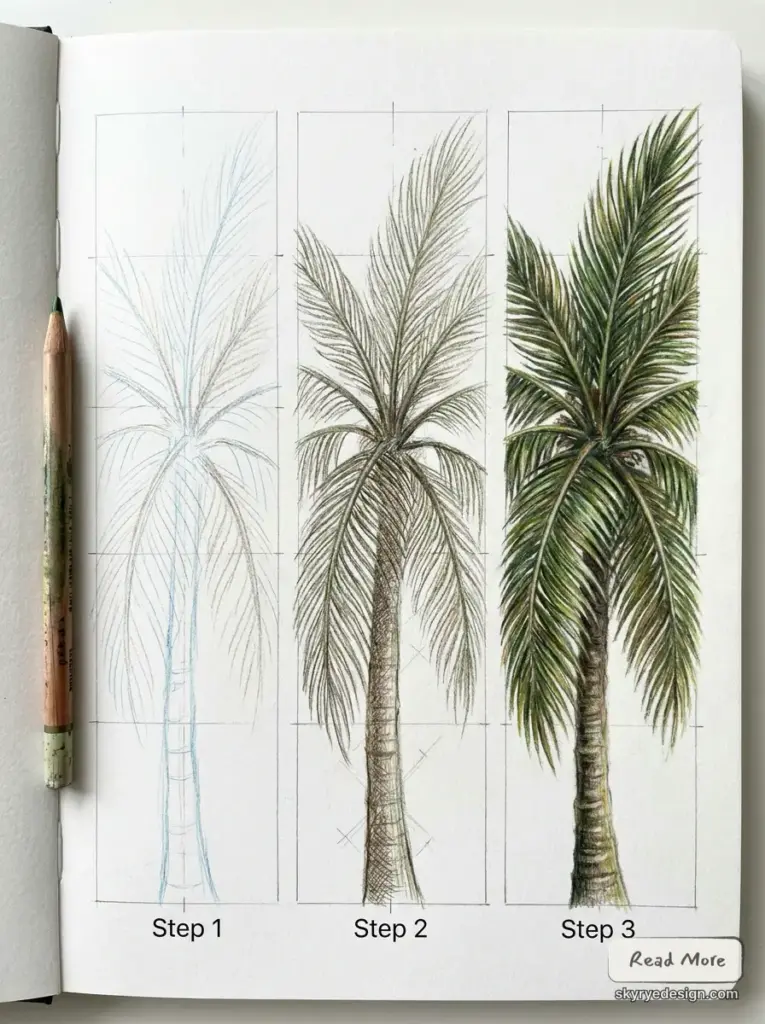
Everything in the step-by-step section above applies directly to this type. The 3-tier frond system, the rachis-first approach, the leaflet variation — it’s all built around pinnate structure. If this is the palm you want to draw, you’re already set.

1000 Drawing Ideas for Artists
Get a free PDF packed with easy drawing ideas, anime prompts, character concepts, nature inspiration, and fantasy sketchbook challenges.
Download Free PDFOne detail worth adding for the royal palm specifically: the trunk is unusually smooth and almost grey-green near the top, with a distinct green crownshaft just below the fronds. That crownshaft — a tight cylinder of overlapping frond bases — is a strong visual feature. Drawing it as a slightly darker, smoother cylinder section between the rough trunk below and the frond crown above instantly makes a royal palm recognizable.
Palmate (fan) palms — Washingtonia, Chinese fan palm
Fan palms work on completely different logic. There’s no long rachis — the leaflets radiate from a single central point, like fingers spreading from a palm of a hand. The frond shape is roughly circular or semicircular, divided into segments that droop at their tips. The petiole (the stem connecting the frond to the trunk) is shorter and noticeably thicker than on a pinnate frond.
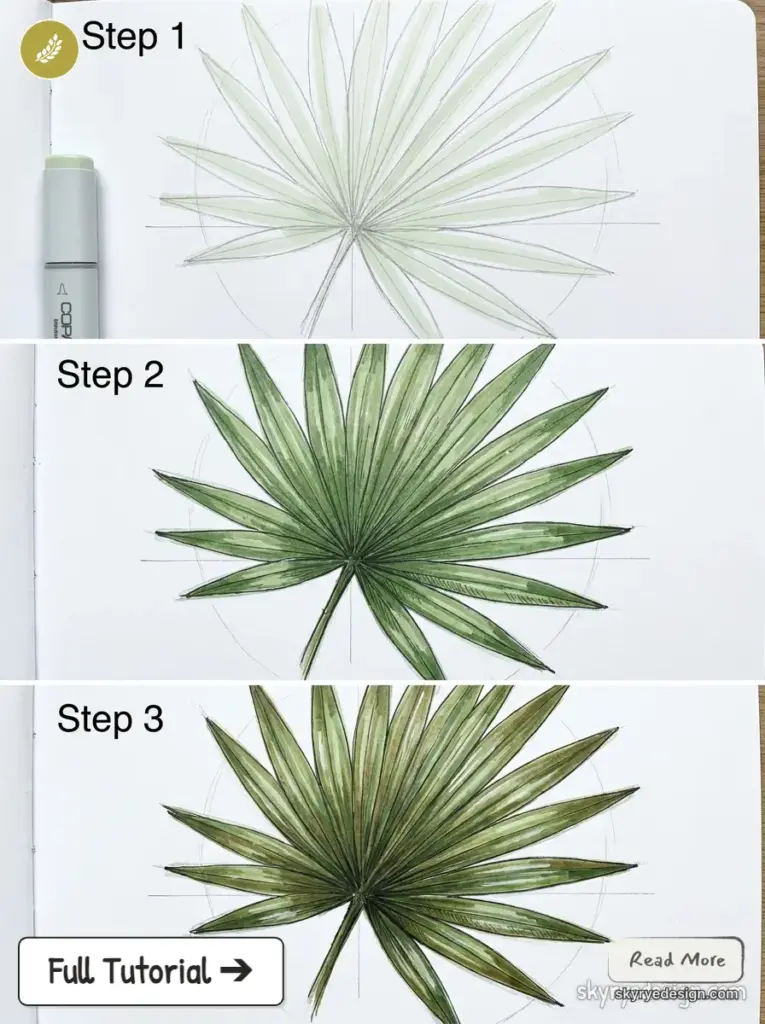
To draw a fan frond, start with a rough semicircle or wide arc shape — this is your outer boundary. Then draw the petiole coming in from the trunk, meeting the center of that arc. From that central point, draw radiating lines outward to the arc edge — these are the segments, typically 20 to 40 of them on a real frond but 8 to 12 is plenty for a convincing drawing. Each segment narrows toward its tip and droops slightly. The outer segments droop more than the inner ones.
The trunk on a Washingtonia palm often retains a dense skirt of dead fronds hanging down below the live crown — a shaggy, layered mass that’s actually fun to draw and immediately identifies the species. If you leave it in, draw it as overlapping dark curved shapes, progressively lighter as they recede back into the cluster.
Bottle palm and other unusual silhouettes
Once you understand the two main types, the unusual ones become easier to read and draw. The bottle palm (Hyophorbe lagenicaulis) is exactly what the name suggests — the trunk swells dramatically at the base into a fat rounded bottle shape before narrowing again toward the crown. It’s a short tree, rarely over 3 meters, with a small tight crown of pinnate fronds sitting on top of that swollen base. As a drawing subject it’s striking precisely because it breaks the expected silhouette.
The traveler’s palm (Ravenala madagascariensis) isn’t technically a true palm but it draws like one — giant banana-like leaves arranged in a perfect flat fan, all in the same plane. From the front it’s almost entirely symmetrical, which makes it unusual and slightly surreal as a drawing subject. Worth trying once you’re comfortable with the basics.
And the date palm deserves a specific mention for trunk texture: the diamond-shaped frond scars on a date palm trunk are more pronounced and more evenly spaced than on a coconut palm. Drawing them as proper diamond or chevron shapes rather than simple horizontal lines immediately shifts the species reading.
Tools and materials: what actually matters
There’s a version of this section that lists every pencil grade from 9H to 9B and talks about cold-press vs hot-press watercolor paper. This isn’t that. Palm tree drawing doesn’t require much — but a few specific choices make a real difference, and a few common substitutions quietly undermine the result.
Pencil grades for each stage
Four grades cover the whole drawing. H or 2H for construction lines and frond guidelines — light enough to erase cleanly or draw over without muddying the final lines. HB for frond outlines and leaflet strokes — the workhorse grade, enough contrast to be readable without committing too heavily. 2B for trunk body shading and the main shadow areas on fronds. 4B for the deepest shadows: the undercut of each trunk ring, the dense shadow inside the crown cluster, any frond that passes fully behind another.
The brand matters more than most people admit. I’ve used the Faber-Castell 9000 series for years — it’s what’s in the Kyiv studio, it’s what I bring to workshops, and the graphite consistency across grades is noticeably better than cheaper alternatives. The 8-pencil set (2H through 8B) covers everything here with room to spare and costs around €12–15. Staedtler Mars Lumograph is the other reliable option at the same price point.
One thing to avoid: using a single grade for the whole drawing. It’s the most common beginner shortcut and it produces flat, tonally dead results. Palm drawings specifically need that jump from HB to 4B on the trunk rings to read as three-dimensional.
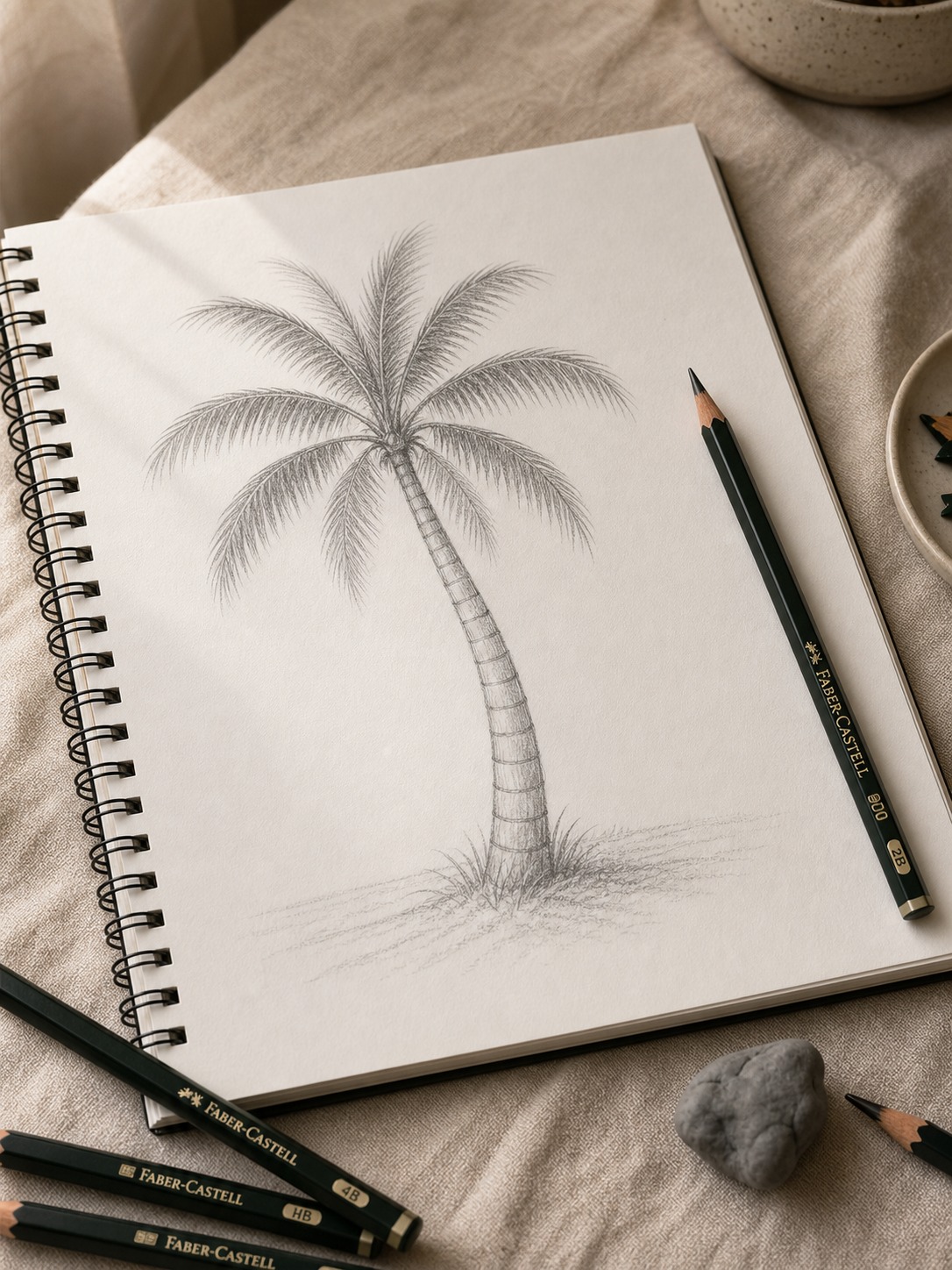
Paper choice
Smooth cartridge paper at 70–90 gsm is the right surface for pencil palm drawing. The slight tooth holds graphite without fighting the fine leaflet lines, and it erases cleanly. Go much rougher and the texture starts to break up the delicate pinnae strokes — you end up with leaflets that look fuzzy rather than crisp.
For finished work, Strathmore 400 Series drawing paper is worth the upgrade — it handles layered pencil grades without buckling or pilling under the eraser. For sketchbook studies and practice sessions, a Moleskine Art Sketch works fine. The paper is smooth enough and the portability means you’ll actually use it.
Avoid standard office printer paper for anything beyond a 5-minute warmup sketch. It’s too thin, it pills under a kneaded eraser, and 4B on it smears badly. A proper drawing paper costs almost nothing per sheet — there’s no good reason to skip it.
Ink tools for the silhouette method
The Faber-Castell Pitt Artist Pen in size B (brush nib) is the one tool I’d add to the kit if you plan to try the silhouette method covered in the next section. The brush nib loads ink for bold trunk strokes and then tapers naturally for the thin leaflet pulls at the frond edge — one tool handles both. It’s been around for decades, costs about €3–4 per pen, and the pigment ink is fully waterproof once dry, which matters if you want to add a watercolor wash over the top.
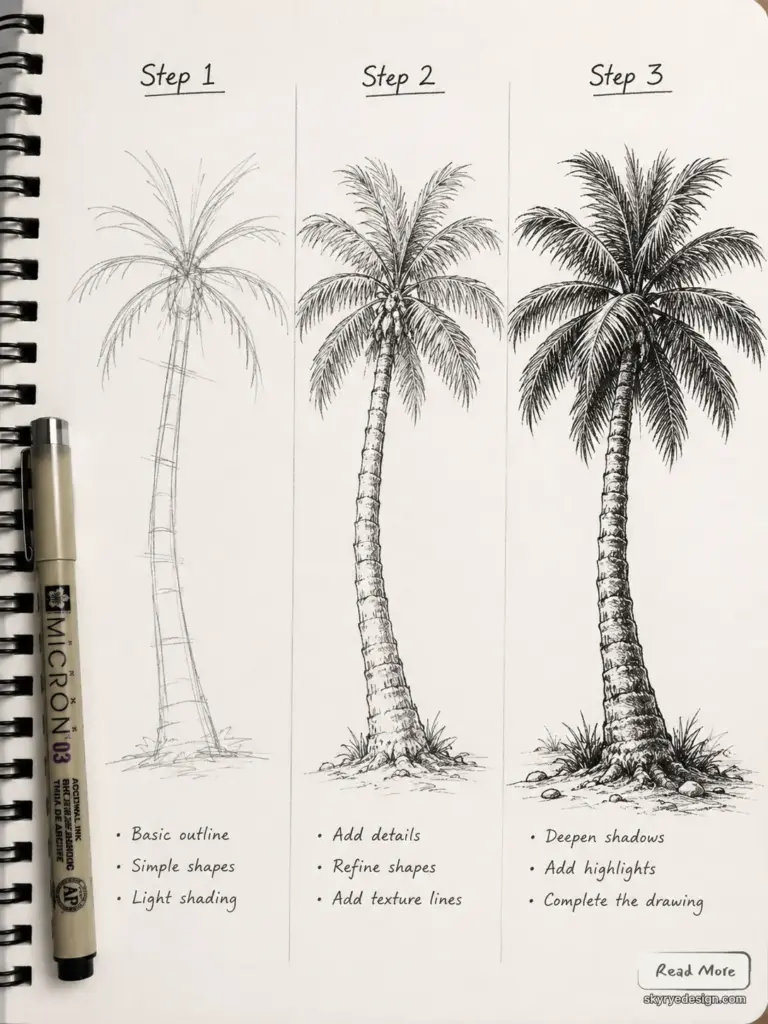
For more controlled ink work — precise leaflet outlines over a pencil base — the Copic 0.3 Multiliner is cleaner. The 0.1 size works for very fine detail on smaller drawings. Ballpoint pen is a genuine option too, and I cover it properly in the FAQ rather than dismissing it the way most tutorials do.
The silhouette method: faster and often more striking
There’s a moment in most drawing sessions where you want to get the idea down fast — before the composition decision, before the detail commitment, before you’ve decided if this palm is even going in the right place on the page. The silhouette method is for that moment. And it happens to produce results that, for palms specifically, often look more confident than a carefully outlined pencil drawing.
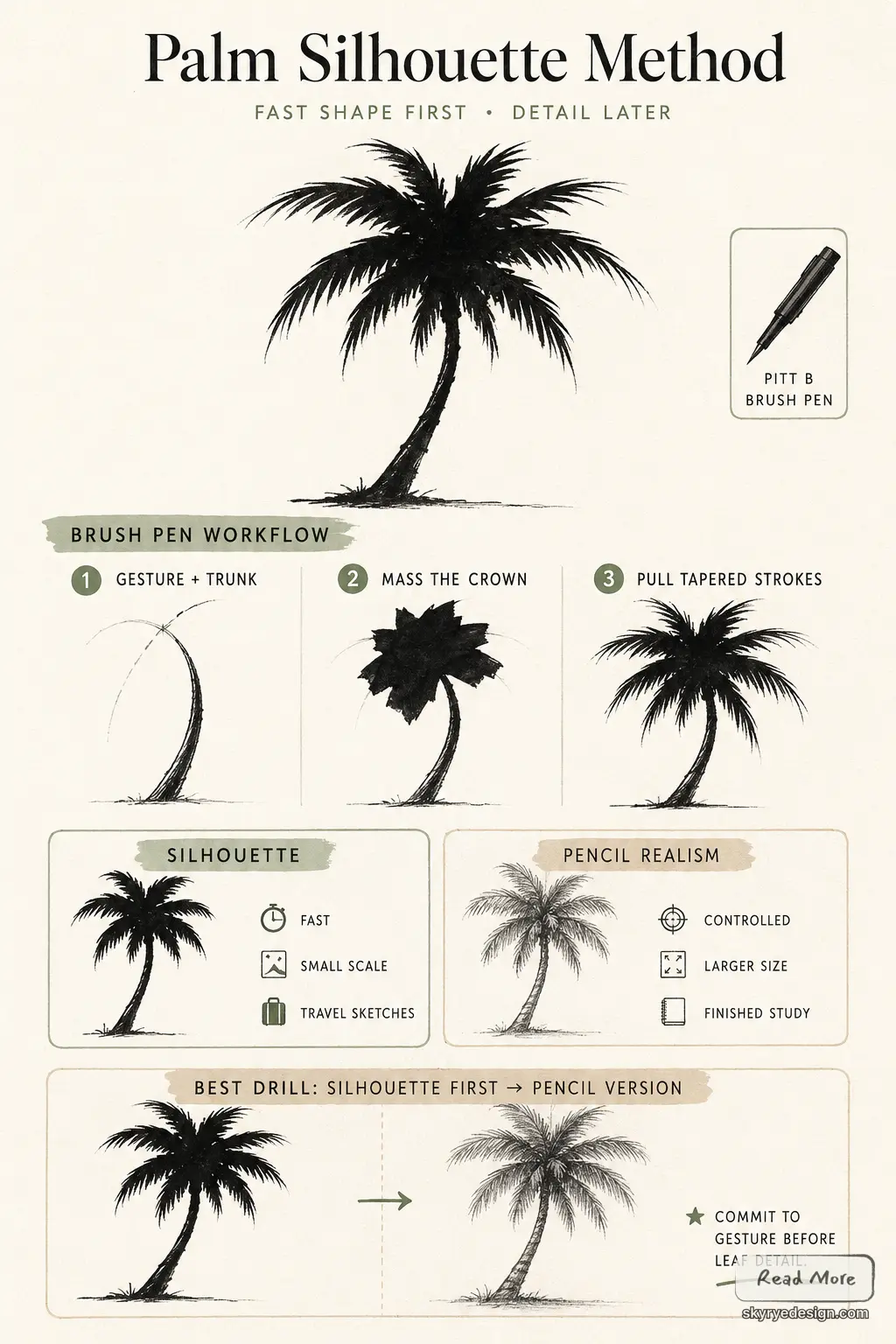
The reason is simple: the palm’s profile is distinctive enough that the brain recognizes it without any internal detail. Show someone a black trunk with a dark irregular crown shape and a few tapering strokes at the edges — they read “palm tree” immediately. The silhouette carries the idea. This is the same logic behind architectural massing sketches, where a black marker form on white paper communicates a building’s character long before any windows or materials are decided.
How to execute it with a brush pen
Same starting point as always — gesture line first. Trunk second, built around the gesture with two lines that taper upward. But from here, the process diverges completely from the pencil approach.
Instead of placing rachis guidelines and building fronds outward from the inside, you mass the entire frond crown as a single dark shape. Load the Pitt B pen and block in the crown as one loose, irregular form — not a circle, not a blob, but an asymmetric cluster that’s denser at the center and irregular at the edges. Let it be imperfect. Imperfect is right.
Then, while the ink is still slightly workable or immediately after it dries, switch to the brush pen’s fine tip and pull thin tapering strokes outward from the edge of the crown mass. Each stroke starts with light pressure at the frond body edge and tapers to nothing as you pull toward the leaflet tip. The brush nib does this naturally — you don’t need to control the taper consciously, the flex of the nib handles it. Do this around the entire crown perimeter, varying the stroke length and angle. Longer pulls on the upper fronds, shorter and more drooping on the lower ones.
Fill the trunk solid. Add the ring lines last with the pen held lightly — they don’t need to be dark, just present enough to break the flat trunk surface. The whole thing takes four to five minutes once you’re comfortable with it.
When to use silhouette vs pencil realism
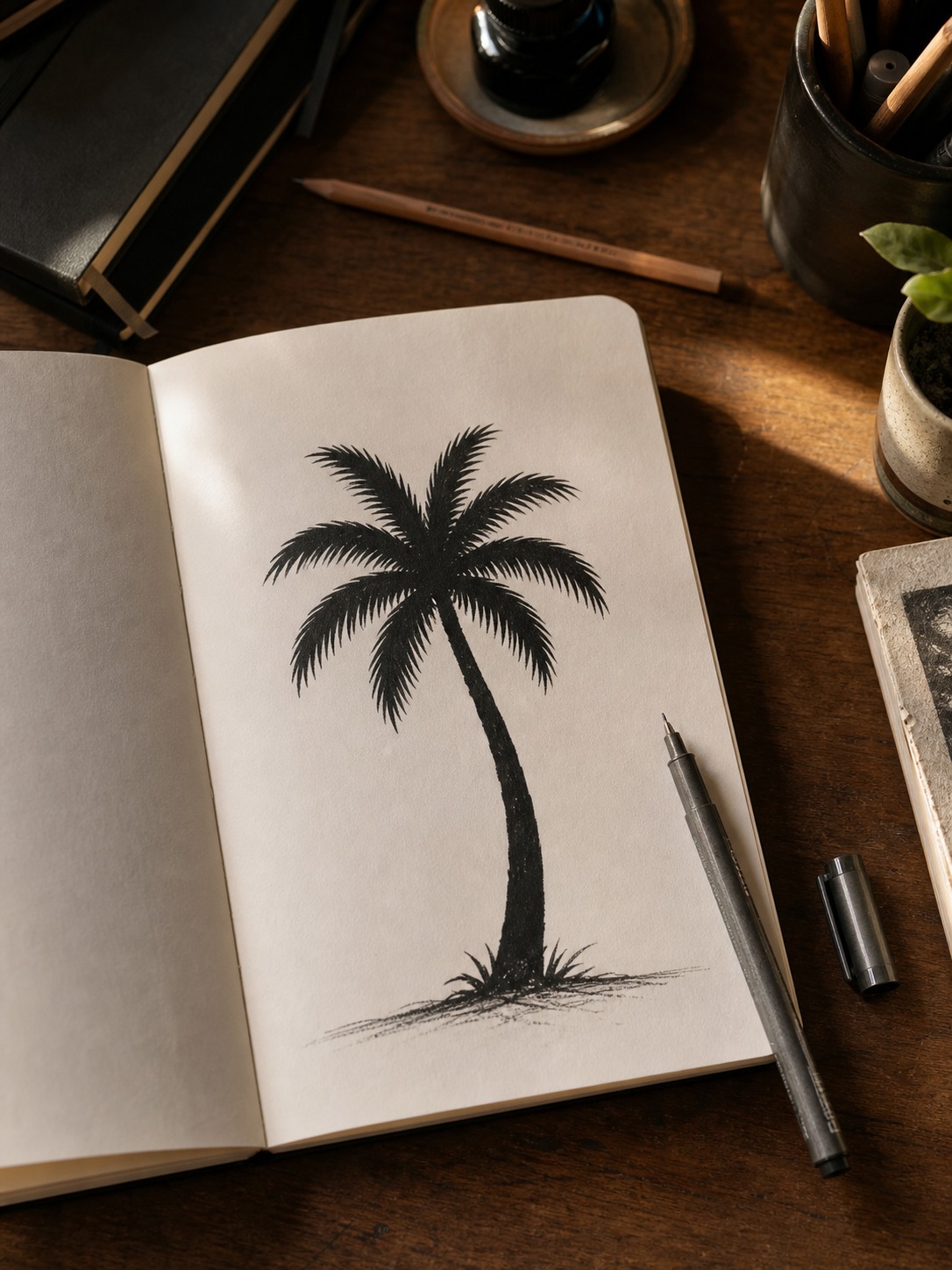
They solve different problems. The silhouette method is fast, expressive, and works at small scale. Use it for travel sketches, quick studies, social content, or any situation where you’re drawing in volume rather than finishing one piece carefully. It’s also a good warmup — doing a silhouette palm before a detailed pencil session loosens the hand and forces you to commit to the overall form before getting lost in leaflets.
Pencil realism is slower, more controllable, and produces work that holds up at larger sizes and under close inspection. Use it for portfolio pieces, finished studies, anything where you want to train your eye on how light actually behaves on a cylindrical trunk or a drooping frond.
The most useful drill I know for improving palm drawing quickly: silhouette first, then immediately do the full pencil version of the same pose. The silhouette forces the gesture. The pencil version builds the detail on top of a form you’ve already committed to. Doing them back to back in one session, on the same page, is worth more than five isolated attempts at either method alone. Pencil construction underneath with ink on top is also a legitimate finished technique — lay in the whole structure in H pencil, ink over it with the Pitt pen, let it dry fully, then erase the pencil.
Composition: putting the palm in a scene
A palm drawn in isolation is a study. A palm placed in a scene is an illustration. The difference isn’t complexity — it’s three compositional decisions made before the first line goes down: where the horizon sits, where the trunk is rooted, and how much of the environment you actually need to show.
Horizon line and palm placement
The horizon line is the most powerful variable in a palm tree composition. Place it low — say, one-fifth from the bottom of the page — and the viewer is looking up at the tree. The trunk feels tall, the fronds feel high and distant, the whole image has a dramatic, slightly cinematic quality. This is the angle that makes a palm feel like it belongs on a travel poster.
Place the horizon at mid-page and the reading becomes more eye-level, more documentary. You’re standing next to the tree rather than under it. This works well for botanical-style illustrations where the full tree needs to read clearly without perspective drama.
1000 Drawing Ideas for Artists
Get a free PDF packed with easy drawing ideas, anime prompts, character concepts, nature inspiration, and fantasy sketchbook challenges.
Download Free PDFFor placement: root the trunk just off-center. Not dramatically — a third of the way from one edge is enough. A palm dead-center reads as a logo or a symmetry exercise. Slightly offset, it reads as a scene. If you’re drawing a single palm against an empty background, lean the trunk slightly toward the center of the page rather than away from it — that subtle inward lean keeps the composition from feeling like the tree is about to exit the frame.
Drawing multiple palms with depth
Two palms side by side, same size, same lean, same level of detail — that’s not a composition, that’s a pattern repeat. The moment you add a third palm at a different size and a different angle, something clicks and it starts to read as a real place.
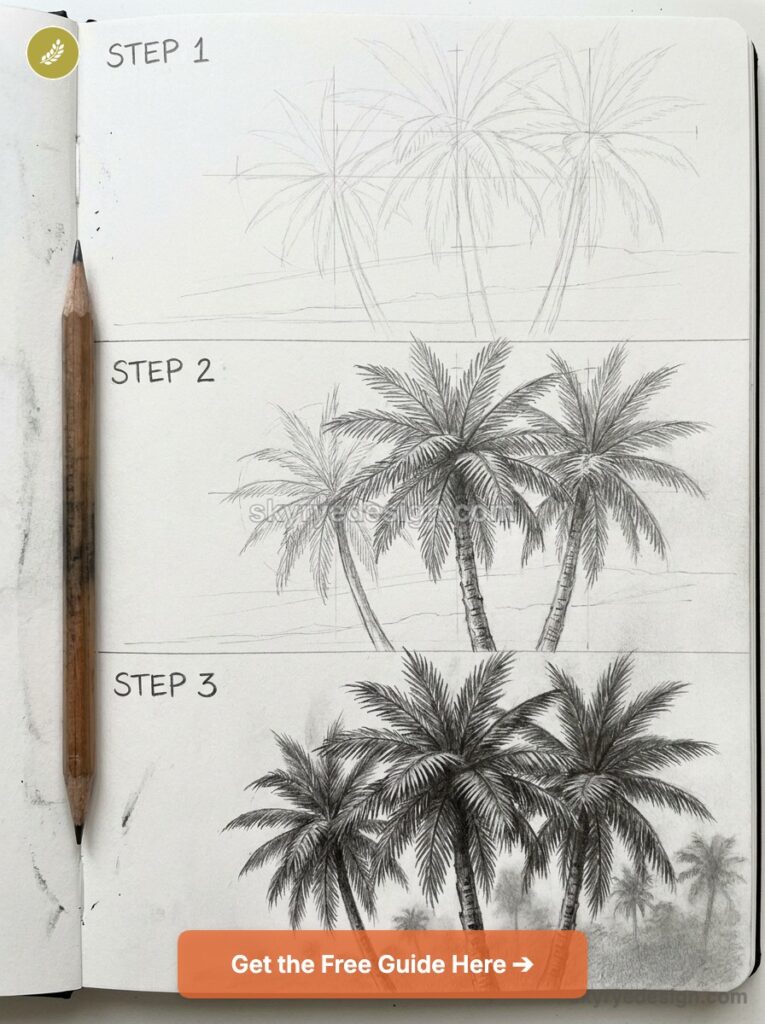
Overlap is the fastest way to create depth. The nearest palm sits in front of everything — largest, most detailed, darkest values, sharpest edges. The next one overlaps it slightly and is drawn smaller and lighter. Background palms get minimal detail: just the trunk line and a loose crown shape, and the value drops significantly. In pencil, that means barely any pressure for the distant trees — H grade only, no shading.
Vary the lean direction between palms. Not dramatically — 5 to 10 degrees difference is enough. Two palms leaning the same way and one leaning the opposite creates a natural, wind-interpreted grouping. Three all leaning identically looks choreographed. And the number: three palms in an asymmetric cluster reads as natural. Two symmetrical palms on either side of a composition reads as a gate or a logo.
Grounding the tree
A palm floating on a white page without any ground reference looks unfinished, even if the drawing itself is technically complete. The fix doesn’t require a full environment — it requires just enough to anchor the trunk to something solid.
For a beach scene: a single gentle arc below the trunk base for the sand line, and one horizontal stroke across the page for the sea horizon. That’s it. Two lines, done in ten seconds, and the tree is placed in a world. Don’t add waves, don’t add texture on the sand, don’t add clouds — every extra element competes with the palm for attention. The white space around a well-anchored palm is part of the composition, not empty space waiting to be filled.
For a more grounded scene — grass, soil, a small root flare at the base — draw a slight widening of the trunk right at ground level and three or four short curved lines pushing outward into the ground plane. These suggest the root structure without showing it fully. This is something that carried over directly from my architectural sketching background: add just enough ground plane to anchor the object. Let the rest breathe.
Common mistakes when drawing palm trees
Most bad palm drawings fail at the same five points. None of them are technique failures — they’re observation failures. Once you see what’s actually wrong, the fix is immediate.
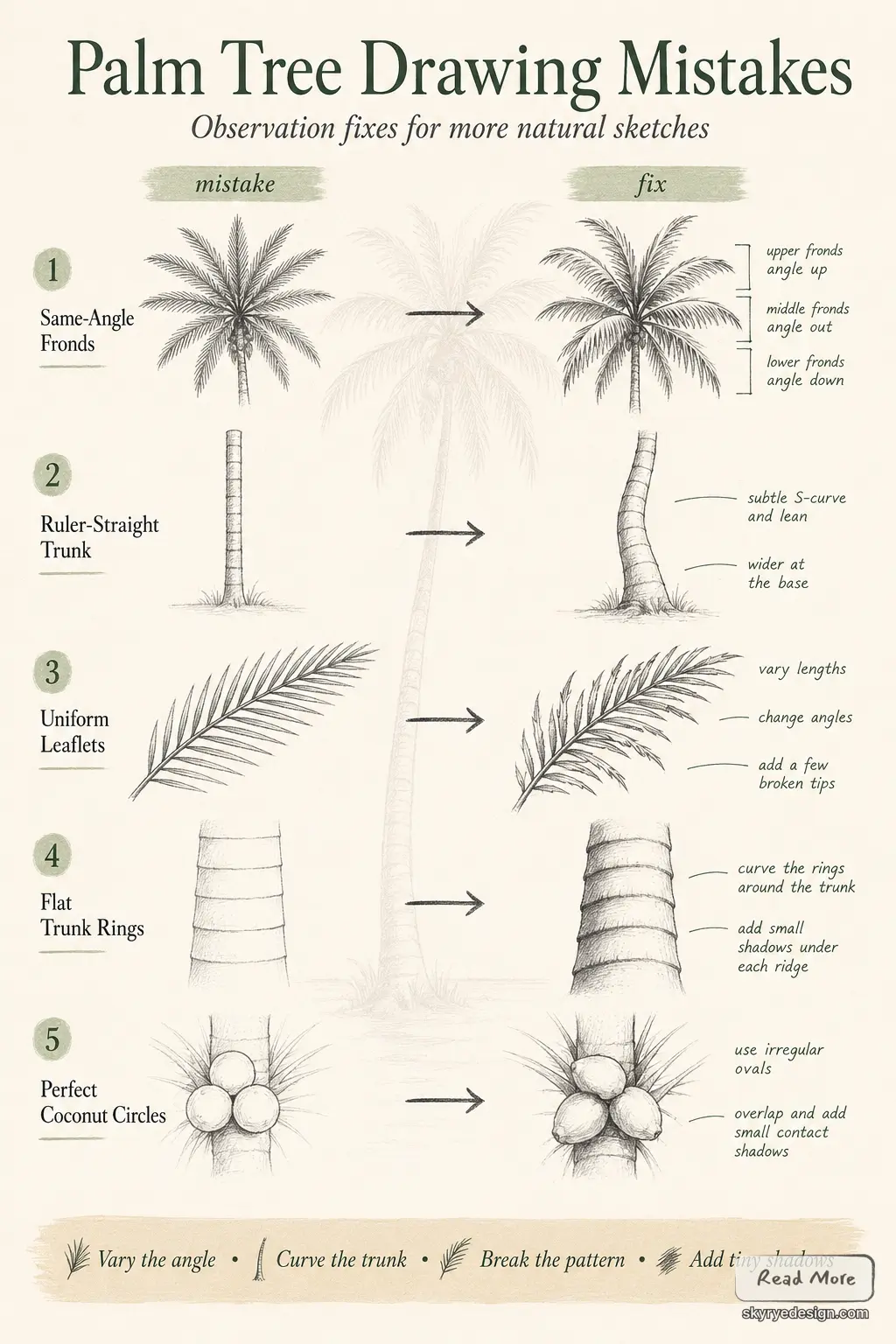
Fronds all at the same angle and length
This is the most common one and the most damaging to the overall drawing. When every frond radiates at a similar angle with similar length and similar curve, the crown looks like a pinwheel or a starburst — perfectly symmetrical, completely artificial. Real palm crowns have fronds at wildly different stages of development. Young ones push straight up, mature ones spread horizontally, old ones hang. That variation across the 3-tier system is what makes a crown feel organic.
The fix is structural, not stylistic: go back to the frond guidelines and deliberately assign each rachis line to a tier before drawing anything else. Upper tier up, middle tier out, lower tier down. Then vary the length — upper fronds are typically shorter than the long spreading middle ones. Do this once consciously and it becomes instinct quickly.
Trunk drawn with a ruler
A perfectly vertical, perfectly parallel trunk looks like a drainpipe. Palm trunks have a lean — sometimes subtle, sometimes dramatic — and a slight taper that’s rarely perfectly even. They also widen at the base where the root system begins. More importantly, the trunk has character: a slight S-curve, a lean into the prevailing wind direction, a bulge here and there from the fibrous structure underneath.
The gesture line approach fixes this before it starts. One curved spine drawn first, trunk built around it. If the gesture has personality, the trunk will too. If you’ve already drawn a stiff trunk, don’t try to fix it with detail — the trunk texture rings won’t save a fundamentally straight silhouette. Start the trunk again.
Leaflets too uniform
Leaflets drawn at identical length, identical angle, and identical spacing look more like a fish skeleton than a palm frond. The eye reads the pattern immediately as mechanical. Real pinnae vary in length along the rachis — longer in the mid-section of the frond, shortening toward both ends. The angle they come off the rachis shifts slightly too, and the tips on older fronds split, curl, or break off entirely.
The fastest fix: after drawing the first few leaflets the careful way, deliberately make three or four of them wrong — shorter, longer, slightly bent, one split at the tip. Those “wrong” ones are actually right. A few broken or missing leaflets on the lower drooping fronds immediately reads as weathering, and weathering reads as real.
No shadow under the trunk rings
This is the detail that separates a flat textured trunk from one that reads as three-dimensional. The rings are scars — they’re slightly raised ridges on the surface of the cylinder. Where a raised ridge exists, a shadow sits just below it. Draw the ring line with HB, then place a short, firm 4B stroke immediately underneath it, following the same curve. That’s the whole trick. It takes two seconds per ring and it completely changes the trunk’s volume. Skip it and the trunk looks like a wallpaper pattern — all surface, no form.
Coconuts drawn as identical circles
Three perfectly round, evenly spaced circles sitting on top of the trunk look like a traffic light, not a coconut cluster. Real coconuts grow in dense bunches, they’re slightly irregular in shape, they vary in size, and they overlap each other and partially hide behind frond bases. Draw them as a loose cluster of overlapping irregular ovals — different sizes, different angles, some partially obscured. Add a small dark shadow where each coconut sits against its neighbor. That shadow is what makes them read as separate spherical objects rather than flat discs.
The three things that fix most palm drawings
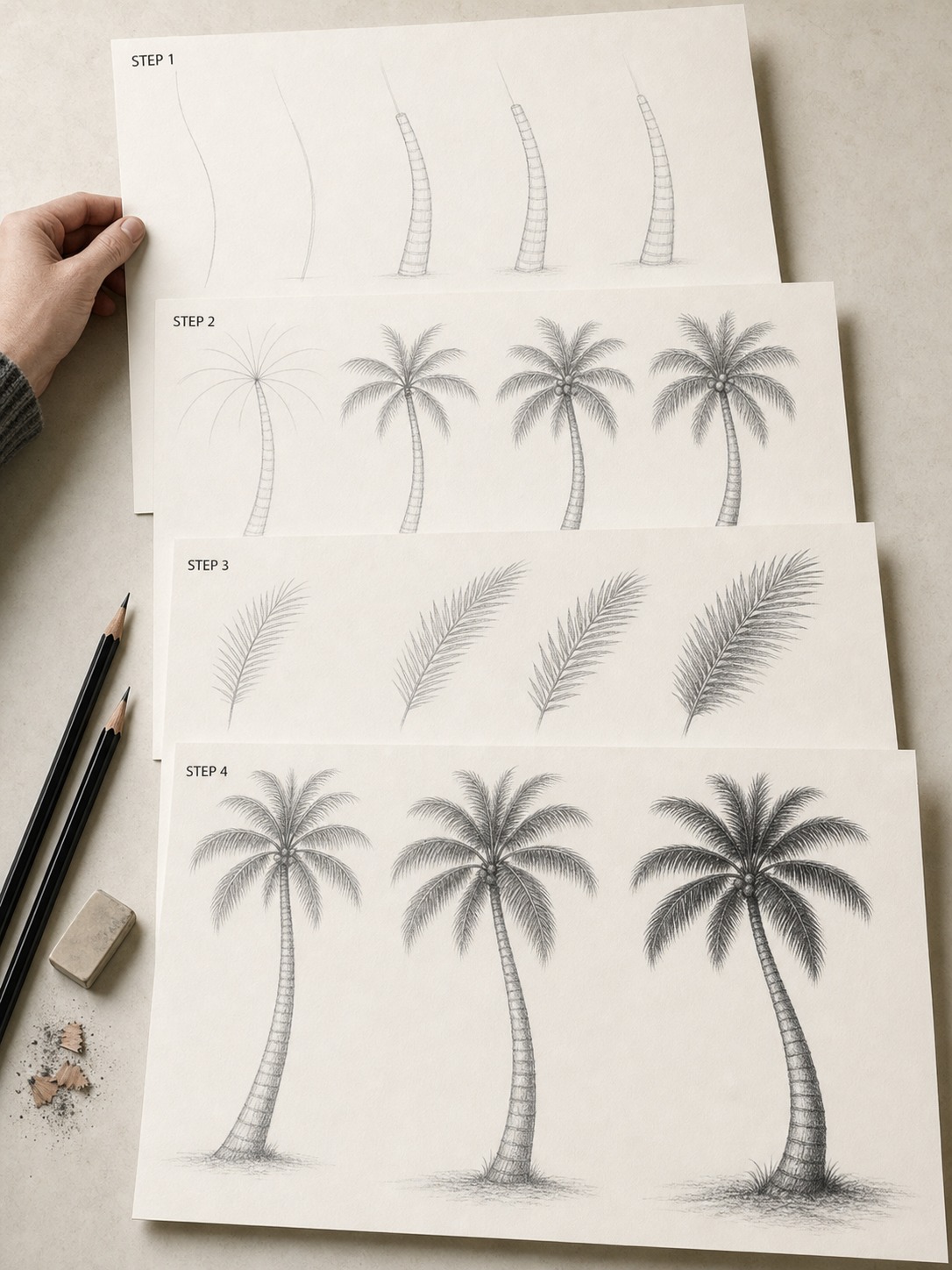
Three things fix most palm drawings before you even get to shading: a gesture line that commits to a lean, frond guidelines placed deliberately across all three tiers, and one clear light source that every shadow decision refers back to. Everything else — leaflet variation, ring shadows, coconut clusters — builds on top of those three foundations. Get them right and the detail almost takes care of itself.
If you’re starting out, do the silhouette version first. Four minutes, brush pen, no erasing. It forces the gesture and the overall form without letting you hide in leaflet detail. Then do the full pencil version of the same tree on the same page. You’ll find the second drawing is significantly better than if you’d gone straight to it — the silhouette session did the thinking for you.
Palm trees are worth practicing in volume. They appear in beach scenes, botanical illustration, travel sketchbooks, editorial spots, background environments. Once the form clicks, you’ll draw them fast and confidently — and that fluency transfers directly to other organic subjects: other tree types, plants, any natural form that lives somewhere between geometry and chaos.
Try a quick gestural palm today — three minutes, no pressure. Then come back and do the detailed version. The gap between those two drawings will tell you exactly where to focus next. And if botanical drawing is pulling you in, the Sky Rye flower drawing tutorials cover a lot of the same organic form logic from a different angle.
Frequently asked questions
Q: What’s the easiest starting point — trunk or fronds first?
Trunk first, always — but start with the gesture line before the trunk. A single curved stroke establishes the lean and height of the whole tree. Build the trunk around it, then place frond guidelines from the crown. Starting with fronds and adding the trunk underneath is a common instinct but it almost always produces proportion problems. The trunk is the spine of the composition; everything else hangs off it.
Q: How many fronds should a palm tree have in a drawing?
Seven to nine works well for most drawings. Fewer than six and the crown looks sparse; more than twelve and it becomes difficult to read individual fronds clearly, especially at small sizes. Real coconut palms carry 25 to 35 fronds at any given time, but drawing that many produces visual noise rather than realism. Seven to nine, placed deliberately across the 3-tier system, reads as full and convincing without becoming cluttered.
Q: How do I make palm leaves look natural instead of stiff?
Two things. First, apply the 3-tier frond system — upper fronds angling up, middle ones spreading out, lower ones drooping. That variation in angle is the main thing that makes a crown feel alive. Second, vary the leaflets: different lengths along the rachis, slightly different angles, a few split or torn tips on the older lower fronds. Stiffness almost always comes from uniform leaflets more than anything else. Make them irregular and the stiffness disappears.
Q: What pencils do I actually need for a palm tree drawing?
Four grades cover everything: H or 2H for construction lines and frond guidelines, HB for outlines and leaflet strokes, 2B for trunk shading and frond shadows, 4B for the deep shadow under each trunk ring and inside the crown cluster. The Faber-Castell 9000 series is the one I’d point to specifically — consistent graphite quality across grades and it handles the fine leaflet lines without crumbling. The full 8-piece set runs about €12–15 and lasts for years of regular use.
Q: How do I draw a coconut palm vs a fan palm?
Coconut palm is pinnate — long rachis with leaflets off both sides, the standard feather-frond structure covered in the main tutorial. Fan palm (like a Washingtonia or Chinese fan palm) is palmate — no long rachis, leaflets radiate from a single central point like an open hand. To draw a fan frond, start with a semicircle outline, bring the petiole in from the trunk to the center of that arc, then divide the arc into 8–12 radiating segments drooping at their tips. Completely different construction logic from pinnate, but straightforward once you understand the underlying form.
Q: Can I get a good result with just a ballpoint pen?
Yes, genuinely. Ballpoint is actually well-suited to palm drawing — the variable pressure produces natural line weight variation, which helps with leaflet tapering. The limitation is that you can’t erase, so construction lines stay visible unless you work very lightly in the early stages and go over them confidently with darker pressure on the final lines. For trunk shading with ballpoint, use tight parallel hatching rather than broad strokes — the ink doesn’t blend the way graphite does, but layered hatching at different angles builds convincing dark values. Pilot G2 or a Bic Cristal work well; a finer tip gives more control on leaflet detail.
If you want to keep practicing organic forms after this palm tree drawing, browse more lessons in the Sky Rye Design drawing archive.
- 2.0Kshares
- Facebook0
- Pinterest2.0K
- Twitter0
- Reddit0