In 2017, the Grenfell Tower fire spread vertically across the facade at a rate that no one in the building’s management chain had modelled as a realistic scenario. The aluminium composite cladding — selected partly for its cost efficiency and partly for its visual finish — ignited and propagated flame in a way that a different material specification would not have permitted. Seventy-two people died. The subsequent inquiry produced, among many other recommendations, a fundamental reassessment of how material performance under fire conditions is evaluated and specified in high-rise construction.
That reassessment changed the specification conversation for architects, structural engineers, and fire safety specialists across the industry. The question is no longer ‘does this material pass the regulatory minimum?’ It has become: ‘how does this material actually behave under fire conditions, and what happens to structural integrity as temperatures rise?’ The difference between those two questions is the difference between a building that technically complies and a building that performs. For any engineer or architect specifying materials for critical infrastructure — hospitals, transport hubs, high-rise residential, industrial facilities — that distinction is not academic. It is the core of responsible design.
- Why Fire Performance Is a Material Specification Decision, Not Just a Compliance Requirement
- How Stainless Steel Behaves Under Fire Conditions
- Material Comparison: Stainless Steel vs Common Alternatives Under Fire
- Critical Applications: Where Stainless Steel Fire Performance Is Non-Negotiable
- Specification Guidance for Architects and Engineers
- The Material Decision Is the Safety Decision
- FAQ: Stainless Steel in Fire-Safe Building Design
- Q: Why is stainless steel better than carbon steel for fire safety?
- Q: Which stainless steel grades are used in fire-safe building design?
- Q: What is the chromium oxide passivation layer?
- Q: How does stainless steel compare to aluminium in fire?
- Q: What applications specifically require heat-resistant stainless steel?
This guide examines what stainless steel specifically offers in fire safety applications: the metallurgical properties that make it perform differently from carbon steel, aluminium, and timber under elevated temperatures; the specific grades relevant to structural fire engineering; the applications where its performance characteristics are not just preferable but necessary; and the practical specification considerations that translate laboratory material properties into real-world building safety.
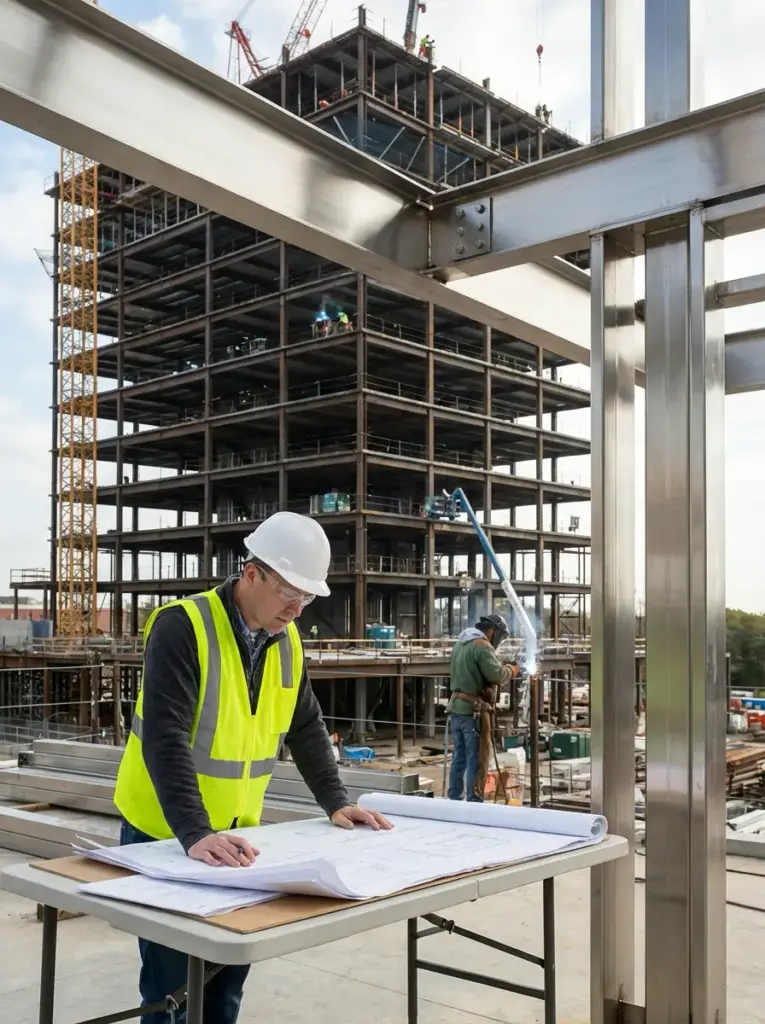
Why Fire Performance Is a Material Specification Decision, Not Just a Compliance Requirement
Building regulations in most jurisdictions define fire resistance in terms of time-rated performance: a structural element must maintain its load-bearing function, its integrity (resistance to flame and hot gas penetration), and its insulation properties for a defined period — typically 30, 60, 90, or 120 minutes. These ratings are determined by standardised furnace tests and form the basis of building code compliance.
The limitation of this framework is that it describes minimum survivable performance under controlled test conditions. Real structural fires are not controlled. Temperature distribution across a structural member varies with fuel load, ventilation geometry, compartment size, and fire suppression effectiveness. A beam that passes a 60-minute furnace test may fail earlier in a real fire if the thermal exposure profile is different from the test protocol — or it may survive significantly longer if the fire conditions are less severe. Material properties under a range of temperature conditions are therefore more informative for the design engineer than pass/fail test ratings alone.
The critical physical property is the relationship between temperature and yield strength — the stress at which a material begins to deform permanently. For structural applications, the practical concern is the temperature at which a material has lost enough yield strength to be at risk of failure under its design load. Understanding this relationship for different materials — and understanding how stainless steel’s relationship differs from common alternatives — is the foundation of fire-safe material specification.
✏ Engineering note: The Eurocodes (specifically EN 1993-1-2 for steel structures in fire) provide the authoritative framework for calculating the fire resistance of steel structures in European jurisdictions. This standard includes specific provisions for stainless steel that differ from the carbon steel provisions in the main body of EN 1993-1-1. Architects and engineers specifying stainless steel for structural fire applications should confirm that their fire engineer is applying the stainless steel annex, not the carbon steel provisions — the two produce different reduction factors and different resistance calculations.
How Stainless Steel Behaves Under Fire Conditions
Yield Strength Retention at Elevated Temperatures
The most significant structural advantage of stainless steel in fire applications is its superior retention of yield strength at elevated temperatures compared to carbon steel. Carbon steel loses approximately 50% of its room-temperature yield strength at around 550°C — a temperature routinely exceeded in structural fires. This 50% reduction threshold is the point at which carbon steel structural elements are considered at significant risk of failure under design loads.
Austenitic stainless steel grades (304, 316) retain yield strength more effectively at temperatures above 500°C, maintaining meaningful load-bearing capacity up to approximately 800°C. For applications requiring performance at even higher temperatures — tunnel fires, industrial facility fires, or petrochemical facility emergencies — Heat-Resistant Steel grades such as 310S (25% chromium, 20% nickel) and 309S (23% chromium, 13% nickel) maintain structural integrity at continuous service temperatures up to 1050°C and 980°C respectively. These grades are specifically engineered for applications where sustained elevated temperature exposure is a design condition, not just an emergency scenario.
The Chromium Oxide Passivation Layer: Oxidation Resistance Under Fire
Stainless steel’s characteristic corrosion resistance derives from a chromium oxide passivation layer that forms spontaneously on the surface when the material contains at least 10.5% chromium by mass. This layer — typically 1 to 5 nanometres thick — is chemically stable, self-repairing when damaged in the presence of oxygen, and critically, it functions as an oxidation barrier under elevated temperatures that would cause rapid scale formation and surface degradation in unprotected carbon steel.
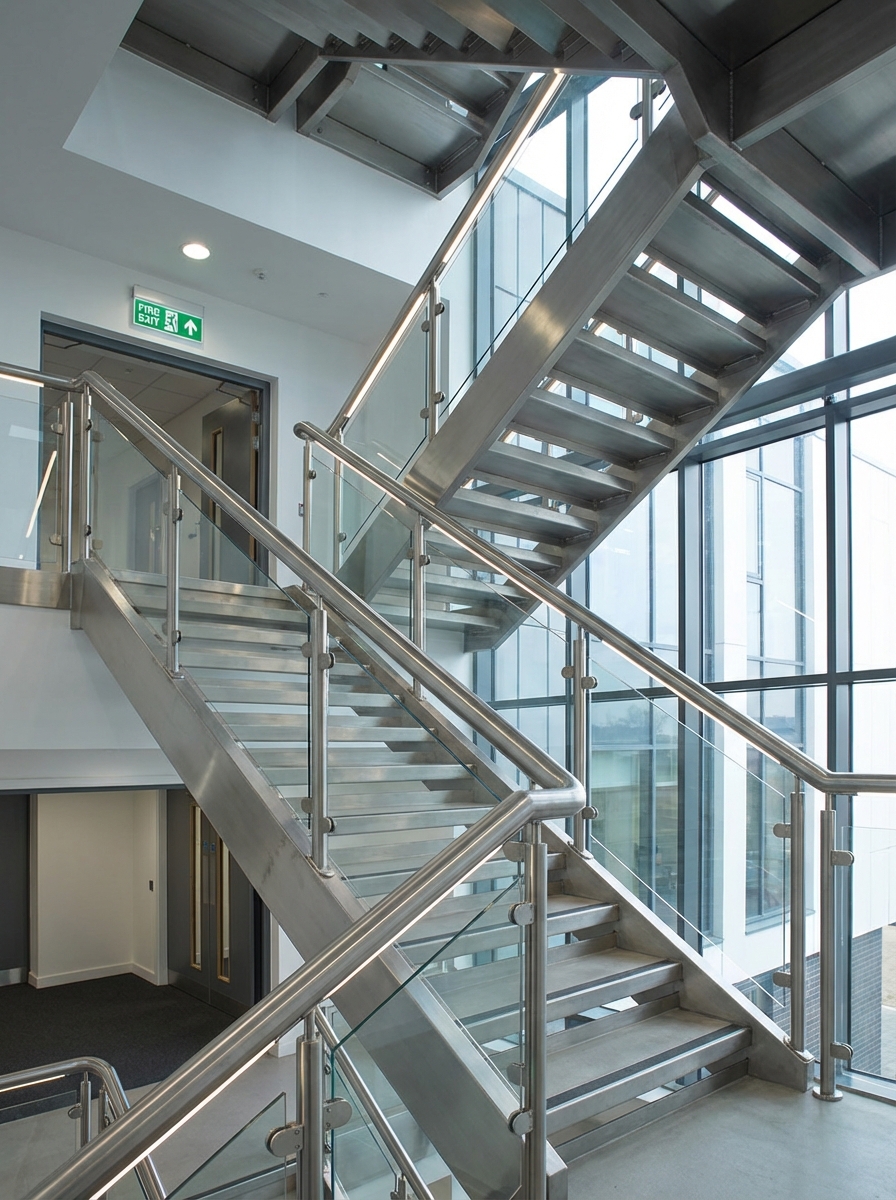
Under fire conditions, this passivation layer suppresses the iron oxide formation that accelerates structural deterioration in carbon steel. While the chromium oxide layer does not prevent all high-temperature oxidation — at temperatures above 900°C, even austenitic stainless steel will experience some scale formation — it significantly extends the temperature range over which the material surface remains stable and load-bearing capacity is preserved. For structural elements exposed to fire, this surface stability translates directly into extended safe performance time.
Thermal Conductivity and Heat Distribution
Stainless steel has lower thermal conductivity than carbon steel — approximately 15-20 W/mK for austenitic grades compared to 50 W/mK for carbon steel. This lower conductivity means that heat travels more slowly through a stainless steel structural member, reducing the rate at which the full cross-section reaches critical temperature. In fire engineering terms, a lower conductivity material requires more time to achieve uniform temperature elevation through its cross-section — which generally translates to a longer period before structural capacity falls to a critical level.
The practical implication for structural design: a stainless steel section may achieve a better unprotected fire resistance rating than a geometrically equivalent carbon steel section, both because its yield strength retention is better at temperature and because its cross-section heats more slowly. Fire engineers should account for this difference when calculating required protection levels and comparing specification options.
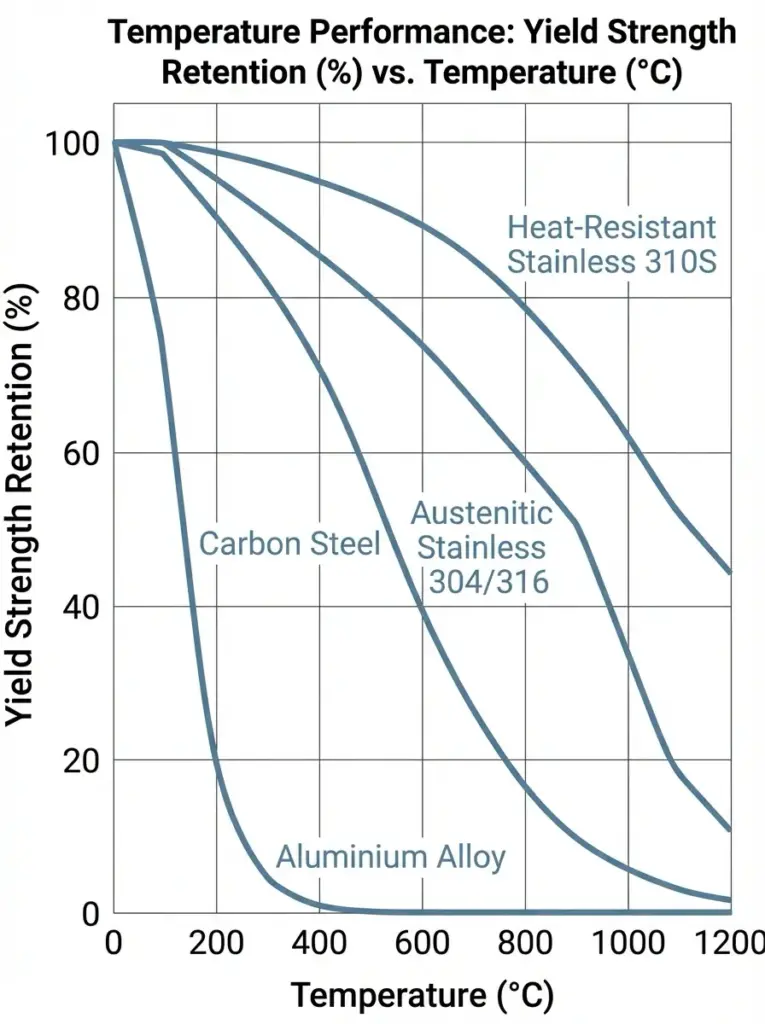
Material Comparison: Stainless Steel vs Common Alternatives Under Fire
Carbon Steel (S235, S355)
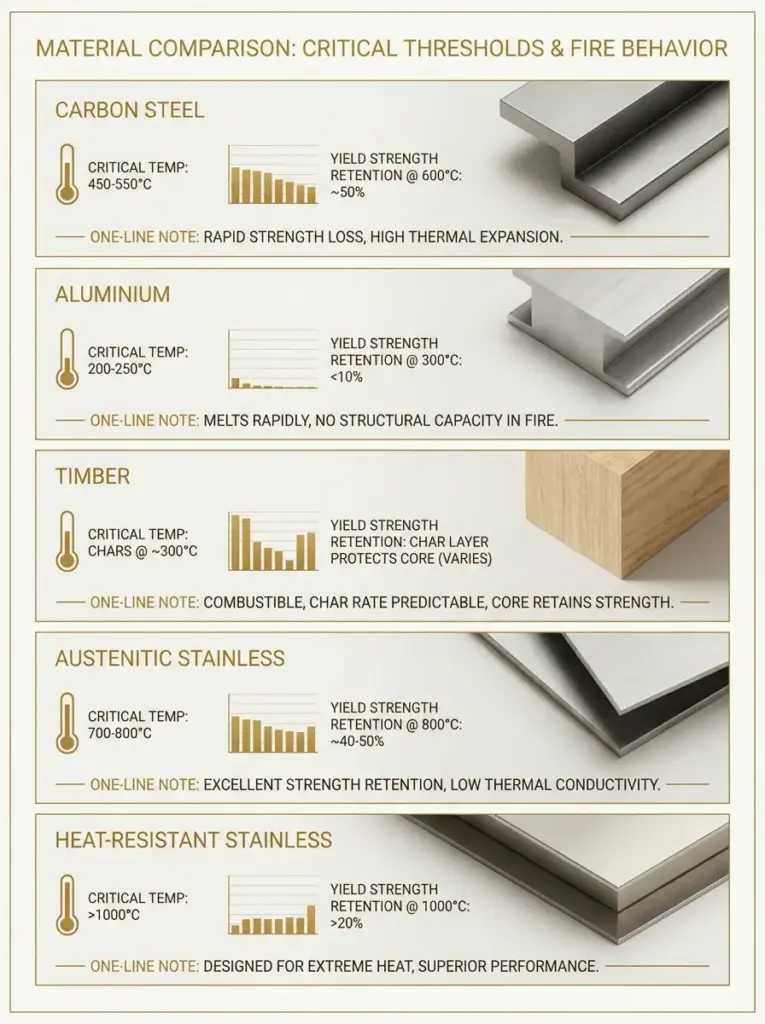
Critical temp: ~550°C for 50% yield strength loss — the standard structural failure threshold
Under fire: Rapid strength reduction above 400°C. Significant creep deformation at sustained temperatures above 500°C. Scale formation accelerates surface degradation.
Failure mode: Progressive structural failure at fire temperatures routinely reached within 10-20 minutes of ignition in an uncontrolled compartment fire without fire protection.
Fire design relevance: Requires intumescent coating or fire-resistant board protection for most structural fire rating requirements. Cannot be specified unprotected for 30-minute ratings in most load-bearing applications.
Aluminium Alloys (6000, 7000 series)
Critical temp: ~200-300°C for significant strength loss; melting point ~660°C
Under fire: Loses structural capacity rapidly above 200°C. Melts within the temperature range of a developed structural fire (700-1100°C). Does not form a protective oxide layer under fire conditions.
Failure mode: Complete structural collapse. Aluminium structural elements exposed to developed fire cannot be relied upon for load-bearing function.
Fire design relevance: Cannot be used unprotected as primary structural material in fire-rated applications. Limited to applications where fire resistance is provided entirely by other means (sprinkler systems, compartmentalisation). Grenfell Tower cladding system is the defining case study of aluminium composite performance failure under fire.
Timber (Structural Grade)
Critical temp: Begins charring at ~250-300°C; char layer forms at approximately 0.7mm/minute
Under fire: Paradoxically predictable — char layer insulates the remaining cross-section. Structural capacity calculable from residual cross-section after char depth subtracted.
Failure mode: Progressive section loss. Full cross-section failure when residual structural zone is insufficient for design load. Contributes fuel load to fire.
Fire design relevance: Engineered timber (CLT, glulam) can achieve fire ratings through oversized cross-sections that maintain structural capacity after char layer formation. A design tool rather than a fire safety material. Not appropriate for applications requiring sustained structural performance at temperatures above ~300°C.
Stainless Steel — Austenitic (304, 316)
Critical temp: ~800°C for comparable yield strength reduction to carbon steel at 550°C
Under fire: Gradual, predictable strength reduction. Chromium oxide passivation layer limits oxidation and scale formation. Lower thermal conductivity slows cross-section temperature rise.
Failure mode: Controlled, calculable capacity reduction — not sudden collapse. Extended safe performance window compared to carbon steel under equivalent fire exposure.
Fire design relevance: Can achieve better unprotected fire resistance ratings than equivalent carbon steel sections. Preferred for exposed structural applications in high-risk environments, fire escape routes, and facade systems where material performance transparency is required.
Stainless Steel — Heat-Resistant (310S, 309S)
Critical temp: Continuous service to 1050°C (310S); 980°C (309S). Intermittent service to 1150°C (310S).
Under fire: Exceptional oxidation resistance and yield strength retention at temperatures beyond the range of conventional structural fire scenarios. Chromium-nickel composition specifically engineered for sustained elevated temperature performance.
Failure mode: Not a failure mode within standard building fire temperature ranges. Designed for industrial processes and extreme thermal environments.
Fire design relevance: Specified for tunnels, industrial facilities, petrochemical infrastructure, and any application where fire temperature may exceed 800°C or where structural integrity must be maintained for extended periods beyond standard fire resistance ratings.
Critical Applications: Where Stainless Steel Fire Performance Is Non-Negotiable
Fire Escape Stairs and Structural Handrails
Fire escape stairs must remain structurally functional for the full duration of the building evacuation — a period that, in high-rise buildings, may extend to 60 minutes or more. The structural elements of fire escape stairs are the last line of defence for occupant safety, and their material specification directly determines the available evacuation time. Stainless steel balustrades, stringers, and handrail systems for fire escape routes are specified for their ability to maintain both structural integrity and surface quality under elevated temperatures — the handrail must remain graspable and the stringer must remain load-bearing throughout the evacuation scenario.
High-Rise Facade Cladding Systems
Post-Grenfell, the specification of facade cladding systems in high-rise buildings has been subject to fundamental regulatory revision in the United Kingdom and progressively across European jurisdictions. Stainless steel cladding panels and sub-frame systems are specified for their non-combustibility, resistance to fire spread, and structural stability under the thermal conditions generated by an external fire or a fire venting from an internal compartment. The material contributes no fuel load and maintains its dimensional stability under conditions that would cause polymer-based composites to ignite and aluminium to melt.
Underground Stations and Transport Tunnels
Underground transport infrastructure presents the most extreme fire safety challenge in building design. Tunnels and underground stations are enclosed environments with limited ventilation, high passenger density, and escape routes that are themselves within the affected zone. Fire temperatures in tunnel scenarios can exceed 1,000°C — beyond the performance range of standard structural materials. Heat-resistant stainless steel grades are specified for structural elements, tunnel lining support systems, and critical infrastructure within underground fire scenarios because they are the only metallic structural material that maintains meaningful load-bearing capacity at these temperatures without protective systems that may themselves be vulnerable to fire damage.
Industrial and Petrochemical Facilities
Industrial facilities in petrochemical processing, power generation, and chemical manufacturing operate environments where fire risk is elevated, fire temperatures are extreme, and the consequences of structural failure extend beyond the building itself to industrial accident scenarios. Heat-resistant stainless steel is a standard specification material in these environments — not because of regulatory compliance alone, but because the process temperatures and fire risk profiles of industrial facilities exceed the performance range of conventional structural materials.
Healthcare and Critical Infrastructure
Hospitals, data centres, emergency service facilities, and other critical infrastructure have an additional fire safety requirement beyond occupant safety: operational continuity. The structural elements that house critical functions — operating theatres, server rooms, emergency dispatch centres — must maintain integrity not just for evacuation but for continued operation under fire conditions that may affect adjacent areas of the building. Stainless steel structural and architectural elements contribute to this operational resilience by providing predictable, calculable fire performance rather than the uncertain degradation profile of conventional materials.
✏ Engineering note: When specifying stainless steel for fire-safety-critical applications, the grade selection should be driven by the specific temperature exposure scenario, not by default to the most commonly stocked grade. A fire engineer’s temperature analysis of the worst-case fire scenario for each structural element should inform grade selection — 304 or 316 for standard compartment fire scenarios, 309S or 310S where temperatures may exceed 800°C. Stainless Europe’s technical team can advise on grade-specific performance data and supply availability for project-specific requirements.
Specification Guidance for Architects and Engineers
Grade Selection Framework
- Grade 304 / 316: Standard structural and architectural applications where fire resistance improvement over carbon steel is required. Suitable for most commercial and residential fire rating scenarios. 316 preferred in coastal or chemically aggressive environments.
- Grade 309S: Intermediate heat resistance. Specified for applications where sustained exposure above 600°C is anticipated — industrial kitchen extraction systems, commercial catering infrastructure, process equipment housings.
- Grade 310S: Maximum heat resistance in the standard austenitic range. Tunnel structures, petrochemical facilities, power generation infrastructure, any application where fire temperatures may reach or exceed 1000°C.
- Duplex grades (2205, 2507): Where both elevated temperature performance and corrosion resistance (particularly chloride resistance) are required simultaneously — coastal industrial facilities, offshore structures, chemical processing environments.
Documentation and Compliance
Material certification for fire-safety-critical stainless steel applications should include: EN 10204 Type 3.1 mill test certificates confirming chemical composition and mechanical properties; specific grade designation conforming to EN 10088 or ASTM A240 as applicable to the project jurisdiction; and, for heat-resistant grades, elevated temperature mechanical property data from the mill or from published grade-specific test data referenced in EN 1993-1-2 Annex C. Where projects are subject to third-party fire engineering review, material certificates should be issued as part of the fire engineering documentation package, not as a separate procurement record.
Surface Finish Considerations
Surface finish selection for stainless steel in fire-safety applications has both aesthetic and functional implications. Mill finish (2B or 2D) is the baseline for structural elements where appearance is secondary. Brushed or polished finishes on architectural elements — handrails, balustrades, facade panels — do not significantly affect fire performance but do affect maintenance requirements and the visual quality of the material over its service life. For applications where condensation or aggressive atmospheric exposure may be a factor, a smoother surface finish reduces the sites for contamination accumulation that can compromise the passivation layer over time.
The Material Decision Is the Safety Decision
Fire safety in building design is a system — sprinklers, compartmentation, escape routes, detection, suppression. Material specification is one component of that system, but it is the component that operates without power, without maintenance, and without human intervention. A material either performs under fire conditions or it does not, and that performance — or the lack of it — is determined at the point of specification, not at the point of the fire.

Stainless steel’s fire performance properties — elevated temperature yield strength retention, oxidation resistance through chromium passivation, lower thermal conductivity, and predictable degradation behaviour — make it the specification choice for any application where structural integrity under fire must be reliable and calculable. For architects and engineers specifying critical infrastructure, that reliability is the core value proposition. Not the aesthetic quality of the material, not its long-term corrosion performance, not its sustainability credentials — though all of those are real. The primary argument is simpler: stainless steel does what it is specified to do under the conditions that matter most.
For projects requiring guidance on grade selection, temperature performance data, or supply of certified stainless steel for fire-safety applications, Stainless Europe provides technical support alongside high-grade material supply across the full range of austenitic and heat-resistant grades. The right material specification, supported by the right technical data, is the foundation of safe building design.
FAQ: Stainless Steel in Fire-Safe Building Design
Q: Why is stainless steel better than carbon steel for fire safety?
Stainless steel retains significantly more yield strength at elevated temperatures. Carbon steel loses approximately 50% of its yield strength at ~550°C — a temperature routinely reached within 10-20 minutes of ignition. Austenitic stainless grades maintain comparable capacity to ~800°C. Heat-resistant grades (310S) remain structurally stable to 1050°C. The chromium oxide passivation layer also prevents scale formation and oxidation that accelerates carbon steel degradation under sustained heat.
Q: Which stainless steel grades are used in fire-safe building design?
Grade 304 and 316 for general structural and cladding applications. Grade 310S (continuous service to 1050°C) and Grade 309S (to 980°C) for industrial, tunnel, and extreme temperature applications. Duplex grades (2205, 2507) where both corrosion and elevated temperature resistance are required. Grade selection should be based on fire engineer’s worst-case temperature scenario for each structural element, not default specification.
Q: What is the chromium oxide passivation layer?
A thin, stable, self-repairing layer of chromium oxide (Cr₂O₃) that forms spontaneously on stainless steel surfaces containing at least 10.5% chromium. Under fire conditions, this layer acts as a thermal and oxidation barrier, suppressing scale formation and surface degradation that reduces load-bearing capacity in carbon steel. The layer reforms in the presence of oxygen if mechanically damaged — a property that makes it effective over the full service life of the material.
Q: How does stainless steel compare to aluminium in fire?
Aluminium begins losing structural strength above 200°C and is essentially non-load-bearing above 300°C — well below the temperatures of a developed compartment fire. Its melting point of ~660°C is within the standard structural fire temperature range. Stainless steel grades retain meaningful capacity at three to four times the temperature at which aluminium fails. The Grenfell Tower fire is the most significant documented case study of aluminium composite cladding failure under building fire conditions.
Q: What applications specifically require heat-resistant stainless steel?
Fire escape stairs and structural handrails; high-rise facade cladding systems; underground stations and transport tunnels (where fire temperatures can exceed 1000°C); industrial and petrochemical facilities; healthcare and critical infrastructure requiring operational continuity under fire. Any application where structural integrity must be maintained beyond the performance envelope of standard structural materials is a candidate for heat-resistant stainless steel specification.
- 18shares
- Facebook0
- Pinterest18
- Twitter0
- Reddit0