The first time I recommended a builder I hadn’t properly vetted, it cost the project fourteen weeks. Not in obvious ways — the builder was VBA registered, insured, and had a reasonable portfolio.
But the pre-construction process was thin, the clash detection between structural and services drawings was almost non-existent, and when the mechanical contractor hit the structural steel in week three, the redesign consumed time that the programme had no room for. The client lost a trading quarter. The design intent — an open ceiling that expressed the services as a deliberate aesthetic decision — had to be closed off to hide the coordination problem.
- Pre-Construction: Where Design Quality Is Won or Lost
- Design-Build, Construction Management, General Contracting: The Designer's Perspective
- The Victorian Regulatory Environment: What Architects Need Builders to Handle
- The Five Phases of a Commercial Build: What the Designer Needs at Each Stage
- The Architect's Evaluation Framework
- Sector-Specific Considerations for Commercial Projects
- The Builder Is Part of the Design Team
- FAQ: Choosing Commercial Builders
- Q: What should an architect look for when selecting a commercial builder in Melbourne?
- Q: What is pre-construction and why does it matter for design quality?
- Q: What is design-build delivery and when is it appropriate?
- Q: How do commercial builders in Melbourne handle sustainability requirements?
- Q: What questions should architects ask builder references?
That experience changed how I evaluate builders. I stopped treating the selection process as primarily about price and schedule and started treating it as a question about how the builder thinks before they build. The value of a commercial builder to a design project is not what they do on site — any reasonably competent crew can follow detailed documentation. The value is what they do in the months before site mobilisation: how they read drawings, where they find coordination problems, what they flag about compliance, and how they protect the design intent when the budget and programme start applying pressure.
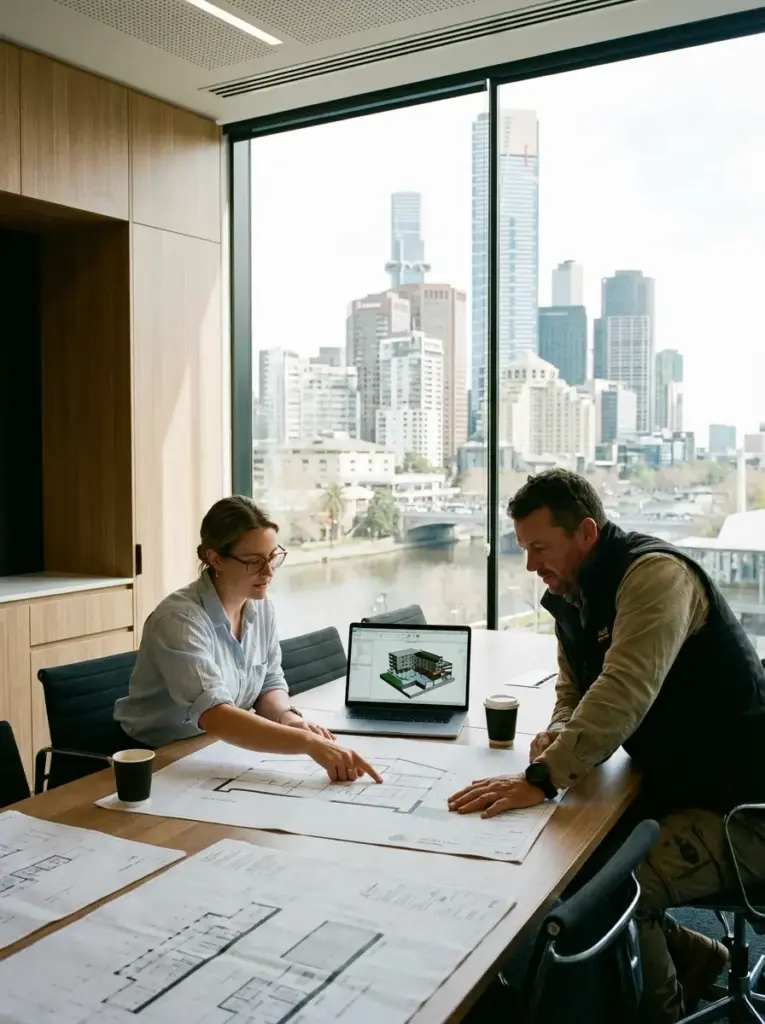
Melbourne’s commercial construction market is mature and competitive. The choice between builders at the top of the market is not about finding one who can build — it’s about finding one whose pre-construction process, delivery methodology, and project culture align with the specific demands of the project. This guide covers the evaluation framework from a designer’s perspective: what to look for, what to ask, and what the answers reveal.
Pre-Construction: Where Design Quality Is Won or Lost
The construction phase is where problems become visible. Pre-construction is where they’re either prevented or embedded. For architects and designers working on Melbourne commercial projects, the quality of a builder’s pre-construction process is the single most important evaluation criterion — more revealing than their portfolio, more predictive than their price.
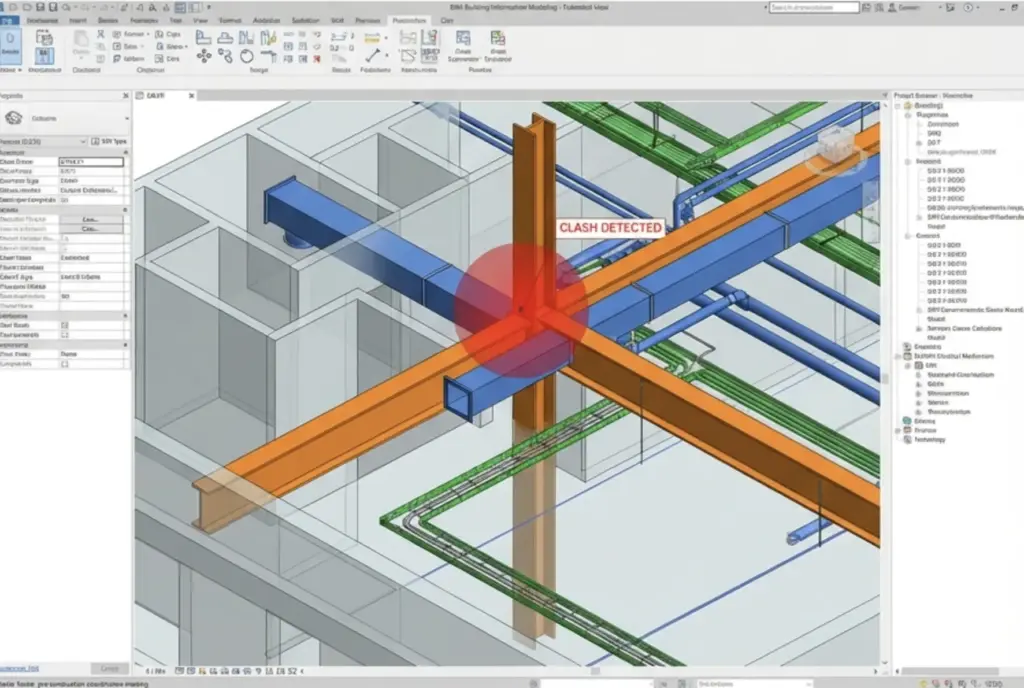
A thorough pre-construction phase involves clash detection between architectural, structural, and mechanical/electrical/plumbing drawings — typically in a federated BIM model that combines all consultants’ work into one coordination model. This process reveals the category of problem that destroyed my open ceiling: a structural element and a services run occupying the same space, invisible in any single consultant’s drawings but immediately apparent when the models are combined. Catching this before documentation is issued costs a conversation and a drawing revision. Catching it on site costs weeks and often a design compromise.
Pre-construction also includes a value engineering review — a systematic examination of the design for cost efficiency opportunities that don’t compromise design intent. This is where a good builder earns their fee before they’ve broken ground: identifying that a specification-grade product can be substituted for an equivalent at 40% of the cost, or that a structural system can be simplified without affecting spans or finish quality. The distinction matters — value engineering that saves money by degrading the design is not value engineering, it’s value destruction. A builder who understands the design intent can tell the difference.
✏ Design note: When interviewing builders for a pre-construction appointment, ask to see a value engineering register from a completed project in a similar sector. The register should list the item, the original specification, the proposed alternative, the cost saving, and — critically — the design impact assessment. If the impact column is consistently ‘nil’ or ‘none’, the builder is either not being honest or not doing real value engineering. Every substitution has some impact. The question is whether that impact is acceptable, and that requires the architect’s judgment.
Design-Build, Construction Management, General Contracting: The Designer’s Perspective
The choice of delivery model is partly a client decision and partly a project decision, but architects need to understand the design implications of each — because the delivery model determines how much independent design advocacy exists throughout the construction phase.
Design-Build: Speed at a Cost to Independence
Design-build gives the client a single point of responsibility for both design development and construction. For hospitality fit-outs, industrial buildings, and retail rollout programmes — projects where the brief is well-defined and speed to market is the priority — this model often produces the fastest path from concept to occupation. The builder manages the design consultants and takes responsibility for their coordination, which can compress the programme significantly.
The design quality risk: when the builder is managing the architect, the architect’s independent advocacy for design intent is structurally compromised. Budget pressure during construction can produce design decisions that the architect would resist in a traditional delivery model but may accept in a design-build context where the builder controls the scope. Design-build works best when the design brief is resolved to a level of detail that protects the key design decisions before the builder takes over. It works least well when the design is still being developed and the builder’s cost management instincts conflict with the designer’s quality instincts.
Construction Management: Transparency at Scale
Construction management suits complex, evolving, or large-scale projects — major hospitality developments, education buildings, medical facilities — where the scope is unlikely to be fully resolved at contract award and where transparency of cost and programme is a priority. The construction manager works alongside the design team rather than managing them, which preserves design independence while providing early contractor input.
The commercial model — where the client contracts directly with trade contractors, with the construction manager providing programme, coordination, and cost reporting — gives the design team visibility of real subcontractor prices rather than a lump-sum that may conceal significant contingency. This transparency is valuable for budget management throughout the design process, not just at the end of it.
General Contracting: Defined Scope, Competitive Tension
Traditional general contracting — a lump-sum tender after design documentation is substantially complete — remains the most common delivery model for Melbourne commercial projects and is appropriate when the design is resolved, the scope is well-defined, and competitive pricing is a priority. The risk is that documentation quality must be very high before tender: ambiguous drawings or specifications become RFIs during construction, which create variation opportunities and programme delays.
For architects, the general contracting model provides the clearest structural separation between design and construction responsibilities, which protects design independence but requires that the design is genuinely complete before the builder is engaged. Issuing under-developed documentation for a lump-sum tender produces tenders that are either too high (builders pricing risk) or too low (builders planning to capture variations) — neither of which serves the design quality or the client’s interests.
The Victorian Regulatory Environment: What Architects Need Builders to Handle
Melbourne’s commercial construction regulatory framework is one of the most complex in Australia. The Victorian Building Authority (VBA) administers registration and compliance; the National Construction Code (NCC) sets performance requirements; WorkSafe Victoria governs site safety; and individual councils impose planning overlays that interact with all of the above. A builder who doesn’t have mature processes for navigating this environment creates compliance risk that ultimately falls back on the architect’s professional responsibility.
VBA Registration and Insurance: The Baseline
VBA registration is mandatory for commercial construction work in Victoria — not a differentiator, a baseline. Verify registration directly on the VBA register rather than accepting a builder’s representation. Check that the registration class matches the work being performed: a builder registered for domestic construction is not automatically registered for commercial work of equivalent complexity. Current public liability insurance (minimum $20 million for commercial projects) and professional indemnity insurance should be verified, with the architect named as an additional insured where appropriate.
Permit Management: Where Delays Are Born
Building permit applications in Victoria require coordinated documentation across all consultants, with the Relevant Building Surveyor (RBS) reviewing for NCC compliance before issuing the permit. Fire engineering approvals, accessibility compliance under the Disability Discrimination Act, and services authority approvals from entities like CityWest Water or AusNet add further complexity. A builder who treats permit management as the architect’s problem is one who has never been the critical path item on a programme delay caused by an incomplete permit application.
The best commercial builders run permit management as a concurrent pre-construction workstream, not a sequential one. They know which elements of the design need to be resolved before the permit can be issued, they coordinate the consultant submissions, and they maintain a permit pathway schedule that flags risks early. A permit delay of eight weeks at the start of a project often becomes a twelve-week delay by the end — programme compression in the middle phases rarely fully recovers the time lost at the beginning.
Sustainability Compliance: Green Star, NABERS, and NCC Section J
Victorian commercial projects increasingly carry sustainability commitments — Green Star design ratings, NABERS operational targets, or client-specific electrification and embodied carbon requirements. These commitments must be embedded in pre-construction rather than bolted on at the end. A builder who treats sustainability as a separate workstream managed by the ESD consultant, with no interface to the construction programme or procurement strategy, will deliver a building that achieves its sustainability ratings on paper but misses the operational performance targets in practice.
The specific compliance requirement that architects most often see overlooked during construction: NCC Section J energy efficiency requirements for commercial buildings. Section J applies to the building envelope, artificial lighting, HVAC systems, and heated water systems. A builder who doesn’t have in-house Section J expertise — or a strong relationship with a specialist consultant who is integrated into the pre-construction team — creates documentation risk that can delay permit issue and certification at practical completion.
The Five Phases of a Commercial Build: What the Designer Needs at Each Stage
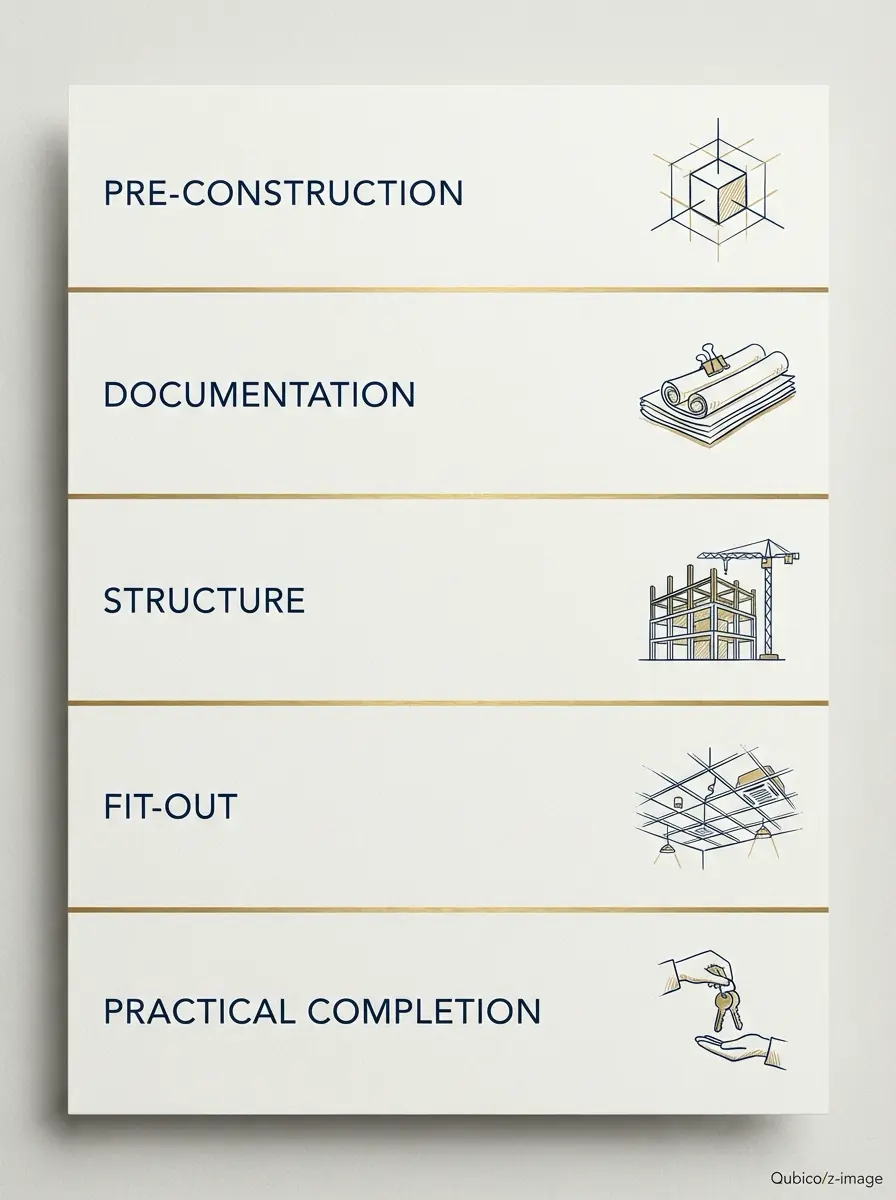
Phase 1 — Pre-Construction and Planning
What happens: Clash detection in BIM, value engineering review, permit management pathway, construction logistics plan, site establishment strategy, procurement plan for long-lead items.
Why it matters to design: This is where the design is tested against buildability, cost, and compliance. Problems identified here are cheap. Problems identified during construction are expensive — in time, money, and often in design quality.
Design quality signal: A builder who delivers a value engineering register with design impact assessments, a coordinated BIM model showing resolved clashes, and a permit pathway schedule with flagged risks is demonstrating that they’ve actually read and understood the design.
Phase 2 — Documentation and Tender
What happens: Trade packages issued to specialist subcontractors, RFI management process established, programme baseline set, procurement orders placed for long-lead items (structural steel, glazing, mechanical plant).
Why it matters to design: Documentation quality determines tender quality. Ambiguous drawings produce ambiguous prices and expensive variations. The builder’s review of documentation at this stage — flagging gaps, inconsistencies, and coordination issues — is the last opportunity to resolve problems cheaply.
Design quality signal: A builder who returns a detailed RFI list at tender stage, rather than pricing risk into their tender and resolving it as variations during construction, is protecting the design quality and the budget simultaneously.
Phase 3 — Site Establishment and Structure
What happens: Site hoarding, crane positioning, temporary services, base structure — concrete or steel frame, floor slabs, façade structure. Typically the highest-risk phase for programme delays.
Why it matters to design: The design decisions made at the structure stage are the hardest to change later — structural openings, services penetrations, and floor-to-floor heights. Any design changes at this stage have cascade effects through the programme.
Design quality signal: A builder who maintains an up-to-date design change register, with cost and programme impact assessed for each change at the time it’s identified rather than cumulatively at the end, is allowing the design team to make informed decisions rather than discovering the consequences later.
Phase 4 — Fit-Out and Services
What happens: Internal partitions, ceiling systems, mechanical, electrical, and hydraulic services installation, joinery, finishes. The phase where the design intent either becomes visible or gets compromised.
Why it matters to design: This is where value engineering decisions made in pre-construction either prove to have been sound or reveal their consequences. Substituted products, changed specifications, and coordination compromises all become visible as finishes are installed.
Design quality signal: A builder who maintains the specified products and manages subcontractor substitution requests through a formal approval process — with the architect’s sign-off required for any design-affecting change — is protecting the design intent through the phase where it’s most vulnerable.
Phase 5 — Practical Completion and Commissioning
What happens: Defects inspection, services commissioning and testing, regulatory sign-offs, handover documentation, as-built drawings, operations and maintenance manuals.
Why it matters to design: Practical completion defines the quality of the handover. A building that is technically complete but poorly commissioned — HVAC systems not balanced, lighting controls not programmed, services not tested at full load — will underperform operationally and generate callbacks.
Design quality signal: A builder who commissions services progressively throughout the fit-out phase — not just in the final two weeks before the handover date — produces a building that operates correctly from day one. Progressive commissioning requires planning from pre-construction, not improvisation at the end.
The Architect’s Evaluation Framework
Selecting a commercial builder for a Melbourne project is a structured process, not a competitive exercise in who can produce the lowest number. The design quality of the completed building is directly affected by which builder is appointed, and the architect has both the professional expertise and the client’s interest at stake to be active in the selection process. When you look at the stronger end of the commercial builders Melbourne market, the differentiator is consistently pre-construction depth — not portfolio size, not tender price.
Builders who have invested in pre-construction capability, design-literate project management teams, and integrated compliance processes represent a different value proposition from those competing primarily on price — and the difference becomes visible in the quality of the completed building.
When you look at the stronger end of this end of the market, the differentiator is consistently pre-construction depth — not portfolio size, not tender price. Builders who have invested in pre-construction capability, design-literate project management teams, and integrated compliance processes represent a different value proposition from those competing primarily on price — and the difference becomes visible in the quality of the completed building.
The Shortlist Criteria
- Demonstrated sector experience: A portfolio that includes projects of comparable type, scale, and complexity — not just comparable size. A builder who has completed multiple hospitality fit-outs understands the acoustic, FF&E coordination, and live-trading interface requirements. A builder whose hotel portfolio consists of one project ten years ago does not.
- Pre-construction service depth: Ask specifically what the pre-construction deliverables are: clash detection reports, value engineering register, permit pathway schedule, construction logistics plan. If the answer is ‘we’ll review the drawings and let you know if there are any issues,’ the pre-construction process is not structured.
- Team continuity: The project director, senior project manager, and site manager who present at the interview should be the people who will run the project. Builder staff turnover is a real risk on Melbourne commercial projects — if the experienced team that won the project is replaced by junior staff during construction, the design quality suffers.
- BIM capability: For projects with complex services coordination, the builder’s ability to federate and work in a coordinated BIM model is a genuine capability differentiator. Ask to see a sample coordination model from a completed project, and ask what software they use for clash detection (Navisworks is the standard; anything less sophisticated suggests the process isn’t systematic).
- Reference quality: Not just whether they have references, but what the references say when you speak to them directly. The most revealing question: ‘Was there anything about the construction process that affected the design quality, and how was it resolved?’
The Questions That Reveal Capability
- Show me three projects most similar to ours and walk me through what changed between tender and practical completion — in scope, in cost, and in design.
- What were the major coordination clashes identified in pre-construction, and how were they resolved before documentation was issued?
- How do you manage subcontractor substitution requests during construction — what is the approval process, and who has sign-off authority for design-affecting changes?
- What is your permit management process, and who is responsible for coordinating the consultant submissions to the Relevant Building Surveyor?
- How do you integrate sustainability requirements — Green Star, NABERS, Section J — into your pre-construction and procurement processes?
✏ Design note: The builder who answers these questions with specific examples — this project, this clash, this substitution request, this permit delay — is drawing on real experience. The builder who answers in generalities is describing a process they aspire to rather than one they practice. The difference becomes apparent during construction, when the aspiration meets the reality of a tight programme and a difficult site.
Sector-Specific Considerations for Commercial Projects
Hospitality and Retail
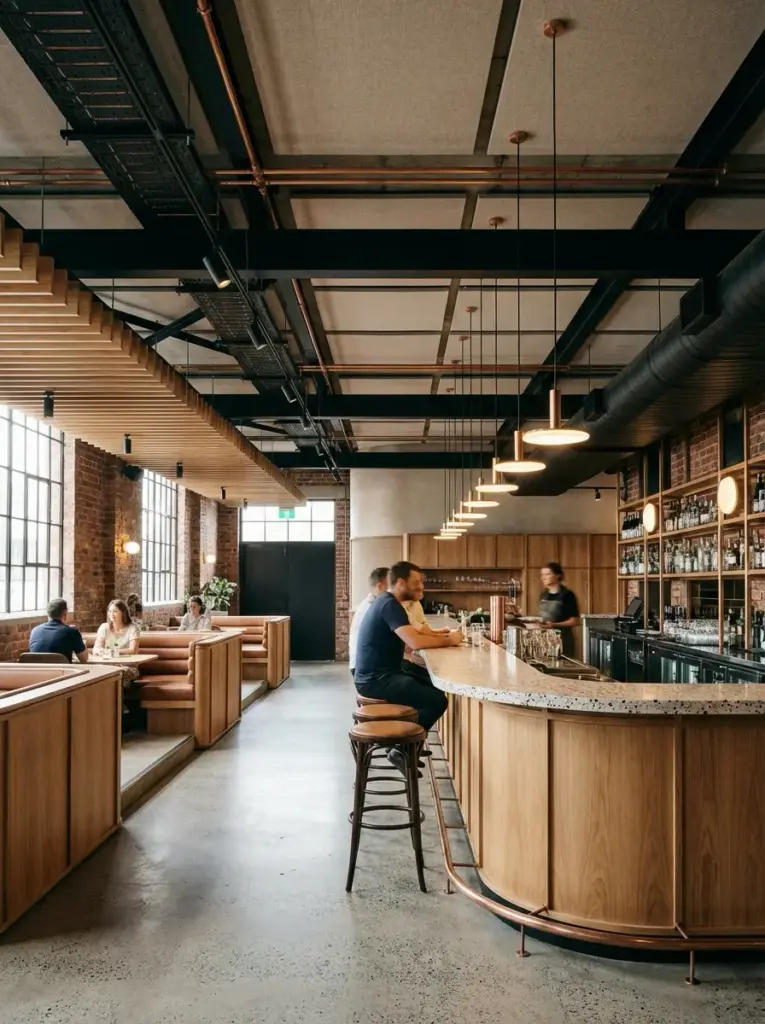
Fit-outs in trading environments require night and weekend work, staged handovers, and coordination with operators who are simultaneously fitting out and training staff. Acoustic separation, FF&E coordination, and services commissioning in a live trading environment are specialist skills. Ask for references from projects where construction occurred in an operational building — the management of this interface is genuinely different from a vacant site.
Industrial and Logistics
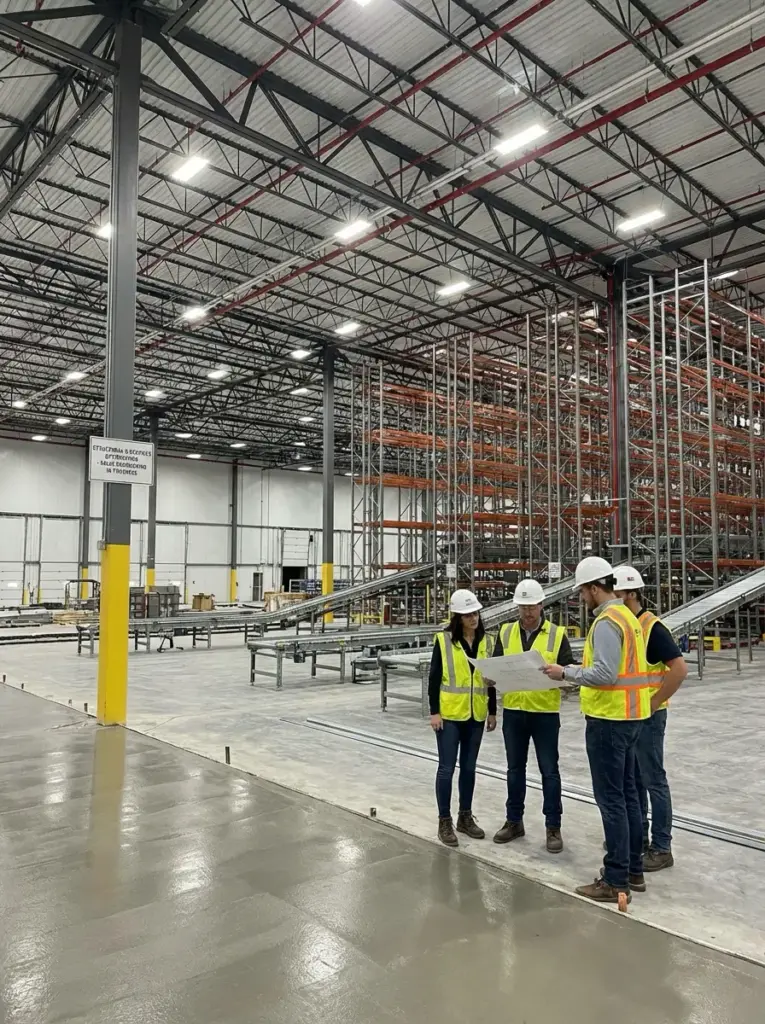
Industrial projects — warehouses, self-storage, logistics facilities — appear simple but contain significant structural engineering, slab specification, and services distribution complexity. Structural spans, floor load ratings, dock leveller requirements, and fire suppression systems all require specialist knowledge. Value engineering in industrial projects is where builders earn their fee: optimising structural steel tonnage, concrete slab thickness, and cladding systems without compromising operational performance requires deep sector knowledge, not just general construction competence.
Education and Community
Education projects carry staged occupancy requirements, community stakeholder engagement, and acoustic performance specifications that most other building types don’t. The interface between construction and occupied spaces — particularly for staged school refurbishments — requires safety management plans and community communication processes that go beyond standard site management. Builders who have not worked in occupied educational environments consistently underestimate this complexity.
The Builder Is Part of the Design Team
The gap between a good design and a well-built building is the quality of the builder who bridges them. In Melbourne’s commercial construction market, that gap is not closed by the cheapest tender or the most impressive portfolio — it’s closed by the builder who understood the design before they started building it, who identified the coordination problems before they became site problems, and who protected the design intent when the programme and budget applied pressure.

The selection process for a commercial builder is a design decision. It deserves the same rigour, the same evidence-gathering, and the same professional judgment that goes into any other significant design decision on the project. The architect who treats it as an administrative process — get the tenders, check the numbers, recommend the lowest — is outsourcing a decision that significantly affects the quality of the completed building.
The builder who asks good questions in pre-construction, coordinates the consultants in documentation, manages the programme without compromising the finishes, and commissions the building progressively rather than frantically is the one whose name should appear on the recommendation. In Melbourne’s current market, those builders exist. Finding them requires the right evaluation framework — and the willingness to ask the questions that reveal the difference between aspiration and practice.
FAQ: Choosing Commercial Builders
Q: What should an architect look for when selecting a commercial builder in Melbourne?
VBA registration and current insurances are the non-negotiable baseline — verify directly on the VBA register. Beyond that, look for demonstrated experience in your specific project type: hospitality, industrial, retail, and education buildings each have different sequencing, compliance, and coordination requirements. Ask to see pre-construction deliverables from comparable completed projects: clash detection reports, value engineering registers, permit management track records. The builder who asks the right questions before the contract is signed is protecting the design.
Q: What is pre-construction and why does it matter for design quality?
Pre-construction is the structured phase between design development and site mobilisation where the builder reviews the design for buildability, cost accuracy, compliance, and coordination. This includes clash detection, value engineering, permit management pathway, and construction logistics planning. Architects who engage builders during pre-construction consistently report fewer design changes during construction — the expensive phase where changes have the highest impact on programme and cost.
Q: What is design-build delivery and when is it appropriate?
Design-build suits projects where speed to market is the priority and the design brief is clear enough to be executed without extensive iterative development — hospitality fit-outs, industrial buildings, retail rollout programmes. It is less appropriate for bespoke or architecturally complex projects where design quality requires the independent advocacy of a separate architect throughout the construction phase. The risk: when the builder manages the architect, budget pressure can produce design decisions that compromise intent.
Q: How do commercial builders in Melbourne handle sustainability requirements?
The leading builders integrate sustainability targets — Green Star ratings, NABERS commitments, NCC Section J compliance, electrification strategies — from pre-construction rather than treating them as a separate workstream. This means embodied carbon is considered during material specification, building services are selected for operational performance and life-cycle cost, and commissioning plans are established early enough to influence procurement. Section J compliance is the most commonly overlooked requirement and the most likely to cause permit and certification delays.
Q: What questions should architects ask builder references?
Focus on what changed between tender and completion: how did the builder handle scope evolution? Where did the design change during construction and why? Were there RFIs that revealed coordination issues that should have been caught in pre-construction? And critically — would you use them again, and for what type of project? A builder whose references are enthusiastic but only for one project type may not transfer their capability to a different asset class.
- 67shares
- Facebook0
- Pinterest67
- Twitter0
- Reddit0