The Best Running Tattoos Tell a Story — Not Just a Distance
Mile 23 of my first marathon, I made a deal with myself: finish this and get it permanently marked somewhere on my body. Not the number. Something that captured what that particular 4 hours and 47 minutes actually felt like — the doubt around mile 18, the ugly-cry at mile 25, the weird euphoria at the finish line when my legs stopped working but nothing hurt.
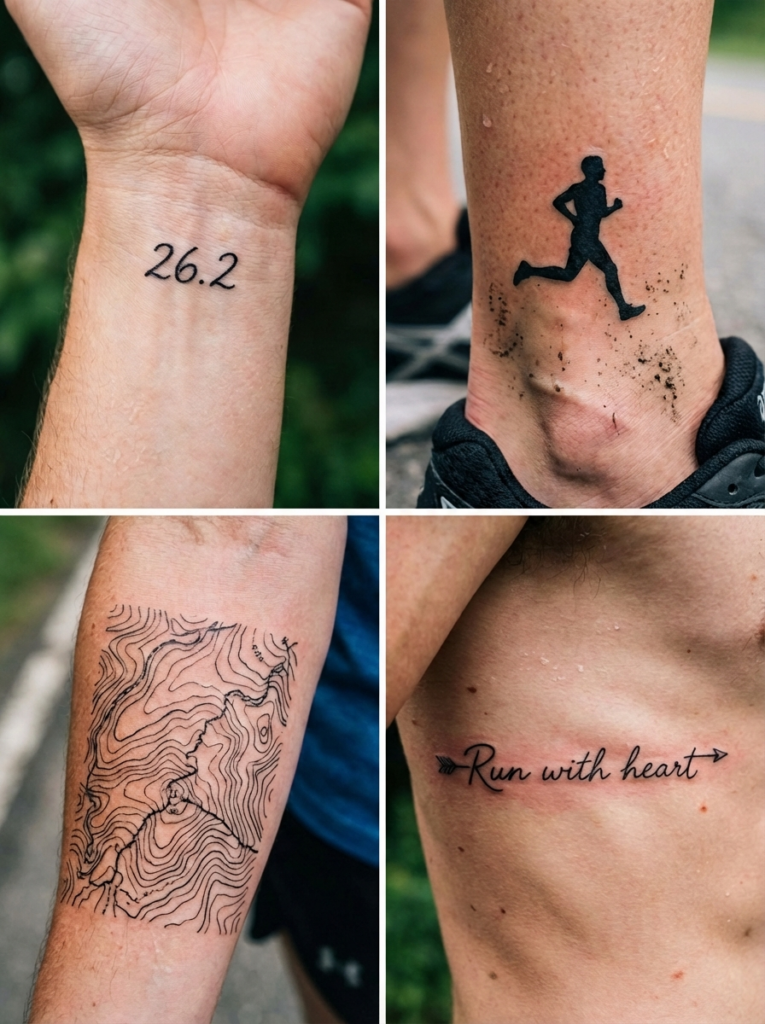
That’s the thing about running tattoos. The obvious ones — 26.2 on a wrist, a runner silhouette on an ankle — are everywhere. And they’re fine. But the most interesting running tattoos I’ve seen aren’t about the distance. They’re about the thing that keeps someone lacing up at 5am in the dark when no one is watching.
- Why Runners Get Tattoos (And What Makes Them Different)
- Minimalist Running Tattoo Ideas for Small, Clean Ink
- Marathon Tattoo Ideas and Race Milestone Tattoos
- Running Quote & Mantra Tattoo Ideas
- Trail Runner Tattoo Ideas With Mountains, Maps and Nature
- Detailed & Statement Running Tattoo Ideas
- Running Tattoo Placement Guide
- How to Find the Right Artist for Your Running Tattoo
- FAQ: Running Tattoo Ideas
- The Right Running Tattoo Is the One That Means Something in Year Five
This guide covers 25+ running tattoo ideas organized by category — from minimalist and clean to detailed and story-rich. Each idea includes placement recommendations, style guidance, and a Pinterest hook so you can brief your tattoo artist properly.
One thing I’d recommend before you read further: don’t get a running tattoo immediately after a race. Wait 30 days. If you still want it after the endorphins fade, it’s the right one.
Best Running Tattoo Ideas by Runner Type
If you are choosing between a marathon tattoo, a trail runner tattoo, or a small minimalist design, start with the kind of running story you want the tattoo to tell. A good running tattoo should read clearly at its real size, fit the body placement, and still make sense years after the race photos disappear from your camera roll.
| Runner type | Best tattoo ideas | Best placement | Style |
|---|---|---|---|
| Marathon runner | 26.2, finish time, race bib, route map | Wrist, calf, forearm | Fine line, blackwork |
| Trail runner | Mountain line, trail map, tree roots, topo lines | Calf, shoulder, forearm | Fine line, dotwork |
| Minimalist runner | Tiny shoe, runner silhouette, 13.1, arrow | Ankle, wrist, behind ear | Single-needle |
| Daily runner | Mantra, heartbeat line, GPS loop | Inner forearm, ribcage | Script, fine line |
| First tattoo | Small 26.2, shoe outline, simple word | Wrist, ankle, upper arm | Clean black ink |
Why Runners Get Tattoos (And What Makes Them Different)
Running tattoos occupy a specific niche — they’re not just aesthetic choices, they’re commemorative ones. The three most common motivations:
- Achievement markers — 26.2, 13.1, a specific race date or finish time.
- Identity declarations — designs that say ‘I am a runner’ rather than ‘I ran a race.’ Silhouettes, maps, and anatomical illustrations.
- Mantras and reminders — the phrase you repeated on mile 22, the quote that explains why you run.
The placement question matters more for runners than most. You spend a lot of time in shorts and exposed skin — a calf tattoo gets seen constantly on run days, while a ribcage piece stays private. Think about when you want to see it, not just whether it looks good in a photo.
Minimalist Running Tattoo Ideas for Small, Clean Ink
Minimalist running tattoo ideas work best when the shape is readable in one glance: a tiny running shoe, a 26.2 number, a runner silhouette, a route line, or a short word you actually repeat on hard miles. Keep small running tattoo ideas simple enough to survive healing and aging; fine line can look beautiful, but only if the design has enough breathing room.
1. The Classic 26.2
Still the most recognised running tattoo in the world — and for good reason. The key to making this feel personal rather than generic: the font. A handwritten-style 26.2 in your own actual handwriting (photograph your writing, give it to your artist) immediately transforms a cliché into something genuinely yours. Alternatively, 42.2 for kilometres, 13.1 for the half, or your actual finish time.
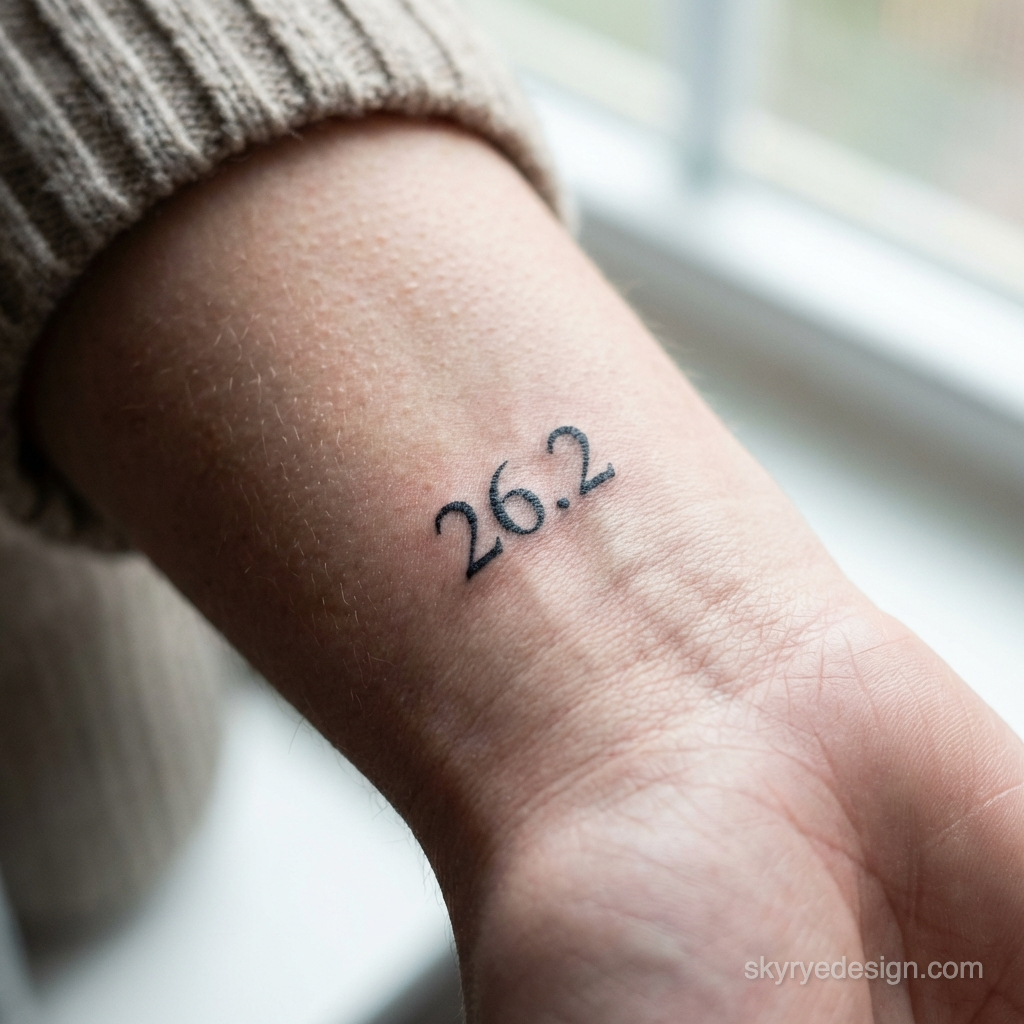
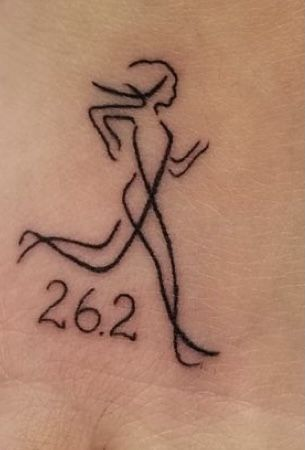
Best placement: Inner wrist, top of foot, back of ear for subtle placement; calf for visibility
Style to ask for: Fine line or single-needle; handwritten script if personalising with your own writing
2. Runner Silhouette
A single-colour outline of a running figure — the most universal ‘I am a runner’ tattoo that exists. Works at nearly any size and reads clearly at a distance. To elevate it: add a specific landscape behind the figure (mountains for trail runners, a city skyline for road runners), or make the runner’s stance match your actual running form — your artist can work from a photo of you mid-stride.
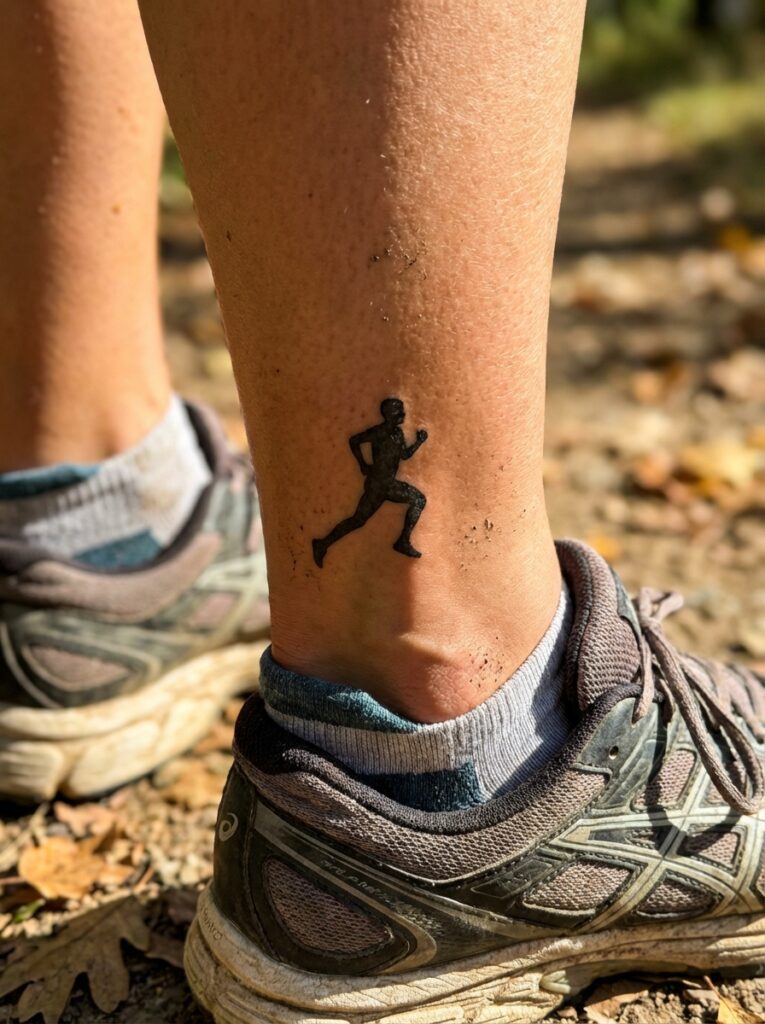
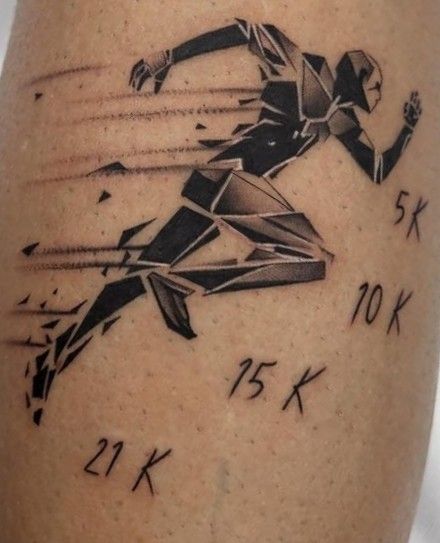
Best placement: Ankle, inner forearm, shoulder — anywhere the elongated silhouette has room to breathe
Style to ask for: Blackwork or fine line; geometric silhouette for a more modern take
3. Running Shoe
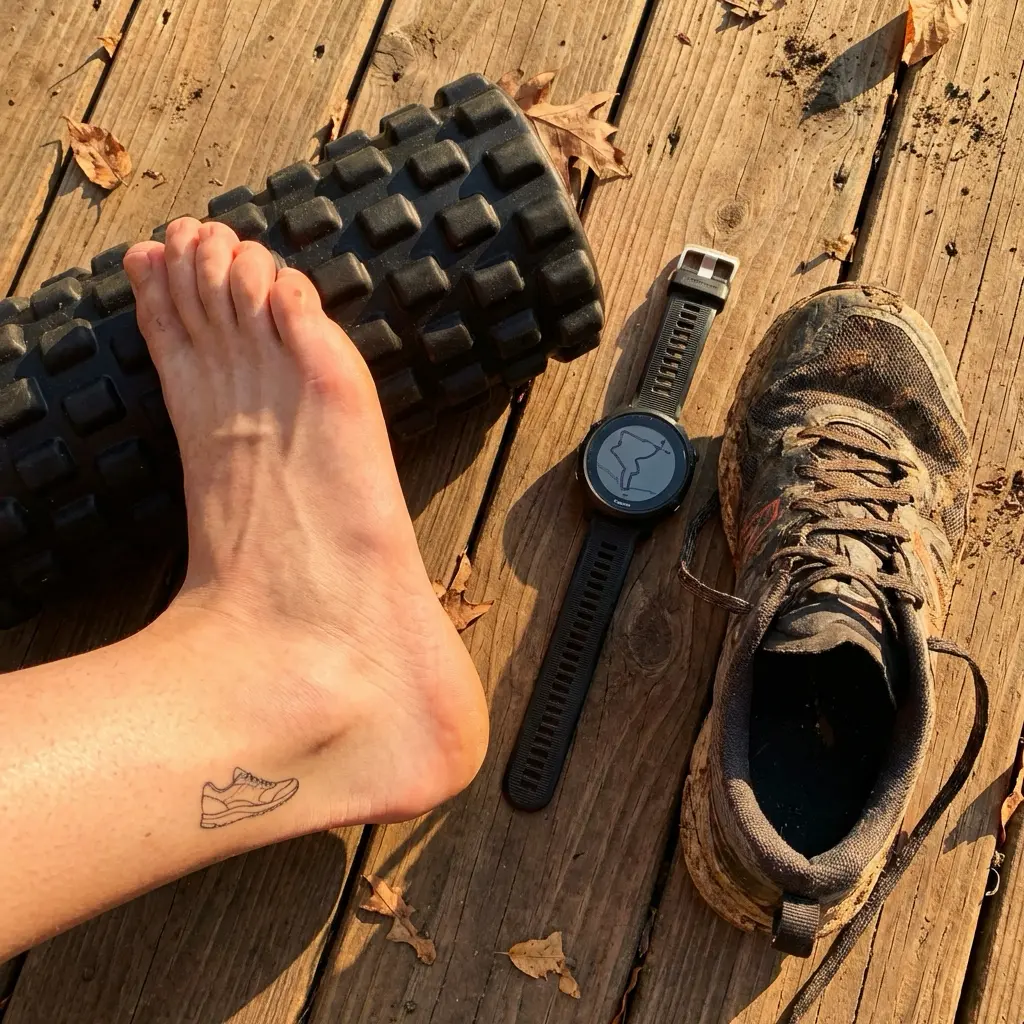
Not a brand logo — a stylised or realistic rendering of a well-loved running shoe. Works especially well when it references your actual shoe: the silhouette of a worn Nike Pegasus, a New Balance 1080, or the low-profile shape of a racing flat. A worn, slightly beat-up shoe reads more authentically than a pristine product-shot version.
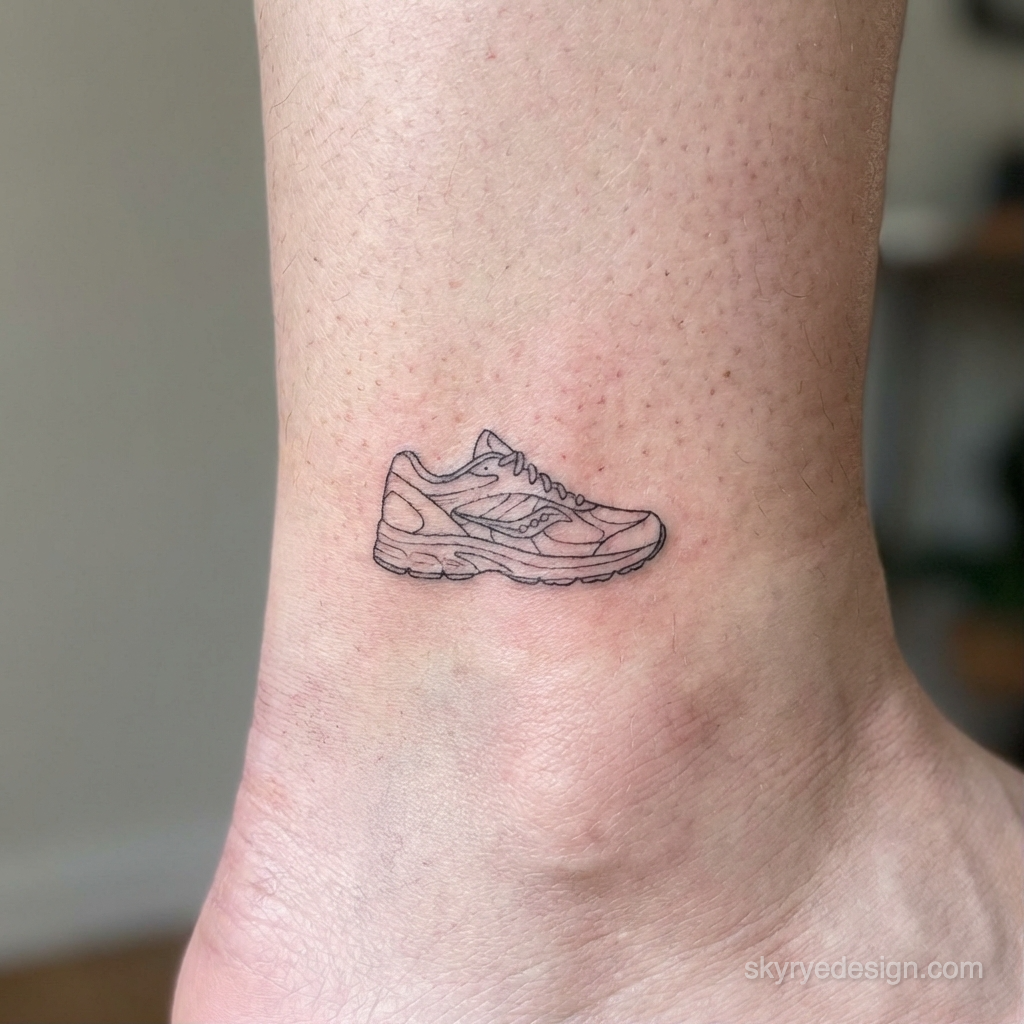
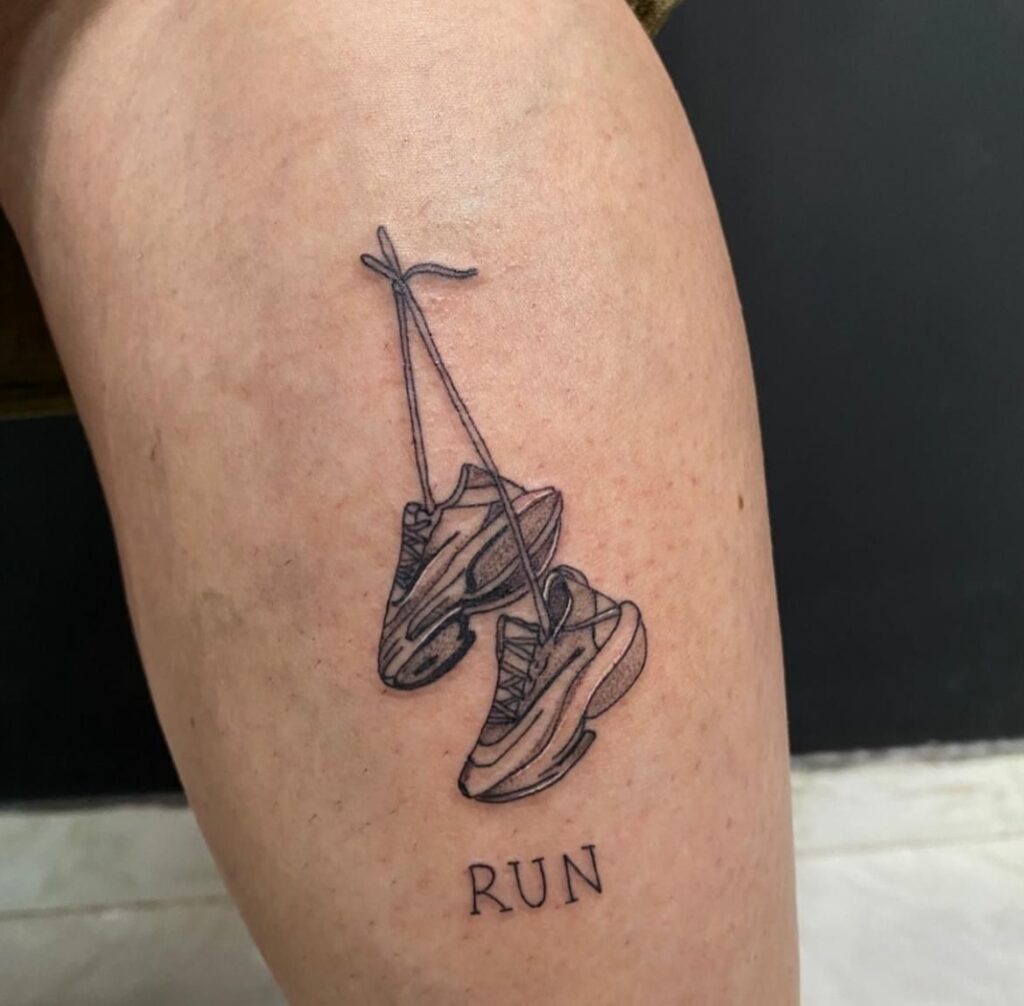
Best placement: Top of foot (meta — your shoe on your shoe), inner ankle, forearm
Style to ask for: Fine line for detail; watercolour wash for a more expressive feel
4. Finish Line Tape
A horizontal line of tape — the kind you run through at the end of a race — with optional text: your time, a date, a word. Works beautifully as a thin band around a wrist or ankle. Can also be rendered as a ribbon mid-break, which has more visual dynamism than a flat horizontal line.
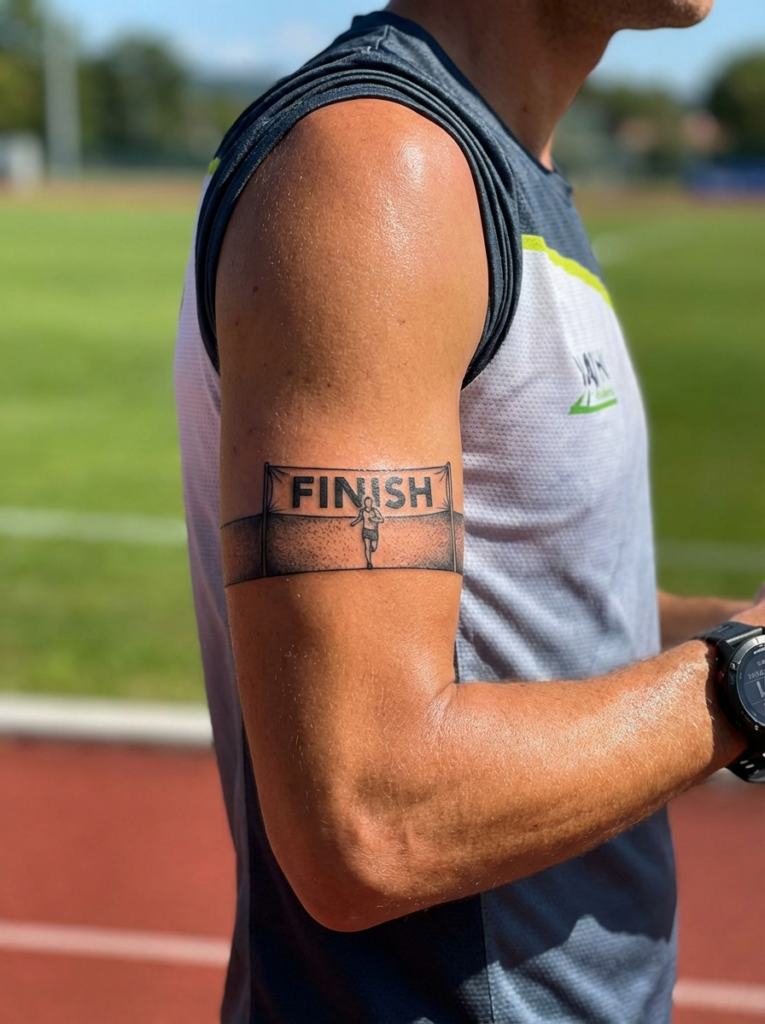
Best placement: Wrist as a band, ankle as a band, upper arm
Style to ask for: Single-needle fine line; keep it clean and minimal
5. GPS Route Map
Export the route of a meaningful run — your first marathon, the trail where you got your PR, the loop you’ve run every morning for five years — as a line map and have it tattooed as-is. Services like Strava allow you to export a clean SVG of any run, which you can hand directly to a tattoo artist. Jonathan Ichikawa of Vancouver has the course maps of every marathon he’s completed tattooed on his left leg.
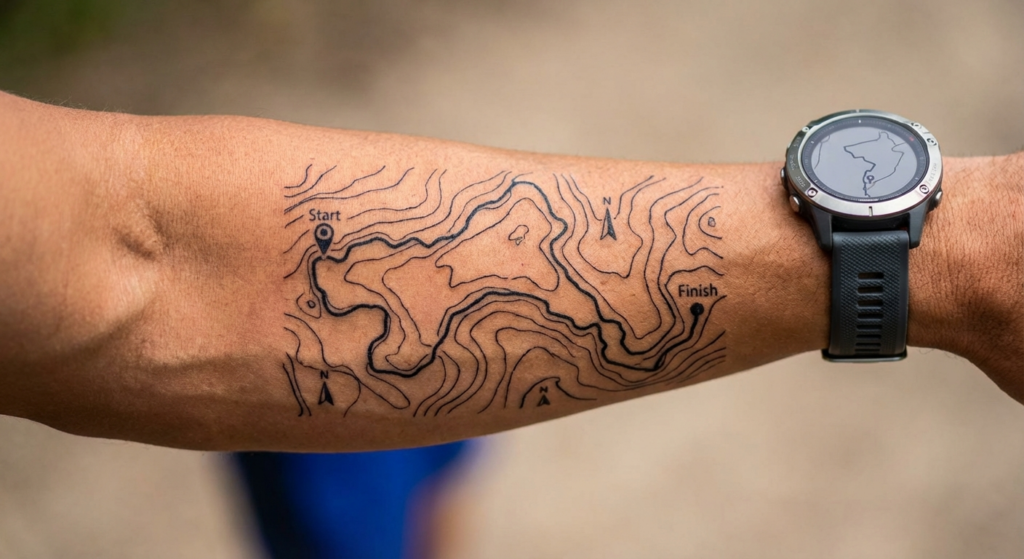
Best placement: Forearm, calf, upper arm — anywhere with enough surface area for the route detail
Style to ask for: Fine line blackwork; avoid shading so the map lines remain crisp as they age
6. Coordinates of a Meaningful Location
The GPS coordinates of somewhere that matters to your running life: the starting line of your first race, the summit where you trained, the park trail you consider home. Non-runners see numbers; runners know exactly what it means.
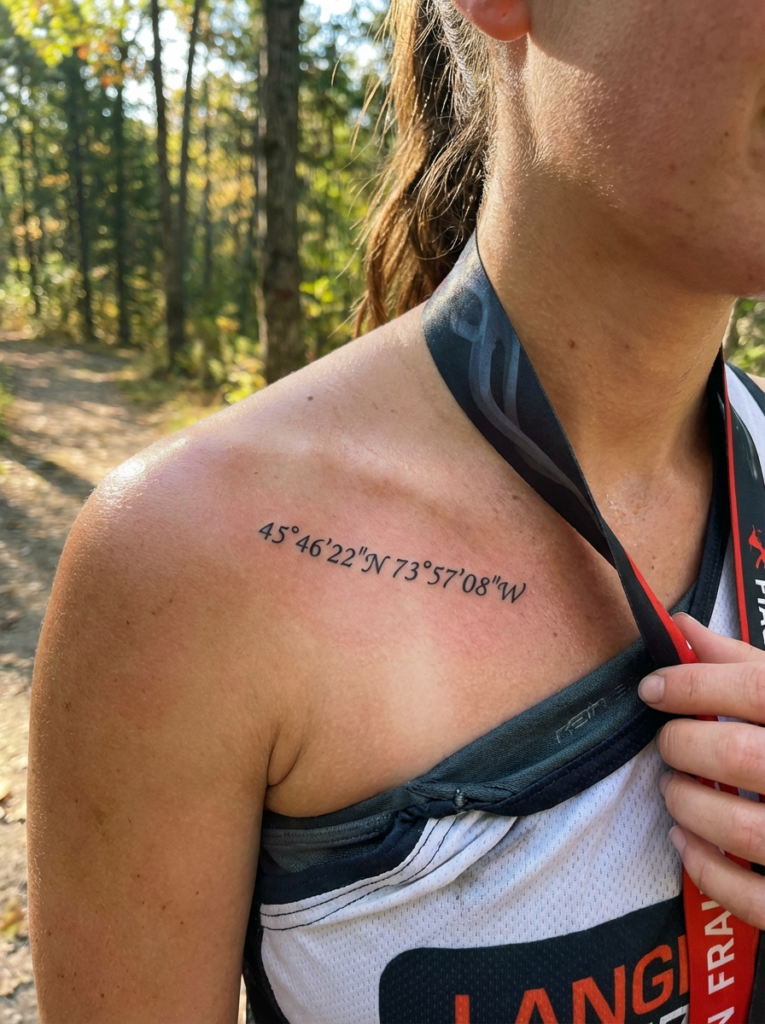
Best placement: Inner wrist, collarbone, behind ear, inner forearm
Style to ask for: Clean serif or sans-serif font; no decorative elements needed
Marathon Tattoo Ideas and Race Milestone Tattoos
Marathon tattoo ideas usually work best when they mark a specific race memory, not just the fact that you ran 26.2 miles. A finish time, race bib number, course map, medal detail, or PR date gives the design a story to hold onto when the race itself becomes a blur.
7. Your Actual Finish Time
Not a round number — your exact time, down to the seconds. 3:47:22. 5:12:04. Whatever it was. This separates the ‘I ran a marathon’ tattoo from the ‘I ran MY marathon’ tattoo. It’s the difference between a fact and a memory. Pair it with a minimal design element — a small laurel, a line, a distance — and it becomes a complete piece.
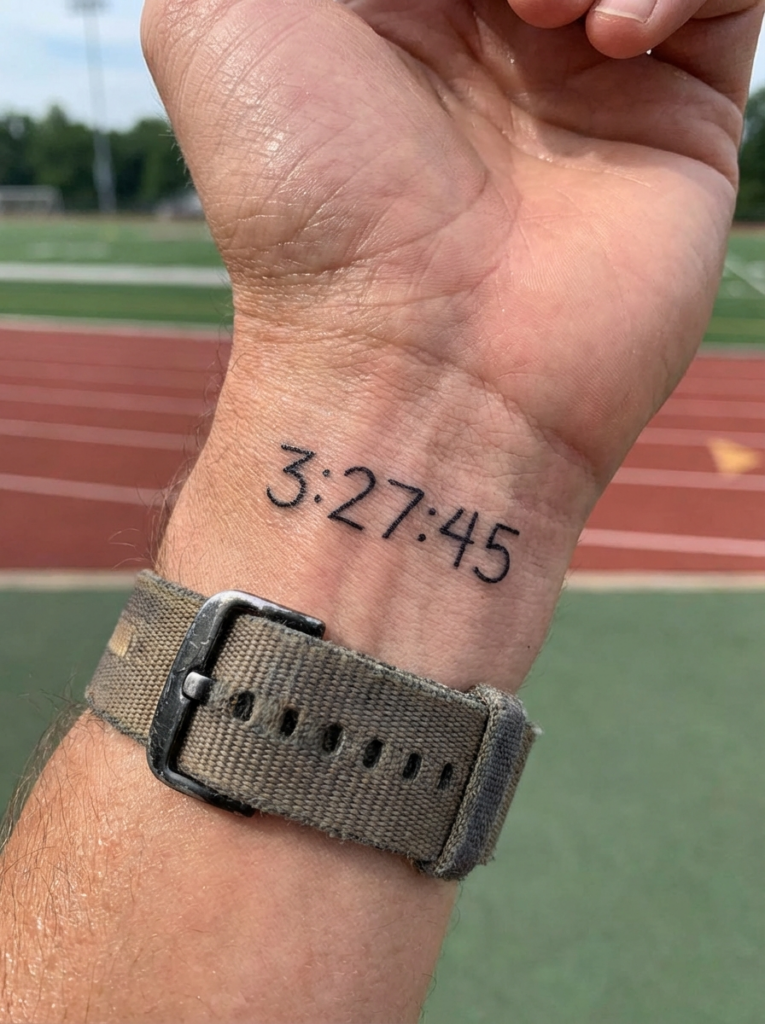
Best placement: Inner wrist, collarbone, behind knee, top of foot
Style to ask for: Clean typography — a narrow serif like Garamond works well for numbers
8. Race Bib Number
Your bib number from a specific race, rendered as it appeared on the day — font, colour, race name, and all. Works beautifully in a slightly weathered, vintage style — ink a little faded, edges slightly worn — to suggest that this bib has been through something.
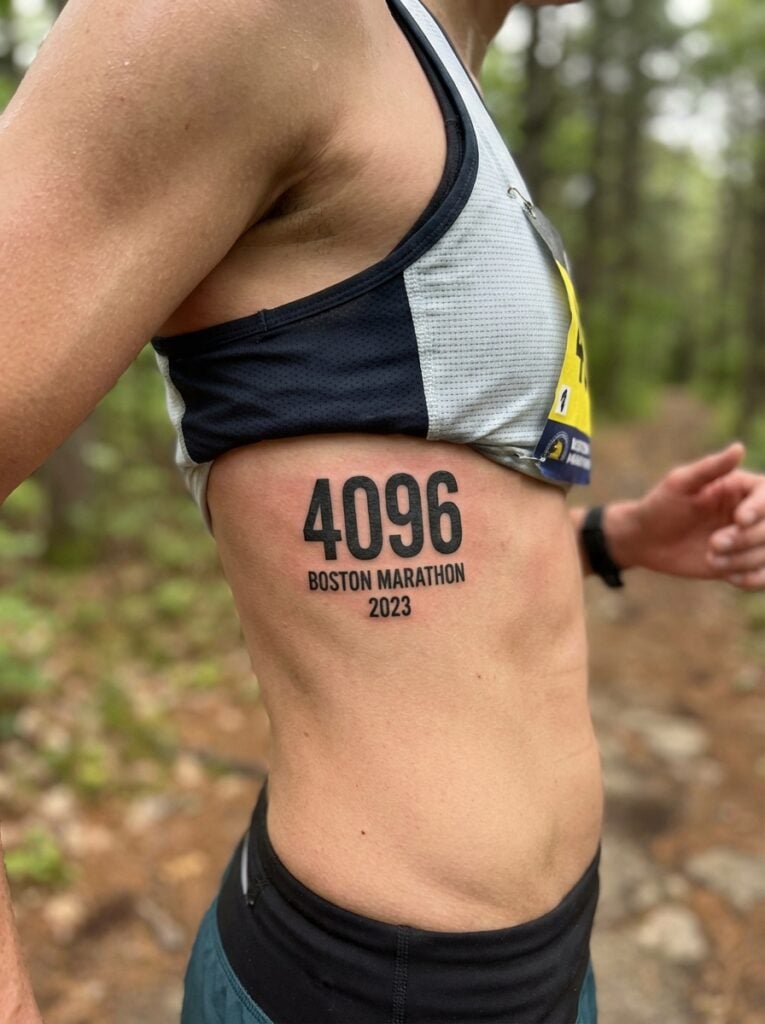
Best placement: Ribcage, upper arm, shoulder blade — slightly hidden, personal spots work well
Style to ask for: Neo-traditional for a stylised treatment; realism if you want accuracy; vintage weathered style
9. Race Medal
The medal from a specific race, rendered in detail. The finisher medals for major marathons (Boston, Berlin, Tokyo, London, New York, Chicago — the World Marathon Majors) are distinctive enough to be legible as tattoos. A Boston Marathon unicorn medal tattoo, for example, immediately communicates something specific about the runner’s history.
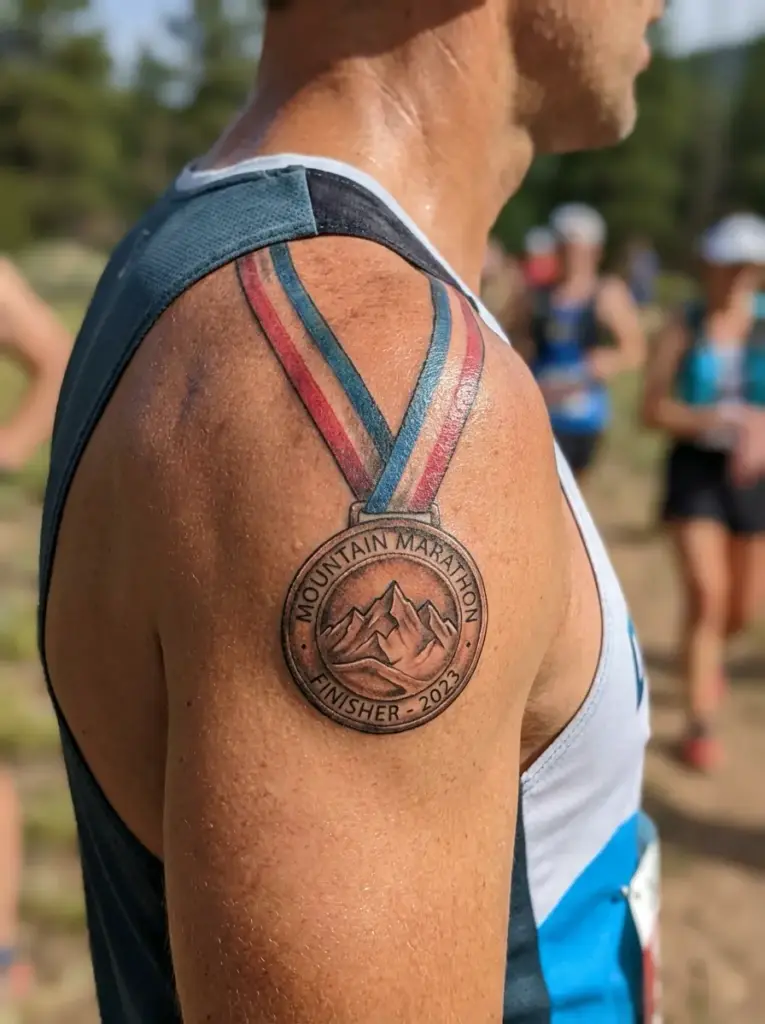
Best placement: Upper arm, shoulder, thigh, calf
Style to ask for: Neo-traditional blackwork with fine detail; avoid colour unless it’s integral to the medal design
10. The 6-Star Tattoo
If you’ve completed all six World Marathon Majors — Tokyo, Boston, London, Berlin, Chicago, New York — you receive the Abbott Six Star medal. A six-pointed star, or six small symbols representing each city, or the actual six-star logo incorporated into a personal design. The running community recognises it immediately.
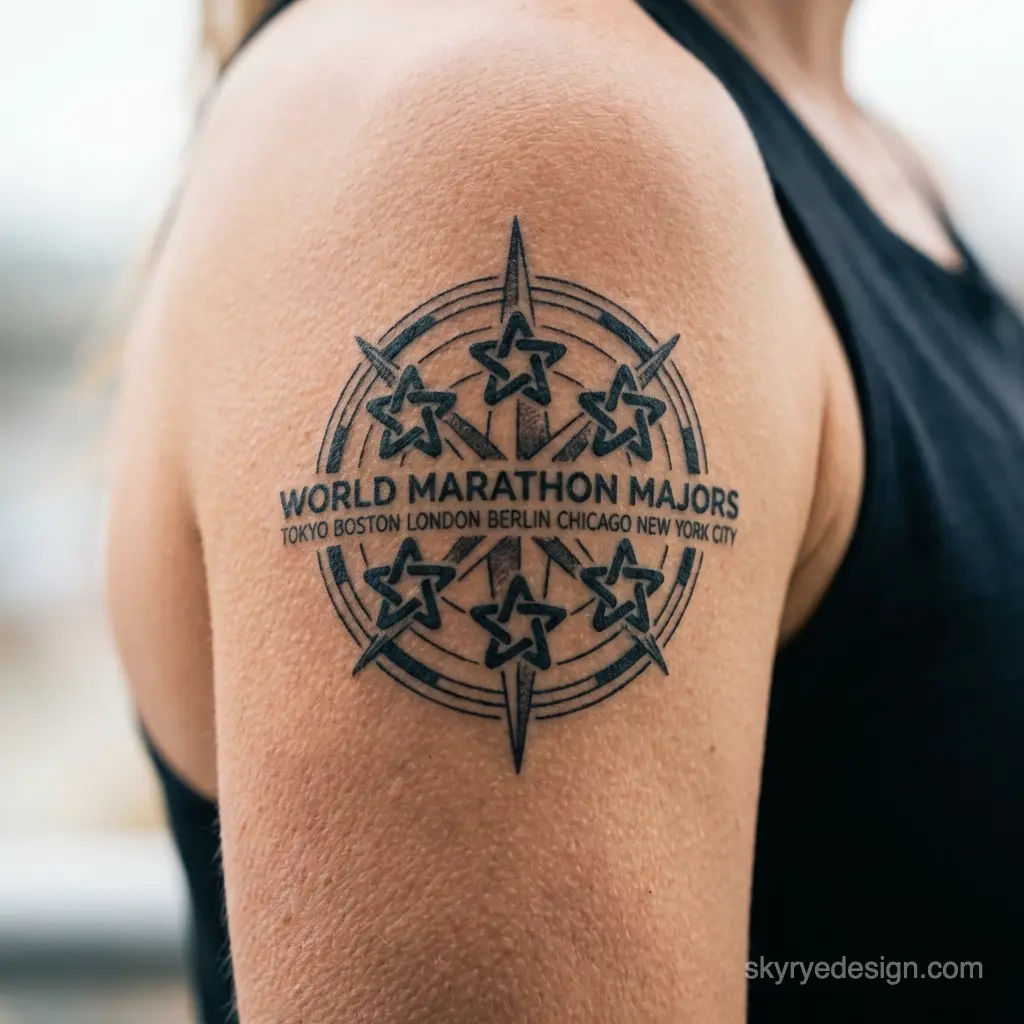
Best placement: Forearm, upper arm, shoulder — somewhere you see it
Style to ask for: Geometric fine line for the stars; blackwork for longevity
11. PR Date + Distance
Not just the number — the date it happened, combined with the distance. The way you might write it in a running journal: ‘Oct 13, 2023 — 3:44:11 — Berlin.’ Multiple PRs stacked over years become a visible record of growth — each one a chapter.
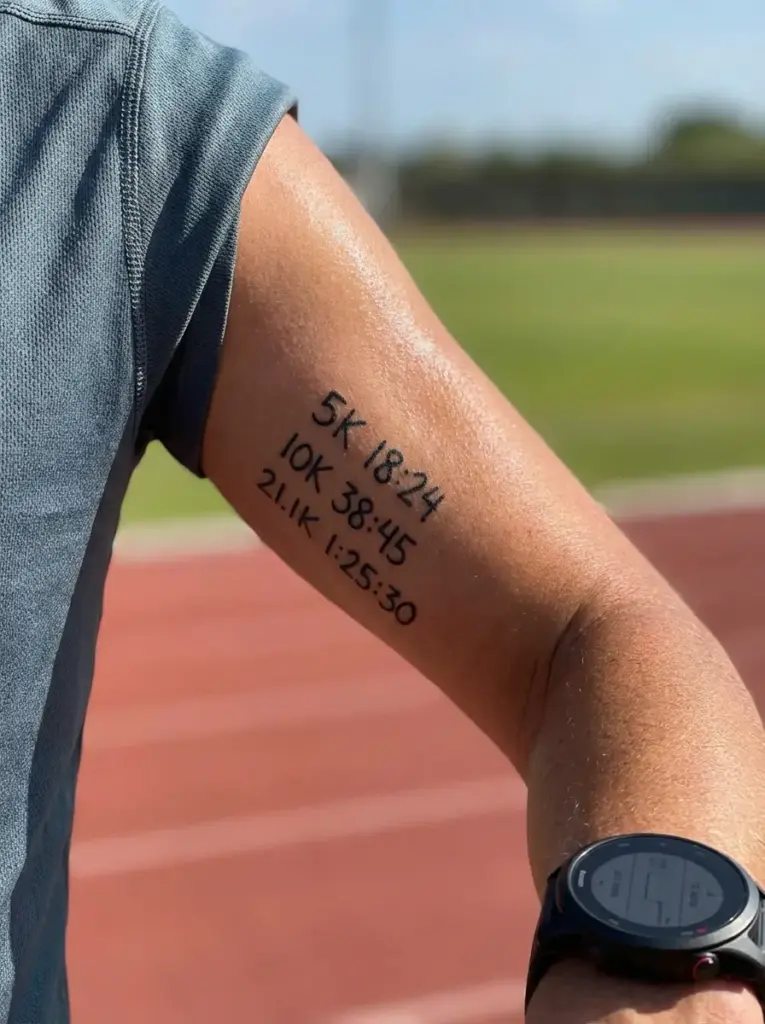
Best placement: Inner forearm as a running list, inside upper arm
Style to ask for: Clean handwritten script or typewriter-style font; minimal and legible
Running Quote & Mantra Tattoo Ideas
The phrase you tell yourself in the final miles. These work best when they’re genuinely personal — not borrowed inspiration, but the actual words that live in your head during a hard run.
12. “Miles to go before I sleep”
From Robert Frost’s ‘Stopping by Woods on a Snowy Evening’ — one of the most popular running tattoo quotes in existence. It works because it’s simultaneously about literal running distance and something much larger. The top-of-foot placement is especially popular because you see it on every run.
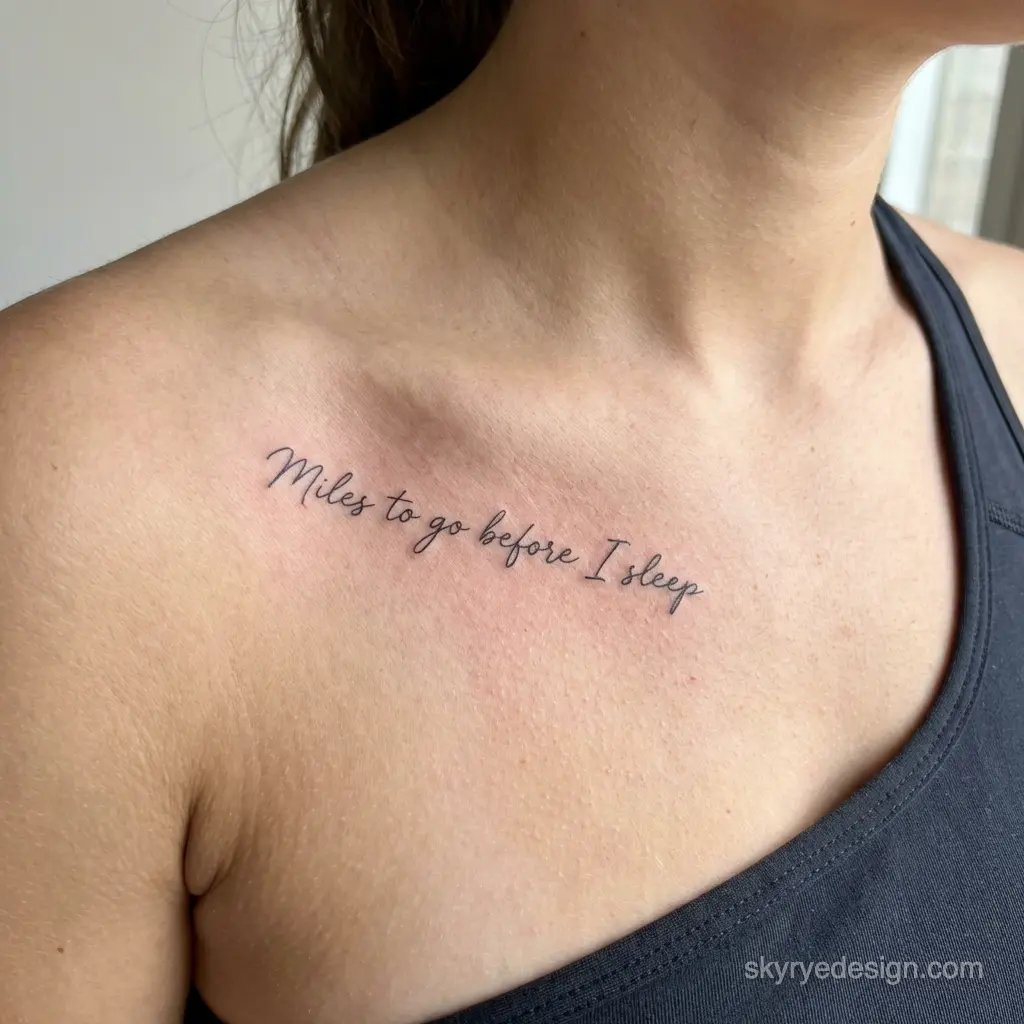
Best placement: Top of foot (high pain, high visibility on runs), inner forearm, collarbone
Style to ask for: Fine line script; small size; elegant rather than bold
13. Your Personal Mantra
Not a famous quote — yours. The phrase you actually repeat in your head during the 20th mile. ‘Keep moving.’ ‘One more step.’ ‘Just run.’ ‘Earn it.’ Kim Stiff had ‘run hard, run fast, just run’ tattooed on her right forearm so she sees it on every run — then added 26.2 after her first marathon.
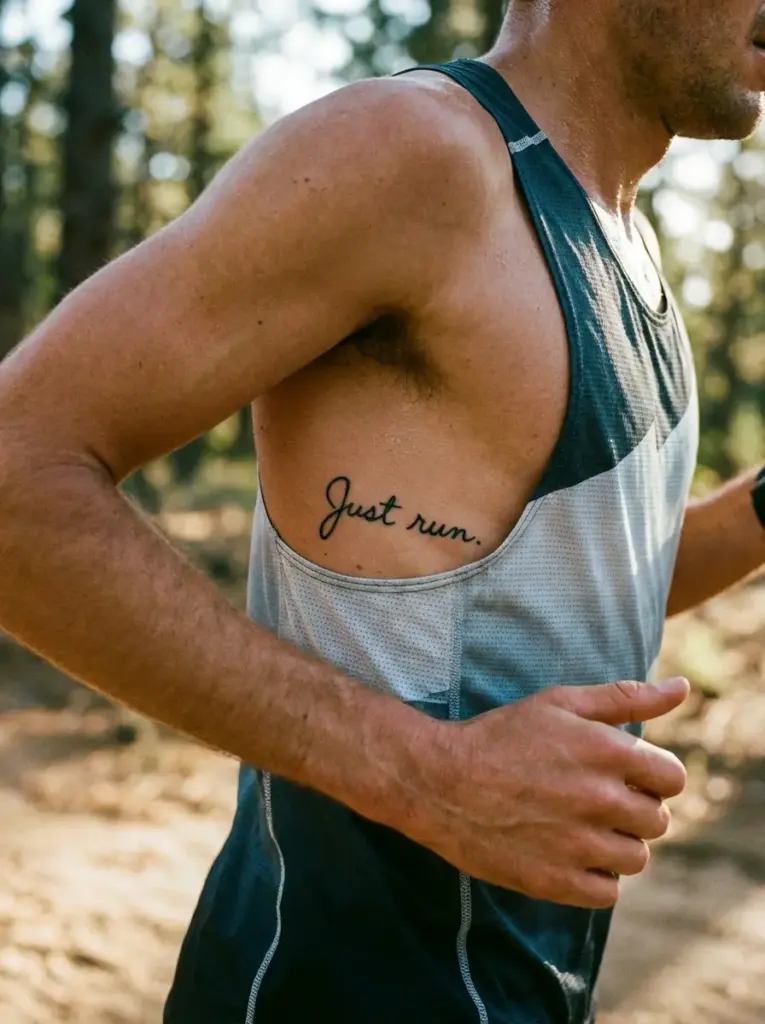
Best placement: Inner forearm (you see it mid-run), inner wrist, ribcage for private placement
Style to ask for: Handwritten — literally your own handwriting photographed and traced by the artist
14. “I just felt like running” — Forrest Gump
For runners with a sense of humour about their obsession. Works as a serious tattoo or a knowing wink depending on the font and placement. Understated and small reads as sincere; larger and bolder reads as self-aware. The reference is immediately recognisable to a generation of runners who started with a casual run and somehow ended up training for ultras.
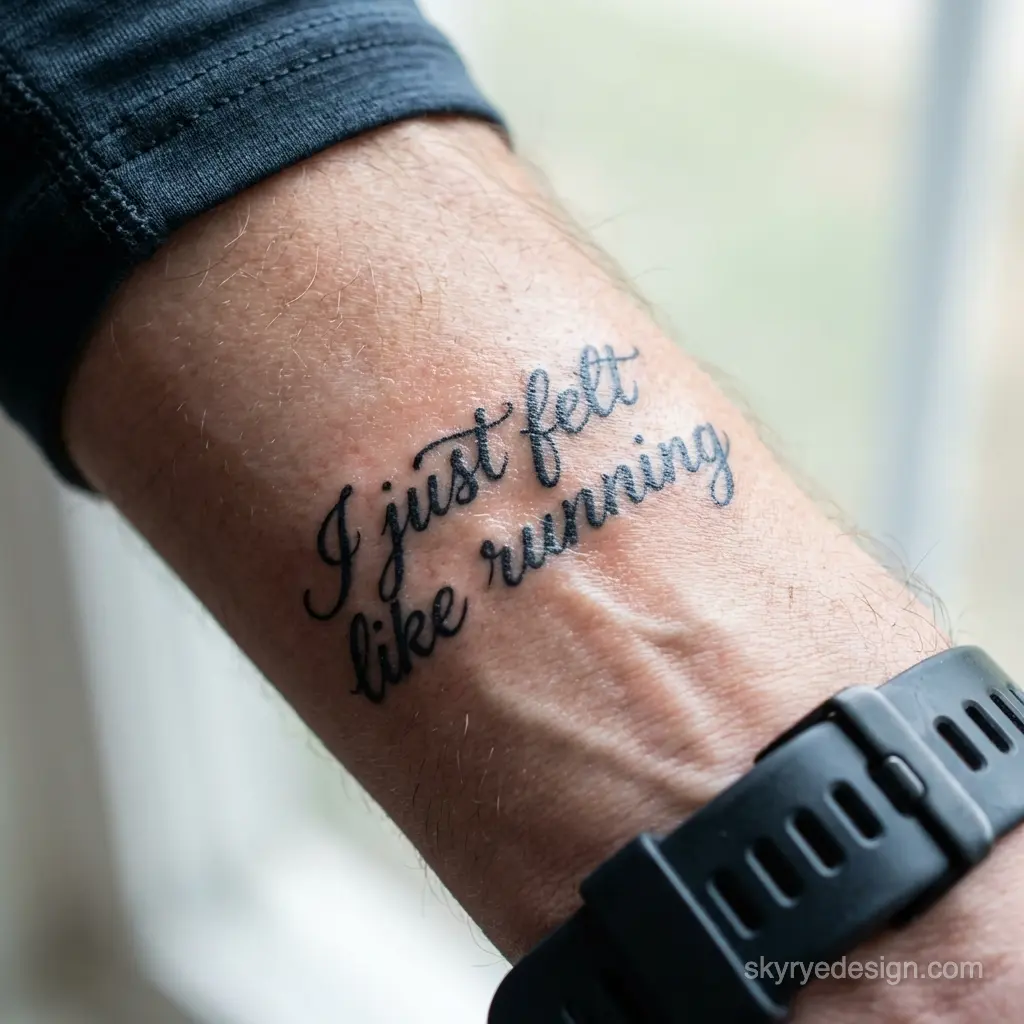
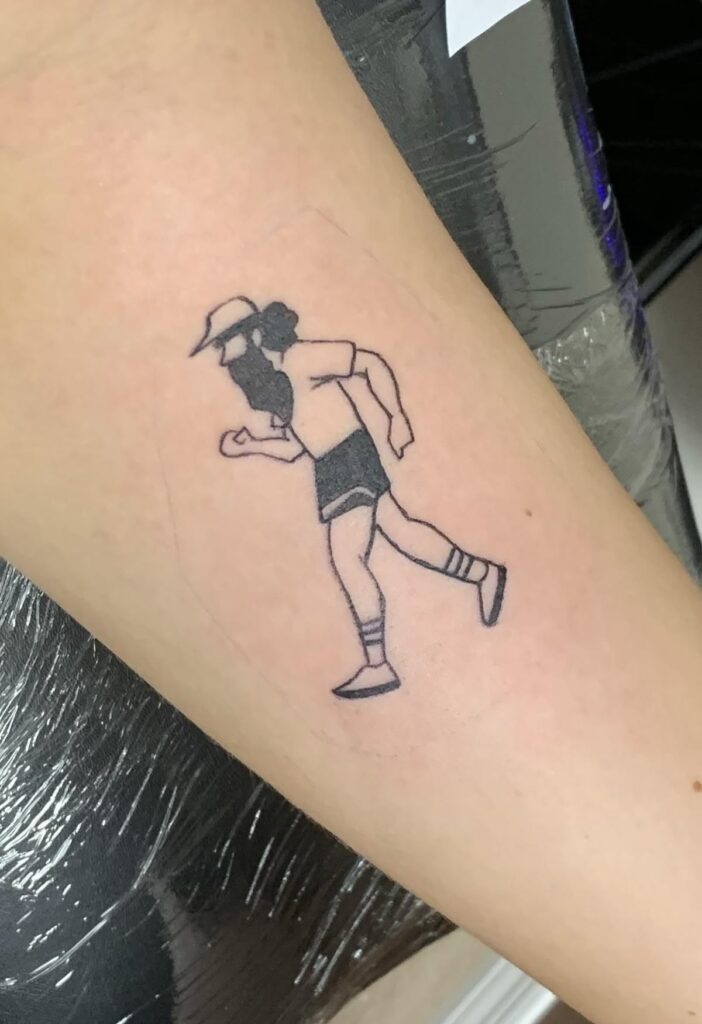
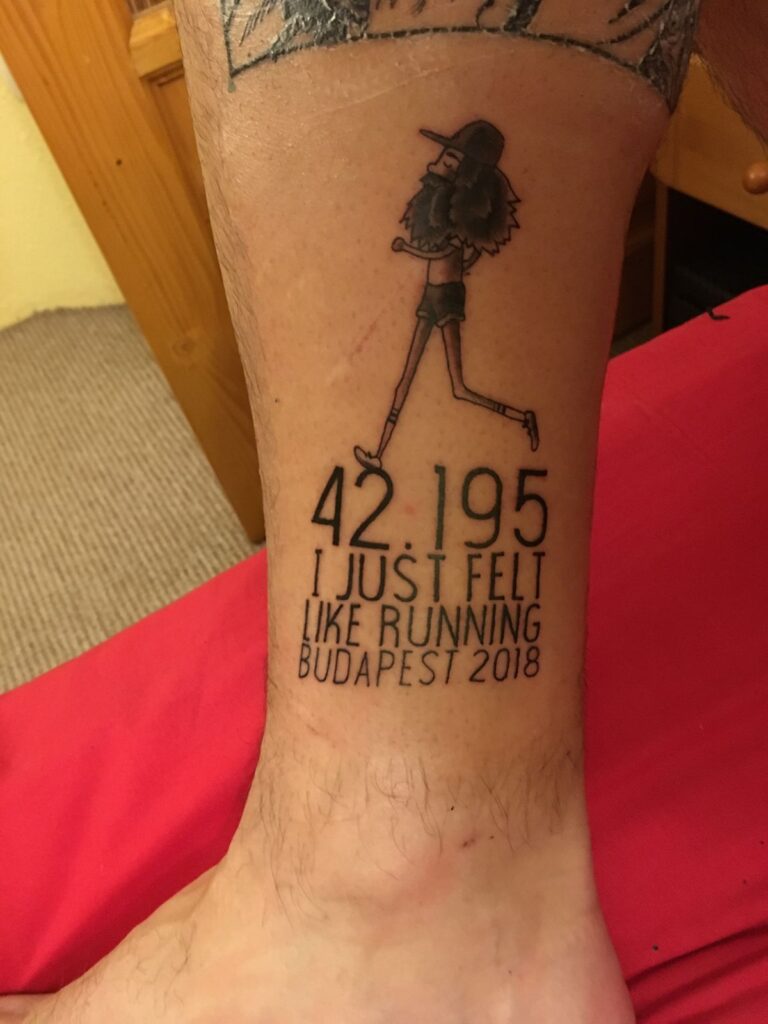
Best placement: Inner ankle, inner wrist, small font behind ear
Style to ask for: Simple sans-serif or italic script; keep it small
15. The Runner’s High Molecule — Met-enkephalin
Runner’s high is caused partly by a release of met-enkephalin — a pentapeptide whose molecular structure has been tattooed by runners who want a science-based way to say ‘I run for how it makes me feel.’ Emily Macaulay’s met-enkephalin structure tattoo went viral in the running community in 2016 and sparked a micro-trend that’s still going.
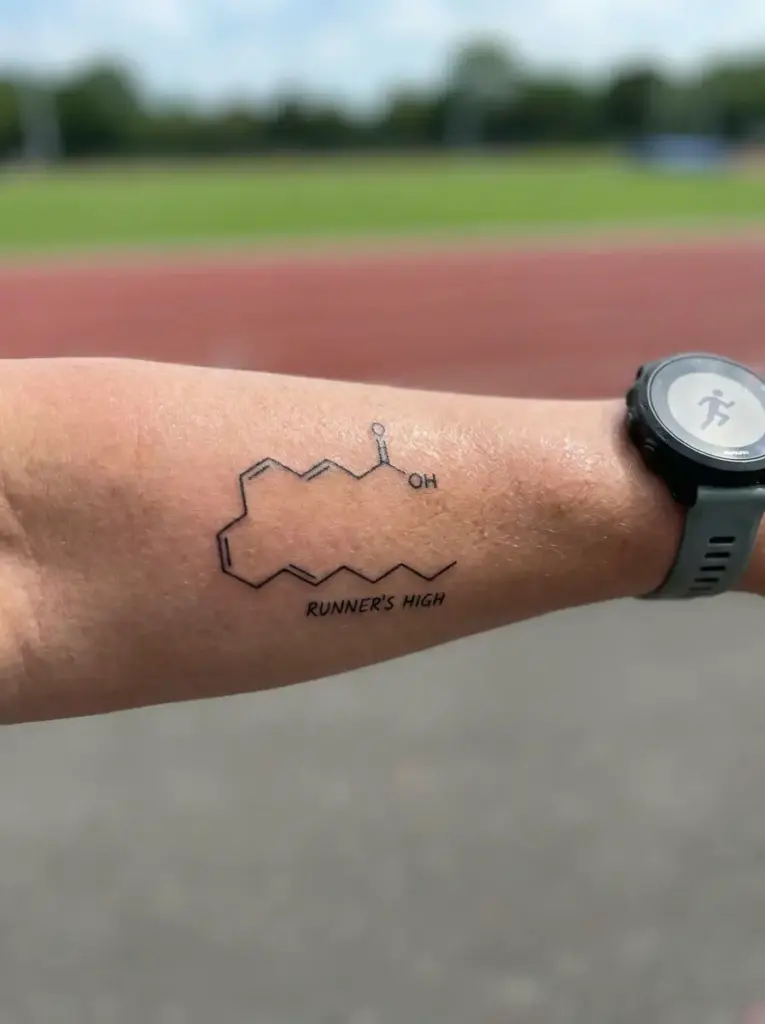
Best placement: Inner wrist, inner forearm — somewhere intimate, befitting the personal nature of the feeling
Style to ask for: Fine line technical diagram style; black ink only; keep it precise
Trail Runner Tattoo Ideas With Mountains, Maps and Nature
For trail runners, the strongest tattoo ideas are mountain silhouettes, topo maps, pine trees, route lines, compass details, and small landscape cues from a real place. A trail runner tattoo should feel like terrain, not clip art: line weight, contour spacing, and placement matter more than adding every tree and rock.
16. Mountain Range Silhouette
A continuous line of mountain peaks — either a specific range you race in, or a stylised representation of the terrain that defines your running. Trail runners who’ve completed iconic races in the Alps, Rockies, or Dolomites often use the actual profile of those peaks as their design reference.
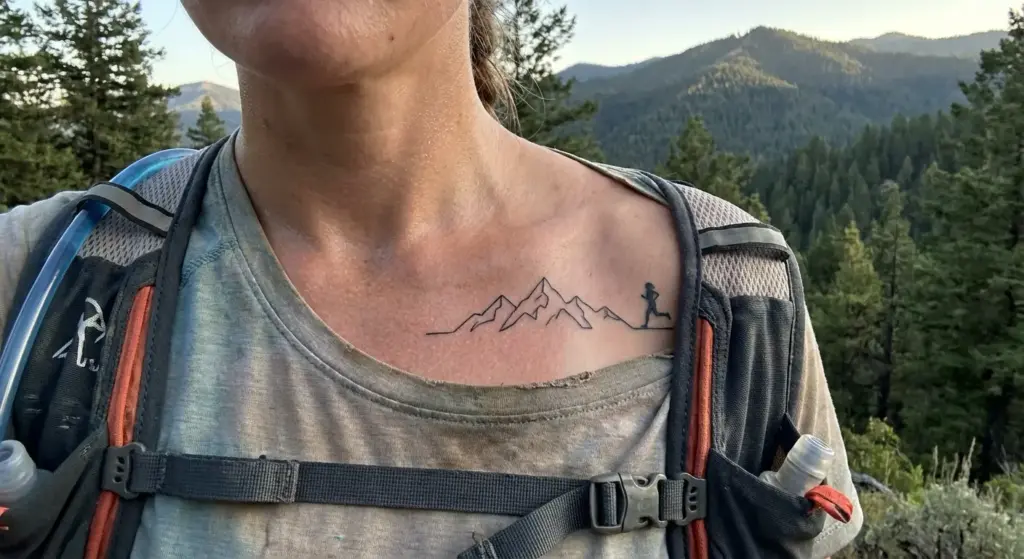
Best placement: Wrist as a band, upper arm, across collarbone, shoulder blade
Style to ask for: Fine line blackwork; continuous line style for minimalist treatment; stipple for texture
17. Trail Map of a Favorite Route
The contour lines, switchbacks, and terrain markers of a trail map section. USGS topographic maps can be printed and used as direct reference material for a tattoo artist. The combination of topo lines and a route highlight is visually complex enough to be interesting at larger sizes while still reading as meaningful.
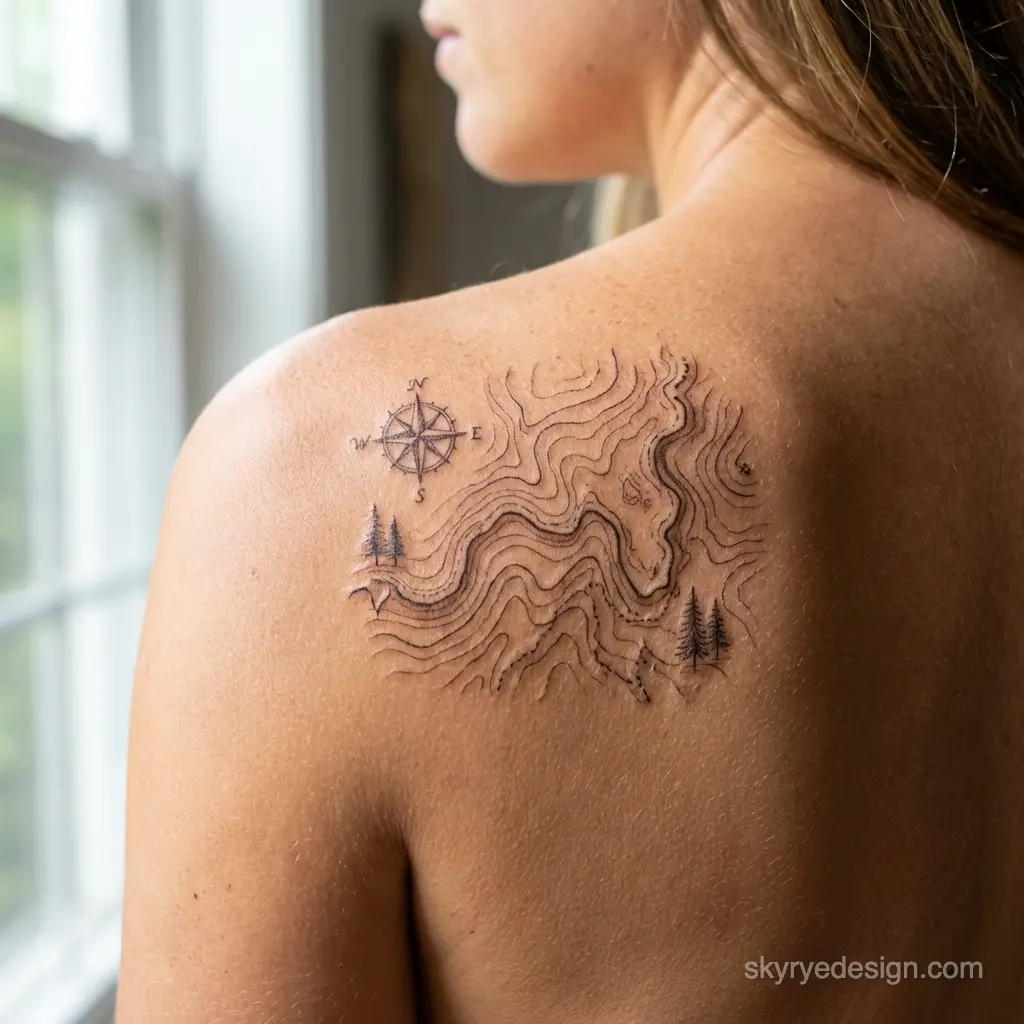
Best placement: Calf, forearm, shoulder blade — needs enough space for the map detail
Style to ask for: Fine line technical; avoid fills so lines remain clear with age
18. Tree Roots + Running Figure
A runner whose legs transition into tree roots as they connect to the ground — representing the connection between movement and nature. This is a concept tattoo that requires a skilled artist who can handle the visual transition between human anatomy and organic root forms.
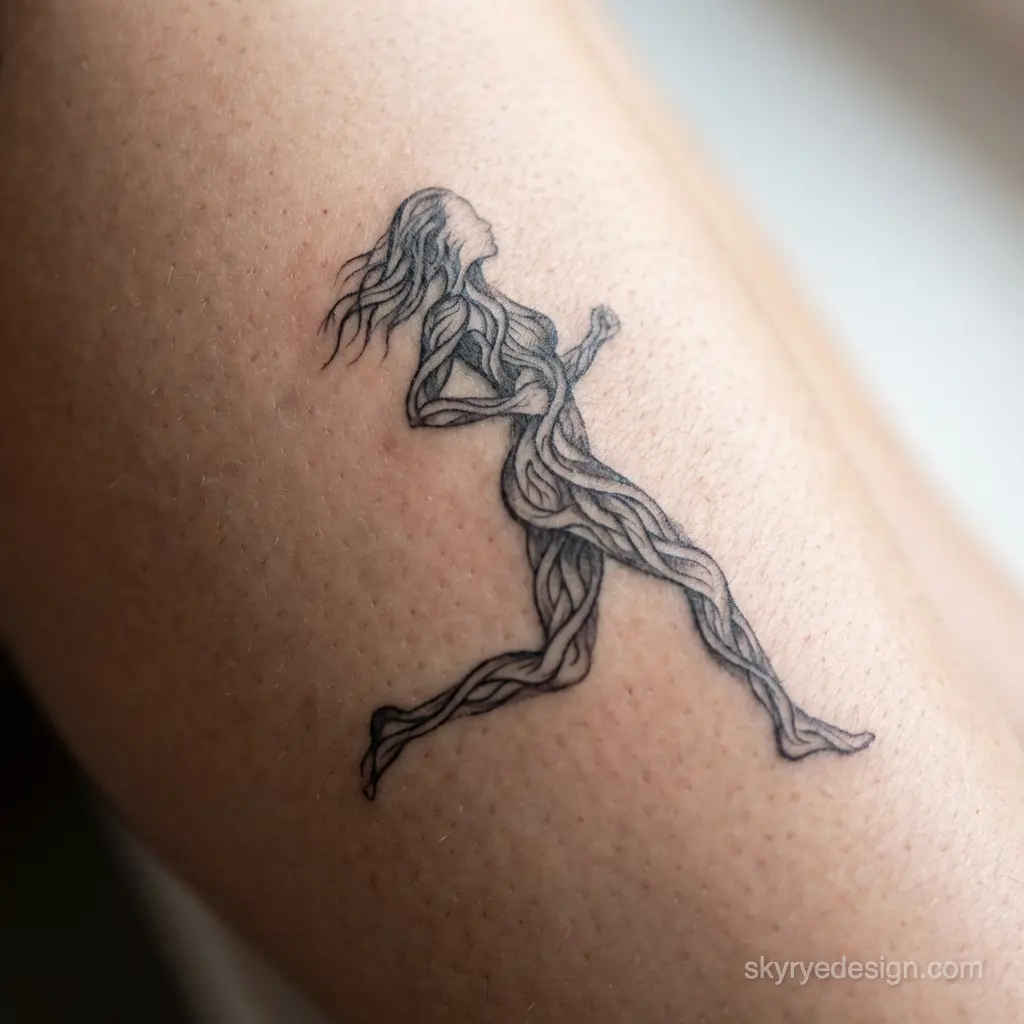
Best placement: Calf or full leg — the vertical length supports the root-spreading composition
Style to ask for: Neo-traditional blackwork or illustrative style; avoid fine line for this — needs line weight variation
19. Phoenix / Bird in Flight
For runners who came back from injury, illness, or something harder — the phoenix represents what a multi-year return to running can feel like. Susan G., quoted in Another Mother Runner, got a phoenix after major meniscal repair surgery: ‘They symbolise rebirth for the next phase of running.’
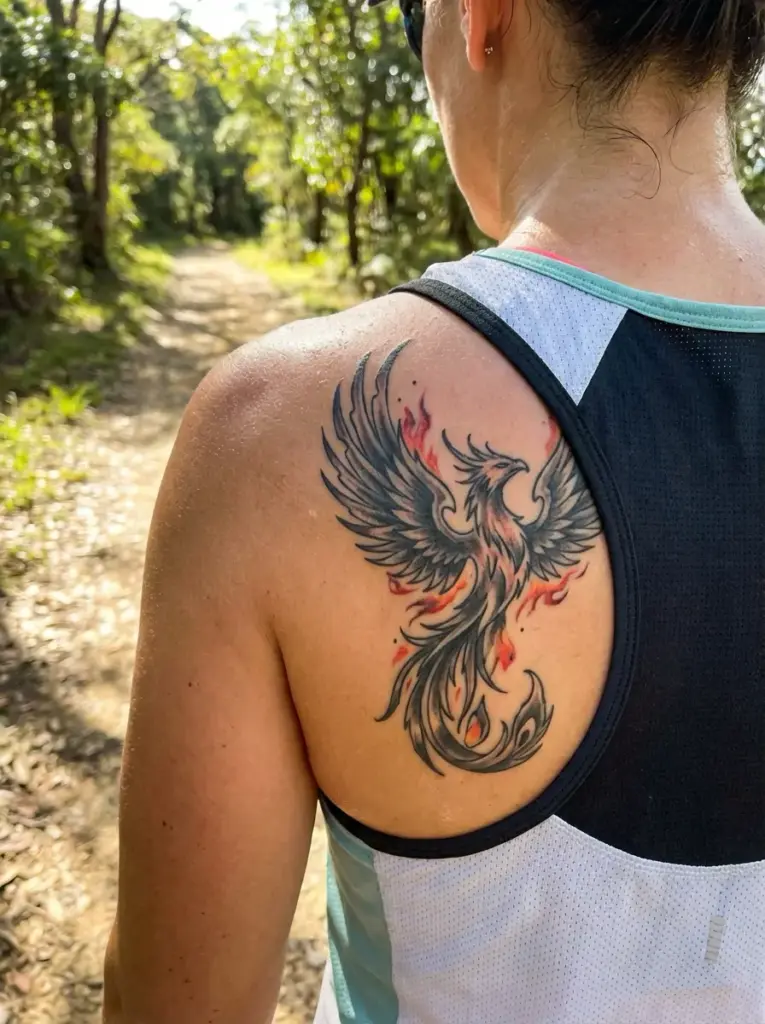
Best placement: Shoulder blade, upper arm, ribcage — placement that allows wingspan
Style to ask for: Neo-traditional for full phoenix; fine line for minimalist bird; watercolour for an emotional, loose interpretation
20. The Tortoise and the Hare
For runners who identify with the tortoise — slow, steady, still finishing. Deirdre D. described her sea turtle tattoo: ‘I’m turtle slow but I get it done — 26.2 and 50K will be added to the petals.’ This works because it reframes what it means to be a ‘real’ runner: not speed, but persistence.
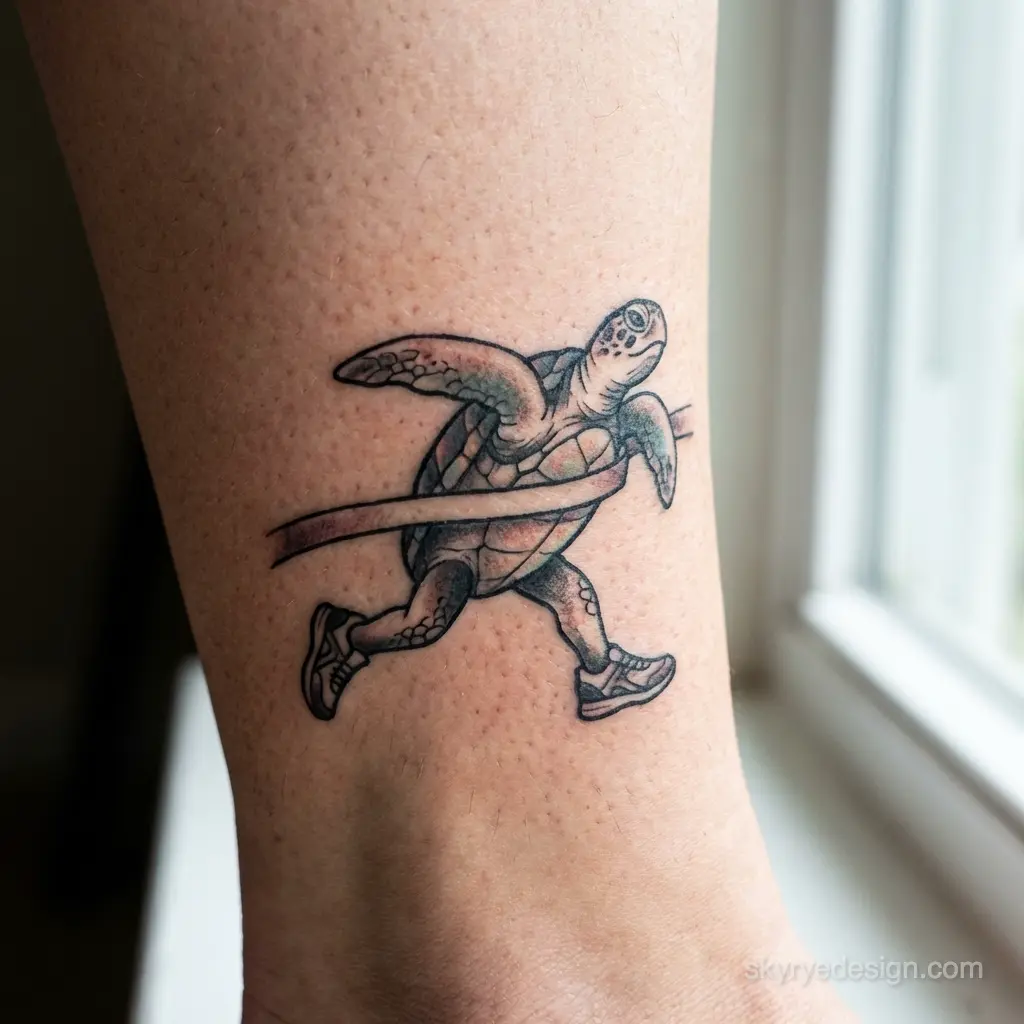
Best placement: Ankle, calf, inner arm — works at small sizes
Style to ask for: Whimsical illustrative style; fine line or minimal colour; avoid photorealism
Detailed & Statement Running Tattoo Ideas
Larger, more complex pieces for runners who want a full design rather than a single element. These require more time in the chair and a skilled artist — plan accordingly.
21. Anatomical Running Muscles
An anatomical diagram of the leg muscles most engaged in running — quadriceps, glutes, IT band, calf complex — rendered in the style of a medical illustration. This appeals to runners with a scientific or analytical relationship to their sport, physical therapists who run, or anyone who finds the biomechanics of running genuinely beautiful.
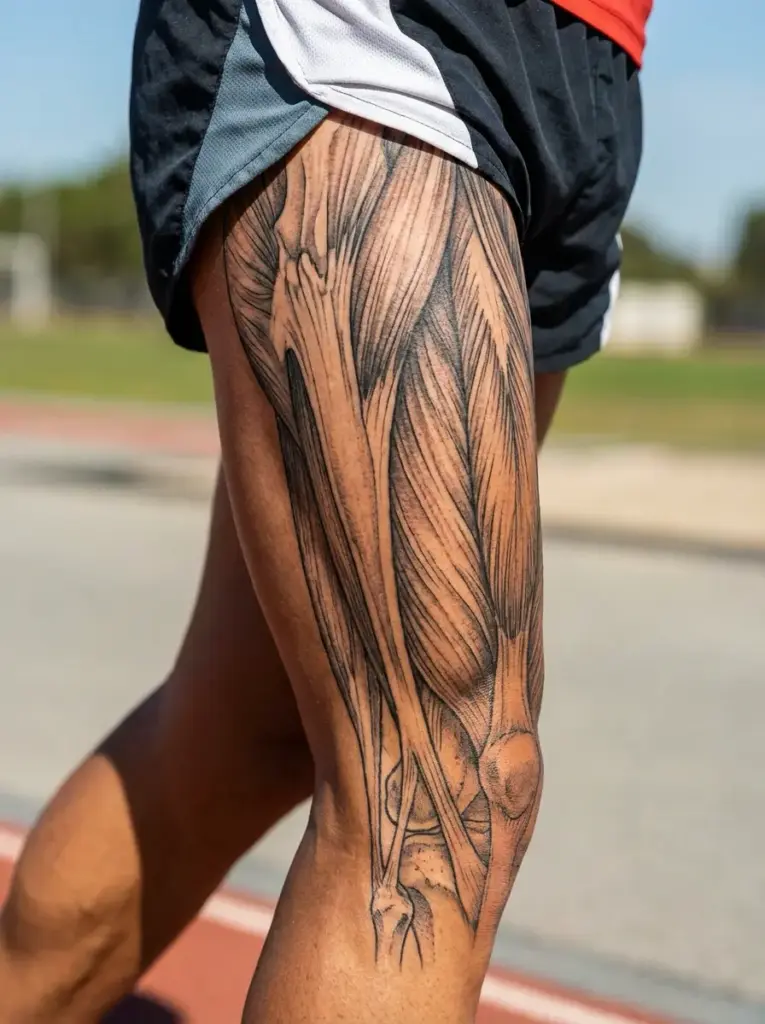
Best placement: Calf, thigh, upper arm — large enough surface for anatomical detail
Style to ask for: Fine line technical illustration; black ink; geometric precision
22. Running Scene with Personal Landscape
A full scene: a runner mid-stride against a recognisable backdrop — the Boston finish line on Boylston Street, a specific park at golden hour, a trail with a distinctive rock formation. At its best, this is personal portraiture in tattoo form.
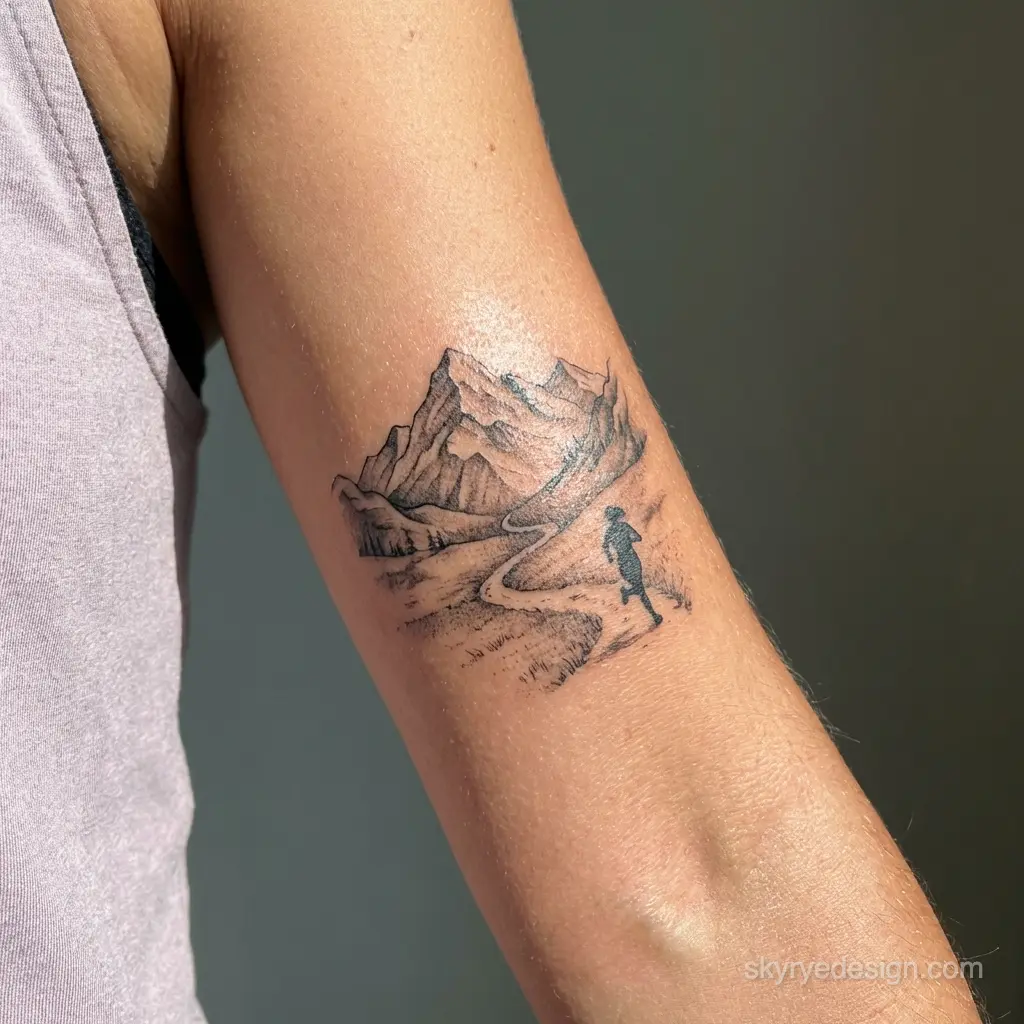
Best placement: Upper arm, shoulder blade, calf, thigh — needs space for the scene
Style to ask for: Watercolour for expressive colour landscapes; neo-traditional for bold graphic treatment; fine line for a detailed illustrated style
23. Celtic / Nordic Knotwork Runner
A running figure or symbol (track, winged foot, laurel) integrated with Celtic knotwork or Nordic rune patterns. The winged foot of Mercury/Hermes — the messenger god, the original runner — is a strong starting point for mythological running tattoo designs.
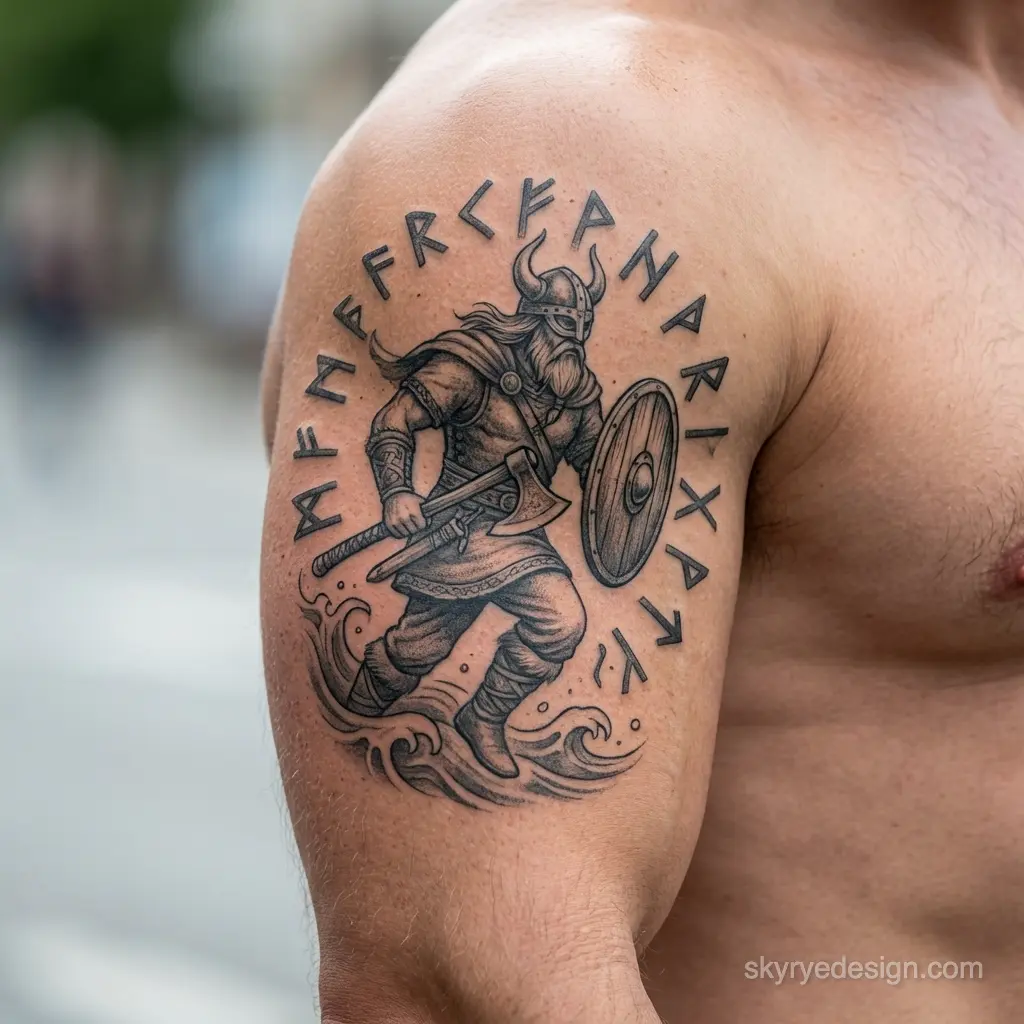
Best placement: Upper arm or forearm sleeve element, shoulder, calf
Style to ask for: Traditional blackwork with Celtic knotwork; bold line weight; avoid overcomplicating the runner figure
24. Broken Finish Line Tape
A runner breaking through finish line tape, rendered as a detailed scene. The tape wrapping around the arm or wrist as though in the moment of breaking through. This captures the kinetic energy of a race finish in a way that static numbers or symbols can’t.
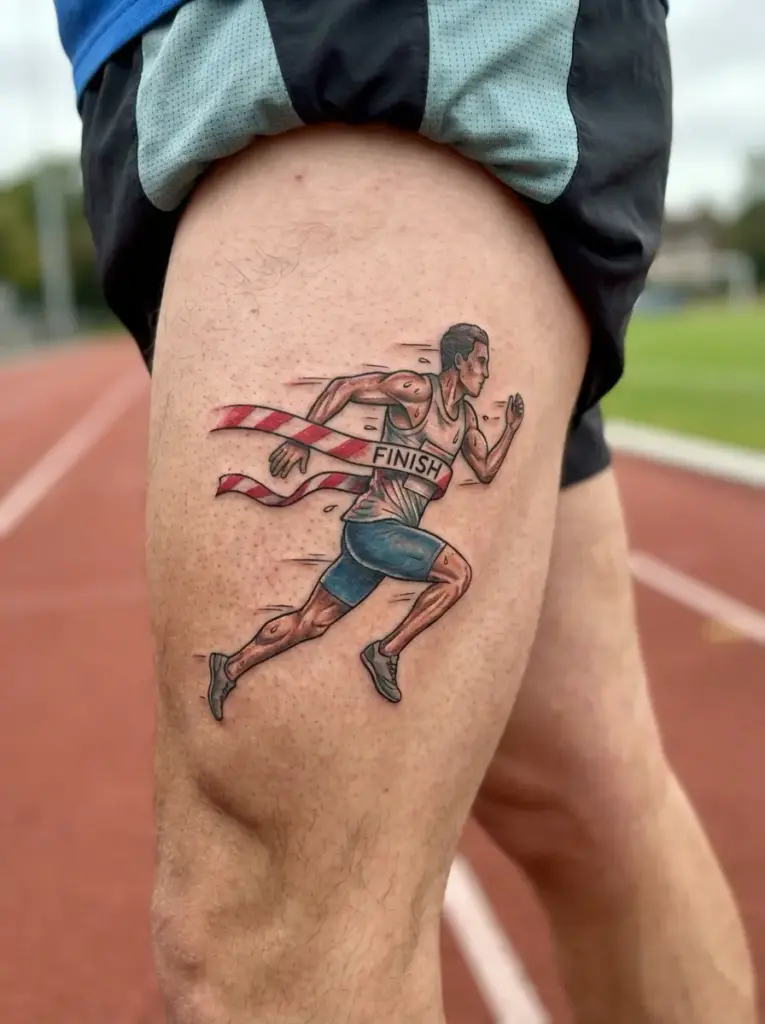
Best placement: Upper arm wrapping the bicep, wrist band with the tape element
Style to ask for: Neo-traditional for dramatic effect; fine line for a cleaner treatment
25. Shoeprint with Personal Map
The tread pattern of a running shoe with a meaningful map inside it — your city, a race course, a specific trail. Nathan Arsenault of PEI had a shoeprint incorporating his island, a runner figure, and the marathon distance after his first marathon.
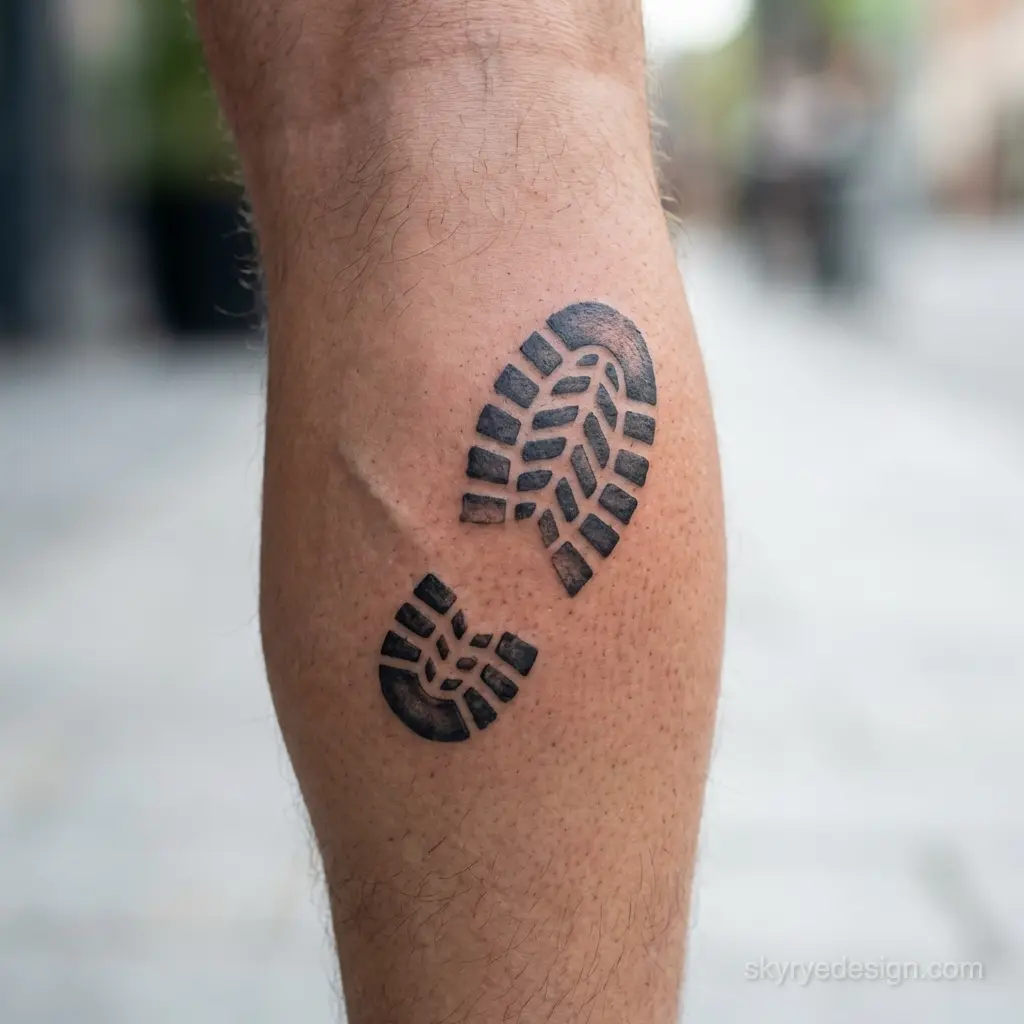
Best placement: Calf, upper arm, shoulder blade
Style to ask for: Fine line blackwork; the map detail inside the print needs a skilled fine-line artist
26. Heartbeat Line + Distance
A cardiogram line — a single peak and trough like a heartbeat monitor readout — with a running distance embedded in the rhythm, or the distance number at the end of the line. Simple and legible at small sizes.
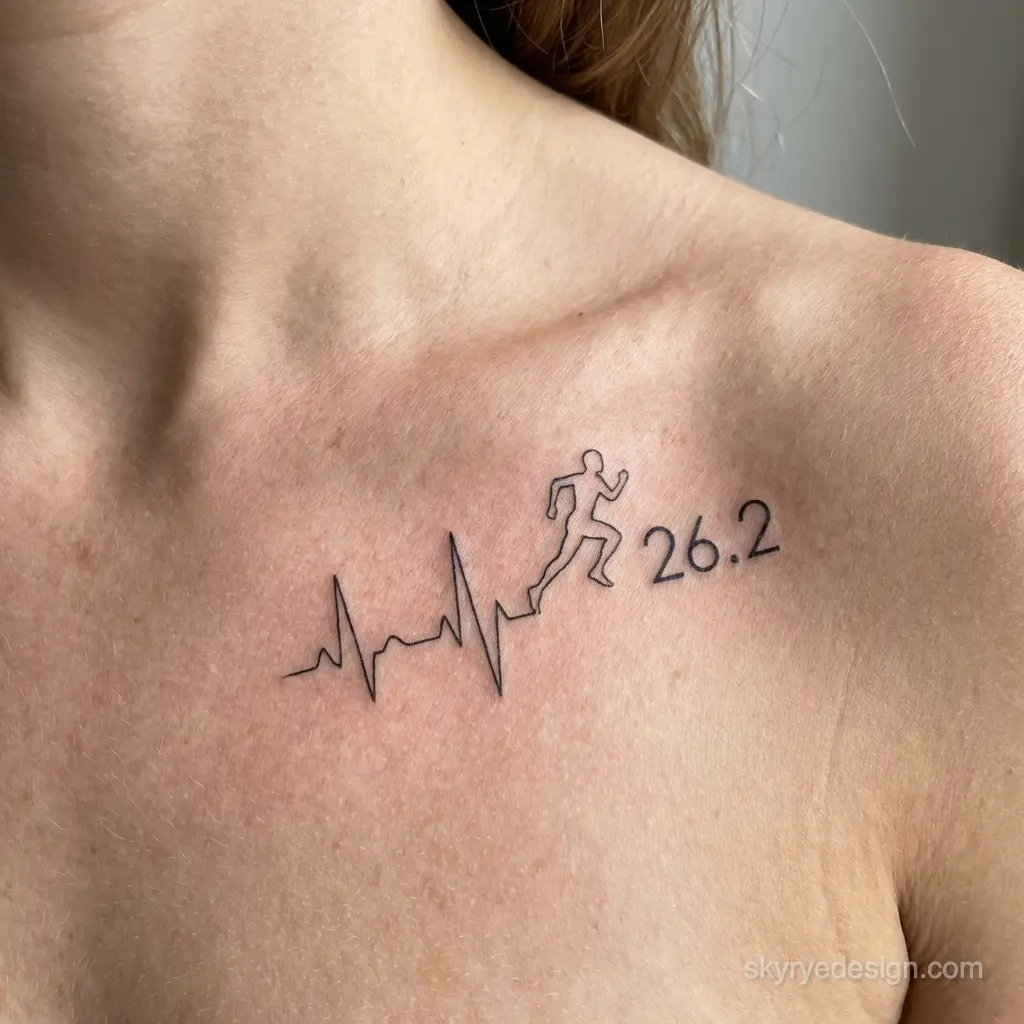
Best placement: Inner wrist, inner forearm, collarbone
Style to ask for: Fine line single needle; purely linear; no fill
27. Arrow — “Forward”
An arrow pointing forward, sometimes with directional text. Jennifer M. described hers: ‘I drew an arrow on my hand to remember to just move forward. When the path is uncertain, faith moves us forward.’ One of the most versatile and age-proof tattoo designs — works at micro size on a knuckle or as a larger statement piece.
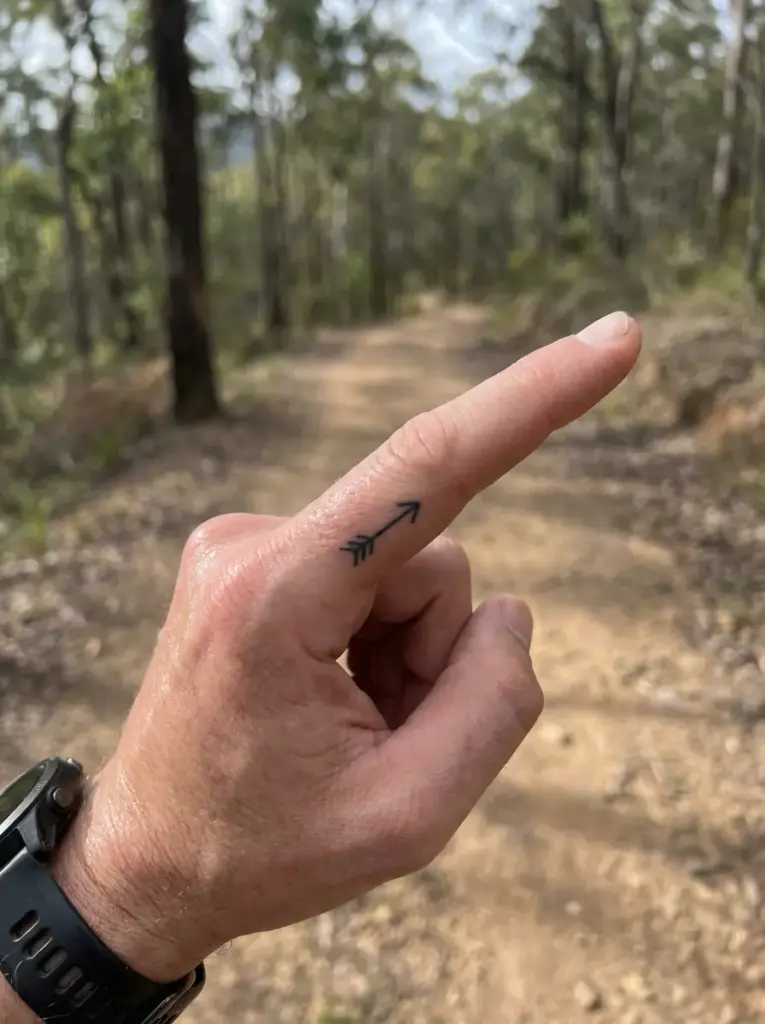
Best placement: Index finger, inner wrist, inner forearm, ankle pointing forward
Style to ask for: Fine line geometric; or bold blackwork for a stronger statement
Running Tattoo Placement Guide
High Visibility (You See It Every Run)
Top of foot: Painful to get, but meaningful — you look down at it every run. Works for quotes, minimal numbers, and small symbols. Ink fades faster here due to sun and friction.
Inner forearm: The most seen placement for runners — visible during every arm swing. Great for mantras, maps, and fine line designs.
Inner wrist: Always visible, including at work. Works best for small pieces — numbers, coordinates, minimal icons.
Statement Placements (Seen During Races and Training)
Calf: Shown constantly in shorts season. Strong for larger designs — maps, silhouettes, anatomical pieces.
Upper arm: Shown in tank tops and race singlets. Space for detail. Classic placement for meaningful larger pieces.
Ankle: Clean, visible in socks-down running shoes. Works for small clean designs.
Private Placements (Meaningful Rather Than Visible)
Ribcage: Personal and somewhat hidden. Reserved for deeply personal pieces — a phrase that’s for you, not for others.
Shoulder blade: Medium visibility — shows in tank tops, hidden in business clothes. Strong for larger illustrative pieces.
How to Find the Right Artist for Your Running Tattoo
- For fine line and script: Search Instagram for #finelinetattoo #singleneedletattoo. Look at healed photos, not just fresh ones.
- For illustrative and watercolour: Studios like Bang Bang NYC have set benchmarks. Search style-specific tags.
- For technical map or anatomical work: Find artists who specialise in architectural or technical illustration.
- Budget: Fine-line wrist piece: $150–300. Detailed calf piece: $500–1,200. Large illustrative: $800–2,000+. Always tip 15–20%.
FAQ: Running Tattoo Ideas
Q: What is the most popular running tattoo?
The 26.2 tattoo — representing the marathon distance in miles — is consistently the most popular. It’s typically placed on the inner wrist, top of foot, or calf. Close runners-up: runner silhouettes, 13.1 (half marathon), personal mantras, and race course maps.
Q: Where should I get a running tattoo?
The inner forearm is most practical for runners who want to see their tattoo during every run. Top of foot is meaningful but painful and fades faster. The calf shows constantly in shorts season. Inner wrist works for small, clean designs. Ribcage for private, deeply personal pieces.
Q: Should I wait to get a running tattoo until after a race?
Yes — and I’d go further and recommend waiting 30 days after the race. The immediate post-race period is flooded with endorphins and emotion. Most experienced runners recommend waiting long enough to confirm the tattoo still feels right when the race memory settles into something quieter.
Q: How much does a running tattoo cost?
A small fine-line piece (wrist quote, ankle silhouette, 26.2 number) runs $100–300. A medium detailed piece (forearm route map, calf scene) is typically $350–700. Large illustrative work: $800–2,000+. Factor in a tip (15–20%) and potential touch-up fees.
Q: Do running tattoos need special aftercare?
Don’t run for at least 3–5 days after getting tattooed. Sweat, friction, and sun exposure can compromise healing. Top-of-foot tattoos need extra care — the friction of running shoes over a fresh tattoo creates real healing challenges. Keep the tattoo covered with SPF 50+ once healed if it’s in a sun-exposed spot.
Q: What style works best for running tattoos?
Fine line and single-needle work best for delicate scripts, route maps, and minimalist symbols. Neo-traditional or bold blackwork suits statement pieces. Watercolour suits landscape scenes. Whatever style you choose, look at healed photos of that artist’s work in that style — fresh tattoos always look better than healed ones.
Q: What is the best marathon tattoo idea?
The best marathon tattoo idea is usually the one tied to a specific race: your finish time, bib number, course map, medal shape, or the date you crossed the line. A plain 26.2 works, but it becomes more personal when you pair it with handwriting, coordinates, or a route detail only you recognize.
Q: What is a good minimalist running tattoo?
A good minimalist running tattoo is simple enough to stay clear as it heals: a tiny running shoe, a runner silhouette, 13.1 or 26.2, a GPS route line, a heartbeat line, or one short mantra. Avoid squeezing too much detail into a wrist or ankle piece; small tattoos age better when the silhouette is clean.
Q: What tattoo should a trail runner get?
Trail runners usually do best with designs that show terrain: mountain lines, topo maps, pine trees, a favorite route, a compass, or a small runner moving through a landscape. Calves and forearms give those details enough room, especially if the tattoo includes contour lines or a real trail map.
Q: Where do running tattoos age best?
Running tattoos usually age best on placements with less friction and enough flat space, such as the inner forearm, upper arm, shoulder, or calf. Top-of-foot and ankle tattoos can look great, but shoes, socks, sweat, and sun exposure make aftercare and long-term fading more important.
The Right Running Tattoo Is the One That Means Something in Year Five
The best running tattoos I’ve seen have one thing in common: the person wearing them can tell you exactly what mile they were on when that phrase, that number, or that symbol became the right choice.
The 26.2 on a wrist is common. But the 26.2 in your own handwriting, placed there the week after your first marathon, after 18 months of training through injuries and early mornings — that’s not common at all. That’s yours.
Take your time with this. The run will still matter in six months. If the tattoo still feels right then, it’s the right one.
For more starting points, browse the Sky Rye Design tattoo ideas hub. If you want to keep the design quiet, our fine line tattoo guide and meaningful music tattoo ideas are useful next reads.
- 1.8Kshares
- Facebook0
- Pinterest1.8K
- Twitter0
- Reddit0