

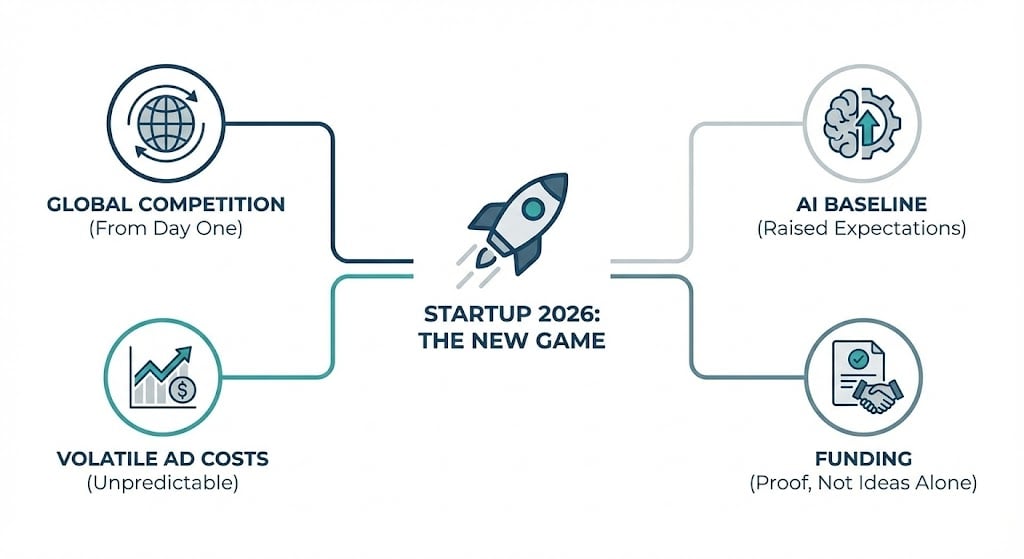
Growing a startup has never been easy—but in 2026, it’s a very different game to even five years ago. Competition is global from day one, ad costs are volatile, AI has raised the baseline, and funding isn’t handed out for ideas alone anymore.
The good news? Startups that grow smart—not just fast—are winning. Growth today is about leverage, systems, and credibility, not brute-force spending.
- 1. Secure Non-Dilutive Funding (Grants, Credits & Incentives)
- 2. Focus on One Core Problem (Then Dominate It)
- 3. Build a Marketing System (Not Random Campaigns)
- 4. Invest Early in SEO (It’s Still the Highest ROI Channel)
- 5. Use Link Building to Build Authority, Not Just Rankings
- 6. Build a Brand That Signals Trust Fast
- 7. Leverage Partnerships Instead of Paid Reach
- 8. Track the Right Metrics (Ignore Vanity Numbers)
- 9. Automate Early (But Only What’s Repetitive)
- 10. Reinvest Profits Strategically (Not Emotionally)
- Final Thoughts: Growth Is a Long Game Played Well
Below are 10 proven, modern ways to grow a startup, covering funding (including grants), marketing, SEO, and link building—without lighting money on fire.


1. Secure Non-Dilutive Funding (Grants, Credits & Incentives)
One of the biggest mistakes founders make is assuming venture capital is the only way to grow.
In reality, non-dilutive funding—money you don’t give equity away for—can quietly fund early growth and extend runway.
Funding options to explore:
- Government innovation grants – many of these are state relevant – so check Florida state grants etc to find ones local to you
- R&D tax credits
- Regional startup incentives
- Industry-specific grants (tech, green energy, health, AI, manufacturing)
- Export and expansion grants
These funds can be used for:
- Product development
- Hiring key staff
- Marketing and market expansion
- Technology upgrades
Many founders miss grants simply because they assume they won’t qualify. In practice, grants often favor early-stage, innovative, or regional businesses—exactly what startups are.
Pro tip: Assign one person (or an advisor) to actively monitor grant opportunities quarterly. Treat it like pipeline building.
2. Focus on One Core Problem (Then Dominate It)

Startups don’t fail because they aim too small—they fail because they aim everywhere.
The fastest-growing startups:
- Solve one painful problem
- For one clear audience
- Better than anyone else
Instead of:
“We help businesses grow”
You want:
“We help UK e-commerce brands increase repeat purchases using AI-driven email automation”
Narrow positioning:
- Makes marketing cheaper
- Improves conversion rates
- Clarifies product decisions
- Speeds up sales cycles
Once you dominate a niche, expansion becomes optional—not necessary for survival.
3. Build a Marketing System (Not Random Campaigns)


Many startups “do marketing.” Very few build marketing systems.
A system means:
- Predictable lead flow
- Repeatable channels
- Clear attribution
- Scalable effort
Your early marketing system should include:
- One primary acquisition channel (SEO, partnerships, outbound, content)
- One secondary channel (paid ads, social, referrals)
- A simple funnel (awareness → trust → conversion)
Random tactics burn cash. Systems compound.
4. Invest Early in SEO (It’s Still the Highest ROI Channel)
SEO is one of the few channels where effort compounds over time.
Unlike ads:
- Traffic doesn’t stop when you stop paying
- Content becomes more valuable with age
- Authority builds defensibility
Early-stage SEO priorities:
- Clear site structure
- Pages targeting buyer-intent keywords
- Educational content that answers real questions
- Technical hygiene (speed, mobile, indexing)
Founders often say:
“SEO takes too long.”
What they really mean is:
“We don’t want to wait six months for results.”
But six months passes either way. The startups that start SEO early are almost always cheaper to acquire customers later.
5. Use Link Building to Build Authority, Not Just Rankings
Link building isn’t about gaming Google anymore—it’s about credibility.
High-quality backlinks:
- Increase search visibility
- Improve trust signals
- Drive referral traffic
- Support PR and brand authority
Smart link building strategies for startups:
- Guest features on real industry sites
- Digital PR and commentary
- Resource link placements
- Founder interviews and thought leadership
- Strategic partnerships and mentions
Avoid:
- Spammy link packages
- Automated outreach at scale
- Irrelevant placements
One strong, relevant link is worth more than 100 low-quality ones.
6. Build a Brand That Signals Trust Fast

Startups don’t just compete on product—they compete on perceived legitimacy.
People ask subconsciously:
- “Is this real?”
- “Can I trust this company?”
- “Will they still exist in a year?”
Trust signals matter:
- Professional website and messaging
- Clear positioning
- Case studies (even small ones)
- Media mentions
- Transparent founders
This is where marketing, PR, and link building overlap. Visibility + consistency = credibility.
7. Leverage Partnerships Instead of Paid Reach

One good partnership can outperform months of ads.
Examples:
- Integration partnerships
- Affiliate or referral deals
- Co-branded webinars
- Cross-promotion with complementary products
- Distribution partnerships
Why partnerships work:
- You borrow existing trust
- Customer acquisition cost is lower
- Leads are warmer
- Brand authority transfers
Startups that rely only on ads stay fragile. Startups that build relationships build resilience.
8. Track the Right Metrics (Ignore Vanity Numbers)
Growth isn’t likes, followers, or pageviews. Growth is movement in the numbers that matter.
Key metrics to watch:
- Customer acquisition cost (CAC)
- Lifetime value (LTV)
- Conversion rates at each funnel stage
- Churn or retention
- Time to first value
Marketing, SEO, and link building should all tie back to revenue impact, not activity reports.
If a tactic doesn’t move a meaningful metric, it’s noise.
9. Automate Early (But Only What’s Repetitive)
Automation is not about replacing people—it’s about removing friction.
Startups grow faster when they automate:
- Lead capture and follow-up
- Email and SMS nurturing
- Appointment booking
- CRM workflows
- Reporting
This frees founders to focus on:
- Strategy
- Partnerships
- Product
- Hiring
Automation doesn’t make bad systems good—but it makes good systems scale.
10. Reinvest Profits Strategically (Not Emotionally)
The most dangerous moment for a startup isn’t launch—it’s early success.
Founders often reinvest emotionally:
- More ads because ads worked once
- More hires without systems
- More features without demand
Smart reinvestment looks like:
- Doubling down on proven channels
- Strengthening SEO and content
- Improving onboarding and retention
- Building defensible moats (brand, authority, data)
Growth should be intentional, not reactive.
Final Thoughts: Growth Is a Long Game Played Well
Startups that win in 2026 don’t rely on one magic tactic.
They:
- Use grants and funding strategically
- Build marketing systems, not hacks
- Invest in SEO and a link building service early
- Focus on authority, trust, and leverage
- Measure what actually matters
Growth isn’t about being everywhere—it’s about being effective where it counts.
If you treat growth as an asset you build—rather than a switch you flip—you dramatically increase your odds of becoming one of the startups that actually lasts.
- 62shares
- Facebook0
- Pinterest62
- Twitter0
- Reddit0