If you’ve tried running Facebook ads with a fresh account, you’ve probably hit the wall: instant bans, spending limits locked at $50, and ad approvals that take forever. It’s frustrating when you know your offer is legitimate, but Meta’s systems treat you like a threat.
This is why advertisers search for aged Facebook accounts. These older profiles come with existing history, which can mean faster ad approvals and higher trust from Meta’s algorithms. But buying these accounts isn’t simple; it violates Facebook’s Terms of Service, carries real risks, and requires careful handling to avoid immediate shutdowns.
This guide walks through everything: what aged accounts actually are, how to evaluate sellers, proper warming techniques, and whether this strategy even makes sense for your business.
What Are Aged Facebook Accounts?
Buyers use the phrase “buy aged Facebook accounts” to describe purchasing existing Facebook profiles that were created years ago and already have a usage history. These can be simple personal profiles, ad-ready accounts, or profiles with extras like Marketplace access or Business Manager eligibility.
Aged accounts are attractive because they generally have more “trust” in Meta’s systems than brand-new profiles, but buying them sits in a grey zone: it can work, yet it clearly violates Facebook’s Terms of Service, so anyone considering this route needs a clear understanding of both the upside and the risk.
Why Advertisers Want to Buy Aged Facebook Accounts
Before you even search “buy aged Facebook accounts for sale,” you need to know what you expect them to do for your campaigns.
The core reason advertisers buy aged Facebook accounts is to shortcut the painful early phase where new profiles get flagged, restricted, or throttled the moment they try to spend.
Algorithmic trust and authority
Older accounts tend to have a longer engagement history: logins from consistent locations, past likes and comments, friends, and content. That pattern looks safer to automated systems than a profile created yesterday.
Because of that history, aged accounts are less likely to be thrown into endless review queues, and they often see faster ad approvals and fewer instant rejections when you eventually start advertising.
Immediate advertising potential
When you create a new Facebook account, you often face:
- Low initial spending limits
- Frequent identity and security checks
- Delays in Business Manager and ad account creation
With a solid aged profile, the path to creating a Business Manager, linking a page, and opening an ad account can be much shorter if you handle it carefully and warm the account instead of treating it like a disposable login. For businesses that need more stable advertising infrastructure, working with specialized Facebook Business Manager services can provide legitimate, platform-compliant alternatives to purchasing aged personal profiles.
Built-in social proof and reach
Many aged accounts come with:
- Existing friends or followers
- Previous posts, likes, and comments
- Group memberships or page likes
That existing social graph can give your early posts and page activity more organic reach than a totally blank profile. It also makes the account look more believable when Facebook’s systems check for “real user” behavior. While aged accounts provide a foundation, you’ll still need to build genuine engagement. Consider complementing your strategy with Facebook engagement services to maintain natural-looking activity patterns.
The Harsh Truth: Risks When You Buy Aged Facebook Accounts
Buying aged Facebook accounts isn’t just “a clever hack.” It’s a trade-off: you’re borrowing trust the platform gave to someone else, and that can backfire.
If you approach this like buying any other digital asset, you will likely underestimate how sharp the edges are.
Terms of Service and account termination
Meta’s rules forbid selling or transferring accounts. That means:
- There’s always a non-zero chance the account is shut down without warning
- You have no real recourse with the platform if that happens
- The more important the account becomes for your business, the more exposed you are
You need a mindset that treats any purchased account as transient infrastructure, never as a single point of failure.
Seller quality, scams, and data risks
Common problems buyers run into:
- Accounts with fake engagement or bot friends
- Profiles that were already flagged or “soft-banned.”
- Sellers who keep recovery access and reclaim accounts later
- Exposure of your personal or business data if you reuse logins or email accounts carelessly
Vet sellers, never reuse critical emails or passwords, and assume that any account details you receive could have been sold to multiple buyers if the vendor is shady.
Detection through IP, device, and behavior
Even if the account itself is old, your behavior might scream “new owner”:
- Logging in from a totally different country or IP range
- Jumping from zero activity to heavy ad spend in days
- Using one device or browser fingerprint across many accounts
Facebook tracks IP ranges, device fingerprints, cookies, activity rhythms, and more. This is where proper proxies, anti-detect browsers, and a disciplined warming schedule matter more than the account’s age itself.
Types of Aged Facebook Accounts You’ll See in the Market
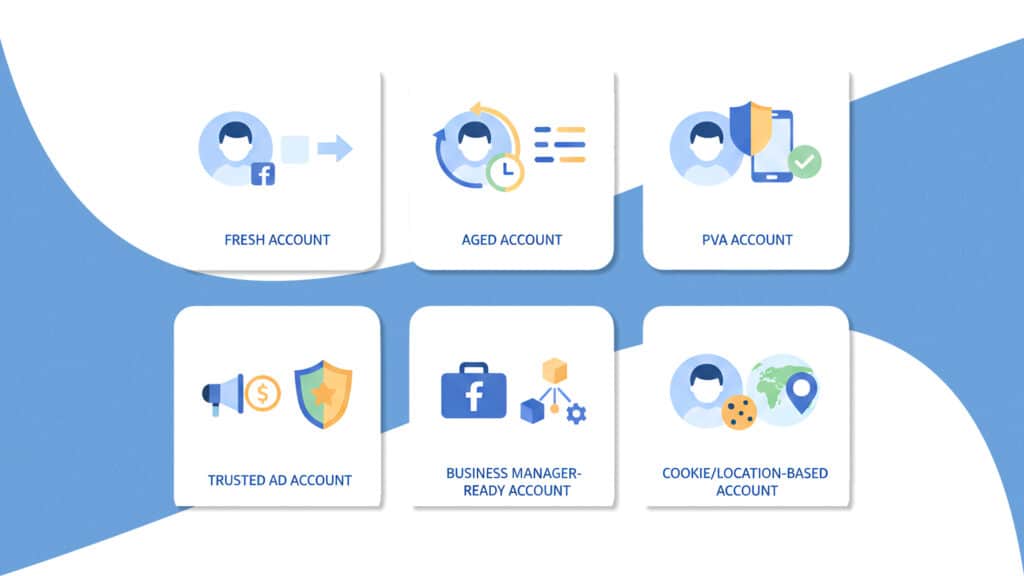
If you search “aged Facebook accounts for sale,” you’ll quickly find a confusing mix of jargon and bundles. A bit of structure helps you avoid buying the wrong thing.
Common categories
Most marketplaces and sellers will group accounts by:
- Age bracket – e.g., 1–3 years, 4–7 years, 8+ years
- Verification – email-verified only vs. phone-verified (PVA)
- Region – US, EU, Tier-1, or geos aligned to your targeting
- Features – Marketplace access, profile with friends, ready for Business Manager, etc.
Older, PVA accounts from trusted regions typically cost more but are more resilient than cheap, generic profiles.
Quality signals that actually matter
Ignore flashy labels and look for:
- A believable, consistent profile (photo, name, some history)
- Realistic friend counts and interactions (not 5,000 randoms from one country)
- Activity over time, not just a burst of posts years ago and nothing since
- A clean security history: no recent bans, no obvious policy-violating content
You’re not just buying “age.” You’re buying a pattern of behavior that Facebook’s systems have already tolerated.
Pricing When You Buy Aged Facebook Accounts
Prices vary a lot, but most reputable sellers follow similar logic.
Your goal isn’t to find the cheapest offer; it’s to find accounts that align with your risk tolerance, ad budget, and niche.
Typical price ranges and what affects them
You’ll commonly see:
- 1–3 year accounts: cheapest bracket, suitable for experiments and low-risk verticals
- 4–7 year accounts: mid-range, good for more serious testing and early scaling
- 8+ year accounts: premium, often used for important projects or higher initial budgets
Price goes up when:
- The account is phone-verified
- It has a stronger social graph (real friends, consistent posts)
- It’s from a Tier‑1 country you want to target
- It comes “ad-ready” or with favorable past ad history (higher risk but more power)
How to Evaluate a Seller Before You Buy

Most people focus on “buy aged Facebook accounts cheap.” A better question is “which seller will still matter to me six months from now?”
Due diligence checklist
Before you commit money, check:
- Reputation: reviews, case studies, mentions in communities
- Transparency: clear specs for each account type, not vague promises
- Refund/replacement policy: what happens if the account dies in 24–72 hours
- Support responsiveness: how fast and how clearly they answer pre‑sale questions
- Security practices: how they deliver credentials, whether they insist on safe channels
If a seller cannot explain where accounts come from (without naming sources), what verification level they have, and how long they expect them to last under normal use, move on.
Safe Workflow After You Buy Aged Facebook Accounts

This is where most people fail. Buying is the easy part; handling the account like a fragile, high-value asset is the hard part. For beginners, starting with a verified Facebook account can be a safer alternative than managing aged profiles independently.
Day 0–1: First contact with the account
Your first 24 hours should be quiet and controlled:
- Use a dedicated residential proxy that matches the account’s original country
- Log in once, from one device or anti-detect profile, and stay consistent
- Do not instantly change the password or email unless the seller instructs you and covers that in the warranty
- Check notifications, messages, and recent activity, but avoid aggressive changes
Days 2–7: Stabilizing the profile
Once you’ve verified the account works and isn’t instantly flagged:
- Change the password to something strong and unique
- Update the recovery email to one you control, not tied to your personal identity
- Add a phone number if the account isn’t PVA, ideally via a trusted SMS provider
- Enable two-factor authentication for extra stability
Keep behavior human: a few likes, some post views, maybe a comment or two. No Business Manager, no ads yet.
A Practical 8-Week Warming Plan
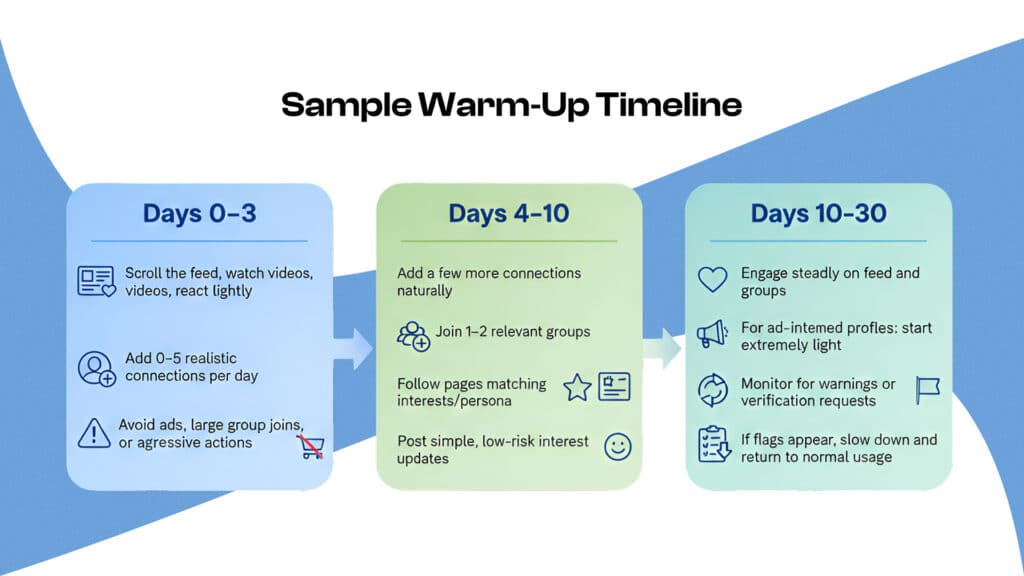
The phrase “warm up Facebook accounts” gets thrown around a lot, but most advice is vague. Here’s a clear, realistic structure you can adapt. If you’re also managing other social platforms alongside Facebook, resources like social media content guides can help you maintain consistent, authentic activity patterns across multiple channels.
Weeks 1–2: Act like a real person
Focus on normal user behavior:
- Scroll the feed 10–15 minutes a day
- Like 20–40 posts daily (spread across friends, pages, and groups)
- Watch a few videos and stories
- Join 1–3 relevant groups that match the account’s apparent interests
- Add a handful of friends over several days, not all at once
You’re teaching the system, “this is the same kind of user this account always was,” not “new owner who showed up to launch offers.”
Weeks 3–4: Broaden social activity
Once early activity feels stable:
- Comment on posts (2–5 per day) with natural, short replies
- Share a post occasionally on your own timeline
- Post 1–2 simple status updates or photos per week
- Engage in groups by reacting or leaving a short comment
Avoid heavy outbound actions like mass friend requests or group spamming. Consistency beats volume here.
Weeks 5–8: Prepare for business use
If the account has remained stable:
- Create or connect a Facebook Page that aligns with a believable interest or brand
- Post content to that page 2–3 times a week
- If you plan to use a Business Manager, create it in this phase, not earlier
- Add the page to Business Manager, then wait again before adding payment methods or requesting ad accounts
For advertisers who need established pages with existing history, pre-aged Facebook Pages can complement your account strategy and reduce the warming period required for business assets.
Treat every new “business” step as a separate trust test. Add, wait, behave normally. Only then move to the next action.
Using Aged Accounts vs. Using Proper Ad Infrastructure

Even if you decide to buy aged Facebook accounts, they shouldn’t be your only strategy.
When aged accounts make sense
They can be useful when you:
- Need to validate offers or creatives quickly
- Work in verticals where new accounts constantly get flagged
- Want redundancy so one ad account ban doesn’t end all campaigns
They are less suitable as the sole foundation for a long-term brand or serious agency.
Why stable ad infrastructure matters
For businesses that want to scale, professional ad accounts and Business Managers are critical. Services that provide structured Facebook ad account management and Business Manager access can give you a more stable base than relying only on purchased personal profiles.
If your main issue isn’t the profile itself but the constant disabling of ad accounts and pages, working with a specialized provider of agency‑grade Facebook assets is often a more sustainable fix than endlessly buying new aged profiles.
Multi-Account Management: Proxies, Browsers, and Automation
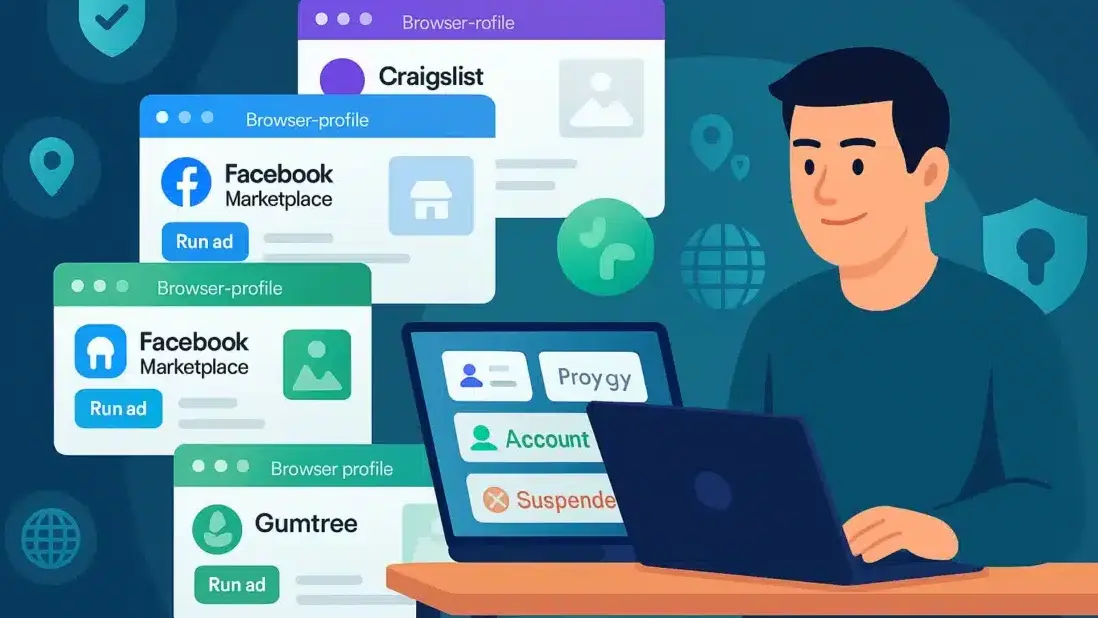
Once you manage more than one or two accounts, your real bottleneck becomes operational, not just “where to buy aged Facebook accounts.”
Why do you need a proper technical setup
Trying to run 5–20 accounts from one browser and one IP is almost guaranteed trouble. You need:
- One dedicated residential proxy per account
- Either separate physical devices or an anti-detect browser that simulates them
- Isolated cookies and sessions, so one ban doesn’t contaminate all profiles
Think in terms of “fingerprints.” Each account should have its own environment, IP, and behavior rhythm.
Automation with restraint
Tools that automate likes, story views, and basic interactions can save time, but they’re a double-edged sword. If they push actions too fast or repeat patterns across profiles, they make detection easier, not harder.
If you use automation, cap daily actions, randomize timing, and keep everything within human-like limits. Automation should support your warming strategy, not replace it.
Alternatives to Buying Aged Facebook Accounts
A smarter long-term plan usually combines purchased aged accounts, properly farmed profiles, and legitimate ad infrastructure.
Farming your own accounts
Account farming means:
- Creating new profiles with unique details and clean devices
- Warming them over months using the same protocols outlined above
- Slowly adding pages, Business Managers, and ad accounts
This takes far more time, but:
- You fully control the identity, email, and phone numbers
- You avoid sellers reclaiming profiles
- You reduce the Terms of Service risk because the account has had one real owner from the start.
Many serious advertisers use bought aged accounts to “bridge” the early phase while their farmed accounts mature.
Relying more on channel diversification
Even if you buy aged Facebook accounts, your business shouldn’t live or die on one platform. Building organic traffic, search presence, and other paid channels gives you leverage. If Facebook decides you’re done, your business keeps moving.
Over time, investing in link-building services and content marketing can pay off more than endlessly rotating through new accounts and proxies. Establishing your website’s authority through quality backlinks creates a sustainable foundation that doesn’t depend on any single advertising platform.
For businesses looking to build comprehensive digital marketing strategies beyond paid ads, working with an SEO marketing agency can help develop organic traffic channels that provide long-term stability.
Legal and Ethical Realities You Can’t Ignore
No serious guide about how to buy aged Facebook accounts is complete without a blunt section on risk.
What “illegal” does and doesn’t mean here
Buying accounts breaks the platform’s contract with users, not criminal law in most countries. That means:
- The platform is within its rights to close accounts at any time
- You’re unlikely to face legal prosecution just for buying an account
- However, if you use these accounts for fraud, scams, or other crimes, that’s a separate, very real legal problem
Treat this as a business risk calculation: “What happens if all these assets vanish overnight?”
Ethics and long-term trust
There’s also an ethical angle:
- You are effectively pretending to be someone else in the eyes of the platform
- The more heavily you lean on this tactic, the more brittle your business becomes
- A balanced approach uses aged accounts as a tactical tool, not the backbone of your brand
When Buying Aged Facebook Accounts Is Not Worth It
Sometimes, the best answer to “should I buy aged Facebook accounts?” is “no.”
Cases where you should avoid aged accounts
You’re usually better off avoiding this route if:
- You’re building a long-term, reputational brand (SaaS, personal brand, large e‑commerce)
- You’re new to Facebook ads and still learning the basics
- You don’t have the discipline to manage proxies, fingerprints, and warming schedules
- A single account ban would cause serious legal, reputational, or financial damage
In these scenarios, stick to your own accounts or work with legitimate ad-account providers and agencies that operate within platform rules.
Cases where it can be a calculated tool
Buying aged accounts can be a rational choice if you:
- Already understand Facebook’s policies and limitations
- Have backup traffic sources and don’t rely on one asset
- Budget for account losses as an operating cost
- Use them primarily for testing and exploration, not permanent infrastructure
Treat these accounts like disposable but valuable tools: useful, but never something your business can’t live without.
Should You Buy Aged Facebook Accounts?
You now know that “buy aged Facebook accounts” isn’t a magic phrase. It’s a shortcut with conditions.
Quick decision framework
Ask yourself:
- What am I really trying to solve? Early bans, low spend limits, slow approvals, or something else?
- Can I afford to lose this account tomorrow? If not, don’t build anything critical on it.
- Do I have the technical setup to manage it safely? Proxies, anti-detect browser, clear warming plan.
- What’s my parallel long-term strategy? Farming own accounts, stable and infrastructure, organic channels.
If you can answer these clearly and still feel comfortable, buying aged Facebook accounts can be one tool in a broader system. If not, focus your effort on assets you fully own and that don’t depend on skating around platform rules.
Conclusion
Buying aged Facebook accounts can solve specific problems faster, such as ad approvals, higher spending limits, and less friction during the early advertising phase. But it’s not a silver bullet, and it’s definitely not a foundation you should build your entire business on.
The accounts work best when treated as temporary tools within a larger strategy that includes proper account farming, legitimate ad infrastructure, and diversified traffic sources. If you decide to move forward, invest in the right technical setup (proxies, anti-detect browsers), follow disciplined warming protocols, and always have a backup plan for when accounts inevitably get flagged. Consider diversifying across advertising platforms services like Google Ads agency accounts can provide additional channels when Facebook restrictions become limiting.
Ultimately, the smartest approach balances short-term tactics with long-term stability using aged accounts to buy yourself time while building sustainable assets you actually own and control.
- 0shares
- Facebook0
- Pinterest0
- Twitter0
- Reddit0