

HVAC and interior design work best when they are planned together. Supply vents, return-air paths, equipment size, humidity control, and service access all affect furniture placement, ceiling lines, noise, and how comfortable a room feels. Before finalising a layout, mark the mechanical elements on the floor plan and coordinate them with lighting, millwork, curtains, and the main seating zones.
HVAC coordination also includes the details people see after installation. This guide to hiding mini-split lines and placing ductless units covers covers, routing and placement choices that keep ductless equipment from disrupting the room or facade.
Quick answer: keep supply air clear of large furniture, give return grilles an unobstructed path, avoid placing strong air throws directly over beds or seating, and review the reflected ceiling plan before ducts are fixed. Concealed equipment can protect a clean composition, but it still needs enough airflow and reachable access for filters, drains, and repairs.
I learned this after redesigning a living room that looked right on paper but never felt settled. The sofa overheated in the afternoon, the chair near the entry stayed cool, and the air felt stale. The problem was not the furniture or lighting. It was the HVAC system underneath the room.
- Why HVAC Is an Interior Design Decision
- Heating: What the System Choice Communicates About the Room
- Cooling: The Aesthetics of Air Conditioning
- Indoor Air Quality: The Invisible Design Element
- HVAC Replacement and Upgrade: Making the Financial Case
- What to Look for in a Residential HVAC Provider
- FAQ: Residential HVAC and Indoor Comfort
- How does HVAC placement affect interior design?
- What is the most discreet HVAC option for a designed interior?
- How often should a residential HVAC system be serviced?
- What air quality improvements make the most difference in a home?
- What financing options are available for HVAC system replacement?
- How do I know when to replace rather than repair my furnace?
- What HVAC features should I look for when renovating a home?
Undersized. Poorly balanced. Return vents in the wrong places. A filter that hadn’t been changed in two years. The room looked right, but it never actually felt right.
That project changed how I think about interiors. Mechanical systems are not separate from design — they shape whether a space is genuinely livable. A room that’s too hot, too cold, too dry, or stuffy doesn’t work, no matter how good everything else looks.
This guide explains how to plan heating, cooling, ventilation, and indoor air quality with the same care you give the room layout and finish schedule.
Why HVAC Is an Interior Design Decision

Most people treat HVAC like plumbing. The builder picks it, the homeowner inherits it, end of story. Fair enough — until you realize it changes how a room feels every single day.
Vent placement matters more than people think. It decides where the cold spots are, where heat gathers, and sometimes where furniture can realistically go. I’ve walked into living rooms where the proportions clearly wanted the sofa in one corner, but the airflow made sitting there annoying after twenty minutes. Same thing with dining tables. Cold air dumping straight onto the chairs in winter? You stop using the space as much, even if the room looks perfect.
And honestly, the visual side gets overlooked. A wall-mounted split unit is not invisible. Neither is exposed ductwork or a chunky ceiling cassette that cuts across a clean ceiling line. Once it’s there, it becomes part of the room whether the designer planned for it or not.
The best interiors don’t treat HVAC and design as separate conversations. Same room, same decision. Because comfort and aesthetics end up tangled together anyway.
HVAC interior design planning checklist
| Coordinate | Decide before construction | Common mistake |
|---|---|---|
| Furniture plan | Mark supply and return locations, then test the sofa, bed, dining table, and curtain clearances. | Letting upholstery or floor-length fabric block airflow. |
| Ceiling composition | Set diffusers, cassettes, lights, sprinklers, and access panels on one reflected ceiling plan. | Centred lighting and off-centre grilles fighting for the same visual line. |
| Air throw and returns | Check where conditioned air travels and how it returns across the occupied zone. | Aiming a strong draft at a bed, desk, or favourite chair. |
| Materials and humidity | Consider wood floors, millwork, artwork, wallpaper, and other moisture-sensitive finishes. | Choosing finishes without accounting for seasonal expansion, dryness, or condensation. |
| Service access | Keep filters, drain lines, coils, and shut-offs reachable without dismantling built-ins. | Hiding equipment so completely that routine maintenance damages the finish work. |
- Ask the HVAC contractor to review the furniture plan, not just the architectural shell.
- Align linear grilles with the room’s main sight lines, while keeping the required throw pattern and free area.
- Resolve duct routes, ceiling drops, and access panels before approving custom millwork.
- Photograph concealed services before walls and ceilings close; the record makes later repairs far less destructive.
Heating: What the System Choice Communicates About the Room
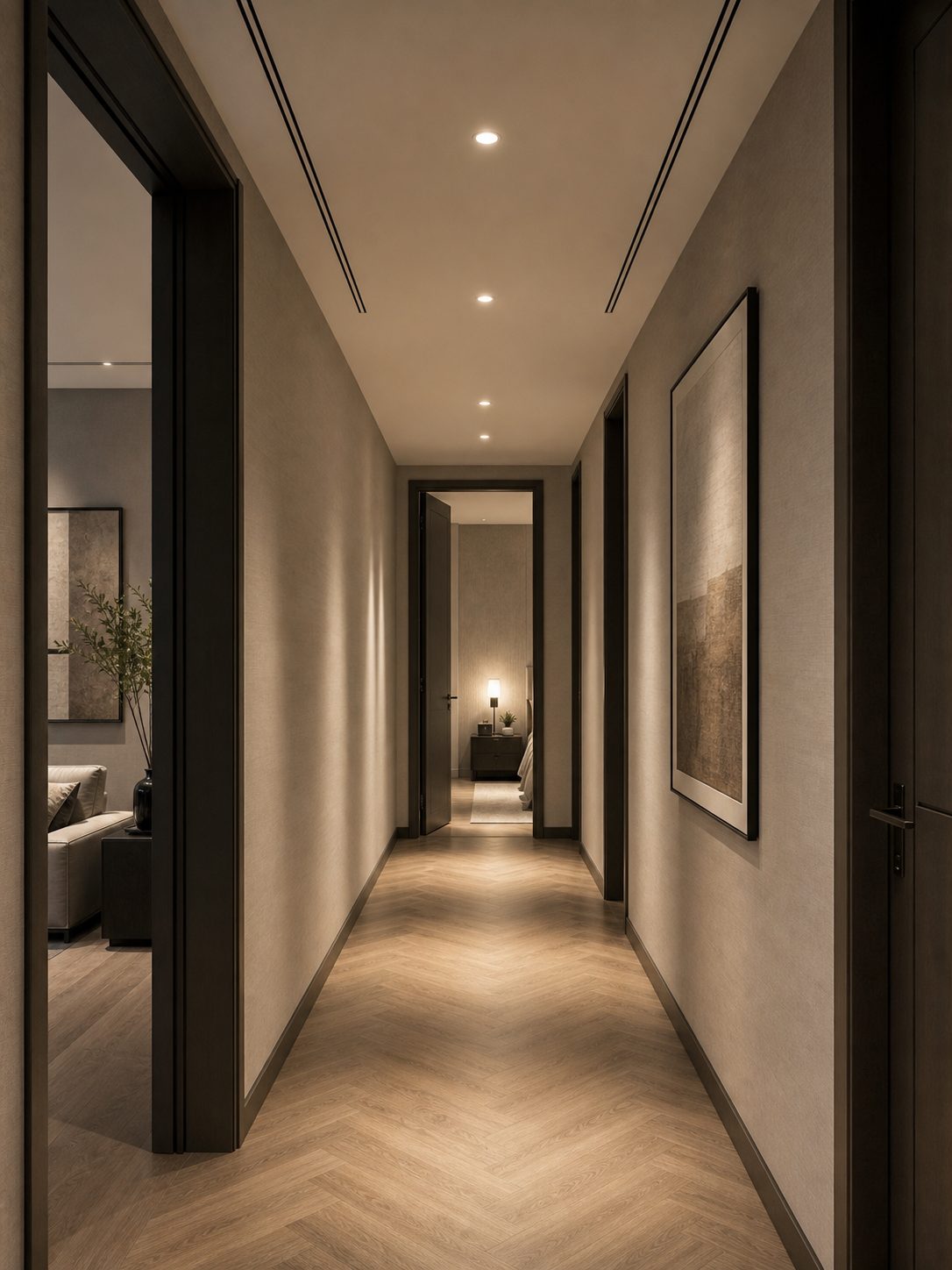
Forced-air furnace systems are the most common residential heating solution in North America, and for most homes they remain the practical baseline. A well-maintained, correctly sized furnace with balanced ductwork and well-placed vents heats a home evenly and quietly. The design impact is minimal when the system is working correctly — the vents disappear, the air moves without noise, and the temperature holds.
Where forced-air systems create problems is when they’re undersized for the space, when ductwork is unbalanced, or when the filter and coils are neglected to the point where airflow is restricted. An undersized system runs continuously without reaching setpoint temperature. A dirty system moves air poorly, creates uneven temperatures, and adds a faint mechanical smell to the air. These are livability problems before they’re comfort problems.
Radiant heating: the invisible system
Radiant floor heating is the most design-forward residential heating option because it has no visible components whatsoever. Heat rises from the floor surface uniformly across the room, which eliminates the hot and cold zones that forced-air systems create near and away from vents. The floor is warm underfoot — a quality that matters more in rooms used barefoot, like bathrooms, kitchens, and bedrooms.
The practical constraint is cost: radiant systems are significantly more expensive to install than forced-air, and they’re most practical in new construction or full renovation where the floor is being replaced regardless. In existing homes they’re often added room by room as a supplement to the primary heating system rather than as a whole-home replacement.
Maintenance: what gets neglected and why it matters
Furnace maintenance is the category most homeowners defer until something fails. The consequences are predictable: reduced efficiency, uneven heating, shortened system lifespan, and eventually an emergency repair call during the coldest week of the year. Annual service before the heating season — filter replacement, heat exchanger inspection, burner cleaning, and combustion testing — prevents most of those outcomes.
Preventative service plans from providers like Efficient Comfort bundle those annual visits with priority scheduling and reduced rates on repairs identified during service. For a home where comfort and air quality are design priorities, that predictability matters. If a finished room still feels wrong, these AC problems designers notice help separate layout issues from mechanical faults.
Cooling: The Aesthetics of Air Conditioning

Air conditioning is where the tension between mechanical necessity and a designed interior is most visible. In climates with genuine summer heat — Colorado included — cooling is not optional. The question is how to deliver it without making the equipment the dominant visual element in the room.
Central air: the baseline
Central air conditioning using the existing forced-air ductwork is the most common residential cooling solution and the most design-neutral. When the system is correctly sized and the ductwork is balanced, it conditions the whole home through the same vents used for heating. The visual impact is the same as the heating system: minimal, if the vents are positioned correctly and maintained cleanly.
Sizing is critical. An oversized central air system short-cycles — running briefly at high capacity, cooling the air temperature quickly without running long enough to remove humidity. The result is a room that feels cold and clammy rather than cool and comfortable. An undersized system runs continuously without reaching setpoint. Both situations indicate a system that hasn’t been sized correctly for the actual load of the home.
Mini-split systems: flexibility with a design trade-off
Ductless mini-split systems offer zone-by-zone control and significant installation flexibility — they don’t require existing ductwork, which makes them practical for additions, converted spaces, and older homes where duct installation would be disruptive. The trade-off is the wall-mounted head unit, which is a visible piece of mechanical equipment in the room.
Concealed-duct mini-split configurations solve the aesthetic problem by routing the refrigerant lines to a small air handler above the ceiling, with only a slim linear grille visible at the surface. The cost is higher than a standard wall-mounted unit, but for rooms where the visual outcome matters — primary living spaces, master bedrooms, formal dining areas — the concealed option is the one that integrates without compromise.
Indoor Air Quality: The Invisible Design Element

Air quality is the element of indoor environment that is entirely invisible and often entirely neglected until it becomes a health issue. It shapes how a space feels in ways that are hard to attribute directly — the slight fatigue in a poorly ventilated home office, the morning stuffiness in a bedroom with low air exchange, the dryness that makes wood furniture crack and skin feel tight in winter.
For homeowners who approach their interiors with care, air quality is worth treating with the same seriousness as the finishes and furnishings. You can have the best furniture, the best lighting, and the best flooring in a room, and if the air is stale, too dry, or particulate-laden, the room won’t feel right.
Filtration: what MERV ratings mean in practice
The filter in a forced-air system is the first line of defense against particulate matter circulating through the home. Standard fibreglass filters (MERV 1–4) capture large particles but pass most of what affects air quality and respiratory health. MERV 8–11 filters capture dust, pollen, mould spores, and pet dander effectively and are appropriate for most residential applications. MERV 13 and above capture finer particles including some bacteria and virus carriers.
The practical constraint is airflow resistance: higher-MERV filters can restrict airflow more, and systems not designed for them may experience reduced efficiency and increased static pressure. An HVAC technician can confirm the highest rating your system can handle. This broader guide to sustainable home design shows how filtration fits with the envelope, daylight, and passive comfort.
Humidity control: the most underrated comfort variable
Relative humidity between 40 and 60 percent is the range in which most people feel most comfortable and in which most wood furniture, flooring, and artwork remains stable. Below 30 percent — common in Colorado homes during winter when forced-air heating runs continuously — wood shrinks and cracks, skin feels dry, and static electricity becomes annoying. Above 60 percent, mould risk increases and the air feels heavy and damp.
Whole-home humidifiers integrated into the forced-air system add moisture during the heating season. Whole-home dehumidifiers remove excess moisture during humid periods. Both can be controlled through the same thermostat interface as the heating and cooling system, which keeps humidity management consistent without adding a separate control routine.
Ventilation and air exchange
Modern homes built to energy-efficient standards are well-sealed — which is good for heating and cooling efficiency and bad for natural air exchange. Without adequate mechanical ventilation, indoor pollutants (off-gassing from furniture and finishes, cooking byproducts, cleaning chemicals) accumulate. Energy Recovery Ventilators (ERVs) exchange stale indoor air for fresh outdoor air while recovering most of the thermal energy from the outgoing air, maintaining efficiency while improving air freshness.

HVAC Replacement and Upgrade: Making the Financial Case

Nobody plans to replace an HVAC system at a convenient time. It’s usually a furnace quitting in the middle of January or an AC dying during the hottest week of summer — exactly when you have the least patience to compare options.
That’s part of why people end up replacing systems reactively. Whatever can be installed fastest wins. Efficiency ratings barely get looked at. Upgrade options disappear from the conversation because nobody wants to spend three days researching furnaces while the house feels unbearable.
The smarter time to think about replacement is before things fail. If your system is pushing 15 years or more, especially in a place like Colorado, there’s a good chance it’s far behind current standards. An older furnace running around 80 AFUE or an AC system at SEER 13 will cost noticeably more to run than newer equipment. A 96 AFUE furnace paired with a SEER 18 system isn’t just better on paper — the lower utility bills start adding up faster than most people expect.
Financing changes the math too. Companies like Efficient Comfort offer plans through providers such as Wells Fargo and FTL Finance, which makes stepping up to higher-efficiency equipment feel more realistic. In some cases, the monthly payment lands surprisingly close to the energy savings, which makes “good enough” replacements harder to justify.
And honestly, replacement is when you finally fix the stuff you’ve been tolerating for years. The room that never heats properly. The airflow that feels uneven upstairs. The vent that blows directly onto your favorite chair. A good HVAC company won’t just swap equipment — they’ll look at how the house actually functions. That’s the difference between replacing a system and solving the problem.
What to Look for in a Residential HVAC Provider
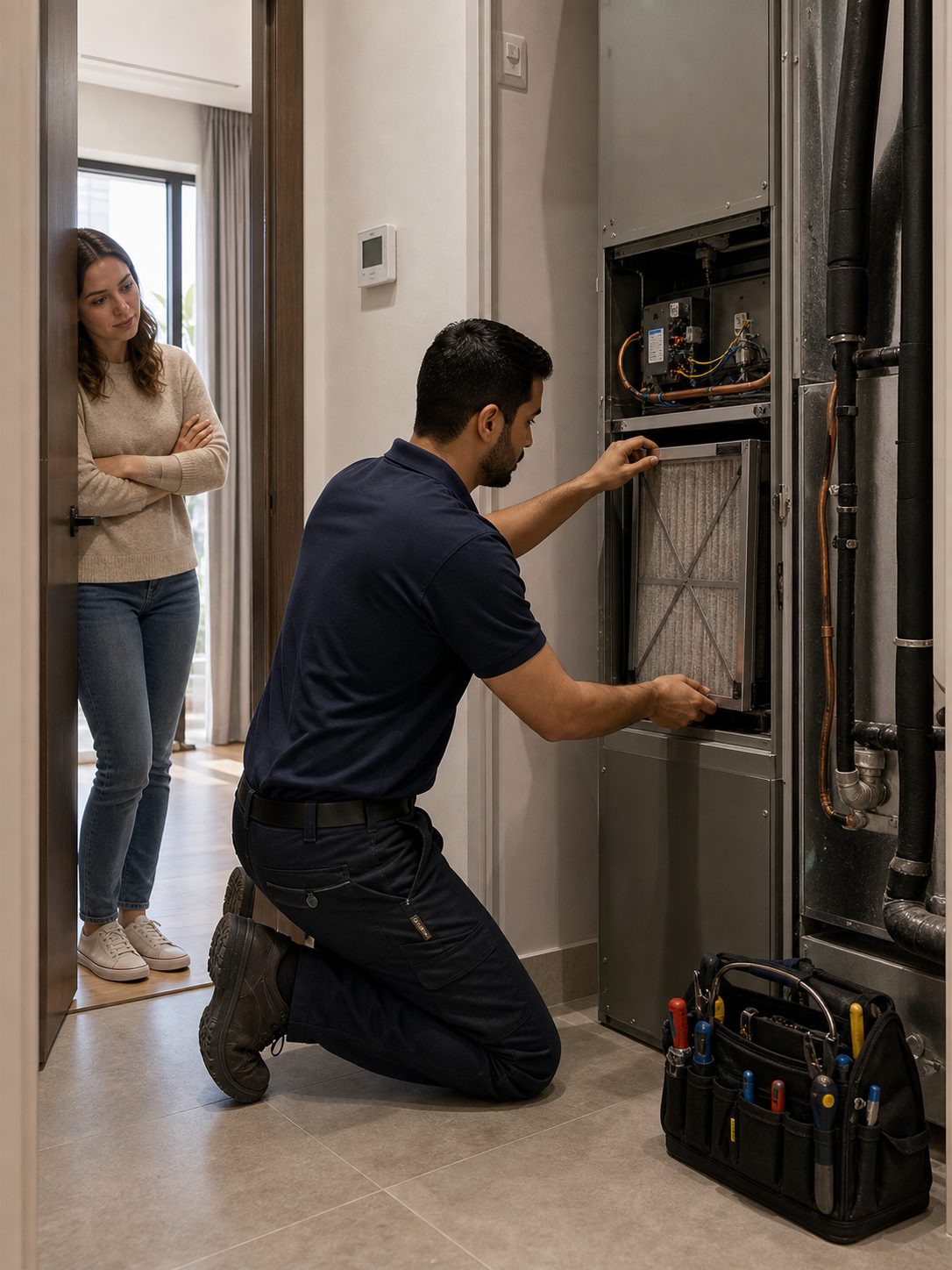
The quality gap between HVAC providers is significant and hard to evaluate in advance. A few signals that distinguish providers who understand residential systems as whole-home environments from those who treat every call as a transactional repair:
- Load calculation before sizing: Any provider recommending a replacement system should perform a Manual J load calculation rather than simply matching the existing system’s capacity. Matching an existing system that was incorrectly sized perpetuates the original problem.
- Duct assessment: System efficiency is limited by duct condition. A provider who installs a new high-efficiency system into leaking or undersized ductwork is selling a result that won’t materialise in practice.
- Air quality integration: Providers who discuss filtration, humidity control, and ventilation alongside heating and cooling are thinking about the indoor environment as a whole rather than just the mechanical equipment.
- Preventative plans: Structured maintenance plans indicate a provider oriented toward long-term system health rather than maximising repair revenue. Efficient Comfort’s preventative service plans are an example of this approach — scheduled visits, priority response, and transparent pricing.
- Financing transparency: Clear financing options with stated rates and monthly payments, rather than vague references to payment plans, indicate a provider who understands that system upgrades are significant investments and treats homeowners accordingly.
For readers comparing local service in Colorado, this furnace repair thornton page is one starting point. Compare any provider’s proposal against the load-calculation, duct, air-quality, access, and pricing criteria above.
For a whole-home version of the same design problem, this healthy 55+ home design explains how entries, bathrooms, lighting, kitchens, flooring, laundry, and outdoor rooms can work together in a 55+ home.
Airflow is only one part of comfort. For the bigger picture, this healthy home and HVAC planning guide shows how heating, cooling, water quality, plumbing, and renovation layout work together.
FAQ: Residential HVAC and Indoor Comfort
How does HVAC placement affect interior design?
Vent placement determines airflow patterns and affects furniture arrangement, acoustic comfort, and ceiling aesthetics. A system designed around the room layout distributes air evenly, allows furniture placement without blocking vents, and keeps mechanical components from becoming visual focal points. Supply vents positioned over seating areas create uncomfortable drafts; return vents blocked by furniture restrict airflow and reduce system efficiency.
What is the most discreet HVAC option for a designed interior?
Concealed duct mini-split systems and ceiling cassette units offer the cleanest interior profiles. Concealed ducted systems hide all mechanical components above the ceiling with only a slim linear grille at the surface. Cassette units sit flush within the ceiling plane. Both eliminate the wall-mounted unit that reads as mechanical equipment in an otherwise designed room.
How often should a residential HVAC system be serviced?
Twice per year: once before the heating season and once before the cooling season. Each visit may include filter inspection, coil cleaning, refrigerant checks where applicable, electrical inspection, and thermostat calibration. Preventative maintenance plans can bundle these visits with priority scheduling and reduced rates on repairs identified during service.
What air quality improvements make the most difference in a home?
In order of impact: HEPA or high-MERV filtration for particulates, whole-home humidification or dehumidification to maintain 40–60% relative humidity, and UV air purification for biological contaminants. Humidity control has the broadest effect on perceived comfort and on the condition of wood furniture, flooring, and artwork.
What financing options are available for HVAC system replacement?
Providers like Efficient Comfort offer financing through Wells Fargo and FTL Finance, with monthly payment structures and competitive rates. This makes upgrading to a higher-efficiency system financially practical without full upfront payment. The monthly payment on a financing plan is often comparable to the monthly energy savings from a more efficient system.
How do I know when to replace rather than repair my furnace?
The 50 percent rule: if a repair costs more than 50% of the replacement value and the system is over 10–15 years old, replacement is typically the better financial decision. Older systems also operate at lower efficiency ratings than current models, and the energy savings from replacement often offset a significant portion of the new system cost over several years.
What HVAC features should I look for when renovating a home?
Variable-speed air handlers that modulate output rather than running at fixed capacity, zoned systems for independent temperature control by room, and integrated air quality components including filtration and humidity control. From a design standpoint, prioritise systems with concealed or low-profile delivery options that allow vent placement to work with the room layout.
The most carefully designed room still needs to be comfortable to live in. That’s a mechanical problem as much as a design one — and it deserves the same attention.
In bathrooms, kitchens, and laundry rooms, treat exhaust airflow as part of the finish plan. Keep grilles clear of tall cabinetry, leave a route for replacement, and place moisture-sensitive storage away from recurring condensation zones.
- 20shares
- Facebook0
- Pinterest20
- Twitter0
- Reddit0