
The first time I tried to use wood panelling in a client’s flat, I got it completely wrong. I specified a mid-tone pine panel for the entire living room — floor to ceiling, all four walls. The room had low ceilings and one north-facing window. What I thought would feel ‘warm and Scandinavian’ felt like a sauna that someone had forgotten to finish. We spent three weeks and a significant budget reversing it.
That experience taught me the rule I now give every client before we touch a material sample: wood on walls amplifies whatever a room already is. A room with good bones, good light, and considered proportion becomes extraordinary with the right panel. A room that’s already fighting itself becomes worse. The material isn’t the magic — the placement and restraint are.
- Why Solid Wood Specifically — Not Veneer, Not MDF-Backed
- Room-by-Room: Where Wood Panels Work and Where They Don't
- Choosing Your Species and Finish: A Practical Reference
- Lighting Wood Panels: The Decision That Makes Everything Else Work
- Installation Principles: What Your Contractor Needs to Know
- The Three Mistakes That Make Wood Panels Look Wrong
- Matching Wood Panels to Your Interior Style
- Starting Your Project
- FAQ: Solid Wood Wall Panels
This guide is about placement and restraint. Specifically, how to use solid wood wall panels in modern interiors without the result looking rustic, heavy, or like a 1970s ski lodge. We’ll cover room-by-room strategy, species and finish selection, the lighting decisions that make or break wood panels, and the mistakes I’ve watched homeowners and designers make repeatedly.
Why Solid Wood Specifically — Not Veneer, Not MDF-Backed
The market for wood wall panels has expanded significantly. You can now buy vinyl-wrapped MDF that looks passably like timber in a photograph. So why does solid wood matter?
Three reasons that become obvious after living with each option for a year. First, solid wood moves with humidity in a way that veneer and composite don’t — it contracts slightly in dry winter air, expands fractionally in summer. That movement is imperceptible to the eye but produces a panel that feels alive rather than manufactured. Second, the grain goes all the way through. A scratch on solid wood can be sanded flush. A scratch on veneer exposes MDF.
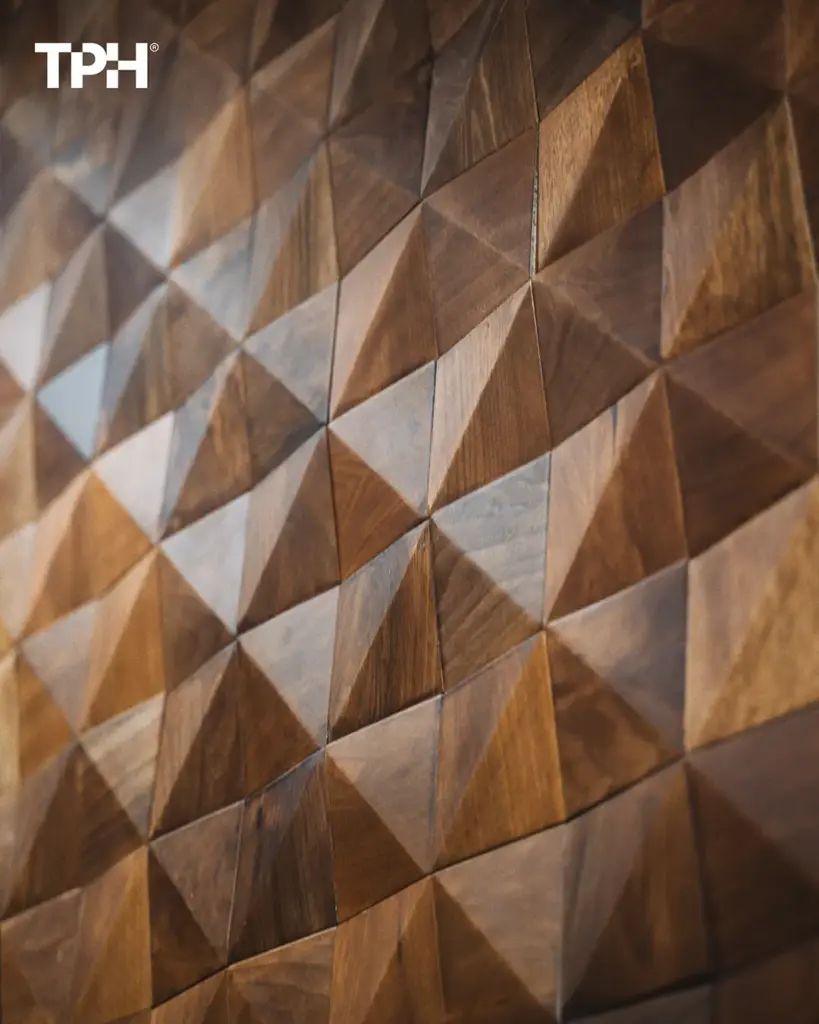
Third, and most important for modern interiors: solid wood catches light differently. The fibres scatter and absorb light across the surface in a non-uniform way that makes a panel look dimensional even without texture or pattern. MDF under veneer reflects light evenly — it looks flat under strong directional lighting, which is exactly the situation in well-designed modern rooms.
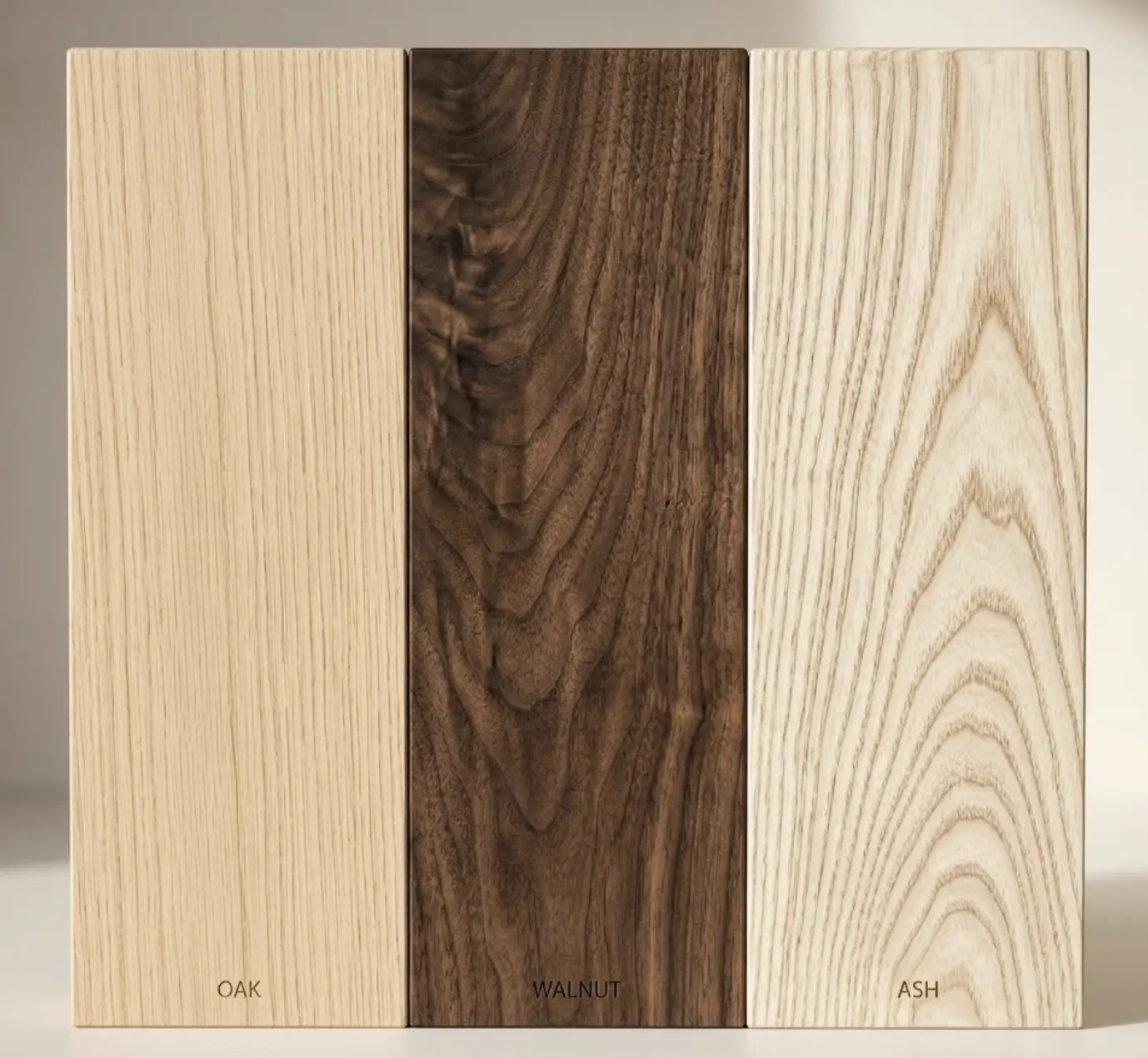
The species you choose — oak, walnut, ash, pine — each have distinct grain characters and undertones. Light oak reads bright and Scandinavian. Dark walnut reads rich and contemporary. Ash has a dramatic, almost graphic grain. Reclaimed timber brings character that no new-cut board can replicate. If you’re choosing between options, wood wall panels from The Panel Hub carry a well-curated range across species and profiles — worth browsing before committing to a species you haven’t seen at scale.
Room-by-Room: Where Wood Panels Work and Where They Don’t
Living Room: The Feature Wall Principle
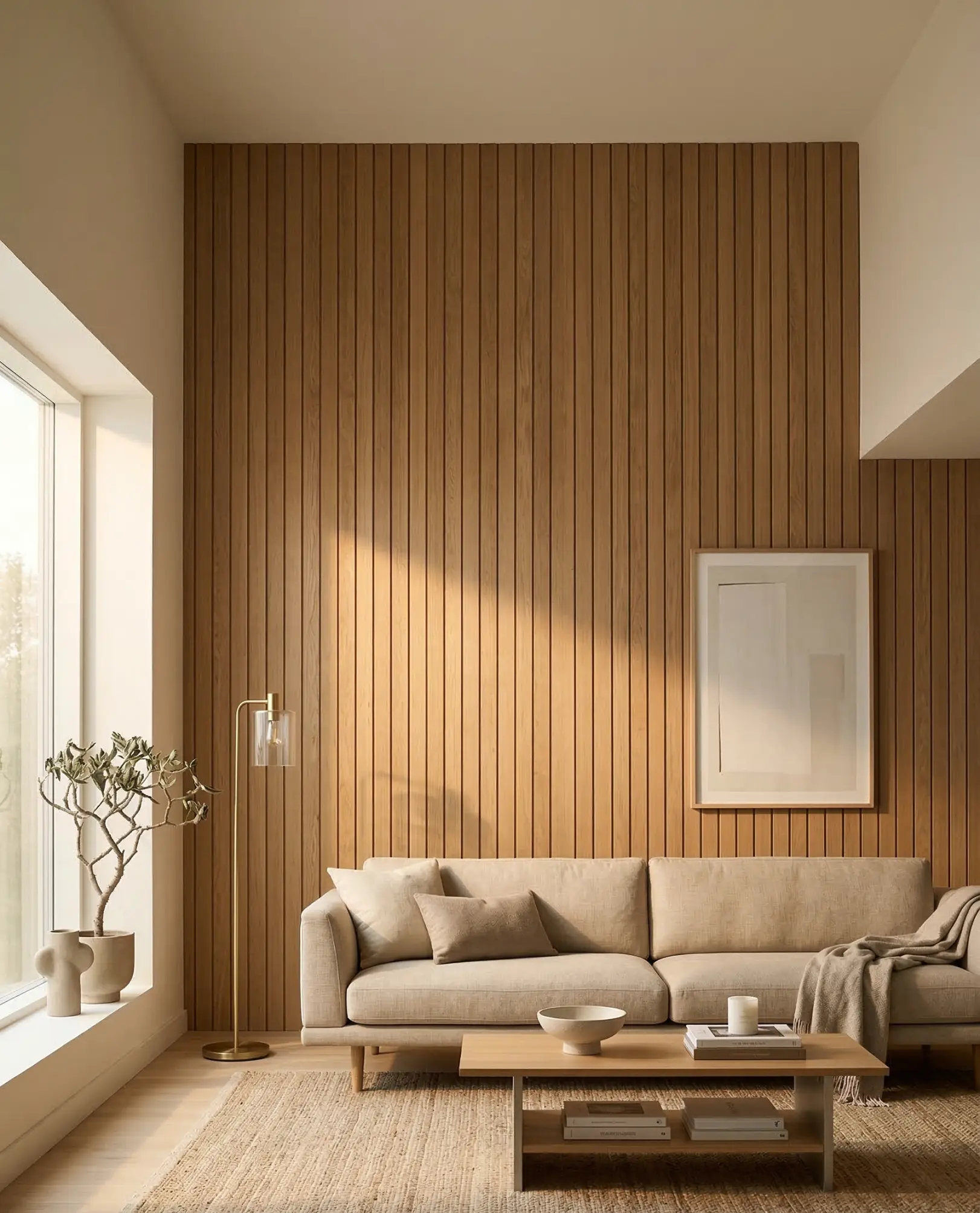
The living room is where solid wood wall panels are most commonly used — and most commonly over-used. The principle that consistently produces the best results: one wall, full height, and the wall the eye travels to first when entering the room.
That’s almost always the wall directly opposite the entry point or behind the primary seating. Not the wall with the window — competing textures (glass, frame, sky) break the panel’s visual field. Not the wall with the fireplace if the fireplace is already a significant material statement.

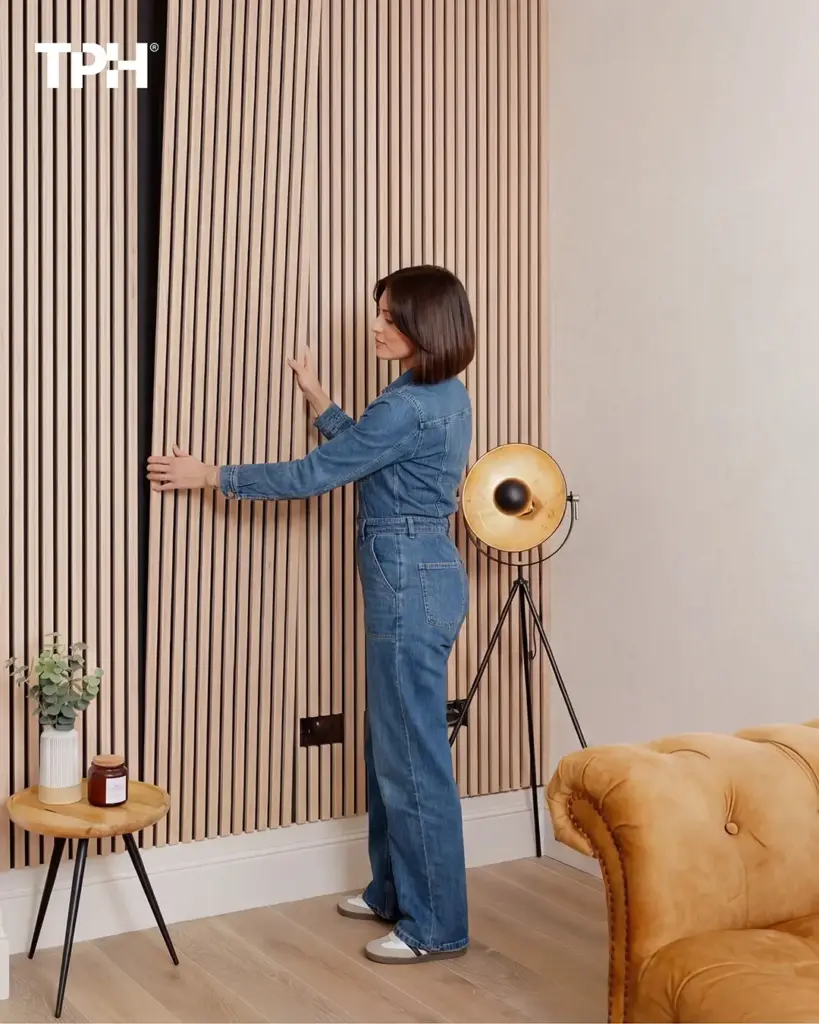
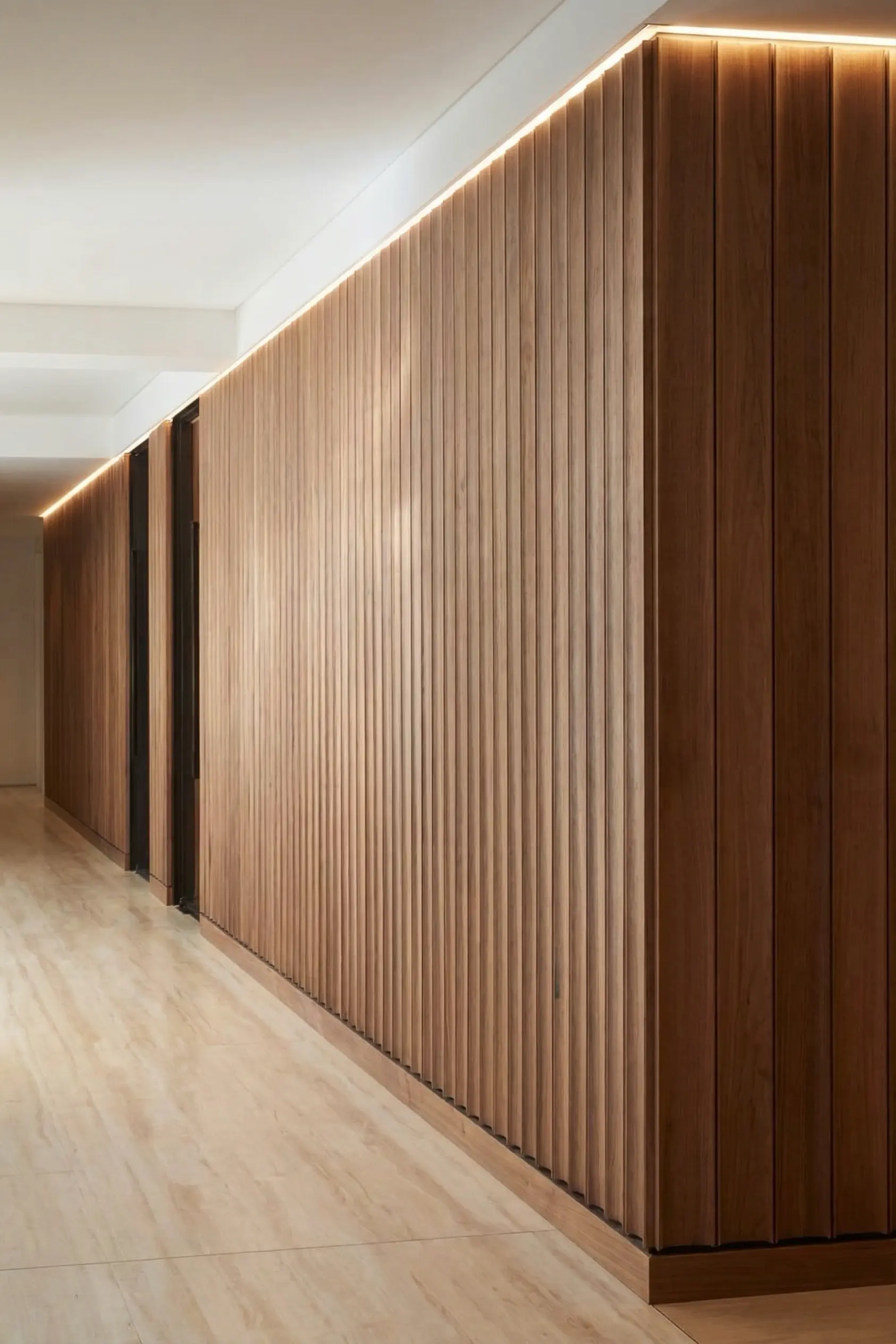
Full-height panelling — floor to ceiling — is consistently more successful than dado-height or wainscot-height wood in contemporary spaces. The continuous vertical line emphasises ceiling height and gives the room a sense of architectural intention rather than decoration. According to BBC Interior Design Masters finalist Jack Kinsey: ‘Panelling can literally elevate any space. It instantly lifts and adds another element that’s unexpected. I picked Dark Oak and ran it straight from the floor right up and over onto the ceiling.’
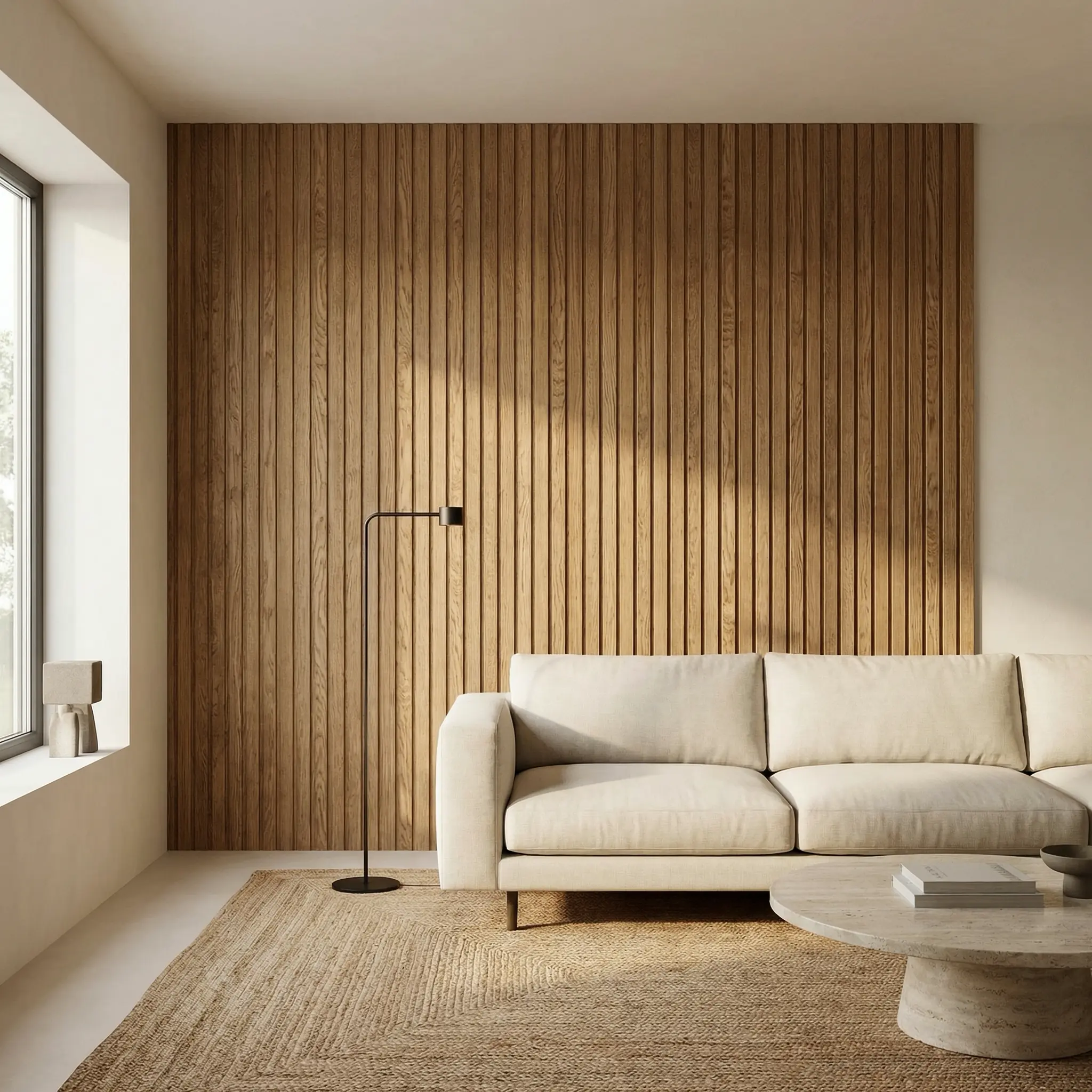
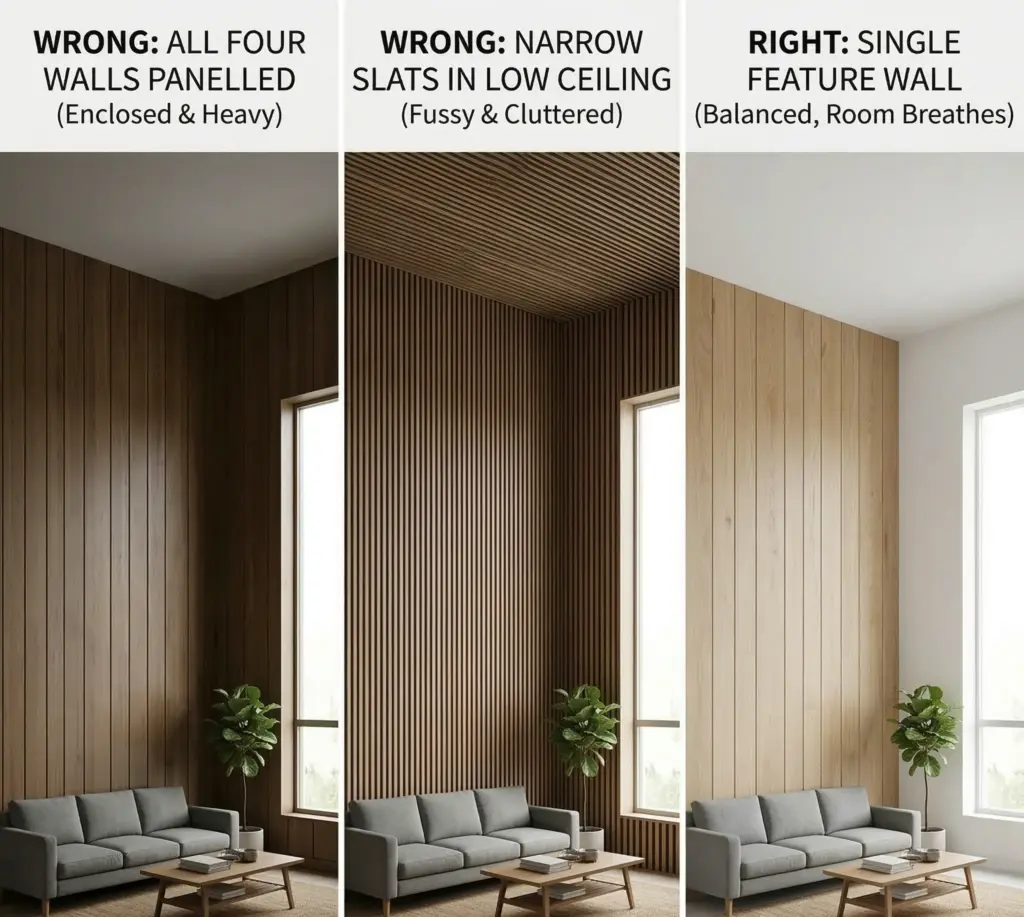
💡 Design tip: If your ceiling is lower than 2.5m (8ft), use vertical-groove or slatted panels rather than horizontal profiles. Vertical lines pull the eye upward and effectively increase perceived ceiling height. Horizontal lines do the opposite.
Bedroom: The Headboard Wall
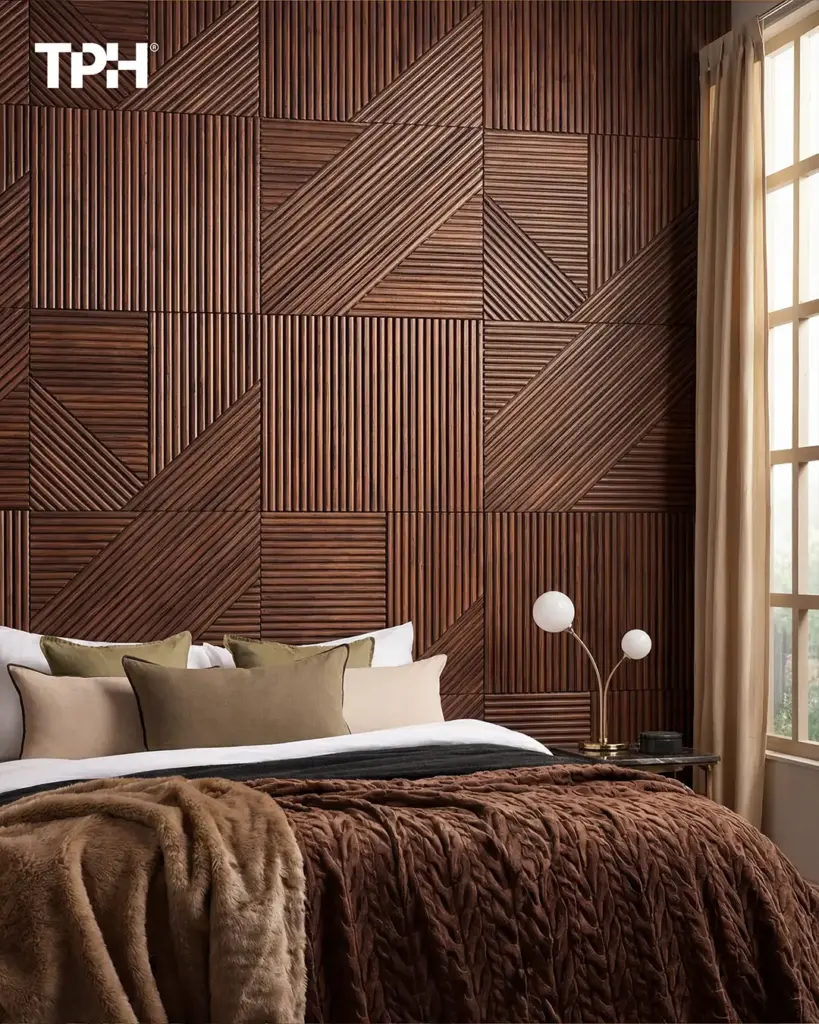
The bedroom application that delivers the highest impact per square metre is the headboard wall — the single wall behind the bed, panelled in solid wood from floor to ceiling or to picture-rail height. This is one of the most searched interior design solutions for bedrooms in 2025–2026, and for good reason: it solves the problem of the bed feeling like furniture floating in the room by giving it architectural grounding.
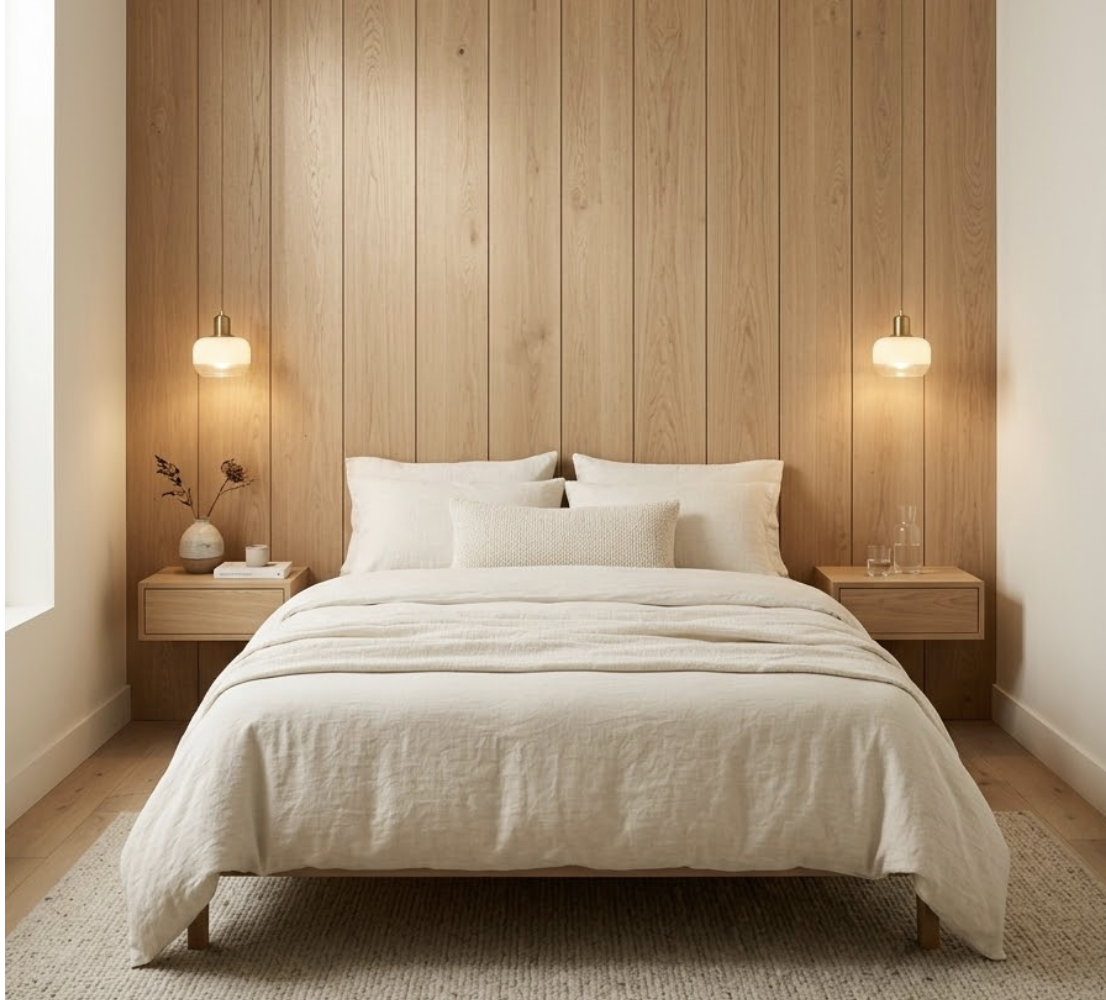
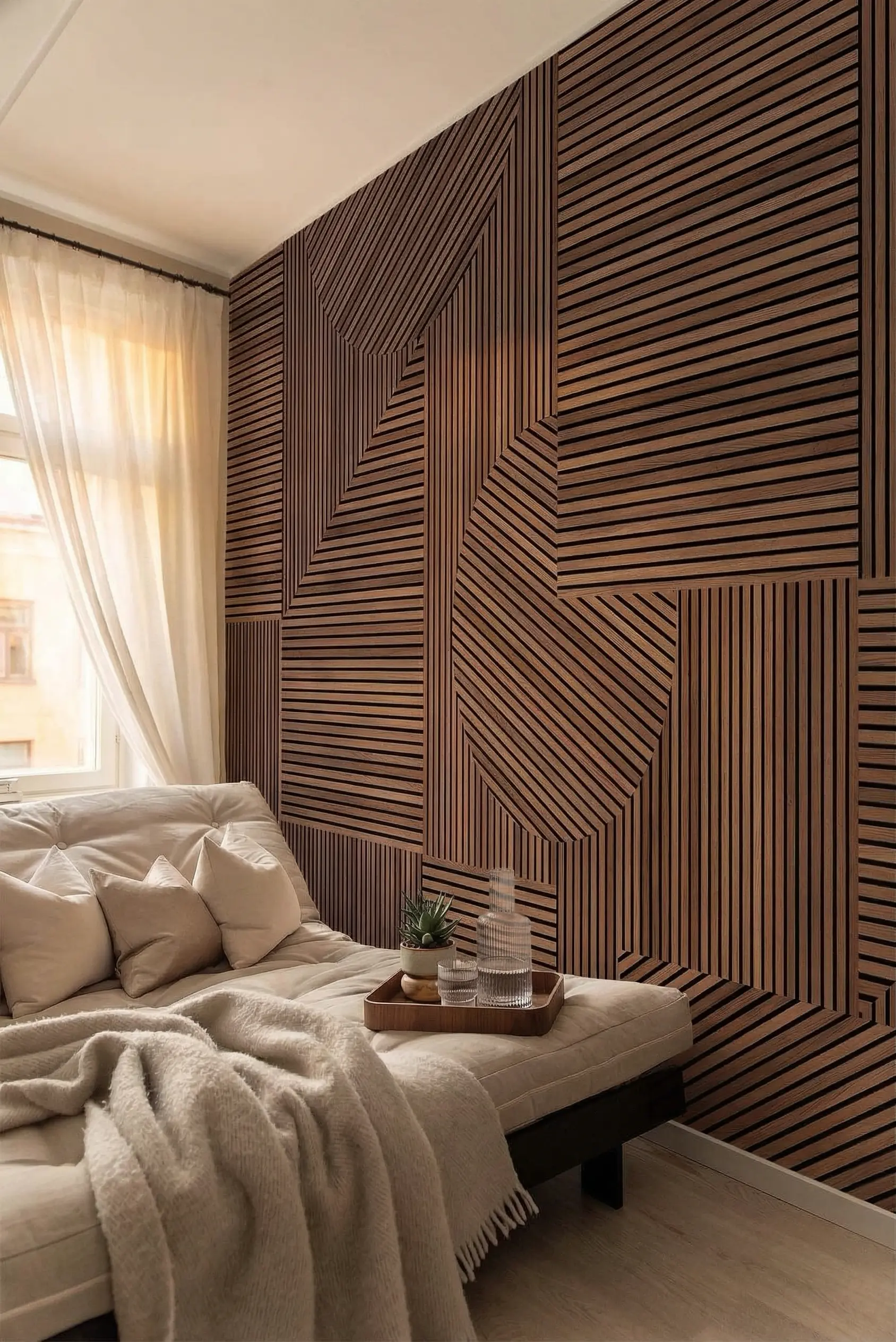
Warm-toned species work particularly well here — light oak, lightly-finished pine, or natural ash. Keep the remaining three walls in a paint colour that picks up a midtone from the wood grain. The bedroom effect you’re aiming for is quiet warmth, not statement drama.
💡 Design tip: Avoid high-gloss finishes in bedrooms. Matte or satin-oiled panels absorb light rather than reflecting it — the difference between a room that reads ‘calm’ and one that reads ‘showroom.’
Home Office and Study
The home office is an underused application for wood panels. A single panelled wall behind the desk — specifically the wall that appears in video calls — has a legitimate practical benefit: it reads as considered and professional in a way that a plain painted wall never quite does, without requiring artwork or shelving.
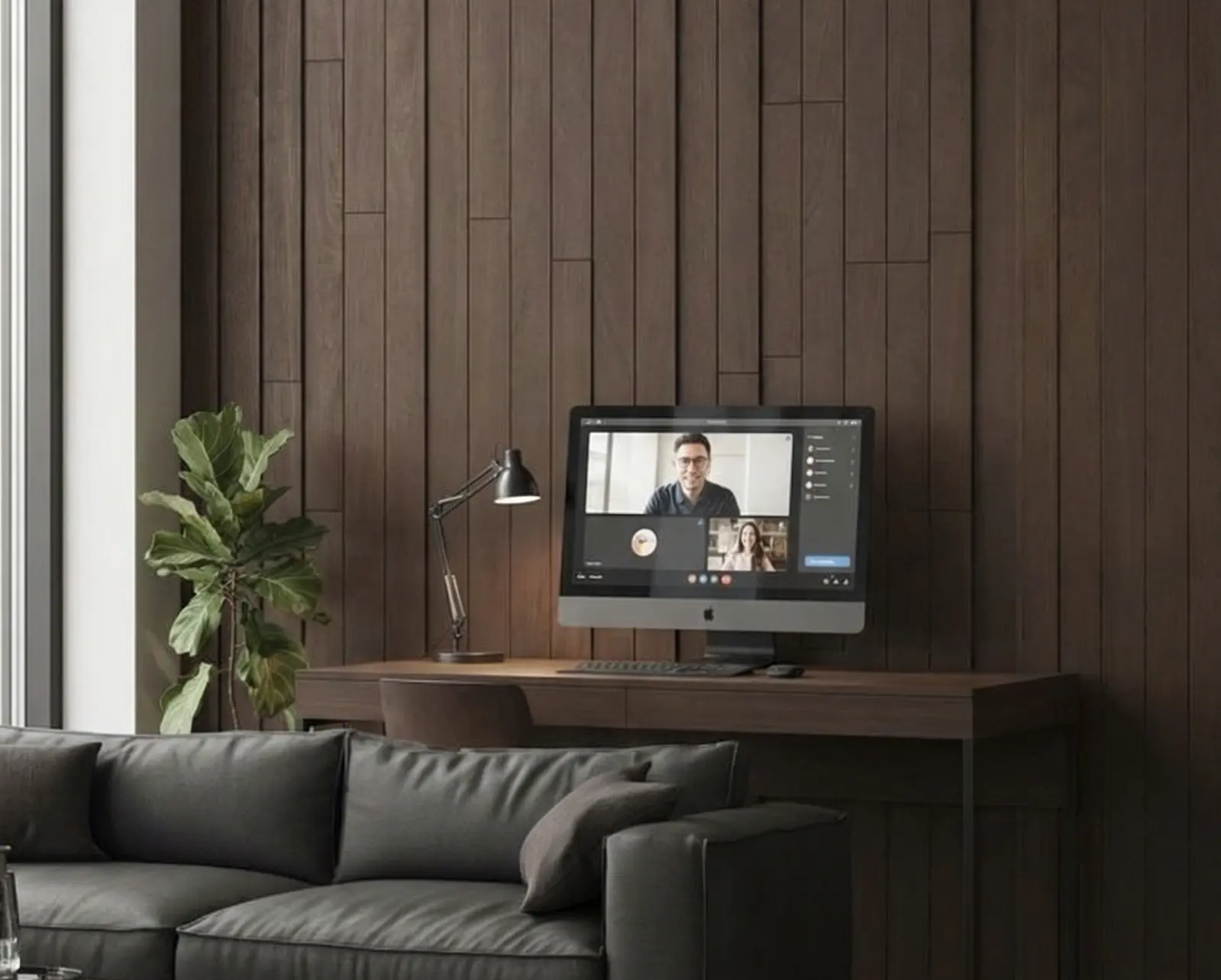
Darker species — walnut, smoked oak — work particularly well in home offices because they reduce eye strain from screen glare. A dark-panelled wall behind a monitor creates contrast that makes the screen feel visually contained rather than floating in ambient light.
Hallway and Entry
Hallways are the most forgiving application for bolder panel choices. Because dwell time is short, you can use darker tones, denser grain patterns, and stronger textures that would be fatiguing in a living room. Full-height walnut panelling on the entry wall is a high-impact decision that takes almost no courage because the commitment is a single narrow strip.
This is also the right application for reclaimed timber panels — the character and marks in aged wood reward close observation, and hallways are where guests stop and wait long enough to actually look.
Choosing Your Species and Finish: A Practical Reference
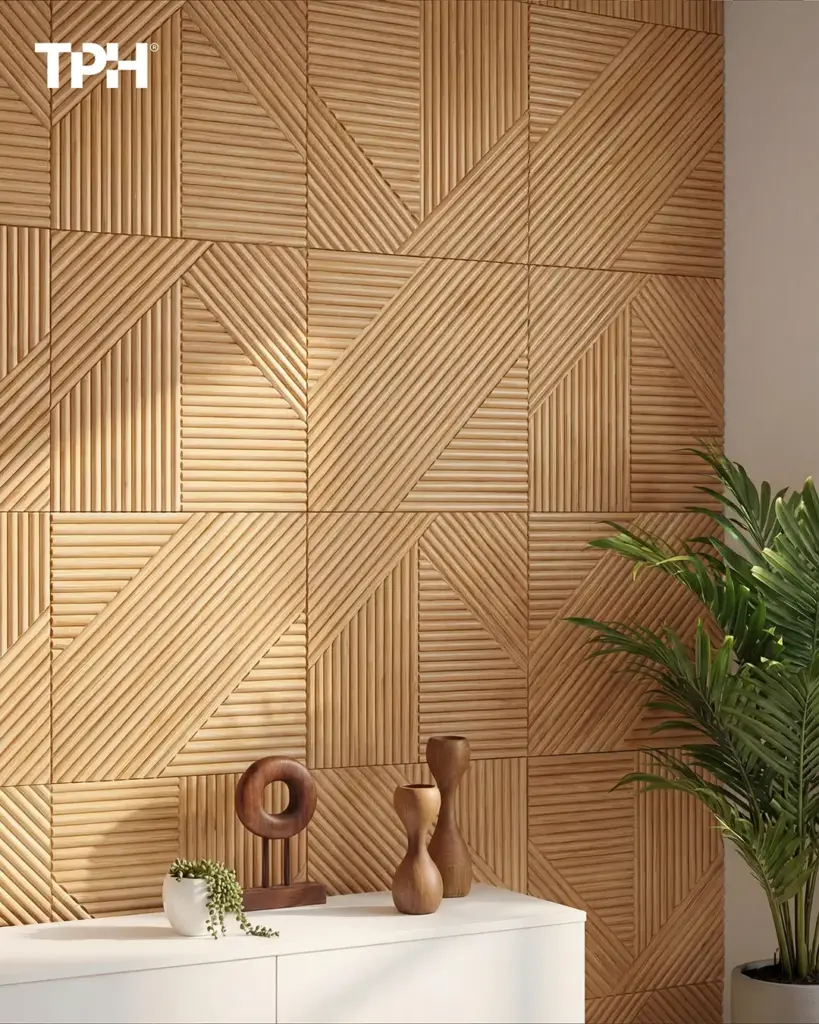
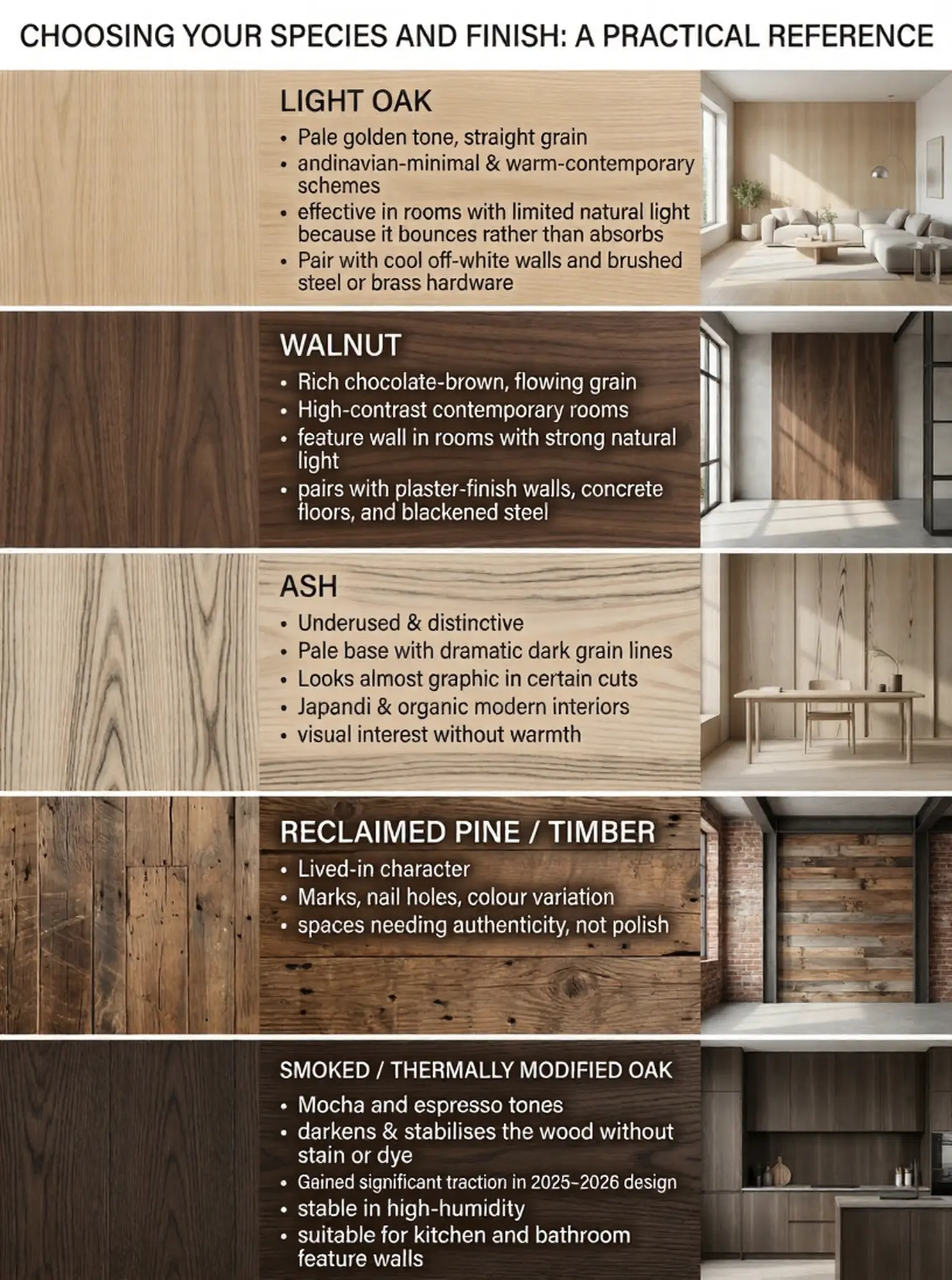
- Light oak — The safest starting point for modern interiors. Pale golden tone, straight grain, works in both Scandinavian-minimal and warm-contemporary schemes. Particularly effective in rooms with limited natural light because it bounces rather than absorbs. Pair with cool off-white walls and brushed steel or brass hardware.
- Walnut — The premium choice for high-contrast contemporary rooms. Rich chocolate-brown with flowing grain. Use as a feature wall in rooms with strong natural light — walnut in a dark, north-facing room reads as oppressive rather than luxurious. Pairs with plaster-finish walls, concrete floors, and blackened steel.
- Ash — Underused and distinctive. Pale base with dramatic dark grain lines — it looks almost graphic in certain species cuts. Excellent in Japandi and organic modern interiors where you want visual interest without warmth.
- Reclaimed pine / reclaimed timber — For interiors that need lived-in character. The marks, nail holes, and colour variation in reclaimed wood can’t be replicated by new-cut boards. Use it in spaces where authenticity is the brief, not polish.
- Smoked or thermally modified oak — A contemporary option gaining significant traction in 2025–2026 design. Thermal modification darkens and stabilises the wood without stain or dye, producing deep mocha and espresso tones. Dimensionally stable in high-humidity environments — suitable for kitchen and bathroom feature walls.
For current stock across oak, walnut, and specialty timber profiles, The Panel Hub’s wood wall panels collection is worth using as a reference for how different species photograph at scale — particularly useful if you haven’t seen a species in situ before.
Lighting Wood Panels: The Decision That Makes Everything Else Work
Wood panels without considered lighting are like paintings without frames — technically present but not doing what they should. The lighting decisions you make before installation determine whether your panels read as architectural or incidental.
Directional Wash Lighting
The most effective technique for solid wood wall panels is grazing light — a directional light source positioned close to the wall surface, angling light across it rather than toward it. Grazing light reveals the three-dimensional texture of the grain, the ridges in slatted profiles, and the variations between boards. Without it, even beautiful timber reads as flat.
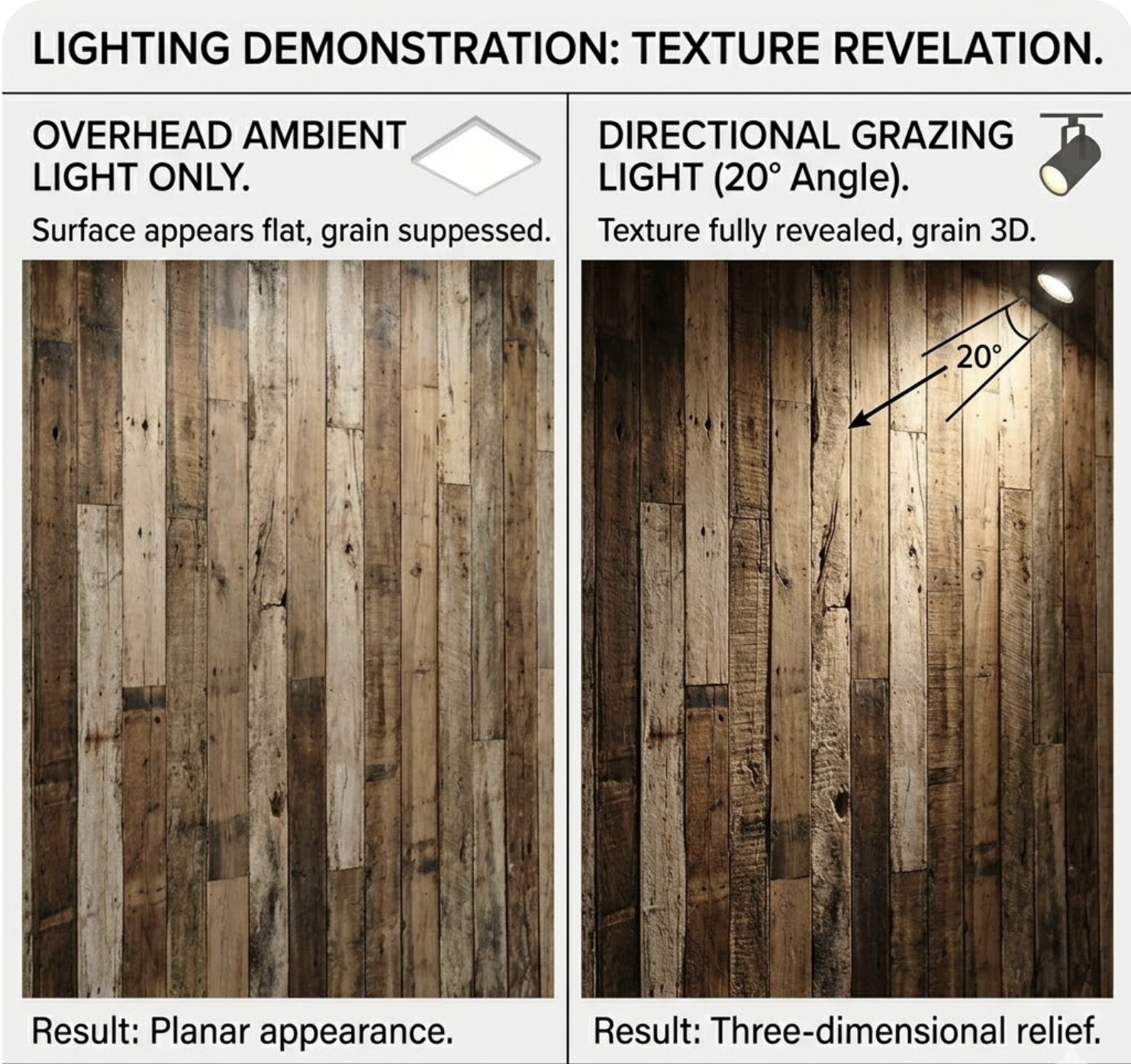
Install recessed ceiling fixtures roughly 150–200mm (6–8 inches) from the wall face, angled at 15–30° to the surface. Track lighting with adjustable heads gives you flexibility to tune the angle after installation.
Warm vs. Neutral Colour Temperature
Match your lighting colour temperature to the wood species. Light oak and ash look best under 3000K warm white — cool white (4000K+) flattens their golden undertone and makes them look beige rather than warm. Walnut and smoked oak can take slightly cooler temperatures, around 3000–3500K, which emphasises the contrast in the grain without washing out the depth.
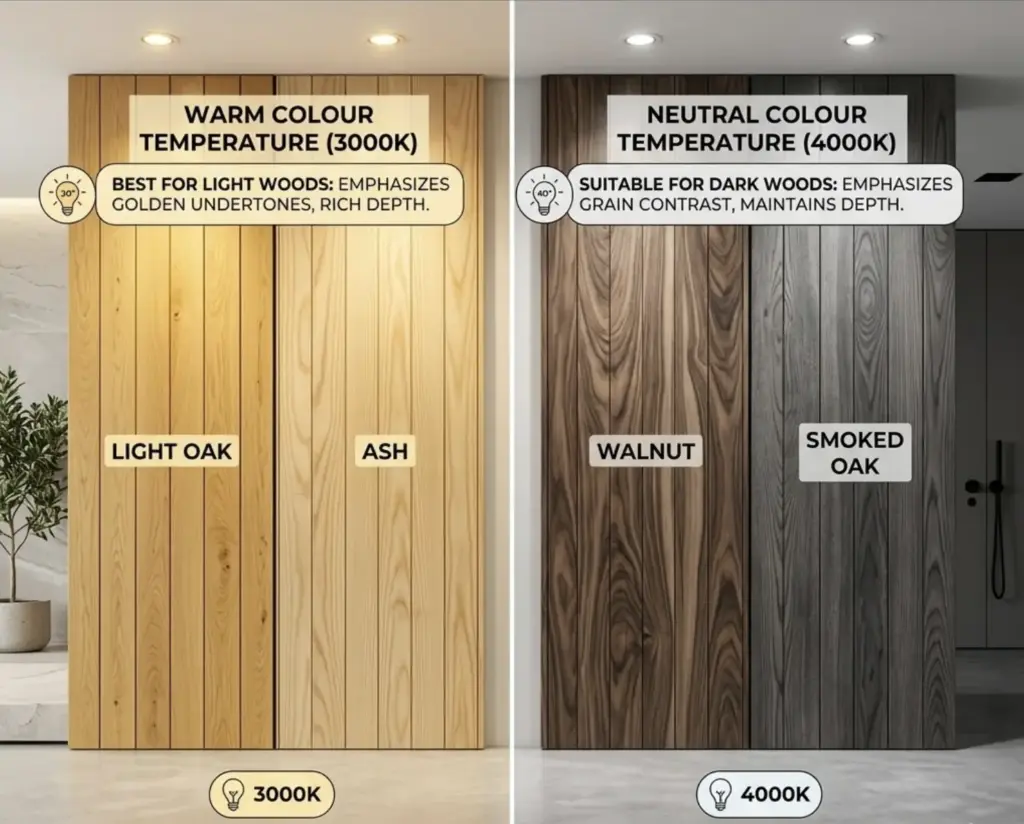
💡 Design tip: Test your lighting before final installation. Temporarily position a directional lamp close to the wall at roughly 20° and observe the panel in the evening — artificial-light conditions reveal how the room will actually feel during the 70% of occupied time when natural light isn’t dominant.
Installation Principles: What Your Contractor Needs to Know
Solid wood panels require different handling than composite alternatives. These are the points most commonly missed during installation that lead to problems in the first year.
- Acclimatise the timber before installation: Solid wood must be stored in the room where it will be installed for a minimum of 48–72 hours before fitting. The timber adjusts its moisture content to match the room’s ambient humidity. Installing without acclimatisation causes gaps (if the room is drier than the storage environment) or buckling (if the room is more humid). This is the single most common cause of post-installation complaints.
- Leave expansion gaps: Solid wood expands and contracts seasonally, particularly in heated homes where humidity drops in winter. Leave 2–3mm gaps at the perimeter of each panel or section. These are covered by skirting, cornice, or batten and are invisible in the finished installation. A contractor who tells you this isn’t necessary for indoor wall panels has never done this job in winter.
- Fix to a level substrate: Panels on an uneven wall surface develop stress points at high spots that cause cracking or movement over time. Use a combination of adhesive and mechanical fixings (hidden nail or screw through the tongue, depending on the panel profile). Adhesive alone is insufficient for solid timber.
- Seal all six faces: If you’re finishing panels on site, apply your chosen finish (oil, wax, or lacquer) to all six faces of each board — including the back face and end grain. This slows the rate of moisture absorption/release and reduces the degree of seasonal movement.
The Three Mistakes That Make Wood Panels Look Wrong
1. Too Many Walls
Covering multiple walls — or worse, all four — removes the architectural logic that makes a feature wall work. A feature wall only reads as a feature in contrast to plain walls. When every surface is panelled, the eye has no resting point and the room feels dense regardless of how beautiful the timber is. One wall, executed well, delivers more visual impact than four walls done carelessly.
2. Wrong Scale Relative to the Room
Slatted panels with very narrow slat spacing (under 20mm) look delicate in large rooms and fussy in small ones. Wide-board flat panels (200mm+) work in rooms with strong architectural bones but can feel heavy in compact spaces. As a baseline: slat width should be roughly proportional to the ceiling height. Higher ceilings tolerate narrower, denser slat patterns. Standard or lower ceilings need broader boards with fewer visible lines.
3. Mismatched Undertones
Wood has undertones — warm (yellow-orange in oak, red in cherry), cool (grey in ash, green in some reclaimed pine). Your wall colour needs to harmonise with the wood’s undertone, not fight it. A warm golden oak panel beside a cool grey-blue wall creates a visual tension that feels unsettled rather than contrasted. Test paint colours directly against your actual panel sample, not against a chip card.
Matching Wood Panels to Your Interior Style
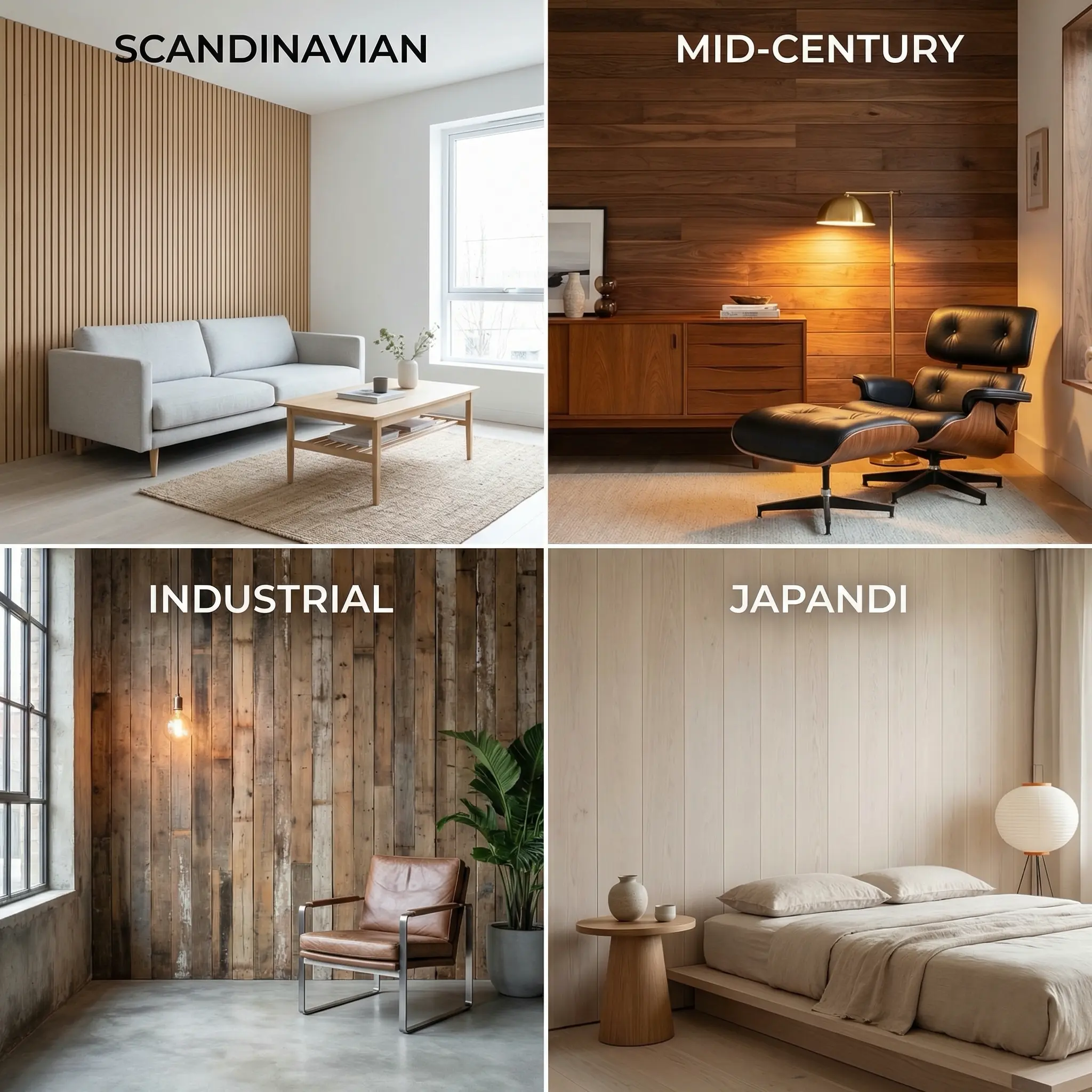
- Scandinavian / Japandi: Light oak or ash, vertical slatted panels, matte oil finish. Pair with plaster walls in off-white or warm grey, natural fibre textiles, and minimal furniture with clean lines.
- Contemporary / Minimalist: Wide-board flat panels in lightly finished oak or thermally modified wood. Flush fitting, no visible profile gaps. The wood acts as a texture rather than a statement — restrained and architectural.
- Mid-century Modern: Walnut with a horizontal board direction, warm amber finish. Pairs with low-profile furniture, wool upholstery in rust or olive, and brushed brass hardware.
- Organic Modern / Biophilic: Natural-finish panels in species with visible grain movement — ash, olive ash, or figured oak. Mix with plants, natural stone, and linen textiles. The wood panel is part of a material strategy that references the outdoors throughout the space.
- Industrial / Urban: Reclaimed timber or smoked oak with a deliberately undressed quality. Pair with concrete, blackened steel, and exposed brick. The contrast between the rough panel and refined furniture is the point.
Starting Your Project
If you’re at the beginning of this decision, the most useful thing you can do is see timber at scale before you commit. Sample chips and swatches are genuinely unreliable guides to how a species reads across a full wall in your actual room’s light. Most panel suppliers — including The Panel Hub — offer full-size or large sample sections that let you hold the real material against your wall in your conditions.
The room-by-room logic in this guide gives you the placement. The species and finish reference gives you the material. The lighting section gives you the decision that turns both of those into something worth building.
One wall, the right species, the right light. That’s the entire brief for doing this well.
FAQ: Solid Wood Wall Panels
Q: Are solid wood wall panels suitable for modern interiors?
Yes — and increasingly, they’re defining what modern interiors look like in 2025–2026. The key is restraint: one feature wall rather than full-room coverage, species and finish choices that complement the room’s undertone, and full-height installation that reads as architectural rather than decorative. Solid wood wall panels work across contemporary, Japandi, minimalist, and organic modern schemes depending on species choice and installation approach.
Q: Which wood species is best for wall panels?
Light oak is the most versatile starting point — it works in most lighting conditions and suits the widest range of interior styles. Walnut is the premium choice for high-contrast contemporary rooms with good natural light. Ash delivers graphic grain for Japandi and organic modern schemes. Thermally modified oak is the best choice for high-humidity environments like kitchens and bathrooms. The best decision is always made with a large sample in your actual room — not from a chip card.
Q: How do you maintain solid wood wall panels?
Oiled or waxed panels require reapplication of the finish every 2–3 years in normal residential conditions — a light clean and a thin coat of the same oil or wax used originally. Lacquered panels need no periodic maintenance but can’t be spot-repaired without refinishing the whole panel. Scratches on oiled panels are sanded flush and re-oiled; on lacquered panels, they need professional attention. Most homeowners find oiled finishes lower-maintenance in practice despite the periodic reapplication schedule.
Q: Do solid wood wall panels need special installation?
Three requirements that composite panels don’t share: acclimatise the timber in the room for 48–72 hours before installation, leave 2–3mm expansion gaps at all perimeter edges, and seal all six faces of each board (including back and end grain) if finishing on site. A contractor unfamiliar with solid timber wall panelling — rather than MDF-backed panels — may need to be briefed on these points before installation begins.
Q: Can solid wood panels be used in a bathroom or kitchen?
With the right species and finish, yes. Thermally modified (heat-treated) oak or pine is dimensionally stabilised to resist the humidity cycles of bathroom and kitchen environments — it’s the species choice I specify for those rooms. Apply a moisture-resistant oil or hardwax-oil finish and ensure adequate ventilation. Avoid placing panels directly behind sinks or shower splashback zones where they’ll receive direct water contact.
- 4shares
- Facebook0
- Pinterest4
- Twitter0
- Reddit0