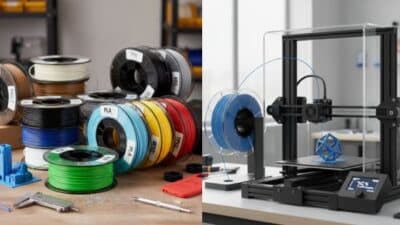
Automotive 3D printing, also called additive manufacturing, now plays a part in how carmakers design, test and build vehicles. It began as a way to make small plastic models. Today it supports prototypes, assembly-line tooling, lightweight components and a growing number of low-volume production parts.
This guide covers where the technology fits in vehicle development, which materials it uses, and where its limits still matter.
Taking a car from first sketch to showroom involves long lead times, costly tooling and many rounds of revision. 3D printing shortens parts of that process. Teams can hold a physical version of a design much sooner, and they can produce shapes that machining or molding can’t easily make.
There are tradeoffs. Printed parts can cost more per unit at high volumes and need careful process control. They also have to pass the same validation as conventionally made parts before they go into a vehicle.
Pros and cons
| Pros | Cons |
|---|---|
| – Rapid Prototyping: Significantly speeds up design iteration and testing. | – High Initial Cost: Industrial 3D printers and materials can be expensive. |
| – Design Freedom: Allows for complex geometries and lightweight structures. | – Limited Material Range: Still fewer options compared to traditional manufacturing. |
| – Customization: Enables personalized parts and low-volume production. | – Slower Production Speed: Not ideal for true mass production of simple parts. |
| – Reduced Waste: Uses only the material needed, minimizing scrap. | – Post-Processing Required: Many 3D printed parts need additional finishing. |
| – Tooling Elimination: Cuts costs and lead times by removing the need for molds. | – Scalability Challenges: Large-scale, high-volume production is still evolving. |
What is automotive 3D printing?
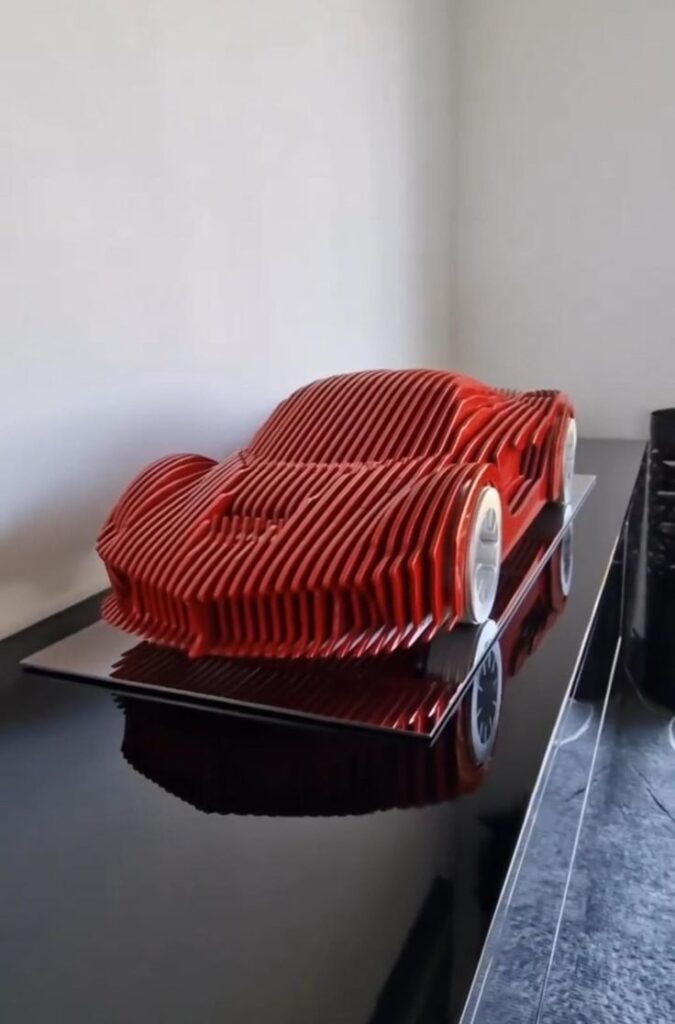
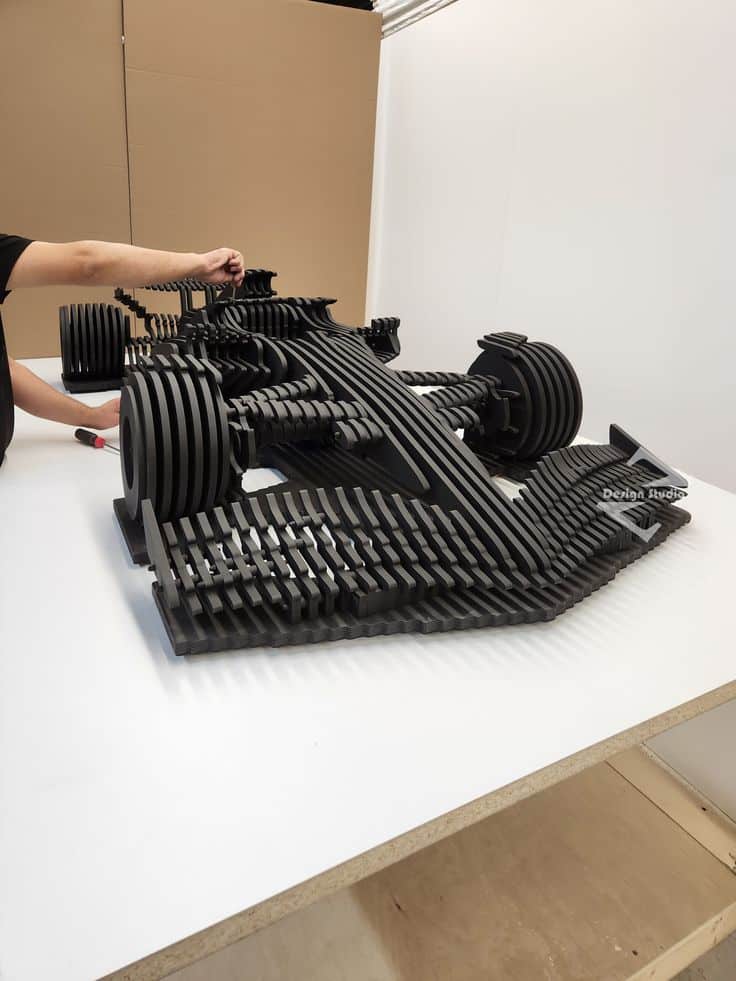
Automotive 3D printing builds a three-dimensional object by adding material in thin layers, following a digital design file. Depending on the process, the printer extrudes or fuses plastics, metals, composites or ceramics.
Traditional subtractive manufacturing works the other way. It starts with a solid block and cuts away material. Additive manufacturing deposits material mainly where the part needs it, which explains many of its benefits for complex shapes and material use.
In the auto industry, 3D printing covers more than display models. It produces functional components, durable prototypes and some parts that go straight into production vehicles.
The term covers a family of processes. Fused Deposition Modeling (FDM) works with plastic filament, and Selective Laser Sintering (SLS) fuses powdered polymers. Direct Metal Laser Sintering (DMLS) and Electron Beam Melting (EBM) produce metal parts. Each differs in material properties, surface finish and the geometry it can handle, so engineers choose the process that fits the job.
Carmakers have used 3D printing for decades, but adoption has grown quickly in recent years. Early uses were mostly visual prototypes and fit checks. Now the technology appears at many stages, from concept design and production tooling to replacement and aftermarket parts. It is most useful where parts are complex, needed quickly or made in small numbers.
From concept to crossover: how 3D printing is used in design and prototyping
Design and prototyping is where automotive 3D printing has had the clearest impact. Before printing became widely available, physical prototypes were slow and expensive to make, often by hand. Designers could wait weeks or months to see an idea in physical form, which limited how many versions they could try. Printing cuts that wait, so teams can explore more options within the same schedule.
Rapid prototyping
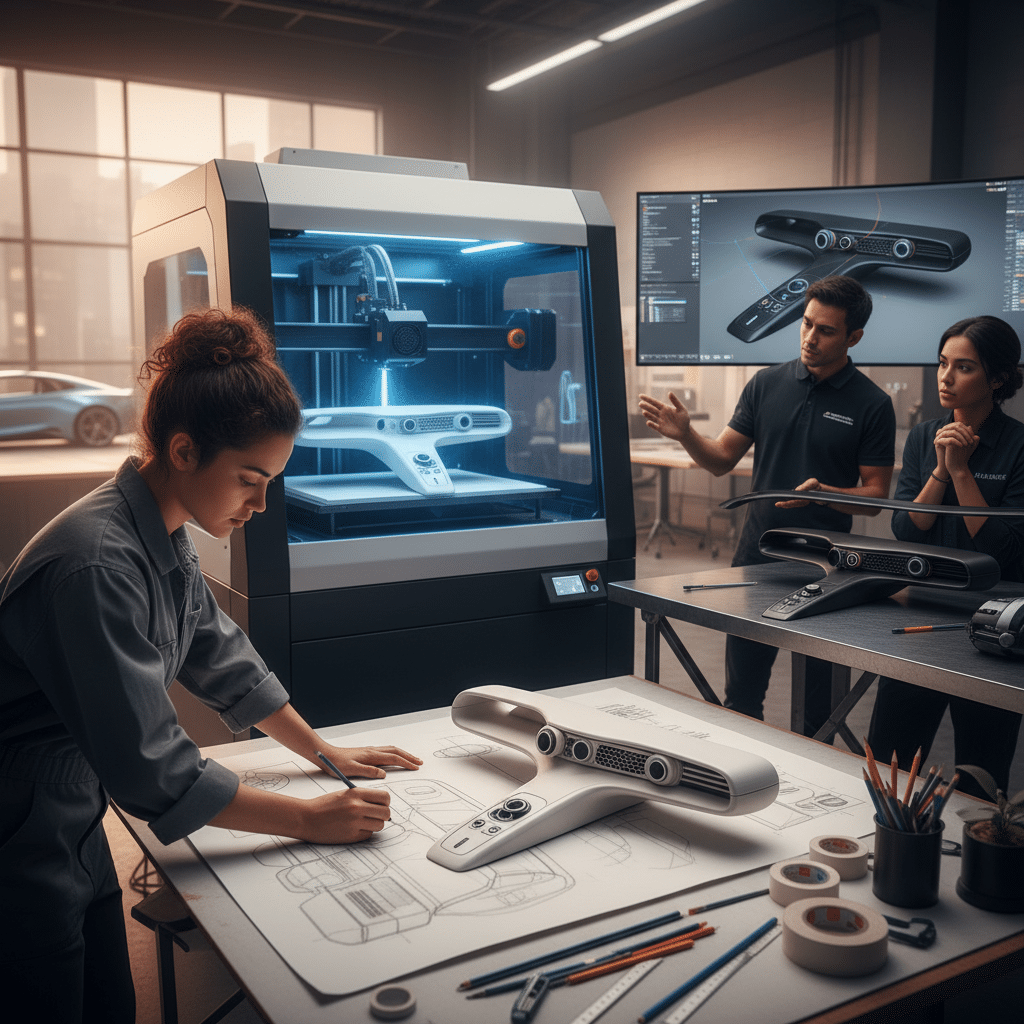
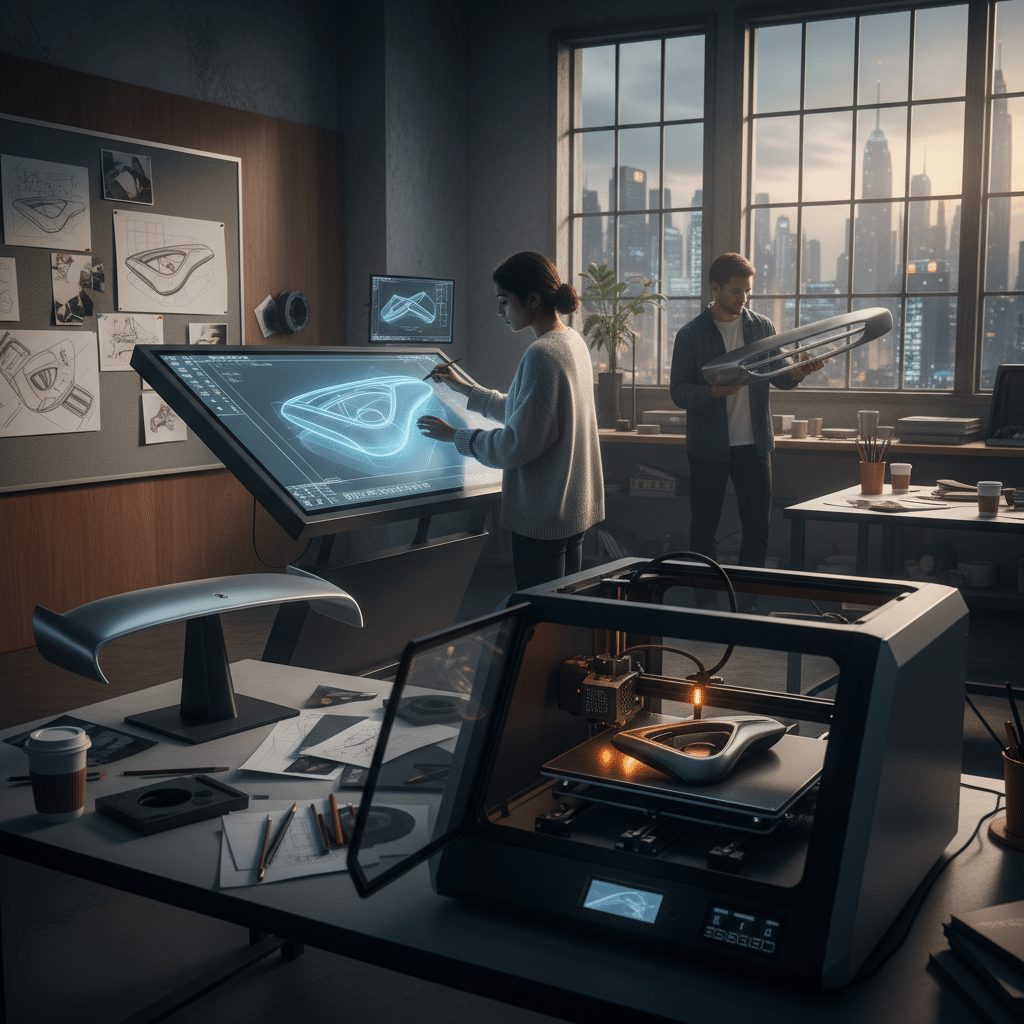
Take a designer working on a new interior console or an aerodynamic wing. Traditionally, turning that idea into a physical model meant machining, molding or handcrafting it. With 3D printing, the digital file can become an accurate physical model within hours or days, depending on size and process.
This rapid prototyping lets designers and engineers check form, fit and sometimes function early. They can spot flaws, try different shapes and test ergonomics before paying for production tooling. Dassault Systèmes describes this kind of prototyping and iterative development as a core automotive use of 3D printing.
Catching problems at this stage matters because they are cheapest to fix before tooling is made. Faster prototyping can also shorten development cycles for parts such as grilles or dashboard layouts.
Design iteration
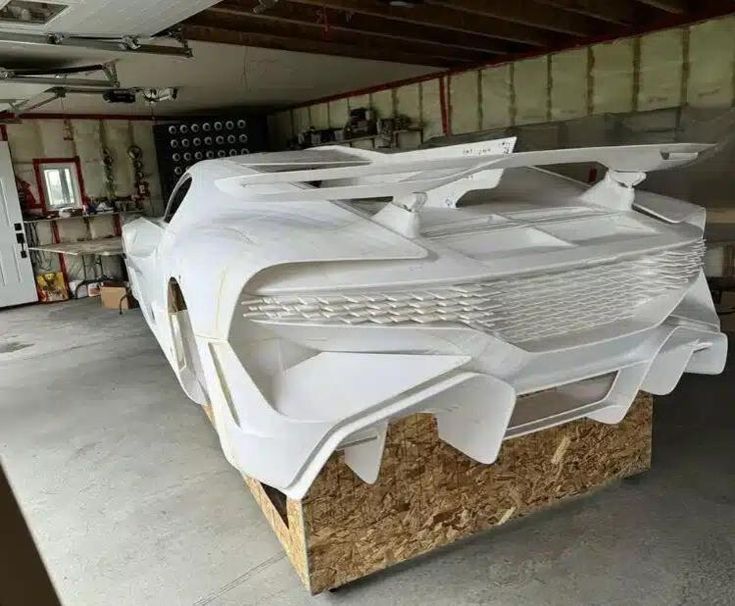
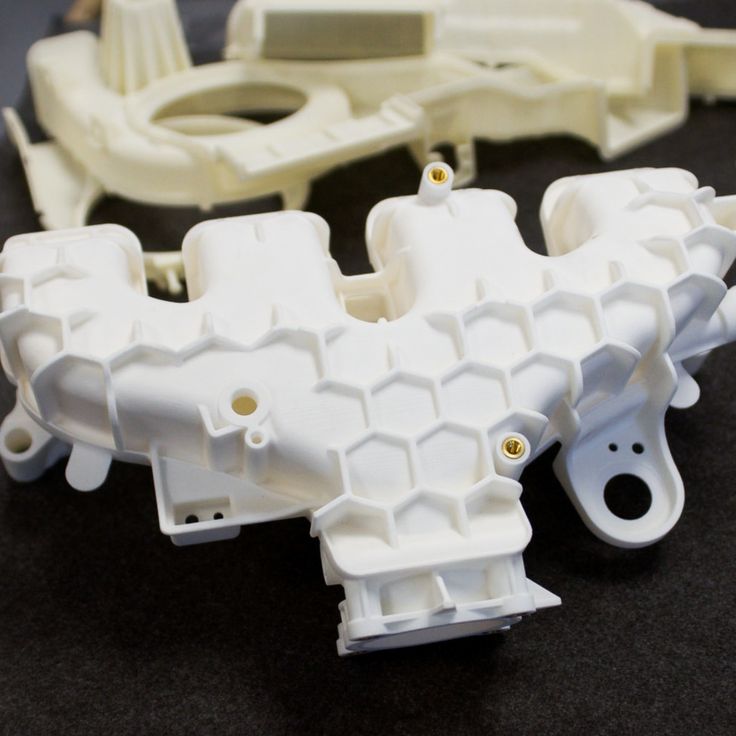
Because each printed variation costs relatively little, designers can compare more options. A team might print two mirror housings with slightly different curves to study airflow. It could also print two HVAC vent designs and compare them side by side in a dashboard mock-up.
This kind of iteration helps refine styling, aerodynamics and ergonomics. It also lets teams answer “what if” questions with a physical part, alongside computer simulation.
Iteration isn’t limited to exterior parts. Designers print interior layouts, test button placement and try out textures and finishes for cabin materials. Holding a physical part gives tactile feedback that a screen can’t provide.
For more on keeping an attractive design practical to build, see this guide on from styling to structure: balancing design and manufacturability in automotive prototypes. It covers the checks that help early-stage concepts stay manufacturable.
Under the hood: manufacturing with additive techniques
3D printing also appears in automotive manufacturing itself, beyond the design studio. Its most established roles are production tooling and selected end-use parts, while high-volume use is still developing.
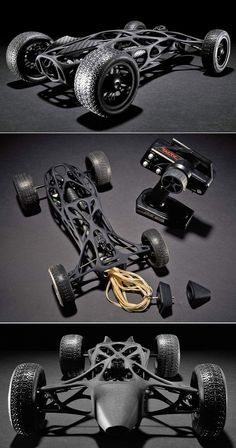
Tooling and jigs
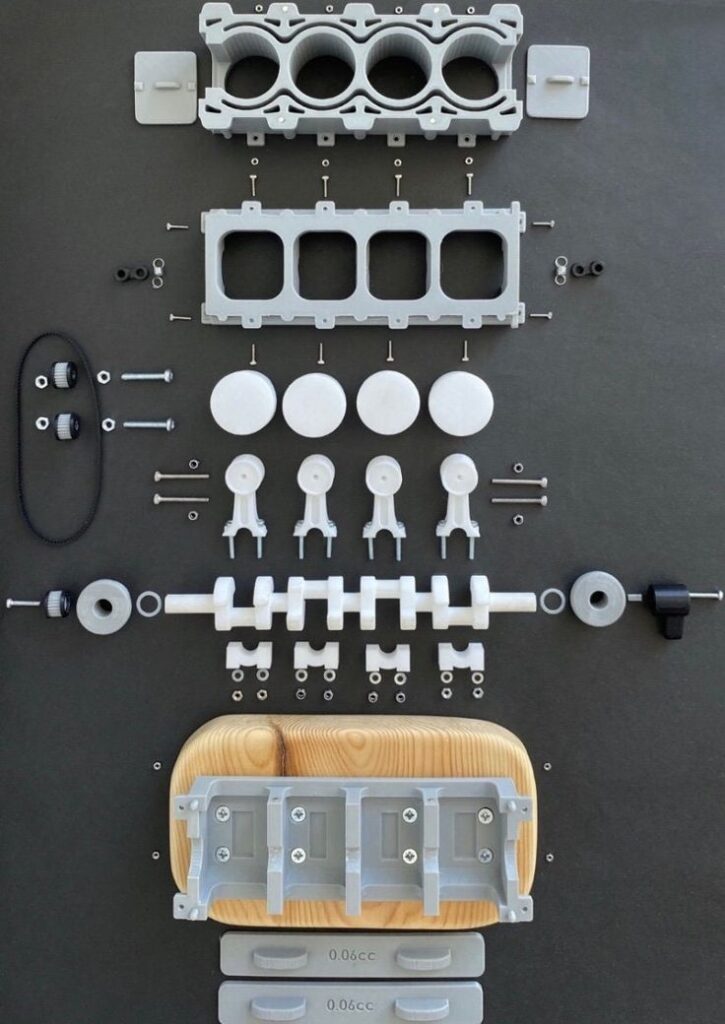
One of the most common manufacturing uses is making custom tools, jigs, fixtures and guides for assembly lines. Conventional tooling can be expensive and slow to produce because it often needs complex machining.
A printed jig that holds a specific part during assembly may be quicker and cheaper to produce, depending on size, material and finishing requirements. This shortens setup time for new production lines and makes it easier to adapt existing ones.
For example, assembly workers may need a fixture that aligns a sensor during installation. Instead of waiting weeks for a machined metal tool, a team can often print a polymer version within hours.
Printed tools tend to be lightweight and can be shaped for comfortable handling. They are also easy to replace or update when production needs change, which saves time and money.
End-use parts
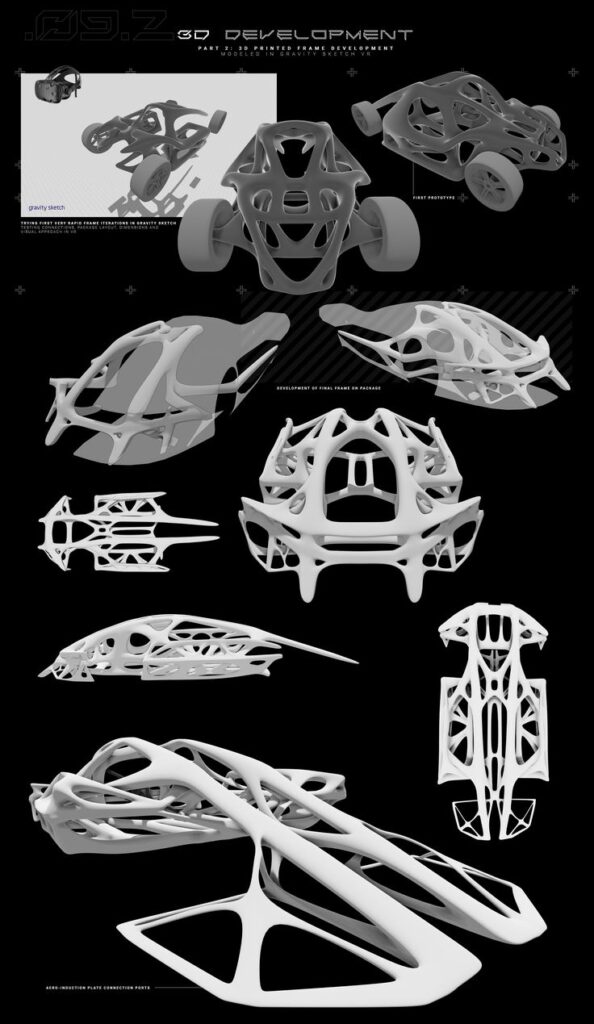
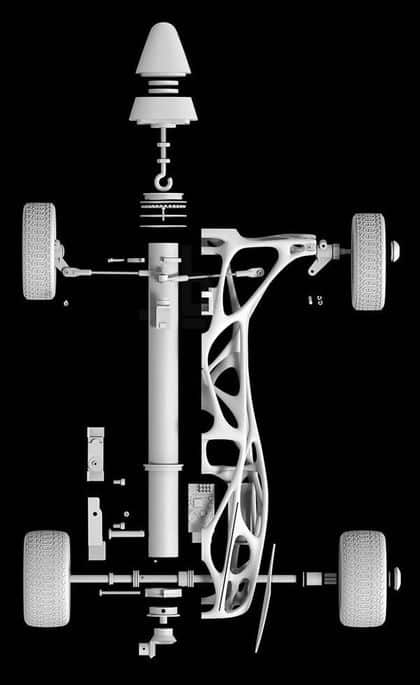
3D printing is also used for some end-use parts that go directly into vehicles. These are usually complex, low-volume or highly optimized components, where additive methods offer the clearest advantage. Most high-volume parts are still made with conventional methods.
A sensible rule is to start with prototypes and tooling. Move a printed part into a vehicle only after the material, process and design have passed the same validation as a conventional part. Hobbyist prints for brakes, steering, suspension or seat mounts are not validated safety parts.
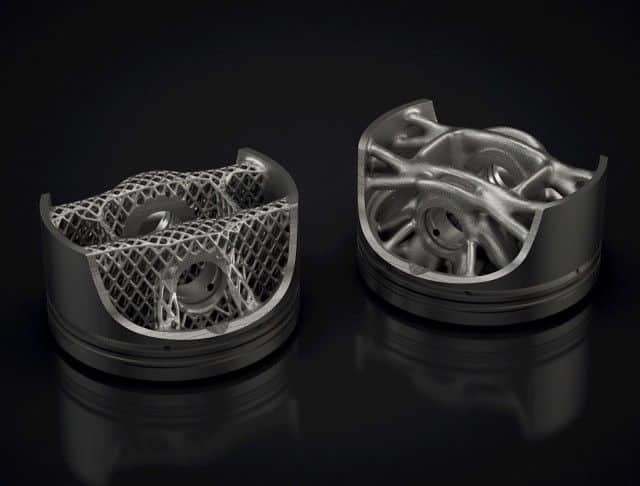
- Lightweighting: Printing can produce lattice structures and hollow forms that conventional methods can’t easily make. This can reduce part weight while keeping the required strength, which helps fuel economy, electric vehicle range and performance.
- Consolidation: Several parts can sometimes be combined into one printed component. This can reduce assembly time, simplify inventory and remove joints that might fail.
- Performance: In supercars and racing cars, printed metal parts such as exhaust components, turbocharger parts and brake calipers can be shaped for specific thermal or aerodynamic needs.
- Legacy parts: Replacement parts for older and classic cars can be hard to find. Printing can reproduce discontinued components, provided the replica meets the original part’s material and safety requirements.
BMW and Porsche are among the companies using 3D printing for end-use parts. Their applications range from small plastic clips and trim pieces to metal parts for specialized models. Porsche has offered bucket seats with 3D printed sections for some 911 and 718 models, with a choice of firmness levels.
Customization and personalization
Many buyers now expect products tailored to them, and 3D printing lets carmakers offer more personal options. Beyond paint color and trim, a buyer might choose a custom shift knob, vent cover or interior panel. Some panels could carry unique textures or the owner’s initials.
For limited editions and premium brands, printing makes one-off components affordable in small numbers. Customization can also be practical, such as a steering wheel grip shaped for a driver’s hand or pedal extensions for shorter drivers.
The same digital flexibility shows up in other design fields. 3D printed jewelry designs use similar principles of customization and fine detail.
Racing ahead: 3D printing in motorsports
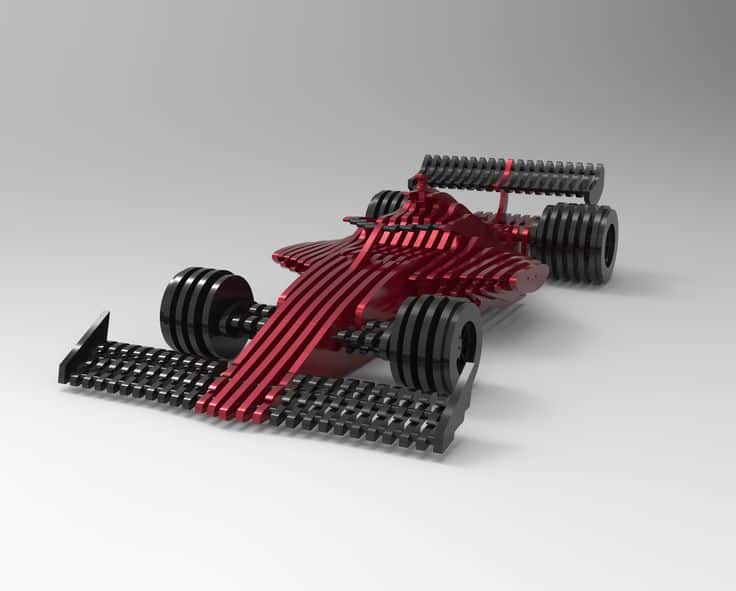
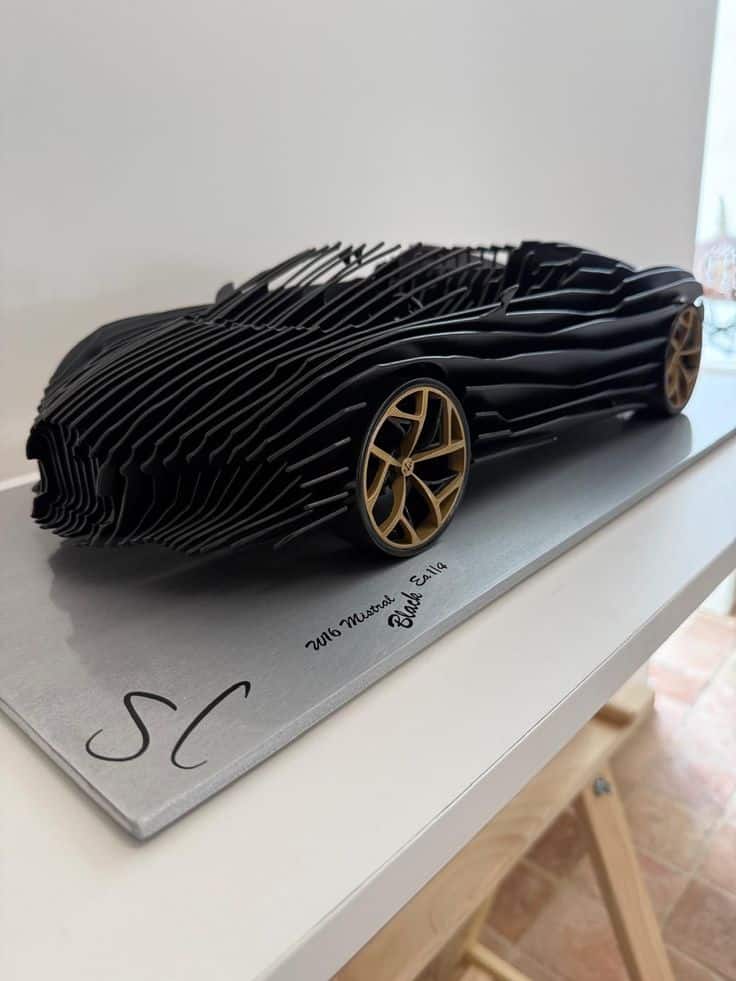
In motorsport, small weight savings and short development times matter a great deal. Formula 1, endurance racing and other top series use 3D printing heavily to develop and refine their cars.
Formula 1 teams update their cars throughout the season. Printing lets them quickly produce new aerodynamic parts, internal components and chassis elements with complex shapes.
In principle, a team can design a new winglet, print it overnight and test it in a wind tunnel the next day. If it passes testing and meets the regulations, it could reach the car for an upcoming race. Actual turnaround depends on the process, finishing and test schedule.
Teams use metal processes such as DMLS for engine, gearbox and structural parts that must be both strong and light. They use polymer printing for cooling ducts, brake ducts and aerodynamic pieces. Some of these may be made for a single race or track layout.
Racing teams work within strict technical rules and, in some series, cost caps. Lessons from motorsport often carry over into road car development and help spread the technology to consumer vehicles.
Materials beyond plastic
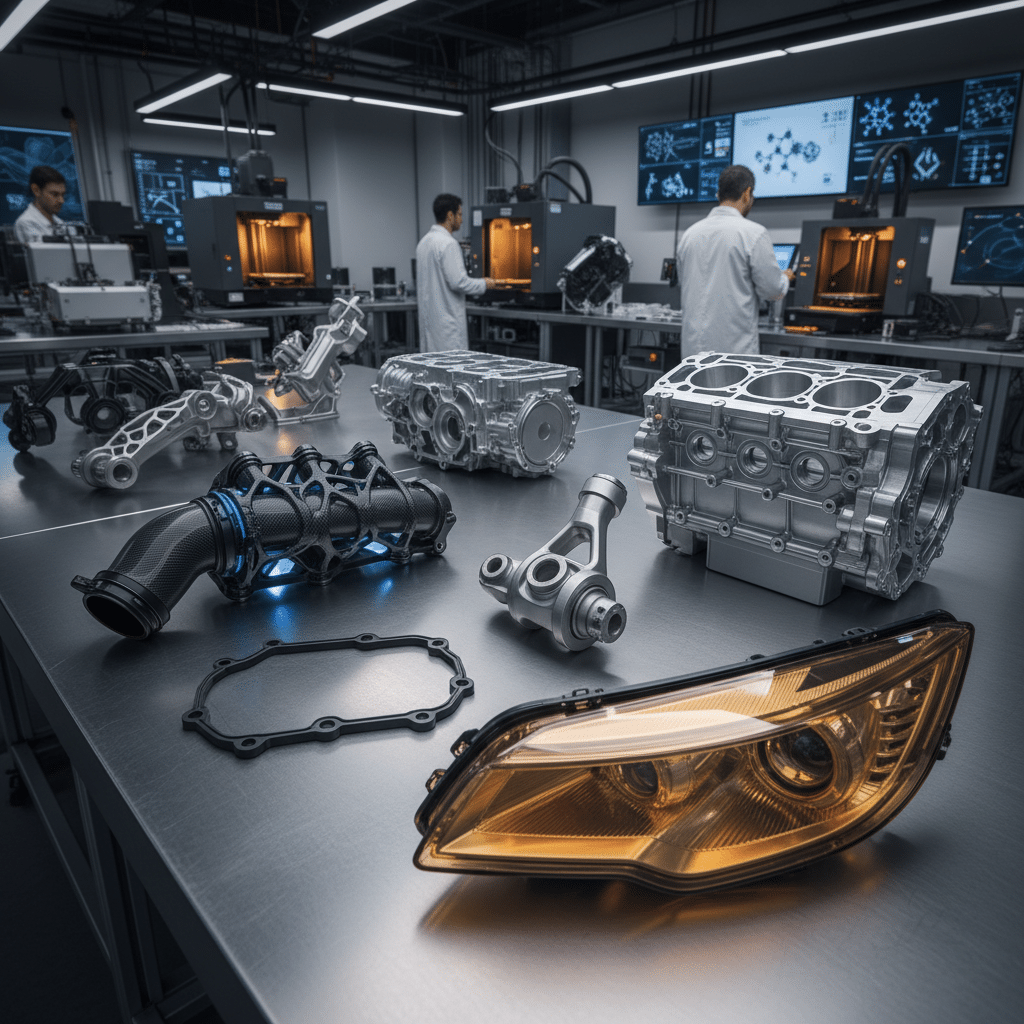
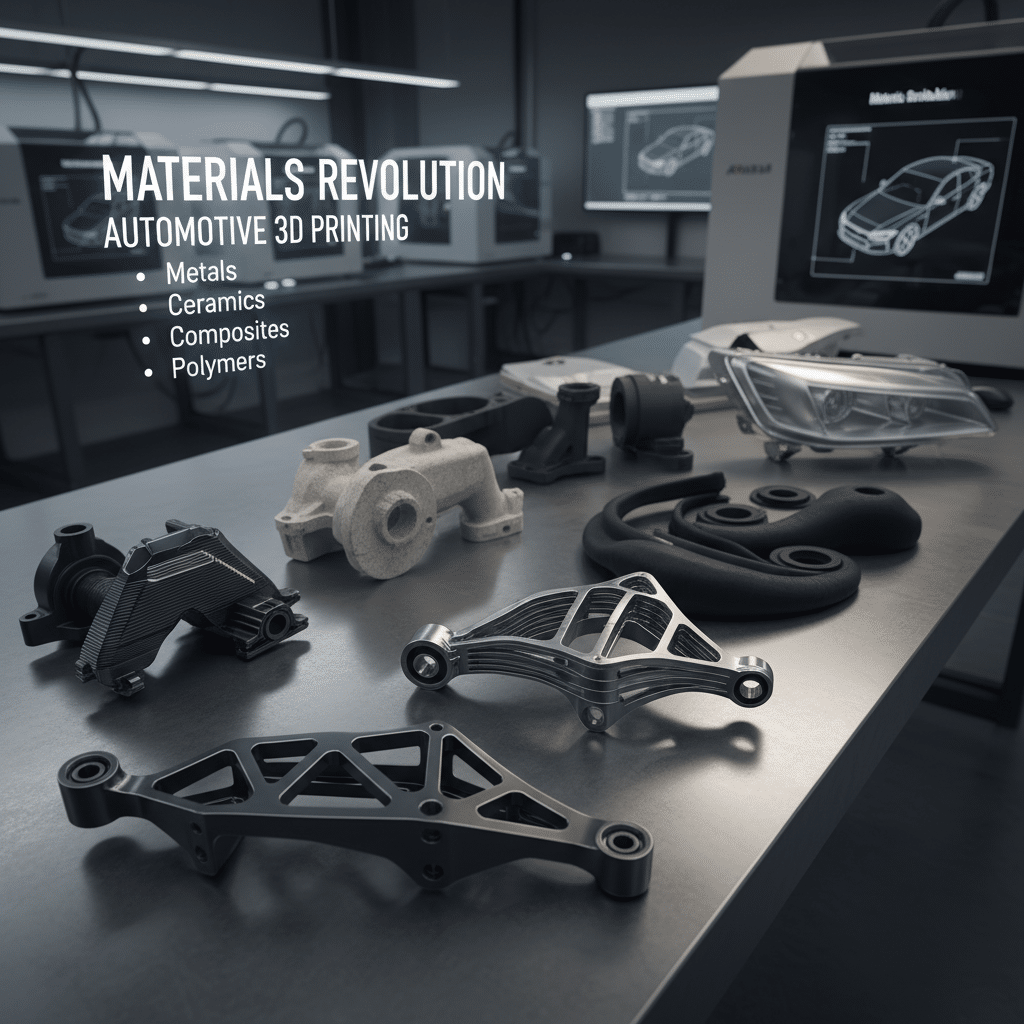
Most people associate 3D printing with plastic. Plastics remain important, but automotive printing now uses a much wider range of materials. That range makes it possible to produce parts that meet the industry’s demanding requirements.
- High-performance polymers: Automotive work goes beyond basic ABS or PLA to nylon, carbon fiber-reinforced plastics and PEEK (polyether ether ketone). These offer good strength-to-weight ratios, heat resistance and durability, which suits uses such as intake manifolds, electrical connectors, interior parts and brackets.
- Metals: DMLS, Selective Laser Melting (SLM) and EBM build parts from aluminum, titanium, stainless steel and nickel alloy powders. With well-controlled processing, these parts can match or exceed cast parts in some properties. They also allow complex shapes, such as internal cooling channels or lightweight suspension components.
- Composites: Some printers embed continuous fibers, such as carbon fiber, during printing. This gives parts strength and stiffness in chosen directions, with more design freedom than many traditional composite methods. It suits structural parts that need reinforcement along specific load paths.
- Multi-material printing: Some printers can combine materials in a single part, such as a rigid core with a flexible outer layer. Researchers are also exploring electrical pathways built into structural components, which could allow more functions in fewer parts.
New materials and better printing equipment keep widening the range of automotive parts that can be printed. For certain complex or low-volume parts, printing is now the better choice. For many others, conventional methods remain cheaper or more proven.
Sustainability and efficiency in the auto industry
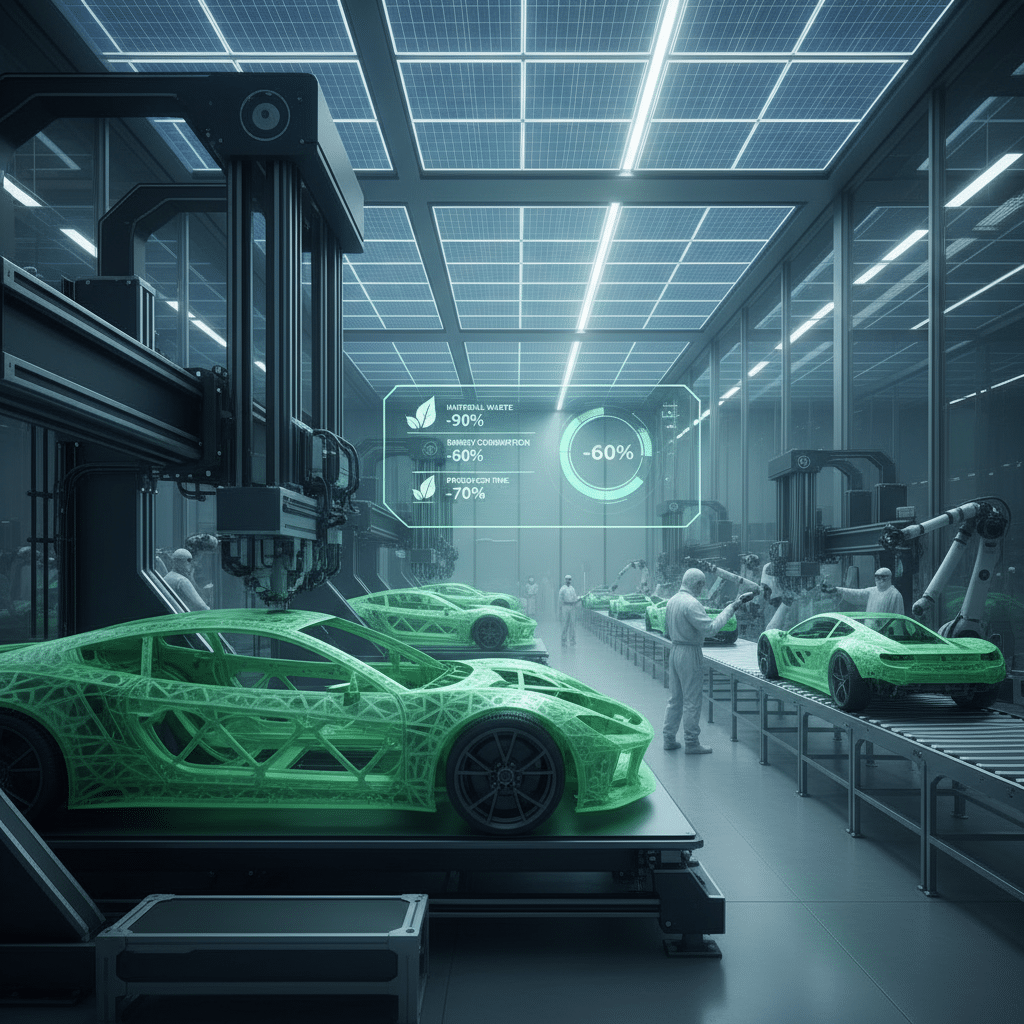
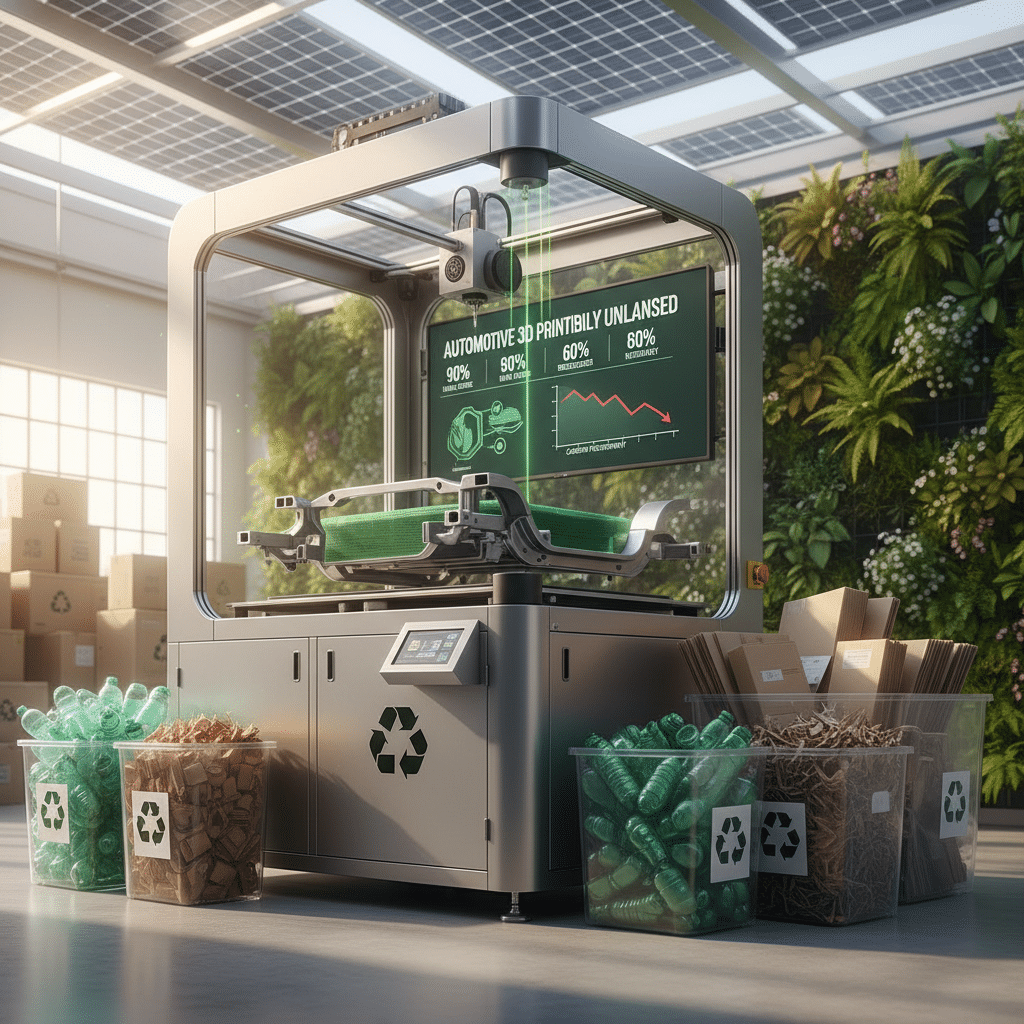
Automotive 3D printing can also improve resource efficiency. Conventional manufacturing can create a lot of scrap and use a great deal of energy. Additive methods can reduce some of that waste, though the overall benefit depends on the part, the process and the volume.
- Less material waste: Printing adds material where the part needs it, while machining cuts away material and can produce a lot of scrap from complex parts. Printing usually produces much less waste, and unused powder can often be reused within the limits of the process.
- On-demand production: Parts can be printed when needed instead of made in bulk and stored. This reduces warehousing, transport and the risk of parts becoming obsolete before use.
- Lightweighting: Optimized printed parts can weigh less than conventional ones. Lighter vehicles use less energy, which improves fuel economy in combustion cars and range in electric vehicles. Over a vehicle’s lifetime, that can help lower emissions.
- Localized manufacturing: Printing makes decentralized production more practical. In principle, parts could be made near the assembly plant or at local service centers instead of shipped across continents, which would cut transport emissions.
- Simpler supply chains: Consolidating parts can reduce the number of components and suppliers. Shorter supply chains are less exposed to disruption and need less transport.
The printing process itself uses energy, and that has to be weighed against its gains. Across a part’s life cycle, though, lower material waste and lighter vehicles make 3D printing a useful tool for more sustainable manufacturing.
The road ahead: future trends and challenges
Automotive 3D printing continues to change quickly. The main questions now concern scale, automation and the limits that still keep it out of many high-volume parts.

Mass production potential
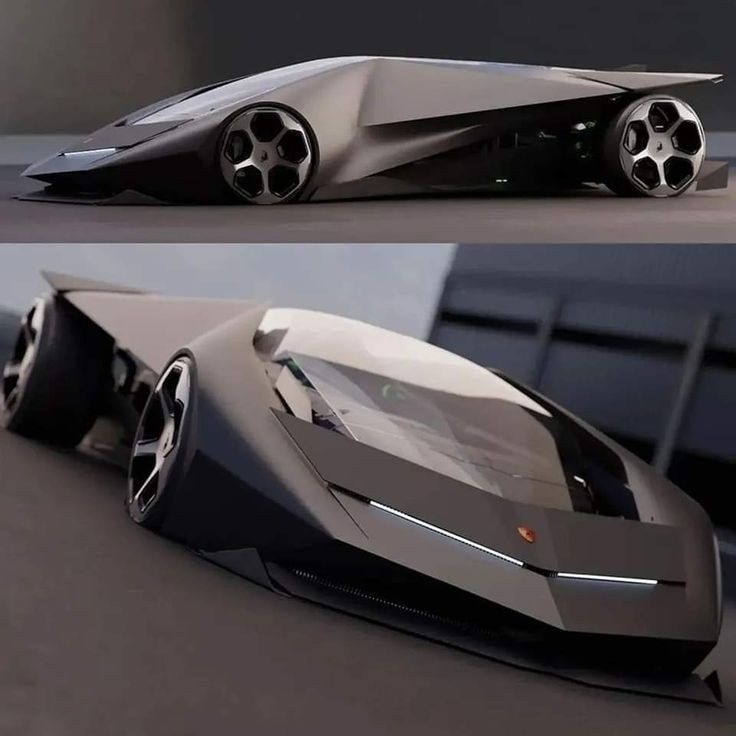
3D printing works best today for low-volume, customized or complex parts. The industry’s larger goal is making it practical for mass production. Equipment makers such as HP are developing systems with higher throughput and lower cost per part, aiming to compete with conventional methods at larger volumes.
Progress includes continuous printing, larger build volumes and faster print speeds. Even so, most high-volume vehicle parts are still made conventionally, and the pace of change will vary by part and material.
Integration with AI and automation
Because 3D printing starts from digital files, it fits well with artificial intelligence (AI) and automation. Generative design software creates candidate shapes from the loads, weight targets and constraints that engineers set. Engineers then review and validate the results.
Automation is also reaching later steps, such as post-processing, machine-vision quality checks and robotic material handling. These can reduce labor costs and make results more consistent.
Addressing material and process limitations
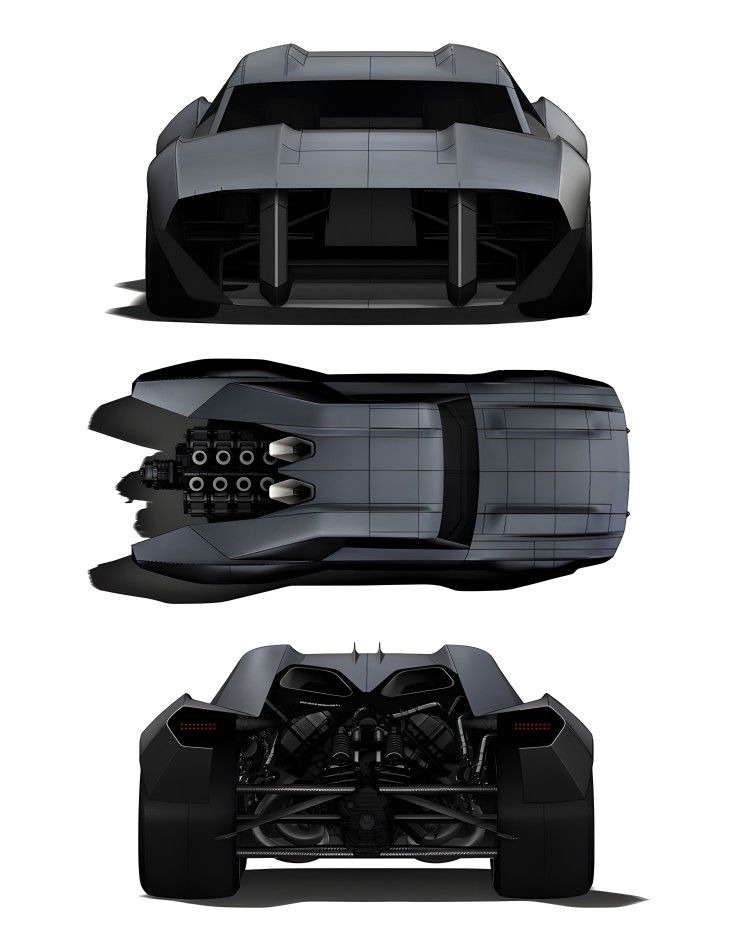
Significant limits remain. The range of printable materials is growing but still narrower than in conventional manufacturing. Print speed, especially for large metal parts, can hold back high-volume production.
Surface finish and part-to-part consistency need close control and often extensive post-processing. Researchers are working on new materials, multi-material printers and hybrid systems that combine additive and subtractive steps. As these issues are solved, printing’s role in car production is likely to expand.
Real-world examples from carmakers
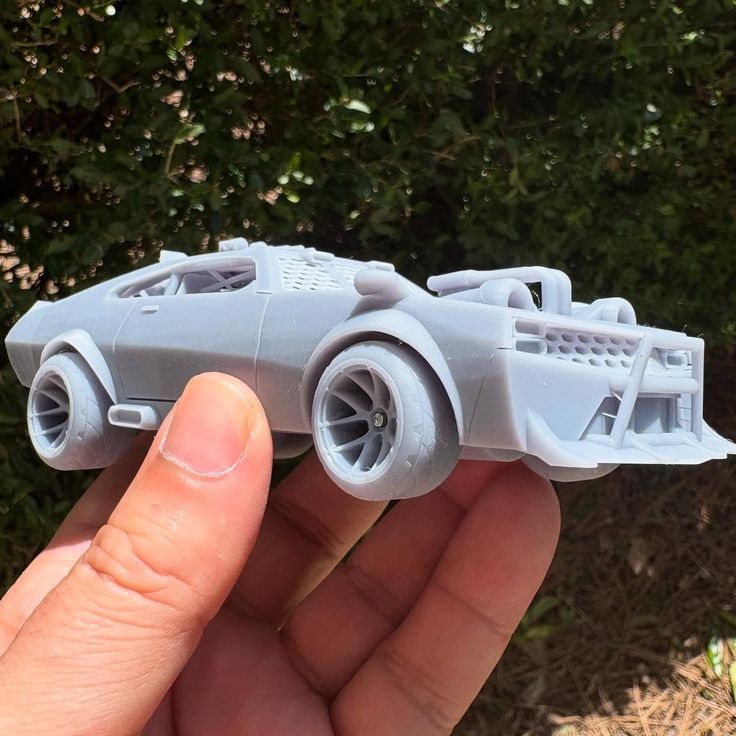
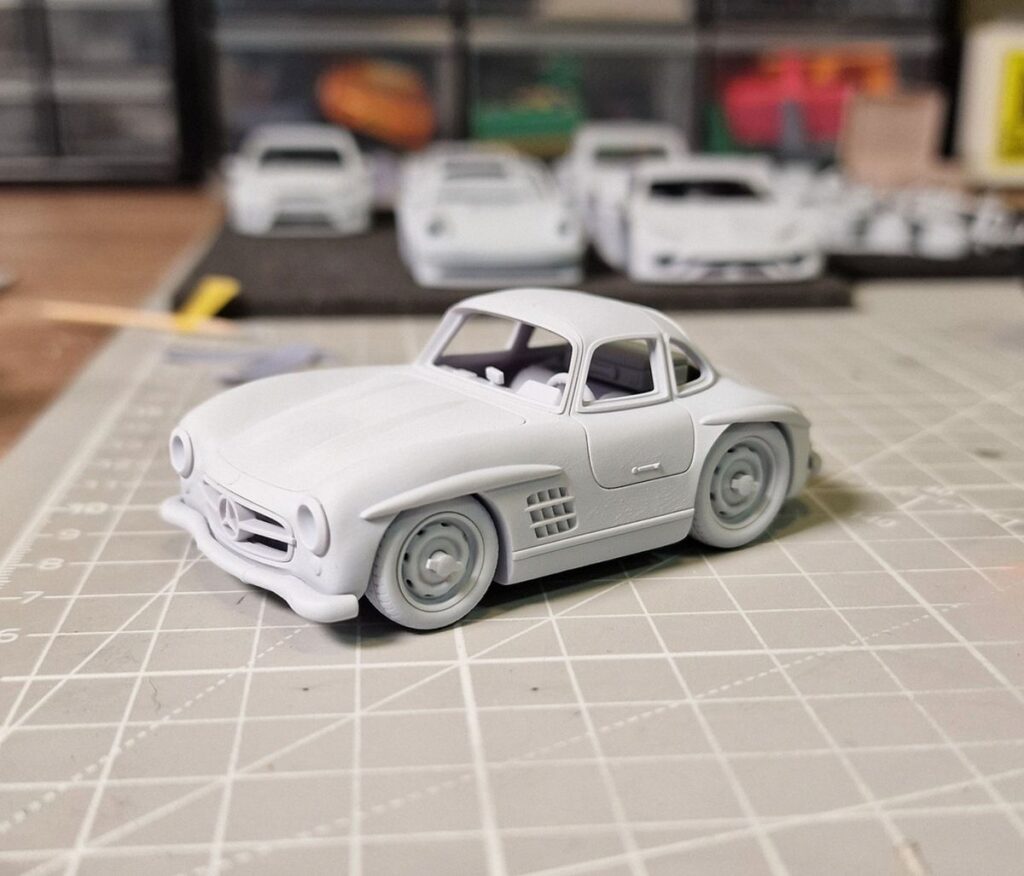
Several major carmakers already use 3D printing in their development and production work. The examples below show how differently they apply it.
- BMW: BMW runs an additive manufacturing campus and uses printing for prototypes across its range. It has also put printed parts into series production, including personalized components and parts for Rolls-Royce models. Its approach covers both niche applications and larger production runs.
- Ford: Ford has used 3D printing for decades, mainly for prototyping engine parts and controls and for making assembly-line tools. Ford has also worked with Stratasys to test large-scale printing for possible future vehicle parts and accessories.
- Porsche: Porsche focuses on customization and performance. Its 2021 bodyform seat announcement described printed cushion sections with different firmness levels for selected 911 and 718 models. This is a concrete example of adapting a printed comfort layer to the driver.
- General Motors (GM): GM has invested heavily in additive manufacturing, including an additive industrialization center. It uses printing for functional prototypes, concept vehicles, tooling and motorsport parts. GM is also exploring printed polymer parts to reduce weight in production vehicles.
- Volvo Trucks: Its New River Valley plant has documented using printed tools and fixtures, including gauges and drilling fixtures. This is a manufacturing application, rather than evidence that all truck spare parts can be printed on demand.
These examples show that automotive 3D printing is already part of everyday work at major manufacturers, though mostly in prototyping, tooling and selected low-volume parts. Fast visualization matters at the earliest stage too, much as an automobile sketch helps an artist refine a concept before building it.
Conclusion
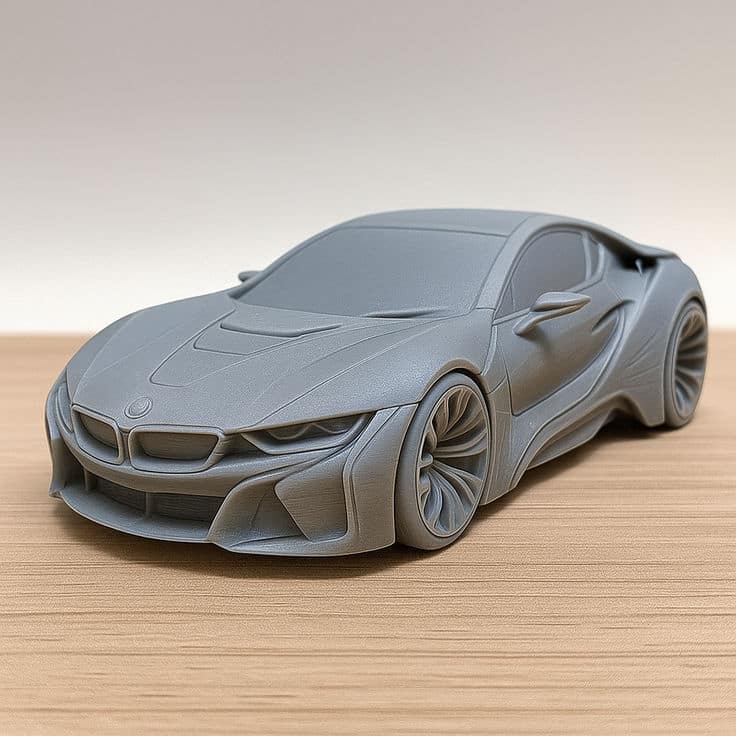
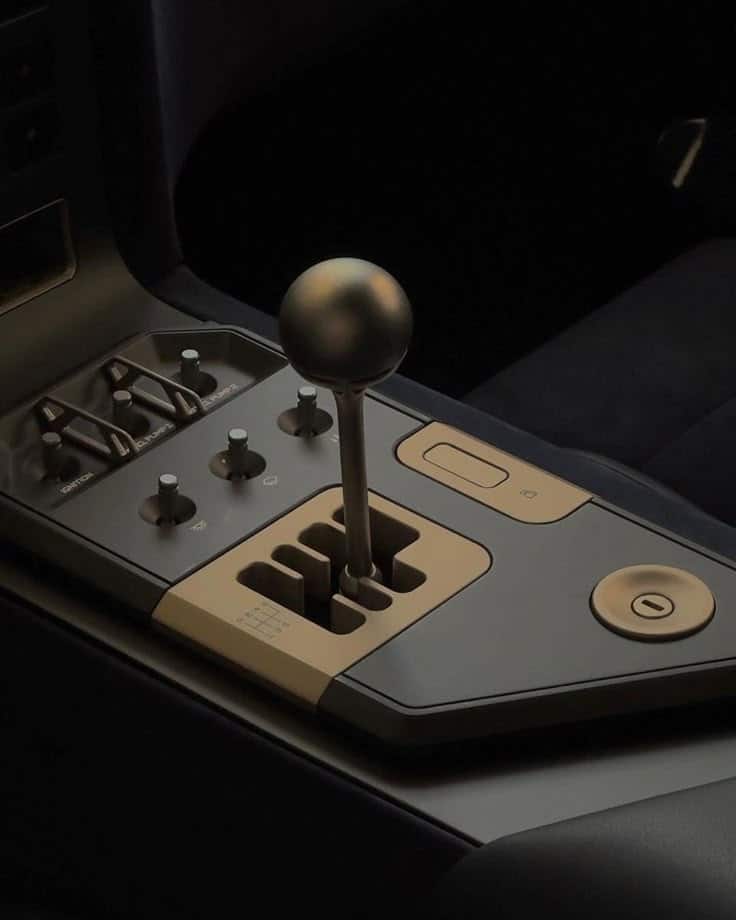
Automotive 3D printing supports design iteration, production tooling and selected end-use parts. If the processes are new to you, start with our 3D printing course for beginners before comparing industrial applications.
Its strongest uses today are prototypes, assembly tooling, motorsport parts and replacement parts for older cars. Material waste reduction and lightweighting also support the industry’s sustainability goals.
New materials, AI-assisted design and automation should widen its role. Higher-volume production will depend on gains in speed, cost and part consistency.
As printers get faster and materials improve, 3D printing will likely shape more of how vehicles are designed and built. Expect more customized and optimized components, alongside conventional methods rather than in place of them.
The practical lesson is to match the method to the part. Printing makes the most sense where speed, complexity or low volume matter more than unit cost.
When you evaluate a printed automotive part, start with three questions. What job does the part do? Is it safety-critical? And has it passed the same testing as a conventionally made equivalent?
- 2.0Kshares
- Facebook0
- Pinterest2.0K
- Twitter0
- Reddit0