The first violin I tried to draw came out looking like a decorative gourd. The waist was in the wrong place. The upper and lower bouts were almost the same size when they should be clearly different. The f-holes were symmetrical teardrops that looked nothing like the elegant S-curves they are in reality. And the scroll — which I left for last because it seemed like the hardest part — was a tightly wound spiral with no relationship to the pegbox or neck below it.
- The Anatomy of a Violin: What You Need to Know Before Drawing
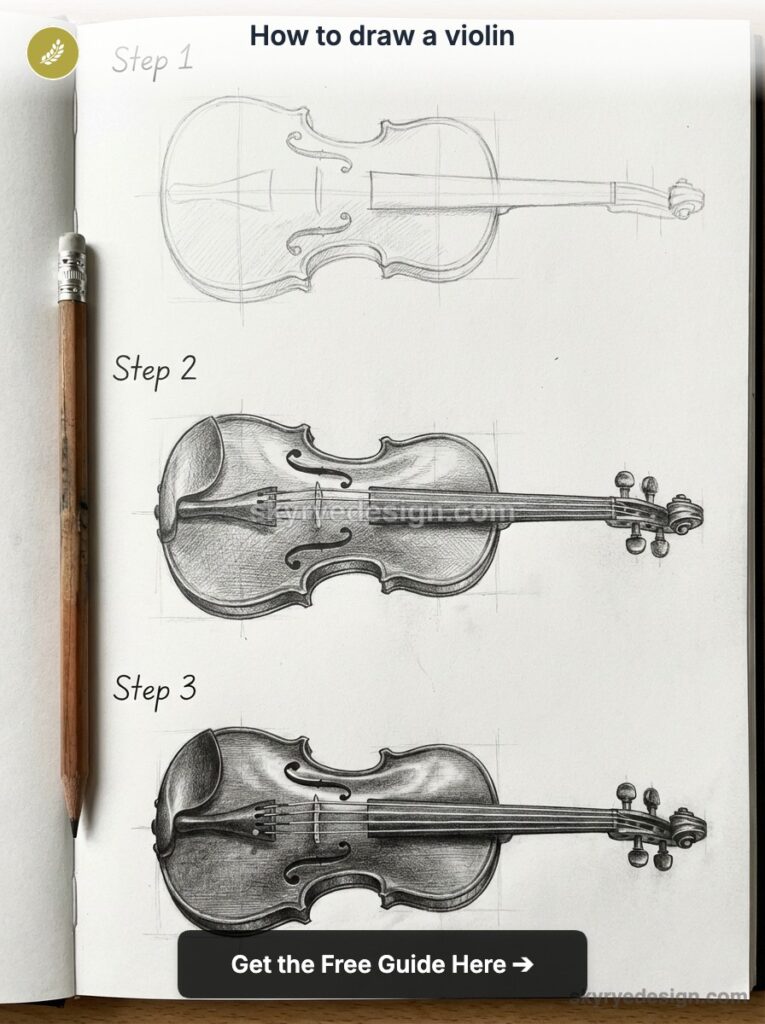
- Step-by-Step Construction: Body to Scroll
- Drawing the F-Holes: The Most Distinctive Violin Detail
- The Scroll: Construction and Volume
- Rendering Wood Grain and the Varnished Surface
- Four Drawing Styles for the Violin
- Materials for Violin Drawing
- FAQ: How to Draw a Violin
What I did not understand at the time was that the violin is one of the most precisely proportioned objects in Western craft tradition. The Cremonese violin makers of the 17th and 18th centuries — Antonio Stradivari, Bartolomeo Guarneri del Gesu, Andrea Amati — did not arrive at the violin’s form aesthetically.
The proportions were calculated: the relationship between the upper bout, waist, and lower bout; the position of the bridge at exactly the midpoint of the body; the placement of the f-holes relative to the bridge feet; the angle and taper of the neck. Get these proportions right and the violin drawing reads immediately. Get them wrong and you get the gourd.
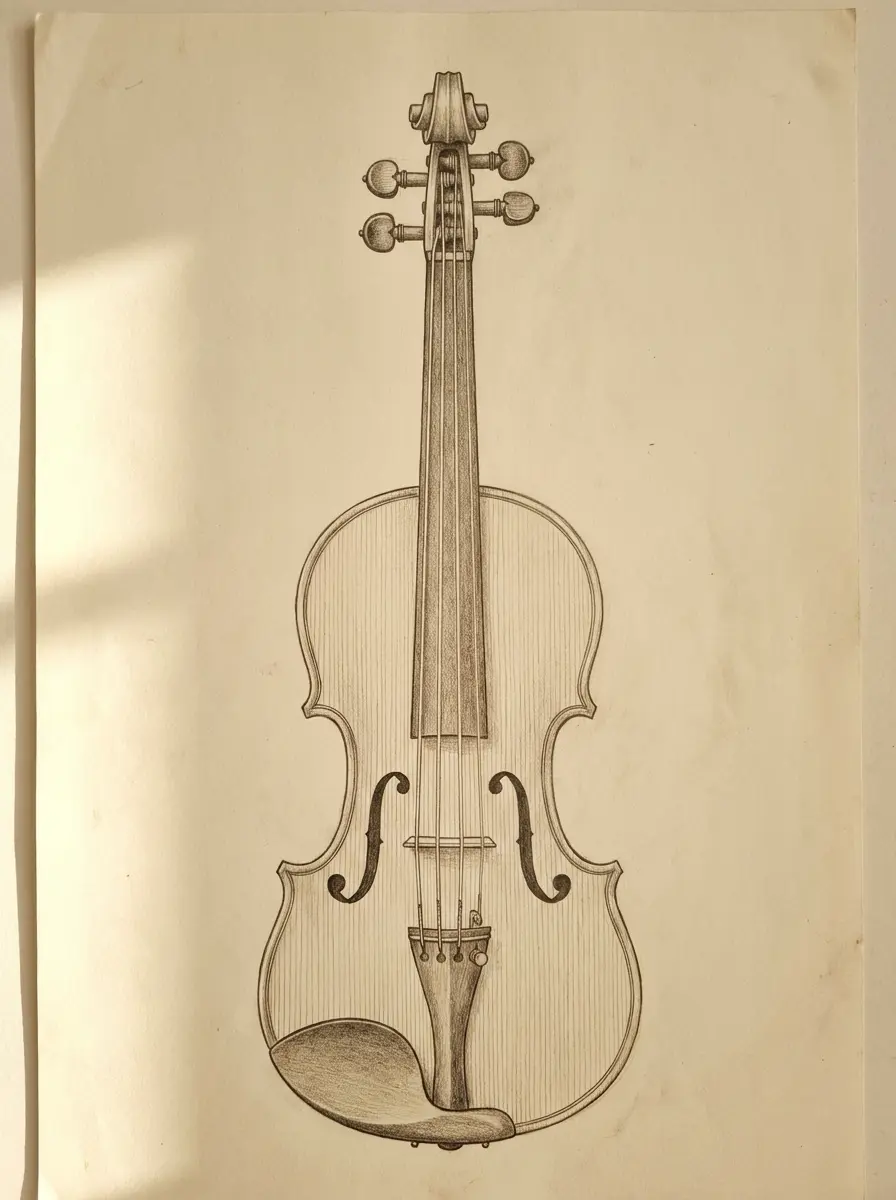
This guide covers the violin drawing process with the same specificity the instrument deserves: exact measurements, the geometry of the body outline, how to construct the f-holes correctly, the scroll step by step, how to render the wood grain that gives the instrument its visual warmth, and four style approaches for different drawing contexts. The violin is one of the most rewarding objects to draw once you understand its geometry — because every element has a logical relationship to every other element, and that logic produces drawings that feel right even when they are not perfectly accurate.
The Anatomy of a Violin: What You Need to Know Before Drawing
Before drawing any complex object, understanding its structure prevents the proportion errors that make recognisable objects unrecognisable. The violin has a specific anatomical vocabulary worth learning — not for its own sake, but because each named part has a specific shape, size, and relationship to adjacent parts that can be checked and corrected.
The Body
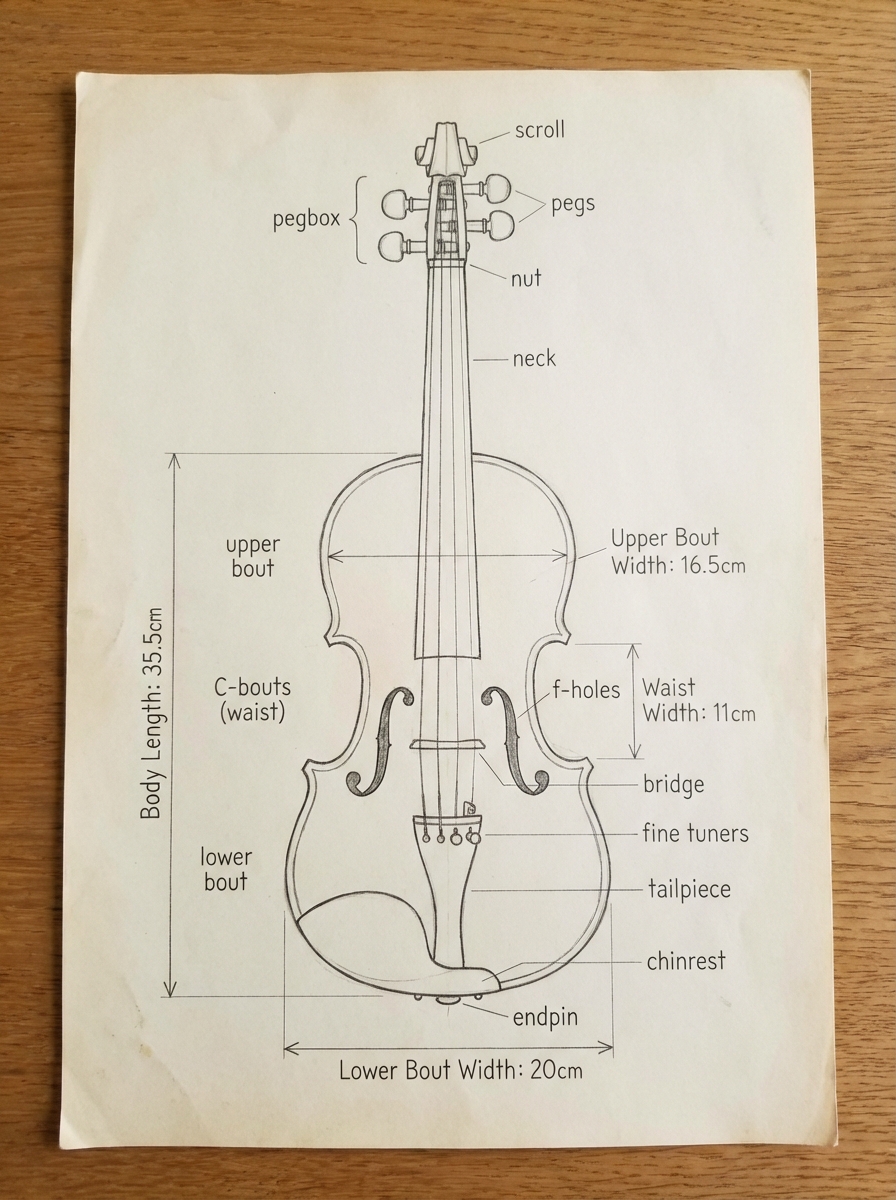
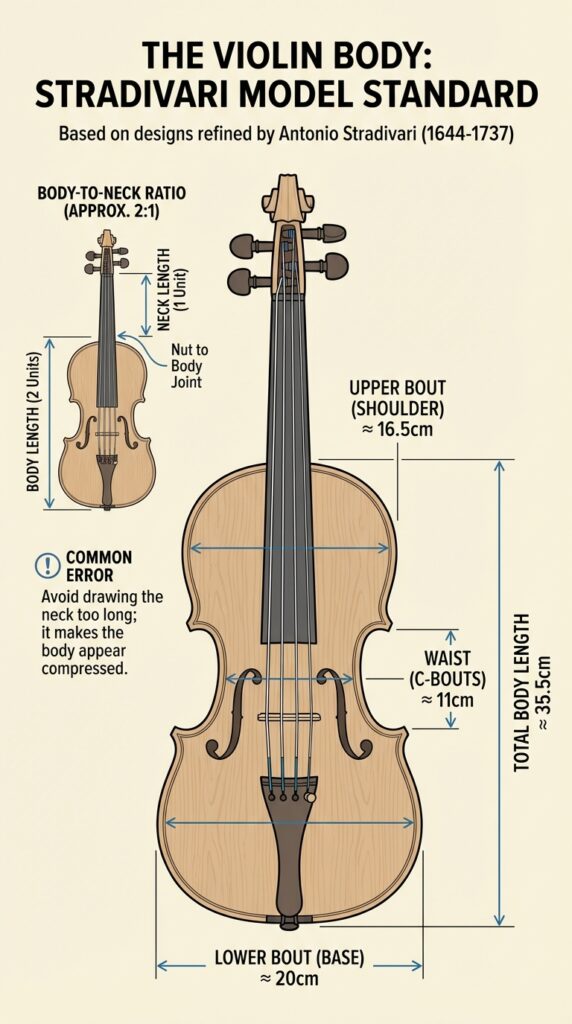
The violin body is composed of three distinct-width sections. The lower bout — the larger, wider base section — is approximately 20cm wide on a full-size (4/4) violin. The upper bout — the narrower shoulder section — is approximately 16.5cm wide. The waist (C-bouts, the hourglass narrowing) is approximately 11cm at its narrowest point. Total body length: 35.5cm. These measurements follow the Stradivari model, which became the standard template for violin makers worldwide after Antonio Stradivari (1644-1737) refined the design in the early 18th century.
The body-to-neck ratio is approximately 2:1 — the body is roughly twice the length of the neck, measured from the nut (the notched piece at the top of the fingerboard) to the shoulder where the neck joins the body. In a drawing, this means the neck occupies significantly less of the total drawing height than most beginners allow for. The common error is drawing the neck too long, which makes the body look compressed.
The Key Elements to Get Right
- Lower bout wider than upper bout: the lower section is noticeably larger. If both sections appear the same width, the violin reads as a symmetrical object rather than the characteristic asymmetric hourglass.
- Bridge position at body midpoint: the bridge sits exactly at the midpoint of the body length, between the inner notches of the f-holes. This position is visually verifiable — the bridge divides the body into two equal halves.
- F-holes flanking the bridge: the f-holes sit symmetrically on either side of the centreline, angled slightly outward. The inner notch of each f-hole marks the exact foot position of the bridge.
- Neck angle: the neck does not continue in the same plane as the body. It angles slightly backward — approximately 3-5 degrees from the body plane — which is visible in side view and in three-quarter views.
- Scroll off-centre: the scroll is not centred over the pegbox but spirals to one side. In front view, the spiral curves to the player’s right (viewer’s left).
✏ Drawing note: The most reliable proportion check for a violin drawing: the lower bout width should be slightly greater than the total neck length from nut to shoulder. If you measure these two elements in your drawing and they are not approximately equal, the proportions are off. This single check catches the two most common errors simultaneously — lower bout too narrow or neck too long.
Step-by-Step Construction: Body to Scroll
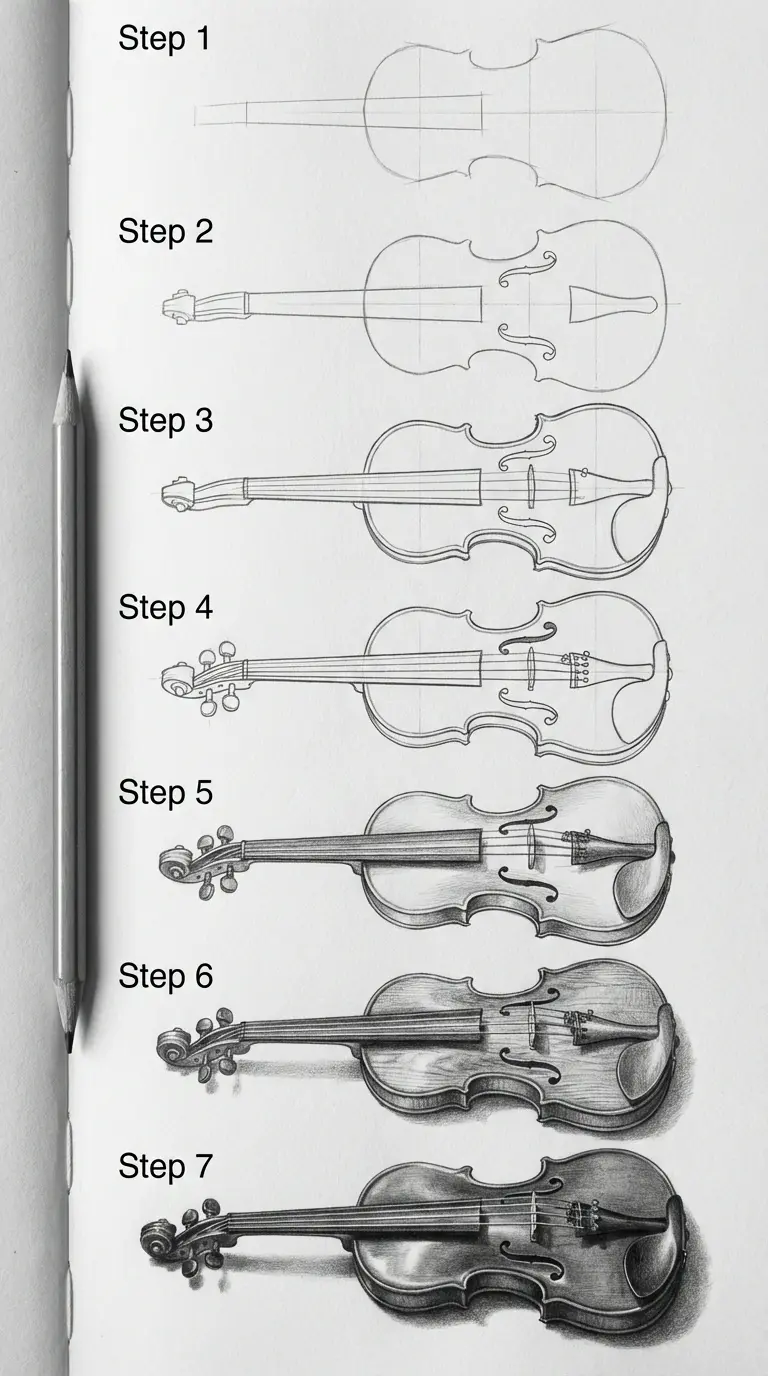
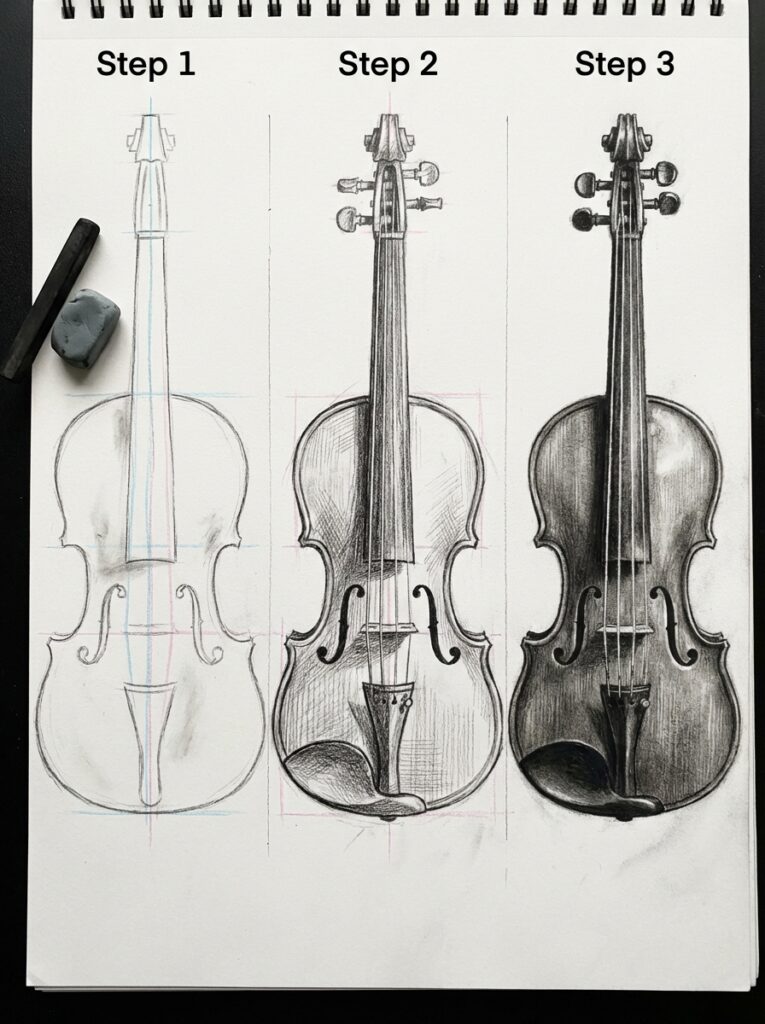
This sequence builds the violin from the largest shapes to the smallest details, establishing proportional relationships at each stage before adding any specificity.
Step 1: Centre Line and Body Guidelines
Draw a vertical centre line the full height of the planned violin drawing. Mark the total body length on this line. At 55% of the body length from the top, mark the bridge position (midpoint with a slight bias toward the lower half). Mark the upper and lower bout widths with horizontal lines at the top and bottom of the body length. These guidelines establish all subsequent proportions.
Step 2: Lower Bout Ellipse
Draw a large ellipse centred on the lower portion of the centre line, with its widest point at approximately 20/35.5 of the total body width ratio. The lower bout is the widest part of the body. The curve should be full and round at the bottom, narrowing as it rises toward the waist. Use light HB pencil — this is a guideline that will be refined, not a final outline.
Step 3: Upper Bout Ellipse
Draw a smaller ellipse in the upper portion, roughly 16.5cm wide relative to the lower bout. The upper bout sits higher and narrower. The upper shoulder curve — where the neck joins — is characteristically sharp compared to the rounder lower bout: the upper bout has more corner to it, especially at the shoulder points where the C-bout begins.
Step 4: Waist (C-Bouts)
Connect the upper and lower bouts with two inward-curving arcs on each side — the C-bouts. The waist at its narrowest is approximately 11cm. These curves are not simple arcs but have a characteristic shape: they begin with a gentle inward sweep from the lower bout, then tighten into the narrowest point, then open again into the upper bout with a slightly more angular shoulder. The C-bouts are the element that most determines the visual character of the violin body — get them wrong and the silhouette reads as a different instrument.
Step 5: Confirm the Outer Body Outline
Draw the final body outline over the guideline ellipses, incorporating the correct asymmetry between upper and lower bouts and the characteristic C-bout shape. The outline should be a single, confident, unbroken line. Use 2B pencil for this confirmed outline. Erase the guideline ellipses but leave the centre line for subsequent steps.
Step 6: Neck and Pegbox
The neck emerges from the upper shoulder of the body as a slightly tapered rectangle — wider at the shoulder (approximately 33mm) and narrowing slightly toward the nut (approximately 23mm at the top of the fingerboard). The neck length from shoulder to nut is approximately 130mm on a full-size violin. Draw the pegbox as a rectangular frame above the nut, with three pegs visible on each side in the three-quarter front view. The pegbox sides are slightly concave.
Step 7: The Scroll
The scroll is the most visually complex element. Begin with a small tight circle at the end — the centre of the spiral. Draw the spiral expanding outward in approximately 1.5 turns, each loop slightly larger than the previous. The scroll terminates at the pegbox with a characteristic ear shape at the bottom of the spiral. In front view, the scroll curves to the player’s right (viewer’s left). The chamfer — a flat bevelled edge running around the scroll — is what gives it the three-dimensional quality visible in good violin drawings.
✏ Drawing note: Draw the f-holes last, after the bridge position is confirmed. The bridge feet sit exactly at the inner notches of the f-holes — so the f-hole position is determined by the bridge position, not the other way around. Drawing the f-holes before placing the bridge results in the f-holes being in the wrong position, which then forces the bridge into an incorrect location. Bridge first, f-holes around it.
Drawing the F-Holes: The Most Distinctive Violin Detail
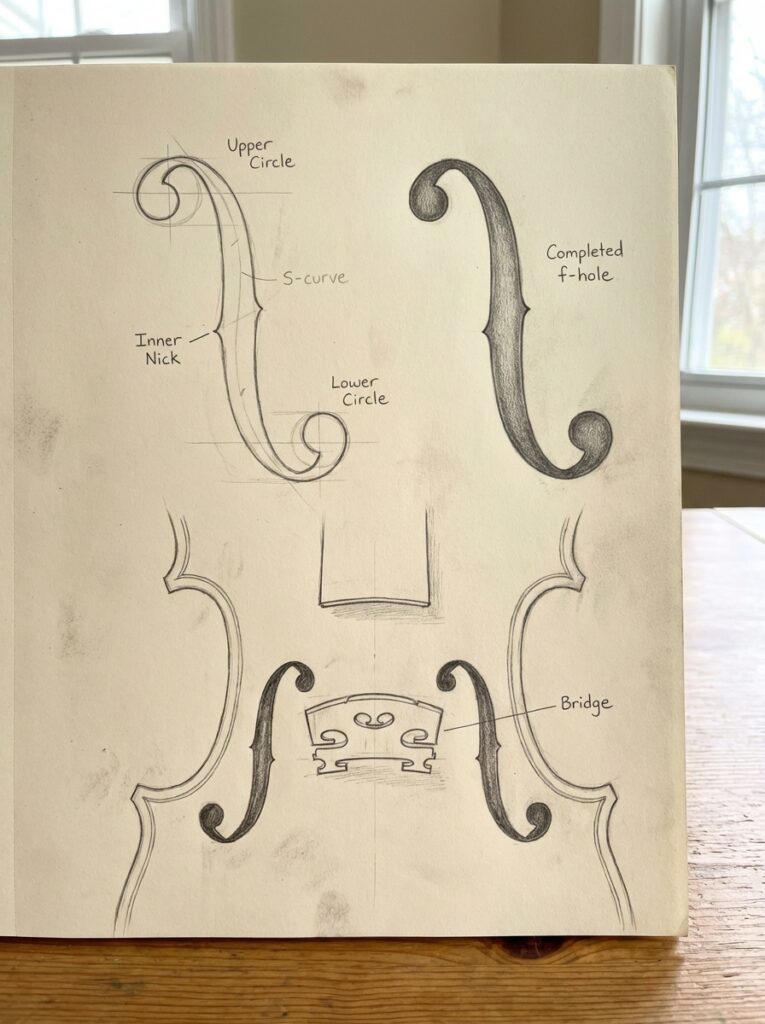
The f-hole is the element that most immediately communicates that you are drawing a violin rather than a generic stringed instrument. Get it right and the whole drawing reads; get it wrong and even perfect proportions elsewhere cannot compensate. The f-hole is not a simple S — it is a specifically shaped opening with two circular voids of slightly different sizes, connected by a narrow waist and oriented on a subtle angle.
The Anatomy of an F-Hole
Each f-hole has four identifiable elements. The upper circle: slightly smaller than the lower, positioned at the top of the f-hole. The lower circle: slightly larger, positioned at the bottom. The waist: the narrow connecting section between the two circles, with a subtle inward curve. The inner nick: a small notch on the inner edge of the waist — this marks the exact bridge foot position and is structurally significant, not decorative.
Construction Method
Draw the two circles first — they establish the overall height and the top-to-bottom proportions of the f-hole. The lower circle should be approximately 30% larger in diameter than the upper circle. Connect them with a waist that curves inward slightly on both sides. The inner nick is a small rectangular notch cut into the inner (centreline-facing) edge of the waist. The overall f-hole should lean slightly outward from top to bottom — the top is closer to the centreline than the bottom. This lean is subtle but critical: perfectly vertical f-holes look stiff and generic.
Common F-Hole Errors
- Making both circles the same size: upper and lower circles are different sizes. The lower is consistently larger.
- Drawing them too upright: f-holes lean slightly outward from top to bottom. No lean reads as rigid and incorrect.
- Forgetting the inner nick: the nick is the structurally significant detail that marks the bridge foot. Its absence makes the f-hole look like a generic decorative shape rather than a functional acoustic opening.
- Making them too symmetrical to each other: real f-holes have very subtle asymmetries — the two are not mirror images of each other at the level of fine detail. Slightly varying the shapes gives the drawing authenticity.
The Scroll: Construction and Volume
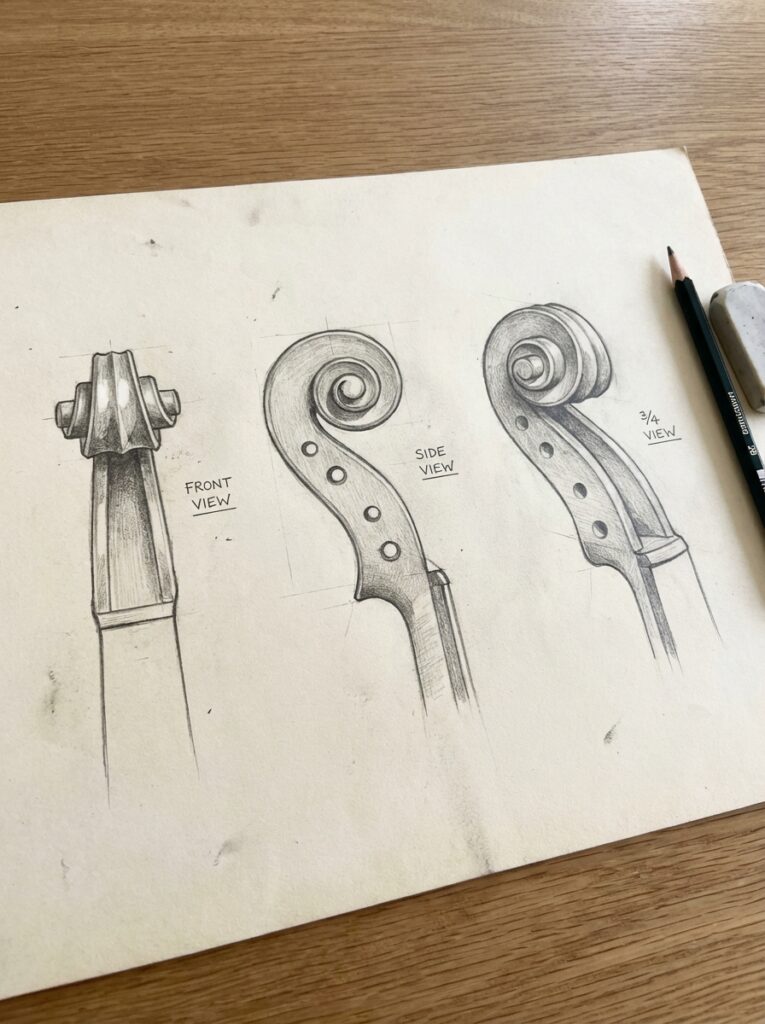
The scroll is the element that most artists approach with the most anxiety — it looks complex, it is at the top of the drawing where mistakes are most visible, and its organic spiral form seems difficult to plan. In practice, the scroll is one of the most logically constructed elements of the violin because it follows a consistent geometric spiral logic. Once you understand the sequence, it is more predictable than the C-bouts.
The Volute
The volute — the spiral portion of the scroll — begins at a small tight centre circle approximately 8-10mm in diameter in a full-size violin drawing. From this centre, the spiral makes approximately 1.5 complete turns, each turn approximately 30-40% wider than the previous. The spiral expands, not uniformly, but with the lower portion growing faster than the upper — which is why the scroll reads as a downward-weighted curve rather than a symmetric circle. The eye of the scroll (the centre circle) is typically partially visible as a small oval in front view.
The Chamfer
The chamfer is the bevelled edge that runs around the outside of the scroll spiral and is what gives the scroll its three-dimensional quality. In drawing, the chamfer is represented as a parallel second line running just inside the outer scroll edge — a consistent-width dark band following the spiral that creates the illusion of depth. Without the chamfer, the scroll looks flat; with it, the scroll reads as a carved three-dimensional form. The chamfer width is approximately 3-4mm at the outer edge, tapering slightly at the inner turns.
Connecting Scroll to Pegbox
The scroll terminates at the pegbox with a characteristic ‘ear’ shape — a flattened, slightly squared form at the base of the spiral that transitions into the straight sides of the pegbox. This transition from the curved scroll to the rectangular pegbox is the most technically demanding part of the scroll construction. The ear shape should read as a natural continuation of the spiral, not an abrupt joint. Draw the ear as the final completion of the last turn of the spiral, allowing it to flatten and square off as it meets the pegbox wall.
✏ Drawing note: Practice the scroll as a standalone exercise at a large scale (5-10cm for the scroll alone on an A4 sheet) before incorporating it into a full violin drawing. At the scale of a full violin drawing, the scroll is small enough that errors compound quickly. At a large scale, the spiral logic is easier to see and correct. Once you can draw a confident scroll separately, scaling it down for the full drawing is straightforward.
Rendering Wood Grain and the Varnished Surface
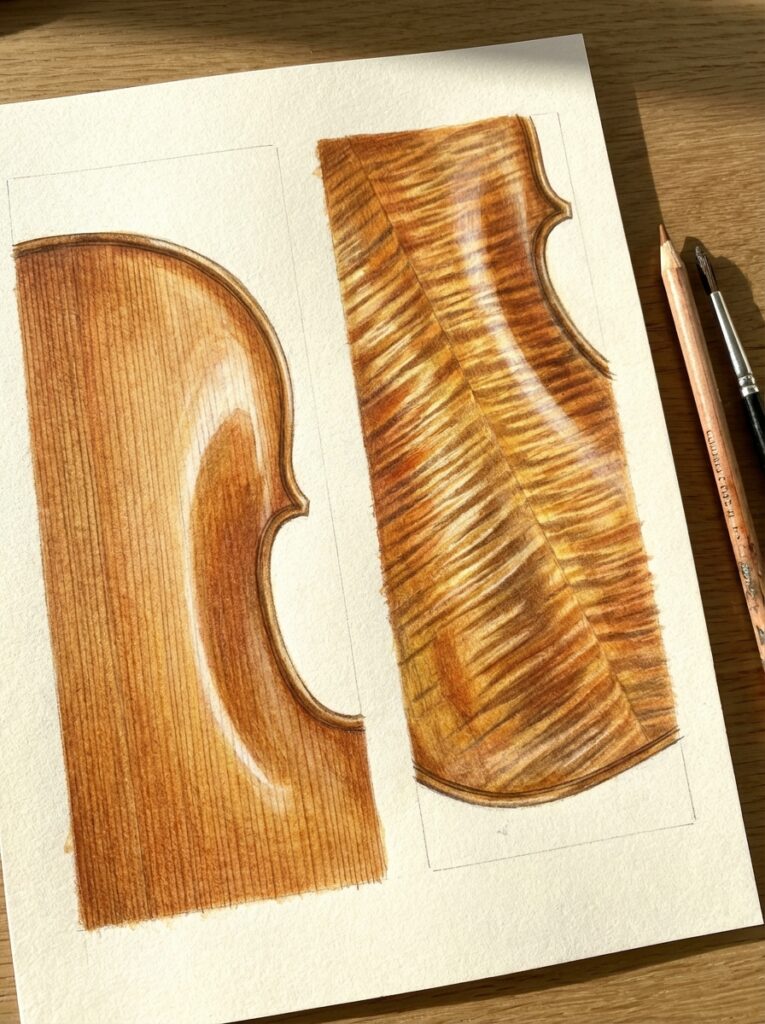
The visual warmth of a violin — that quality that makes even a drawing of one look like it could produce sound — comes from two things: the characteristic varnish colour and the wood grain. A violin drawing without attention to these two elements looks like a diagram of an instrument; one with correctly rendered grain and the amber glow of the varnish reads as the instrument itself.
Spruce Top Plate — Fine Parallel Grain
The top plate of a violin is made from spruce, which has a very fine, closely-spaced straight grain running parallel to the length of the instrument. In drawing, this is rendered as very fine parallel lines running from the upper bout to the lower bout, following the curve of the body at the edges where they bend to meet the outline. The grain is tighter at the centreline (where the two halves of the top join) and slightly more open toward the edges. In coloured pencil or watercolour, the spruce colour is a pale warm grey-white beneath the varnish, reading as a light amber-tan.
Maple Back and Sides — Flamed Figure
The back plate and sides are typically made from maple, which shows a distinctive flamed or quilted figure — a chatoyant shimmer where alternating grain orientations catch light differently. In drawing, this is rendered as diagonal hatching that alternates between slightly lighter and slightly darker tones, simulating the way the flame appears to shift from dark to light as the viewing angle changes. The direction of the flame is typically perpendicular to the spine — running diagonally from the centreline outward, with the direction reversing slightly at the centreline joint on the back plate.
The Specular Highlight
The single most impactful rendering detail in a violin drawing is the specular highlight — a bright reflection running along the highest point of the arched top plate, typically a clean vertical band slightly left of centre (depending on the light source). In pencil: leave this zone unlayered and lift any accidental marks with a kneaded eraser. In ink: apply white gel pen over completed line work. In watercolour: preserve the highlight as reserved white paper from the start. This highlight, more than any grain detail, communicates the domed, three-dimensional quality of the violin’s arched top.
Varnish Colour in Coloured Media
Traditional Italian violin varnish — the Cremonese varnish formula that has never been fully replicated — produces a warm amber to orange-red colour that deepens with age. In coloured pencil: Faber-Castell Polychromos Raw Sienna (187) as the base, Burnt Ochre (268) in the mid-tones, Burnt Sienna (283) in the deeper shadow areas. The varnish colour is richest in the C-bouts and deepest where the arching transitions from top plate to sides. In watercolour: a warm amber wash (Yellow Ochre + a touch of Burnt Sienna) glazed multiple times produces the depth and warmth of genuine violin varnish.
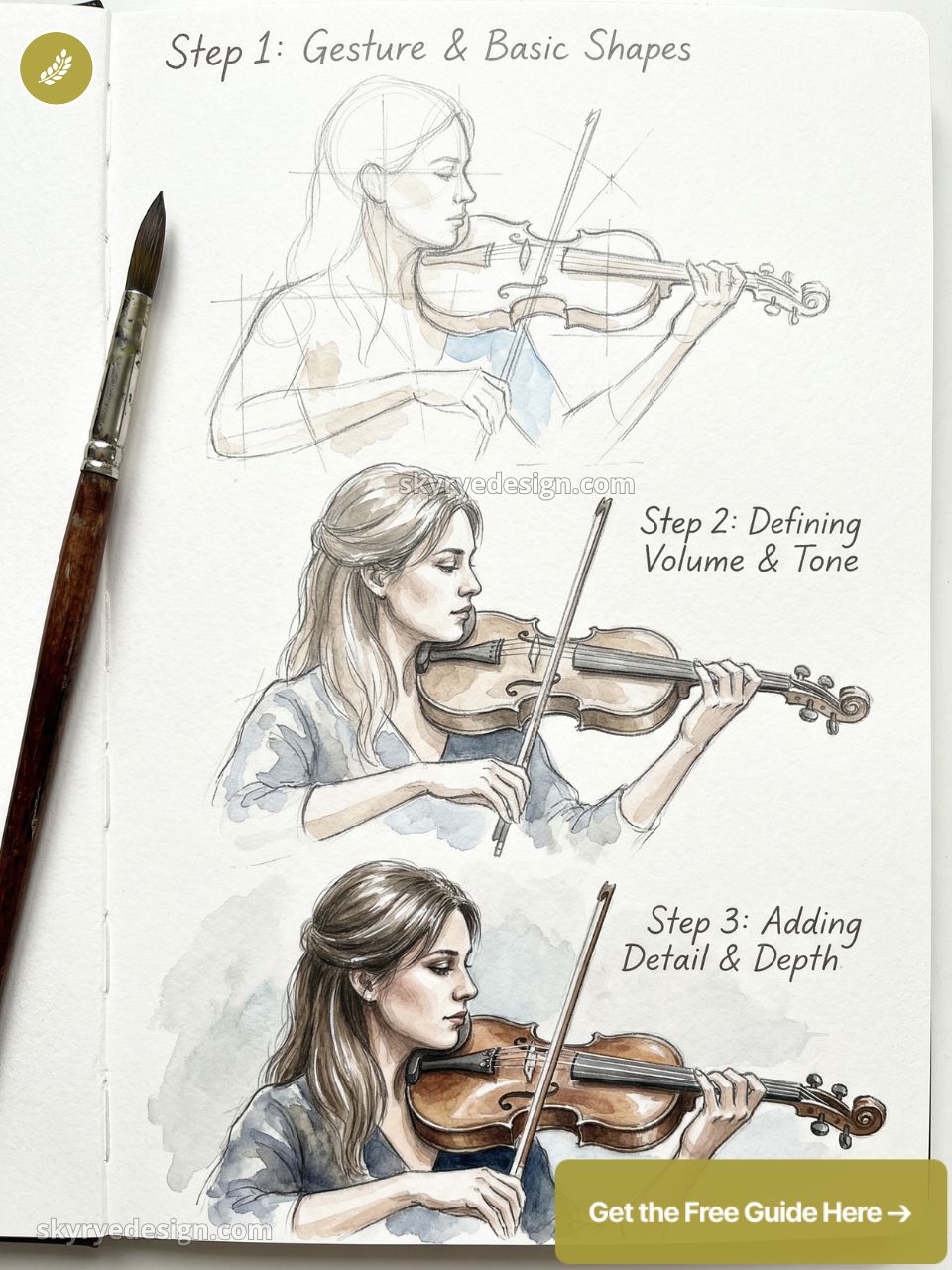
✏ Drawing note: The arching — the domed curvature of the top plate — is the element that most beginners flatten out in their rendering. The top plate is not flat; it curves outward by approximately 15-18mm at its highest point, as evidenced by the centreline specular highlight being surrounded by progressively darker tones toward the edges. In rendering, this means the tones on the top plate should be lightest at the centre and gradually darken toward the outline — even in areas without obvious shading from the light source.
Four Drawing Styles for the Violin
Technical Pencil Study
Medium: HB and 2B pencil on smooth Bristol or cartridge paper
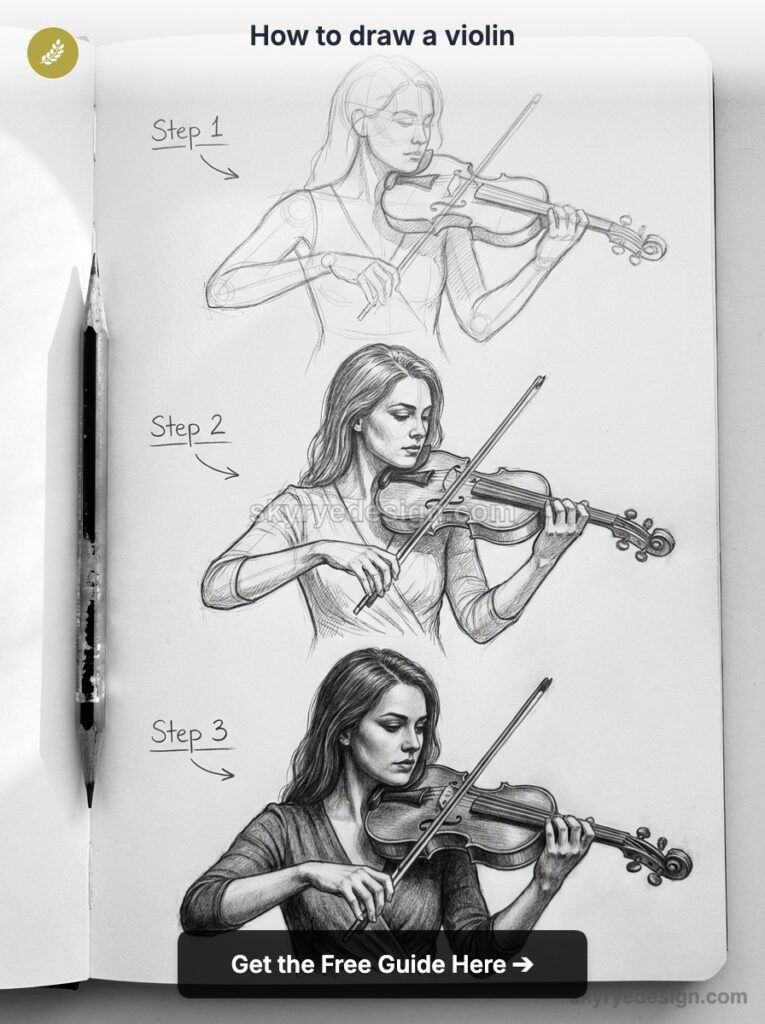
Key technique: Precise outlines with faint construction geometry visible in the final drawing. Minimal tonal shading — just enough to suggest the three-dimensional form. The focus is on accurate proportions and clean line quality rather than surface rendering.
Violin-specific note: Best for learning the violin geometry, producing reference drawings, and as a basis for other media. The technical study approach rewards time spent on proportions and is unforgiving of proportion errors because there is nothing else to distract the eye from them.
Ink Line Art
Medium: Micron 01 (0.25mm) for detail and interior lines, Micron 05 (0.45mm) for the primary body outline, white cartridge or Bristol paper
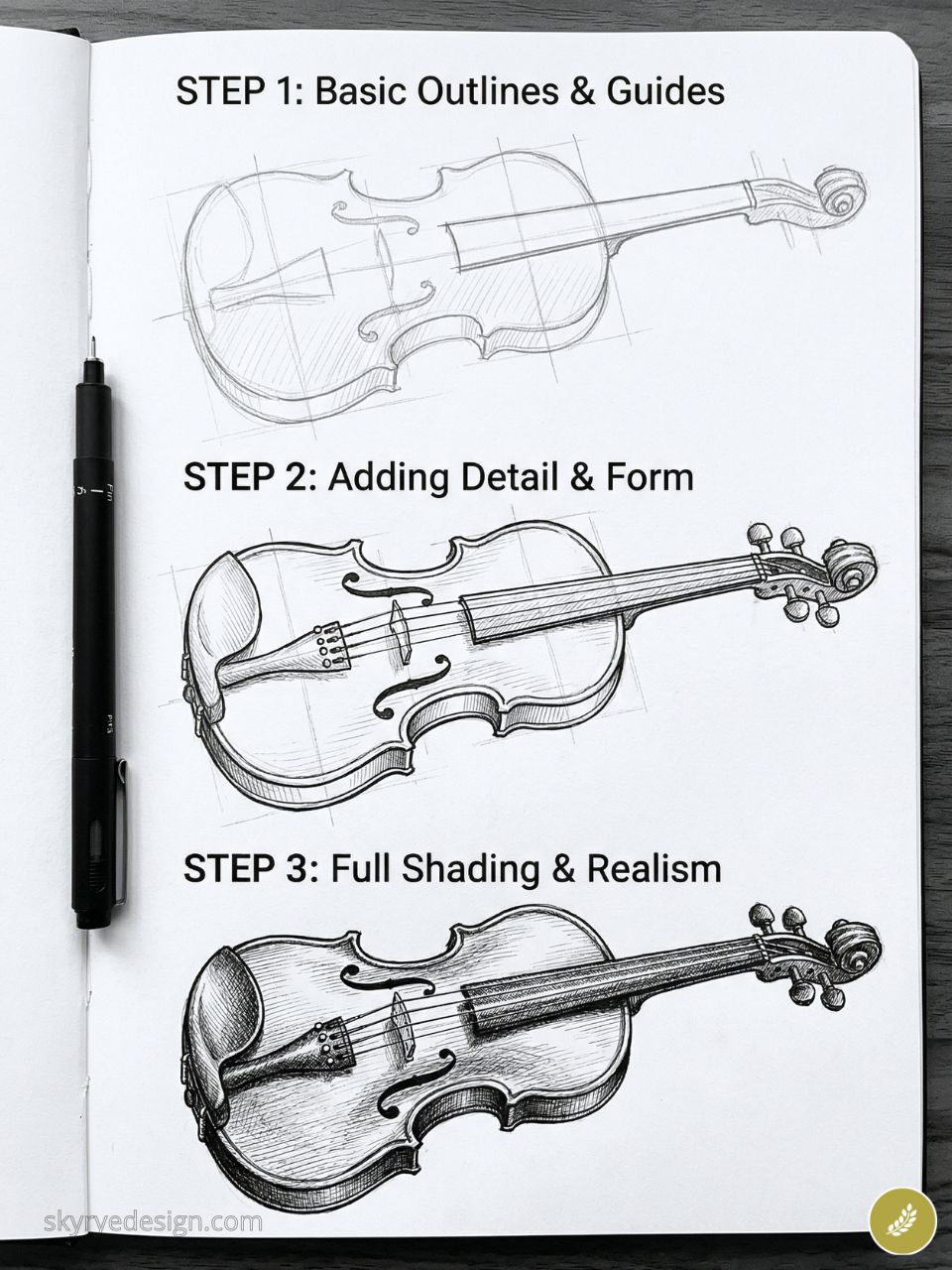
Key technique: Bold outer contour in heavy weight, progressively lighter interior lines for the grain, f-holes, and scroll detail. Cross-hatching in 45-degree parallel lines for shadow areas. The f-holes filled solid black. No tonal gradient — form communicated entirely through line weight variation.
Violin-specific note: The instrument’s organic curves read particularly well in a confident ink line. Avoid drawing very fine detail lines before the primary outline is confirmed — in ink there is no erasing, so the construction sequence matters more than in pencil work.
Coloured Pencil Rendering
Medium: Faber-Castell Polychromos coloured pencils — Raw Sienna (187), Burnt Ochre (268), Burnt Sienna (283), Dark Sepia (175), Cream (102) for the paper. Strathmore 300 Bristol smooth for clean colour layering.
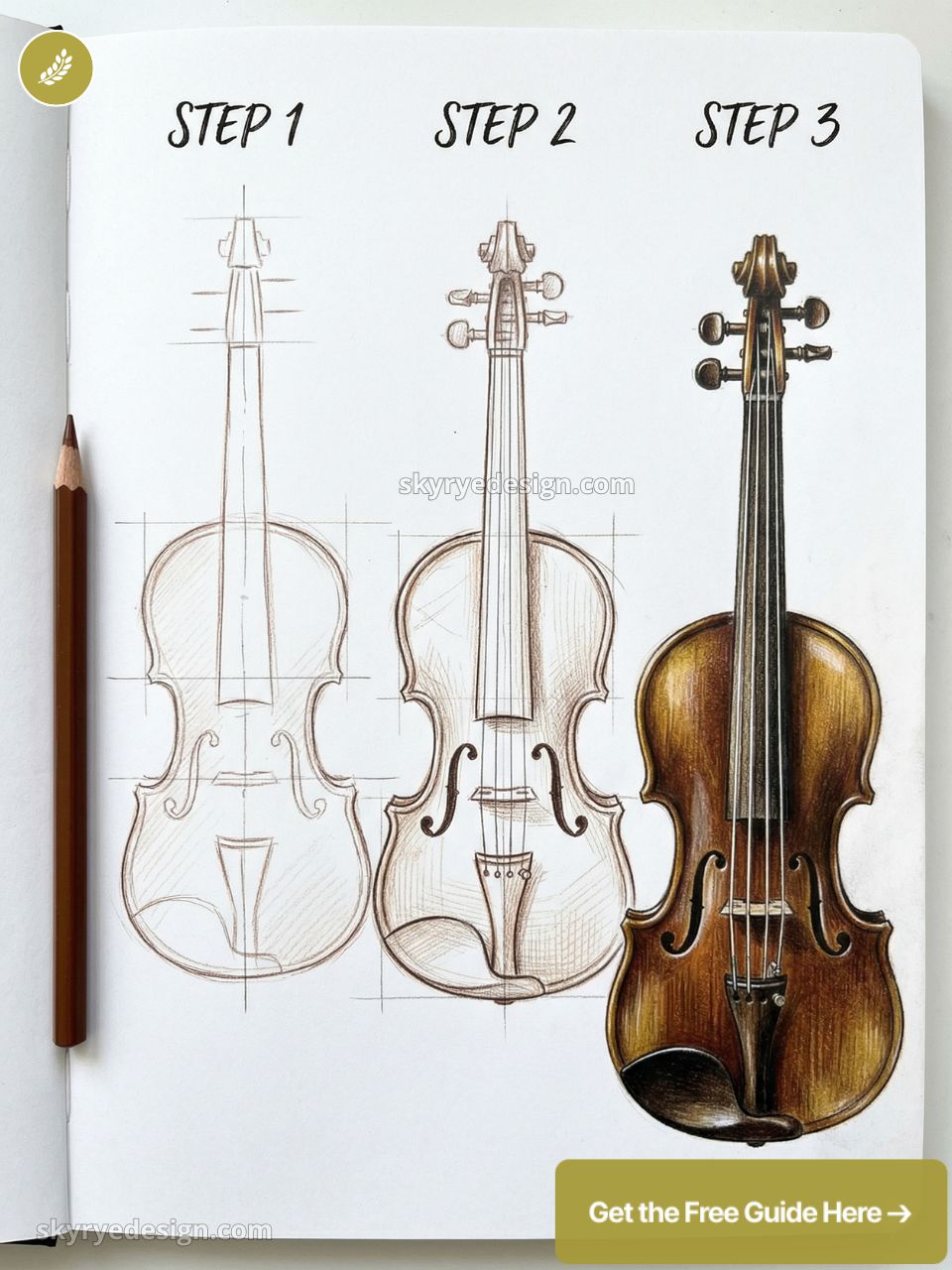
Key technique: Build the warm amber varnish through layered glazing: start with a full Raw Sienna layer over the entire body, deepen with Burnt Ochre in mid-shadow areas, add Burnt Sienna in deepest shadows. The grain on the top plate: very fine parallel lines in Dark Sepia, lighter pressure. The flamed maple back: diagonal hatching alternating direction. Final step: Cream or White over the specular highlight area to lift it slightly above the surrounding tone.
Violin-specific note: Burnishing (heavy pressure application of a light colour over completed layers) can simulate the smooth, glasslike quality of the varnished surface in the lightest areas. Apply Cream or White over the completed mid-tone areas with heavy pressure to merge the grain lines and create a polished finish effect.
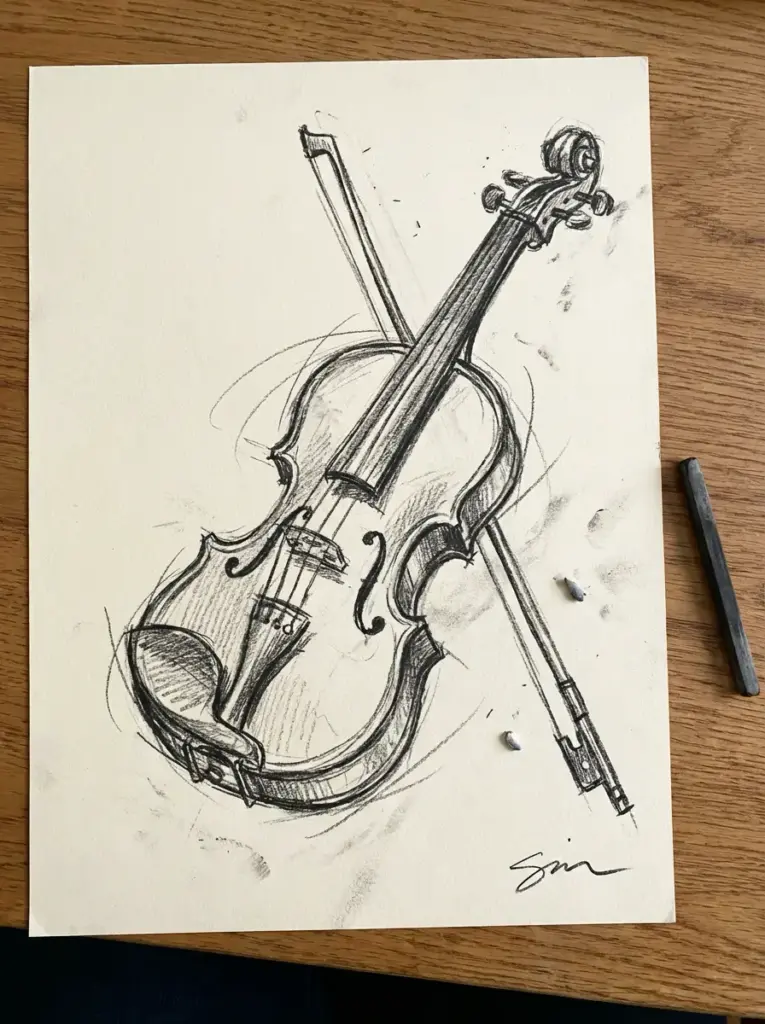
Gestural Charcoal or Conte
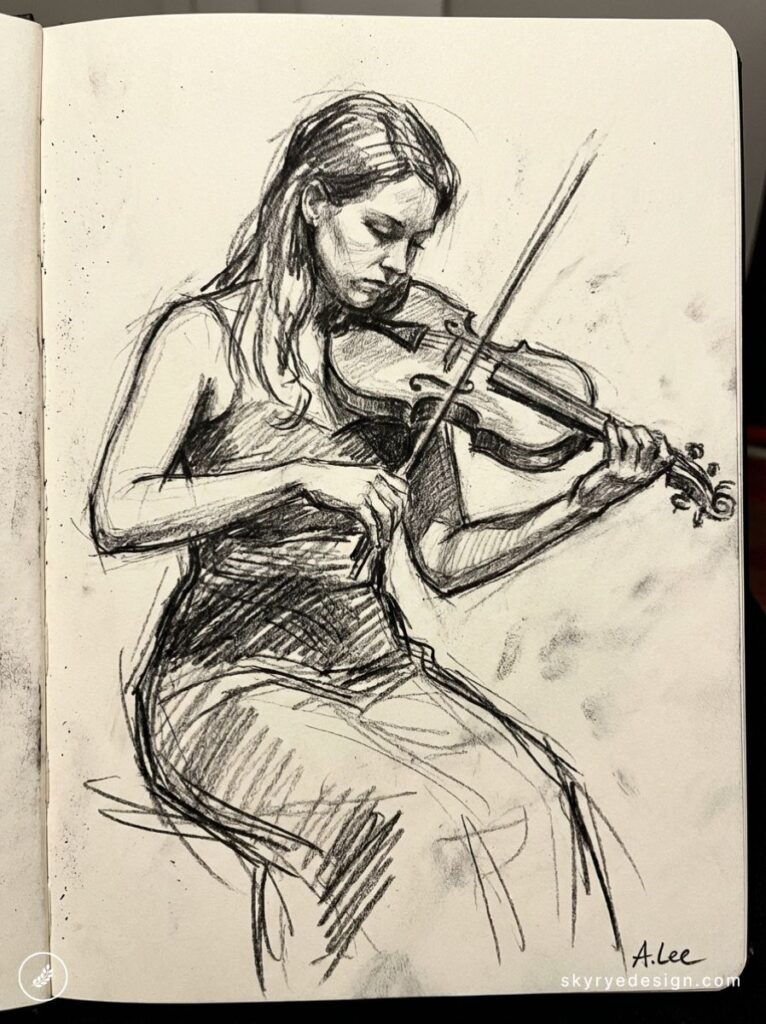
Medium: Vine charcoal or Conte crayon, toned grey paper, white charcoal pencil for highlights
Key technique: Establish the overall form with the side of the charcoal stick in broad strokes. Blend with a finger for atmospheric depth. Use white charcoal pencil to pull back the specular highlight and the light-catching edges of the scroll. The f-holes: press firmly with the charcoal tip to create the darkest areas of the drawing.
Violin-specific note: The gestural approach suits the violin particularly well because the instrument’s arched, three-dimensional form naturally produces the kind of tonal contrasts that charcoal handles best. The goal is not accurate outline but captured volume — the impression of the instrument in space rather than a diagram of its geometry.
Materials for Violin Drawing
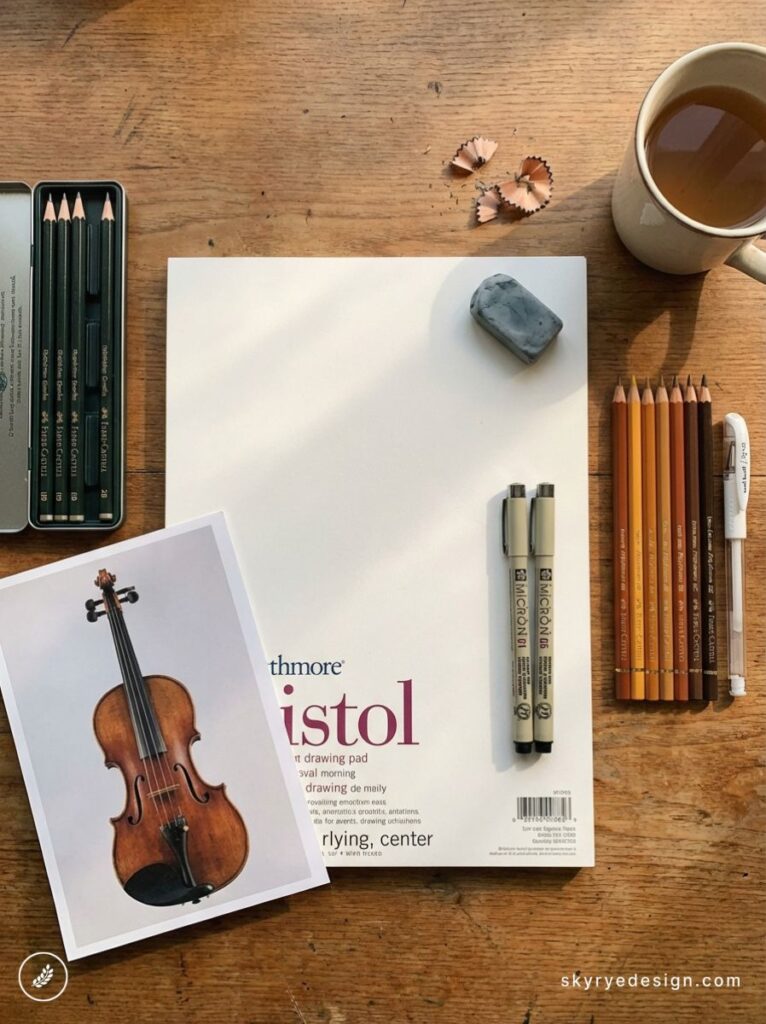
- Pencils: Faber-Castell 9000 in HB (construction lines and grain detail), 2B (confirmed body outline and shadow areas). A 0.3mm mechanical pencil for very fine grain lines on the top plate.
- Paper: Strathmore 300 Bristol smooth (9×12 inch, ~$18) for pencil and ink work. The smooth surface supports fine grain lines without texture interference. For charcoal or Conte: Strathmore 400 toned grey paper.
- Ink liners: Sakura Micron 01 (0.25mm) for f-hole interior lines, grain lines, and scroll chamfer. Micron 05 (0.45mm) for the primary body outline and scroll outer edge.
- Coloured pencils: Faber-Castell Polychromos — Raw Sienna (187), Burnt Ochre (268), Burnt Sienna (283), Dark Sepia (175) for the varnish and wood. Cream (102) for highlight areas.
- White gel pen: Uni-ball Signo broad (~$4) for the specular highlight on the top plate arching, applied last over completed ink or coloured pencil work.
- Reference: A high-resolution photograph of a violin front view is essential. The Stradivarius models at the Cremona Violin Museum (museodelviolino.org) have publicly available photographs that show proportions accurately. Avoid reference images taken with wide-angle lenses at close distance — they distort the proportions significantly.
FAQ: How to Draw a Violin
Q: How do you draw a violin for beginners?
Start with two overlapping ellipses — a larger lower bout and smaller upper bout — connected by the C-bout curves forming the waist. Standard violin body: 35.5cm long, 20cm wide at the lower bout. The neck is approximately half the body length. The key proportion check: lower bout width should approximately equal neck length from nut to shoulder. Draw the scroll last, as a spiral expanding from a small tight centre circle.
Q: What are the proportions of a violin?
Full-size (4/4): body length 35.5cm, lower bout 20cm wide, upper bout 16.5cm, waist 11cm. Body-to-neck ratio approximately 2:1. The bridge sits at the exact midpoint of the body length. These proportions trace to the Cremonese tradition of Antonio Stradivari (1644-1737) and Bartolomeo Guarneri del Gesu (1698-1744), whose instruments remain the global benchmark for violin makers.
Q: How do you draw violin f-holes?
Each f-hole has two circles of slightly different sizes (lower slightly larger) connected by a narrow waist with an inner nick on the inner edge. The overall shape leans slightly outward from top to bottom — not upright. The inner nick marks the bridge foot position. Draw the bridge first, then place the f-holes so their inner notches align with the bridge feet — not the other way around.
Q: How do you render wood grain on a violin?
Top plate (spruce): very fine parallel lines running along the body length, slightly more open toward the edges. Back (maple): diagonal hatching alternating direction to simulate the flamed figure. The specular highlight — a bright vertical band along the highest point of the arched top — is the single most impactful rendering detail. Leave it as reserved white paper in pencil, or apply white gel pen last in ink drawings.
- 14shares
- Facebook0
- Pinterest14
- Twitter0
- Reddit0