For my first year of drawing, I avoided leaves entirely. They seemed easy — just a simple shape, a few lines inside — so I assumed I could dash them off whenever I needed them in a composition. Then I tried to draw an oak leaf for a botanical illustration project and spent forty minutes producing something that looked like a hand grenade. The edges were too symmetrical, the lobes were too regular, and the veins were perfectly parallel, spaced exactly like ruled notebook lines.
- Why Leaf Drawing Is Harder Than It Looks
- Materials for Leaf Drawing
- Leaf Anatomy You Need to Know Before You Draw
- How to Draw a Leaf: 5 Steps
- Four Leaf Types to Draw (and Their Specific Challenges)
- Three Leaf Drawing Styles to Develop
- 5 Leaf Drawing Mistakes (and Their Fixes)
- Resources Worth Having
- The Leaf Is a Good Teacher
- FAQ: Leaf Drawing
My tutor picked it up, looked at it for a second, and said: ‘You drew what you think a leaf looks like. Go outside and look at an actual leaf.’ I did. The real oak leaf had lobes that varied in size, a midrib that curved slightly rather than running perfectly straight, secondary veins that branched at different angles, and edges with tiny variations that made the whole thing read as organic rather than geometric. None of that was in my drawing.
That’s the central problem with leaf drawing: leaves look simple but are full of controlled irregularity — and irregularity is genuinely hard to draw deliberately. This guide goes through the anatomy that governs what you draw, a five-step process that handles the construction correctly, specific techniques for four different leaf types, the most common mistakes and their fixes, and how to develop the observation habit that separates convincing leaf drawings from the hand-grenade version.
Why Leaf Drawing Is Harder Than It Looks
Most people assume leaves are a beginner subject — simple shapes, two or three interior lines, done. That assumption is why so many leaf drawings look unconvincing. There are three specific difficulties that trip up artists at every level.
The Symmetry Problem
Real leaves are bilaterally approximate rather than perfectly symmetrical. The left side of an oak leaf is not the mirror image of the right side — it’s close, but with subtle variations in lobe size, angle, and edge detail. Drawing perfect symmetry produces a leaf that reads as artificial, like a graphic design element rather than a natural object.
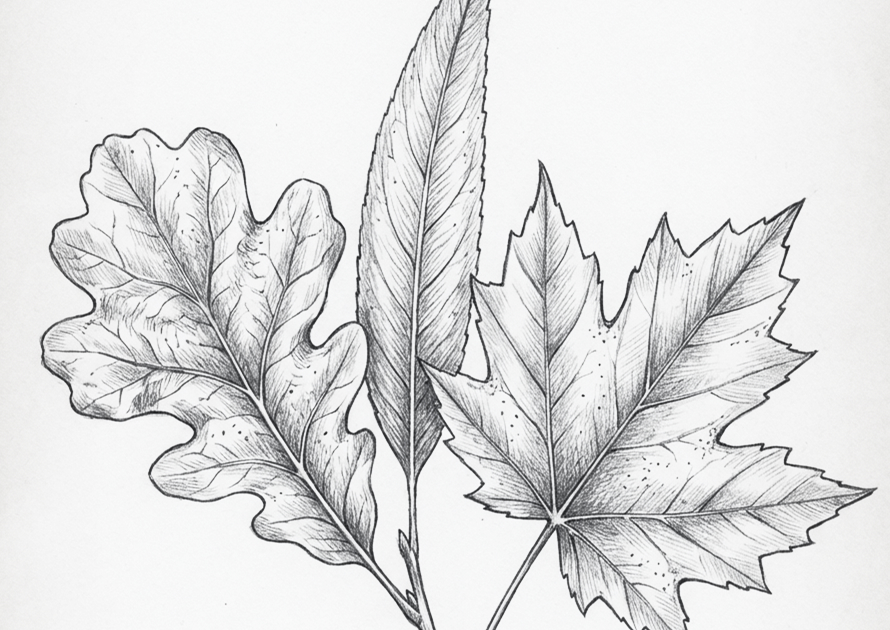
The fix is not randomness but deliberate variation: when you sketch the outline, make each lobe slightly different from its counterpart, and let the midrib curve very gently rather than running perfectly straight.
The Vein Hierarchy Problem
Leaves have a structured vein hierarchy: the midrib (primary vein running from stem to tip) is the thickest and most prominent; secondary veins branch from the midrib at consistent angles; and tertiary veins form a fine network between the secondary veins.
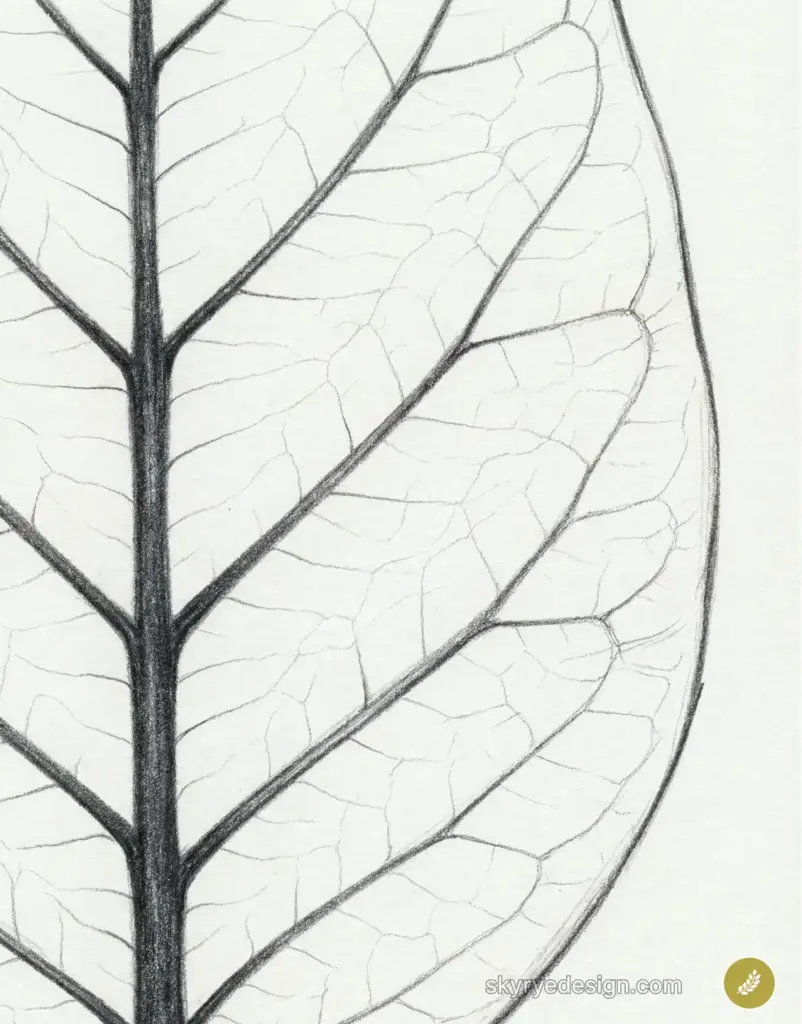
Most beginners either ignore this hierarchy (drawing all veins the same weight) or overdraw the tertiary network (adding so many fine lines that the leaf looks like graph paper). The solution is to draw only the midrib and secondary veins completely, suggest the tertiary network with very light hatching in focal areas only, and use graduated line pressure — thick at the midrib, thinning as each vein extends outward.
The Edge Detail Problem
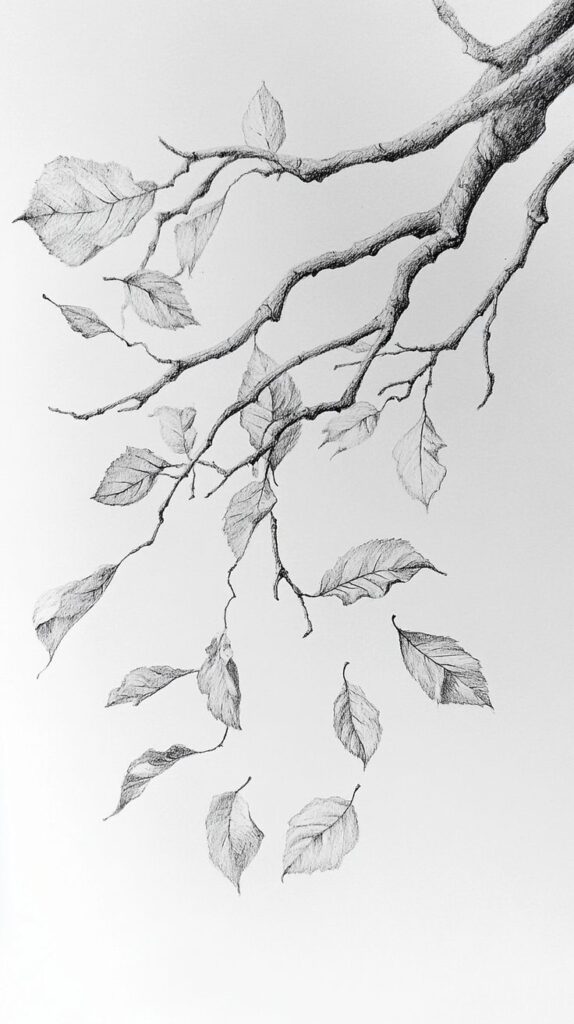
Leaf edges — called margins — are rarely smooth. Most leaves have serrated, lobed, wavy, or crenate edges with specific, repeating patterns. Drawing smooth edges on a leaf that should be serrated produces an instantly wrong result, but drawing the serration mechanically and evenly looks equally unconvincing. The technique is to draw the serration with slight variations in the size and angle of each tooth, working quickly with a slightly loose hand rather than measuring each point precisely.
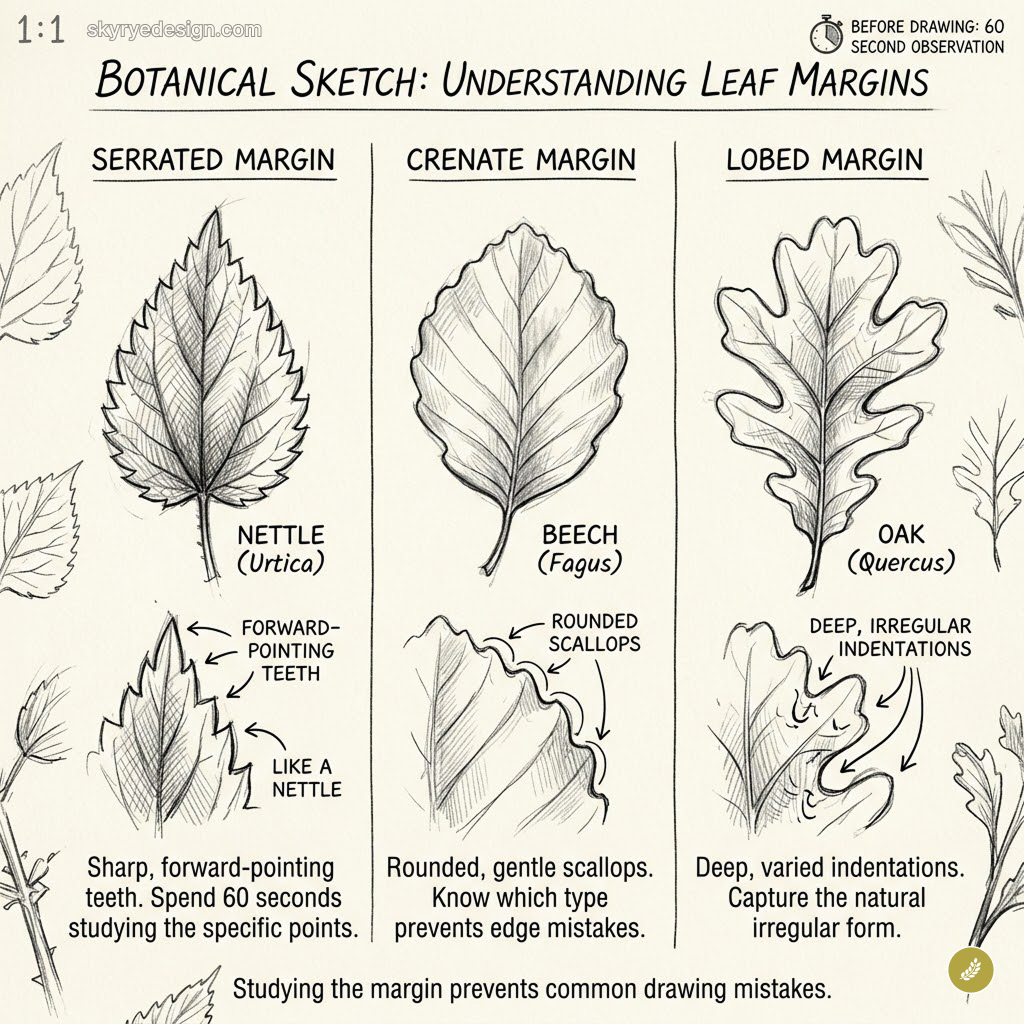
✏ Pro tip: Before drawing any leaf, spend sixty seconds studying the specific margin type of the leaf you’re drawing. Serrated margins (like a nettle) have forward-pointing teeth. Crenate margins (like a beech) have rounded scallops. Lobed margins (like an oak) have deep, irregular indentations. Knowing which type you’re drawing before you start prevents the most common edge mistakes.
Materials for Leaf Drawing
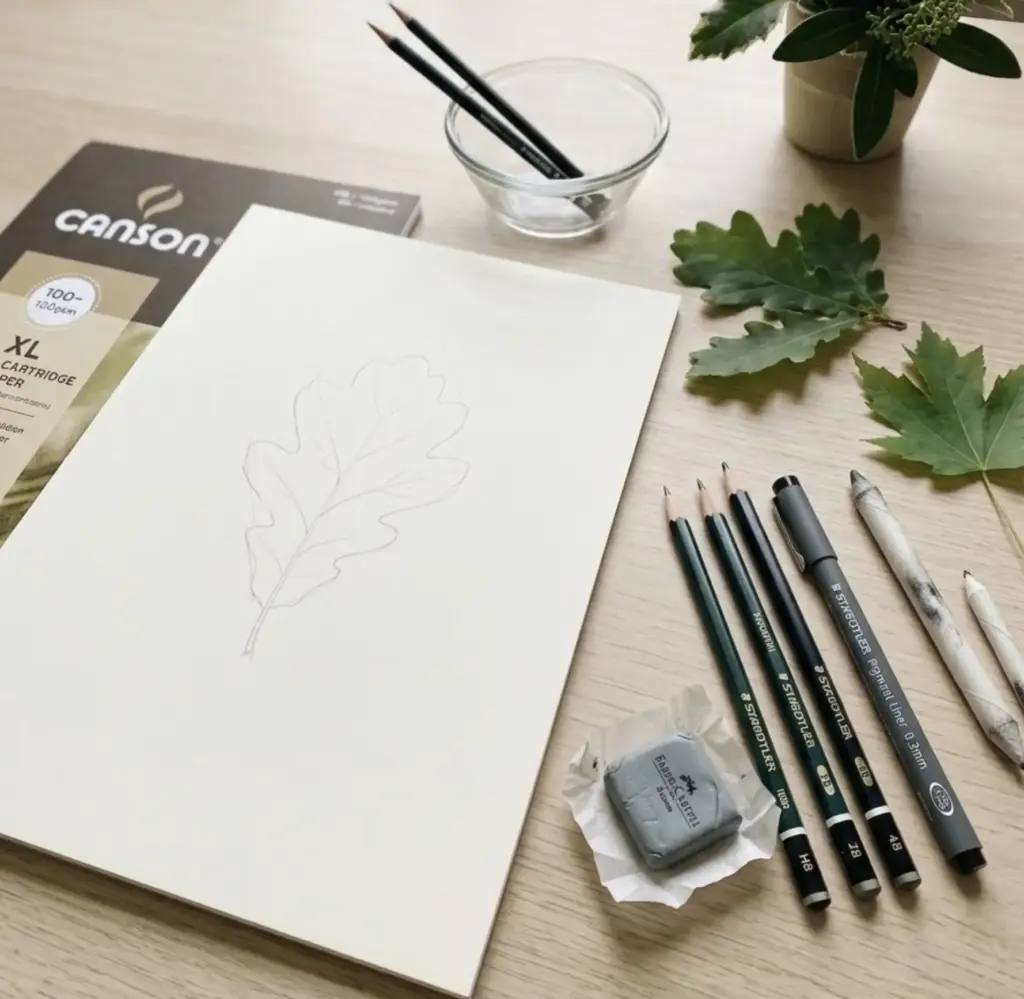
You don’t need specialist supplies for convincing leaf drawings. This is what I use and teach with:
- HB pencil — all construction lines, midrib, and initial outline. Very light pressure; these are erased later.
- 2B pencil — secondary veins, confirmed outline, and lighter shading areas.
- 4B pencil — deep shadow areas: the fold shadows on curved leaves, the shadows under lobes, the deepest vein channels.
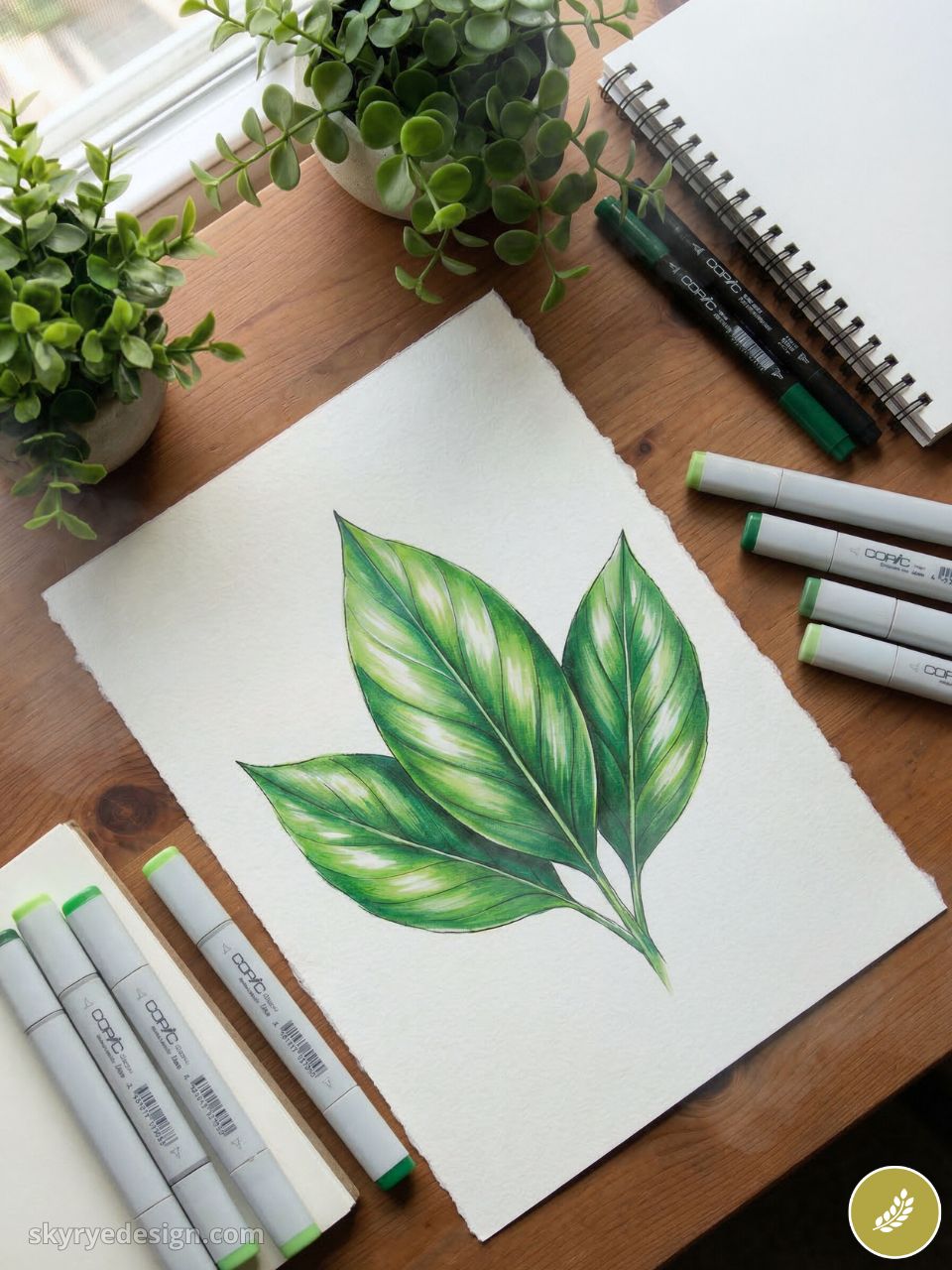
- 0.3mm Fineliner (Staedtler Pigment Liner, ~$4) — for botanical-style inking over pencil construction. Gives consistent vein lines without varying pressure.
- Kneaded eraser (Faber-Castell, ~$3) — lifts HB construction lines cleanly, and pressed gently into 2B shading creates the gloss highlights on waxy leaves.
- Smooth cartridge paper, 100–120gsm — Canson XL or Strathmore Bristol. Avoid heavily textured paper for leaf detail; the tooth disrupts fine vein lines.
- Blending stump — for smooth tonal transitions on the leaf surface, especially useful for shiny leaves like magnolia or rubber plant.
✏ Pro tip: For colour work: Faber-Castell Polychromos coloured pencils (~$3–4 per pencil) are the best choice for botanical leaf colouring — they’re oil-based, layer smoothly, and don’t wax out like cheaper pencils. A minimum useful set for leaves: Leaf Green (112), Olive Green Yellow (173), Earth Green (172), Burnt Sienna (283), and Raw Umber (180).
Leaf Anatomy You Need to Know Before You Draw
These are the structural facts about leaves that inform every drawing decision. You don’t need a biology degree — just a working knowledge of what each part does and how it looks.
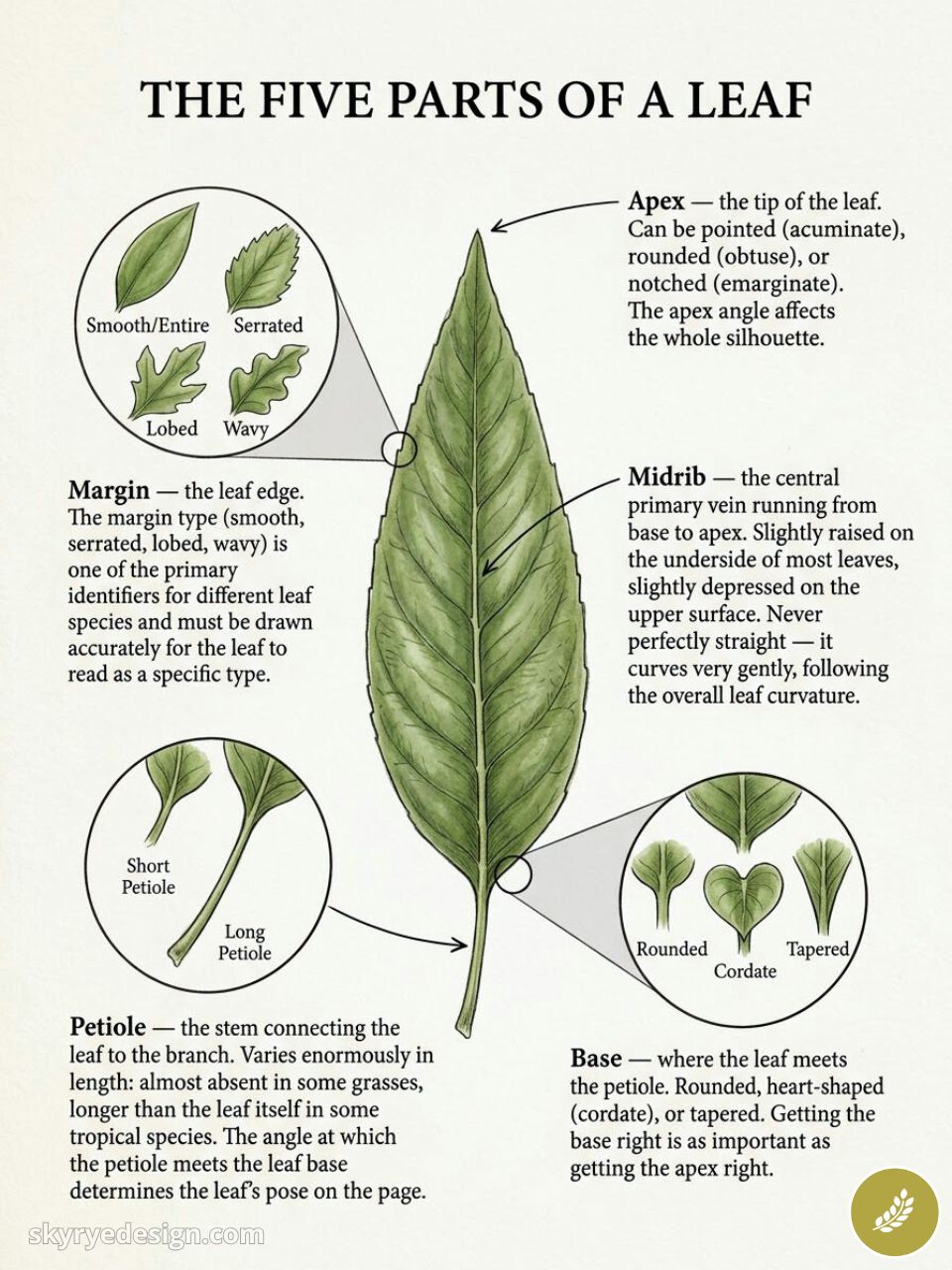
The Five Parts of a Leaf
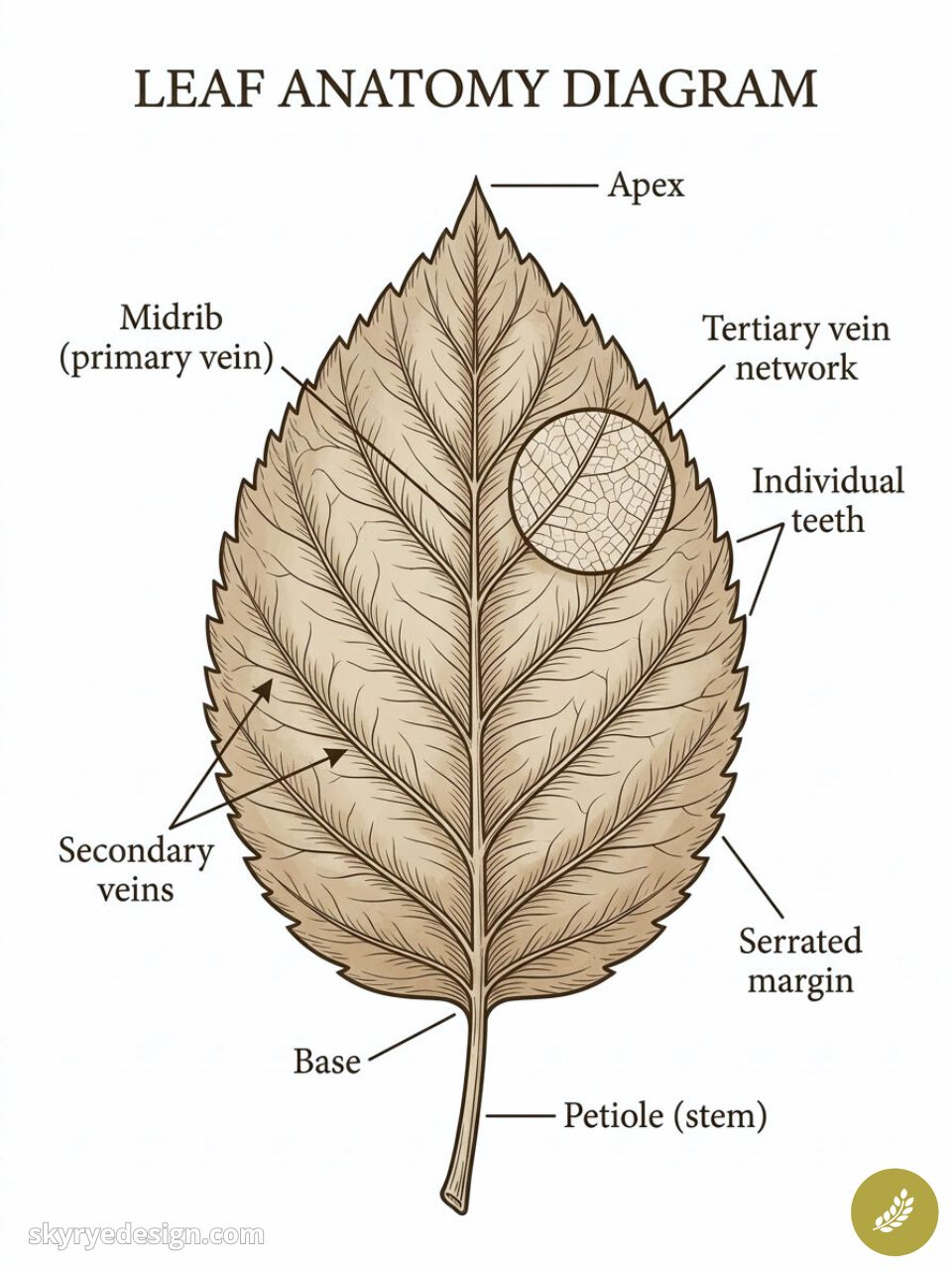
- Apex — the tip of the leaf. Can be pointed (acuminate), rounded (obtuse), or notched (emarginate). The apex angle affects the whole silhouette.
- Base — where the leaf meets the petiole. Rounded, heart-shaped (cordate), or tapered. Getting the base right is as important as getting the apex right.
- Midrib — the central primary vein running from base to apex. Slightly raised on the underside of most leaves, slightly depressed on the upper surface. Never perfectly straight — it curves very gently, following the overall leaf curvature.
- Margin — the leaf edge. The margin type (smooth, serrated, lobed, wavy) is one of the primary identifiers for different leaf species and must be drawn accurately for the leaf to read as a specific type.
- Petiole — the stem connecting the leaf to the branch. Varies enormously in length: almost absent in some grasses, longer than the leaf itself in some tropical species. The angle at which the petiole meets the leaf base determines the leaf’s pose on the page.
Vein Patterns by Leaf Type
Different leaves have different vein architecture. There are two main types: pinnate venation (one central midrib with secondary veins branching off it, like an oak or beech) and palmate venation (several primary veins radiating from the base like fingers, like a maple or geranium). Grass leaves have parallel venation — all veins run roughly parallel from base to tip. Knowing which type you’re drawing before you pick up a pencil prevents structural errors that no amount of detail work will fix later.
How to Draw a Leaf: 5 Steps
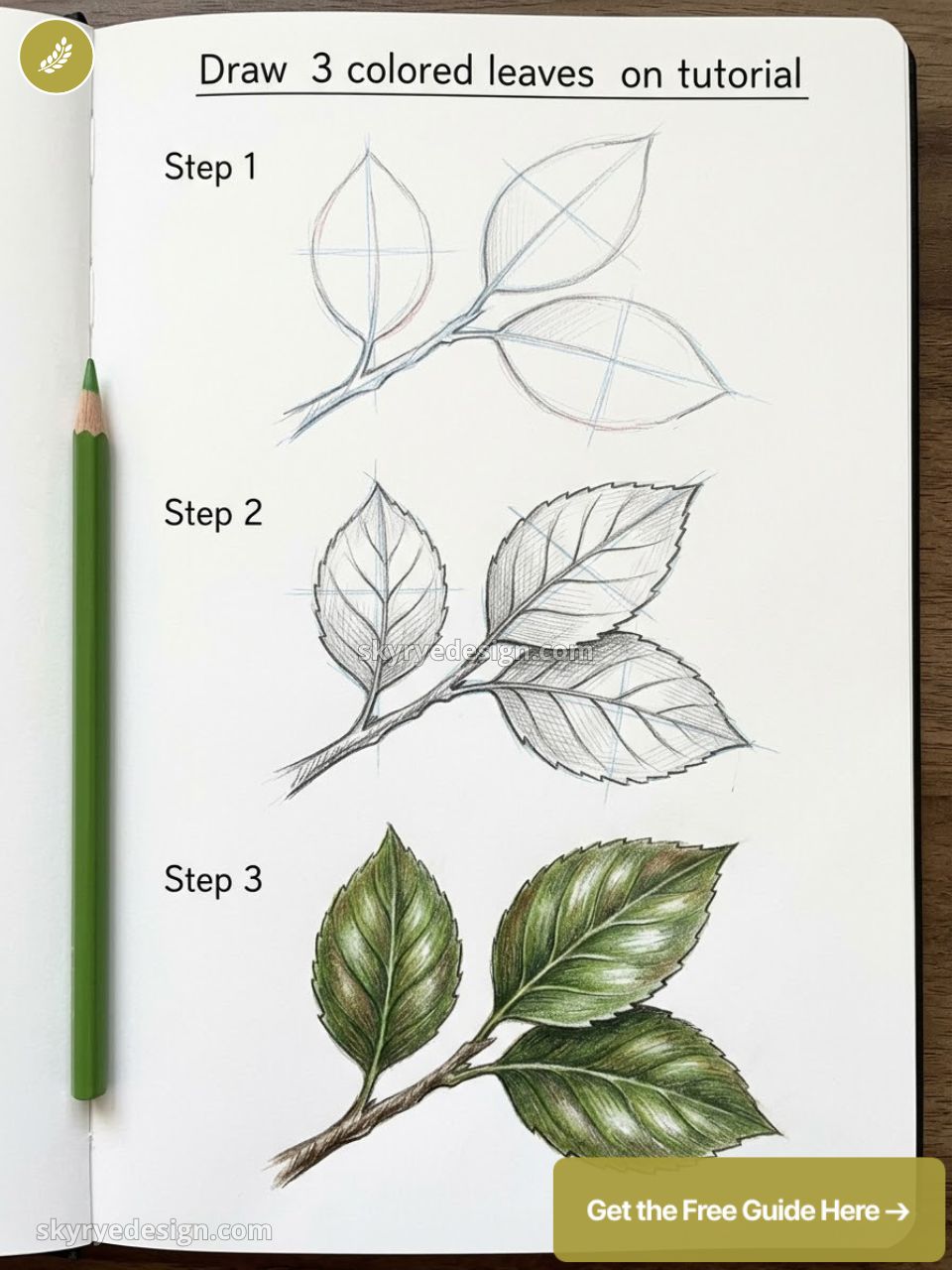
This process works for any leaf type. Steps 1–3 use HB at very light pressure — all construction. Steps 4–5 are the committed drawing.
Step 1: Draw the Midrib and Establish the Leaf Axis
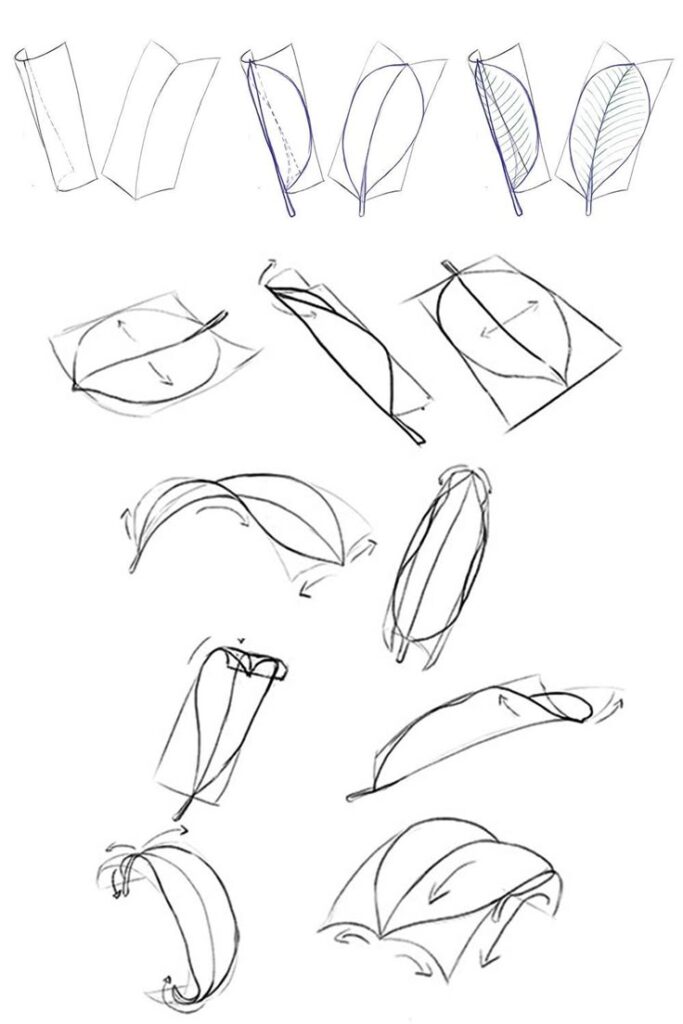
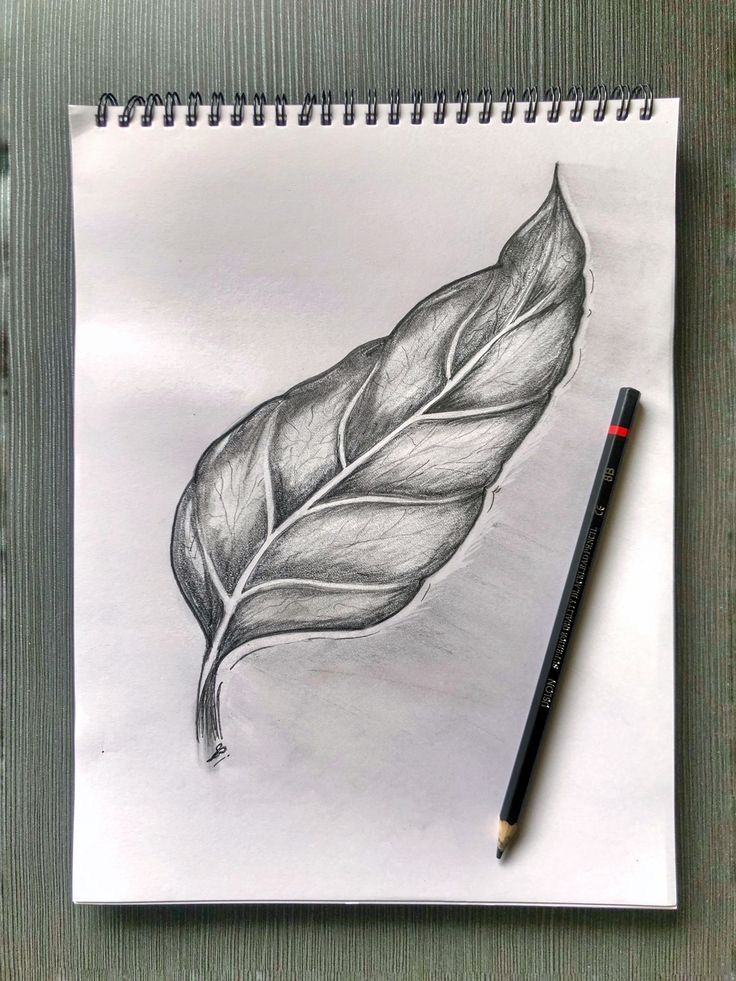
Start with a single light, curved or straight line from the base of the leaf to the apex. This is the midrib — the governing axis of the entire leaf. It should have a very slight curve rather than running perfectly straight; even a 2–3mm deviation from straight makes the leaf read as organic rather than geometric.
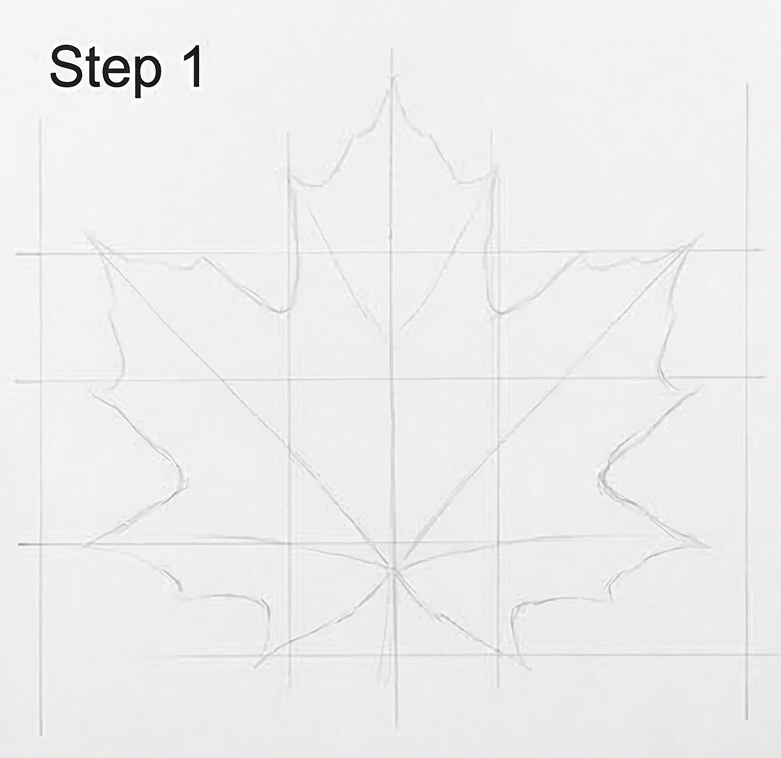
Mark the intended leaf length on this line, then lightly indicate the widest point of the leaf (usually at or slightly below the halfway point for ovate leaves, at the midpoint for elliptic leaves). The midrib and the widest-point marker are all you need before moving to the outline.
Step 2: Sketch the Outline — Rough First, Refined Second
Draw the leaf outline in two passes. First pass: a rough, slightly irregular silhouette that establishes the overall shape without committing to any edge detail. This pass should take about ten seconds and look deliberately loose. Second pass: refine the outline, working in the margin detail — serrations, lobes, or waves.
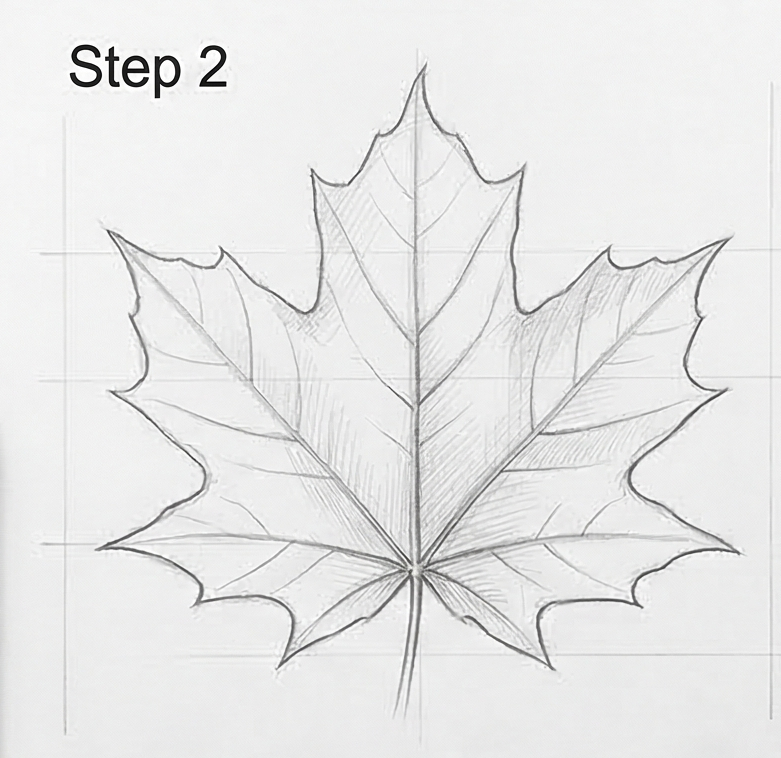
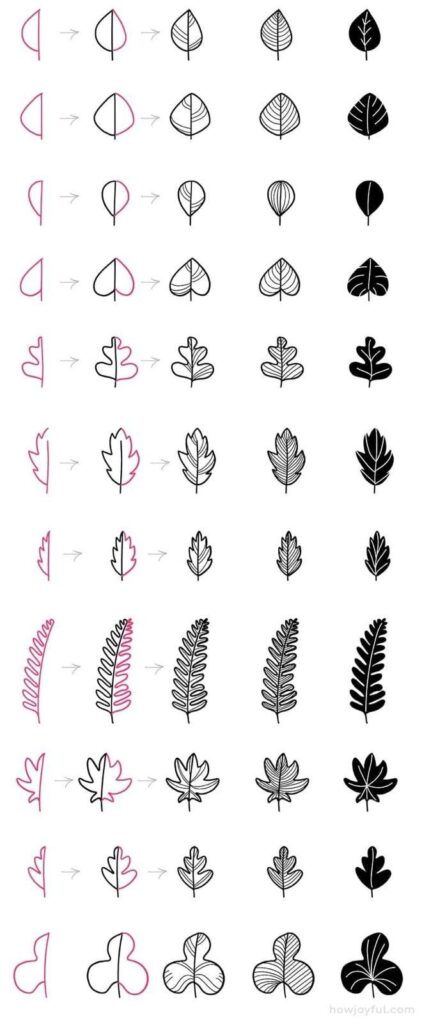
For serrated margins, work from base to apex on each side, varying the tooth size and angle slightly as you go. For lobed margins (oak, maple), sketch each lobe individually rather than drawing the whole edge in a single motion; this naturally produces the variation that makes lobed leaves look real. The leaf’s natural left-right asymmetry should emerge in this pass — don’t correct it.
✏ Pro tip: The most common outline mistake: drawing both sides of the leaf simultaneously, working symmetrically. Instead, draw one side completely (base to apex), then the other. The two sides will naturally differ slightly, and that difference is exactly what you want.
Step 3: Add the Secondary Veins
From the midrib, draw secondary veins branching outward toward the margin. Use your 2B pencil with graduated pressure — heavier where each vein leaves the midrib, lighter as it extends toward the edge.
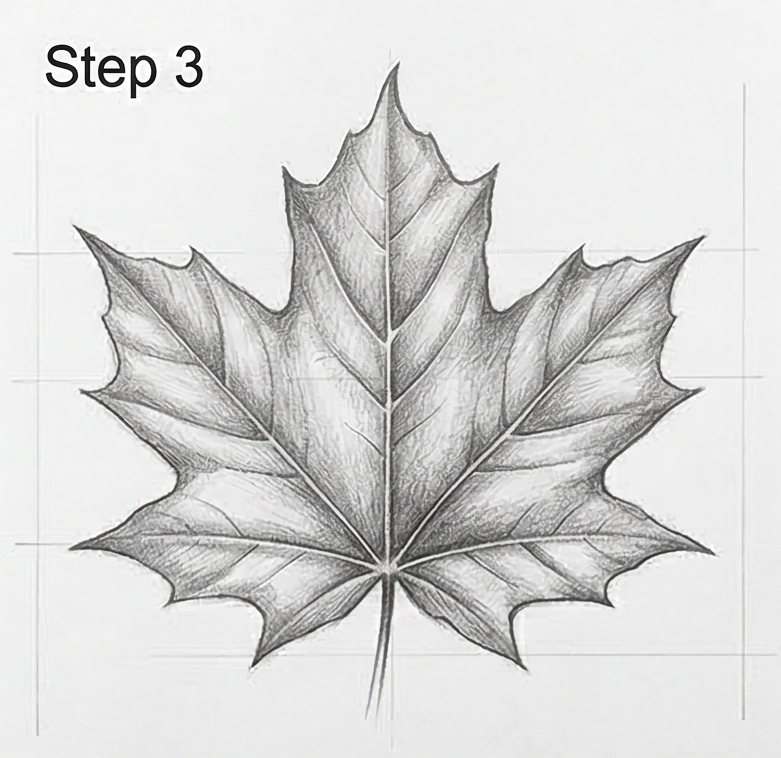
The angle of secondary veins relative to the midrib is a defining characteristic of different leaf types: pinnate-venation leaves like oak have secondary veins that branch at roughly 45–60 degrees; leaves like beech have secondary veins at a steeper angle, nearly perpendicular to the midrib. In lobed leaves, the secondary veins extend into each lobe tip — this is what structurally ‘builds’ the lobe.
Space the secondary veins with slight irregularity in spacing, not perfectly even. Draw them tapering as they reach the margin — don’t let them end abruptly.
Step 4: Final Linework and Edge Refinement
Switch to your 2B (or fineliner if you’re inking) and make the confirmed final outline pass. Use varied line pressure: slightly heavier for the main outline and midrib, lighter for secondary veins, very light for any tertiary vein suggestion.
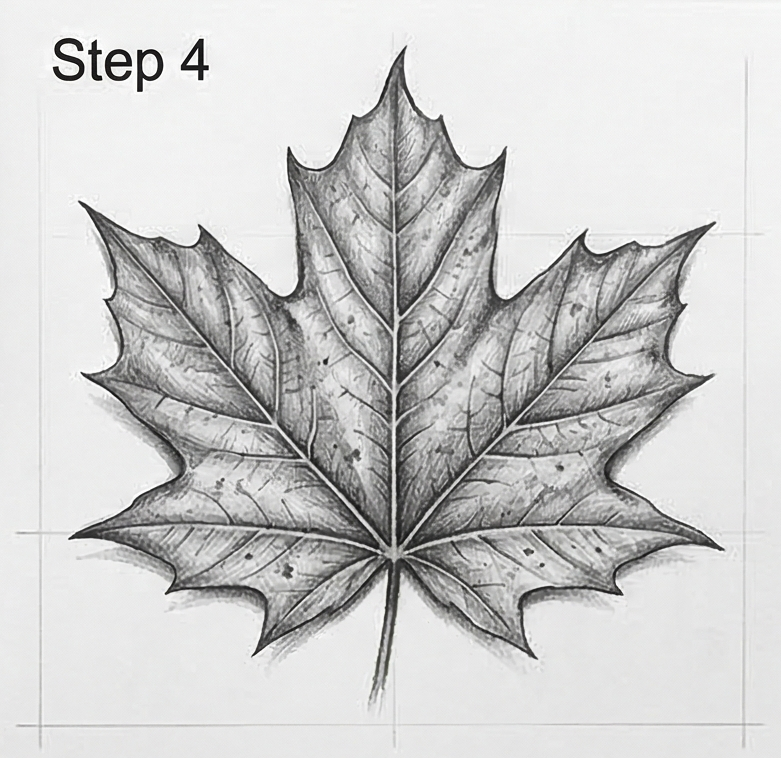
For serrated leaves, the teeth should cast tiny shadow marks on their inner faces — a single dark mark at the base of each tooth from the shadowed side. Erase all HB construction lines once the 2B or ink is fully dry. Check the overall silhouette: the leaf should read correctly from a distance before you add any shading. If it doesn’t, the issue is in the outline, and shading won’t fix it.
Step 5: Shading: Form, Light, and Surface Quality
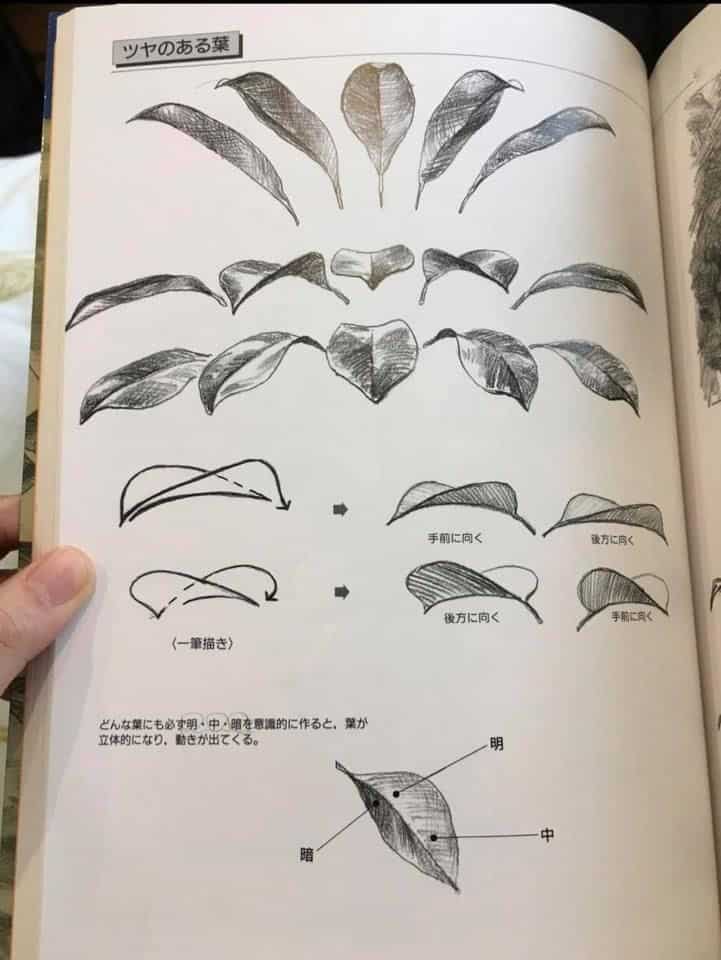
Leaf shading has two distinct goals: rendering the three-dimensional form of the leaf (curved, folded, or flat), and rendering the surface quality (matte, waxy, or leathery).
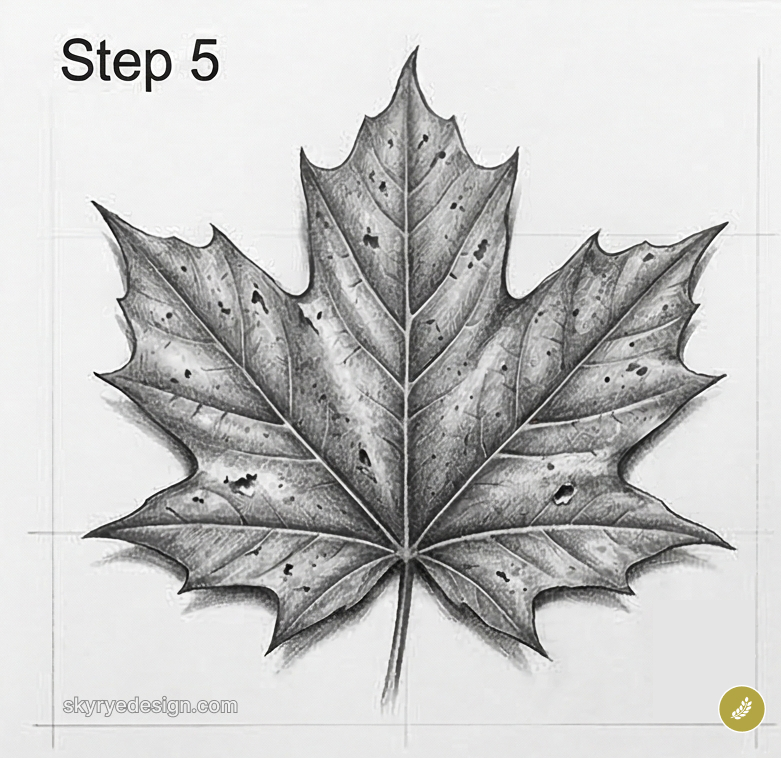
For form shading: pick a single light source and shade the areas that would be in shadow — typically the areas below the midrib on one side, the undersides of any folds, and the areas between secondary veins where the surface dips slightly.
For surface quality: matte leaves like velvet plant (Gynura) receive soft hatching with a blending stump; waxy leaves like magnolia or rubber plant have harder tonal transitions and a small sharp highlight pressed in with the kneaded eraser at the apex of the curvature. The deepest shadow areas — the channels beside the midrib, the shadows under each lobe — go in last with your 4B.
Four Leaf Types to Draw (and Their Specific Challenges)
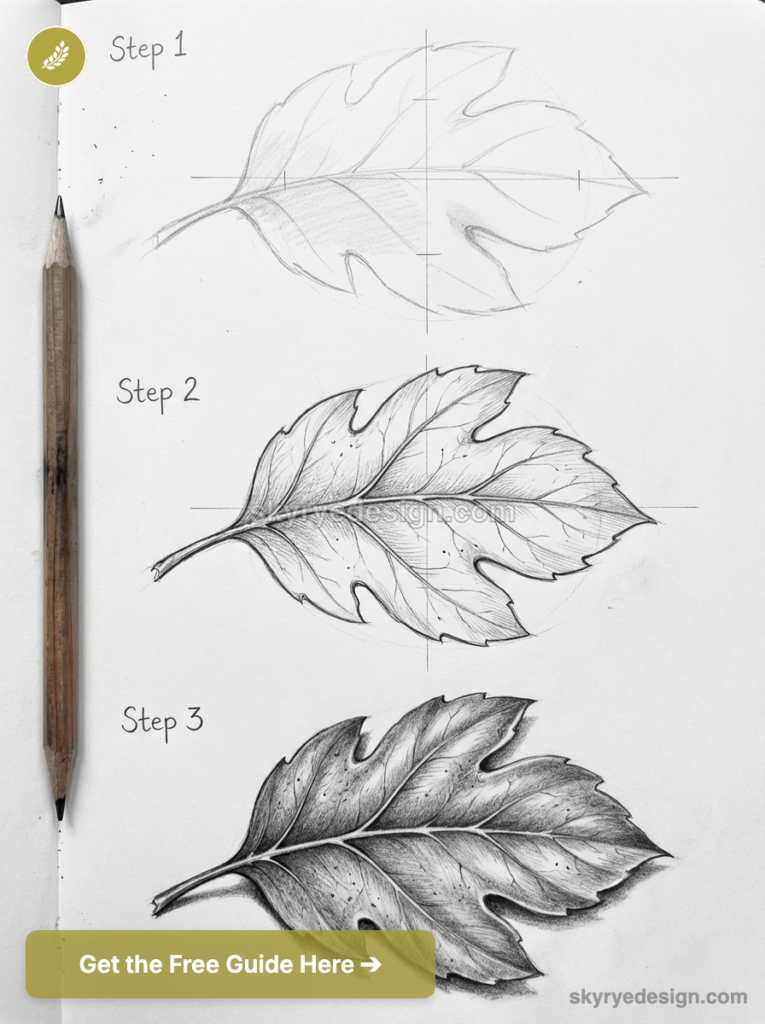
1. Oak Leaf — Lobed Pinnate
The oak leaf is one of the most recognisable silhouettes in botanical drawing and one of the most commonly drawn incorrectly. The lobes must vary in size — the middle lobes are widest, the basal lobes are smaller, and the arrangement is never perfectly regular.
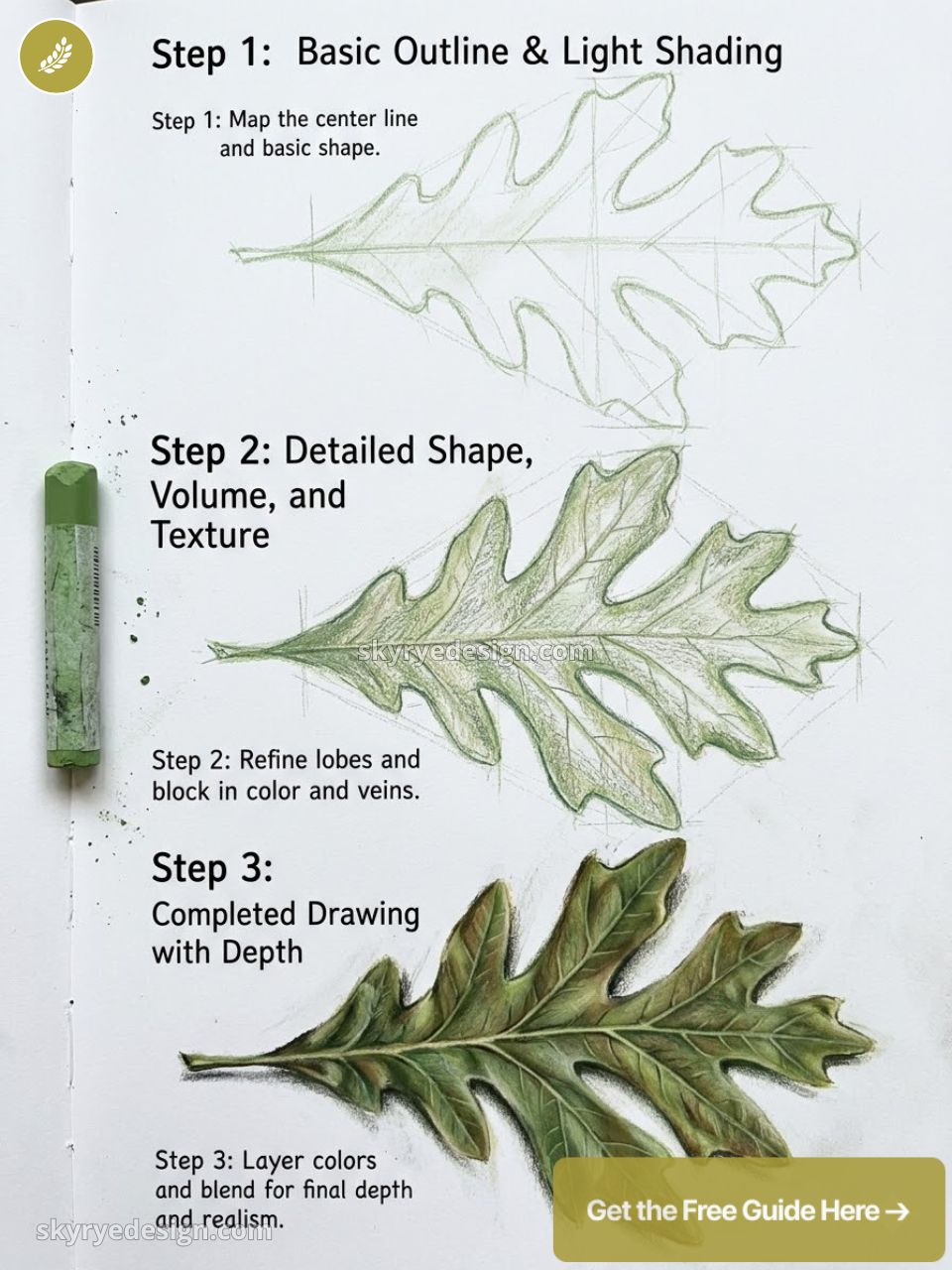
The secondary veins extend directly into each lobe tip, which structurally connects the vein pattern to the outline. The base is usually asymmetrical — one side meeting the petiole at a slightly different angle than the other. Draw this asymmetry deliberately.
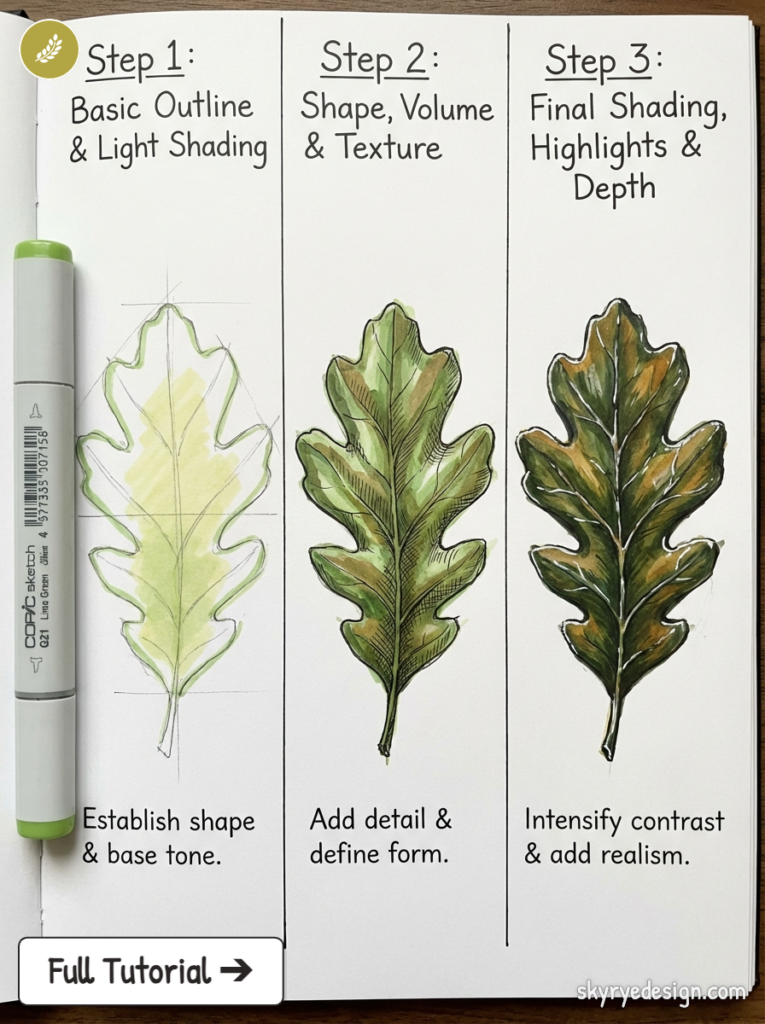
The surface is relatively matte, so shading uses soft gradients without sharp highlights.
2. Maple Leaf — Palmate
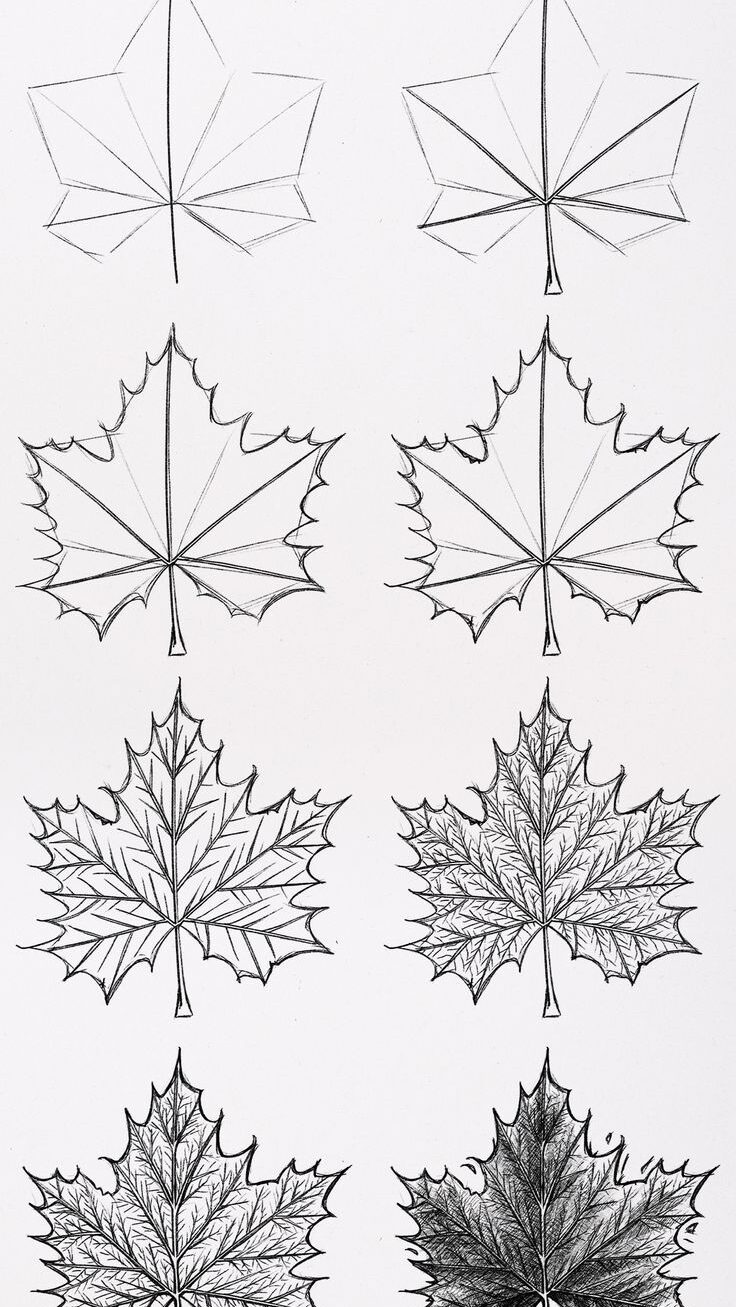
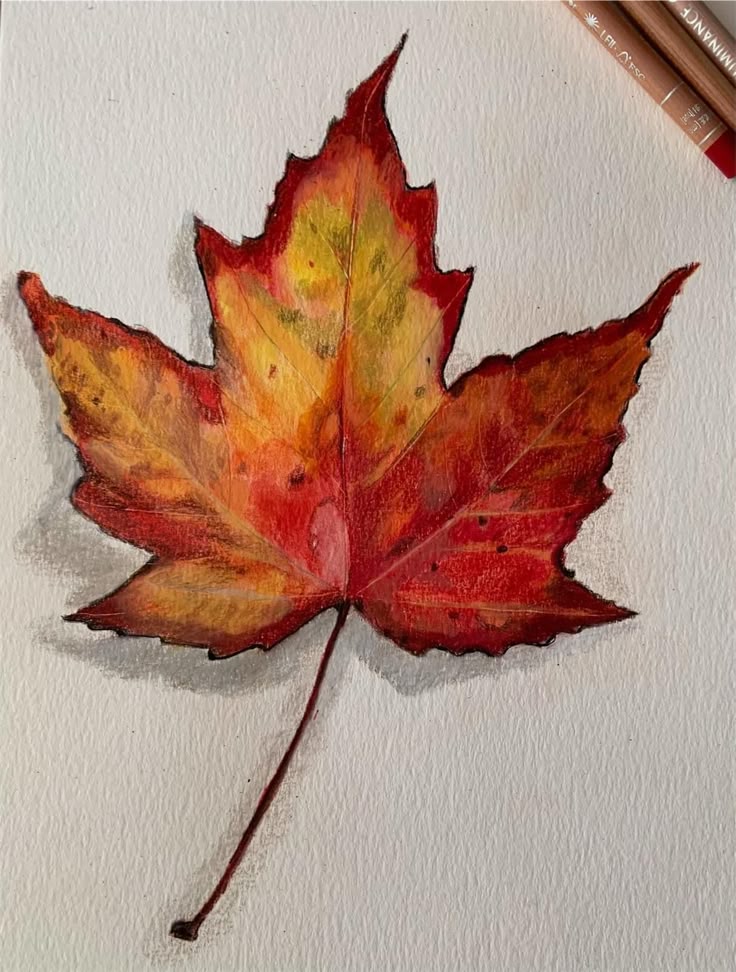
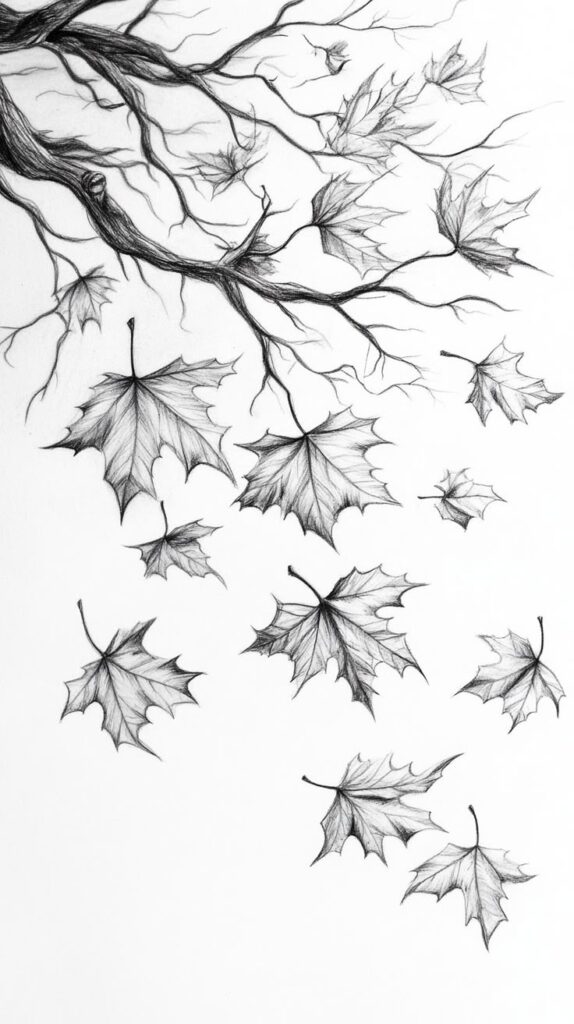
The maple leaf has five to seven primary veins radiating from the base, each governing a major lobe. Construction starts with those radiating veins rather than with a midrib — draw five lines fanning out from a central point at the leaf base, then build the lobe outlines around each vein.
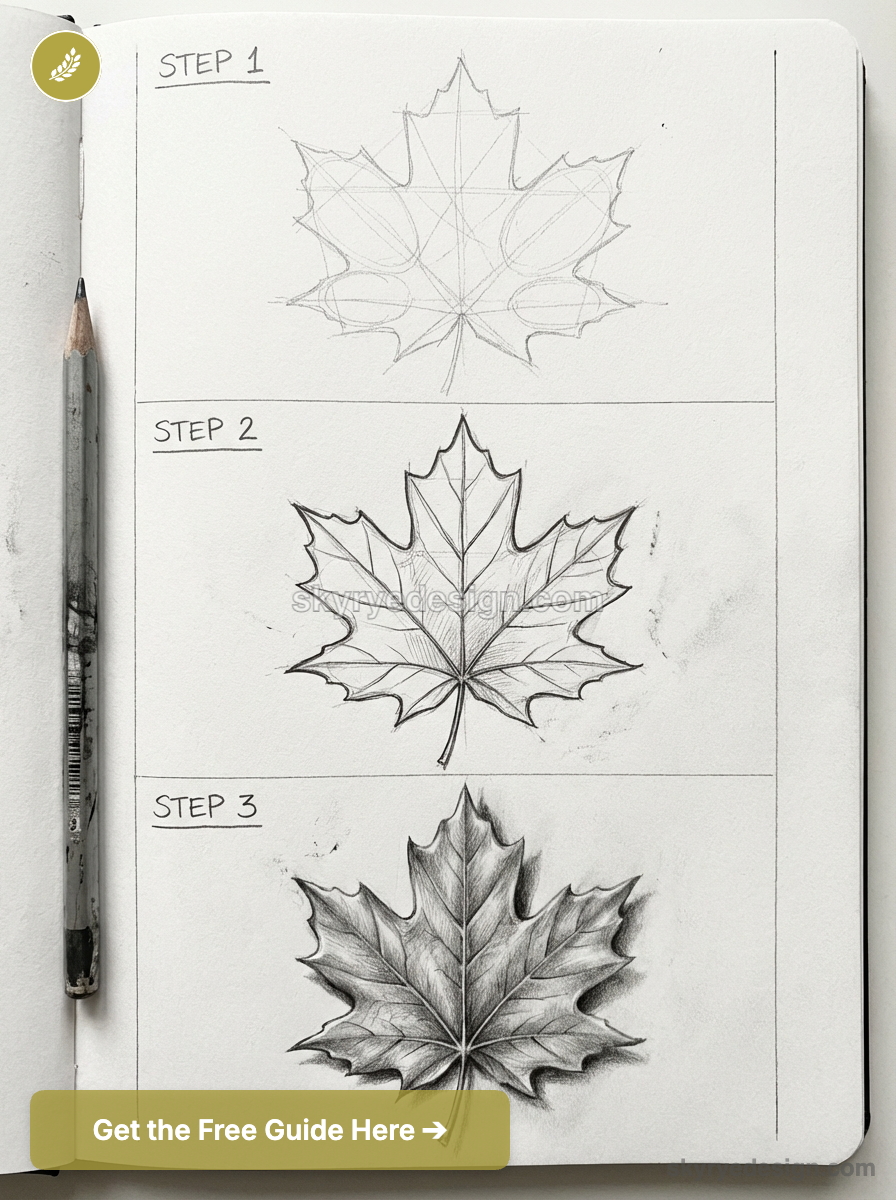
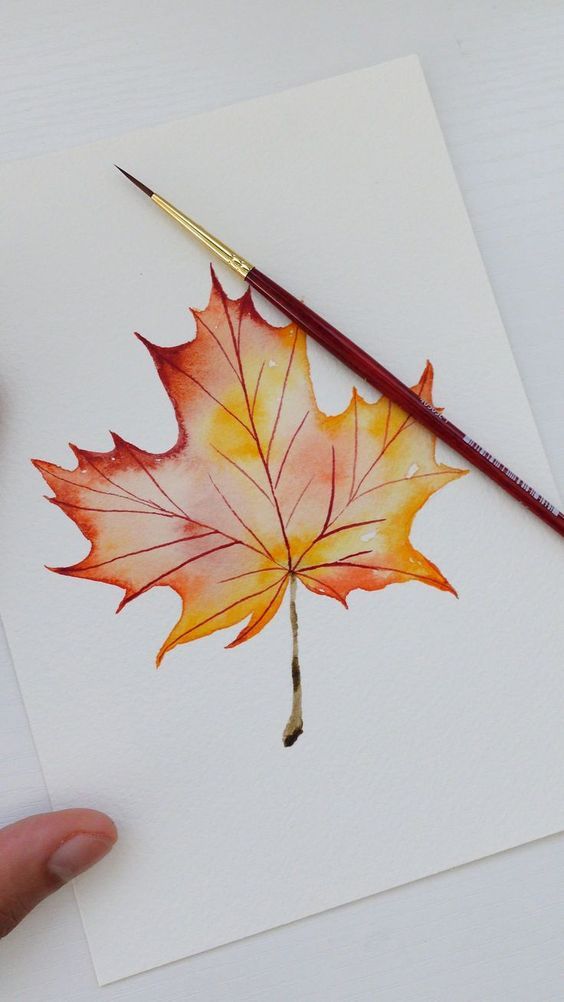
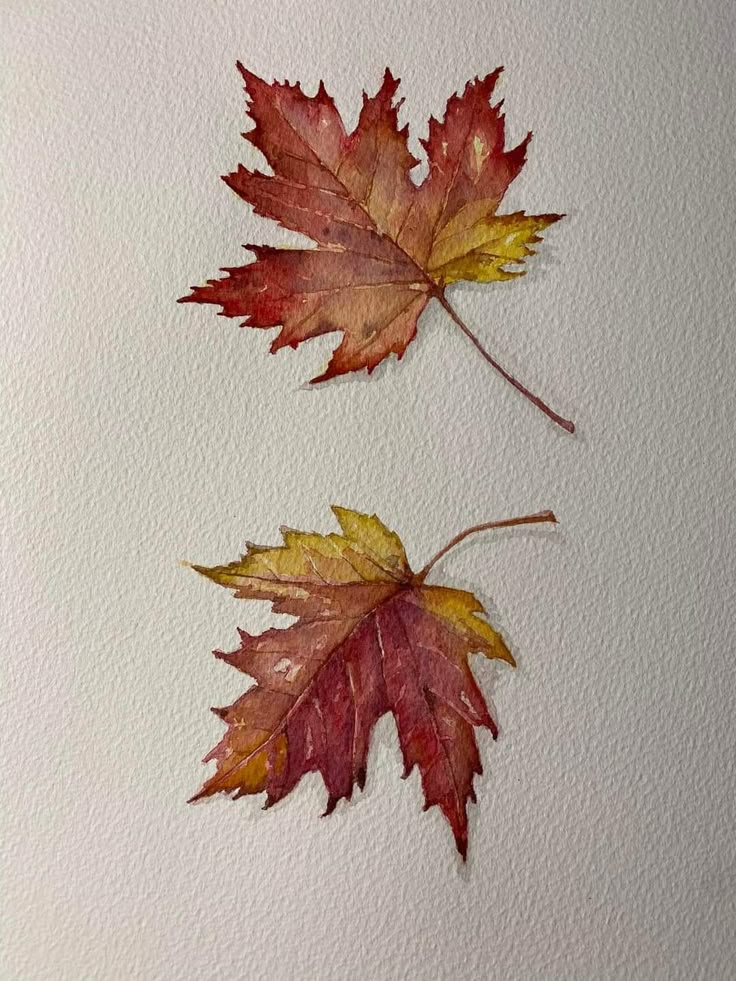
The serration on maple leaves is double-serrate, meaning each large tooth has smaller teeth on its edges. Drawing this correctly is the detail that separates a convincing maple leaf from a generic one. The autumn colour progression (green at the vein base, orange-red at the lobe tips) follows the vein structure precisely.
3. Simple Ovate Leaf — The Foundation Shape
The simple ovate leaf (like a lilac or cherry) is the best starting point for beginners because it isolates the core skills without the complexity of lobes.
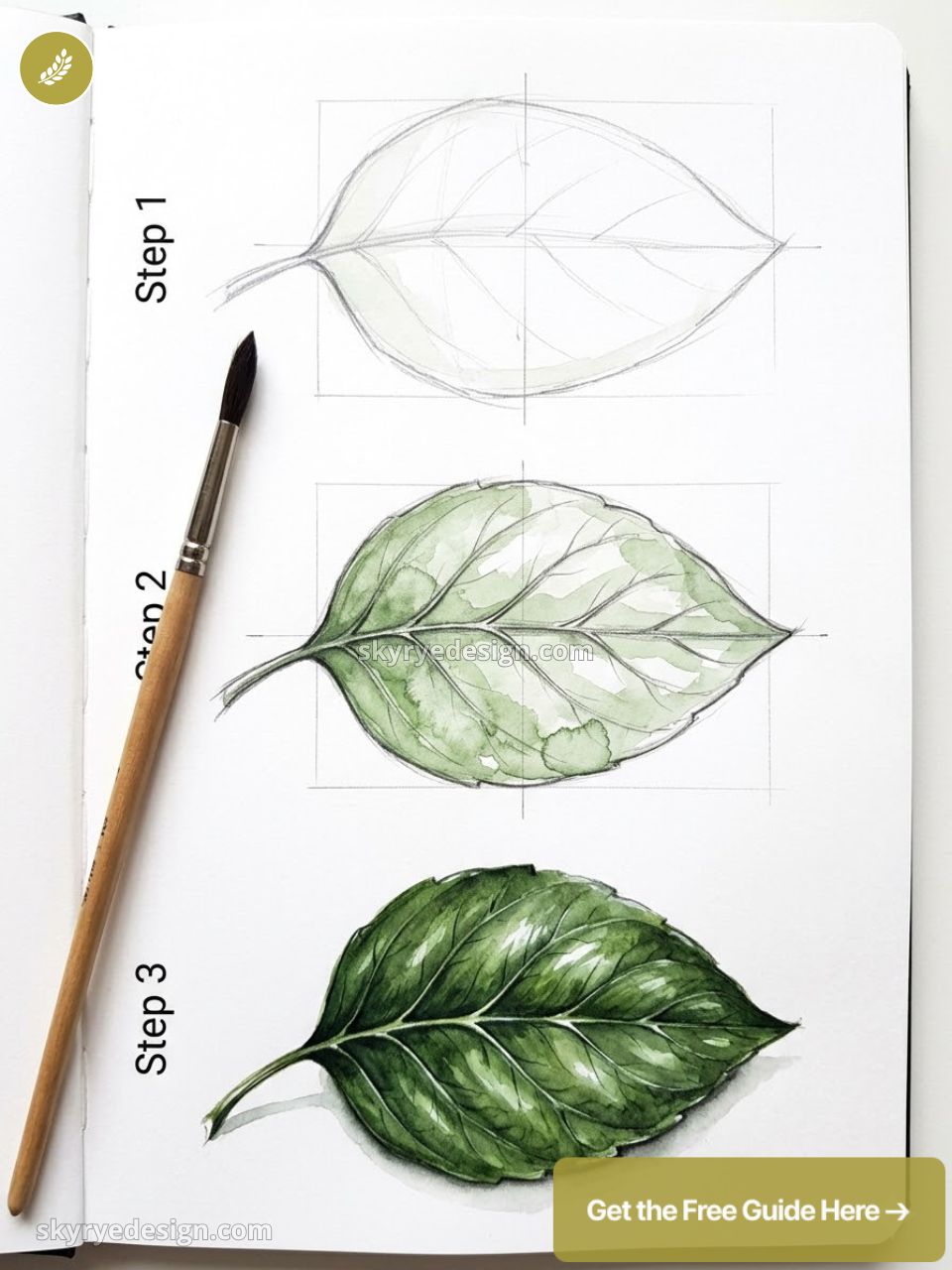
The pinnate vein structure is clear; the margin is either smooth or finely serrated; the curve from base to apex is a single, elegant shape.
I’ve used this leaf as a teaching subject for years because mistakes are easy to identify: if the midrib doesn’t feel like the spine of the leaf — governing the whole shape — the outline will look like a random oval. Draw the midrib with intention, and the rest follows.
4. Compound Leaf — Multiple Leaflets
Ash, rowan, and walnut produce compound leaves — a single leaf stalk (rachis) with multiple separate leaflets along its length.
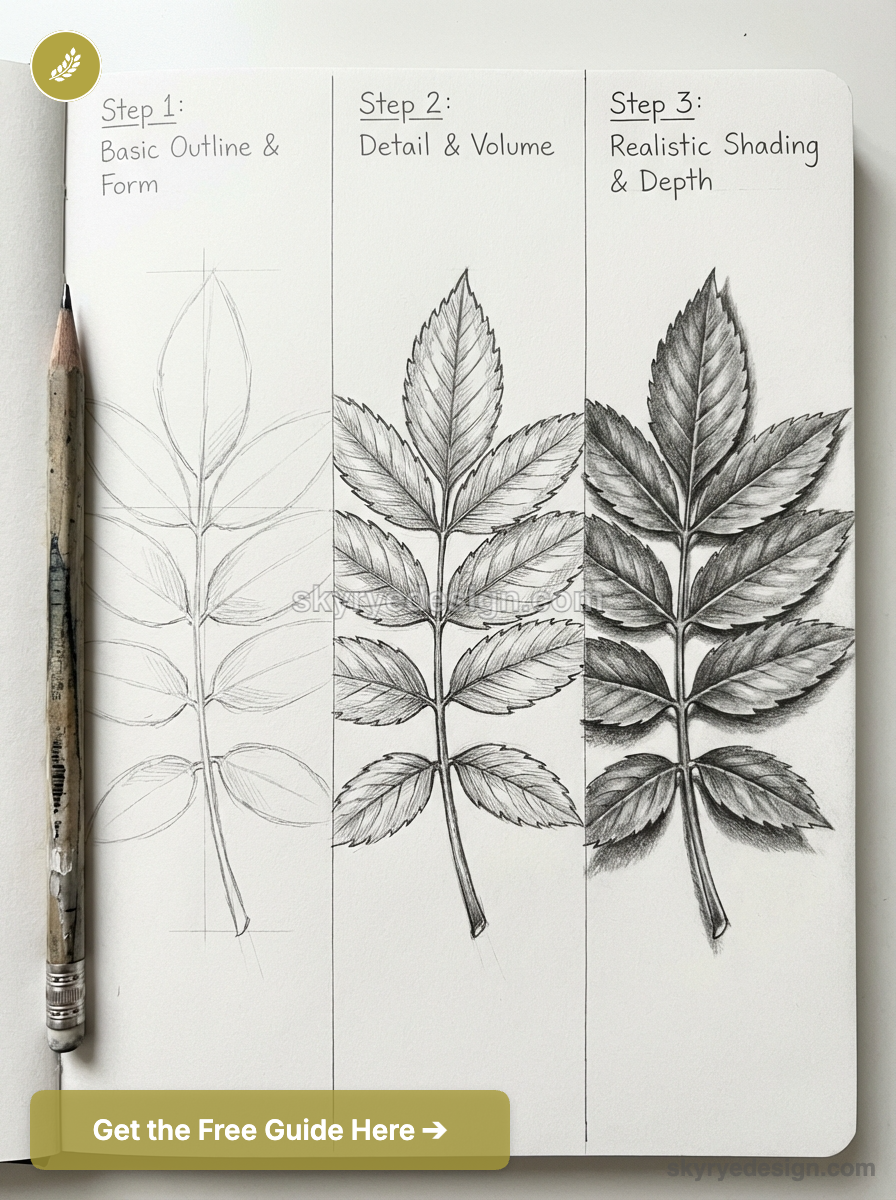
The key construction insight: each leaflet is a small simple leaf with its own midrib and vein structure, and the leaflets decrease in size from the base of the rachis toward the tip. Draw the rachis first (it’s the equivalent of the midrib in a simple leaf), then attach leaflets with a slight angle variation — they don’t all point in exactly the same direction. The leaflets are not perfectly identical; vary their size and the angle of their attachment.
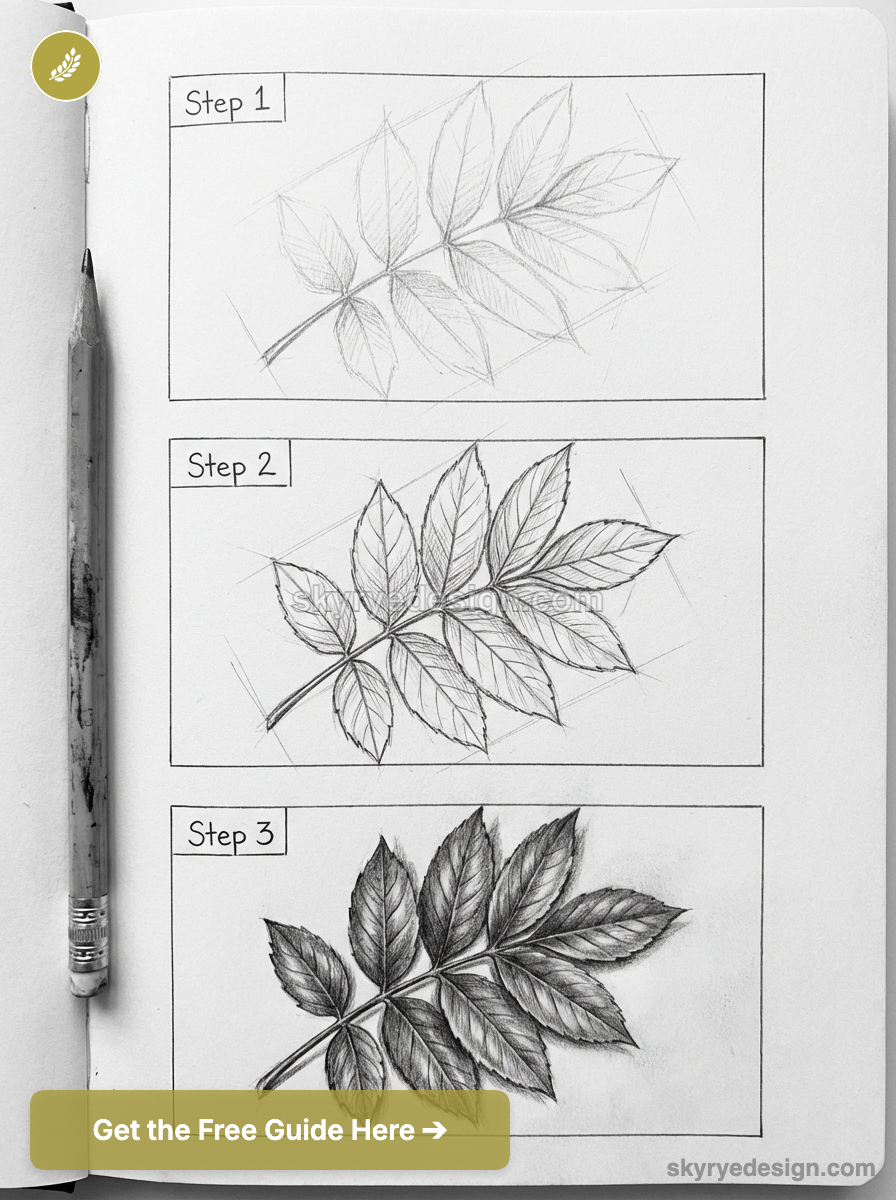
✏ Pro tip: Compound leaves are excellent practice for drawing convincing variety within repetition. The challenge is making ten leaflets read as distinct individual shapes while also reading as a coherent unit. Vary the angle of each leaflet’s attachment by 5–10 degrees, and vary the size by about 15–20% across the length of the rachis. These small variations produce natural-looking variety without making the leaf look chaotic.
Three Leaf Drawing Styles to Develop
Botanical Illustration
Botanical illustration prioritises accuracy, precision, and scientific completeness. The standard: a single specimen drawn in natural orientation with all identifying features visible — apex, base, margin type, vein hierarchy, surface texture, petiole.
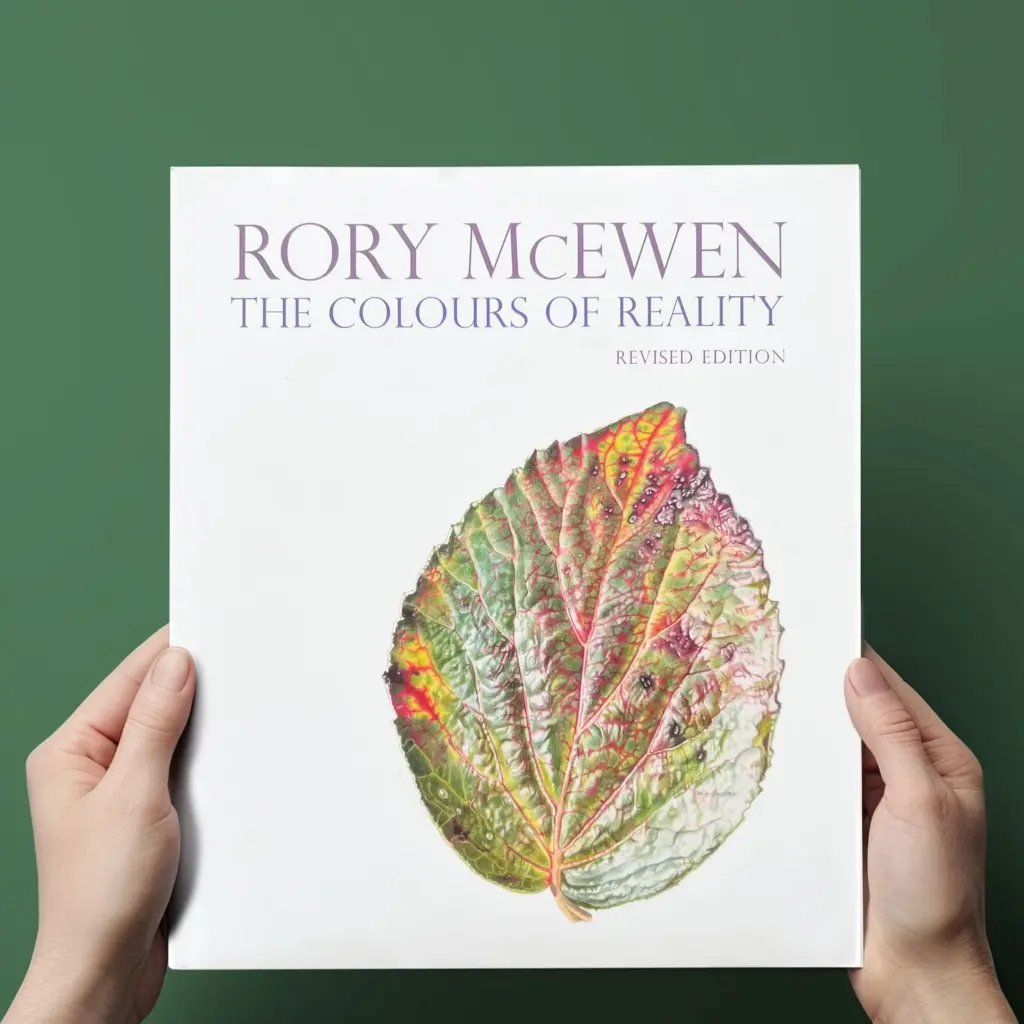
Reference is essential and non-negotiable: either a fresh specimen or a high-resolution photograph. Line quality is the primary expressive element; colour, if used, is applied as flat, accurate washes without artistic interpretation. The recommended tool progression: HB pencil construction → 0.3mm fineliner for all final lines → Faber-Castell Polychromos for colour. Botanical illustrators like Rory McEwen and the artists of the Flora Graeca (1806–1840) are worth studying for the standard of observation and line quality this approach demands.
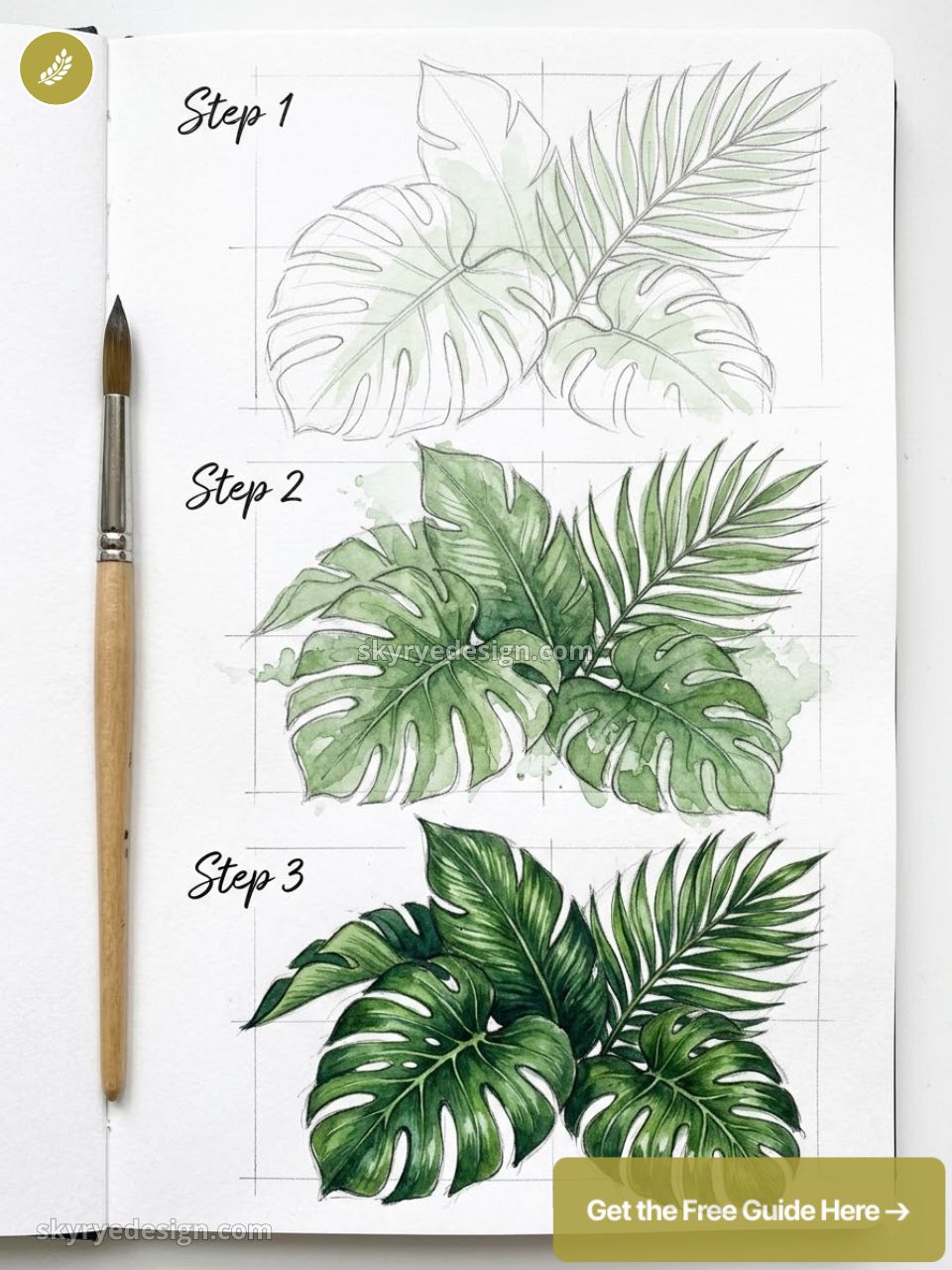
Sketchbook / Observational
Observational leaf drawing prioritises speed, immediacy, and the record of a specific moment of looking.
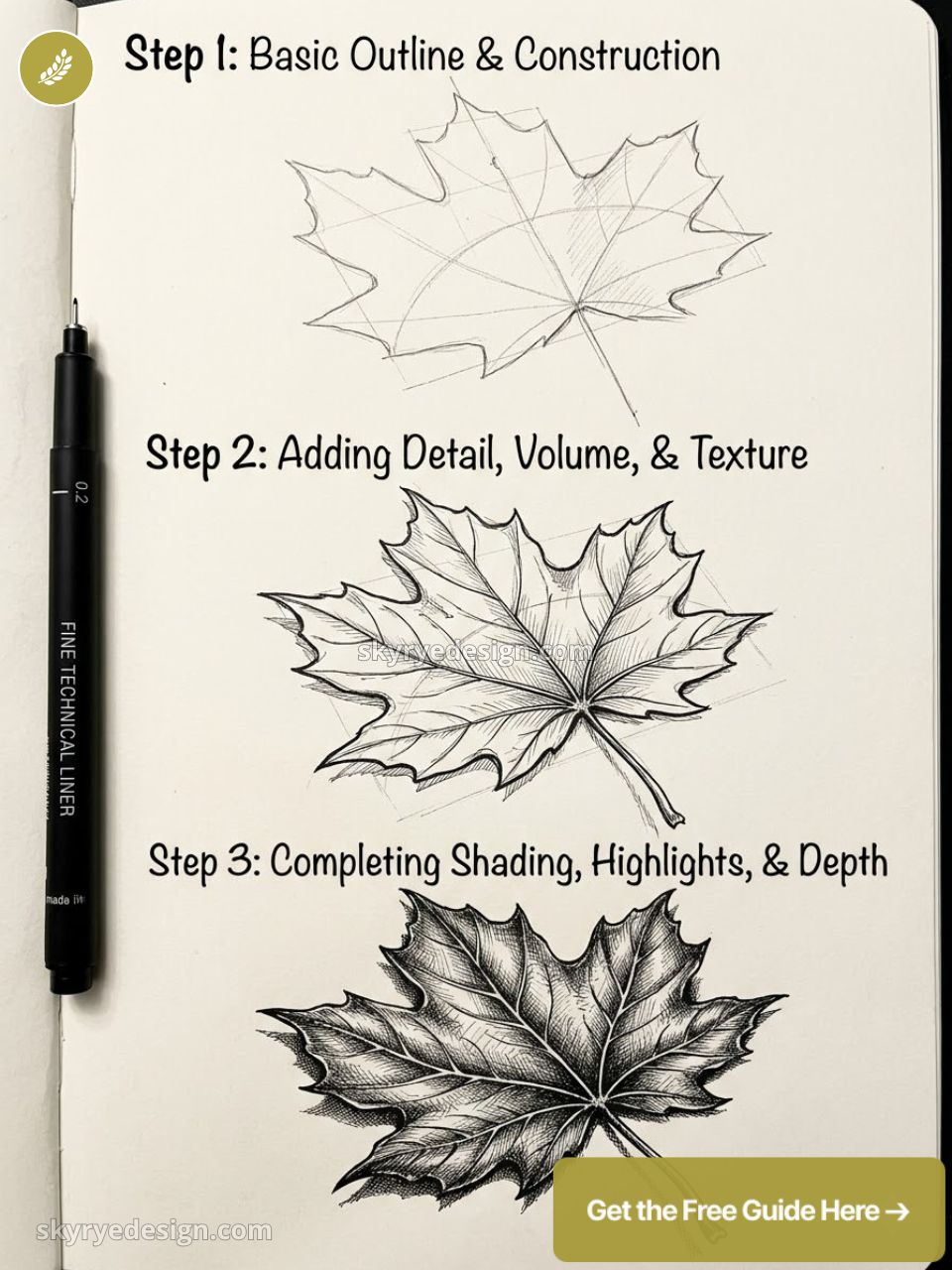
The goal is not scientific completeness but capturing the particular quality of a specific leaf — its current state of curl, its damage marks, its autumn colour patches.
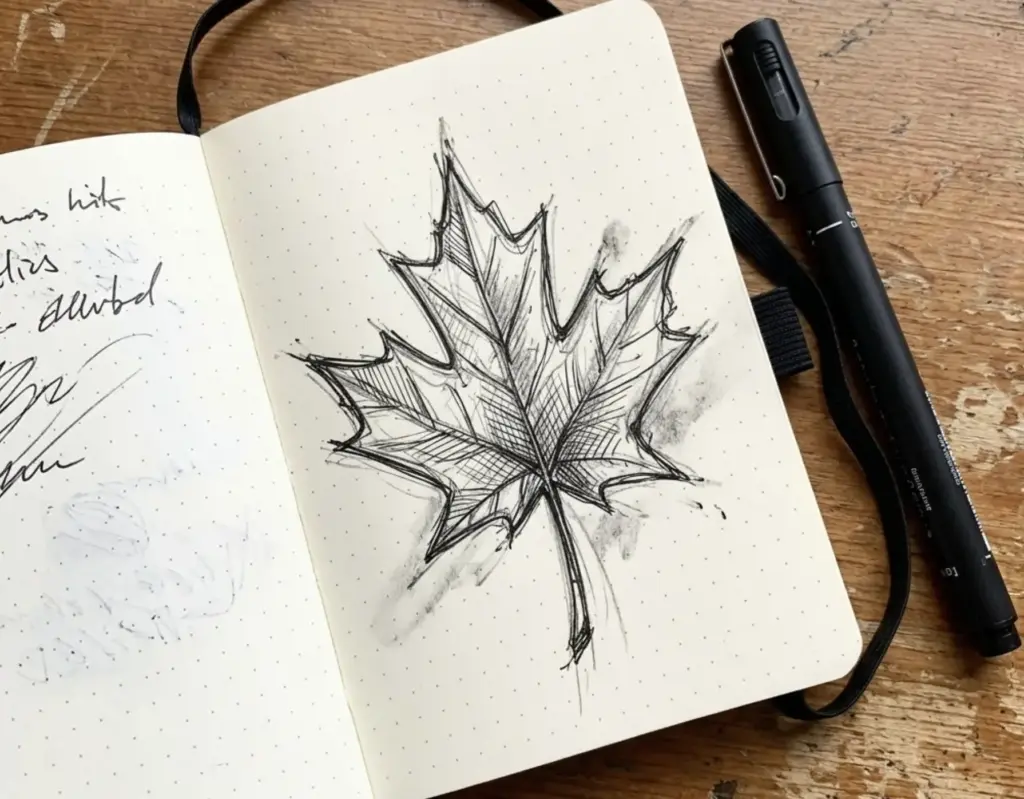
This style encourages variation in line weight and tone, some areas worked up in detail, and others suggested with minimal marks. Carry a small Moleskine or Leuchtturm sketchbook (both ~$20) and a single pencil — the constraints of one medium and limited time improve observational drawing faster than any technique exercise.
Stylised / Pattern
Stylised leaf drawing removes the concern for botanical accuracy in favour of decorative impact. The leaf shape becomes a graphic unit — simplified to its essential silhouette, repeated, rotated, and combined with other elements.
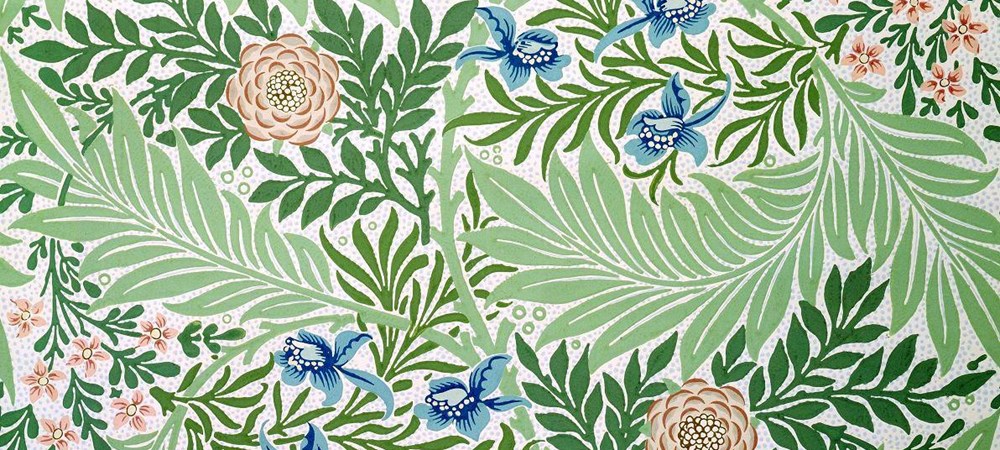
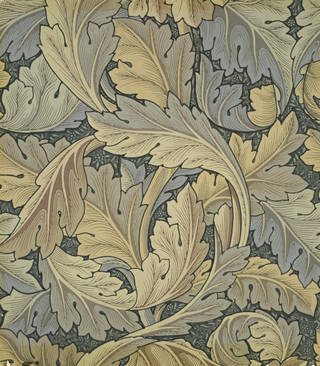
Japanese textile patterns and William Morris’s designs (his Acanthus wallpaper of 1875 is a masterclass in stylised botanical drawing) show how botanical forms can be abstracted while retaining their essential organic quality. The key technique: draw the most reductive version of the leaf that still reads as the specific type (oak reads as oak even with simplified lobes and no secondary veins), then use that simplified unit as the building block for the pattern.
5 Leaf Drawing Mistakes (and Their Fixes)
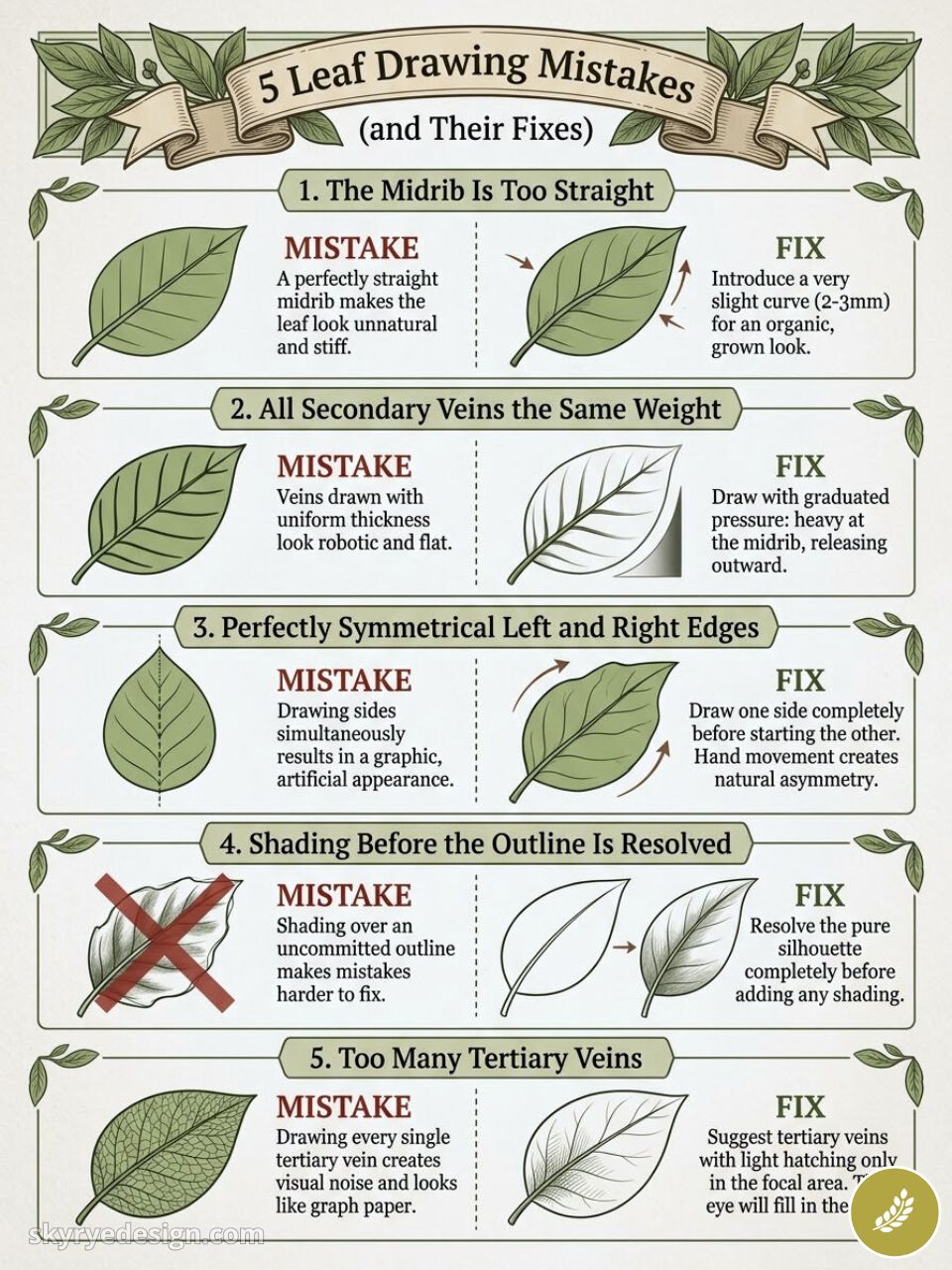
1. The Midrib Is Too Straight
A perfectly straight midrib makes the leaf look like it was cut from paper rather than grown. Every real leaf midrib has a very slight curve — even apparently flat leaves have this. Fix: after drawing the midrib, deliberately introduce a 2–3mm curve before drawing anything else. This single change makes the whole leaf read as organic.
2. All Secondary Veins the Same Weight
Veins drawn at uniform weight look like they were ruled with a technical pen rather than observed from a specimen. Real secondary veins taper as they extend toward the margin — thicker at the midrib junction, thinning to nearly invisible at the edge. Fix: draw each secondary vein with graduated pressure, heavy at the midrib and releasing pressure progressively as you move outward. This single technique makes vein drawings look immediately more natural.
3. Perfectly Symmetrical Left and Right Edges
Drawing the left and right sides of a leaf simultaneously and symmetrically produces a flat, graphic result. Fix: draw one side completely before starting the other. The natural variation in your hand movements will introduce the slight asymmetry that makes the leaf read as real.
4. Shading Before the Outline Is Resolved
Adding shading to a leaf with an incorrect or unresolved outline is the most common way to create a drawing you can’t fix — the shading visually commits the wrong outline. Fix: the leaf should be completely convincing in pure outline before any shading is applied. Hold the drawing at arm’s length. If the silhouette doesn’t read correctly from a distance, fix the outline first.
5. Too Many Tertiary Veins
Beginners who observe real leaves carefully sometimes overcorrect by drawing every visible tertiary vein across the entire leaf surface. The result is a leaf that looks like graph paper — the fine vein network becomes visual noise. Fix: draw tertiary veins only in the focal area of the drawing (typically the area nearest the viewer), and suggest them with very light hatching rather than drawn individual lines everywhere else. The eye fills in the network; you don’t need to draw every junction.
Resources Worth Having
- ‘Drawing Nature’ by Stanley Maltzman (~$18) — the clearest approach to observational botanical drawing in print. Strong on leaf construction and the translation from observation to pencil.
- Faber-Castell Polychromos 12-colour pencil set (~$35) — the minimum useful colour set for botanical leaf work. Oil-based, layer cleanly without waxing out, available individually for precise species-accurate colours.
- Royal Botanic Gardens Kew — kew.org botanical illustrations — the world’s largest collection of published botanical illustration, accessible online. Use as reference standard for leaf anatomy and rendering quality.
- Procreate with Kyle Webster Gouache brushes (~$13 for app, brushes free) — for digital leaf drawing. The Gouache brushes replicate the layering quality of coloured pencil work with easier colour correction.
- iNaturalist app (free) — photograph any leaf and identify the species. Gives you the correct botanical name, which links to reference specimens and illustrations. Indispensable for accurate species-specific drawing.
The Leaf Is a Good Teacher
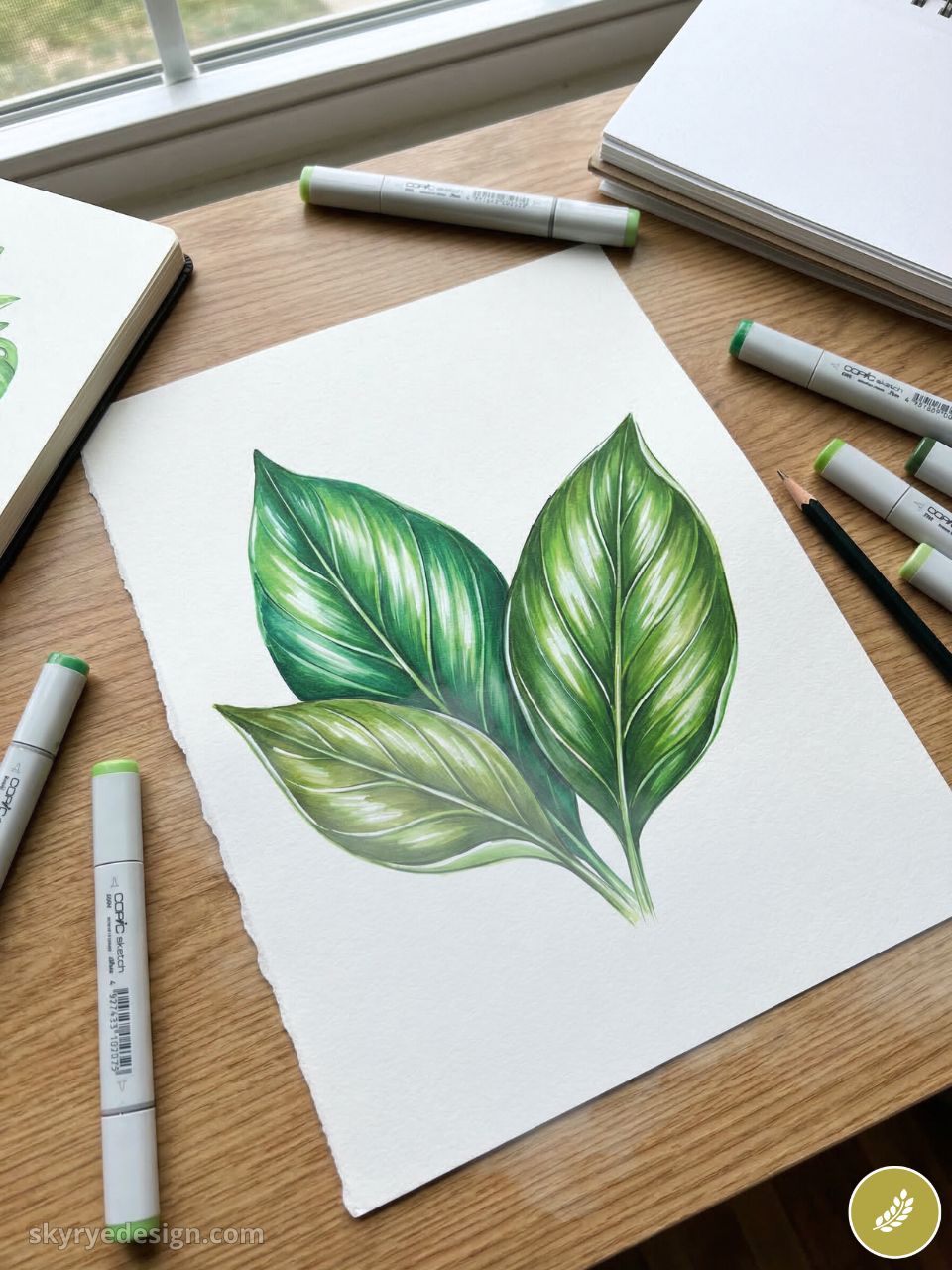
The oak leaf that looked like a hand grenade was, in retrospect, one of the most useful failures I’ve had at a drawing desk. It forced me to look at a leaf I’d seen ten thousand times as if seeing it for the first time — to notice the midrib’s slight curve, the lobe size variation, the way the secondary veins extend directly into each lobe tip, the controlled irregularity of the serration.
That quality of looking is the skill that leaf drawing develops, and it transfers to everything else you draw. A subject that appears simple — just a shape with some lines inside — turns out to be full of structural logic and controlled irregularity. Learning to draw it correctly means learning to see it correctly. And once you can see it, you can draw it from memory, from imagination, or from a reference you’ve never used before.
Start with the midrib. Make it curve slightly. Draw one side before the other. The leaf will tell you the rest.
FAQ: Leaf Drawing
Q: How do you draw a simple leaf for beginners?
Start with the midrib — a single slightly curved line from the base to the tip. Mark the widest point of the leaf on this line. Sketch a rough silhouette around these guides, then refine it with the specific margin type (smooth, serrated, or lobed). Add secondary veins branching from the midrib with graduated pressure — thick at the midrib junction, thinning toward the margin. The full five-step process in this guide covers each stage with specific pencil grades and techniques for building a convincing result rather than just a leaf shape.
Q: What pencils do you need for leaf drawing?
HB for all construction lines and the initial midrib (light pressure). 2B for the confirmed outline, secondary veins, and lighter shading. 4B for the deepest shadow areas — vein channels, fold shadows, and lobe undersides. A kneaded eraser (Faber-Castell, ~$3) is essential for lifting construction marks and pressing into 2B shading to create highlights on waxy leaves. For paper: Canson XL or Strathmore Bristol at 100–120gsm. For botanical colour work: Faber-Castell Polychromos oil-based pencils (~$3–4 each) layer smoothly without waxing out.
Q: How do you draw realistic leaf veins?
The key is vein hierarchy and graduated pressure. Draw the midrib first with your 2B — slightly thicker at the base, thinning slightly toward the apex. Secondary veins branch from the midrib at consistent angles (45–60 degrees for most pinnate leaves), tapering from thick at the midrib junction to very fine at the margin. Use graduated pressure on each stroke: press firmly at the start, release progressively as you move outward. Draw only secondary veins completely; suggest tertiary veins with very light hatching in focal areas only. All-same-weight veins look mechanical; graduated veins look grown.
Q: How do you make leaf drawings look realistic?
Four things produce realistic leaf drawings. First: controlled asymmetry — the left and right sides of the leaf should be similar but not identical; draw one side before the other to let natural hand variation introduce this. Second: graduated vein lines — thick at the midrib junction, thinning toward the margin. Third: margin-specific edge detail — serration, lobing, or crenation drawn with slight variation in each tooth or lobe rather than mechanically even. Fourth: shading that separates form from surface quality — soft gradients for matte leaves, harder transitions and kneaded-eraser highlights for waxy ones.
Q: What’s the difference between botanical illustration and sketching leaves?
Botanical illustration prioritises scientific accuracy: a single specimen drawn with all identifying features visible, from a fresh specimen or high-resolution reference, with accurate colour and precise line quality. Observational sketchbook drawing prioritises speed, immediacy, and the particular character of a specific leaf at a specific moment — its curl, damage, or autumn colour. The tools and intent differ significantly. Botanical illustration uses a 0.3mm fineliner and Faber-Castell Polychromos in a disciplined sequence; sketchbook drawing uses whatever pencil is to hand and captures the impression quickly. Both are valuable and each develops different aspects of observation skill.
Q: What are the main types of leaf shapes?
The most commonly drawn leaf shapes are: ovate (egg-shaped, widest below the midpoint — oak, cherry), lanceolate (long and narrow, like a lance tip — willow, eucalyptus), elliptic (oval, widest at the midpoint — magnolia, rhododendron), cordate (heart-shaped with a notched base — linden, catalpa), palmate (multiple primary veins radiating from the base, like fingers — maple, geranium), and linear (very long and narrow with parallel margins — grass, iris). Each shape has a different construction starting point and a different vein architecture. The ovate shape is the most useful starting point for beginners because it isolates the core construction skills clearly.
- 1.8Kshares
- Facebook0
- Pinterest1.8K
- Twitter3
- Reddit0