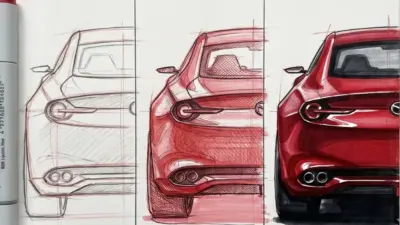
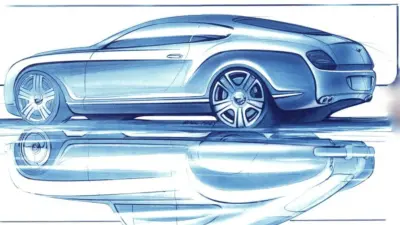
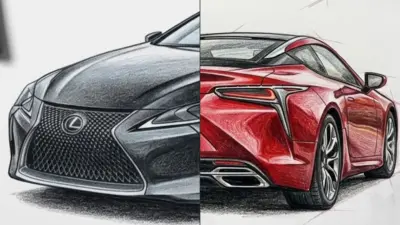
My first Aston Martin drawing looked exactly like every other sports car I’d drawn — long, low, vaguely fast-looking, completely generic. The proportions were reasonable. The wheels were approximately the right size. The roofline swept. It could have been a Jaguar or a Ferrari or something entirely fictional. Nothing about it said Aston Martin.
- The Four Design Elements That Make Every Aston Martin Recognisable
- How to Draw an Aston Martin: Step-by-Step Construction
- 10 Aston Martin Models: Drawing Challenges and Specific Proportions
- 01 — Aston Martin DB5 (1963–1965)
- 02 — Aston Martin DB9 (2004–2016)
- 03 — Aston Martin DB11 (2016–present)
- 04 — Aston Martin DB12 (2023–present)
- 05 — Aston Martin Vantage (2018–present)
- 06 — Aston Martin DBS Superleggera (2018–2022)
- 07 — Aston Martin Rapide (2010–2020)
- 08 — Aston Martin One-77 (2009–2012)
- 09 — Aston Martin Valkyrie (2021–present)
- 10 — Aston Martin DBX (2020–present)
- Rendering Metallic Surfaces: How to Make It Look Like a Car
- Materials for Car Sketching
- FAQ: How to Draw an Aston Martin
The problem was that I’d been drawing a sports car rather than a specific car. I’d learned to construct a generic automotive form — bounding box, wheel placement, roofline — without understanding what makes Aston Martin’s design language distinct from every other manufacturer’s. Once I understood that — the specific proportions of the bonnet, the precise character of the oval grille, the particular tension in the shoulderline — the drawings started reading as Aston Martins immediately, even in rough construction stage.
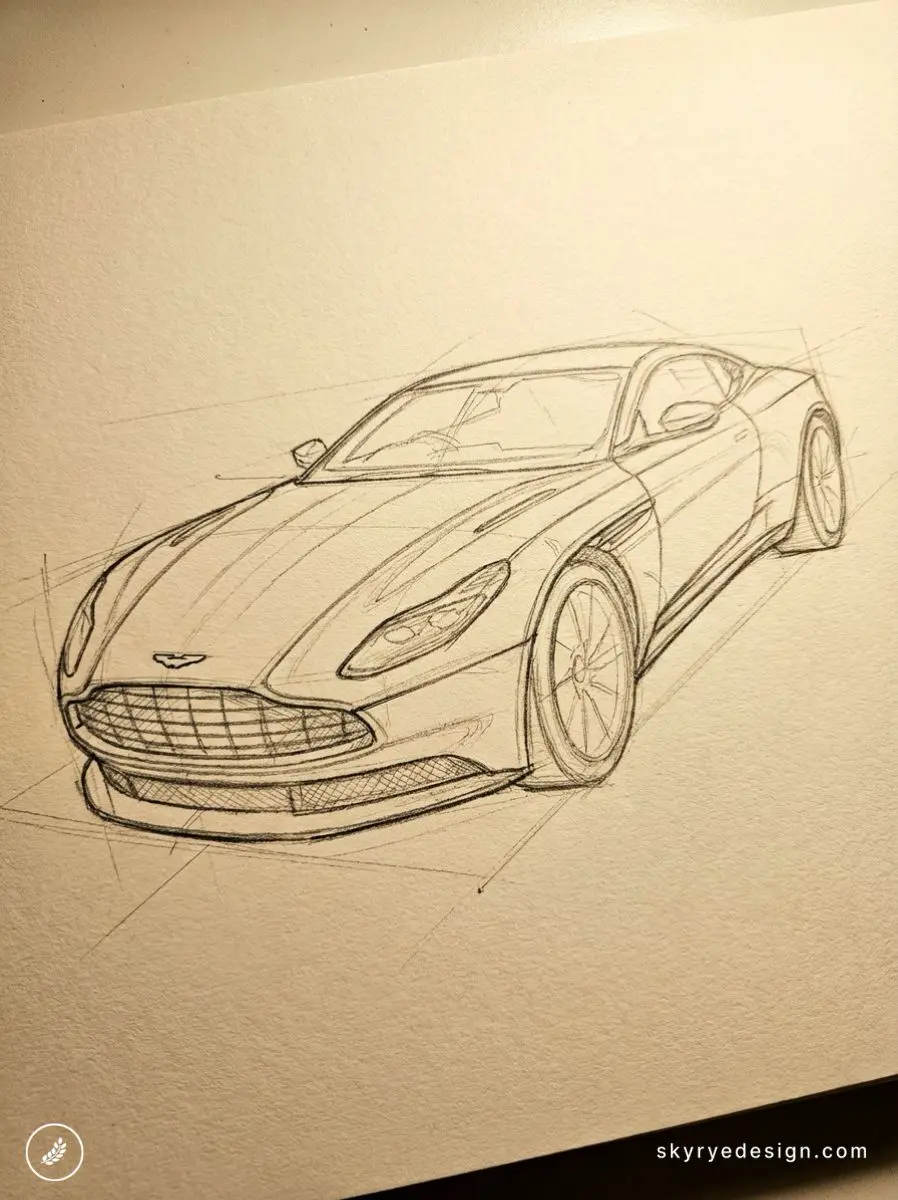
This guide covers the design language first, because that’s what makes the difference. Then a step-by-step construction process. Then ten specific models — from the DB5 to the Valkyrie — with the particular drawing challenge each one presents. By the end, you’ll be able to look at any Aston Martin and immediately identify the proportional relationships and surface characteristics that define it.
The Four Design Elements That Make Every Aston Martin Recognisable
Before touching the pencil, understand what you’re drawing. Aston Martin has maintained one of the most consistent design languages of any automotive manufacturer — the core visual elements that defined the DB4 in 1958 are still present in the DB12 today, evolved but unmistakable. Get these four elements right and the car reads as an Aston Martin at any level of finish. Miss any one of them and it doesn’t.
1. The Long Bonnet — The Proportion That Defines Everything
Aston Martin bonnets are proportionally longer than almost any other production car. The bonnet — the area from the front of the car to the base of the windscreen — occupies approximately 40% of the total car length on most models. For reference, a typical modern hatchback has a bonnet occupying roughly 25-30% of car length. This extended bonnet is what gives Aston Martins their sense of power — the engine is pushed far back, the cabin is far rearward, and the nose stretches ahead with the particular combination of elegance and menace that defines the brand.
In your construction sketch, establish the bonnet length before anything else. Draw a horizontal centre line for the car’s full length, then mark the 40% point — that’s where the windscreen base sits. Everything forward of that line is bonnet; everything rearward is cabin and tail. If the cabin occupies more than 60% of the car, the drawing will never read as an Aston Martin regardless of how well you render the details.
2. The Oval Grille — The Brand’s Face
The Aston Martin grille is a tall, vertically oriented oval — not circular, not rectangular, not trapezoidal. It is taller than it is wide, with a specific curvature: slightly flatter at the top than at the bottom, which gives it an asymmetric quality that reads as purposeful rather than geometric. The grille sits high on the front face — occupying the upper half of the nose section rather than being positioned low and wide like a more aggressive sports car grille.
The interior of the grille has a mesh or vertical slat pattern depending on the era and model. For sketching purposes, represent this as a series of thin vertical lines or a simple cross-hatch — the specific pattern matters less than getting the overall oval shape and its position on the front face correct. The grille is the car’s most recognisable feature. Drawing it accurately is more important than any other single element.
3. The Continuous Shoulderline — The Car’s Tension
A shoulderline (also called a character line) is a crease or ridge in the bodywork that runs along the side of the car. Aston Martin’s shoulderline is a single, unbroken line that begins at the top of the front wheel arch and runs continuously to the rear of the car, rising very slightly as it travels rearward. It separates the upper body surface (which curves toward the roof) from the lower body surface (which curves toward the sill), and it’s what gives the car’s flanks their sense of controlled tension — the surface above it reflects light differently from the surface below it.
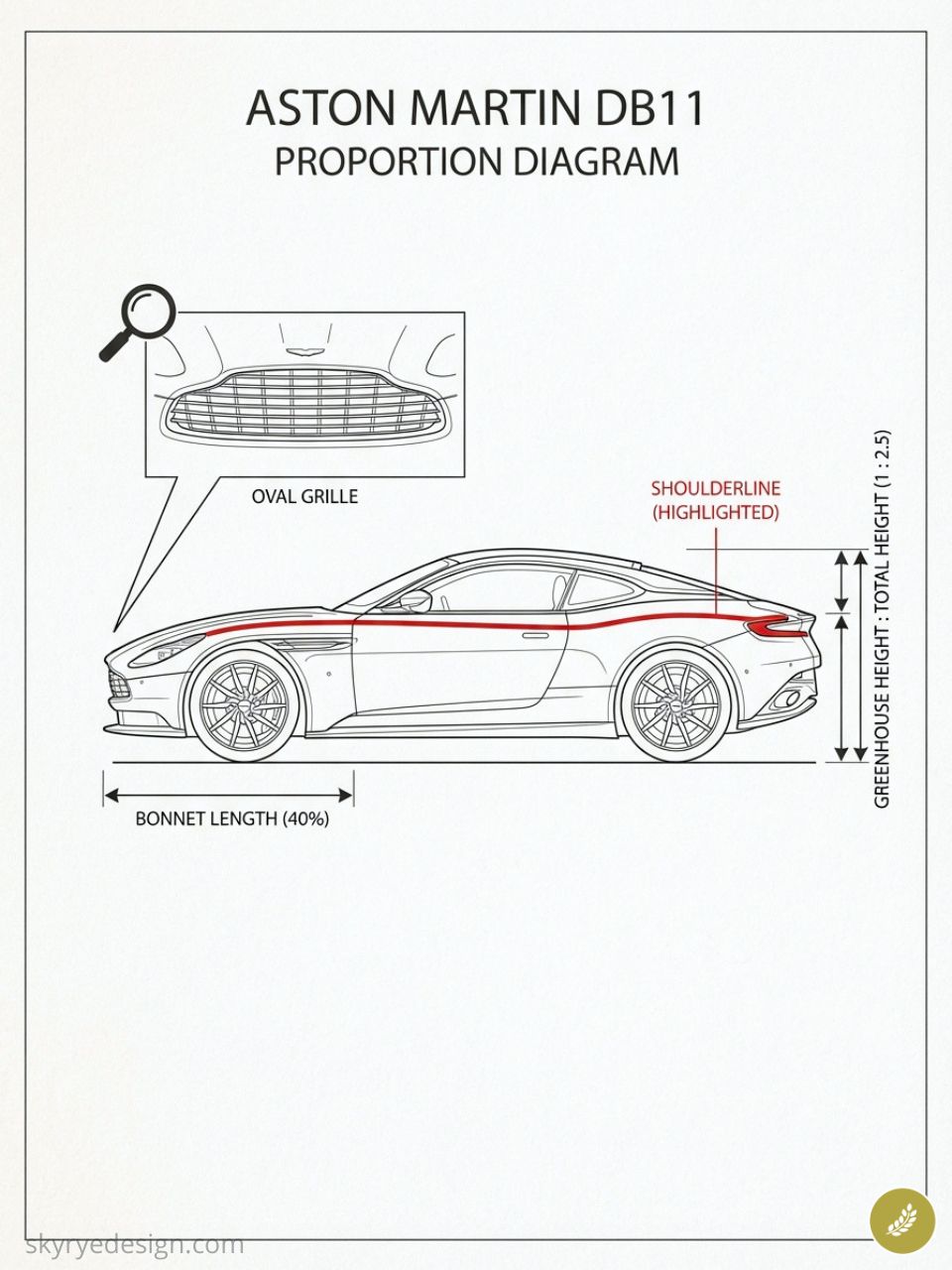
In a side-profile sketch, this line is the most important single mark after the bounding box and wheel placement. Draw it as a single confident, slightly upward-sweeping line from front arch to rear. It should be slightly above the midpoint of the door height — not at the equator of the car but in the upper third of the door surface.
4. The Compact Greenhouse — The Low, Predatory Roofline
The greenhouse — the glass area above the body — is deliberately small relative to the body on every Aston Martin model. This is a proportion decision as much as an aesthetic one: a smaller greenhouse means a lower roofline, which means the car appears lower and faster. The ratio of greenhouse height to overall car height on a DB11 is approximately 1:2.5 — the glass area occupies roughly 40% of the car’s total height, with the body occupying the remaining 60%. Compare this to a typical family saloon where the greenhouse occupies closer to 50% of the height.
✏ Drawing note: The fastest way to check your Aston Martin proportions at any stage: draw a rectangle that exactly contains the car (touching the front, rear, top, and bottom simultaneously). The car should fit inside a rectangle that is approximately 2.5 times as wide as it is tall. If it’s shorter and squarer — more like 2:1 — the bonnet isn’t long enough or the roofline is too high. If it’s longer and flatter than 2.5:1, you’ve over-extended the body. This bounding box ratio check catches proportion errors immediately.
How to Draw an Aston Martin: Step-by-Step Construction
This process uses the DB11 as the construction model — the clearest expression of the current Aston Martin design language. Once you can draw the DB11 convincingly, the proportion logic transfers to every other model.
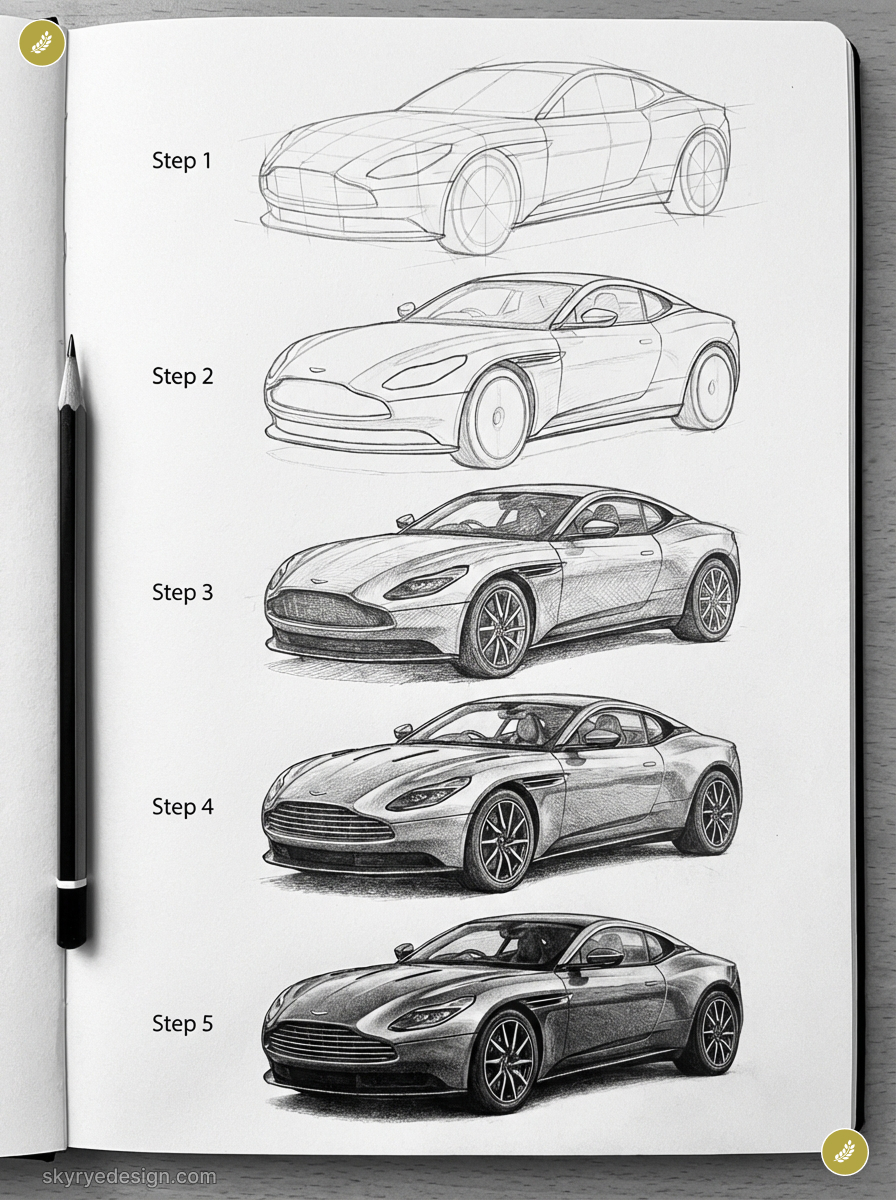
- Bounding box first. Draw a horizontal rectangle 2.5 times as wide as it is tall. This is your total car envelope. Mark a vertical centre line. Mark the 40% point from the left — this is the windscreen base. Mark the 20% and 75% points — these are the front and rear wheel centres.
- Wheel circles. Draw circles at your 20% and 75% points. The wheel diameter should be approximately equal to the height of the door panel — roughly 27-30% of total car height. These are the most important proportion markers in the drawing. Get the wheel size right before anything else.
- Roofline and greenhouse. From the 40% windscreen base, draw the roofline rising to its peak at approximately 55% of total length (slightly behind the midpoint). The greenhouse should be visibly compact — the roof peak sitting at approximately 90% of the car’s total height, leaving the remaining 10% as glass above the door belt-line.
- Body profile. Draw the bonnet surface from the front of the car to the windscreen base — it rises very slightly from front to rear, giving the hood a subtle wedge quality. The rear deck falls gently from the roofline to the rear of the car. The sill line (bottom of the body, above the wheels) is straight and nearly horizontal.
- Front face and oval grille. The front face is not vertical but raked slightly rearward. Draw the oval grille in the upper half of the front face — taller than wide, flat at top, more curved at bottom. The grille should occupy approximately 35-40% of the front face width and 50-60% of its height.
- The shoulderline. Draw a single line from the top of the front wheel arch to the rear of the car, rising very slightly. This line should sit in the upper third of the door surface. This is the most important mark in the side-profile drawing.
- Wheel arches. Draw smooth curves above each wheel, with the arch top approximately 5-10mm above the tyre in your scale. The front arch is slightly more angular than the rear arch on most Aston Martin models.
- Windows and details. The windscreen angle is steep — close to 60 degrees from vertical on the DB11. The side windows are long and narrow. Add the door shut line, wing mirrors, headlights (slim and sharp, integrated into the front corners), and rear lights (horizontal LED signatures). Erase construction lines.
- Shade and render. The brightest surface area on a metallic car is always the upper body surface catching sky light. The shoulderline creates a highlight strip. Below the shoulderline, the surface turns away and becomes darker. The deepest shadows are in the wheel arch interior and beneath the car. Use a graduated tone from light above the shoulderline to dark below it.
✏ Drawing note: The most common Aston Martin drawing mistake — beyond proportion errors — is placing the headlights too high and too prominent. Aston Martin headlights are slim, low, and integrated into the front corners rather than being large circular or rectangular units. They should feel like a detail, not a feature. If your headlights are dominating the front face, they’re too big. Reduce them by approximately half and reposition them lower on the front corner.
10 Aston Martin Models: Drawing Challenges and Specific Proportions
01 — Aston Martin DB5 (1963–1965)
Design signature: The quintessential Aston Martin — round headlights in chrome bezels, vertical front grille with fine chrome slats, chrome bumpers, elegant fastback roofline. The Bond car. Every proportion is balanced — no single element dominates.
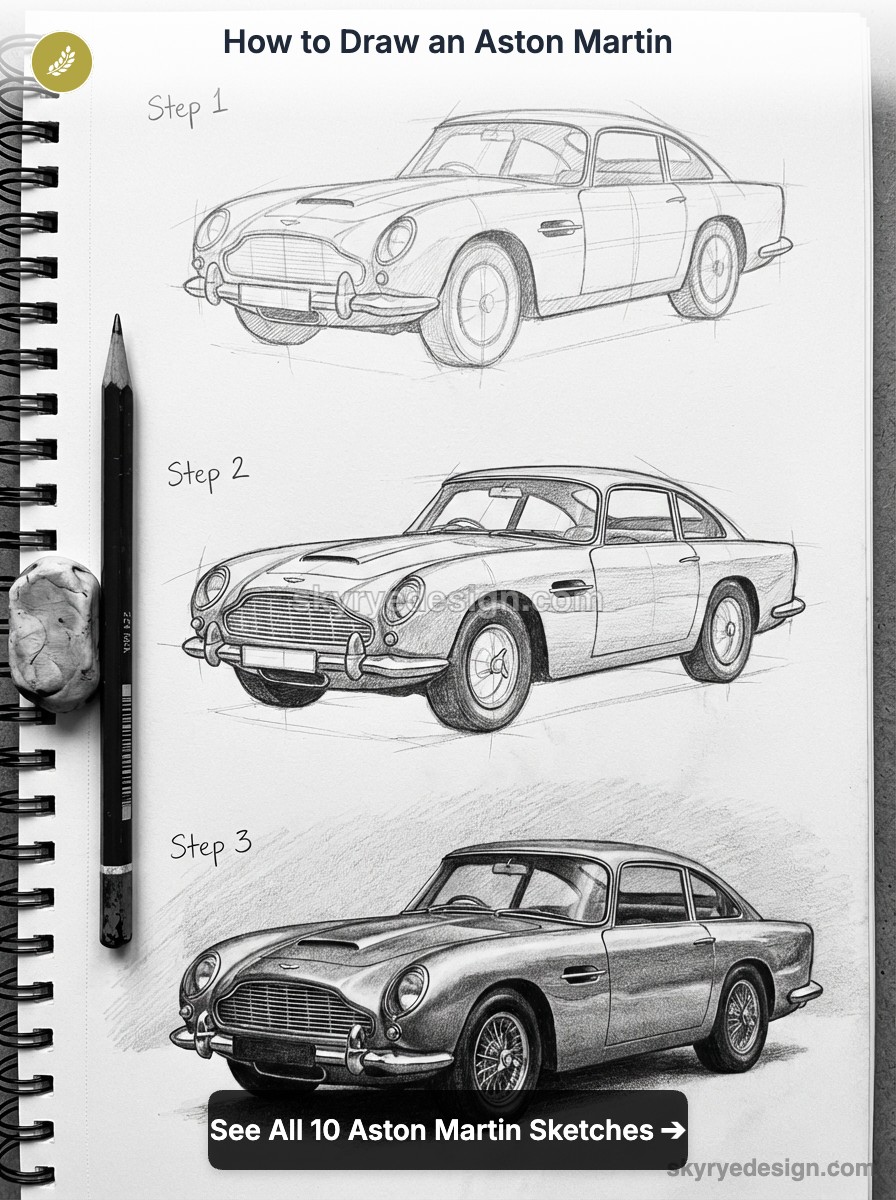
Drawing challenge: The round headlights. They sit in the front corners as prominent circles — getting their size (relatively large for a sports car of this era) and their position (sitting high in the front corner, almost at the apex of the front wing) is the primary challenge. Too small and it reads as a generic 1960s GT; the correct size makes it instantly the DB5.
Key proportions: Length-to-height ratio approximately 2.3:1 — slightly squarer than the DB11. The roofline is higher relative to the body than modern models. Bonnet still long at 38% of total length. Rear overhang relatively generous for the era.
02 — Aston Martin DB9 (2004–2016)
Design signature: The design that established the modern Aston Martin language. The oval grille appears here in its current form. Side strakes behind the front wheels. Deeply sculpted side panels with muscular rear haunches. More athletic than the DB5 but less extreme than the One-77.
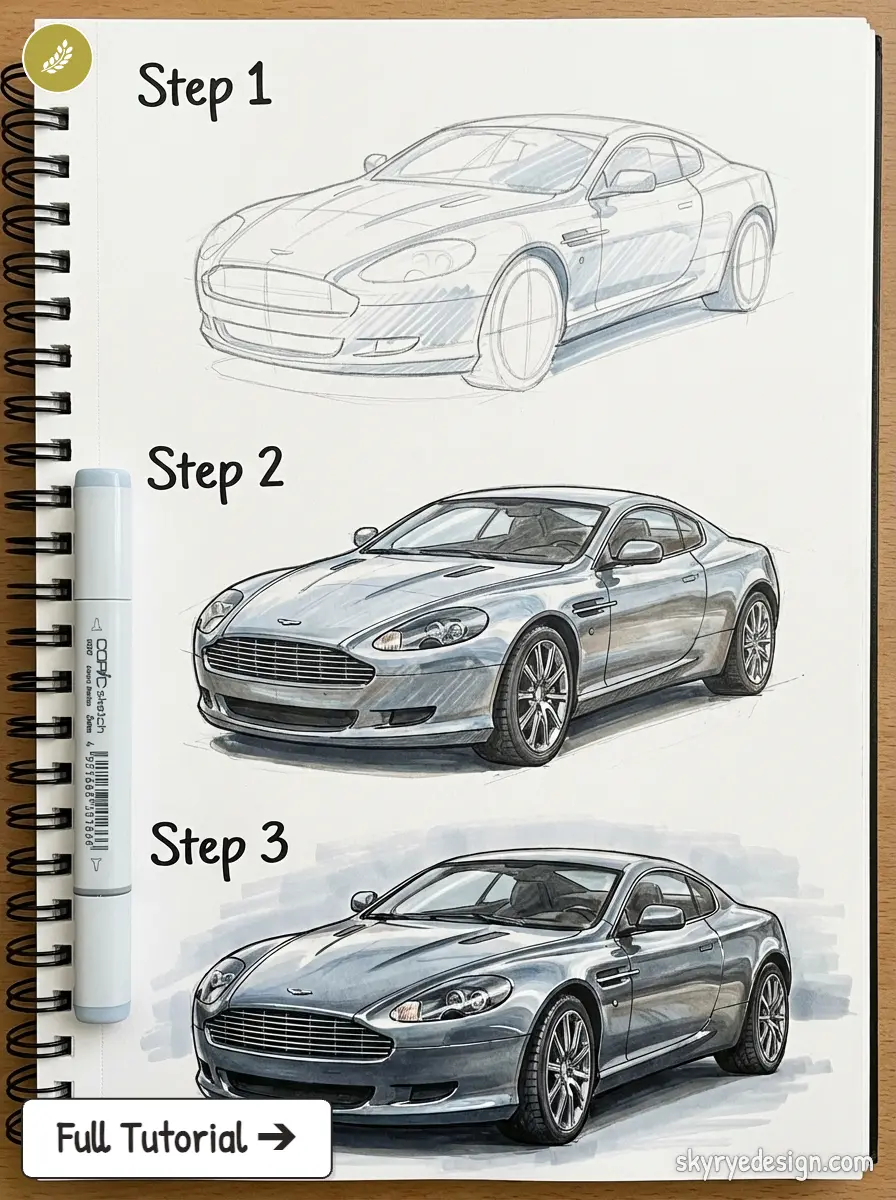
Drawing challenge: The rear haunches — the rear wheel arches flare outward significantly, creating a muscular swelling in the rear quarter that requires understanding how a surface can both curve outward (wider) and curve inward (lower) simultaneously. This three-dimensional surface quality is difficult to suggest convincingly in a two-dimensional side profile.
Key proportions: 2.5:1 length-to-height ratio. Bonnet 40% of length. Rear haunches create a visual widening of the rear quarter — the rear of the car appears slightly wider than the front in a three-quarter rear view.
03 — Aston Martin DB11 (2016–present)
Design signature: Current-generation GT grand tourer. Aeroblade technology — the rear of the bonnet incorporates a hidden duct that channels air through the car and exits via a slot at the tail, eliminating the need for a visible rear spoiler. Smoother, more refined surface treatment than the DB9.
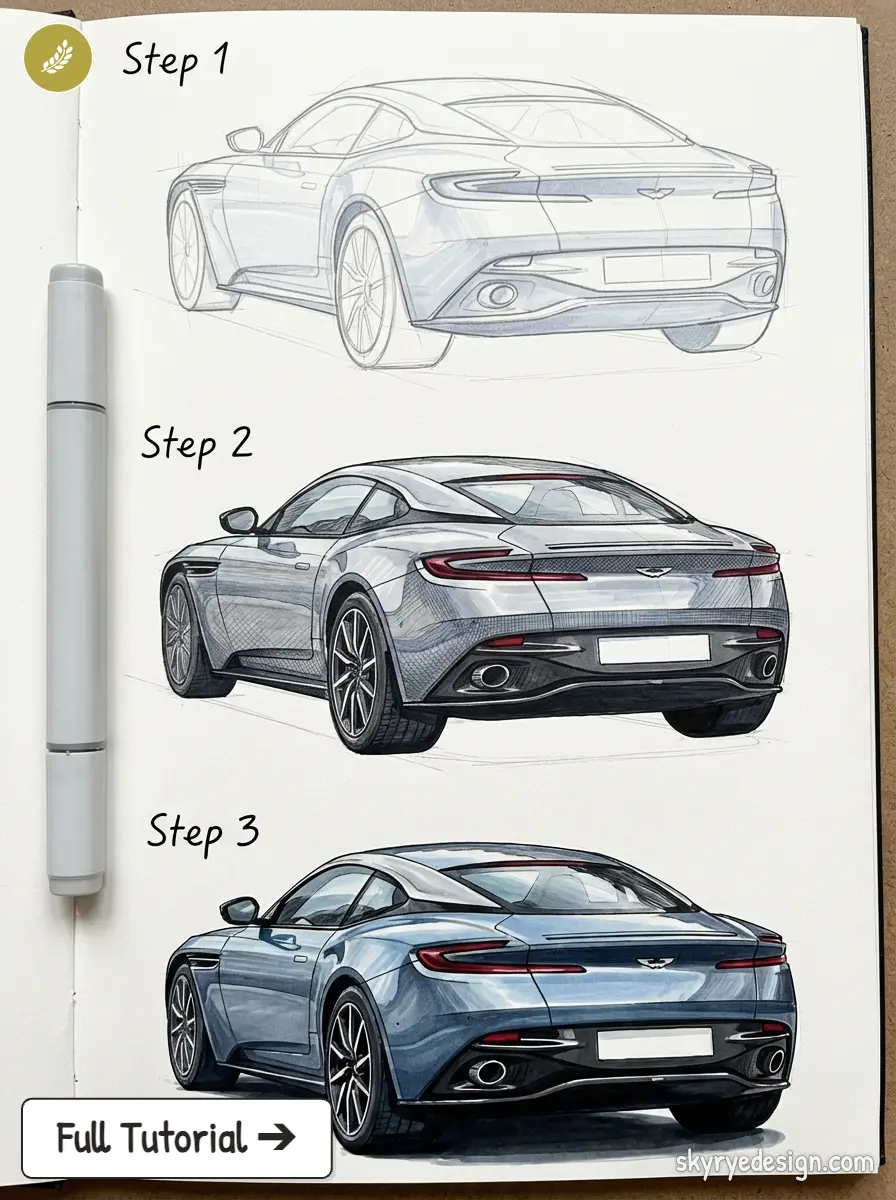
Drawing challenge: The Aeroblade exit — a thin horizontal slot at the tail end that looks like a shut line but isn’t. Getting this detail right (correctly scaled, precisely positioned just above the rear bumper) is what distinguishes a careful DB11 drawing from a generic Aston Martin sketch.
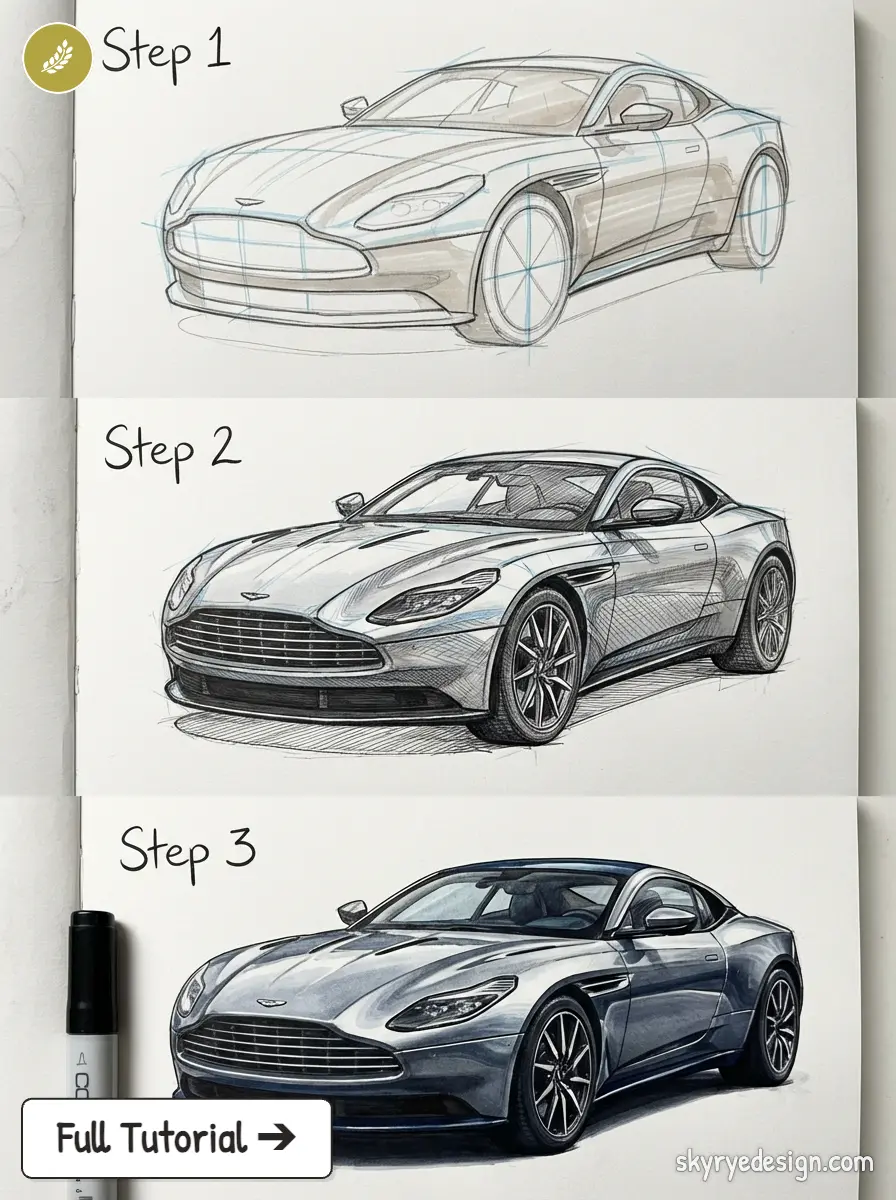
Key proportions: 2.5:1 bounding ratio. The bonnet surface has a subtle central peak (a power bulge that runs along the centreline). The side strakes behind the front wheels are present but more subtly integrated than the DB9.
04 — Aston Martin DB12 (2023–present)
Design signature: The current flagship GT, replacing the DB11. More aggressive front end with wider grille, sharper headlight signature, more defined rear diffuser. The proportions are similar to the DB11 but the surface tension is higher — crisper shut lines, more angular headlights, bolder character lines.
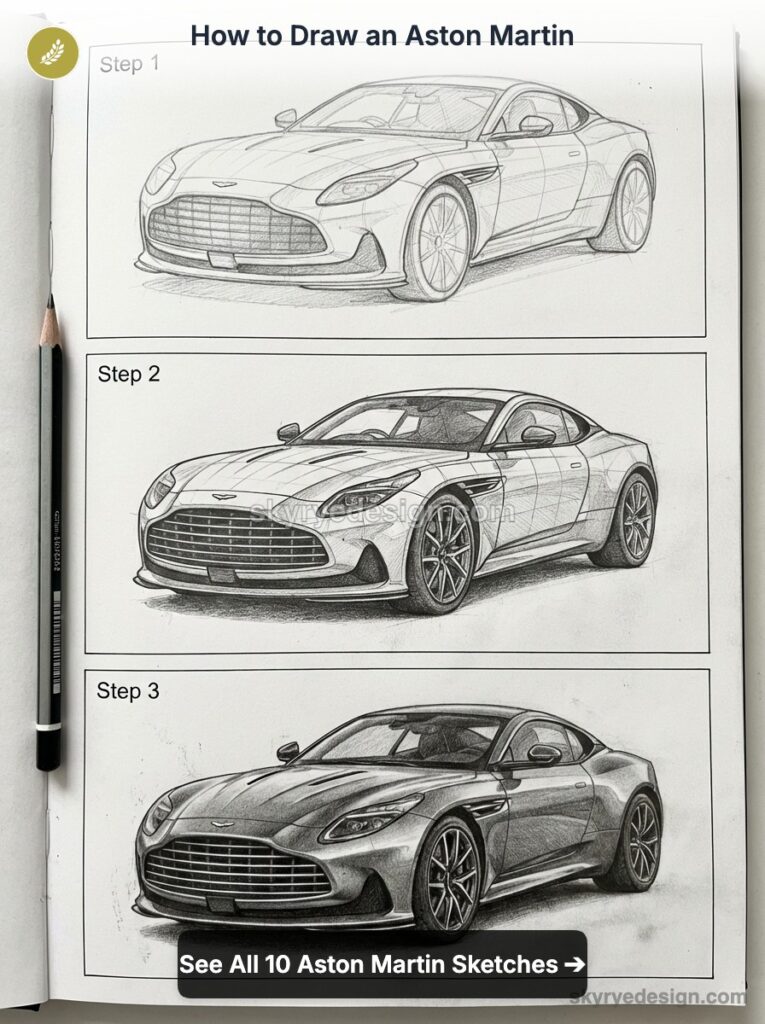
Drawing challenge: The headlight signature — the DB12 uses a specific LED daytime running light pattern that runs along the top of the headlight housing. Getting this light signature right (it curves specifically, not generically) is the detail that distinguishes a DB12 from a DB11 in a drawing.
Key proportions: Very similar to DB11 at 2.5:1. The front overhang is slightly shorter, making the front of the car feel more planted. The rear is wider at the tail than the DB11.
05 — Aston Martin Vantage (2018–present)
Design signature: Smaller, more aggressive than the DB range. The front grille is lower and wider relative to the car’s size — a more predatory face than the GT models. The bonnet has a more pronounced power bulge. The overall character is more sports car than grand tourer.
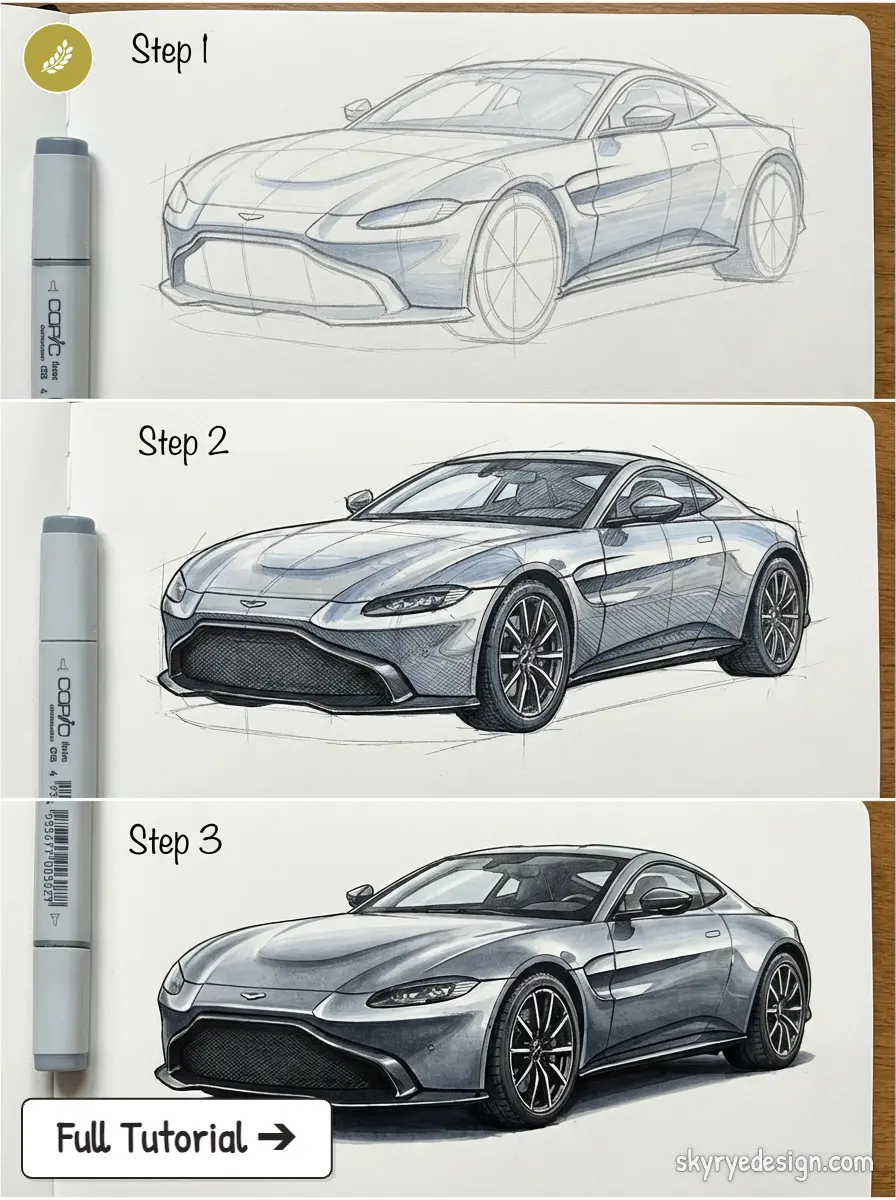
Drawing challenge: The front face proportion — the Vantage grille sits lower on the front face than the DB11, and the front splitter (the aerodynamic element at the very bottom of the nose) is more prominent. The relationship between grille, splitter, and hood leading edge is tighter and more aggressive than the DB11.
Key proportions: 2.4:1 length-to-height ratio — slightly squarer than the DB range, reflecting the shorter wheelbase. Bonnet power bulge more pronounced. Rear haunches more muscular relative to car size.
06 — Aston Martin DBS Superleggera (2018–2022)
Design signature: The top of the DB range — more powerful and more dramatically styled than the DB11. A prominent front splitter, large carbon fibre rear diffuser, and more visible aerodynamic elements give it a more purposeful appearance than the GT models.
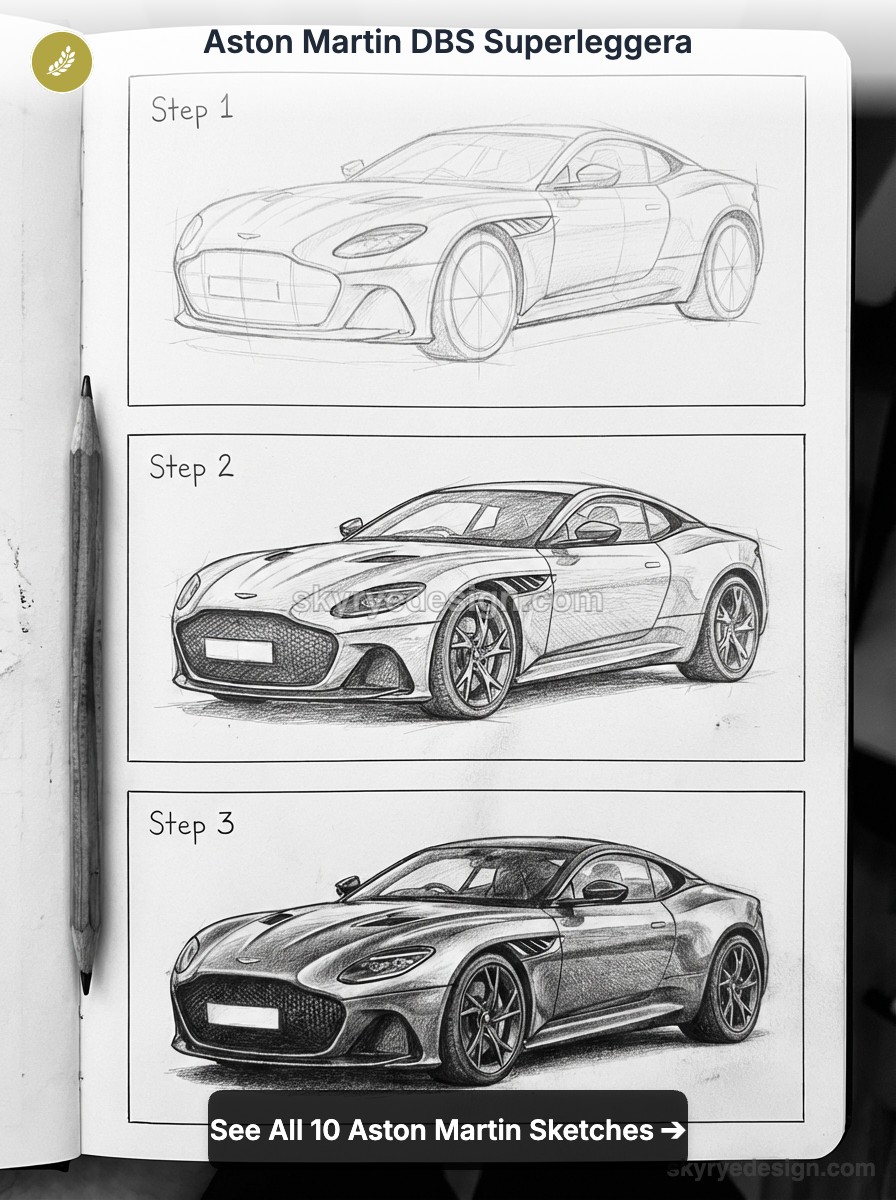
Drawing challenge: The front splitter and its integration with the lower bumper — the DBS has a large carbon front splitter that creates a strong horizontal element across the bottom of the front face. Getting the depth and angle of this element correct is essential: too shallow and it disappears; too prominent and the car looks like a racing prototype.
Key proportions: Same 2.5:1 ratio as DB11 but with more visual mass at front and rear due to aerodynamic elements. The overall car reads as wider and lower due to the splitter and diffuser.
07 — Aston Martin Rapide (2010–2020)
Design signature: Aston Martin’s four-door model — the brand’s answer to the Panamera. The challenge is extending the Aston Martin design language to a longer wheelbase while maintaining the proportion elegance of the two-door models. It largely succeeds: the bonnet remains long, the greenhouse remains compact, but the rear door adds length behind the B-pillar.
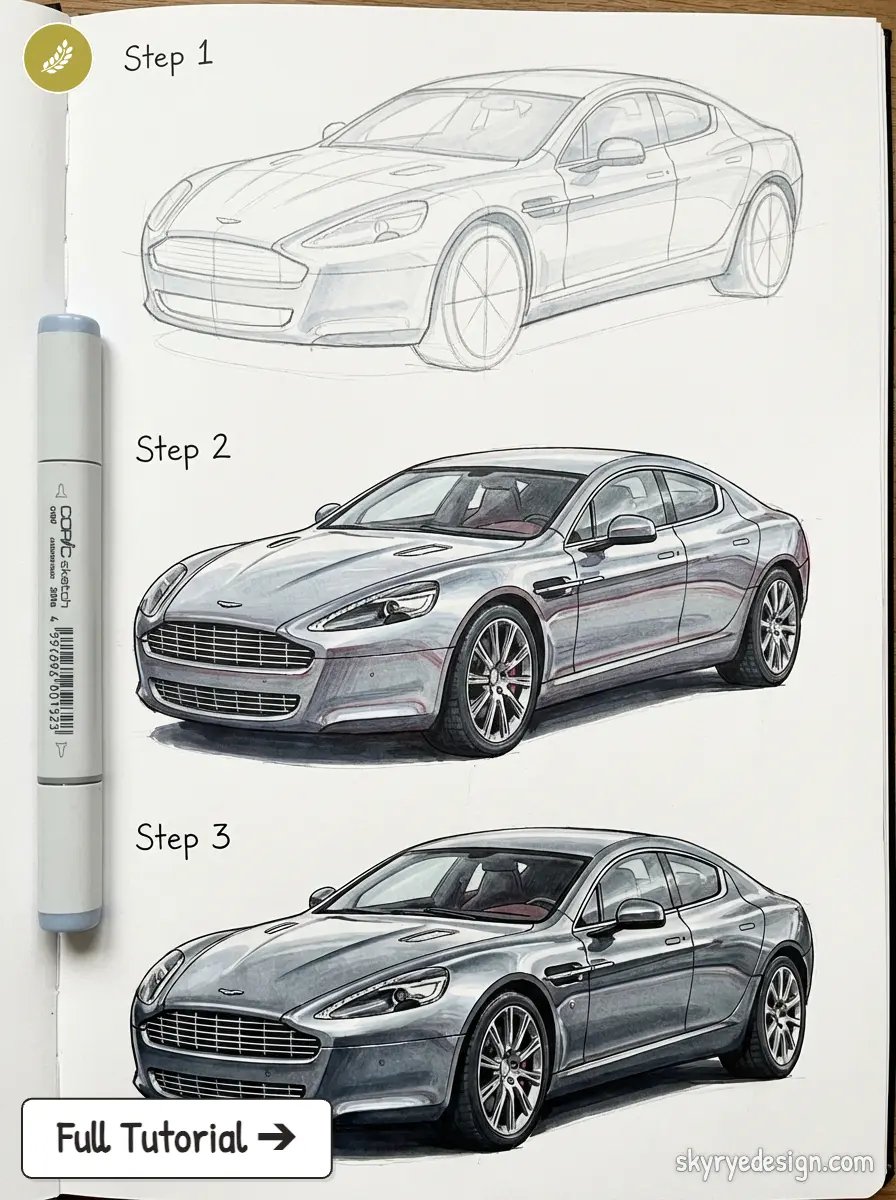
Drawing challenge: The B-pillar and rear door integration — the addition of a rear door introduces a second door shut line that must be drawn in a position that doesn’t disrupt the visual flow of the car. Too prominent and the car looks like a stretched estate; correctly proportioned and it reads as a genuinely elegant four-door GT.
Key proportions: 2.8:1 length-to-height ratio — longer than the DB11 due to the extended wheelbase. The bonnet remains at 40% of length despite the overall stretch.
08 — Aston Martin One-77 (2009–2012)
Design signature: The ultimate expression of the pre-2016 Aston Martin design language. Only 77 were built. The body is all carbon fibre, the surfaces are more complex and organic than the DB range, and the proportions are more extreme — longer bonnet, lower roofline, more flared arches. A masterclass in surface tension.
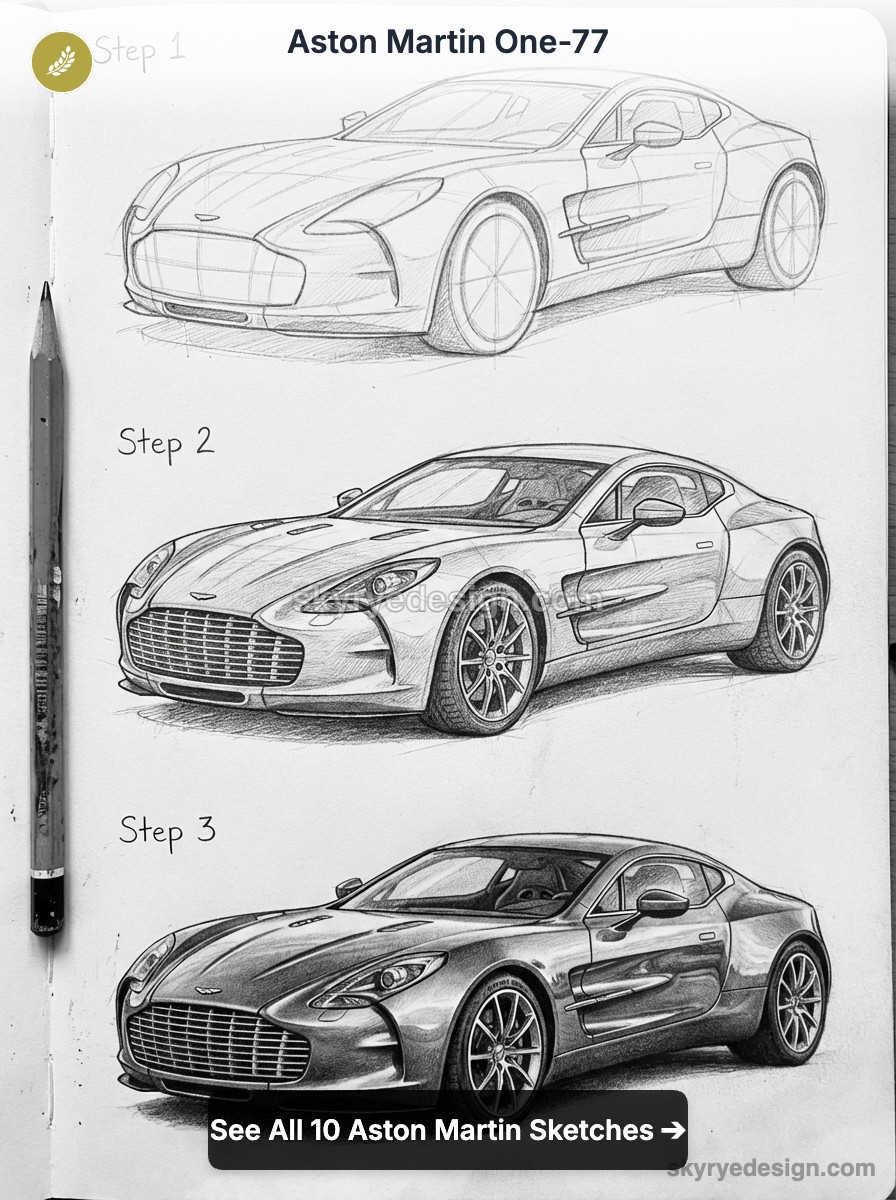
Drawing challenge: The carbon fibre body panels — the One-77’s surfaces have a complexity that exceeds the DB range, with multiple surface transitions visible as subtle inflections in the bodywork. Suggesting this surface complexity without overworking the drawing requires careful attention to where highlights appear and where they don’t, using the eraser as much as the pencil.
Key proportions: 2.6:1 length-to-height ratio. The most extreme Aston Martin proportions prior to the Valkyrie — the bonnet occupies 42% of total length, the roofline is lower relative to the body, and the wheel arches are more dramatically flared.
09 — Aston Martin Valkyrie (2021–present)
Design signature: A Formula 1-derived hypercar developed with Red Bull Racing. The design language is completely different from the GT models — extreme aerodynamic surfaces, exposed underfloor tunnels, a cockpit-forward seating position, and no traditional bonnet or boot. This is not an Aston Martin GT; it’s an F1 car with road-legal lights.
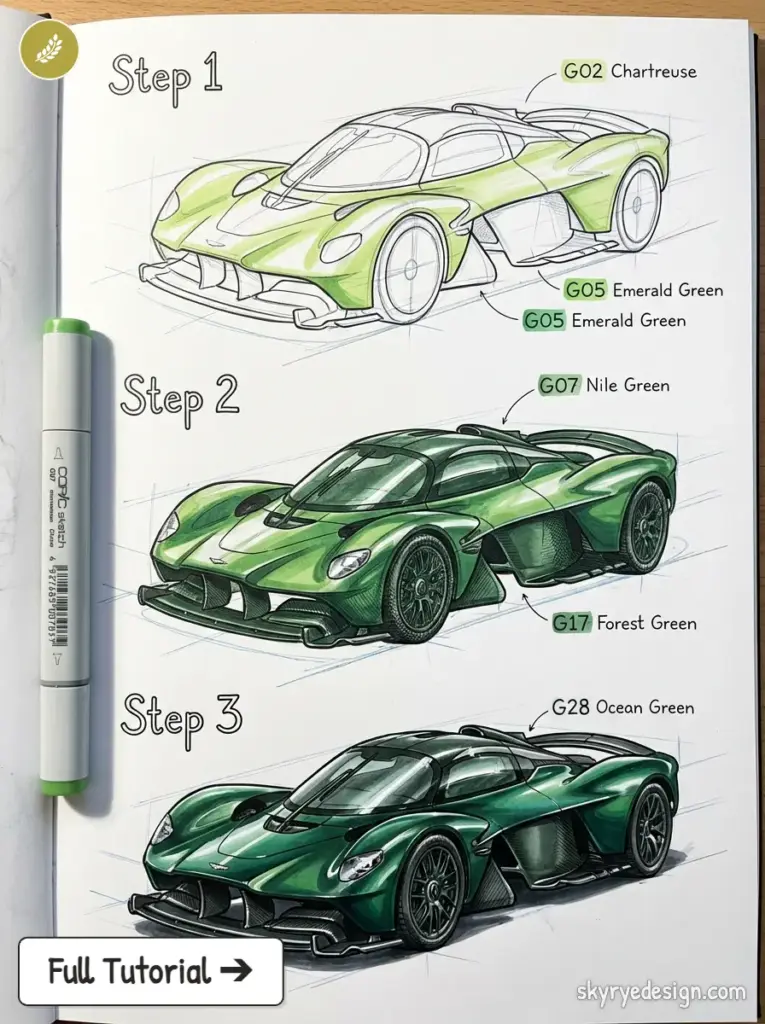
Drawing challenge: The underfloor tunnels and venturi channels — the Valkyrie’s most distinctive visual element is its exposed underfloor aerodynamic tunnels, visible from the side as complex curved channels beneath the body. Drawing these requires understanding the three-dimensional geometry of venturi tunnels: they curve in two planes simultaneously and converge toward the rear of the car.
Key proportions: No conventional bounding box applies — the Valkyrie’s proportions are dictated by aerodynamics, not automotive tradition. The cockpit is extremely far forward. The tail is extremely elongated. Approach it as a sculptural study rather than a conventional car drawing.
10 — Aston Martin DBX (2020–present)
Design signature: Aston Martin’s first SUV — a significant departure from the GT formula but still carrying the brand’s design DNA. The oval grille is present in its current form, the shoulderline logic applies, but the overall car sits much higher and has a completely different roofline proportion from the sports cars.
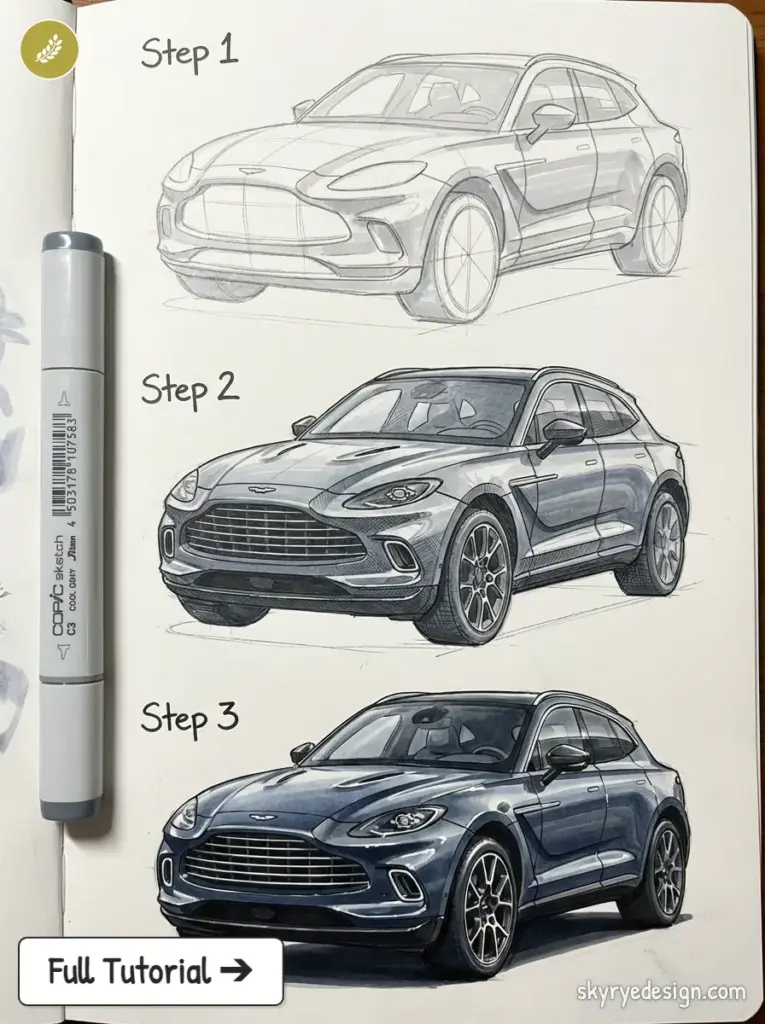
Drawing challenge: Translating the Aston Martin grille and shoulderline to an SUV body — the oval grille on a taller, more upright front face reads differently than on the low GT models. The challenge is maintaining the elegance of the grille proportion while accepting the fundamentally different height-to-width ratio of an SUV.
Key proportions: 2.0:1 length-to-height ratio — the squarest Aston Martin by a significant margin. The bonnet occupies 35% of total length rather than 40% due to the more upright packaging. The shoulderline sits at a higher proportion of body height.
Rendering Metallic Surfaces: How to Make It Look Like a Car
The step that turns a line drawing into a car sketch is the rendering — the tonal work that suggests the metallic surface quality of the bodywork. Aston Martin cars are typically painted in deep, saturated colours (Racing Green, Midnight Black, Quantum Silver) that interact with light in a specific way: broad areas of mid-tone, a strong highlight running along the shoulderline, and deep shadows in the wheel arches and beneath the car.
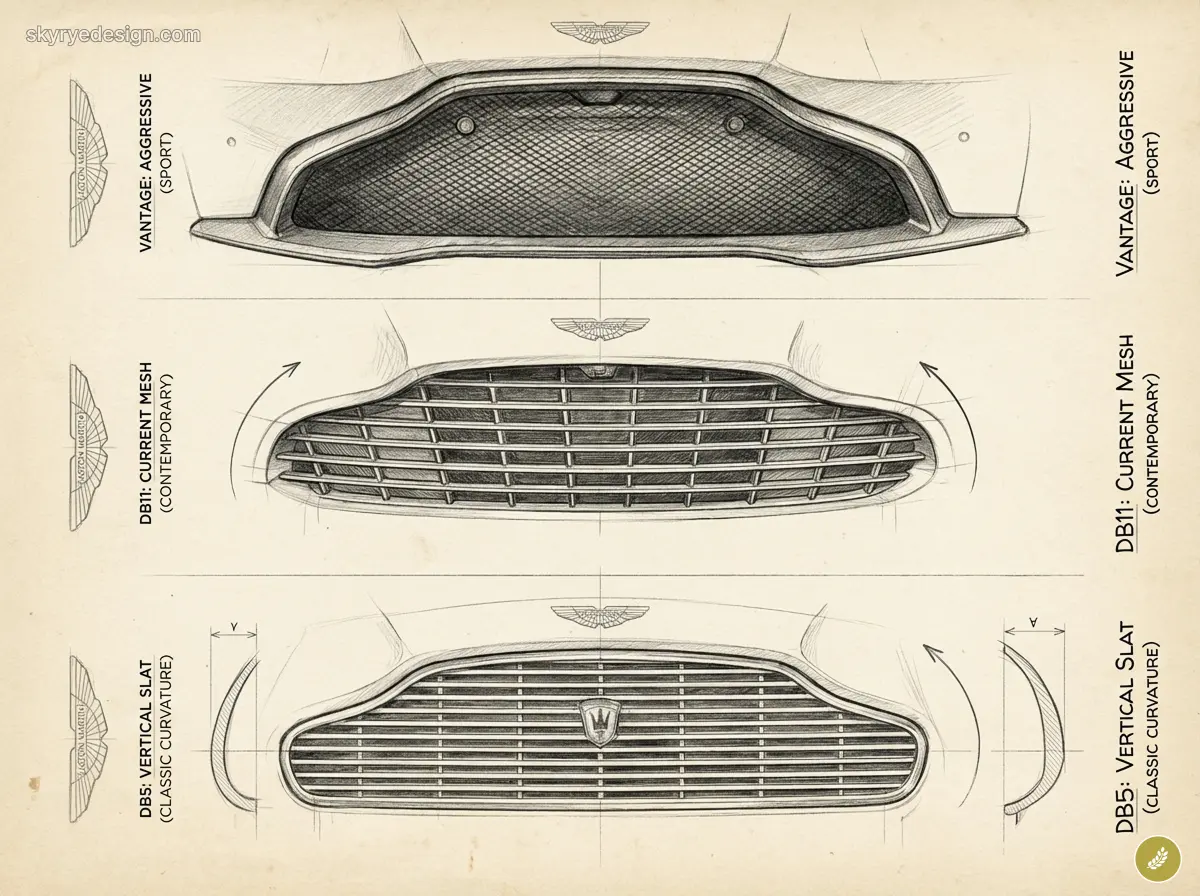
The Three-Zone Tonal Logic
Every metallic car body has three tonal zones in a studio or outdoor light condition: sky reflection (the lightest area, typically on the upper body surface above the shoulderline, where the sky reflects into the panel), mid-tone (the main body surface, neither light nor dark, below the shoulderline), and ground reflection (a secondary lighter area near the sill, where light reflected from the ground bounces back into the lower body panel). Between these three zones are transition areas where the tone shifts gradually.
For a pencil sketch: use your eraser to lift a highlight strip along the shoulderline — this is the brightest part of the car. Apply mid-tone grey to the main body surface. Leave a lighter band near the sill. Apply deep 4B shadow in the wheel arch interiors, the shadow beneath the car, and the window glass. The windows should be the darkest area of the drawing — darker than the wheel arches, darker than any shadow.
Wheels and Tyres
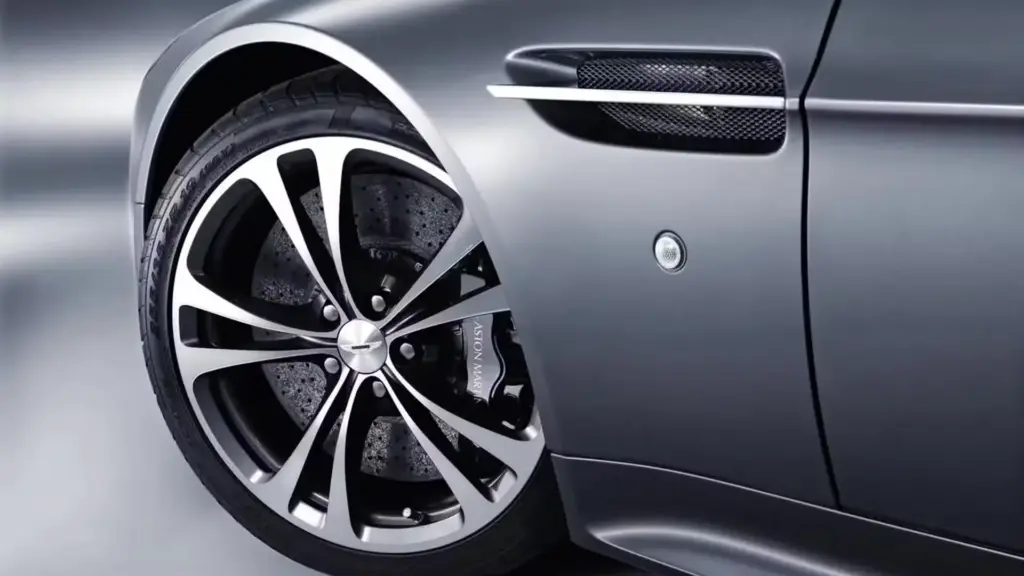
Aston Martin wheels are typically multi-spoke designs in polished or machined alloy — complex enough to be interesting, not so complex that they dominate the drawing. In a side-profile sketch, don’t attempt to draw every spoke. Instead, suggest the spoke pattern with 5-7 lines radiating from a central hub circle, leaving the gaps between spokes as lighter areas. The tyre should be drawn as a slightly darker tone than the wheel — rubber absorbs more light than polished metal.
✏ Drawing note: After completing a pencil sketch, photograph it and open it in a photo editing app (even the basic exposure/contrast adjustment in your phone’s camera roll works). Increase the contrast slightly. This reveals whether the tonal range of your drawing is wide enough to suggest a metallic surface — if the car looks flat at high contrast, you need more shadow in the dark areas. The best car sketches have a very wide tonal range from near-white highlights to near-black shadows.
Materials for Car Sketching
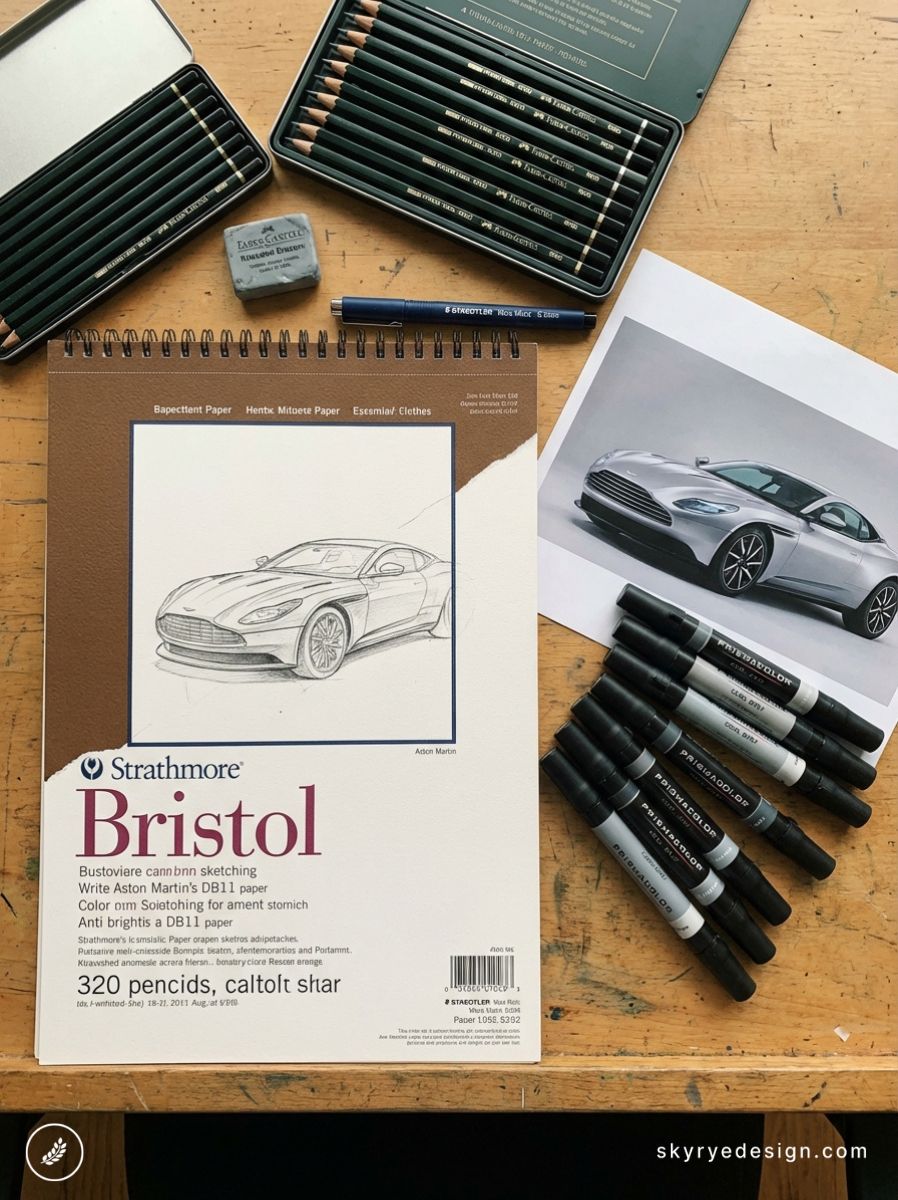
- Pencils: Faber-Castell 9000 Art Set (HB through 4B) — the full tonal range needed. HB for construction lines, 2B for body outlines, 4B for shadows and glass.
- Paper: Strathmore 300 Series Bristol smooth pad (~$18, 9×12 inch) — smooth surface for clean line work and eraser lifting without surface damage.
- Eraser: Faber-Castell kneaded eraser (~$3) for construction line removal and highlight lifting. A standard vinyl eraser for crisp edge corrections.
- Ink (optional): Staedtler Pigment Liner 0.3mm (~$4) for confirmed outlines. The 0.3mm nib handles both the body outline and fine detail lines without becoming too dominant.
- Marker rendering (optional): Prismacolor Cool Grey markers in 10%, 30%, 50%, 70% — the four grey values needed for a complete metallic surface rendering. Apply over pencil lines or ink outlines.
- Reference: Use official Aston Martin press photographs for proportion reference — press photographs are taken at a standardised distance and focal length that shows the car’s proportions accurately. Avoid showroom photographs taken with wide-angle lenses, which distort proportions significantly.
FAQ: How to Draw an Aston Martin
Q: How do you draw an Aston Martin for beginners?
Start with the DB11 in side profile. Draw a bounding box 2.5× as wide as it is tall. Mark the front wheel at 20% of total length, the rear wheel at 75%. The windscreen base sits at 40%. Establish the long bonnet proportion first — 40% of car length must be bonnet before any detail is added. The oval grille is the most important single detail: draw it tall, slightly flat at top, positioned in the upper half of the front face.
Q: What makes Aston Martin design distinctive to draw?
Four elements: long bonnet (40% of car length), tall oval grille, continuous shoulderline from front arch to rear, and compact greenhouse. Missing any one of these produces a generic sports car rather than an Aston Martin. The bonnet proportion is the most important — it establishes the car’s fundamental character before any detail is added.
Q: What is the best Aston Martin model to draw first?
The DB11. Its proportions are the clearest expression of the current design language without extreme complexity. The body surfaces are smooth with one primary character line, the greenhouse is simply shaped, and the oval grille is clearly defined. All other Aston Martin models are variations on the DB11’s proportion logic.
Q: How do you draw car wheels correctly?
In side profile, wheels are circles. In three-quarter view, the far wheel is a shallow ellipse. Wheel diameter should equal the height of the door panel — the most reliable proportion check. Draw the tyre as a slightly darker tone than the rim. The wheel arch sits approximately 5-10mm above the tyre at the arch top.
Q: What pencils should I use for car sketching?
HB for construction (erased later), 2B for body outline, 4B for deepest shadows. Strathmore Bristol smooth pad (~$18) for paper. Faber-Castell kneaded eraser for construction removal and highlight lifting. Prismacolor Cool Grey markers (10%, 30%, 50%, 70%) for rendering if you want to go beyond pencil.
- 7shares
- Facebook0
- Pinterest7
- Twitter0
- Reddit0