The worst drawing session I ever had started with forty-five minutes of blank-page paralysis. I had all my supplies out, a perfectly good afternoon, and absolutely nothing coming. I kept thinking I needed a ‘good idea’ before I could start drawing. What I actually needed was any idea — something specific enough to put pencil to paper and get out of my own head.
That’s the real function of an idea list. Not inspiration in the romantic sense — a specific subject that removes the decision-paralysis and lets you practice. The more specific the idea, the better. ‘Draw an anime girl’ produces staring. ‘Draw a girl in a hooded rain jacket, watching a convenience store neon sign reflecting in a puddle at 2am’ produces drawing.
- What 'Aesthetic' Actually Means in Anime Art (And Why It Matters)
- Category 1: Lofi and Quiet Moments — Drawing the In-Between
- Category 2: Nature and Ghibli-Influenced — When the Environment Is the Character
- Category 3: Cyberpunk and Urban Night — Neon and Shadow
- Category 4: Fantasy and Magic — Inventing Worlds
- Category 5: Emotional Character Studies — Drawing What Can't Be Said
- Category 6: Dark Academia and Moody Aesthetics — Beauty in the Heavy
- Ideas 37–45: Quick-Reference Anime Drawing Prompts
- Making These Ideas Work: Five Technique Principles
- Tools for These Ideas: What You Actually Need
- FAQ: Anime Drawing Ideas
- Q: What are good anime drawing ideas for absolute beginners?
- Q: How do I develop my own anime art style?
- Q: What's the best way to practise anime eyes specifically?
- Q: Clip Studio Paint vs Procreate — which is better for anime drawing?
- Q: How long should each drawing take at different skill levels?
- Q: How do I draw anime hair that looks natural rather than stiff?
- One Rule: Start Before You're Ready
This guide contains 40+ anime drawing ideas organized by aesthetic, mood, and what each one teaches you. These aren’t just prompts — each one comes with a technique note about what skill you’re actually developing when you draw it. Some are beginner-friendly. Some are genuinely difficult. All of them are more interesting than ‘draw a face.’
I’ve organized them into six categories based on how most working anime artists actually think about their work — not by difficulty level, but by the visual world they inhabit. Find the category that pulls at something in you, pick one idea, and start before you’re ready.
What ‘Aesthetic’ Actually Means in Anime Art (And Why It Matters)
The word ‘aesthetic’ gets thrown around constantly in anime art communities, but most people use it to mean ‘looks nice’ — which isn’t a useful working definition if you’re trying to develop actual craft.
A more useful definition: aesthetic anime art is work where every visual decision — colour, lighting, composition, subject — serves a single emotional experience. The colour palette and the subject and the way light falls all agree on one feeling. That coherence is what separates a drawing that makes someone stop scrolling from one that’s technically fine but forgettable.
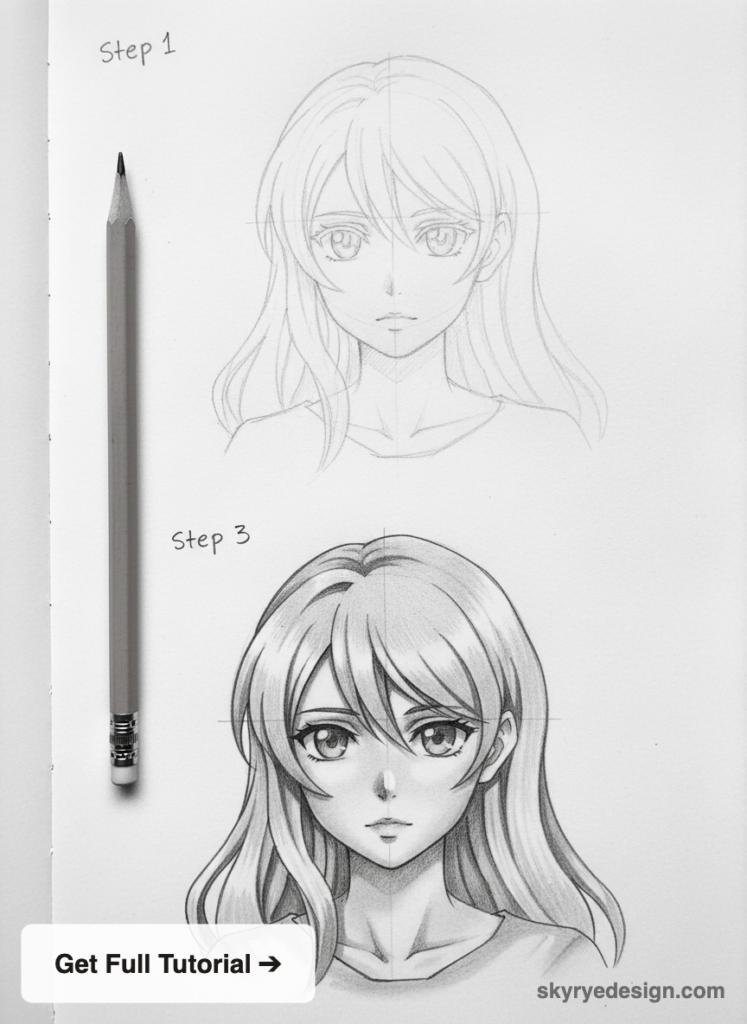
The good news is that ‘aesthetic’ in this sense is learnable. It’s not talent — it’s decision-making. And the fastest way to learn it is to draw from prompts where the aesthetic is defined in advance, so you’re practicing the execution of a unified mood rather than trying to invent one from nothing.
The six categories in this guide are each built around a distinct aesthetic world — its own palette logic, its own lighting vocabulary, its own emotional territory. Working through prompts in a category you love is how you internalize that aesthetic until you can produce it from memory.
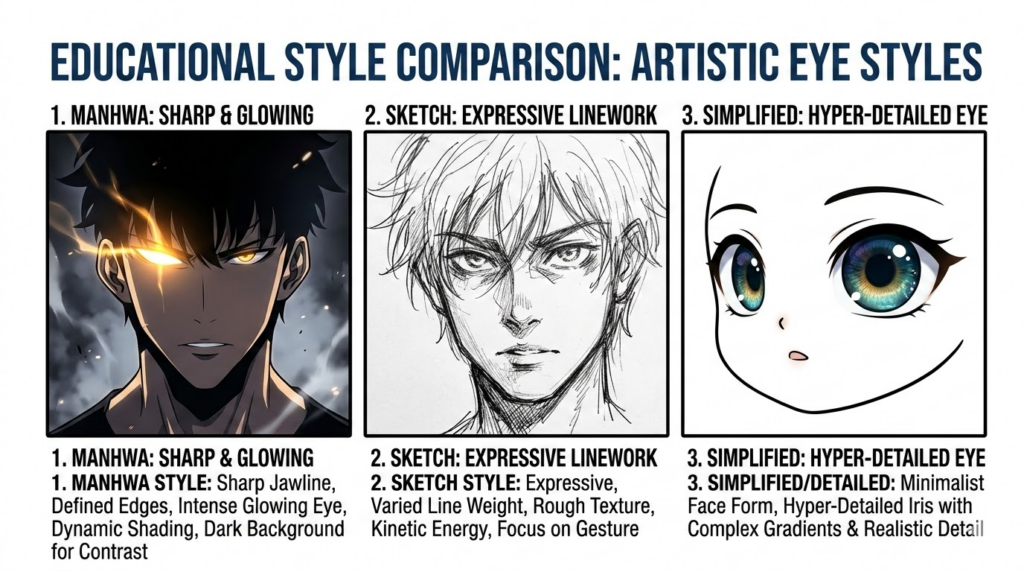
The Three Dominant Anime Aesthetics in 2026
Manhwa-influenced: Sharp jaw lines, high-contrast lighting, digital glow effects on eyes and energy. Popularized by Solo Leveling’s anime adaptation. Sleeker and more ‘UI-focused’ than traditional anime — characters look like they exist in a designed interface.
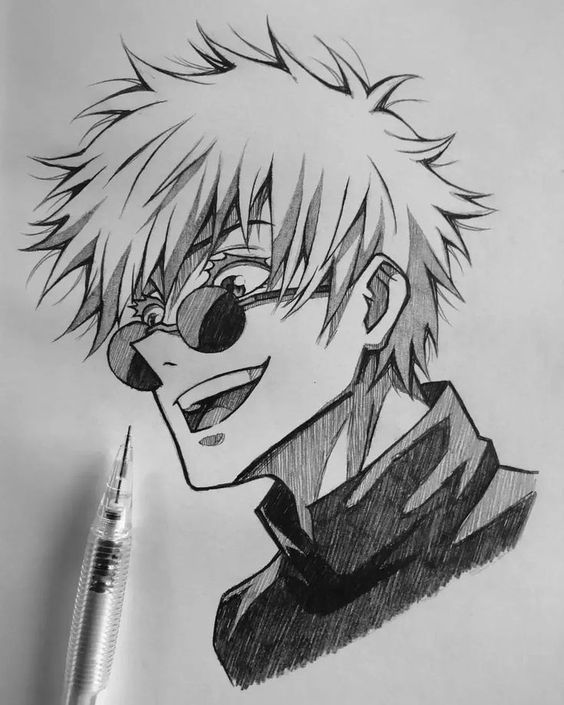
Rough/expressive linework: Variable line weight that reads like confident pencil sketching. Popularized by Science Saru’s work on Dandadan and the key animation sequences in Jujutsu Kaisen. The aesthetic deliberately leans into imperfection — control is visible through the roughness, not despite it.
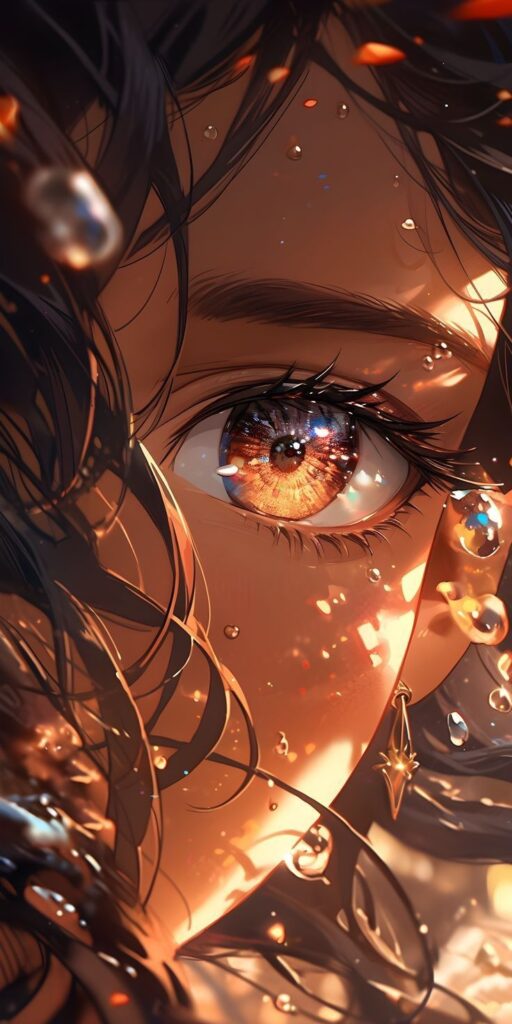
Complex gradient eyes: Eyes containing galaxy-depth gradients, distinct shapes, and multiple highlights — while the rest of the face stays simple. The eyes become the entire focal point of the composition. This is currently the most-practiced technique among serious anime fanart artists on platforms like Twitter/X and Pixiv.
Category 1: Lofi and Quiet Moments — Drawing the In-Between
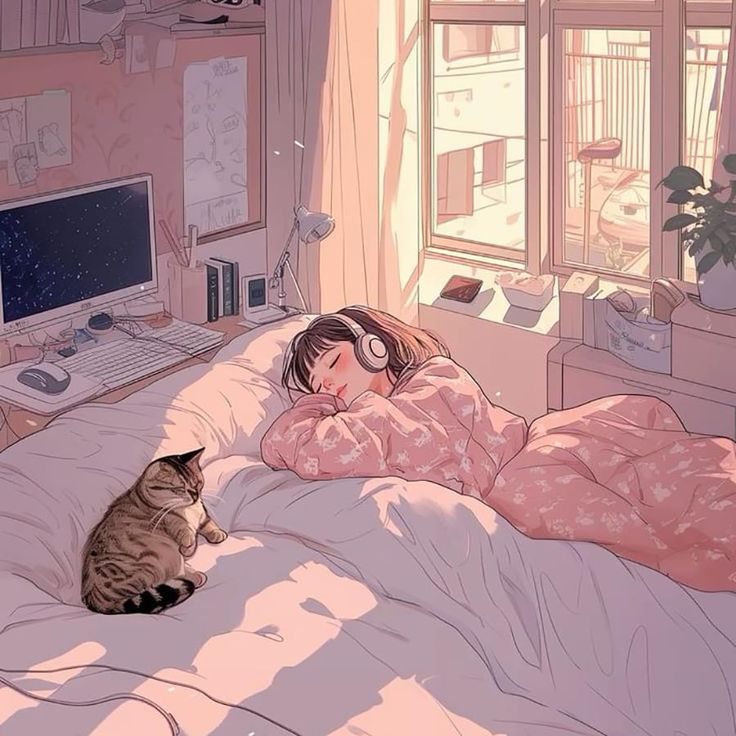
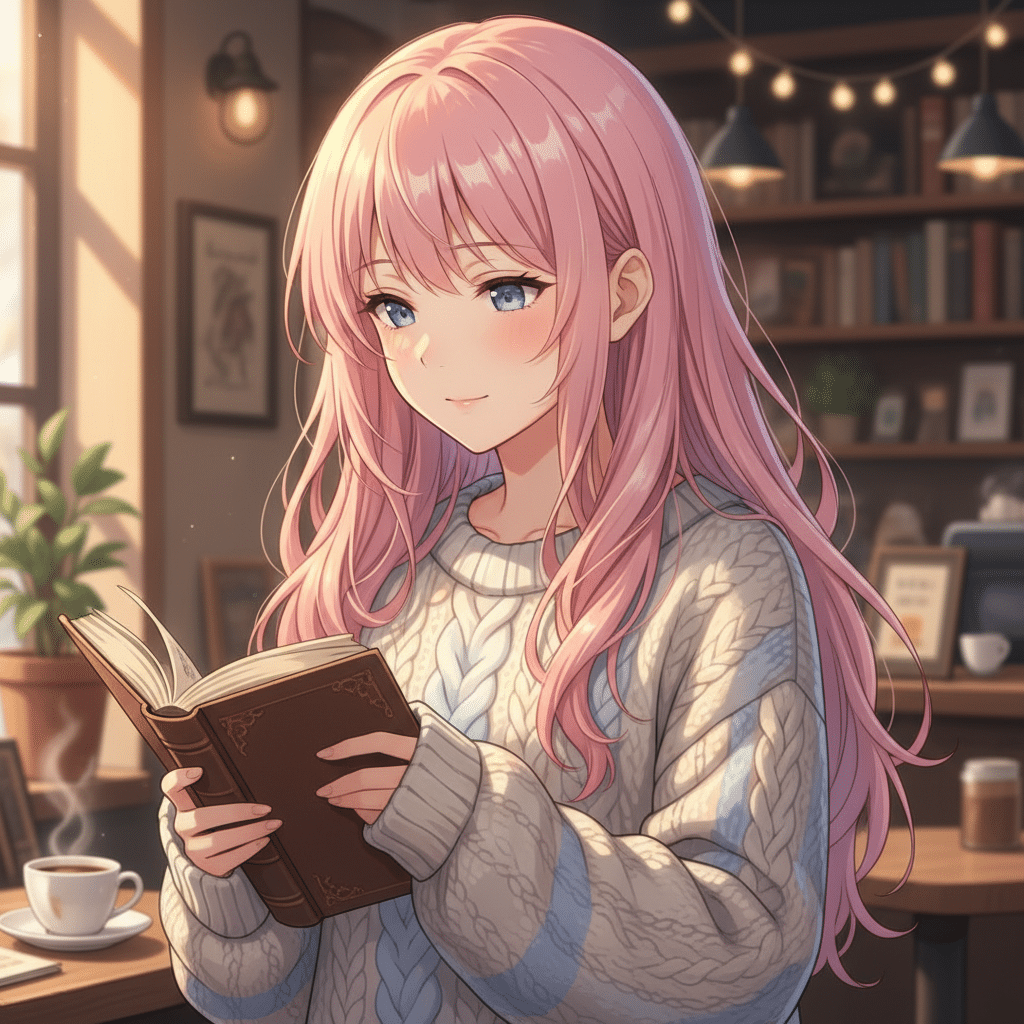
Lofi anime aesthetics are built from the ordinary made beautiful — a person studying at midnight, steam rising from a mug, rain on a window, the blue glow of a phone screen at 3am. The emotional core is comfort-with-solitude: the feeling of being completely at ease inside a small, warm, private world.
These are technically some of the most deceptively challenging ideas on this list — not because the subjects are complex, but because the mood requires restraint. Every element has to agree on ‘quiet.’ One overly sharp line or overly saturated colour breaks the spell. Working in this aesthetic teaches colour temperature control and atmospheric lighting better than almost anything else.
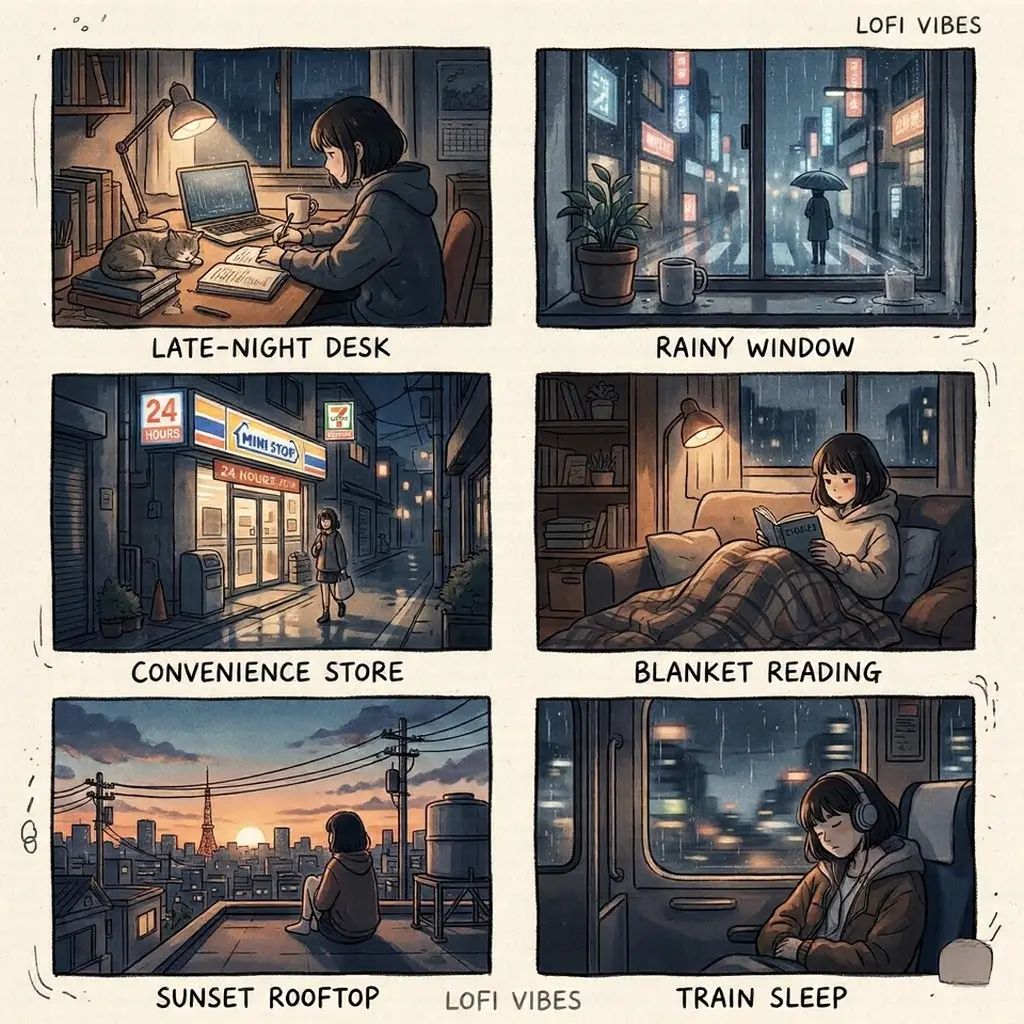
1. Late-Night Study Session
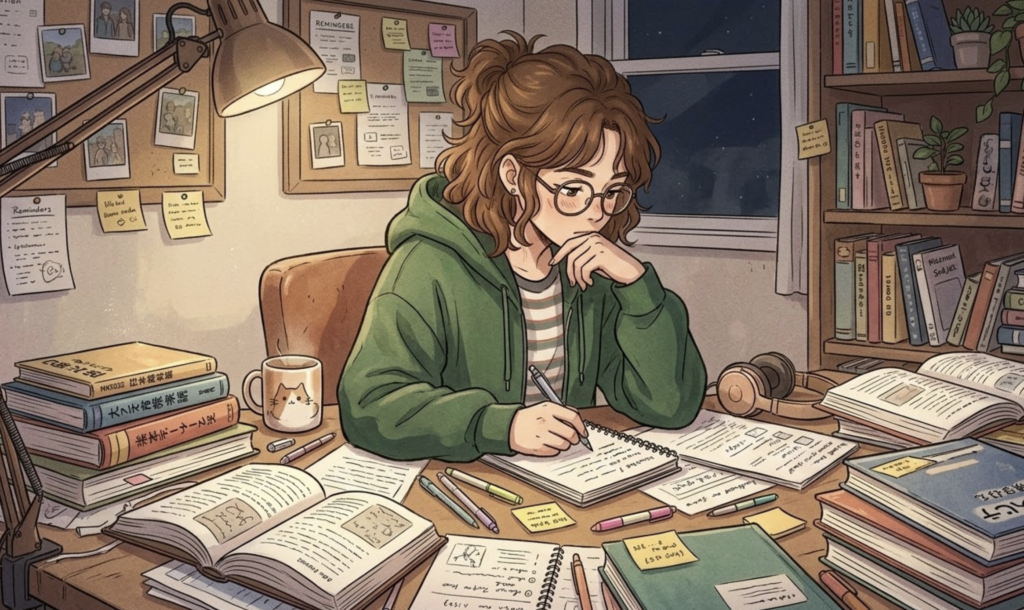
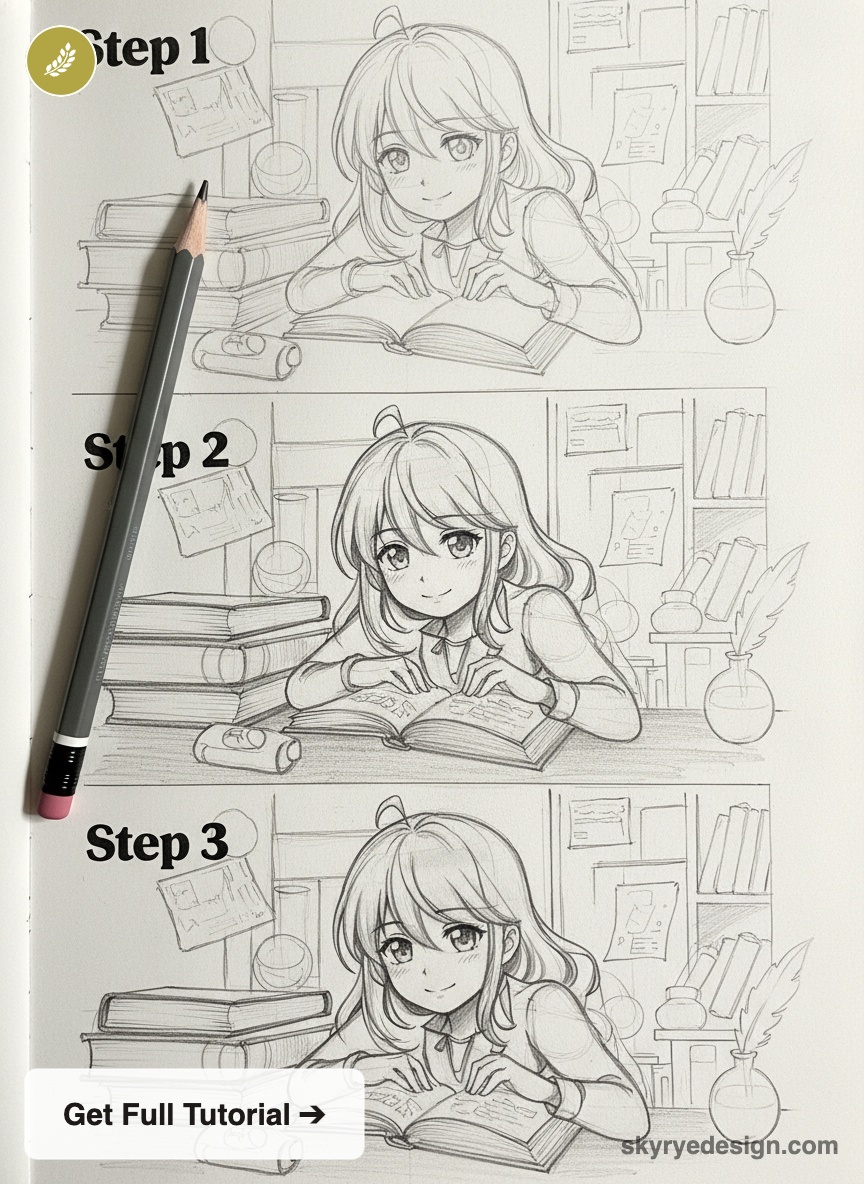
A character bent over books at a wooden desk, surrounded by the organized chaos of late-night studying — open notebooks, a lamp casting warm yellow light into the darker blue of the room, maybe a cat asleep on the edge of the desk. The key compositional decision: what light sources exist, and what colour temperature are they? The lamp (warm amber), fighting the blue ambient (cool exterior light), creates the classic lo-fi tension without needing to be stated explicitly.
Skill focus: Colour temperature contrast, interior lighting logic, atmospheric still life composition
2. Rainy Window, Looking Out
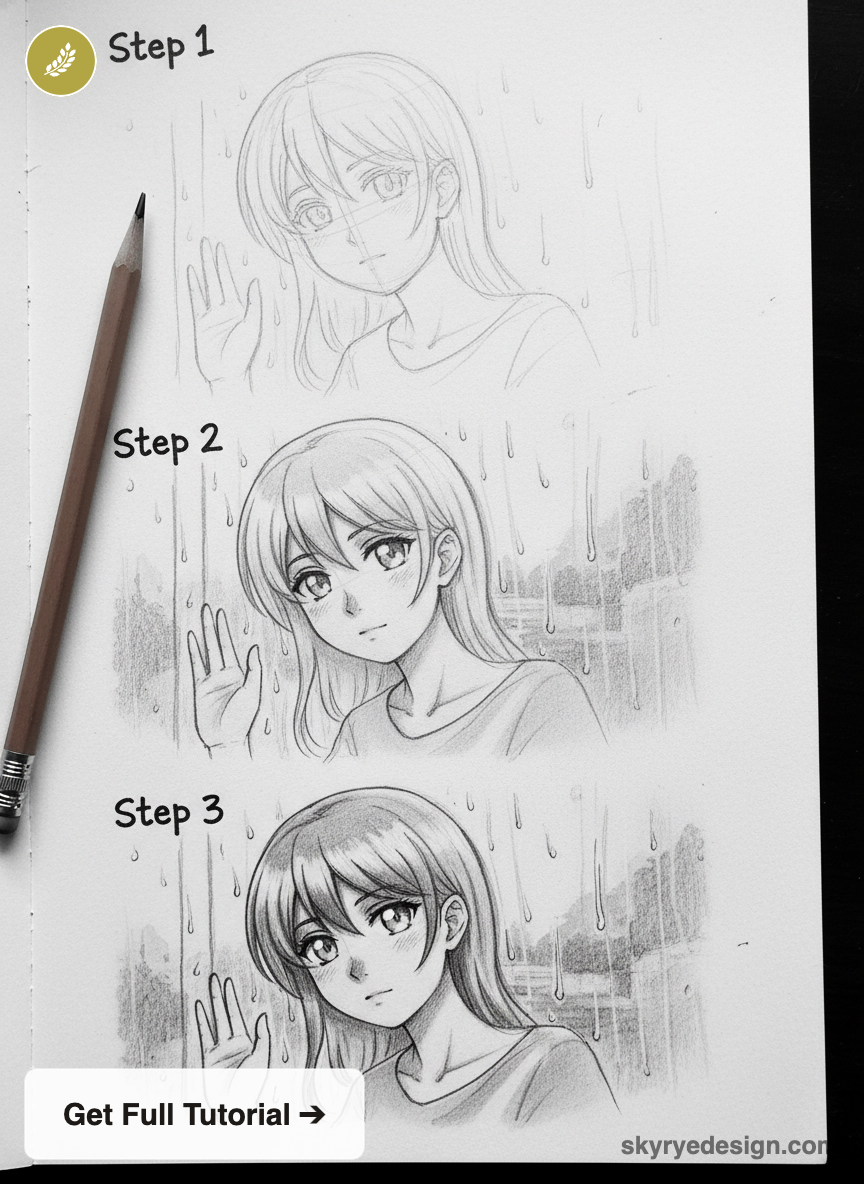
A character pressed against a window or sat beside it, looking out at rain streaking the glass. The world outside is blurred and distorted by the water; the room inside is in sharper focus. This subject is a masterclass in depicting different planes of depth simultaneously — the window surface, the immediate interior, the blurred exterior. The character’s expression should carry the emotional weight; the setting provides the mood.
Skill focus: Layered depth rendering, glass and water effects, background-foreground relationship
3. Convenience Store, 2am
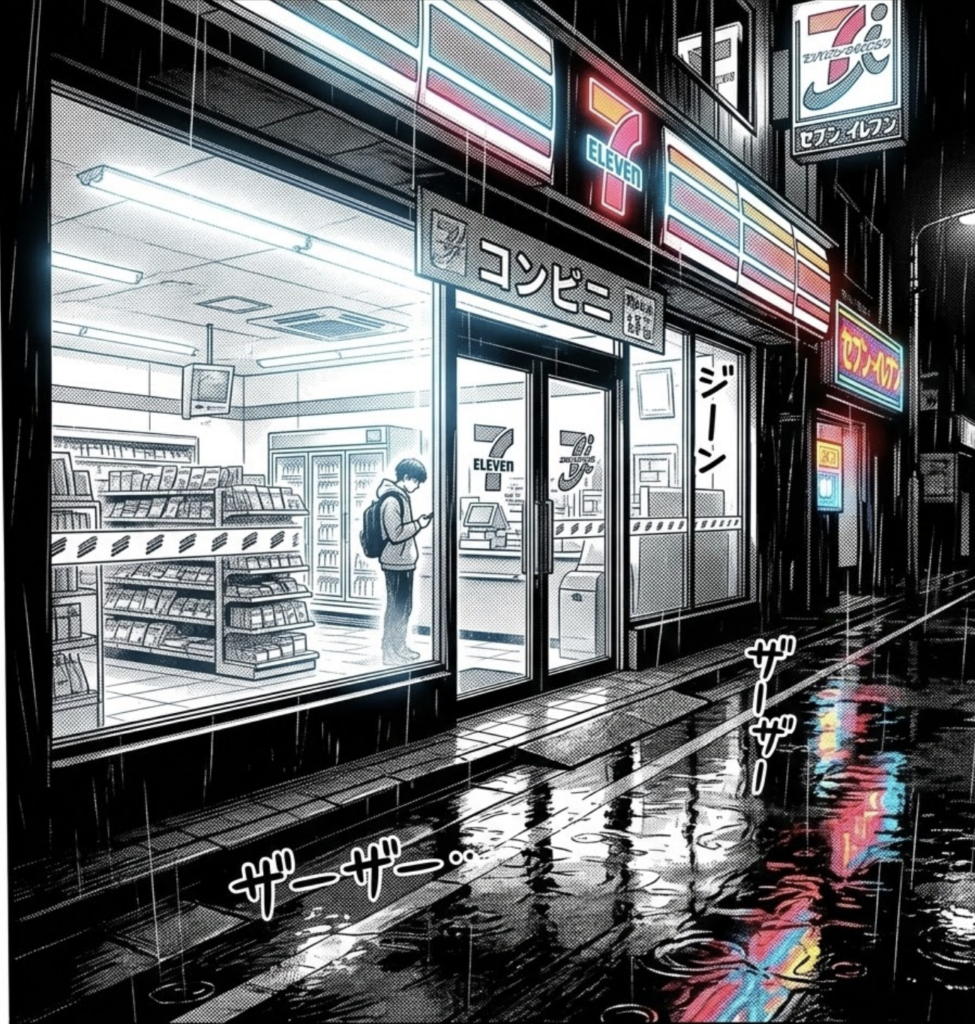
The harsh, blue-white fluorescent interior of a convenience store seen from outside — a lone figure visible through the glass, the neon sign reflections in the wet pavement, the contrast between that hard artificial light and the dark street. This idea comes directly from a compositional approach that became iconic in lofi anime art around 2021–2022 and remains one of the most effective ‘urban quiet’ compositions available.
Skill focus: Artificial light colour rendering, night scene composition, interior/exterior depth split
4. Character Reading Under a Blanket
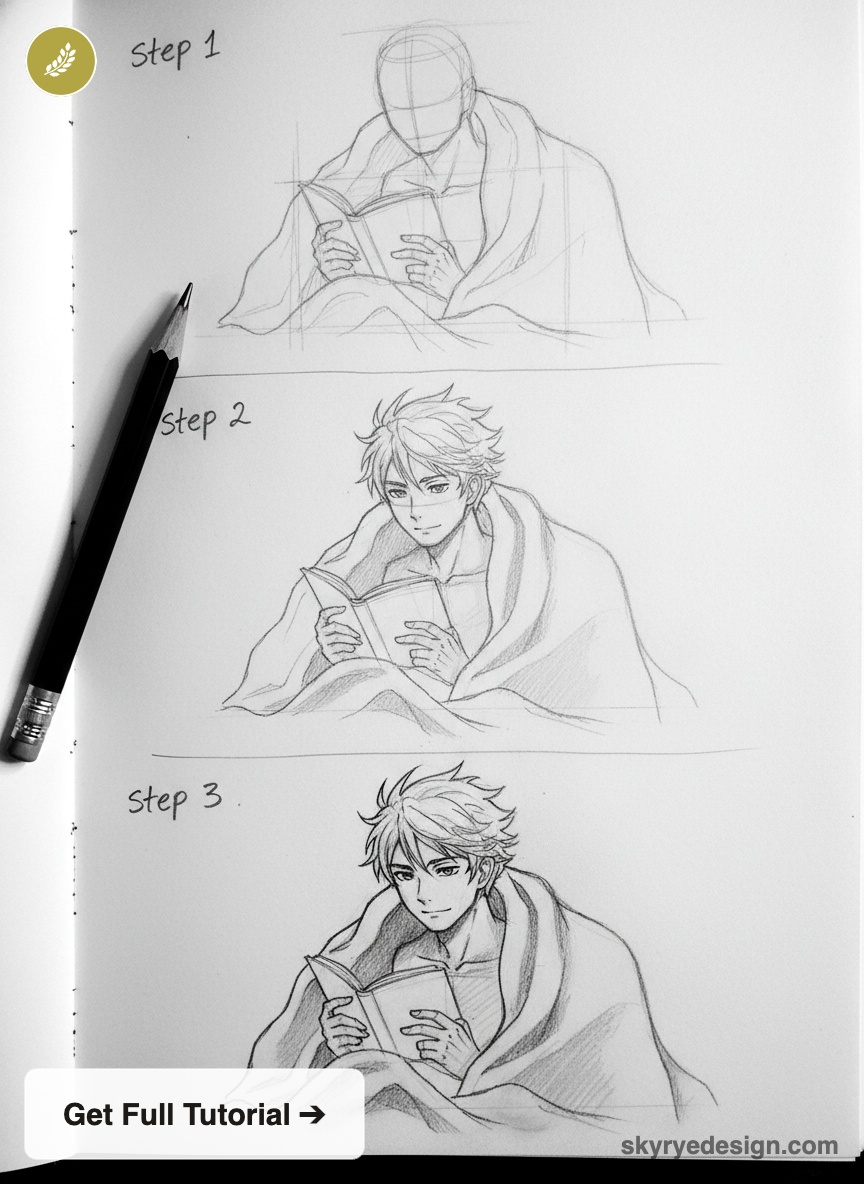
A figure half-buried in blankets, reading by the light of a small lamp or phone — the warm light pooling on the pages, the rest of the scene in shadow. The challenge here is drawing fabric convincingly: how blankets fold under a person’s weight, how they drape over limbs, where they bunch and where they stretch smooth.
Skill focus: Fabric drapery under compression, warm focused light, intimate scale composition
5. Rooftop at Sunset Alone
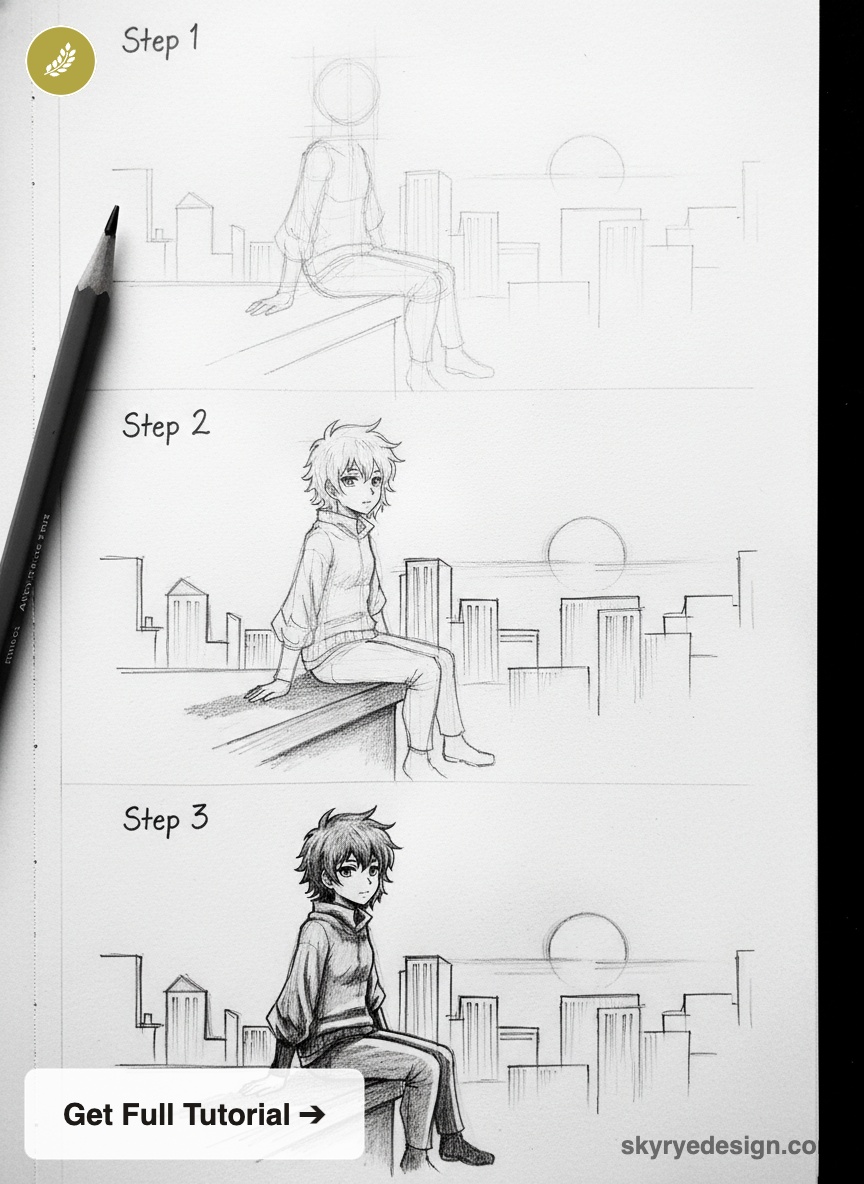
One character sitting on a flat rooftop edge, legs dangling, looking at a city skyline at the specific moment the sun is almost gone — the sky in that transition between orange and deep blue, the city lights just starting to appear. This is the golden-hour lofi idea: warm above, cool below, figure silhouetted in the middle. Practice it as a silhouette first, then add internal detail on subsequent passes.
Skill focus: Silhouette composition, dual-gradient sky rendering, transition-hour colour work
6. Sleeping at a Train Window
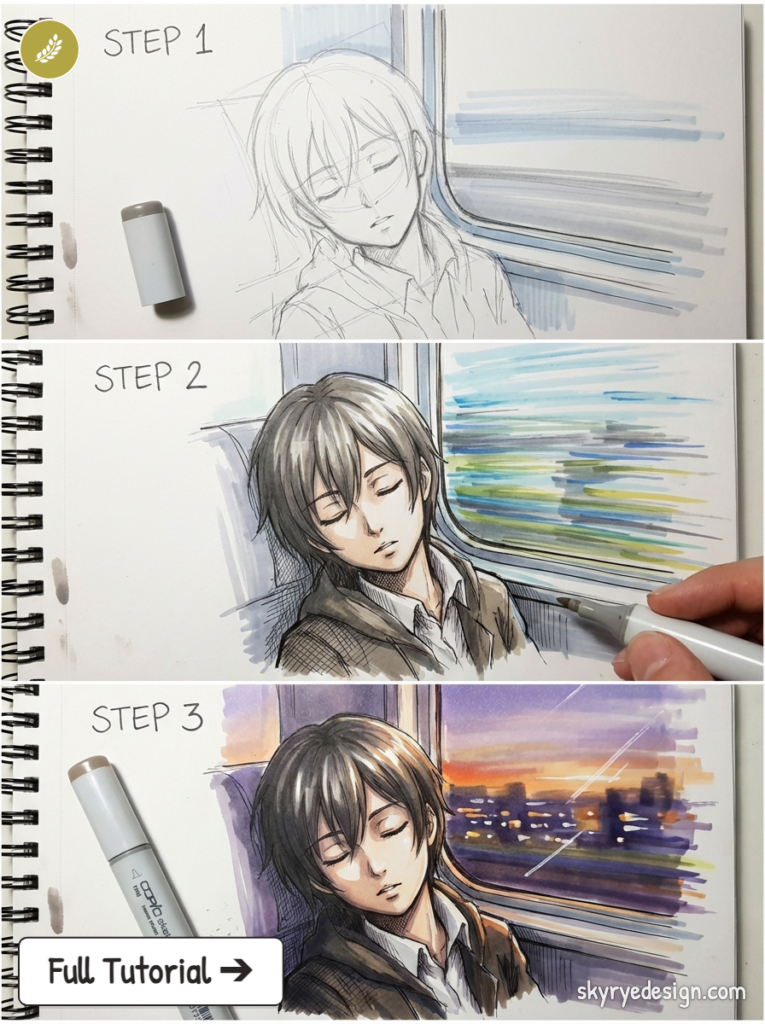
A character asleep on a train, head against the glass, countryside or city moving in a blur outside. The sleeping pose is genuinely difficult to draw convincingly — the way the head lolls, how the body relaxes differently in sleep than in waking stillness. The moving exterior seen through the window allows you to practice motion blur and background suggestion.
Skill focus: Relaxed-pose anatomy, motion blur background technique, travel scene mood
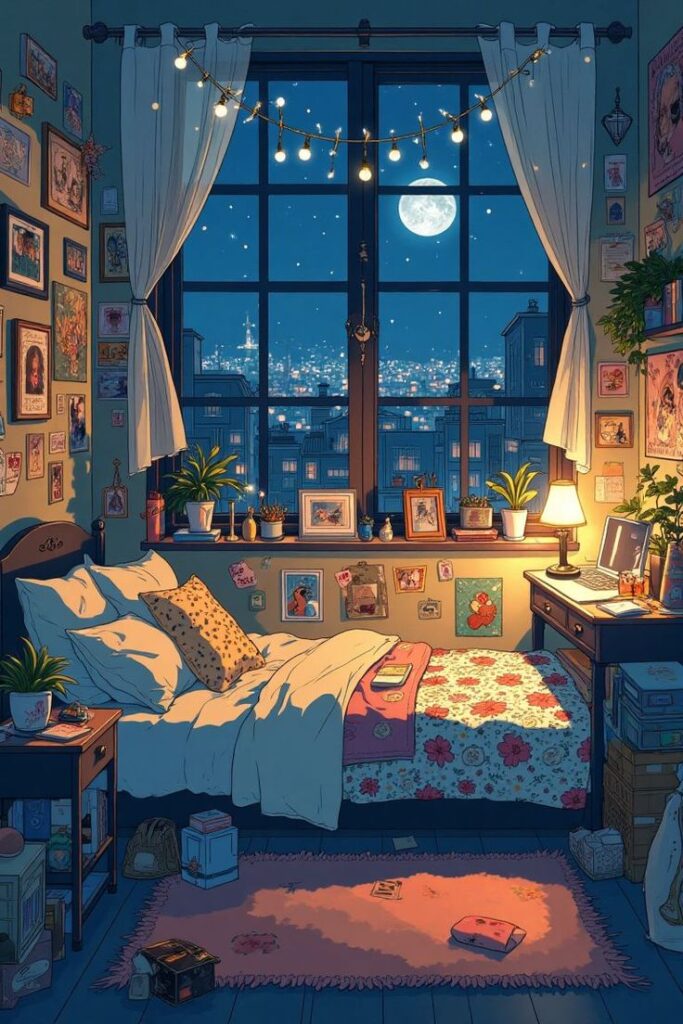
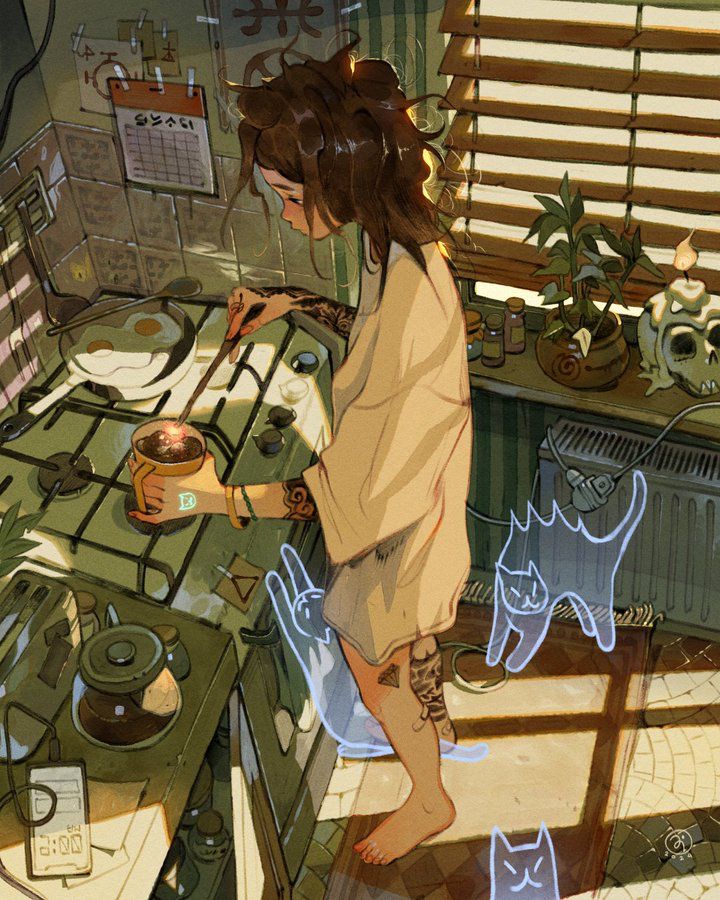
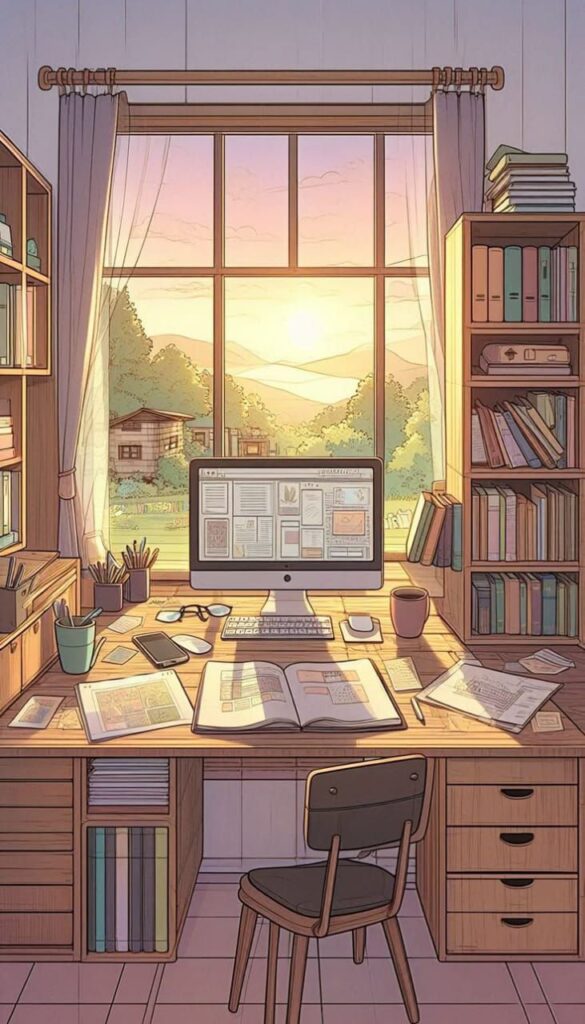
✏ Technique tip: For all lofi ideas: limit your palette to 4–5 colours maximum. The lofi aesthetic lives or dies on palette restraint. If you’re working digitally, create a locked colour swatch before you start and don’t deviate from it.
Category 2: Nature and Ghibli-Influenced — When the Environment Is the Character
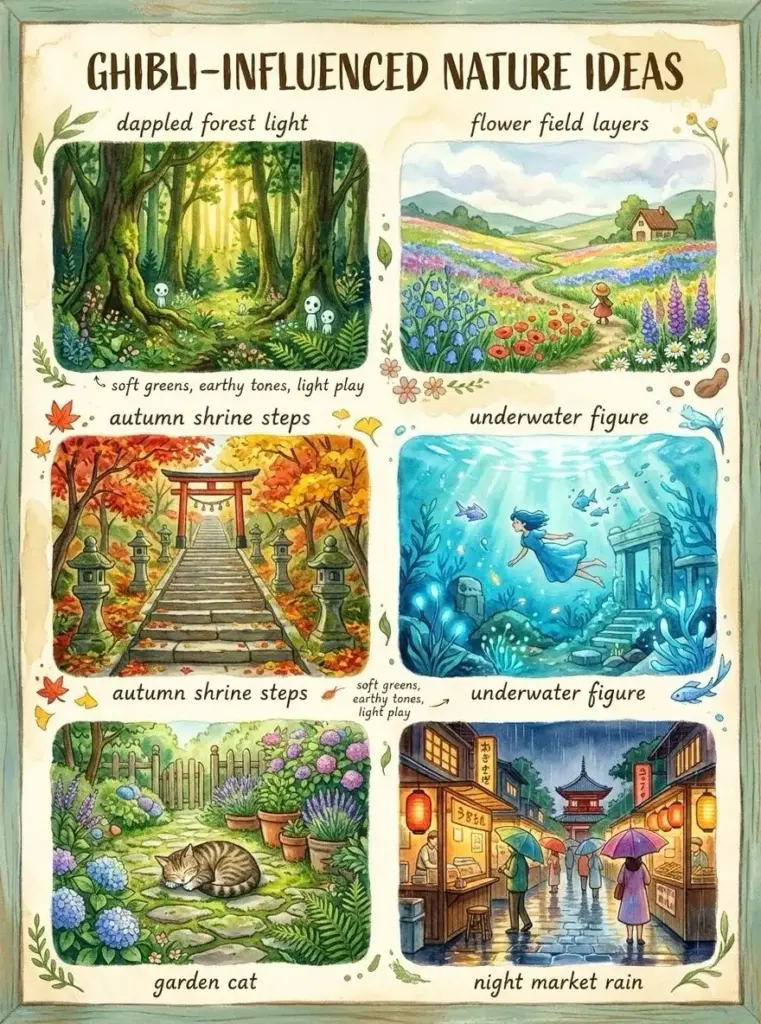
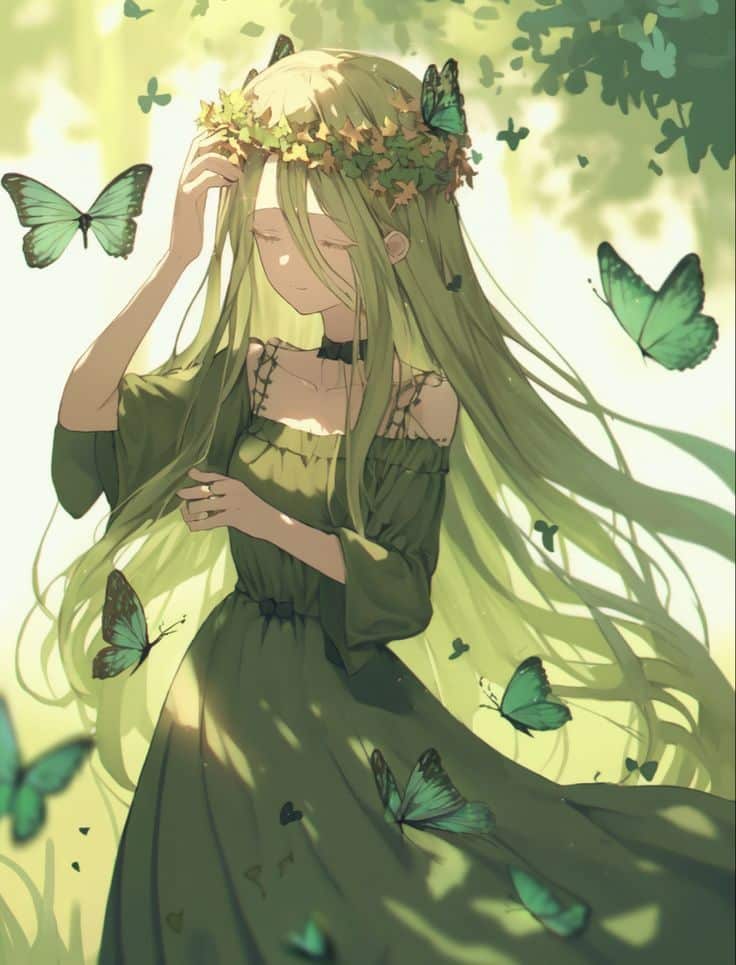
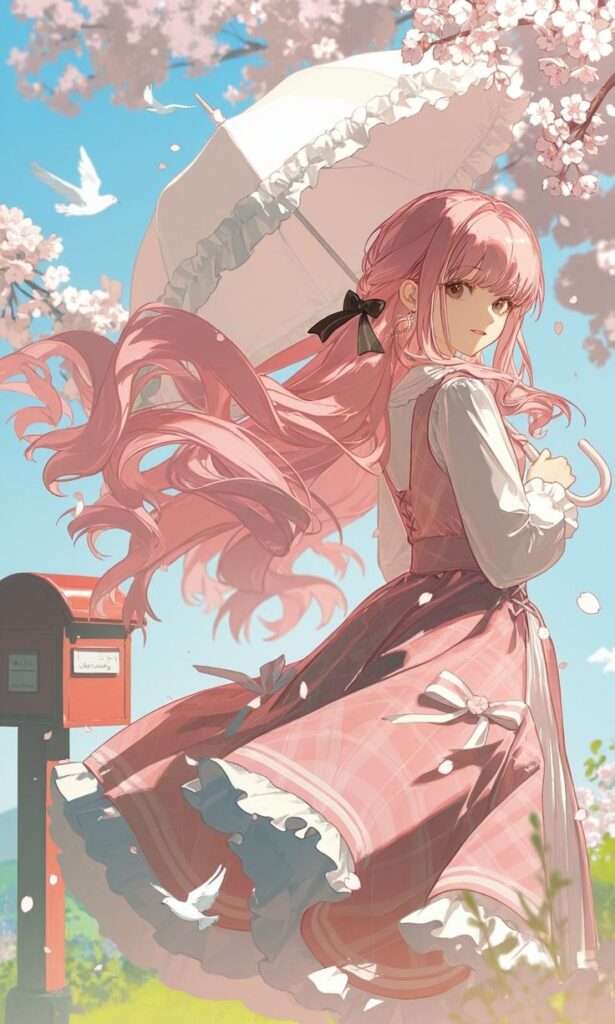
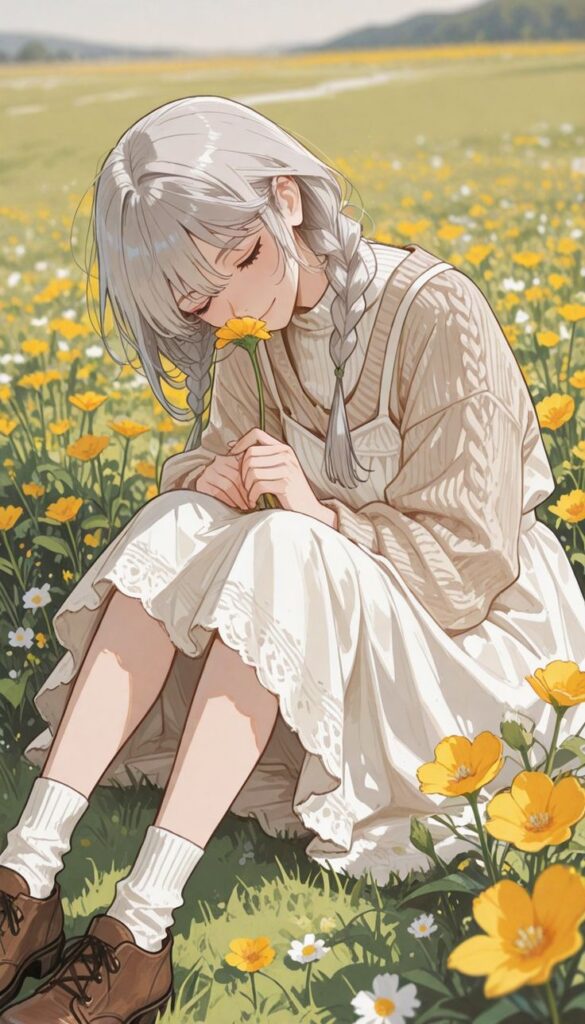
Studio Ghibli established a visual language for depicting the natural world in animation that has influenced anime drawing more profoundly than almost anything else — and that influence is, if anything, growing stronger in 2026 as artists push back against hyper-digital, high-contrast aesthetics with something softer and more grounded.
The core principle of Ghibli-influenced nature work is that environments have personality. A forest isn’t a backdrop — it has texture, light behaviour, scale, and its own kind of presence. Drawing in this aesthetic teaches the most transferable art skills on this list: understanding of light through complex environments, organic form drawing, and the patience to build depth through layered detail.
7. Sunlight Through Forest Canopy
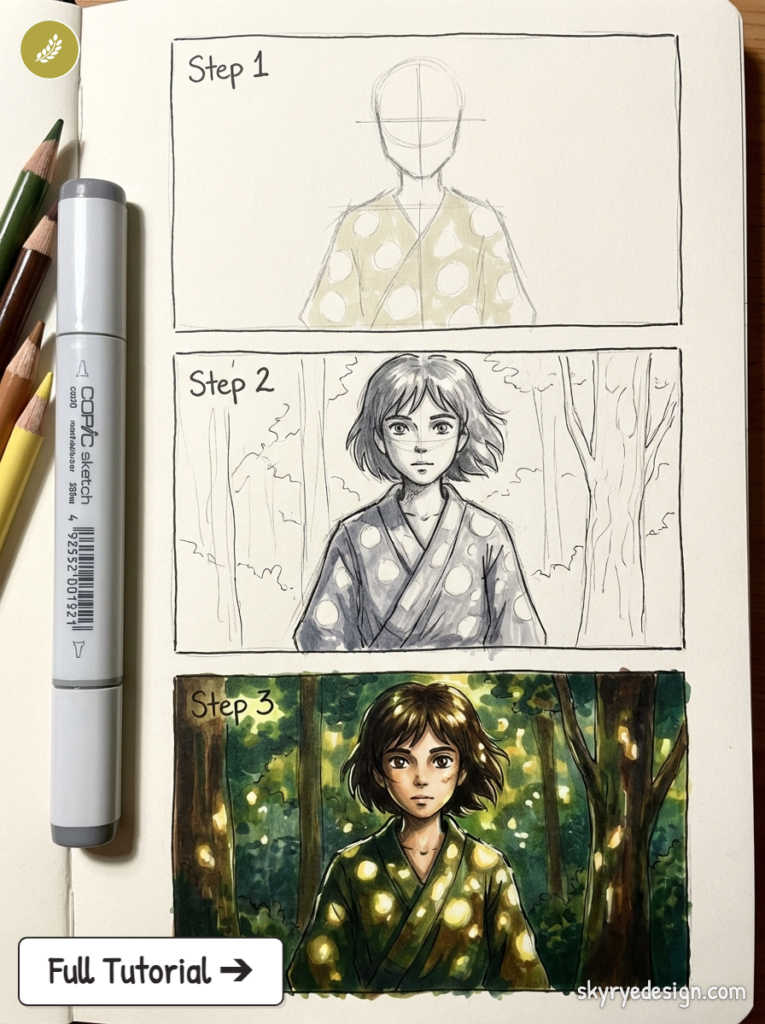
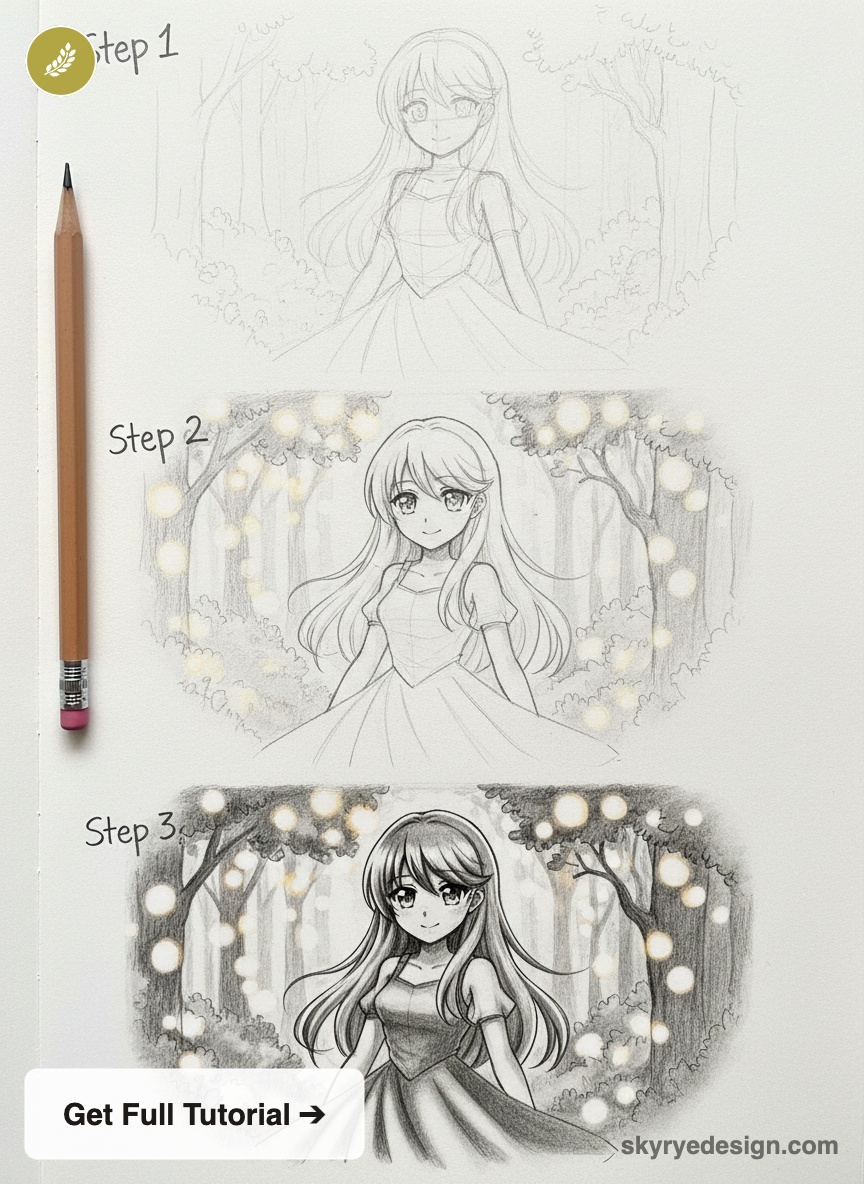
A character standing in dappled forest light — the kind where sunlight breaks through leaf cover and creates pools and shafts of warm light against cool shadow. The challenge is the light itself: each leaf casts a shadow, and the cumulative effect of thousands of small shadows creates the dappled pattern. You don’t draw every leaf — you draw the light pattern the leaves create, then suggest the leaves around it. This is a fundamental technique distinction that changes how the result reads.
Skill focus: Dappled light rendering, organic canopy drawing, foreground-background atmospheric perspective
8. Character in a Flower Field
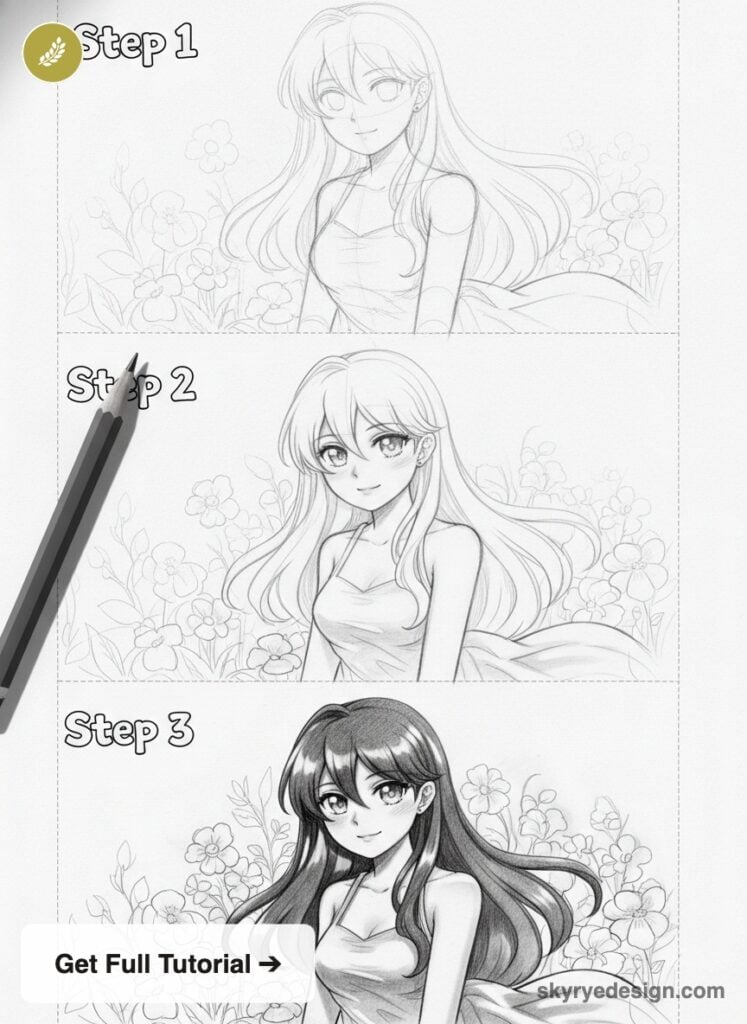
A figure in a field of tall flowers — poppies, sunflowers, lavender — where the flowers are close to the camera and the character is partially obscured by the foreground. The visual interest is in the layering: flowers in front of the character, character in front of more flowers, distant treeline behind everything. Each layer needs its own level of focus and detail.
Skill focus: Layered organic composition, foreground framing, depth-of-field suggestion in a flat medium
9. Shrine Steps in Autumn
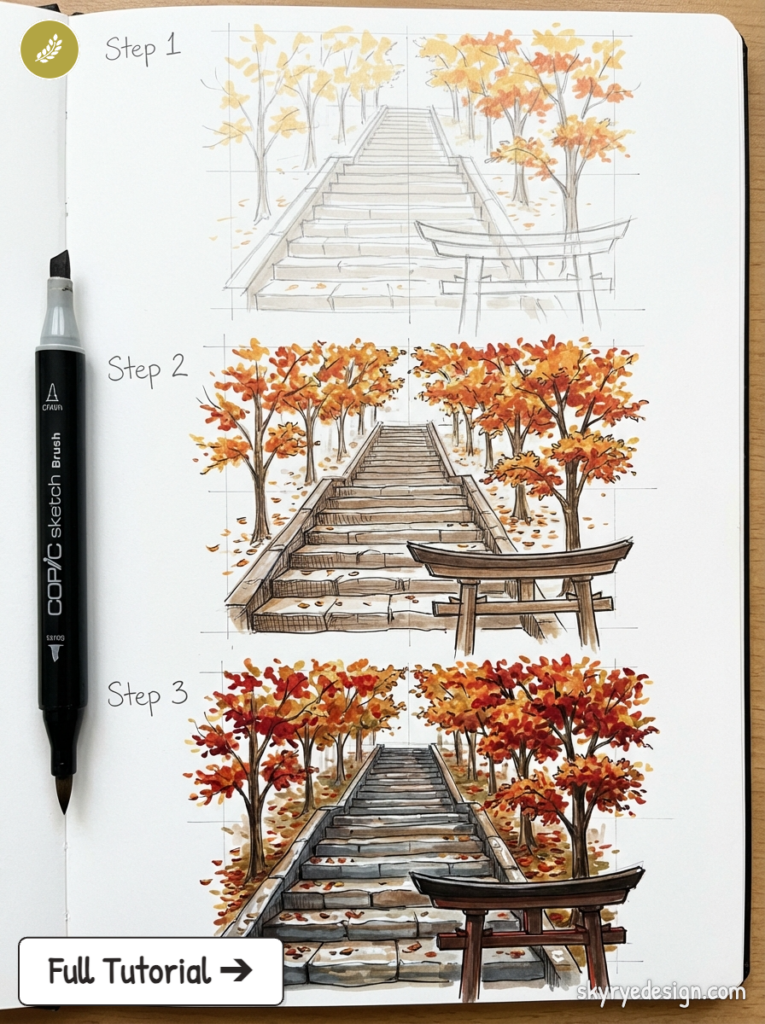
A Shinto shrine staircase ascending through autumn-coloured maple trees — the stone steps worn smooth, the torii gate visible at the top or bottom, fallen leaves on the stairs. This composition is visually iconic in anime precisely because it combines geometry (the stairs, the gate) with organic complexity (the leaves, the trees) in a way that’s immediately recognizable as ‘Japanese autumn.’ The leaves falling give you a motion element to work with.
Skill focus: Architecture + nature integration, autumn colour palette work, perspective on ascending stairs
10. Character Swimming Underwater
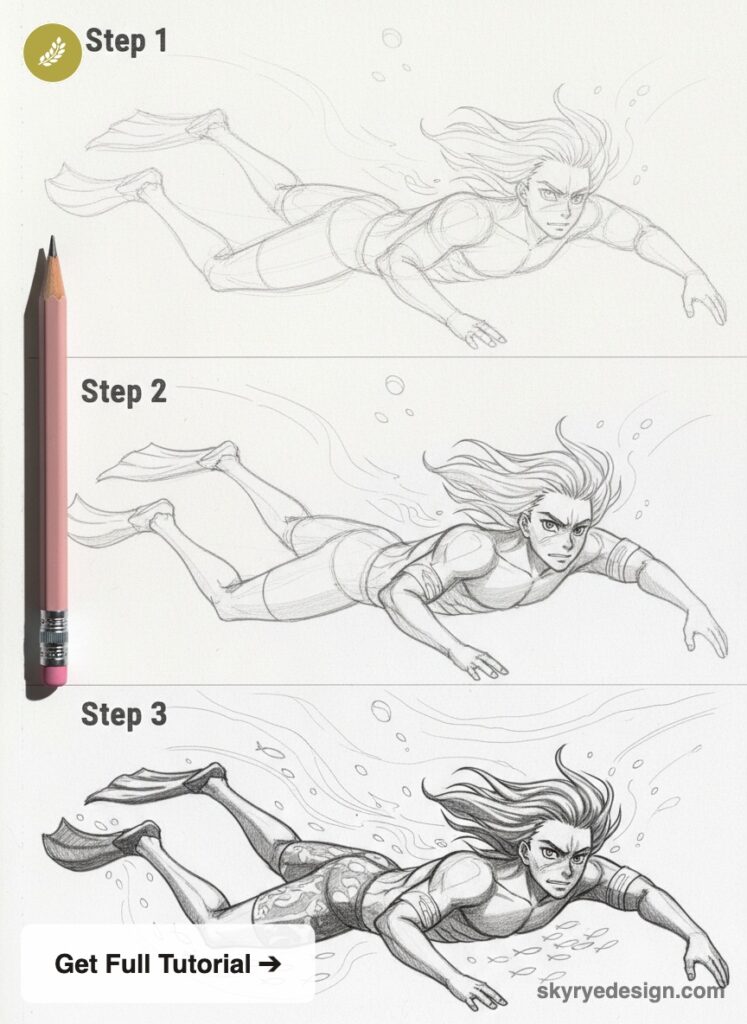
A figure seen from below or beside them, suspended in clear water — light refracting from above, bubbles rising, fabric and hair moving in the slow physics of underwater. Water physics behaves completely differently from air physics: hair fans out and moves in all directions; clothing doesn’t fall but floats; light creates moving caustic patterns on every surface.
Skill focus: Underwater light physics, fabric in fluid, body pose for a low-gravity environment
11. Cat in a Garden (Character Optional)
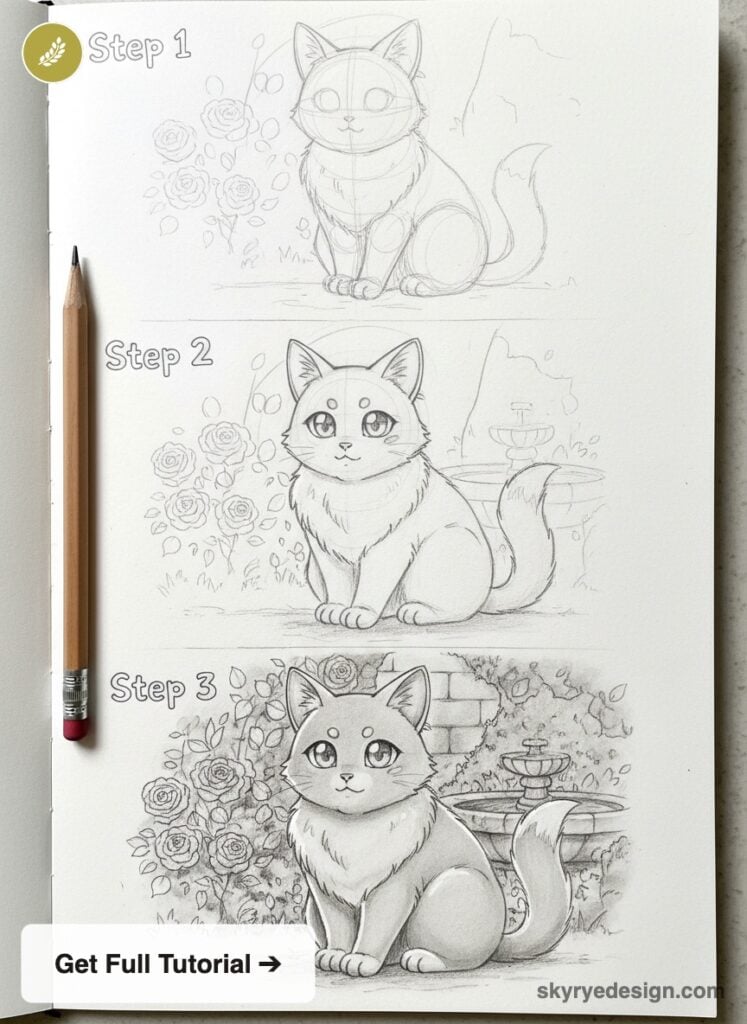
A cat — or several — in a sun-drenched garden. The cat as subject teaches animal anatomy, fur rendering, and the art of drawing something that doesn’t cooperate with being drawn (cats are rarely in the poses you want). Add a character sitting nearby reading or gardening if you want the human element, but the cat is the compositional focal point.
Skill focus: Animal anatomy and fur texture, sunlight in organic settings, secondary subject composition
12. Night Market in the Rain
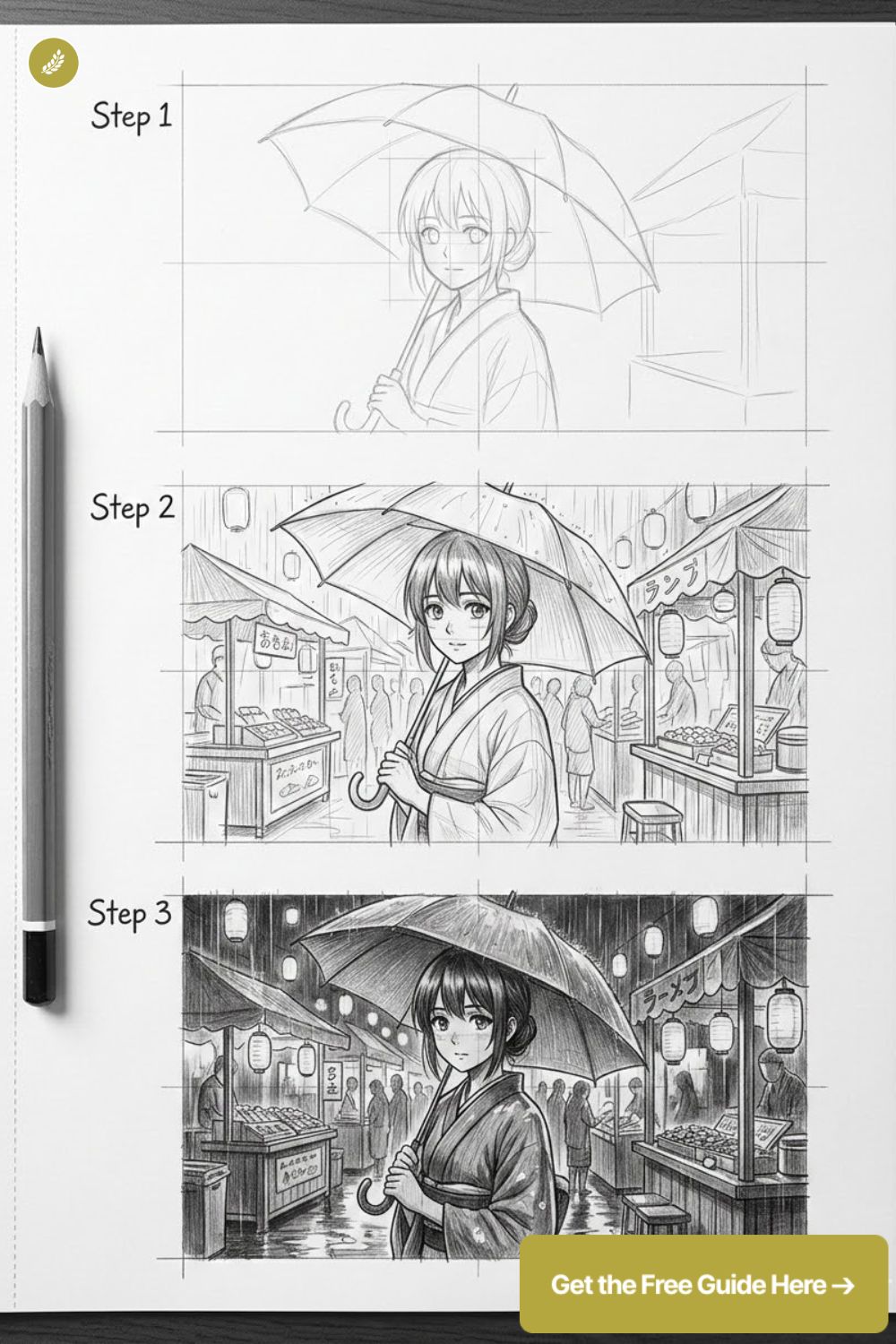
A traditional festival or night market scene — paper lanterns, food stalls, yukata-wearing figures, rain making the ground reflective. This idea is more complex than the others in this category because it requires crowd scene management (how many figures, how much detail in each), but the lantern light in rain creates one of the most atmospheric colour combinations available: warm orange-gold against cool grey-blue wet ground.
Skill focus: Crowd scene management, mixed light sources in rain, festival aesthetic colour work
✏ Technique tip: Study how light passes through leaves and water in photographs before drawing these. The specific way light refracts and scatters in natural environments has patterns you can learn to shortcut. Five minutes of photo study before each nature drawing session pays dividends.
Category 3: Cyberpunk and Urban Night — Neon and Shadow
Cyberpunk anime aesthetics reached a new cultural peak with Cyberpunk: Edgerunners (2022) and the sustained popularity of works like Ghost in the Shell, and in 2025–2026 the visual vocabulary has matured into something more interesting than the early-wave neon-everything approach. The sophisticated version of cyberpunk anime aesthetics is about contrast: the warmth of human presence against the cold geometry of engineered city environments.
Technically, this category teaches the most advanced lighting skills on this list. Urban night scenes with multiple light sources — neon signs, street lamps, vehicle headlights, holographic projections, phone screens — require you to understand how coloured light mixes, how it falls differently on different surfaces, and how to establish reading hierarchy when every surface in the scene is illuminated differently.
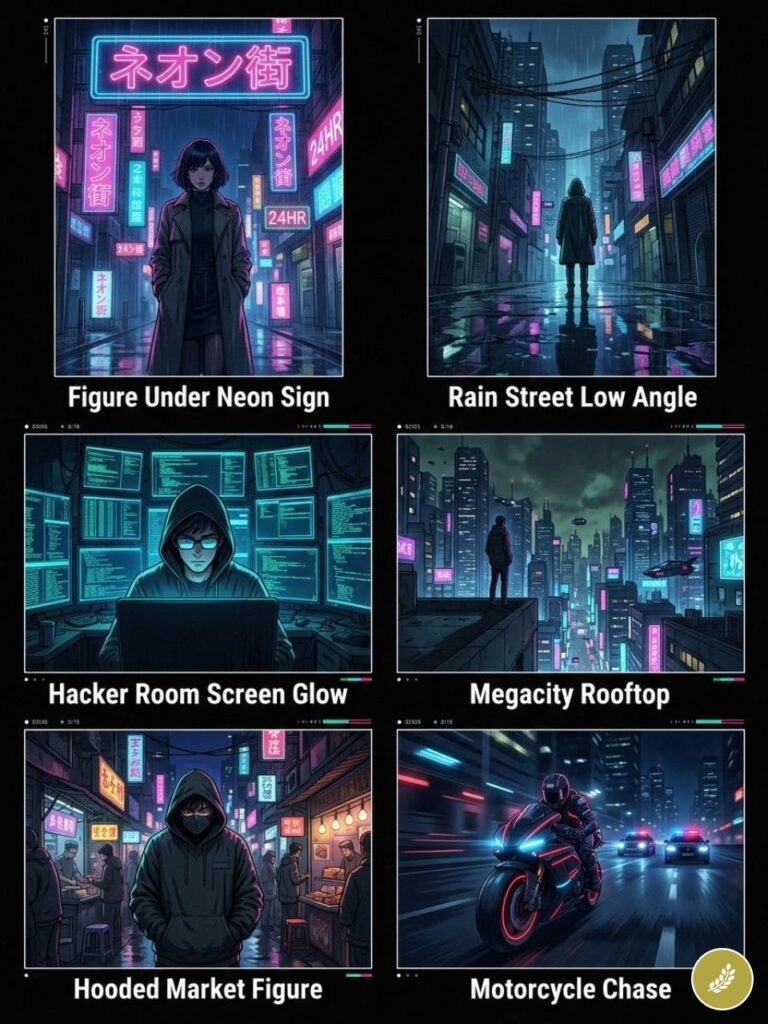
13. Figure Under a Neon Sign
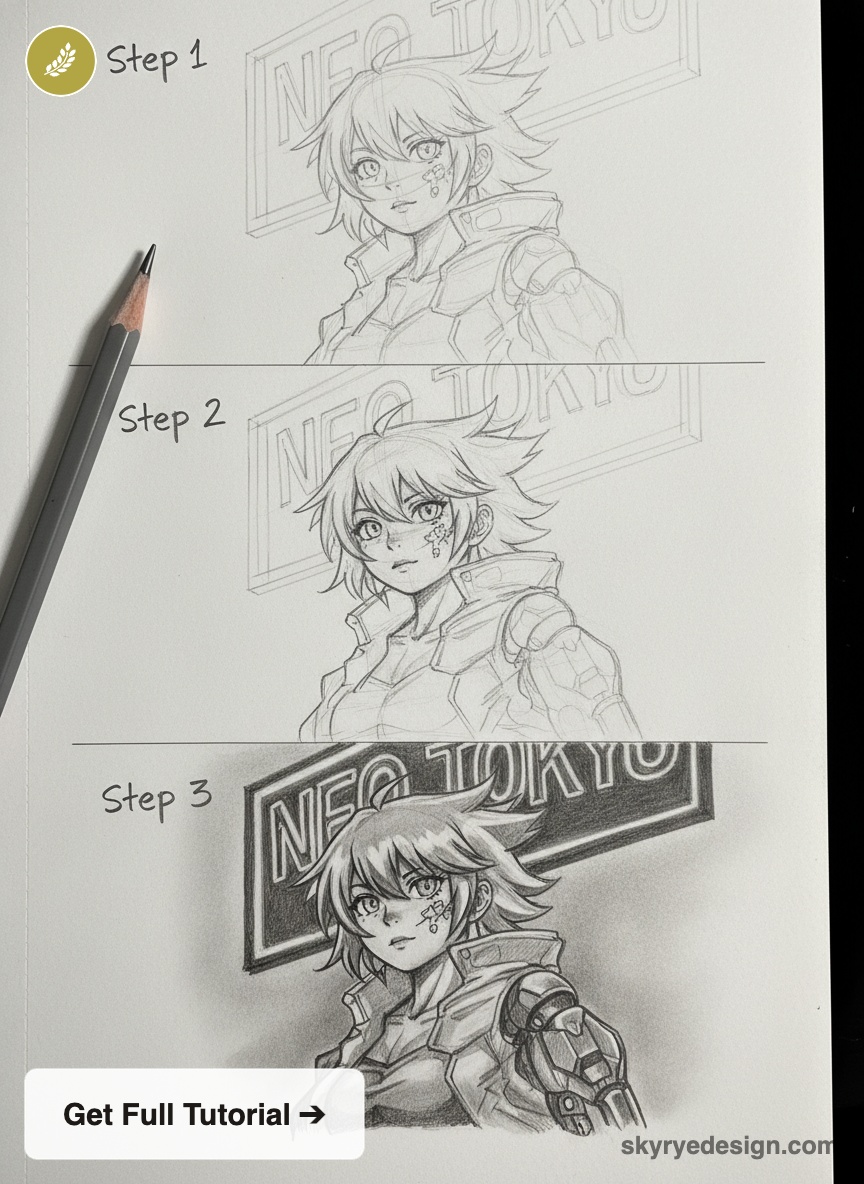
A single character standing or sitting beneath a large neon sign, the coloured light washing over them from above — pink, cyan, or orange neon casting hard-edged shadows across their face and clothing. The sign doesn’t need to be legible text; it can be a shape or colour field. This is one of the strongest single-figure lighting studies available because the neon colour is so obvious and saturated that any error in how you render its falloff is immediately visible.
Skill focus: Coloured light falloff on skin and fabric, hard neon shadow rendering, single dominant light source
14. Rainy Cyberpunk Street — Low Angle
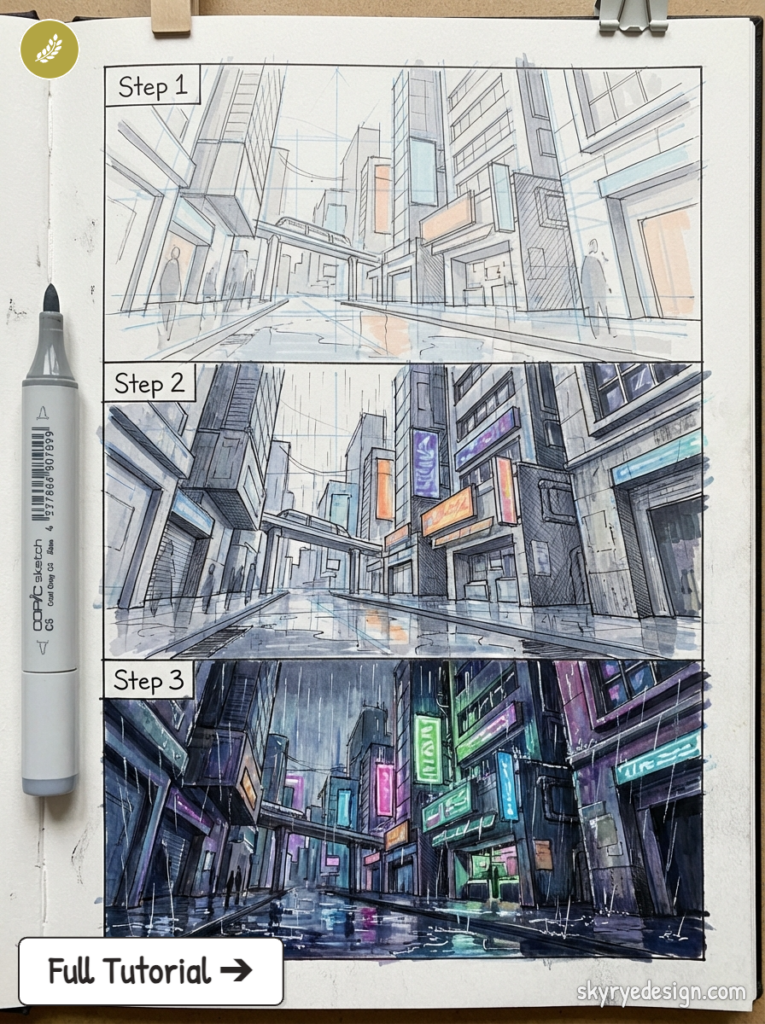
An almost ground-level perspective looking up at a figure walking through a neon-lit rain — the wet ground reflecting every light source, the figure small against towering lit buildings. The low angle creates extreme perspective foreshortening on the buildings and a dramatically elongated foreground. The puddle reflections give you a second, inverted composition to work with below the actual scene.
Skill focus: Extreme perspective and foreshortening, puddle reflection rendering, multi-source urban light mixing
15. Character in a Hacker’s Room
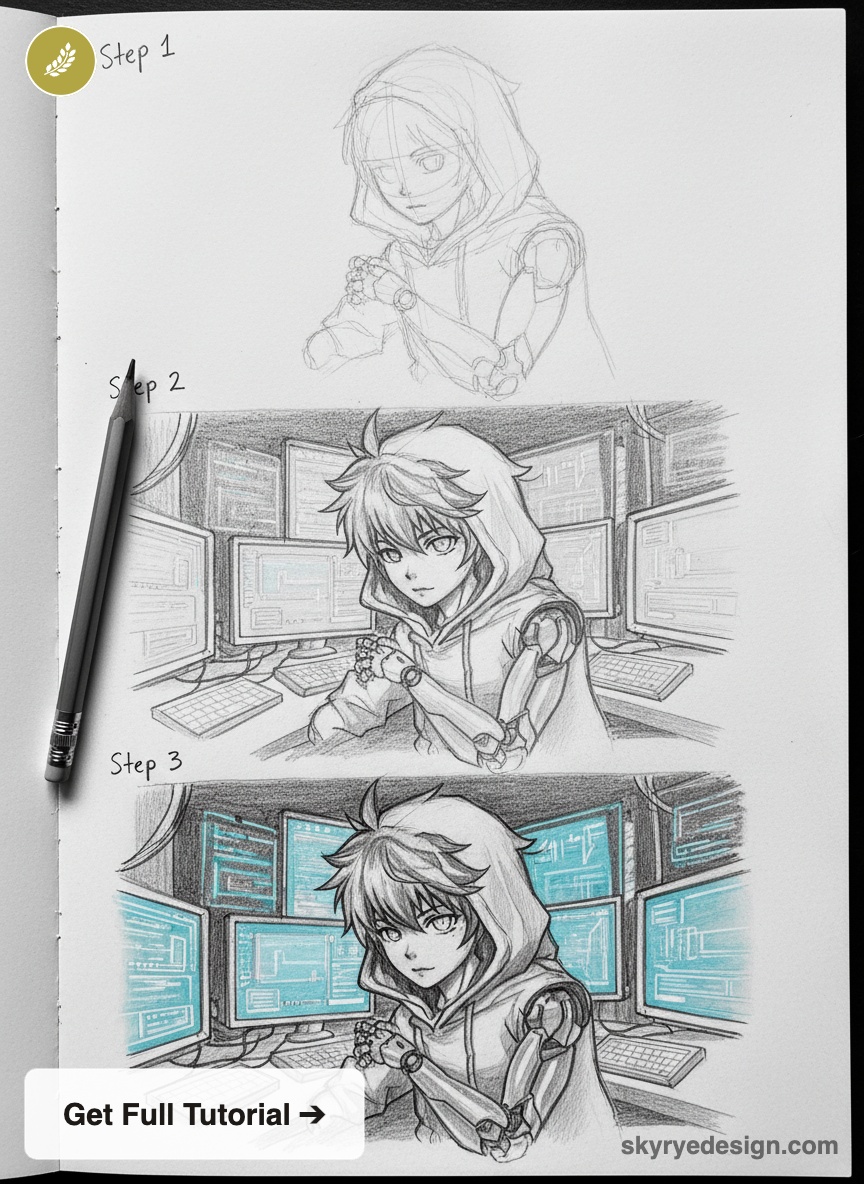
A figure surrounded by multiple monitors, cables, server equipment — the blue-white glow of multiple screens illuminating their face from below and sides simultaneously. This is a genuinely complex multi-light-source interior. The screen glow creates cool, even light; any secondary sources (a window, a desk lamp) layer over this. The character’s face should show the light mixing — blue-lit forehead, different angle on the jaw.
Skill focus: Screen glow rendering, multiple monitor composition, cool ambient mixed-source lighting
16. Rooftop Overlooking the Megacity
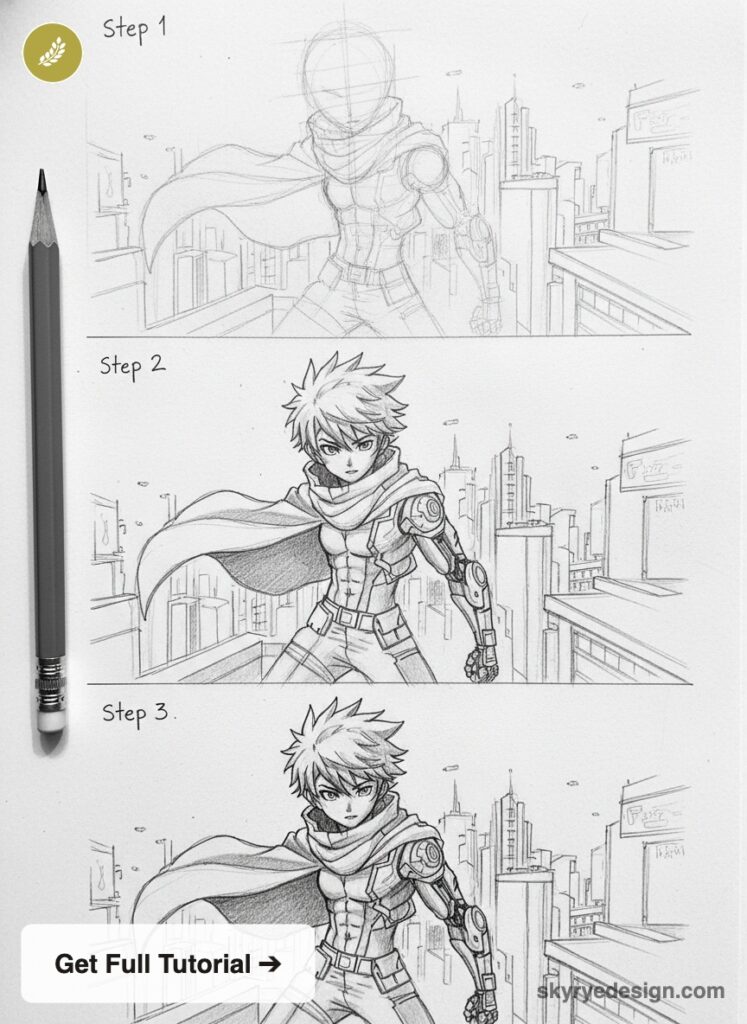
A character on a high rooftop, the vast city spread below them — building lights becoming an abstract light-field in the distance, the character’s silhouette in the middle ground. This is a scale study: making the city feel genuinely vast requires specific choices about how you render the distance. The aerial perspective rules (things get lighter, bluer, and less detailed as they recede) apply differently in a lit night scene.
Skill focus: Aerial perspective in night scenes, scale through atmospheric distance, city light abstraction
17. Hooded Figure in a Crowded Market
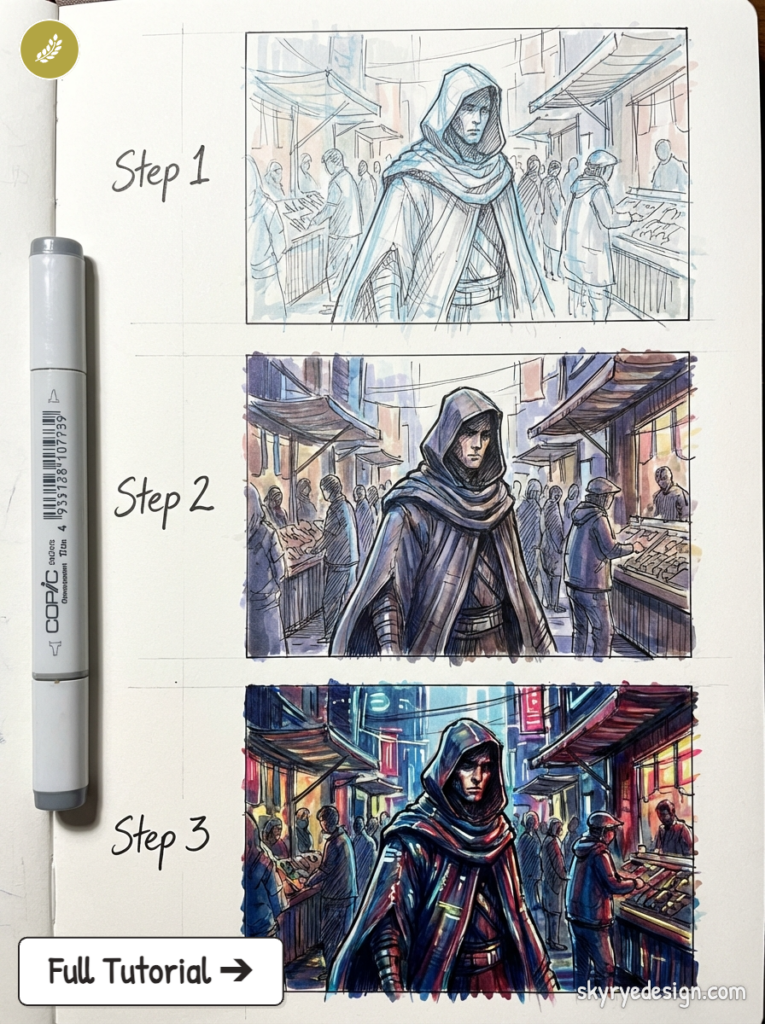
A figure with a hood or mask — face partially obscured — moving through a dense, lit market crowd. The cyberpunk market aesthetic combines physical and digital: holographic signage, diverse crowds, the clash of different culture aesthetics. The hooded/masked figure creates narrative mystery while also giving you an easier subject (you don’t need to fully render a face).
Skill focus: Crowd scene at medium density, figure-ground relationship in busy environments, narrative mystery in composition
18. Motorcycle Chase, Night
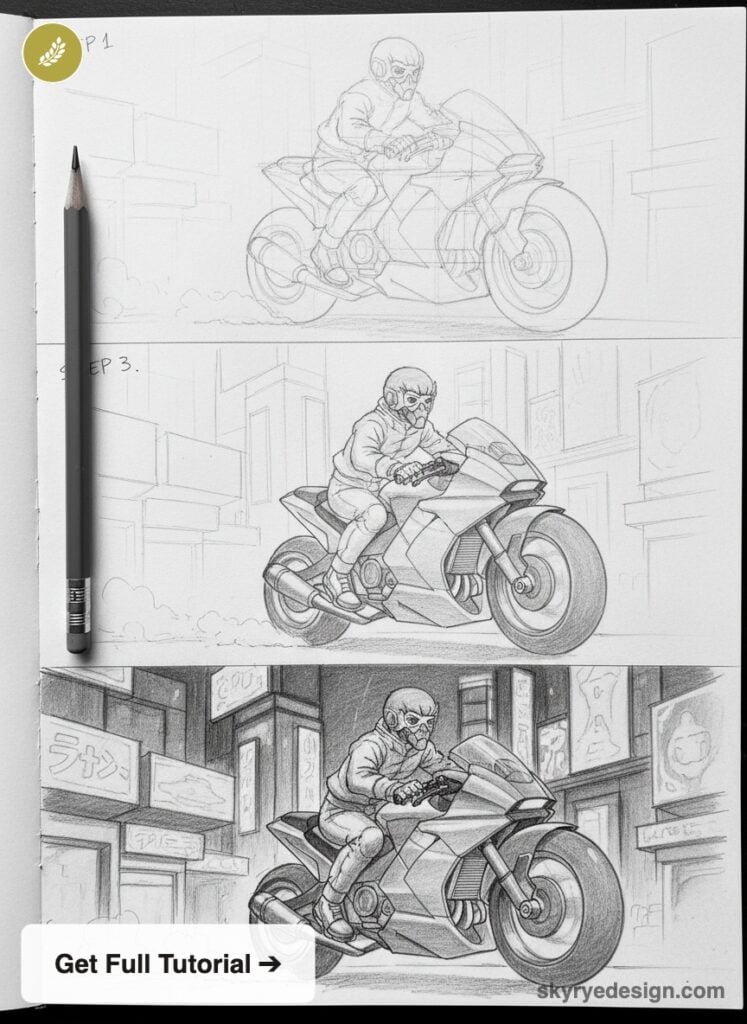
Two or more figures on motorcycles in a night chase — extreme foreshortening on the lead vehicle, motion blur on the surroundings, the neon streaks of streetlights becoming horizontal lines of colour. This is the highest-difficulty idea in this category: it requires vehicle drawing, figure foreshortening, motion representation, and night lighting simultaneously. But the component skills are each individually teachable.
Skill focus: Vehicle perspective drawing, motion blur representation, extreme foreshortening of objects coming toward viewer
✏ Technique tip: For all cyberpunk ideas: set your background dark first (near-black), then add your light sources as colour additions. Don’t draw a light-coloured scene and darken it — build from darkness up. This is how night scenes work photographically, and it trains a different, more accurate light-thinking approach.
Category 4: Fantasy and Magic — Inventing Worlds
Fantasy anime drawing ideas are the category with the widest possible scope — from the approachable warmth of cottagecore witch aesthetics to the genuinely complex world-building challenges of alien landscapes and magical architecture. What ties them together is that they all require you to invent rather than observe: the world you’re drawing doesn’t exist, so you’re responsible for its internal logic.
This is why fantasy drawing ideas develop different skills than the other categories. You’re not studying a reference and rendering it — you’re making design decisions about what a thing looks like and then rendering your own invention consistently. That design thinking layer is what separates illustration from drawing, and fantasy is where it lives.
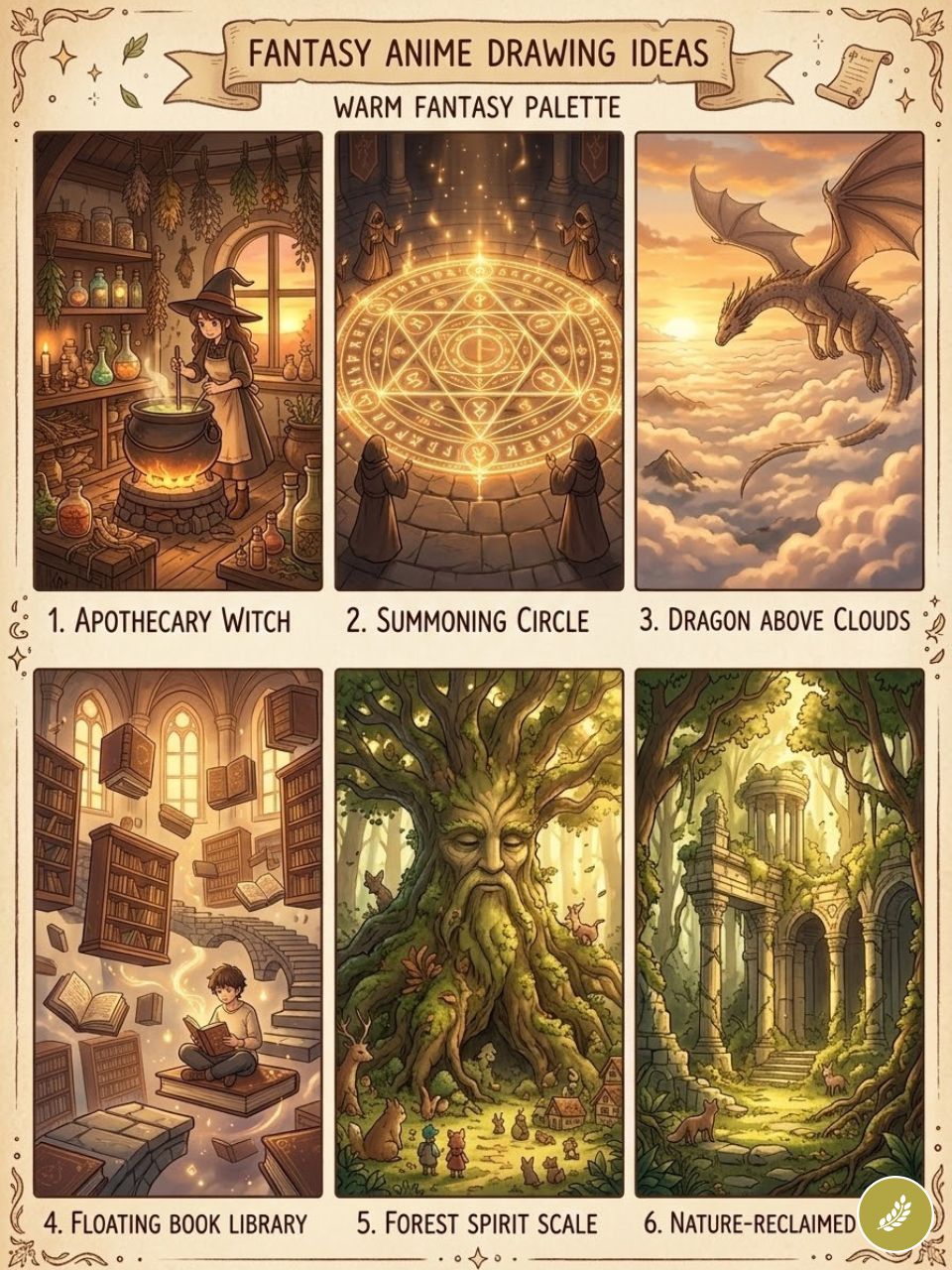
19. Witch in an Apothecary
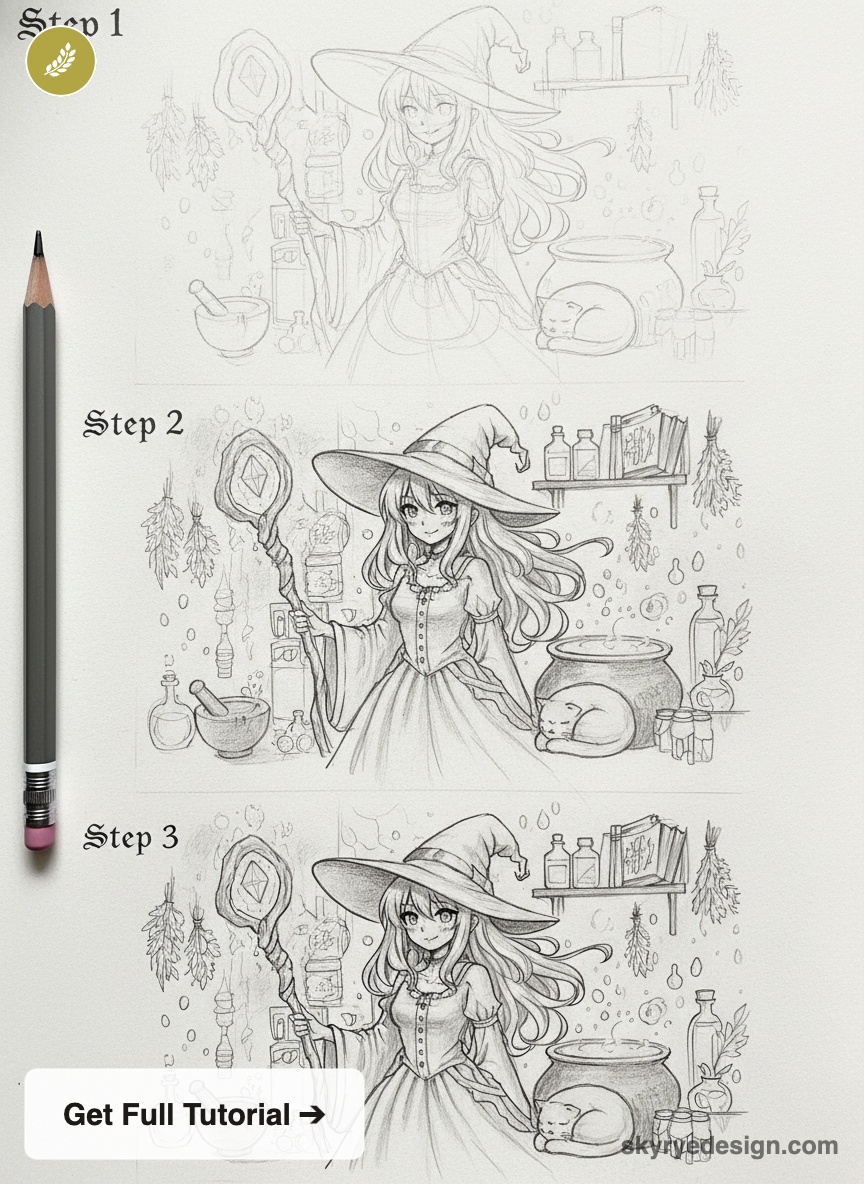
A witch character working in an apothecary — surrounded by shelves of bottles and jars, dried herbs hanging from the ceiling, a cauldron or mortar and pestle, candlelight and firelight. The subject is extremely popular in current cottagecore-adjacent fantasy aesthetics, and for good reason: it gives you a character, a complex interior, multiple light sources (candle, fire, glowing potions), and dozens of interesting small objects to design and render.
Skill focus: Interior design invention, multiple practised still-life objects, warm magical light sources
20. Character Summoning Spell
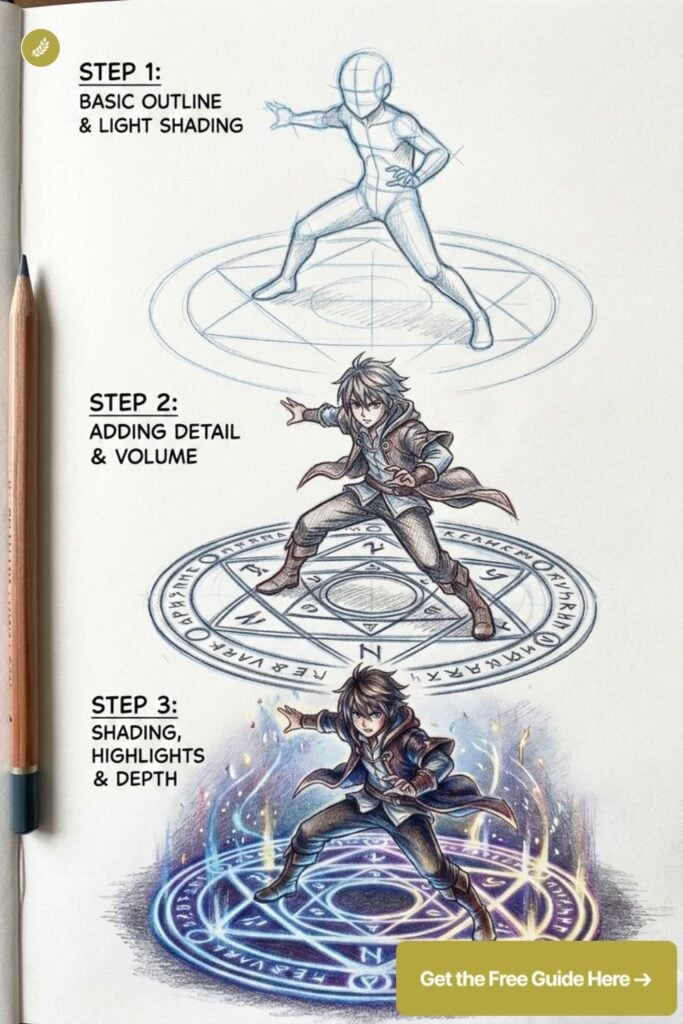
A figure in the moment of casting — geometric magic circle glowing on the floor beneath them, light radiating upward across their face, the spell effect itself (particles, geometric light, distortion) filling the space above. This idea teaches you to draw the moment of peak magical effect: the magic circle design, the light radiating upward, and the pose that signals ‘summoning’ rather than ‘just standing with light around them.’
Skill focus: Luminescent geometric design, upward-radiating light on face, magic effect visual grammar
21. Dragon and Rider Above the Clouds
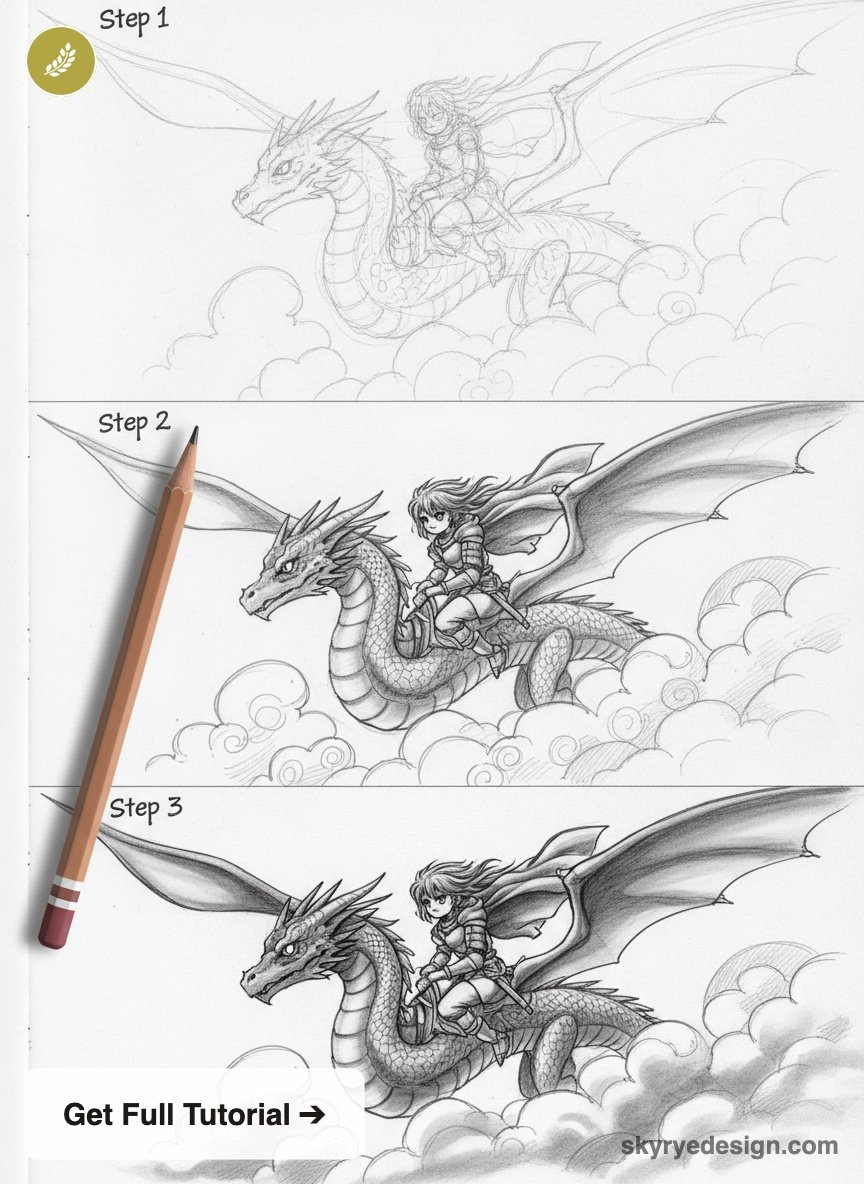
A rider on a large dragon’s back, high above a cloud layer — only clouds visible below, perhaps distant mountains or floating islands visible at the horizon. The cloud layer gives you a clear compositional floor and allows the dragon’s scale to read against something familiar. Dragon anatomy is challenging — approach it as four-limbed animal anatomy plus wings, with its own proportional system to establish.
Skill focus: Large animal anatomy, cloud perspective from above, scale relationships in aerial composition
22. Magical Library — Floating Books
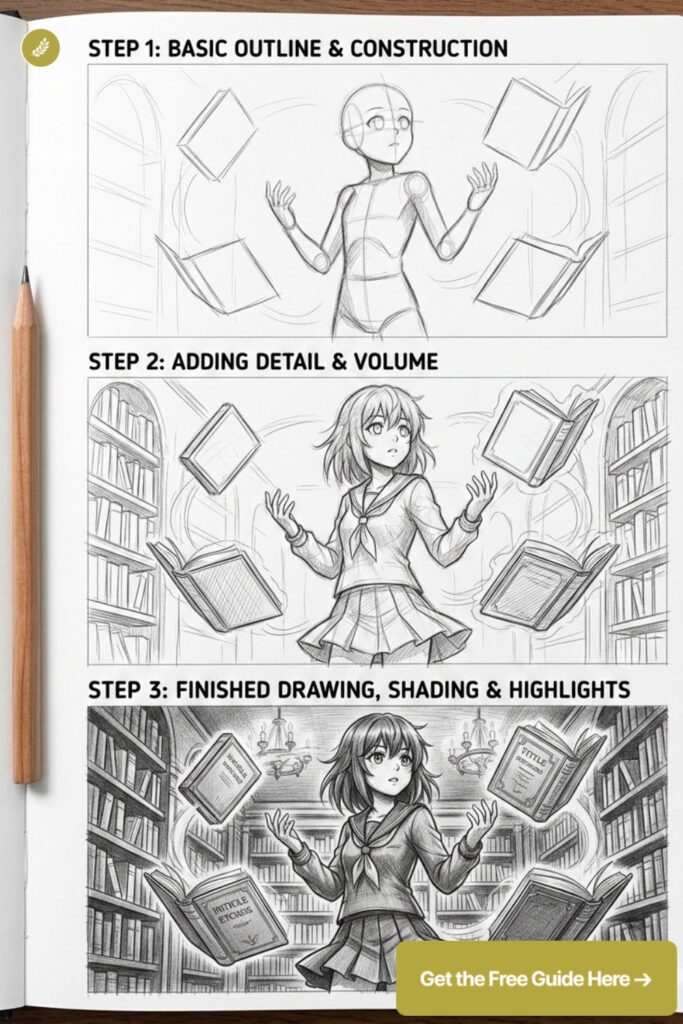
A grand library with books floating independently — a student reaching for a volume while standing on a library ladder, books drifting at different heights, warm candlelight from chandeliers below. This composition rewards architectural detail: the library’s structure (shelves, arches, reading alcoves) gives you the geometry to anchor the fantastical element of the floating books.
Skill focus: Architecture with fantasy integration, staged composition with multiple elements, warm interior atmosphere
23. Forest Spirit Encounter
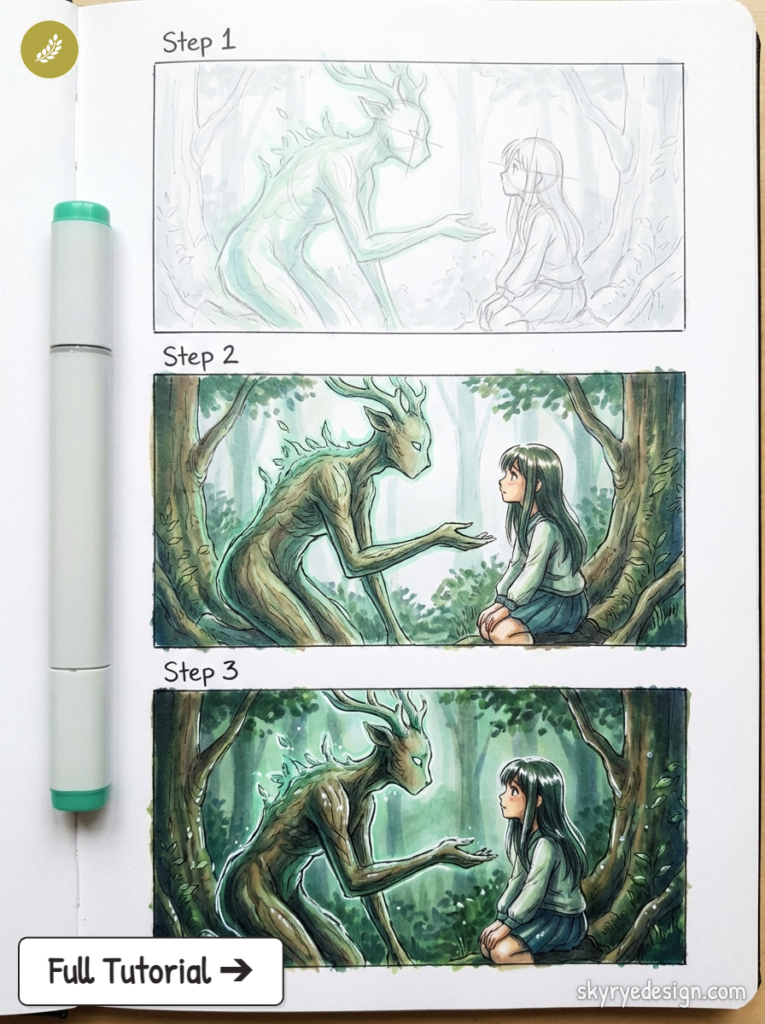
A small human figure encountering a large nature spirit in a forest — the spirit made of ancient wood and glowing moss and light, enormous relative to the figure. Scale contrast is the compositional engine of this idea: the human very small, the spirit filling most of the frame, the encounter occurring in the middle ground. This is quintessential Ghibli-adjacent fantasy territory.
Skill focus: Scale contrast composition, organic spirit design, character emotional response to overwhelming subject
24. Ruins Reclaimed by Nature
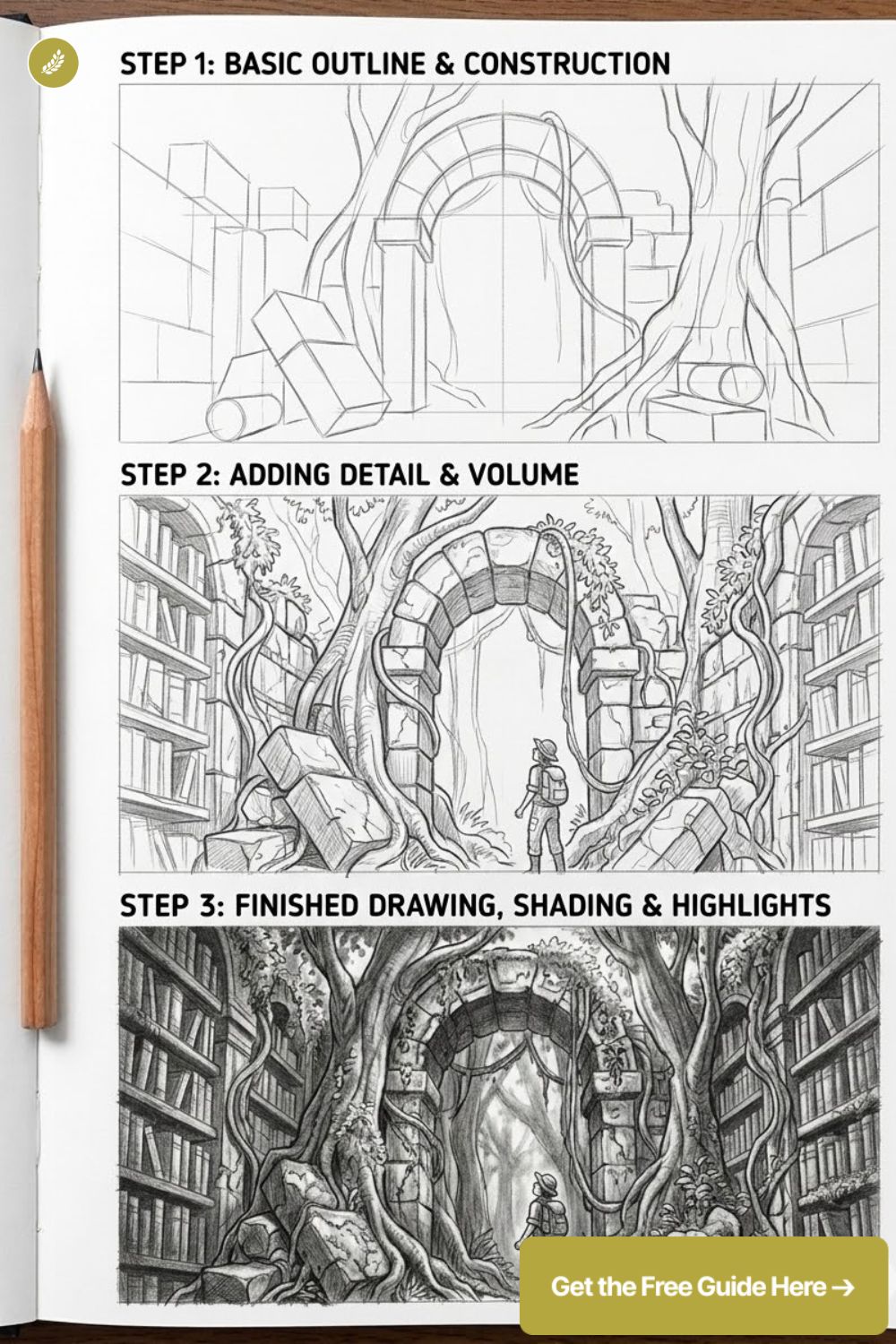
An ancient ruin — stone arches, collapsed walls, crumbling statues — completely overgrown with vines, moss, flowering plants, trees growing through the foundations. The tension between the human geometry of the structure (straight lines, intentional architecture) and the organic chaos of the plant life is the visual subject. A figure exploring the ruins gives you human scale and narrative.
Skill focus: Architecture-meets-organic integration, aged surface texture rendering, multiple material types in one composition
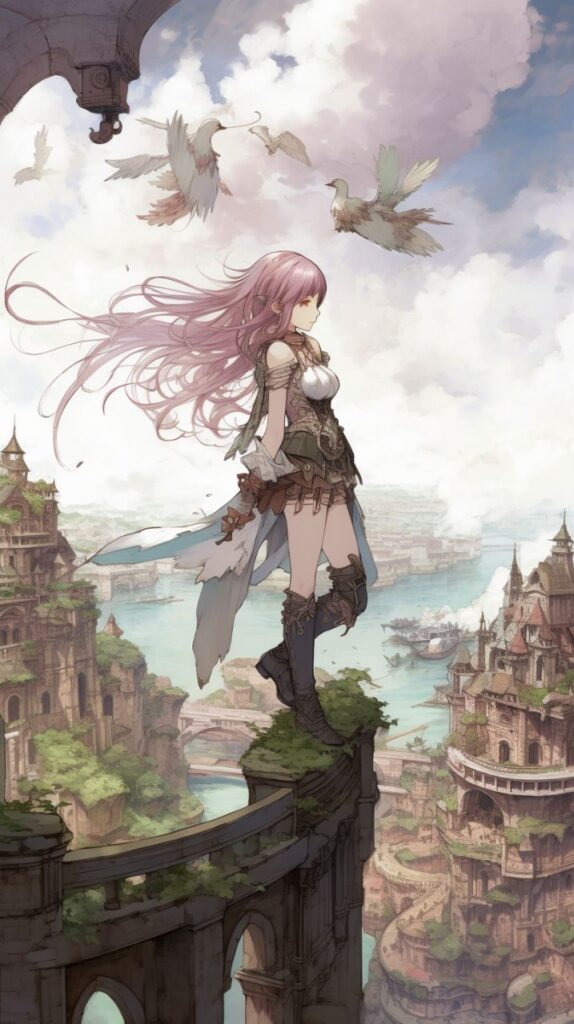
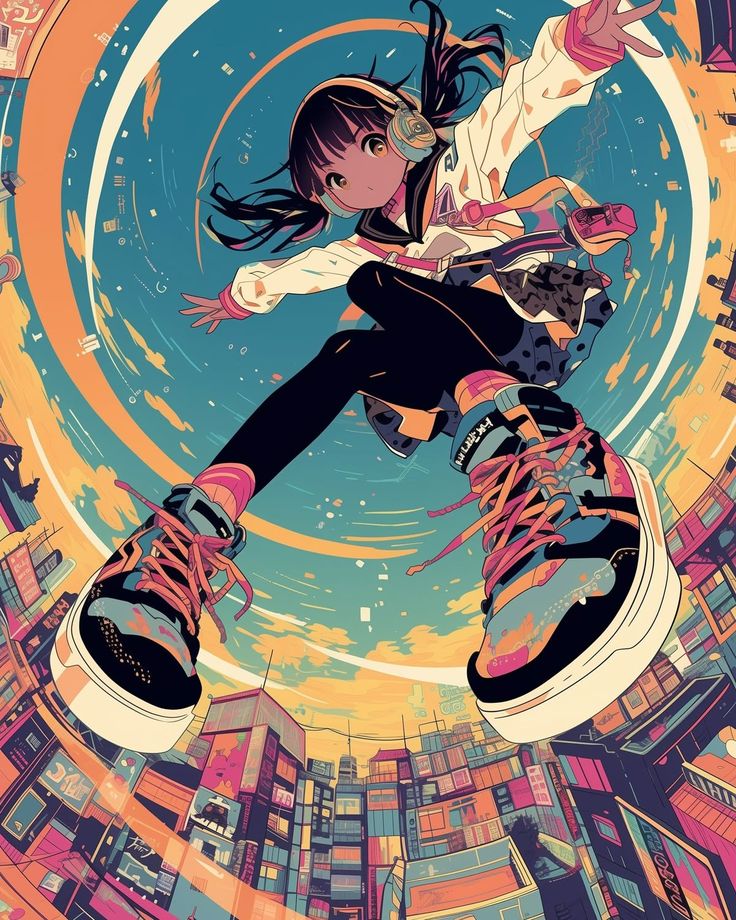
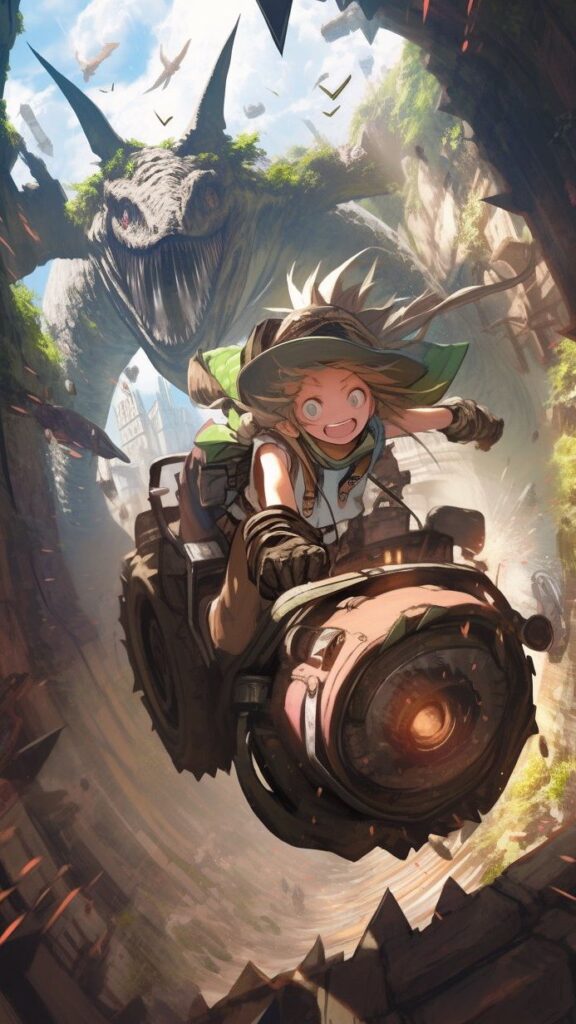
✏ Technique tip: For fantasy ideas: design your world consistently before you draw it. Decide on one or two rules about how magic looks or how the world’s physics work, then draw from those rules. Arbitrary visual choices make fantasy feel hollow; rule-bound visual choices make it feel real.
Category 5: Emotional Character Studies — Drawing What Can’t Be Said
The most technically demanding anime drawing ideas aren’t the ones with the most complex environments. They’re the ones that require you to communicate something invisible — grief, longing, tenderness, pride — through the way a body is positioned and a face is composed.
Emotional character studies are the category that separates anime artists who draw attractive people from ones who draw characters you actually care about. Every anime artist hits a plateau where their technical skills are solid but their drawings feel empty — emotionally generic. The way through that plateau is deliberate practice with specific emotional subjects. These are those subjects.
25. The Moment Before Crying
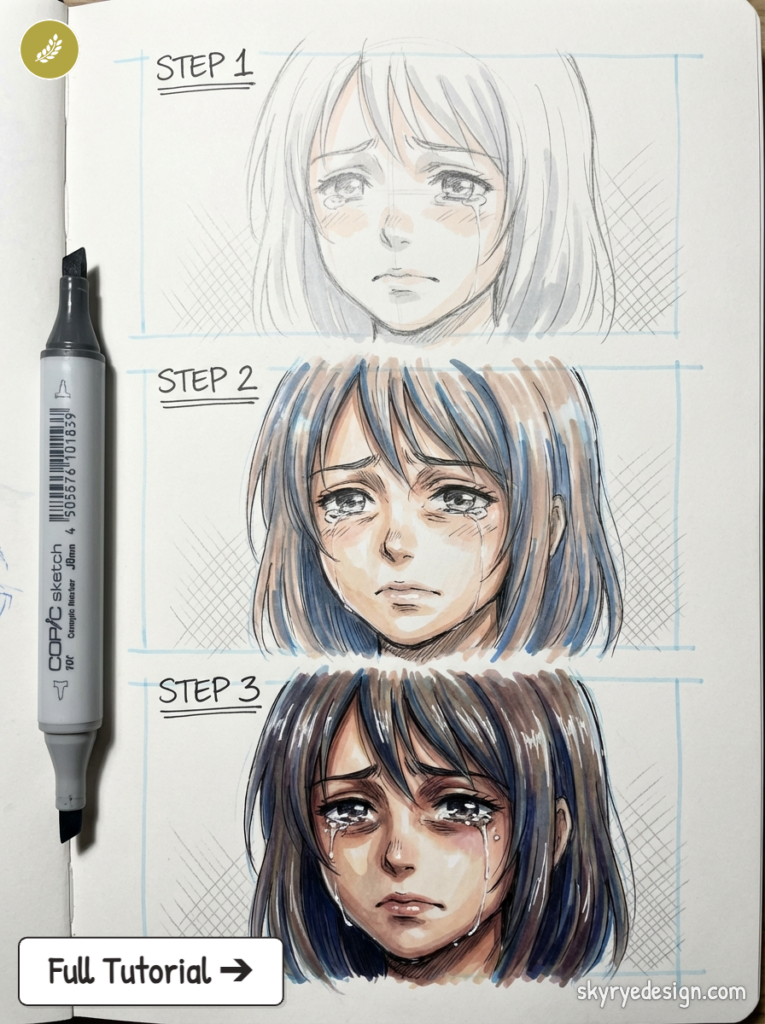
A face caught in the specific micro-expression between controlled emotion and the breaking point — jaw slightly tense, eyes bright, lower lip barely compressed. Not full crying (easier to draw) and not fully controlled (also easier). This specific in-between state is where the most emotionally resonant anime art lives, and it requires very precise control of the small muscles around the eyes and mouth.
Skill focus: Micro-expression drawing, tear rendering, the specific anatomy of emotion suppression
26. Reunion After Long Separation
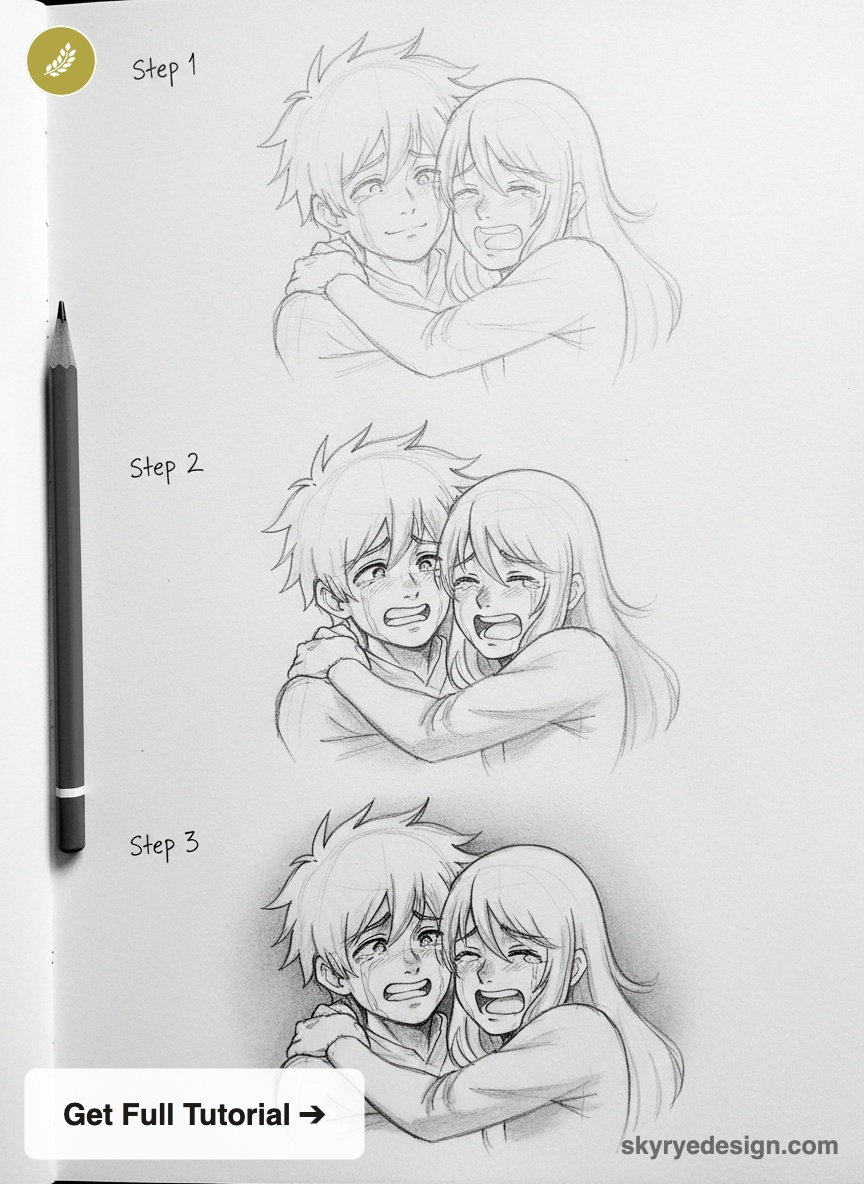
Two characters in the moment of reunion — the specific body language of people who haven’t seen each other in a long time making contact again. This requires you to draw two bodies in close physical relationship, which is itself technically demanding, while also communicating the emotional weight through pose, touch, and expression simultaneously.
Skill focus: Two-figure close composition, touch and physical contact drawing, dual emotional expression
27. Pride in Exhaustion
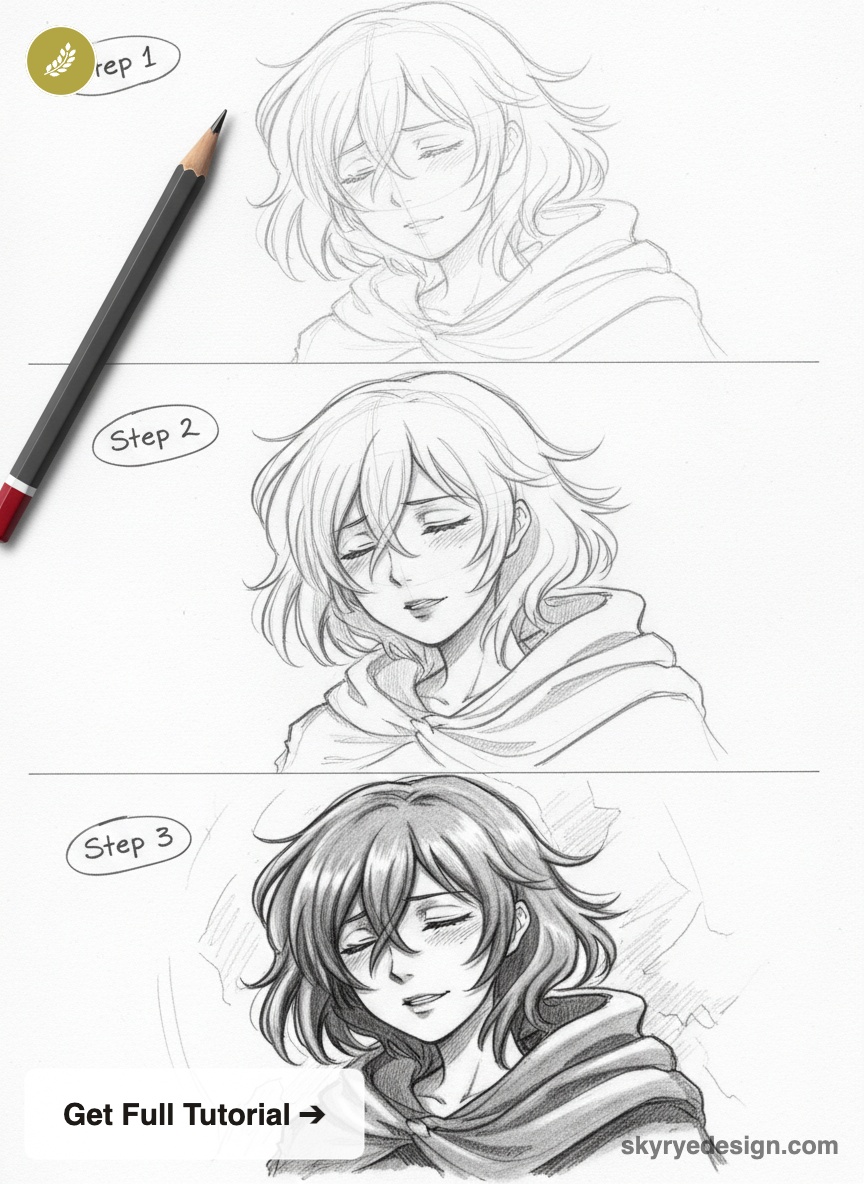
A character who has just accomplished something difficult — exhausted, maybe injured, leaning on something for support — but with an expression of deep satisfaction rather than suffering. This specific emotional combination (physical low, emotional high) is one of the most human experiences and one of the hardest to draw because the body signals defeat while the expression must clearly signal victory.
Skill focus: Contradictory body-emotion expression, post-effort anatomy, light that signals accomplishment
28. Grief in an Empty Room
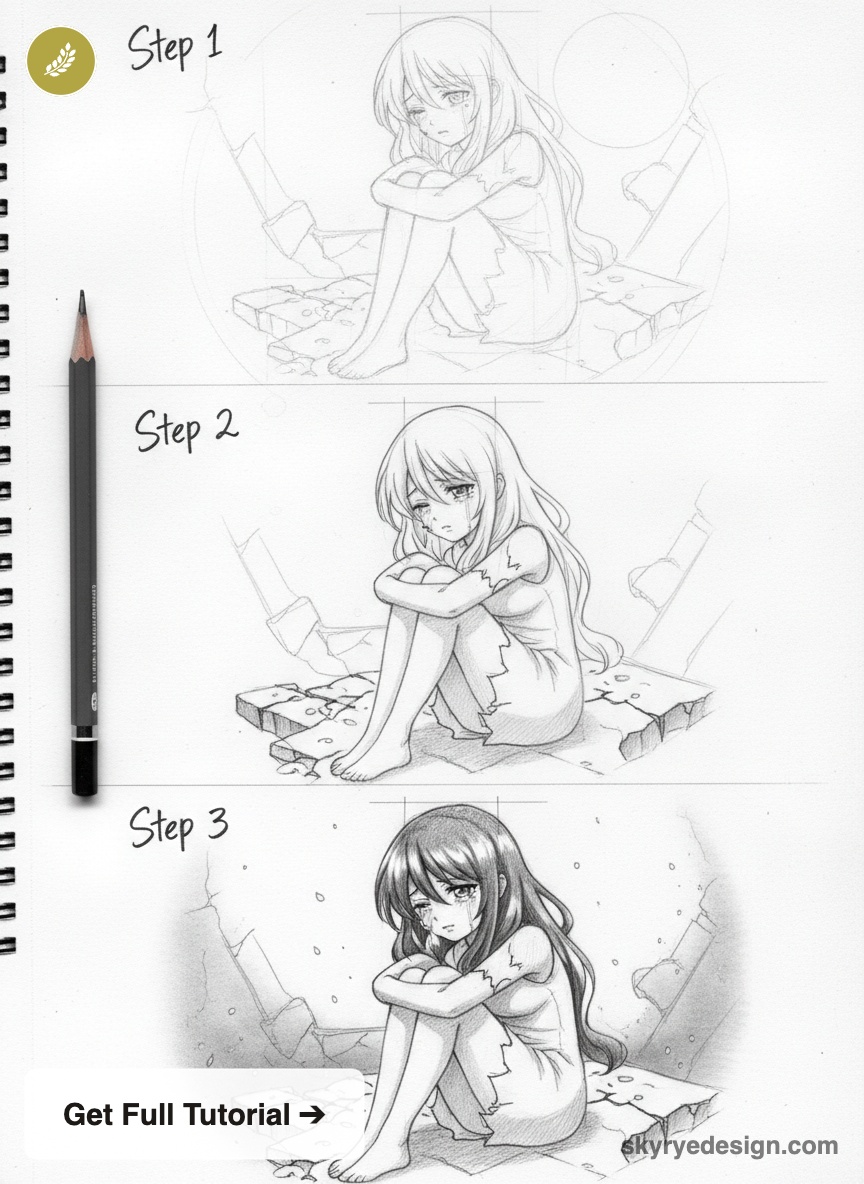
A character alone in a space that used to contain someone else — the emotional content communicated through the room itself (a second chair, an unused cup, a space on a shelf) as much as through the figure’s pose. This is environment-as-emotion: the room’s composition tells the story rather than the character’s face needing to carry everything.
Skill focus: Environmental storytelling, loss depicted through absence, character pose in grieving stillness
29. Quiet Tenderness — Hand-Holding
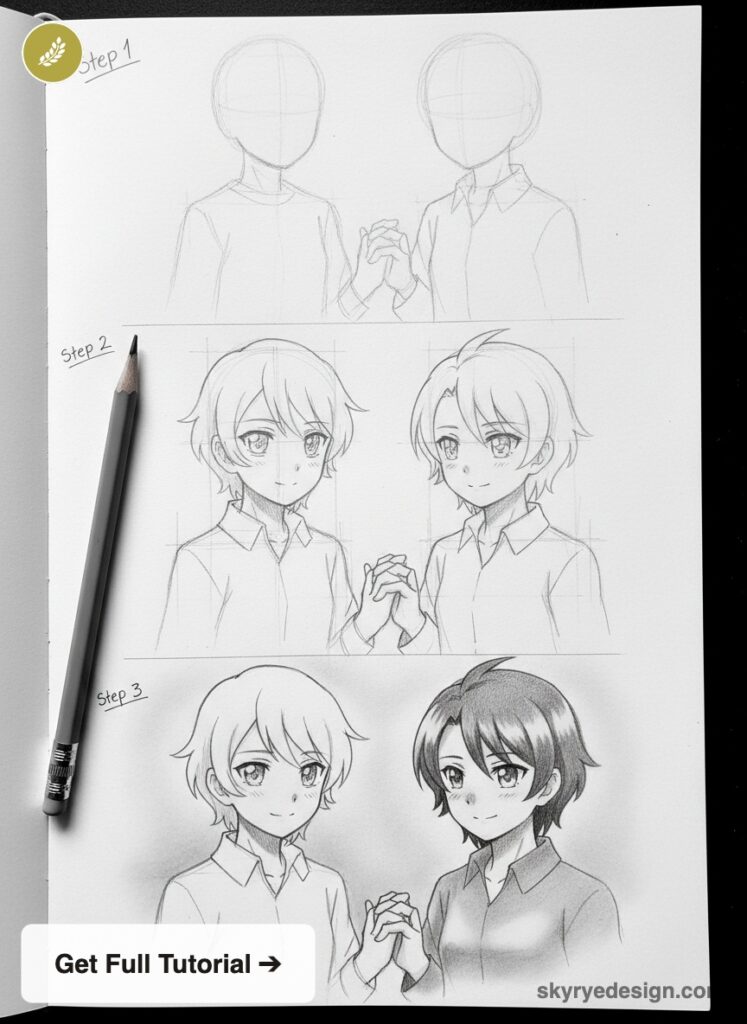
Two characters holding hands — a close-up study of the hands, possibly with faces in soft background focus. Hand anatomy is notoriously difficult, and intertwined hands are the most demanding version of hand drawing. But the emotional payoff — the specific way two people hold hands tells you everything about their relationship — makes this worth the difficulty.
Skill focus: Hand anatomy and intertwining, close-up composition, emotional communication through touch
30. A Child Looking at the Sky
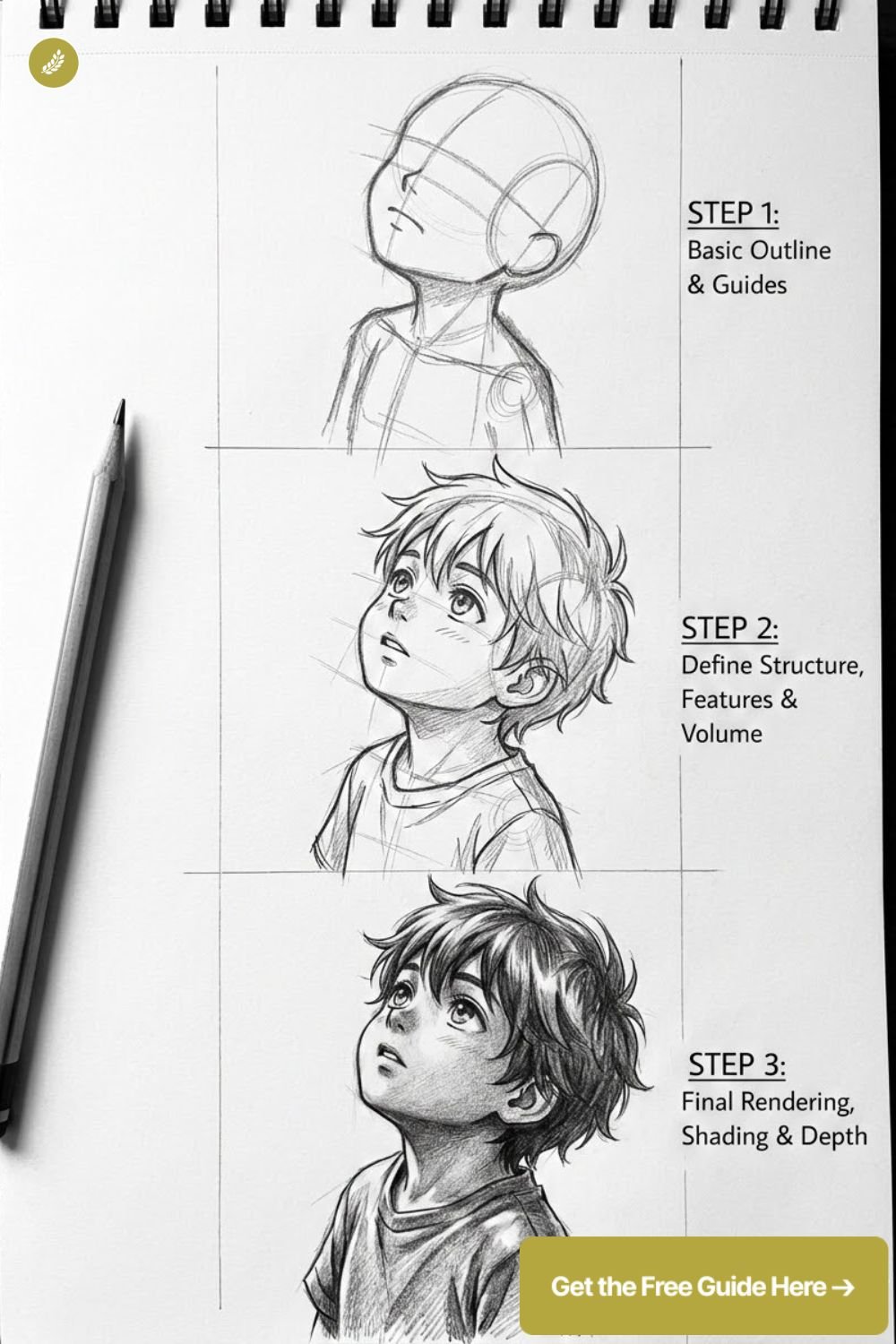
A small figure (child proportions) lying in grass or sitting on a hill, looking up at an enormous sky — clouds, birds, possibly stars or the moon. The compositional principle is smallness against vastness: the figure should occupy a small fraction of the composition, surrounded by sky. Child proportions in anime differ meaningfully from adult proportions and are worth practicing independently.
Skill focus: Child vs adult proportion differences, figure-sky scale composition, wonder through smallness
✏ Technique tip: For emotional ideas: study the actor’s technique of substitution — identify a real experience in your own life that creates the emotion you’re trying to draw, think about it before you start, and draw from the physical memory of how that emotion feels in your body. The most convincing emotional anime art comes from artists drawing experiences they know, not emotions they’re imagining.


Category 6: Dark Academia and Moody Aesthetics — Beauty in the Heavy
Dark academia anime aesthetics translate the literary aesthetic movement (candlelit libraries, autumn leaves, the beauty of difficult books and difficult thoughts) into anime’s visual language. The palette is specific: dark wood, aged paper, deep burgundy, navy, cream, black — with light coming from candles or low lamps rather than sun or screens.
This category is currently experiencing a significant revival in fan art communities in 2026, partly as a reaction against the high-saturation neon aesthetic of previous trends, and partly because the source material (Moriarty the Patriot, The Ancient Magus’ Bride, The Case Study of Vanitas) produces exceptionally beautiful visual references.
31. Student in a Gothic Library
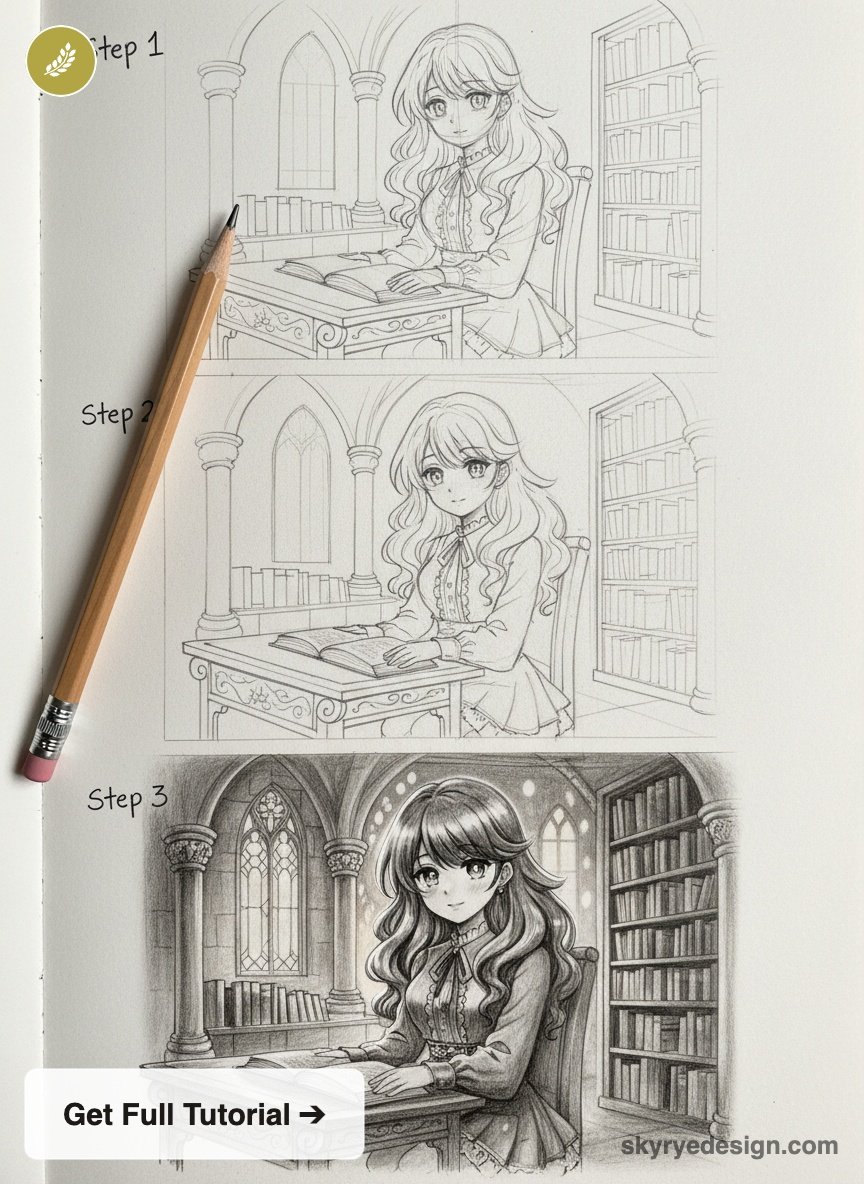
A character in Victorian or early-20th-century clothing working in a grand Gothic library — arched stone ceilings, tall windows with lead panes, candlelight, leather-bound books. The architectural drawing challenge here is significant: Gothic arches require an understanding of how curved stone structures work visually. But the atmosphere — that specific quality of intelligence and melancholy in a beautiful old room — rewards the effort.
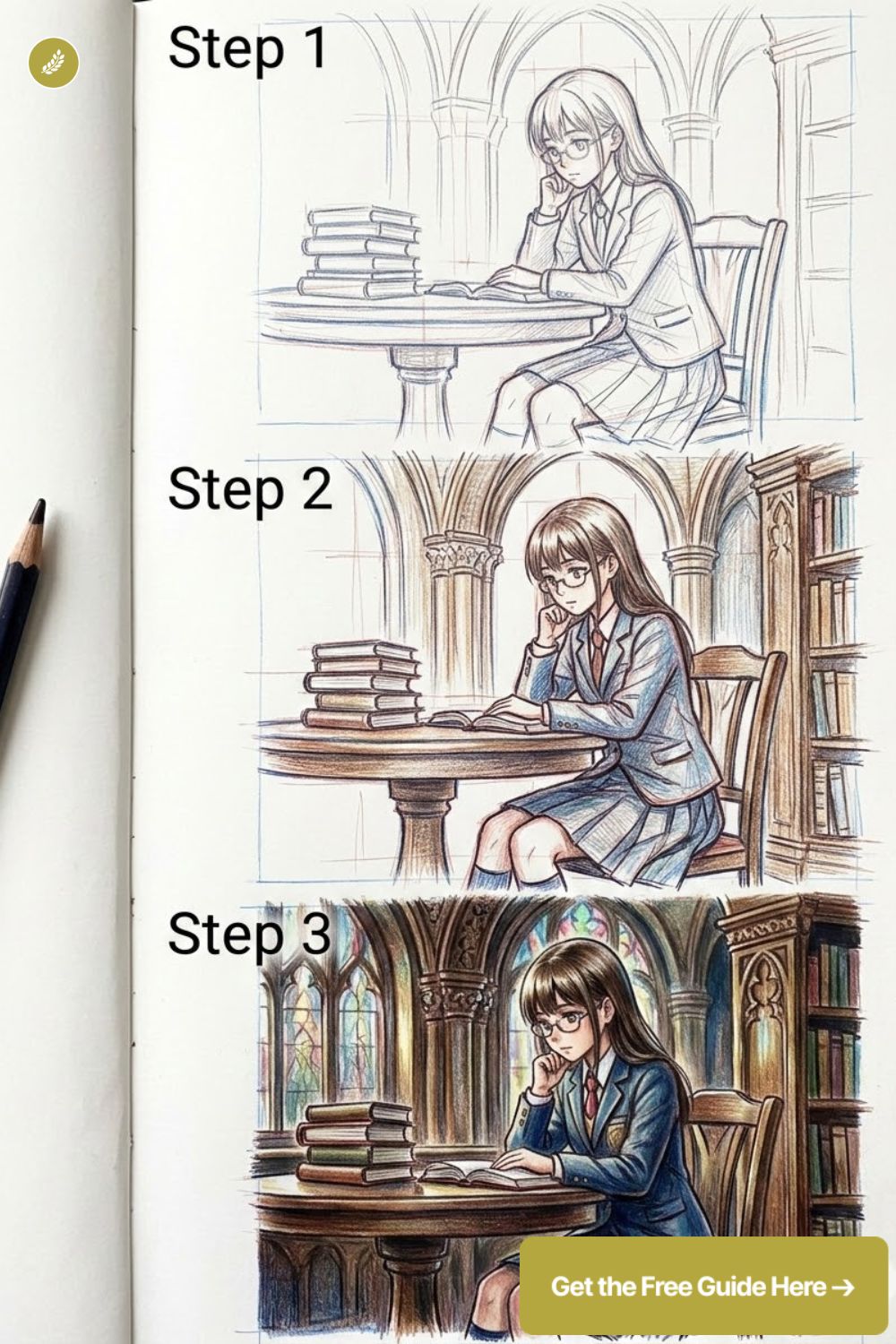
Skill focus: Gothic architectural rendering, candlelight in stone interiors, period-appropriate costume detail
32. Character Studying at 3am
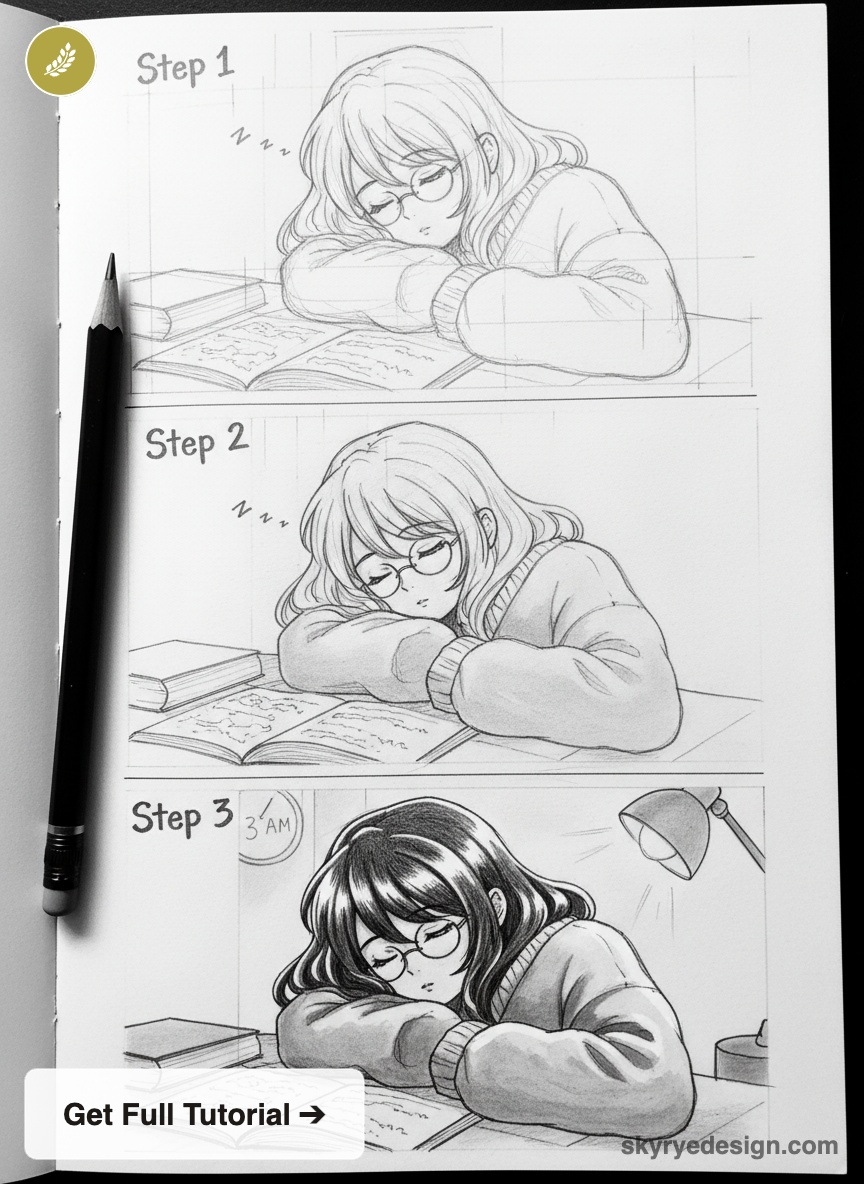
The dark academia version of the lo-fi study scene — but older, heavier, more driven. The same lamp-lit desk, but the books are dense, and the expression is more intense. The character should read as someone who chooses to be awake at 3 am with difficult material, not someone who simply forgot to sleep.
Skill focus: Character expression of intellectual intensity, late-night lamp rendering, book and paper texture
33. Autumn Walk Between Old Buildings
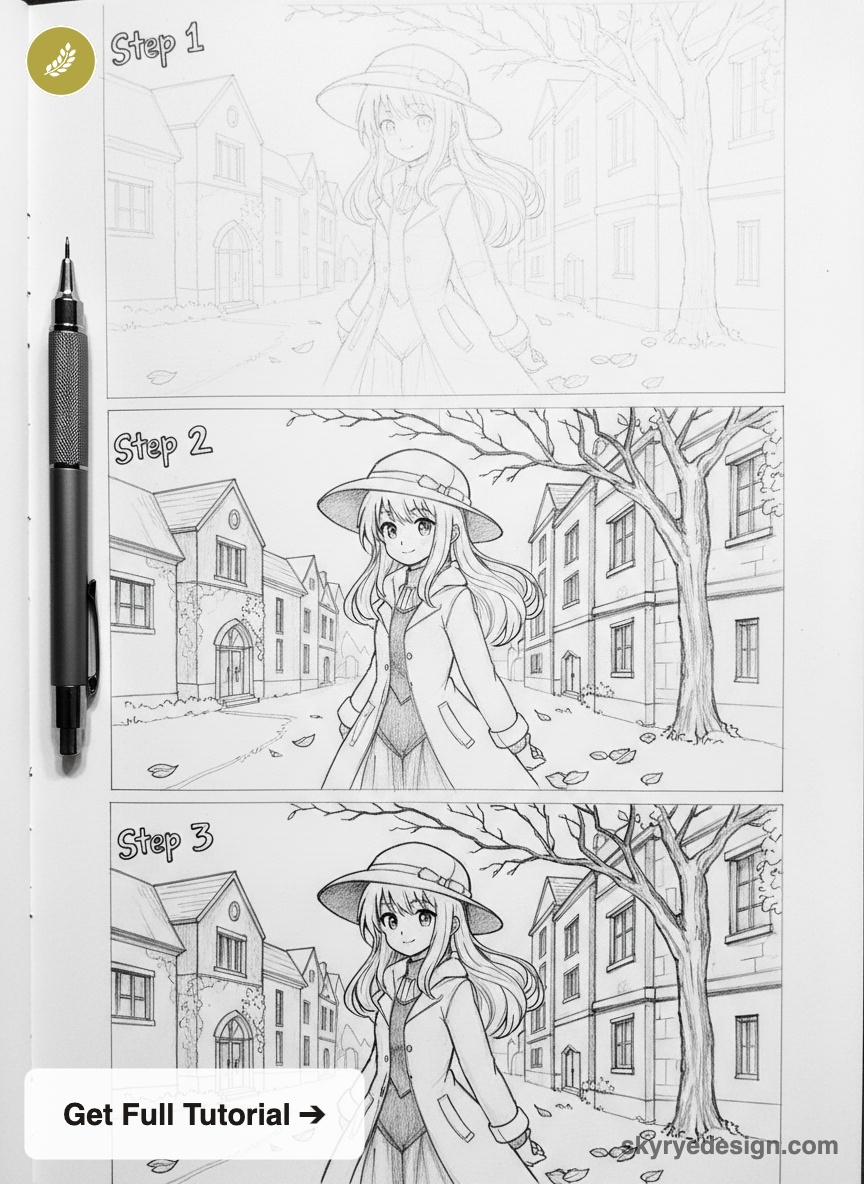
A figure in a long coat walking through a lane between old stone or brick buildings — autumn leaves, perhaps mist, cobblestones. The setting is architectural, but the mood is internal: this is a thinking-walk, not a purposeful destination walk. The pace reads in the pose.
Skill focus: Autumn urban environment, figure in contemplative motion, period architectural detail
34. Fencing or Kendo Scene
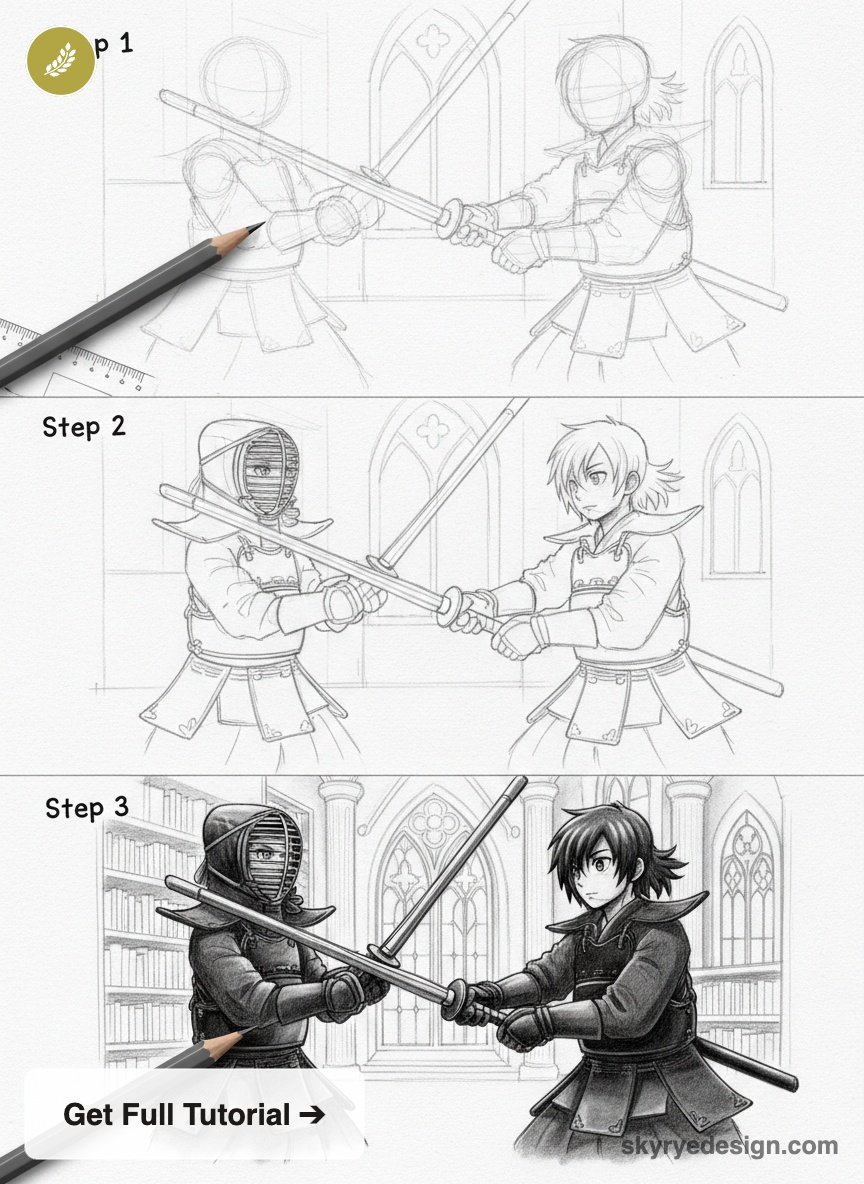
Two characters in a training duel — fencing masks, épées, or shinai — the dynamic of formal combat practice that’s also about something else (testing each other, friendship, rivalry). The crossed-blades moment, or the moment just before or just after a strike, is the compositional peak. Formal combat wear has strong visual character and is worth learning to draw consistently.
Skill focus: Dynamic two-figure action composition, formal equipment design, the specific energy of controlled combat
35. Character Playing a Grand Piano
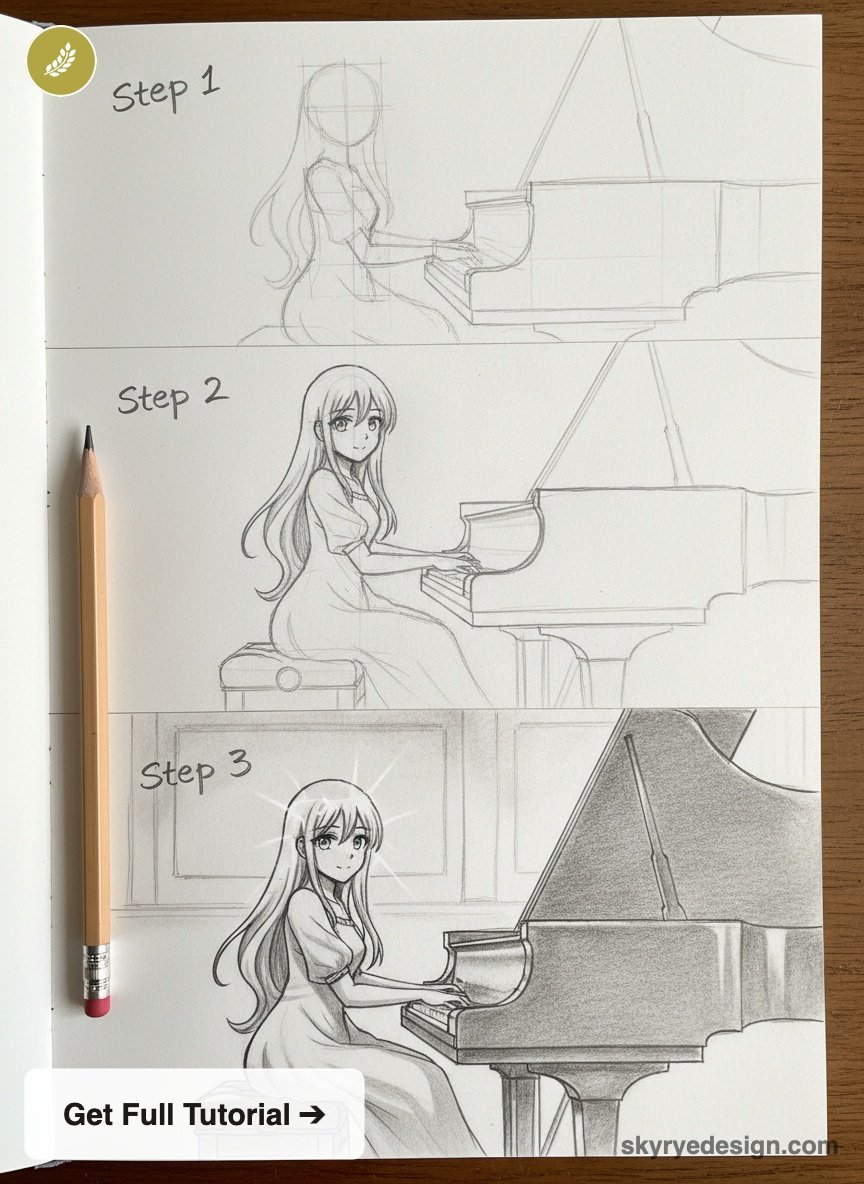
A figure at a large piano in a dim room — the instrument imposing, the character intensely concentrated. Piano keys and the piano’s geometry provide strong perspective lines; the figure’s hands on the keys create the human connection point. The light should be specific: from above (a lamp or chandelier) rather than from a window, keeping the mood interior and intense.
Skill focus: Large instrument drawing in perspective, hands in playing position, concentrated expression rendering
36. Rain on a Greenhouse Window
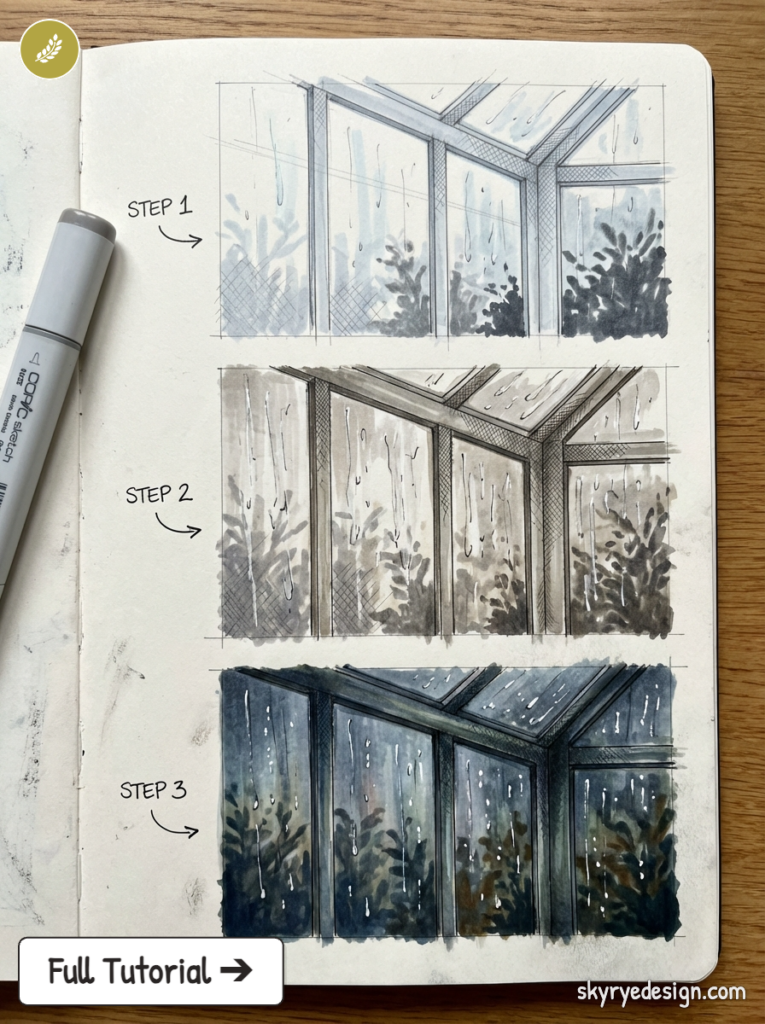
Interior of a Victorian greenhouse with a character reading or working among the plants — rain visible through the curved glass roof and walls, the plants in warm interior green against the cold grey exterior. The curved glass panels of a greenhouse provide a challenging but distinctive perspective grid.
Skill focus: Curved glass structure perspective, warm-interior versus cold-exterior colour contrast, botanical detail
✏ Technique tip: For dark academia ideas, research period clothing before drawing. The specific silhouettes of Victorian, Edwardian, and 1920s fashion are part of what makes this aesthetic work — getting the collar, the coat cut, or the hair right costs fifteen minutes of reference study and pays back enormously in how the drawing reads.
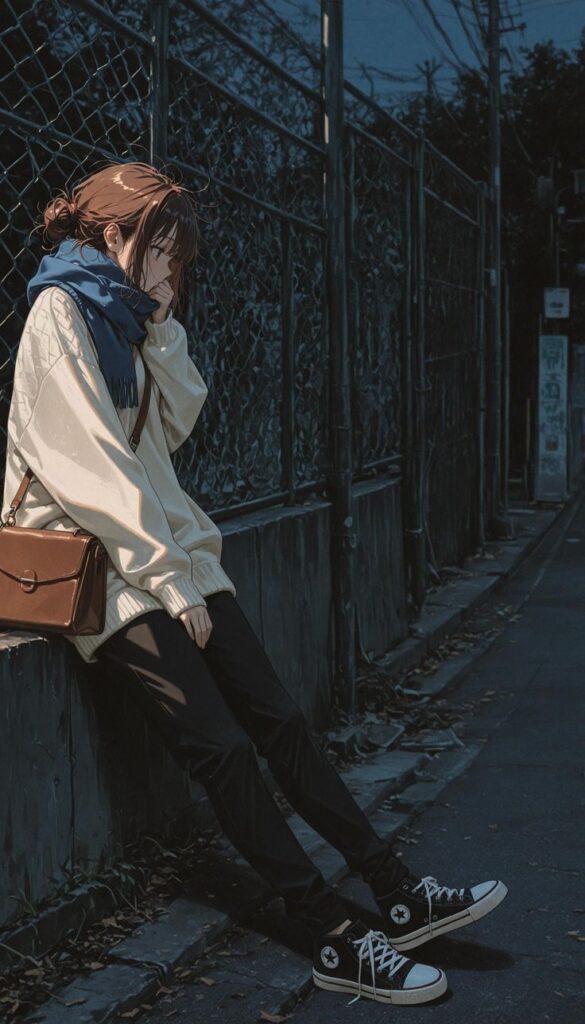
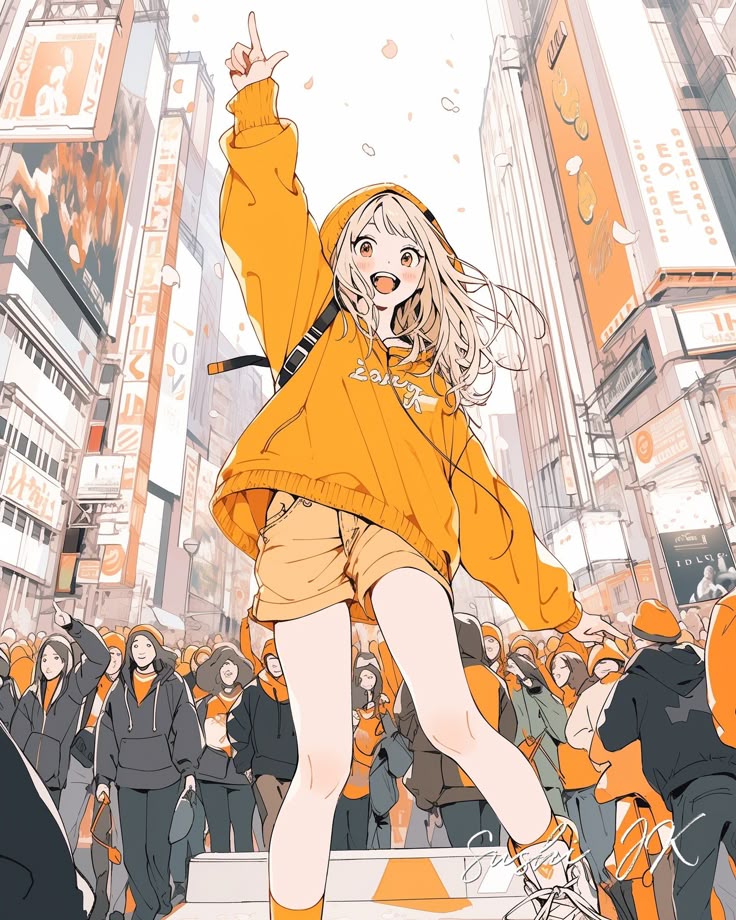
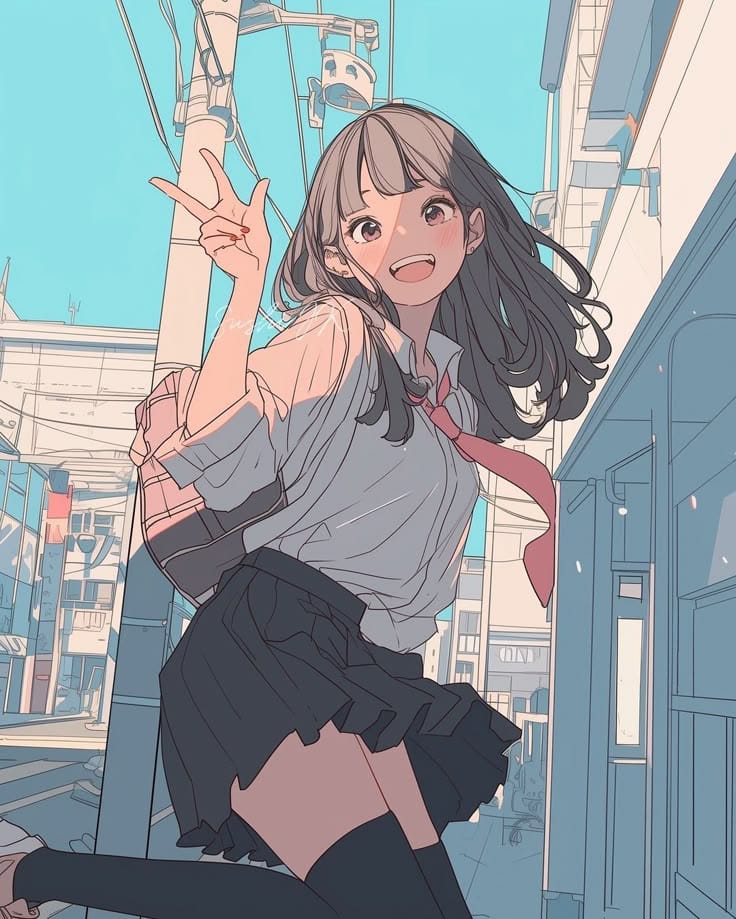
[Image: Dark academia mood board — Gothic library candles, 3am intense study, autumn cobblestone walk, fencing duel moment, grand piano dim room, greenhouse rain — deep warm darks, aged paper tones, architectural detail]
Ideas 37–45: Quick-Reference Anime Drawing Prompts
Beyond the six main categories, here are eight more prompts that don’t fit neatly into one aesthetic but are worth drawing:
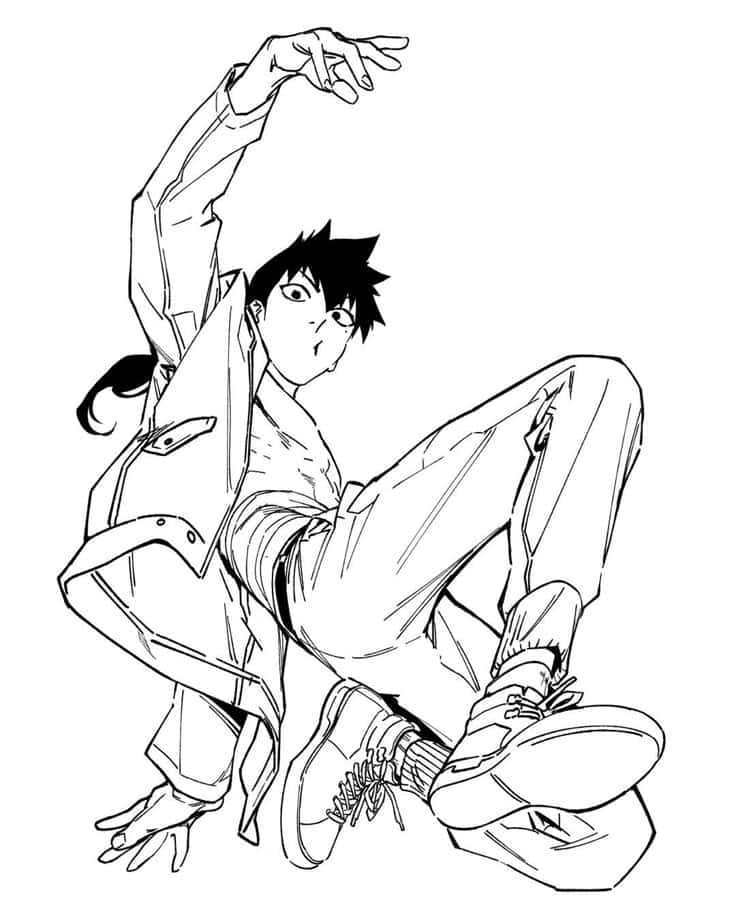
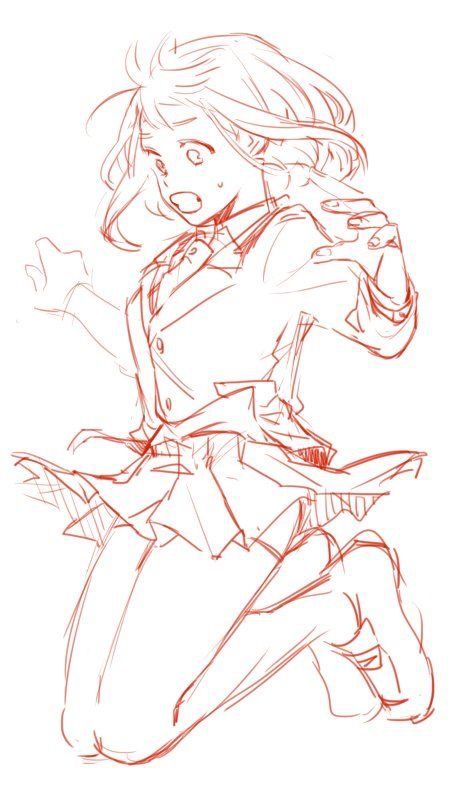
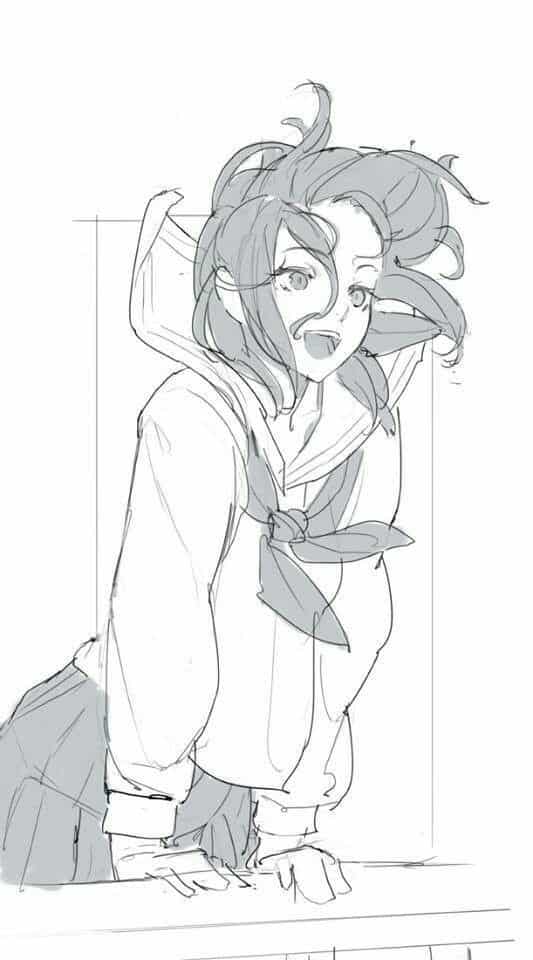
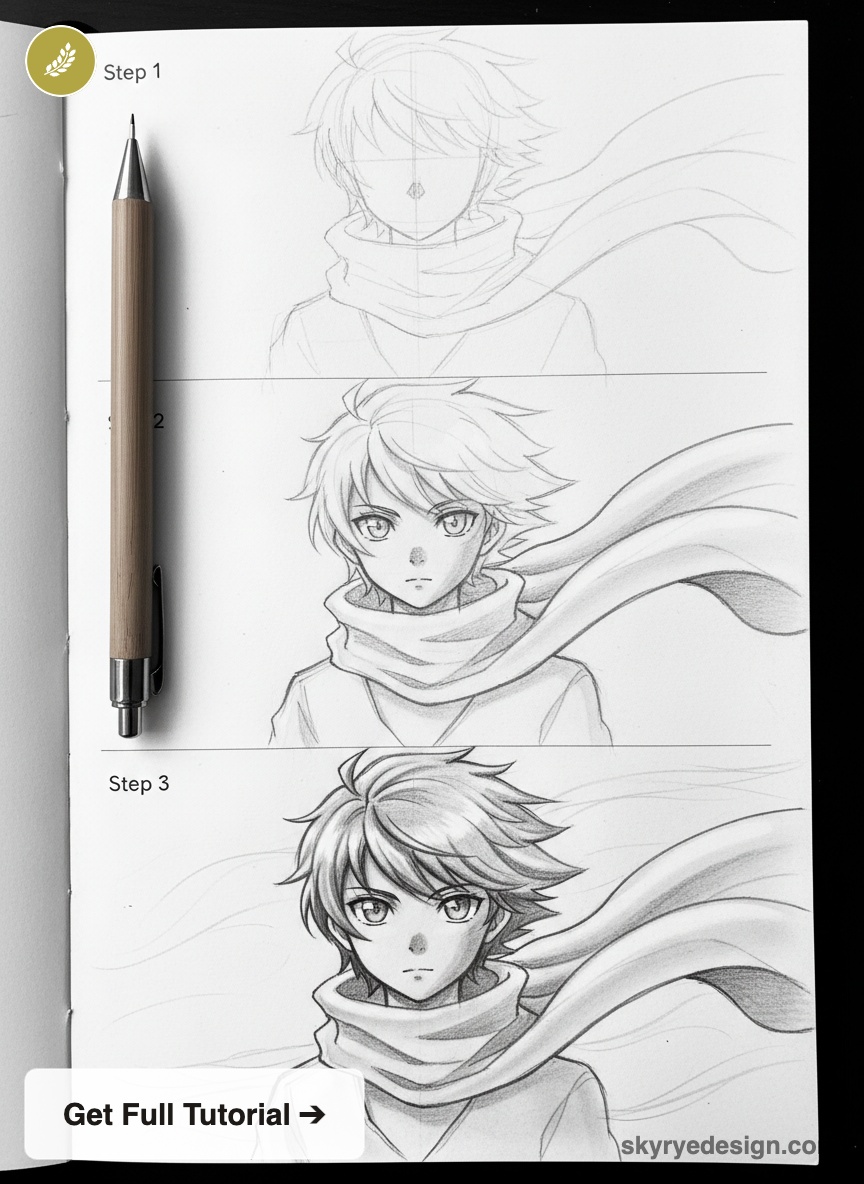
- 37. Character with Flowing Scarf in Wind: Practice fabric physics and secondary movement. The scarf should trail in clear opposition to the figure’s direction of movement.
- 38. Chibi Version of a Complex Character: Simplify an intricate character design into chibi proportions (1:2 head-to-body ratio). Tests your ability to identify which details define the character’s identity.
- 39. Character with Galaxy-Hair: Hair that contains a starfield or galaxy — a fantasy element drawn in a naturalistic style. Practice gradient-to-black transitions and star placement that doesn’t look random.
- 40. Same Character, Four Seasons: Draw a single character in four poses/costumes across spring, summer, autumn, and winter. Tests consistency of character design and seasonal colour literacy.
- 41. Manga Panel Page Layout: Design a single page with 4–6 panels telling a short story beat — entry action, reaction, consequence. Tests panel composition, reading direction, and visual storytelling rather than single-image craft.
- 42. Character as a Constellation: A figure’s outline formed by connecting stars, set against a deep space background. Tests your understanding of a character’s essential silhouette — the simplest readable form of who they are.
- 43. Mirror Reflection That Doesn’t Match: A character looking in a mirror where the reflection shows a different emotional state or a different version of themselves. A surreal concept that teaches you to draw the same face twice with deliberate, subtle differences.
- 44. Battle-Damaged Aftermath: A character sitting in the quiet after a battle — exhausted, equipment damaged, the environment around them showing the evidence of what happened. The ‘after’ moment rather than the action itself.
- 45. Floating Island at Sunrise: A landmass suspended in air, lit by a sunrise, waterfalls cascading from its edges. A foundational fantasy environment prompt that teaches aerial perspective and geological form invention.
Making These Ideas Work: Five Technique Principles
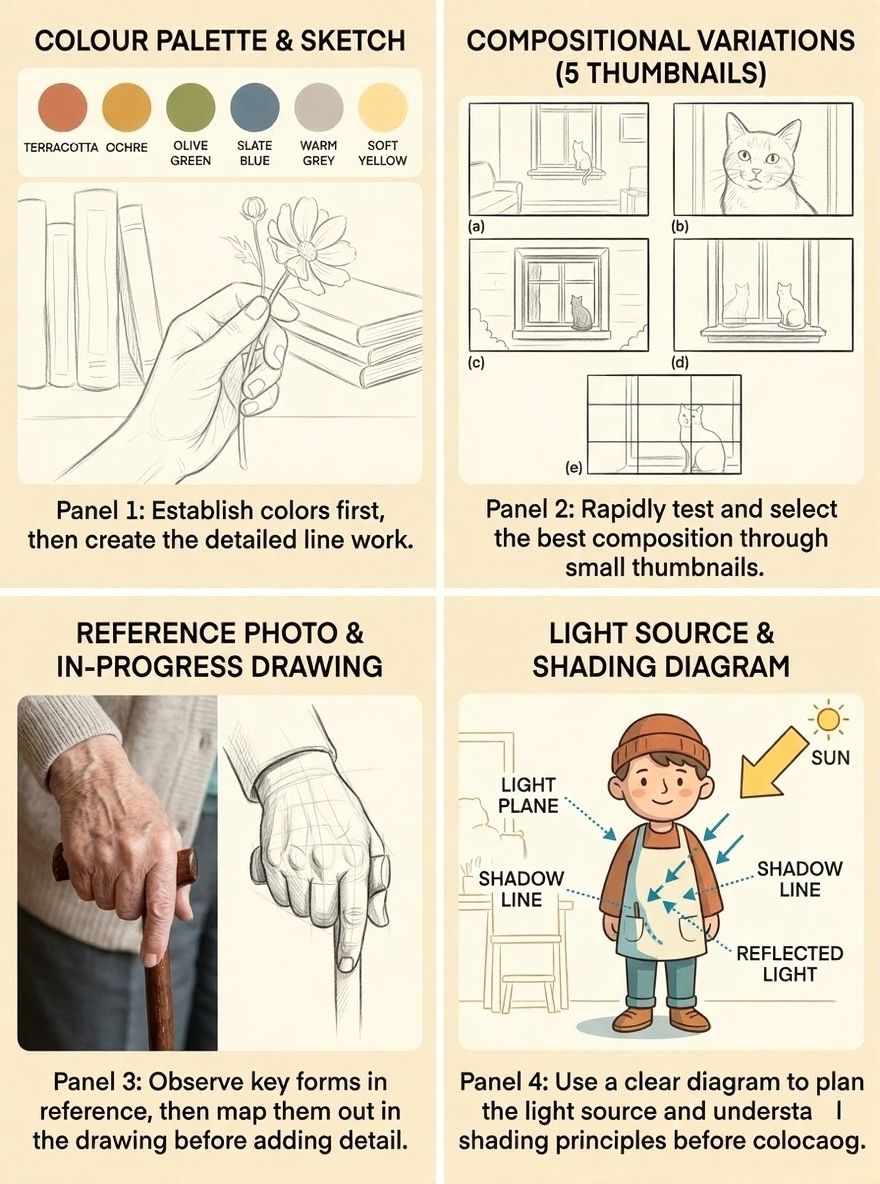
1. Start With a Colour Swatch, Not a Blank Canvas
Before drawing anything, choose your 4–6 colours and commit to them. Every aesthetic category in this guide has a specific palette logic — lofi lives in muted warm-cool contrast; cyberpunk in deep darks with saturated neon accents; dark academia in warm darks and cream. Choosing your palette first forces coherence and prevents the most common aesthetic failure: a drawing that has technically good elements but doesn’t feel unified.
In Clip Studio Paint or Procreate, create a palette swatch strip at the top of your canvas before you start. In traditional media, do a small colour study on scrap paper first.
2. Thumbnail Before You Commit
The ideas in this guide are specific enough to start from — but they’re not compositions yet. Before you start the final drawing, do 3–5 small thumbnail sketches (5–10 minutes total) trying different compositions for the same idea. Where is the figure in the frame? What angle? What’s in the foreground? These decisions made at thumbnail scale take 5 minutes; made at full-drawing scale they take an hour to undo.
3. Reference Isn’t Cheating
Every professional anime artist uses references. The skill isn’t in avoiding reference — it’s in knowing what to reference and how to use it. For these ideas: reference your lighting (find a photograph with the light quality you want), reference your objects (you cannot invent an accurate apothecary bottle from memory), and reference your poses (gesture drawing photo tools like Line of Action and Quickposes are free). Inventing everything from imagination produces charming inaccuracy; smart reference use produces work that looks real.
4. Finish One Layer of the Whole Before Detailing Any Part
The most common structural error in anime drawing sessions: spending forty-five minutes perfecting a face while the rest of the drawing is unresolved. Finish the rough of the entire drawing before refining any part of it. This ensures proportional consistency, lets you see the composition as a whole, and prevents the sunk-cost trap of over-invested details in a composition that doesn’t work.
5. Name Your Light Sources Before You Draw
Every drawing in this guide has implied light sources — the convenience store fluorescent, the library candle, the neon sign, the forest sunlight. Before you start any drawing, write down: how many light sources, what colour temperature each is, and which direction each falls from. This takes two minutes and prevents the most common technical error in amateur anime art: light that comes from everywhere and from nowhere, creating a flat drawing that looks like it’s equally lit on all sides.
Tools for These Ideas: What You Actually Need
Traditional Tools
- Sketching: 0.5mm mechanical pencil (Uni Kuru Toga or Pentel GraphGear) for line control. Cheap layout paper for thumbnails — it’s thin enough to light-box under.
- Inking: Micron 005 and 01 for fine line work; a Pentel Pocket Brush for expressive lines with variable weight.
- Colour: Copic markers — a 12-colour grey set plus 6–8 accent colours covers most of the palettes in this guide. They’re expensive but refillable and blend. Pentel Aquash water brushes with Kuretake watercolours work for Ghibli-influenced ideas.
- Paper: Canson Bristol 250gsm for marker work (doesn’t bleed through); Fabriano Hot Press 300gsm for watercolour; plain 90gsm copy paper for daily practice sketches.
Digital Tools
- Clip Studio Paint: The industry standard for manga/anime illustration. Around $70 one-time purchase. Has native comic panel tools, perspective rulers, and the best anime-specific brush library available.
- Procreate: iPad only, $13, excellent for lofi and atmospheric work. The default ‘Narinder’ pencil brush is outstanding for rough anime sketching.
- Krita: Free, Windows/Mac/Linux, genuinely excellent for anime illustration. The learning curve is steeper than Procreate but the tool set is comparable to Clip Studio.
- Tablets: Wacom Intuos Small (around $80) for beginners. Huion Kamvas 13 (around $200) for screen tablets. iPad Pro + Apple Pencil 2 for the most flexible setup.
FAQ: Anime Drawing Ideas
Q: What are good anime drawing ideas for absolute beginners?
Start with Category 1 (Lofi and Quiet Moments) — ideas 1 through 6. These subjects are visually simple but teach foundational skills: colour temperature, atmospheric lighting, and small-scale composition. Specifically: begin with idea #1 (Late-Night Study Session) at any skill level. The warm lamp against a dark room teaches you more about light in an hour than a week of drawing faces.
Q: How do I develop my own anime art style?
Don’t aim for a ‘style’ directly — styles are the residue of consistent aesthetic decisions made across many drawings. Instead: choose 3–5 anime artists whose work you genuinely love, study specifically what decisions they make (colour choices, line weight variation, how they simplify faces), and incorporate one of those decisions deliberately into your next ten drawings. Do this across several artists over six months and your ‘style’ will emerge as the pattern in all those decisions.
Q: What’s the best way to practise anime eyes specifically?
Eyes in 2025–2026 anime aesthetics are increasingly complex — multiple gradients, distinct iris shapes, layered highlights. The fastest improvement method: draw 20 different eye studies in one session, from different anime references, focusing on only the iris and pupil structure. Not the lashes, not the face — just the iris. The gradient construction (base colour, mid-tone, dark ring, inner highlight, outer rim light) is a repeatable structure you can learn in a single intensive session.
Q: Clip Studio Paint vs Procreate — which is better for anime drawing?
For anime and manga specifically: Clip Studio Paint. It has panel layout tools, manga-specific rulers (perspective rulers, symmetry rulers), and a vast library of anime-style brushes and assets. Procreate is more intuitive and better for sketching and painting with an atmospheric or painterly quality — it’s excellent for Ghibli-influenced and lofi ideas. If you can only have one: Clip Studio Paint for anime; Procreate for illustration.
Q: How long should each drawing take at different skill levels?
Beginner (0–1 years): 1–3 hours per finished drawing. Intermediate (1–3 years): 30 minutes for sketches, 2–6 hours for finished pieces. The goal isn’t speed — it’s that as your skills improve, you spend less time second-guessing and more time executing. For daily practice: 20-minute focused sketches on one specific element (just hands, just eyes, just lighting on a single object) build skill faster than occasional long sessions.
Q: How do I draw anime hair that looks natural rather than stiff?
The common error: drawing individual hairs or very small hair clusters. The professional approach: start with the overall hair mass as a single silhouette shape, then divide it into 4–6 large flow sections, then add secondary flow lines within each section, and add the finest individual strand detail only at the very end as highlights. Hair moves as a physical mass with its own weight and flow physics — draw the physics first, the details last.


One Rule: Start Before You’re Ready
The blank page problem isn’t a creativity problem — it’s a decision problem. Every idea in this guide is specific enough to make the first decision for you: here is the subject, here is the mood, here is what you’re practising. That first decision is the only hard one.
Everything else — the colour choices, the composition, whether the drawing turns out good — those are problems you solve while drawing, not before. The artists who improve fastest aren’t the ones with the most talent. They’re the ones who start most consistently, even when nothing feels ready. Pick one idea from this list. The one you keep coming back to as you read through — the one that creates a small flicker of ‘I want to draw that.’ Start it today. Your best anime drawing ideas aren’t in a list — they’re in the decisions you make once you actually begin.




- 1.1Kshares
- Facebook0
- Pinterest1.1K
- Twitter0
- Reddit0