Why draw a realistic tiger face
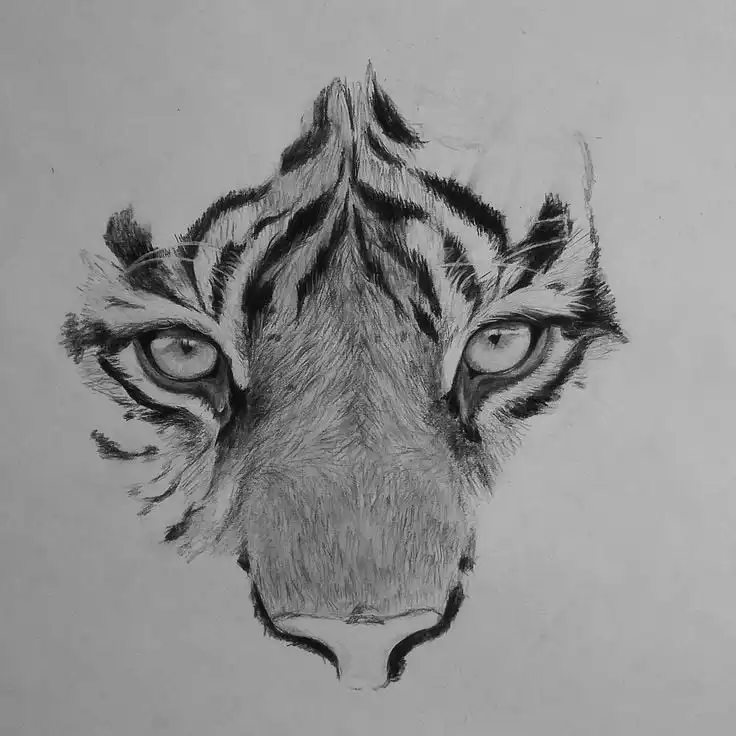
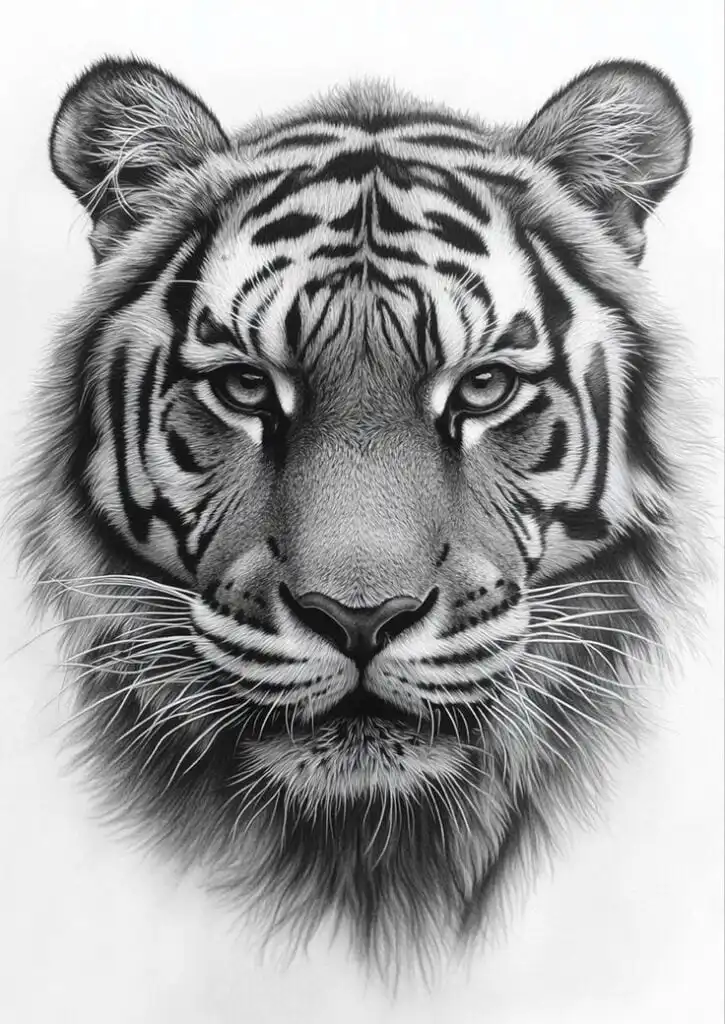
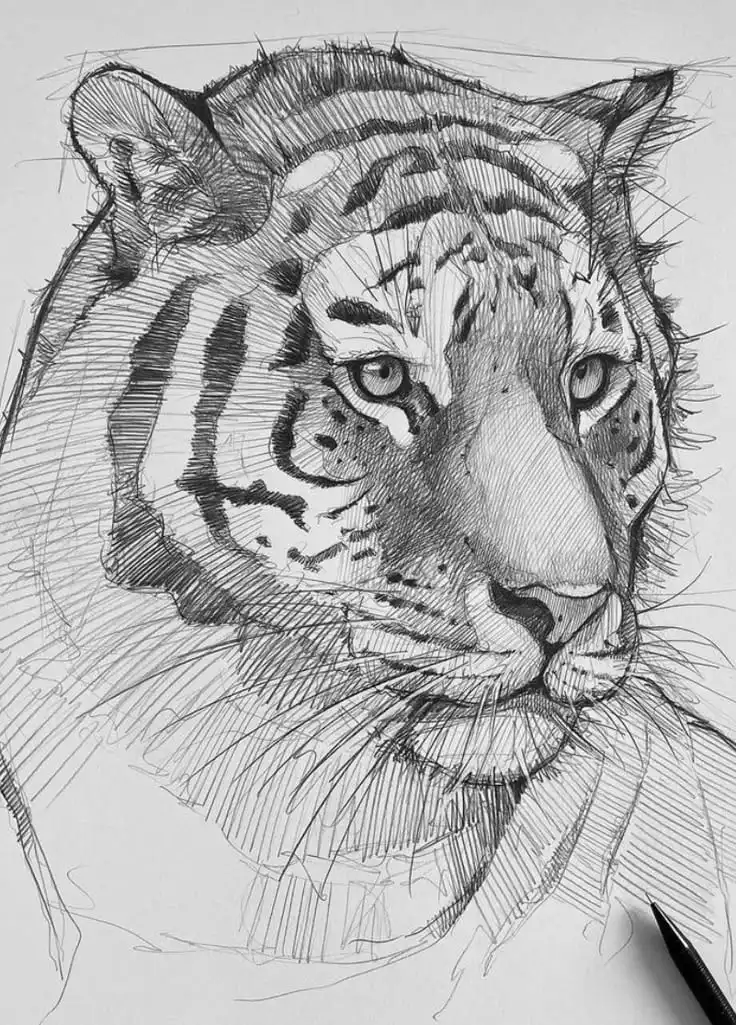
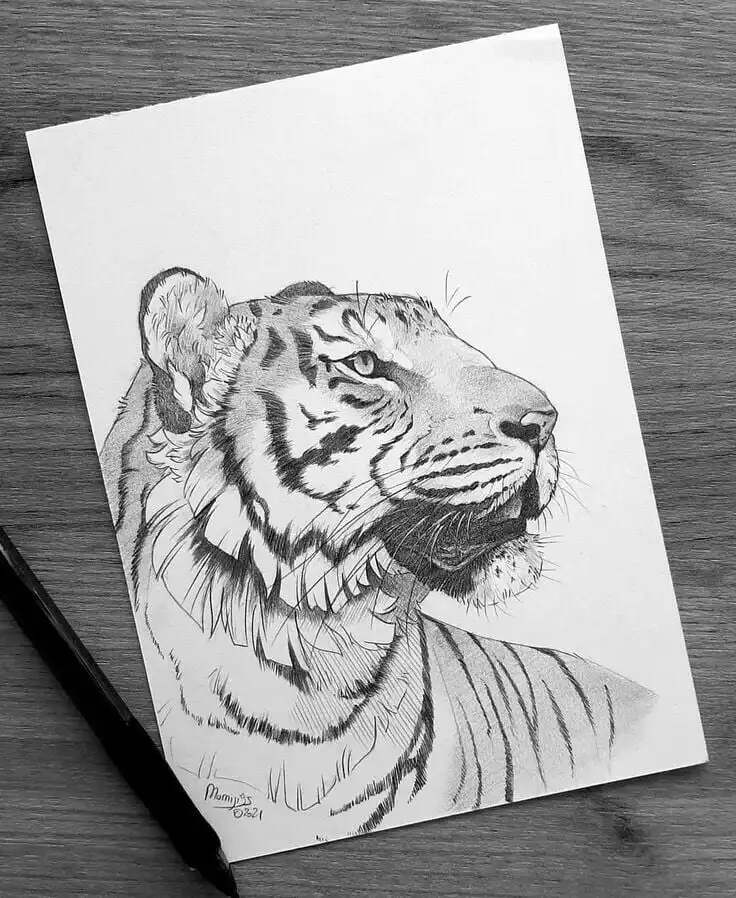
If you want to level up your animal art, a realistic tiger face drawing is the perfect challenge. You get to practice proportions, eye detail, fur texture, and bold stripe patterns all in one subject. Once you can draw a convincing tiger head, other big cats and furry animals feel less intimidating.
In this tutorial, you will walk through each stage of drawing a tiger face, from the first light circle on the page to the final whisker. You will learn how to block in shapes, place facial features correctly, refine the eyes for depth and realism, and choose paper that lets your colored pencils shine.
Throughout, you can lean on expert techniques from step-by-step guides on How2DrawAnimals and a detailed animal eye tutorial on DeviantArt, plus real-world supply tips from colored pencil artists on Reddit.
You do not need to be an expert to follow along. You just need a pencil, paper, and a bit of patience.
Gather your drawing supplies

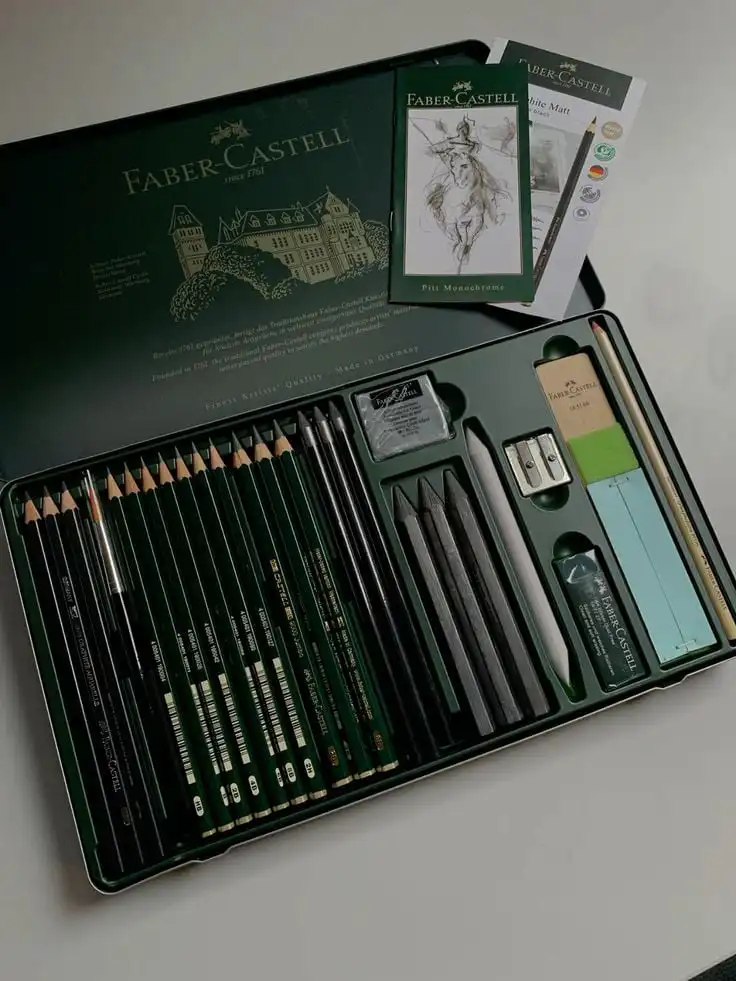
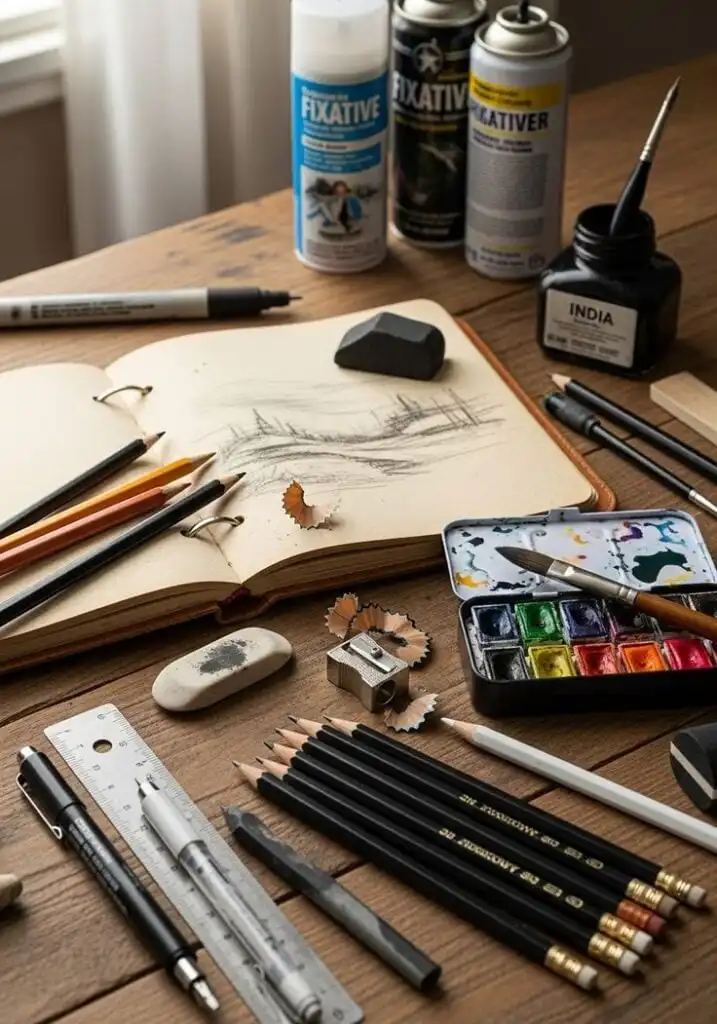
Before you start your realistic tiger face drawing, set yourself up with tools that make it easier to work in layers and fix mistakes.
Basic sketching tools
You can create a strong tiger head with a simple setup:
- HB or 2H pencil for light construction lines
- 2B or 4B pencil for darker outlines and shading
- Kneaded eraser for soft corrections and lifting graphite
- Vinyl or plastic eraser for crisp fixes
- Ruler for centering the face on your page
- Blending stump or tissue for soft shading if you like smooth fur
Keep a sharpener nearby. A sharp point helps you draw fine fur and whiskers without smudging.
Recommended paper for realism
Paper choice matters when you want detail and subtle shading. Colored pencil artists who draw realistic tigers often recommend:
Hot-pressed watercolor paper
Hot-pressed paper, especially Arches, has a smooth surface with enough tooth to hold multiple layers, which is ideal if you plan to color your tiger face with pencils (Reddit).Bristol smooth paper
Brands like Strathmore 300 series or Canson Bristol offer a slick, even surface. This helps you keep edges clean and avoid unwanted texture in areas like the eyes and nose (Reddit).Stonehenge paper by Legion
Stonehenge has a fine tooth and excellent layering capability, which is why many artists use it for detailed animal portraits, including tiger faces (Reddit).Strathmore toned papers
Toned Tan or Toned Grey provides a mid-value background so your highlights and dark stripes pop. The paper still has enough tooth to grab a colored pencil and build up a realistic fur effect (Reddit).
If you are practicing line work and basic shading, regular drawing paper or a sketchbook is fine. As you get more comfortable, try one of the papers above for your polished pieces.
Understand basic tiger head structure
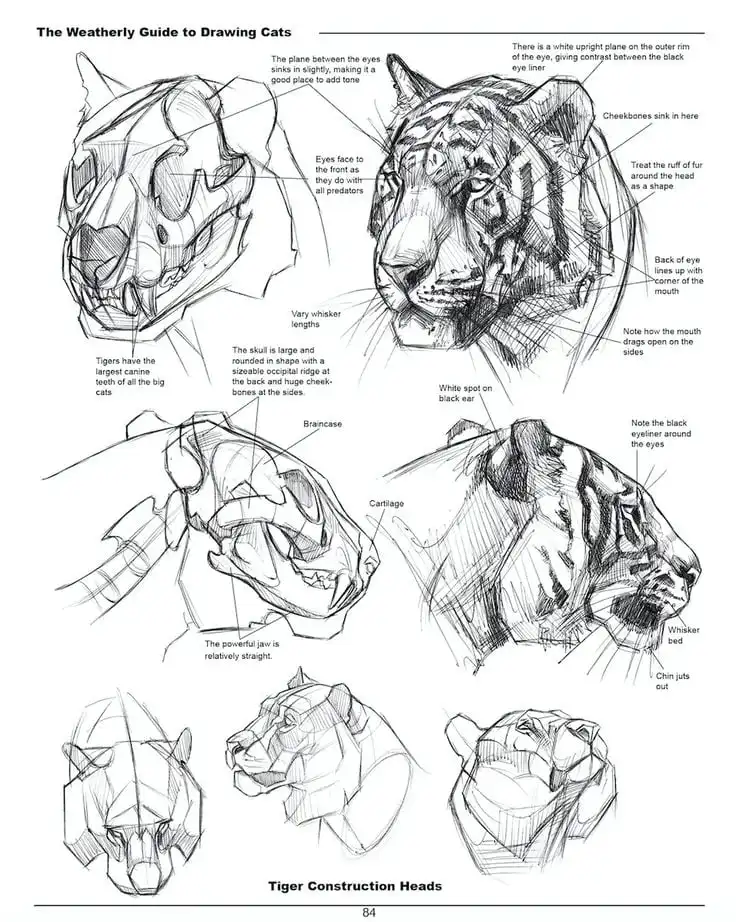
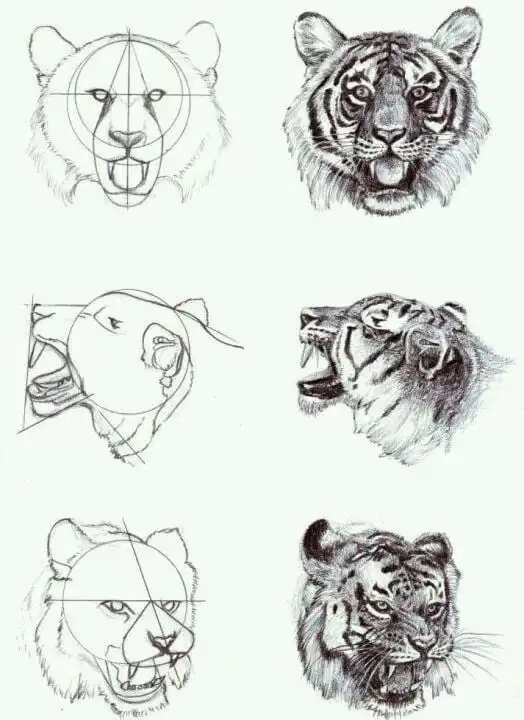
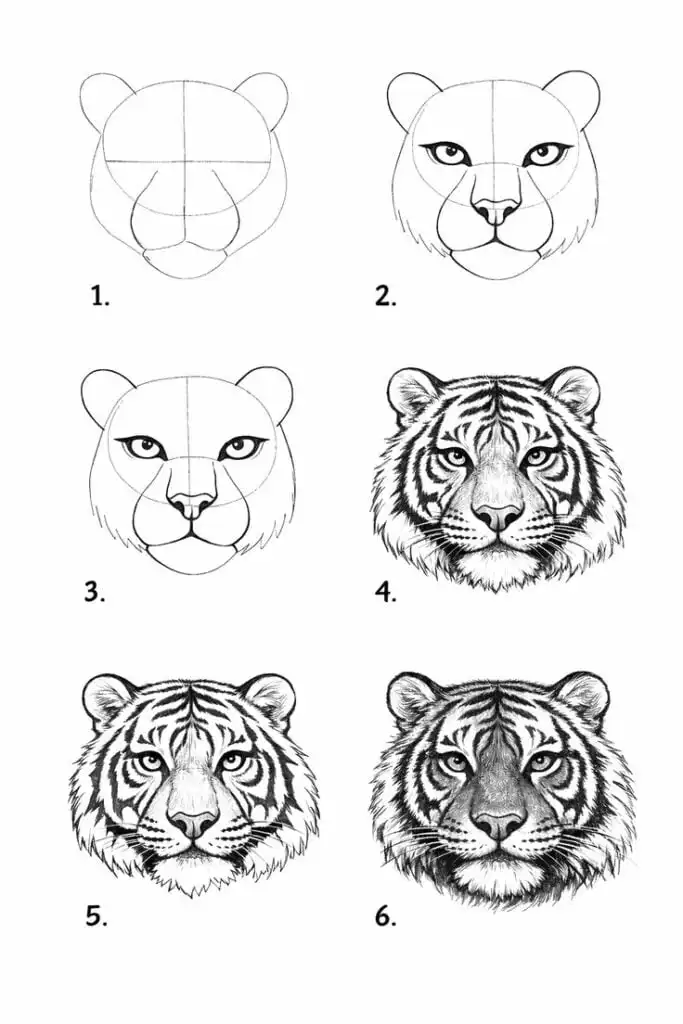
Before you jump into details, you will get better results if you understand the simple shapes that sit under a tiger’s face.
Break the head into simple forms
Think of the tiger head as a combination of basic shapes:
- A large sphere for the skull
- A smaller oval for the muzzle
- Two triangles or rounded cups for the ears
- A wedge shape connecting the muzzle to the forehead
If you picture the head as three-dimensional, it becomes easier to keep features aligned and believable as you draw.
Pay attention to the front view proportions
In a front-facing realistic tiger face drawing, you will usually see:
- The eyes are placed roughly halfway between the top of the head and the bottom of the chin
- The nose sits in the lower half of the face, but not all the way at the bottom
- The width of the head is about twice the distance between the inner corners of the eyes
- Ears start around eye level, then curve upward
You do not need to memorize exact measurements. Instead, use these as guidelines and adjust based on your reference photo.
Draw the initial construction lines
This is where you start your tiger. Keep your lines extremely light so they are easy to erase and refine later.
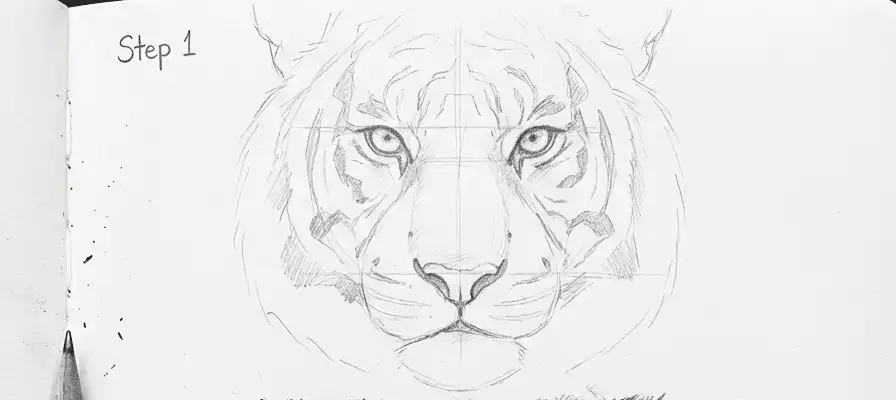
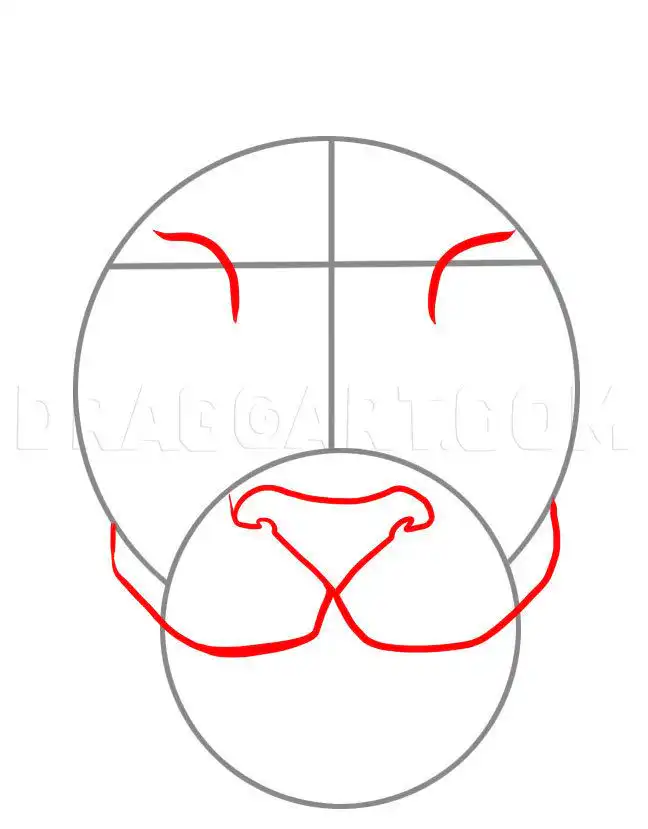
Step 1: Sketch the main circle
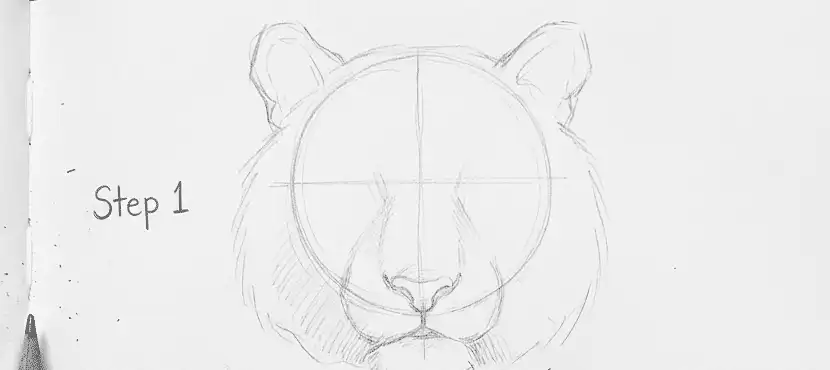
Following the method from How2DrawAnimals, begin with:
- Draw a large circle for the main part of the tiger’s head.
- Press lightly so you can modify the circle as needed.
- Leave space around the circle for ears, fur, and whiskers.
This circle is your base. Almost everything else in your tiger face will relate to it.
Step 2: Add center guidelines
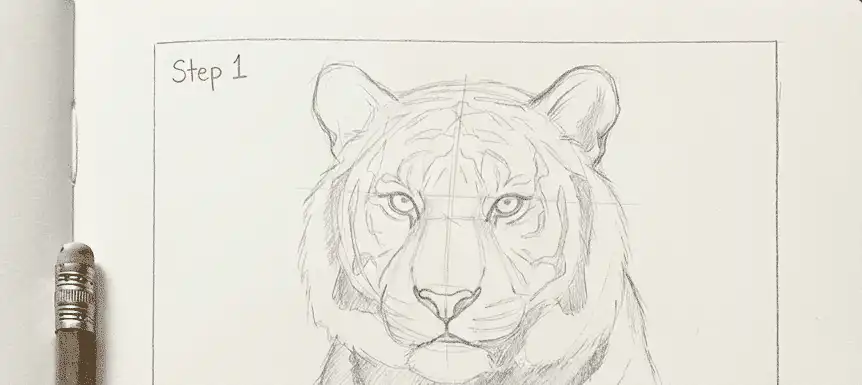
Construction lines help you line up the eyes, nose, and mouth.
- Lightly draw a vertical line down the middle of the circle. This splits the face into left and right halves.
- Add a long, slightly curved horizontal line a bit above the center of the circle, as suggested in the How2DrawAnimals tutorial. This will guide your eye placement (How2DrawAnimals).
- Make sure both lines follow the curve of the circle so the face feels rounded rather than flat.
Think of these guides as scaffolding. You will erase most of them later.
Place the core facial features
With your circle and guidelines in place, you can start blocking in the features that define the tiger’s expression.
Step 3: Draw the eyes
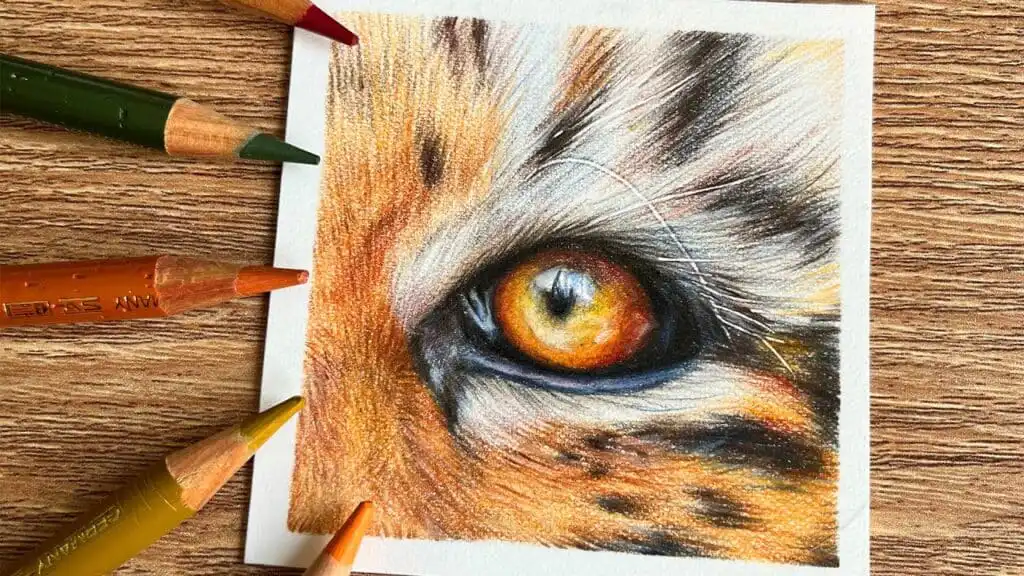
On a tiger, the eyes are relatively small compared to the rest of the head. Keeping them small is one of the quickest ways to create realism.
- On the curved horizontal guideline, draw two small circles for the eyes, one on each side of the vertical center line.
- Leave enough space between them so the bridge of the nose feels wide and strong.
- Confirm that the eyes sit directly on the horizontal guide, which is slightly above the true middle of the circle (How2DrawAnimals).
Later, you can refine these circles into almond-like eye shapes with lids and corners, but for now, keep them as simple round markers.
Step 4: Build the muzzle and nose
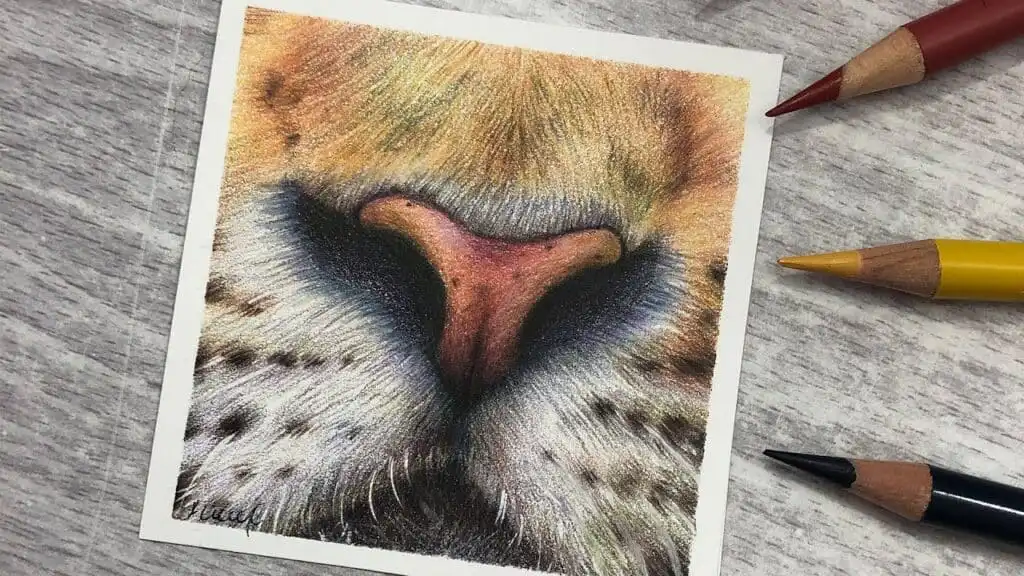
The muzzle gives the tiger its distinctive, powerful jaw.
- Draw a vertical oval that overlaps the bottom portion of your main circle. This oval should be narrower than the head and centered on your vertical guideline.
- Make sure the top of this muzzle shape sits below the eyes.
- Inside the top half of this oval, sketch a small triangle for the nose. Place it slightly higher than the center of the muzzle so there is room for the nostrils and philtrum (the groove between nose and mouth) (How2DrawAnimals).
Check the proportions. The muzzle should feel substantial but not so large that it overwhelms the eyes.
Step 5: Outline the mouth and chin
Now give your tiger a mouth line.
- From the bottom corners of the nose triangle, curve two lines downward along the muzzle to form the top lip.
- Add a small dip in the center, then curve outward again to suggest the wide shape of the mouth.
- Below the lip, sketch the lower jaw and chin with another softer curve that follows the bottom of the muzzle.
Keep these lines loose. You will refine the expression once the rest of the head is in place.
Shape the outer head and ears
Once you know where the main features sit, you can shape the rest of the head around them.
Step 6: Define the cheek and forehead
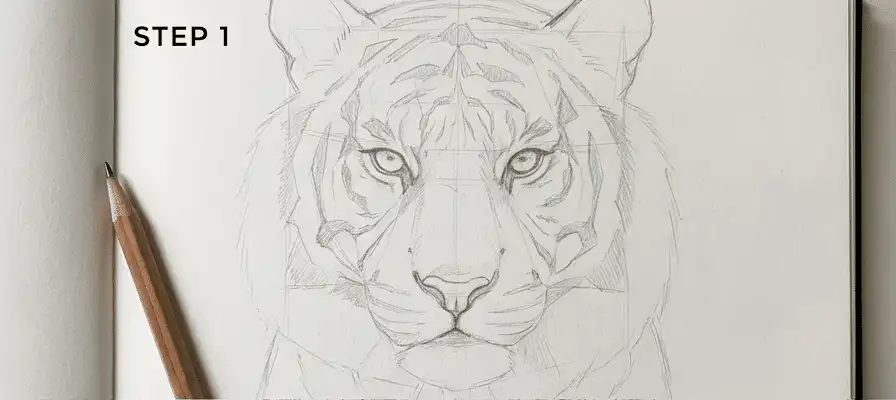
A tiger’s face is not perfectly round. It has wide cheeks and a flatter forehead.
- Starting from the top of your circle, slightly flatten the line across the forehead.
- At the sides, expand the circle outward into soft bulges for the cheeks. These should sit a bit below eye level.
- Soften the bottom of the circle into a rounded point for the chin, using the muzzle as your guide.
Erase or fade parts of the original circle that no longer match the true head shape.
Step 7: Draw the ears
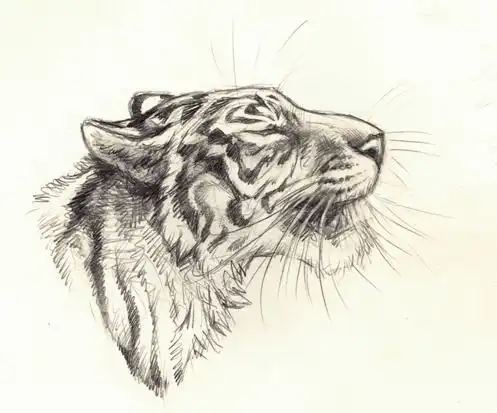
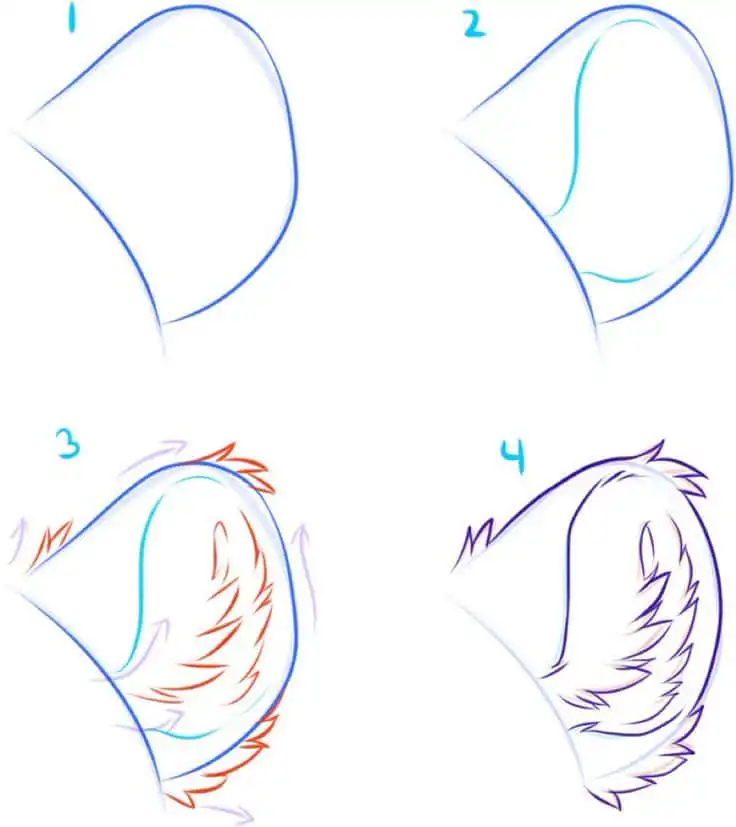
Tiger ears are rounded, not pointy, and sit near the top corners of the head.
- On each side of the top of the head, draw a curved shape that looks like a small, rounded cup or half circle.
- Tilt the ears slightly outward so they feel relaxed and natural.
- Add an inner ear curve and a bit of fur at the base where the ear meets the head.
Make sure both ears are roughly the same size and sit at the same height. If they feel off, measure the distance from each ear to the center line and adjust.
Refine and detail the eyes
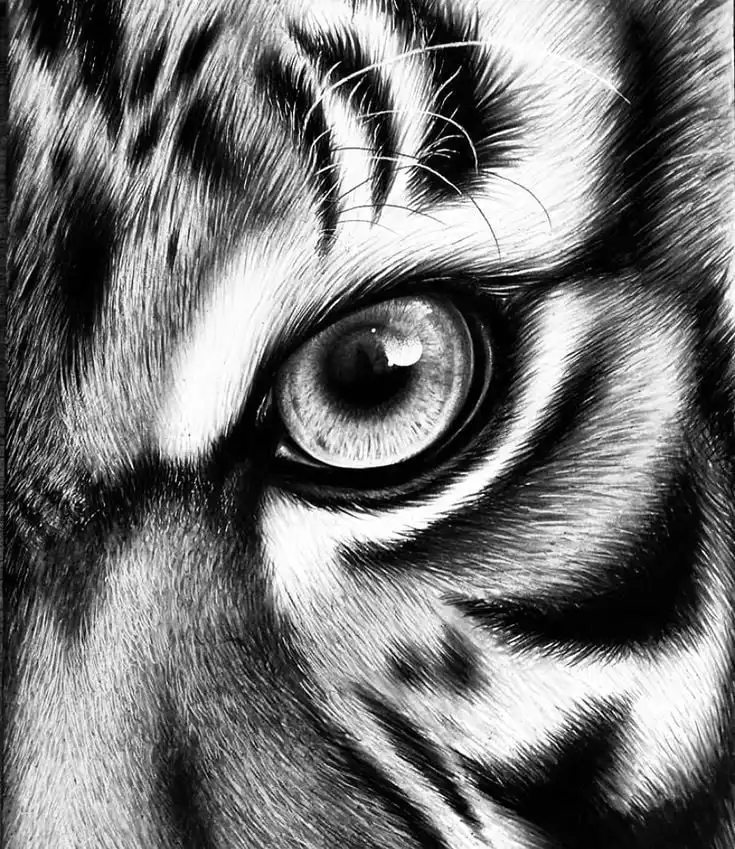
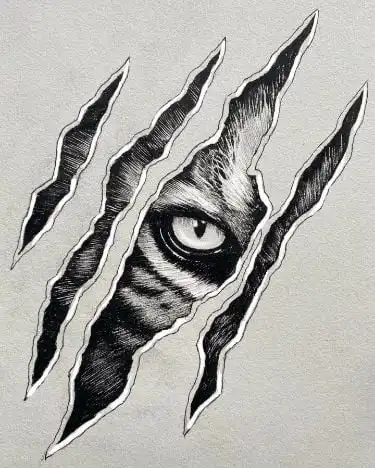
The eyes are the focal point of most realistic tiger face drawings. Spending extra time here will drastically improve your final result.
Step 8: Shape the lids and iris
Using the small circles you already sketched:
- Draw upper eyelids that curve slightly downward toward the outer corners, creating a strong, focused gaze.
- Add lower lids with a softer curve that mirrors the top, but is flatter.
- Inside each eye, draw a round iris and pupil. Tigers have round pupils, which allow good depth perception and suit their day and night activity pattern (DeviantArt).
Avoid making the pupils too large. A balanced pupil size helps the eyes look alert rather than startled.
Step 9: Add realistic eye details
Borrowing from the in-depth animal eye guide on DeviantArt, focus on these elements for realism:
Dark rim around the iris
Add a darker line around the outer edge of the iris. This makes the eye feel defined and less flat (DeviantArt).Radial lines
Lightly draw thin, darker lines that radiate outward from the pupil toward the iris edge. These subtle streaks add complexity and visual interest.Color variations
Even if you are shading in graphite, vary your values as if you were using color. In colored pencil, you would mix browns, yellows, oranges, and touches of darker tones inside the iris to avoid a flat fill (DeviantArt).Highlights
Leave one or two small bright areas for light reflections, usually near the top of the iris. These highlights mimic reflections from the sky or a window and instantly make the eyes look alive (DeviantArt).
Step 10: Suggest the tapetum lucidum effect
Felines, including tigers, have a reflective layer behind the retina called the tapetum lucidum. This is what makes their eyes glow in low light.
You can hint at this structure by:
- Softly brightening the lower half of the iris compared to the upper half
- Allowing subtle tonal shifts across the iris to show that it catches light differently at different angles (DeviantArt)
You do not need to draw a literal glow, just create a sense that the eye has depth and an internal shine.
Build up the nose, muzzle, and mouth
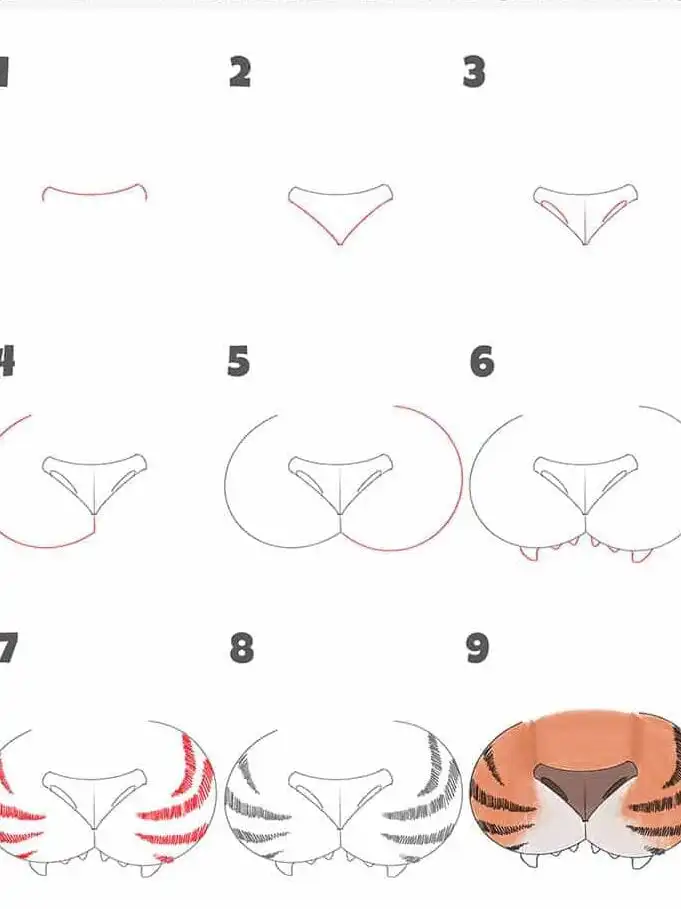
With the eyes in good shape, your next focus is the center of the face: the nose and mouth.
Step 11: Refine the nose
Use your nose triangle as a base.
- Round the top corners of the triangle slightly.
- Draw the nostrils as teardrop-like shapes at the bottom corners, angled outward.
- Add a slight vertical split at the bottom center of the triangle where it meets the philtrum.
Shade the nose to suggest volume. The top plane is usually lighter, with the sides and underside darker.
Step 12: Add mouth details and whisker pads
Tigers have thick, padded areas around the mouth where whiskers grow.
- From the base of the nose, draw the philtrum as a thin line down to the upper lip.
- Define the whisker pads as two rounded, slightly bulging shapes on either side of the philtrum.
- Add a slight curve to the mouth corners for a neutral, powerful expression. You can tip the corners down for a more serious look or up slightly if you want a calmer face.
Use small, light strokes to suggest the change from fur to the smoother texture of the lips.
Step 13: Sketch the whiskers
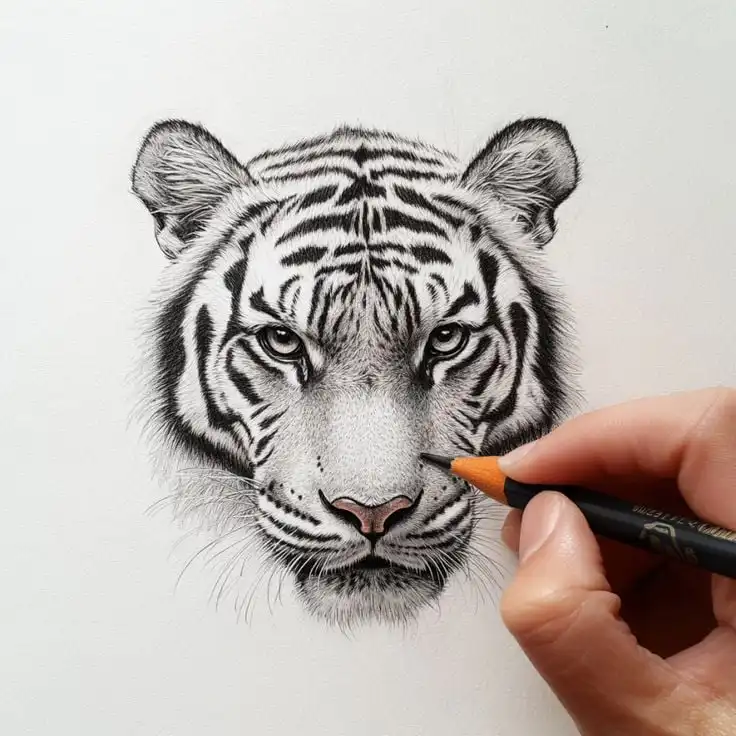
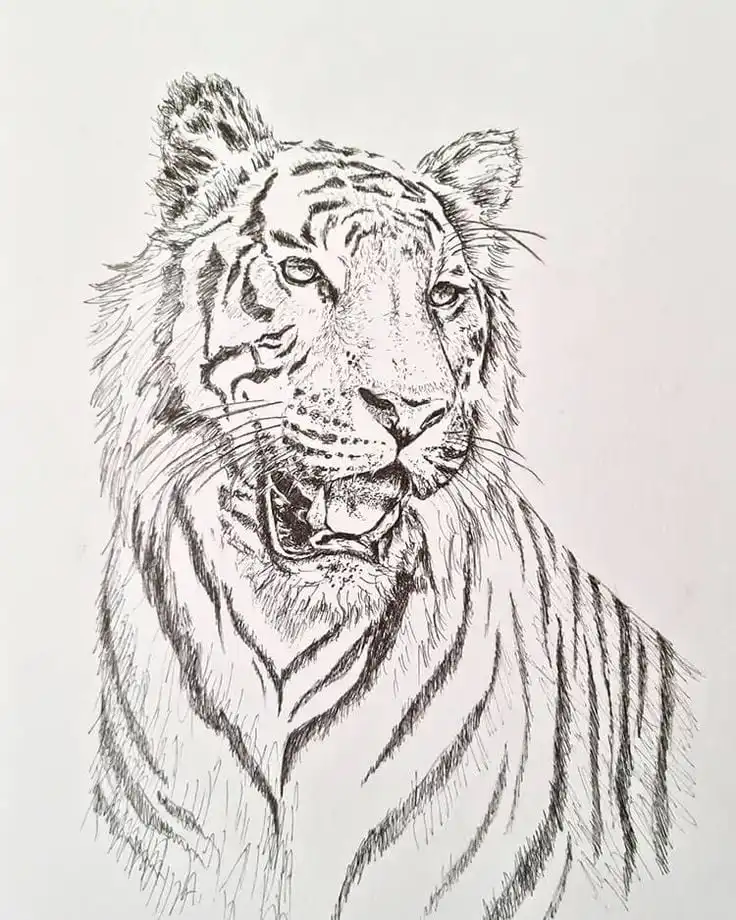
Whiskers are simple lines, but they change the whole drawing.
- Starting from the whisker pads, draw long, slightly curved lines that flow outward.
- Vary the length and direction so they feel natural, not like identical rays.
- Keep your hand loose and make each whisker in a single confident stroke.
If you are planning to use colored pencil, you can either draw whiskers now and preserve them, or save them for last and lift them out with an eraser over darker shading.
Map and draw tiger stripes
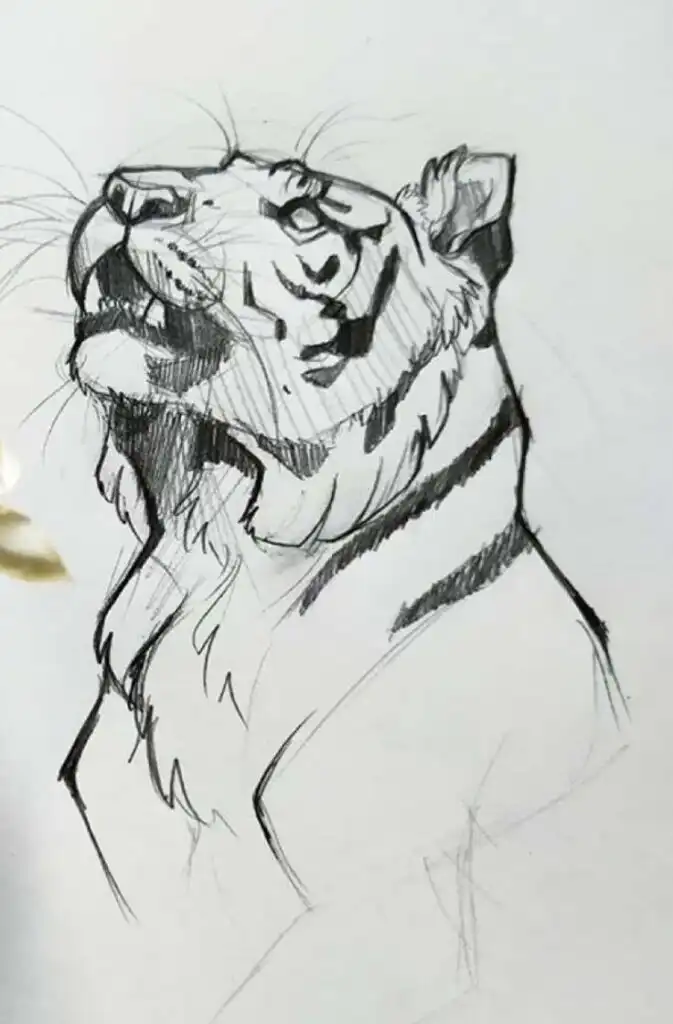
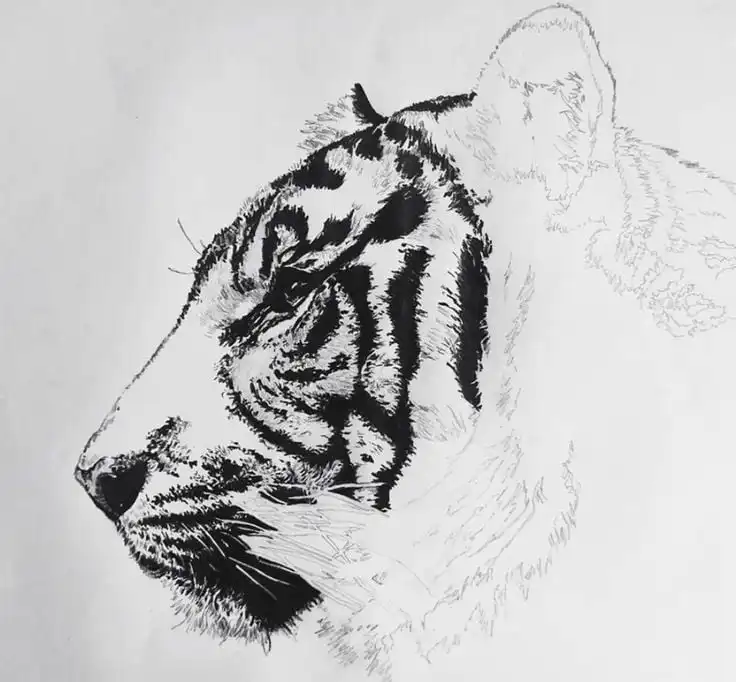
Tiger stripes follow the form of the skull and muscles. Getting the flow right is more important than copying every stripe perfectly.
Step 14: Understand stripe flow
Before you draw, study a reference photo and notice where stripes tend to appear:
- Vertical or slightly angled stripes on the forehead
- Curved stripes framing the eyes and cheeks
- Dark patterns over the bridge of the nose
- Thicker bands along the sides of the face and below the ears
Stripes usually narrow as they cross raised areas like the bridge of the nose and widen in softer, flatter areas like the cheeks.
Step 15: Lightly sketch the main patterns
Using your reference and keeping your pencil light:
- Draw the primary forehead stripes, starting near the center and fanning outward.
- Add eye-framing stripes that wrap around the eyes and taper toward the cheeks.
- Sketch cheek stripes that curve with the roundness of the head rather than cutting straight across.
- Include darker areas inside and behind the ears if visible from your angle.
Do not worry about every small mark. Think of this as a pattern map you will refine in shading.
Add fur texture and shading
Once structure and pattern are in place, shading pulls your realistic tiger face drawing together.
Step 16: Choose your light source
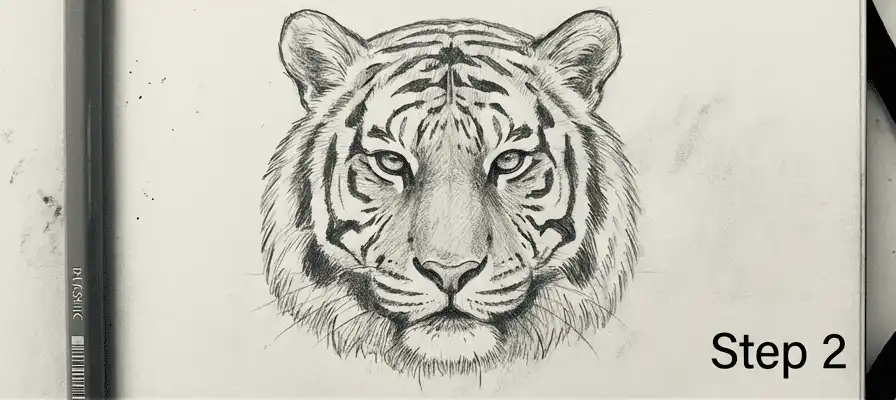
Decide where your light is coming from, for example, upper left. Every value decision depends on this:
- Plan to keep the lit side of the face lighter with softer shadows.
- Deepen the shadows on the opposite side, under the chin, and below the cheekbones.
- Leave the brightest highlights on the nose bridge, forehead, and edges of the whisker pads.
Mark your light direction in the margin as a reminder.
Step 17: Shade in layers
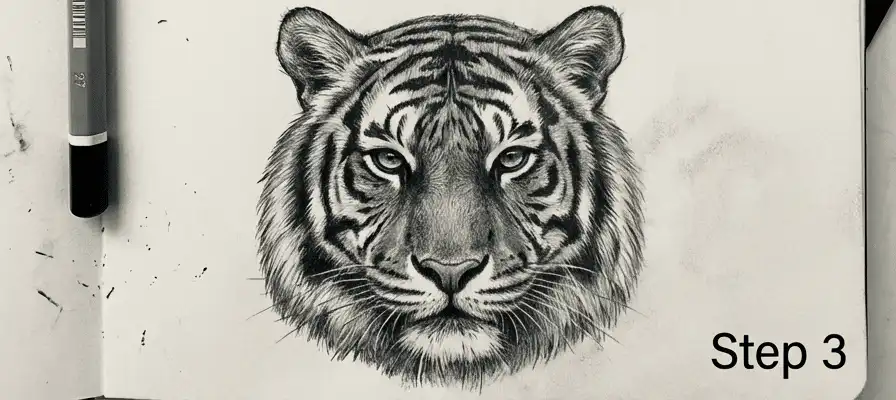
Work from light to dark, building up your tones gradually.
- Start with a light, even shading over the entire face, following the direction of fur growth.
- Darken the stripe areas in stages rather than going straight to black. This makes it easier to blend edges and keep a soft fur look.
- Use small strokes that follow the flow of fur, especially around the muzzle, cheeks, and above the eyes.
If you are using colored pencils, apply multiple light layers instead of pressing hard. This lets the tooth of the paper hold more pigment for richer color and smoother transitions.
Step 18: Suggest fur without drawing every hair
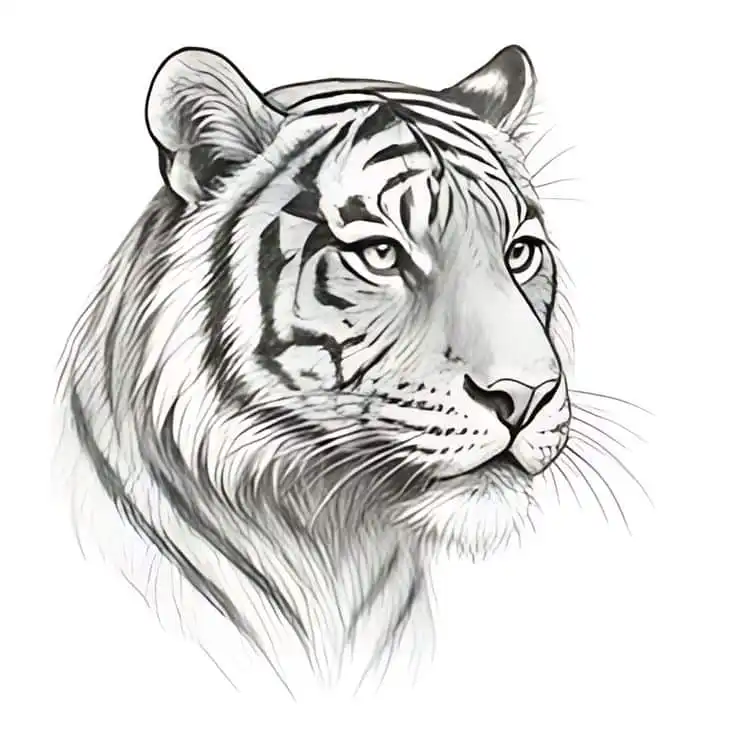
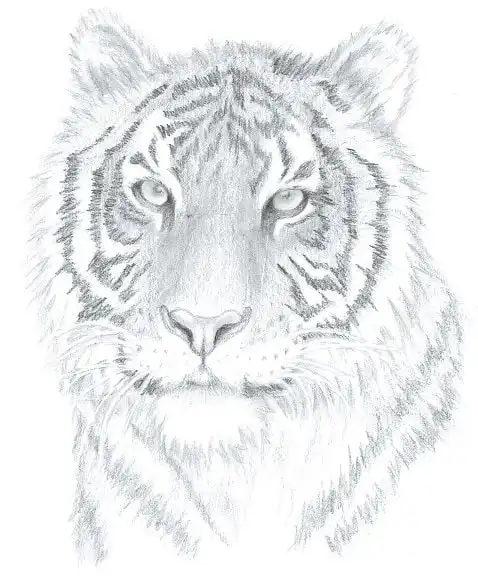
You do not need to draw each individual hair for your tiger to look realistic. Focus on:
Directional strokes
Change your stroke direction with the natural flow of the fur. For example, fur on the cheeks often radiates outward from the muzzle.Edge softness
Keep the edges of stripes slightly soft rather than razor sharp. This looks more like hair and less like painted shapes.Value contrast
Make sure there is a clear contrast between the dark stripes and the lighter fur around them. A strong value range is more important than perfect detail.
Around the edges of the head and ears, use lighter, feathery strokes that break the outline so the fur looks soft rather than cut out.
Polish your drawing and fix common issues
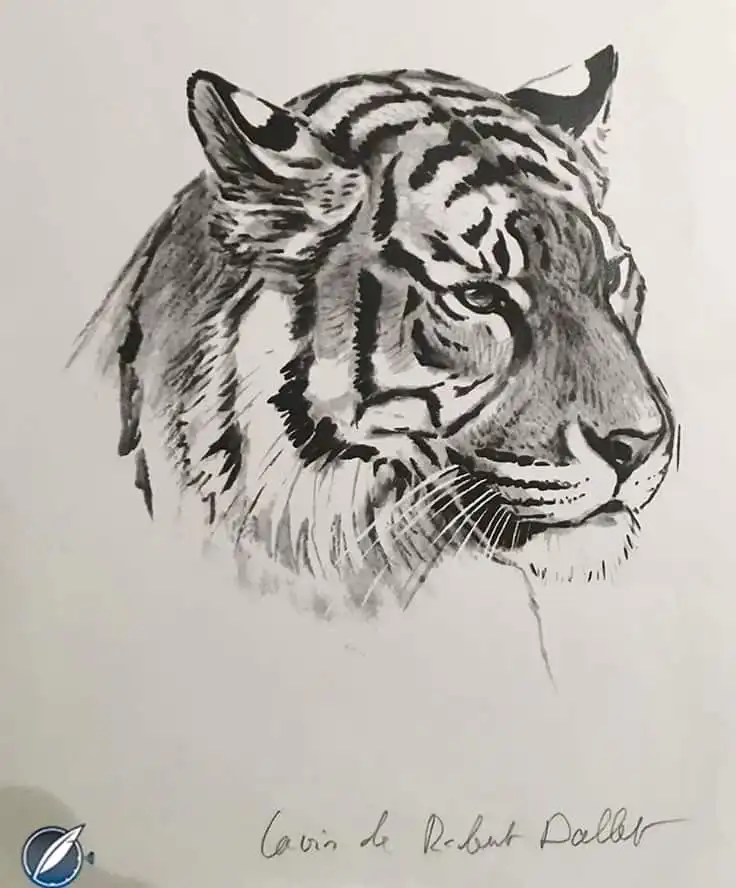
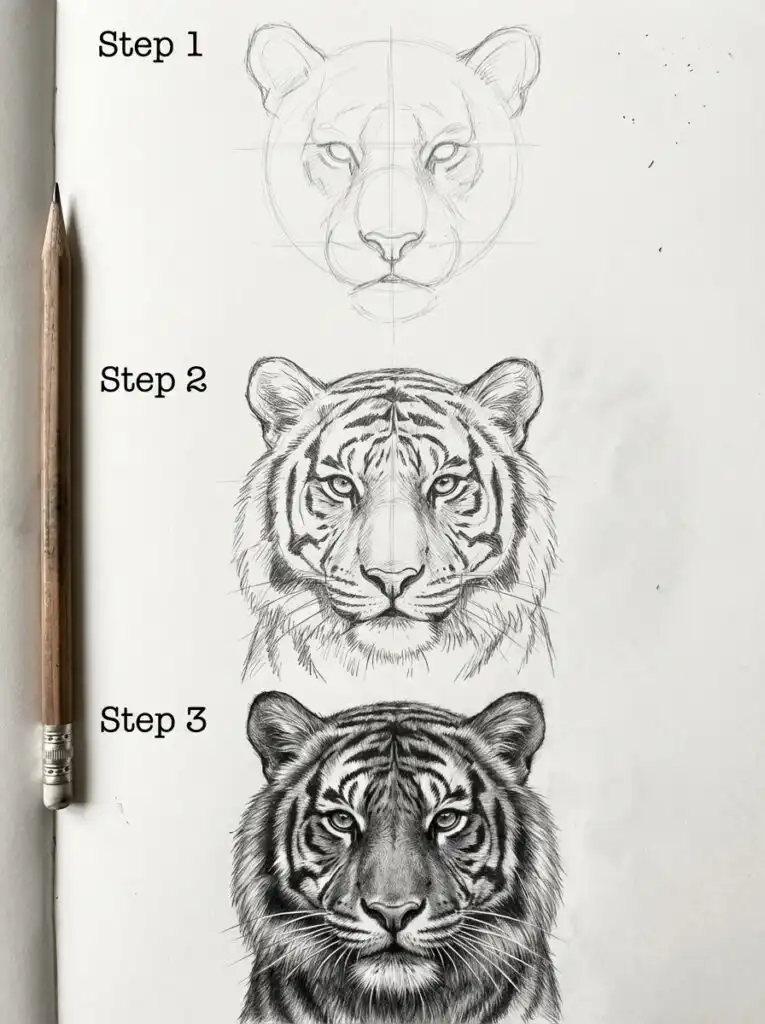
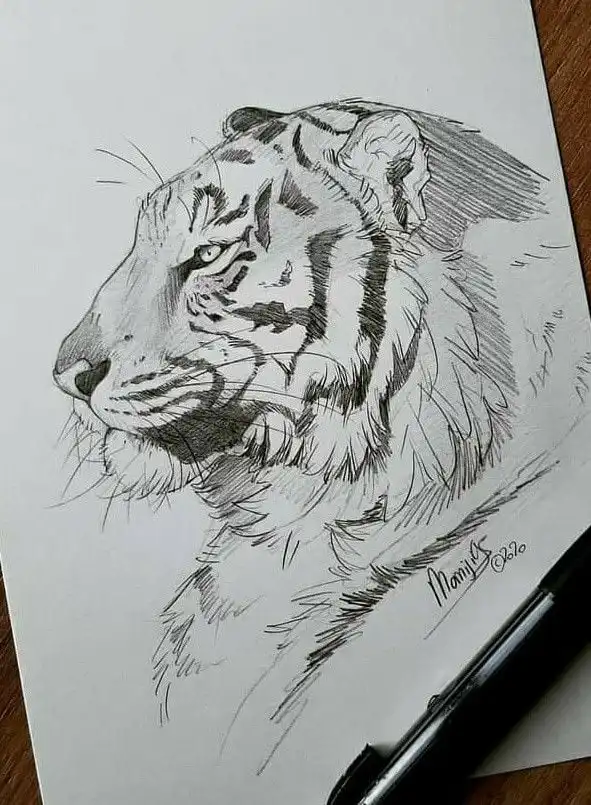
You are almost done. Now you will clean up lines, adjust shading, and make small changes that have a big impact.
Step 19: Clean construction lines
Look for any remaining guidelines or circles that you no longer need.
- Carefully erase visible parts of the original head circle and center lines that cross through finished features.
- Redraw any edges that lost clarity as you erased.
- Use a kneaded eraser to gently lift graphite instead of scrubbing, which can damage the paper.
Your goal is to keep the structure, but remove the scaffolding.
Step 20: Check symmetry and proportions
Even in a front view, a tiger’s face is rarely perfectly symmetrical, but major elements should feel balanced.
Ask yourself:
- Are both eyes on the same horizontal line?
- Do the ears match in size and placement?
- Is the nose centered along the vertical guideline?
- Does one cheek look much larger than the other?
If something feels off, lightly adjust with shading rather than heavy erasing when possible. Small tweaks around the eyes and jawline can correct the overall balance.
Step 21: Deepen final shadows and highlights
Finish with a pass that focuses only on values.
- Darken the deepest shadows under the chin, under the brows, inside the nostrils, and in the darkest parts of the stripes.
- Reinforce the pupils so they are clearly darker than the iris.
- Lift highlights on the nose bridge, eye highlights, and whisker tips with an eraser.
Viewed from a distance, the tiger’s features should read clearly, and the face should feel three-dimensional.
Practice exercises to improve faster
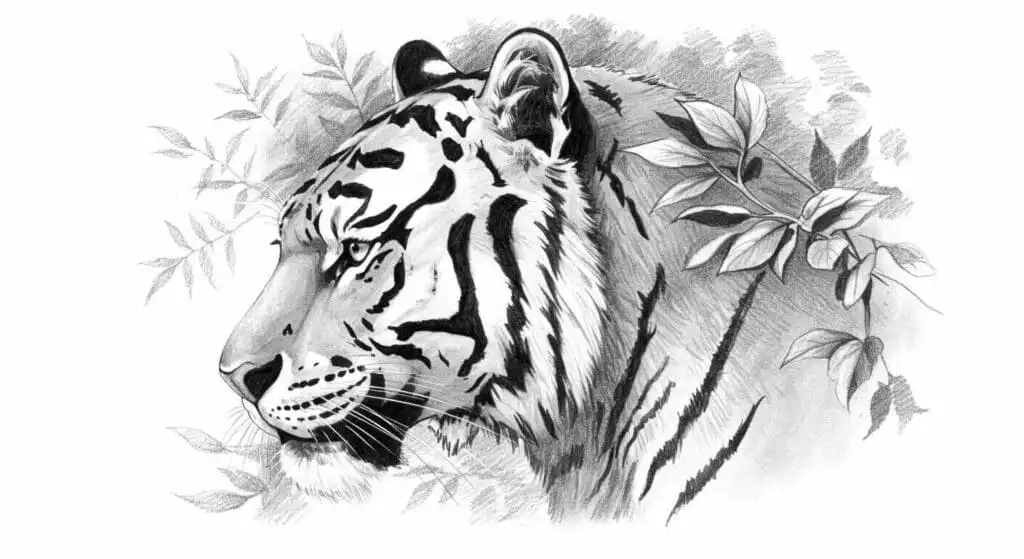
If you want your realistic tiger face drawings to improve more quickly, add a few focused exercises to your routine.
Quick eye studies
Spend a week drawing only tiger eyes:
- Zoom in on reference photos and draw each eye in a simple rectangle.
- Practice round pupils, radial iris lines, and highlights as described in the DeviantArt eye guide (DeviantArt).
- Try both high contrast lighting and softer, diffuse light.
These mini studies will make you more confident when you return to full faces.
Stripe pattern thumbnails
On a page of small head shapes, sketch different stripe layouts.
- Keep each thumbnail under five minutes.
- Focus on the flow and rhythm of stripes rather than detail.
- Notice how changing the pattern slightly can change the tiger’s personality.
This helps you understand how stripes wrap around form, which is key for realism.
Paper and pencil tests
When you try a new paper, do a small fur sample first:
- Draw a 2 x 2-inch square.
- Test light, medium, and heavy pressure.
- Layer strokes to see how many layers the paper can handle.
On hot-pressed watercolor paper, for example, you should be able to build several layers of colored pencil without the surface breaking down (Reddit).
Example workflow recap
To keep the full process in mind, here is a compact version of the steps you just explored:
- Sketch a light circle for the head.
- Add a curved vertical and horizontal guideline.
- Place small eye circles on the horizontal line.
- Draw a vertical oval for the muzzle and a small nose triangle.
- Outline the mouth, chin, and whisker pads.
- Adjust the head shape and add ears.
- Refine eye shapes, iris, pupil, and eyelids.
- Add eye details like dark rims, radial lines, and highlights.
- Refine the nose, nostrils, and lips.
- Draw the whiskers.
- Map out the main tiger stripe patterns.
- Decide on your light source and start light shading.
- Build up values on fur and stripes in layers.
- Clean up construction lines and check symmetry.
- Deepen final shadows and reinforce highlights.
Follow this path a few times with different reference images, and you will notice your lines becoming more confident and your faces more believable.
Frequently asked questions
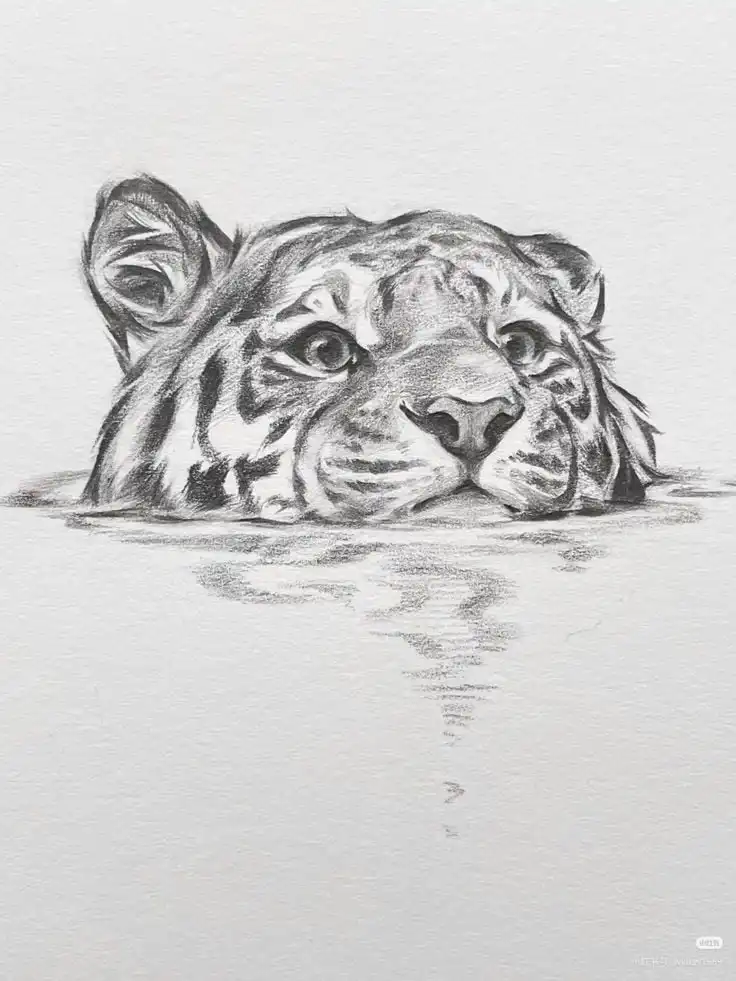
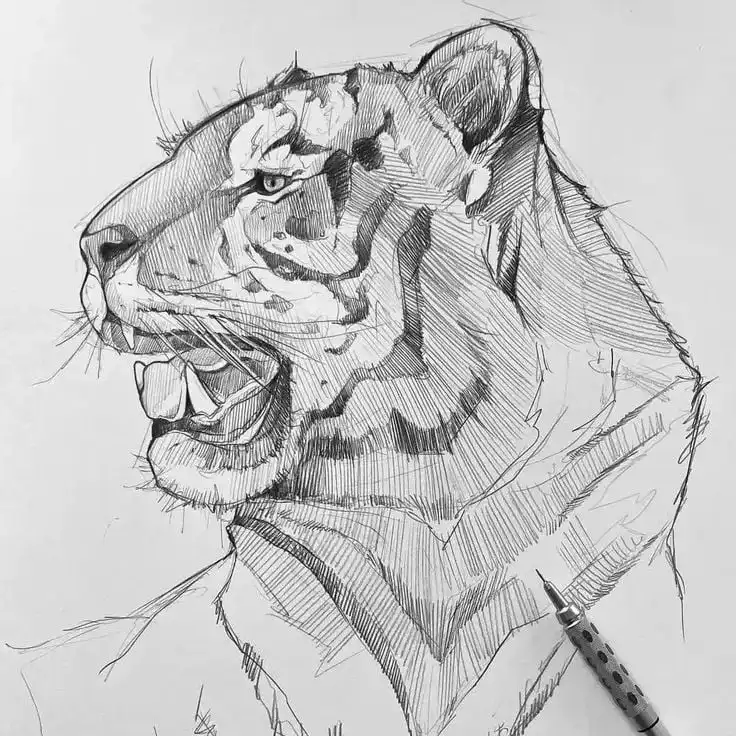
1. How long does it take to draw a realistic tiger face
Your first realistic tiger face drawing might take a couple of hours or more, especially if you are carefully following step-by-step guides like the one on How2DrawAnimals. With practice and repetition, you will move through the construction and shading stages faster. Focus on accuracy first, then speed.
2. Do I need colored pencils, or can I work in graphite only
You can absolutely create a convincing, realistic tiger face drawing with only graphite. Colored pencil adds richness to the orange and black fur, but values and proportions matter more than color. Many artists first master the subject in graphite, then repeat the process with color on papers like Bristol smooth, Stonehenge, or hot-pressed watercolor paper for more nuanced results (Reddit).
3. What is the best reference for beginners
Look for clear, front-facing tiger photos with good lighting and visible eyes. You can also practice using structured tutorials, such as the realistic tiger head breakdown on How2DrawAnimals, where new lines are highlighted in red so you can see each construction step clearly. As you build confidence, branch out to side views and more complex lighting.
4. How do I stop the face from looking flat
Flatness usually comes from weak value contrast and inconsistent perspective. To fix this:
- Make sure your eyes sit correctly on the curved guideline, which creates a sense of depth at the front of the face (How2DrawAnimals).
- Strengthen shadows under the brows, under the cheekbones, and below the jaw.
- Soften stripe edges slightly so they wrap around the form rather than sitting on top like stickers.
- Use radial lines and varied tones in the iris to give the eyes internal depth (DeviantArt).
5. Why do my tiger’s eyes look lifeless
Lifeless eyes often lack highlights and structure. To bring them to life:
- Ensure pupils are round, not ovals, for accuracy in a tiger.
- Add a clear, bright highlight that does not sit in the exact center of the pupil.
- Use a dark line around the iris edge and subtle radial lines to avoid a flat fill (DeviantArt).
- Consider the tapetum lucidum by adding soft tonal variation in the iris, which suggests a reflective inner surface.
If you are unsure, zoom in on just the eyes in your reference and redraw them larger as a practice study. Then return to your main drawing with fresh insight.
The more often you repeat this full process, the more natural and realistic the tiger face drawing will feel. Start with light construction lines, respect the underlying structure, then take your time with the eyes and values. With each new tiger, you will see your control and confidence grow.
- 3.7Kshares
- Facebook0
- Pinterest3.7K
- Twitter0
- Reddit0