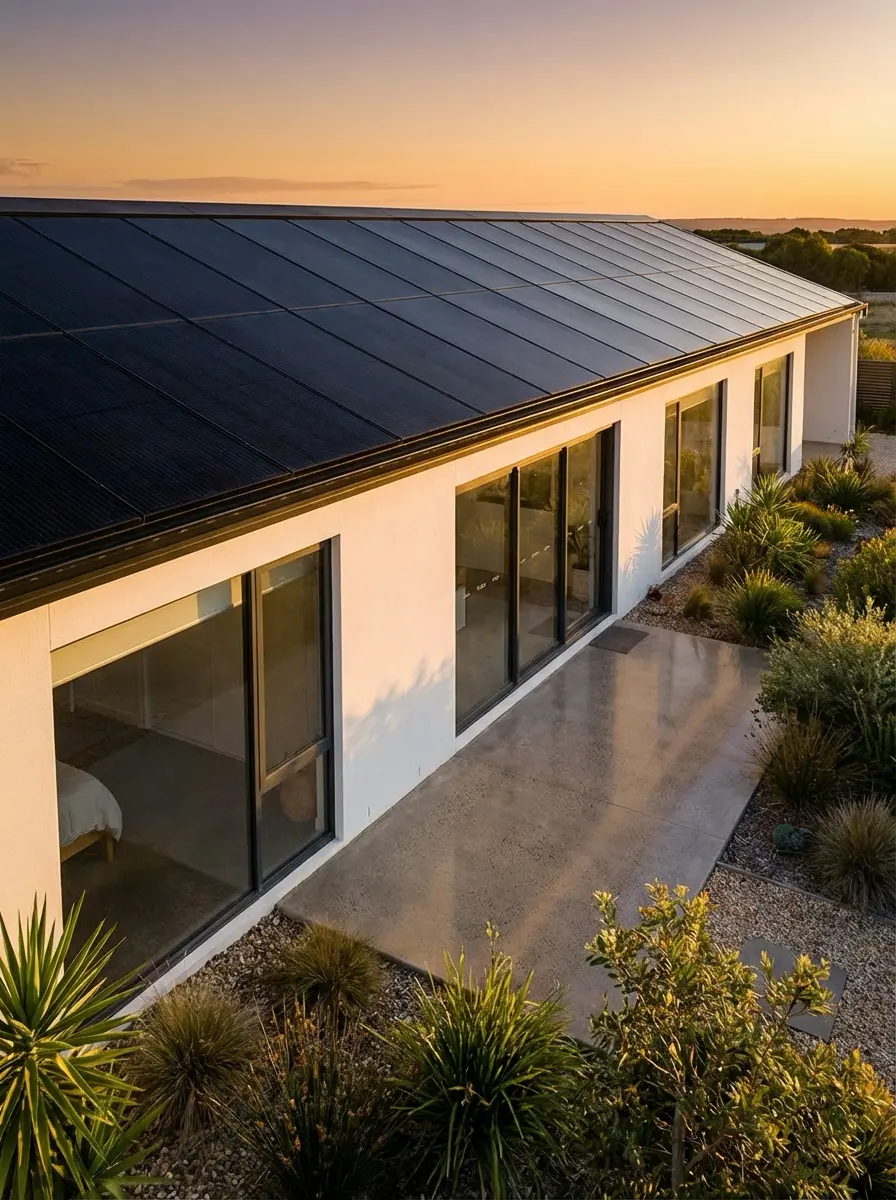
The first solar installation I saw that made me think seriously about photovoltaics as architecture rather than technology was a house in the Swiss canton of Valais that I came across in a 2022 architecture journal. The roof was a single, uninterrupted dark plane. No visible panels, no rack hardware, no colour or texture break between the ridge and the eave. It looked like a precisely detailed standing-seam metal roof in anthracite — the kind of detail that communicates material confidence and compositional intention.
- The Roof as a Design Plane: Why Solar Integration Starts Here
- The Solar Product Landscape: A Design-Led Overview
- Compositional Principles for Solar Integration
- The Financial Framework: Investment Logic for Design-Conscious Homeowners
- Solar Integration as Architectural Intent
- FAQ: Solar Panel Integration in Architecture
It was solar tiles. Building-integrated photovoltaics (BIPV) sitting flush in the roof plane, generating electricity, indistinguishable at any viewing distance from the roofing material they replaced. The architect had not compromised the exterior composition for energy performance — the energy performance was the exterior composition. That building is not unusual in 2026. It represents a design approach that has been developing for over a decade and is now mainstream enough that clients bring it as a reference rather than as a technical query.
This guide covers solar integration from an architectural and design perspective: how photovoltaics interact with the exterior composition of a building, what the current product landscape looks like for design-conscious installations, how to evaluate the roof as a design plane before specifying any solar product, and the financial framework that makes integration viable.
The technical question of whether solar works is settled. The design question of how to integrate it well is where the interesting work is.
The Roof as a Design Plane: Why Solar Integration Starts Here
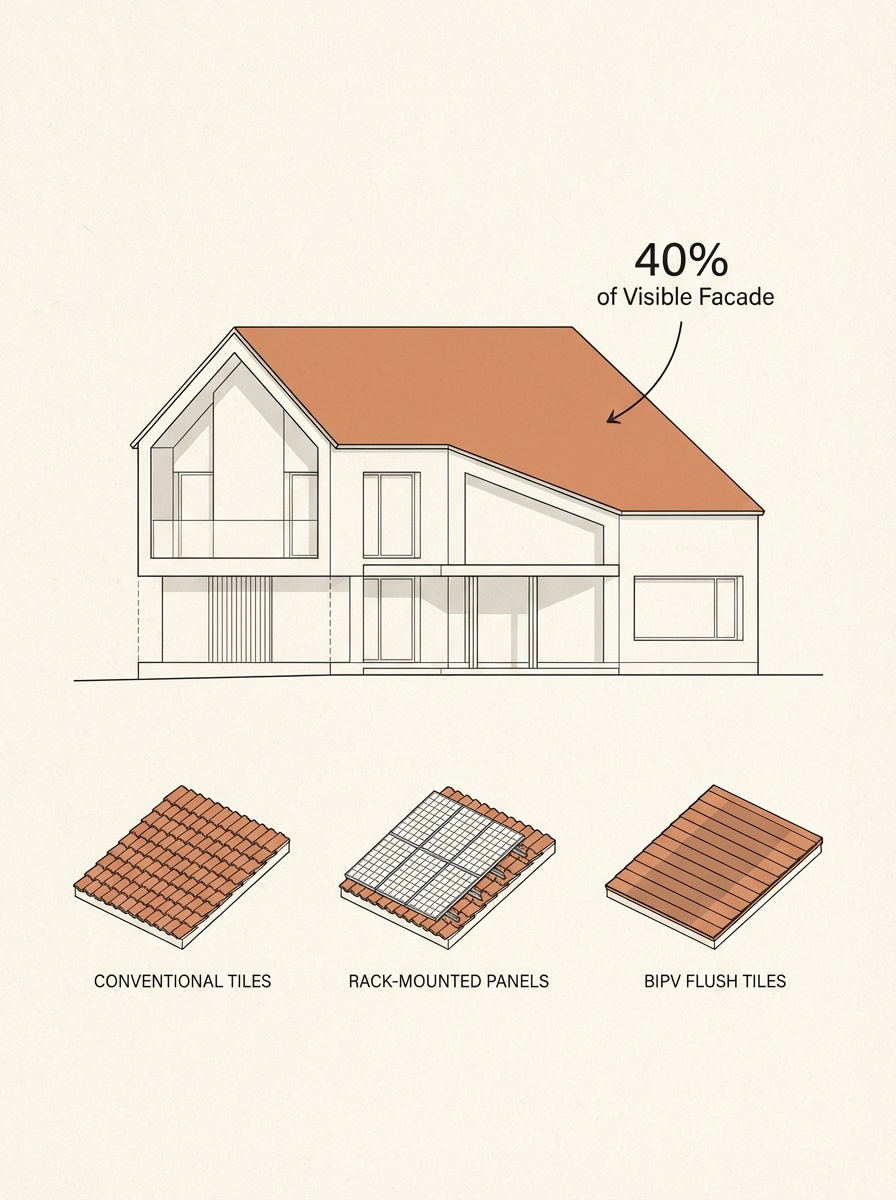
The starting point for any intelligent solar integration is understanding what the roof does visually before it does anything energetically. In residential architecture, your roof accounts for approximately 40% of your home’s visual exterior — a proportion that makes it the single largest surface in the street-facing composition, and the one that most directly communicates the design intent of the building.
This proportion has direct implications for solar specification. A solar installation that looks good on a flat contemporary facade can look awkward on a traditional pitched roof with multiple valleys and dormers — not because the technology is wrong, but because the roof form itself does not provide a clean, unified plane for the panels to read as an intentional composition. Conversely, a long, uninterrupted south-facing pitch on a simple gable-end house is almost ideally suited for integrated solar: the panels fill the plane without interruption, the colour and texture are consistent, and the result reads as a deliberate material choice rather than an energy appliance bolted to the exterior.
Reading the Roof Before Specifying Solar
The design evaluation that should precede any solar specification involves three questions. First: how many contiguous, uninterrupted roof planes does the building have? Each valley, hip, or interruption is a compositional break that will be visible in the final installation. Second: what is the orientation and pitch of the dominant plane? South-facing planes at 30-45 degree pitch maximise annual generation; east and west orientations are viable but less efficient; north-facing planes in the northern hemisphere are generally not worth specifying. Third: what roofing material currently covers the building, and what is its remaining life? Replacing a roof that has five years of remaining life to install solar adds unnecessary cost; replacing an end-of-life roof with BIPV tiles or installing rack-mounted panels at the same time as a roof replacement is the moment of most efficient intervention.
✏ Design note: The strongest solar integration compositions tend to treat the roof as a single surface rather than a divided one. If specifying rack-mounted panels, aim to fill the entire south-facing plane rather than placing a partial array — a full-plane installation reads as an intentional design decision; a partial array in one corner reads as an afterthought. Even from a pure generation efficiency perspective, filling the plane produces better output-to-visual-disruption ratios than a partial installation.
The Solar Product Landscape: A Design-Led Overview
The gap between the first generation of solar panels — blue-tinted polycrystalline modules on visible aluminium racks — and the current product range is significant. Design-conscious homeowners and architects now have a product landscape that ranges from near-invisible BIPV tiles to precision-detailed rack systems that read as deliberate architectural elements rather than engineering necessities.
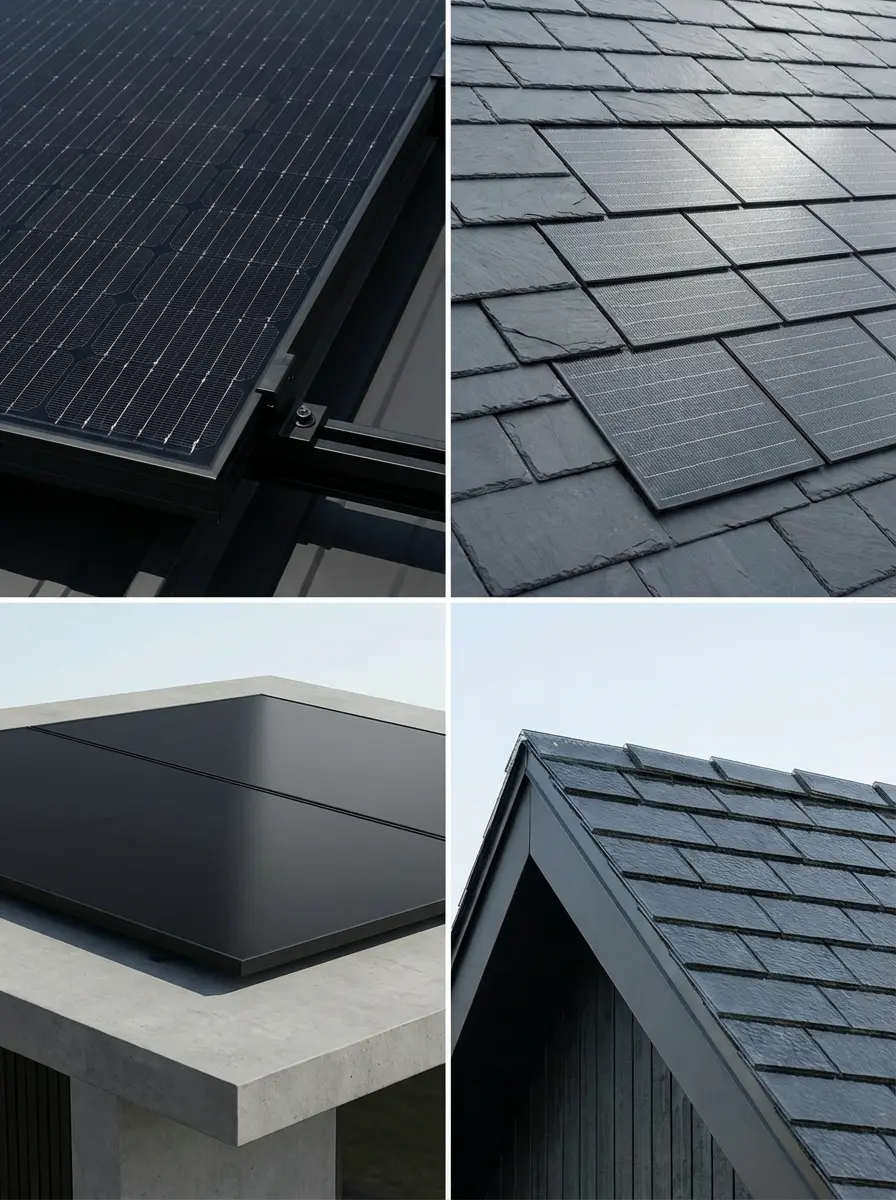
Full-Black Monocrystalline Panels (Rack-Mounted)
Visual profile: Uniform dark surface with fine cell grid barely visible at normal viewing distance. Frame either matching black or frameless. Significantly more architectural than the blue-tinted polycrystalline panels of the previous decade.
Best for: Contemporary residential architecture with simple, uninterrupted roof planes. The standard choice for design-conscious installations that do not require full flush integration.
Design consideration: Frame colour matters significantly. A silver aluminium frame on an otherwise dark panel is the most common visual weakness in otherwise well-considered installations. Specify black-framed or frameless panels as a non-negotiable design requirement.
Building-Integrated Photovoltaics (BIPV) — Solar Tiles
Visual profile: Completely flush with the roof plane — the tile is the photovoltaic cell, with no rack hardware, no elevation above the roof surface, and no visual differentiation from adjacent non-generating tiles at viewing distance.
Best for: Projects where visual integration is the primary design requirement — heritage-adjacent contexts, high-design residential architecture, or any building where a visible panel installation would compromise the compositional intent.
Design consideration: BIPV tiles are significantly less efficient per square metre than rack-mounted panels, and significantly more expensive per watt of generation capacity. Specify them when the design requirement justifies the premium; specify rack-mounted panels when generation efficiency and value are the priorities.
Frameless All-Black Panels (Flat Roof Systems)
Visual profile: Ballasted or mechanically attached mounting systems on flat or very low pitch roofs, with panels oriented to optimal angle regardless of roof orientation. Panels not visible from street level on flat-roof buildings.
Best for: Commercial buildings, flat-roof residential, and rooftop installations where panels are entirely above the parapet and invisible from the public realm. The architectural design challenge shifts from panel appearance to parapet height and roof drainage design.
Design consideration: Flat roof solar is primarily a performance specification rather than an aesthetic one, since the panels are not visible. The design consideration is structural: flat roofs must be assessed for load capacity, drainage pattern after panel installation, and maintenance access.
Coloured and Textured BIPV Facade Panels
Visual profile: Photovoltaic cells integrated into facade cladding panels rather than roof surfaces. Can be coloured or printed to match or contrast with adjacent facade materials. Increasingly used in commercial architecture.
Best for: Vertical facade integration on contemporary buildings where the south or west facade plane has more surface area than the roof. Relevant for multi-storey residential and commercial projects.
Design consideration: Facade-integrated PV generates less power per panel than roof-mounted systems (due to more perpendicular solar incidence angle on vertical surfaces), but allows the building envelope itself to be the energy generator — a compositional shift with significant architectural implications.
Compositional Principles for Solar Integration
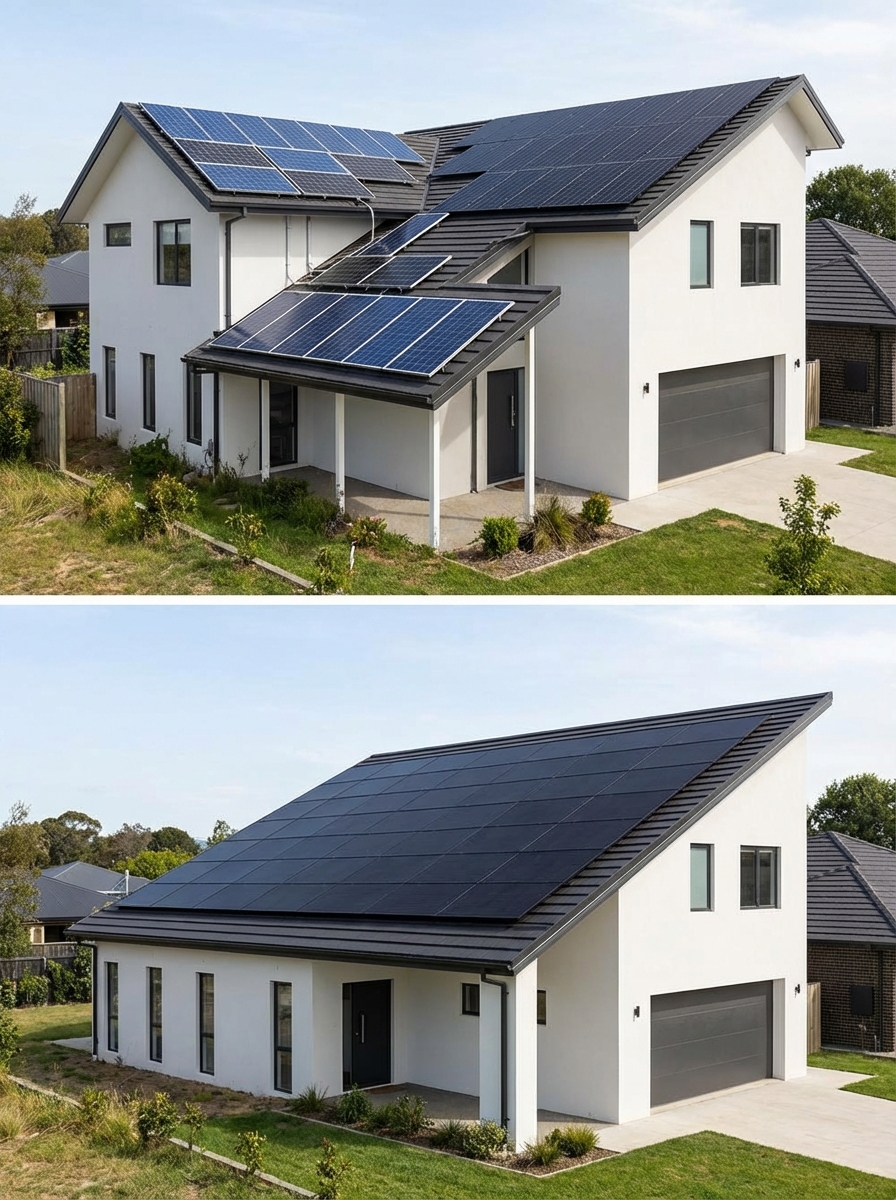
The difference between a solar installation that enhances a building’s exterior and one that detracts from it almost always comes down to a small number of compositional decisions that are made before the first panel is specified.
Colour Consistency
The most visually damaging element in a poorly integrated solar installation is colour inconsistency between the panels, the mounting hardware, and the adjacent roofing material. A black panel on a dark grey slate reads as compositionally coherent — the panel adds a surface, not a colour break. The same panel on terracotta tiles creates a jarring contrast that makes the installation look retrofitted regardless of the technical quality of the work. Specifying panel colour and frame colour in relation to the existing or planned roofing material is the single highest-impact design decision in a solar specification.
Plane Completion
A partial array — panels covering 60% of a south-facing plane, leaving the remaining 40% as bare roofing — reads as incomplete rather than intentional. Where budget or structural capacity constrains the full-plane approach, it is often better to concentrate panels on a single, smaller plane that can be fully covered than to partially cover the primary plane. A complete array on the garage roof reads better than an incomplete array on the main house roof, even if the main house generates more power.
Setback and Edge Detail
On rack-mounted installations, the setback of the array from the roof perimeter is visible from ground level and affects the compositional quality of the installation. A uniform setback — typically 200-400mm from all roof edges — reads as considered and intentional. An uneven setback created by irregular panel placement or structural constraints reads as ad hoc. If the structural layout of the roof forces an irregular setback, a consistent shadow gap or trim detail at the array perimeter can restore the visual order.
✏ Design note: The most underused tool in residential solar design: a rendered elevation showing the proposed panel layout on the actual building form, viewed from the street-facing angle. Most solar installers work from aerial imagery and generation calculations rather than facade composition. Requesting a streetscape elevation with the panel layout modelled is a five-minute exercise in most CAD tools and immediately reveals compositional problems that are expensive to correct after installation.
The Financial Framework: Investment Logic for Design-Conscious Homeowners
The adoption curve for residential solar has been steep. According to Gitnux, 25% of U.S. rooftops are expected to have solar panels by 2030 — a figure that reflects both falling panel costs (down approximately 90% since 2010) and an improving financial incentive structure that has made the investment case for solar significantly clearer than it was a decade ago.
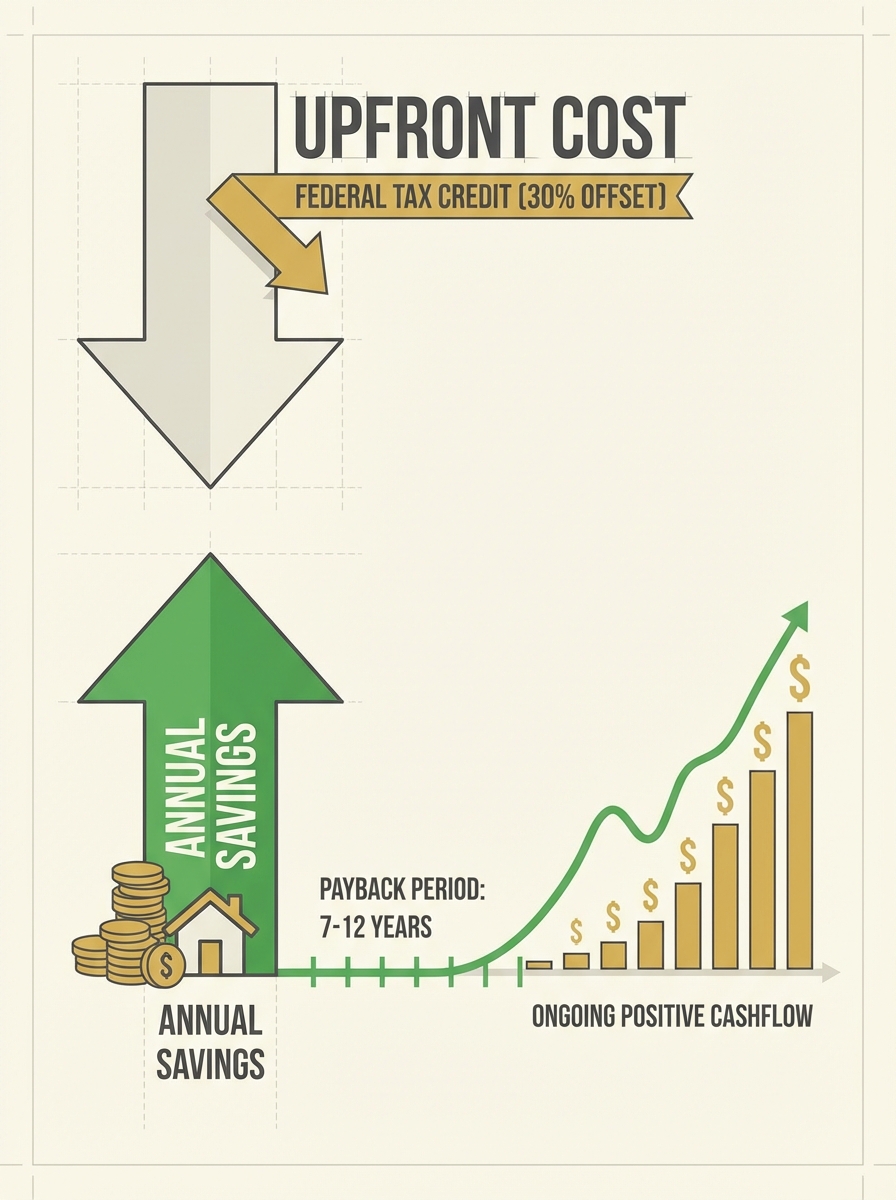
The federal incentive structure is the most significant financial variable in the specification decision. Under the Inflation Reduction Act, homeowners can claim up to 30% of solar installation costs from 2022 to 2032 as a federal tax credit — a direct reduction in the tax liability, not a deduction from taxable income, which makes it substantially more valuable than a deduction at most income levels. This credit applies to equipment, installation labour, and some associated electrical work.
The Design Premium Question
For design-conscious homeowners choosing between standard rack-mounted panels and BIPV tiles, the financial question is whether the design premium of full integration is justified by aesthetic value added to the property rather than generation return. BIPV tiles typically cost 2-3x more per watt of generation capacity than equivalent rack-mounted systems. The generation output is lower per square metre due to the fixed tile angle compared to optimally tilted rack-mounted panels. The financial payback period for a BIPV installation is therefore significantly longer than for a standard installation — often 15-20 years versus 7-12 years for a well-positioned standard system.
The rational basis for choosing BIPV in spite of this: the design premium is amortised over the life of the building, not just the life of the solar system. A roof that enhances the architectural quality of a building adds value continuously through the property’s life — in buyer perception, in sale price, and in the subjective quality of living in a well-designed space. Evaluated as a combined roofing and energy investment rather than as solar alone, the premium can be justified in high-design contexts where the aesthetic quality of the exterior is a priority.
State and Local Incentives
The federal 30% credit is available nationally, but state-level incentives vary significantly. California, Massachusetts, New York, and several other states offer additional rebates, property tax exemptions on the value added by solar, and net metering programs that provide credit for excess generation exported to the grid. The combined effect of federal and state incentives can reduce the effective installation cost by 35-45% in the most incentive-rich states, significantly improving the payback period calculation and the financial logic for upgrading from a standard to a premium integration approach.
Solar Integration as Architectural Intent
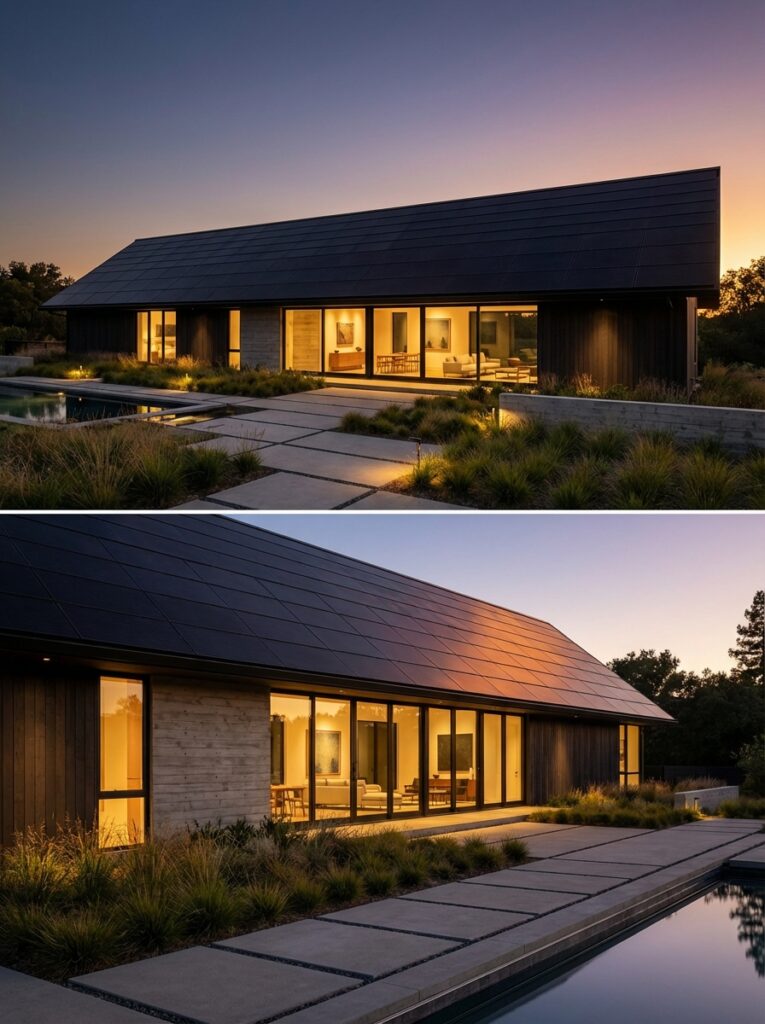
The Valais house I began with is not exceptional anymore. It represents a specification approach that is available to any architect or homeowner willing to treat the roof as a design element first and an energy system second — because when the order is right, the two goals do not conflict. They reinforce each other.
The most successful solar integrations share a common characteristic: the panel specification follows the architectural analysis, not the other way around. The roof form is evaluated for its generating planes. The dominant south-facing surface is identified. The product that best fills and completes that surface — whether full-black rack-mounted panels or flush BIPV tiles — is specified based on the compositional requirement and the financial framework. The result is an installation that reads as a design decision because it was made as a design decision, from the beginning.
The financial structure supports this approach. With the 30% federal tax credit, falling panel costs, and state-level incentives that continue to expand, the investment case for solar is no longer a compromise between spending on design and spending on energy. A well-integrated solar roof is both the better-looking roof and the financially superior one — not despite the design attention, but because of it.
FAQ: Solar Panel Integration in Architecture
Q: Do solar panels damage the roof or affect structural integrity?
Correctly installed panels on a structurally sound roof do not cause damage. Standard rack-mounted panels attach through the roofing material to structural rafters with sealed, flashed penetrations. A roof nearing end-of-life should be replaced before solar installation — removing and reinstalling panels for a roof replacement adds significant cost. BIPV tiles replace roofing material entirely, eliminating penetration concerns.
Q: What is the difference between solar panels and solar roof tiles?
Solar panels mount on a rack above the existing roofing material. Solar roof tiles (BIPV) replace the roofing material entirely, sitting flush in the roof plane with no visible hardware. BIPV is significantly more expensive per watt and less efficient per square metre. The choice is primarily architectural: panels for efficiency and value; tiles for visual flush integration at a premium.
Q: How do solar panels affect home value?
Lawrence Berkeley National Laboratory research found homes with solar sold at approximately $15,000 premium on average. Owned systems add value more reliably than leased or PPA systems, which can complicate property transfer. Architecturally, a well-integrated solar installation also contributes to the contemporary positioning of the property and buyer perception beyond the quantifiable energy savings.
Q: What roof orientation works best for solar?
In the northern hemisphere: south-facing, 30-45 degree pitch for maximum annual generation. East/west orientations produce 15-20% less but suit occupants who use more power in morning or evening. Flat roofs allow optimal-angle ballasted mounting regardless of building orientation. North-facing planes generally not worth installing on until south and west planes are fully utilised.
- 3shares
- Facebook0
- Pinterest3
- Twitter0
- Reddit0