Picking a haircut from a photo is easy. Picking one that actually works for your face shape, hair texture, and the amount of time you spend styling it in the morning is where most guys get stuck. This men’s hairstyles 2026 gallery gives you visual ideas first, then a practical guide underneath so you can narrow the options before you sit in the barber chair.
Use the photos as references, not strict rules. A cut that looks sharp on straight thick hair may need a different length on curly hair. A high fade that works on a square face can make a long face look even longer. The goal is to find the direction, then adjust the cut to your head shape, growth pattern, and routine.


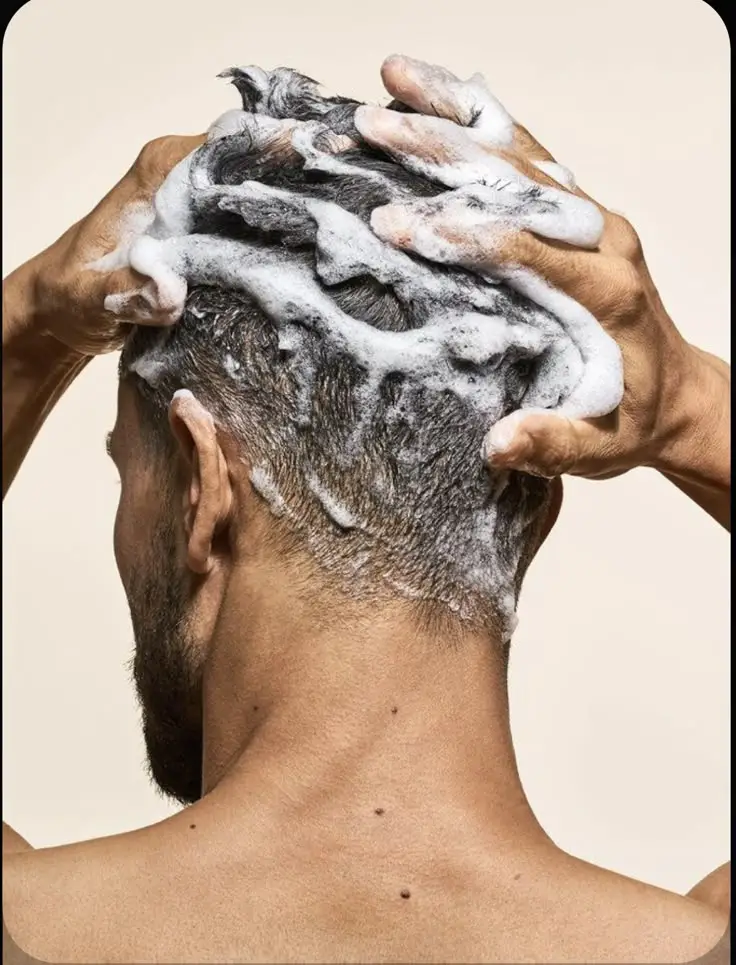


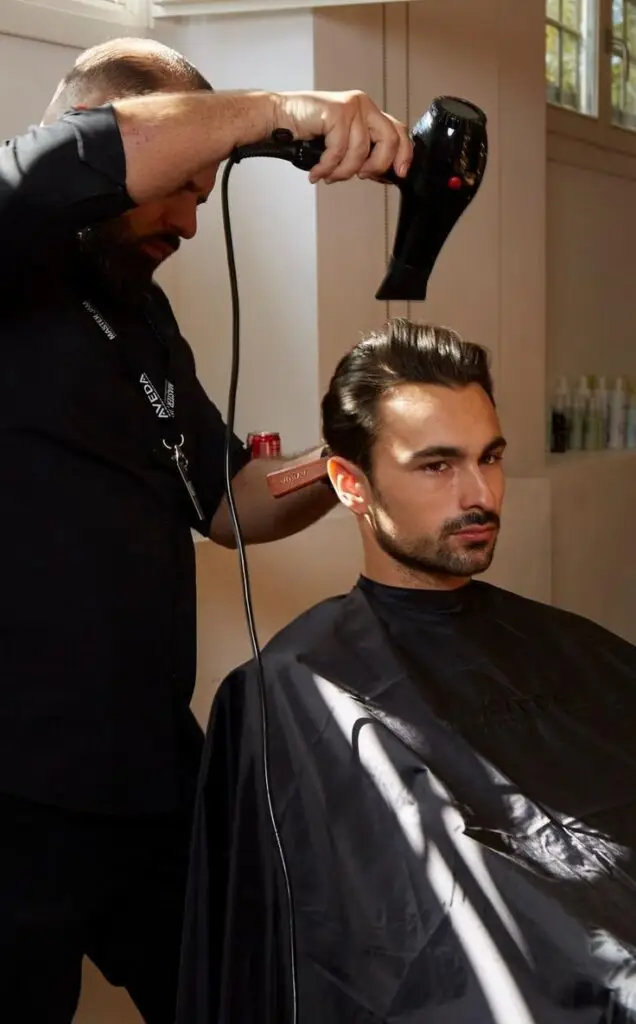


Which men’s hairstyle works for your face shape
Face shape is the fastest way to remove bad options. You do not need to measure your face with a ruler. Look at the overall impression in the mirror: is your face longer than it is wide, very angular at the jaw, soft and round, or fairly balanced? That quick read already tells you what to avoid.
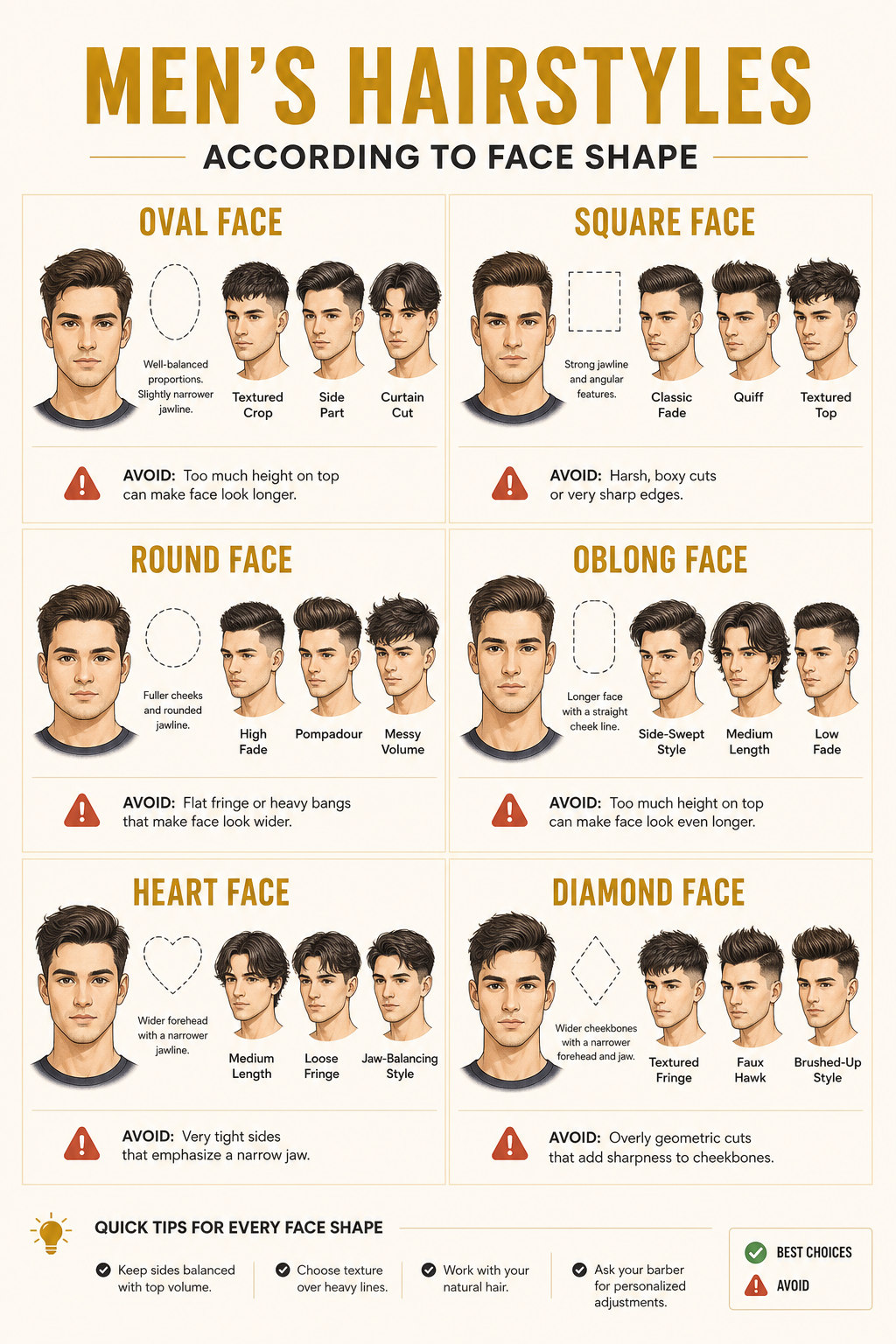
| Face shape | Cuts that usually work | What to avoid |
|---|---|---|
| Oval | Textured crops, fades, side parts, curtain cuts, longer styles | Extreme height if the face already looks long |
| Square | Classic fades, quiffs, textured tops, medium-length cuts | Very hard edges everywhere if the jaw already dominates |
| Round | High fades, pompadours, messy volume, textured tops | Flat fringe or very short all-over cuts |
| Oblong | Side-swept styles, medium length, low fades, curtains | Too much height on top |
| Heart | Medium-length cuts, loose fringe, styles with weight near the jaw | Very tight sides with a tall top |
In design terms, a haircut is a silhouette. The outline matters before the details. If the overall shape balances your face, product and texture make it better. If the silhouette is wrong, even a perfect fade will feel slightly off.
How hair type changes the haircut
Hair type matters as much as face shape. Straight hair shows sharp lines clearly, which is why side parts, crops, and clean fades can look very precise. Wavy hair is more forgiving and often looks best with texture, movement, and a little length on top.
Curly hair needs shape more than control. A good curly cut removes bulk where it gets wide and keeps enough length where the curl pattern looks good. If your barber cuts curly hair too short on top, the shape can turn round fast. For thick hair, ask for weight removal, not just shorter length.
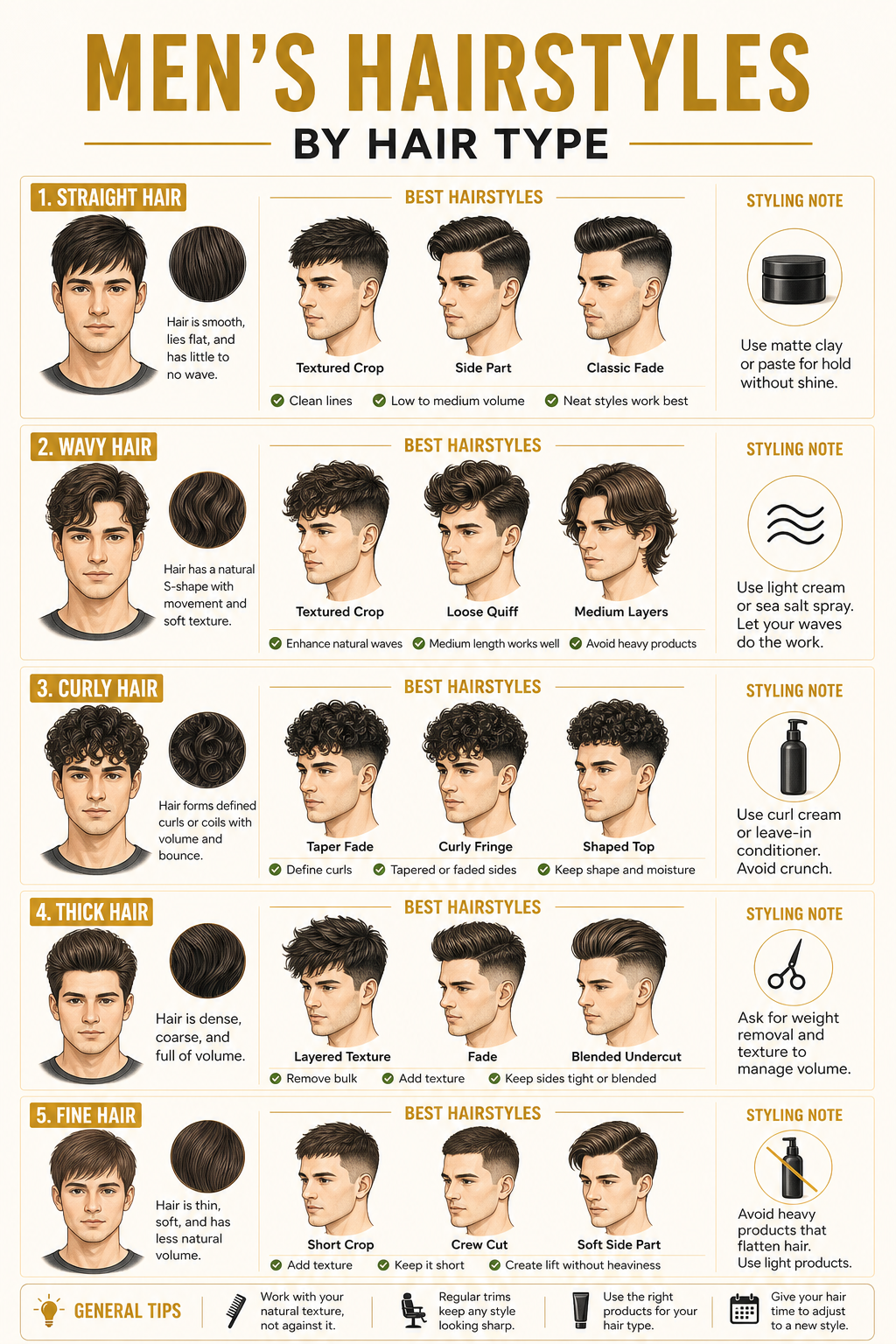
| Hair type | Good haircut direction | Styling note |
|---|---|---|
| Straight | Crop, side part, fade, slick back | Use light matte product so it does not look greasy. |
| Wavy | Textured crop, medium layers, loose quiff | Let the wave show instead of flattening it. |
| Curly | Taper fade, shaped top, curly fringe | Use curl cream or light leave-in conditioner. |
| Thick | Layered texture, fade, undercut with blending | Ask to remove weight so the sides do not puff out. |
| Fine | Short crop, crew cut, soft side part | Avoid heavy product that collapses the hair. |
How to tell your barber exactly what you want
Show the photo first. That removes half the confusion. Then give three details: the side length, the top length, and how the top should connect to the sides. Barber language sounds complicated, but most of it comes down to those choices.
- Length on the sides: Say a guard number if you know it. A #2 is about 6mm. A skin fade goes down to the skin. A low fade starts near the ear, while a high fade starts closer to the temple.
- Length on top: Use inches, centimeters, or a simple instruction like “leave about 2 inches” or “clean it up but keep the length.”
- The blend: Say whether you want it blended, tapered, disconnected, or with a hard line. Most modern cuts look better blended unless you specifically want a sharp undercut.
A complete instruction could be: “Number 2 on the sides, low skin fade at the bottom, leave about 2 inches on top, textured and messy, not slicked back.” That gives your barber a clear starting point and still leaves room to adjust the cut to your hair.
Men’s haircut trends in 2026
The best men’s hairstyles in 2026 are less stiff than the over-polished cuts that dominated a few years ago. Texture is the big shift. Hair can look shaped and intentional without looking like it has been locked in place with heavy gel.
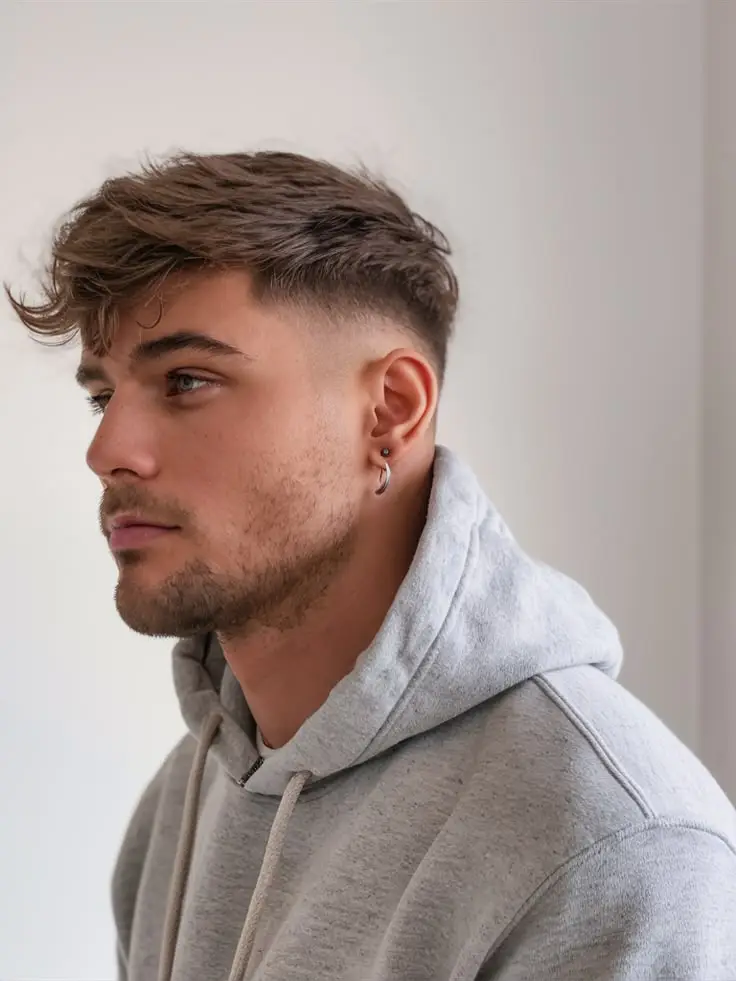
The modern mullet is still around, but the wearable version is cleaner: faded or tapered sides, controlled length in the back, and enough texture so it feels current. The textured crop with a drop fade is still one of the safest choices because it works on many face shapes and does not take much styling.
Curly taper cuts are also strong, especially for guys who used to cut their curls too short because they did not know what else to do with them. Longer curtain cuts are growing too, but they need patience. They look effortless only after the length, parting, and layers are right.
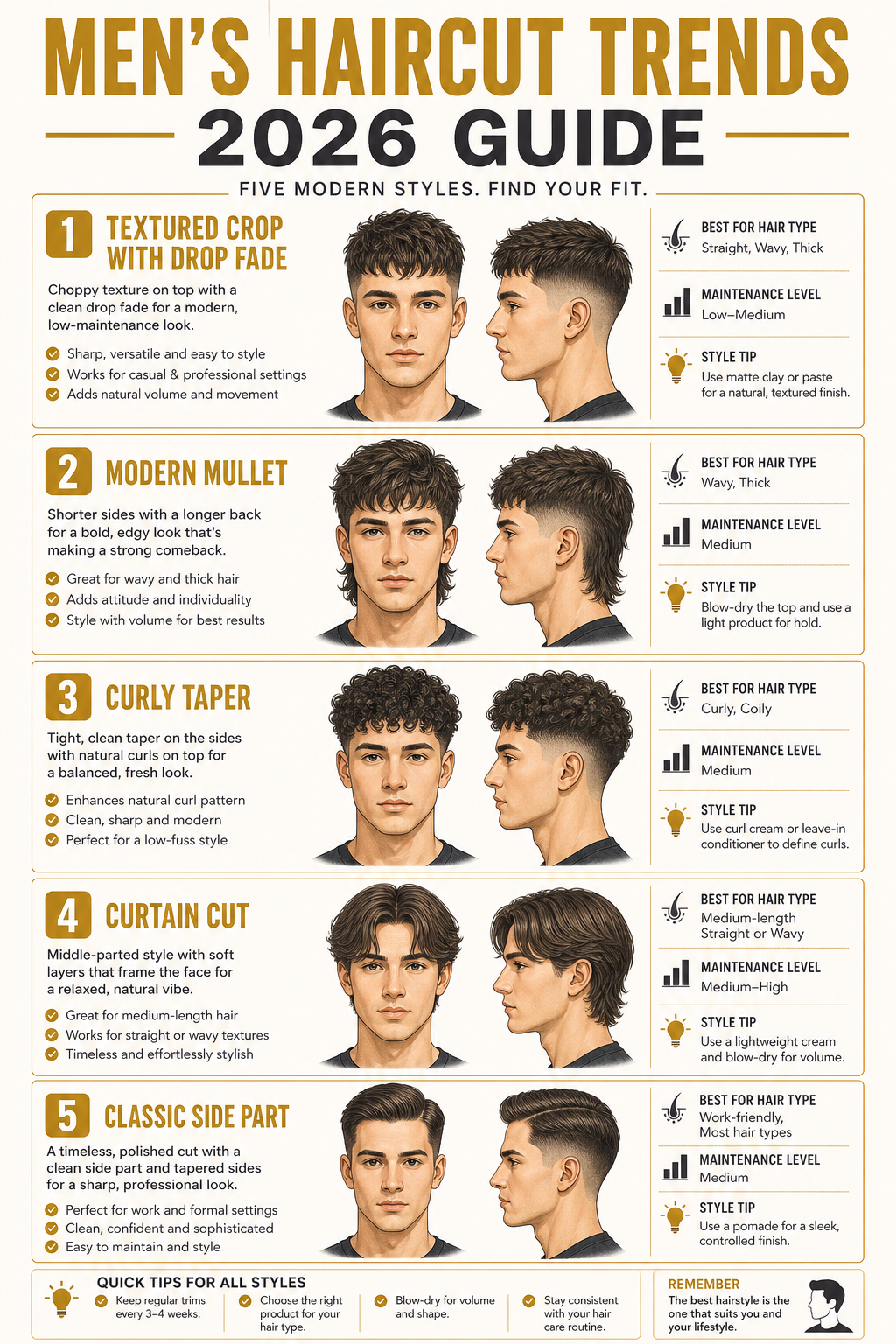
| Trend | Best for | Maintenance |
|---|---|---|
| Textured crop with drop fade | Straight, wavy, or thick hair | Low to medium |
| Modern mullet | Wavy or thick hair, confident style | Medium |
| Curly taper | Curly and coily hair | Medium |
| Curtain cut | Medium-length straight or wavy hair | Medium to high |
| Classic side part | Work-friendly polished style | Medium |
What to check before choosing a style
Before saving a reference photo, ask one boring but useful question: can your hair actually do that? If the model has dense wavy hair and yours is fine and straight, the same cut will not sit the same way. You can still use the photo, but your barber may need to adapt the length, layers, and product.
Also think about your morning routine. A textured crop can be styled in a minute. A pompadour, longer curtain cut, or slick back takes more effort and a blow dryer. There is nothing wrong with a higher-maintenance style, but it should match how you actually live.
The same face-shape logic matters for cropped women’s cuts too; this short haircuts by face shape guide explains how bobs, pixies, and layers change the silhouette.
Frequently asked questions
Q: How do I choose a men’s hairstyle for my face shape?
A: Start with the shape you want to balance. Round faces usually look better with height on top and cleaner sides. Square faces can handle strong fades, but softer texture keeps the jaw from looking too heavy. Oval faces have the most flexibility, while oblong faces usually need less height and more width.
Q: What is the lowest-maintenance men’s haircut?
A: A buzz cut, crew cut, or short textured crop is usually the easiest to maintain. A crop still needs a little product if you want texture, but it does not require careful blow-drying. Fades look clean, but they need barber visits every 3 to 4 weeks to keep the shape sharp.
Q: What men’s hairstyle is trending in 2026?
A: Textured crops, drop fades, modern mullets, longer curtain cuts, and curly taper styles are all strong in 2026. The useful trend is not one exact haircut, but more natural texture: hair that looks shaped, not frozen in place.
Q: How often should men get a haircut?
A: Short fades and crops usually need a trim every 3 to 4 weeks. Medium-length cuts can go 5 to 6 weeks. Longer styles can stretch to 8 to 10 weeks, but they still need cleanup around the neck, sideburns, and ends if you want the style to look intentional.
Q: What should I tell my barber if I do not know haircut terms?
A: Show a clear reference photo, then describe the sides, top length, and finish. Say whether you want a low, mid, or high fade; how much length to leave on top; and whether the style should be textured, messy, side-swept, or slick. A photo plus those three details is enough for most barbers.
Q: Which hairstyle works best for thick or curly hair?
A: Thick hair usually works well with texture, tapering, and enough weight removal so it does not puff out. Curly hair often looks better with a taper or drop fade and a shaped top, rather than trying to force it flat. The key is choosing a cut that uses the natural volume instead of fighting it.
More style and visual reference ideas
Looking for more visual reference? Browse our portrait and hair sketching techniques, architecture inspiration, and design reference collections.
- 3.0Kshares
- Facebook0
- Pinterest3.0K
- Twitter3
- Reddit0