There is a smell that hits you the moment you step into a freshly raised Douglas fir frame. Resinous, warm, faintly sweet — the kind of scent that slows your breathing and makes you want to stay. It’s biological. We’ve been building with wood for ten thousand years, and something in us still recognizes it as shelter.
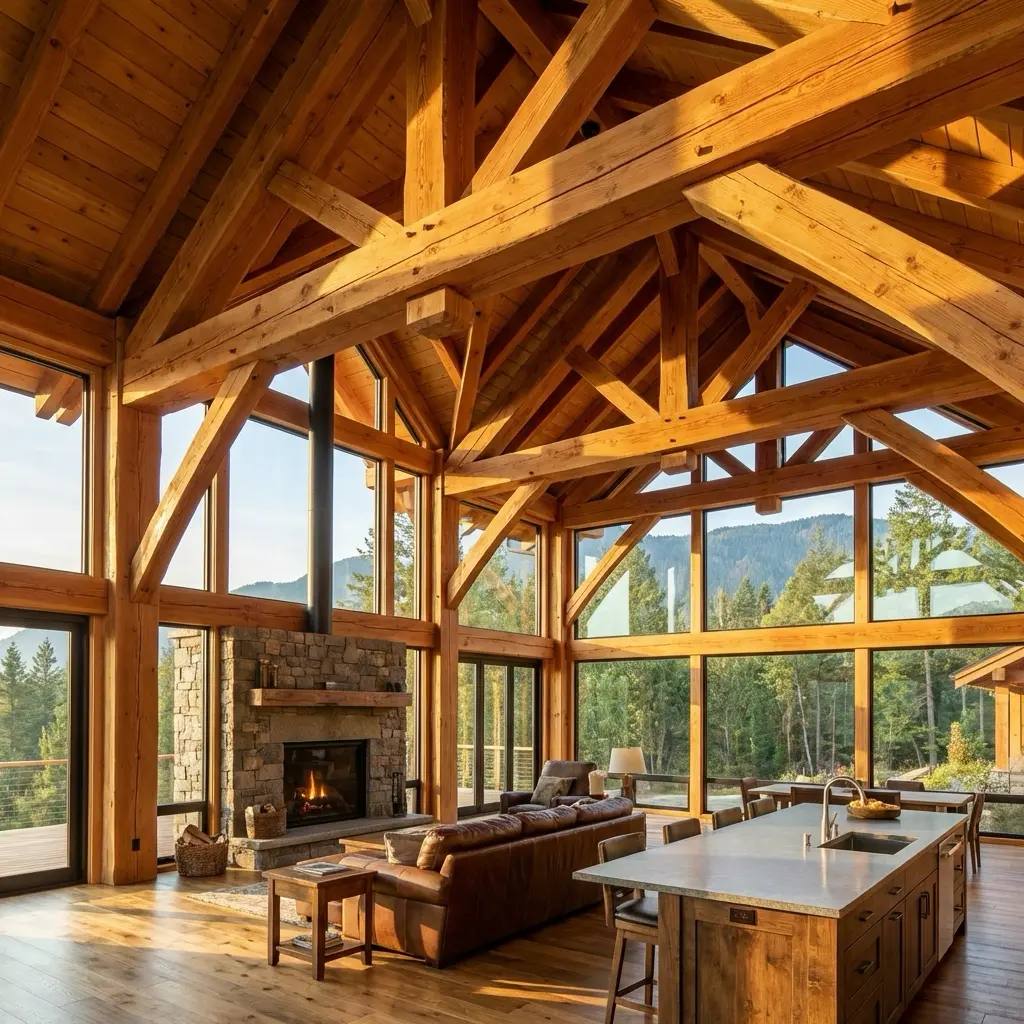
Then come the acoustics. A vaulted timber ceiling doesn’t just look generous — it sounds different. Voices carry with a subtle warmth that drywall and steel stud construction simply can’t replicate. Stand beneath a king-post truss and speak, and the space answers with a richness that no interior designer can retrofit.
- How We Picked the Standouts
- 1. Mountain View Lodge — Best All-Around Custom Design
- 2. Unity Värm — Best Prefab Eco-Home
- 3. Nelson by PrecisionCraft — Best Luxury Indoor-Outdoor Living
- 4. Green Gables Cottage — Best Small, Sustainable Design
- 5. Aurora Passive House — Best Ultra-Efficient Performance
- 6. Timber Loft Retreat — Best Open-Plan Entertaining Space
- 7. Maple Glen Estate — Best Multi-Generational Layout
- 8. Cedar Ridge Hybrid — Best Timber-Plus Innovation
- 9. Sierra Sunset Cabin — Best Off-Grid Freedom
- 10. Oakwood Manor — Best Adaptive-Reuse Revival
- How the Designs Stack Up at a Glance
- Your Timber Frame Questions, Answered
- Conclusion: The Material Chooses You
And finally, the visual rhythm of joinery. The way a mortise-and-tenon connection resolves at a knee brace. The shadow line where a purlin rests in its notch. These details aren’t decoration — they’re the structural logic made visible. Every joint is load calculation and craft simultaneously.
This is why timber framing has moved from rustic nostalgia to the vanguard of high-performance architecture in 2026. Rising energy codes, spiking utility prices, and a cultural shift toward materials with honest provenance have converged into what designers are quietly calling the Timber Renaissance.
We reviewed 24 plans, award winners, and kit catalogs released in the past 18 months and scored each on airtight efficiency, site-savvy orientation, real-world cost, flexible living, and sustainability. These ten designs represent the best of that field.
How We Picked the Standouts
Choosing the right timber frame home is not a catalog exercise. It requires weighing structural ambition against site-specific constraints, lifestyle vision against energy-code reality. Before committing to any plan, it’s worth working through a structured evaluation framework — we found that referencing how to choose a timber-frame design untangles each variable cleanly, from budget tiers to climate-specific framing strategies.
Our own scoring covered five measurable benchmarks, applied consistently across all 24 candidates.
Energy efficiency. A home that gulps power is an architectural failure, regardless of how beautiful it photographs. We required high-R SIP shells, tight blower-door scores, and solar-ready roofs. One consistent real-world benchmark: the SIP enclosure packages used by Hamill Creek Timber Homes — owners who specify these precut panels report up to a 50% reduction in heating and cooling costs compared with conventional fiberglass insulation. Because the panels arrive with window openings and electrical chases already milled, a weather-tight shell rises in days rather than weeks.
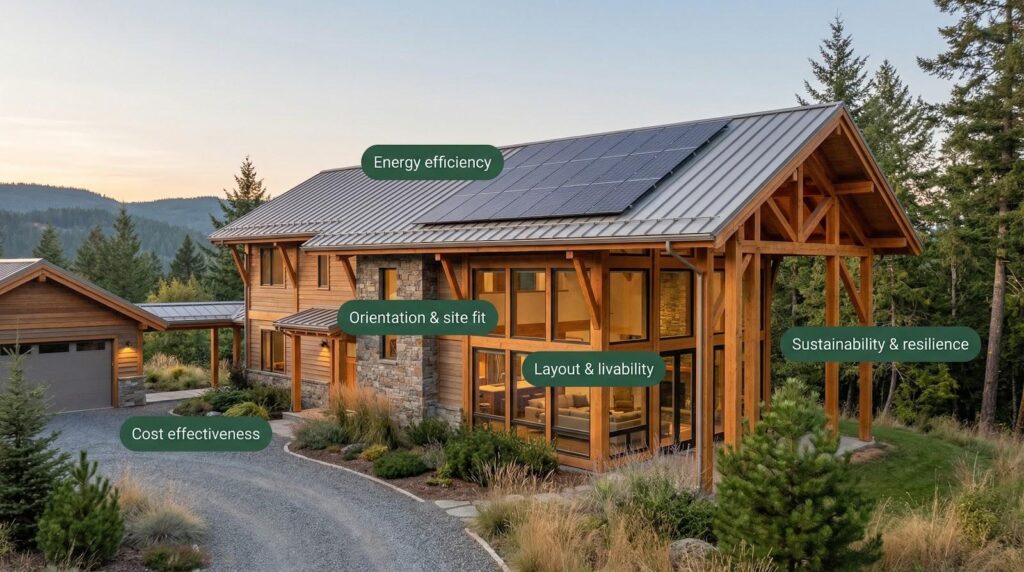
Orientation and site fit. Great architecture cooperates with sun, view, and wind. Designs that mirror easily or build in calibrated shading earned extra credit.
Cost effectiveness. Factory-cut frames that reach weather-tight in weeks and cut total build cost by 20–40% stood out. We flagged price tiers — , $, $ — for quick reference.
Layout and livability. Open plans are popular; daily flow, privacy, and adaptability decide how a home actually lives. We favored plans that eliminate wasted corridors and offer flex rooms for offices, gyms, or in-law suites.
Sustainability and resilience. Timber locks carbon by default. We also looked for FSC sourcing, wildfire-smart detailing, and durable finishes that age with dignity.
1. Mountain View Lodge — Best All-Around Custom Design
Some architectural briefs are straightforward: maximize the view, anchor the space, make it feel permanent. Mountain View Lodge executes all three without concession.
Douglas fir posts frame a great-room window wall that captures mountain sunsets at the precise angle that makes guests go quiet. The main level holds a vaulted great room, an entertainer’s kitchen, and a primary suite tucked behind a masonry chimney — which functions as a sound buffer as effectively as it does a heat source. A loft lounge above gives guests their own perch without adding the dead square footage of an extra corridor.
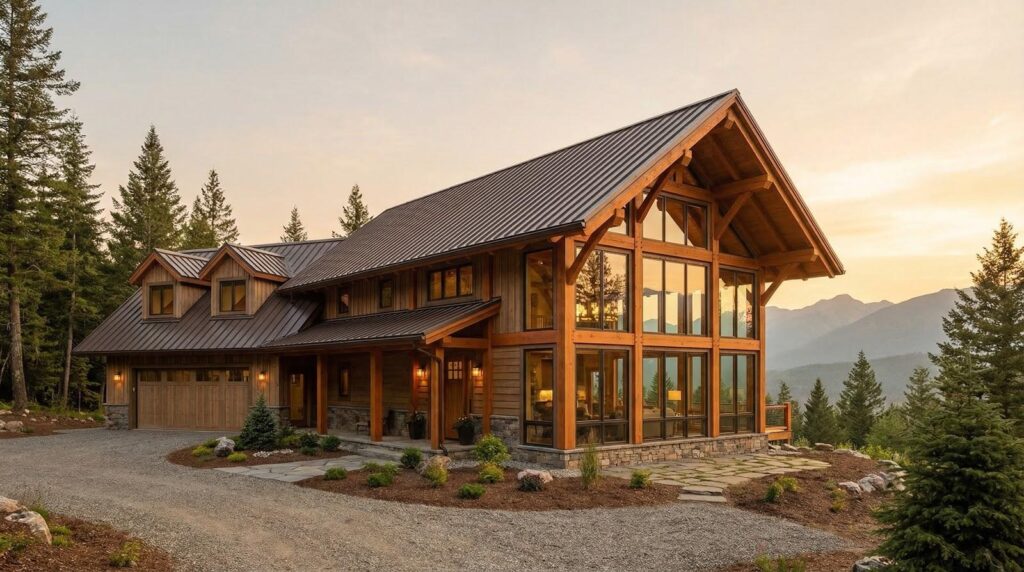
Performance matches the drama. A SIP shell with R-26 walls and an R-42 roof pairs with triple-pane glass and pre-wired capacity for a 10 kW solar array. Deep overhangs are calibrated to admit low winter sun while shading summer glare — passive solar design executed at the detail level, not as an afterthought.
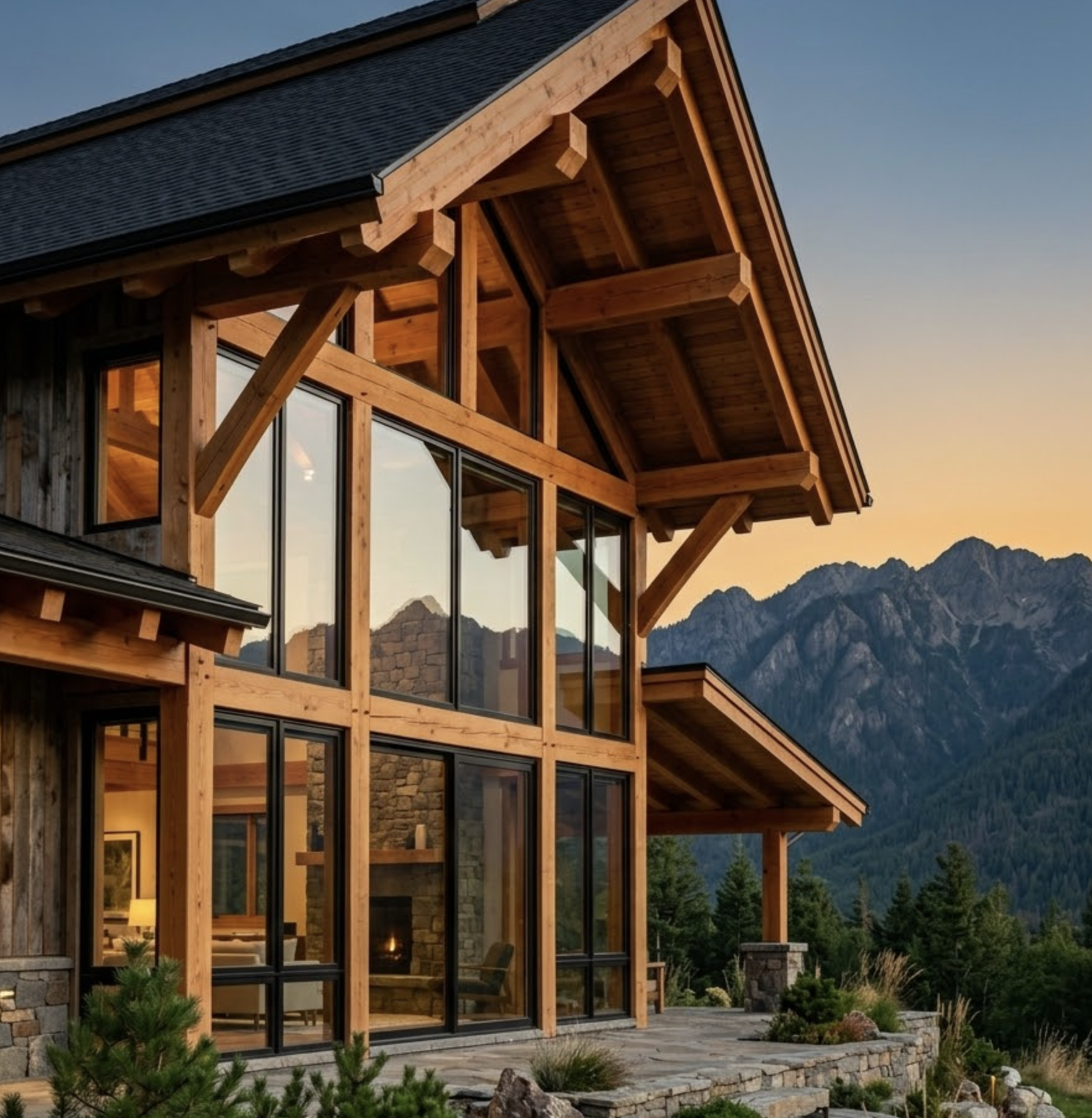
Future-proofing is structural, not aspirational. A bonus room above the garage is framed and wired for a later apartment. The structural grid leaves one gable ready for a future wing. A Class A metal roof and ember-screened vents satisfy wildfire-zone requirements.
2. Unity Värm — Best Prefab Eco-Home
The anxiety of a custom build is real: cost overruns, weather delays, the slow accumulation of small decisions that compound into months of scheduling chaos. Unity Värm eliminates most of it by design.
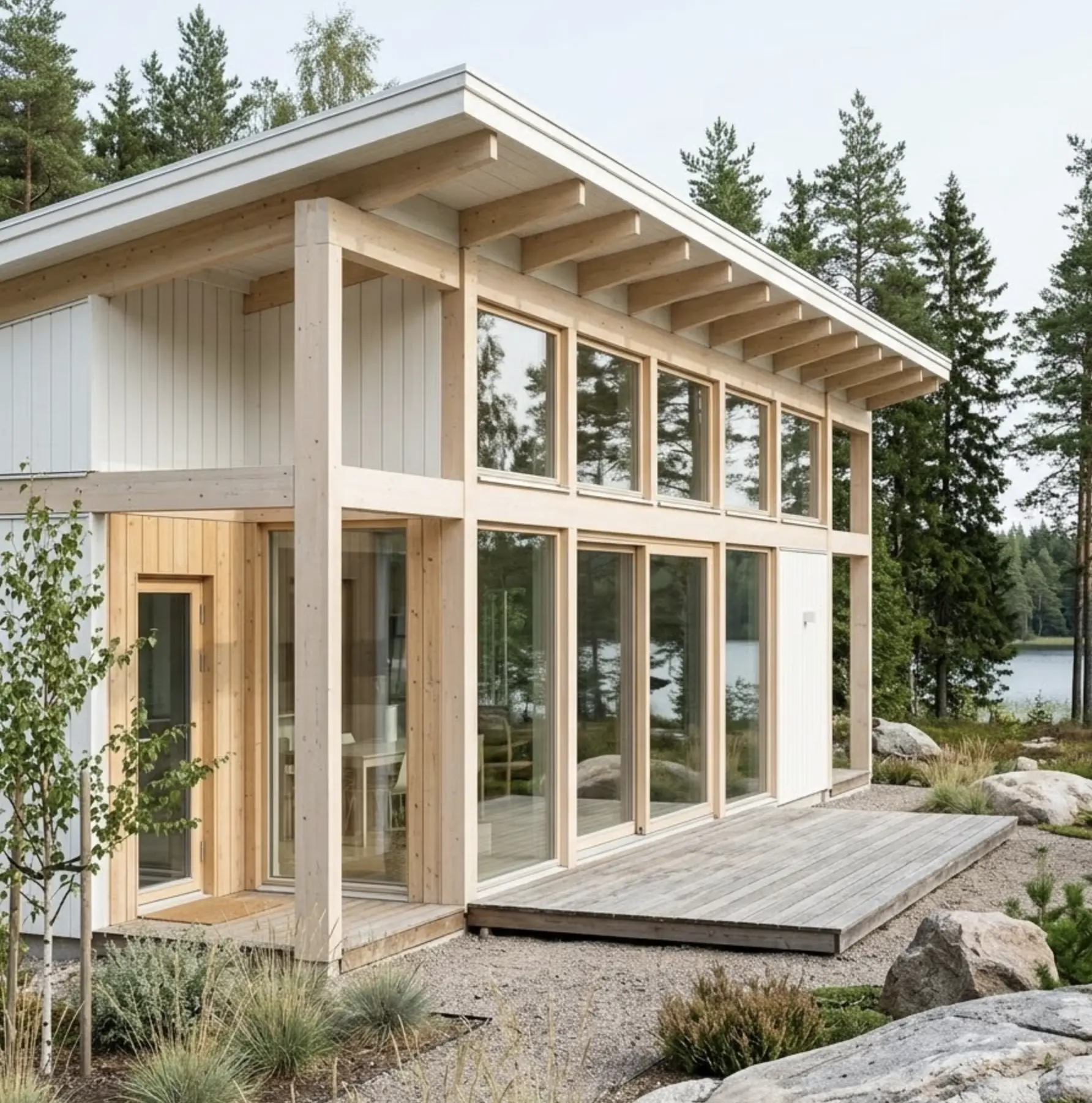
Unity’s factory team cuts every panel to the millimetre, dry-fits the shell indoors, then ships a labelled kit that assembles on site with the precision of furniture. Weather-tight in days. Finish-ready within weeks.
The single-storey Scandinavian plan is deceptively generous. A vaulted great room anchors the centre, bedrooms to one side, a mud-laundry core on the other. Clerestory windows draw daylight deep into the plan so electric lights stay off until dusk — a passive strategy that reads as an aesthetic choice but functions as an energy one.
The numbers: R-30 walls, R-48 roof, blower-door scores below 1.0 ACH as standard. Published Unity Homes case studies show many owners approaching net-zero annual energy use. Each Värm sits on a modular grid — mirror the plan, add a bay, attach a garage — without touching frame engineering.
3. Nelson by PrecisionCraft — Best Luxury Indoor-Outdoor Living
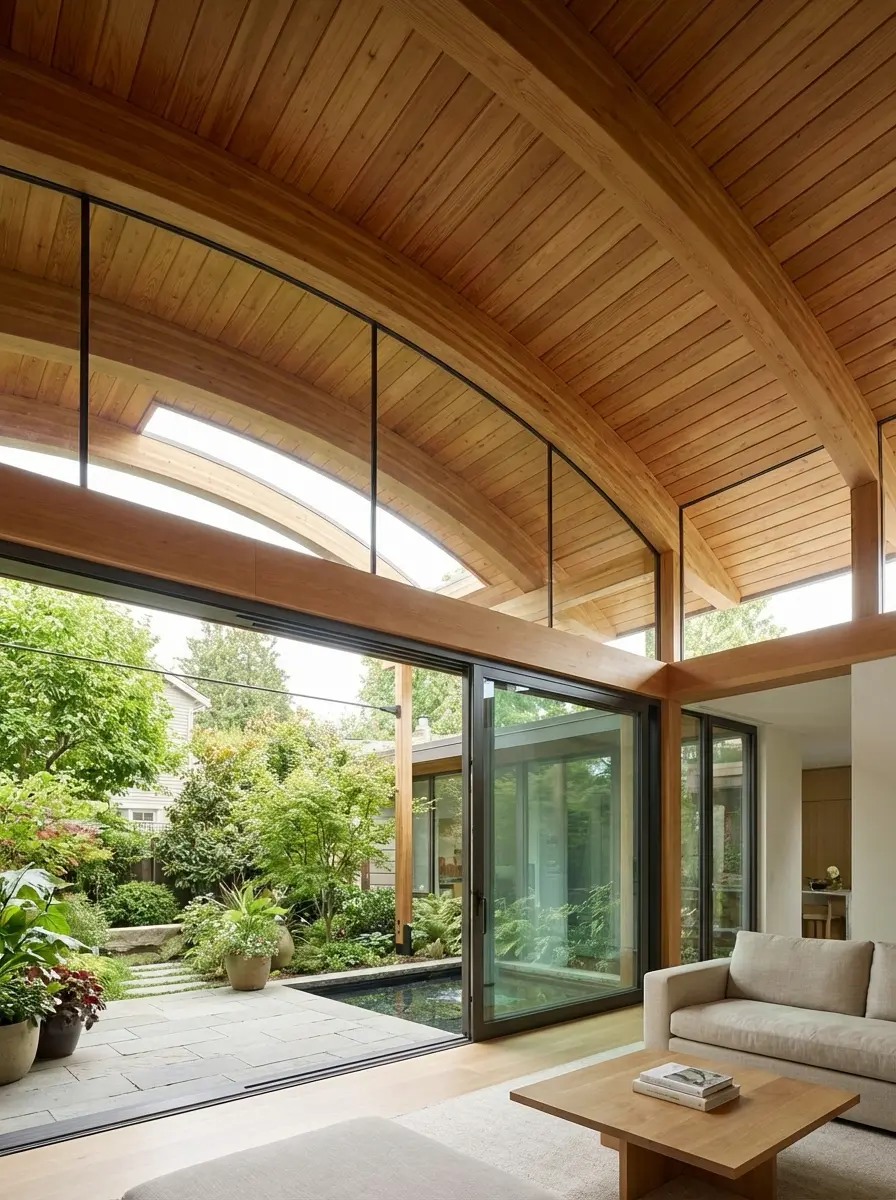
The most revealing question in residential design isn’t “how big is the house?” It’s “where does the inside end and the outside begin?” Nelson by PrecisionCraft answers that question by eliminating the boundary entirely.
Instead of a conventional backyard, the plan centers on a glass-walled private courtyard. Every main room arcs around this atrium so the experience of greenery and sky is continuous. A curved timber ceiling draws the eye toward a wall of sliding glass; when the panels open, the great room extends thirty feet into the garden without threshold or step.
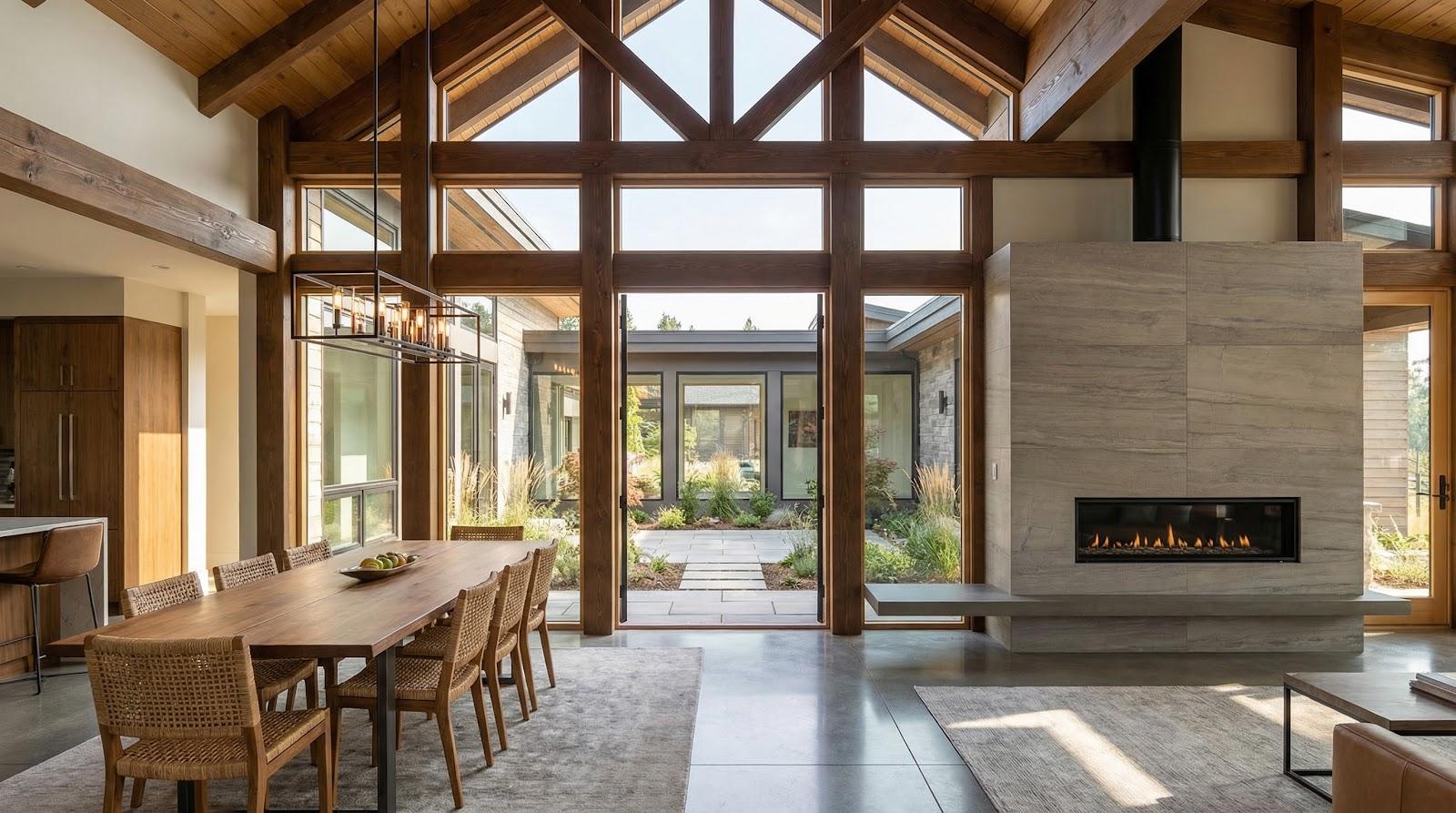
At 4,500 sq ft, Nelson carries commensurate performance obligations: R-30 wall panels, R-50 roof, geothermal HVAC, low-iron glazing, and deep overhangs calibrated to block high-summer sun while welcoming winter light. Paired with rooftop solar tiles, the finished home edges toward net-zero operation.
4. Green Gables Cottage — Best Small, Sustainable Design
[Image: 1200 sq ft timber frame cottage with wrap-around porch, simple gable form, cedar siding, garden setting — exterior photography]
There is a particular satisfaction in small architecture done well — in a plan where nothing is wasted and everything pulls double duty. Green Gables delivers that satisfaction at 1,200 square feet.
The simple gable form is a deliberate structural decision: it minimizes the exterior envelope, simplifies air sealing, and reduces framing complexity. The vaulted great room compensates by making the interior feel at least a third larger than its footprint.
A wrap-around porch shades the south facade, allowing low winter sun to warm the interior without overheating in summer. SIP walls at R-30, a wood stove paired with a single minisplit, and annual heating bills that reportedly rival a streaming subscription. Many owners choose locally milled cedar siding — which sequesters carbon, resists decay without chemical treatment, and develops a silver patina that looks intentional.
The square plan welcomes an L-shaped bedroom wing without touching the main roofline. Build only what you need, build it to last, leave room to grow.
5. Aurora Passive House — Best Ultra-Efficient Performance
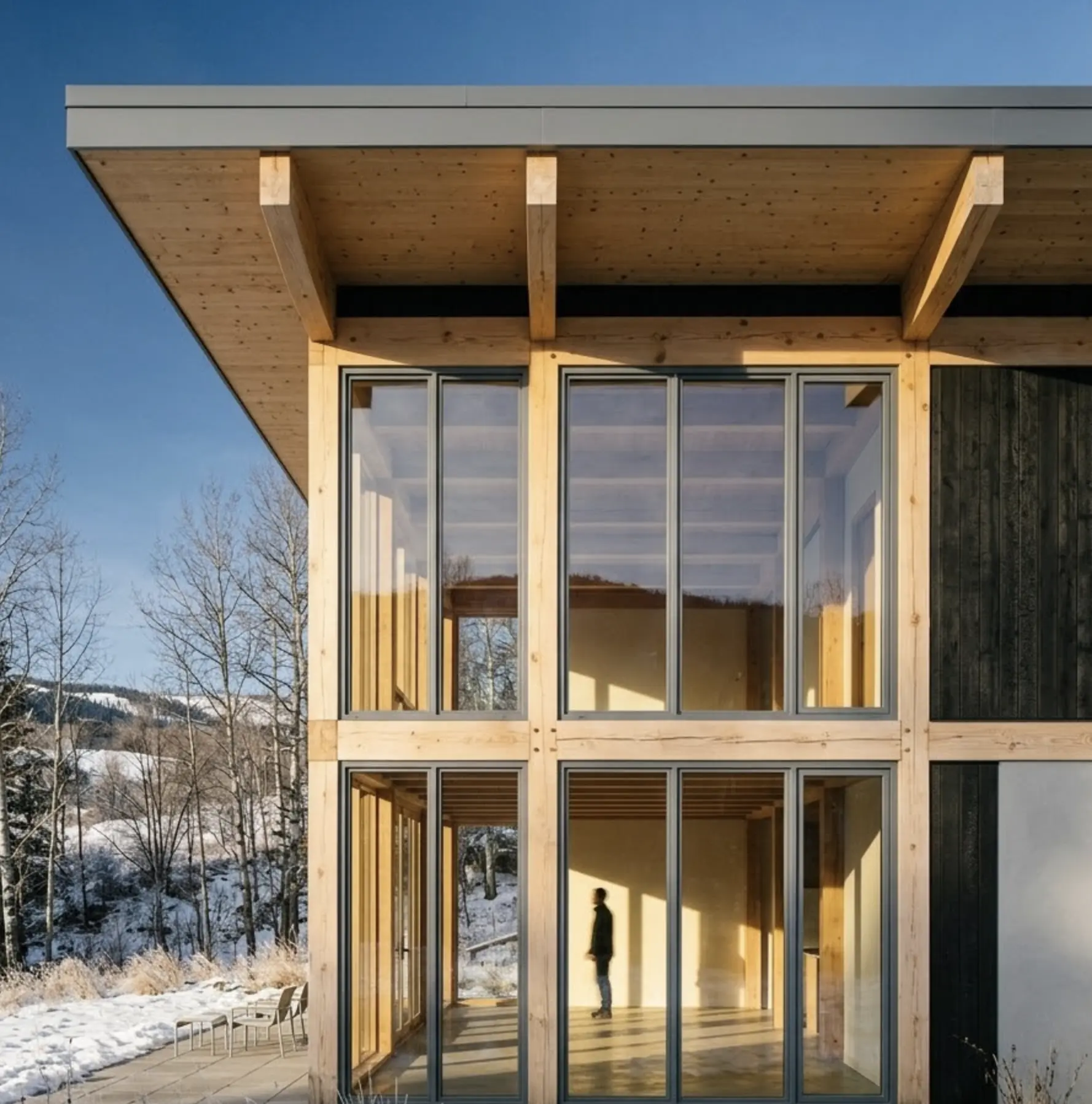
Passive House certification is the most rigorous energy performance standard in residential architecture. Aurora meets it without sacrificing the warmth that makes timber framing worth specifying.
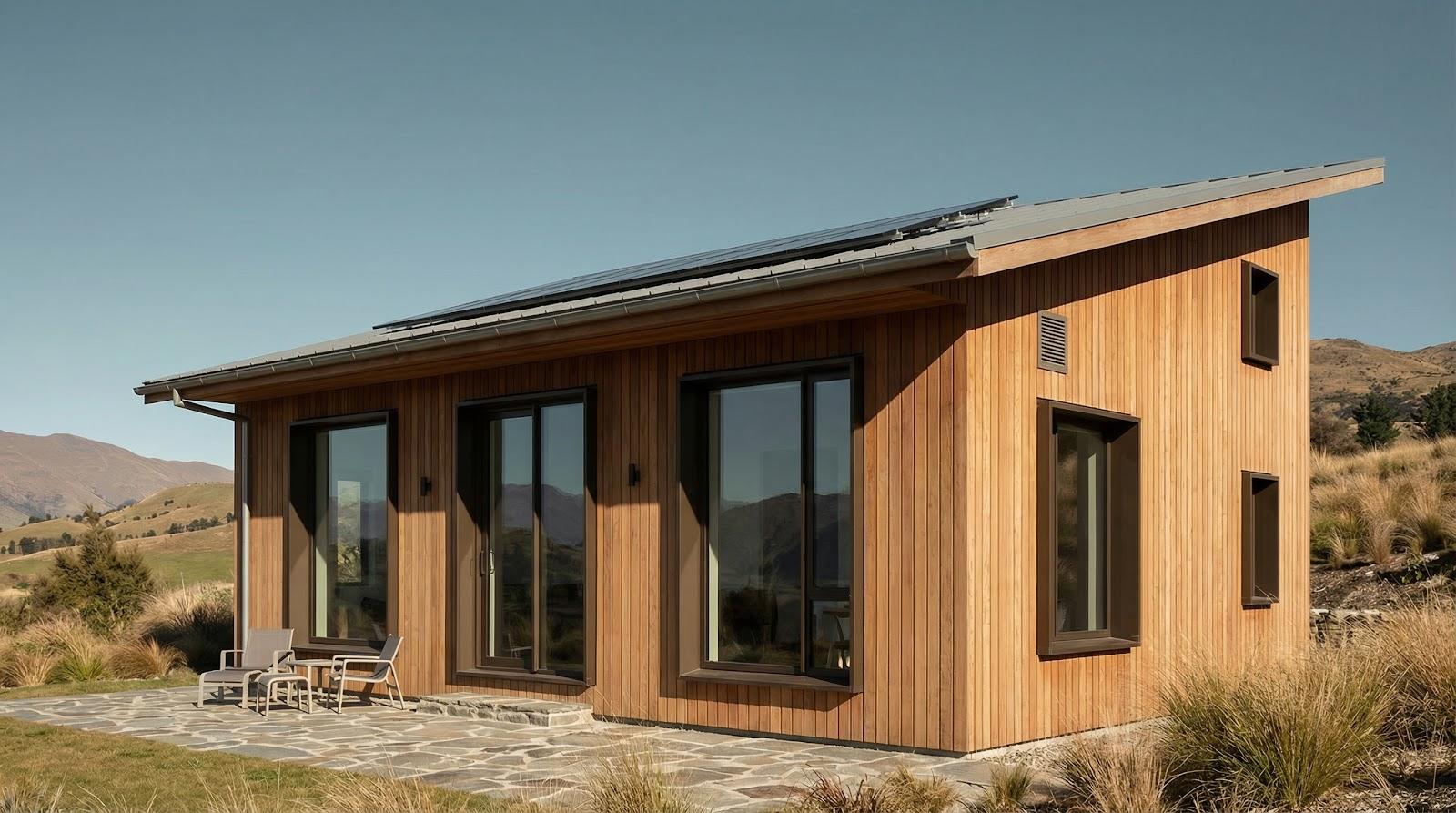
The two-storey rectangle faces due south with the deliberateness of a solar instrument. Triple-pane glass is sized by solar gain calculation: maximum winter sun, minimum summer overheating. The overhangs aren’t decorative — their depth is derived from latitude and roof pitch.
Twelve-inch wall panels and a taped vapour layer push airtightness below 0.6 ACH — the Passive House threshold. A heat-recovery ventilator exchanges stale air without surrendering conditioned energy. Annual heating demand stays below 15 kWh per square metre — about 90% less than a code-built house, according to 2024 energy-model data from the Passive House Trust.
Inside, exposed glulam beams soften the high-performance shell. Quiet, draft-free, cheaper to run than many studio apartments.
6. Timber Loft Retreat — Best Open-Plan Entertaining Space
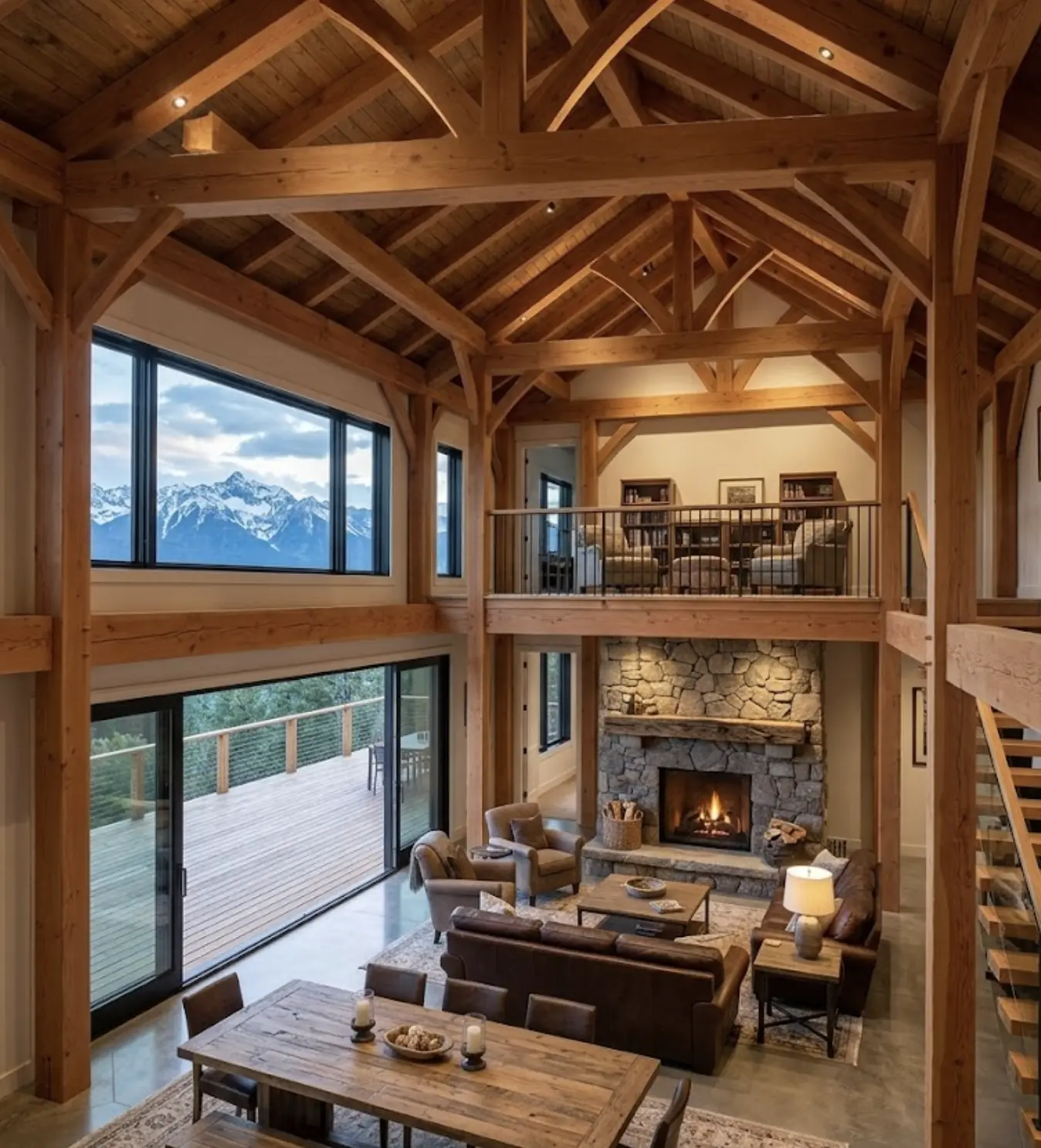
There are homes designed for privacy and homes designed for gathering. Timber Loft Retreat is unambiguously the latter.
A barn-style great room stretches beneath a 30-foot ridge beam, with a mezzanine lounge suspended above so guests experience the same generous volume from two elevations simultaneously. Two sets of sliding doors align front to back, framing the view and pulling mountain air through the space. A stone fireplace anchors one gable; a chef’s kitchen commands the other. The floating timber staircase connects both levels without blocking sightlines.
R-50 roof, R-30 walls, efficient ceiling fans to prevent thermal stratification. Owners typically pair a high-output wood stove with a single minisplit and report annual heating costs below the regional average for comparable floor area, per builder survey data.
The barn DNA means non-bearing interior walls. Drop light partitions for a media room. Extend the roofline to add a timber bay. The frame is your playground.
7. Maple Glen Estate — Best Multi-Generational Layout
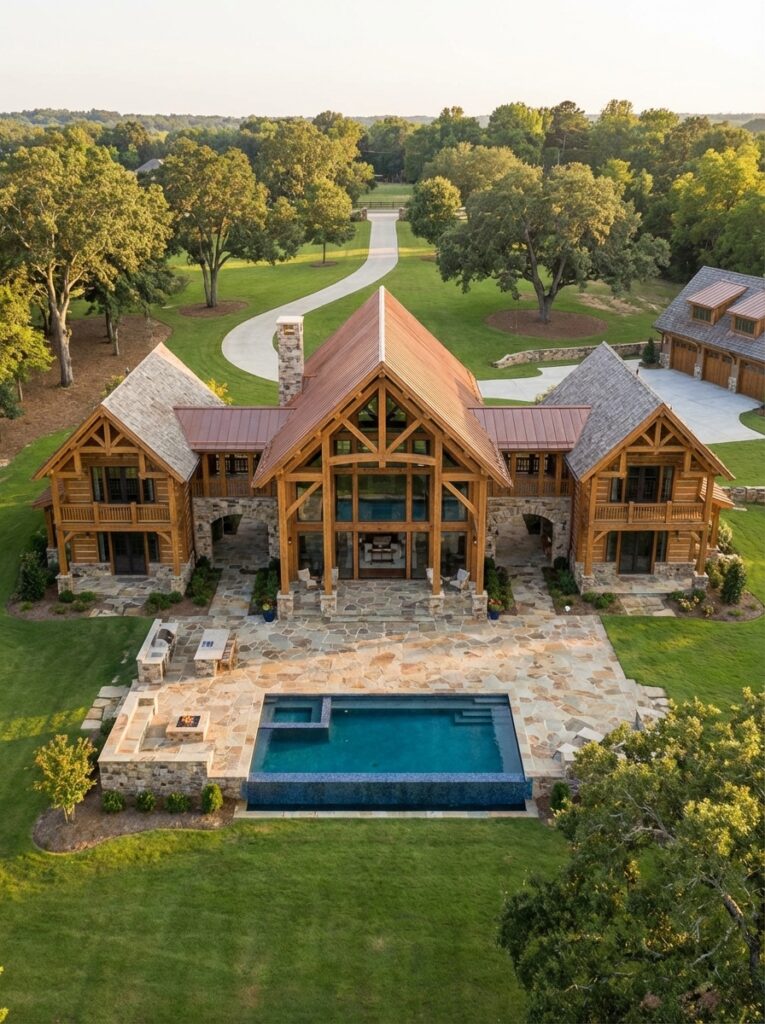
The multi-generational household is the fastest-growing residential typology in North America. Nearly one in five U.S. households now combines relatives under one roof, according to 2023 Pew Research Center data. Maple Glen Estate is one of the few plans designed for that reality rather than retrofitted to accommodate it.
Twin wings connect through a soaring central great room. The main wing holds a ground-floor primary suite — accessible, private. Across a sound-buffered breezeway, an in-law apartment runs independently: kitchenette, sitting nook, zero-step shower, separate entrance. Grandparents stay close. Everyone keeps independence.
Zone-controlled HVAC ensures empty rooms aren’t conditioned. SIP walls rated R-28, triple-pane windows, and a pre-wired south roof complete the performance package.
8. Cedar Ridge Hybrid — Best Timber-Plus Innovation
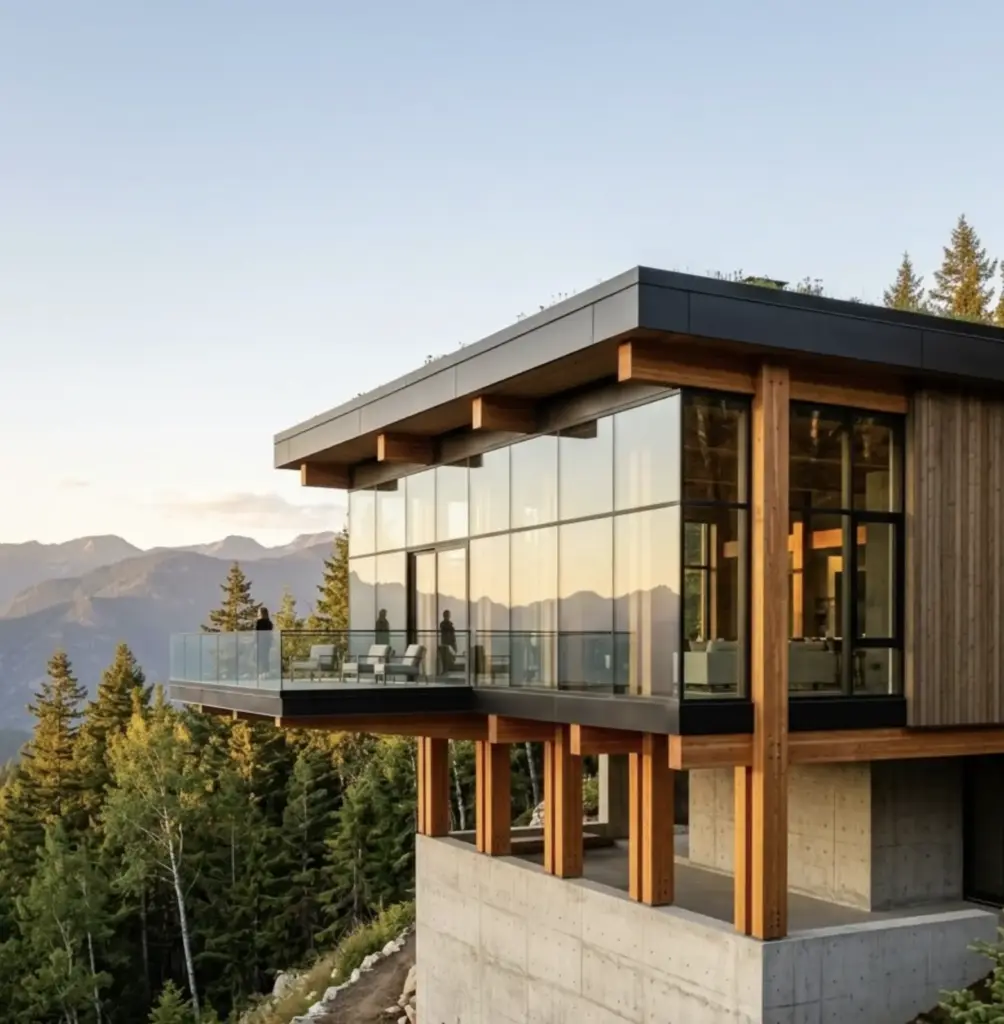
A seismic zone with a steep hillside and clients who want a 50-foot glass wall is a brief that pushes past pure timber’s limits. Cedar Ridge solves it by treating material selection as a design decision rather than a constraint.
An insulated concrete podium nests in bedrock at the lower level. A slim steel moment frame — concealed inside glulam posts — provides seismic resistance and long-span capacity for the glass wall. The timber frame takes over above, warm ceiling planks floating over an open kitchen-living core that cantilevers toward the view.
Exterior foam wraps the concrete, SIPs sheath the timber, triple-pane glass sits in thermally broken frames. An 8 kW rooftop array supplies most of the annual load; the concrete stair core stores daytime solar heat for night release.
9. Sierra Sunset Cabin — Best Off-Grid Freedom
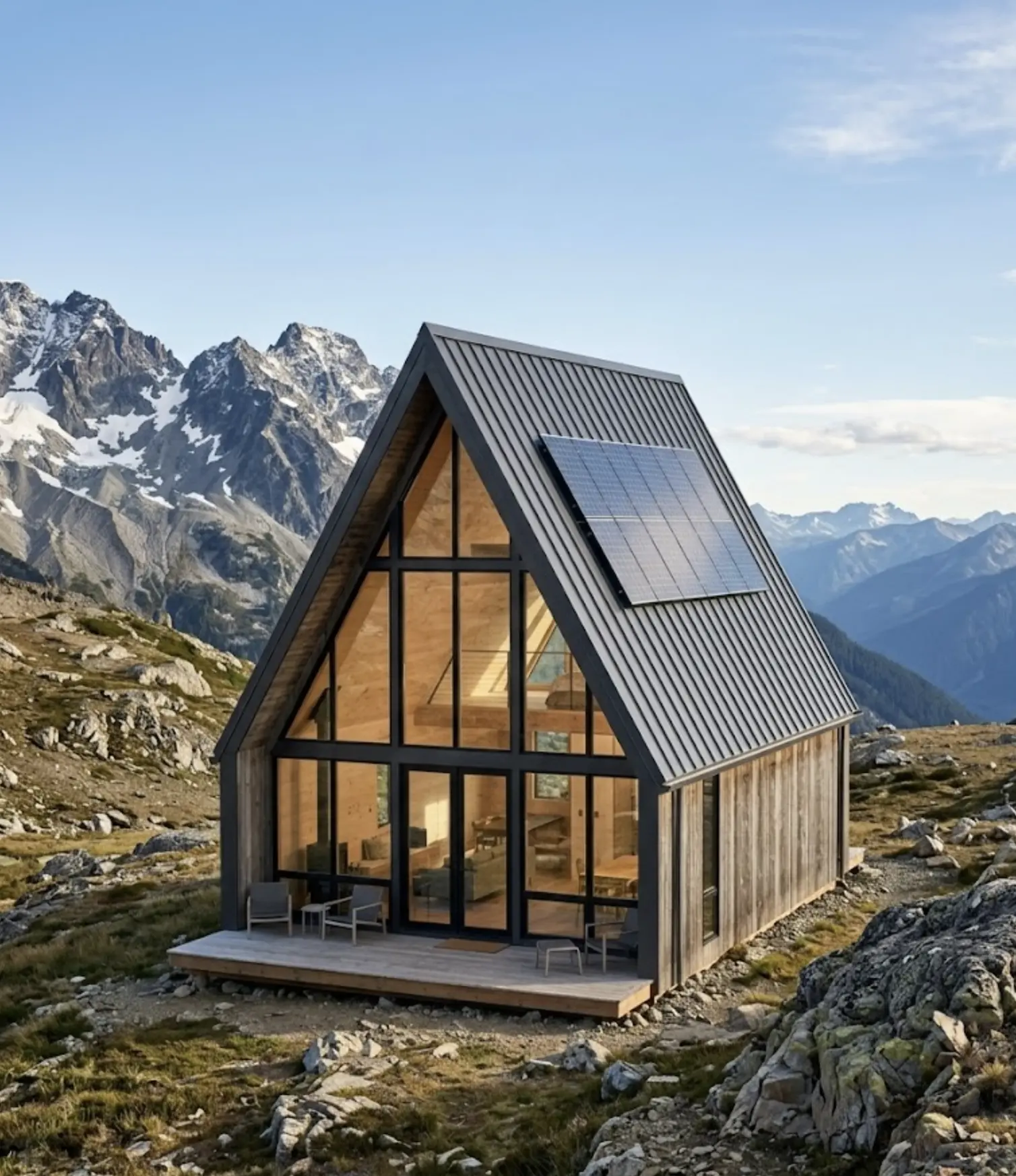
Off-grid living has an image problem. It conjures compromise: dim lighting, cold mornings, the constant anxiety of running short. Sierra Sunset Cabin exists to dismantle that image entirely.
The steep A-frame roof sheds snow without human intervention, and its 35-degree pitch is the optimal angle for the 5 kW solar array on standing-seam metal. South-facing glass runs floor to ridge, flooding the great room with winter sun. Operable clerestories vent warm air each summer afternoon; deep eaves shade glazing when the sun sits high.
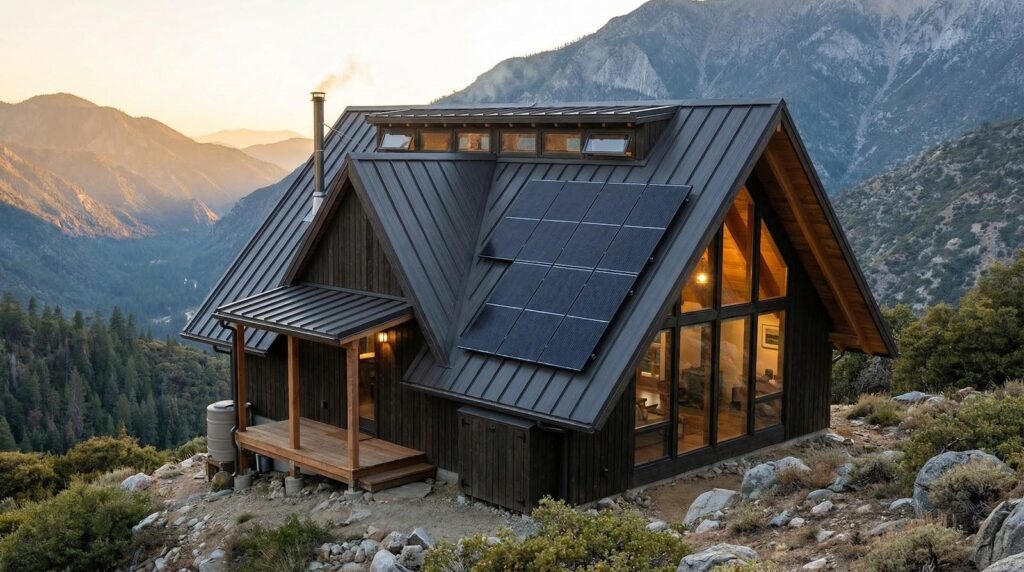
A lithium battery bank beneath the entry deck stores four days of energy. A high-efficiency wood stove handles deep-freeze nights. A 2,500-gallon rainwater cistern feeds filtered taps. All systems sit in a prefabricated utility core — next-generation batteries or a heat pump swap in without structural modification.
Build it once. Live well, far from the grid, indefinitely.
10. Oakwood Manor — Best Adaptive-Reuse Revival
The most sustainable building is the one that already exists. Oakwood Manor begins from that premise and follows it to its logical conclusion.
An 1880s hay barn — hand-hewn oak posts weathered silver but structurally true — becomes the architectural spine of a modern family home. SIP walls slide around the lifted frame. The posts now live indoors, protected and displayed like sculpture. One hundred and forty years of grain and character that no new timber can replicate.
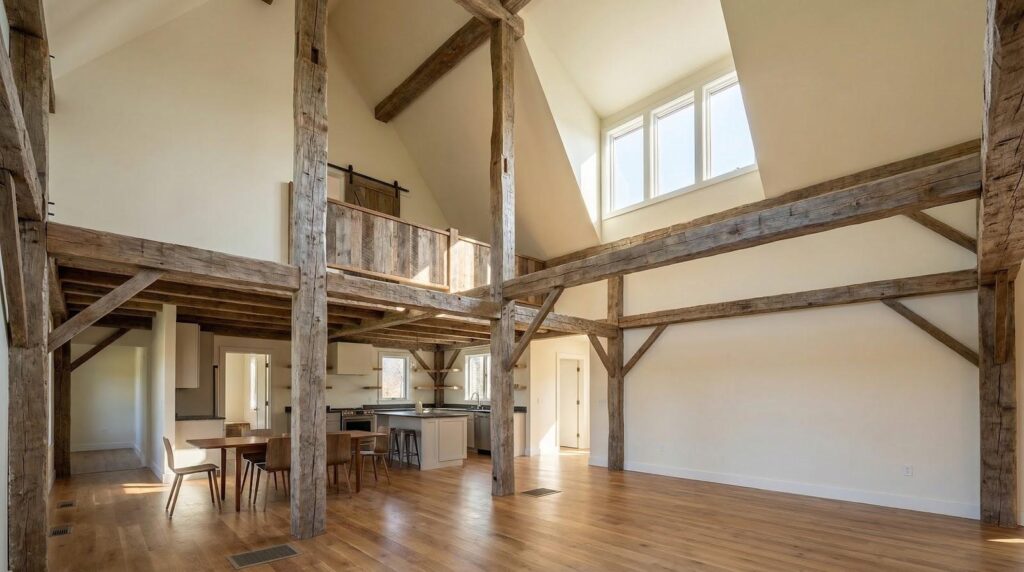
An open kitchen and living area rise under a two-storey void. Daylight pours through south-facing dormers cut into the antique roofline. The hay loft became a primary suite. Energy use fell by more than half — spray foam under new metal roof, triple-pane windows, ground-source heat pump.
Preserving 80% of the original timber avoided roughly 25 tons of embodied carbon. History and sustainability at the same address.
For off-grid timber projects, the frame is only half the story. The strongest rural homes with hidden services plan their plant rooms, tanks, and drainage routes before the pretty joinery details take over.
How the Designs Stack Up at a Glance
| Design | Size / Beds | Energy Edge | Price Band | Signature Move | Best For |
|---|---|---|---|---|---|
| Mountain View Lodge | 3,000 sq ft / 3 BR | Net-zero-ready SIP shell | $ | Panoramic window wall + future-wing prep | Scenic family living |
| Unity Värm | 2,200 sq ft / 3 BR | < 1.0 ACH prefab envelope | $ | Factory speed, mirror-friendly plan | Quick, predictable builds |
| Nelson by PrecisionCraft | 4,500 sq ft / 4 BR | Geothermal + courtyard airflow | $$ | Glass atrium links every room to sky | Luxe indoor-outdoor life |
| Green Gables Cottage | 1,200 sq ft / 2 BR + loft | Tiny load, wood-stove assist | $ | Vaulted micro great room | Downsizers, ADUs |
| Aurora Passive House | 2,500 sq ft / 3 BR | Certified Passive — 0.6 ACH | $$ | 90% cut in heating demand | Efficiency-focused owners |
| Timber Loft Retreat | 3,200 sq ft / 3 BR + loft | R-50 roof over grand volume | $ | Two-storey party space | Entertainers |
| Maple Glen Estate | 4,000 sq ft / 5 BR | Zoned HVAC by wing | $$ | Dual-generation wings | Multi-gen households |
| Cedar Ridge Hybrid | 3,300 sq ft / 4 BR | SIPs + concrete thermal mass | $$ | 50-ft glass wall, steel assist | View lots, seismic sites |
| Sierra Sunset Cabin | 1,600 sq ft / 2 BR + loft | Off-grid solar + battery | $ | Self-contained utility core | Remote living |
| Oakwood Manor | 2,800 sq ft / 3 BR | 80% reclaimed frame, GSHP | $ | 1880s oak meets modern shell | Heritage conversions |
Price bands: $ = budget-accessible, $ = mid-range, $$ = custom high-end.
Your Timber Frame Questions, Answered
Are timber frame homes more expensive than conventional builds?
Up-front costs are often higher — large timbers and skilled joinery command a premium over platform framing. But faster assembly (a frame can rise in a week), lower ongoing energy bills, and multi-decade durability shift the lifetime cost calculation considerably. Choosing a kit plan or a smaller footprint — Green Gables being the clearest example — narrows the initial gap substantially.
How long does the whole process take?
Plan on 10 to 18 months from design approval to move-in for a custom build. The frame raise itself takes about a week for an experienced crew. Permits, site work, and mechanical finishes follow typical schedules. Prefab shells like Unity Värm compress the weather-tight stage by several weeks — a real cost advantage in volatile weather climates.
What kind of maintenance should I expect?
Interior timbers need only occasional dusting and are essentially permanent. Exterior wood — porches, brackets, siding — benefits from a fresh coat of penetrating stain every five to seven years. Generous overhangs and properly detailed drainage reduce that interval. Cedar and naturally durable species extend it further.
Do timber homes meet modern energy codes?
When wrapped in SIP panels or equivalent continuous insulation systems, they frequently exceed code requirements by a meaningful margin. Aurora Passive House certifies to 0.6 ACH — the most stringent residential standard available. Mid-range designs on this list typically test below 2.0 ACH with wall R-values in the high twenties.
Can I add on later?
If planned from the start, additions are architecturally straightforward. Mountain View Lodge, Cedar Ridge, and Timber Loft Retreat all include structural provisions for future expansion. Non-bearing interior walls can be reconfigured freely. Adding a storey requires new engineering — build the vertical extent you need from the outset.
Conclusion: The Material Chooses You
There’s a reason architects keep returning to timber. It performs — genuinely, measurably, against the hardest benchmarks 2026 energy codes can apply. It ages in ways that concrete and steel don’t: developing patina, deepening in color, acquiring the kind of character that makes a room feel inhabited rather than staged.
But the deeper reason is sensory. The smell of a fresh frame. The acoustic warmth of a vaulted ceiling. The visual satisfaction of joinery that makes structural logic visible. These are not incidental qualities. They are the reason we build — to make places that feel worth living in.
Integrating your indoor rooms with outdoor decks can be enhanced with simple balcony decorating ideas that extend your living footprint.
While wood is a warm and organic material, studying structural materials like raw concrete in brutal architecture provides a fascinating contrast in structural design.
The ten designs above represent the clearest expression of that ambition in 2026: architecture that performs like a machine and feels like a home.
For a wider material comparison, keep this wooden house design nearby; it connects timber-frame planning with layout, insulation, and long-term care decisions.
- 70shares
- Facebook0
- Pinterest70
- Twitter0
- Reddit0