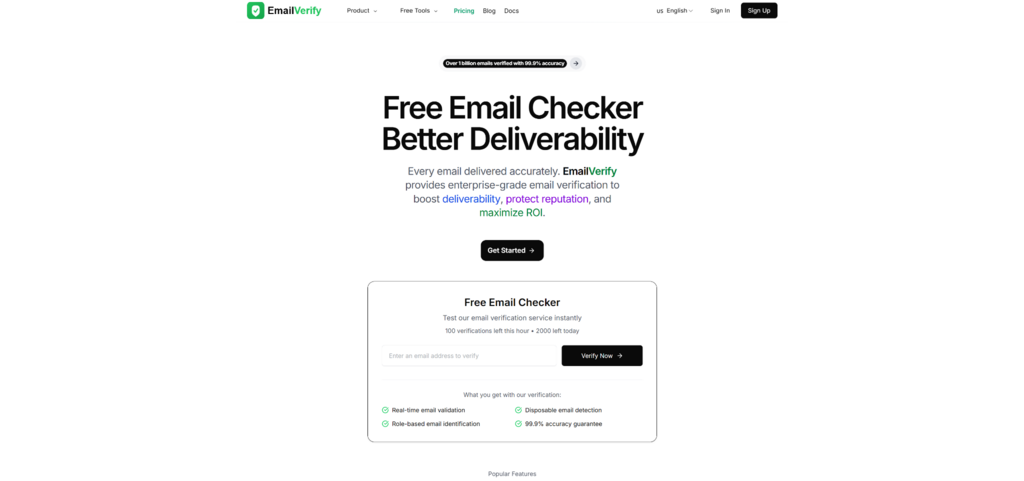
When you’re building a product, you obsess over latency, drop-off, and conversion. But email often slips through as a “basic input”—until fake accounts, typos, and disposable inboxes start bending your metrics. The first time I instrumented a signup funnel properly, I realized something uncomfortable: a meaningful share of “new users” weren’t users at all. That’s when I began placing an Email Checker directly in the registration flow—not to block people aggressively, but to route them intelligently.
- The Signup Funnel Problem Nobody Likes Talking About
- What “Real-Time Verification” Should Actually Mean
- A Developer-Friendly Way to Use Email Checking
- Comparison Table: Ways to Validate Emails in a Product
- A Policy Template You Can Copy (and Adjust)
- Why Role-Based and Disposable Emails Deserve Their Own Handling
- Limitations (So You Don’t Over-Engineer)
- A Gentle Way to Talk About This Internally
- Closing Thought
- The Real Cost of Ignoring Email Quality
- Start Small, Route Smart
- Your Metrics Deserve Better
The Signup Funnel Problem Nobody Likes Talking About
You can have a beautiful onboarding flow and still get polluted data:
- Typos create unreachable accounts (“I never got the welcome email.”)
- Disposable addresses inflate growth numbers
- Role accounts muddy identity resolution in B2B
- Catch-all domains introduce uncertainty into activation metrics
Why This Hurts More Than Deliverability
Bad emails aren’t only a marketing problem. They affect:
- Password resets and account recovery
- Support load (“your system never emailed me”)
- Analytics accuracy (activation and retention tracking)
- Abuse prevention (bot farms + throwaway inboxes)
What “Real-Time Verification” Should Actually Mean
A good checker needs to fit into product reality:
- Fast enough for synchronous flows
- Predictable enough to write policies
- Transparent enough that you can explain decisions to your team
EmailVerify’s Model (As I Observed It)
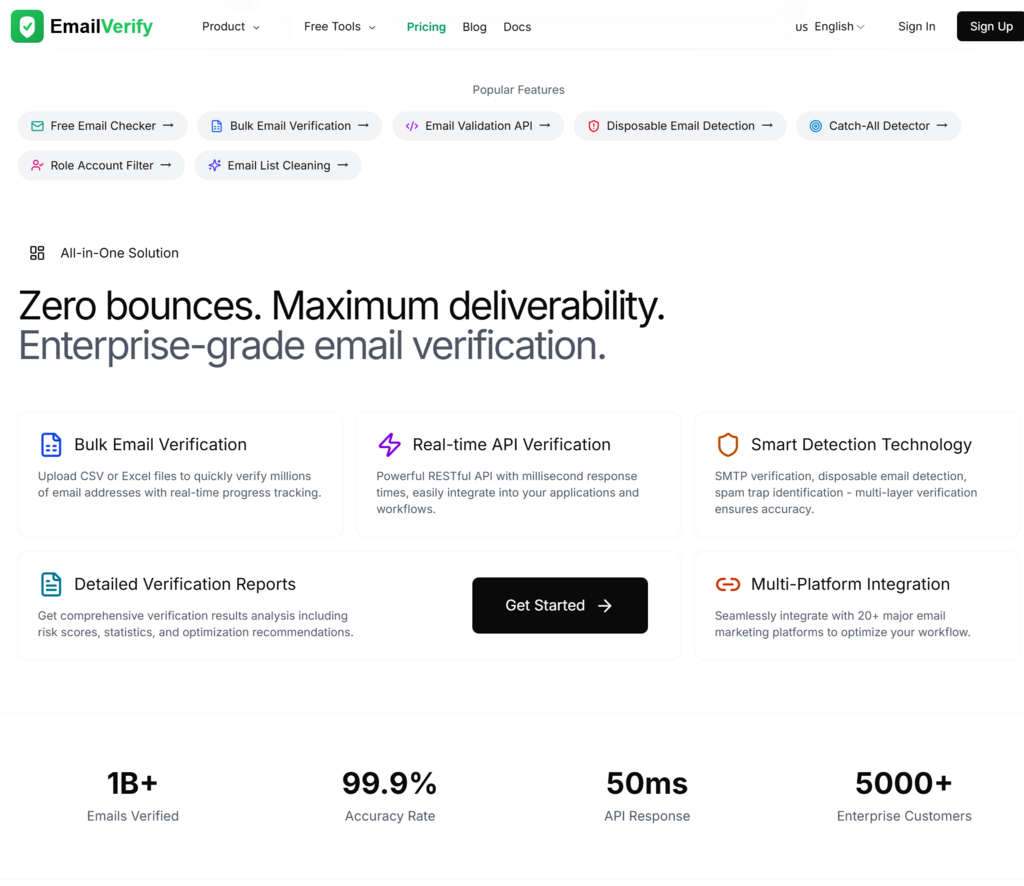
Email Validator positions verification as a multi-layer pipeline: format → domain/DNS → MX → risk types → optional SMTP signal. The key isn’t any single step; it’s that the output is immediately useful for decision-making.
A Practical Output Format
The most valuable output isn’t “valid/invalid.” It’s “valid / invalid / risky,” with reasons—so you can build routing rules without guessing.
A Developer-Friendly Way to Use Email Checking


Here’s the pattern I’ve used in production-like setups.
1. Run a Check at the Moment of Capture
When a user submits the email field:
- If clearly invalid, show a gentle prompt to correct it.
- If risky, request a one-time confirmation step.
- If valid, proceed normally.
2. Don’t Block People—Increase Certainty
If the email is risky, you don’t have to say “no.
You can say:
- “Please confirm your email to continue.”
- “We’ll send a verification code.”
- “Use a business email for team accounts.”
That tone matters. You’re guiding behavior, not selling a tool.
3. Keep the Funnel Smooth
EmailVerify advertises millisecond-level checks and an API designed for real-time usage. In my tests, the usability came from consistency—similar emails produced similar classifications, which made it easier to create deterministic policies.
Comparison Table: Ways to Validate Emails in a Product
| Method | UX Friction | Security / Abuse Resistance | Data Quality | Notes |
| Client-side regex only | Low | Low | Low | Stops obvious typos only |
| Domain + MX checks | Low | Medium | Medium | Better, still misses many risky cases |
| Send confirmation email only | Medium | High | High | Strong, but adds onboarding delay |
| “Allow everything” | Lowest | Lowest | Lowest | Metrics look good—until they don’t |
| Email Verifier | Low–Medium | Medium–High | Medium–High | Best balance when you segment risky cases |
A Policy Template You Can Copy (and Adjust)
This is the exact kind of rule set that kept my team aligned.
Accept
- Syntax ok
- Domain exists
- MX present
- Not disposable
Soft Gate
- Catch-all domain
- Role-based email on consumer plan
- Uncertain SMTP signal
Soft gate actions:
- Require email confirmation code
- Delay access to high-abuse features
- Ask for an alternative email if deliverability fails
Reject
- Invalid syntax
- Domain doesn’t resolve
- No MX records
- Known disposable provider (for your risk tolerance)
Why Role-Based and Disposable Emails Deserve Their Own Handling
This isn’t moral judgment—it’s behavior pattern recognition:
- Disposable emails are often used when someone expects not to return.
- Role accounts are shared inboxes; engagement and ownership can be inconsistent.
Some marketing platforms explicitly treat role-based emails as deliverability risks, which aligns with what I’ve seen: they can behave differently in complaint rates and engagement patterns.
Limitations (So You Don’t Over-Engineer)
A realistic implementation plan includes edge cases:
- Some servers intentionally obscure mailbox-level status.
- SMTP checks can be rate-limited by providers.
- Catch-all domains remain inherently ambiguous.
- Verification results can vary with timeout settings and transient DNS conditions.
How I Handle This
I don’t expect certainty on every address. I expect:
- High confidence on the obvious cases
- A clear “risky” bucket for ambiguity
- A policy that turns ambiguity into controlled friction
A Gentle Way to Talk About This Internally
If you need buy-in from product, sales, or marketing, frame it like this:
- We’re not “blocking users.”
- We’re protecting the funnel from polluted inputs.
- We’re reducing support load and making metrics trustworthy.
Closing Thought
Treat email as identity infrastructure, not a string field. When you add a checker and route risky cases thoughtfully, you get cleaner cohorts, fewer surprises, and a signup funnel that reflects real people—not just real-looking text.
The Real Cost of Ignoring Email Quality
The decision to validate emails isn’t about being pedantic—it’s about respecting your own data. Every fake signup creates a cascade: skewed dashboards, wasted marketing spend, frustrated support tickets, and decisions based on numbers that don’t represent reality.
The companies that treat email verification as infrastructure rather than an afterthought share a common trait: they sleep better. Their activation metrics mean something. Their support teams aren’t drowning in “I never got your email” tickets. Their growth numbers reflect actual humans who can be reached.
Start Small, Route Smart
You don’t need to implement everything at once. Start with the basics:
- Add verification to your signup endpoint
- Create one rule: if disposable, require confirmation
- Watch what happens to your activation rate
Most teams discover that a small amount of intelligent friction eliminates a disproportionate amount of noise. The users who matter don’t mind confirming their email. The bots and throwaway accounts quietly disappear.
Your Metrics Deserve Better
When someone asks “how many signups did we get?” you should be able to answer with confidence. Not “347 form submissions” but “347 reachable people who can actually use the product.”
That distinction—between text in a database and verified contact with a human—is what separates growing companies from companies that just look like they’re growing.
Treat email as identity. Route uncertainty into confirmation. Trust your metrics again.
The fastest way to lose signups isn’t verification—it’s launching features to an audience that was never really there.
- 6shares
- Facebook0
- Pinterest6
- Twitter0
- Reddit0