Learning how to draw people on the street changed everything about how I understand art. Not drawing from photos. Not copying references. Drawing real people, in real time, in real places.
The first time I drew someone in public, I picked the worst possible subject.
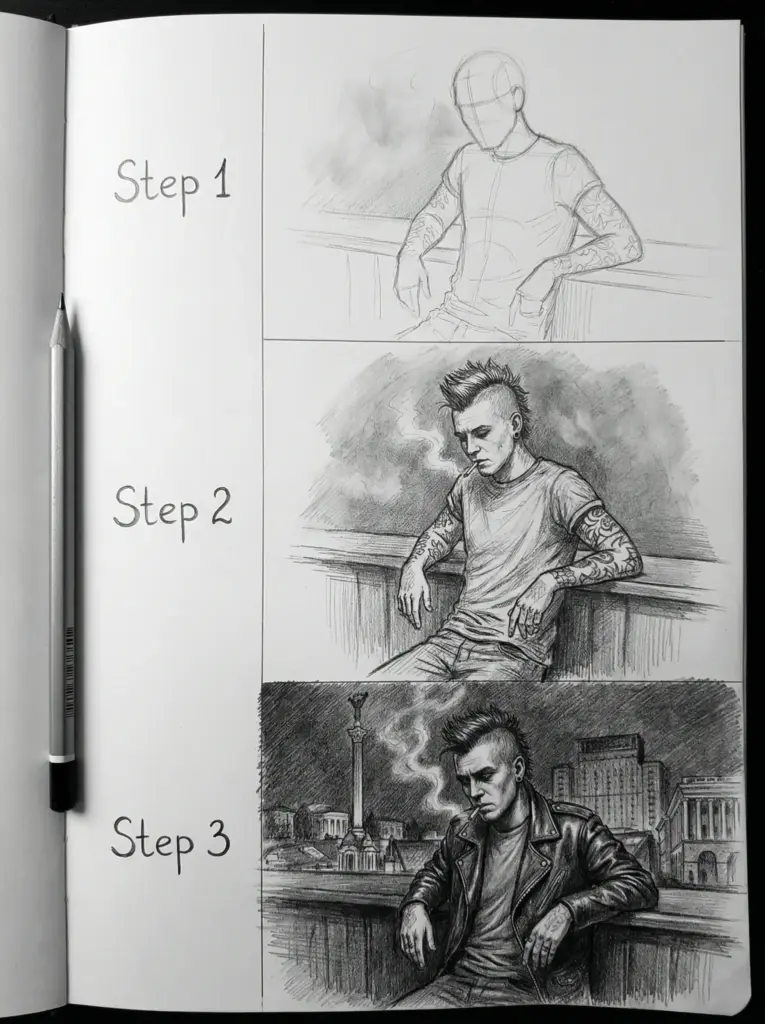
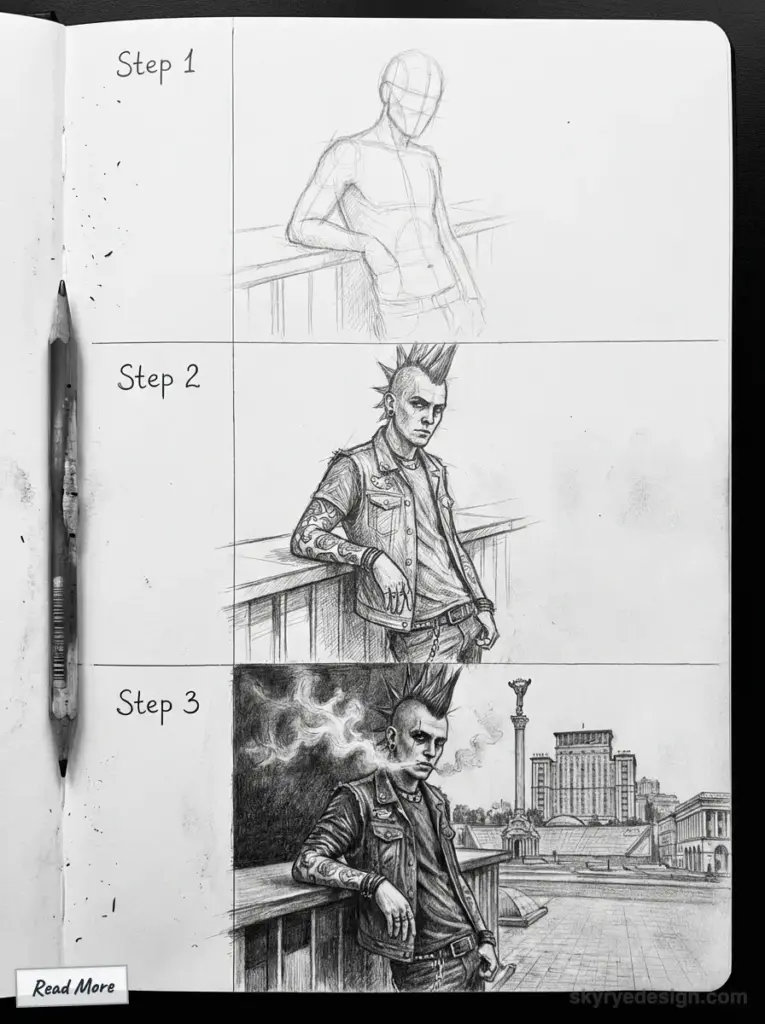
It was 2019. A punk show in Kyiv. This guy with sleeve tattoos was leaning against the bar—constantly moving, terrible lighting, cigarette smoke everywhere. I was sweating through my sketchbook.
The sketch looked like a crime scene diagram. Arms at wrong angles. Head too small. Proportions from another planet.
But here’s what nobody tells you about street sketching: that terrible drawing taught me more in five minutes than weeks of copying Instagram photos. I’d captured the energy—the way his weight shifted to one leg, the tension in his shoulders, the casual aggression of his stance.
- Why Street Sketching Actually Works (When Studio Drawing Doesn't)
- Tools You Actually Need (Not What Art Stores Sell You)
- The Core Technique: Stop Drawing Bodies, Start Drawing Weight
- How to Handle Moving Subjects (My Biggest Failure, Then Breakthrough)
- Where to Actually Practice (My Tested Locations in Kyiv)
- How to Stop Being Terrified (The Conversation That Fixed Everything)
- Ethics: The One Rule That Matters
- The Five Mistakes I Made (So You Don't Have To)
- My Daily Practice Routine (20 Minutes, Real Results)
- How Street Sketching Develops Style (Without Trying)
- Questions I Get Asked (Honest Answers)
- Final Thoughts: Why This Changed How I See Drawing
You can’t get that from reference photos. You can’t learn it in a studio. Real movement, real light, real proportions—they only exist on the street.
Since then, I’ve filled 23 sketchbooks with street drawings across Kyiv, Lviv, Berlin, and Amsterdam. I’ve drawn in cafés, metro stations, parks, and one memorable afternoon in a hospital waiting room. Some sketches are beautiful. Most are messy. All of them made me better.
This guide covers everything I wish someone had told me before I started: the mindset, the techniques, the tools, and most importantly—how to stop being terrified of drawing strangers.
Why Street Sketching Actually Works (When Studio Drawing Doesn’t)
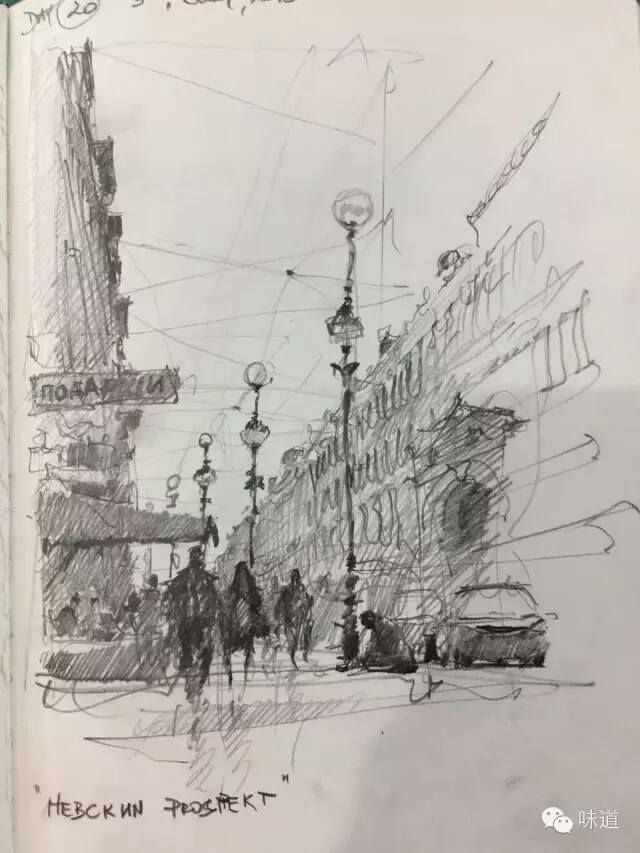
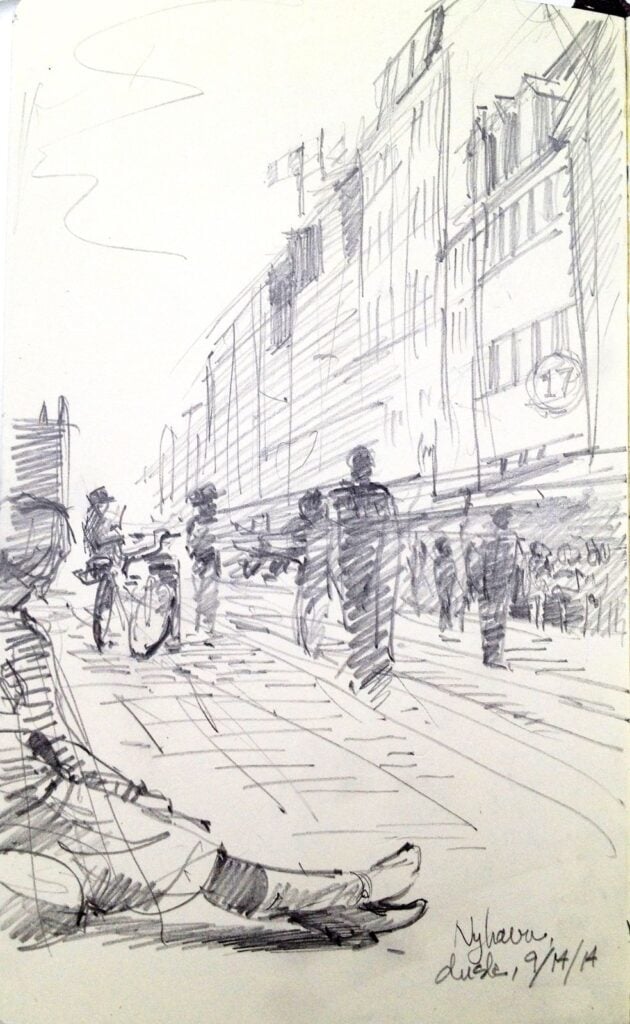
Here’s the uncomfortable truth: you can practice figure drawing from photos for years and still struggle with real people.
I know because I did it. Two years of drawing from Pinterest references, ArtStation models, anatomy books. My drawings looked okay on paper, but put me in front of a live model and I froze. Why?
Photos lie. They flatten depth, freeze motion, eliminate weight. Your brain knows the difference—even if you can’t articulate it.
What Street Sketching Trains (That Nothing Else Can)
Speed: You have 30 seconds to 3 minutes before people move. This kills your perfectionism and forces decisive marks.
Visual memory: When someone leaves mid-sketch, your brain fills in the gaps. This trains observational recall better than any exercise.
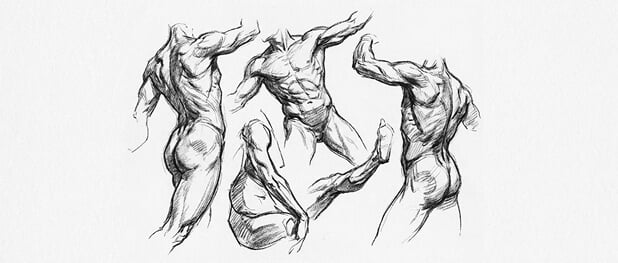
Gesture over anatomy: You stop drawing “bodies” and start drawing “movement.” This is the difference between stiff poses and dynamic figures.
Confidence: After drawing 50 strangers, asking a friend to model feels easy. Street sketching is exposure therapy for artist anxiety.
Tools You Actually Need (Not What Art Stores Sell You)
I’ve tested dozens of setups. Here’s what survived 500+ hours of street sketching:
My Current Kit (Total Cost: $18)
Muji A6 notebook ($4, 60 pages, 80gsm): Fits in a jacket pocket. Small enough to not intimidate people. Cheap enough that I don’t baby it.
Uni-ball Signo 0.5mm pen ($2): Waterproof, smooth, doesn’t skip. I buy them in packs of 10 and lose half.
Backup: Sakura Pigma Micron 05 ($3): When the Uni-ball dies mid-sketch. Finer line, better for details.
Optional: Pentel Pocket Brush Pen ($9): For dramatic shadows and expressive marks. Not for beginners—it’s unforgiving.
What I Don’t Use (And Why)
Erasers: Same problem. Plus they slow you down. People don’t pause while you fix proportions.
Large sketchbooks: A4 or bigger attracts attention. People notice. They get self-conscious or curious. A6 disappears.
Expensive anything: You’ll lose it, spill coffee on it, or fill it with terrible drawings. Use cheap tools until they become irreplaceable.
The Core Technique: Stop Drawing Bodies, Start Drawing Weight
This is the revelation that changed everything for me.
I used to start with heads. Big mistake. Heads are hard, faces are harder, and they’re usually moving. You spend 90 seconds on a face, the person leaves, and you have a detailed head floating above a stick figure body.
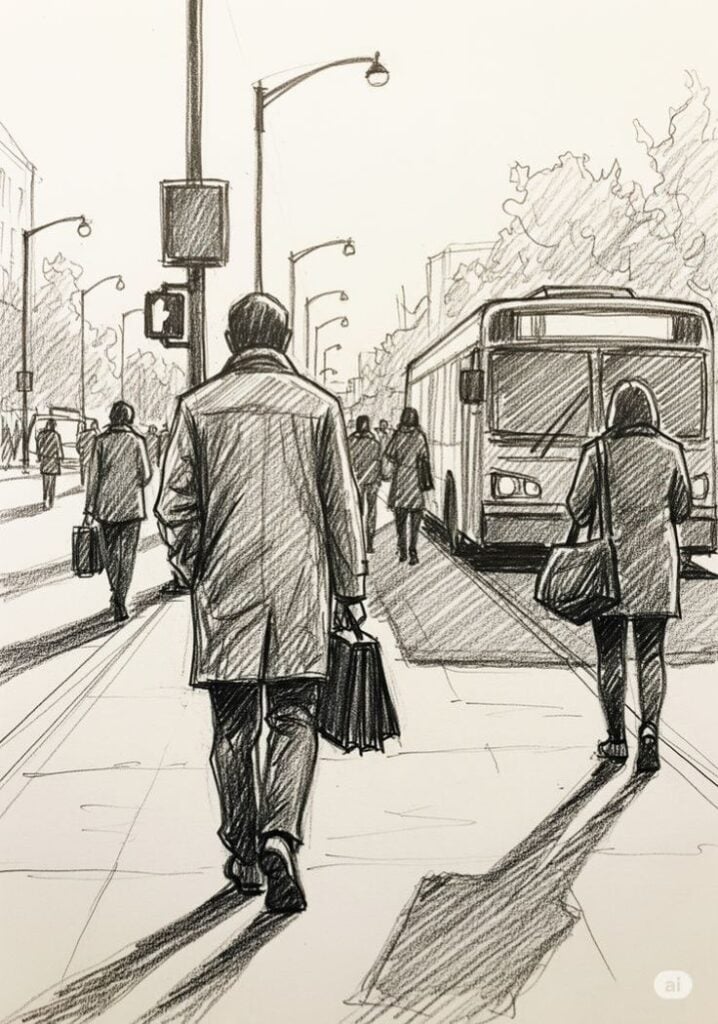
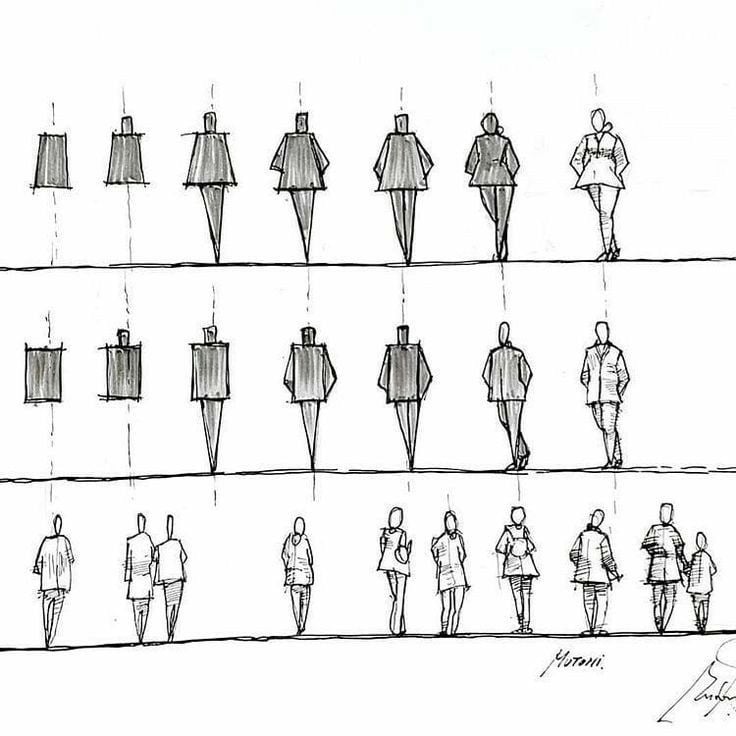
A sketch artist in Amsterdam showed me the fix. She started every drawing the same way:
- Find the line of action (spine curve)
- Mark where the weight lands (usually one foot)
- Block in the torso (ribcage as egg, pelvis as box)
- Add limbs (simple cylinders, no details)
- Suggest the head (circle or oval, one line for face direction)
Total time: 30-45 seconds. If they leave, you have a gesture. If they stay, you can add details.
How to Handle Moving Subjects (My Biggest Failure, Then Breakthrough)
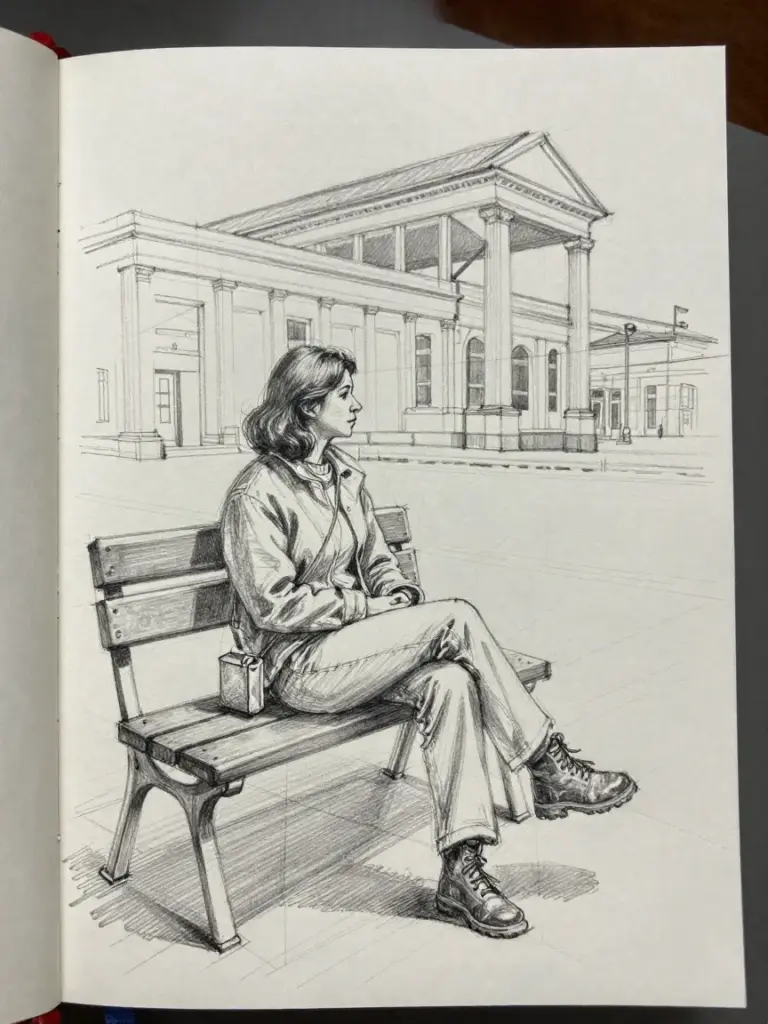
October 2021. Lviv train station. I was trying to draw a woman sitting on a bench.
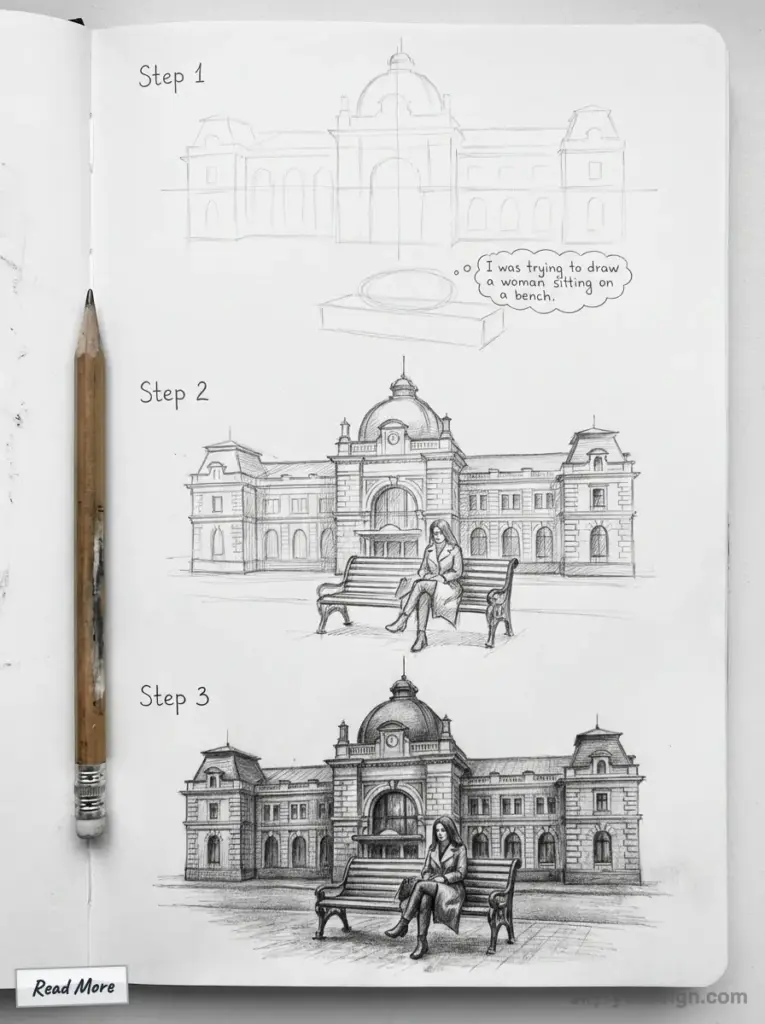
Ten minutes in, deeply focused on her coat buttons—perfect little circles, accurately spaced—she stood up and walked away.
I had a beautiful coat with sleeves. No arms. No torso. No head. Just a haunted jacket.
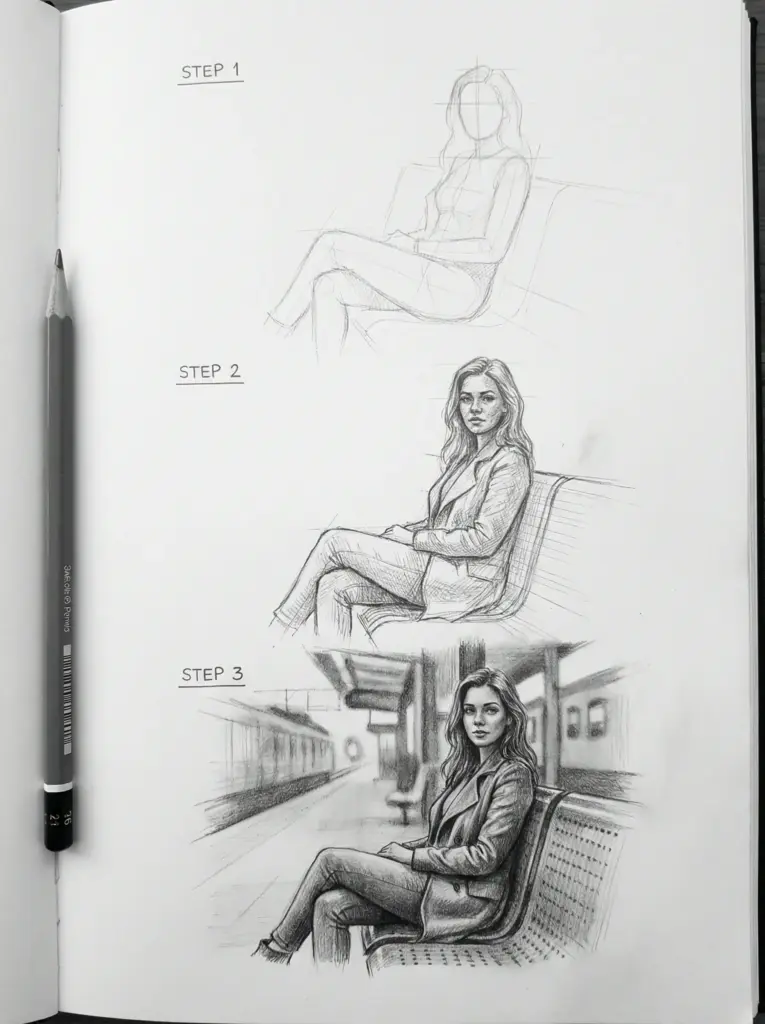
That failure taught me the golden rule: gesture first, details never.
Three Techniques for Moving People
Memory drawing: Look at them for 5 seconds. Look down. Draw what you remember. Look up. Correct. Repeat. This trains visual memory faster than staring.
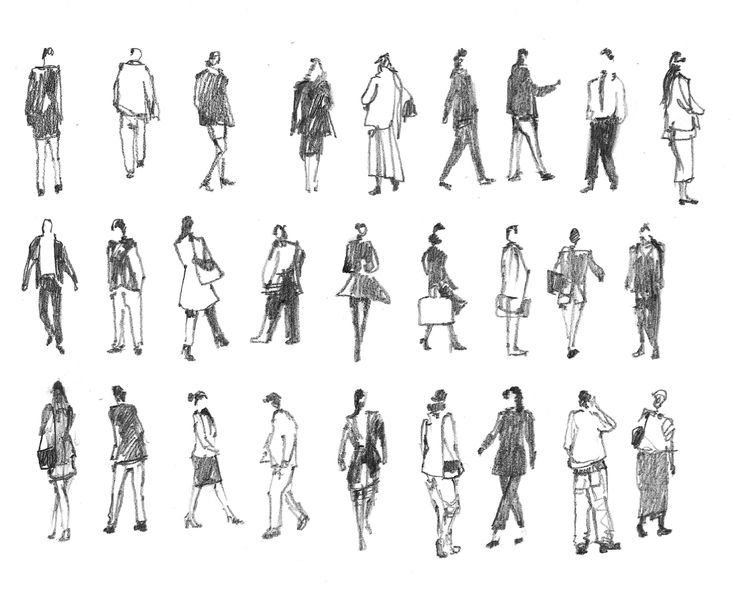
Composite figures: People on the metro sit similarly. Draw one person, when they leave, continue with the next similar pose. You’re drawing the archetype, not the individual.
Finish anyway: If they leave mid-sketch, complete it from imagination. Your brain knows more than you think. These “imagined completions” teach you to trust your instincts.
Where to Actually Practice (My Tested Locations in Kyiv)
Not all locations are equal. Some spots feel wrong, others become second studios.
Beginner Spots (People Pause, Don’t Notice)
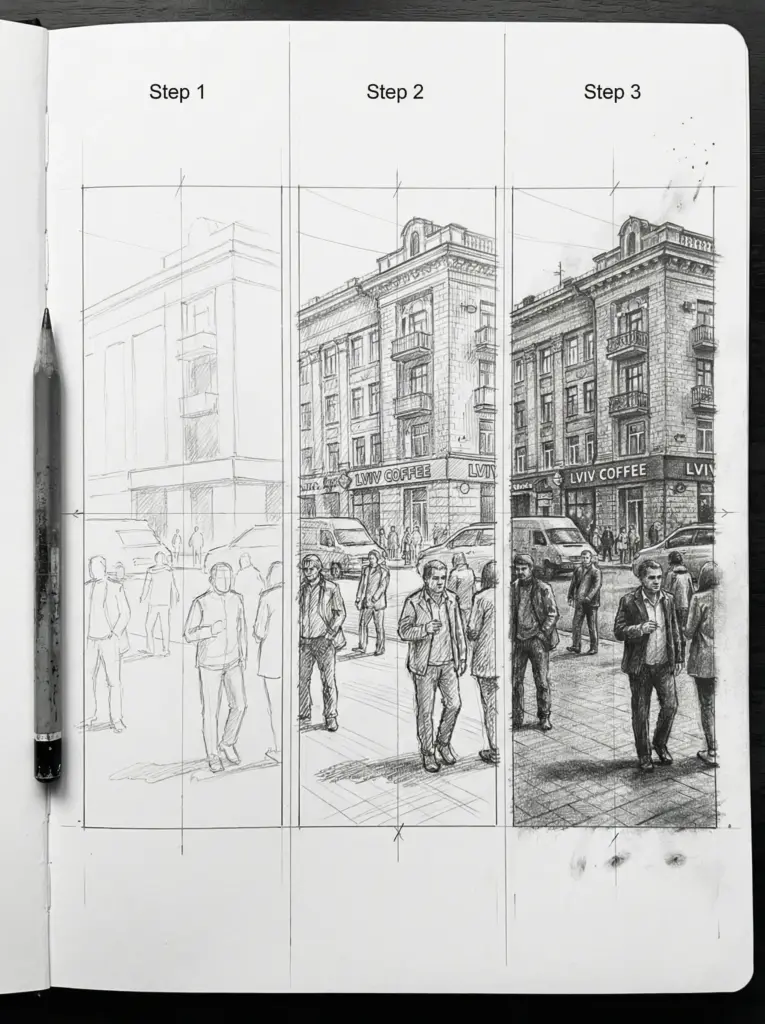
Lviv Coffee on Khreshchatyk: Large windows, slow-moving customers, everyone’s on laptops. I’ve done 40+ sketches here. Order an Americano, sit by the window, draw for hours.
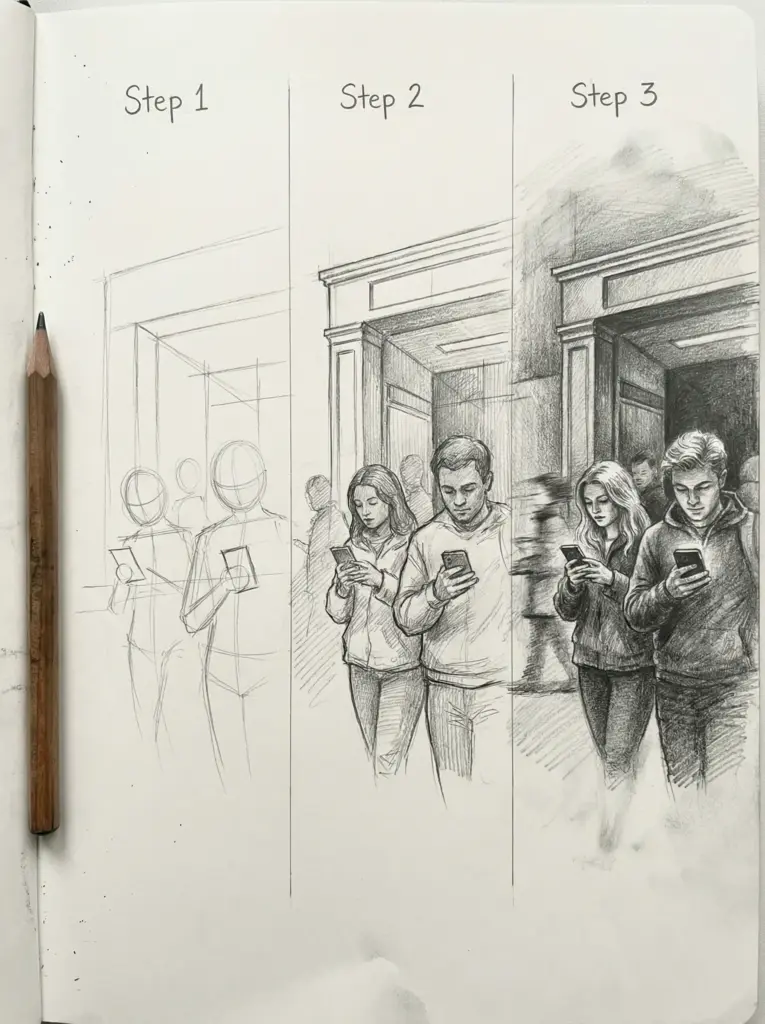
Maidan Metro Station (exits): People waiting for friends. They check phones, smoke, shift weight. 2-5 minute windows. Weekend mornings are best—less rushed.
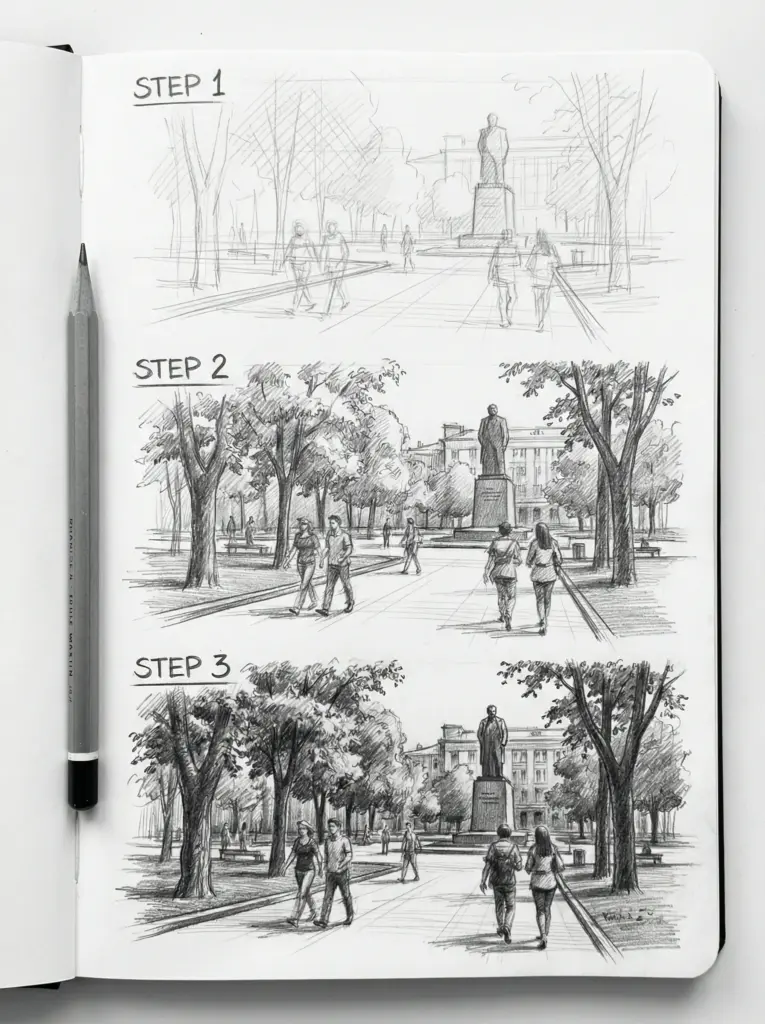
Any park bench in Shevchenko Park: Find a bench across from another bench. Draw people resting, reading, scrolling. No one notices someone sketching in a park.
Intermediate (More Movement, More Challenge)
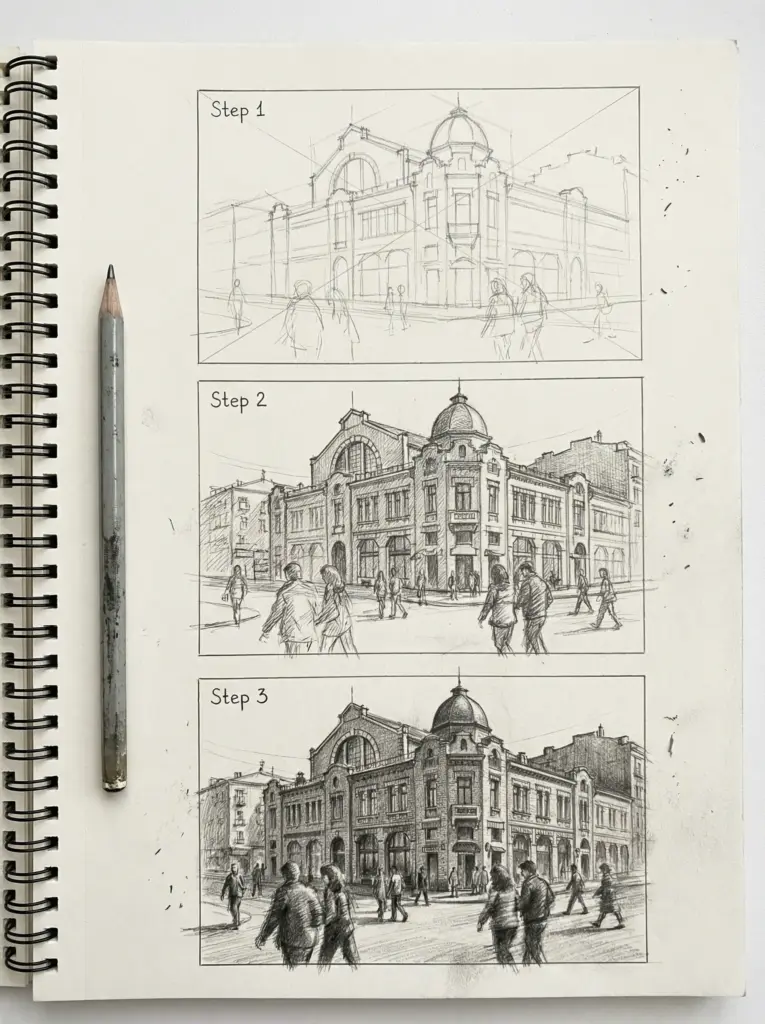
Bessarabsky Market corners: Shoppers pause to examine produce. Quick poses (30-90 seconds). Great for capturing weight shifts and reaching gestures.
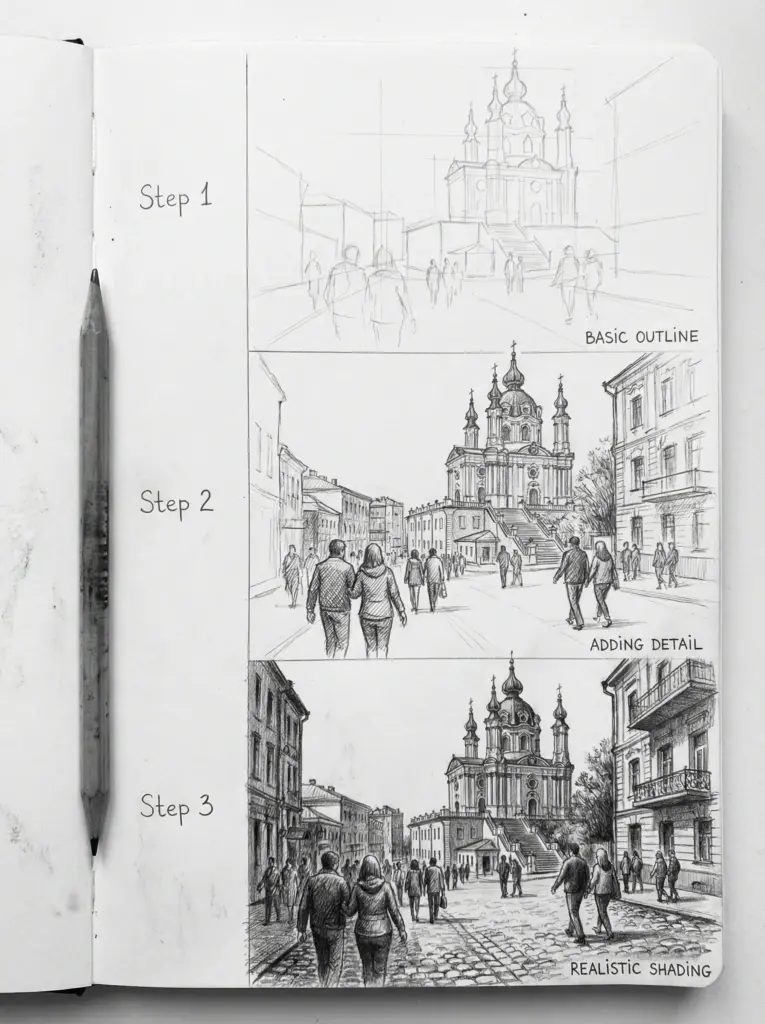
Andriyivskyy Descent on weekends: Tourists taking photos. They hold still-ish. Background activity forces you to work fast.
Advanced (Chaos Mode)
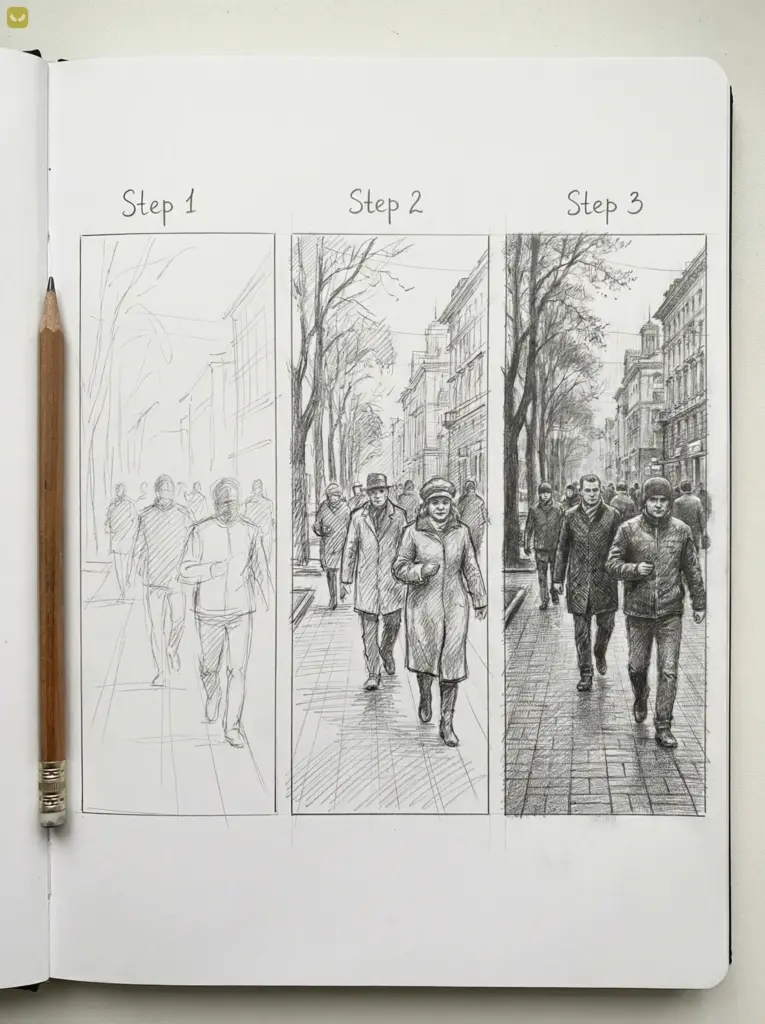
Khreshchatyk on Saturday: Walking people. You get 3-5 second windows. Forces pure gesture, zero details. This is where style emerges—there’s no time to think.
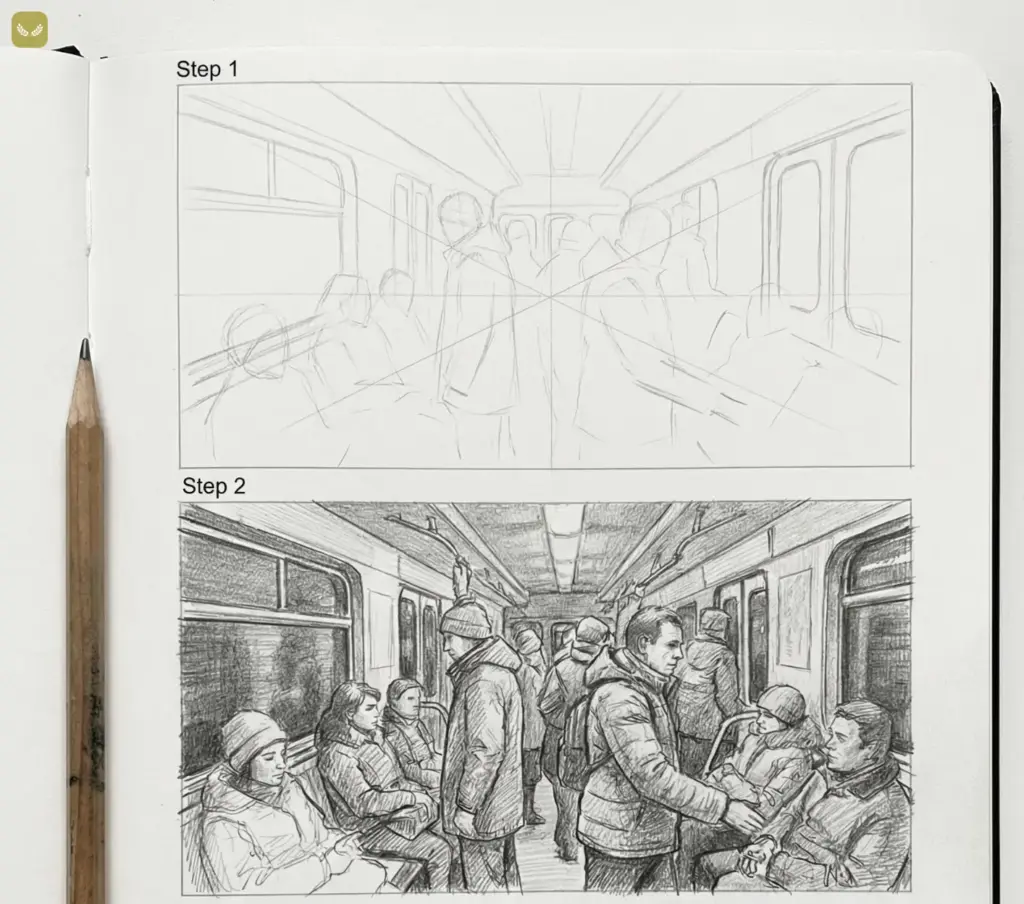
Metro during rush hour: Moving targets, bad lighting, no space. Absolutely brutal. Also the fastest way to improve. I don’t recommend this until you’ve filled 2-3 sketchbooks.
How to Stop Being Terrified (The Conversation That Fixed Everything)
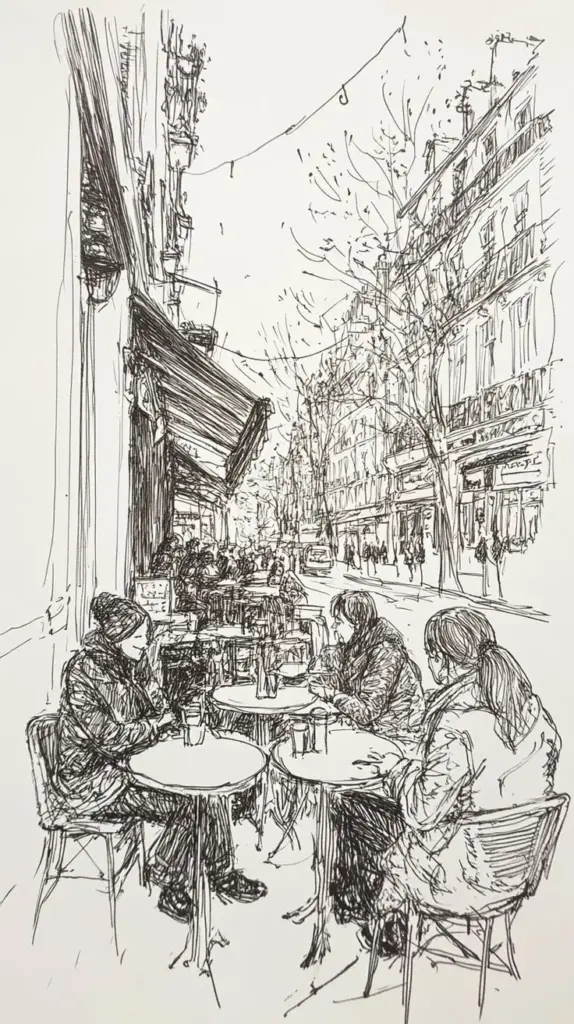
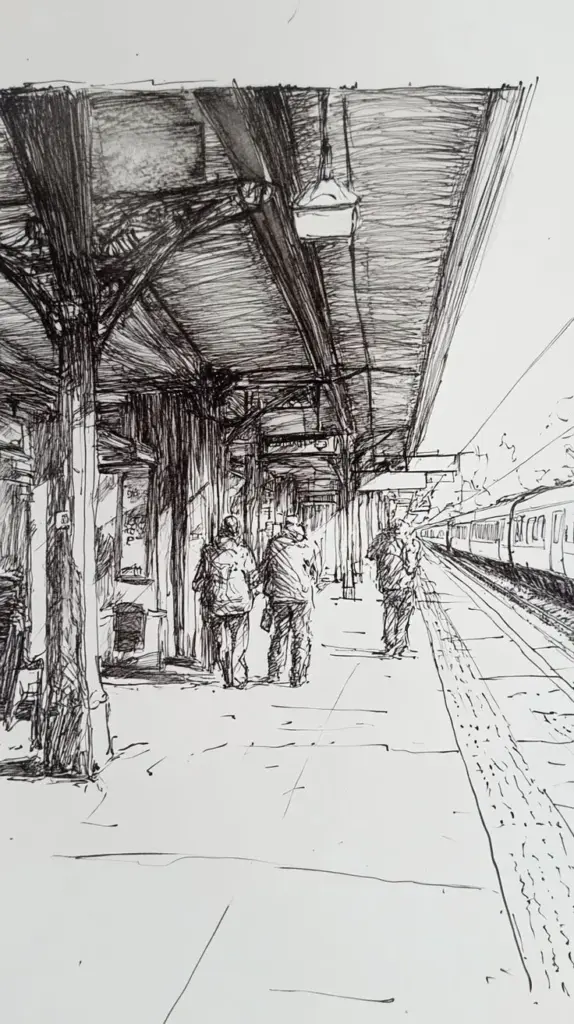
I spent three months sketching in cafés before anyone noticed.
Then, July 2020, a guy in a Kyiv coffee shop walked over. Here’s what I expected:
- “Why are you drawing me?”
- “That doesn’t look like me.”
- “Is this legal?”
Here’s what actually happened:
“Are you an artist?”
Yeah, just practicing figure drawing.”
“Cool. Can I see?”
(I showed him)
“That’s sick. Keep going.”
That interaction taught me three truths about public sketching:
The Three Realities
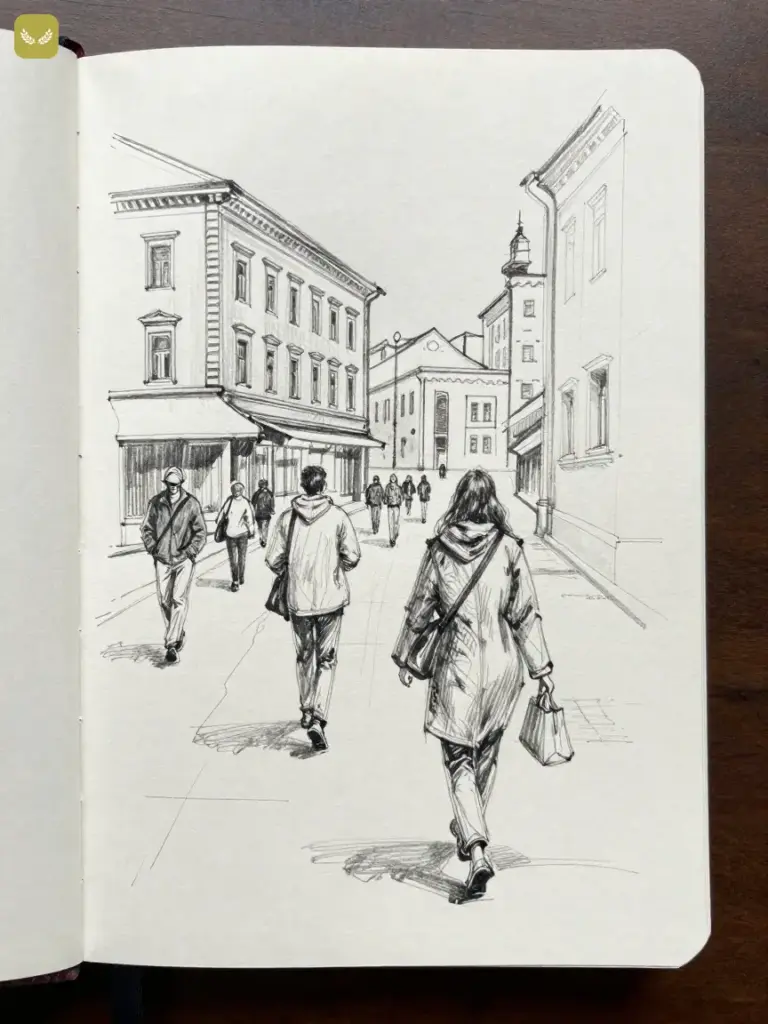
1. Most people don’t notice: They’re in their phones, their thoughts, their conversations. You’re invisible.
2. Those who notice are usually curious, not angry: In 500+ sketches, I’ve had exactly two negative reactions. Both just asked me to stop. I did. No drama.
3. Many are flattered: People like being seen. Not photographed—seen. There’s a difference. Drawing is observational, not exploitative.
Ethics: The One Rule That Matters
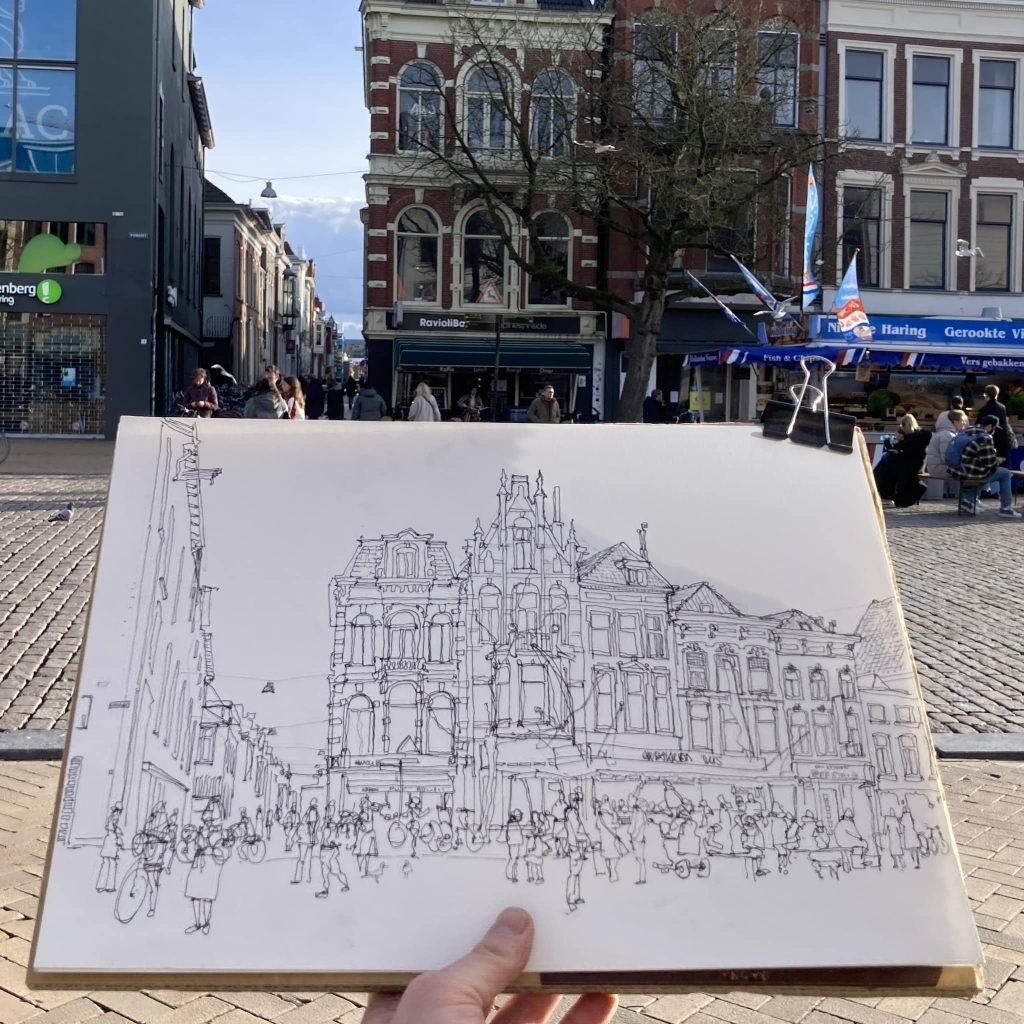
Street sketching is legal in public spaces across most of Europe and North America. But legal doesn’t mean ethical.
My rule: Don’t be creepy.
What “Don’t Be Creepy” Means
Don’t exaggerate features for mockery: You’re observing, not caricaturing. Draw what’s there, not what’s funny.
Don’t draw children unless you’re clearly in a family context: Parents notice. It looks wrong. Just don’t.
Don’t draw people in vulnerable moments: Someone crying, arguing, clearly upset—leave them alone.
If someone asks you to stop, stop immediately: No explanation needed. “Sure, no problem.” Close the book. Move on.
I’ve never had someone escalate after I stopped. Respect builds trust. Trust builds confidence. Confidence makes better artists.
The Five Mistakes I Made (So You Don’t Have To)
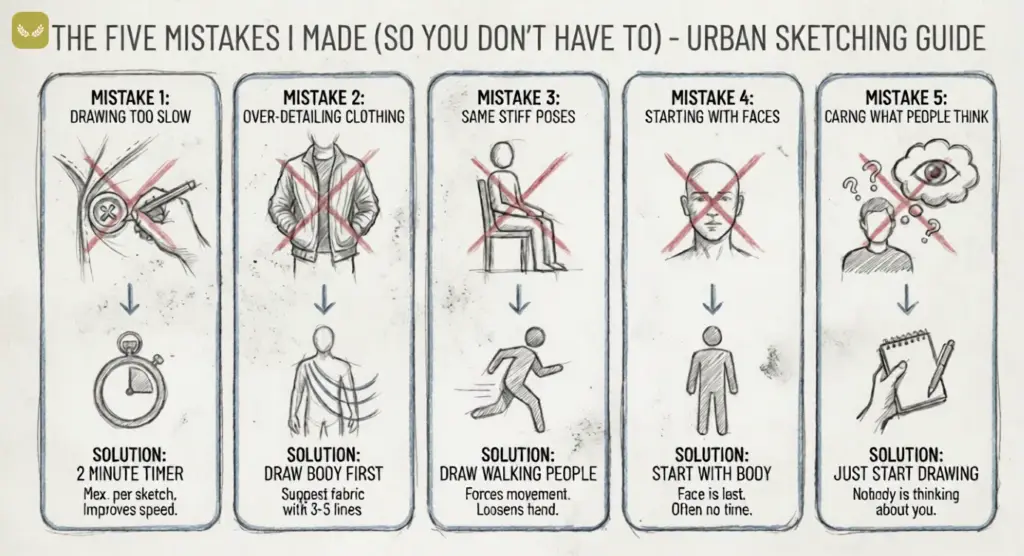
1. Drawing Too Slow (The Coat Button Disaster)
Already told this story. Solution: Set a timer. Two minutes maximum per sketch for the first month. You’ll hate it. You’ll improve faster than any other method.
2. Over-Detailing Clothing
I spent weeks drawing every fold in jackets. Useless. Clothing follows the body. Draw the body first. Suggest fabric with 3-5 directional lines. That’s it.
3. Same Stiff Poses Every Time
I drew 50 seated people before I realized they all looked identical. Solution: Draw walking people. Forces you to capture movement. Loosens your hand. Breaks the stiffness habit.
4. Starting With Faces
Faces are hard. They’re also the first thing to change when people move. Start with the body. If there’s time, add a face. Usually there isn’t. That’s fine.
5. Caring What People Think
This killed six months of potential practice. I was too scared to open my sketchbook. Then I read something that stuck: “Nobody is thinking about you. They’re thinking about themselves.” It’s true. They are. Start drawing.
My Daily Practice Routine (20 Minutes, Real Results)
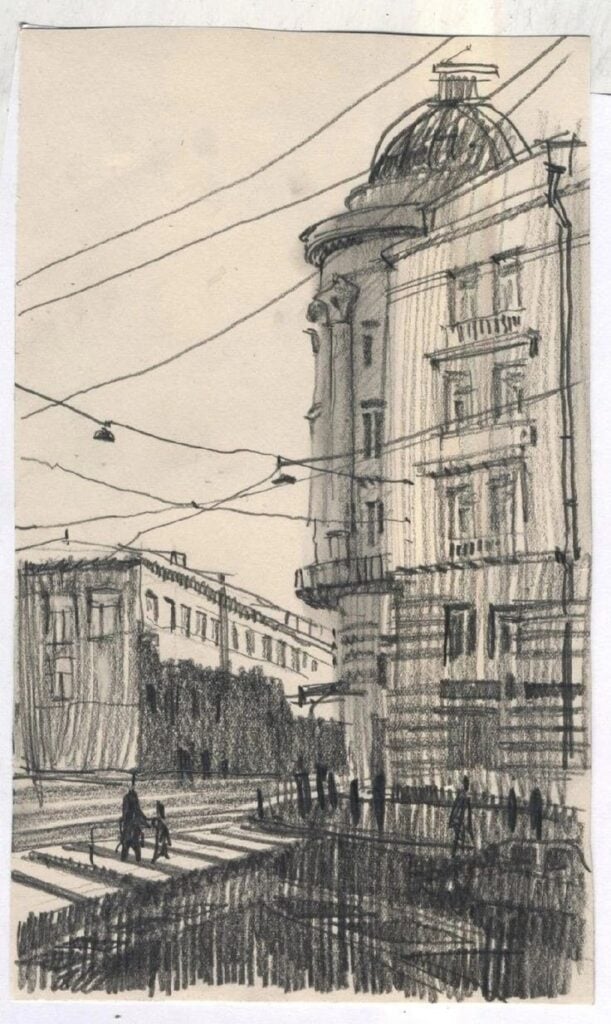
This is what I actually do, not idealized nonsense:
5 minutes – Warm-up gestures: Draw 10 people in 30 seconds each. No details. Just lines of action and weight distribution.
10 minutes – Quick observation: 5-8 people, 1-2 minutes each. Add basic shapes, suggest clothing, skip faces unless there’s time.
5 minutes – One longer sketch: Pick someone seated. Take the full five minutes. Add details, experiment with line weight, try something new.
Consistency matters more than quality. I’d rather see 20 terrible sketches than one perfect drawing. Terrible sketches teach you. Perfect drawings teach you to play safe.
How Street Sketching Develops Style (Without Trying)
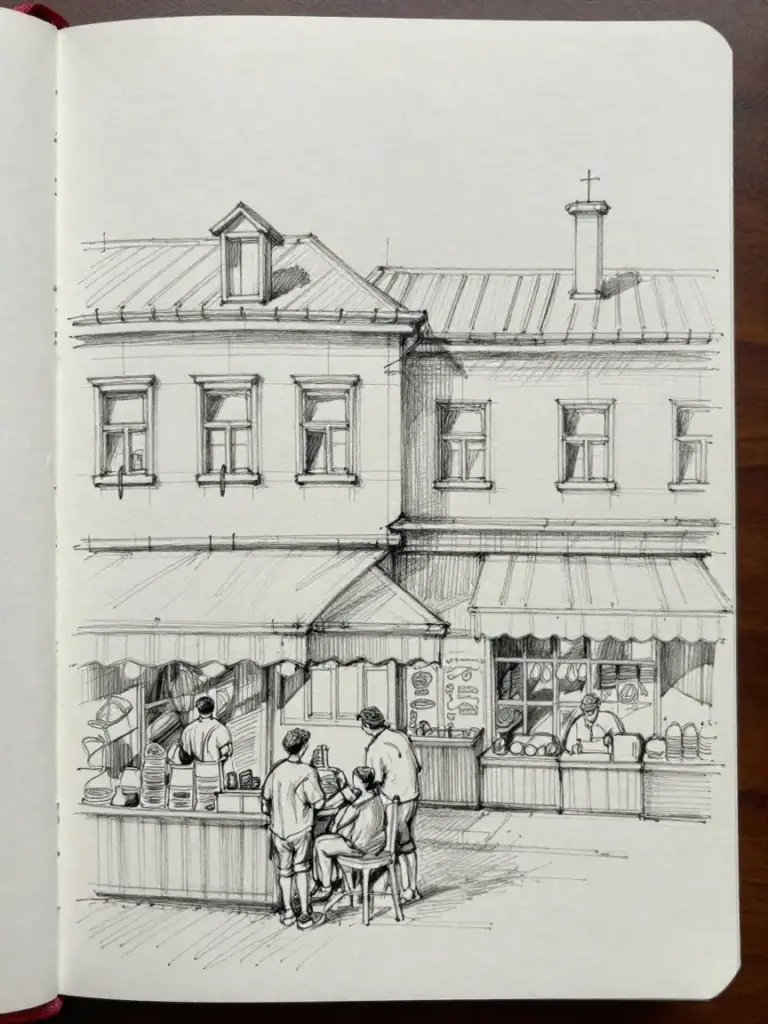
I never tried to develop a style. Styles emerged.
When you draw fast, you can’t copy anyone. There’s no time. You develop shortcuts—personal symbols for eyes, simplified ways to draw hands, your own method for suggesting fabric.
After 200 sketches, I noticed patterns. I always emphasized shoulders and hips. I never drew feet in detail. My faces were three lines: one for the profile, two for eyes.
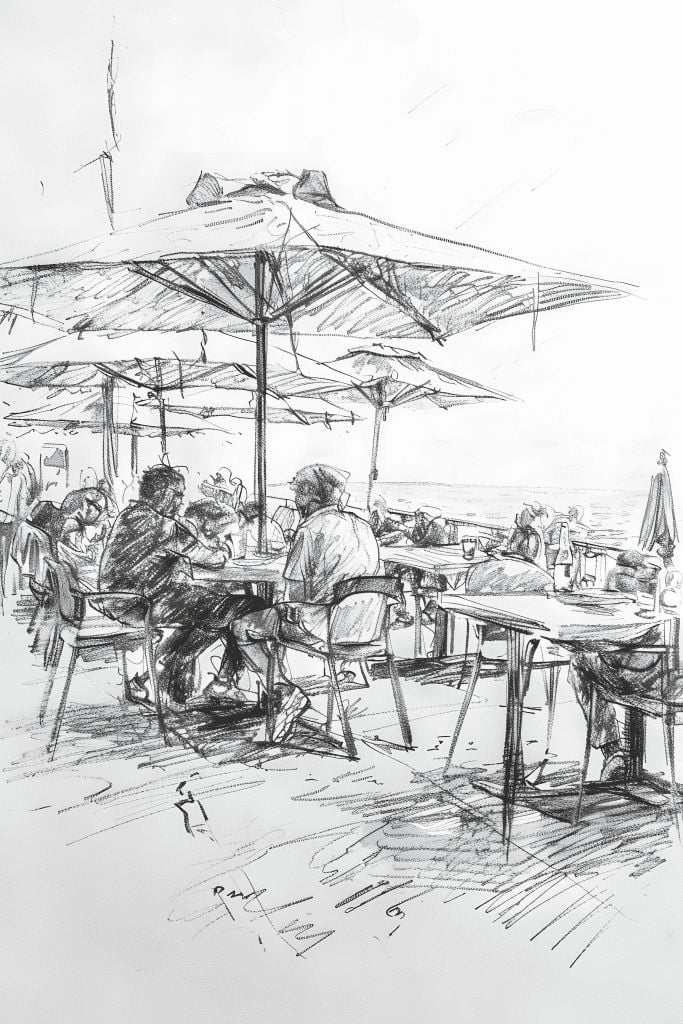
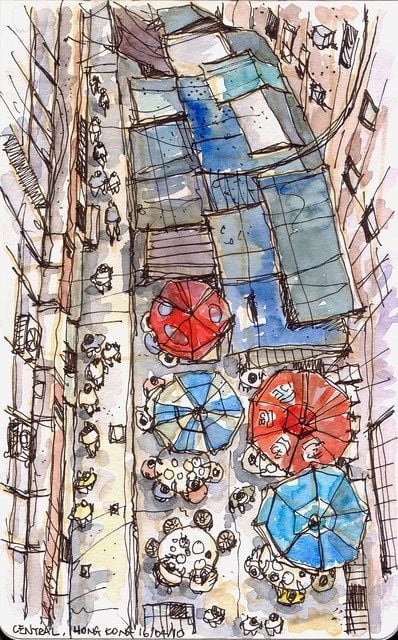
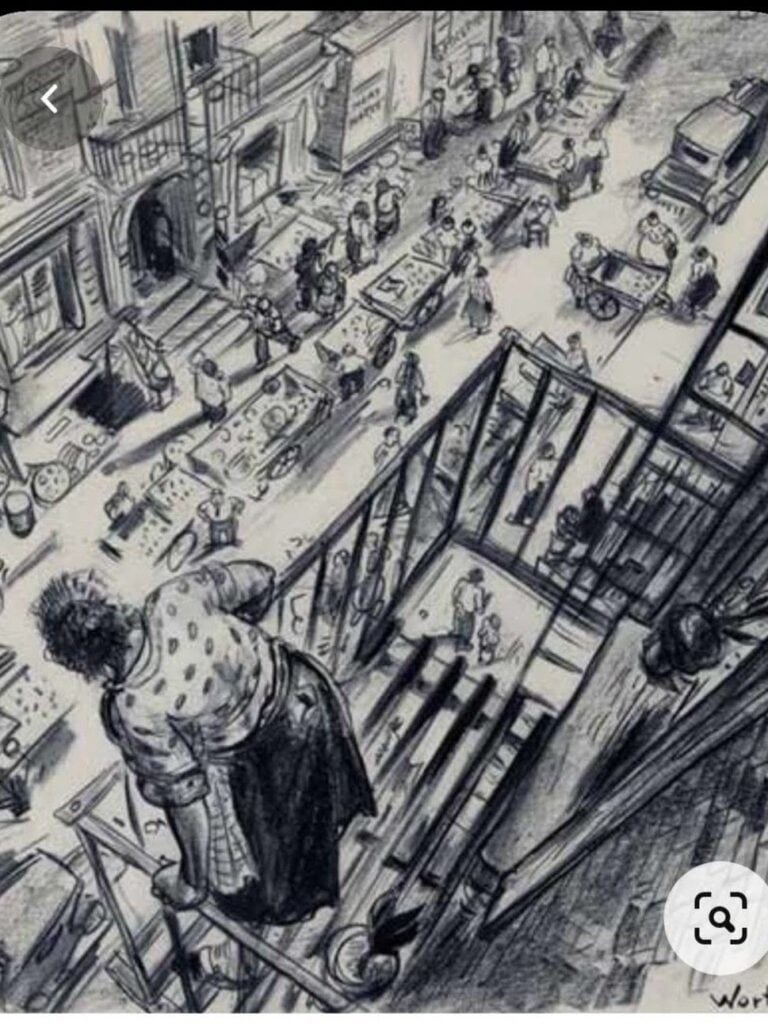
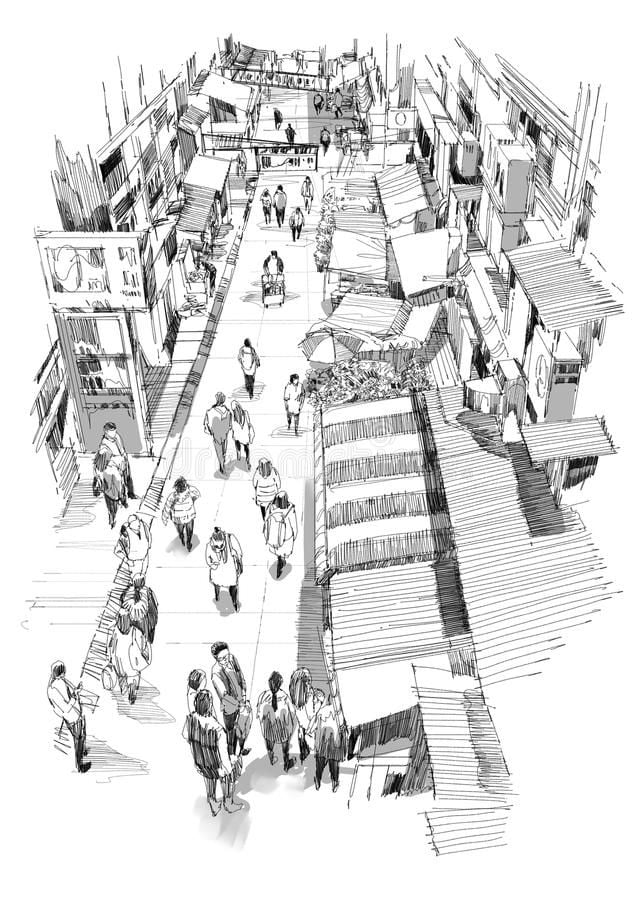
That’s my style. I didn’t choose it. It chose me through repetition and time pressure.
Street sketching doesn’t give you style. It reveals the style that was already there, hidden under perfectionism and second-guessing.
Questions I Get Asked (Honest Answers)
How do beginners start drawing people on the street?
Start in a café. Order coffee. Sit by a window. Draw people outside for 20 minutes. If that feels scary, draw other café customers—they’re stationary, distracted, and unlikely to notice. Use pen, not pencil. Focus on gesture, not details. Do this three times a week for a month. You’ll improve.
What’s the fastest way to sketch people?
Gesture drawing. One line for the spine curve. Mark where the weight lands. Block in torso and limbs with simple shapes. Skip the face unless there’s time. Aim for 30-second sketches until you stop overthinking. Speed comes from simplification, not from drawing faster.
Is it legal to draw strangers in public?
Yes, in most countries. Public spaces = observable. But legal doesn’t mean ethical. Don’t draw children. Don’t mock people. If someone asks you to stop, stop. Respect trumps rights every time.
How long until I get good at street sketching?
Honest answer: Four to six weeks of daily practice. That’s 20-30 sketches per week, 80-180 total. You’ll see noticeable improvement around sketch 50. Confidence arrives around sketch 100. By sketch 200, you’ll stop worrying about quality and start enjoying the process. That’s when it gets fun.
What if people get angry?
In 500+ sketches, it happened twice. Both times they just asked me to stop. I said “Sure, no problem,” closed my book, and moved. No escalation. No drama. Most people are curious, not hostile. And most don’t even notice.
Final Thoughts: Why This Changed How I See Drawing
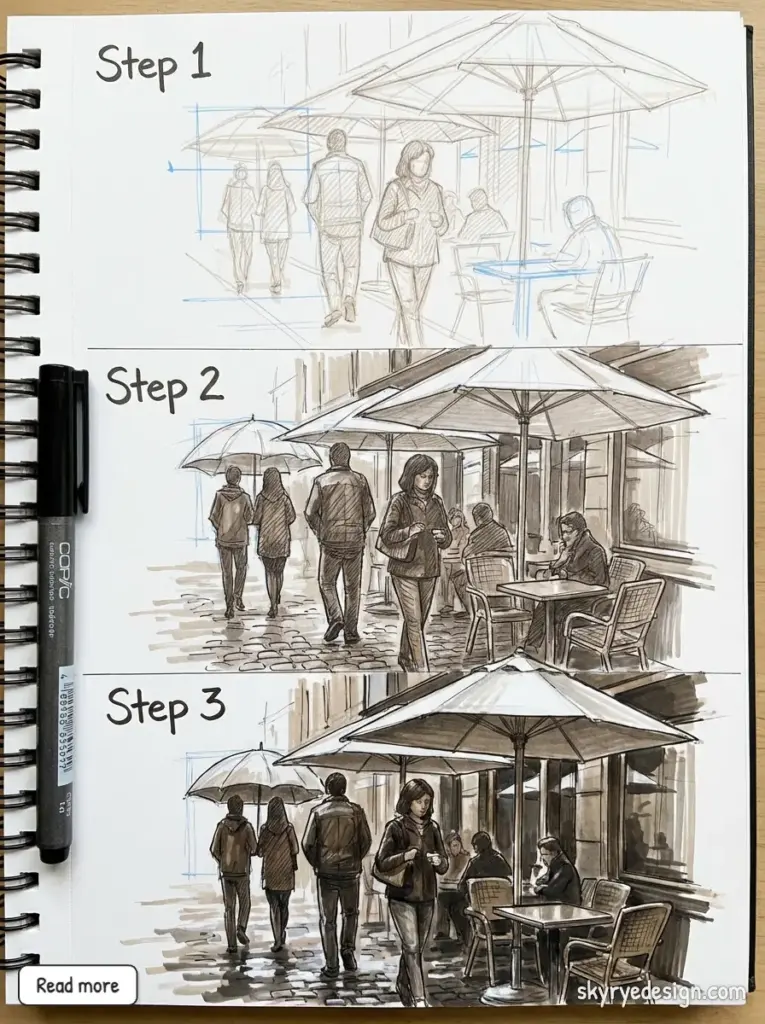
Street sketching isn’t about making pretty drawings. It’s about learning to see.
Before I started, I drew objects. Bodies were collections of parts—head, torso, arms, legs—assembled like IKEA furniture. Technically correct, emotionally dead.
After a year of street sketching, I draw people. Weight, gesture, attitude, energy. The technical stuff followed naturally. You can’t draw movement without understanding anatomy. You can’t capture gesture without studying proportions.
But you can—and should—start with life, not theory.
The punk guy I drew in 2019 taught me more than any tutorial. The woman at Lviv station showed me what not to do. The sketches in my first notebook are terrible. The sketches in my current notebook are better. The sketches in my next notebook will improve again.
That’s the point.
Grab a cheap notebook. Find a café. Start drawing.
Your first sketches will be bad. Do them anyway. They’re not the destination—they’re mile markers on a road that never ends.
And that’s exactly what makes it worth doing.
- 463shares
- Facebook0
- Pinterest463
- Twitter0
- Reddit0