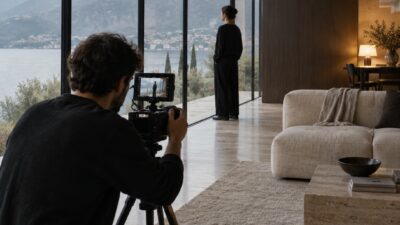
Natural light photography is the easiest lighting system a beginner can practice with: sunlight, shade, window light, and reflected light are already available before you buy any gear. The fastest improvement comes from reading direction, softness, color, and intensity first, then placing your subject where the light is flattering instead of asking the camera to fix everything later.
- What Is Natural Light Photography?
- Quick Natural Light Photography Tips
- Natural Light Photography Basics for Beginners
- How to Use Natural Light in Photography
- Mastering Color and White Balance in Natural Light
- Best Natural Light Conditions to Shoot In
- Natural Light Portraits, Landscapes, and Window Shots
- Camera Settings and Practice Drills for Natural Light
- Natural Light Photography Recovery Playbook
- Related Photography Guides
- Frequently Asked Questions
- More natural light photography examples
- What is natural light photography?
- What is the best natural light for beginners?
- How do I shoot portraits in natural light?
- What camera settings work for natural light photography?
- How can I fix harsh midday sunlight?
- Is window light good for natural light photography?
- Do I need a reflector for natural light photos?
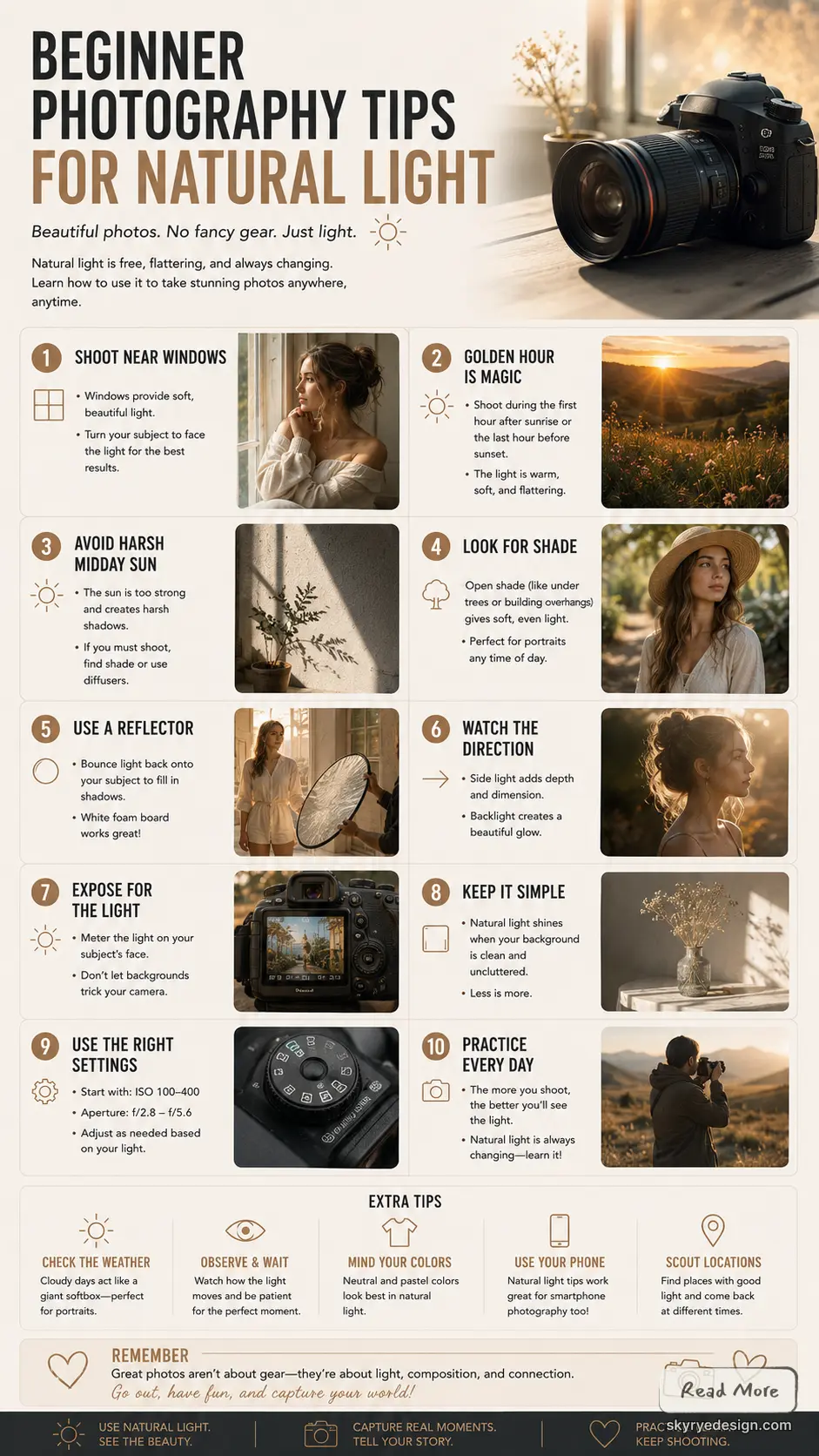
This beginner guide focuses on practical natural light photography tips you can use today: window light for indoor portraits, golden hour for warm backlight, open shade for harsh sun, simple reflectors, basic camera settings, and quick recovery moves when a photo looks flat or overexposed.
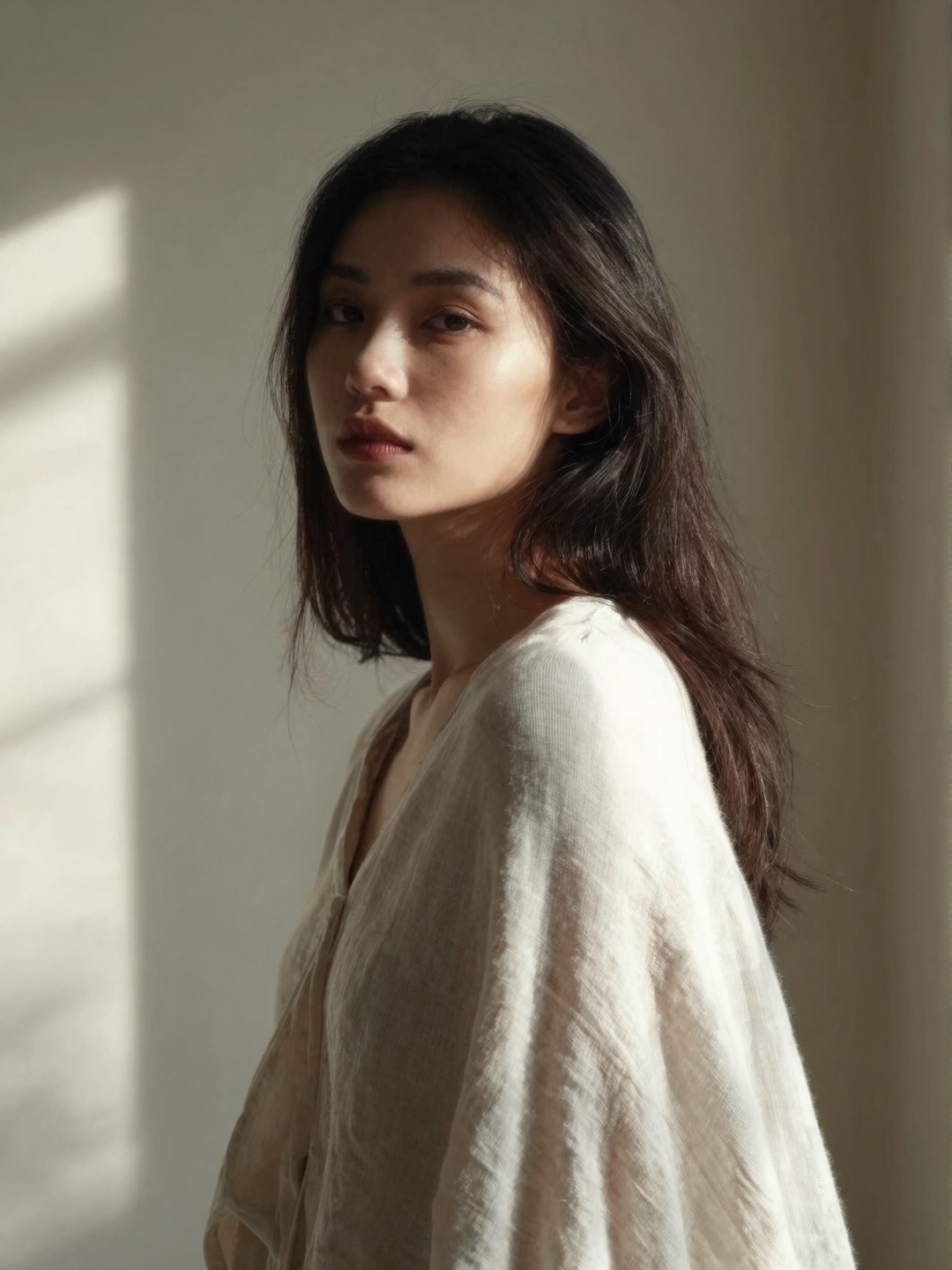
What Is Natural Light Photography?
Natural light photography means using the sun, sky, shade, window light, or reflected light as the main source of illumination. For beginners, it is the best place to start because it teaches you to see where light comes from, how soft it is, what color it has, and how shadows shape the subject before you add any extra gear.
| Lighting problem | Fast natural light fix | Why it works |
|---|---|---|
| Face looks flat | Turn the subject 30-45 degrees from the window or sun | Side light creates shape without harsh contrast |
| Eyes look dark | Move the subject toward open sky or add a white reflector | Catchlights brighten the portrait naturally |
| Midday shadows are harsh | Move into open shade near a bright wall | The wall bounces soft reflected light back onto the subject |
| Colors look too warm or cool | Set white balance manually or correct the RAW file later | Color temperature changes by time of day and surface reflection |
Quick Natural Light Photography Tips
- Natural light’s direction, quality, and color temperature change throughout the day and directly affect how your photos look
- Positioning your subject relative to the light source and adjusting white balance are fundamental skills that improve image quality
- Different lighting conditions require specific techniques, from shooting during golden hour to working with overcast skies and backlighting
Natural Light Photography Basics for Beginners
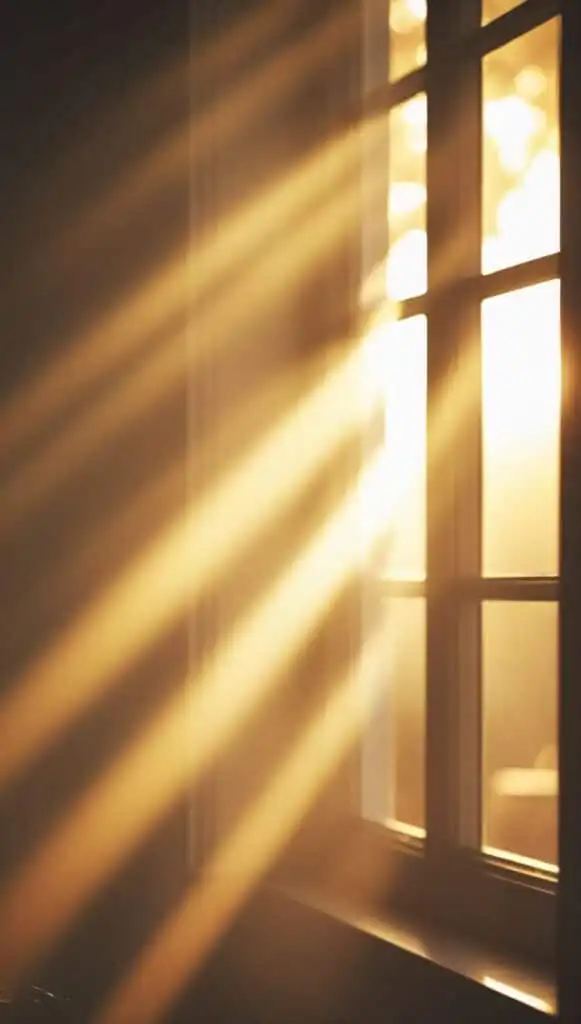
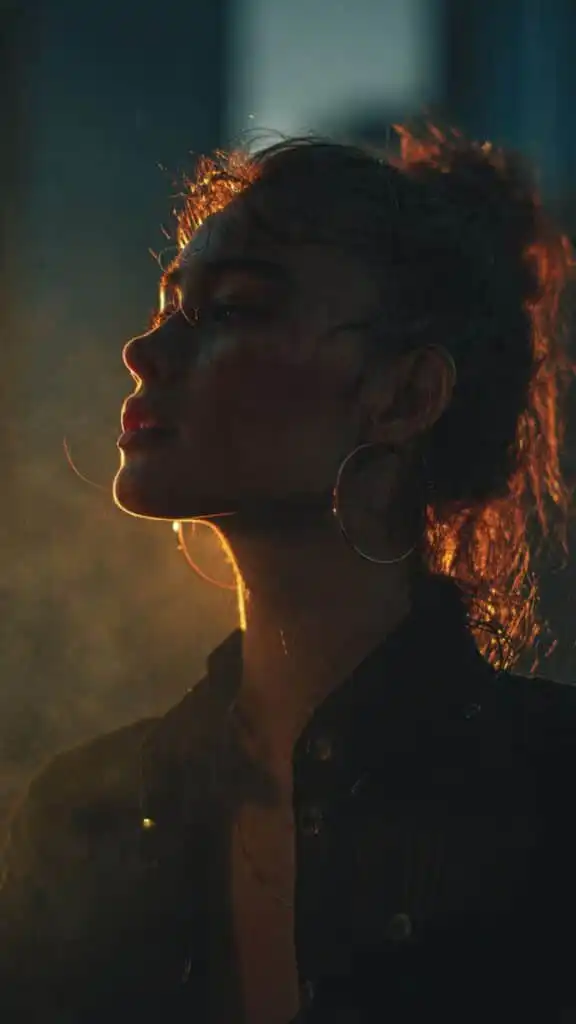
Natural light behaves differently depending on the time of day, weather conditions, and your shooting environment. The quality, direction, and intensity of natural lighting directly impact the mood and clarity of your photographs.
Defining Natural Light Photography
Natural light photography means using sunlight or ambient light from the sky as your primary light source instead of artificial equipment like flashes or studio lights. This includes direct sunlight, light on overcast days, the soft glow during golden hour, and even moonlight.
You’ll find natural light readily available and free, making it ideal when you’re starting out. It creates authentic-looking images that feel less staged than artificially lit photos. The key is learning to work with what’s available rather than trying to control every aspect of your lighting setup.
Natural light photography requires you to adapt to changing conditions throughout the day. You’ll need to understand how the sun’s position affects shadows, highlights, and overall exposure in your images.
Types of Natural Light: Direct, Diffused, and Reflected
Direct light comes straight from the sun without any obstruction. It creates strong shadows, high contrast, and clearly defined edges in your photos. You’ll encounter this type of light on clear, sunny days, especially during midday hours.
Diffused light occurs when clouds, fog, or other atmospheric elements scatter the sunlight. This creates even illumination with softer shadows and lower contrast. Overcast days provide naturally diffused light that’s flattering for portraits and reduces harsh shadows.
Reflected light bounces off surfaces before reaching your subject. Light reflecting from walls, water, sand, or snow can fill in shadows and add interesting color casts to your images. You can position subjects near light-colored walls or use reflective surfaces intentionally to redirect natural light where you need it.
Each type serves different purposes in your photography. Direct light works well for dramatic landscapes and creating mood, while diffused light excels for portraits and detail work.
Hard vs. Soft Light
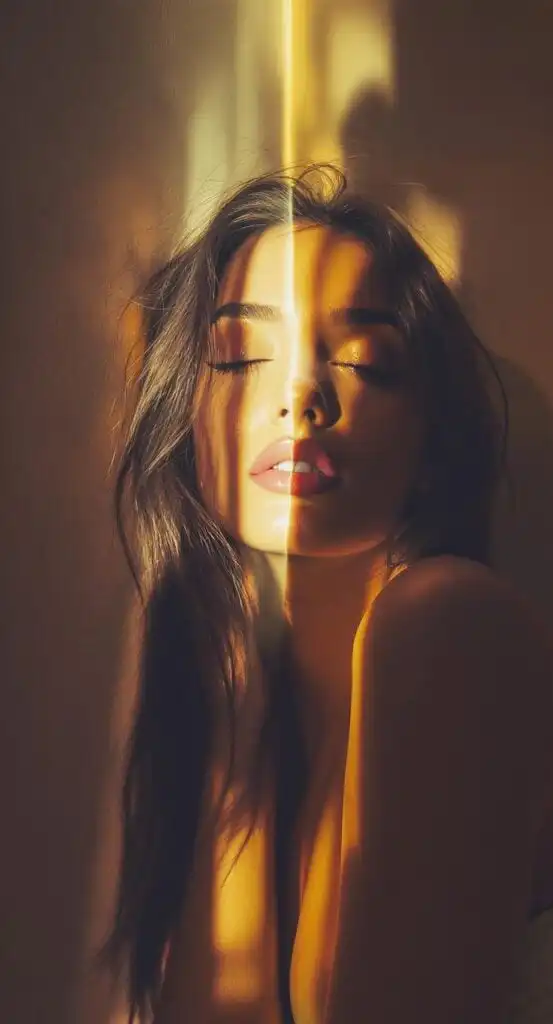
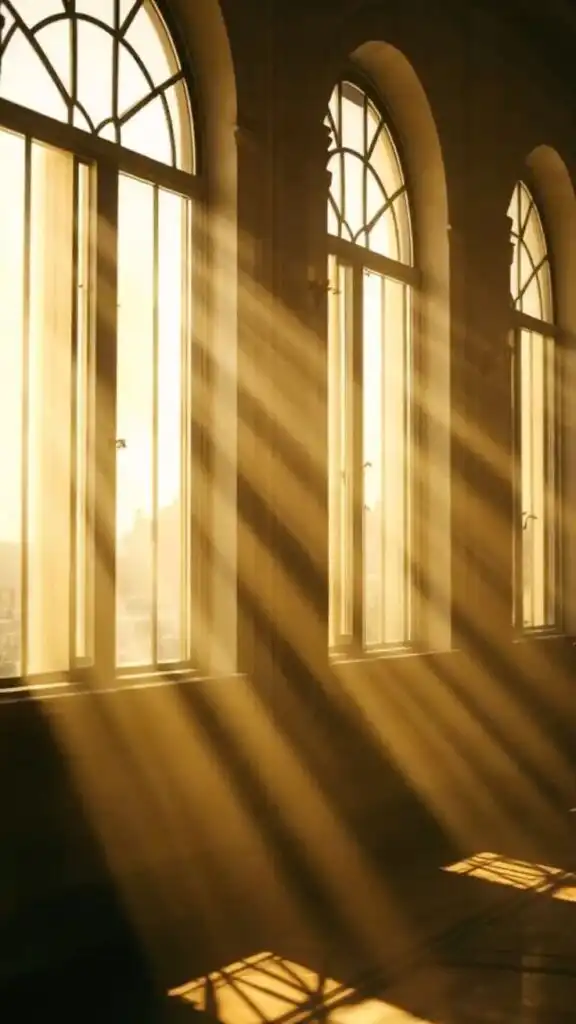
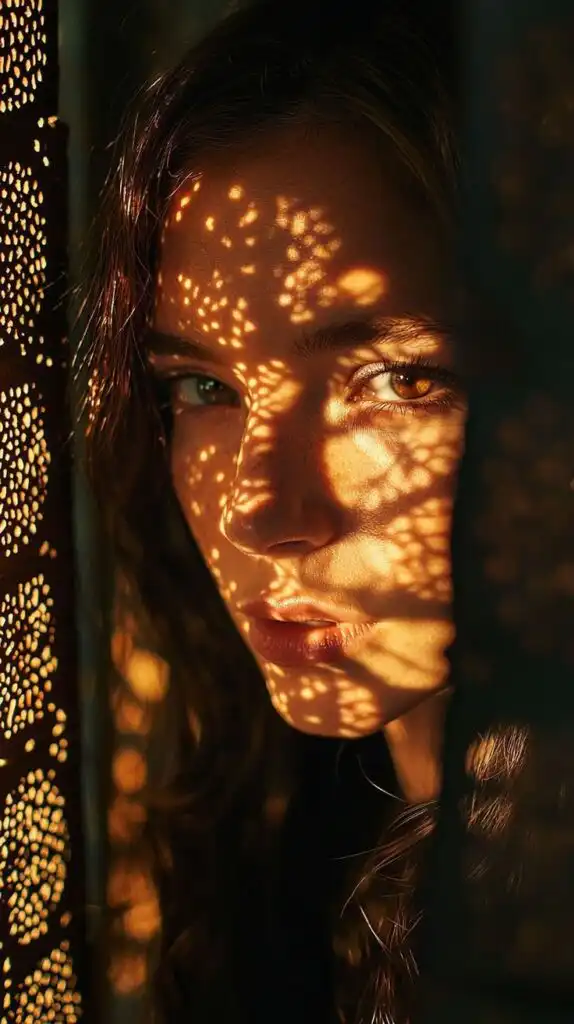
Hard light produces sharp, well-defined shadows with high contrast between bright and dark areas. The sun on a clear day creates hard light because it acts as a small, intense light source relative to your subject. This lighting emphasizes textures and creates dramatic, bold images.
Soft light generates gentle transitions between highlights and shadows with lower contrast. It wraps around your subject more evenly, minimizing harsh shadows. You’ll get soft light naturally on cloudy days, during golden hour, or when shooting in open shade.
The quality of light matters more than the quantity for creating compelling images. Soft light flatters skin tones in portraits by minimizing blemishes and reducing unflattering shadows under the eyes and nose. Hard light can add drama and emphasis to architectural photography or landscapes where you want to highlight textures and shapes.
Understanding when to use each type helps you make intentional creative decisions rather than shooting randomly.
Common Natural Light Mistakes to Avoid
Shooting only during harsh midday sun is a frequent beginner mistake. The overhead sun creates unflattering shadows under eyes, noses, and chins in portraits. Move your subject into open shade or wait for better lighting conditions during early morning or late afternoon.
Ignoring the direction of light leads to flat or poorly exposed images. Position yourself so the light falls on your subject from the side or front rather than shooting directly into the sun, unless you’re intentionally creating a silhouette or backlit effect.
Forgetting to adjust your camera settings for changing light conditions causes exposure problems. Natural light changes constantly, so you need to check your settings regularly throughout a shoot.
Not using available tools to modify natural light limits your creative options. You can use walls, trees, or buildings to block or reflect light, creating the effect you want without expensive equipment.
How to Use Natural Light in Photography
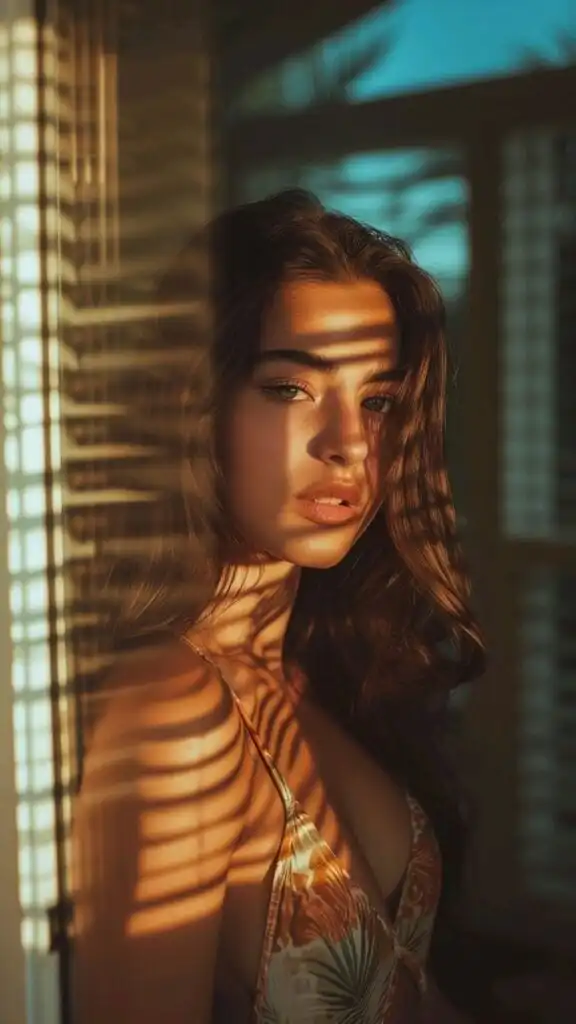
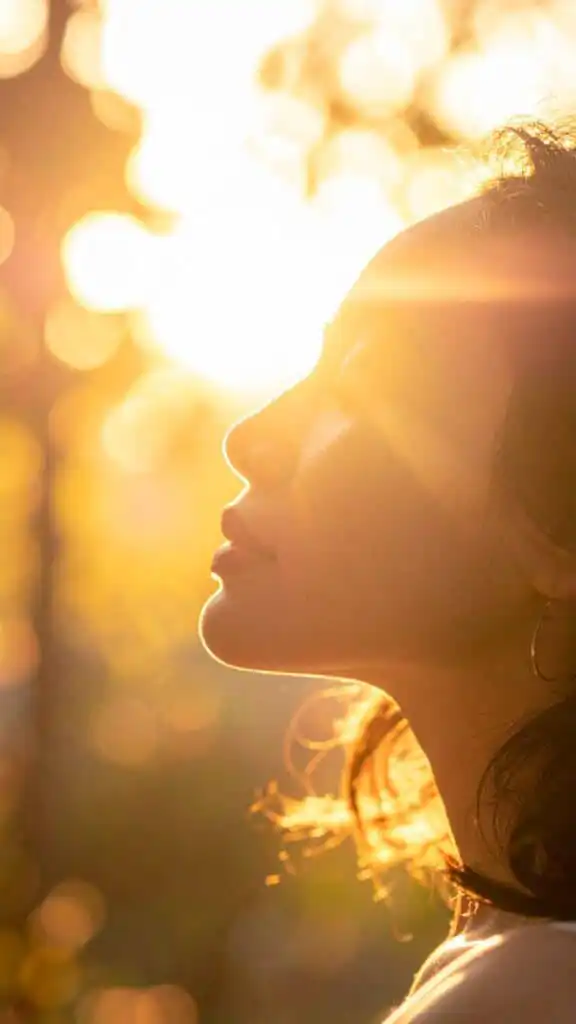
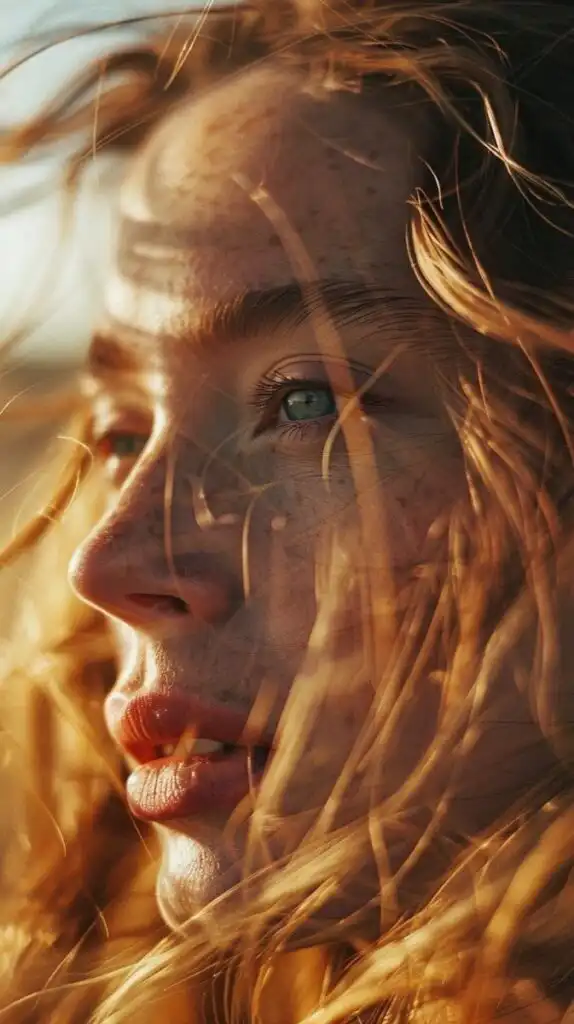
Mastering natural light requires understanding how light direction shapes your subject, positioning your subject at optimal angles, controlling brightness through camera settings, and using simple tools to redirect illumination where you need it most.
Direction of Light and Its Impact
The direction from which light hits your subject determines mood, texture, and dimension in your photographs. Front lighting creates even illumination across your subject’s face or surface but can appear flat and reduce depth. Side lighting produces shadows that reveal texture and shape, adding drama and visual interest to your images.
Backlight positions your light source behind the subject, creating a glowing rim effect around edges. This works well for silhouettes or ethereal portraits but requires careful exposure management. Top lighting occurs during midday when the sun is directly overhead, casting harsh shadows under eyes, noses, and chins that rarely flatter portraits.
Window light indoors offers directional light you can control by positioning your subject closer or farther from the source. Watch how shadows fall across your subject as you move around them to find the most appealing angle.
Angle Your Subject for Best Results
Your subject’s position relative to the light source dramatically changes how features appear in the final image. Turn your subject 45 degrees away from window light to create gentle shadows that add dimension without being too dramatic. This angle works well for portraits because it defines facial structure while maintaining a natural appearance.
For outdoor photography, position your subject so harsh overhead sunlight doesn’t cast unflattering shadows. Have them face toward open sky or find locations where buildings or trees block direct sunlight while still providing bright ambient light.
Profile angles with side lighting emphasize contours and create striking silhouettes. Experiment by having your subject shift their position incrementally while you observe how light plays across surfaces through your viewfinder.
Mastering Color and White Balance in Natural Light
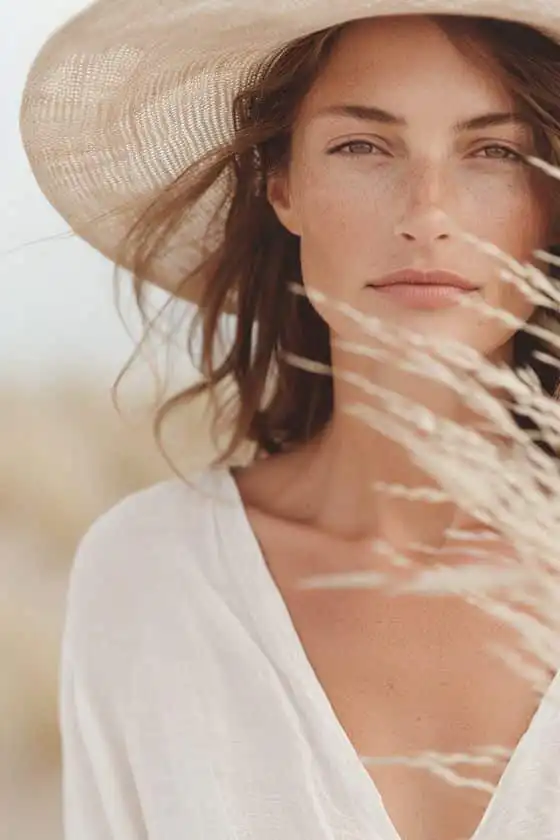
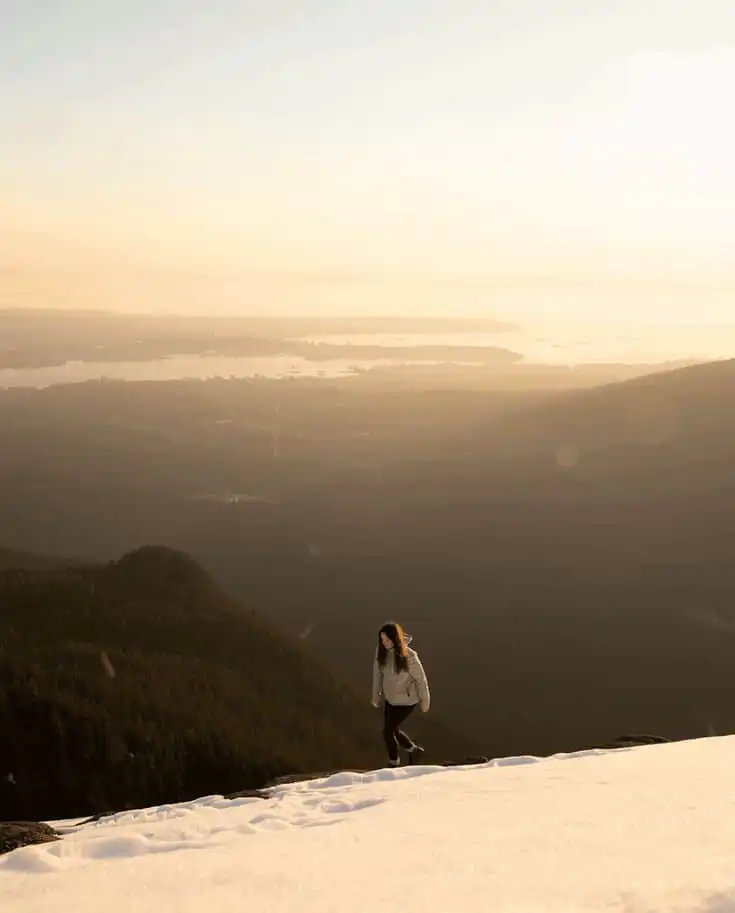
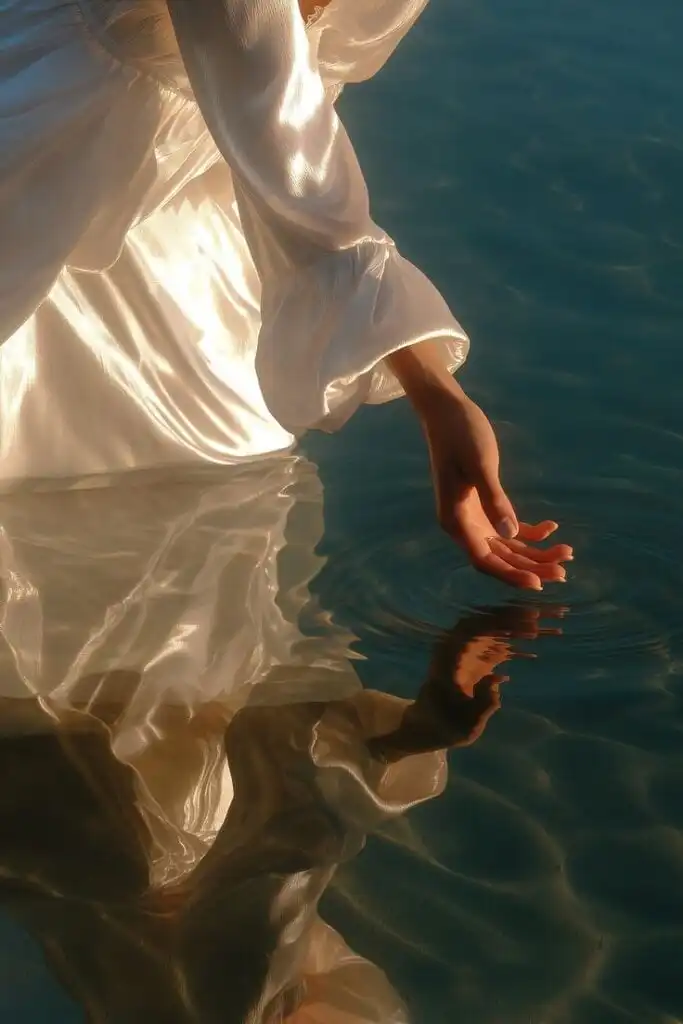
Natural light constantly shifts in color throughout the day, and understanding how to manage these changes will transform your images from flat to faithful. White balance controls how your camera interprets different light colors, ensuring skin tones look natural and scenes appear as you remember them.
Understanding Colour Temperature
Colour temperature measures the warmth or coolness of light on a scale from orange to blue, measured in Kelvin (K). Candlelight sits around 1,800K with a deep orange glow, while midday sunlight reaches 5,500K for a neutral white appearance.
Blue sky in shade can climb to 8,000K or higher, casting distinctly cool tones on your subjects. Early morning and late afternoon light drops to 3,000-4,000K, giving you those warm golden tones.
Your eyes automatically adjust to these shifts, but your camera needs guidance. Different times of day produce dramatically different colour temperatures, which is why the same location can look completely different at dawn versus noon.
Controlling Colour Casts
A colour cast occurs when your entire image takes on an unwanted color tint. Shade under blue skies creates blue casts that make skin look cold and lifeless, while late afternoon sun can push everything too orange.
Reflective surfaces introduce unexpected casts. Grass reflects green onto faces, white walls bounce neutral light, and colored buildings tint nearby subjects with their hue.
Shoot in RAW format to give yourself maximum flexibility. RAW files store all color information, letting you adjust white balance in post-processing without degrading image quality. JPEG files bake in your white balance choice, making corrections harder and less effective.
Use your camera’s white balance compensation to fine-tune presets by adding or removing warmth in small increments.
Natural light changes the entire feel of a destination, so it helps to choose places with a strong visual mood where sunrise, mist, water, or foliage gives you a clear visual mood.
Best Natural Light Conditions to Shoot In
Natural light changes dramatically throughout the day, and each lighting condition presents unique opportunities and challenges. Learning to adapt your approach for golden hour warmth, blue hour subtlety, harsh midday sun, and tricky shadow patterns will help you capture better images no matter when you shoot.
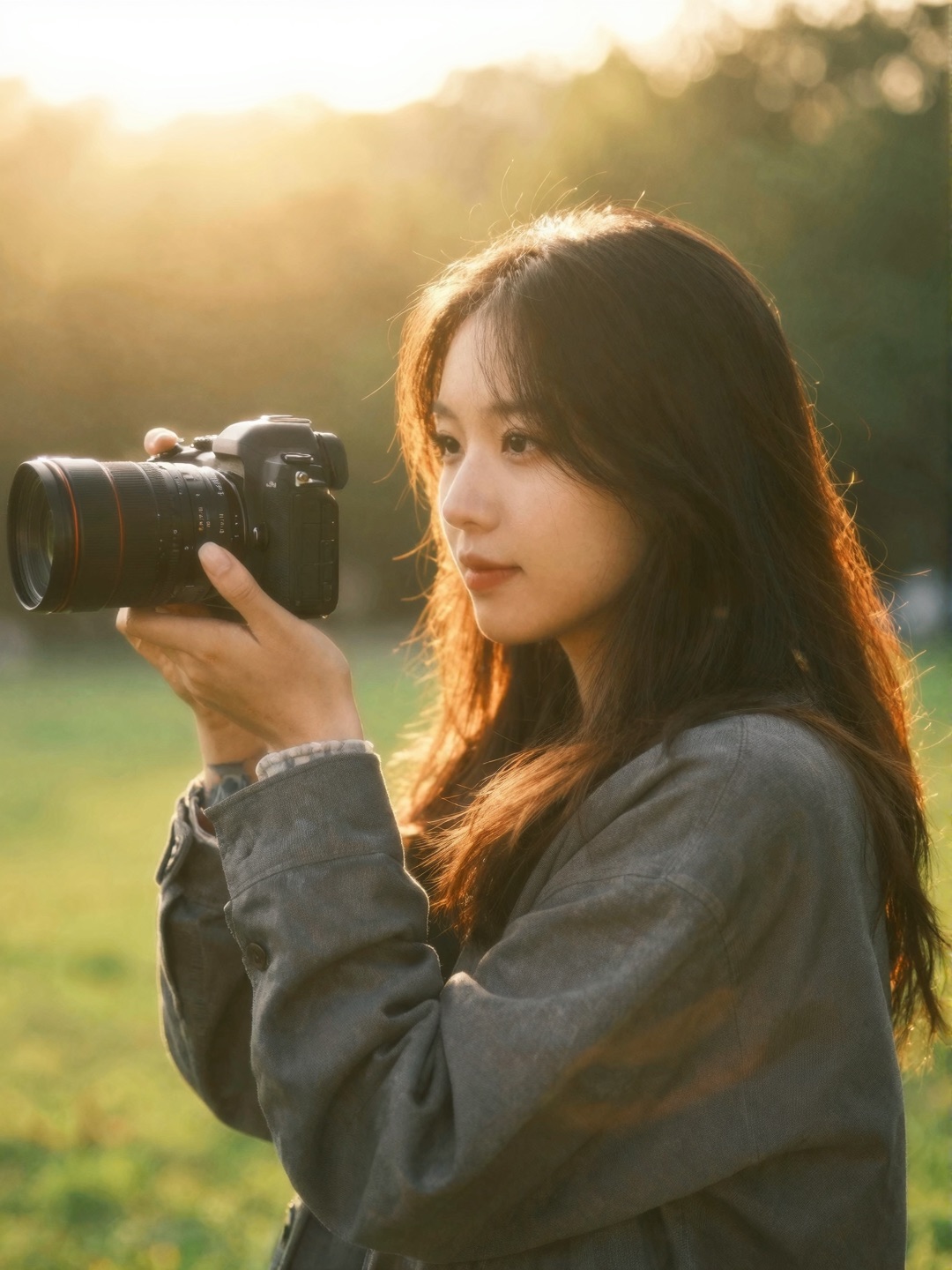
Golden Hour: Capturing Warm, Soft Tones
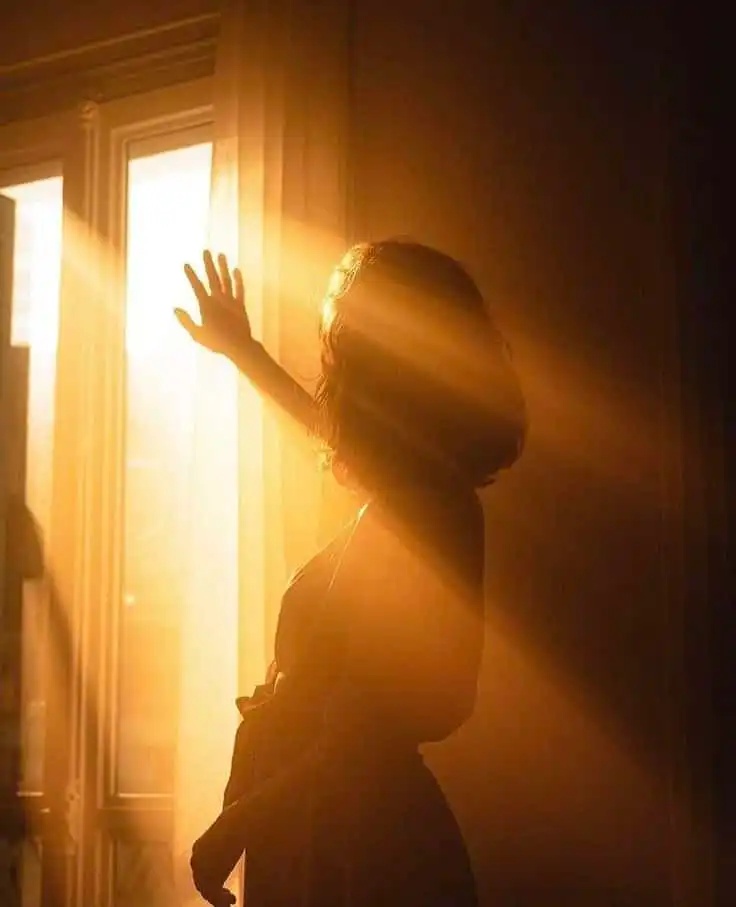
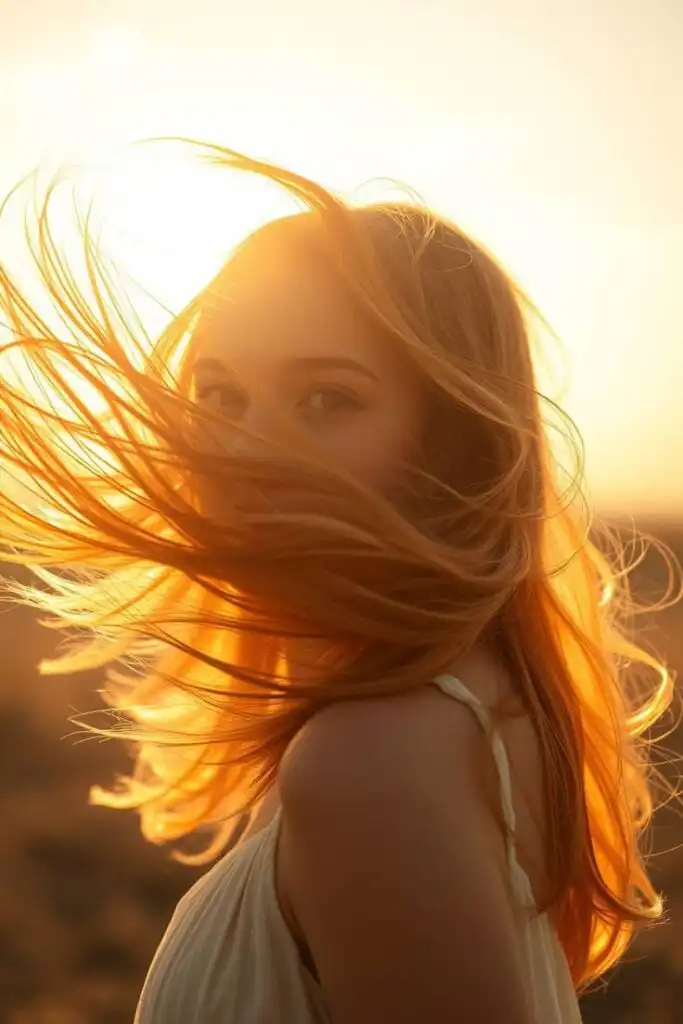
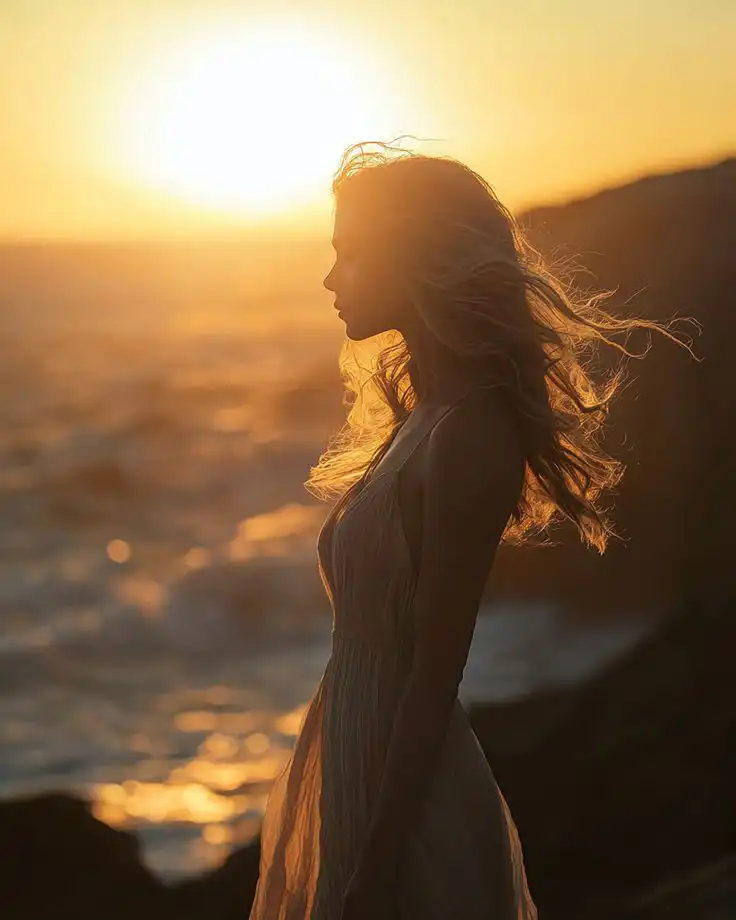
Golden hour occurs during the first hour after sunrise and the last hour before sunset. The sun sits low on the horizon, creating warm, golden light that flatters subjects and produces long, soft shadows.
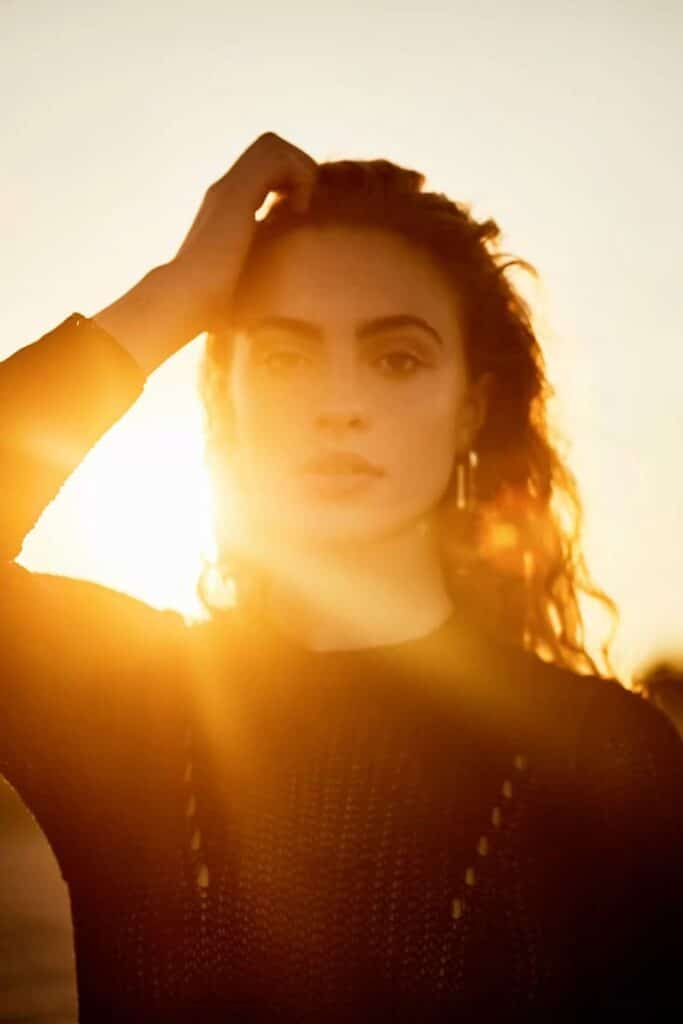
During this time, you can shoot directly into the sun for dreamy backlit portraits with a natural rim light around your subject. Position your subject between yourself and the sun, then expose for their face to create a glowing effect.
Side lighting during golden hour adds dimension and texture to your images. Place your subject at a 45-degree angle to the light source to reveal detail while maintaining that warm glow.
The color temperature during golden hour ranges from 2500K to 3500K, giving your photos rich oranges and yellows. You can enhance these tones in camera by adjusting your white balance to the cloudy or shade preset, or cool them down with the daylight setting if the warmth becomes too intense.
Blue Hour and Low Light Tips
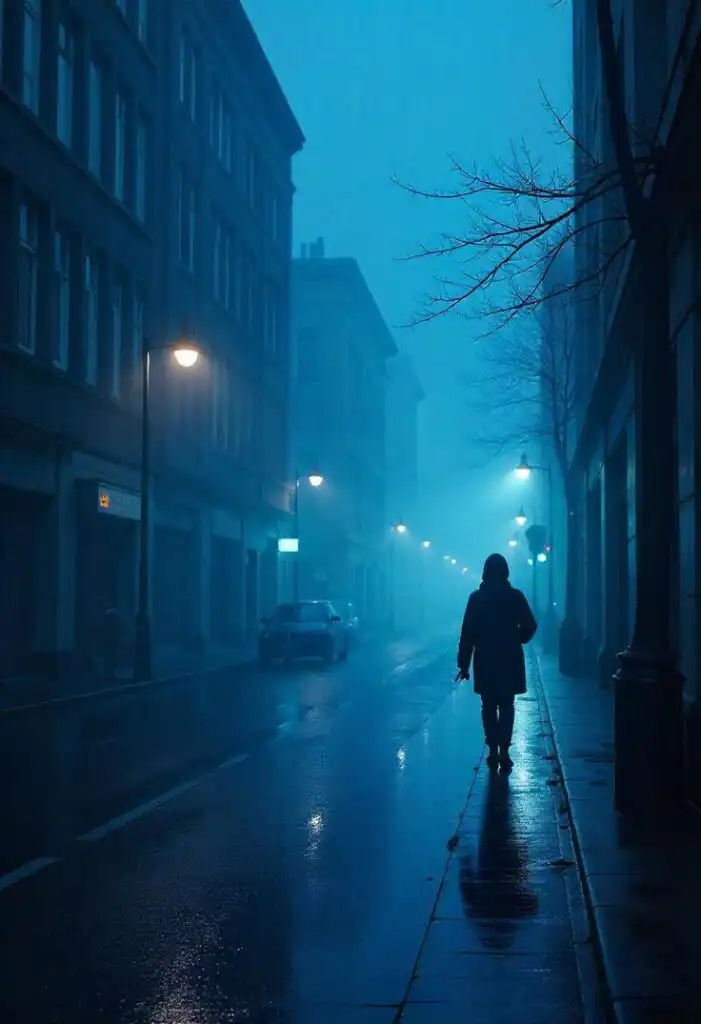
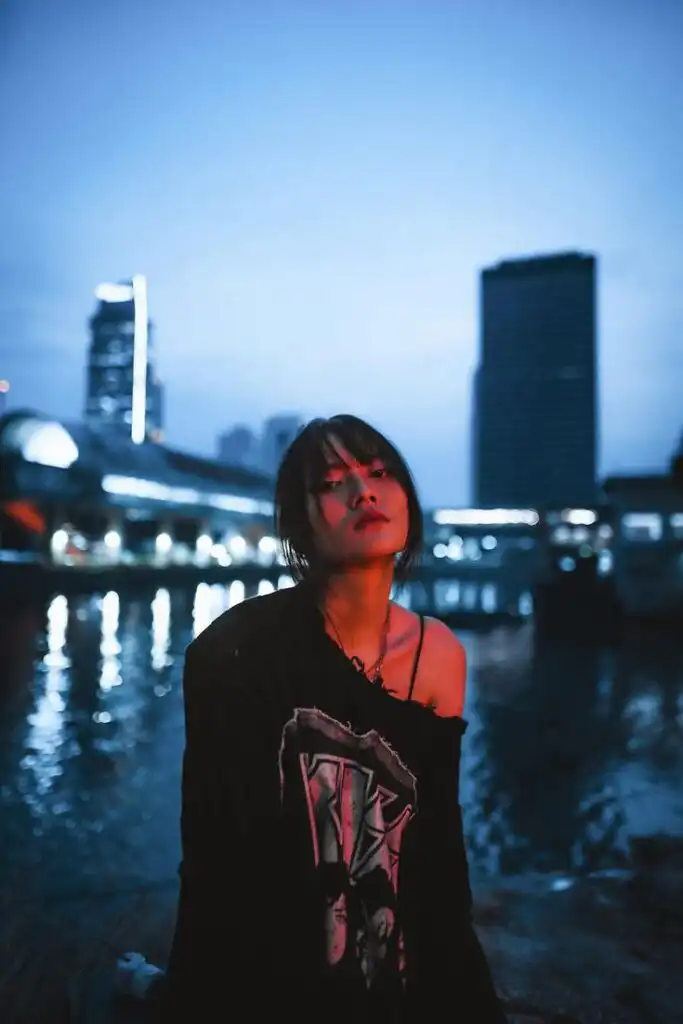
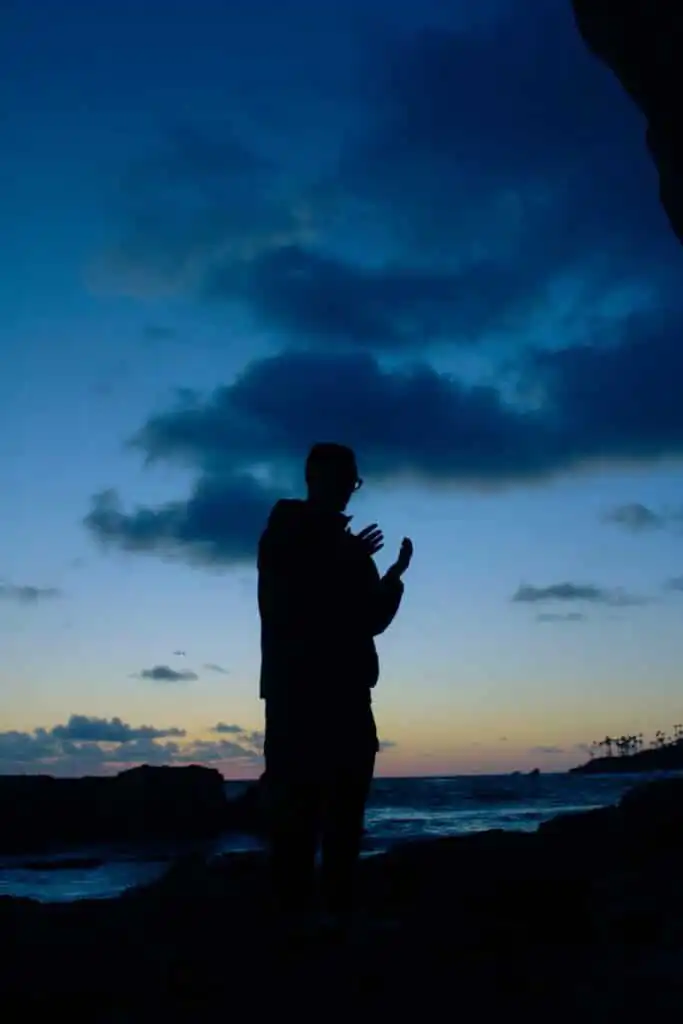
Blue hour happens just before sunrise and just after sunset when the sky takes on deep blue tones. This brief window lasts only 20-40 minutes, so you need to work quickly and come prepared.
Your camera settings need adjustment for the reduced light. Increase your ISO to 800-3200 depending on your camera’s capabilities, open your aperture to its widest setting (f/1.8-f/2.8 works well), and slow your shutter speed to 1/60th or slower.
Use a tripod during blue hour to keep your images sharp at slower shutter speeds. If you’re shooting handheld, enable image stabilization and brace yourself against a solid surface.
The even, diffused light of blue hour eliminates harsh shadows and creates a calm, moody atmosphere. This makes it excellent for architectural photography, cityscapes, and portraits with a contemplative feel.
Overcoming Harsh Midday Sun
Midday sun creates strong contrast, deep shadows, and can wash out your subjects with its intensity. Despite these challenges, you can still capture quality images with the right techniques.
Key strategies for midday shooting:
- Move your subject into open shade under trees, buildings, or overhangs
- Use a reflector to bounce light into shadowed areas and reduce contrast
- Shoot in aperture priority mode and slightly underexpose by -0.3 to -0.7 stops
- Position subjects with the sun behind them and expose for their face
If you must shoot in direct midday sun, place your subject with the light hitting them from the side rather than directly overhead. This reduces unflattering shadows under the eyes and nose.
Convert challenging midday images to black and white in post-processing. The high contrast that causes problems in color photography often creates striking monochrome images.
Natural Light Portraits, Landscapes, and Window Shots
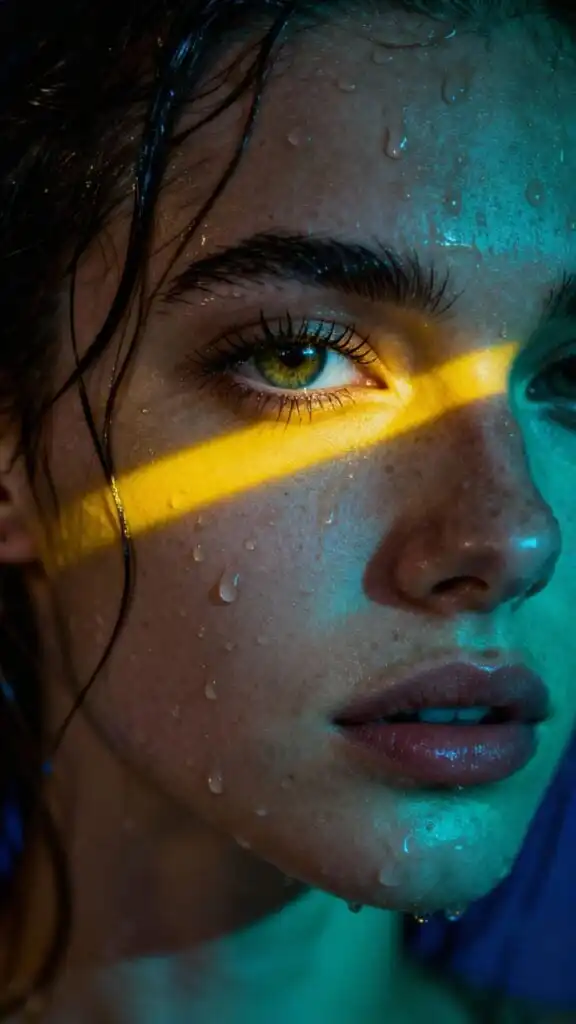
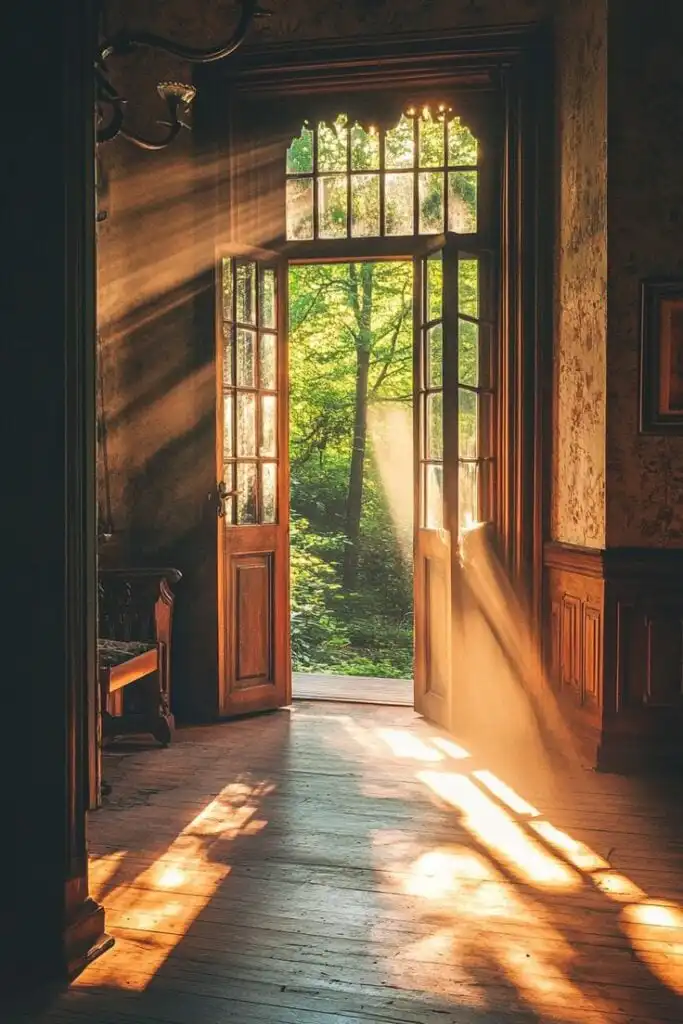
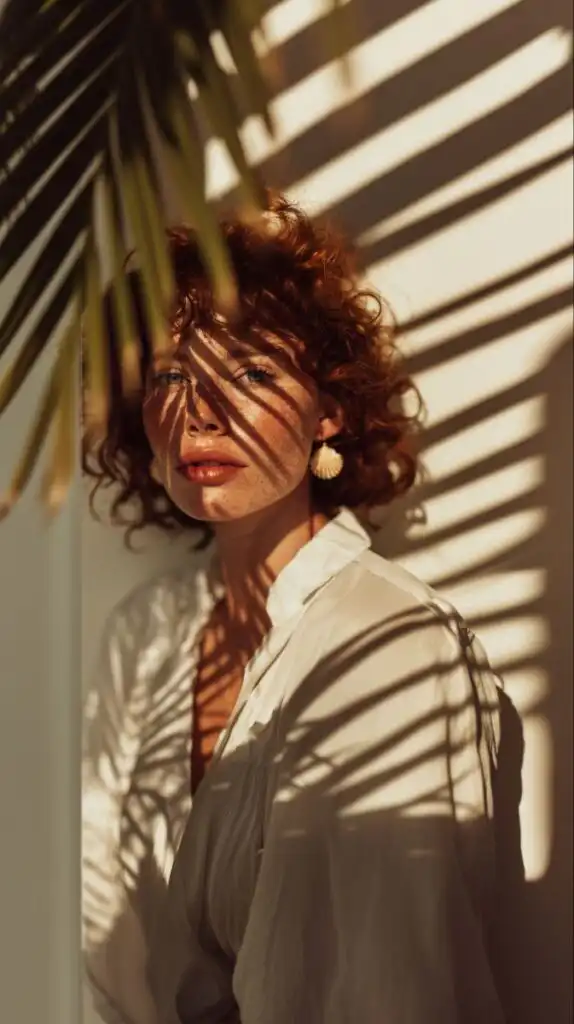
Natural light works differently for portraits versus landscapes, requiring you to adapt your approach based on your subject. Window light offers controlled conditions indoors, while outdoor shooting demands awareness of time, direction, and weather patterns.
Portrait Photography with Natural Light
Position your subject to control how light falls across their face. Side lighting creates depth and dimension by casting shadows that define facial features. Front lighting produces even, flattering results but can appear flat without careful positioning.
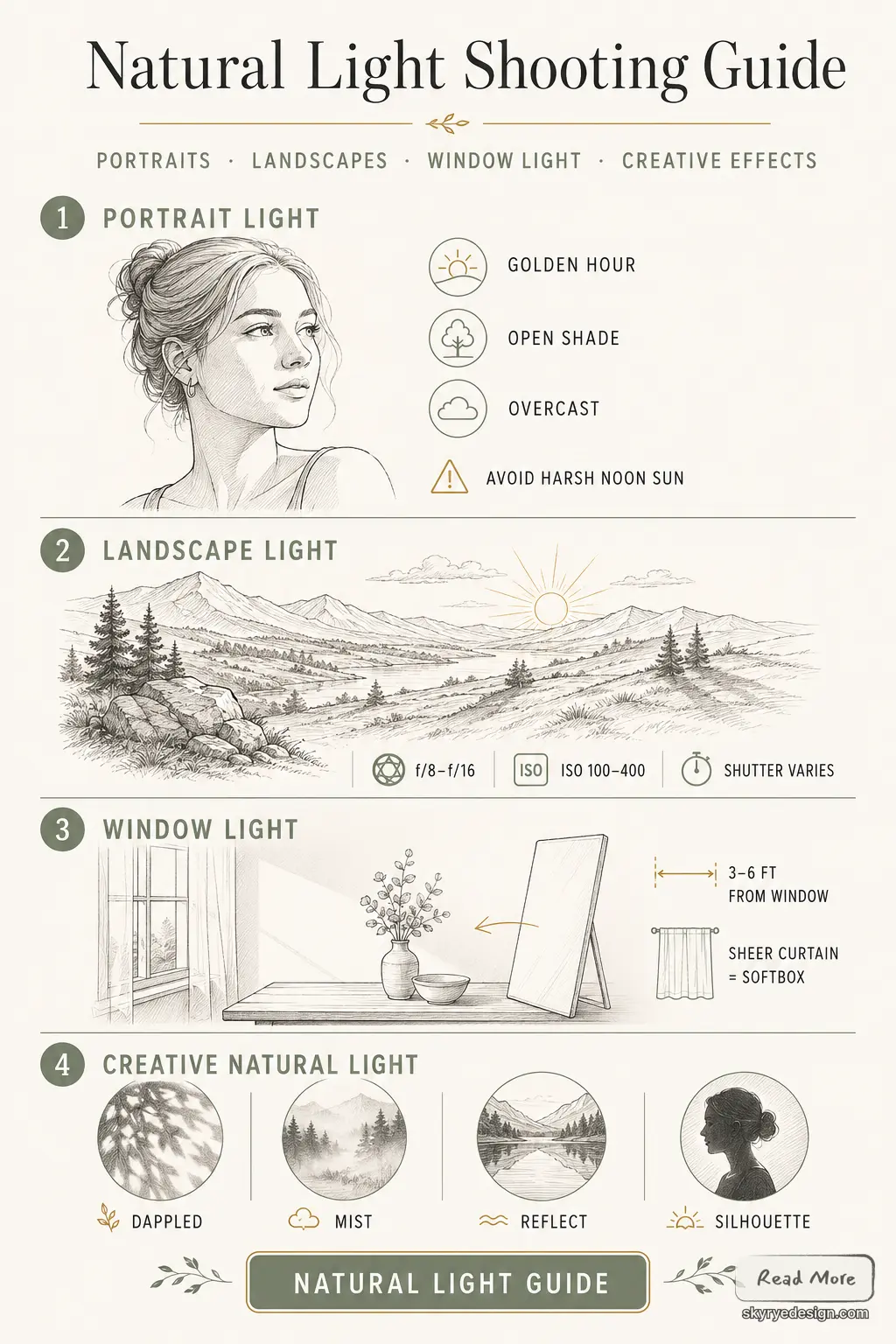
Best times for outdoor portrait photography:
- Golden hour (first hour after sunrise, last hour before sunset): warm, soft light
- Overcast days: natural diffusion eliminates harsh shadows
- Open shade: even lighting without direct sun overhead
Avoid midday sun directly overhead, which creates unflattering shadows under eyes and nose. If shooting at noon, place your subject in shade or use a reflector to bounce light into shadowed areas. Watch for color casts from surrounding objects like green foliage or colored walls.
Keep your subject’s eyes visible and well-lit. Turn their face toward the light source slightly rather than positioning them straight-on. This creates catchlights in the eyes and adds natural contour to the face.
Landscape Photography Approaches
Scout locations before golden hour to find compositions that work with changing light direction. The quality of light transforms landscapes more than any other factor. Early morning produces cool tones and mist, while evening light adds warmth and long shadows.
Use backlighting to create silhouettes or rim light around trees and hills. Side lighting emphasizes texture in rocks, sand, and vegetation. Overcast conditions work well for forests and waterfalls where bright sun creates excessive contrast.
Camera settings for landscape photography:
| Setting | Recommendation | Purpose |
|---|---|---|
| Aperture | f/8 to f/16 | Maximum depth of field |
| ISO | 100-400 | Minimize noise |
| Shutter Speed | Varies | Adjust for proper exposure |
Include foreground elements to add depth when shooting wide scenes. Position yourself so light direction enhances rather than flattens your composition.
Window Light for Indoor Shots
Place your subject perpendicular to a large window for soft, directional light. North-facing windows provide consistent light throughout the day without direct sun. South-facing windows offer stronger light but require more careful positioning.
Position your subject 3-6 feet from the window. Closer creates more dramatic shadows, while farther produces softer, more even light. Use a white foam board or reflector opposite the window to fill in shadows on the darker side of your subject.
Sheer curtains diffuse harsh direct sunlight streaming through windows. This creates a natural softbox effect that flatters portraits and still life photography. Avoid mixing window light with indoor artificial lights, which creates competing color temperatures.
Creative Uses of Natural Lighting
Shoot through objects like leaves, fabric, or glass to create unique effects. Dappled light through trees adds pattern and interest to portraits. Fog and mist diffuse light naturally, creating atmospheric conditions for both portraits and landscapes.
Reflections in water, windows, or mirrors multiply light sources and add complexity to compositions. Use golden hour backlighting to create lens flare effects deliberately. Position your subject between you and the sun, then adjust your angle to control flare intensity.
Silhouettes work when your subject blocks a bright background. Expose for the bright area behind your subject rather than their face. Rim lighting occurs naturally during golden hour when light wraps around edges of your subject, separating them from the background.
Camera Settings and Practice Drills for Natural Light
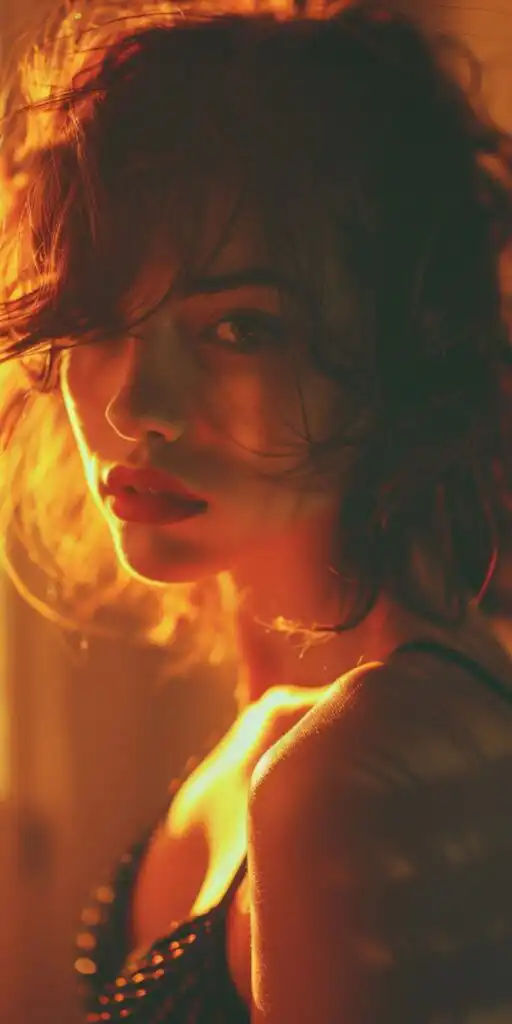
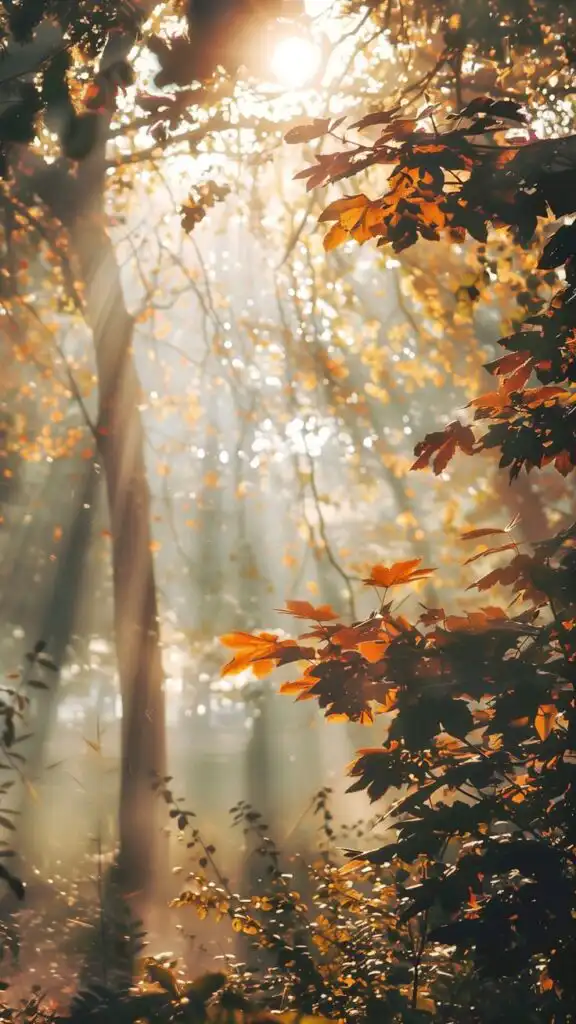
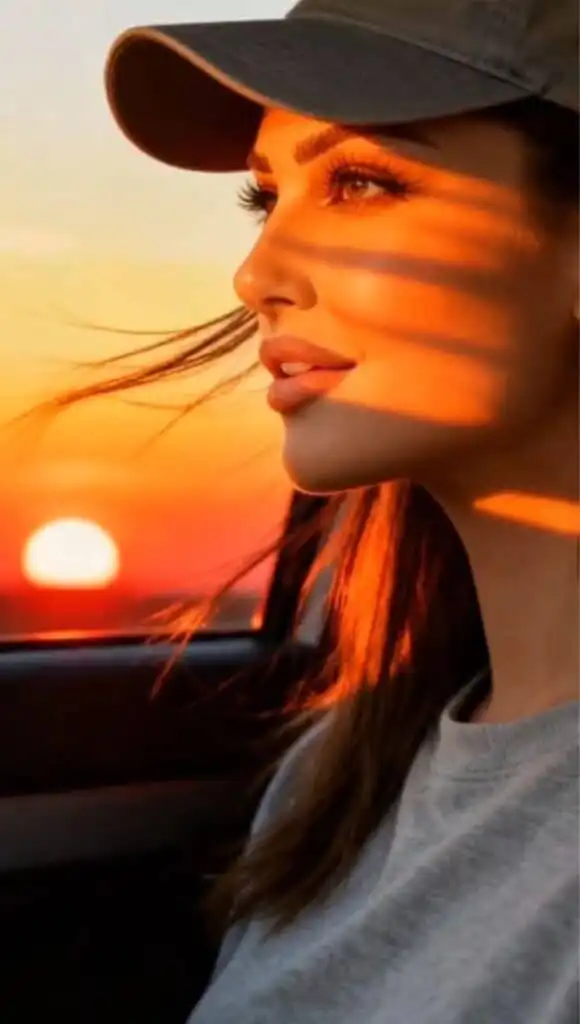
As you grow more comfortable with natural light, you’ll want to refine your approach by managing challenging lighting scenarios and optimizing your camera settings. These techniques will help you handle tricky conditions like harsh shadows, bright highlights, and direct sunlight.
Balancing Shadows and Highlights
The contrast between bright and dark areas can make or break your photos. When shooting in natural light, your camera’s sensor often struggles to capture detail in both shadows and highlights simultaneously.
Use your camera’s histogram to check exposure levels. The graph shows whether you’re losing detail in the brightest or darkest parts of your image. If the histogram bunches up on the right side, your highlights are blown out. If it clusters on the left, your shadows are too dark.
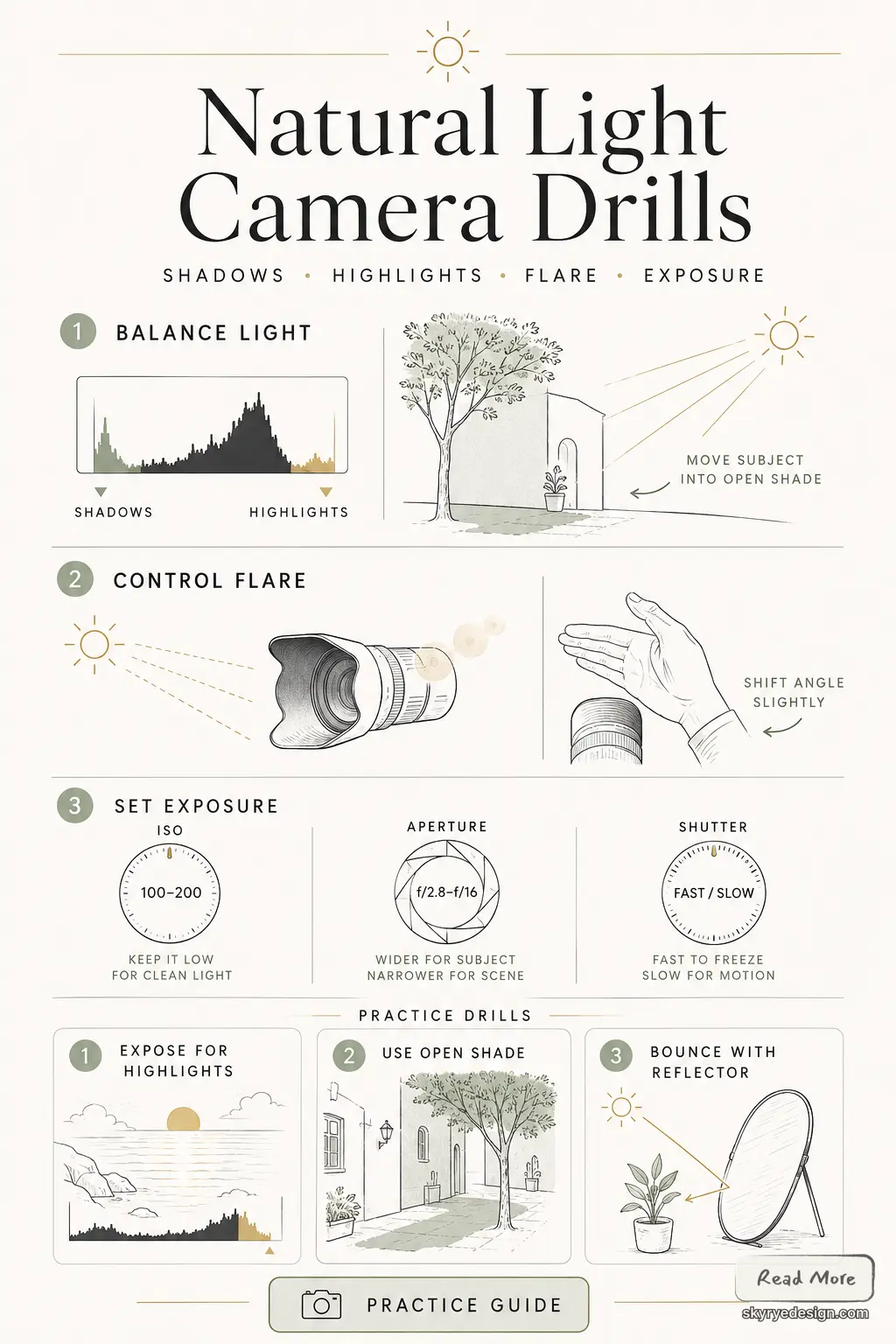
Position your subject to minimize extreme contrast. Move them into open shade where light is more even, or wait for clouds to diffuse harsh sunlight. You can also use a reflector to bounce light into shadowed areas, filling them without artificial lighting.
Expose for the highlights and lift shadows in post-processing when needed. Modern cameras capture more shadow detail than highlight detail, so slightly underexposing protects bright areas while keeping shadow information recoverable.
Controlling Lens Flare
Lens flare occurs when direct sunlight hits your lens at certain angles, creating unwanted spots or haze. While some photographers use flare creatively, learning to control it gives you more intentional results.
Keep the sun outside your frame or position it behind your subject. When the sun appears in your composition, expect flare and adjust accordingly. Use your hand or a lens hood to block stray light from hitting the front element.
Shoot with a clean lens to reduce flare intensity. Dust, fingerprints, and smudges scatter light and amplify flare effects. Check your aperture settings too—smaller apertures like f/16 create pronounced sunstar effects, while larger apertures minimize this.
Change your shooting angle slightly if flare appears. Moving just a few inches can eliminate unwanted artifacts while maintaining your composition.
Fine-tuning Exposure and Camera Settings
Manual mode gives you complete control over how your camera captures natural light. Start by setting your ISO to the lowest value possible (typically 100 or 200) for maximum image quality in bright conditions.
Choose your aperture based on depth of field needs. Use f/2.8 to f/5.6 for portraits with soft backgrounds, or f/8 to f/16 for landscapes where you want sharpness throughout. Your shutter speed balances the exposure—faster speeds freeze motion, while slower speeds can introduce blur.
Enable exposure compensation in aperture priority mode when you’re still learning. Dial in +1 or +2 stops for backlit subjects, or -1 stop when photographing scenes with lots of bright sky. Your camera’s meter can be fooled by bright or dark scenes, so adjust accordingly.
Bracket your exposures when dealing with challenging light. Take three shots at different exposure levels to ensure you capture the scene properly.

Practical Natural Light Photography Tips
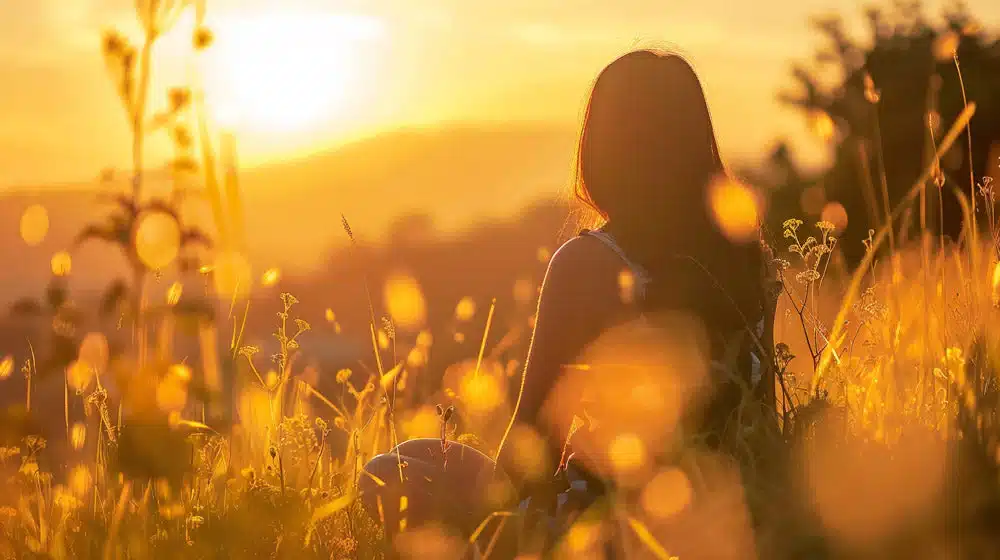
The quality of natural light changes throughout the day, affecting your outdoor photography significantly. Golden hour—the first hour after sunrise and last hour before sunset—provides warm, directional light that flatters most subjects.
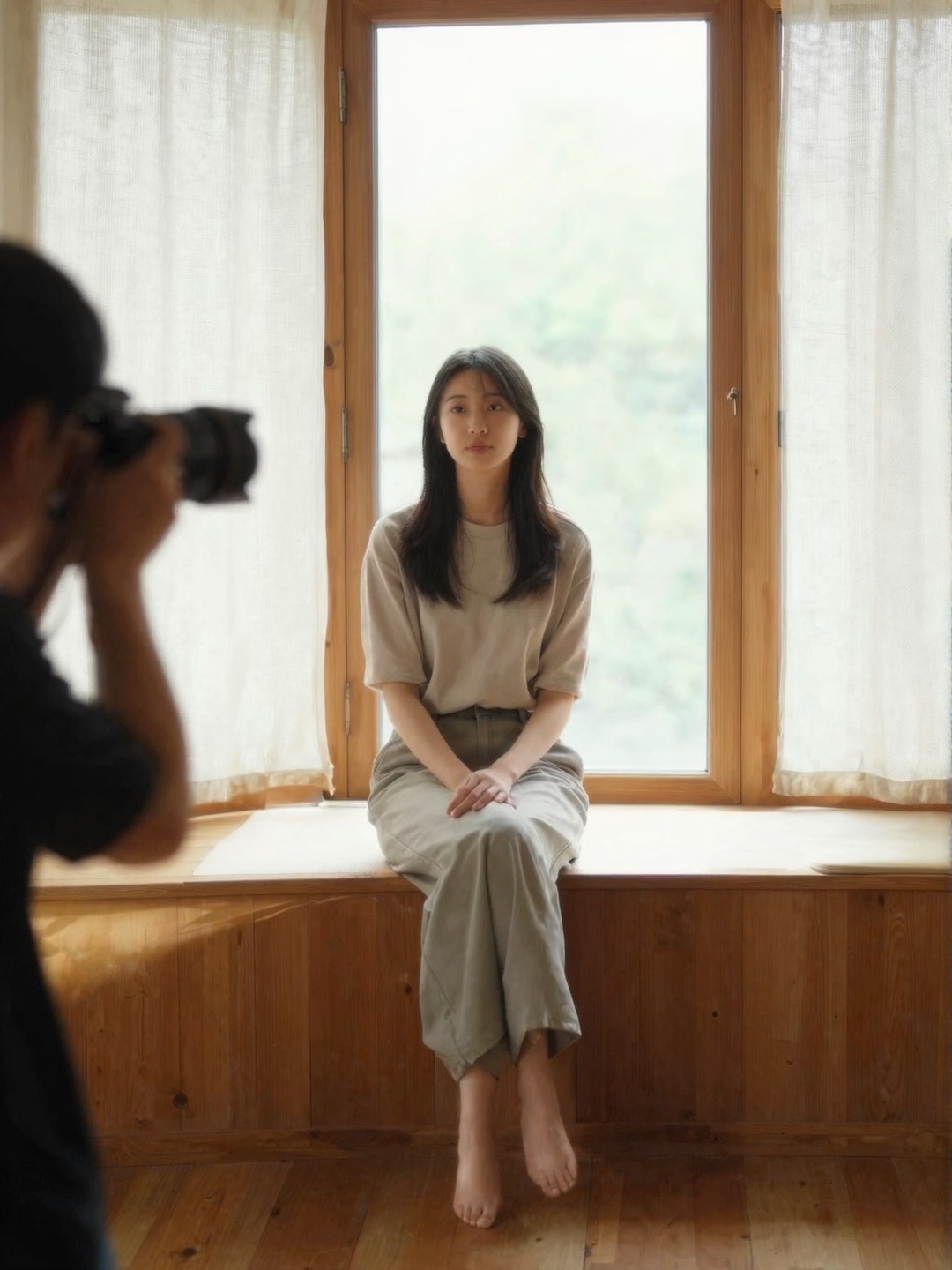
Overcast days create a giant natural softbox. The clouds diffuse sunlight evenly, eliminating harsh shadows and making it ideal for portraits and detail shots. You won’t get dramatic lighting, but you’ll achieve consistent, flattering results.
Window light works beautifully for indoor natural light photography. Position your subject near a large window and use the direction of light to create dimension. Side lighting adds depth, while front lighting minimizes texture.
Observe how light interacts with your environment. Notice where shadows fall, how light bounces off surfaces, and what colors reflect onto your subject. White walls and light-colored surfaces act as natural reflectors, while dark surfaces absorb light and create deeper shadows.
Shoot in RAW format to maximize your editing flexibility. RAW files retain more information in shadows and highlights, letting you recover details and adjust white balance without degrading image quality.
Natural Light Photography Recovery Playbook
Use this quick playbook when the light is close but the frame still feels wrong. Make one change at a time, take another test shot, then compare the shadow edge, skin tone, and highlight detail.
- If the photo is too harsh: move the subject into open shade or put a sheer curtain between the subject and window light.
- If the subject is too dark: rotate toward the light, add a white reflector, or raise exposure compensation by one stop.
- If the background is too bright: expose for the face, step sideways, or use backlight only when you can recover highlights in RAW.
- If color looks strange: check white balance, avoid strongly colored walls, and keep skin away from saturated reflected light.
- If the image feels flat: move the subject slightly to the side of the light source so soft shadows create shape.
Once the light is set, the next decision is movement. For portraits in open shade or window light, these dynamic poses for a photoshoot help keep the face readable while the body adds energy.
After you understand the light, the next step is choosing a subject. These photo ideas for natural light work well with windows, shade, side light, and golden hour.
Related Photography Guides
- framing photography techniques for stronger composition after you find good light
- camera settings for beginners when exposure still feels confusing
If you want to practice this with buildings instead of portraits, use this architectural photography ideas guide as a next exercise in reading light across glass, concrete, and street shadows.
Frequently Asked Questions
More natural light photography examples
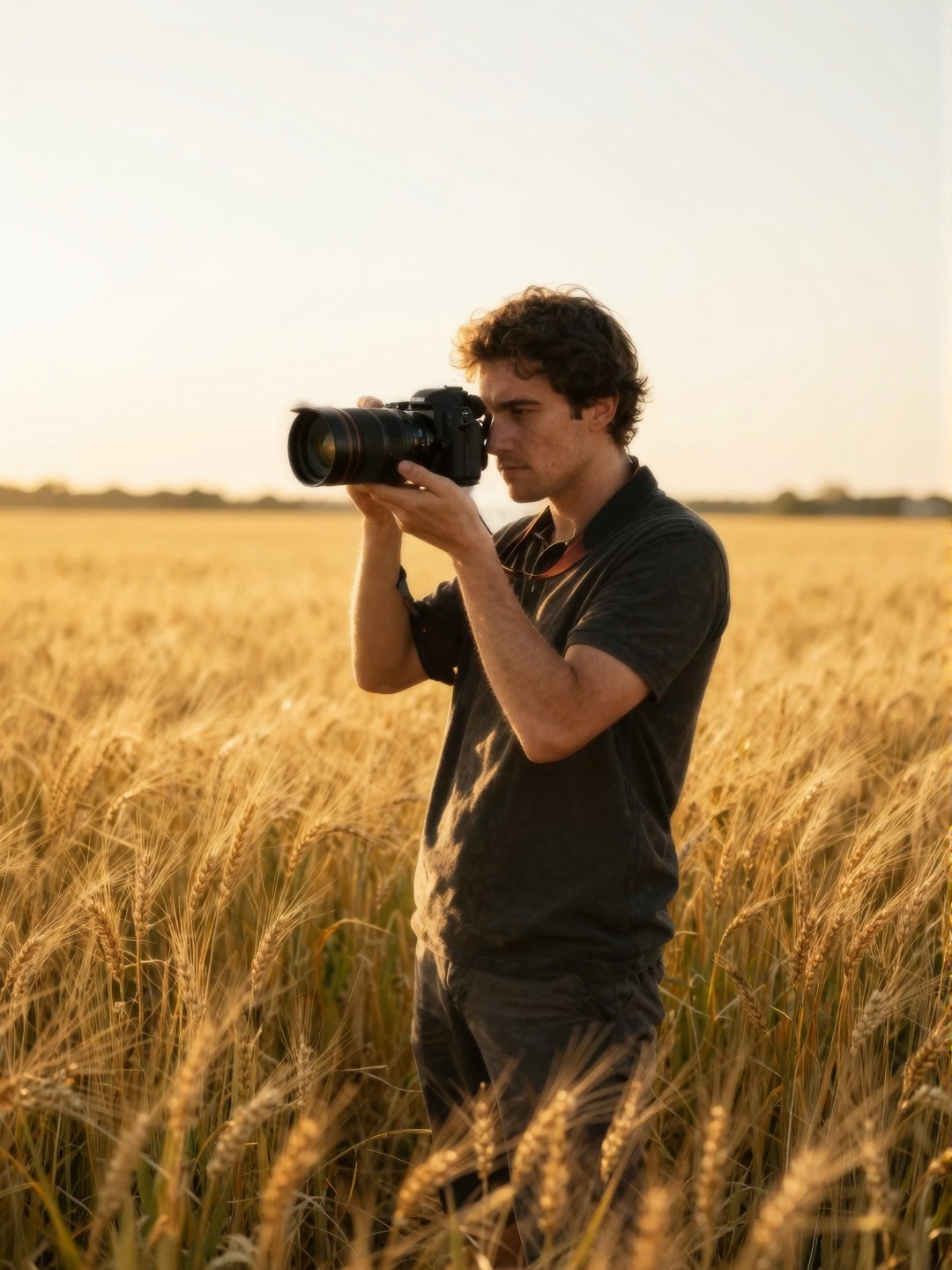
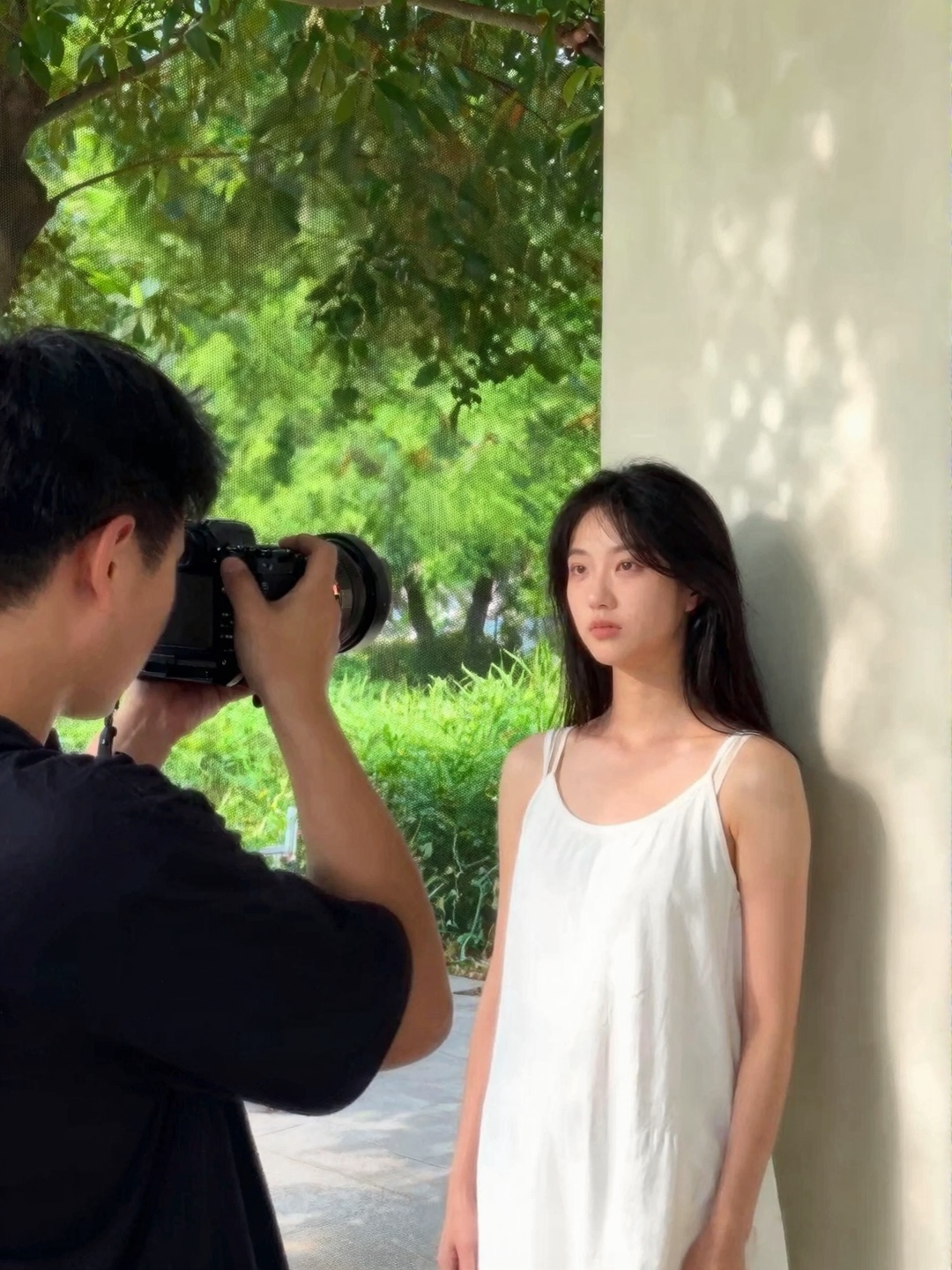
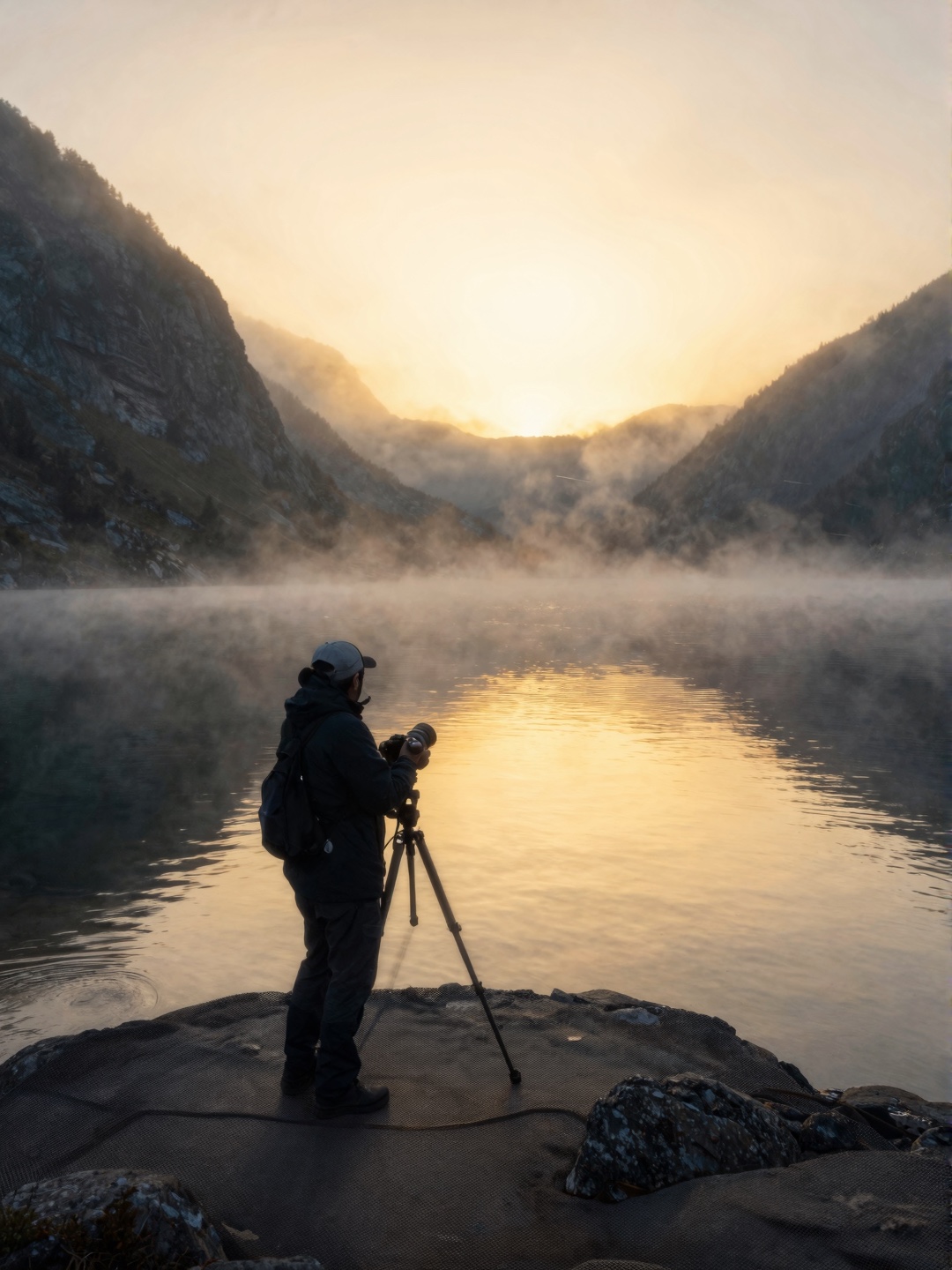
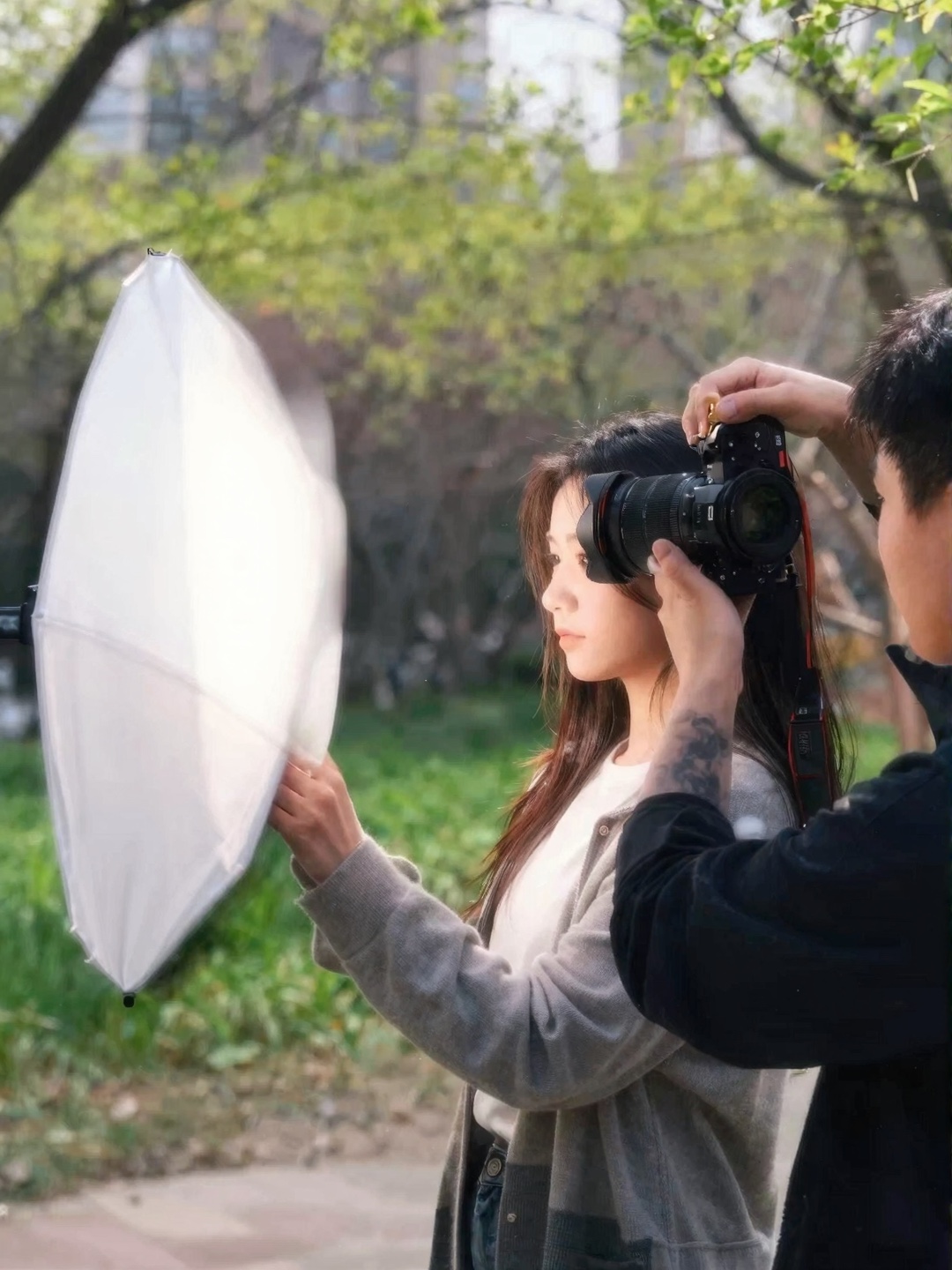
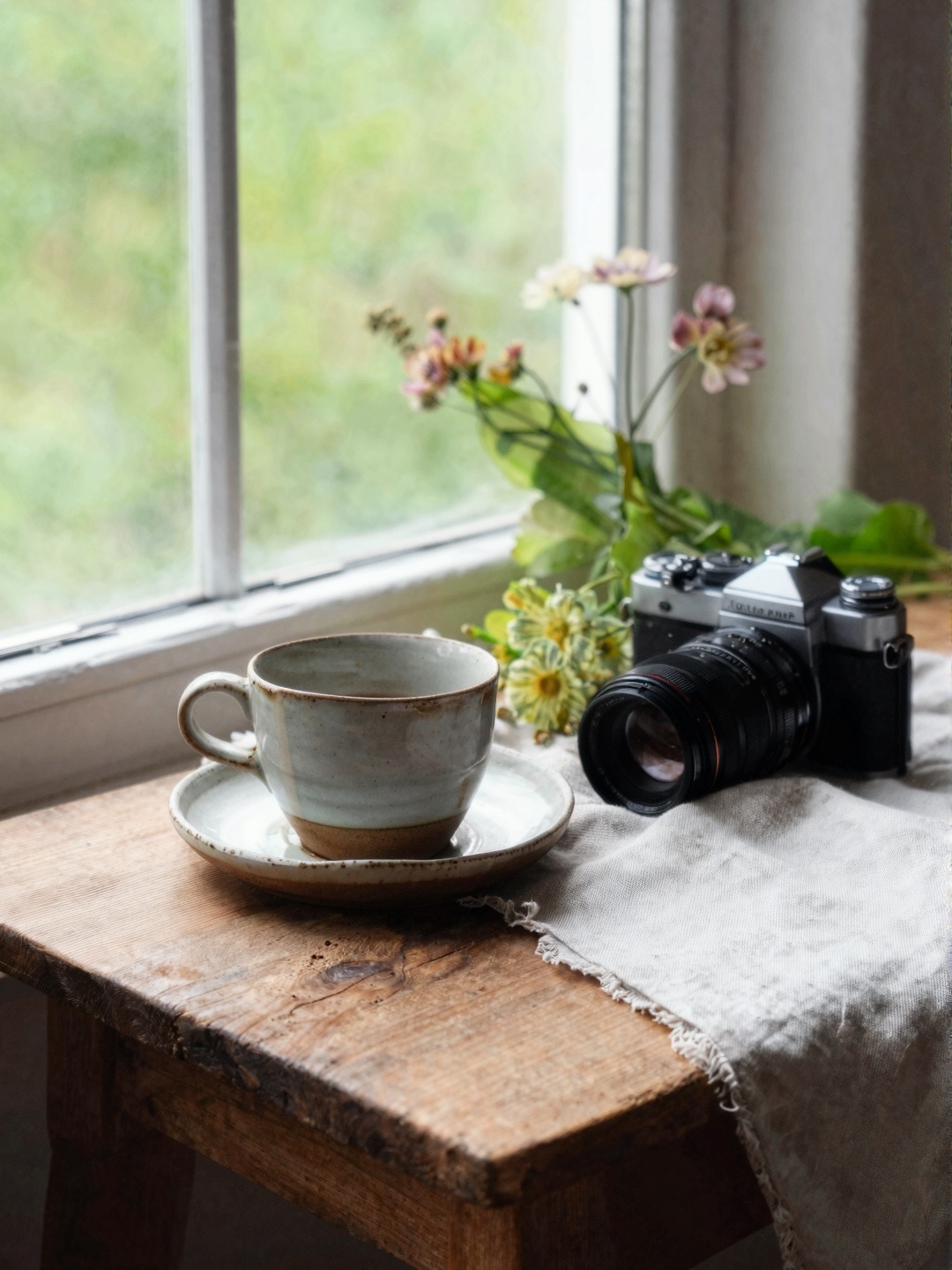
Use these extra examples as quick visual references for how natural light changes across fields, windows, open shade, reflectors, still life setups, and sunrise landscapes.
What is natural light photography?
Natural light photography uses sunlight, sky light, shade, window light, or reflected light as the main illumination source instead of flash or studio lights.
What is the best natural light for beginners?
Soft side light is usually easiest for beginners. Try window light, open shade, or golden hour because shadows are gentler and exposure is easier to control.
How do I shoot portraits in natural light?
Place the subject near a large light source, turn them slightly toward the light, watch the shadow under the eyes, and use a white reflector if one side of the face becomes too dark.
What camera settings work for natural light photography?
Start with ISO 100-400, aperture around f/2.8-f/5.6 for portraits or f/8-f/11 for landscapes, then adjust shutter speed or exposure compensation until highlights are protected.
How can I fix harsh midday sunlight?
Move into open shade, use a wall or sidewalk as reflected light, turn the subject away from direct overhead sun, and avoid placing bright sky behind the face.
Is window light good for natural light photography?
Yes. Window light is one of the easiest ways to learn natural light because the window acts like a large soft source, especially with sheer curtains or indirect daylight.
Do I need a reflector for natural light photos?
You do not need one, but a white reflector, foam board, or pale wall can brighten shadows and give portraits a cleaner, more intentional look.
To practice capturing beautifully diffused directional light, check out our suggestions on using natural light from bay windows as a perfect indoor photography studio setting.
- 1.2Kshares
- Facebook0
- Pinterest1.2K
- Twitter3
- Reddit0