Every time you interact with your smartphone, smart TV, or digital signal processor, you’re likely benefiting from Harvard architecture. Harvard architecture is a computer design that uses separate memory units and pathways for program instructions and data, allowing the processor to fetch both simultaneously rather than sequentially. This separation stands in contrast to the more common Von Neumann design, where instructions and data share the same memory space.
The architecture gets its name from the Harvard Mark I computer, but its principles have become fundamental to modern computing devices you use daily. Understanding how Harvard architecture works helps explain why certain processors excel at real-time tasks and power efficiency. The design choice between Harvard and Von Neumann architectures affects everything from your phone’s battery life to how quickly your devices can process information.
Most modern CPUs actually blend both approaches, using Harvard-like separation at their core while presenting a Von Neumann interface to the rest of the system. This hybrid approach gives designers flexibility to optimize for speed and efficiency where it matters most. Whether you’re a computer science student, embedded systems developer, or simply curious about how your devices work, grasping these architectural differences reveals much about computing performance.
Key Takeaways
- Harvard architecture separates instruction and data memory with independent buses, enabling simultaneous access for faster processing
- The design excels in real-time and low-power applications like microcontrollers and digital signal processors
- Modern processors often use a modified Harvard architecture that combines benefits of both Harvard and Von Neumann designs
Fundamentals of Harvard Architecture CPU



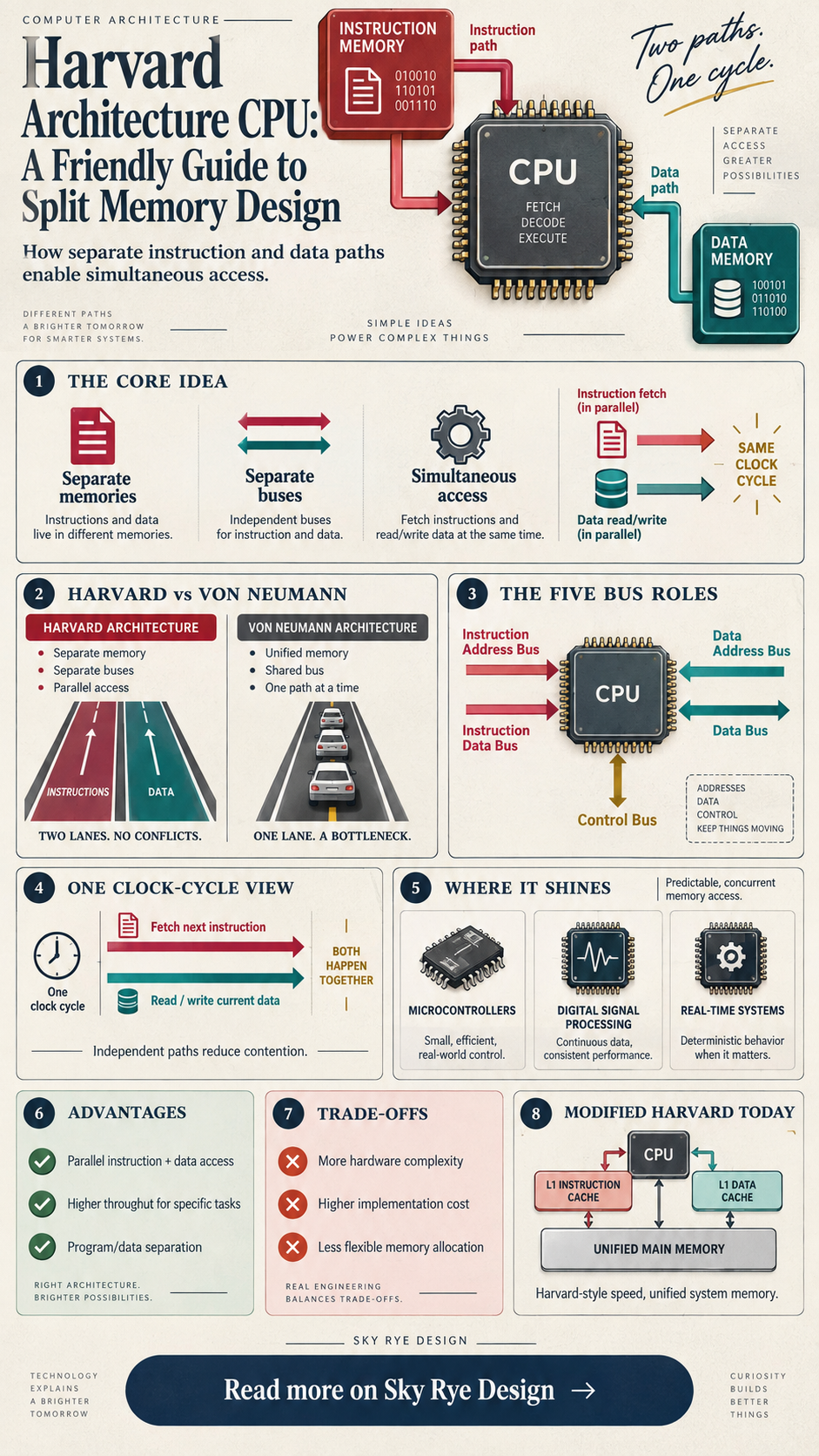
Harvard architecture organizes your CPU with distinct memory spaces and separate pathways for instructions and data. This design allows your processor to fetch instructions and access data simultaneously, eliminating the bottleneck that occurs when both compete for the same memory bus.
Definition of Harvard Architecture
Harvard architecture is a computer architecture design where your CPU accesses instructions and data through completely separate memory units. Unlike traditional designs, this architecture provides independent storage spaces and signal pathways for program code and data.
Your processor can simultaneously read an instruction from instruction memory while writing or reading data from data memory. This parallel access capability stems from the physical separation of memory spaces, which means your instruction memory and data memory operate independently.
The architecture takes its name from the Harvard Mark I computer, where program instructions were stored on punched tape and data resided in electromechanical counters. Modern implementations maintain this separation principle, though they use advanced semiconductor memory technologies instead of mechanical systems.
How Harvard Architecture Differs from Von Neumann
The fundamental difference lies in memory organization. Von Neumann architecture uses a single memory unit and shared buses for both instructions and data, while Harvard architecture maintains separate memory spaces for each.
Your Von Neumann processor must complete instruction fetches before accessing data because both share the same bus. This creates what’s known as the Von Neumann bottleneck. Your Harvard architecture CPU eliminates this limitation through independent pathways.
Key Architectural Differences:
| Feature | Harvard | Von Neumann |
|---|---|---|
| Memory spaces | Separate for instructions and data | Unified memory |
| Bus system | Separate buses | Shared bus |
| Simultaneous access | Yes | No |
| Processing speed | Faster for specific tasks | Limited by bottleneck |
| Circuit complexity | Higher | Lower |
Your Harvard CPU can execute instructions more efficiently in real-time processing and low-power applications. The separate buses allow your processor to fetch the next instruction while the current instruction accesses data memory.
Memory Organisation in Harvard CPUs
Your Harvard architecture organizes memory into two physically separate units with independent address spaces. Instruction memory typically operates as read-only or flash memory containing your program code. Data memory uses RAM for variables that change during program execution.
Each memory unit connects to your CPU through dedicated buses with independent addressing systems. Your instruction memory might use 16-bit addresses while data memory uses 8-bit addresses, depending on your application requirements.
The separation provides security benefits because your data operations cannot accidentally overwrite program instructions. Your processor physically cannot write to instruction memory during normal operation, protecting program integrity.
Modern implementations sometimes use modified Harvard architectures where caches create the appearance of separate memory spaces while sharing underlying physical memory. This approach gives you Harvard architecture benefits while maintaining Von Neumann flexibility for your system design.
Architecture Features and Operation



Harvard architecture distinguishes itself through separate memory units and buses for instructions and data, enabling simultaneous operations that boost processing speed. The control unit coordinates instruction execution while the ALU performs calculations, with dedicated pathways ensuring these components work without interference.
Instruction Fetch and Data Access
In Harvard architecture, your CPU can fetch instructions and access data simultaneously because these operations use separate memory spaces and buses. The instruction fetch occurs through a dedicated instruction bus connected to program memory, while data access happens via a separate data bus linked to data memory.
This parallel operation eliminates the bottleneck present in architectures where instructions and data share the same pathway. Your processor retrieves the next instruction from program memory while the current instruction reads or writes data, creating a pipeline effect that significantly improves throughput.
The separation means your address bus splits into two distinct components: one for instruction addresses and another for data addresses. Each memory unit responds independently to its respective address signals, allowing simultaneous memory operations without conflicts.
Types of Buses in Harvard Architecture
Harvard architecture employs multiple buses to maintain separation between instruction and data pathways:
- Instruction Address Bus: Carries memory addresses for program instructions
- Instruction Data Bus: Transfers actual instruction codes from program memory to the processor
- Data Address Bus: Transmits addresses for data memory locations
- Data Bus: Handles bidirectional data transfer between the processor and data memory
- Control Bus: Distributes control signals throughout the system
This multi-bus structure enables your processor to access instructions and perform data operations concurrently. The control bus coordinates timing and synchronization across all buses, ensuring operations occur in the correct sequence without interference.
Registers and Data Paths
Your processor contains operational registers that temporarily store data during instruction execution. These registers include the accumulator, general-purpose registers, and special-purpose registers like the program counter that tracks instruction addresses.
Data paths connect registers to the ALU, memory interfaces, and input/output systems. In Harvard architecture, these paths split into instruction and data routes, allowing your processor to move instruction codes and data values simultaneously without competition for the same pathway.
The program counter updates through the instruction path while data transfers occur independently through data registers. This separation extends to input/output operations, where your system can handle peripheral communication through data paths while continuing to fetch instructions through dedicated instruction channels.
Advantages and Limitations



Harvard architecture’s separate memory pathways create distinct benefits for performance while introducing specific design challenges. The dual-bus system affects everything from execution speed to manufacturing costs.
Parallelism and Increased Performance
You gain significant speed advantages with Harvard architecture because your CPU can fetch instructions and access data simultaneously. This parallelism eliminates the bottleneck that occurs when a single pathway handles both operations.
Your processor achieves higher throughput since it doesn’t need to wait for one memory access to complete before starting another. The separate buses allow instruction fetch and data read/write operations to happen in the same clock cycle. This becomes especially valuable in pipelining, where your CPU processes multiple instructions at different stages simultaneously.
Real-time systems benefit most from this design. Your embedded devices and digital signal processors can execute time-critical operations with predictable performance because instruction and data access never compete for the same memory bandwidth.
Memory Bandwidth and Bottlenecks
Your system enjoys doubled memory bandwidth compared to single-bus architectures. Each bus operates independently, giving you dedicated pathways for instruction and data traffic.
This separation means your instruction fetch never waits for data storage operations to complete. You can optimize each memory type for its specific purpose—using faster memory for instructions that rarely change and different memory characteristics for frequently updated data.
The independent buses prevent the traditional von Neumann bottleneck where all memory access shares a single channel. Your system design can allocate bandwidth based on actual needs rather than forcing both instruction and data through the same pipeline.
Complexity and Cost
Your hardware requirements increase with Harvard architecture. You need two separate memory units, dual bus systems, and additional control circuitry to manage both pathways independently.
Manufacturing costs rise because your system requires more physical components and circuit board space. The memory organisation demands careful planning during the design phase, and you face higher power consumption from operating multiple memory interfaces.
Debugging becomes more challenging since you must monitor two separate memory spaces. Your development tools need to handle the complexity of tracking instruction and data flow through independent pathways.
Flexibility and Scalability
Your system faces limitations in memory utilization. Fixed boundaries between instruction and data storage mean you cannot reallocate unused instruction memory for data or vice versa.
This rigid memory organisation can waste resources if your application needs more of one memory type than allocated. You must carefully plan memory distribution during the design phase since modifications require hardware changes rather than simple software adjustments.
Scaling your system requires proportional increases in both memory types, even if your application only needs more of one. Modern modified Harvard architectures address this by allowing some flexibility, but pure implementations lock you into predetermined memory allocations.
Harvard Architecture in Practice



Harvard architecture finds its most practical applications in systems requiring real-time processing and efficient instruction execution. The separation of instruction and data memory makes this architecture particularly valuable in embedded systems, digital signal processors, and modern microcontrollers.
Applications in Embedded Systems
Embedded systems benefit significantly from Harvard architecture’s ability to fetch instructions and data simultaneously. You’ll find this design in automotive control units, medical devices, and industrial automation equipment where timing is critical.
The architecture allows these systems to meet strict real-time requirements by eliminating memory access bottlenecks. When your embedded device needs to respond within microseconds, the parallel access paths ensure predictable performance. Many embedded applications also operate under power constraints, and Harvard architecture helps reduce energy consumption by optimizing memory access patterns.
Safety-critical embedded systems particularly rely on this architecture because the separation of program and data memory provides an additional layer of protection against unintended memory overwrites.
Use in Digital Signal Processing
DSP chips almost exclusively use Harvard architecture to handle the demanding computational requirements of signal processing tasks. You need simultaneous access to filter coefficients and input data samples when performing operations like digital filtering or frequency analysis.
The architecture enables DSP processors to execute multiply-accumulate operations at high speeds by fetching an instruction, a coefficient, and a data sample in a single cycle. This parallelism is essential for applications like audio processing, image compression, and telecommunications.
Modern DSP implementations often feature multiple data memory banks, creating what’s called a modified Harvard architecture that provides even greater memory bandwidth for complex algorithms.
Microcontrollers and Contemporary Processors
Most microcontrollers you work with today implement Harvard architecture at their core level. Popular families like ARM Cortex-M, AVR, and PIC microcontrollers use this design to maximize performance within limited hardware resources.
Contemporary processors actually use a hybrid approach that combines Harvard and Von Neumann architectures. Your desktop or mobile CPU appears as Von Neumann architecture at the system level but implements Harvard architecture internally with separate instruction and data caches.
This modified Harvard architecture gives you the programming simplicity of unified memory addressing while maintaining the performance benefits of separated instruction and data pathways. The L1 cache typically splits into separate instruction and data caches, following Harvard principles, while higher cache levels may be unified.
Harvard Architecture Versus Von Neumann



The distinction between Harvard and Von Neumann architectures centers on memory organization and data access methods. These two design philosophies have shaped how processors handle instructions and data since the mid-20th century.
Historical Context and Origins
John von Neumann developed his eponymous architecture in the 1940s as part of the EDVAC project. His design introduced the stored-program concept, where both instructions and data reside in a single memory space. This approach simplified computer design and became the foundation for most modern computing systems.
Harvard architecture emerged from work at Harvard University on the Mark I computer. Unlike Von Neumann’s unified approach, the Harvard design separated instruction memory from data memory. This separation was initially used in early relay-based computers and later found applications in signal processing and embedded systems where performance matters most.
The two architectures represent fundamentally different solutions to organizing computer memory and processing. Your choice between them depends on specific performance requirements and cost constraints.
Memory and Bus Differences
The core distinction lies in memory organization. Von Neumann architecture uses a single memory space for both instructions and data, with one bus connecting the CPU to memory. This means your processor can either fetch an instruction or access data, but not both simultaneously.
Harvard architecture employs separate memory spaces and buses for instructions and data. You get dedicated pathways for each type of information, allowing simultaneous access to both. This parallel access eliminates the bottleneck present in Von Neumann systems.
The separate buses in Harvard architecture enable faster execution since your processor doesn’t wait for memory access to complete before starting the next operation. Von Neumann systems experience what’s called the “Von Neumann bottleneck” where the single bus limits throughput.
Real-World Implications
Modern processors often use modified Harvard architectures that blend both approaches. Your smartphone’s processor likely uses separate instruction and data caches (Harvard-style) while presenting a unified memory space to software (Von Neumann-style).
Digital signal processors and microcontrollers typically implement pure Harvard architectures. You’ll find these in audio equipment, motor controls, and real-time systems where predictable timing matters. The architecture allows deterministic performance since instruction fetches never compete with data access.
General-purpose computers favor Von Neumann designs for their flexibility and simpler programming models. Your desktop or laptop uses this approach because it simplifies memory management and allows self-modifying code when needed.
Variations and Modern Developments



Most modern processors don’t strictly adhere to pure Harvard architecture but instead implement variations that balance performance benefits with practical design needs. The modified Harvard architecture and hybrid memory systems represent the primary approaches used in contemporary computing systems.
Modified Harvard Architecture
You’ll find that modified Harvard architecture dominates modern CPU design. This approach uses separate instruction and data caches at the processor level while connecting both to a unified main memory system. Your processor can still fetch instructions and data simultaneously through the split cache design, maintaining the performance advantage of Harvard architecture.
The key difference lies in how memory appears to your system. While the CPU’s internal cache structure remains Harvard-like with distinct pathways, the external memory interface operates more like Von Neumann architecture with shared address space. This compromise gives you the speed benefits of parallel access while simplifying your system design and programming model.
Your device’s processor likely uses this architecture right now, particularly in smartphones and embedded systems where power efficiency matters.
Hybrid and Multiported Memory Systems
Modern implementations often incorporate multiported memory units that allow simultaneous access from different sources. Your system might use dual-port RAM where both the instruction memory and data memory can be accessed in the same clock cycle without conflicts.
Some processors switch between architectures depending on operational mode. You’ll see this in systems that use Harvard architecture for time-critical operations but revert to Von Neumann-style access for general-purpose tasks. This flexibility lets your hardware optimize for specific workloads.
Advanced designs may include multiple memory banks with crossbar switches, giving you even more parallel access options. These configurations blur the line between pure architectural models while maximizing throughput for your applications.
What is Harvard architecture in computing?
Harvard architecture is a computer design that uses separate memory units and pathways for program instructions and data, allowing simultaneous fetching of both, which enhances processing speed and efficiency.
How does Harvard architecture differ from Von Neumann architecture?
Harvard architecture maintains separate memory spaces and buses for instructions and data, enabling parallel access, while Von Neumann architecture uses a single memory and bus for both, which can create bottlenecks.
What are the main components of a Harvard CPU?
A Harvard CPU includes instruction memory, data memory, dedicated instruction and data buses, a control unit, an arithmetic logic unit (ALU), a program counter, and operational registers that work together for efficient processing.
What are the advantages of Harvard architecture?
Harvard architecture offers increased performance through parallel instruction fetch and data access, higher memory bandwidth, and better real-time processing capabilities, especially in embedded and signal processing systems.
What are the limitations of Harvard architecture?
The limitations include increased hardware complexity and cost, higher power consumption, less flexibility in memory utilization, and difficulties in reprogramming or reallocating memory resources, making it less suitable for general-purpose computing.
- 65shares
- Facebook0
- Pinterest65
- Twitter0
- Reddit0