
The cherry tattoo is one of those designs that looks immediately legible — red fruit, green stem, classic. Anyone who has spent time around traditional tattooing knows it. And yet the more you look at the history, the more the cherry turns out to carry genuinely different meanings depending on where you are, what you are doing with it compositionally, and what tradition the design is working in.
I have spent a fair amount of time researching tattoo symbolism for this site, and the cherry is one of the more interesting cases precisely because the same image carries contradictory readings across different cultural contexts. In Japan, where the cherry is part of a rich visual vocabulary rooted in Buddhist ideas about impermanence, the fruit symbolises the brief, precious quality of beauty and life.
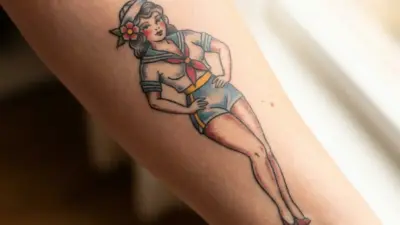
In the American traditional tattooing of the 1940s and 1950s, cherries on a stem became an icon of pin-up culture: playful, alluring, unapologetically sensual. In Western religious iconography, the cherry connects to the forbidden fruit tradition — temptation, desire, choice. And in the visual language of gambling, the cherry on a slot machine is pure luck.
None of these readings cancel each other out. They coexist in the design, and which one comes forward depends on the composition, the style, the accompanying elements, and the intent of the person wearing it.
This guide unpacks all of it: the cultural history of cherry symbolism, the specific meanings carried by different compositions (single cherry, double cherry, bitten cherry, cherry blossom), the five major tattoo styles that translate cherry designs most effectively, placement advice, and the specific visual choices that shift meaning in one direction or another.
The Cultural History of Cherry Symbolism
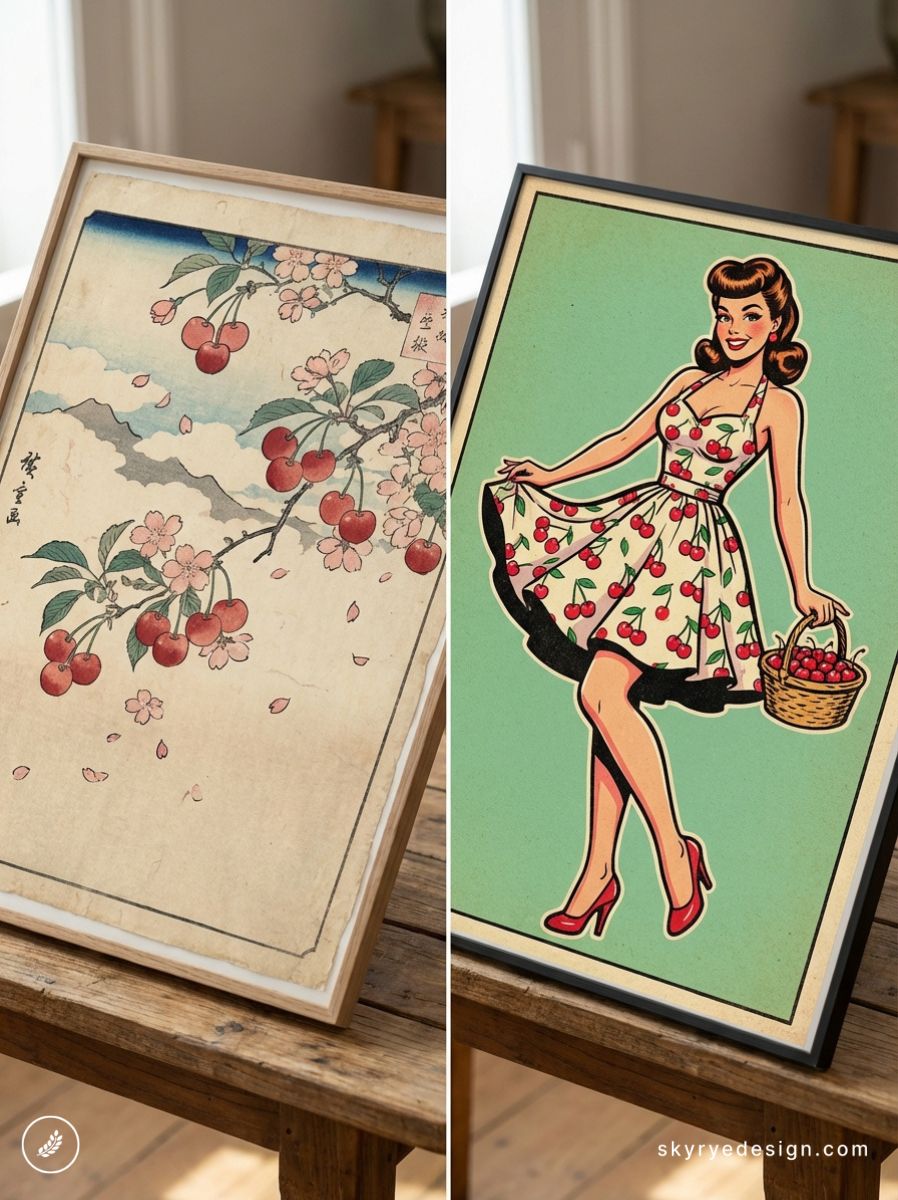
Before the tattoo, there was the fruit — and the cherry has carried symbolic weight in human culture for thousands of years across entirely different civilisations, often arriving at similar themes through different routes.
Japan: Impermanence and the Beauty of the Brief
In Japanese culture, the cherry holds a meaning rooted in Buddhist philosophy. The sakura — cherry blossom — is Japan’s most iconic natural symbol, representing the mono no aware: the bittersweet awareness that beautiful things do not last. Cherry blossoms bloom for approximately two weeks before falling, and their brief, intense flowering has been a central metaphor in Japanese art, poetry, and philosophy for over a thousand years. The cherry fruit extends this symbolism: it is a sign of summer’s peak, the moment of fullness before decline begins.
In the Japanese tattoo tradition (irezumi), cherries appear within seasonal compositions that reference this cycle — fruit alongside falling blossoms, ripeness alongside the suggestion of decay. The meaning is not melancholy but appreciative: the cherry signals that you understand that beauty is temporary, and that this makes it more precious rather than less. This reading is distinct from the Western sexual symbolism and tends to produce more compositionally complex tattoos that situate the cherry within a larger natural scene.
American Traditional: Pin-Up, Playfulness, and the 1950s Icon
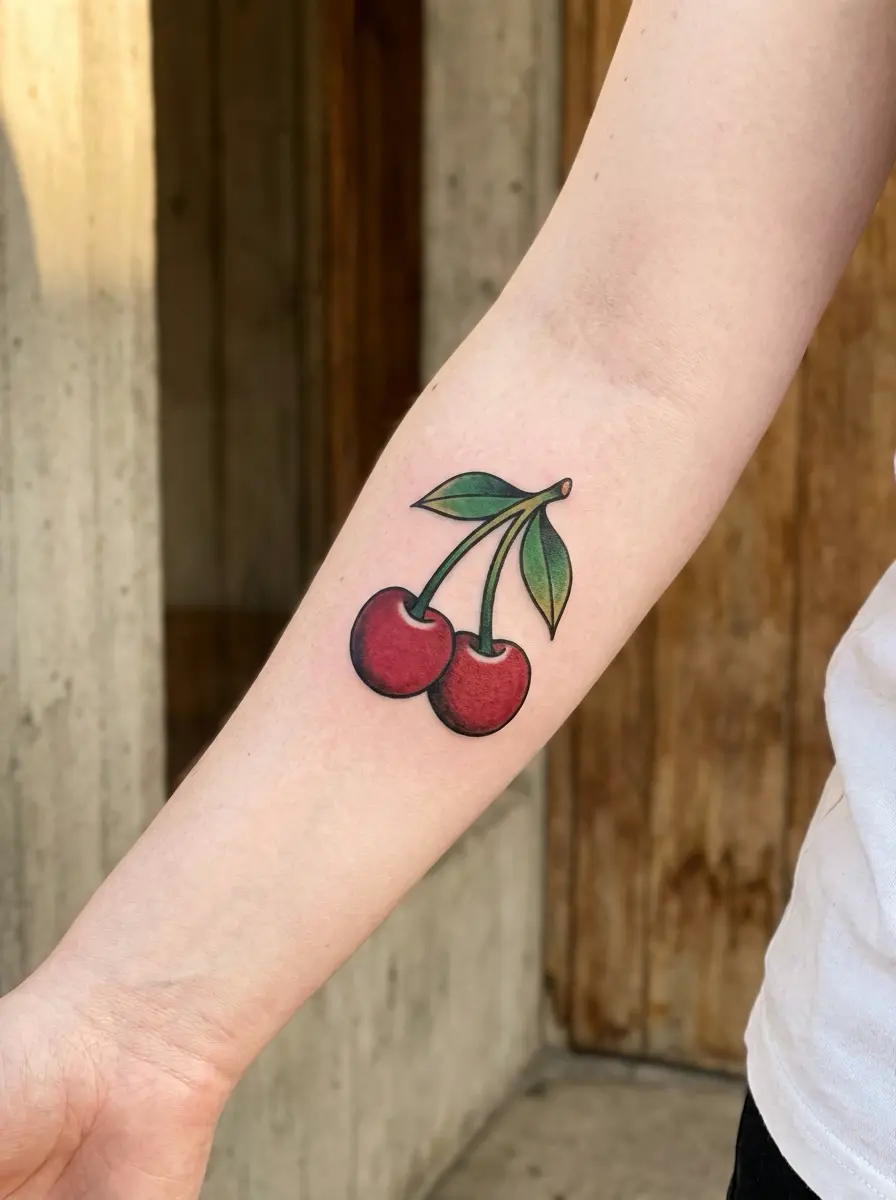
The American traditional tattoo cherry has a very different genealogy. The design — two red cherries on a curved stem, often with a single leaf — became an icon of 1940s and 1950s pin-up culture, appearing on posters, playing cards, cheesecake illustrations, and eventually as a tattoo motif that spread through sailor culture and eventually into the broader Western tattoo vocabulary. The cherries functioned as a playful, knowing shorthand for allure: cute enough to be deniable, suggestive enough to be unmistakable.
The pin-up cherry sits in a specific tradition of American visual culture that used fruit imagery as a vehicle for innuendo — the peach, the banana, and the cherry all acquired double meanings in mid-century American slang. The tattoo version codified this: the double cherry on a stem became one of the most recognisable compositions in the traditional American flash vocabulary, as standard in any shop’s collection as the anchor, the swallow, or the rose.
Religious and Western Symbolism: Temptation and the Forbidden
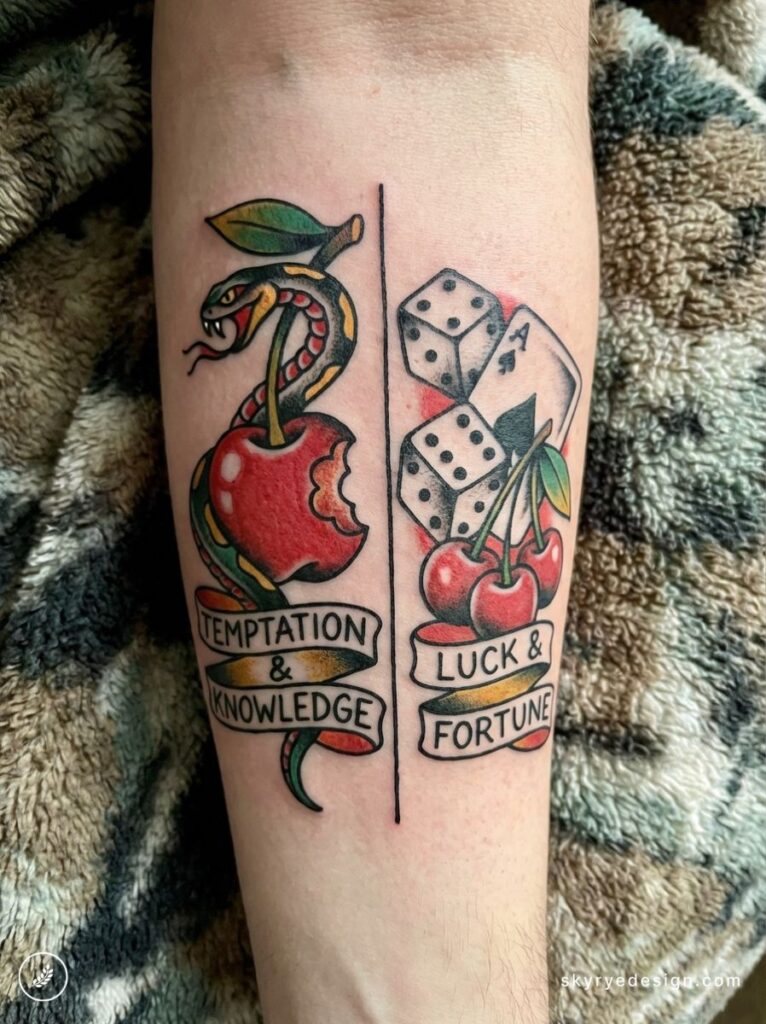
In Western Christian iconography, the cherry carries a less playful association. As a red, round fruit, the cherry has been linked to the forbidden fruit of Eden since the medieval period — some scholars argue that the apple only became the definitive Eden fruit during the Renaissance, and that earlier depictions sometimes show a cherry or a fig. In this reading, the cherry represents temptation, choice, and the knowledge that comes with transgressing a boundary. A tattoo composition that emphasises a bitten cherry, a serpent, or an open mouth engages this symbolism deliberately.
Gambling Culture: Luck and the Slot Machine
The cherry in gambling culture is purely associative: cherry symbols on slot machines (introduced in the early 20th century by the Bell Fruit Gum Company, which used fruit symbols to represent flavours of gum dispensed as prizes) became icons of luck and fortune. Cherry tattoos in this register are often paired with dice, playing cards, lucky horseshoes, or other gambling iconography — and the meaning shifts away from symbolism altogether into pure visual vocabulary: you like the aesthetic, you appreciate the luck association, you want the classic flash look.
✏ Tattoo note: When choosing a cherry tattoo, decide which cultural reading you want to engage with before choosing a style. A Japanese-influenced composition with blossoms and soft shading reads impermanence and seasonal beauty. A bold American traditional double cherry reads pin-up and playfulness. A cherry with a serpent and bite mark reads temptation. The style and compositional choices are the meaning, not the cherry alone.
What Cherry Tattoo Compositions Mean
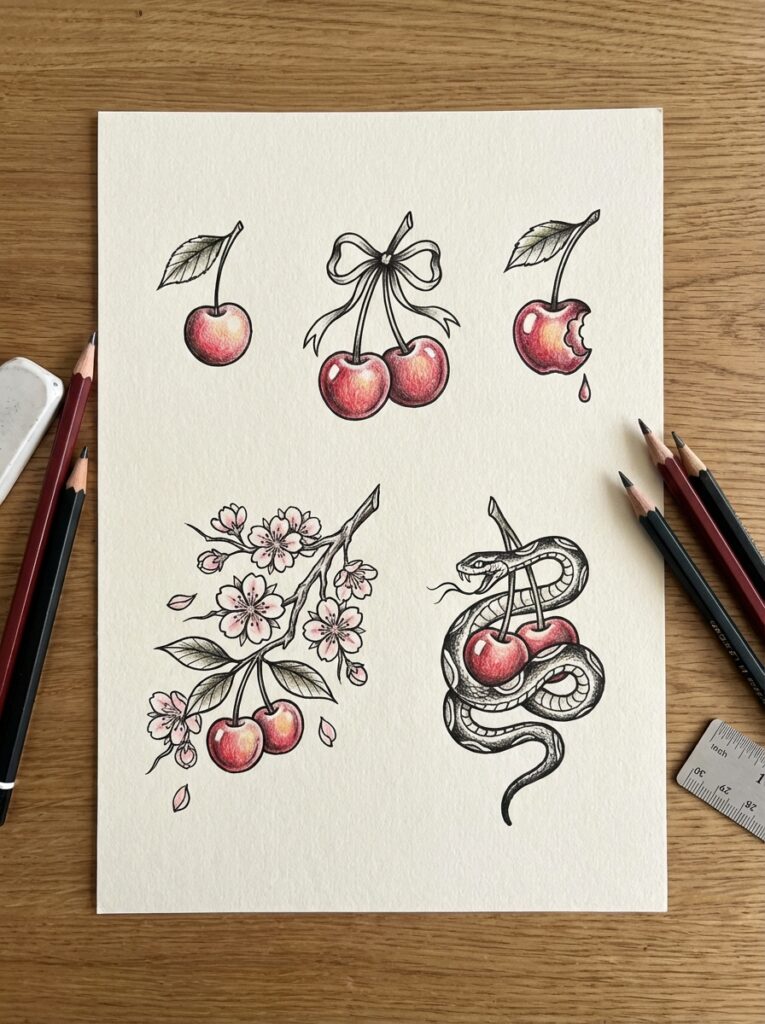
The cherry itself is a starting point. The composition around it is where the specific meaning crystallises. A cherry tattoo with blossoms says something entirely different from the same cherry with a snake. Understanding these compositional shifts helps you make intentional design decisions rather than relying on the artist to interpret the meaning for you.
Single Cherry — Intimacy and Self-Sufficiency
A single cherry — one fruit on a short stem with one or two leaves — is the most understated composition in the cherry vocabulary. It reads as personal, intimate, and self-contained.
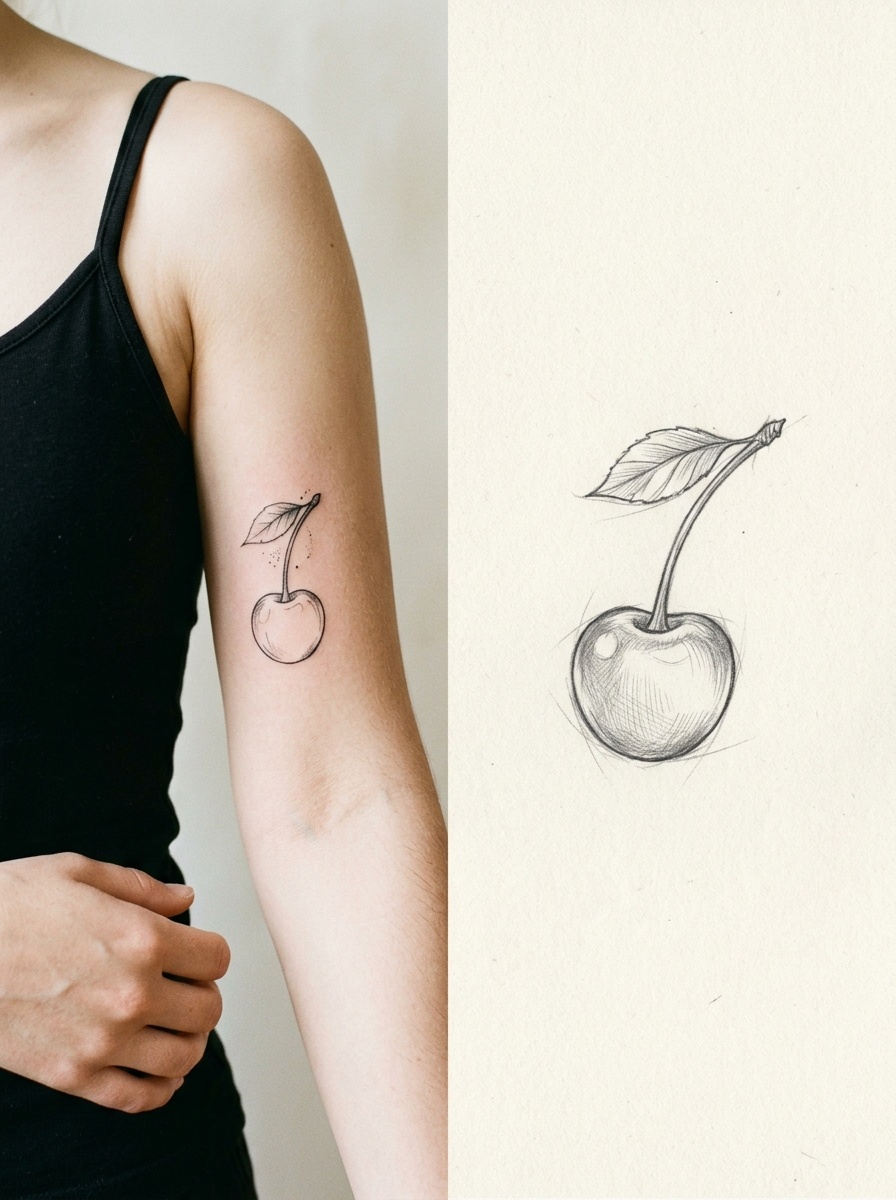
Without the double-cherry dynamic of partnership or connection, the single cherry emphasises the individual: beauty that stands alone, the self as sufficient, the moment of ripeness complete in itself. It is a popular choice for small placements (wrist, ankle, behind the ear) precisely because its meaning is quiet rather than declarative.
Double Cherry — Partnership and Connection
Two cherries on a single stem is the most iconic and most consistently interpreted cherry tattoo composition. The double cherry symbolises partnership, connection, and two lives joined at a shared origin.
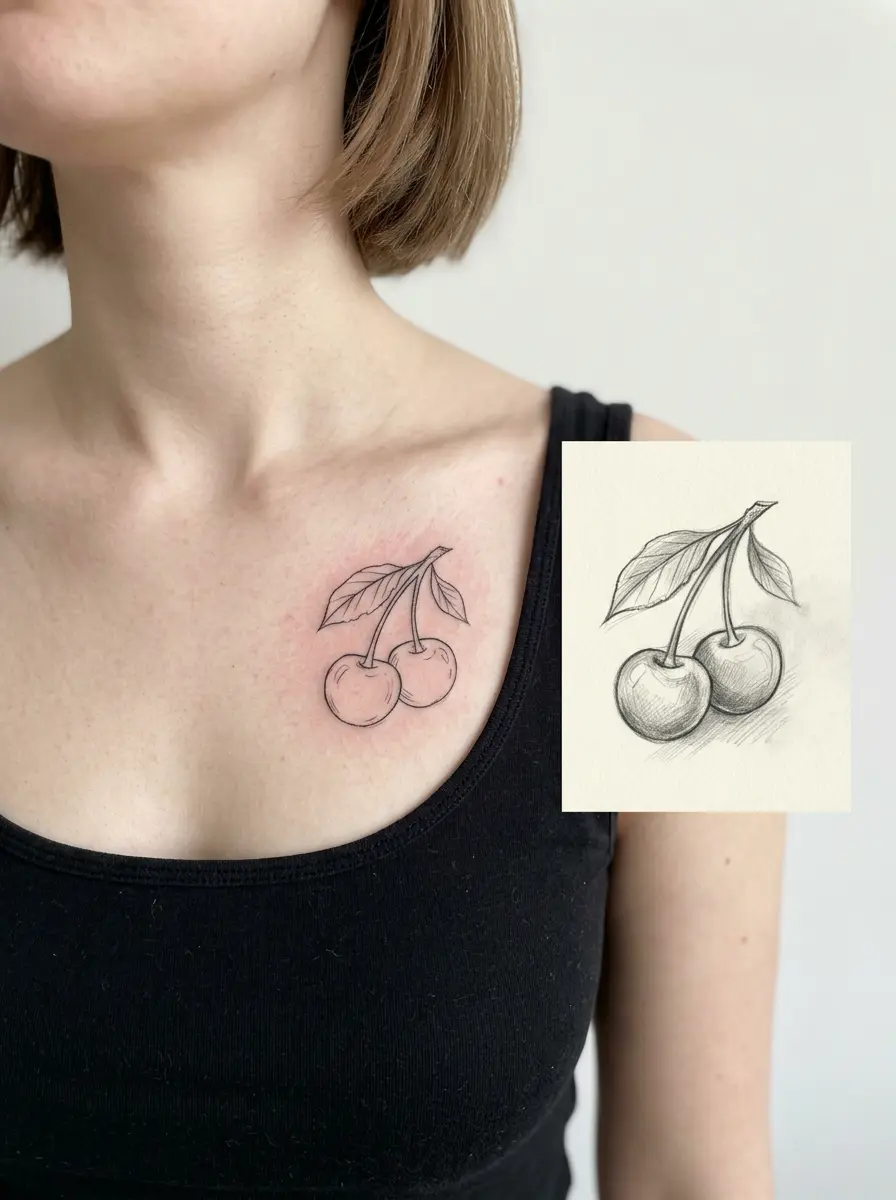
It appears frequently as a couple’s tattoo, with one partner taking one cherry and the other taking the matching design. Within the pin-up tradition, the double cherry also carried a knowing duality — innocence and experience coexisting on a single stem. The visual symmetry of two cherries is part of the appeal: it is a satisfying graphic composition regardless of the meaning you assign it.
Bitten Cherry — Temptation Chosen
A cherry with a bite taken out of it — sometimes shown mid-bite with lips visible, sometimes as a clean cross-section revealing the pit — shifts the symbolism from latent desire to acted-upon temptation.
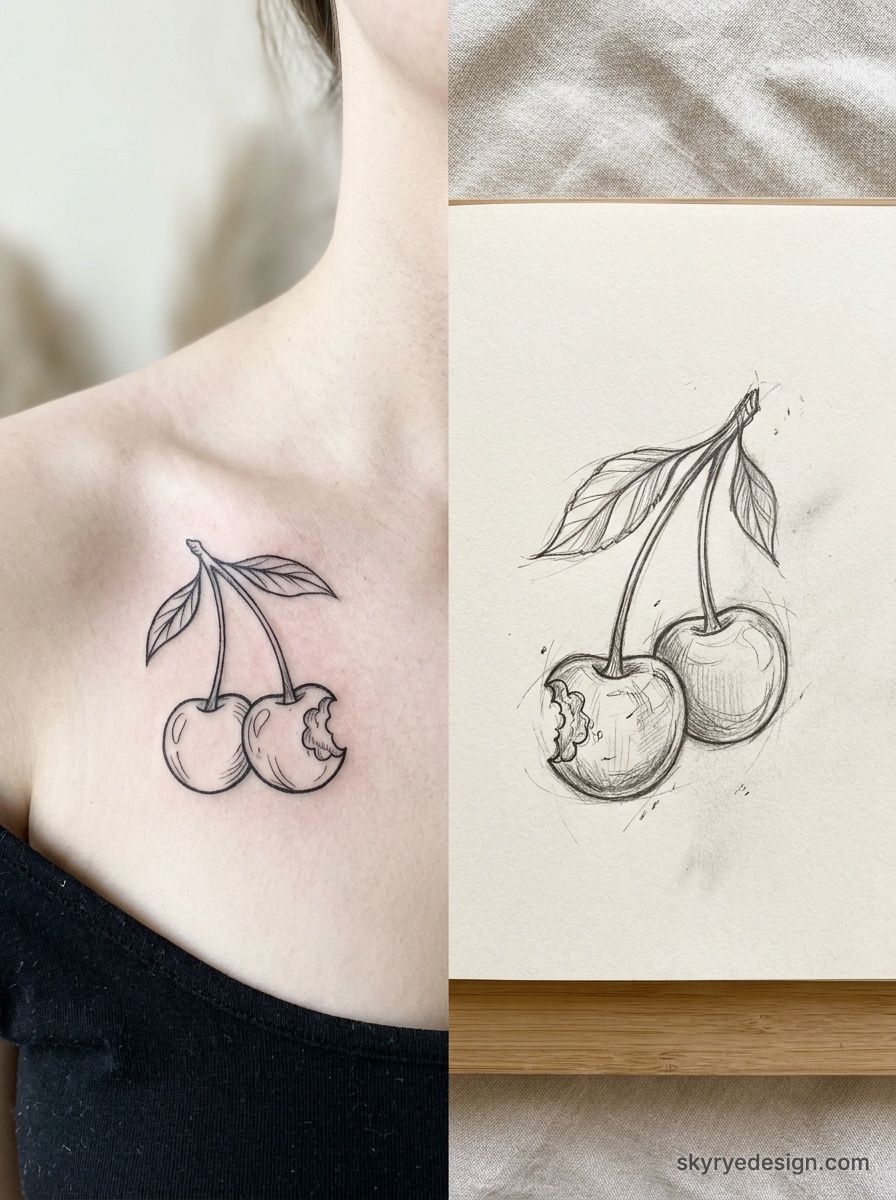
The bitten cherry is about choice: the moment of transgression, the decision to take the forbidden thing. In compositions that engage the Eden symbolism, the bite mark is what transforms temptation into knowledge. In more playful compositions, the bite reads as appetite, confidence, and the willingness to take what you want without apology.
Cherry with Blossoms — Japanese Cycle of Seasons
A cherry fruit depicted alongside cherry blossoms (sakura) or bare branches places the composition in the Japanese symbolic vocabulary of seasons and impermanence.
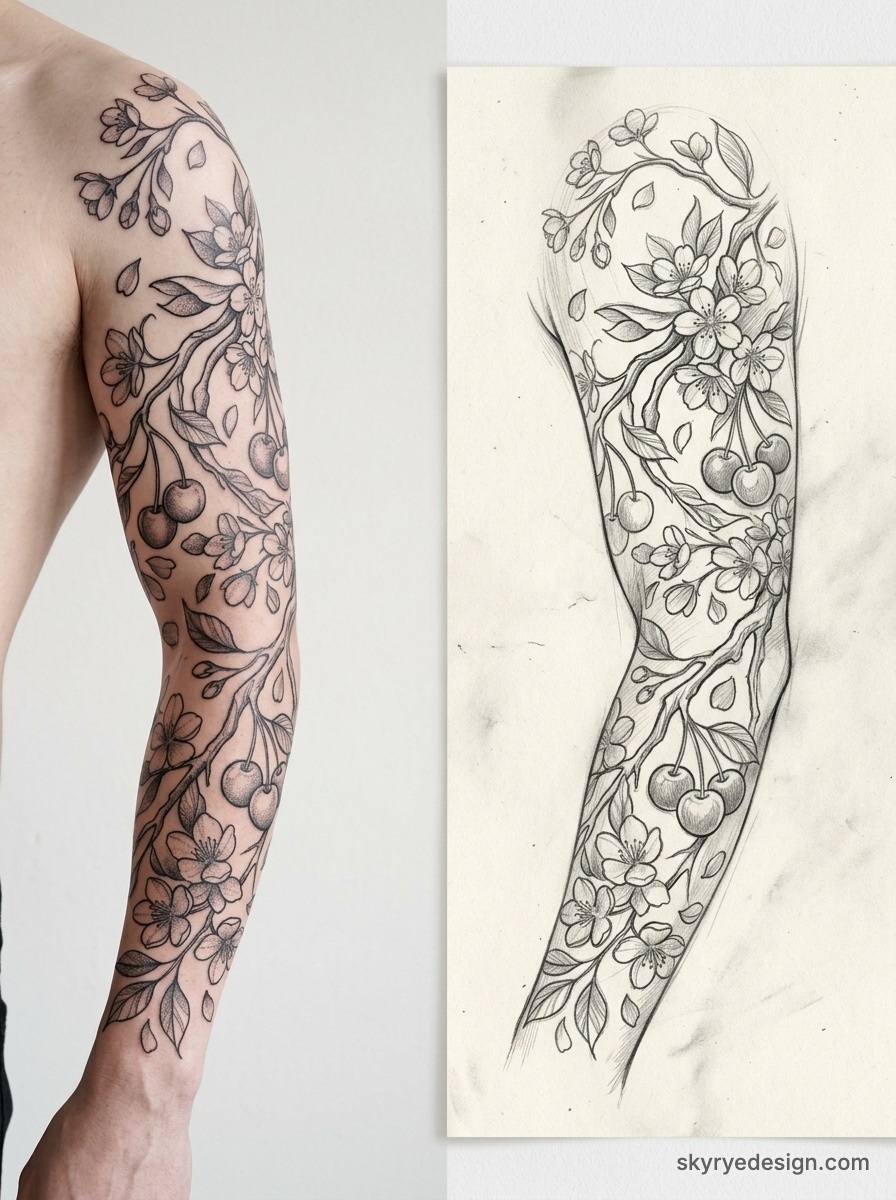
The blossom represents the brief, brilliant moment of flowering; the fruit represents the fullness that follows; together they suggest the complete cycle from potential to peak.
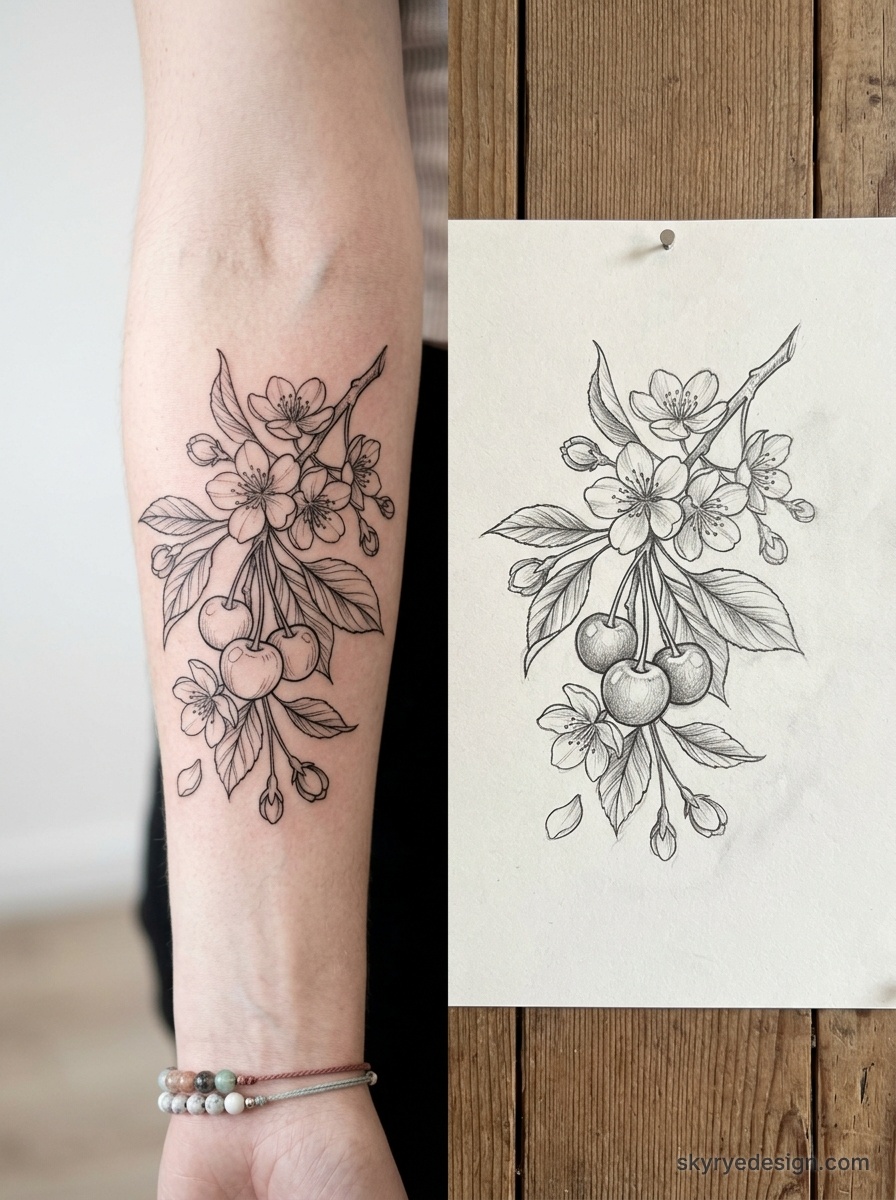
This composition is more contemplative than sensual, and tends toward larger-scale designs that can accommodate the branch structure and petal detail that make the seasonal reading legible.
Cherry with Serpent — Temptation and Power
A snake coiled around a cherry stem or a cherry branch directly engages the Eden symbolism.
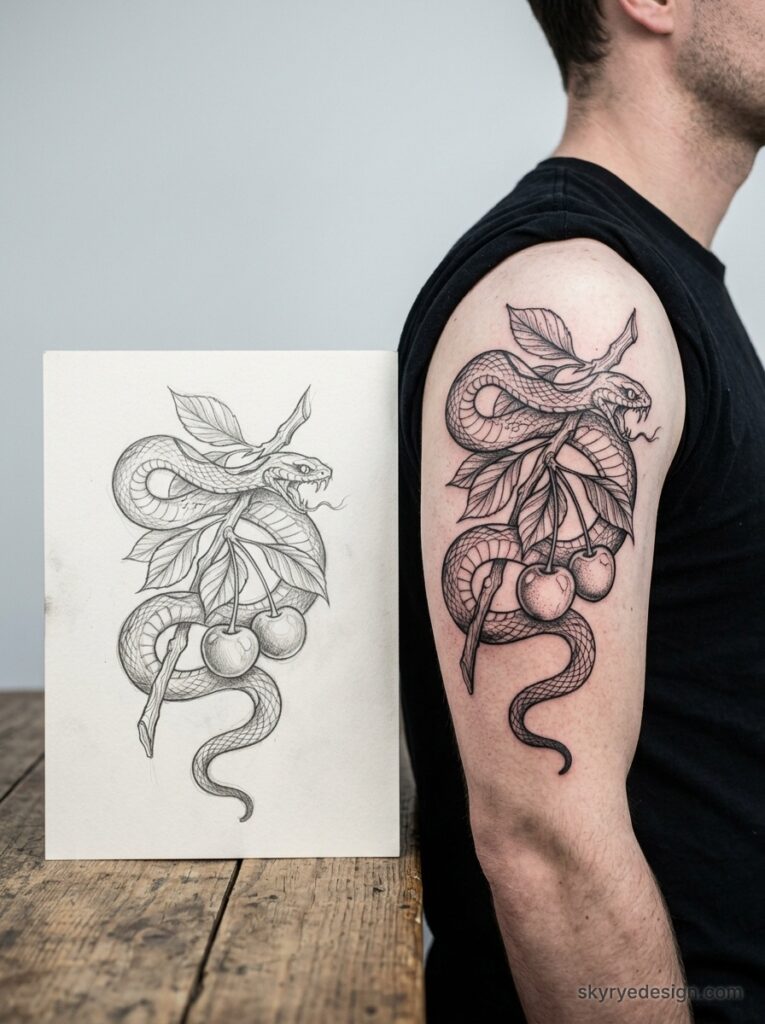
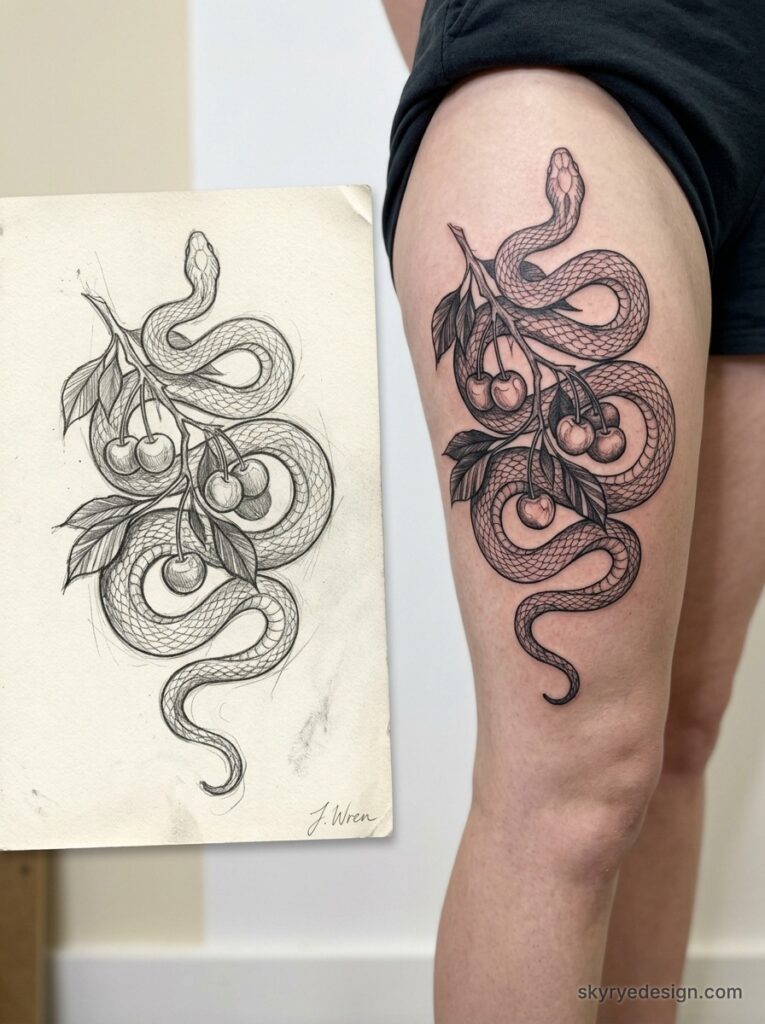
The serpent is the agent of temptation; the cherry (or apple, or fruit) is the object of it. This composition is about transgression, forbidden knowledge, and the power dynamics of desire. It tends to produce more dramatic, gothic-inflected designs — darker palette, heavier line work, compositions that emphasise weight and shadow rather than the lightness of a classic pin-up cherry.
Cherry with Dice, Cards, or Horseshoe — Lucky Charm
Cherry tattoos paired with gambling iconography work in the slot-machine tradition.
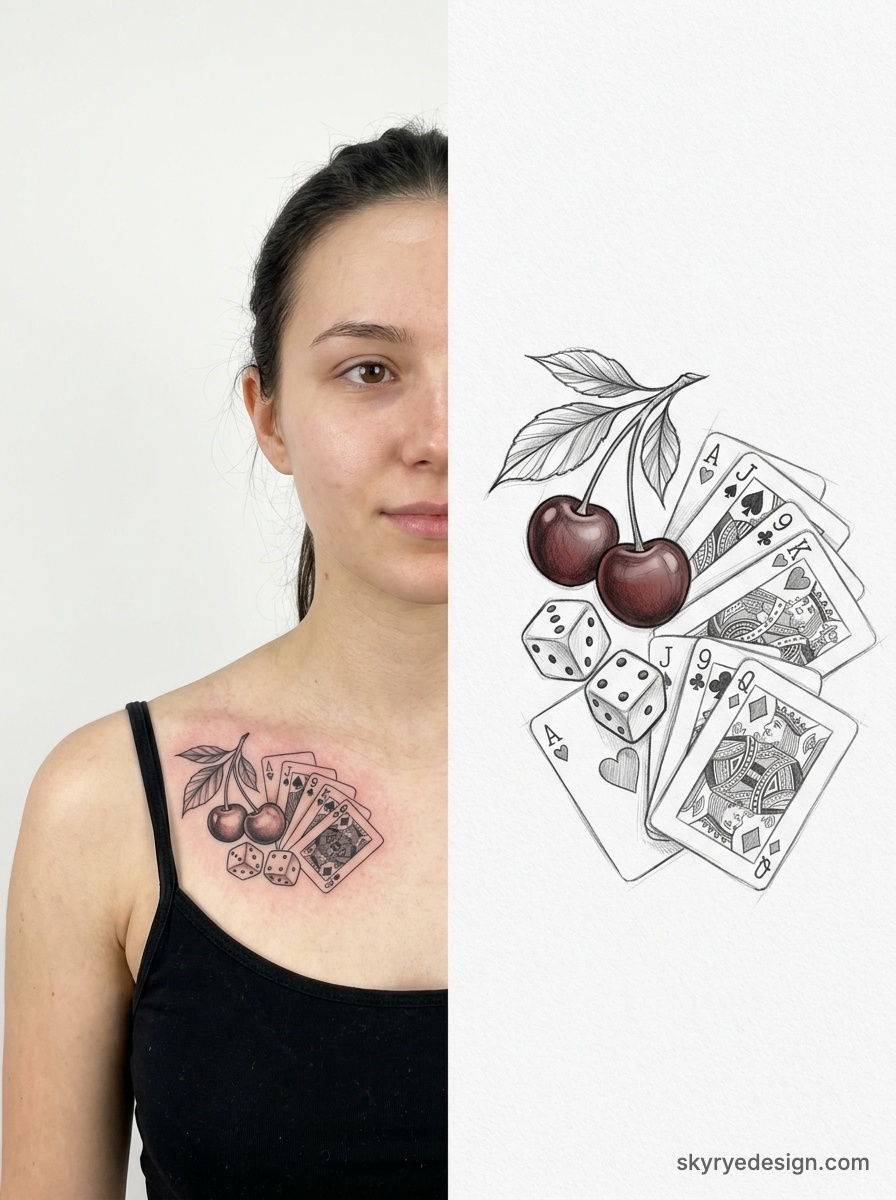
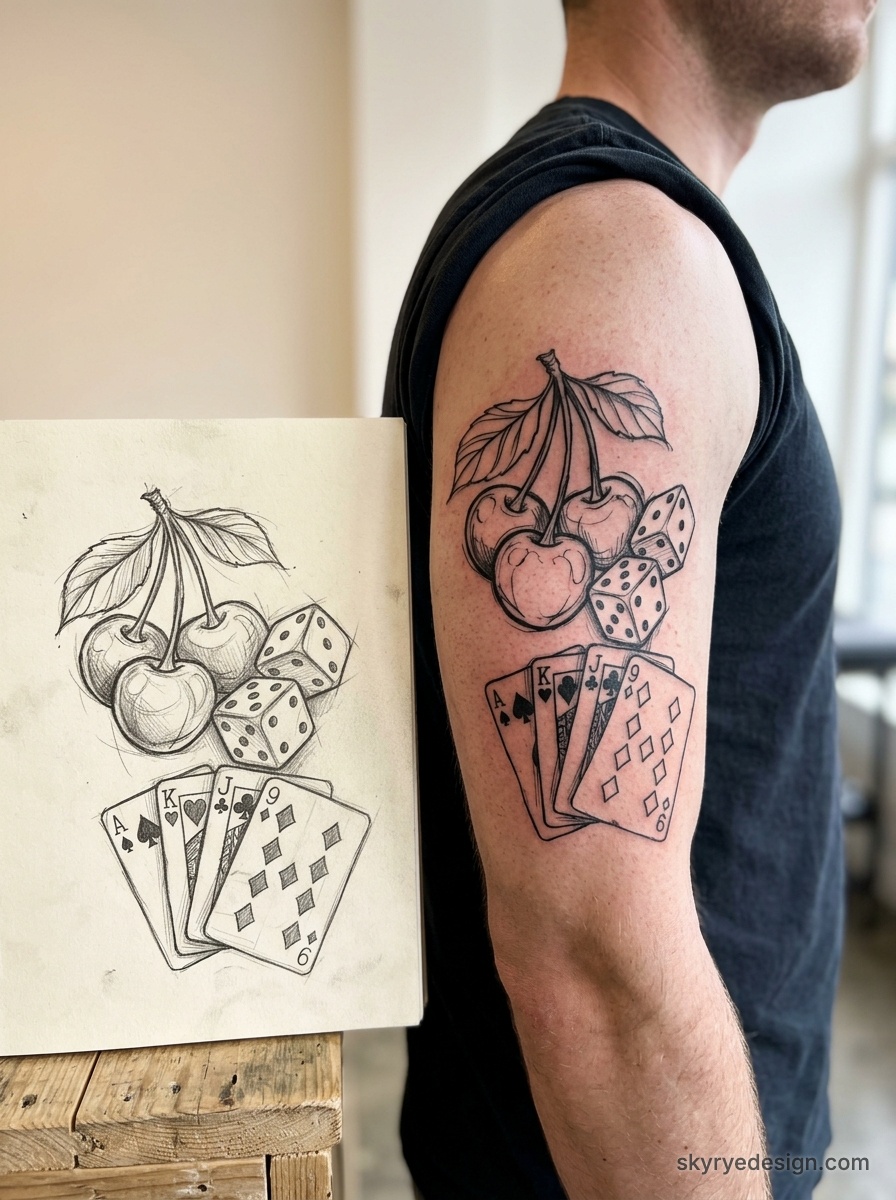
The meaning is luck, fortune, and the gambler philosophy — life as a game of chance, the cherry as the jackpot symbol. These compositions tend to use the brightest, most graphic colour palette of any cherry design, leaning fully into the visual language of vintage arcade culture.
Five Tattoo Styles That Work for Cherry Designs
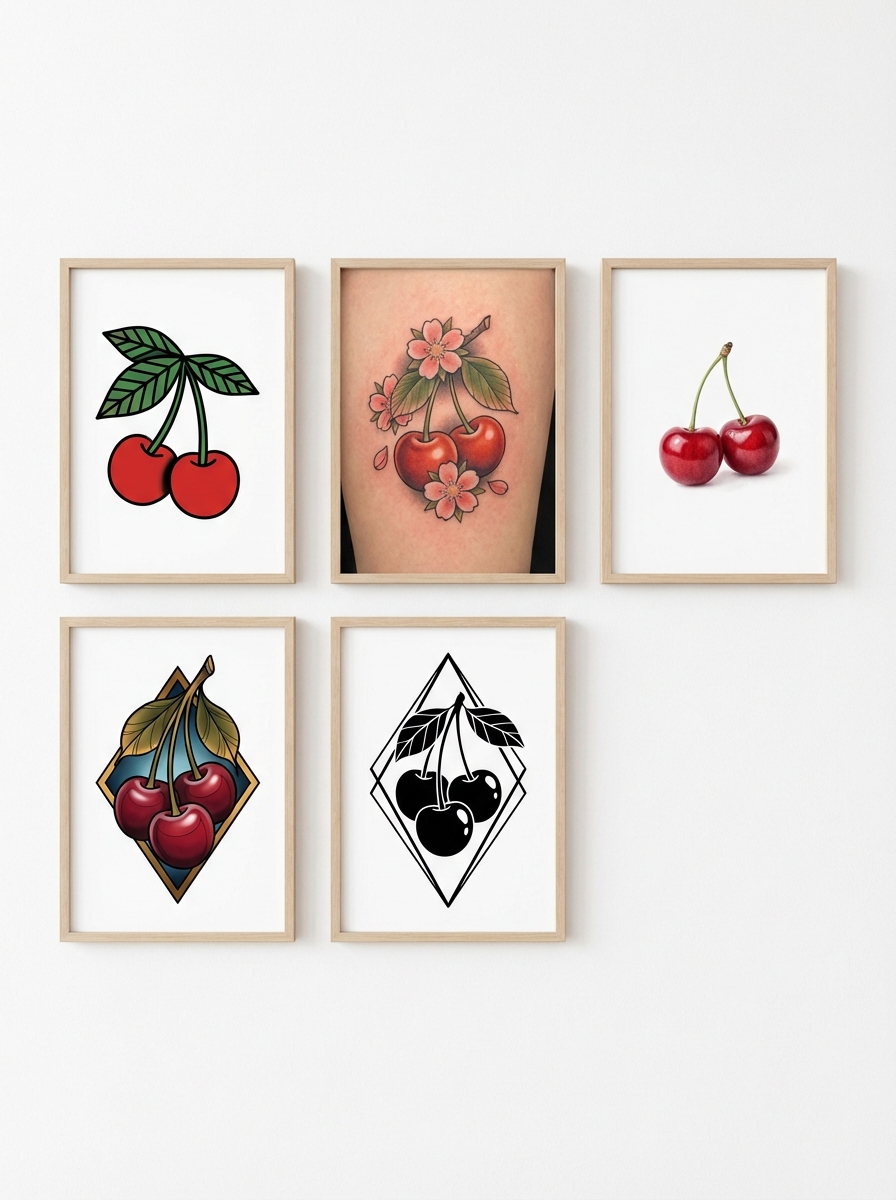
Cherry tattoos are unusually versatile across tattoo styles because the subject is inherently bold in colour, simple in form, and carries visual associations in multiple traditions. The style you choose shapes the mood of the tattoo as much as the composition does.
American Traditional (Old School)
Origin: United States, 1930s-1950s sailor tattoo culture
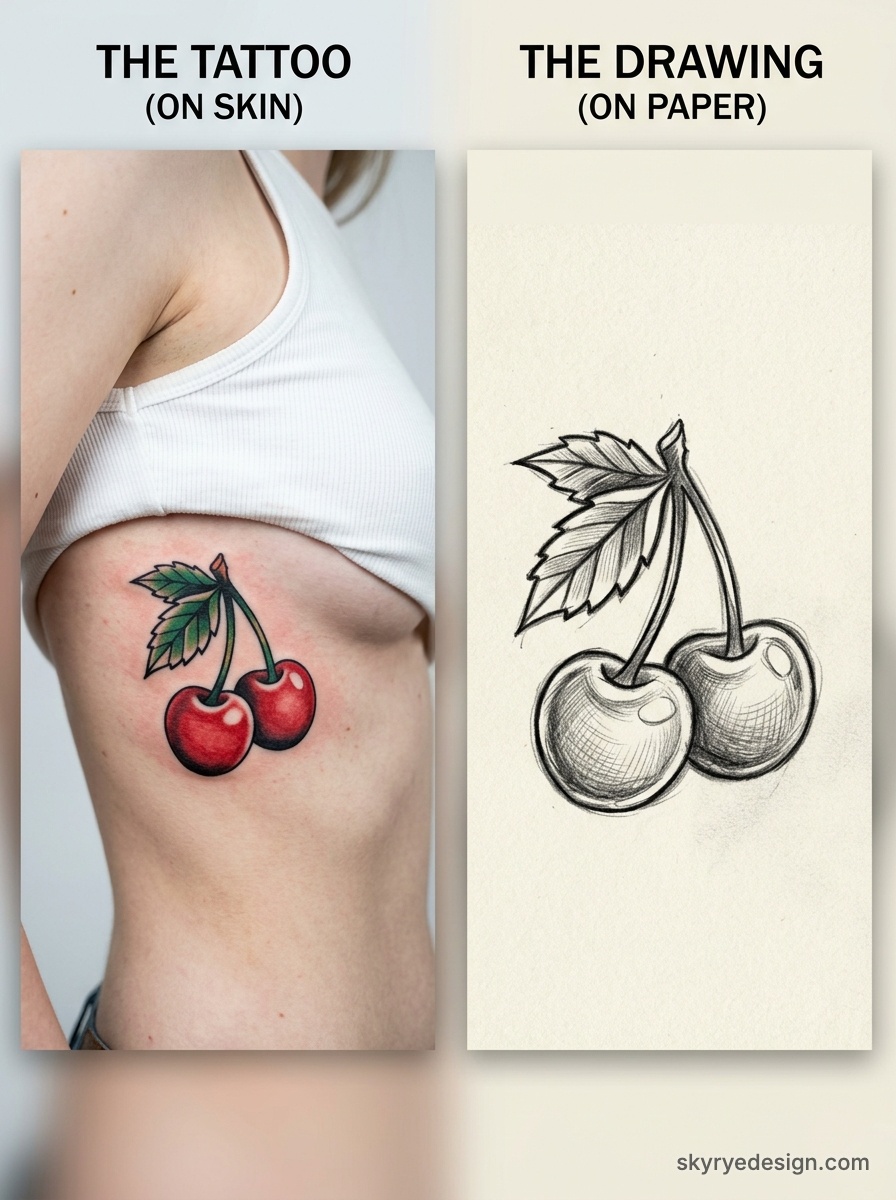
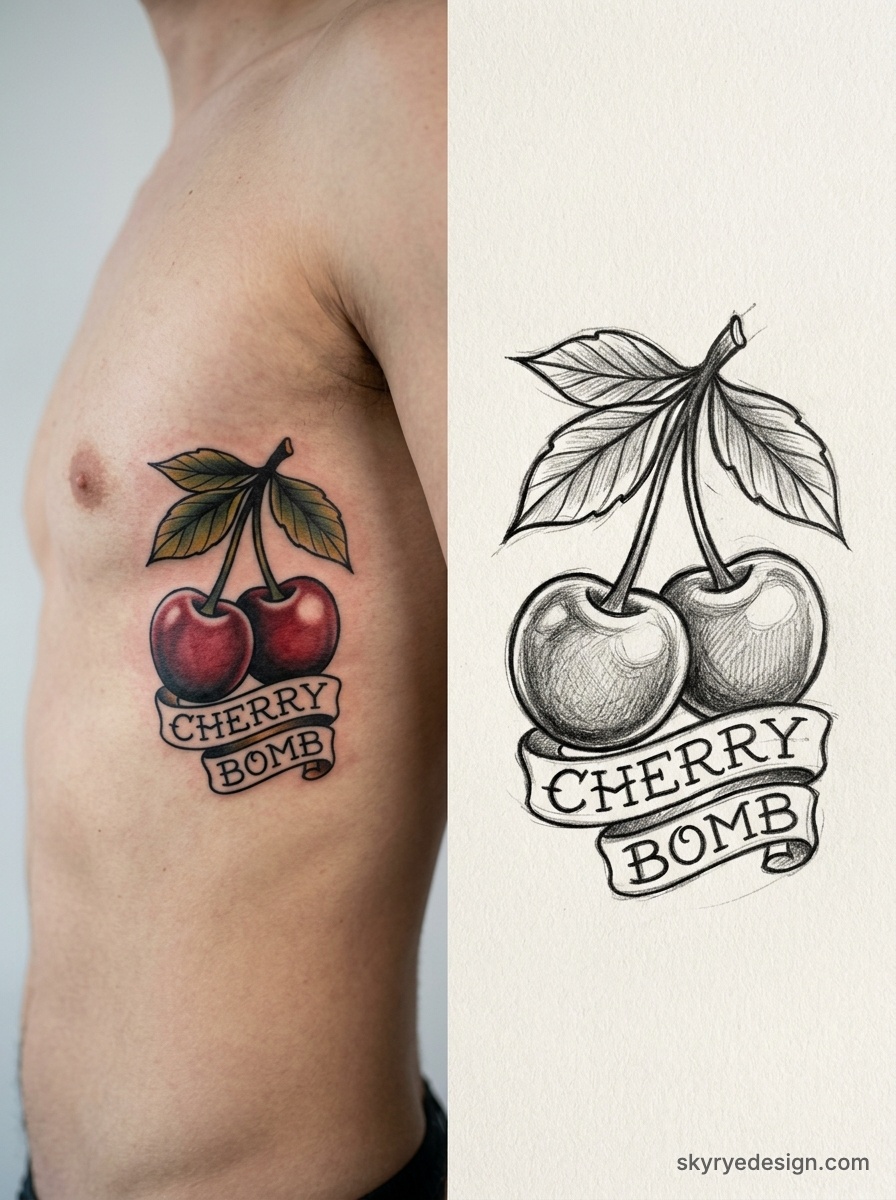
Meaning: Playfulness, allure, luck, the pin-up era — this is the style most associated with cherry symbolism in Western tattoo culture
Best technique: Bold black outlines with flat colour fill — red for the fruit, green for the stem and leaves, limited palette of three to five colours maximum. No gradients, no photorealistic shading. The design should read clearly at a distance and at a small scale
Placement: Wrist, forearm, ankle, shoulder — placements that suit small to medium flash designs with enough visibility to appreciate the bold outline quality
Japanese (Irezumi)
Origin: Japan, centuries-old tradition formalised through the Edo period
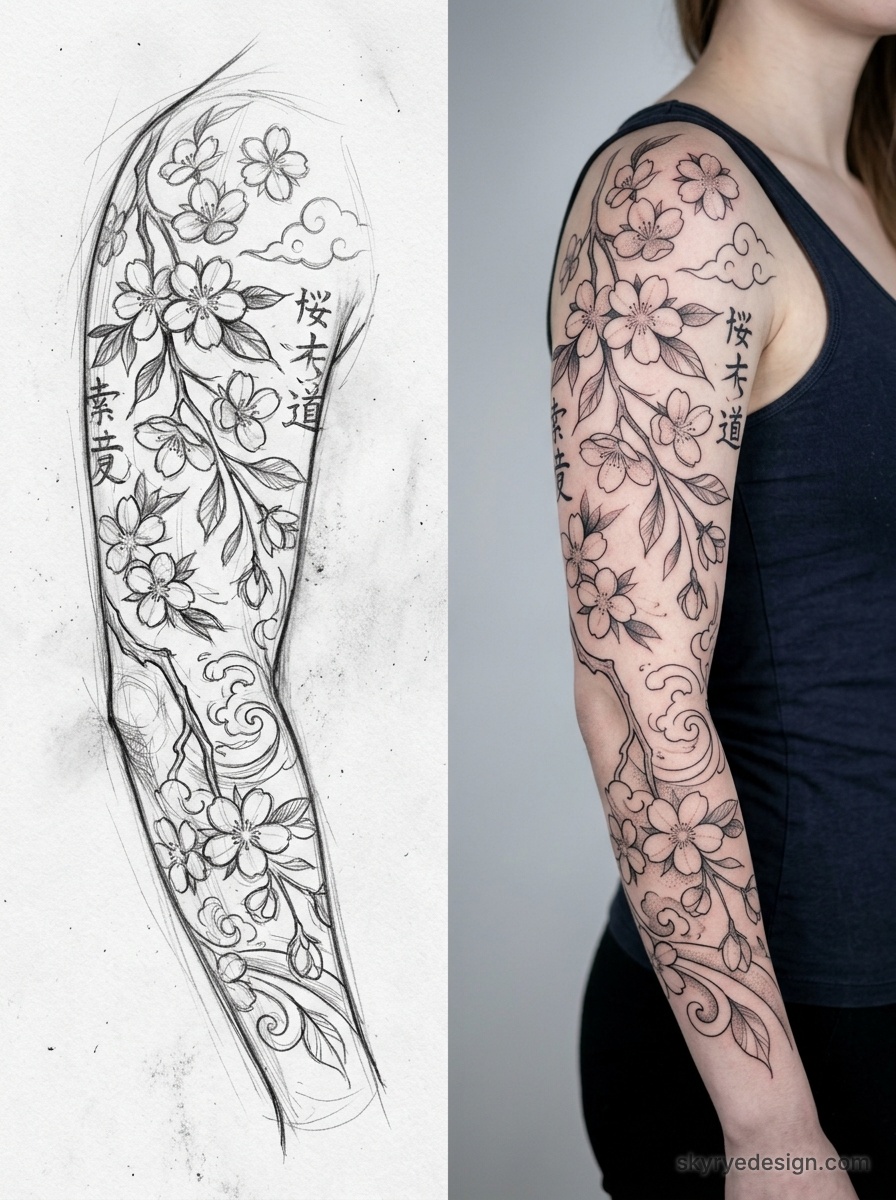
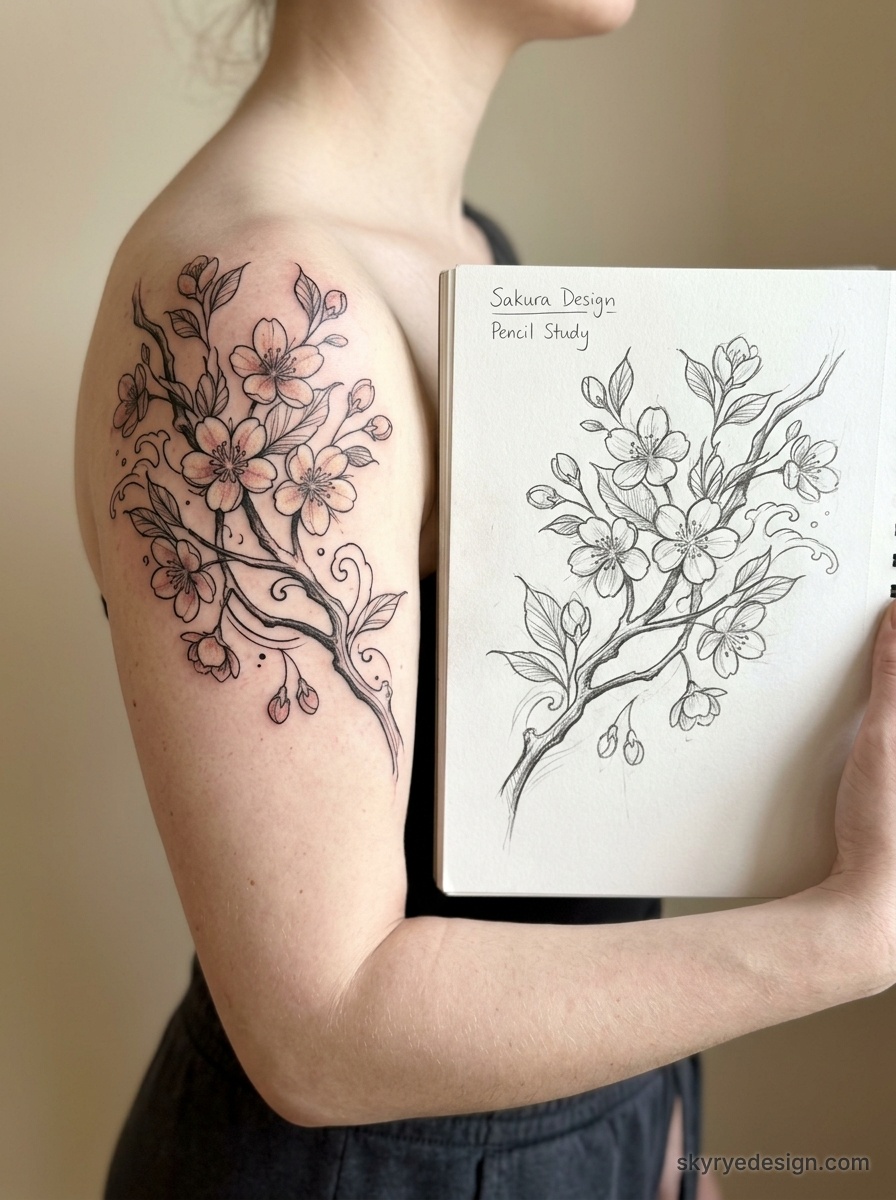
Meaning: Impermanence, seasonal beauty, the mono no aware — typically situates the cherry within a larger natural composition rather than as an isolated motif
Best technique: Softer line work than American traditional, integrated shading that creates three-dimensional volume, watercolour-influenced colour transitions, compositional integration with blossoms, water, or cloud elements. Tebori (hand-poked) application creates the characteristic soft edge
Placement: Larger placements — thigh, back, shoulder, full sleeve — that allow the surrounding composition to breathe and the cherry to sit within its seasonal context
Fine Line and Micro-Realism
Origin: Contemporary tattoo movement, 2010s-present
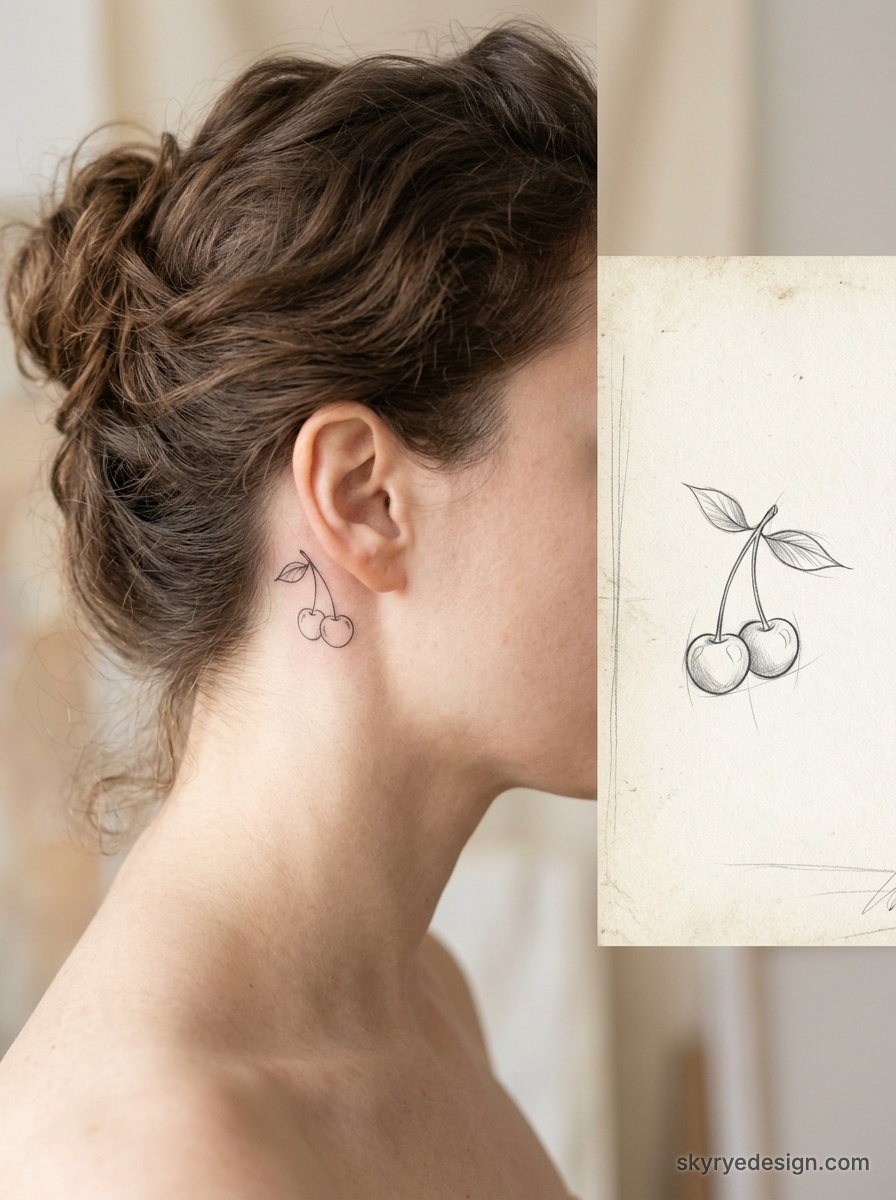
Meaning: Personal and intimate — fine line cherry tattoos tend to be chosen for their aesthetic refinement rather than specific symbolic meaning
Best technique: Single-needle or very fine needle work producing hyperrealistic cherry rendering at small scale — capturing surface gloss, light reflection, the subtle variation in red across the fruit surface. Requires a tattoo artist who specialises in fine line work; heals differently from bold traditional outlines and may require touch-up over time
Placement: Small placements — behind the ear, collarbone, inner wrist, finger — where the refinement of the fine line technique can be fully appreciated at the correct viewing distance
Neo-Traditional
Origin: Evolution of American traditional, 1980s-present
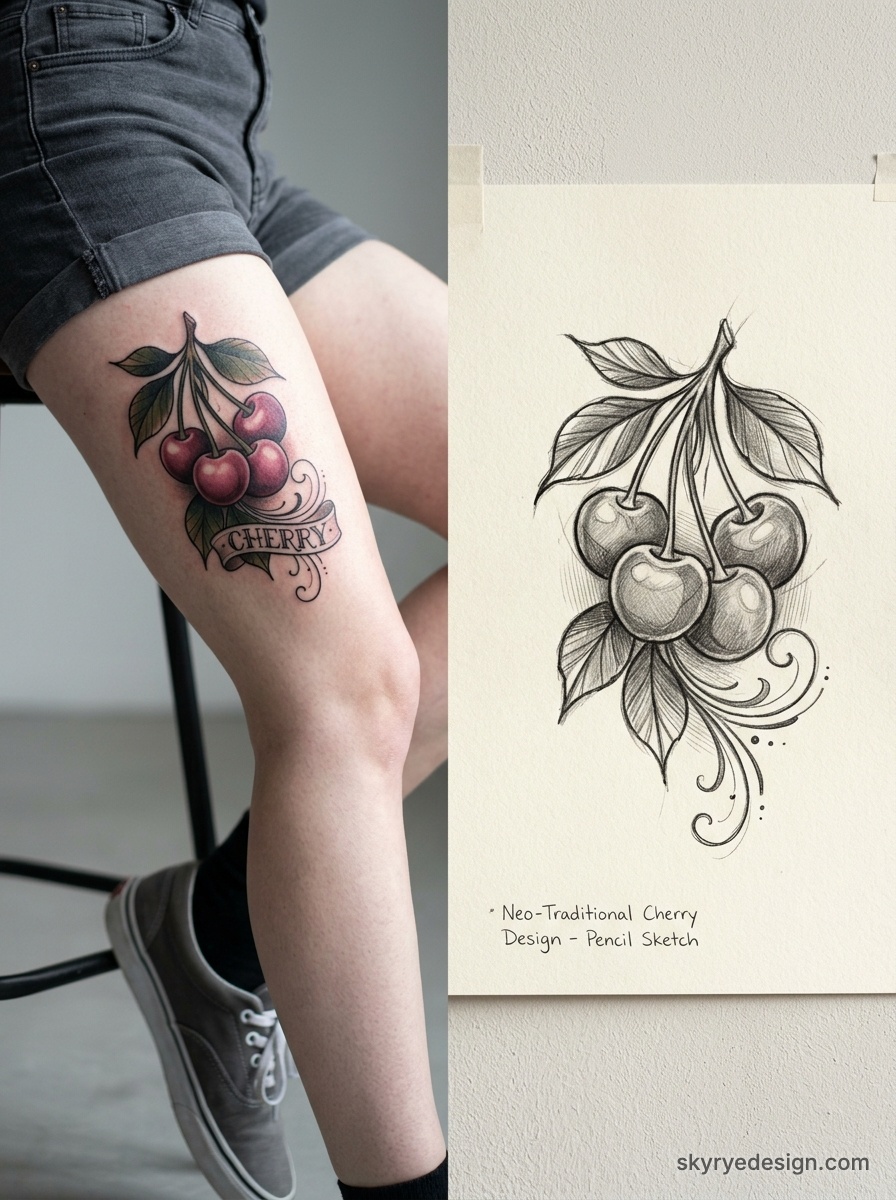
Meaning: Shares the bold, declarative quality of traditional while adding dimensional depth and a broader colour palette
Best technique: Preserves the bold black outline of traditional work but adds dimensional shading, more nuanced colour mixing (deep burgundies and crimsons rather than flat primary red), and decorative elements (ornamental frames, botanical detail) that give the design visual complexity without abandoning graphic clarity
Placement: Medium to large placements — upper arm, thigh, shoulder blade — where the dimensional shading and colour complexity can be fully expressed
Blackwork and Geometric
Origin: Contemporary fine art tattoo tradition
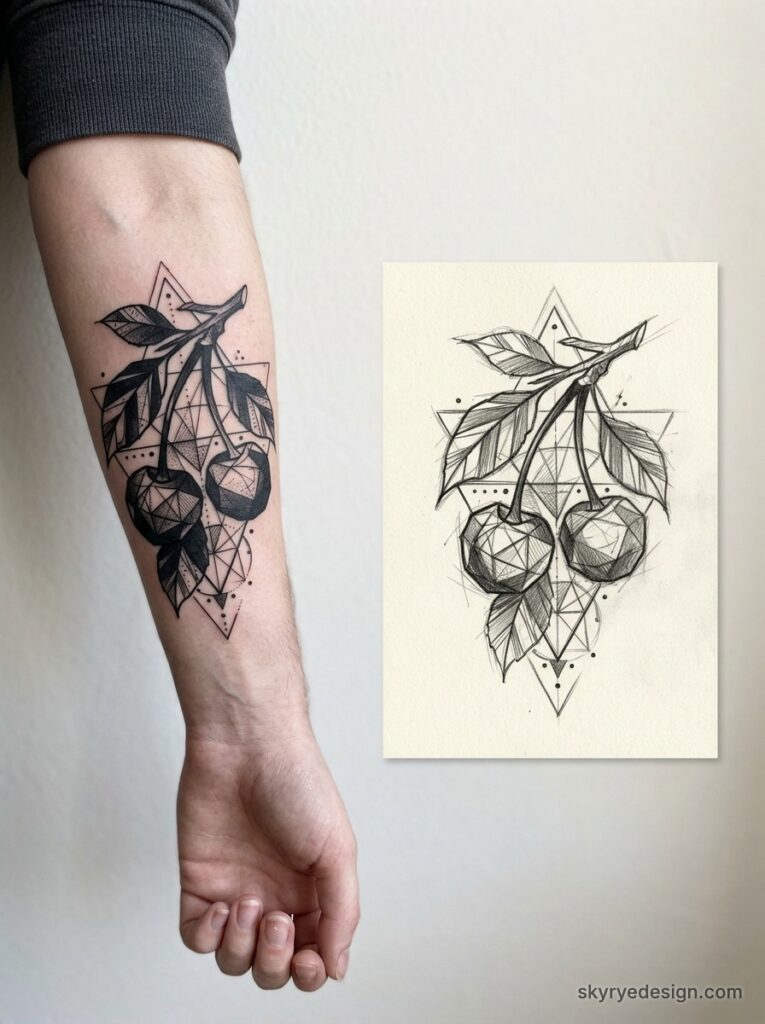
Meaning: Cherry stripped of colour symbolism and treated as pure graphic form — often chosen by collectors who want to integrate cherry motifs into a broader blackwork or geometric body art concept
Best technique: No colour — the cherry is rendered entirely in black ink, using negative space to suggest the fruit form. May be integrated with geometric frames, mandala elements, or abstract line work. The absence of colour removes the red-and-green visual associations and makes the cherry read as structure rather than symbol
Placement: Flexible placement — blackwork reads well at a range of scales and body locations depending on the surrounding piece
✏ Tattoo note: The longevity of a cherry tattoo varies significantly by style. Bold American traditional outlines and flat colour hold their readability for decades with minimal fade — this is one reason the style has remained popular for over 80 years. Fine line and micro-realism are technically impressive but more vulnerable to fading and blurring over time, particularly in sun-exposed placements. If longevity is a priority, the bolder the outline, the better the tattoo will hold over the years.
Placement Guide: Where Cherry Tattoos Work Best
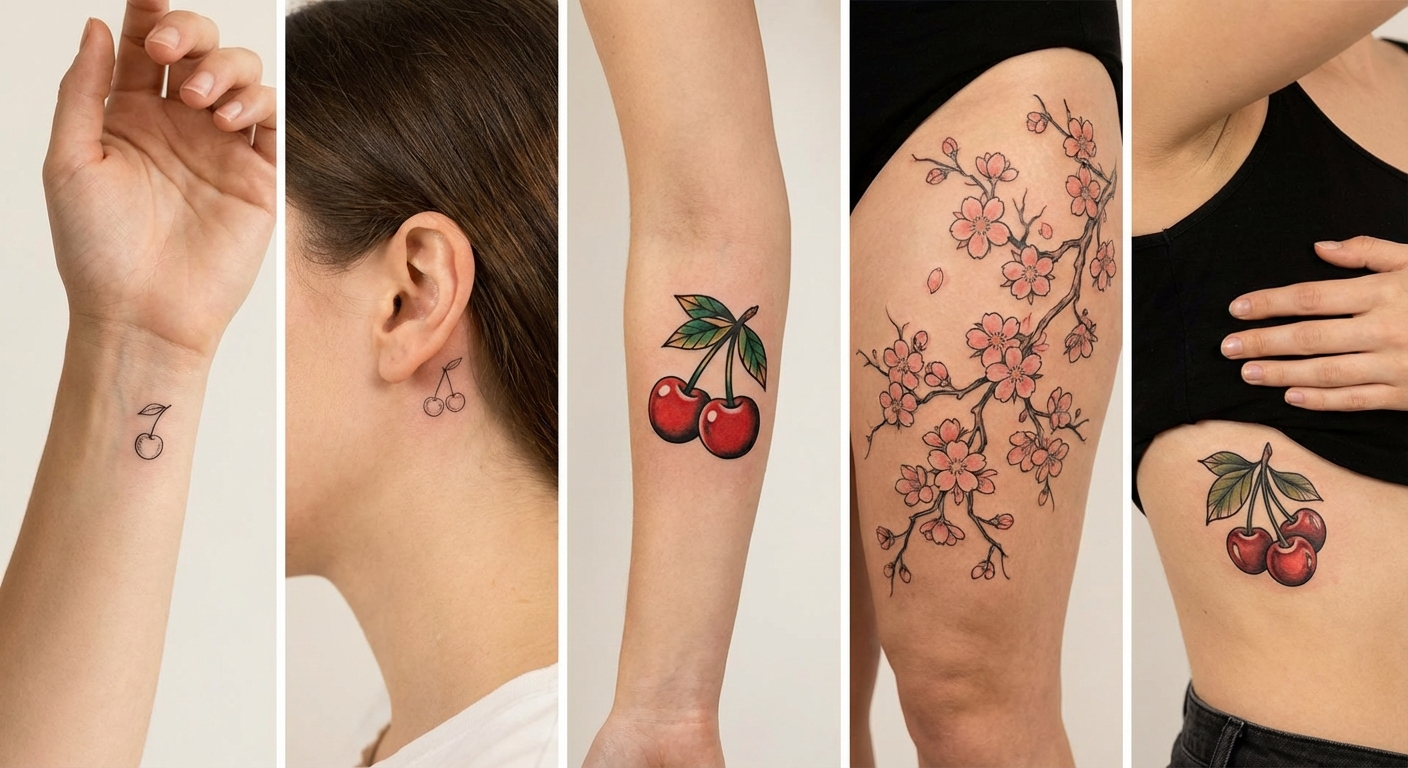
Cherry tattoos are particularly placement-flexible because the design scales naturally from very small to very large without losing coherence. A single cherry works as a micro tattoo on a finger; a cherry blossom branch with fruit works as a half-sleeve. The stem and leaf elements give the design visual direction — a stem pointing upward feels lighter and more playful; a stem curving downward adds graphic weight.
Small Placements — Intimate and Subtle
- Behind the ear: a single small cherry or double cherry, 2-4cm. Hidden in daily life, visible when hair is pulled back. One of the most popular micro placements for cherry designs.
- Inner wrist: small to medium scale, visible in everyday gestures. Works well for fine line or small traditional designs.
- Ankle: classic placement for flash-style cherry tattoos. Visible in sandals and skirts, concealable in most professional contexts.
- Finger: micro scale only. Note that finger tattoos fade faster than other placements due to skin movement and sun exposure — require more frequent touch-up.
- Collarbone: gentle curve of the collarbone suits the hanging stem of a double cherry composition particularly well.
Medium Placements — Expressive and Visible
- Upper arm: the most classic placement for American traditional cherry flash. Visible in T-shirts and tank tops, reads clearly at arm’s length.
- Shoulder blade: good for medium to large compositions with leaf or blossom elements. Visible in backless tops, tends to age well in this lower-movement location.
- Ribcage: elongated placement that suits a composition with a longer stem or branch. More painful placement due to proximity to bone, but it ages well and allows a larger scale.
Large Placements — Compositional and Statement
- Thigh: the largest available canvas for a standalone cherry design. Suits Japanese-style compositions with blossoms and branches, or large neo-traditional pieces with ornamental framing.
- Back: allows the largest possible cherry composition — full branch with multiple fruits, blossoms, and seasonal elements. Suits the Japanese irezumi approach where the cherry is part of a larger natural scene.
- Sleeve integration: cherry designs integrate well into Japanese or botanical sleeve compositions as seasonal accent elements alongside other fruit, flower, and branch motifs.
Colour Choices and What They Shift
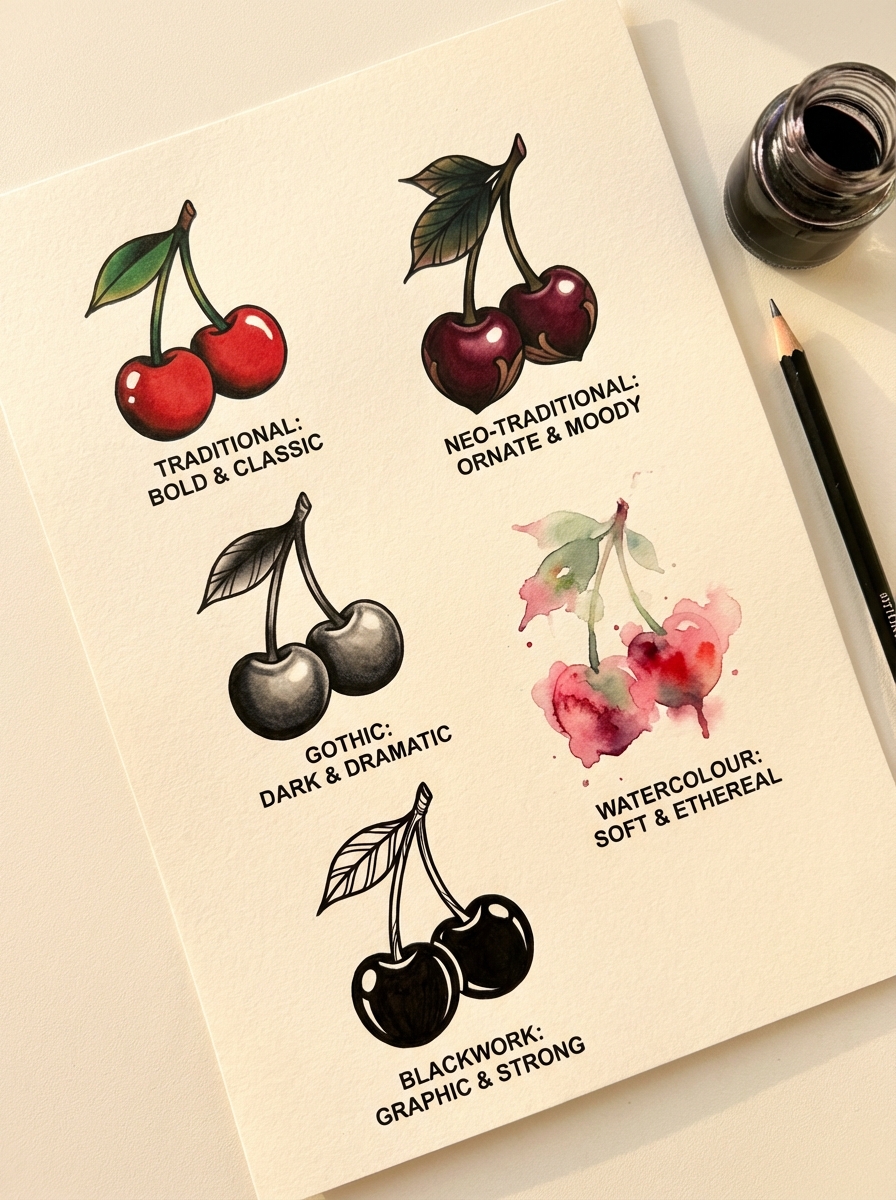
Colour in a cherry tattoo is not purely aesthetic — it shifts the emotional register of the design in ways that are worth understanding before the appointment.
Classic Red and Green
The most instantly recognisable cherry palette: primary red for the fruit, leaf green for the stem and leaves, black for the outline. This is the American traditional colour formula, and it communicates everything the tradition stands for — boldness, clarity, visual confidence. The red is saturated and warm, never dark. The green is medium-toned, never too dark or too yellow.
Deep Burgundy and Forest Green
Shifting from primary red to deep burgundy and from leaf green to forest green moves the design from playful to sophisticated. This is the neo-traditional palette — the same compositional elements as traditional, but with a colour treatment that feels more autumnal, more contemplative, and more mature. It suits wearers who want the cherry symbolism without the full retro-camp of the classic pin-up palette.
Black and Grey
A cherry rendered entirely in black and grey ink removes the colour associations entirely. Without red, the cherry loses the visual cue that most immediately triggers its cultural symbolism — it reads more as form, more as still life, less as icon. Black and grey cherry tattoos tend toward realism or fine line work and appeal to collectors who want the subject without the style associations of the coloured versions.
Watercolour Bleeding
Soft, bleeding colour washes that reference Japanese woodblock printing and contemporary watercolour tattooing suit the Japanese symbolic reading of the cherry most naturally.
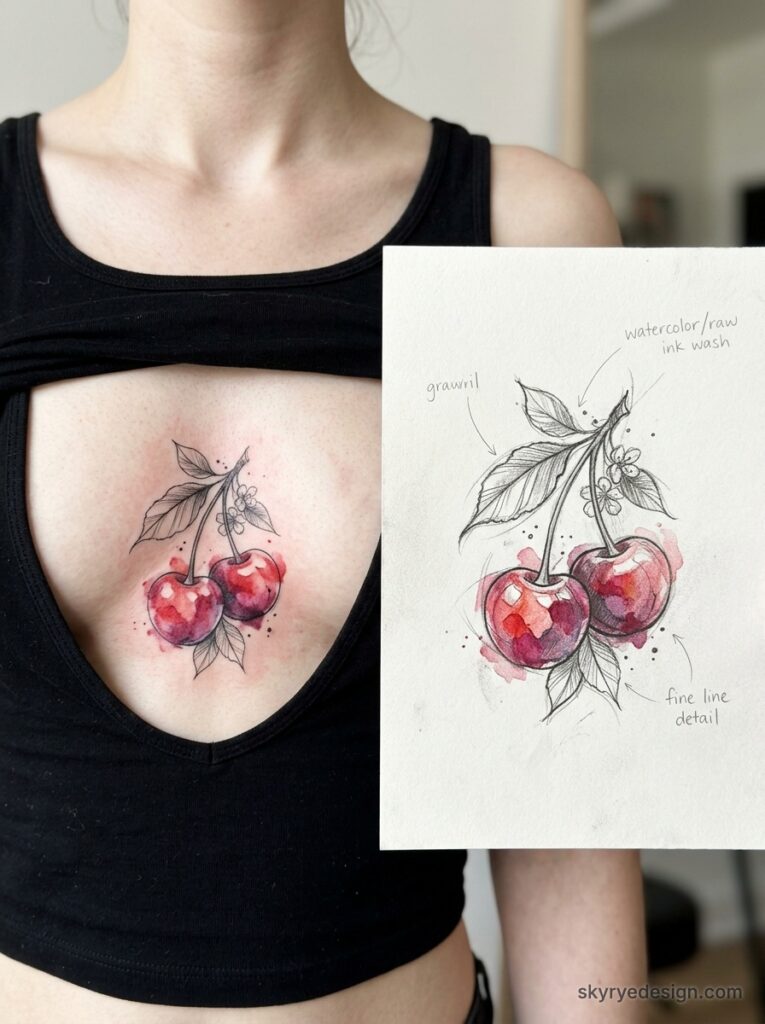
The blurred edges of the watercolour technique visually echo the theme of impermanence— the fruit’s edges dissolving into the surrounding space rather than being contained by a bold outline. This approach typically requires an artist who specialises in the style; poorly executed watercolour tattoos fade faster and blur more than other styles.
Popular Cherry Tattoo Combinations
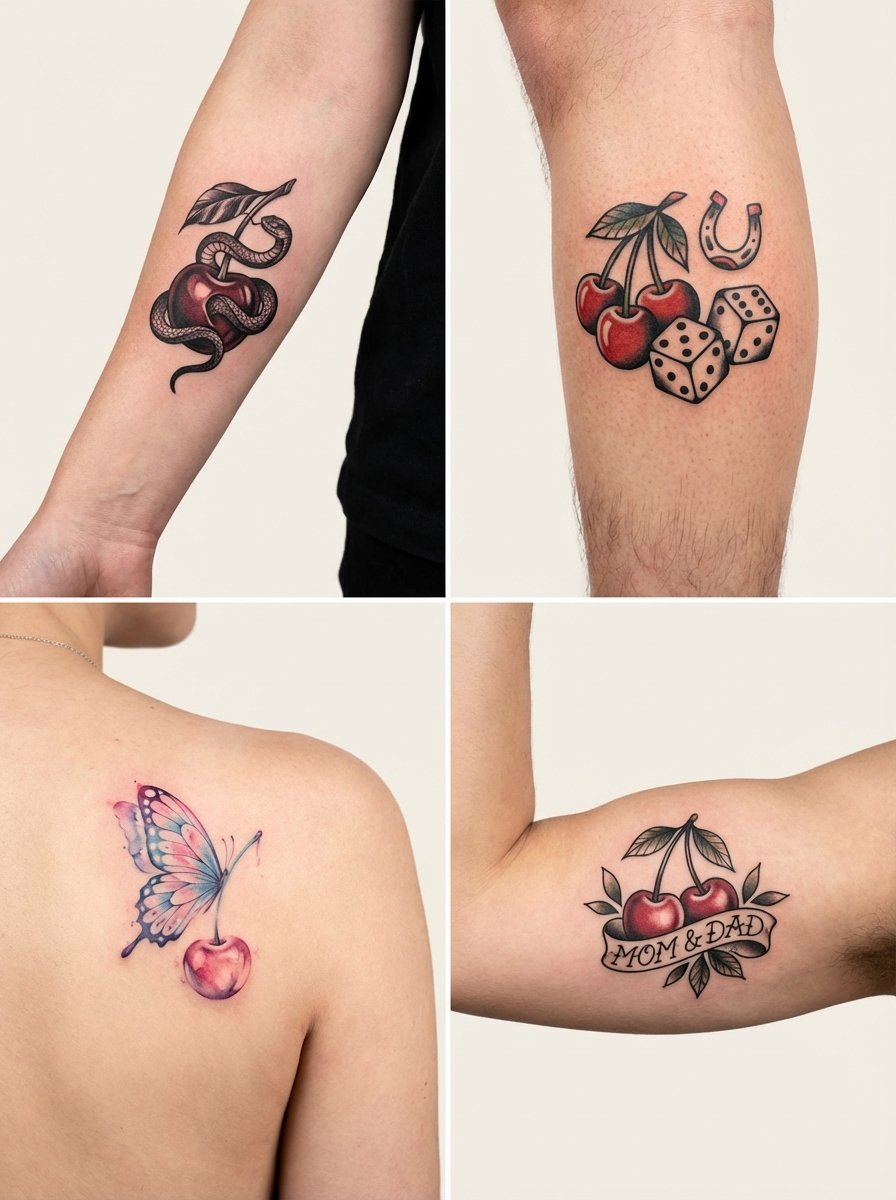
What surrounds the cherry shapes its reading as much as the cherry itself. These are the combinations that recur most frequently and the meaning each adds.
- Cherry + serpent: temptation, forbidden knowledge, the Eden narrative. Dramatic, gothic-adjacent, often rendered in darker palettes.
- Cherry + dice or playing cards: luck, fortune, gambler’s philosophy. Classic flash combo that leans into the slot-machine cherry association.
- Cherry + butterfly: transformation and fleeting beauty. Both cherry and butterfly reference the brief, intense moment of peak — the combination doubles down on this theme.
- Cherry + banner with name or word: dedication or memorial. The banner format (from American traditional flash) allows a name or phrase to be integrated with the fruit motif — a personalisation of the classic design.
- Cherry + crown: regality and self-possession. The crowned cherry appears in neo-traditional and new-school styles and communicates ownership of desire — the self as monarch of its own pleasures.
- Cherry + lips or teeth: appetite, desire, and the act of taking. Close compositional relationship to the bitten cherry reading — the lips and teeth make the desire explicit rather than implied.
FAQ: Cherry Tattoo Meaning
Q: What does a cherry tattoo mean?
Context-dependent: youth and impermanence (Japan), femininity and sensuality (American pin-up tradition), temptation and forbidden desire (Eden symbolism), or luck (gambling culture). The composition, style, and accompanying elements determine which reading dominates. A cherry with blossoms reads seasonal beauty; a cherry with a serpent reads temptation; a double cherry reads partnership.
Q: What does a cherry tattoo mean on a woman?
Historically associated with femininity, allure, and playful sensuality from the 1940s-1950s pin-up tradition. Contemporary wearers often reclaim this: the cherry as self-defined desirability on personal terms rather than external projection. In Japanese tradition, both men and women use cherry symbolism for impermanence and seasonal beauty. The meaning is ultimately set by the wearer and the specific design.
Q: What is the best placement for a cherry tattoo?
Small designs (single or double cherry): behind the ear, inner wrist, ankle, collarbone. Medium designs with leaf elements: upper arm, shoulder blade, ribcage. Large Japanese or neo-traditional compositions: thigh or back. The stem direction gives the design visual energy — upward feels lighter; downward adds weight.
Q: What tattoo styles work best for cherry designs?
American Traditional for the boldest, most lasting result. Japanese for seasonal and impermanence symbolism. Fine line for intimate small-scale realism. Neo-traditional for dimensional depth with a bold outline. Traditional American cherry tattoos age the best — bold outlines and flat colour hold for decades.
Q: What does a double cherry tattoo mean?
Two cherries on a single stem: partnership, connection, two lives joined. Common as a couples tattoo. Within pin-up tradition also references duality — innocence and experience coexisting. One of the most iconic and consistently recognised compositions in the American traditional tattoo vocabulary.
- 6shares
- Facebook0
- Pinterest6
- Twitter0
- Reddit0