A client I worked with last year had just moved into a renovated Victorian terrace and called me in to consult on why the kitchen felt wrong. The colour was beautiful — a warm off-white she’d chosen carefully, tested with samples, lived with in different lights. Nothing wrong with the colour at all. The problem was on the ceiling.
Her contractor had used the same tin of paint on the ceiling as on the walls. It was a satin finish. In the morning light, you could see every single drywall joint, every fastener dimple, every slight variation in the skim coat — all of it caught and amplified by the reflective surface bouncing light at a consistent angle. The ceiling looked like a topographic map of its own imperfections.
We repainted the ceiling in flat white. Two hours of work. The ceiling disappeared — exactly as a ceiling should. That experience is the best single illustration of why paint finish is not a secondary decision. Colour is the soul of a painted room. Finish determines the physics. Get the finish wrong and the colour can’t save you. Get both right and the room does what you designed it to do.
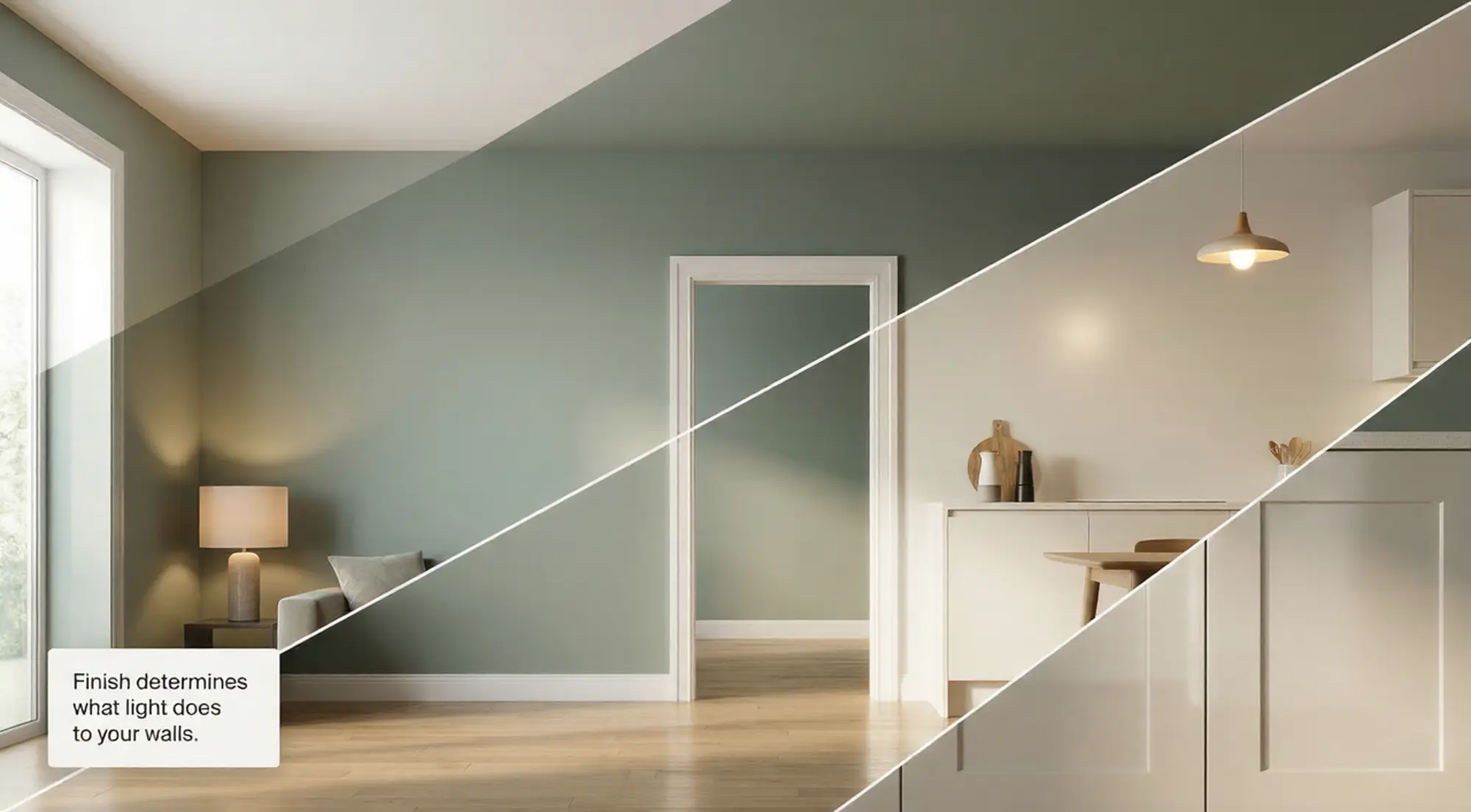
This guide covers the full hierarchy of paint finishes — flat through high-gloss — with the specific light physics behind each, the room-by-room logic, the design consequences, and the common mistakes professionals see repeatedly.
It’s not about preferences. It’s about understanding why each finish behaves the way it does, and using that understanding to make better decisions every time.
Why Finish Matters: The Light Physics of Sheen
Understanding why different finishes behave differently starts with one concept: surface microgeometry.
Every painted surface, no matter how smooth it looks, has microscopic texture. The difference between finishes is how that texture interacts with light.
Matte and Flat: The Diffusion Effect
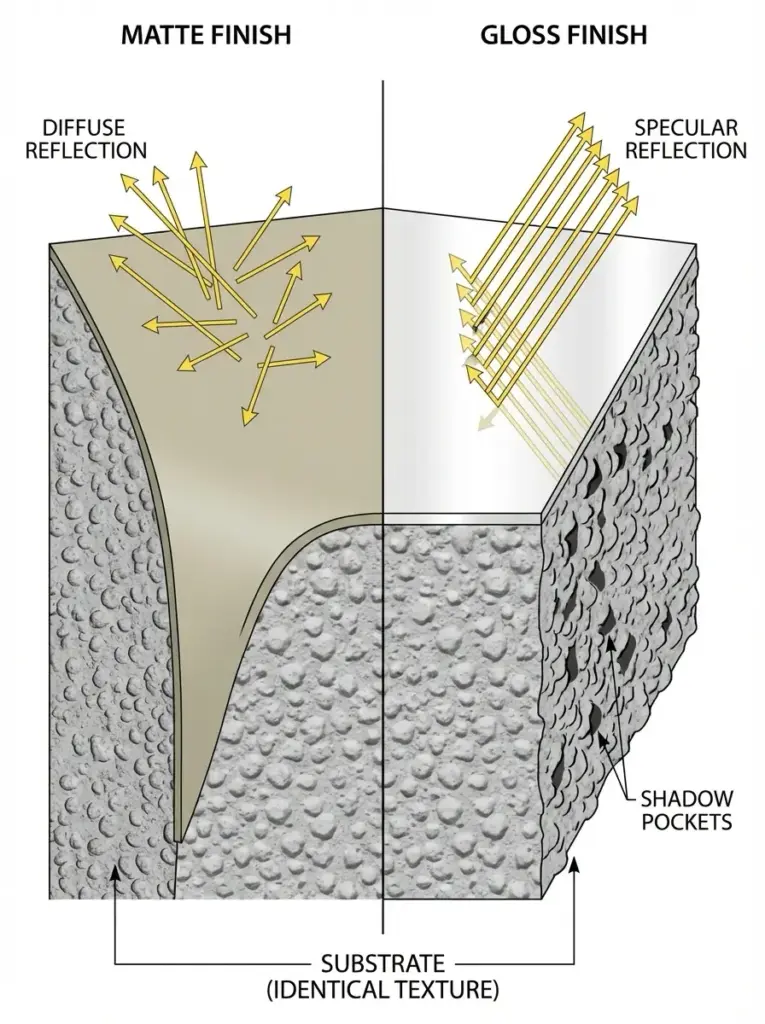
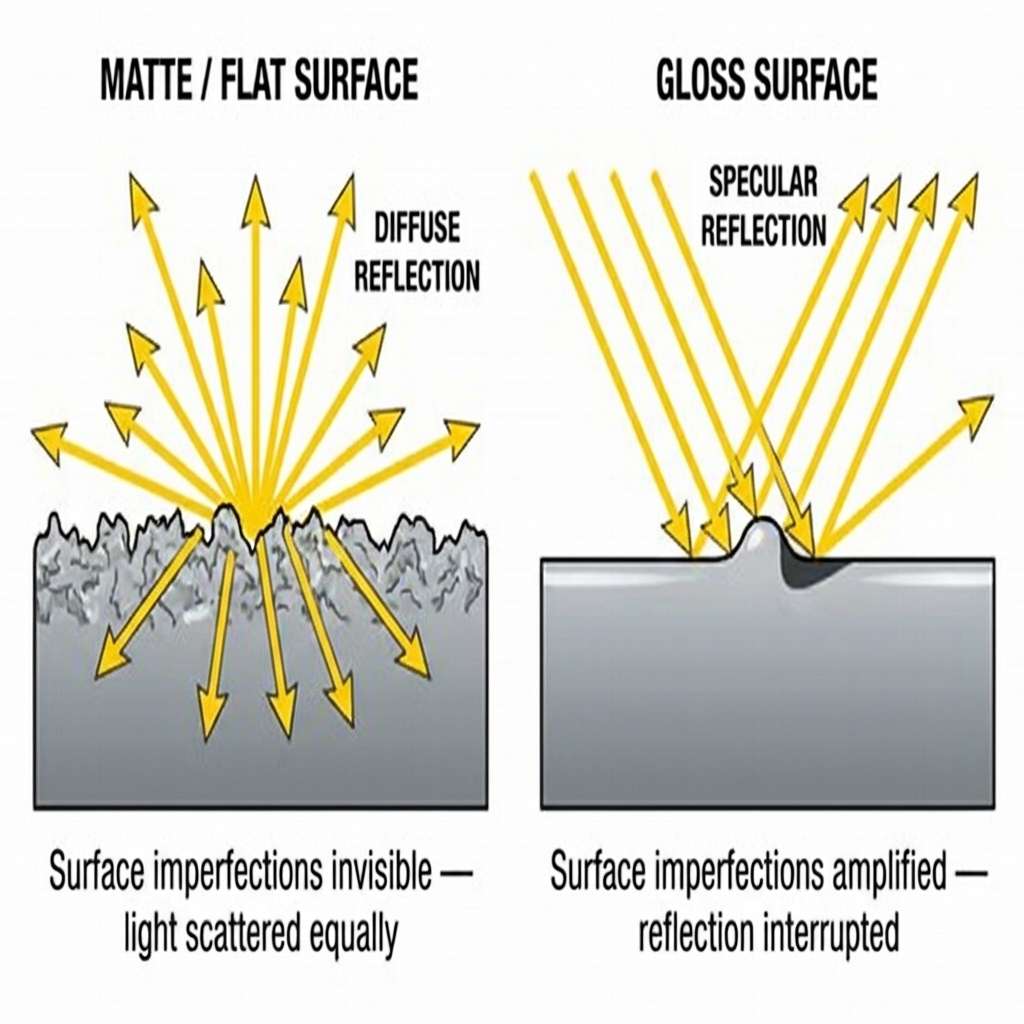
Matte and flat finishes contain a high proportion of pigment particles and mineral fillers relative to binders. Under magnification, a dried flat paint surface looks like a landscape of tiny rough peaks — microscopically irregular. When light hits this surface, it scatters in hundreds of different directions simultaneously.
The technical term is diffuse reflection. The practical result: the eye perceives a uniform, non-directional surface regardless of the light source position or angle. Surface imperfections — drywall joints, slight undulations in plaster, brush marks — become invisible because they are never lit and shadowed simultaneously from the viewer’s position.
Gloss and Semi-Gloss: The Mirror Effect
Gloss finishes contain fewer pigment particles and more resinous binders, which flow and level during drying to create a microscopically smooth surface.
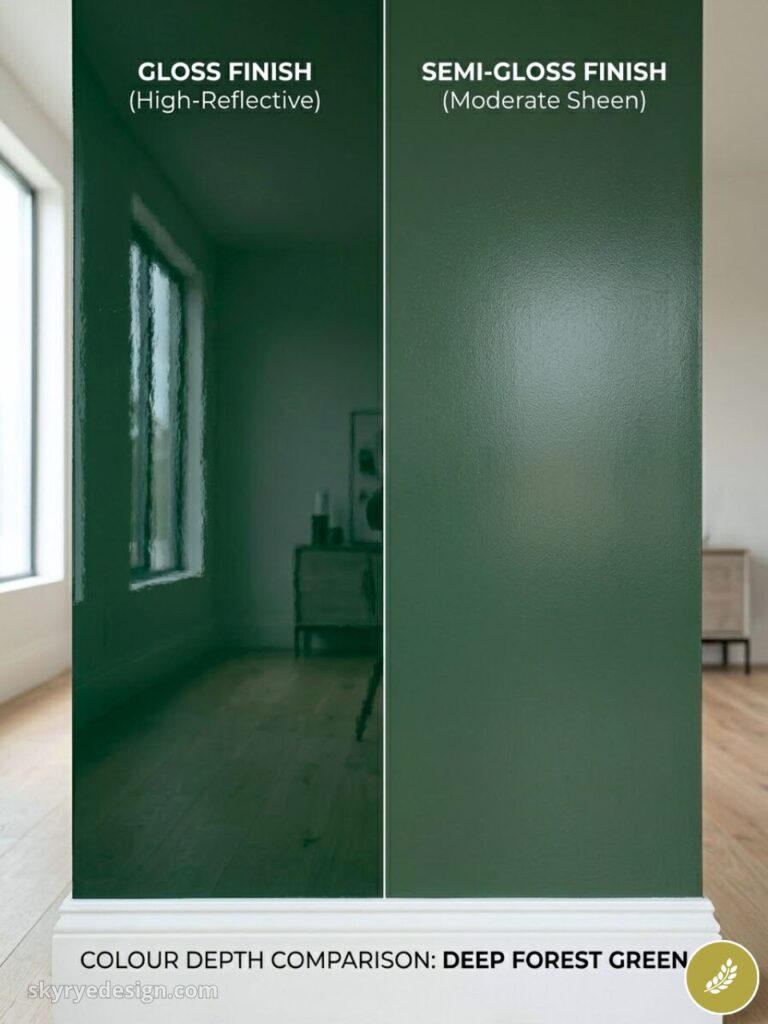
When light hits this surface, it reflects at a consistent angle — the way a mirror does. This is specular reflection. Any surface irregularity beneath the paint — a raised joint, a fastener dimple, a brush stroke — disrupts the reflection angle at that point, creating a visible shadow or bright spot. The higher the sheen, the more faithfully the surface reports what is beneath it. A high-gloss wall is, in effect, a quality-control report on the surface preparation.
The Design Consequence
This physics has a direct design implication that goes beyond hiding imperfections.
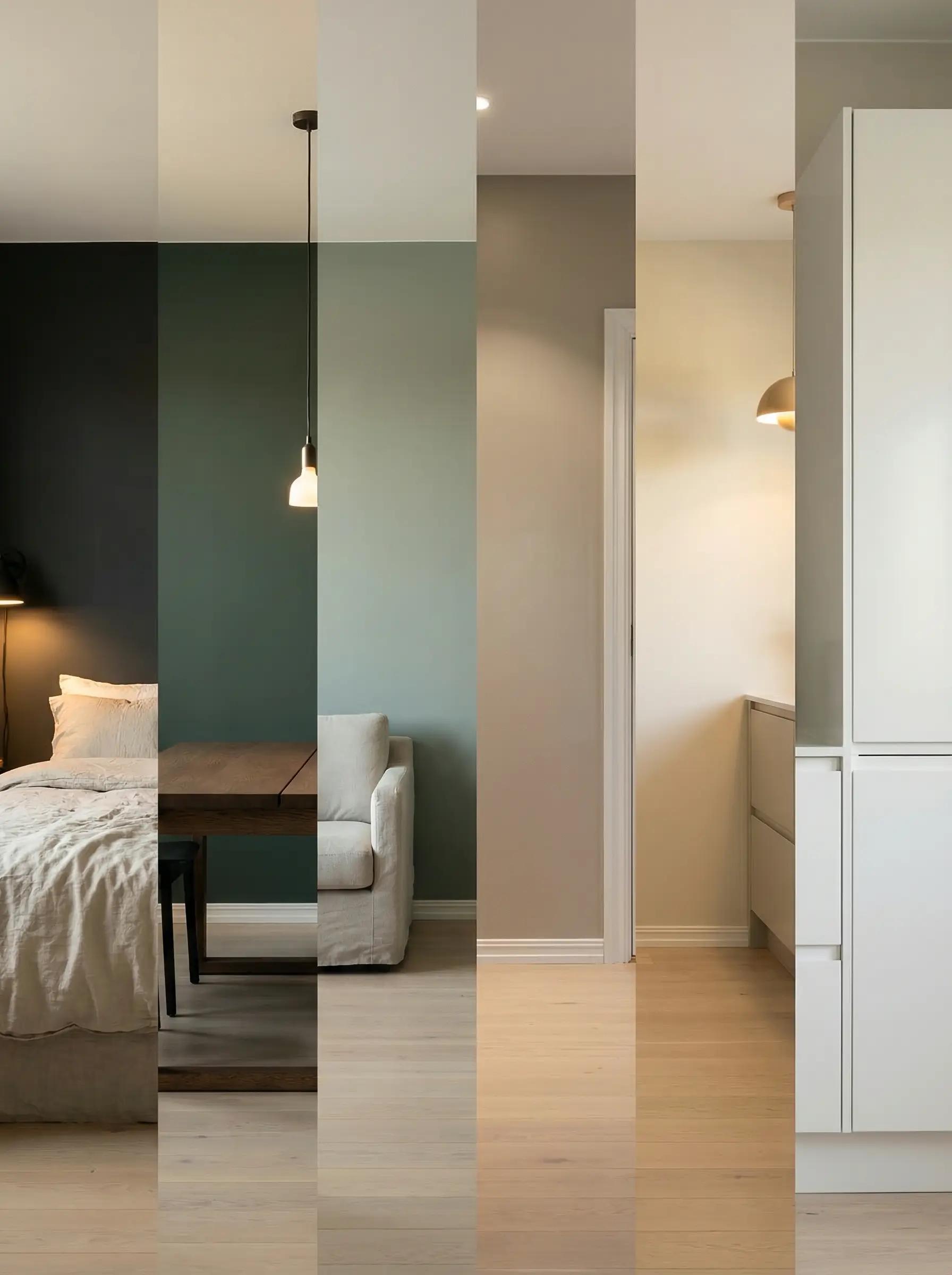
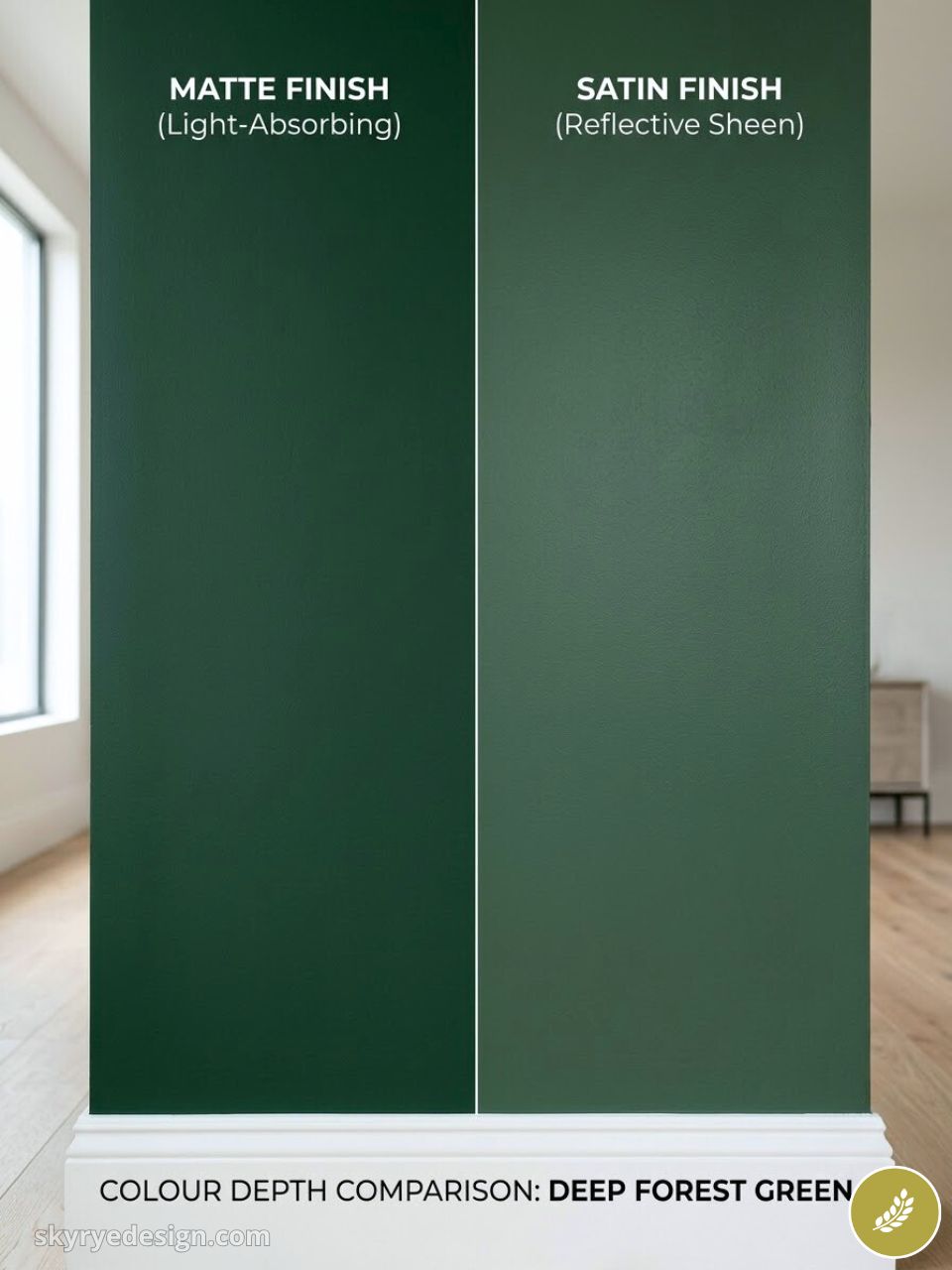
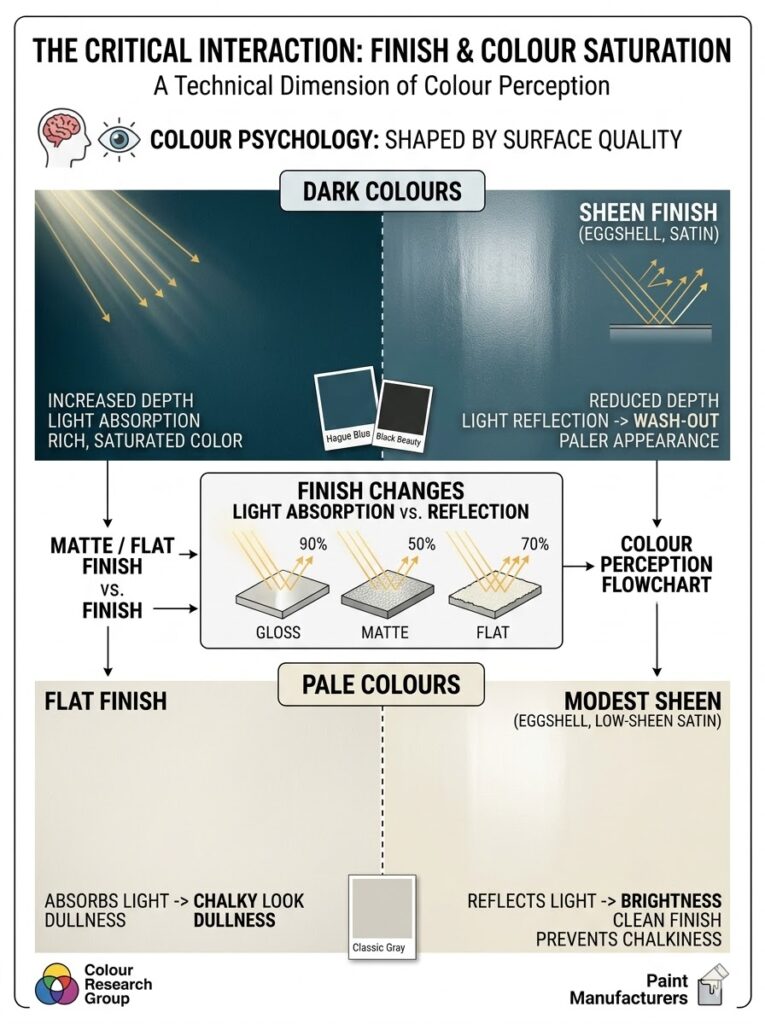
Matte finishes make colours appear deeper and more complex because they absorb ambient light rather than reflecting it back. The same colour in satin will appear noticeably lighter and slightly more washed-out than in matte. For deeply saturated colours — forest green, burgundy, charcoal — matte finish dramatically intensifies the visual impact. For pale neutrals where the goal is brightness, a modest sheen (eggshell or satin) helps bounce light around the room and prevent the colour from reading as flat and dull.
This is the design logic that complements colour psychology research: the finish determines how much of the colour’s energy reaches the eye. Blue in flat and blue in gloss are not the same psychological experience, even if they came from the same tin.
The Finish Hierarchy: Six Levels Explained
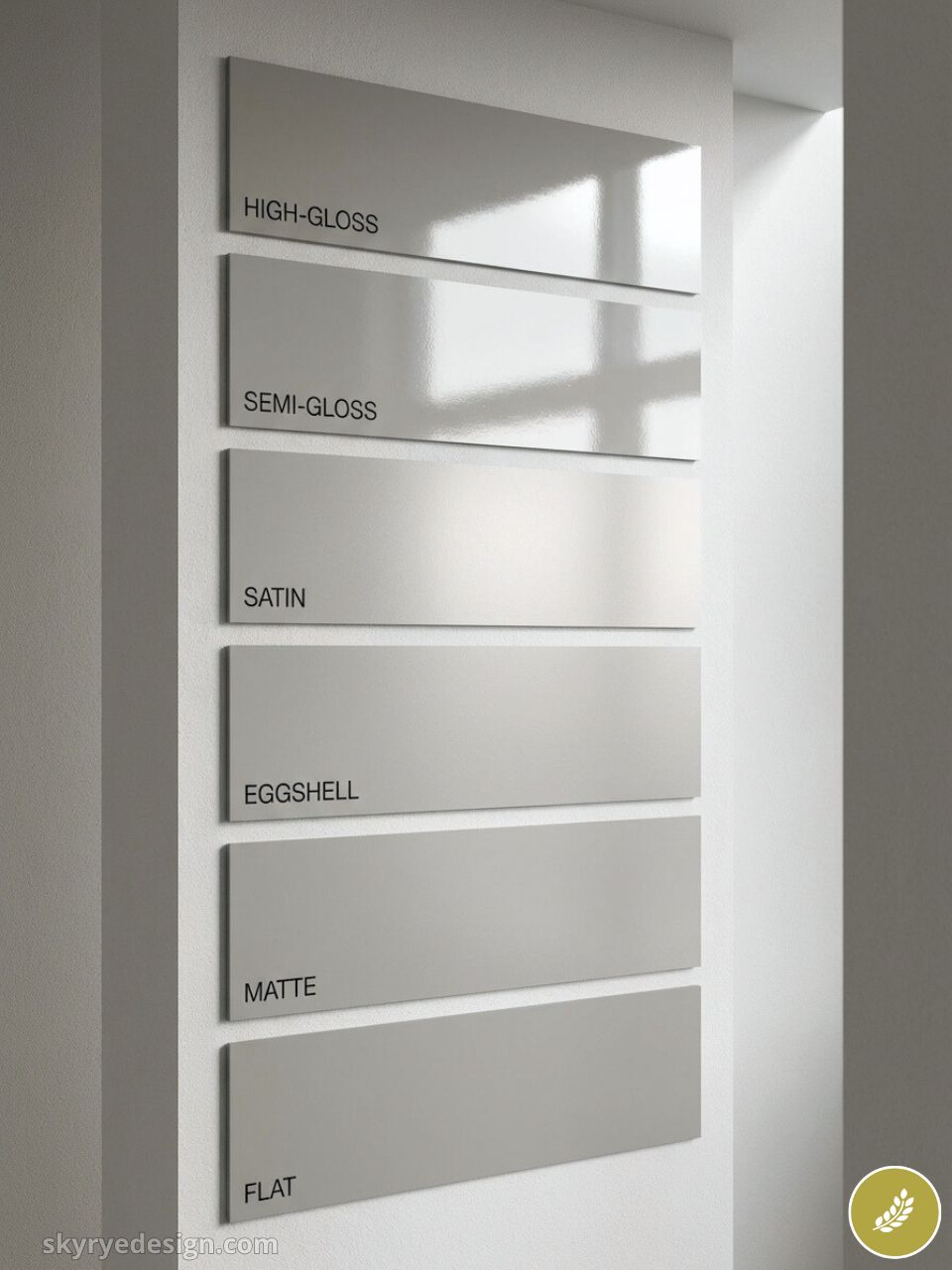
Paint finishes are measured by sheen value — the percentage of light reflected at a 60-degree angle. Most manufacturers organise their finishes into six levels, from flat to high-gloss. Each level has a specific set of properties and appropriate applications.
Flat / Ultra-Flat | Sheen: 0–5% — No reflectivity
Best for: Ceilings in all rooms; walls in bedrooms, dining rooms, formal living spaces; any surface with significant imperfections
Avoid on: Kitchens, bathrooms, children’s rooms, hallways, any surface that needs regular cleaning
Design impact: Creates the most intense, velvety colour saturation. Makes rooms feel intimate and enveloping. Absorbs light rather than reflecting it, which can make a small room feel smaller — but also makes a large room feel anchored and luxurious.
Matte | Sheen: 5–10% — Barely perceptible sheen
Best for: Living room walls, bedroom walls, dining rooms, home offices; rooms where atmosphere matters more than cleanability
Avoid on: Surfaces subject to steam, moisture, or regular wiping; trim and woodwork
Design impact: A sophisticated middle ground — more durable and slightly more washable than flat, with the same imperfection-hiding quality. The go-to choice for professional interior designers specifying wall paint in feature rooms. Produces richer colour depth than any finish above it on the hierarchy.
Eggshell | Sheen: 10–25% — Soft, low sheen
Best for: Living rooms, hallways, entryways, low-traffic bedrooms; general-purpose wall paint in most residential rooms
Avoid on: Ceilings; walls with significant subsurface texture or unrepaired imperfections
Design impact: The most popular residential wall finish for good reason — it sits at the exact point where cleanability and imperfection-hiding are both acceptable. Adds slight luminosity to colour without the problems of higher sheens. Eggshell in a north-facing room gives the colour more presence than flat without making the surface reflective.
Satin | Sheen: 25–35% — Soft glow, pearl-like
Best for: Kitchen walls, bathroom walls, children’s bedrooms, hallways with heavy traffic; all woodwork in contemporary interiors
Avoid on: Ceilings; walls with surface preparation issues; any surface where lap marks and roller texture will show
Design impact: The workhorse finish for high-performance rooms. More binders and fewer pigment particles than eggshell give satin its durability and cleanability edge — this is what allows you to wipe down a grease splatter without destroying the surface. In design terms, satin adds a subtle luminosity that reads well against matte walls: the slight contrast between a satin-finish door frame and a matte wall is more sophisticated than the flat-on-flat alternative.
Semi-Gloss | Sheen: 50–70% — Noticeably shiny
Best for: All trim, architraves, skirting boards, door frames, window frames, cabinetry; bathroom walls where maximum moisture resistance is needed
Avoid on: Large wall areas; ceilings; any surface that is not very smooth
Design impact: Semi-gloss on trim creates the visual separation between wall and architectural element that makes a room read as resolved and finished. The sheen catches light on the edge profiles of architraves and skirting boards, giving them definition that flat paint removes. In design terms, white semi-gloss trim against a matte coloured wall is the pairing that defines the traditional interior aesthetic.
High-Gloss | Sheen: 70–90%+ — Mirror-like
Best for: Front doors, cabinetry in lacquer finishes, specific furniture-like architectural elements; interior doors as a deliberate design statement
Avoid on: Walls and ceilings unless very smooth and impeccably prepared; DIY applications where application skill is not at a professional level
Design impact: High gloss is a commitment. It requires flawless surface preparation, professional-level application skill, and a deliberate design intent. When executed correctly on a front door or a lacquered kitchen cabinet, it creates an effect that no other finish achieves: a deep, dimensional surface that seems to have internal depth. Bill Carroll of Indiana University describes the gloss-to-flat spectrum as ‘the difference between a mirror and sandpaper’ — and at the high-gloss end, that mirror quality is exactly the point.
✏ Builder note: The professional rule of thumb that builders and decorators use: start with the worst-prepared surface and ask what finish it can support. If the drywall is builder-grade, flat or matte is the honest answer. Every step up the sheen hierarchy requires one step up in surface preparation quality. Skipping that relationship is the most common source of client callbacks.
Room-by-Room Finish Logic
Ceilings: Always Flat, Without Exception
The ceiling is the one surface in any room where the finish question has a single correct answer: flat or ultra-flat, always.
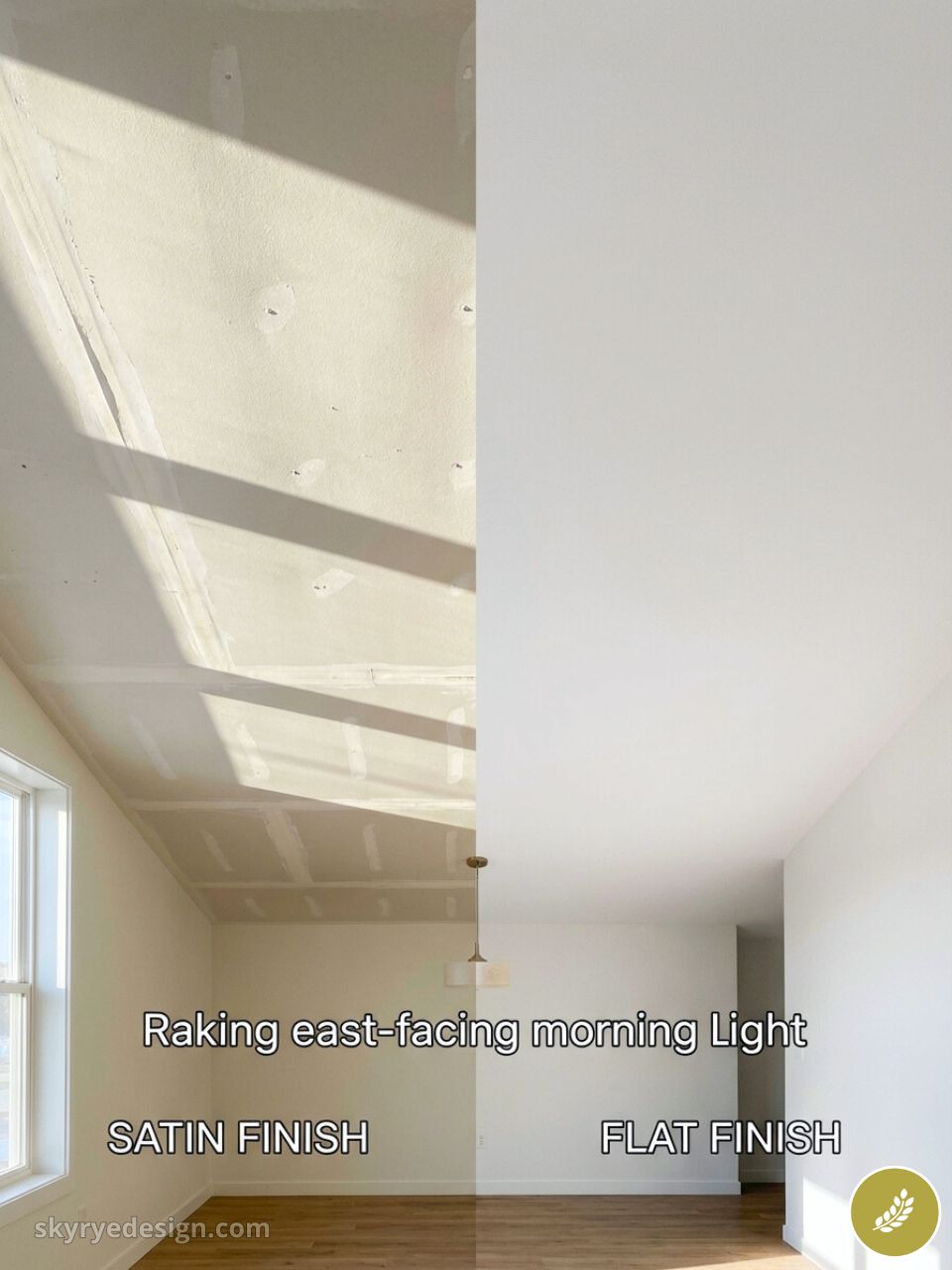
Benjamin Moore’s Waterborne Ceiling Paint (508) and Sherwin-Williams’ Ceiling Flat are both formulated specifically for this purpose — zero sheen so that raking light from windows never reveals the fastener pattern, tape joints, or skim-coat variations that are present in virtually every drywall ceiling.
The reason contractors sometimes use wall paint on ceilings is economy — one tin covers both surfaces. The reason this creates the outcome my client experienced is that even a modest satin sheen on a ceiling behaves like a specular surface under strong directional light.
Morning sun through east-facing windows, late afternoon light from the west — these are the lighting conditions that expose everything wrong with a sheened ceiling. The fix costs two hours of repainting. The mistake costs the visual quality of the room every day until it is corrected.
Kitchens: Satin on Walls, Semi-Gloss on Cabinetry
The kitchen is the room that most clearly illustrates the functional logic of finish choice. Grease, steam, and routine splashing create a surface environment that requires a finish capable of tolerating wiping — ideally repeated wiping with a damp cloth. Flat and matte are essentially non-washable in practice: the pigment-heavy surface structure traps grease and deteriorates with scrubbing. Eggshell is marginal. Satin is the minimum functional specification for kitchen walls.
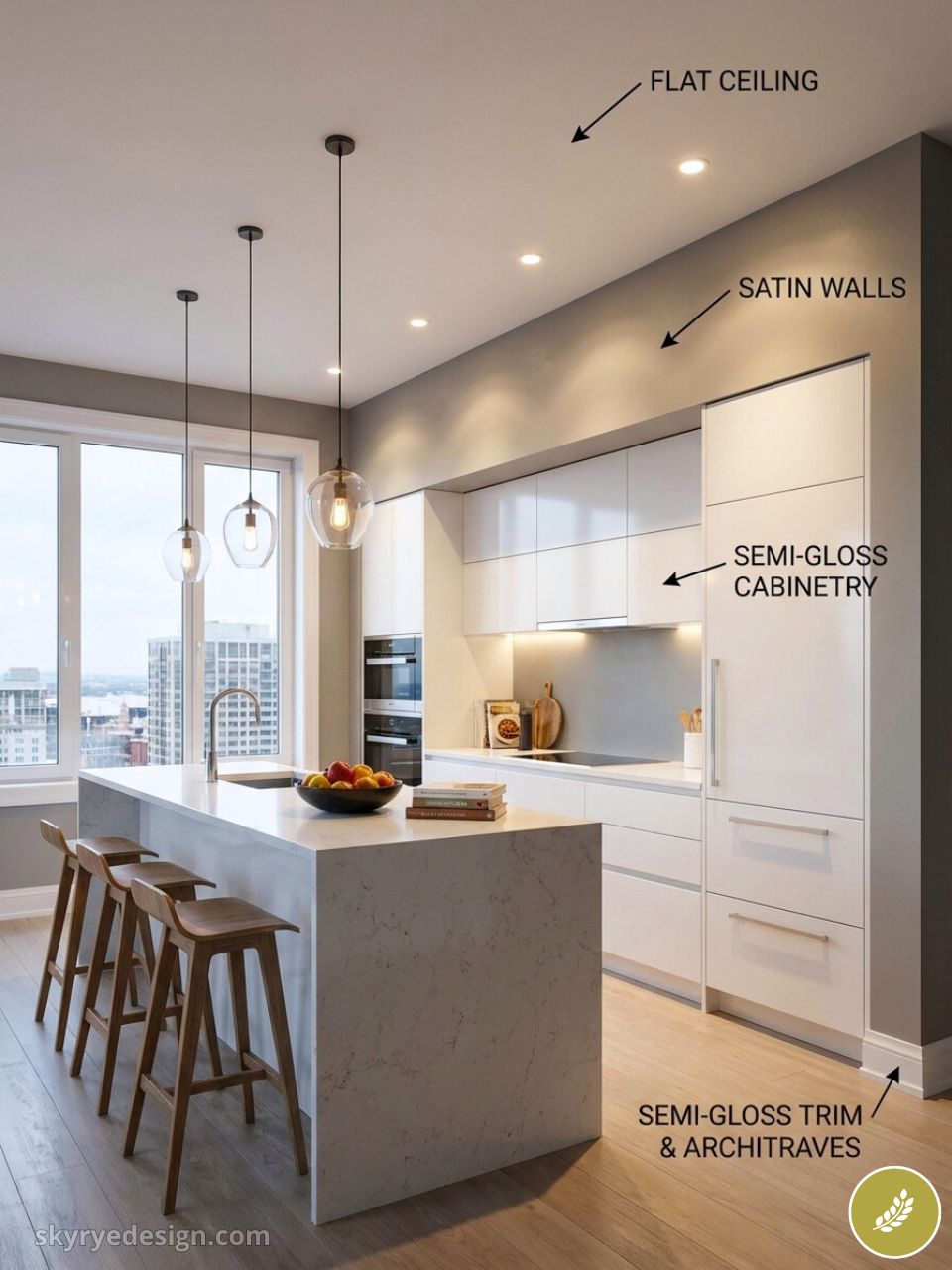
Semi-gloss on kitchen cabinetry is the standard professional specification, and for good reason: the Benjamin Moore Advance Interior Semi-Gloss (793) cures to a furniture-like surface that tolerates daily contact and regular cleaning over years of use. For a high-spec kitchen with lacquered cabinetry, this is also the finish level where the door fronts begin to function as design elements rather than just surfaces — the semi-gloss catches the light at the routed edges and panel profiles, giving the cabinetry a three-dimensional presence.
If you’re uncertain about the right product or application approach for your specific kitchen environment, a local painting company like Crash of Rhinos can advise on the specific products and preparation that produce a durable, washable finish in a working kitchen.
Bathrooms: Satin Walls, Semi-Gloss Trim
Bathrooms cycle through dramatic humidity changes — steam from a shower, then rapid drying. This is one of the most challenging environments for paint. Satin’s binder-rich formulation provides genuine moisture resistance that eggshell and matte do not. The Sherwin-Williams satin line and Benjamin Moore’s Aura Bath and Spa (532) are specifically engineered for this environment, with mildew-resistant formulations that prevent the visible biological growth that appears on poorly-specified bathroom paint within months.
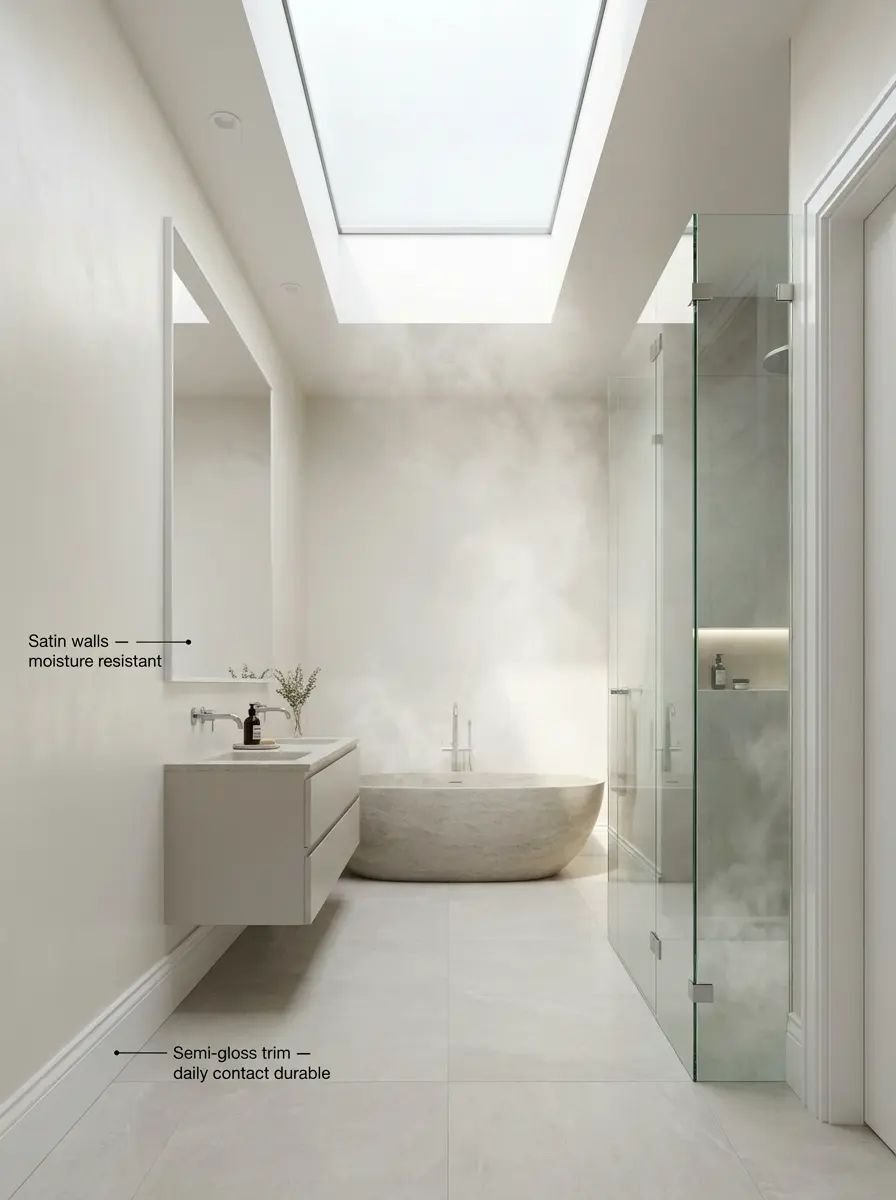
The trim — skirting, door architraves, window frames, and mirror frame if painted — goes to semi-gloss. This is both a durability decision (semi-gloss handles the daily contact and moisture better than satin on woodwork) and a design decision: the semi-gloss trim creates a visual boundary that organises the bathroom space and reads as clean and precise.
Living Rooms and Bedrooms: The Matte Opportunity
Living rooms and bedrooms are the rooms where the designer has the most freedom to choose on the basis of atmosphere rather than function. These are low-moisture, relatively low-contact surfaces that don’t require the cleaning performance of satin.
This is where matte and flat finishes produce their best work. The idea connects directly to what mindfulness and mental clarity practitioners describe as visual noise reduction — the same principle behind uncluttering the mind applies to physical environments: a matte wall is literally quieter than a gloss one because it makes no demands on the eye’s attention. Sheen creates micro-movement as you move through a room; Matte simply holds the colour.
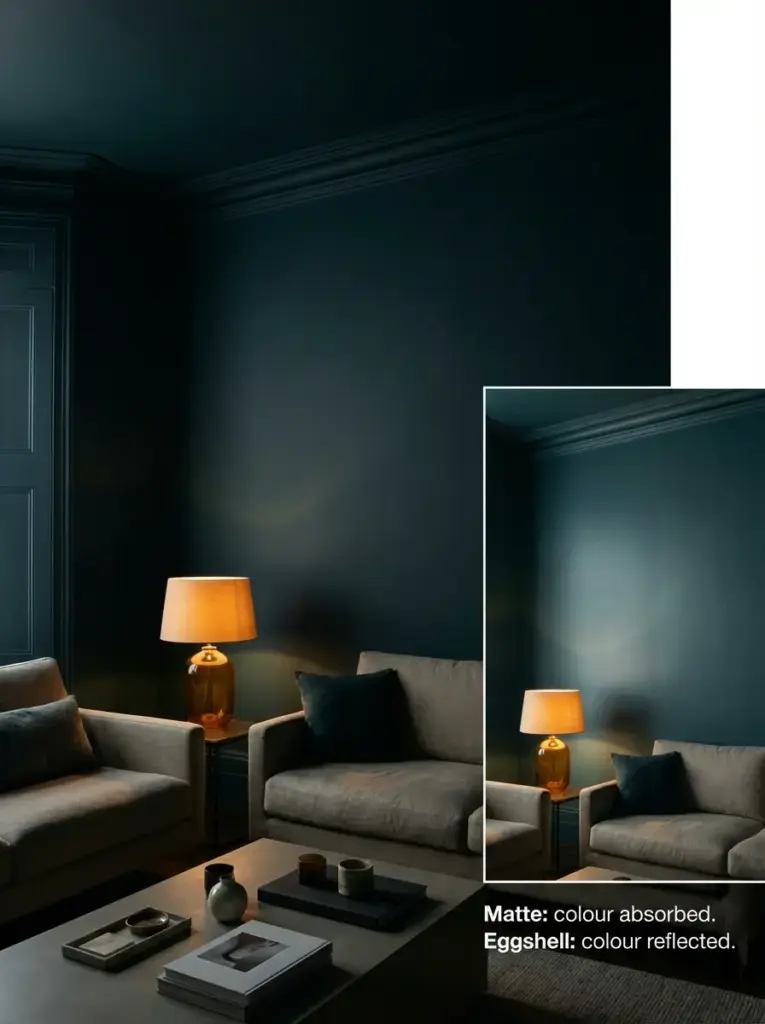
A living room painted in a deep, saturated colour — the kind of colour that the colour psychology literature associates with depth, mystery, and introspection — achieves its maximum visual impact in a matte finish. The colour absorbs into the surface rather than bouncing off it, and the effect at 6pm under warm lamp light is genuinely different from the same colour in eggshell. This is the room where the design decision about finish has the highest aesthetic leverage.
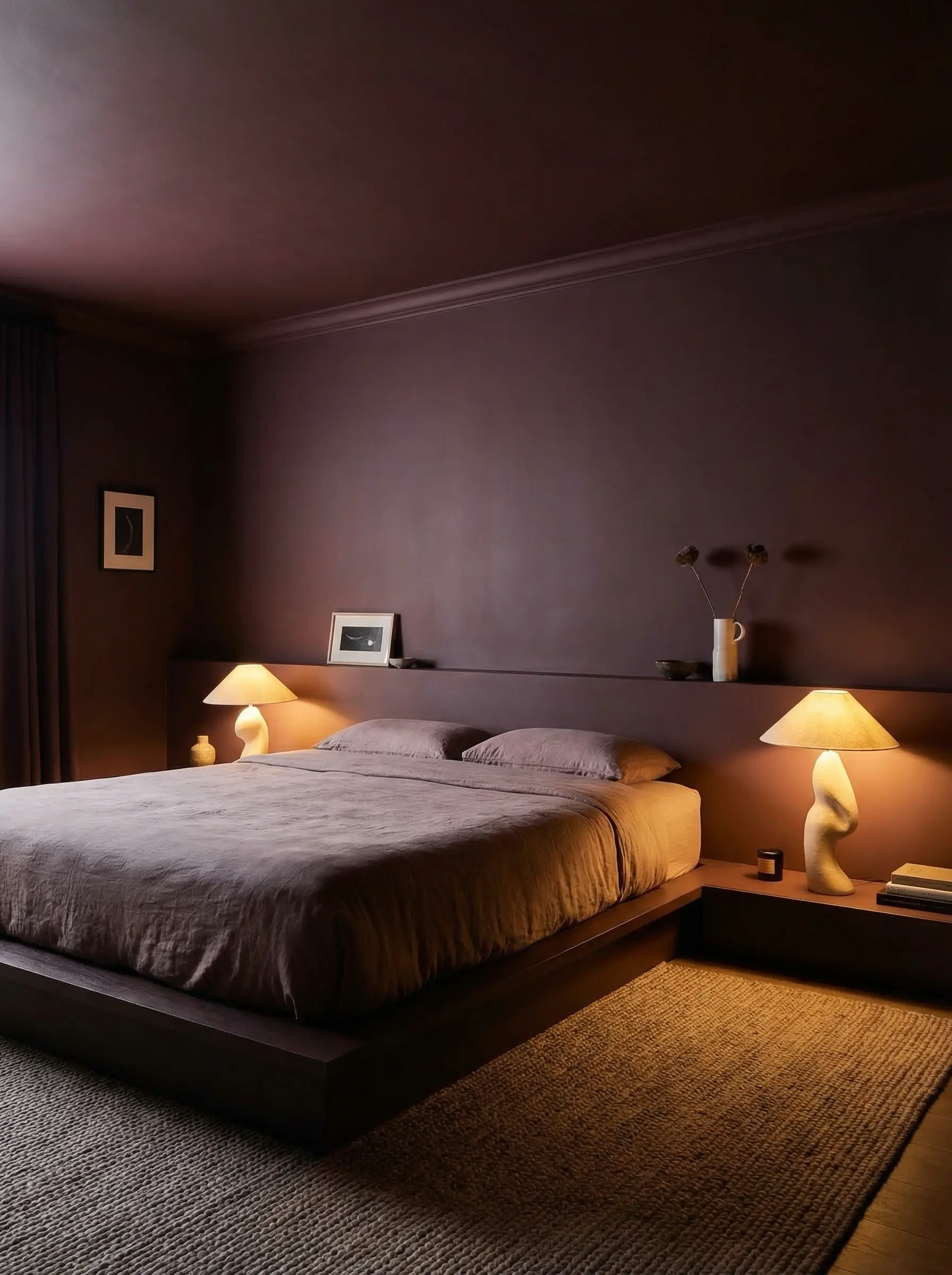
The subconscious conversations that a room holds with its occupants are partly conducted through this surface quality — the soft absorption of a matte wall creates a different psychological register than the slight luminosity of eggshell.
✏ Builder note: For bedrooms specifically, the goal of deep, restorative rest is served by surfaces that don’t compete for attention. A flat or matte ceiling and matte walls create the visual equivalent of silence. This is part of why the Scandinavian and Japanese design traditions that emphasise calm and mental clarity both favour low-sheen surfaces in sleeping and meditation spaces. The idea of decluttering the mind extends to the visual environment — matte surfaces are literally quieter than gloss ones.
Hallways and High-Traffic Areas: Eggshell as the Compromise
Hallways present the clearest argument for eggshell: they’re the room where surfaces get touched, scuffed, and leaned against more than anywhere else in the house, but the surface preparation quality is often inconsistent and the lighting is frequently a single central source that creates raking conditions.
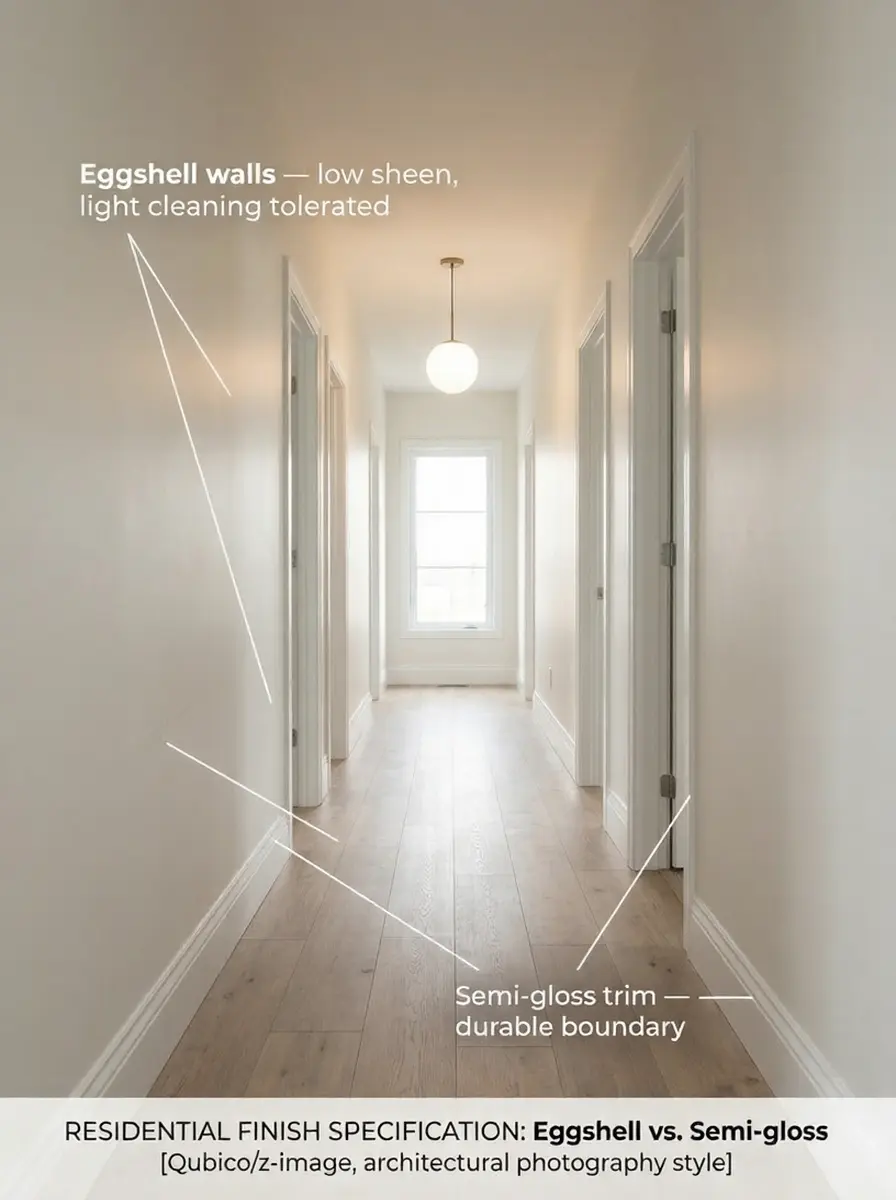
Eggshell at 10–25% sheen sits exactly at the point where the surface tolerates light cleaning without requiring satin’s higher reflectivity. It hides the minor undulations in hallway walls while standing up to the occasional wipe-down. It is the genuine compromise finish, and hallways are the genuine compromise room.
Finish as a Design Decision, Not Just a Technical One
The Trim-to-Wall Relationship
The most powerful design decision in a painted room is the sheen differential between trim and walls. The traditional pairing — white semi-gloss trim against a matte coloured wall — works because the contrast reads simultaneously as clean precision and as visual hierarchy. The eye is drawn to the semi-gloss trim edges because they catch the light; this serves to define the room’s architectural structure. Reducing this differential (satin trim against eggshell walls, for example) produces a flatter, more contemporary reading — less architectural emphasis, more surface continuity. Neither is wrong; both are deliberate design choices that produce different results.
Finish and Colour Saturation
The interaction between finish and colour perception is one of the less-discussed aspects of interior colour selection. The same colour chip from a paint deck will look different on a wall depending on the finish, because finish changes how much ambient light the surface absorbs versus reflects. For dark colours, matte or flat finish is almost always the better choice: the depth of a colour like Farrow and Ball’s Hague Blue or Benjamin Moore’s Black Beauty is served by a surface that absorbs light and prevents it from washing out the colour. For pale colours where brightness is the intent, a modest sheen (eggshell or low-sheen satin) prevents the colour from reading as chalky.
This is the technical dimension of what colour psychology research identifies as colour perception: our experience of a colour is not fixed but is shaped by surface quality, lighting conditions, and the reflective characteristics of surrounding surfaces.
The Single-Finish Trap
One of the most common mistakes in residential paint specification is using a single finish throughout a space — typically eggshell applied to walls, trim, and ceilings indiscriminately. This produces a room that feels technically correct but design-incomplete. The absence of sheen differentiation removes the visual hierarchy that tells the eye what surface is and what is an architectural element. Engaging a local painting company that understands finish specification is exactly the kind of professional input that prevents this outcome — the difference between a technically adequate paint job and a designed one.
Quick Reference: Finish by Room
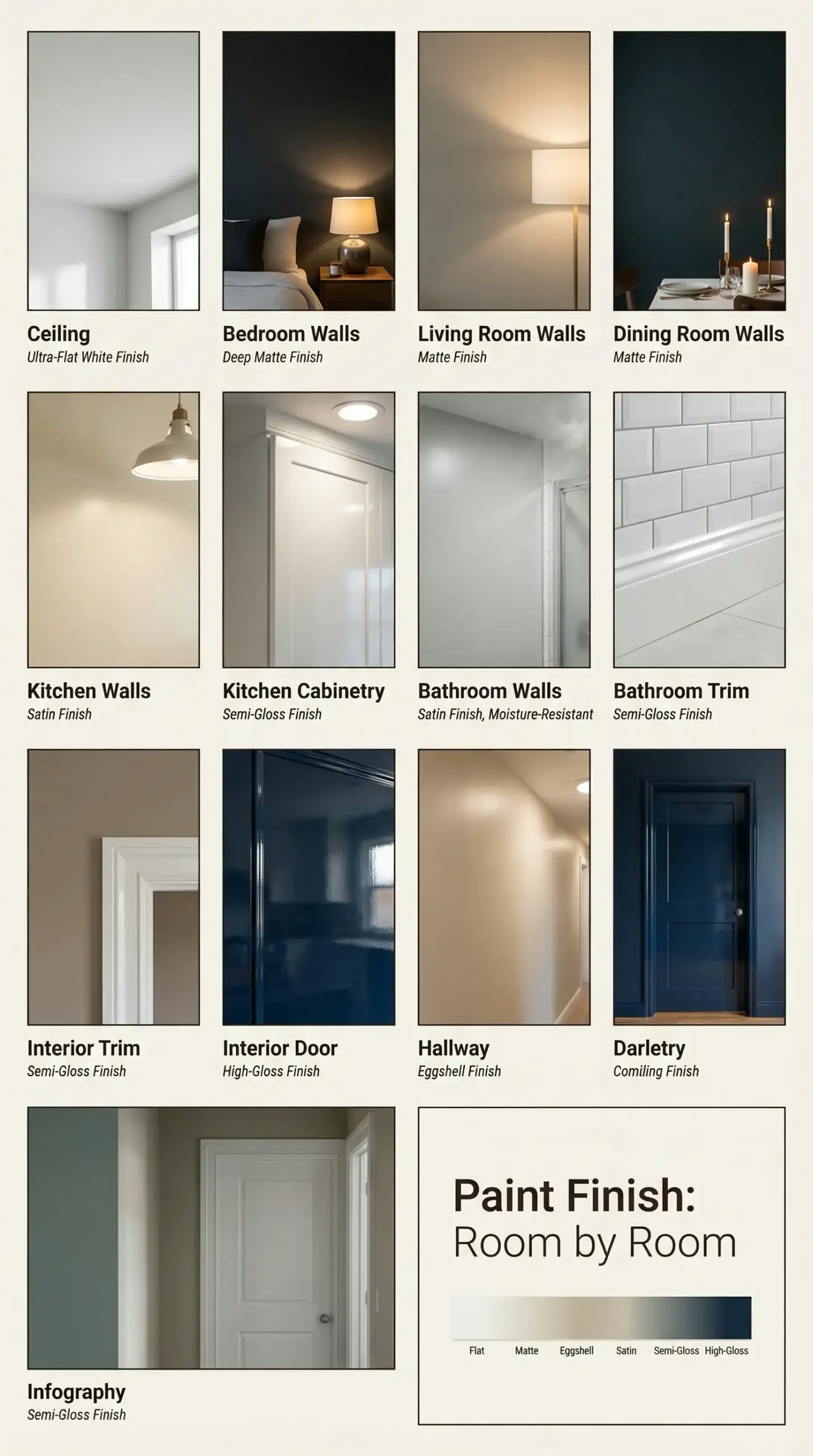
- Ceiling (all rooms): Flat or ultra-flat. No exceptions. Every sheen level above flat shows drywall imperfections under directional light.
- Bedroom walls: Matte or flat for maximum colour depth and visual calm. Eggshell if washability is a priority.
- Living room walls: Matte or eggshell depending on whether atmosphere or cleanability is the priority.
- Dining room walls: Matte. The evening candlelight or warm pendant light in a dining room is the context where matte finish achieves its most flattering effect.
- Kitchen walls: Satin minimum. Eggshell is acceptable in areas away from the cooking zone. Flat and matte are functionally inappropriate.
- Kitchen cabinetry: Semi-gloss or satin depending on desired aesthetic. Semi-gloss is the professional standard for durability and cleanability.
- Bathroom walls: Satin. Use a bathroom-specific formulation with mildew resistance (Benjamin Moore Aura Bath and Spa, Sherwin-Williams Emerald).
- Bathroom trim: Semi-gloss. The hardest-working trim surface in the house.
- All interior trim (skirting, architraves, door frames): Semi-gloss as standard. Satin for a contemporary softer look, accepting the slight durability trade-off.
- Interior doors: Semi-gloss for utility doors. High-gloss as a deliberate design statement on feature doors.
- Hallways and entryways: Eggshell. The correct finish for surfaces that need moderate cleaning tolerance without full satin reflectivity.
- Home office walls: Matte or eggshell. The cognitive environment for concentrated work benefits from a visually quiet, non-reflective surface.
FAQ: Paint Finishes
Q: What paint finish should I use on ceilings?
Flat or ultra-flat, without exception. The physics are non-negotiable: any sheen above flat will catch raking light and reveal the tape joints, fastener dimples, and skim-coat variations that are present in virtually every drywall ceiling. Benjamin Moore Waterborne Ceiling Paint (508) and Sherwin-Williams Ceiling Flat are purpose-formulated for this application. The one time professionals make an exception is on perfectly plastered historic ceilings with a mirror-smooth surface, where an eggshell finish adds luminosity without the imperfection risk.
Q: What is the best paint finish for kitchen walls?
Eggshell or satin for kitchen walls, with satin preferred for surfaces adjacent to the cooking zone. Satin’s higher binder content makes it genuinely washable — you can wipe down a grease splatter with a damp cloth without damaging the surface. Eggshell is acceptable for kitchen walls that are away from the cooking area and don’t accumulate grease. Flat and matte are functionally wrong for kitchens: the pigment-heavy surface structure traps grease and deteriorates with scrubbing.
Q: Why does gloss paint show imperfections more than matte?
Gloss surfaces reflect light at a consistent angle — specular reflection, like a mirror. Any surface irregularity disrupts this angle and creates a visible shadow or highlight at that point. Matte surfaces scatter light in all directions simultaneously — diffuse reflection — so the eye perceives the surface as even regardless of what is beneath it. The higher the sheen, the more faithfully the surface reveals its subsurface texture and application quality. This is why professional surface preparation (filling, sanding, priming) is exponentially more important as you move up the sheen hierarchy.
Q: Can I use satin finish on trim?
Yes, satin on trim is common in contemporary interiors, particularly in modern farmhouse and minimalist spaces where the traditional high-contrast semi-gloss trim look is not desired. The trade-off: satin trim is less durable than semi-gloss and harder to keep clean over time, particularly on skirting boards that receive regular contact from furniture, vacuum cleaners, and foot traffic. Semi-gloss (50–70% sheen) remains the professional standard for trim because it creates the strongest visual separation between wall and woodwork and provides the best cleanability.
Q: Does paint finish affect how the colour looks?
Significantly. The same colour in flat versus semi-gloss will appear as visibly different colours in the same room. Matte finishes make colours appear deeper and more complex because they absorb ambient light rather than reflecting it — the colour seems to have more depth and internal dimension. Semi-gloss and higher finishes make colours appear lighter and slightly less saturated, because the ambient light is reflected back toward the viewer, adding brightness but reducing depth. For deeply saturated colours (dark blues, greens, blacks) matte is almost always the better finish choice for maximising the colour’s design impact.
Q: What finish should I use in a bathroom?
Satin (25–35% sheen) for bathroom walls using a bathroom-specific formulation that includes mildew resistance, such as Benjamin Moore Aura Bath and Spa (532) or Sherwin-Williams Emerald Interior. These products are engineered to handle the humidity cycling that destroys standard wall paint within months in a bathroom environment. Semi-gloss (50–70%) for all bathroom trim — skirting boards, architraves, window frames, mirror frames if painted. The moisture resistance and daily-contact durability of semi-gloss is the correct specification for bathroom woodwork.
- 12shares
- Facebook0
- Pinterest12
- Twitter0
- Reddit0