My first attempt at biophilic design was a shelf full of half-dead pothos and a single piece of driftwood from a craft store. It looked like a sad aquarium had retired there. That was three years ago — and if you’ve ever Googled ‘biophilic interior design’ and felt vaguely overwhelmed by $50,000 living wall installations, this article is for you.
Here’s what’s shifted in 2026: biophilic design has finally moved out of luxury showrooms and into real homes. The trend has matured from ‘put more plants on your shelves’ into something genuinely interesting — science-backed, multisensory, and surprisingly doable on a normal budget.
- 1. From Visual to Multisensory: The Big Shift in 2026
- 2. Circadian Lighting: The Biophilic Trend You Can't See (But Definitely Feel)
- 3. Biophilic Materials That Age Well: Limewash, Stone & Live Wood
- 4. Living Walls and Moss Panels: What's Worth the Investment
- 5. Biophilic Color in 2026: The Low-Cortisol Palette
- 6. Biomorphic Shapes: Why Curves Beat Straight Lines for Wellbeing
- 7. Budget-Smart Biophilic Design: 5 High-Impact Changes Under $100
- FAQ: Biophilic Interior Design Trends 2026
- Q: What is biophilic interior design?
- Q: How is biophilic design different from just adding plants?
- Q: What are the most important biophilic design trends in 2026?
- Q: How much does biophilic design cost?
- Q: Do living walls require a lot of maintenance?
- Q: What colors are used in biophilic interior design?
- Q: Can biophilic design work in a small apartment?
- Conclusion: Start With One Layer, Not a Full Renovation
Research from the University of Technology Sydney found that indoor plants alone reduced employee anxiety by 37% and depression by 58%. But the 2026 version of biophilic design isn’t just about plants. It’s about circadian lighting, fractal patterns, sound, scent, and the way natural materials age in your space over time.
In this article, you’ll get 7 specific, actionable biophilic design trends — with real brand names, price points, and the science behind why each one actually works on your nervous system.
1. From Visual to Multisensory: The Big Shift in 2026
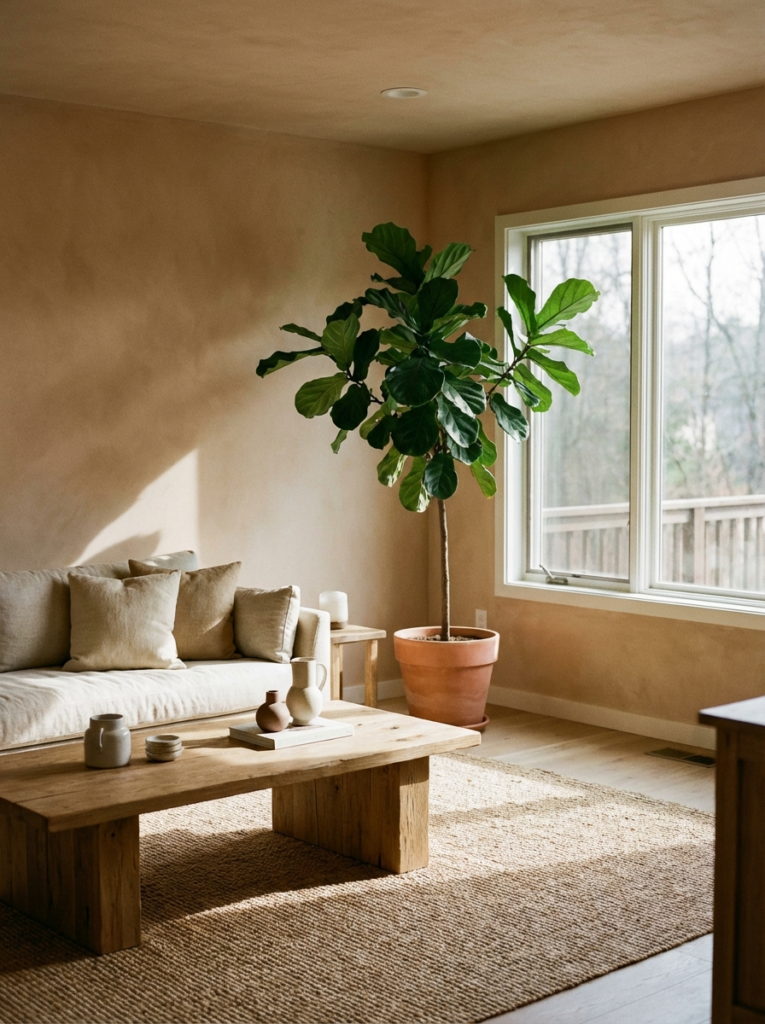
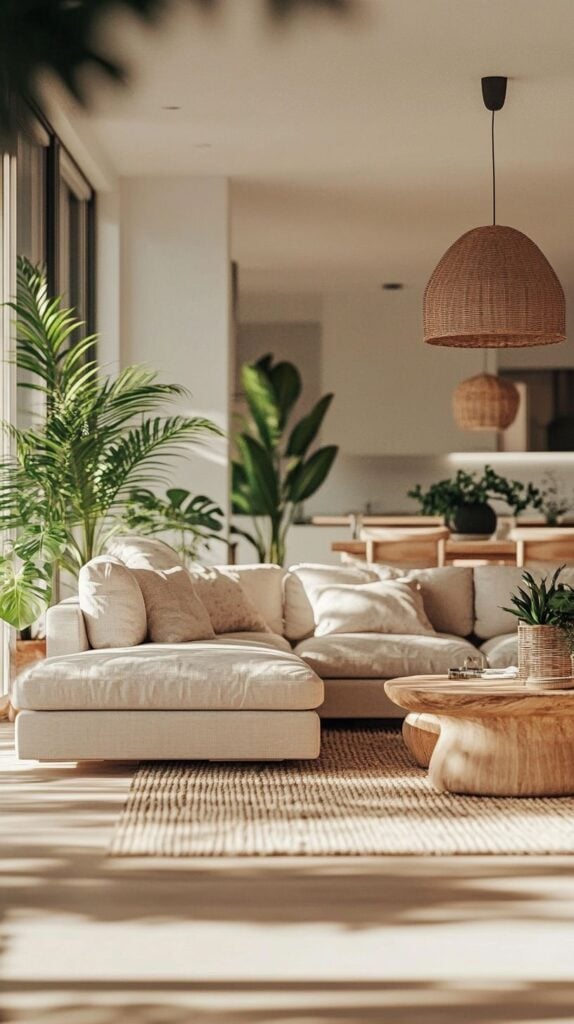
Walk into a well-designed biophilic space and something happens before you can name it. Your shoulders drop. Your breath slows. You’re not consciously registering the jute rug or the moss wall — your nervous system is already responding.
That’s the real story of biophilic design in 2026: it’s stopped being a visual checklist and become a full sensory conversation.
Why Your Eyes Aren’t Enough
For years, biophilic design was treated as an aesthetic category — pick earthy colors, add a few plants, done. But research published in the Journal of Environmental Psychology in 2025 found that spaces with visual biophilic elements alone showed more modest wellbeing benefits compared to rooms that engaged multiple senses.
The most effective spaces combined: natural light that shifts with the day, tactile surfaces (rough linen, smooth stone, unfinished wood), ambient sound (water features, soft acoustic materials), and occasional scent cues — herbs in the kitchen, cedarwood in a bedroom.
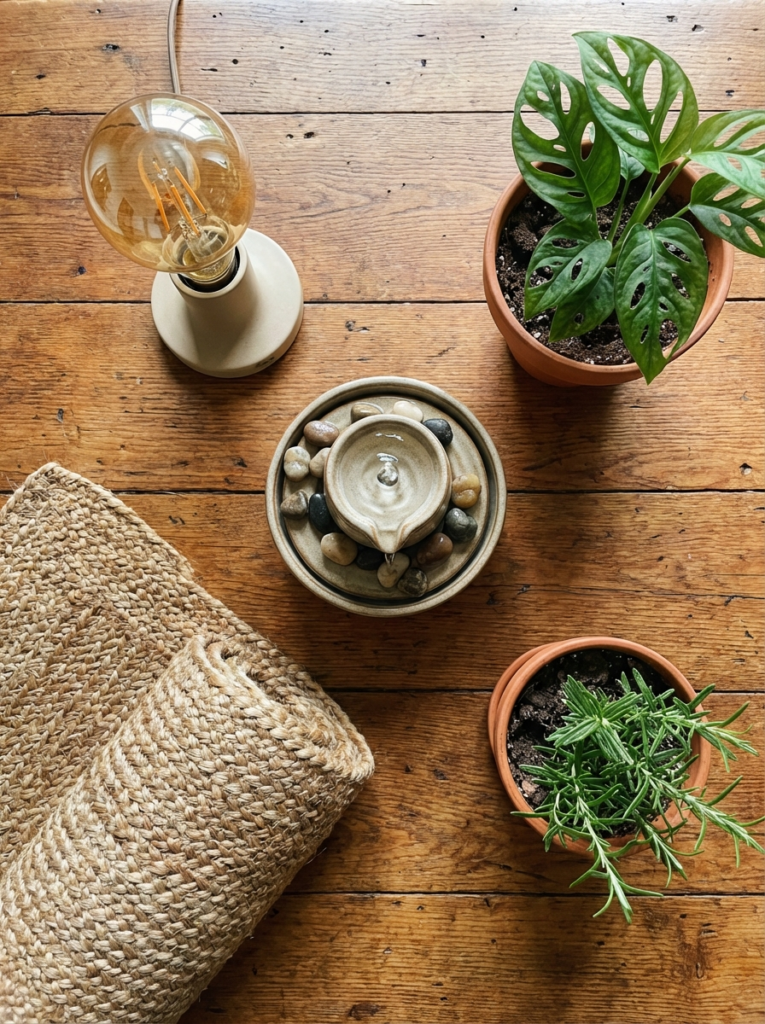
I’ve noticed this in my own workspace: adding a small tabletop water feature from Umbra ($68) did more for my focus than three new plants ever did. The sound was the missing layer.
The 5-Sense Checklist for Any Room
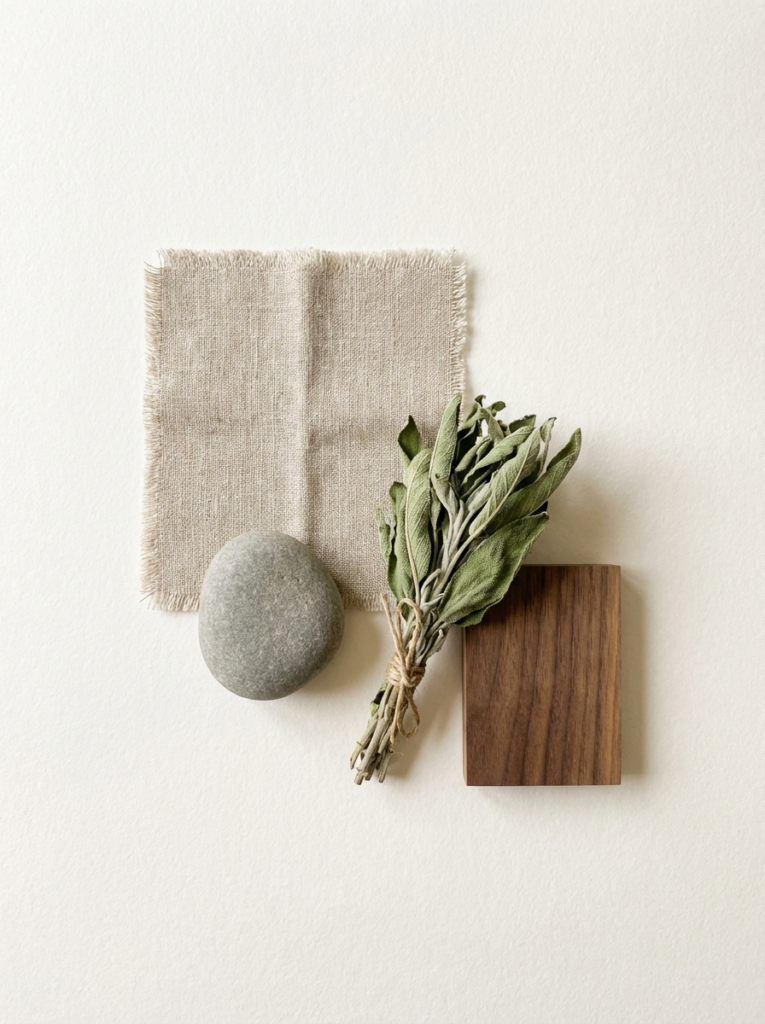
Before touching anything in a room, ask: which senses does this space currently neglect? Here’s a quick audit:
- Sight: natural light, organic shapes, earth-tone palette
- Touch: at least one rough texture (stone, bark-like ceramic, woven textile)
- Sound: soft acoustic materials that absorb echo, or a small water element
- Scent: a living herb on the windowsill, beeswax candles, or cedarwood accessories
- Temperature: cross-ventilation, or at minimum, a window that opens to outside air
You don’t need all five layers in every room. But identify the one that’s missing — that’s usually where the biggest improvement lives.
2. Circadian Lighting: The Biophilic Trend You Can’t See (But Definitely Feel)
Here’s a fact that changed how I think about room lighting: ordinary household bulbs can suppress melatonin by up to 50% if used at the wrong time of day. Not blue-light-from-phones melatonin suppression — regular ceiling lights.
Circadian-responsive lighting is one of the most significant biophilic interior design trends of 2026, and it costs less than you probably think.
What Circadian Lighting Actually Means
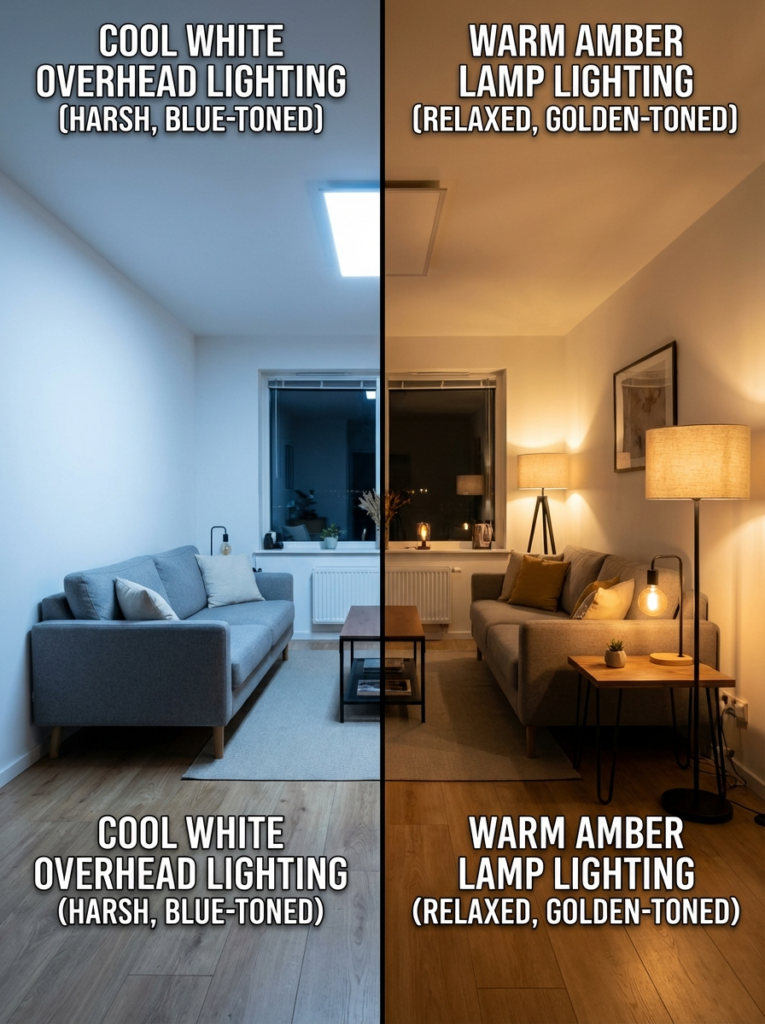
The principle is simple: light temperature should mirror the sun. In the morning, cooler, brighter light (5000K) supports alertness. By evening, it shifts to warm amber (2200–2700K) to support your body’s natural melatonin ramp-up.
A 2026 study in Scientific Reports found that LED lamps set to 2100K suppressed melatonin by only 0.1%, compared to 10% at 5700K (cool white). Your evening lighting is actively either helping or fighting your sleep.
Real Products Worth Using
LIFX and Philips Hue both offer tunable white bulbs that shift automatically through the day — around $35–55 per bulb, controllable via app. For a simpler, no-app approach, Norb Lighting makes warm-spectrum bulbs designed specifically around sleep health (starting at $24/bulb). If you want zero tech, swap your bedroom and living room bulbs to 2700K LEDs and add a dimmer — total cost under $40, most of the benefit.
The brand Ketra (now part of Lutron) builds whole-home circadian systems used in high-end wellness residences — worth knowing for client work even if it’s not a DIY option.
3. Biophilic Materials That Age Well: Limewash, Stone & Live Wood
One of the most overlooked aspects of biophilic design is the concept of ‘material aging.’ In nature, nothing stays static. Bark weathers. Stone gets worn smooth. Leaves change color. The best biophilic interiors in 2026 use materials that do the same — they evolve with the space, and that’s the point.
Limewash Walls
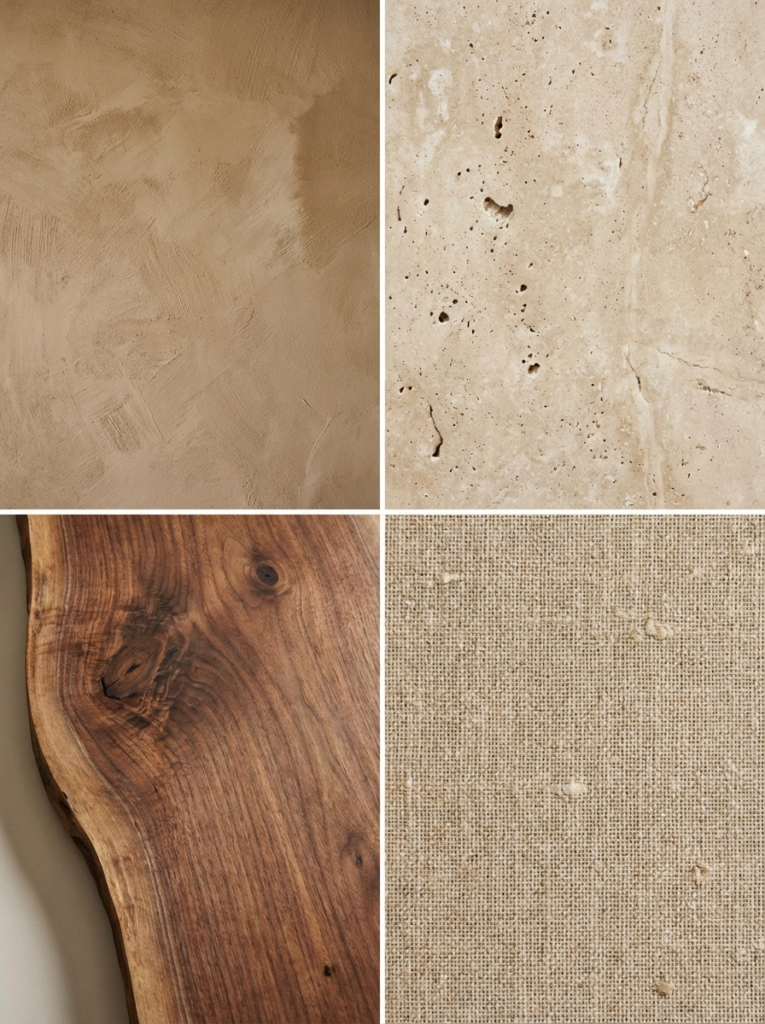
Limewash plaster has exploded in 2025–2026 because it delivers exactly this quality: a matte, layered, slightly chalky finish that absorbs light differently across the day and develops subtle variation over time. Brands like Portola Paints (their Roman Clay line, $90–110/gallon) and BEHR’s newer limewash kits ($65/gallon at Home Depot) have brought it into mainstream budgets.
What makes it biophilic — beyond looking good — is its texture. Running your hand across limewashed plaster engages the touch-based sensory cue that registers as ‘natural material,’ not synthetic. That’s a measurable nervous-system signal, not just an aesthetic preference.
Live-Edge Wood and Natural Stone
Live-edge furniture — where the natural outline of the tree slab is preserved — has moved from ‘artisan boutique’ to ‘West Elm catalog’ territory. West Elm’s Emmerson reclaimed wood dining table (from $899) and CB2’s Reyes live-edge coffee table ($599) make the look accessible without hiring a custom woodworker.
For stone, honed (matte) finishes are replacing polished marble in biophilic interiors. Honed limestone and travertine have the kind of subtle surface variation — tiny pores, slight color shifts — that the brain reads as organic rather than manufactured. IKEA’s SIBBARP custom countertops offer real stone options from around $100/m² if you’re doing a kitchen refresh.
The Rule of Imperfection
There’s a useful neuroaesthetics concept here called ‘fractal fluency’ — the brain processes patterns that repeat at multiple scales (like tree branches, or the grain in a plank of walnut) with unusually low cognitive load, which translates to a felt sense of calm. Materials with natural variation engage this system. Perfectly smooth, uniform synthetic surfaces don’t.
Practical takeaway: when choosing between two materials at similar price points, pick the one with more natural variation. That slight imperfection is doing real work.
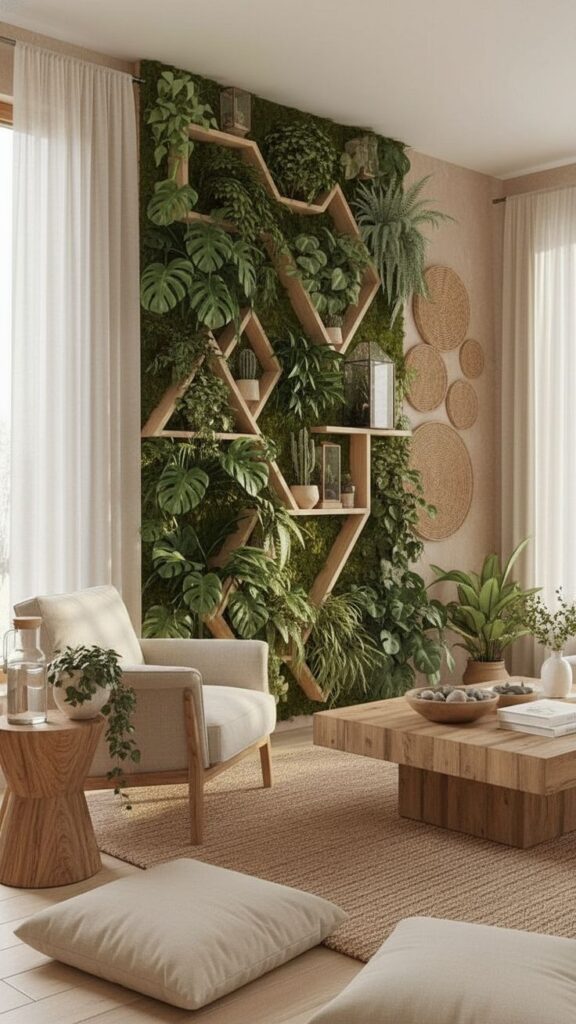
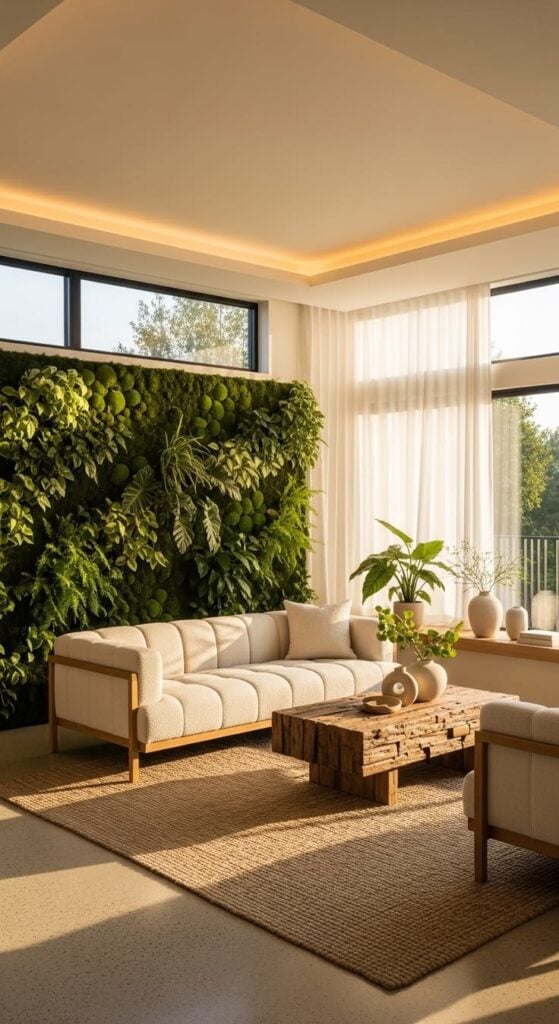
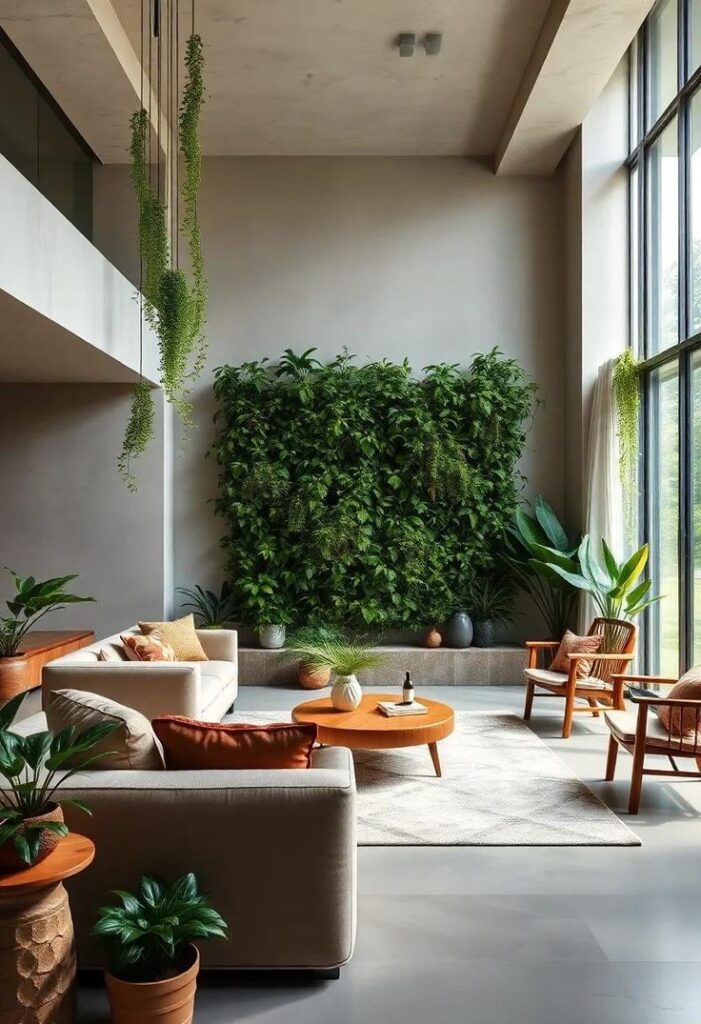
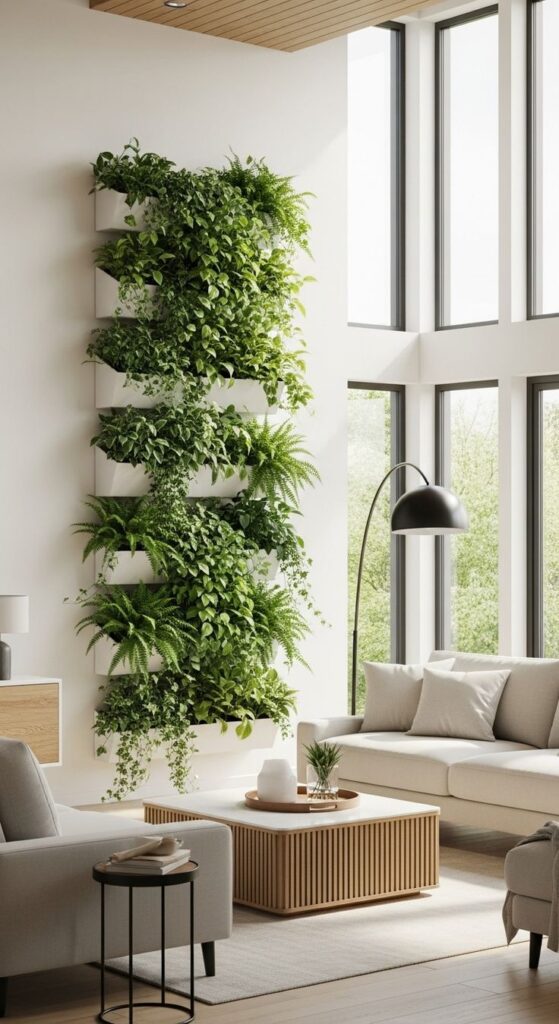
4. Living Walls and Moss Panels: What’s Worth the Investment
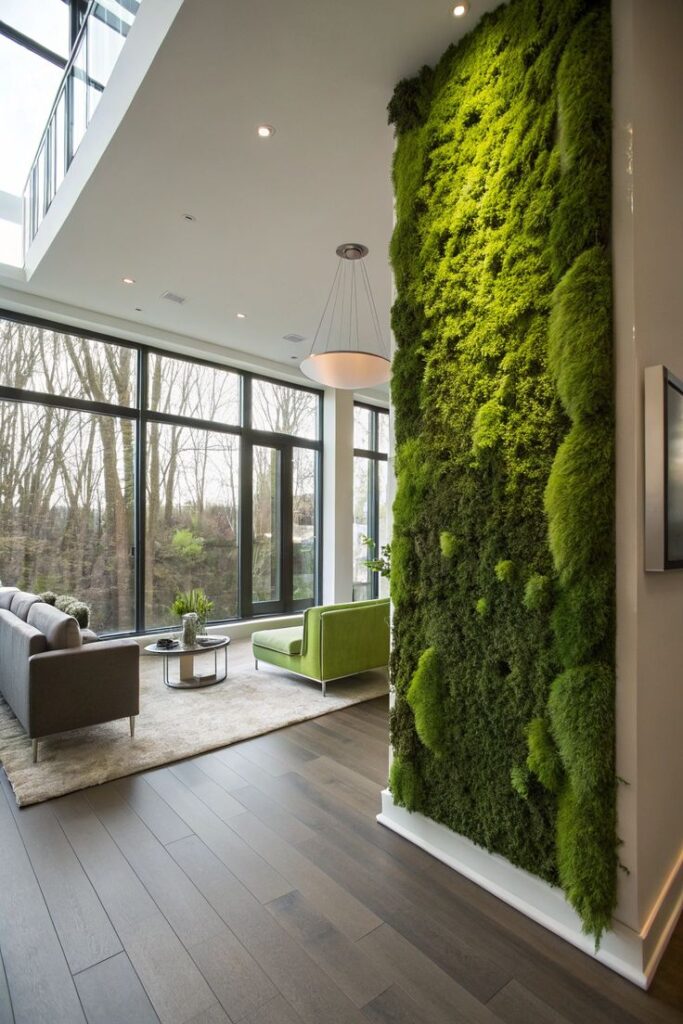
Living walls are the most photographed biophilic design element — and, honestly, often the most over-promised. Here’s what I wish someone had told me before I started pricing them out: maintenance is the real cost, not installation.
The Honest Math on Living Walls
A professionally installed living wall from a studio like Ambius or Habitat Horticulture runs $150–350 per square foot, installed. A 4×6 foot feature wall lands between $3,600–$8,400 — plus $80–200/month in maintenance visits if you’re not a confident plant person.
The DIY alternative: modular living wall kits from brands like Wooly Pocket ($35–60 per panel, stack as many as you want) or IKEA’s SKADIS grid system (repurposed with small planters, around $40 total) can create a similar visual impact for under $300.
Moss Panels: Low-Maintenance Biophilia
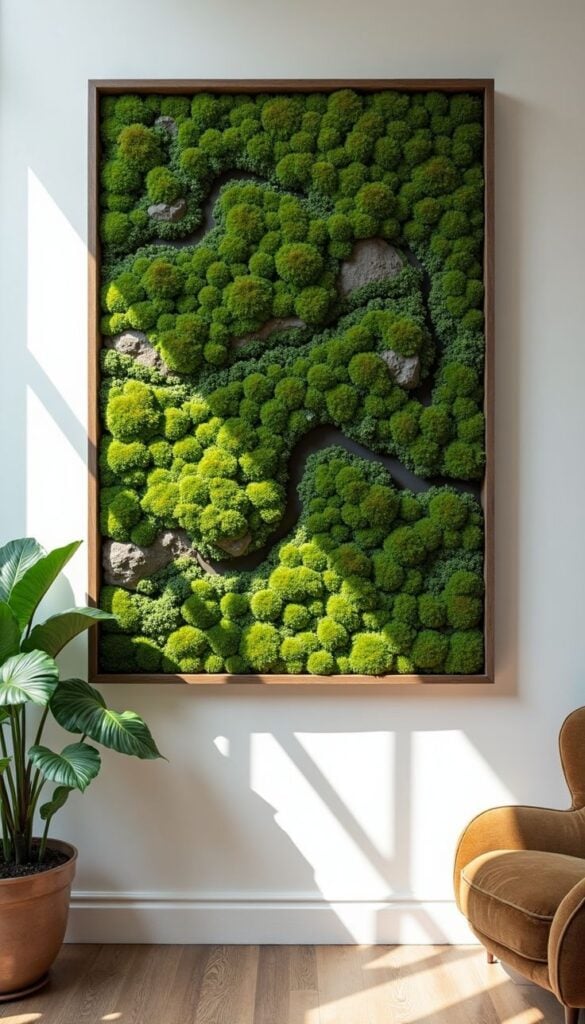
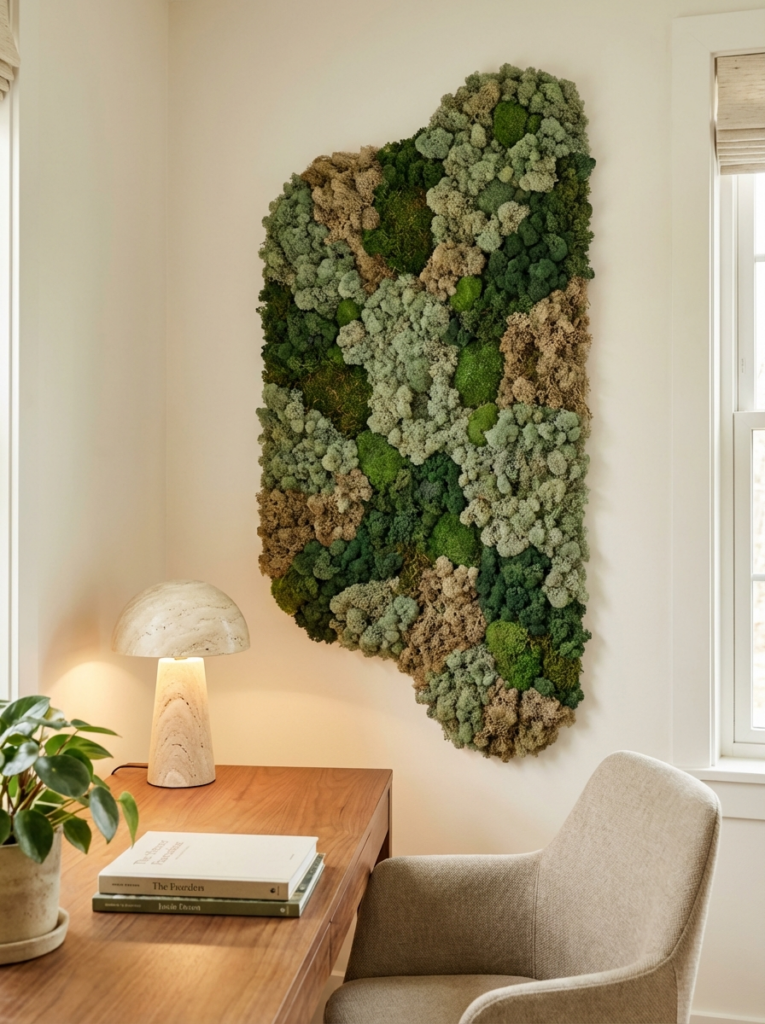
Preserved moss panels have emerged as the pragmatic answer to living wall maintenance anxiety. They’re made with real moss that’s been glycerin-preserved — no watering, no soil, no sunlight required. Moss Amor and Mossify both sell framed panels from $80–400 depending on size and moss type.
The biophilic benefit is real: the texture, color variation, and organic smell of preserved moss engages touch and scent pathways. Research from the Biophilic Design Assessment Report (January 2026) notes that natural analogs — materials that reference nature without requiring full living-system maintenance — deliver measurable wellbeing benefits comparable to live plant installations in time-limited occupancy settings.
Plants That Actually Survive
If you’re doing live plants, stop buying what looks good at the garden center and start buying what’s actually hard to kill in your specific light conditions. For low-light spaces: ZZ plant, cast iron plant, snake plant. For bright indirect light: fiddle-leaf fig (yes, it’s still worth it if you give it one consistent spot), monstera, or pothos in a hanging planter.
Bloomscape and The Sill both offer online plant subscriptions with care guides tied to specific room conditions — The Sill’s mid-sized plants start at $35, and they’ve gotten genuinely good at matching plants to light environments.
5. Biophilic Color in 2026: The Low-Cortisol Palette
‘Low-cortisol design’ sounds like wellness marketing jargon — but there’s real neuroscience underneath it. The idea, developed by researchers in neuroaesthetics (the study of how the brain responds to visual stimuli), is that certain color environments actively down-regulate the stress response.
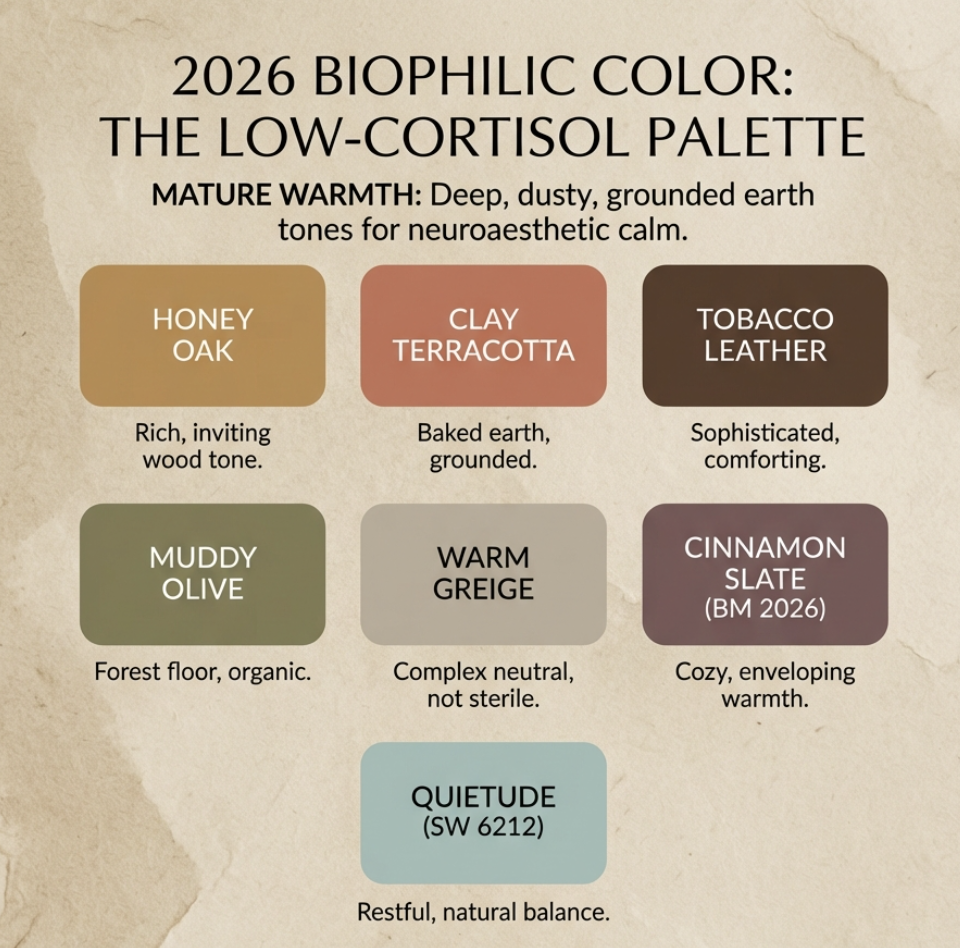
In 2026, the biophilic color palette has moved away from the gray-greige minimalist baseline of the past decade and toward what designers are calling ‘mature warmth’: deep, dusty, slightly muted earth tones that read as grounded rather than sterile.
The 2026 Earth Tone Palette
Think honey oak, clay terracotta, tobacco leather, muddy olive, and warm greige — not the flat cream of 2018 Scandinavian design, but richer, more complex neutrals with genuine warmth. Benjamin Moore’s 2026 Color of the Year, Cinnamon Slate, and Sherwin-Williams’ Quietude (SW 6212) are both good reference points.
The mechanism: earthy pigments reflect the same wavelengths of light that our nervous systems evolved to associate with safe, natural environments — forest floors, stone, soil. Colors in the 4000K+ cool-white family tend to keep the sympathetic nervous system slightly activated. Warm, muted naturals do the opposite.
How to Apply It Practically
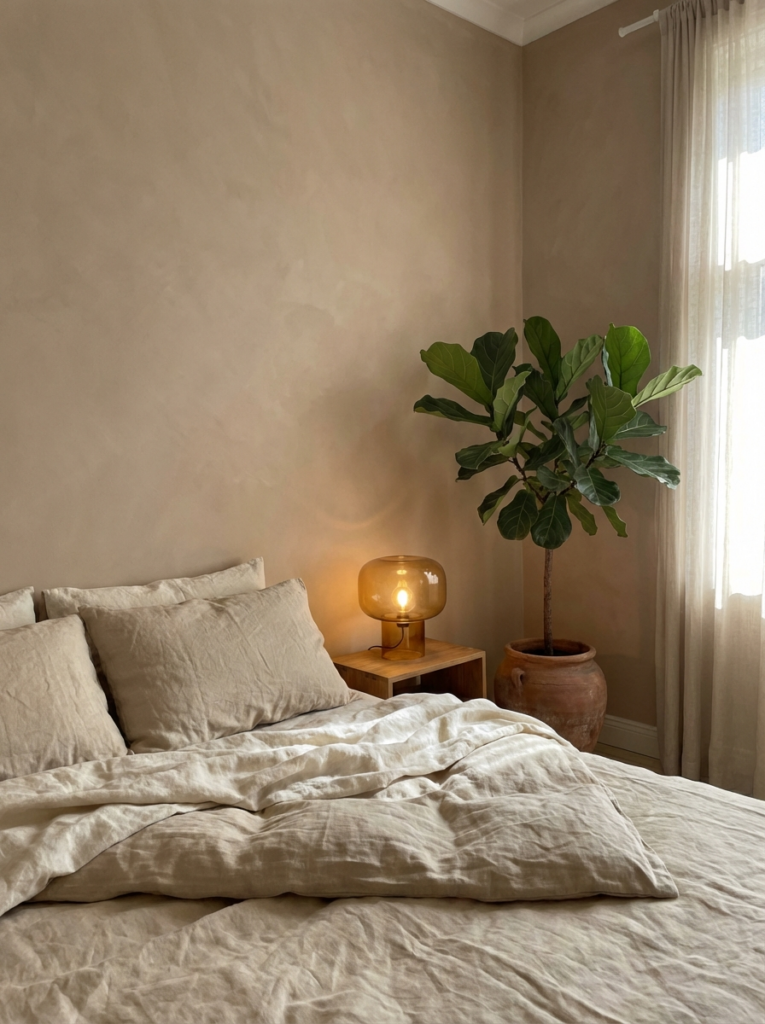
You don’t need to repaint everything. The highest-leverage move is usually the largest surface area with the most hours of occupancy — often the bedroom or main living space. A single limewash accent wall in clay tone (see section 3) does more perceptual work than repainting four rooms in a slightly different shade of beige.
For soft furnishings: linen and undyed wool in caramel, stone, or warm cream pull an earthy palette together faster than paint. IKEA’s SANELA velvet curtains in dusty olive ($59/pair) and H&M Home’s chunky linen throws ($35–65) both hit this palette without requiring a decorator’s budget.
6. Biomorphic Shapes: Why Curves Beat Straight Lines for Wellbeing
Here’s a design choice that’s quietly reshaping interiors in 2026: the straight line is on notice. Rounded edges, arched doorways, curved kitchen islands, and furniture with organic silhouettes are showing up everywhere — and there’s a reason beyond aesthetics.
Research in environmental psychology consistently shows that angular, sharp-edged forms are processed by the brain as slightly threatening, while curved forms feel safe. This is thought to connect back to evolutionary pattern recognition: in nature, sharp points signal danger; curves signal safety. Biophilic design in 2026 is applying this principle deliberately.
Where Curves Work Best
The biggest visual impact comes from architectural elements: arched doorways, curved half-walls, or barrel-vault ceilings. These are significant renovations, but even adding curved furniture to an angular room shifts the sensory tone considerably.
Sofa with a curved back: the Burrow Arc sectional ($2,195–3,695) and IKEA’s ÄPPLARYD sofa (with its rounded arms, from $849) both bring that softened silhouette without full custom pricing. For dining: a round table always wins over rectangular in a biophilic space — it echoes the natural absence of sharp corners.
The Organic Object Layer
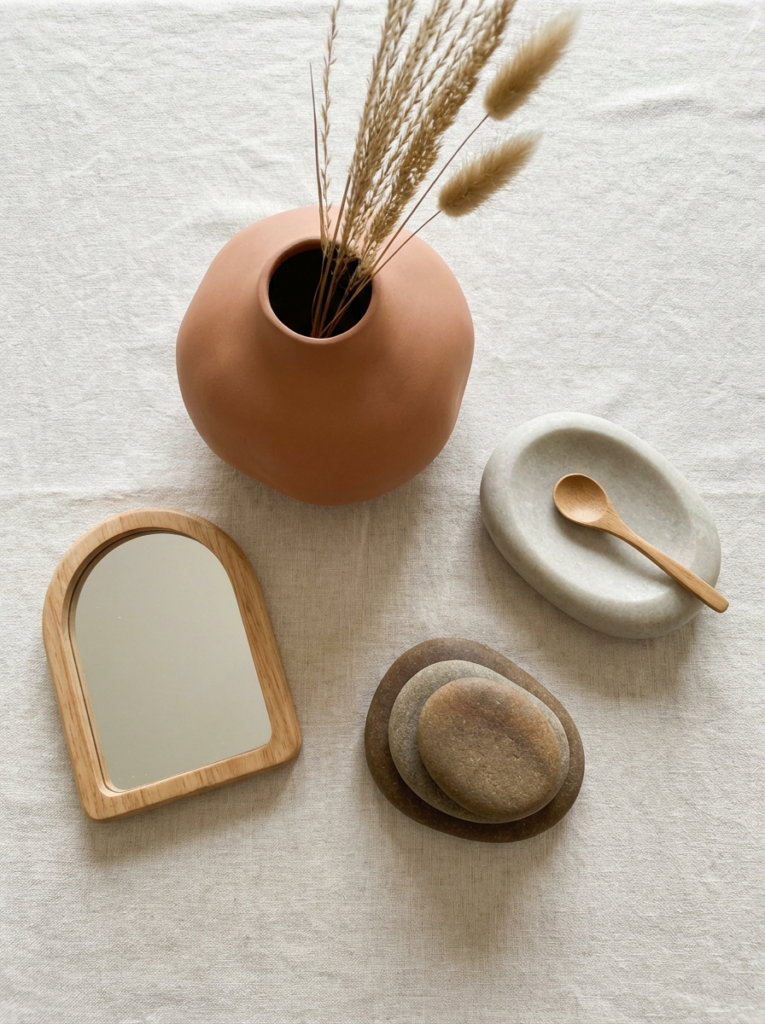
Smaller biomorphic objects add up: a rounded ceramic vase in a slightly irregular shape, a pebble-shaped soap dish, an oblong mirror. Brands like Hawkins New York and Quiet Town make table and bathroom accessories in organic forms starting around $15–45 per piece.
I started replacing sharp-edged decor with organic forms about 18 months ago — it sounds minor, but the cumulative effect on how a room feels is genuinely noticeable. Less tension, somehow.
7. Budget-Smart Biophilic Design: 5 High-Impact Changes Under $100
The most frustrating thing about most biophilic design content is that it assumes a renovation budget. You don’t need one. Some of the highest-impact biophilic changes are also some of the cheapest.
Here’s a ranked list of changes that deliver maximum biophilic benefit per dollar spent:
1. Swap Bedroom Bulbs to 2700K + Add Dimmer ($25–40)
Highest ROI of anything on this list. Replace cool-white bulbs with 2700K warm LEDs (GE Refresh Warm White, $12 for a 4-pack at Walmart) and add a plug-in dimmer switch ($15–25 on Amazon). This one change improves sleep quality for most people within the first week.
2. Add a Tabletop Water Feature ($40–80)
The sound of moving water has been shown in multiple studies to reduce cortisol. Umbra and Homedics both make compact tabletop fountains in the $40–75 range. Put it in your home office or bedroom — the sound layer is the most underused biophilic tool in residential design.
3. A Single Large Plant in the Right Spot ($35–60)
One well-placed large plant does more perceptual work than six small ones scattered around. A 4-foot fiddle-leaf fig or monstera deliciosa near a window becomes a focal point that the eye returns to naturally — that’s the ‘soft fascination’ effect that allows directed attention to recover.
4. Natural Fiber Rug to Anchor the Room ($45–90)
A jute or sisal rug adds tactile texture underfoot and brings organic color variation at floor level. IKEA’s LOHALS flatwoven jute rug (5x7ft, $49) is the reliable starting point. The texture engages touch-based biophilic response even without conscious awareness.
5. Scent Layer: A Living Herb or Beeswax Candle ($12–25)
A small pot of rosemary or lavender on a windowsill does double duty: it’s a living plant and an ambient scent source. If that feels too high-maintenance, P.F. Candle Co.’s beeswax candles in Teakwood and Tobacco or Golden Coast ($18 each) bring a genuine natural scent without synthetic fragrance.
FAQ: Biophilic Interior Design Trends 2026
Q: What is biophilic interior design?
Biophilic design is an approach to interior spaces that integrates elements of the natural world — light, plants, natural materials, organic shapes, water, and sensory cues — to support human wellbeing. The term comes from E.O. Wilson’s ‘biophilia hypothesis,’ which argues that humans have an innate need to connect with living systems. In practice, it means designing rooms that help your nervous system feel safe and restored, not just rooms that look nice.
Q: How is biophilic design different from just adding plants?
Plants are one layer, but genuine biophilic design engages multiple senses. It includes how a space sounds (acoustic softness, water features), how it feels (natural textures), how it smells (herbs, beeswax, cedarwood), and how it’s lit (circadian-responsive, warm-spectrum lighting). A room with perfect circadian lighting and limewash walls but no plants can be more deeply biophilic than a room crowded with greenery under harsh fluorescent lights.
Q: What are the most important biophilic design trends in 2026?
The five biggest shifts in 2026 are: (1) multisensory design over purely visual biophilia; (2) circadian-responsive lighting as a baseline, not a luxury; (3) materials that age and develop character over time (limewash, live-edge wood, honed stone); (4) the ‘low-cortisol’ earth-tone palette replacing cool minimalism; and (5) biomorphic, curved forms replacing sharp-edged modern geometry.
Q: How much does biophilic design cost?
It ranges from $25 (swapping light bulbs to 2700K warm LEDs) to $50,000+ (full living wall installations and circadian smart-lighting systems). Most high-impact changes — a large plant, a natural fiber rug, a tabletop water feature, warm bulbs — cost under $200 total. The principle is sensory layering, not expensive renovation.
Q: Do living walls require a lot of maintenance?
Yes — professionally maintained living walls typically need $80–200/month in care visits. The practical alternative is preserved moss panels (no watering, no sunlight, real moss) from brands like Moss Amor or Mossify starting around $80. Or try modular DIY living walls like Wooly Pocket kits, which cost $150–300 and are manageable with weekly watering.
Q: What colors are used in biophilic interior design?
In 2026, the biophilic palette centers on earthy, muted naturals: clay terracotta, honey oak, muddy olive, warm greige, tobacco brown, and dusty sage. These echo forest floors, soil, stone, and bark — environments the human nervous system evolved to associate with calm and safety. Avoid cool-toned neutrals (gray, cool white, blue-gray) in spaces where you want to feel relaxed.
Q: Can biophilic design work in a small apartment?
Yes — and it actually works especially well in small spaces because each element has proportionally more visual impact. In a studio or one-bedroom, prioritize: (1) maximize natural light by keeping windows clear and using sheer linen curtains; (2) a single large plant near the best light source; (3) warm-spectrum bulbs in every fixture; (4) one natural-material textile (jute rug, linen throw). Small spaces benefit most from scent and sound biophilic layers too — a tabletop fountain takes up almost no floor space.
Conclusion: Start With One Layer, Not a Full Renovation
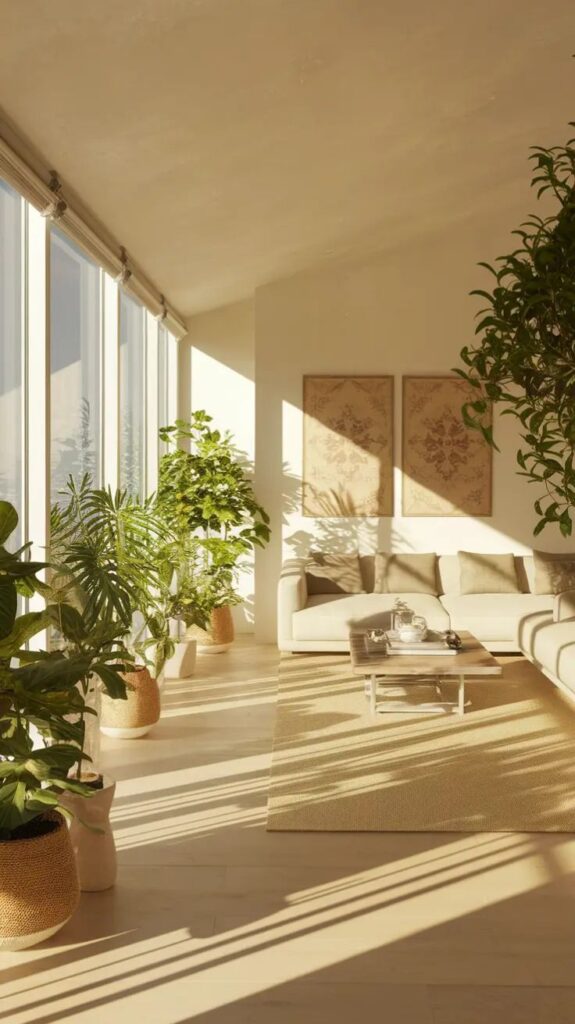
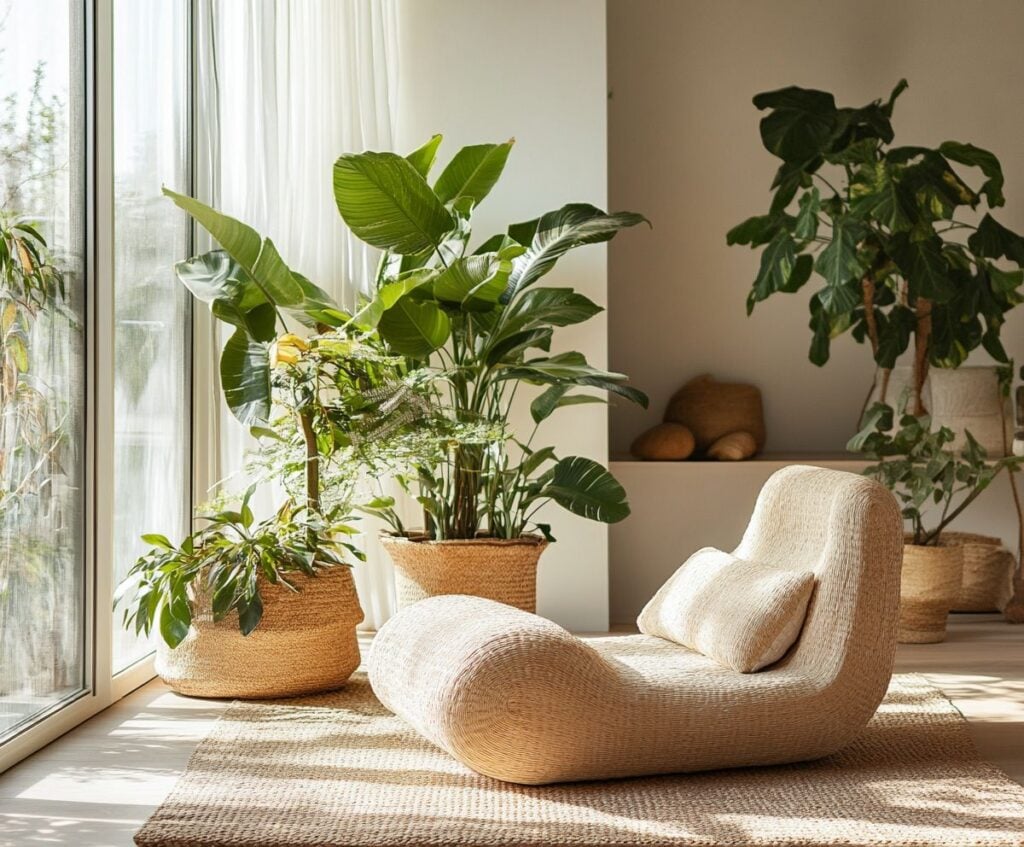
Biophilic interior design in 2026 has one clear message: your home is not neutral. Every material, light source, texture, and shape is either working with your nervous system or against it.
The good news is you don’t need a living wall to feel the difference. Start with whichever sensory layer is most missing from your main living space — for most people, that’s lighting. Swap your bulbs, add a dimmer, move your most used chair closer to a window. See what shifts.
The goal isn’t a perfectly curated biophilic showroom. It’s a space that makes your body feel like it can finally exhale. That’s achievable on almost any budget — and that’s what makes this the most relevant design direction of 2026.
Want more ideas? Check out our related guides on natural material home decor and Japandi interior design for 2026 on skyryedesign.com.
- 76shares
- Facebook0
- Pinterest76
- Twitter0
- Reddit0