I once watched someone open a perfume box for six minutes. Not because they were confused or distracted — because the box was designed to be opened over six minutes. The outer sleeve resisted slightly, just enough to feel intentional. The inner box slid on a ribbon pull. The tissue paper was layered in three sheets, each one requiring a deliberate unfold. The bottle sat in a moulded recess, framed by the tissue like something in a museum vitrine. The whole sequence was choreographed so that by the time the product was in hand, the person holding it felt like they’d received something of genuine significance.
- The First Touch Moment: Why Physical Sensation Precedes Visual Judgment
- The Unboxing Sequence: Designing Time into the Experience
- What the Consumer Never Sees: Functional Layers Inside Luxury Packaging
- Protective Packaging Materials and Their Design Logic
- When Functional Requirements Become Brand Statements
- The Package as the First Product
- FAQ: Luxury Packaging Design
The perfume itself cost what it cost. But the experience of receiving it cost considerably more to engineer — and that engineering is where luxury packaging design lives. Not in the visible surface quality of the box, though that matters too. In the sequence of physical sensations from first touch to product reveal: the weight, the resistance, the sound of materials separating, the smell of the tissue paper, the moment the product is elevated above its resting plane by the insert that presents it. Every one of those moments is a design decision. Every one of them communicates something about the product before the product is used.
This article covers how luxury packaging designers translate functional requirements — moisture protection, structural integrity, transit resilience, regulatory compliance — into sensory experiences. The functional and the experiential are not in opposition in serious packaging design. They’re the same conversation.
The First Touch Moment: Why Physical Sensation Precedes Visual Judgment
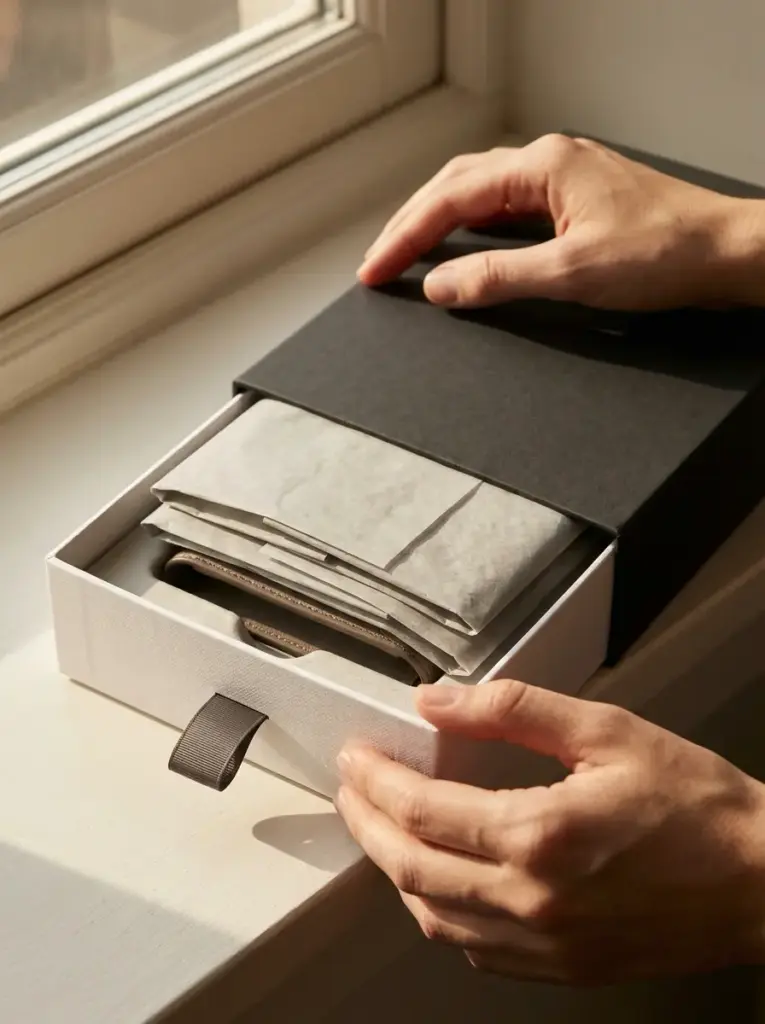
Before a consumer sees what’s inside a luxury package, they’ve already formed an impression — through their hands. The weight of the box, the texture of the exterior surface, the temperature of the material, the flex or rigidity of the walls when slight pressure is applied: all of these communicate material quality and structural commitment before a single visual element is processed.
This is not a peripheral observation — it’s the foundation of luxury packaging strategy. A 2019 study published in the Journal of Retailing found that haptic qualities of packaging directly influenced perceived product quality and purchase willingness, independent of visual design. When the exterior surface had a soft-touch laminate finish, consumers rated the interior product as higher quality than when the same product was presented in a smooth-laminated box of identical visual design. The hand was communicating what the eye couldn’t see.
Surface Treatments That Communicate Quality
The surface treatments that most effectively communicate luxury at first touch are those that require process investment the consumer can feel but cannot easily name. Soft-touch laminate — a matte polyurethane coating applied over the printed surface — produces the particular velvety warmth that reads as high-end even to consumers who’ve never heard the term. Debossed or embossed detail — the logo or pattern pressed into the board — adds tactile depth that a flat-printed equivalent cannot replicate. Foil blocking — metallic or holographic foil applied under heat and pressure — creates a surface quality that catches light differently from every angle and is impossible to replicate with ink alone.
The specific combination of surface treatments chosen for a luxury package creates a tactile signature — a physical identity that the consumer begins to associate with the brand across multiple interactions. Hermès orange boxes have a specific surface quality, a specific weight, a specific lid resistance. That specificity is intentional and consistent. It’s maintained across every production run because the tactile signature is part of the brand equity.
Structural Weight and Its Psychological Function
Weight communicates substance. A box that feels heavier than expected — through thicker board specification, a weighted base insert, or a denser outer sleeve — signals investment and seriousness before the product is revealed. Luxury packaging designers specify board weight in grams per square metre with the same precision that industrial designers specify material thicknesses — not for structural necessity alone, but for the specific handled weight the finished package should produce. The target weight is often established before the structural design is finalised, and the design is engineered to hit it.
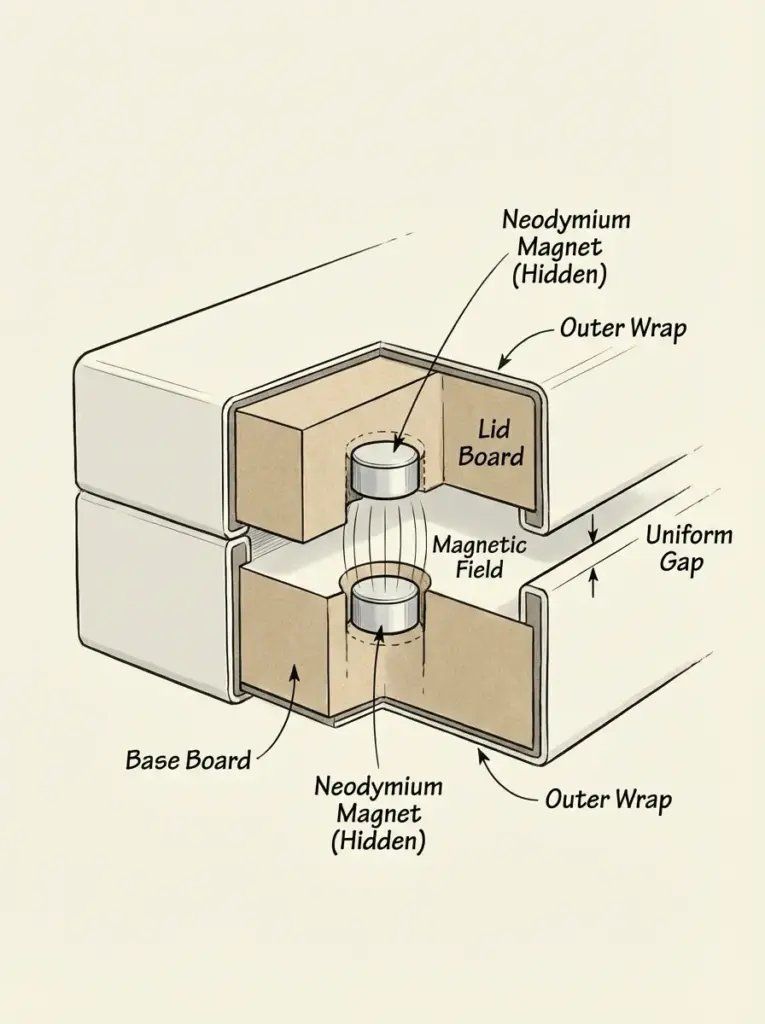
✏ Design note: The resistance of a lid lift is one of the most carefully engineered tactile moments in luxury packaging. Too easy and it feels cheap — the box offers no ceremony. Too heavy and it requires two hands, and reads as a struggle rather than a reveal. The target is a smooth, consistent resistance of approximately 0.5-1.5kg of force that maintains itself throughout the full travel of the lid — achieved through precise tolerances between lid and base, sometimes supplemented by an internal magnetic closure that adds controlled resistance without creating a snap or click.
The Unboxing Sequence: Designing Time into the Experience
Luxury packaging is temporal design — it exists across a sequence of moments rather than as a single static object. The designer’s task is to control the duration and emotional quality of each moment in the sequence: the exterior encounter, the opening gesture, the interior reveal, the product presentation, the secondary materials, and finally the product itself.
The Opening Gesture
How a package opens — lid lift, sleeve slide, magnetic snap, ribbon pull, drawer mechanism — determines the character of the first active moment. Magnetic closures are the most common luxury mechanism: two neodymium magnets embedded in lid and base create a closure that holds firmly when closed, releases smoothly under deliberate pulling force, and produces a subtle click on closing that communicates precision. They’re invisible from the exterior, which is the point — the mechanism only reveals itself through experience, not inspection.
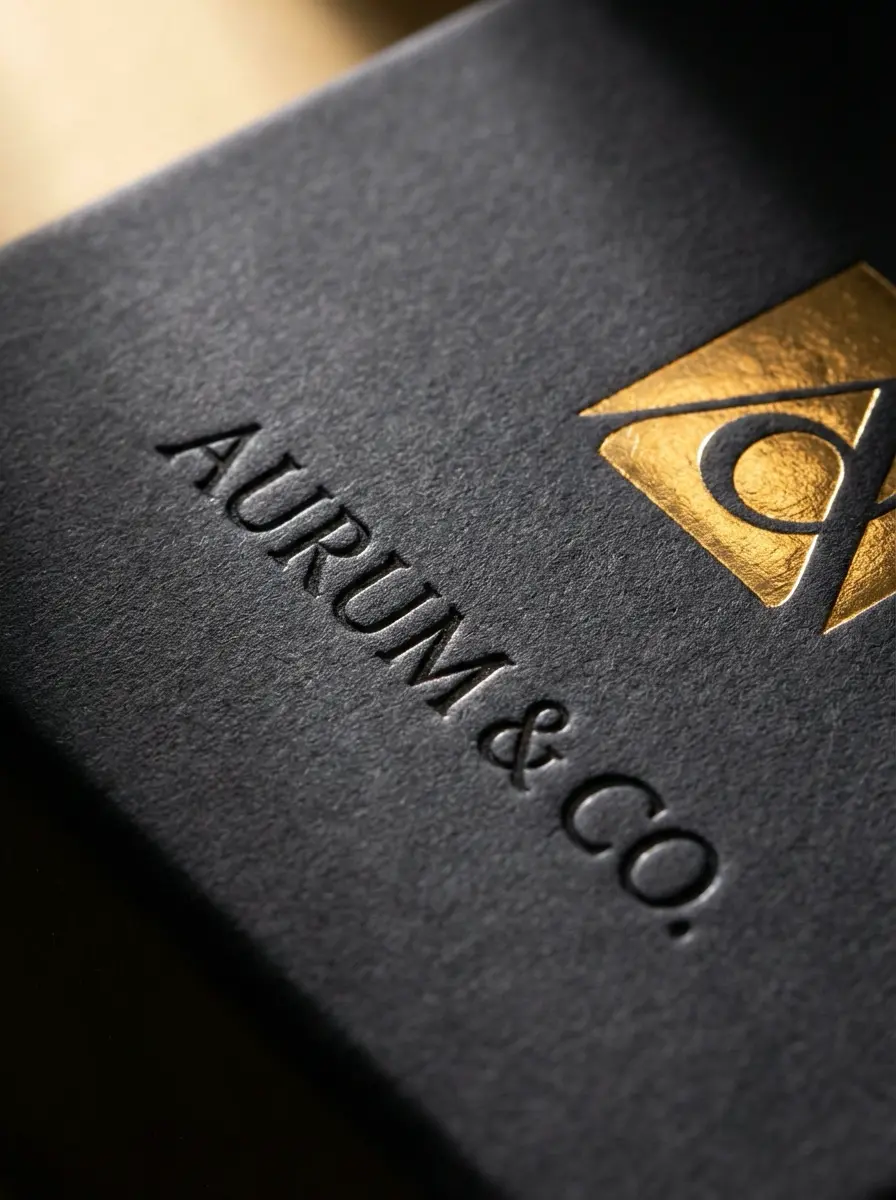
Ribbon pulls add a gesture of ceremony: a deliberate, two-handed action that signals this moment deserves attention. Drawer-style boxes — where the inner tray slides out horizontally from the outer shell — create a reveal sequence that feels like opening a vault or a drawer of collected items. Each mechanism produces a different emotional register. The right choice depends on the product, the price point, and the brand’s relationship with ritual.
Interior Architecture and Layering
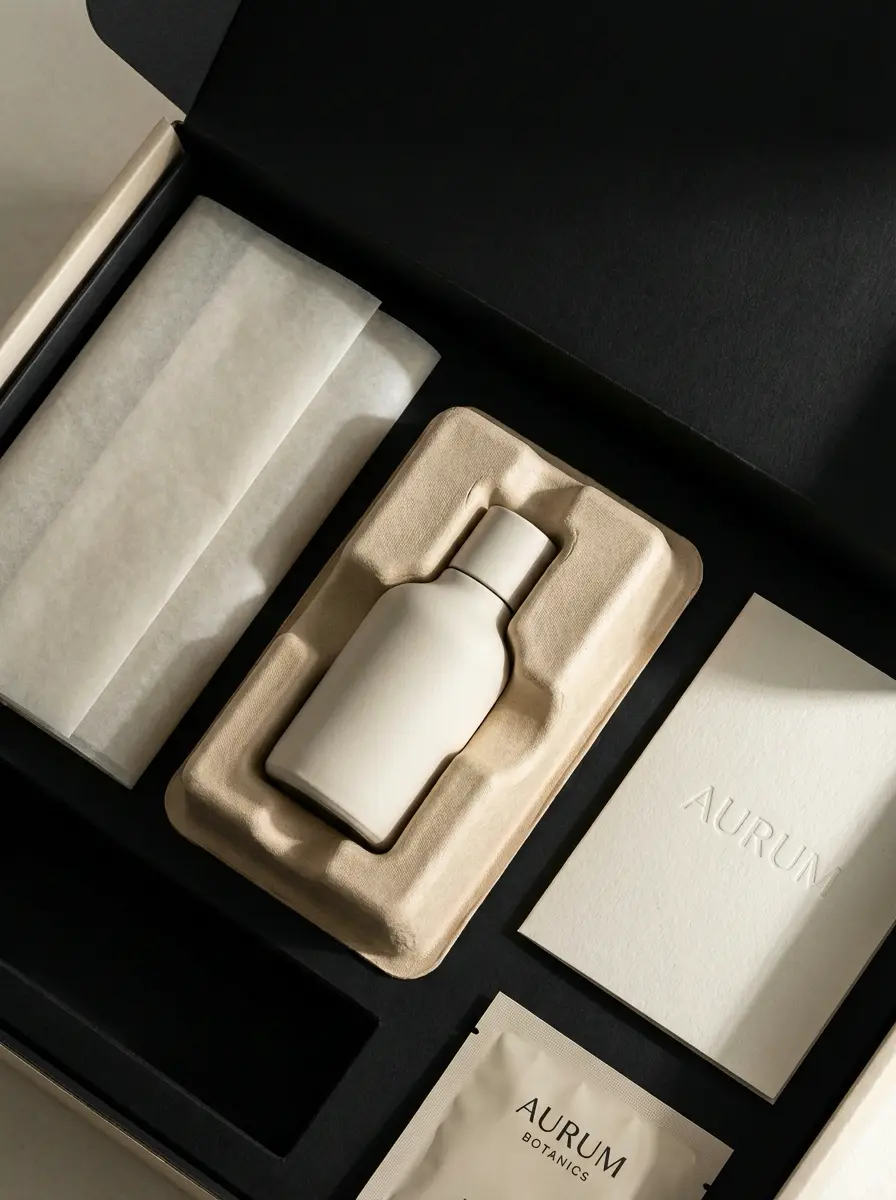
The interior of a luxury package is an architectural space. It has zones — the primary product zone, the secondary material zone, the instruction zone — and those zones are revealed in sequence. A well-designed interior uses layering to extend the temporal experience: tissue paper over the product means one more deliberate unfolding before the reveal; a branded card nested on top of the tissue means the first interior encounter is brand communication, not product. Each layer is a moment. Each moment extends the emotional investment of the opening experience.
Moulded inserts — vacuum-formed in paper pulp, thermoformed in PET, or die-cut in board — present the product elevated above the base plane, which communicates curation and significance. The product is not placed; it’s displayed. This distinction sounds subtle but reads clearly to the consumer: a product lying flat in a box feels different from the same product presented in a recessed mount that holds it precisely at eye level when the box is opened.
✏ Design note: The interior colour of a luxury box is as deliberate as the exterior. A white interior reads as clean and clinical — appropriate for skincare and fragrance. A black interior reads as dramatic and precious — appropriate for jewellery and high-end electronics. A coloured interior — the specific terracotta of an Aesop box, the forest green of a Fortnum and Mason tin interior — creates a chromatic surprise that reinforces brand identity at the moment of maximum engagement. Spec the interior colour as precisely as the exterior.
What the Consumer Never Sees: Functional Layers Inside Luxury Packaging
The packaging the consumer interacts with is the surface layer. Behind it — literally, in the structural layers of the board and insert — is a system of functional components that protect the product from the moment of packing to the moment of unboxing. In luxury packaging, these components are entirely invisible. Their invisibility is a design achievement as significant as the visible surface quality.
Moisture Protection: The Hidden Preservation System
Moisture is the most consistent threat to product quality in storage and transit. Leather goods become mouldy. Metal hardware corrodes. Fragrance top notes separate under humidity variation. Paper-based materials warp and develop foxing spots. Electronics fog. The solution is humidity control through desiccant materials — hygroscopic compounds that bind or trap water molecules within the sealed package, maintaining a controlled relative humidity environment around the product.
The most common desiccant in consumer luxury packaging is silica gel — a non-toxic, chemically stable material that performs reliably across mid-range humidity conditions (approximately 20-60% relative humidity) and is approved for contact with food and pharmaceutical products. Silica gel sachets are typically placed within the base layer of the packaging insert, beneath the moulded product recess, where they’re completely invisible to the consumer but actively controlling the atmospheric conditions around the product throughout its storage and transit period.
The design challenge is integration without disruption: the sachet must be accessible for quality control inspection, positioned where it can influence the atmospheric conditions within the sealed package, and completely invisible from the consumer’s perspective. Specialist suppliers like Australian Inhibitor combine desiccant and corrosion-inhibitor technologies — particularly relevant for luxury goods with metal hardware, precision instruments, and any product where both moisture and atmospheric corrosion are simultaneous risks. The functional system is specified alongside the structural design, not added afterward as an afterthought.
Structural Integrity: Transit Engineering
A luxury box must survive the journey from factory to consumer without visible damage — which means the structural design must account for compression stacking in a shipping container, impact from a courier handling it as one of three hundred packages processed in an hour, and temperature and humidity variation between a climate-controlled warehouse and an unheated delivery vehicle in winter. Luxury packaging structural engineering is impact engineering applied to aesthetically demanding objects: the visible surface must arrive perfect, which means every layer beneath it must absorb and distribute force before it reaches the surface.
The solution is typically a double-wall construction — an outer decorative sleeve over an inner structural box — where the outer sleeve is optimised for surface quality and the inner box provides the load-bearing and impact-absorbing structural function. The two layers don’t touch at the edges, which means impact to the outer sleeve doesn’t directly transfer to the inner box, and the product inside is protected by two independent structural systems.
RFID, NFC, and Anti-Tamper Integration
Authentication technology in luxury packaging has become standard for the highest-tier products. RFID and NFC chips are laminated between paper layers during the board manufacturing process — completely invisible and tactilely undetectable in the finished package. The consumer can verify authenticity by tapping the box with a smartphone, but there’s no visible component, no antenna outline, no disruption to the surface quality. Anti-tamper seals — heat-sensitive voids, destructible labels, holographic films — are integrated into the closure design so that an opened and reclosed package shows clear evidence of tampering at the point of sale inspection.
Protective Packaging Materials and Their Design Logic
Silica Gel Desiccant
Functional role: Maintains relative humidity between 20-60% within sealed packaging. Binds water molecules through adsorption onto a high-surface-area silica matrix. Available in non-woven sachets, rigid canisters, and board-integrated formats.
Design challenge: Concealment without loss of function. The sachet must be positioned where it influences the sealed atmosphere, but invisible from the consumer’s perspective. Premium formats use ultra-thin sachets embedded in the base insert or behind the tissue paper liner.
Luxury application: Standard in leather goods boxes, fragrance packaging, electronics packaging. Cobalt-free indicator versions (orange-to-green colour change) used in QC-visible positions where consumer inspection is anticipated.
Molecular Sieve
Functional role: Synthetic zeolite with uniform micropore sizes (3A, 4A, 13X variants) providing deep moisture control at very low relative humidity — below 20% RH. Used where precise dew point control is required.
Design challenge: More expensive than silica gel and can overdry humidity-sensitive materials. Specified for pharmaceutical-grade packaging and precision optics. In luxury consumer goods, typically reserved for high-precision instruments and medical devices.
Luxury application: Watch and precision instrument boxes where condensation inside sapphire crystal or lens elements is a failure risk. Pharmaceutical-adjacent wellness products with strict stability requirements.
Vapour Corrosion Inhibitor (VCI)
Functional role: Emits vapour-phase corrosion inhibitors that form a molecular protective layer on metal surfaces — hardware, clasps, frames, metal components — preventing oxidation without direct contact.
Design challenge: Must be matched to the specific metals in the product. Incompatible inhibitor chemistries can accelerate corrosion on some metals while protecting others. Specification requires material identification of all metal components in the product.
Luxury application: Luxury leather goods with metal hardware (clasps, D-rings, buckles), fine jewellery boxes, watch packaging, precision instruments. Often combined with silica gel in a dual-function insert for comprehensive protection.
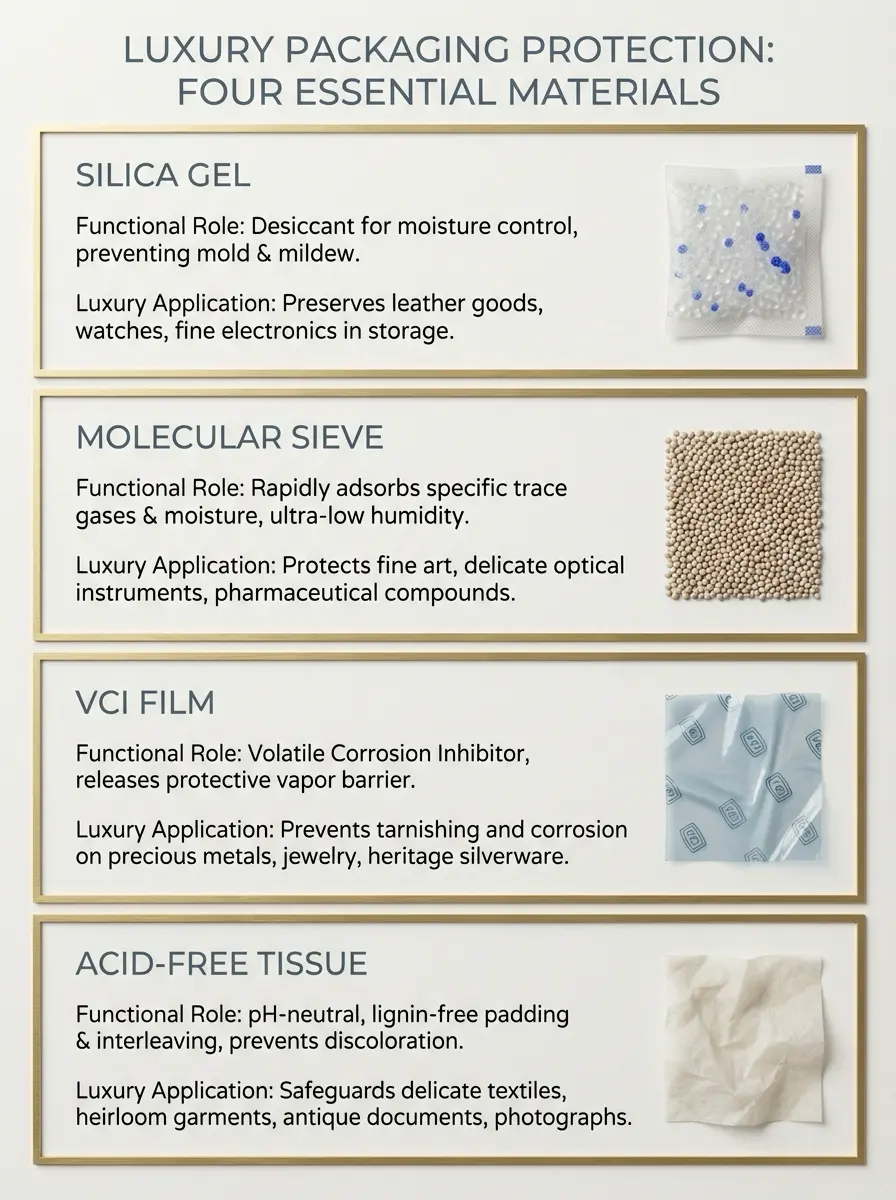
Acid-Free Tissue Paper
Functional role: pH-neutral or alkaline-buffered tissue that prevents acid migration from packaging materials to product surfaces. Standard mass-market tissue paper is mildly acidic and will cause surface degradation on sensitive materials over time.
Design challenge: The consumer sees the tissue; it must be aesthetically consistent with the packaging design. Custom colour, weight, and texture matching to the brand palette. Some brands print the tissue with a repeating pattern or text.
Luxury application: All direct-contact wrapping in luxury leather, textile, and paper goods. The acid-free specification is a protection decision; the custom colour and print is a brand decision. Both happen in the same material.
When Functional Requirements Become Brand Statements
The most sophisticated luxury packaging design makes its functional elements visible as brand values rather than hiding them as technical necessities. This is a distinct design philosophy from mere concealment — it’s reframing function as character.
The Quality Indicator as Design Element
Moisture indicator cards — small components with a colour-changing material that signals whether the interior humidity has remained within specification — are typically hidden in packaging. Some luxury brands have made them visible, positioned in a small branded window on the interior base with a custom graphic treatment that reframes the indicator as a quality verification badge rather than a technical component. The consumer sees a small circular disc in the brand colour that confirms ‘this package has maintained optimal conditions throughout its journey.’ Function becomes proof of care.
The Sustainable Material as Surface Story
Packaging regulations and consumer expectations have pushed luxury brands toward sustainable material specifications — recycled board, FSC-certified paper, soy-based inks, water-based coatings. The most effective luxury response to this pressure is not to hide the sustainable specification but to make it a visible part of the surface story. Uncoated recycled board with visible fibre texture communicates sustainability through the material’s natural character rather than through a logo or text claim. The texture itself is the statement — and it reads as intentional and premium rather than as a compromise, which is the design achievement.
Reusable Architecture
Premium packaging designed explicitly for reuse — the Aesop canister that becomes a desk container, the Diptyque box that serves as a decorative storage piece, the Hermès shoebox that outlasts the shoes — extends the brand into the consumer’s daily environment long after the product is used. The reuse function requires specific structural decisions: thicker board, reinforced corner construction, interior finishes that look intentional rather than incidentally pleasant. Designing for reuse is designing for the second life of the packaging, which is both sustainable and the longest possible brand impression.
✏ Design note: When a functional protection requirement and a brand expression opportunity align in the same material choice, you’ve found the best specification. Acid-free tissue in the brand’s exact Pantone colour costs marginally more than standard white acid-free tissue and produces a significantly richer interior experience. The silica gel sachet printed with the brand logo costs marginally more than an unbranded sachet and makes the functional component feel deliberate. Small specification upgrades at functional components produce disproportionate experiential improvements.
The Package as the First Product
A luxury product has two products: the object inside, and the package that delivers it. The second product is the one the consumer encounters first, handles longest, and in many cases keeps permanently. Its design is not secondary to the object inside — for the most premium brands, it’s structurally inseparable from the object’s perceived value.
Every material decision in a luxury package — the board weight, the surface treatment, the closure mechanism, the interior colour, the tissue paper, the desiccant specification, the moulded insert geometry — is a design decision that the consumer processes, consciously or not, during the unboxing experience. The packaging that performs best is the packaging where the functional decisions and the experiential decisions have been made by the same conversation — where the engineer specifying moisture control and the designer specifying the interior architecture are working from the same brief.
The first touch is not a prelude to the experience. It is the experience, beginning. Getting it right is the same discipline as getting the product right — the same precision, the same attention to material behavior, the same understanding that every detail communicates something whether the designer intended it to or not.
FAQ: Luxury Packaging Design
Q: What is the first touch moment in luxury packaging?
The first touch moment is the consumer’s initial physical interaction — the weight of the box, the texture of the surface, the resistance of the lid. Tactile cues form emotional associations with product quality before the product is seen. Research shows that soft-touch laminate surfaces cause consumers to rate interior products as higher quality than identical products in smooth-laminated packaging. The first touch is the first brand communication.
Q: Why do luxury packages use desiccants?
Moisture causes leather mould, metal corrosion, fragrance separation, paper warping, and electronics fogging. Desiccants control humidity within the sealed package throughout storage and transit. The design challenge is complete invisibility from the consumer’s perspective while maintaining functional effectiveness. Desiccant sachets are positioned within base inserts or behind tissue liners, invisible but active throughout the product’s journey.
Q: What is the difference between silica gel and molecular sieve?
Silica gel covers mid-range humidity (20-60% RH) and is the standard for most luxury consumer goods — non-toxic, stable, food-contact approved. Molecular sieve performs at very low humidity levels (below 20% RH) and is used for pharmaceuticals, precision optics, and watches where condensation inside sealed elements is a failure risk. Silica gel is the broader-use specification; molecular sieve is the precision specification.
Q: How do designers hide functional components?
Desiccants are placed within base inserts or beneath tissue liners. RFID and NFC chips are laminated between paper layers during board manufacturing — invisible and tactilely undetectable. Moisture indicators are sometimes reframed as branded quality verification elements visible in small windows. The design principle: function operates behind the surface; the surface reads as pure experience.
Q: What makes unboxing a designed experience?
Every physical interaction is sequenced and controlled: exterior surface communicates premium; lid opens with engineered resistance; interior materials reveal in layers — tissue, ribbon, insert — each extending anticipation; product is encountered last, elevated and presented. The sequence is the design. Each step extends the emotional reward of the purchase and creates the sensory memory associated with the brand.
- 1share
- Facebook0
- Pinterest1
- Twitter0
- Reddit0