

A practice I admire had one of the most rigorous bodies of residential work I had encountered in years. Five commissions of genuine architectural quality, each documented with precise photography, considered plans, and a design narrative that communicated exactly what the practice believed in. It was the kind of portfolio that should have been generating enquiries from exactly the clients they wanted.
- What an Architectural Portfolio Actually Does in 2026
- The Four Pillars of Digital Strategy for Architectural Practices
- Total Experience: Connecting the Digital Front-End to the Practice Behind It
- Emerging Technologies: From Static Gallery to Immersive Presentation
- Choosing a Digital Partner for an Architectural Practice
- The Portfolio as the Practice's Most Productive Employee
- FAQ: Digital Agencies and Architectural Portfolios
When I looked at how their work appeared online, the gap between the quality of the architecture and the quality of its digital presentation was significant. The portfolio website loaded slowly on mobile. The project pages were ordered by construction date rather than by project type or complexity.
The photography – which was genuinely excellent – was compressed to the point where the material quality that defined the buildings was invisible at screen size. And the practice appeared on page four of any search for the residential architectural services they specialised in. The work existed. The practice was invisible.
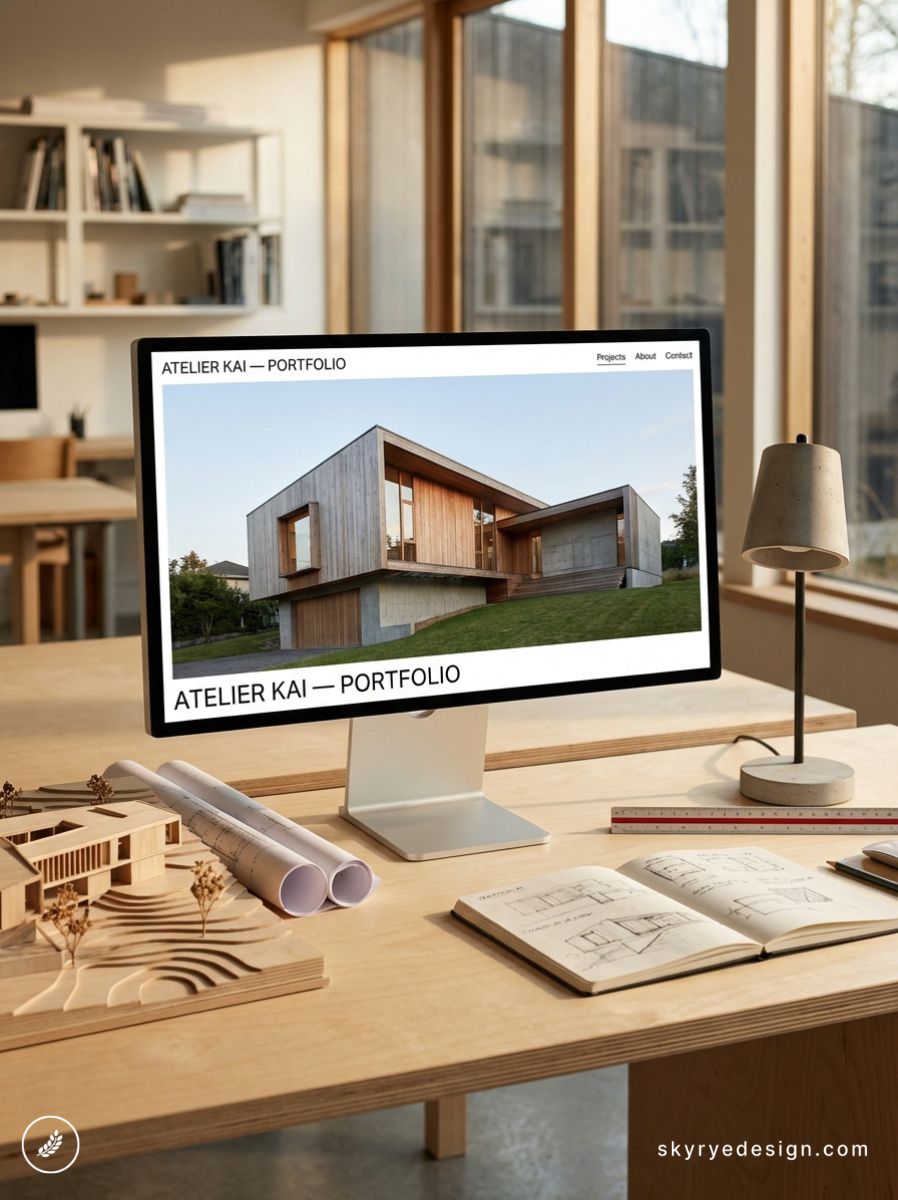
This gap – between the quality of design work and the quality of its digital presence – is not a niche problem. It is endemic across architectural practice, and it exists for a specific reason: the skills required to communicate design work effectively in the digital environment are entirely different from the skills required to produce it. That is what a digital agency brings.
Not just a better-looking website, but the technical and strategic infrastructure that makes architectural intelligence findable, legible, and competitive in the attention economy that determines which practices win the commissions that advance their careers.
What an Architectural Portfolio Actually Does in 2026
The architectural portfolio was invented as a credential document – a physical demonstration of completed work presented to potential clients or award juries. Its function was to answer a single question: what has this practice built? In the digital environment, a portfolio must answer a fundamentally different set of questions simultaneously: who are you, what do you believe, who should hire you, and how do they reach you?
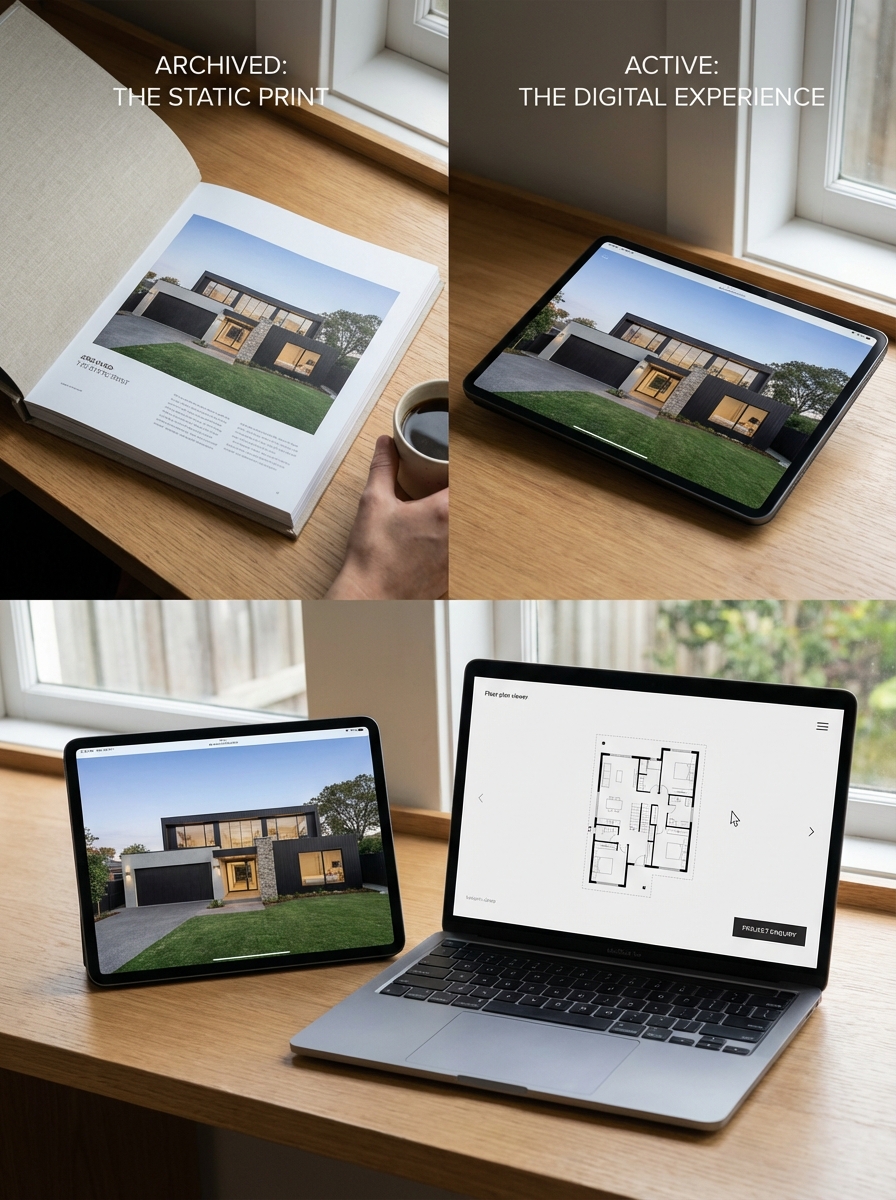
The static gallery of completed projects – however beautifully photographed – answers only the first of these and leaves the other three unanswered.
The practices that are winning significant commissions in 2026 understand that their digital portfolio is their primary business development tool. It is the surface through which developers, developers reps, prospective clients, award bodies, and potential employees form their first impression of the practice – and in most cases, it is the only impression they will form before deciding whether to make contact. A portfolio that is beautiful but slow, beautiful but unindexed, or beautiful but architecturally indistinct in its digital presentation loses clients before they ever consider the quality of the work it contains.
The transition from portfolio-as-credential to portfolio-as-business-development-engine requires a different kind of expertise than the design practice itself possesses. It requires the combination of UX design, search infrastructure, performance engineering, and content strategy that a specialist digital partner provides – not as a service transaction, but as an ongoing strategic relationship that evolves alongside the practice’s ambitions.
✏ Portfolio note: The most reliable diagnostic for whether your architectural portfolio website is functioning as a business development tool: check the ratio of portfolio page views to enquiry form completions in your analytics. Most architecture websites see below 0.5% conversion from visit to enquiry. A well-optimised portfolio website should achieve 1.5-3% conversion. The gap between these numbers represents the volume of qualified visitors who saw the work, were interested, and did not contact the practice – almost always because the path from interest to contact was unclear or inconvenient.
The Four Pillars of Digital Strategy for Architectural Practices
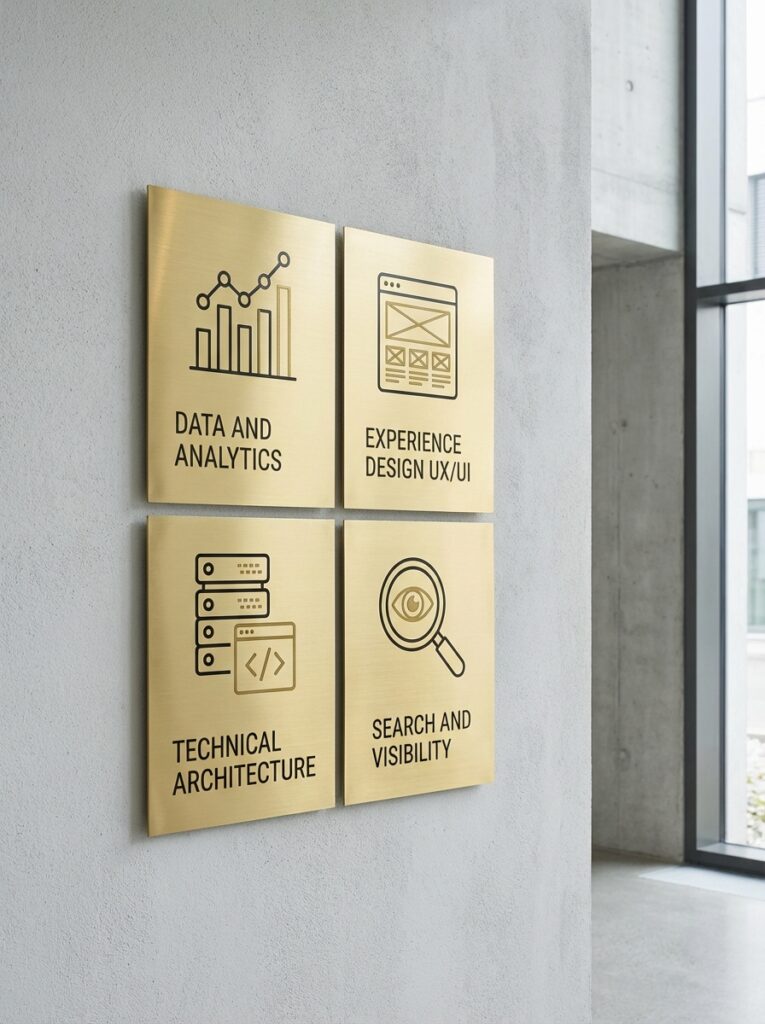
What a digital agency actually does for a practice is not reducible to building a website. The scope of work that transforms a portfolio from a credential document into a functioning business development asset spans four interconnected areas.
Data and Audience Intelligence
What it involves: Before a single design decision is made, understanding exactly who visits the current portfolio, what they look at, and where they leave. Market segmentation: which project types attract which client profiles. Behavioural mapping: how visitors navigate from project to project and what percentage reach the contact page. Predictive analysis: which content types and project presentations retain visitors long enough to generate enquiries.
Architecture-specific value: Most practices have no quantified understanding of their digital audience. Architecture firms frequently assume their primary digital visitors are potential clients when analytics often reveal that a significant portion are architecture students, competitors, or journalists – each requiring different content and different pathways through the site. Data-driven portfolio design starts by knowing who is actually looking.
Experience Design (UX and UI)
What it involves: The frictionless experience — where every step from project discovery to practice enquiry is intuitive, fast, and visually coherent with the quality of the work being presented. This involves information architecture (how projects are categorised and navigated), interface design (how content is presented at every breakpoint and device), and conversion design (how the path from interest to contact is structured and motivated).
Architecture-specific value: Architecture portfolio UX has a specific challenge: the work must be presented at the scale and resolution required to communicate design quality, while the interface must perform quickly enough to retain organic search visitors. Most architectural portfolios sacrifice one for the other. Expert UX design resolves this tension through progressive loading, intelligent image compression, and content hierarchy that communicates design intelligence before high-resolution imagery has fully loaded.
Technical Architecture and Performance
What it involves: The backend infrastructure that determines site speed, security, scalability, and maintainability. Headless CMS architectures that allow content management without developer intervention. API integrations that connect the portfolio to project management systems, client portals, and award submission platforms. Cloud-native hosting that scales dynamically with traffic during award announcements or media coverage.
Architecture-specific value: An architecture firm that wins a significant award or receives a major press feature needs a website that can handle a traffic surge of 10-50x its normal volume without slowing or failing. Most practice websites are hosted on shared infrastructure that collapses under this load – at precisely the moment when the digital presence matters most. Technical infrastructure is the foundation that all other portfolio investment depends on.
Search Visibility and Content Authority
What it involves: The combination of technical site health, keyword-structured project content, and editorial strategy that makes a practice discoverable to clients who are actively searching for architectural expertise they do not yet know exists. Local SEO for geographically focused practices. Project-type SEO for specialisation-focused practices. Content marketing that establishes the practice as a thinking authority in its domain.
Architecture-specific value: Architectural search visibility is consistently underinvested relative to its commercial value. A practice that appears on page one for the search terms its target clients actually use — not the terms the practice thinks are important, but the terms a developer or homeowner types into Google – generates a consistent stream of qualified enquiries at zero marginal cost per lead. This is the most sustainable client acquisition mechanism available to an architectural practice.
Total Experience: Connecting the Digital Front-End to the Practice Behind It
The most significant evolution in digital agency practice over the past three years is the shift from Customer Experience (CX) to Total Experience (TX). The distinction matters enormously for architectural practices. CX is concerned with the client-facing digital touchpoints – the website, the contact process, the digital presentation of work. TX recognises that the quality of the client experience is ultimately determined by the internal operational processes that the digital front-end depends on.
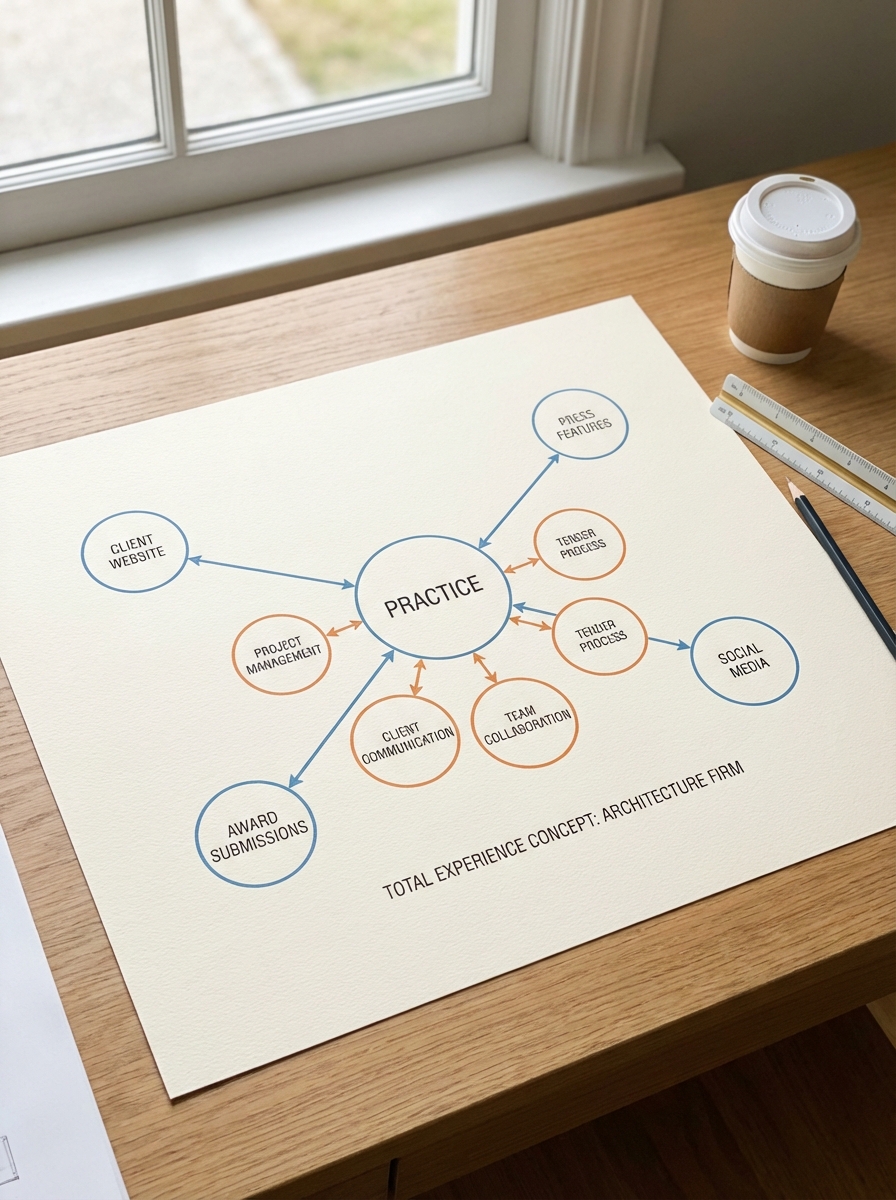
Consider a practice that invests significantly in a beautiful, well-optimised portfolio website. A potential client finds the practice through search, is genuinely impressed by the residential work on display, and submits an enquiry. If that enquiry reaches an inbox that is managed irregularly, if the response takes four days, if the follow-up meeting relies on emailed PDF attachments of drawings rather than a considered digital presentation — the digital experience has failed at the TX level regardless of the quality of the portfolio front-end that generated the enquiry. The digital agency’s value is not just in building the visible surface but in helping the practice integrate its digital presence with the operational processes that determine whether great work generates great opportunities.
The best digital partners – whether working with a boutique residential practice or a large multidisciplinary studio — function as consultants who ask uncomfortable questions: what happens after the enquiry? How does a project move from commission to delivery? Where are the coordination failures that clients experience as disorganisation, and how can digital tools address them? Answering these questions positions the agency as a strategic partner rather than a website vendor, and produces digital infrastructure that serves the practice’s growth over a decade rather than a product delivered once and gradually outdated.
Emerging Technologies: From Static Gallery to Immersive Presentation
The most consequential emerging capability for architectural digital presence is the integration of spatial technologies into client communication. Augmented Reality – once the exclusive domain of gaming and consumer entertainment – has matured to the point where architecture practices can deploy it as a genuine client communication tool, allowing potential clients and project stakeholders to experience proposed designs at 1:1 scale in their actual physical context before construction begins.
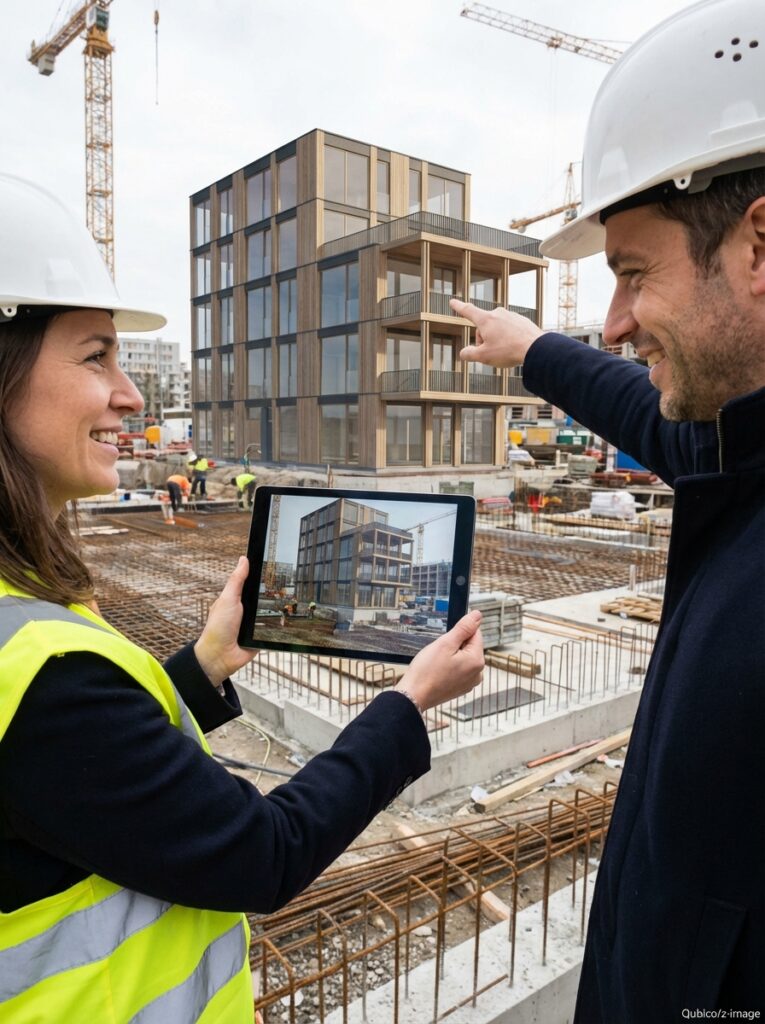
This represents a qualitative shift in what architectural presentation can achieve. A rendered image of a proposed building communicates design intent but requires the viewer to imaginatively translate a two-dimensional representation into three-dimensional spatial reality – a translation that most non-architect clients find difficult and that almost always produces misaligned expectations.
An AR overlay of the same building, experienced at full scale on the actual site through a tablet or phone camera, gives the client a spatial understanding of the design that no rendered image, video walkthrough, or physical model can replicate. The approval process accelerates. The specification conversations become more concrete. The risk of late-stage changes due to spatial misunderstanding decreases significantly.
The practices best positioned to deploy these technologies are those with a digital partner who understands both the 3D pipeline that architectural design produces and the development infrastructure required to deploy that pipeline as a client-facing AR experience. This is the specific intersection that the best digital agency in Melbourne and other design-forward cities now occupies: the overlap between deep understanding of architectural production workflows and the front-end technical capability to translate those workflows into digital experiences that clients can navigate without technical knowledge.
Beyond AR, the emerging tool set available to architectural practices through a capable digital partner includes: interactive plan and section viewers that allow clients to explore a project’s spatial logic without reading a drawing; AI-assisted content generation that supports the practice’s editorial output without displacing its design voice; green hosting infrastructure that aligns the practice’s digital carbon footprint with its sustainability commitments in built work; and analytics tooling that measures which portfolio content is actually influencing client decisions rather than which content the practice believes is its strongest.
✏ Portfolio note: Before commissioning any emerging technology integration — AR, interactive models, AI-assisted content — establish the baseline performance of the existing portfolio first. Fix slow load times, improve search visibility, clarify the contact process. These foundational improvements will generate more qualified enquiries than any emerging technology overlay applied to an underperforming base. The hierarchy: fast and findable first, then immersive and sophisticated.
Choosing a Digital Partner for an Architectural Practice
Not all digital agencies are equipped to serve architectural practices effectively. The specific combination of skills required — deep understanding of architectural production, visual sensitivity to the design standards architecture maintains, and technical expertise across performance engineering, search, and experience design — is uncommon. The criteria for evaluating a digital partner have shifted significantly from the question of who can build the most visually impressive portfolio to who can demonstrate measurable improvement in the portfolio’s business performance.

What a Modern Architecture-Focused Digital Partner Offers
- Portfolio strategy before execution: the agency should begin with an audit of the current digital presence — traffic sources, conversion rates, search visibility, load performance — before proposing any design or development work. A partner who starts with strategy rather than aesthetics is demonstrating the right priority order.
- Architectural literacy: the agency should be able to read a floor plan, understand the distinction between a section and an elevation, and articulate why the material choices in a project photograph matter to the story being told. Without this literacy, digital content decisions will consistently undermine the architectural intelligence they are meant to communicate.
- Long-term partnership model: architectural portfolios require ongoing management — new projects to add, search positions to maintain, content to publish, performance to monitor. A project-based engagement model produces a website that is excellent at launch and gradually outdated. A partnership model produces a portfolio that improves continuously alongside the practice.
- Measurable outcomes: the agency should be able to specify in advance what success looks like in quantified terms — search position improvements, load time targets, enquiry rate benchmarks — and report against these regularly. Vague aesthetic success criteria are the signature of an agency that does not expect to be held accountable for commercial outcomes.
The Portfolio as the Practice’s Most Productive Employee
The practice I described at the start of this piece did engage a digital agency. Within eight months, their portfolio load time had dropped from 6.2 seconds to 1.4 seconds on mobile. Their primary project type appeared on page one of the search results that their target clients were actually using. The enquiry conversion rate doubled. And a new AR presentation tool, deployed for a significant residential commission, reduced the client approval process for a complex facade specification from three rounds of revision to one.
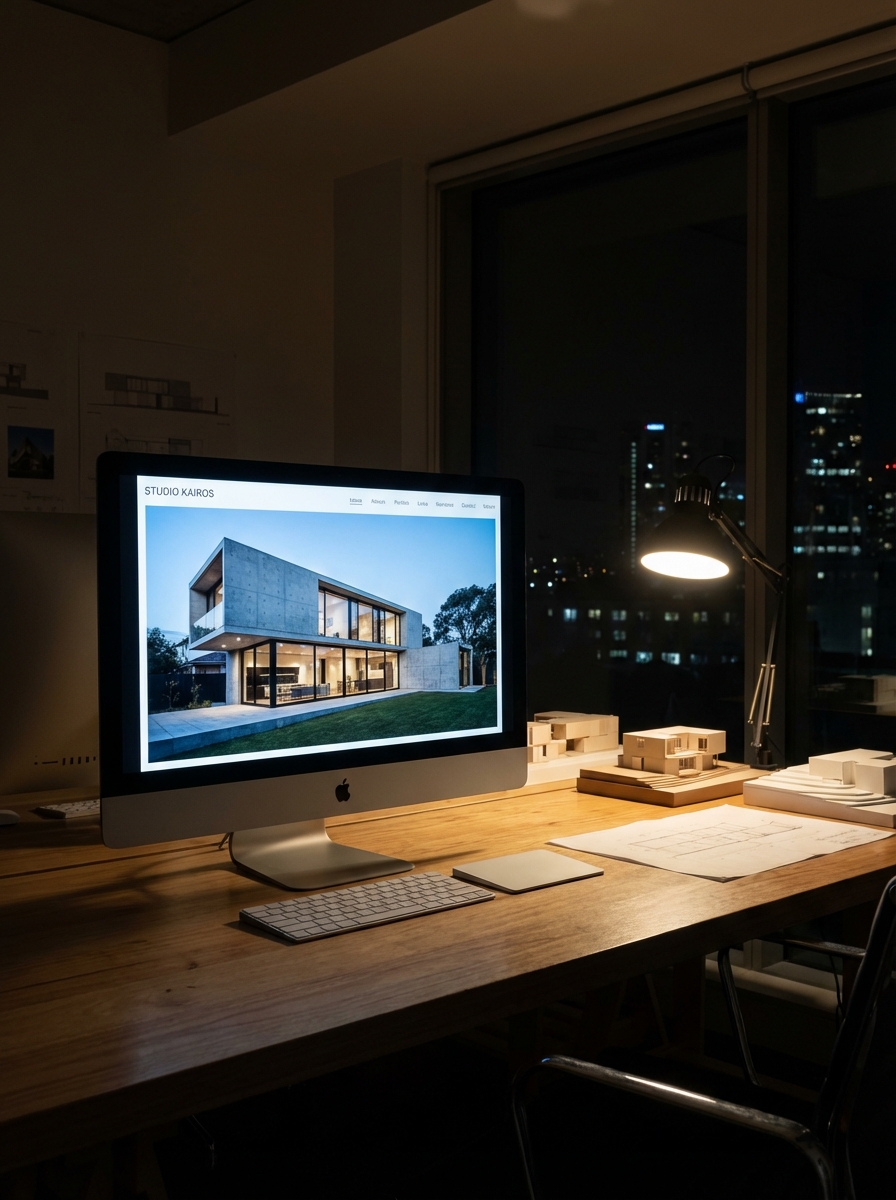
None of this changed the architecture. The buildings were as good as they always were. What changed was the infrastructure through which that quality was communicated to the world that needed to commission it. A well-built digital presence is the architectural practice’s most productive employee — working continuously, generating qualified introductions while the architects are doing the work that justifies those introductions. Building and maintaining it is not an overhead; it is an investment in the practice’s ability to do the work it is capable of.
The digital agency’s role in architectural practice is not to make good design look impressive online. Good design should look impressive online — the challenge is making it findable, fast, legible to a non-architect, and connected to the operational processes that turn interest into commission. That is the work. And done well, it is as considered and as consequential as the built work it exists to support.
FAQ: Digital Agencies and Architectural Portfolios
Q: Why do architecture firms need a digital agency?
A digital agency provides the technical and strategic infrastructure that makes great architectural work findable and commercially effective: search optimisation, performance engineering, UX design, and content strategy. These skills are entirely different from architectural practice and require specialist expertise. The result is a portfolio that actively generates enquiries rather than passively existing as a credential document.
Q: What is Total Experience (TX) in architectural digital design?
TX extends beyond the client-facing website to connect the digital front-end with the internal processes that determine whether the client experience is actually delivered. For architecture, this means connecting portfolio enquiries to project management, client communication, and response workflows so that a strong digital first impression is supported by an equally strong operational follow-through.
Q: How does SEO work for architecture portfolios?
Architecture portfolio SEO structures content around project-type keywords that potential clients actually search (not the terms the practice uses internally), optimises technical performance so image-heavy pages load quickly, and builds editorial content that establishes the practice as a thinking authority. Local SEO matters for geographically focused practices; project-type SEO matters for specialisation-focused ones.
Q: Can Augmented Reality improve an architecture portfolio?
Yes — AR allows potential clients to experience proposed designs at 1:1 scale in their actual physical context before construction. This produces a spatial understanding that no rendering or video walkthrough can replicate, accelerating approvals and reducing late-stage specification changes. Implementation requires a digital partner who understands both architectural 3D pipelines and AR development infrastructure.
- 6shares
- Facebook0
- Pinterest6
- Twitter0
- Reddit0