The first time I tried drawing a Lexus, I chose the LFA. Huge mistake for a beginner. That triple exhaust cluster, the carbon fiber crease lines on the hood, the way the front fascia is almost impossible to simplify — I went through half a sketchbook before anything looked remotely right. But that failure taught me something important: Lexus cars are hard to draw precisely because they’re so deliberately, obsessively designed.
- Before You Start: Universal Lexus Drawing Principles
- Model #1 — Lexus LS 400 (1989): The Classic Starter
- Model #2 — Lexus SC 400 (1991): The Sweep-Back Coupe
- Model #3 — Lexus IS 300 (2000): The Compact Puncher
- Model #4 — Lexus GS 430 (2006): The Spindle Pioneer
- Model #5 — Lexus IS-F (2008): The Performance Sedan
- Model #6 — Lexus RX 350 (2010): The Luxury SUV
- Model #7 — Lexus RC-F (2015): The Track-Ready Coupe
- Model #8 — Lexus LS 500 (2018): Modern Flagship
- Model #9 — Lexus LC 500 (2017): The Design Masterpiece
- Model #10 — Lexus LFA (2010): The Legend
- Essential Techniques for Drawing Any Lexus Model
- Lexus Drawing Difficulty — Quick Reference
- Frequently Asked Questions
- Q: What is the best Lexus model for a beginner to draw?
- Q: How do you draw the Lexus spindle grille?
- Q: Why is the Lexus LFA so hard to draw?
- Q: What pencils should I use for car sketching?
- Q: What makes Lexus car design different from other luxury brands?
- Q: How long does it take to draw a Lexus car realistically?
- Q: Can I draw Lexus cars digitally on an iPad?
- Start With What Excites You
Lexus doesn’t do ‘generic.’ Every model from the LS 400 to the current LC 500 carries a design signature that Koichi Suga, the brand’s long-serving General Manager of Design, calls ‘L-finesse’ — a philosophy of sharp contrasts, flowing surfaces, and striking details. For artists, that’s both the challenge and the reward.
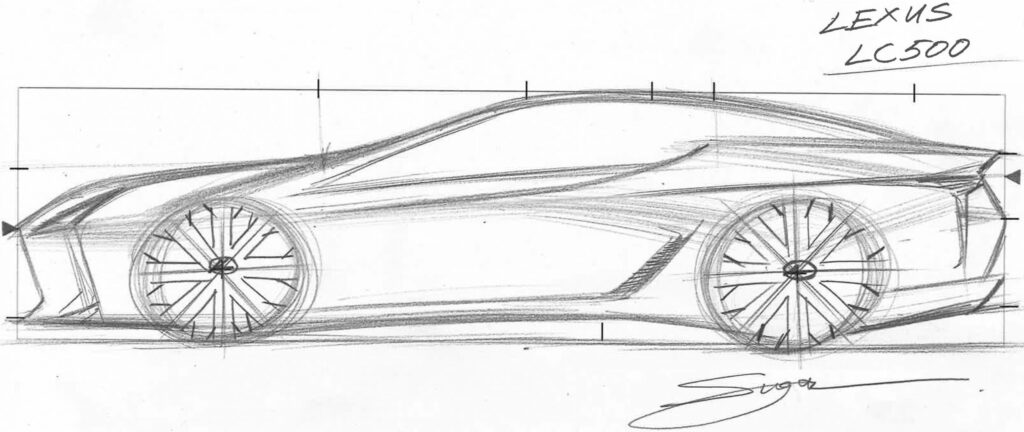
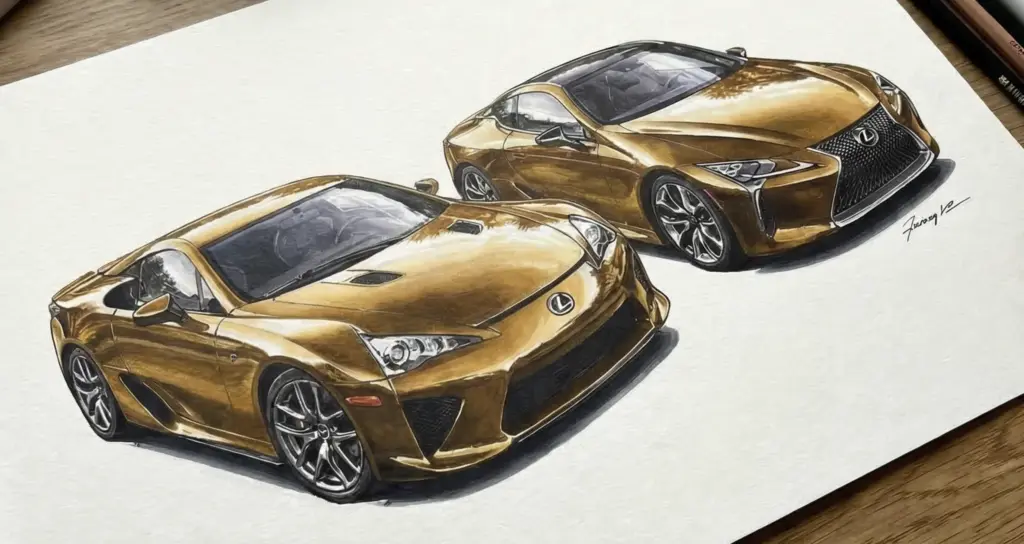
It was a big revelation for me that the letter L is used as a form factor throughout the entire car—on the headlight, hood, and deflector. It’s stunning; the logo is perfectly integrated into the car’s shape. It’s also fascinating to know that the Lexus name is an abbreviation for “Luxury Car in US.
This guide covers 10 iconic Lexus models, ranked from beginner-friendly to genuinely difficult. For each, I’ll break down what makes the design distinctive, which features to get right first, and where most beginners trip up. Whether you’re working in pencil, ballpoint, or digital Procreate on an iPad Pro, these models will sharpen your automotive sketching skills.
Before You Start: Universal Lexus Drawing Principles
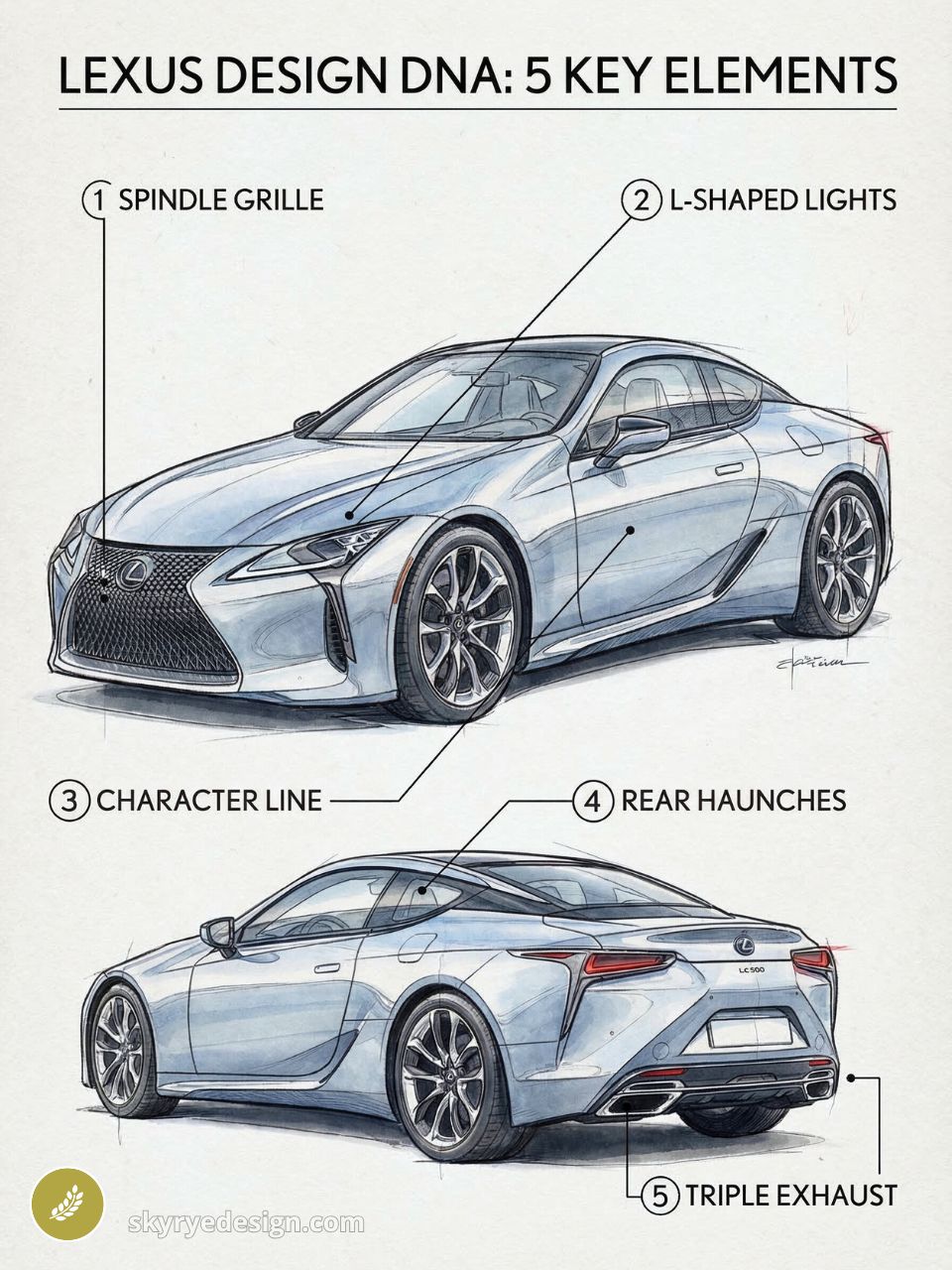
Every Lexus shares a few design DNA markers. Learn to spot and draw these, and your sketches will immediately read as Lexus rather than generic Japanese luxury.
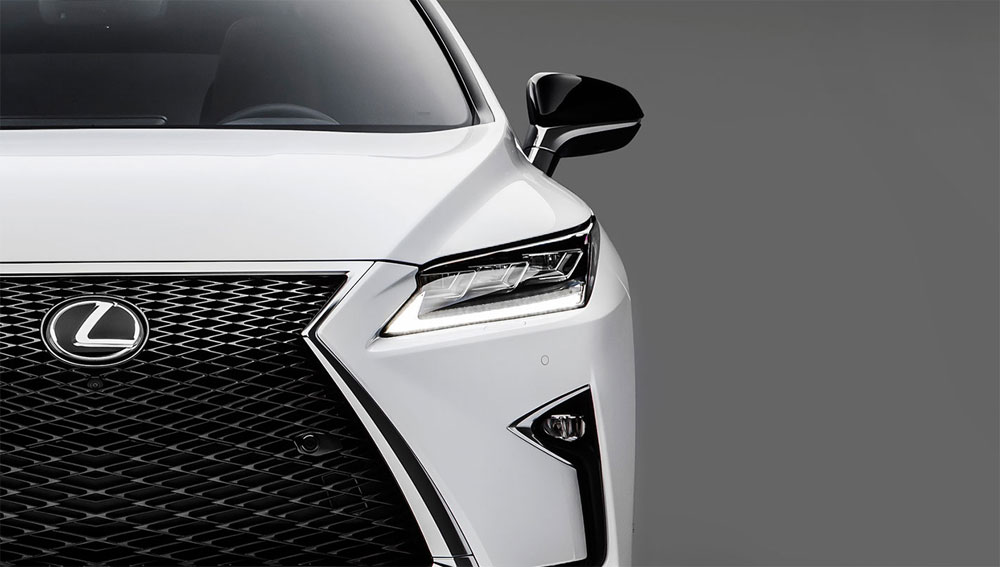
The Spindle Grille
Introduced on the 2012 GS sedan, the spindle grille is the most recognizable Lexus element. It’s not a rectangle — it’s an hourglass shape that pinches at the center, then flares out below the bumper line. When drawing any post-2012 Lexus, get the spindle geometry right before you touch anything else. I usually draw two guide dots at the pinch point and let everything else angle off from there.
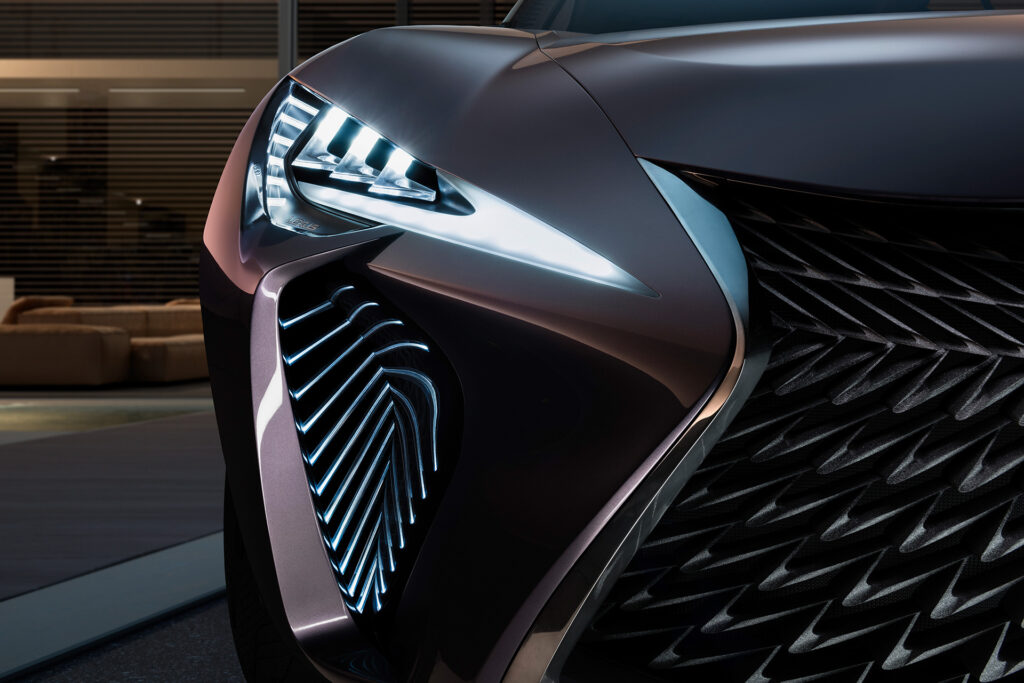
Sharp Triangle Headlights
Lexus headlights, since the LFA era, follow an arrowhead or L-shaped form. They cut back into the fender line aggressively. The mistake beginners make is drawing them too round or too horizontal — Lexus lights almost always have a strong diagonal energy going backward.
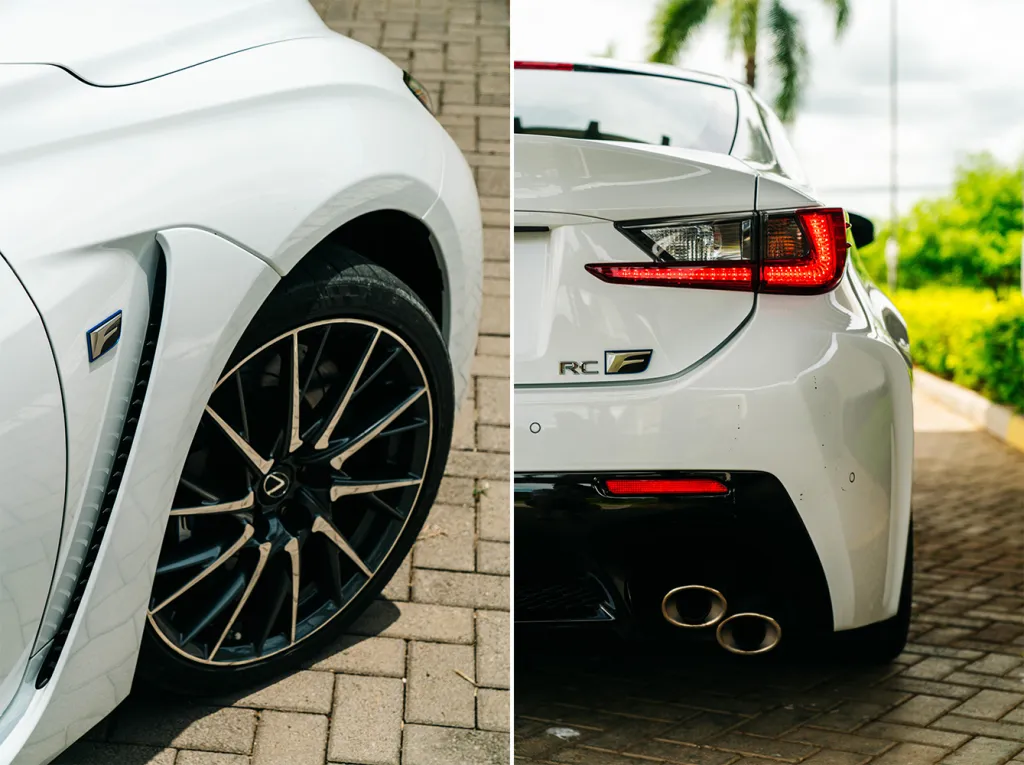
The Character Line
A single rising line along the lower body — tight near the front wheel, sweeping up toward the rear haunch.
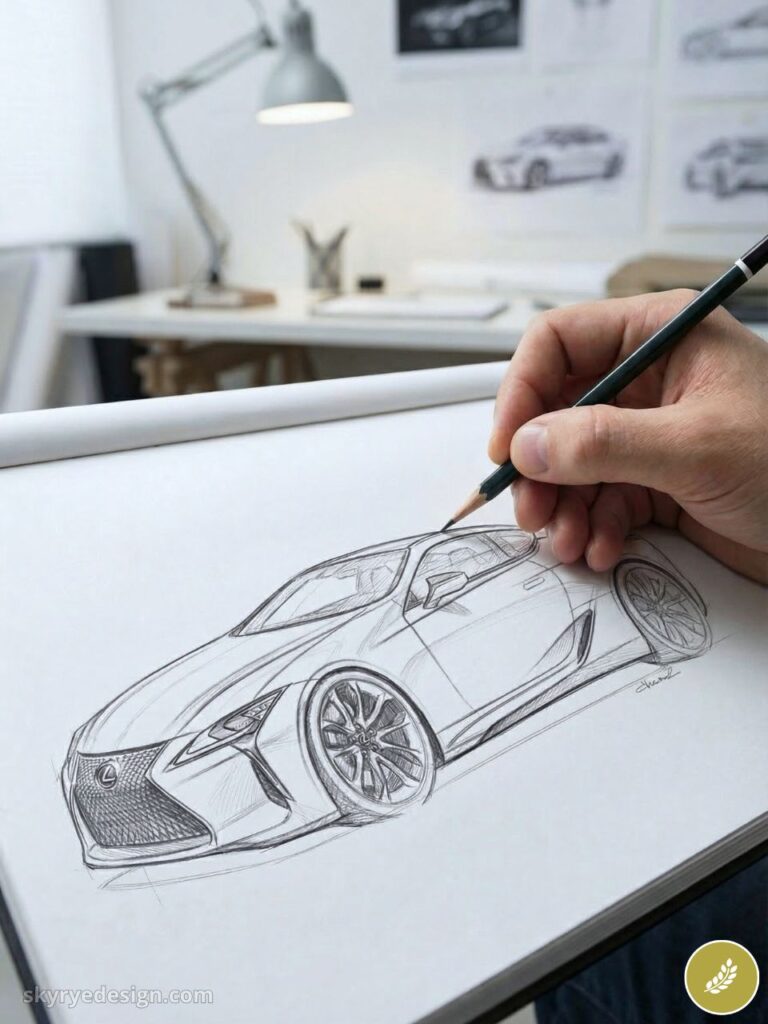
On coupes, it’s dramatic, on sedans it’s subtle, but it’s always there. This line is what gives Lexus cars their ‘coiled energy’ look, even when they’re standing still.

| ✏️ PRO TIP: Use a 2H pencil for initial construction lines — light enough to erase but dark enough to see proportions clearly. Switch to a 0.5mm mechanical pencil or a 0.3mm Staedtler Pigment Liner for final ink lines. |
Model #1 — Lexus LS 400 (1989): The Classic Starter
| #1 Lexus LS 400 1989–1994 | Difficulty: ⭐ Beginner Key design feature: Clean slab-sided body with minimal creases Drawing challenge: Getting the elegant near-invisible roofline right |
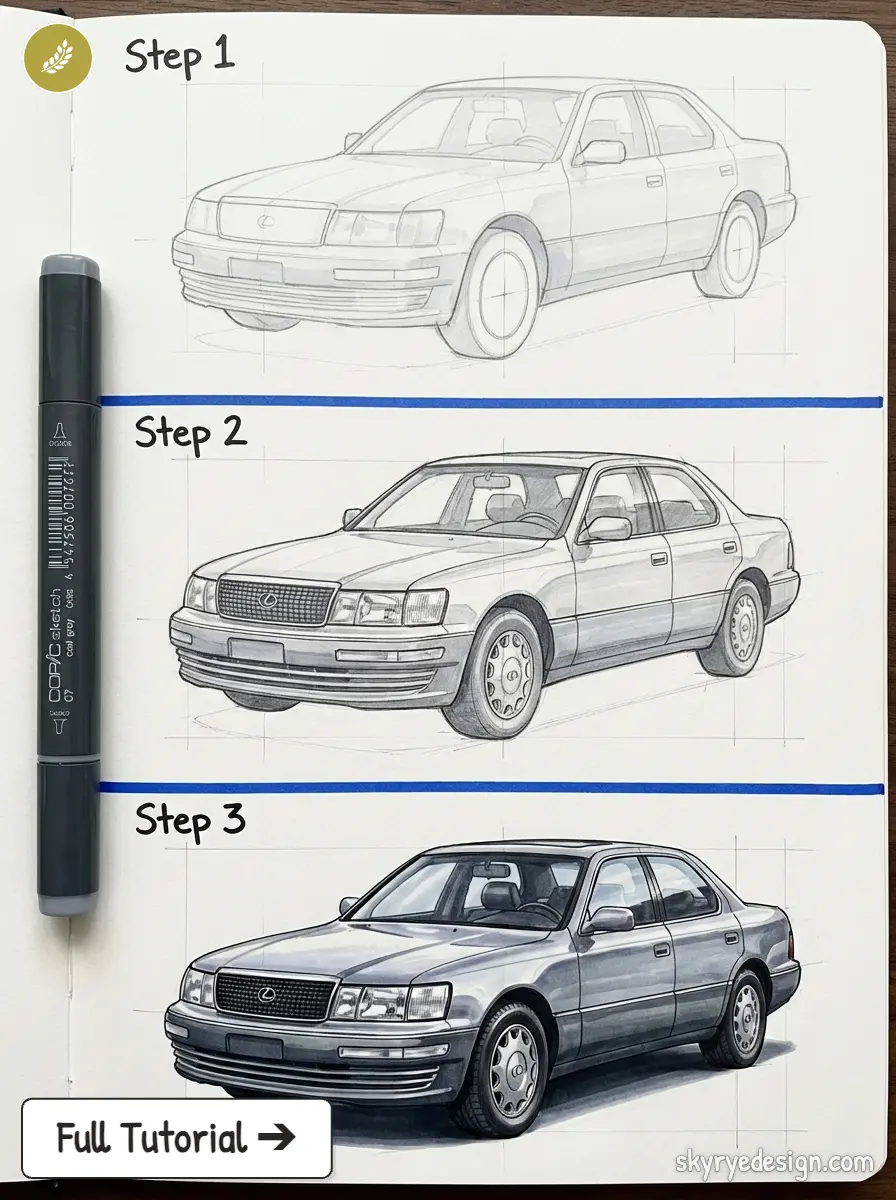
The LS 400 is the car that launched Lexus in 1989 and immediately made Mercedes and BMW nervous. From a drawing standpoint, it’s beautiful precisely because it’s restrained. Long hood, sleek greenhouse, almost no body creases.
Start with two wheel circles — the LS 400 has a 110.4-inch wheelbase, so there’s a lot of space between them. The roofline is the tricky part: it drops almost imperceptibly from the B-pillar, creating that ‘three-box’ sedan elegance. Don’t make the roof too flat or it’ll look like a rental car.
Key tip: The front fascia is round and welcoming — no sharp creases. Imagine a bar of refined soap. That’s the face of the first-gen LS.
Model #2 — Lexus SC 400 (1991): The Sweep-Back Coupe
| #2 Lexus SC 400 1991–2000 | Difficulty: ⭐⭐ Easy-Medium Key design feature: Long sweeping fastback roofline Drawing challenge: The curved rear glass area and wrap-around taillights |
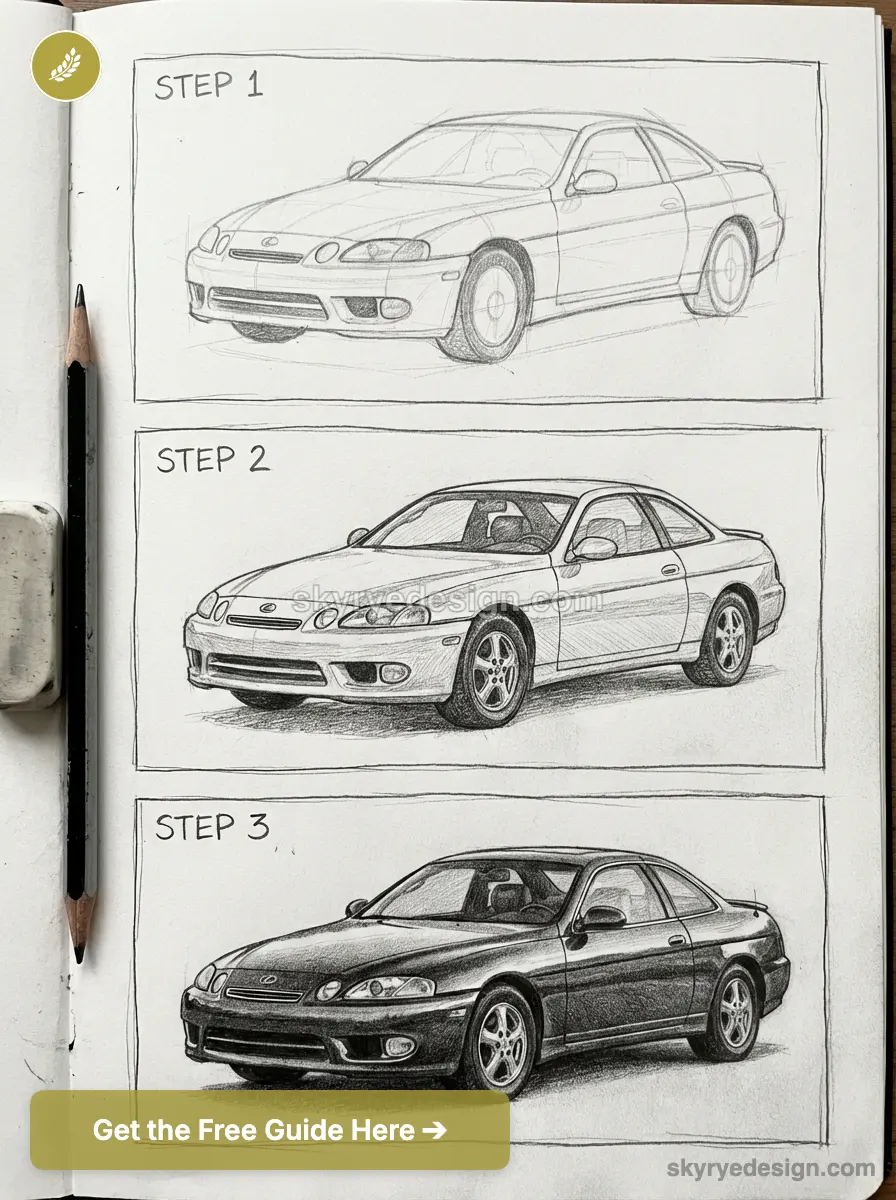
The SC 400 is one of the most satisfying Lexus cars to draw at the intermediate level. The roofline swoops from the A-pillar all the way to the trunk in one beautiful arc — great for practicing fluid freehand curves.
The key proportion challenge: the greenhouse (window area) is long and low, taking up roughly 40% of the side view. Draw the roofline first as a single confident stroke. Then work the hood and trunk lid down from there. The 16-inch wheels are relatively small for the car’s length — a common mistake is drawing them too big.
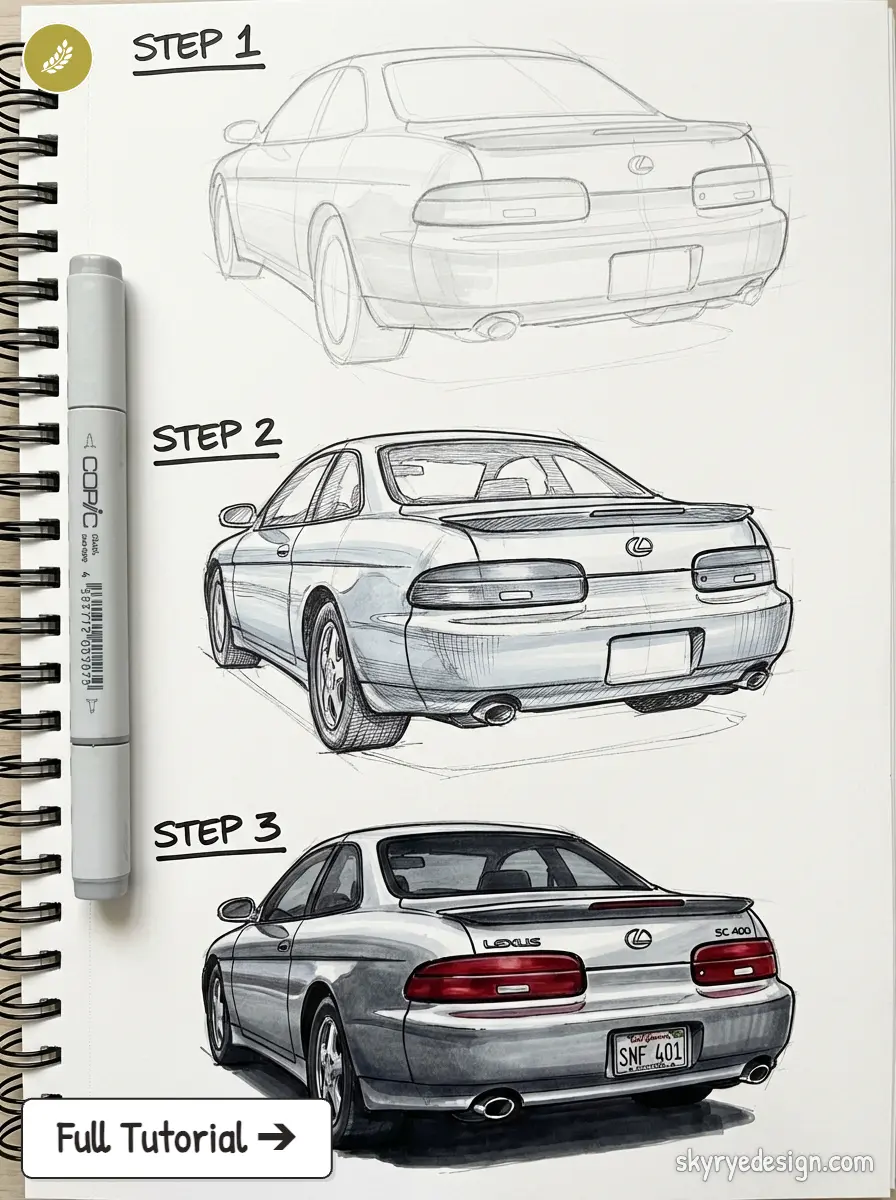
| ✏️ PRO TIP: For any coupe with a long fastback roof, try the ‘roofline first’ approach: draw the entire roof arc before touching the hood or trunk. This locks in the car’s fundamental silhouette proportion. |
Model #3 — Lexus IS 300 (2000): The Compact Puncher
| #3 Lexus IS 300 2001–2005 | Difficulty: ⭐⭐ Easy-Medium Key design feature: Muscular wheel arches and the iconic Altezza taillights Drawing challenge: The fender flares and door crease alignment |
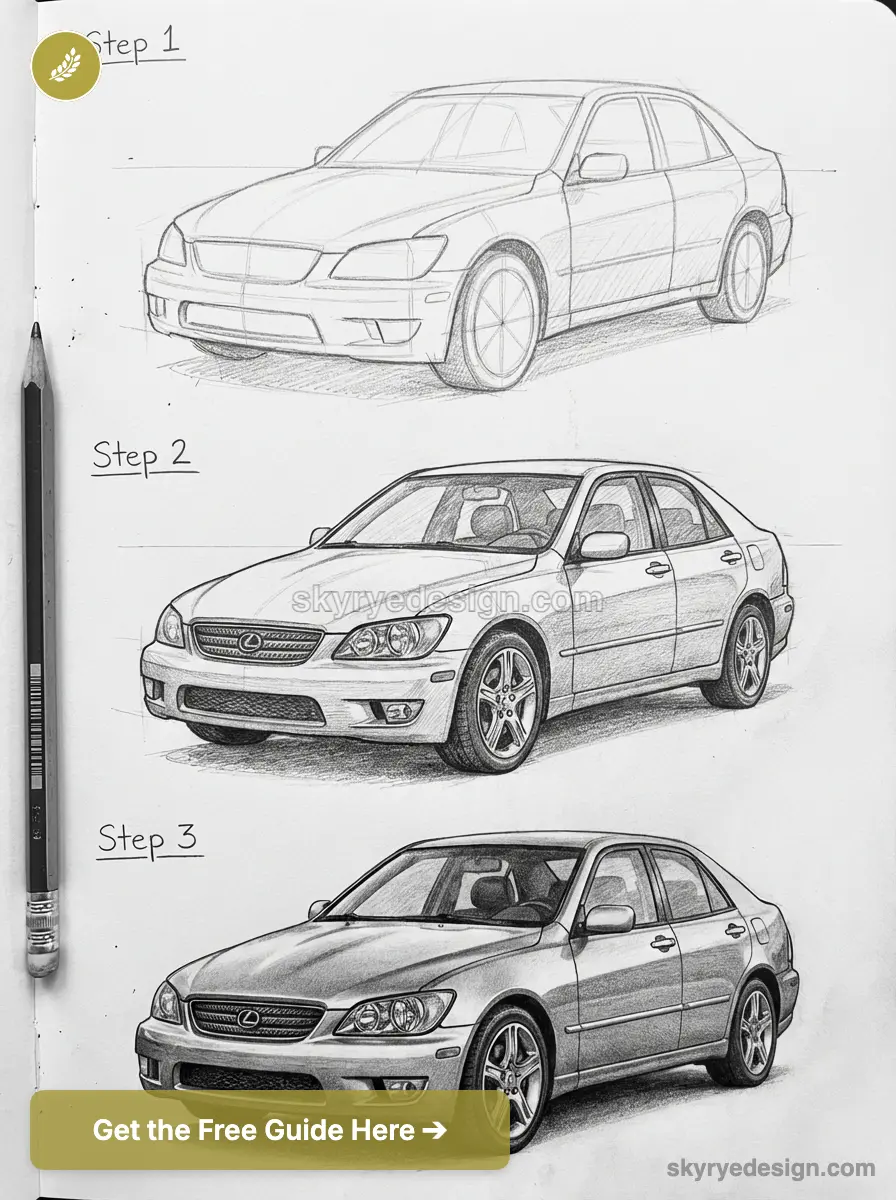
The IS 300 introduced a more aggressive Lexus identity. Based on the Toyota Altezza (which gave the world ‘Altezza-style’ taillights — clear lenses with inner chrome rings), it’s got a more muscular, European-sport feel than the LS.
Focus on the fender flares first — they bulge outward more than the LS or SC. The character line runs from just behind the headlight, rises gently, then kicks up slightly near the rear wheel arch. Draw that line early and use it as an anchor for everything else.
Fun fact: The IS 300’s center-mounted speedometer was modeled to look like a chronograph watch dial. If you’re drawing the interior, that detail alone makes the cockpit instantly recognizable.
Model #4 — Lexus GS 430 (2006): The Spindle Pioneer
| #4 Lexus GS 430 2005–2011 | Difficulty: ⭐⭐ Easy-Medium Key design feature: Bold front grille presence and low roofline Drawing challenge: The wide haunches and getting rear proportions right |
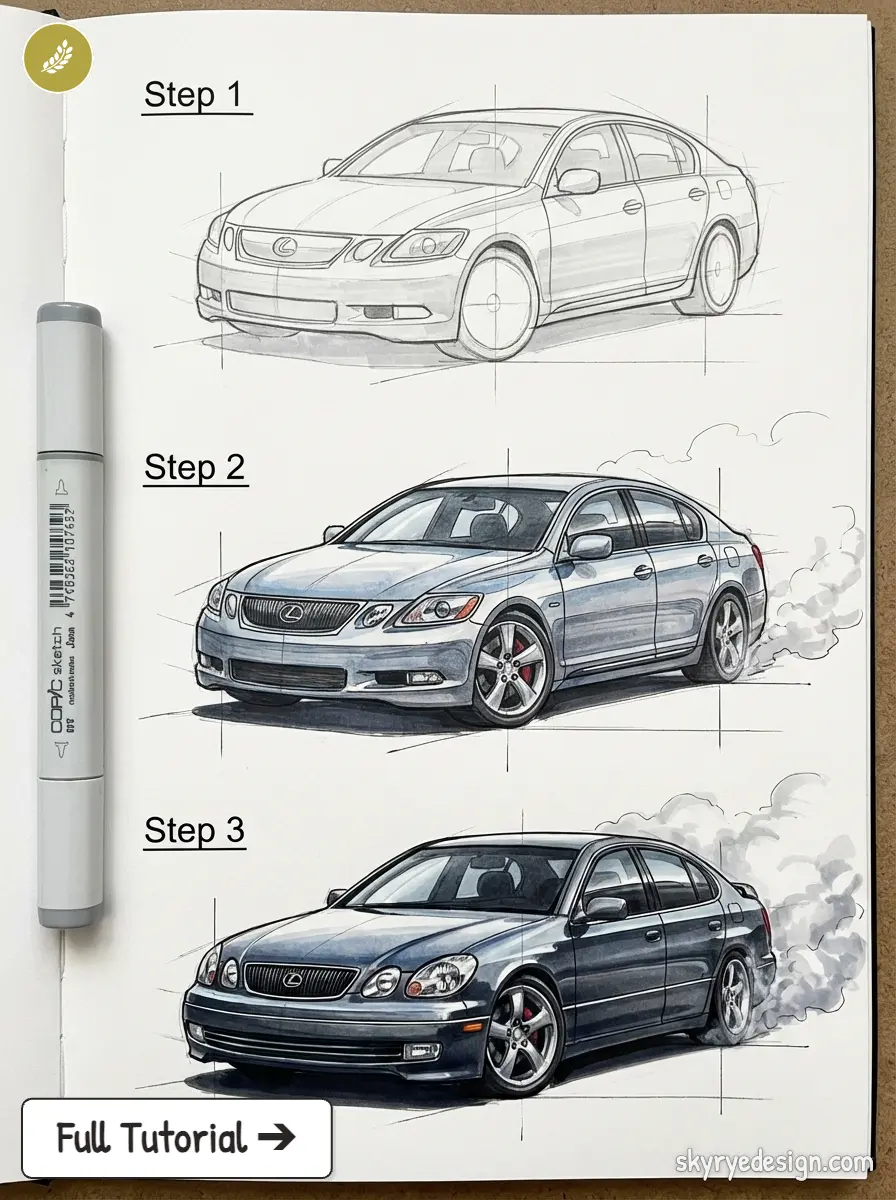
The GS was Lexus’s first real design statement car before the LFA era. The 2006 GS430 has a presence to it — wide front end, low stance, aggressive projector headlights that jut forward like a predator’s brow.
When drawing the GS, work the front fascia carefully. The headlights have a strong downward angle from the hood line, almost dagger-shaped. The lower bumper intakes are wide and horizontal — they balance the front end. The rear of the GS is actually the harder part: the trunk lid has an integrated spoiler with a subtle upswept trailing edge that’s easy to miss.
Model #5 — Lexus IS-F (2008): The Performance Sedan
| #5 Lexus IS-F 2008–2014 | Difficulty: ⭐⭐⭐ Intermediate Key design feature: Flared fenders, quad exhausts, aggressive vents Drawing challenge: The fender flares add real width — proportions are unforgiving |
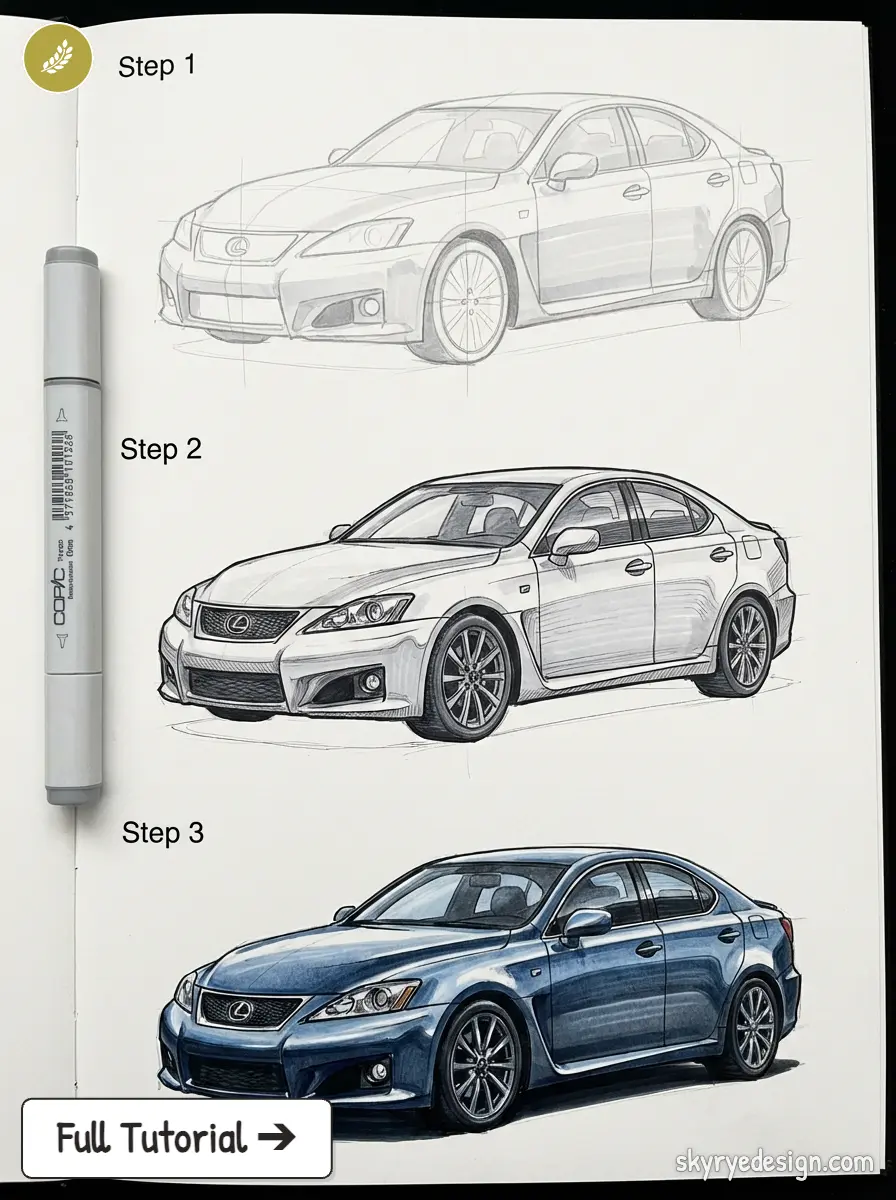
The IS-F was Lexus’s first real M3 fighter: 416 hp from a 5.0L naturally aspirated V8, naturally. From a drawing perspective it’s a significant step up in complexity because of the widebody treatment.
The front fenders are visibly flared — roughly 30mm wider than a standard IS. This is a proportional trap: if you draw them too subtle, the car looks like a stock IS. If you overdo them, it looks like an aftermarket kit. Study reference photos and notice how the flare begins at the top of the arch, rolls outward, then drops straight down with a clean shoulder. The quad exhaust at the rear is arranged in a 2+2 layout, not in a straight line. Get that grouping right, and the drawing immediately looks like the IS-F rather than a generic sport sedan.
| ✏️ PRO TIP: When drawing widebody or fender-flared cars, lightly draw the stock fender shape first, then extend outward from it. This helps keep the flare proportional rather than guessing from scratch. |
Model #6 — Lexus RX 350 (2010): The Luxury SUV
| #6 Lexus RX 350 2010–2015 | Difficulty: ⭐⭐ Easy-Medium Key design feature: Tall, sweeping profile with dramatic roofline curve Drawing challenge: The tall greenhouse and SUV proportions feel unfamiliar after drawing coupes |
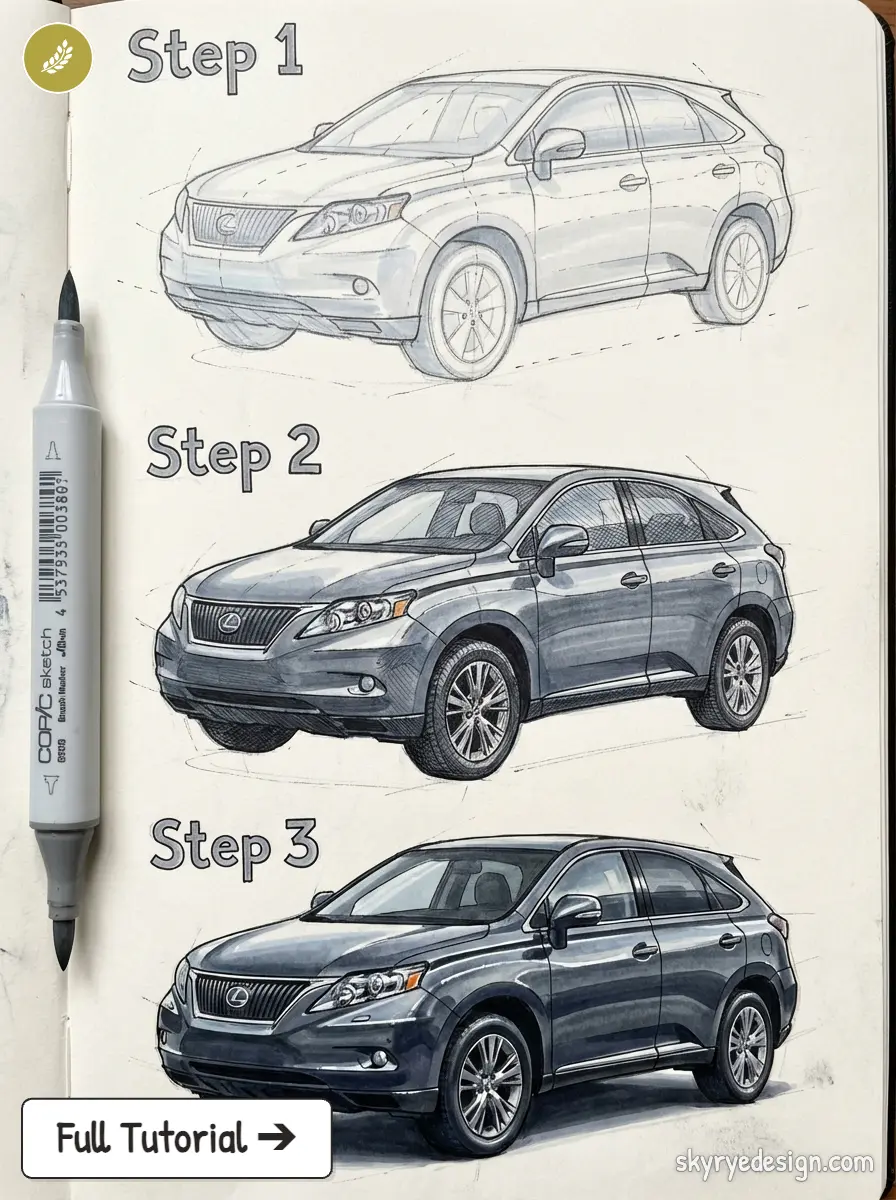
If you’ve been drawing coupes and sedans, jumping to an SUV messes with your proportions. The RX 350 is a great transitional model because its design is relatively clean — no extreme flares, no complex surfacing.
The critical proportion: the RX sits high, but the body’s highest point isn’t the roof — it’s the shoulder line, which crests at about door-handle height before the roof sweeps up and back. Draw that shoulder peak first. The windshield has a pronounced rake angle, similar to a coupe, which gives the RX its distinctive sporty-SUV silhouette.
Note: The RX created the luxury crossover segment. The original 1998 RX 300 sold so well that every European luxury brand eventually copied the formula — Audi Q5, BMW X3, Mercedes GLC. Drawing it is a nod to automotive history.
Model #7 — Lexus RC-F (2015): The Track-Ready Coupe
| #7 Lexus RC-F 2015–2025 | Difficulty: ⭐⭐⭐ Intermediate Key design feature: Carbon fiber roof, aggressive front bumper, wide rear diffuser Drawing challenge: Managing the complex front fascia with multiple intakes and splitters |
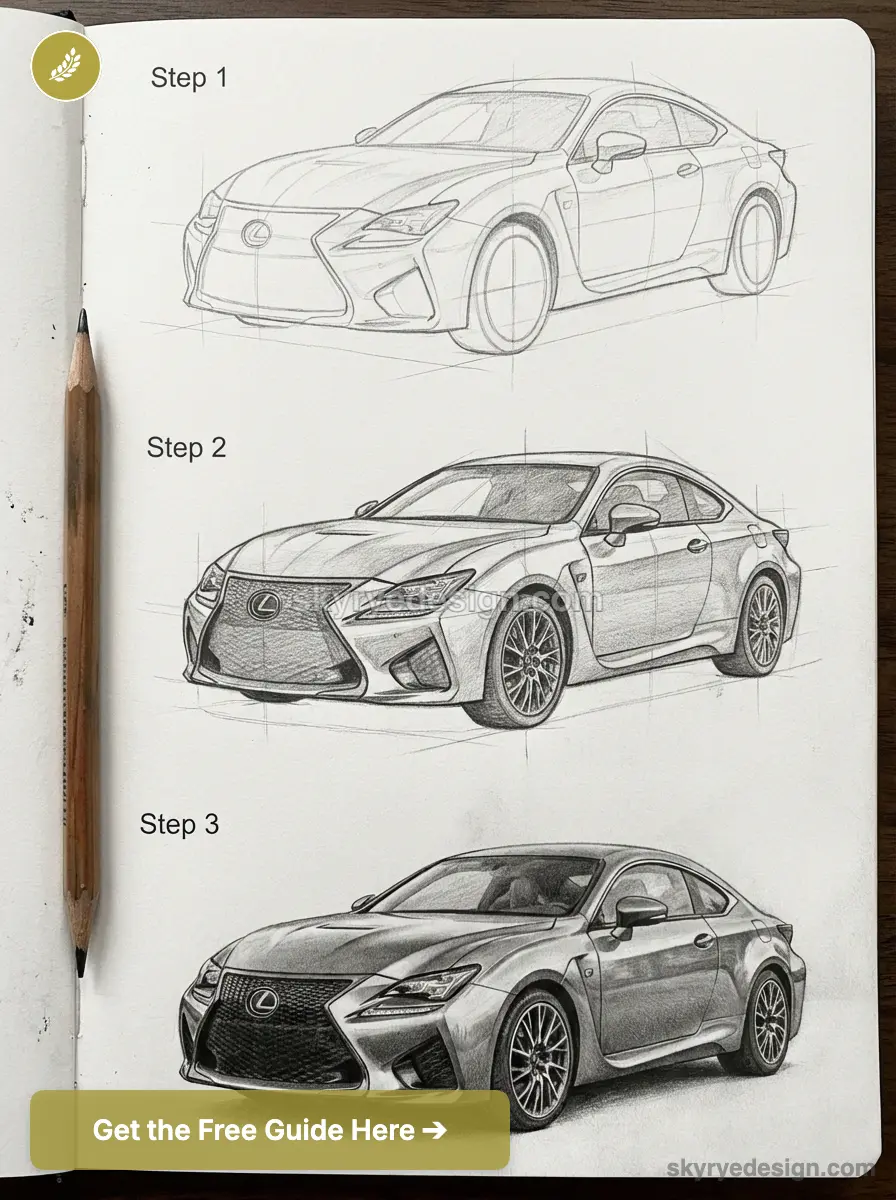
The RC-F is where Lexus design starts getting seriously complex to draw. The front bumper alone has three distinct intake zones, a lower lip splitter, and the widened spindle grille — all overlapping at angles.
My approach: break the front fascia into three horizontal zones. Zone 1 (top) is the main headlight and grille area. Zone 2 (middle) is the wide central intake. Zone 3 (bottom) is the lip splitter and corner vents. Draw each zone as a simple shape first, then add the detail within each. The 2025 RC-F Final Edition — the last production model — added even more carbon fiber elements. If you want the most dramatic version to draw, that’s the one.
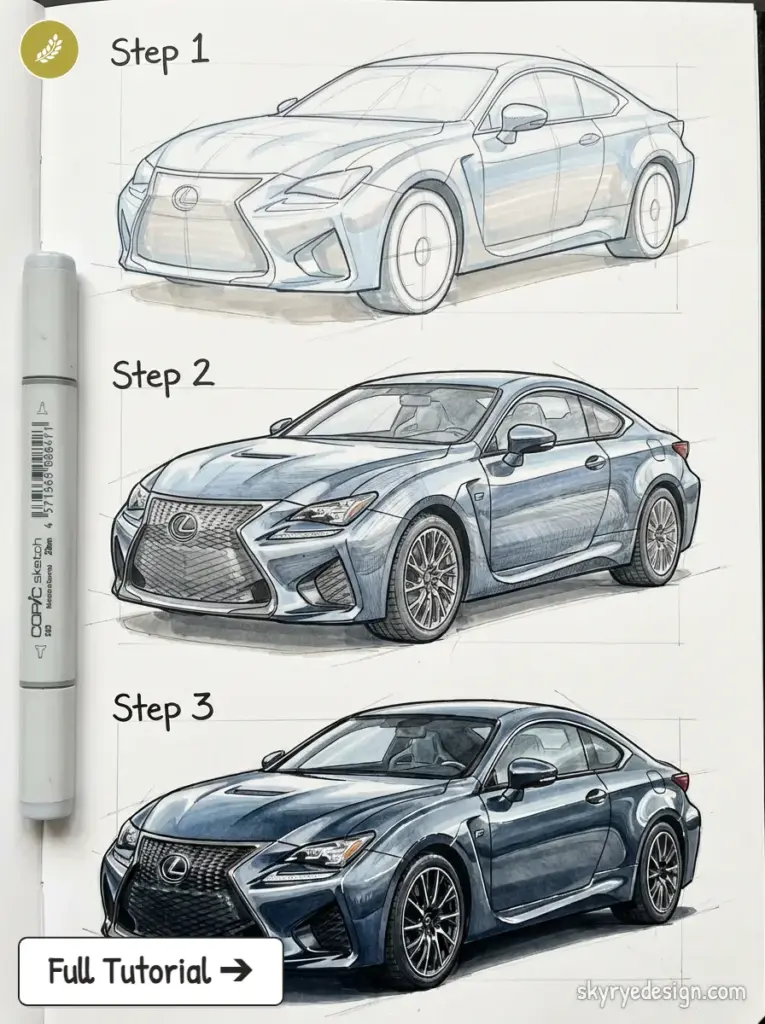
| ✏️ PRO TIP: For cars with multiple overlapping intake shapes at the front, use a light box or tracing paper layer to map out each shape independently before combining them in your final drawing. |
Model #8 — Lexus LS 500 (2018): Modern Flagship
| #8 Lexus LS 500 2018–present | Difficulty: ⭐⭐⭐ Intermediate Key design feature: Massive spindle grille, sweeping fastback sedan roofline, LED light bar Drawing challenge: The grille’s complex mesh pattern and the flowing body crease intersection |
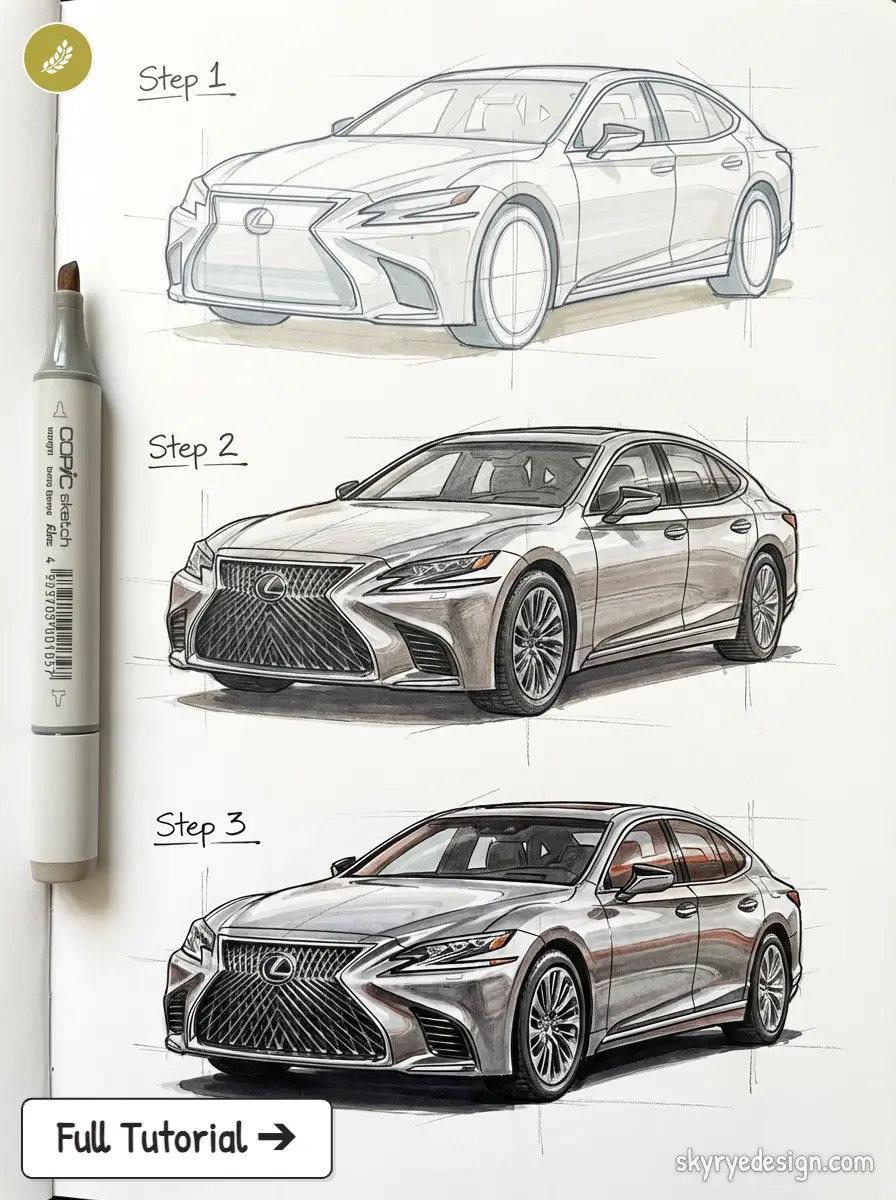
The current LS 500 is one of the most visually ambitious flagship sedans ever built. Koichi Suga’s team pushed the design to its limits: that spindle grille is enormous — nearly 40% of the front face — and the mesh inside it has a depth and complexity that’s genuinely hard to render in a flat sketch.
Here’s my shortcut for the grille mesh: don’t try to draw every diamond cell. Instead, draw the outer spindle shape, then suggest the mesh with diagonal hatching lines. The eye fills in the rest. The body surfacing on the LS 500 is also complex — there’s a triple-crease character line along the lower door that splits into three individual ridges near the rear wheel. Focus on the dominant upper crease only in quick sketches.
Model #9 — Lexus LC 500 (2017): The Design Masterpiece
| #9 Lexus LC 500 2017–present | Difficulty: ⭐⭐⭐⭐ Advanced Key design feature: Dramatic rear haunches, contrast-panel A-pillar, layered front fascia Drawing challenge: Everything — this is Lexus design at its most complex and deliberate |
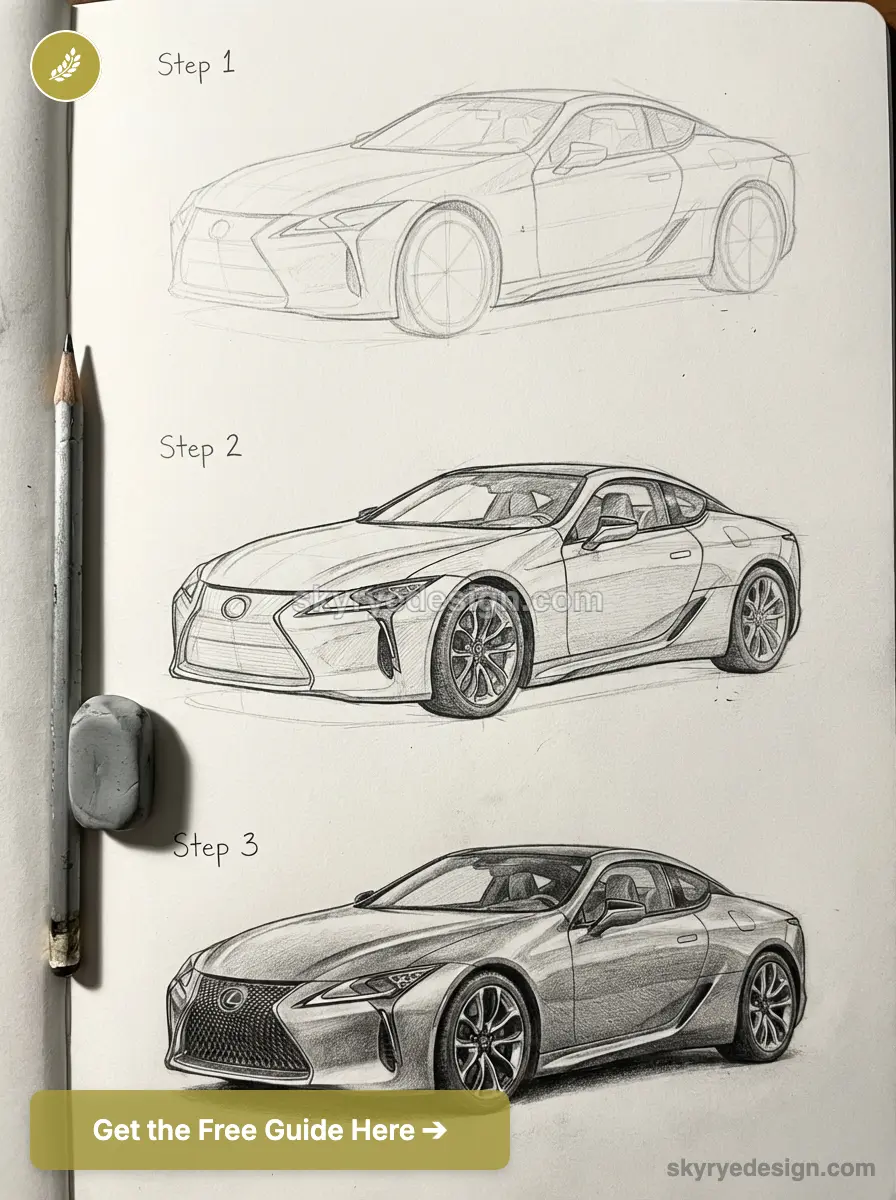
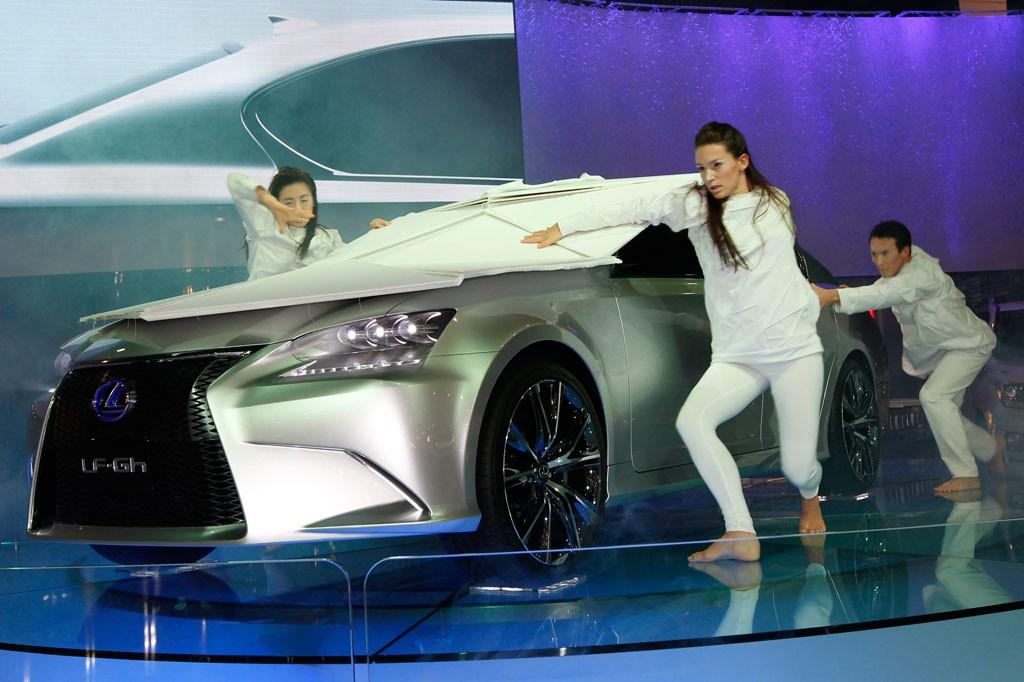
If the LFA is the impossible test, the LC 500 is the rewarding challenge. It won the EyesOn Design Award when shown as the LF-LC concept in Detroit in 2012, and the production version barely changed — it’s that good.
The rear haunches are the defining feature: they balloon outward dramatically from the door line, creating a powerful rear stance. The contrast-color A-pillar adds a black ‘floating roof’ effect. The front fascia layers the spindle grille over an upper hood vent, then continues into the lower bumper with progressive depth — almost like stacked horizontal planes.
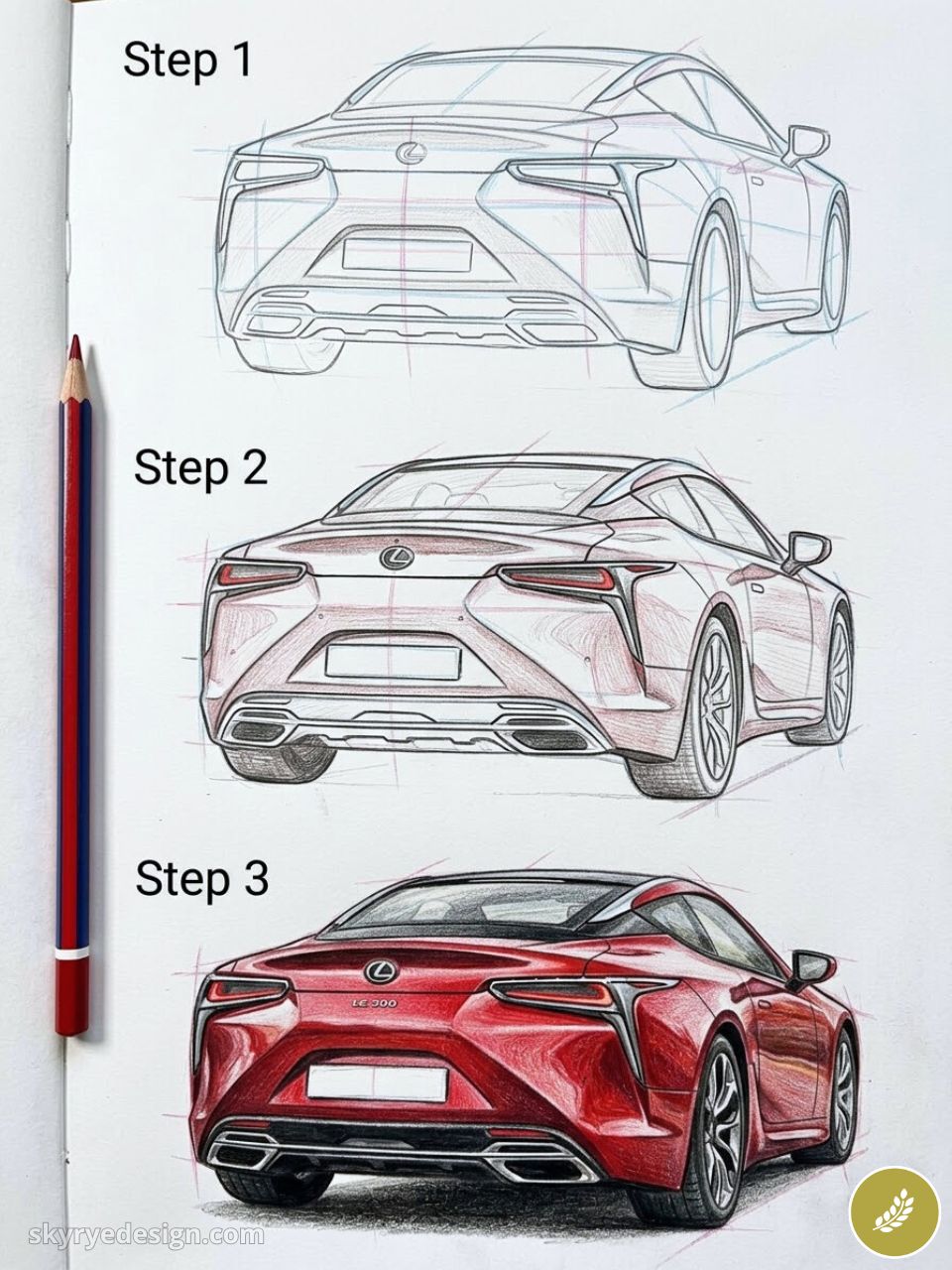
Start with the side profile and nail the rear haunch before anything else. That bulge determines the car’s entire character. I’ve seen countless LC 500 sketches fail because the rear haunch was too subtle — without that mass, the car just looks like a big coupe rather than a rolling piece of sculpture.
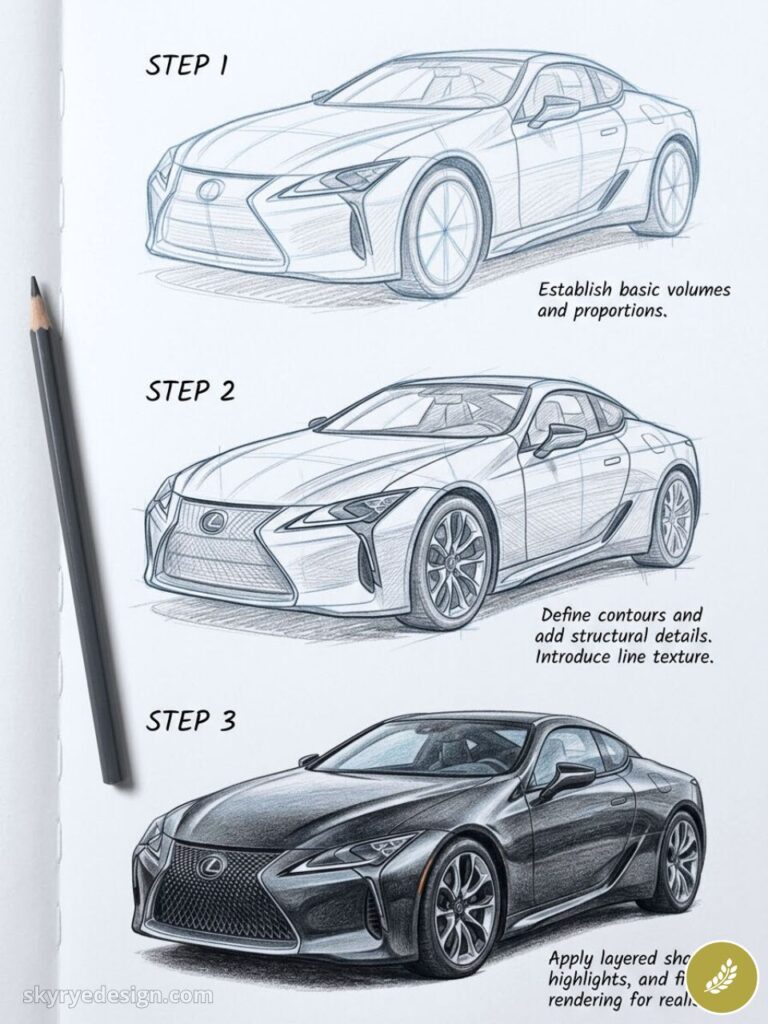
| ✏️ PRO TIP: For the LC 500’s contrast roof, use a 2B pencil to fill the black A-pillar and roof area with confident, even strokes. The hard edge between the body color and black creates the ‘floating roof’ illusion that’s central to the LC’s identity. |
Model #10 — Lexus LFA (2010): The Legend
| #10 Lexus LFA 2010–2012 | Difficulty: ⭐⭐⭐⭐⭐ Expert Key design feature: Triangular headlights, triple exhaust triangle, CFRP surface complexity Drawing challenge: Every single panel — 65% carbon fiber construction means unusual compound curves everywhere |
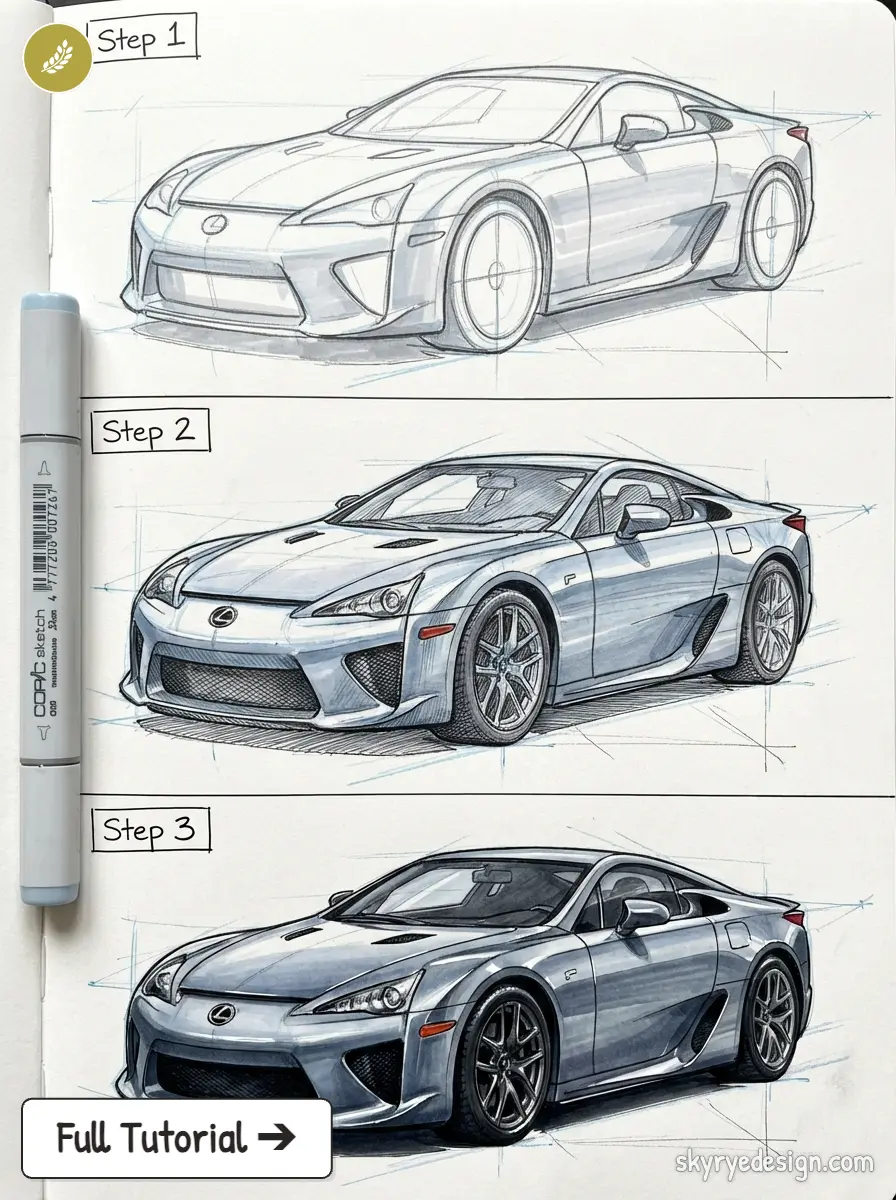
The LFA is the white whale of automotive sketching. Only 500 were ever built (2010–2012), each with a hand-assembled 4.8L V10 producing 553 hp and a top speed of 202 mph. Akio Toyoda himself drove prototypes at the Nürburgring during development. It’s a car that Lexus chief engineer Haruhiko Tanahashi and his team spent a decade developing from scratch.
The design reads unlike anything else on the road. The hood has a raised central spine. The front intake is enormous and slightly asymmetric. The triangular headlights are actual triangles, not just headlight-shaped triangles — they point aggressively backward. The rear triple exhaust in a triangular cluster is the car’s most distinctive signature; get that grouping wrong and the drawing loses its LFA identity.
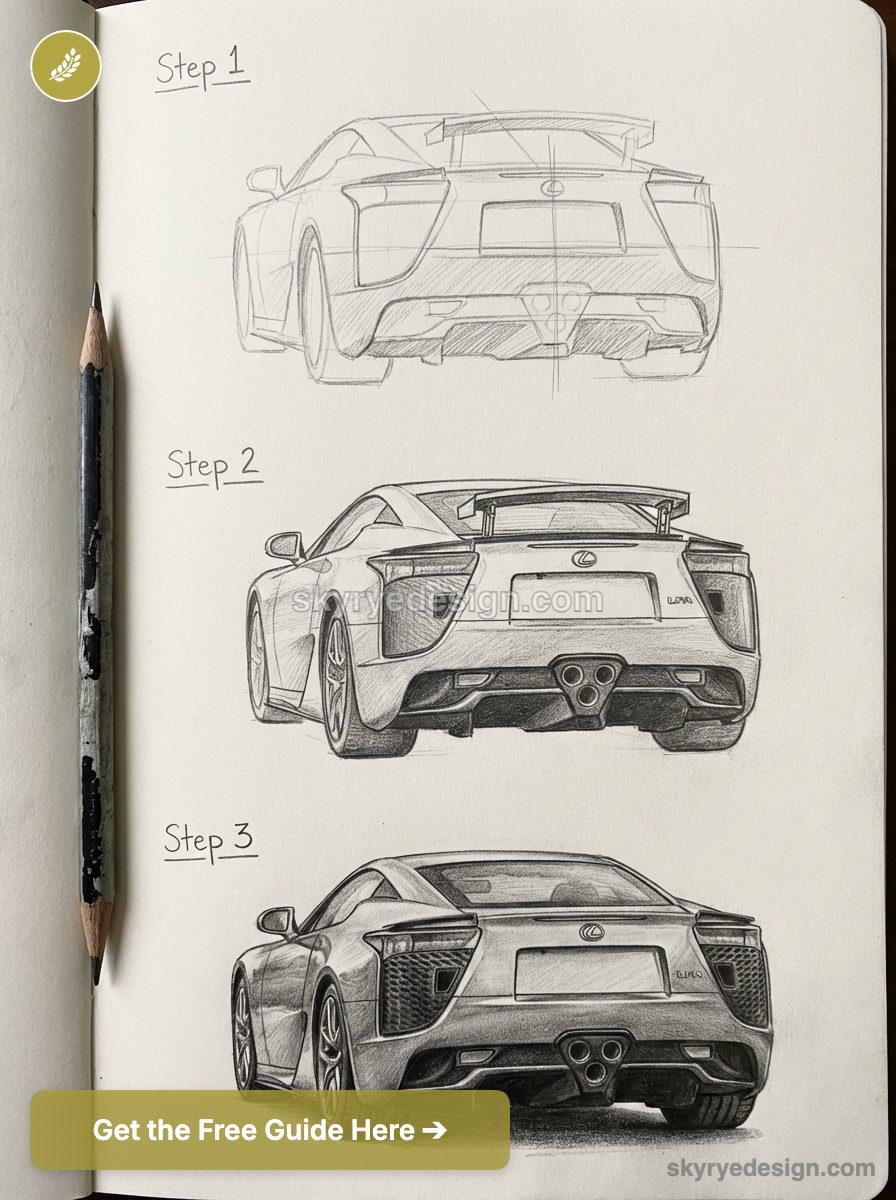
Because 65% of the LFA’s body is CFRP (carbon fiber reinforced polymer), the surfaces have unusual compound curves that don’t follow typical automotive panel logic. There’s no simple character line — instead, surfaces intersect at angles that require you to study the car from multiple reference photos before committing to any single angle.
My approach: Start with the three-quarter front view, which shows the triangular headlights, the raised hood spine, and the front intake all at once. Lock in those three elements before drawing anything else. Once the front face is right, the rest of the body will follow.
Essential Techniques for Drawing Any Lexus Model
Tools That Actually Work
For pencil sketches: Staedtler Mars Lumograph 2H for construction, 2B for shading. For ink: 0.3mm Sakura Pigma Micron or Staedtler Pigment Liner. For digital: Procreate on iPad Pro 12.9″ with the Apple Pencil 2 — use the ‘Technical Pen’ brush for initial linework, ‘Studio Pen’ for fill work. A basic Prismacolor Black marker (Art Marker, $3.50 per marker) can add powerful shadow blocking to any pencil sketch.
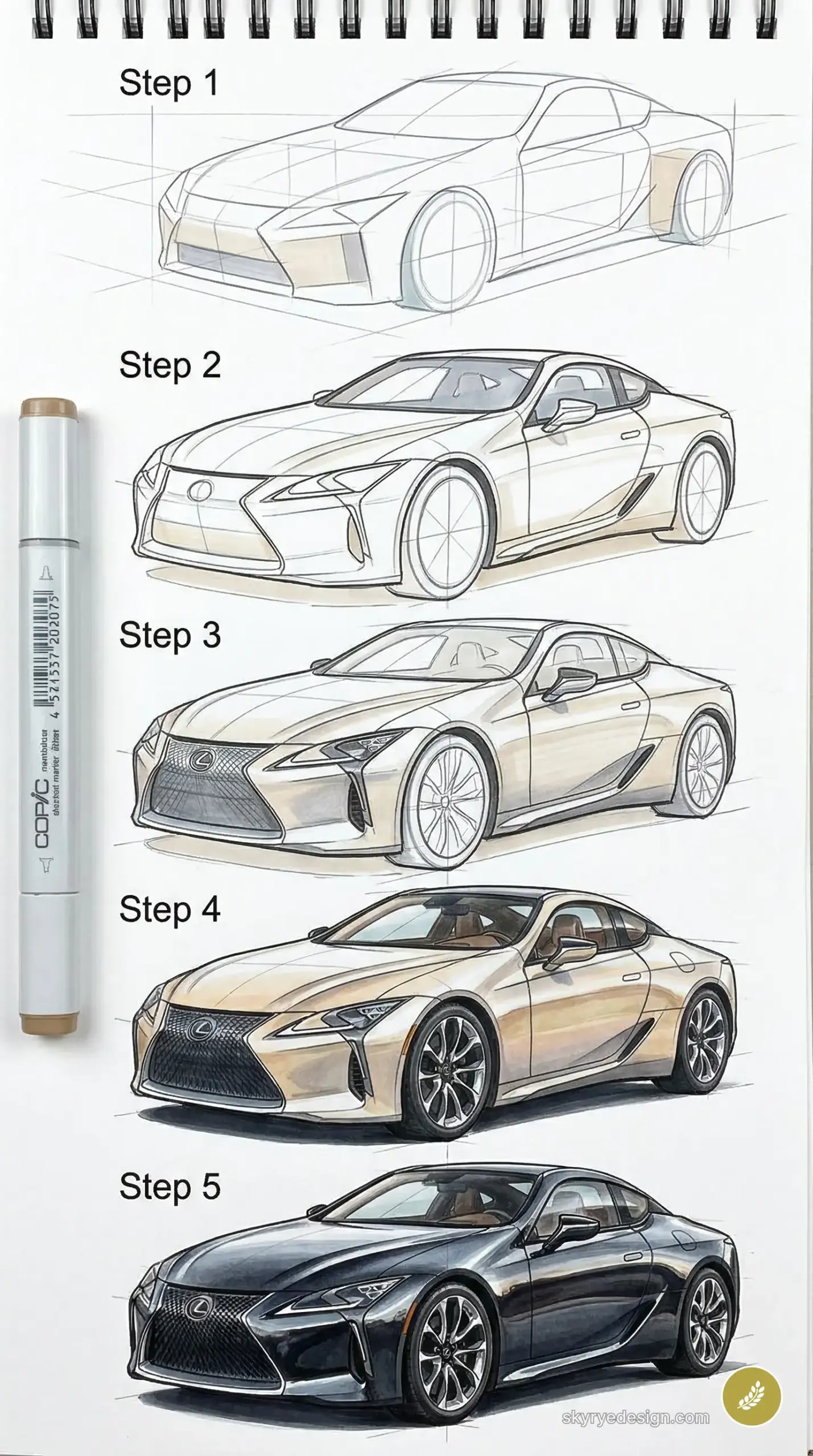
The 5-Step Universal Method
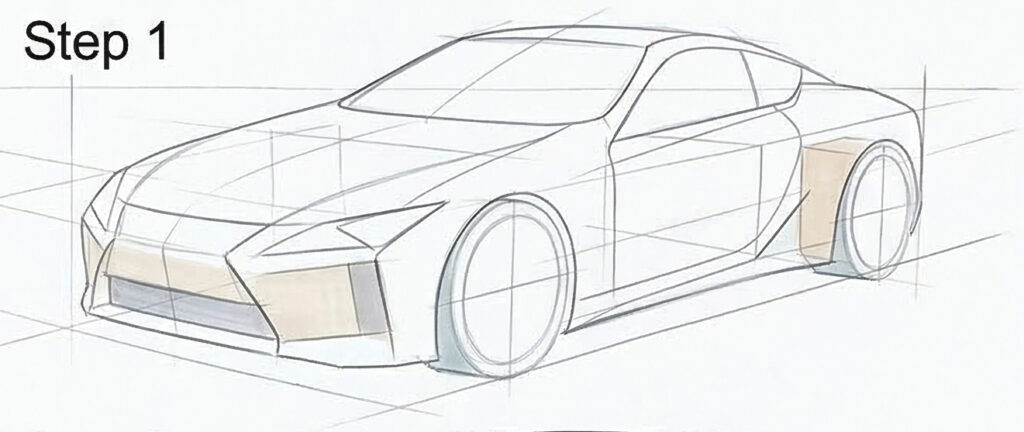
| Step 1 | Draw the wheel circles and ground line |
| Two equal circles touching the ground line. The gap between them determines the car’s proportions — longer for luxury sedans (LS), shorter for coupes (LFA, LC 500). Draw them lightly; you’ll adjust later. |
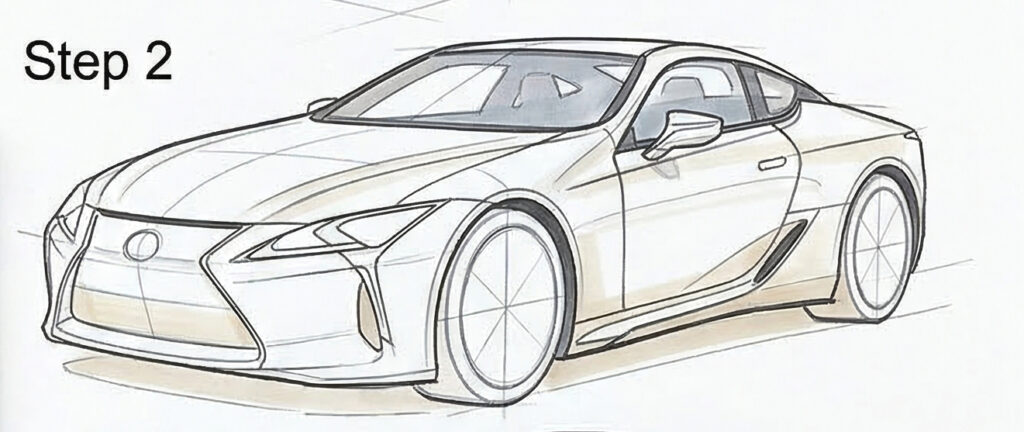
| Step 2 | Block in the silhouette |
| One continuous line from nose to tail — the car’s overall profile. Include the roofline. Don’t add any details. This single line determines everything else about the drawing’s success. |
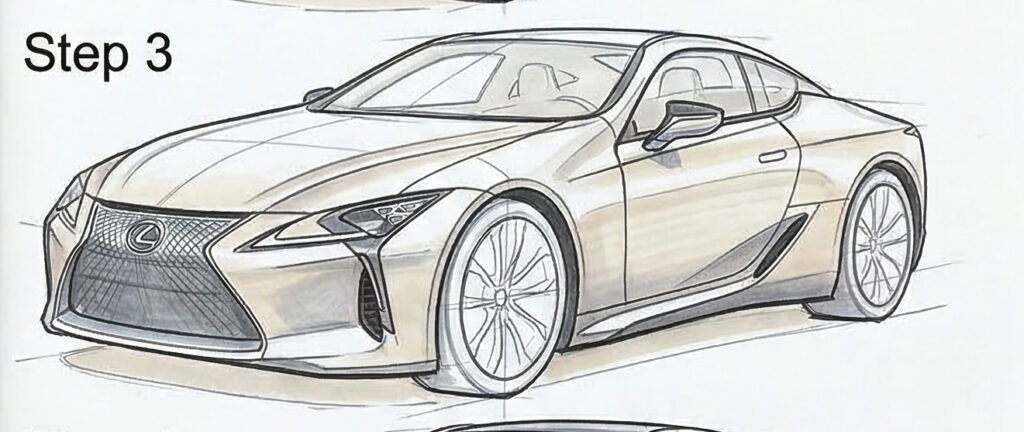
| Step 3 | Establish the key design signature |
| For each Lexus: the spindle grille, the main headlight shape, the dominant character line. Add just these three elements before any other detail. |
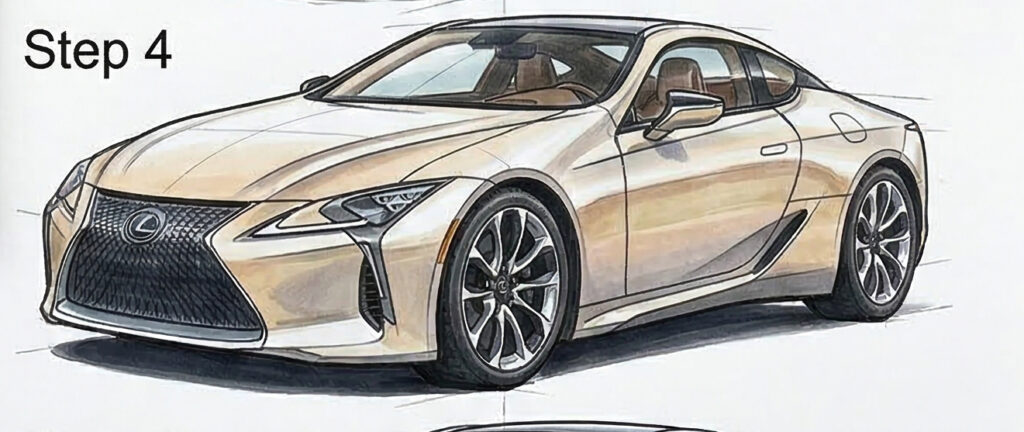
| Step 4 | Refine and add secondary details |
| Wheels (with rim design), bumper details, window trim, mirrors. Work from largest to smallest — never start with small details. |
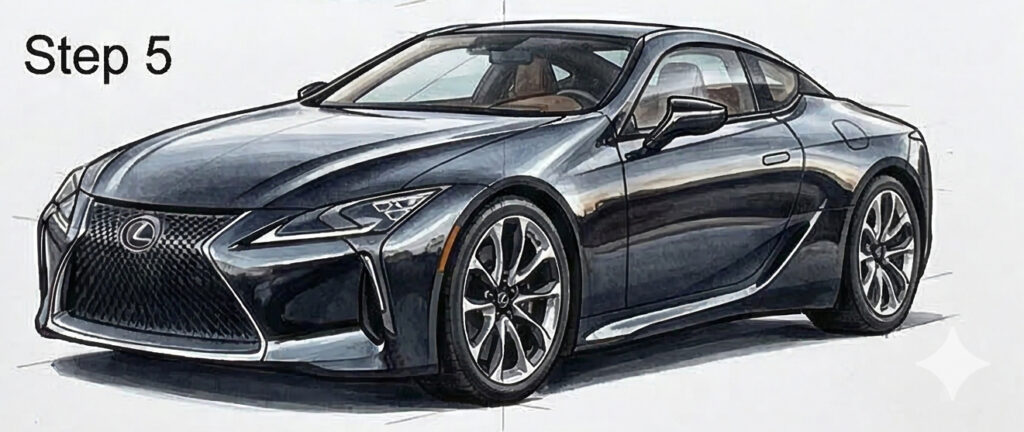
| Step 5 | Add shading and depth |
| Identify your light source and block in shadows on the lower body, under the bumper, inside the wheel arches, and along the roof. For Lexus cars, a light source from upper-right creates the most dramatic effect on the complex surfacing. |
Lexus Drawing Difficulty — Quick Reference
| Model | Difficulty | Best For | Must-Get-Right Element |
|---|---|---|---|
| LS 400 (1989) | ⭐ | Beginner | Clean roofline arc |
| SC 400 (1991) | ⭐⭐ | Beginner+ | Single sweeping roof curve |
| IS 300 (2000) | ⭐⭐ | Beginner+ | Wheel arch flare proportion |
| GS 430 (2006) | ⭐⭐ | Intermediate | Front fascia balance |
| IS-F (2008) | ⭐⭐⭐ | Intermediate | Widebody fender flares |
| RX 350 (2010) | ⭐⭐ | Beginner+ | SUV shoulder peak |
| RC-F (2015) | ⭐⭐⭐ | Intermediate | Triple-zone front fascia |
| LS 500 (2018) | ⭐⭐⭐ | Intermediate | Spindle grille mesh |
| LC 500 (2017) | ⭐⭐⭐⭐ | Advanced | Rear haunch mass |
| LFA (2010) | ⭐⭐⭐⭐⭐ | Expert | Triangular headlights + triple exhaust |
Frequently Asked Questions
Q: What is the best Lexus model for a beginner to draw?
Start with the 1989 Lexus LS 400. Its clean, slab-sided body has minimal complex surface creases, making it ideal for practicing basic car proportions — the long hood, correct wheelbase spacing, and elegant roofline. Once you’ve got the LS 400 comfortable, move to the SC 400 for your first coupe challenge.
Q: How do you draw the Lexus spindle grille?
Draw the grille as an hourglass shape — wide at top and bottom, pinched in the center. Mark the pinch point first (roughly at bumper centerline), then angle outward upward to meet the headlights and downward to meet the lower bumper. For the mesh interior, use diagonal cross-hatching rather than individual cells. The spindle was first introduced on the 2012 Lexus GS sedan.
Q: Why is the Lexus LFA so hard to draw?
The LFA’s body is 65% CFRP (carbon fiber reinforced polymer), which means the panels have unusual compound curves that don’t follow standard automotive body logic. The triangular headlights, raised hood spine, triple exhaust cluster, and asymmetric front intake all need to align precisely. It’s genuinely the most complex Lexus to sketch — treat it as a long-term project rather than an afternoon exercise.
Q: What pencils should I use for car sketching?
Use Staedtler Mars Lumograph 2H for construction lines and initial proportions, then 2B for shading and darkening final lines. A 0.5mm mechanical pencil (Pentel GraphGear 1000, around $15) handles fine detail. For inking, Staedtler Pigment Liner 0.3mm gives clean, consistent line weight. Avoid felt-tip markers for initial sketches — they don’t erase and commit you to early mistakes.
Q: What makes Lexus car design different from other luxury brands?
Lexus design, particularly since the L-finesse philosophy introduced in 2005, emphasizes sharp contrasts: flowing surfaces interrupted by sharp creases, smooth forms broken by aggressive intakes. Unlike German luxury (which tends toward geometric precision) or Italian luxury (organic sculpture), Lexus combines Japanese craft discipline with dramatic visual energy. The spindle grille, L-shaped headlights, and exaggerated rear haunches are hallmarks of this approach.
Q: How long does it take to draw a Lexus car realistically?
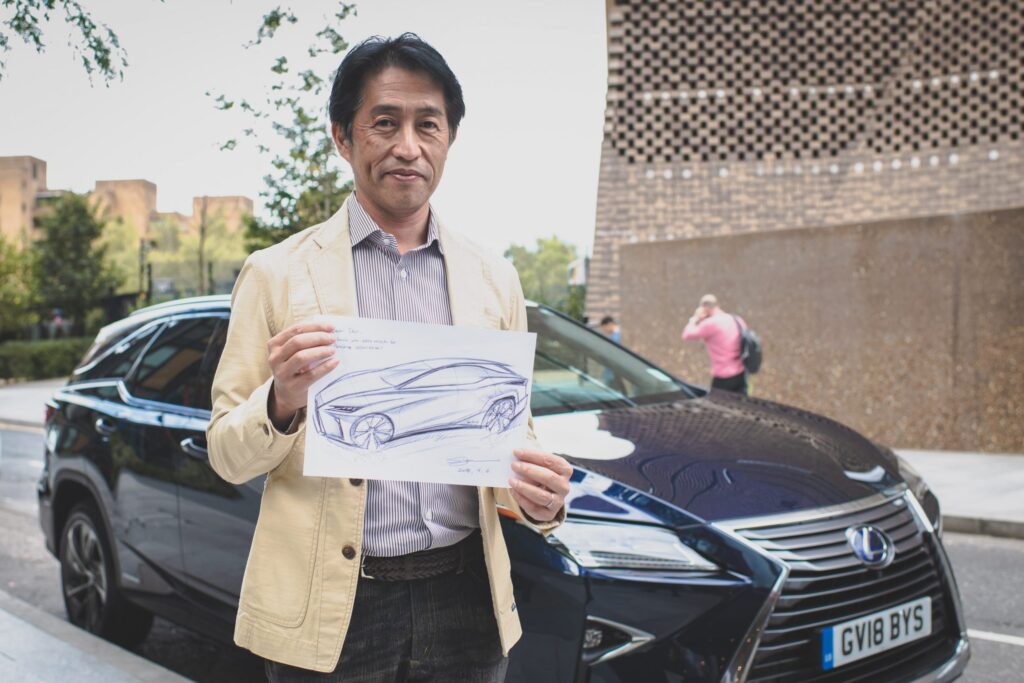
A simple side-profile sketch of an LS 400 takes about 20–30 minutes for an intermediate artist. A detailed 3/4 view of the LC 500 with shading takes 2–4 hours. A fully rendered LFA with hatching, shadow depth, and background can take 6–10 hours. Koichi Suga, Lexus’s own design chief, demonstrated that the LC 500 sketch takes roughly 45 minutes in his official ‘Lexus Creates’ tutorial video.
Q: Can I draw Lexus cars digitally on an iPad?
Yes — Procreate on iPad Pro is excellent for car sketching. Use the Technical Pen brush for construction lines, Studio Pen for final linework, and Soft Airbrush for gradual shading on body surfaces. Set your canvas to 3000 x 2000px at 300dpi. Working with layers is a major advantage: keep your construction lines on one layer, final lines on another, shading on a third. This mimics professional automotive design studio workflow.
Start With What Excites You
There’s a school of thought that says you should always start with the easy stuff — grind through the LS 400, SC 400, IS 300 before you touch anything more complex. I disagree. If the LFA is the car that makes your hand move, start there. You’ll learn more from ten failed LFA sketches than from twenty LS 400 profiles done correctly.
What matters is that you draw from reference, you study the proportions before you commit to lines, and you understand what makes each Lexus model distinctive. The spindle grille, the L-shaped headlights, the character line — once you see those elements, you can’t unsee them. And once you can draw them, your automotive sketching level will jump permanently.
The LC 500 is the model I keep coming back to. It’s the only current production car that Lexus’s own design chief singled out as his personal recommendation for sketching in the official Lexus Creates tutorial series. That endorsement feels right. It’s the most complete Lexus design expression — dramatic, precise, and rewarding to get right.
Pick your model. Draw it badly. Draw it again.
- 318shares
- Facebook0
- Pinterest318
- Twitter0
- Reddit0