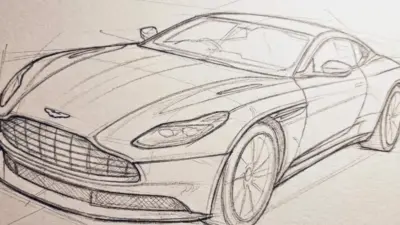
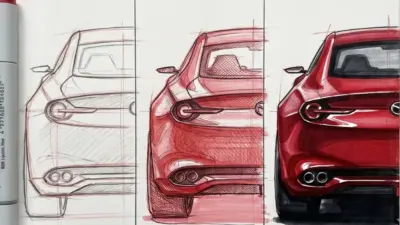
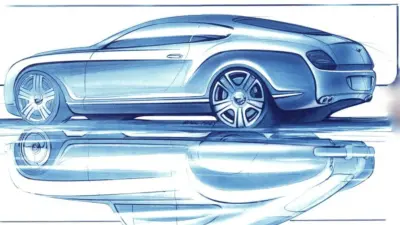
The first time I drew a car with a proper background, the car looked worse than it had without one. Not because the background was bad — it was reasonably drawn. The problem was that the car sat in front of the building at a slightly different vanishing point. Nothing dramatic: maybe five degrees off. But visually it read as if someone had cut out the car from a different drawing and pasted it in front of a house that occupied a different physical reality. The car floated. The house sat. They were in the same picture but not in the same scene.
- Car First: Why the Vehicle Must Be Established Before the Background
- Two-Point Perspective: Setting Up the Grid That Governs Everything
- Drawing the Residential Facade: Architecture as Supporting Cast
- Four Integration Techniques: Making Car and Building Occupy the Same Space
- Common Mistakes in Car-and-Background Compositions
- The Background Is a Test, Not a Decoration
- FAQ: Car Sketching With Residential Backgrounds
That single experience taught me more about perspective than any number of isolated car drawings had. When a car exists alone on a page, proportion errors and minor perspective inconsistencies are invisible — there’s nothing to compare against. Place the same car in front of a building, and every inconsistency in the vanishing point alignment becomes immediately obvious, because the human visual system is extraordinarily good at detecting when two objects don’t share the same physical space. The background doesn’t just add atmosphere. It tests the accuracy of the car drawing against a fixed architectural reference.
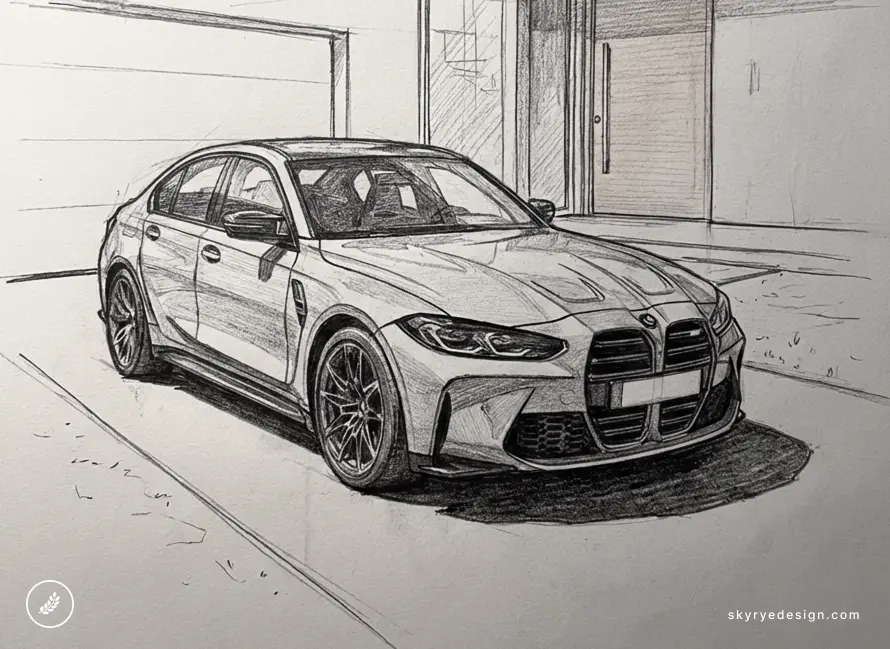
This guide covers the full process: establishing the perspective grid that both car and building share, building a contemporary residential facade in the background without pulling focus from the car, drawing the architectural details that create genuine context — including the entry door — and the four integration techniques that make the car and building read as a unified scene rather than two separate drawings in the same frame.
Car First: Why the Vehicle Must Be Established Before the Background
Every experienced automotive illustrator works in the same sequence: car body completely established, then background added. This is not convention — it’s the practical consequence of how composition works. The car is the subject; the background is the context. If you build the background first, you’re designing the scene around an empty space where the car will go, which produces a fundamentally different compositional logic.
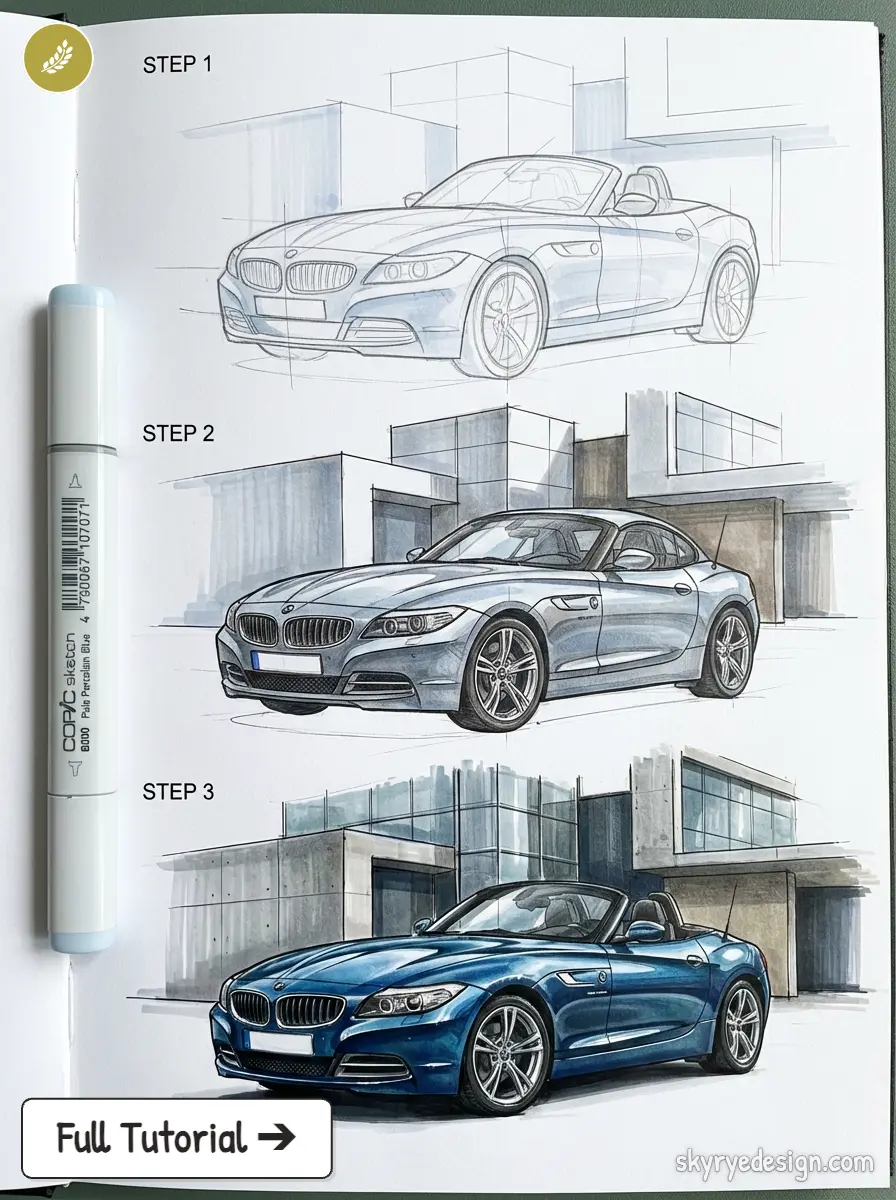
Specifically: the car determines where the horizon line sits. In a three-quarter front view of a parked car, the horizon line typically falls somewhere between the lower sill and the wheel arch — approximately where the road surface level is, slightly below the car’s equator. This is also the line from which all architectural perspective is calculated. If you don’t know where the car sits relative to eye level, you can’t correctly establish the vanishing points for the building behind it.
Establishing the Car’s Proportional Envelope
Before any background work begins, confirm three things about the car: the wheelbase length (the distance between front and rear wheel centres, which determines the car’s total footprint), the overall height (the roof peak relative to the ground plane), and the shoulder line position (the primary character line that typically sits in the upper third of the door surface). These three markers create a proportional envelope that can’t be altered once the background begins — if you discover the proportions are wrong after you’ve drawn the house behind it, the correction requires starting over.
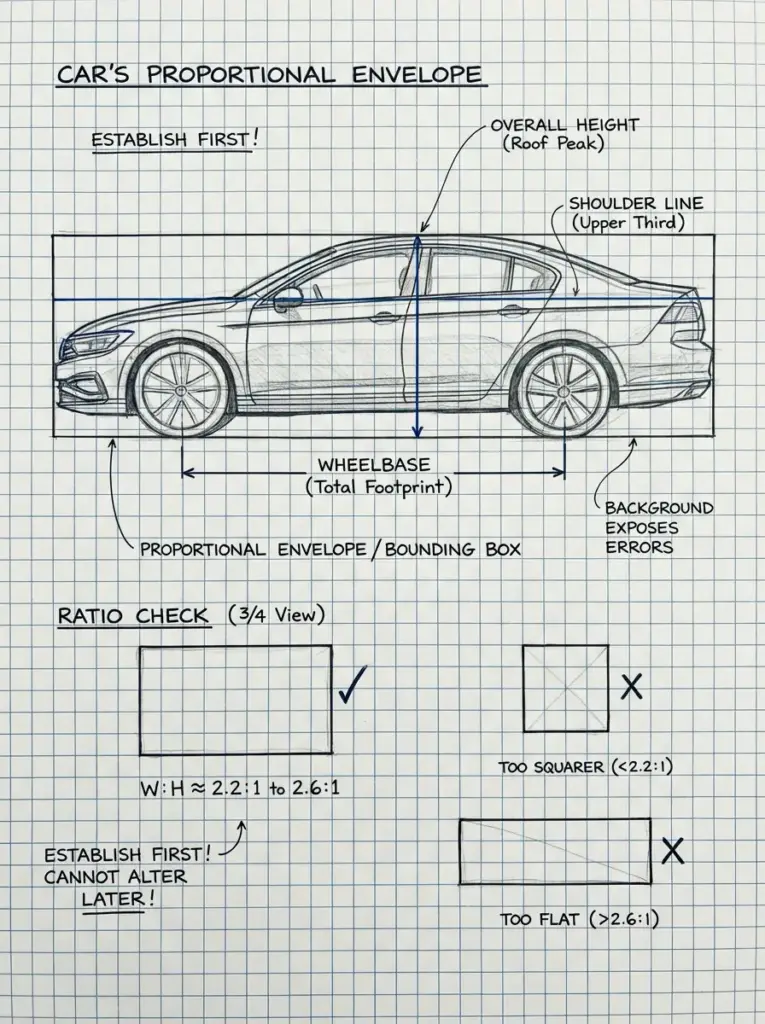
Check the bounding box ratio: most contemporary cars fit inside a rectangle approximately 2.2-2.6 times as wide as it is tall for a three-quarter view. If the ratio is squarer than 2.2:1, the car is too tall or too short. If it’s flatter than 2.6:1, the car is too stretched or too low. These numbers won’t match every model exactly, but any car significantly outside this range has a proportion problem that the background will expose immediately.
✏ Sketch note: The most reliable proportion check for a car in context: the top of the wheel arch should align with the hip of a standing adult beside the car — approximately 90-95cm. If you draw a human figure beside the car at this scale and the figure looks correct relative to the building behind them, the car’s scale is right. This check catches the single most common scale error in automotive illustration: cars that look correct in isolation but are either too small or too large relative to any environmental reference.
Two-Point Perspective: Setting Up the Grid That Governs Everything
Two-point perspective is the foundation of every automotive illustration that includes architecture. One vanishing point is not enough — it produces a parallel projection that looks like an architectural elevation rather than a three-dimensional scene. Three-point perspective adds vertical convergence, which is appropriate for dramatic high or low viewpoints but creates distortion at the normal street-level viewing angle. Two-point is the standard for automotive illustration at eye level.
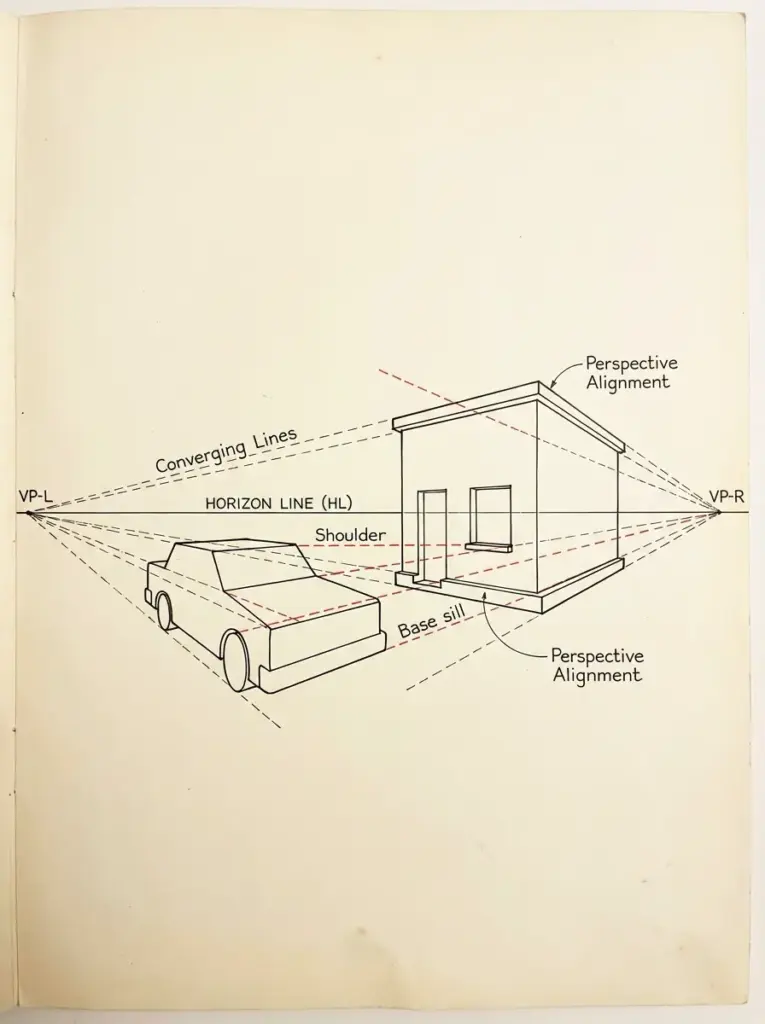
Placing the Horizon Line
The horizon line represents the viewer’s eye level — for a street-level illustration of a parked car, this falls at approximately 1.2-1.5 metres above the ground plane, which in the drawing sits between the lower sill and the shoulder line of most passenger cars. Draw it as a light horizontal line across the full width of the paper before any other marks. Everything above the horizon line is seen from below; everything below it is seen from above. The car’s roofline is above the horizon line; the driveway surface is below it.
Placing the Vanishing Points
For a three-quarter front view of a car parked at approximately 30-45 degrees to the viewer — the most common automotive illustration angle — the left vanishing point (VP-L) sits well to the left of the composition, often off the paper edge. The right vanishing point (VP-R) sits to the right, also often off the paper. The further apart the vanishing points, the shallower the perceived depth; the closer together, the more dramatic and compressed the perspective. For a realistic street-level view, vanishing points positioned at approximately twice the paper width apart produce the most natural result — wide enough to avoid the exaggerated barrel distortion of close vanishing points, close enough to show clear convergence.
Aligning Car and Building to the Same Grid
The critical step: both the car and the building must converge to exactly the same two vanishing points. The bonnet line of the car, if extended, reaches VP-R. The roofline of the house, if extended, also reaches VP-R. The car’s shoulder line and the house’s window sill line converge to the same point on the left. Any deviation between the car’s vanishing points and the building’s vanishing points — even slight — produces the floating effect I described in the opening. Use a ruler and light pencil lines to confirm alignment before inking anything.
Drawing the Residential Facade: Architecture as Supporting Cast
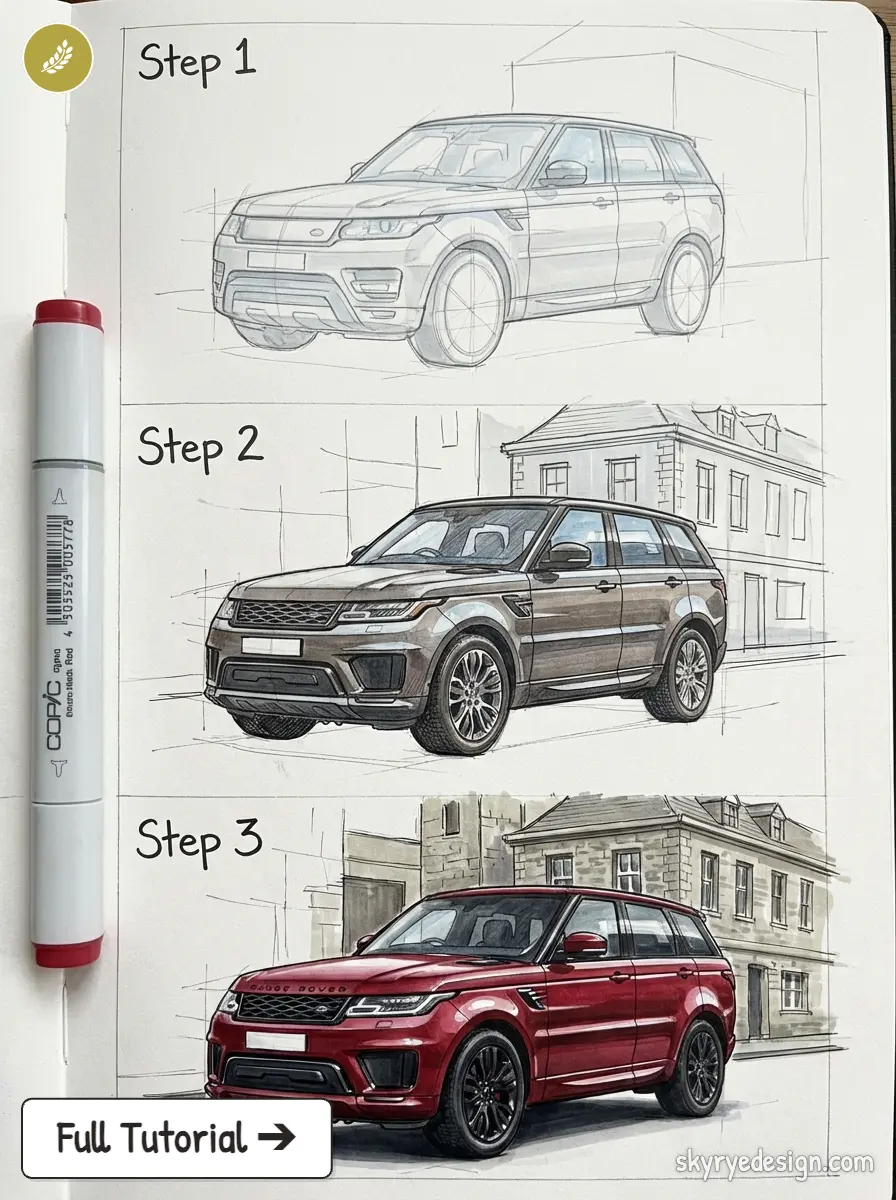
The building behind the car must be drawn with enough detail to read as a real contemporary residence, and enough restraint to remain subordinate to the car. This is a line weight and tonal hierarchy problem as much as a drawing problem. The architectural detail provides context; the car provides focus. The design challenge is managing both in the same frame.
The Contemporary Facade: What to Draw and What to Leave Out
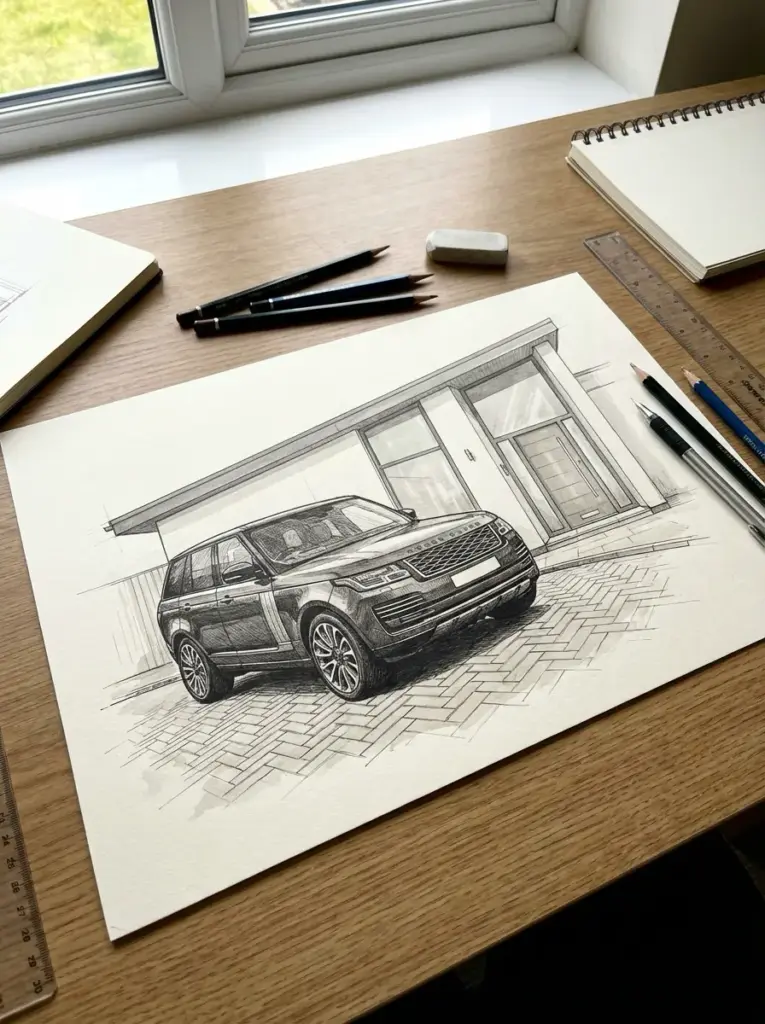
Contemporary residential architecture is built from geometric forms with clean edges and minimal surface detail — which makes it ideal as an automotive illustration background. The elements that read most quickly as ‘modern house‘: a large fixed glazing panel (suggested as a light-toned rectangle with a thin dark frame), a flat or mono-pitch roof overhang creating a strong horizontal shadow line, a rendered or timber-clad wall surface with one dominant texture, and a clearly defined entry.
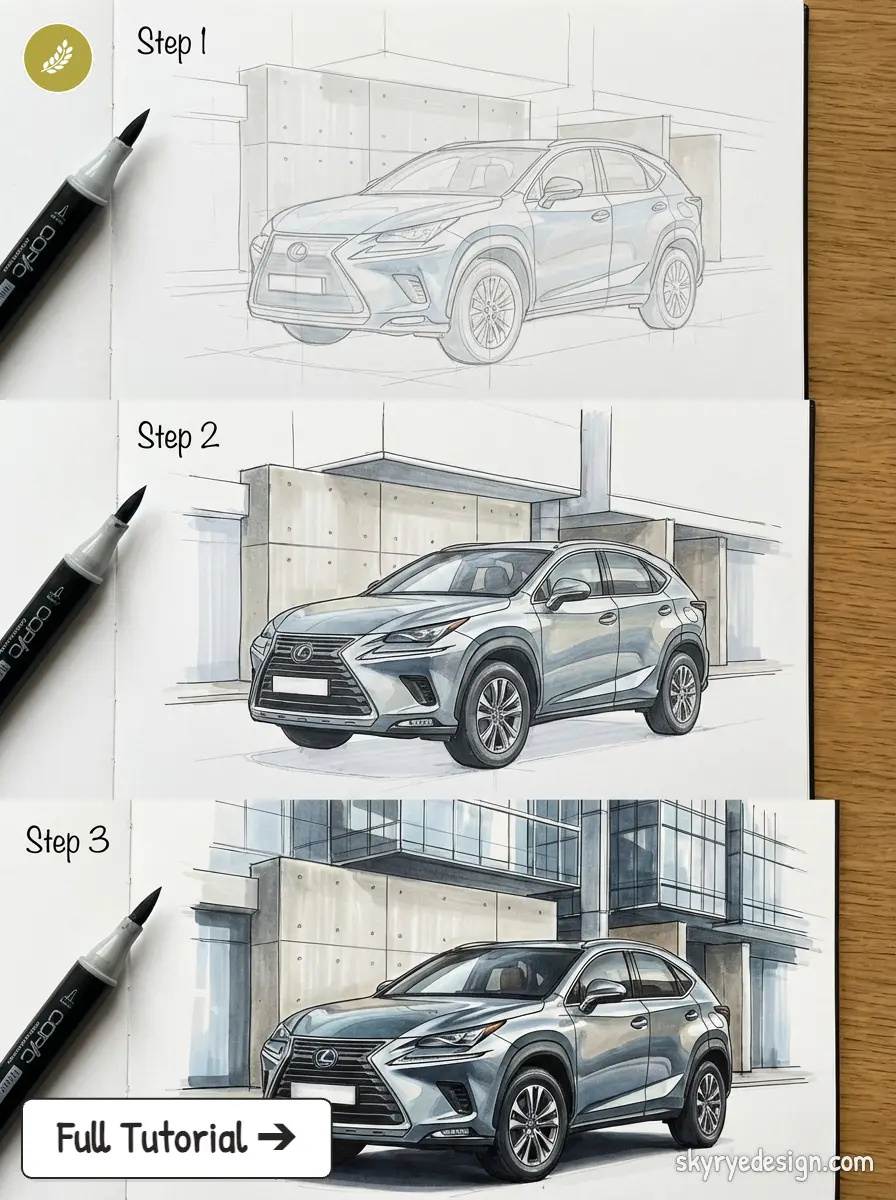
The entry door is the most characterful single element in a residential facade and the best point of architectural focus in the background. A contemporary UPVC entrance doors — flush-panel, frameless-looking, with a long lever handle or recessed pull — is drawn as a clean, tall rectangle with a subtle reveal at the frame, a thin shadow line defining the door leaf, and a single linear handle detail. The geometric clarity of this element contrasts directly with the organic curves of the car body, which is the visual dynamic that makes car-and-architecture compositions compelling: the car’s curvature reads more dramatically against the building’s orthogonal geometry than it would against a natural landscape.
Texture Hierarchy in the Background
The textures you apply to the background architecture signal material quality and give the scene its sense of physical reality — but they must be applied at a lower intensity than the car’s surface treatment. A rendered wall behind the car: light stippling with the pencil tip, applied so lightly it’s barely visible in isolation but reads as surface texture in contrast to the smooth car panels in the foreground. Timber cladding: very fine parallel lines at 1-2mm spacing drawn with a 0.3mm liner, significantly finer than any line on the car. Glazing: left almost completely clean — the glass reads as a light mid-tone with a thin dark frame.
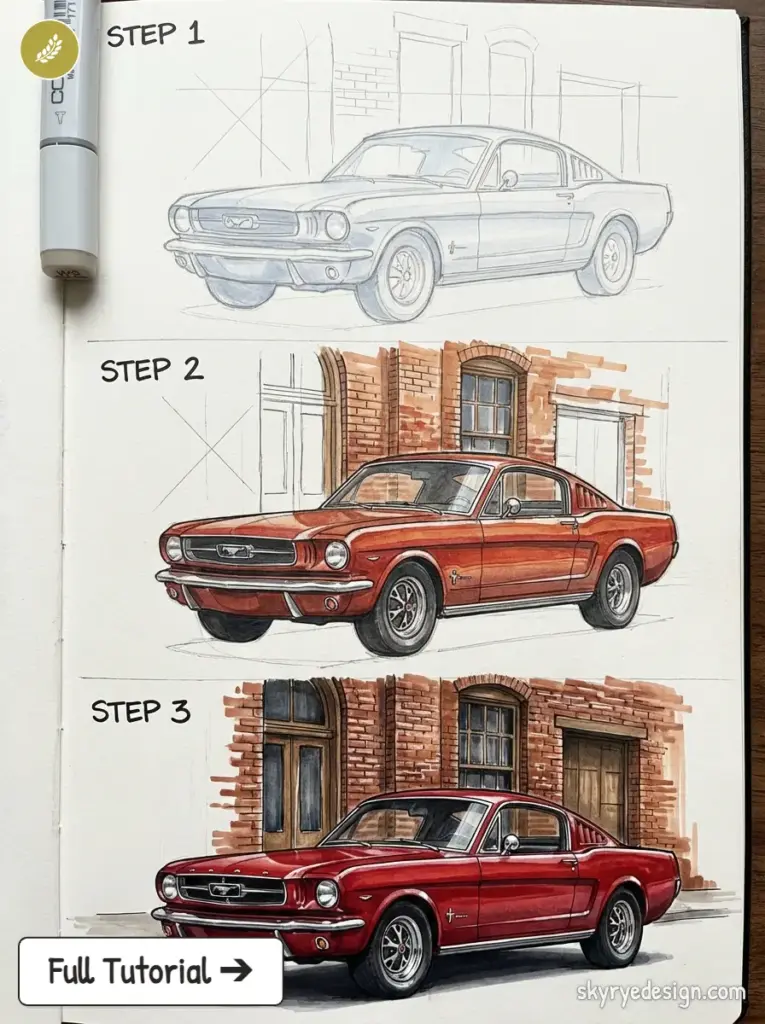
✏ Sketch note: Draw the building’s shadow zones first, before any surface texture. The roofline overhang casts a sharp shadow across the wall below it — this is the single architectural element that most convincingly suggests three-dimensional mass. A flat wall with a well-drawn cast shadow reads as a real building; the same wall with careful texture but no shadow reads as a diagram. Shadow first, then texture within the shadow zone, then lighter texture in the lit zone. This sequence takes the same time as the reverse order but produces significantly more convincing results.
Four Integration Techniques: Making Car and Building Occupy the Same Space
Ground Shadow Alignment
What it is: The car casts a shadow on the driveway surface that is governed by the same light source as the shadows on the building facade. Both must originate from the same direction and maintain consistent shadow angles.
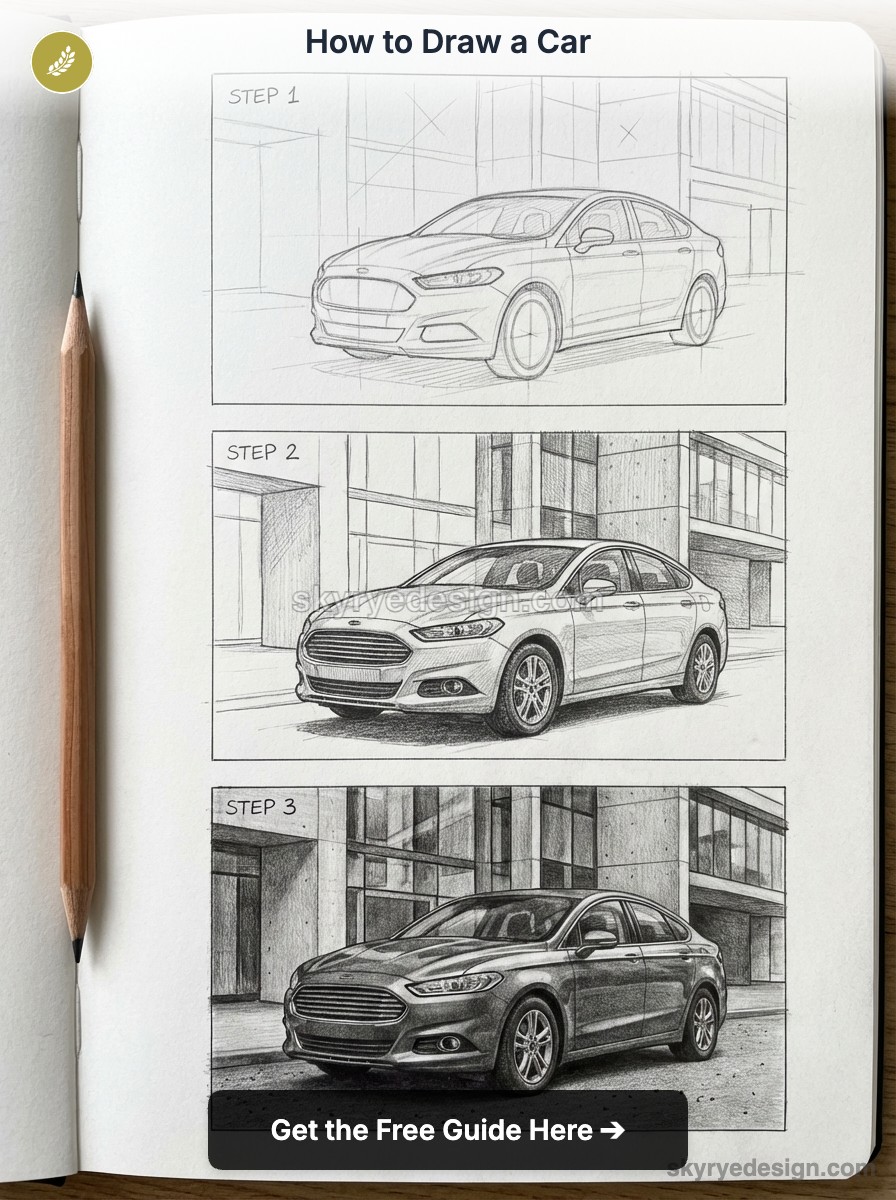
Why it works: Inconsistent shadow directions are one of the most reliable ways to identify a composition where the car and background were drawn at different times without reference to a common light source. The eye detects this immediately even when the viewer can’t identify what’s wrong.
How to execute: Establish the sun direction first — typically upper left for a three-quarter front view — and draw a light directional arrow as a reference mark. The car’s ground shadow falls to the lower right of the car. The building’s wall shadows (cast by the roof overhang) fall at the same angle. The shadow under the car is the darkest mark in the drawing — 4B pencil, slightly soft-edged on the car side, harder-edged on the driveway side.
Environmental Reflection on the Car Body
What it is: A polished car body acts as a convex mirror — it compresses, curves, and reflects whatever is directly behind and beside it. The house facade, the sky above, and the driveway below all appear as distorted, compressed bands on the car’s painted surfaces.
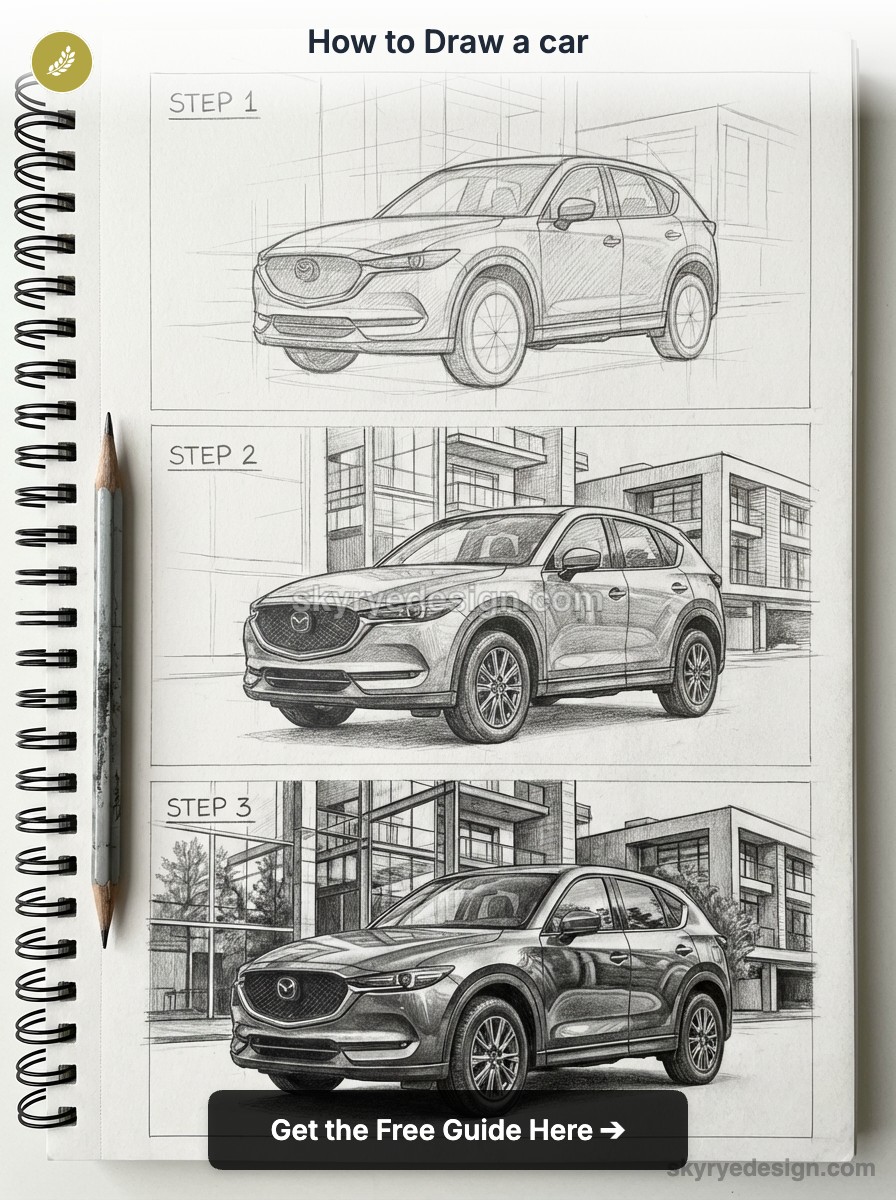
Why it works: Reflections are what make a car surface read as metallic rather than matte. Without them, even the most carefully rendered car body looks like painted cardboard. The reflection connects the car to its environment in a way that no amount of isolated shading can achieve.
How to execute: On the car door panel: a light-toned compressed band in the upper half suggesting the house wall, a slightly darker band in the lower half suggesting the driveway. These are not precise reflections — they are abstract tonal bands that suggest the reflective quality of the surface. Work with a kneaded eraser to lift the lightest areas after shading the panel. On the bonnet: a broad highlight running along the bonnet spine, with a compressed, lightened version of the sky visible in the upper portion of the bonnet surface.
Atmospheric Perspective Through Line Weight
What it is: Objects in the foreground are drawn with heavier, higher-contrast marks than objects in the background. Applied to a car-and-building composition, the car receives 2B-4B line weight and strong tonal contrast; the building receives HB-2B line weight and compressed tonal range.
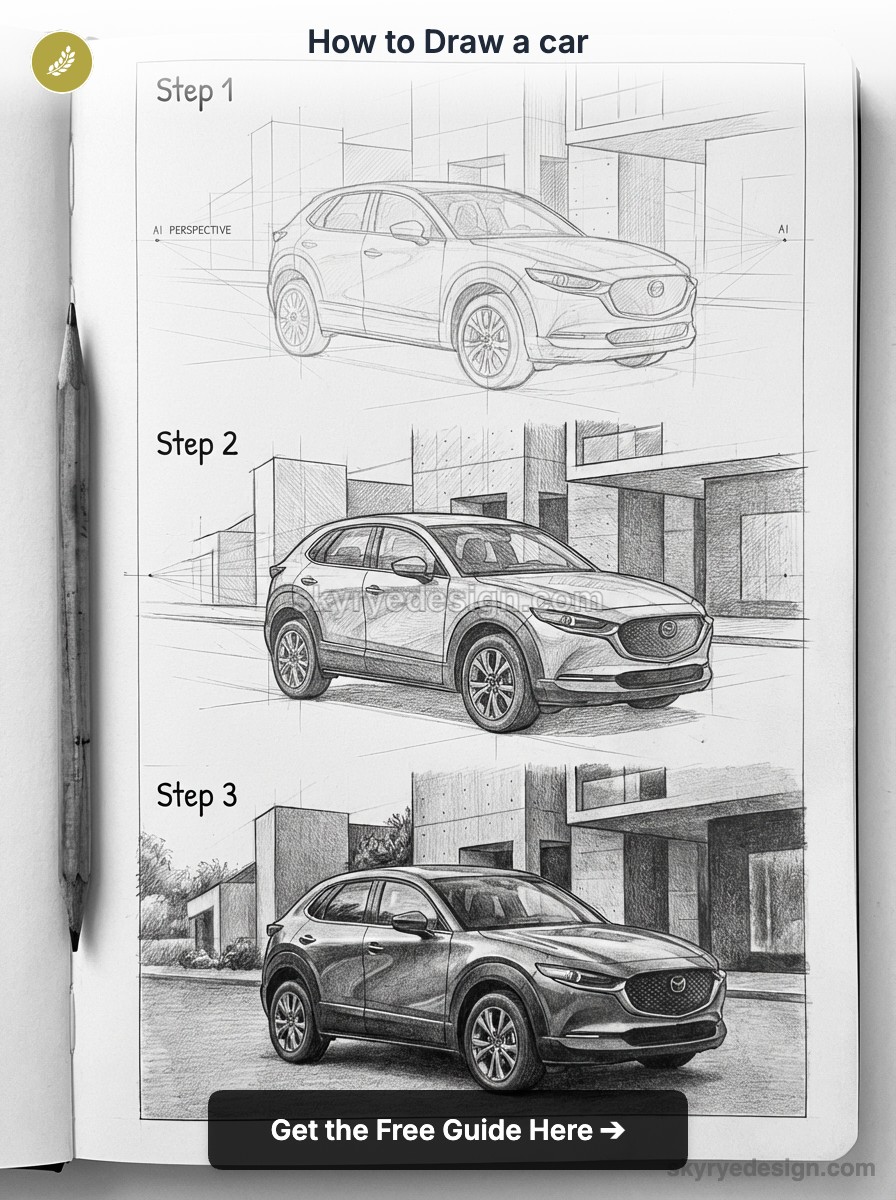
Why it works: The visual system interprets heavier contrast as proximity and lighter contrast as distance. By applying this principle systematically — heavier on the car, lighter on the building — you direct the viewer’s attention to the car without explicitly composing it that way. The hierarchy reads as natural depth rather than as a deliberate design decision.
How to execute: Establish all car outlines with a 0.5mm Staedtler Pigment Liner. Establish all architectural outlines with a 0.3mm liner. Apply 4B shading only within the car — wheel arch interiors, window glass, the deepest body panel shadows. The darkest mark on the building should be lighter than the darkest mark on the car. Enforce this as a rule during the inking phase, not as a suggestion.
Driveway Texture as Ground Plane
What it is: The driveway surface between the car and the building is the primary spatial connector in the composition — it’s the element that simultaneously belongs to both the car zone and the building zone and physically connects them in the same ground plane.
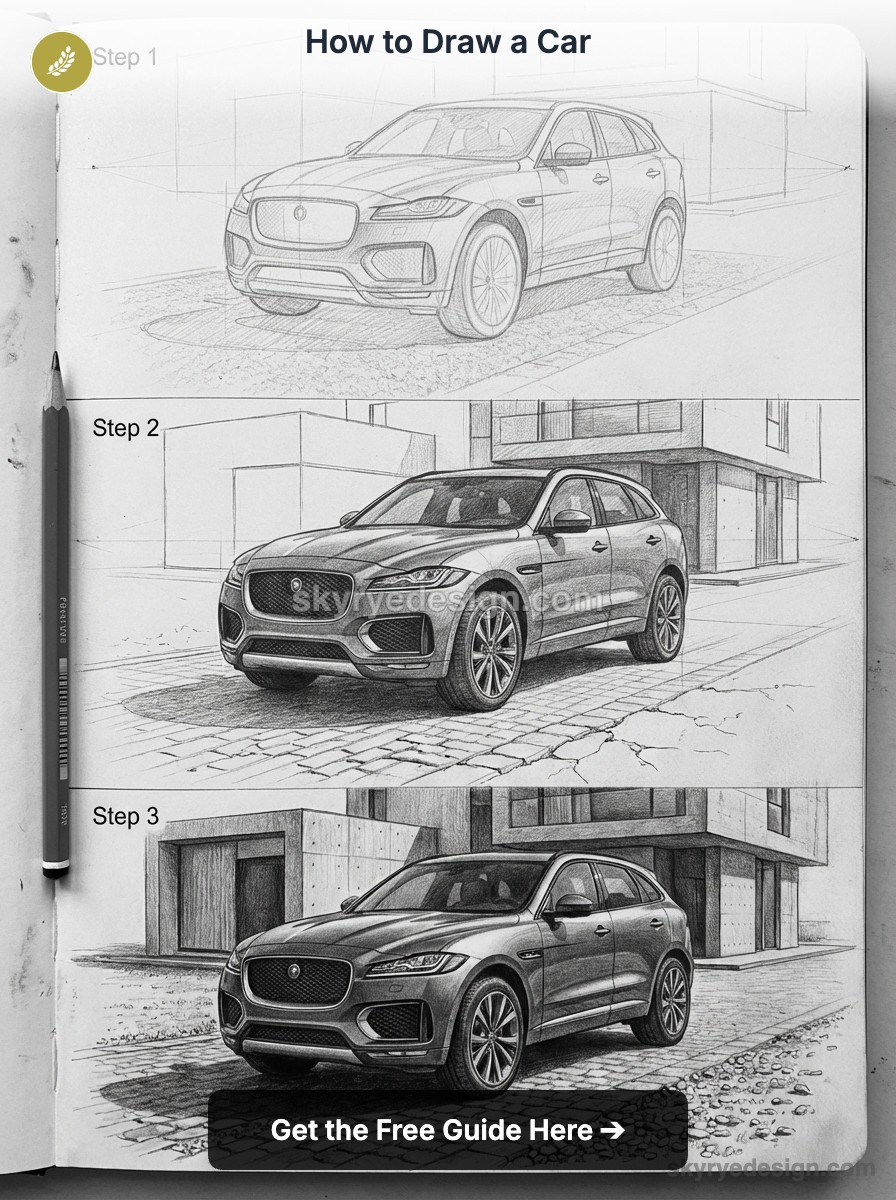
Why it works: A driveway surface drawn with appropriate texture and perspective convergence confirms that the car is sitting on the ground rather than floating above it, and that the ground it’s sitting on is the same ground the building stands on. Without this connective surface, the car and building remain compositionally isolated even when the perspective is correctly aligned.
How to execute: Draw the driveway surface lines as parallel marks converging to VP-R, spaced more closely together as they recede toward the building. Apply a very light pencil texture — finer and lighter than the car body shading, coarser and slightly darker than the wall surface texture. Add a single strong shadow line where the car’s underbody meets the driveway surface; this is the ground contact line that anchors the car more convincingly than any amount of additional bodywork shading.
Common Mistakes in Car-and-Background Compositions
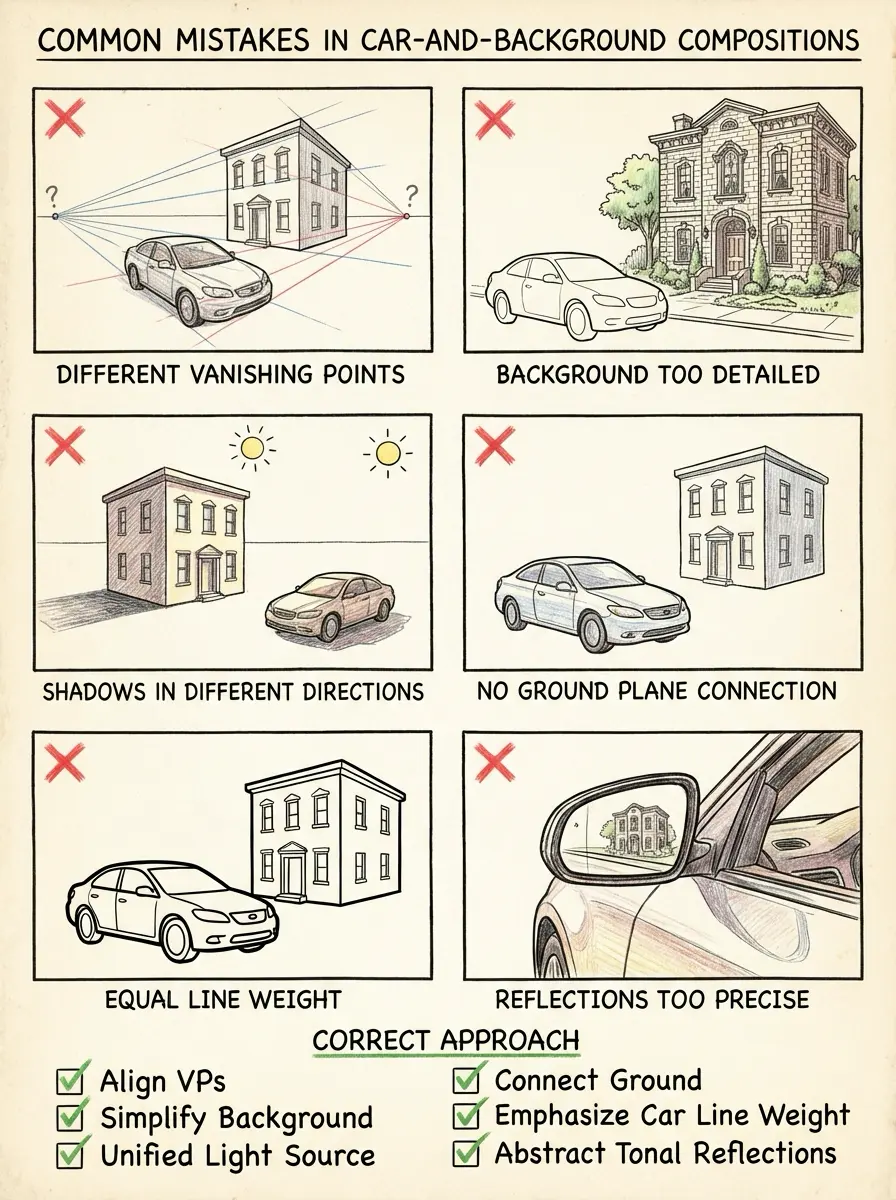
- Different vanishing points for car and building. The most destructive single error — the car and building appear to occupy different physical realities. Confirm alignment with ruler lines to both vanishing points before inking.
- Background too detailed. Brick coursing, decorative mouldings, complex landscaping — background detail competes with the car for visual attention. The building should read at a glance, not reward extended study.
- Shadows in different directions. If the roofline casts a shadow leftward and the car casts a shadow rightward, the composition has two different suns. Establish light direction at the start and enforce it throughout.
- No ground plane connection. A car and a building drawn without a shared driveway surface float in separate spatial zones. The driveway is the compositional bridge between them.
- Equal line weight for car and background. When both car and building are drawn at the same line weight, neither dominates. The car must be heavier, darker, and higher-contrast than the architecture in every mark.
- Reflections that are too precise. Drawing detailed miniature architecture on the car body surface looks wrong — car reflections are compressed, abstracted, and tonal rather than detailed. Abstract tonal bands read more convincingly than precise reflected imagery.
The Background Is a Test, Not a Decoration
A residential background in an automotive illustration does more than add atmosphere — it tests the structural accuracy of the car drawing against a fixed reference. A car that looks perfectly proportioned in isolation may reveal perspective errors the moment a correctly drawn building appears behind it. This is not a problem to avoid; it’s the most useful feedback mechanism available to an automotive artist.
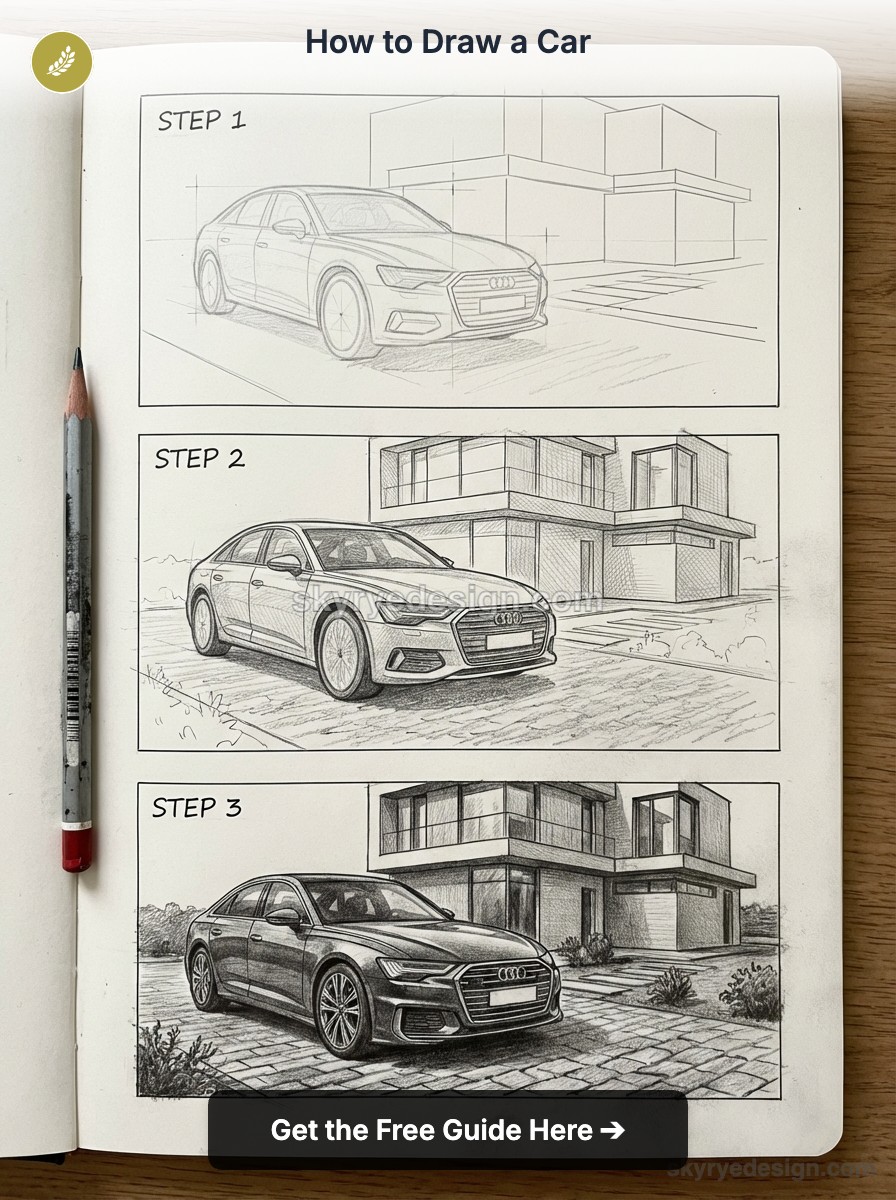
Every architectural element you add to a car sketch — the perspective-aligned roofline, the flush-panel entry door, the driveway surface converging to the vanishing point — is a calibration mark against which the car’s accuracy is measured. Draw backgrounds regularly, not as a finishing technique but as a diagnostic one. The compositions that reveal problems are the most instructive drawings you’ll produce. The ones that hold together completely — car and building sharing the same light, the same ground, the same vanishing points, the car dominant by virtue of line weight and tonal contrast — are when automotive illustration moves from good car drawing to genuine scene-making.
FAQ: Car Sketching With Residential Backgrounds
Q: Why add a background to car sketches?
A background provides three things a blank page cannot: a scale reference that validates the car’s proportions, a light source that explains highlights and shadows on the bodywork, and a narrative context that grounds the scene. A background also tests the car drawing’s perspective accuracy — errors invisible in isolation become immediately apparent against a correctly drawn building.
Q: How do I set up two-point perspective for a car and house?
Draw a horizon line at eye level — for a parked car viewed from the street, this sits at approximately 1.2-1.5m above the ground plane, falling between the lower sill and shoulder line of the car. Place VP-L far left and VP-R far right. Both the car’s horizontal edges and the building’s horizontal edges must converge to the same two points. Confirm alignment with a ruler before inking anything.
Q: What architectural details work best in a car sketch background?
Contemporary elements with clean geometric forms: a large fixed glazing panel, a flat roof overhang with a visible shadow line, a flush-panel entry door with a linear handle, and a rendered or timber-clad wall with one dominant texture. Avoid complex brick coursing or decorative mouldings — they compete with the car for attention. Draw architectural outlines with a 0.3mm liner to stay visually subordinate to the car’s 0.5mm outline.
Q: How do I draw car reflections convincingly?
A car body compresses and curves whatever it reflects. On the door panel: a light-toned compressed band in the upper half (suggesting the house wall) and a slightly darker band below (the driveway). These are abstract tonal bands, not precise miniature reflections. Work with a kneaded eraser to lift the lightest areas after shading. Detailed reflected architecture looks wrong — abstracted tonal bands look right.
Q: What pencils work best for automotive illustration with backgrounds?
HB for construction lines. 2B for confirmed car outline and primary architectural lines. 4B for deepest shadows — wheel arches, window glass, under the car. 0.5mm Staedtler Pigment Liner for the car, 0.3mm for the architecture — this line weight difference is the technical implementation of atmospheric perspective, and it’s what keeps the car dominant without explicitly competing with the building.
- 0shares
- Facebook0
- Pinterest0
- Twitter0
- Reddit0