
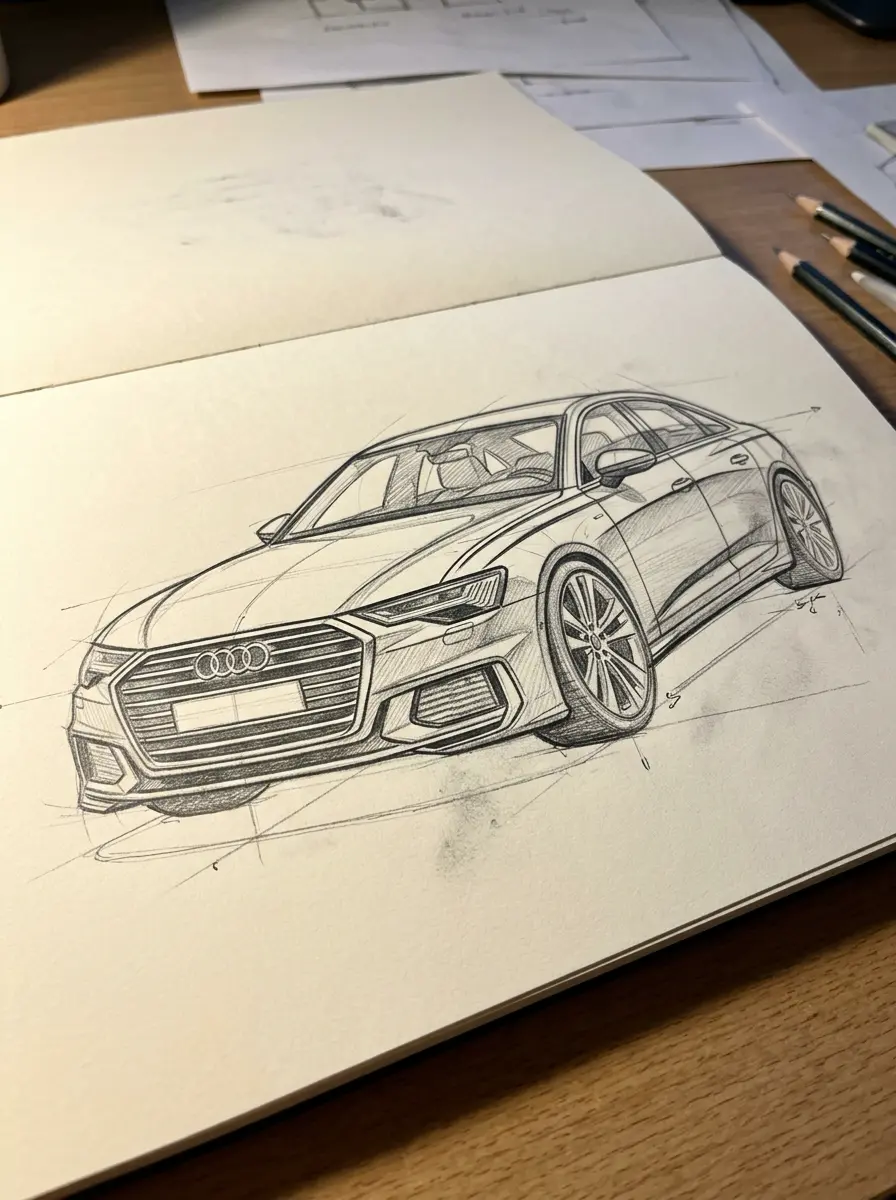
I drew what I thought was a solid Audi for two years before I understood why it never quite read as one. The proportions were close. The wheels were the right size. The roofline swept correctly. But every time I showed the sketch to someone, they’d say ‘nice car’ rather than ‘nice Audi’ — which meant the drawing was generic rather than specific, a sports sedan rather than a particular kind of sports sedan.
The fix, when I finally found it, was embarrassingly precise: I was placing the tornado line — Audi’s primary character line — at the wrong height. I was drawing it at the visual midpoint of the door, which is where most car character lines sit.
Audi’s tornado line sits notably higher, in the upper third of the door surface, creating a deliberate upward tension that runs from the front wheel arch to the rear of the car. That single adjustment — moving one line maybe 15mm higher on the page — changed every sketch I drew afterward. The cars started reading as Audis immediately, at rough construction stage, before any details were added.
This is what understanding a design language actually means in practice: not memorising what cars look like, but knowing which specific proportional and formal decisions define them.
Audi has three such decisions — the Singleframe grille, the tornado line, and the quattro blisters — and getting all three right at the construction stage produces a drawing that reads as an Audi before any surface detail is rendered. This guide covers those three elements in detail, the step-by-step construction method, and eight specific models, each with its own drawing challenges.
The Three Design Elements That Make Every Audi Recognisable
Audi’s design language — developed under chief designers Peter Schreyer (1994-2006) and then Wolfgang Egger and Marc Lichte — is built on a philosophy called ‘Vorsprung durch Technik’ (advancement through technology) expressed visually as precision, tension, and controlled aggression. The three features that embody this philosophy are the ones you need to draw correctly before anything else.
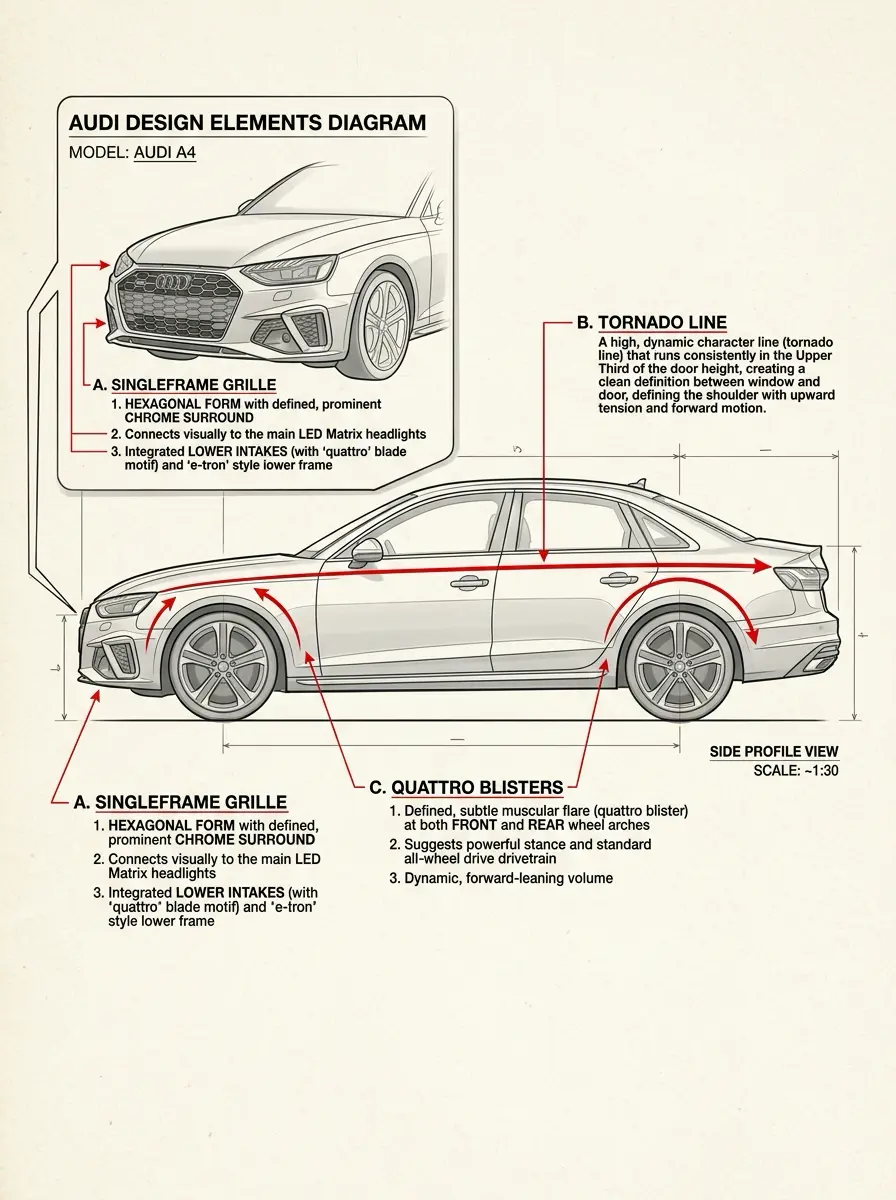
1. The Singleframe Grille — Audi’s Face
Introduced on the Audi Avantissimo concept in 2001 and made production-standard from the 2003 A8, the Singleframe grille is the most distinctive and most technically specific feature in Audi’s design language.
It’s a flattened hexagon — wider than it is tall, with a flat top edge, gently angled upper corners, a wider middle section, and a bottom edge that is slightly narrower. Critically: it is NOT a rectangle, NOT an oval, and NOT a simple arch. The hexagonal geometry is specific and deliberate.

The chrome surround that frames the grille opening doesn’t stop at the grille edges — it continues downward and outward to connect with the lower front bumper air intakes, creating one continuous chrome statement across the entire lower front face.
This connection between grille and lower intakes is what gives the Audi front its particular width and authority. Drawing just the grille opening without this connecting chrome surround produces a front face that looks like a generic car with a hexagonal grille, not an Audi.
2. The Tornado Line — The Tension That Defines the Side
The tornado line is Audi’s primary side character line — a sharp crease or raised line that runs from the upper edge of the front wheel arch to the rear of the car, sitting in the upper third of the door surface rather than at the midpoint. This high placement is the defining characteristic of Audi side profiles and the element most frequently drawn incorrectly. On a 2B pencil sketch, the tornado line should sit at approximately 65-70% of the door height — significantly above the visual midpoint.
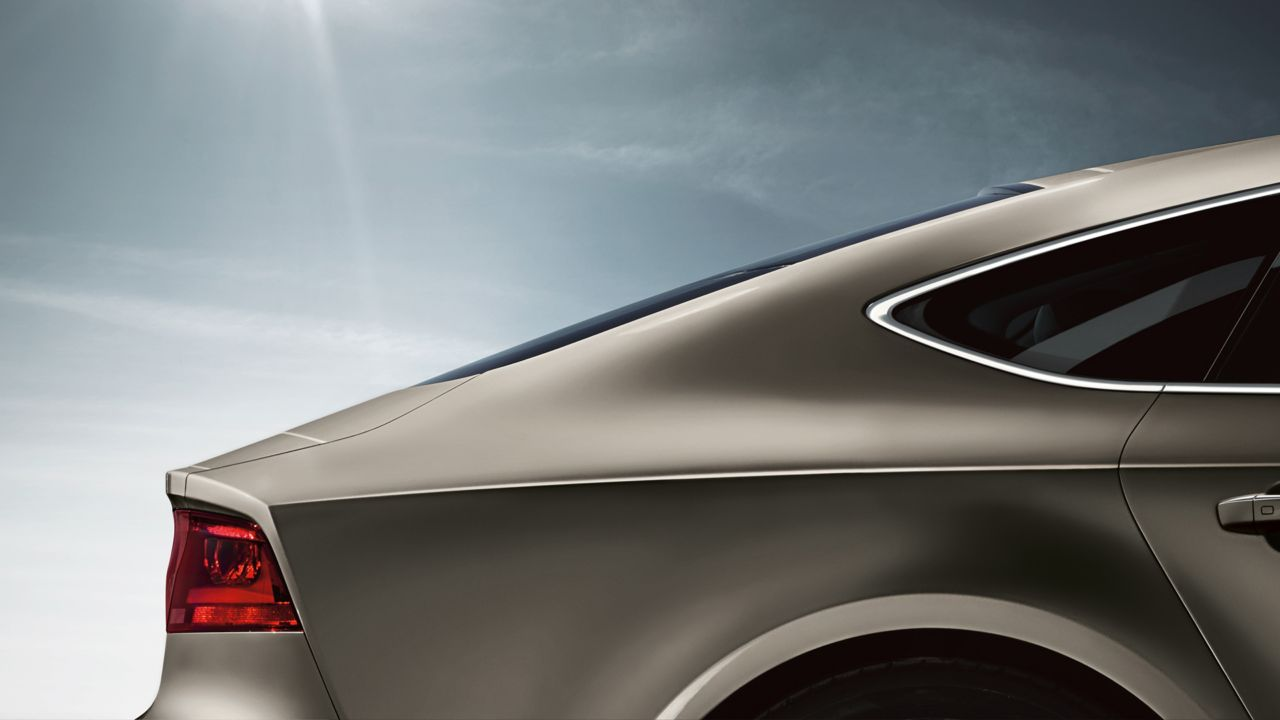
The line itself has specific tension: it begins at the front arch with slightly more intensity (the front of the arch is where the line’s energy originates), runs with controlled flatness across the door surface, and terminates at the rear of the car. It doesn’t sweep dramatically upward like a Mazda character line or remain perfectly flat like a Mercedes line — it holds a subtle but deliberate upward angle across the door, approximately 3-5 degrees above horizontal. This slight rise is what creates the forward motion quality that distinguishes Audi’s side profile from more neutral designs.
3. The Quattro Blisters — Muscular Restraint
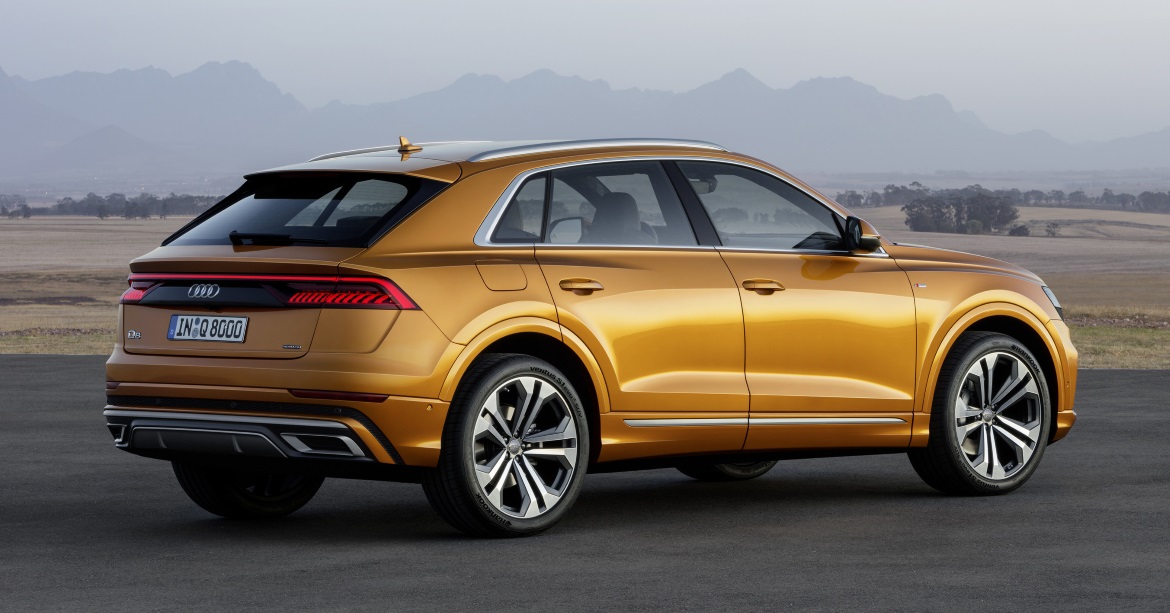
Audi’s quattro all-wheel-drive system has been a defining brand element since the original Audi Quattro rally car of 1980. Visually, the quattro system is referenced through subtle muscular flares over the wheel arches — the ‘quattro blisters’ — that suggest the wider track and more substantial mechanical content beneath the body. These are not the dramatic flares of a Lamborghini or the bold arches of a Porsche 911; they are refined, tension-filled surface transitions that add width and presence without aggression.
In drawing, the quattro blisters are suggested rather than explicitly drawn. The rear wheel arch is slightly wider than the front, and the body surface over both arches has a subtle convex quality — it bulges outward fractionally before returning to the door surface. This convexity is drawn as a subtle tonal gradient (slightly lighter at the bulge apex) rather than as a hard line. On A and B-Series Audis the blisters are understated; on RS and R models they become much more prominent.
✏ Drawing note: The fastest way to check whether your Audi drawing has the tornado line in the correct position: draw a horizontal line at the exact midpoint of the door height. The tornado line should be clearly above this midpoint — in the upper third of the door area. If your tornado line sits at or below the midpoint, the car won’t read as an Audi regardless of how accurate the grille or proportion work is. The high tornado line is the non-negotiable marker of Audi’s design identity.
Audi Proportions: The Numbers That Make the Drawing Work
Audi’s design vocabulary varies significantly across its model range — from the relatively compact A3 to the massive Q7 and E-Tron GT. But the proportional relationships that define the design language are consistent across the range, with specific variations by model class that are worth understanding before drawing each one.
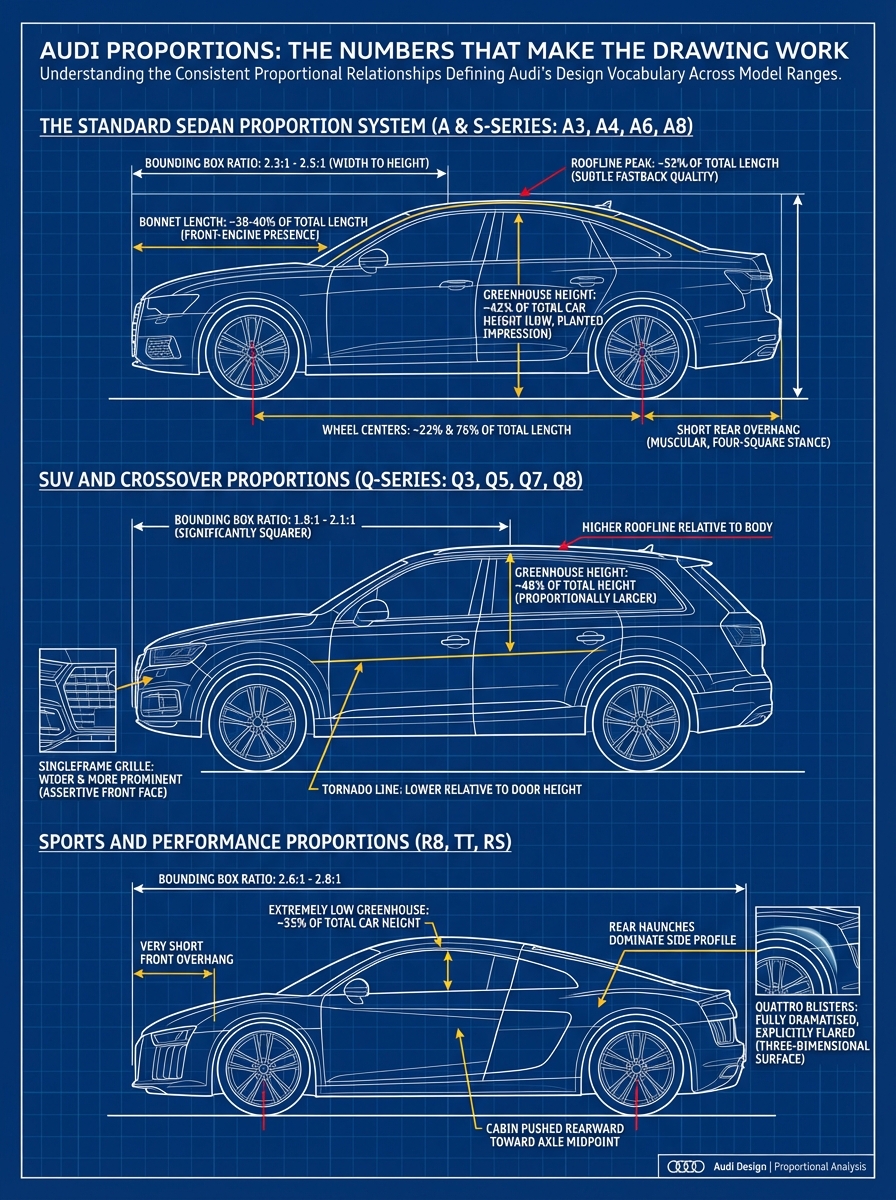
The Standard Sedan Proportion System
For Audi’s A and S-Series saloons and estates (A3, A4, A6, A8), the bounding box ratio sits between 2.3:1 and 2.5:1 (width to height). Wheel centres sit at approximately 22% and 76% of total length. The roofline peaks at approximately 52% of total length — very close to the midpoint but slightly rearward, giving the profile a subtle fastback quality. The greenhouse — the glass area — occupies approximately 42% of the total car height, which is slightly smaller than most European sedans of equivalent class and contributes to the low, planted visual impression.
The bonnet length on current Audi A-series is notable: approximately 38-40% of total car length — long enough to suggest a front-engine architecture with presence, but shorter than Aston Martin or Jaguar territory. The rear overhang is deliberately short, which gives current Audis a more muscular, four-square stance compared to the longer-tailed German sedans of the 1990s.
SUV and Crossover Proportions (Q-Series)
Audi’s Q-Series SUVs follow a different proportion logic: the bounding box ratio runs from 1.9:1 (Q7, Q8) to 2.1:1 (Q3, Q5) — significantly squarer than the sedan range. The greenhouse is proportionally larger (approximately 48% of total height) and the roofline is higher relative to the body. The tornado line is still present but sits lower relative to the door height than on sedans, reflecting the taller body proportion. The Singleframe grille on Q models is wider and more prominent — on the Q8 in particular it dominates the front face in a way that is more assertive than the A-Series equivalents.
Sports and Performance Proportions (R8, TT, RS)
The R8 operates on entirely different proportion logic: a 2.6:1 to 2.8:1 bounding ratio, an extremely low roofline (greenhouse height approximately 35% of total car height), and a mid-engine layout that eliminates the conventional bonnet-cabin-boot sequence. The front overhang is very short, the cabin is pushed rearward toward the axle midpoint, and the rear haunches dominate the side profile. The R8 is the only Audi model where the quattro blisters are fully dramatised — the rear arches flare outward explicitly, requiring the kind of three-dimensional surface understanding that makes the R8 a more advanced drawing challenge than any A-Series model.
✏ Drawing note: Before drawing any specific Audi, identify its model class and note the bounding box ratio. A Q8 drawn at a 2.5:1 ratio looks too sporty; an A4 drawn at 2.0:1 looks like an SUV. Establish the correct ratio from the start, then check it by drawing the bounding box and confirming that the car fills it correctly along all four edges. This single check prevents the most common Audi proportion error: making sedans too tall or making SUVs too low.
Eight Audi Models: Drawing Challenges and Specific Proportions
01 — Audi A4 (B9) (2016–present)
Difficulty: Beginner-friendly — cleanest expression of current design language
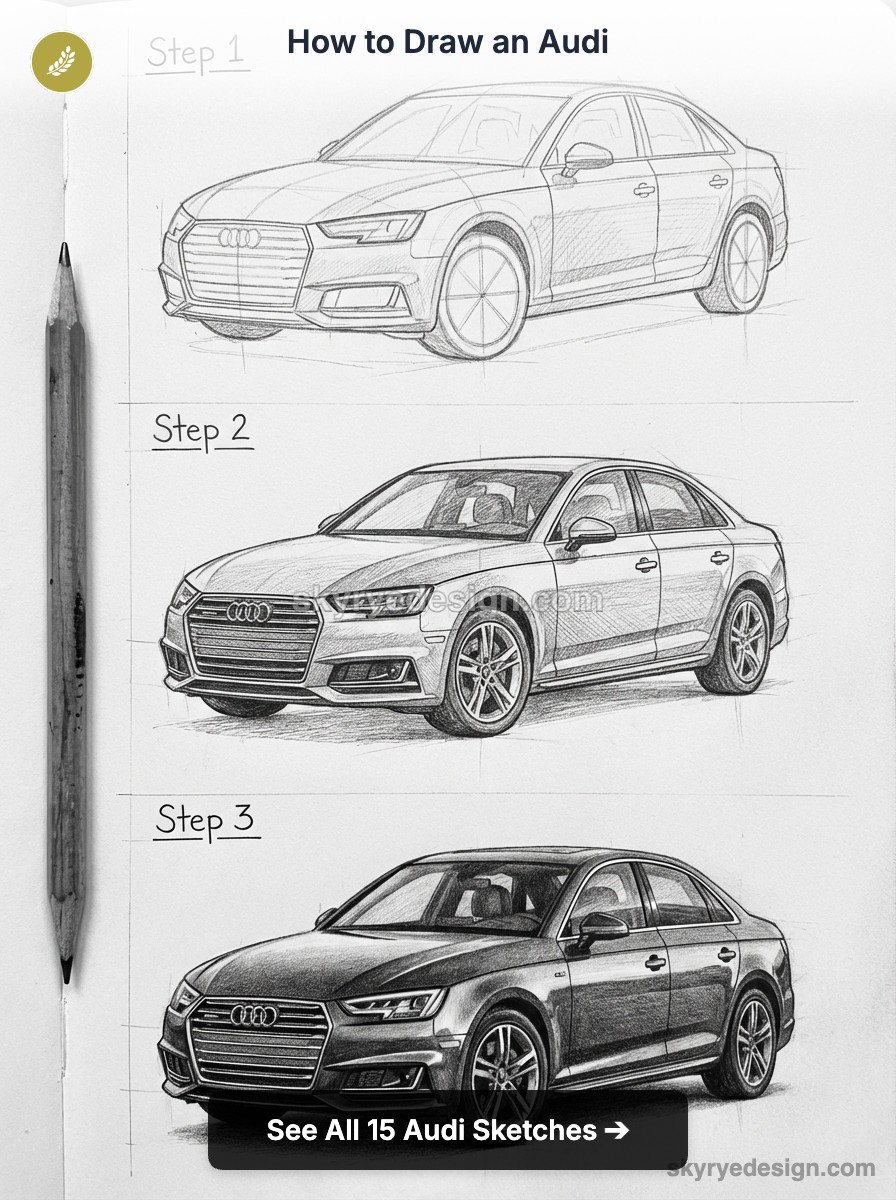
Design DNA: The A4 is the purest expression of current Audi design without RS drama or SUV complexity. The tornado line is clearly readable, the Singleframe is well-proportioned, and the body surfaces are relatively smooth with one primary character line. The subtle edge from the wheel arch to the door shoulder is the A4’s most distinctive detail.
Drawing tip: Start here if you’re learning Audi. The bonnet’s subtle power dome — a very slight central raised section running along the bonnet centreline — is the detail that distinguishes a careful A4 drawing from a generic one. Draw it as a barely-perceptible tonal highlight along the bonnet centre, not as a sharp crease.
02 — Audi A6 (C8) (2018–present)
Difficulty: Intermediate — longer proportions require accurate wheelbase management
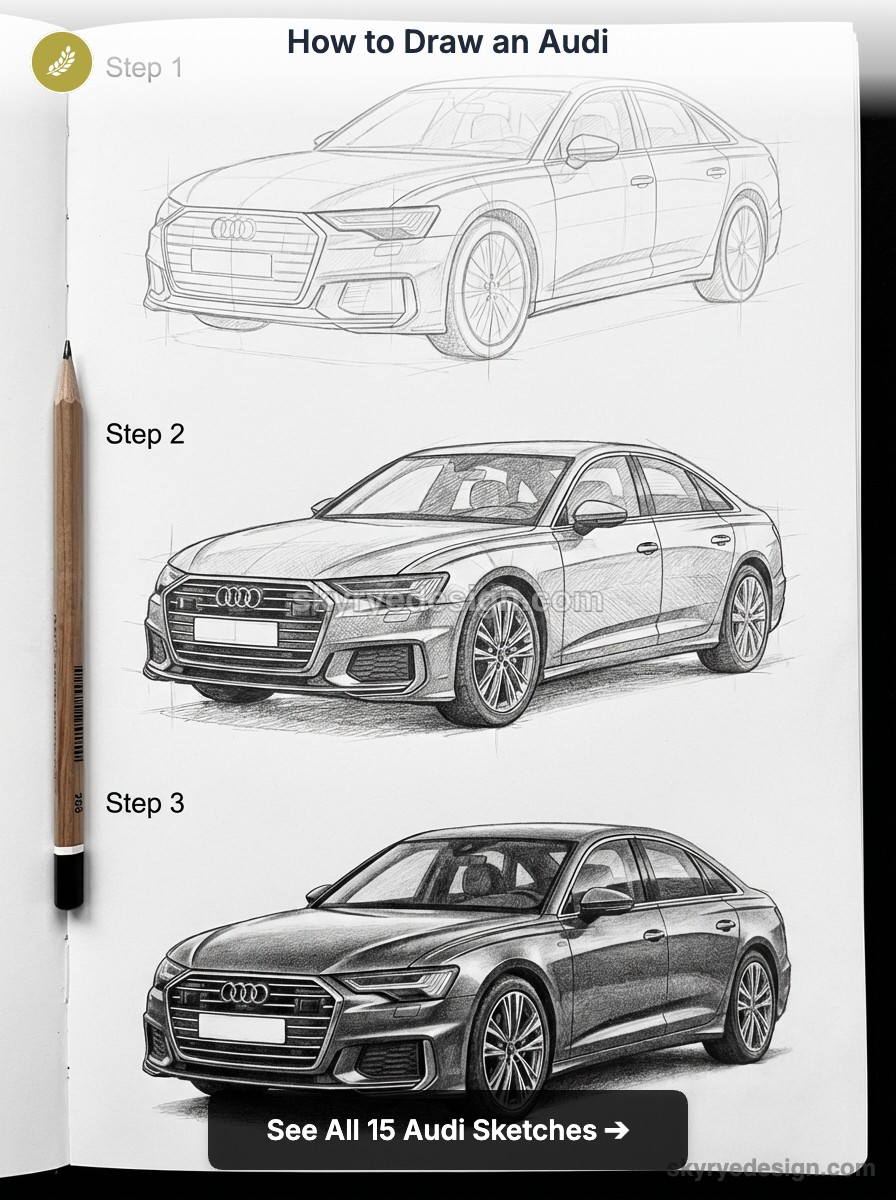
Design DNA: The A6 is where Audi’s ‘Sportback’ roofline — a fastback profile that merges the traditional saloon roofline into a coupé-influenced sweep at the rear — becomes most elegant. The rear roofline angle is 10-15 degrees steeper than the A4, creating a more dramatic profile. The grille on the A6 is wider and lower than the A4, reflecting the larger body.
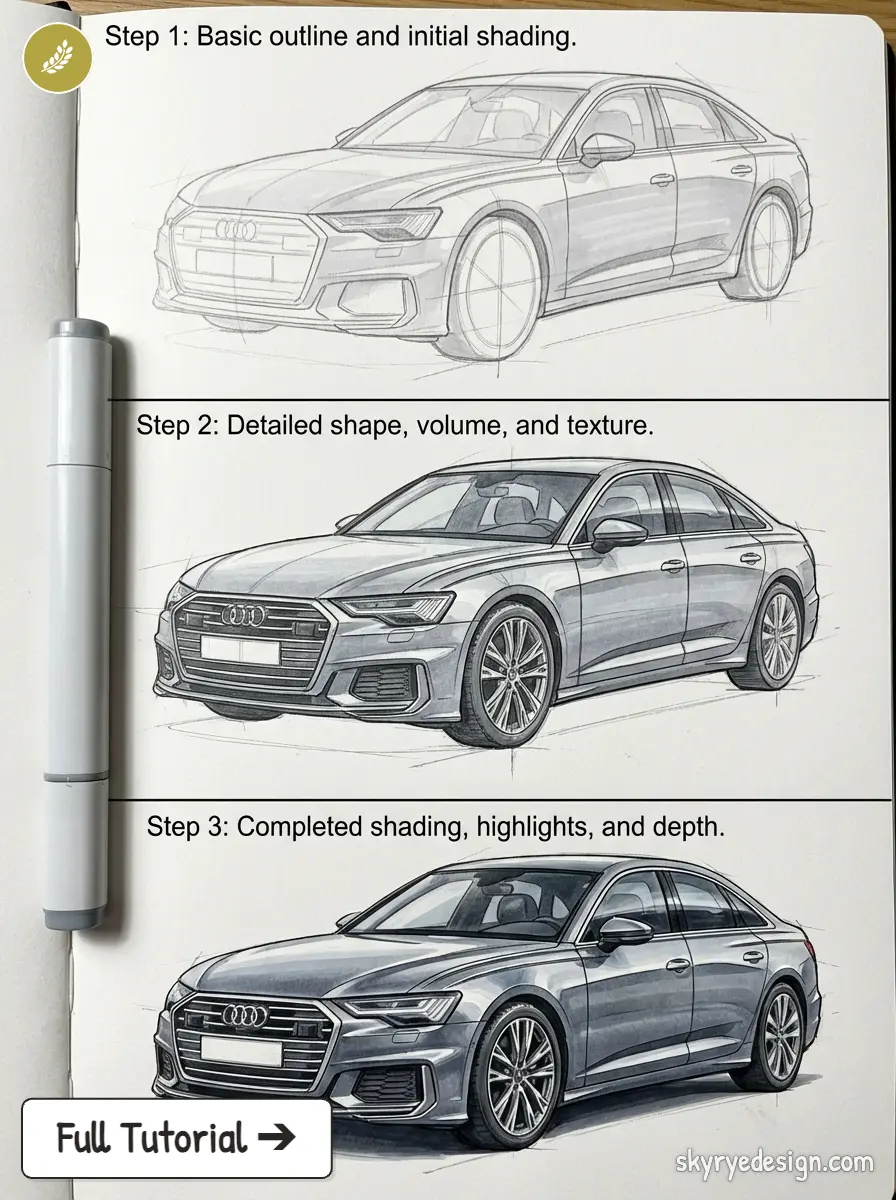
Drawing tip: The rear greenhouse sweep is the A6’s most challenging drawing element. The roofline descends steeply toward the bootlid, then transitions to a short near-horizontal bootlid surface. Get this angle wrong and the A6 reads as a hatchback or an estate. The correct rear angle makes the A6 look decisively like a fastback saloon.
03 — Audi A8 (D5) (2017–present)
Difficulty: Intermediate to advanced — complex surface details reward careful study
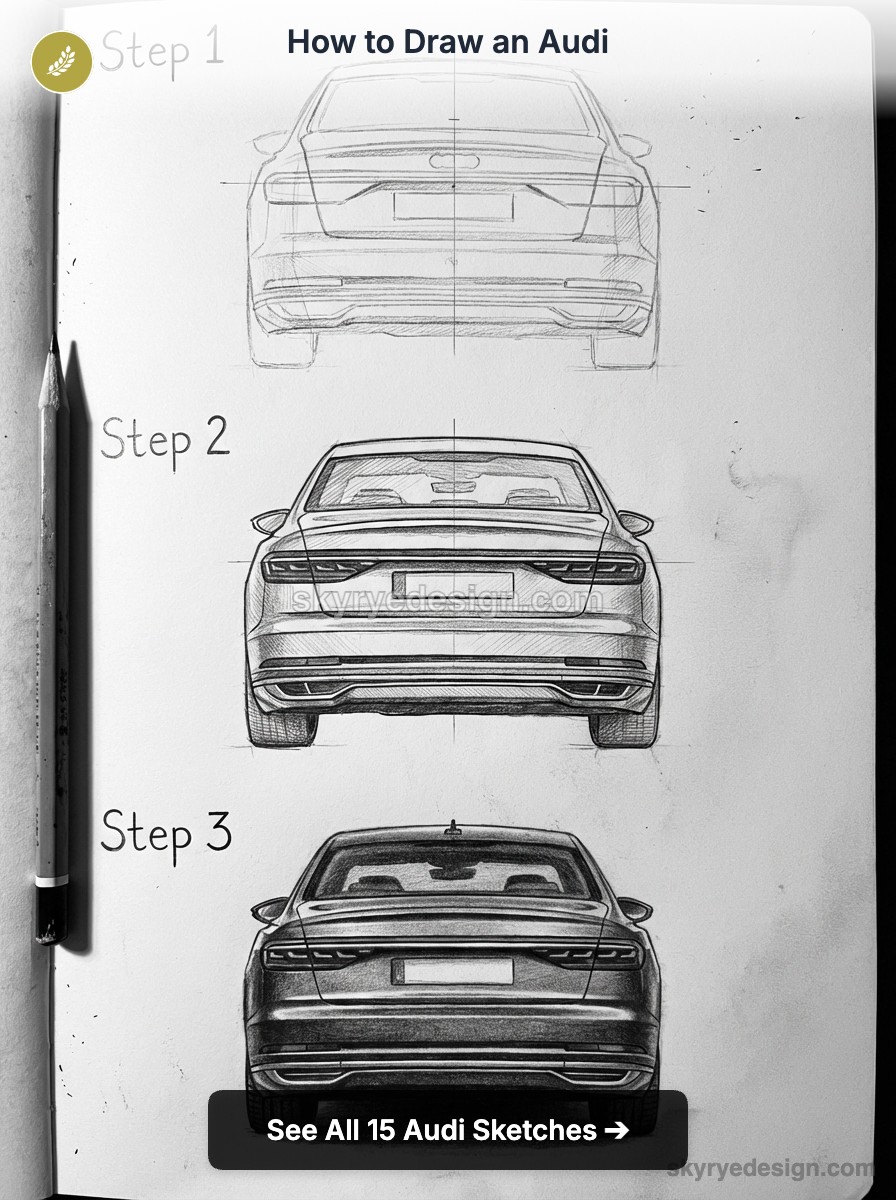
Design DNA: The A8 is Audi’s flagship and the most technically ambitious standard production drawing. The Singleframe grille is at its largest — occupying nearly 40% of the front face width — and the body surfaces have more complex secondary creases and shoulder lines than the smaller models. The LED light signatures are a major design element on the A8.
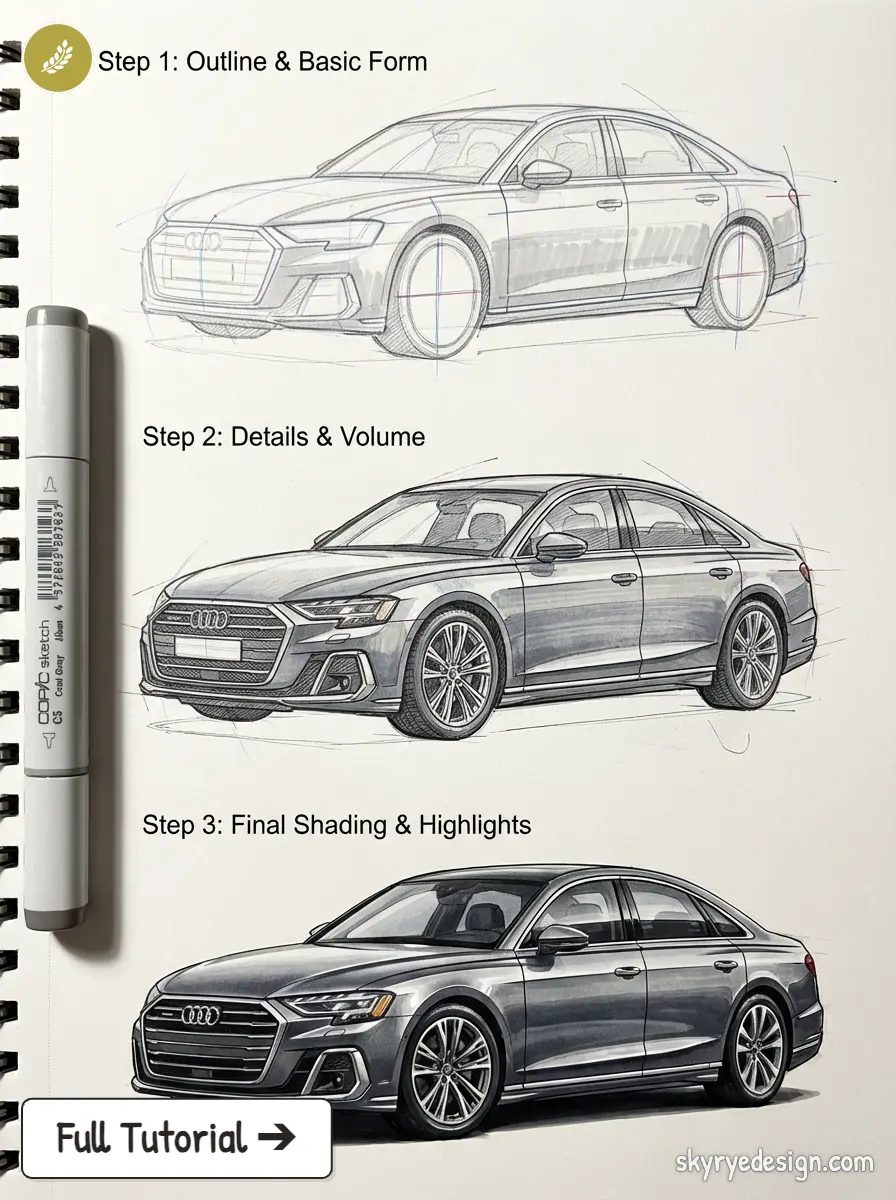
Drawing tip: The A8’s headlight design — thin, horizontal, with a complex internal light guide pattern — is the most technically demanding feature to sketch accurately. In a rough construction sketch, represent the headlights as very thin horizontal slits with a slight upward angle at the outer corners. The thinness of the headlight is critical: it communicates the A8’s maturity and restraint.
04 — Audi R8 (Type 4S) (2015–present)
Difficulty: Advanced — mid-engine proportions require complete rethinking of construction sequence
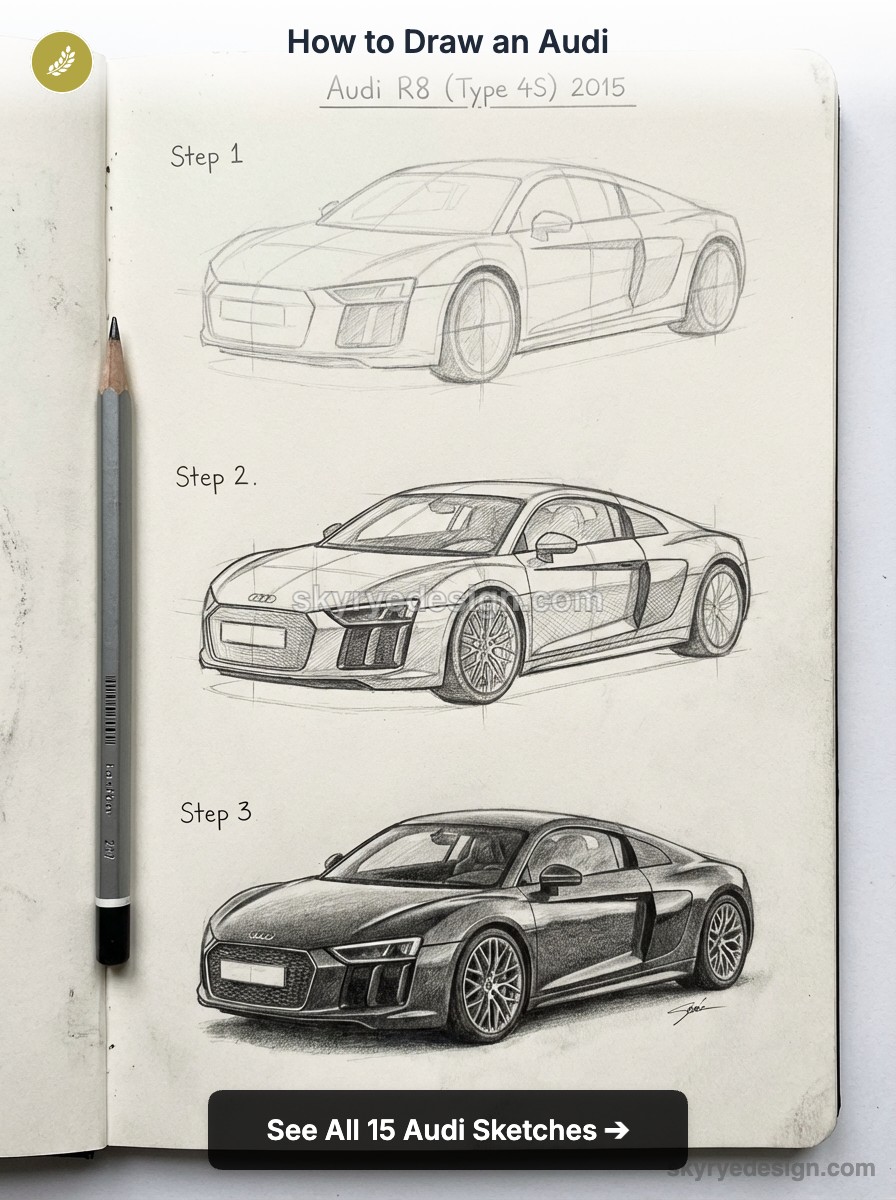
Design DNA: The R8’s mid-engine layout makes it the most compositionally challenging Audi to draw. The cabin is positioned rearward of the front wheel centre. The rear haunches are the dominant side profile element. The side blade — a distinctive air intake element behind the door — is a unique Audi R8 feature that must be drawn correctly for the car to read as an R8 rather than a generic supercar.
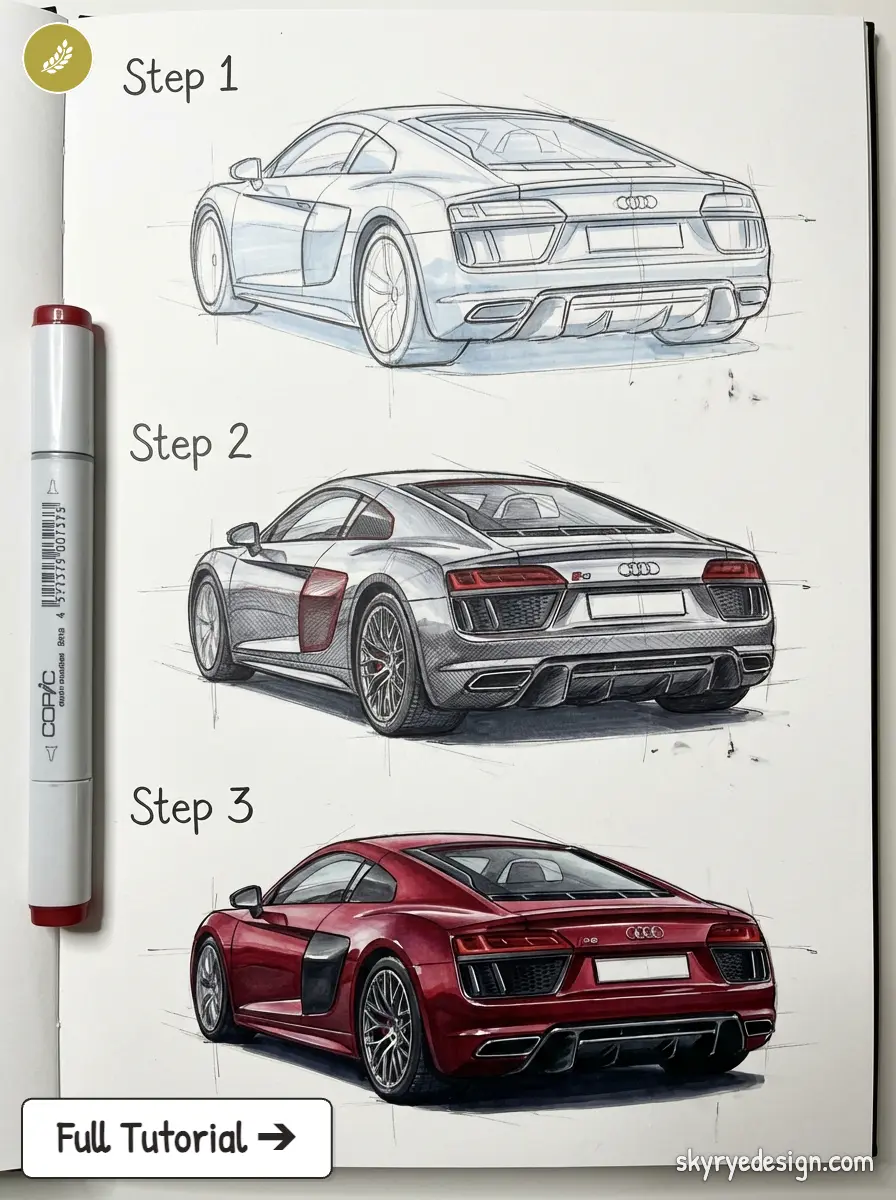
Drawing tip: Draw the R8 starting from the wheel arch positions rather than from the nose. The front axle sits very far forward in the wheelbase — approximately 40% from the front, versus 45-48% on a conventional front-engine car. Getting this wheel placement correct establishes the R8’s mid-engine stance immediately. The side blade (a triangular aperture behind the door) is the detail that confirms R8 identity.
05 — Audi TT (8S) (2014–present)
Difficulty: Beginner-friendly — highly geometric forms simplify construction
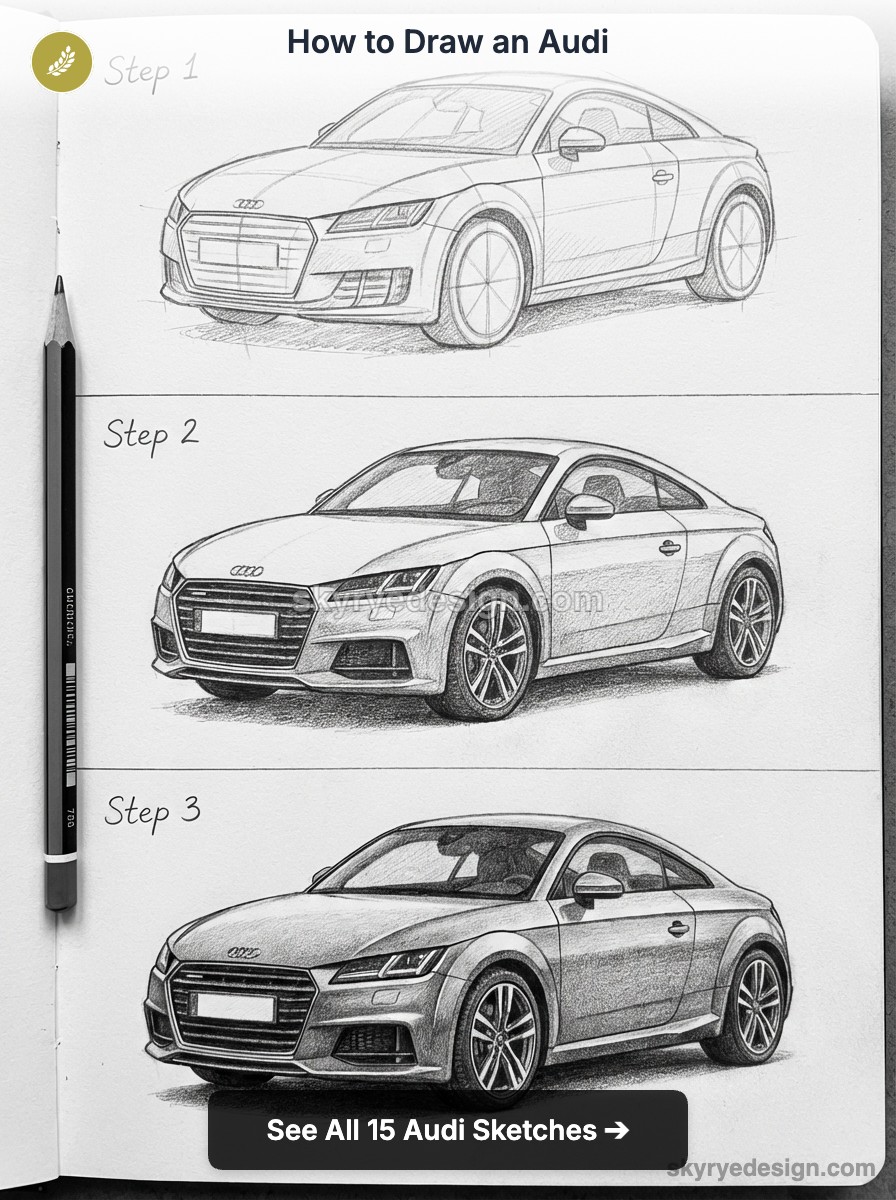
Design DNA: The TT is one of the most geometric production cars designed since the original Bauhaus-influenced TT of 1998. The body is built almost entirely from simple curves with minimal surface complexity. The round roofline, the short overhangs, and the near-circular wheel arches make the TT a genuinely approachable drawing subject despite its distinctive character.
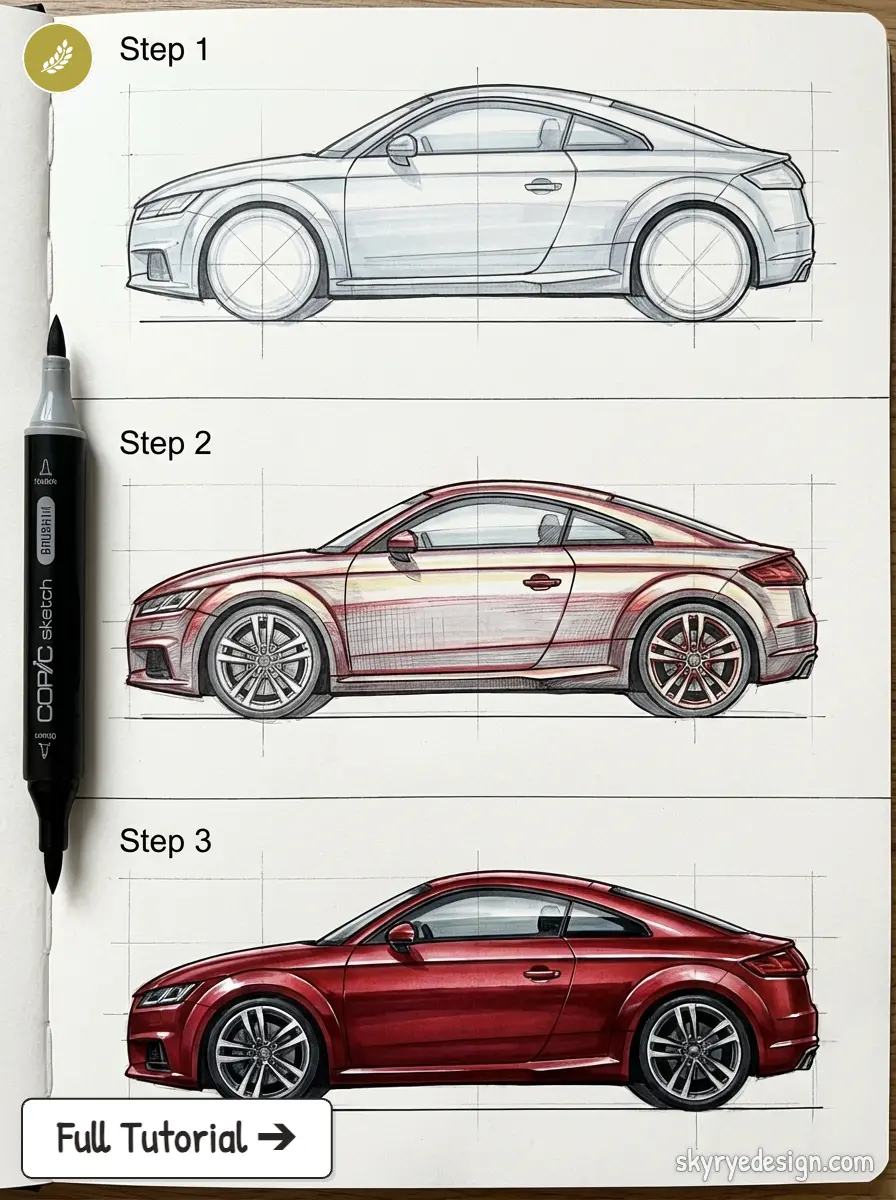
Drawing tip: The TT’s proportional signature is its perfect 1:1 relationship between the front overhang and the rear overhang — both are equal and very short. If either overhang is longer than the other in your drawing, the car immediately stops reading as a TT. Check this proportion early in construction before adding any detail.
06 — Audi Q5 (FY) (2017–present)
Difficulty: Beginner — clean proportions, clear Singleframe, manageable complexity
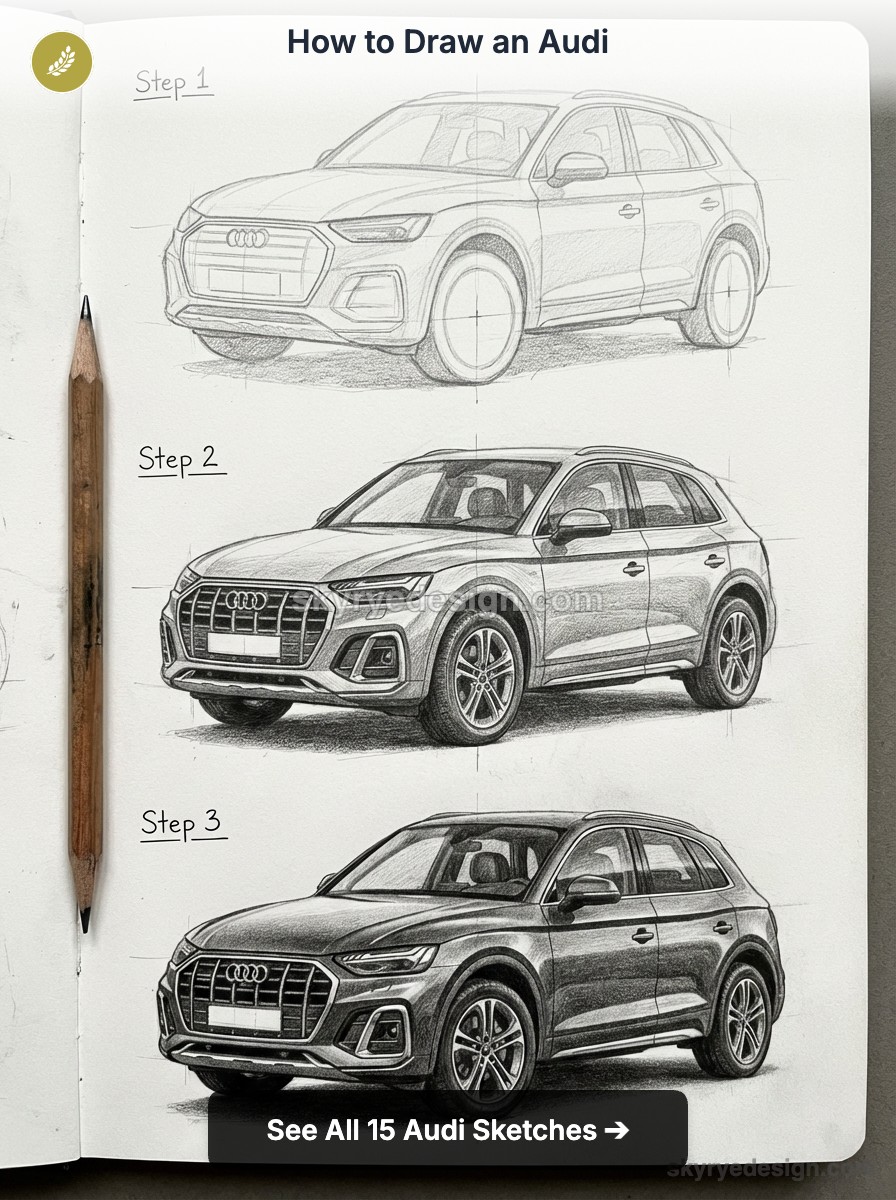
Design DNA: The Q5 is the mid-size SUV that best balances Audi’s design DNA with the practical proportions of a family vehicle. The tornado line is still clearly readable at the correct high position, the Singleframe is prominent without being overwhelming, and the body surfaces are less complex than the Q8 without feeling bland.
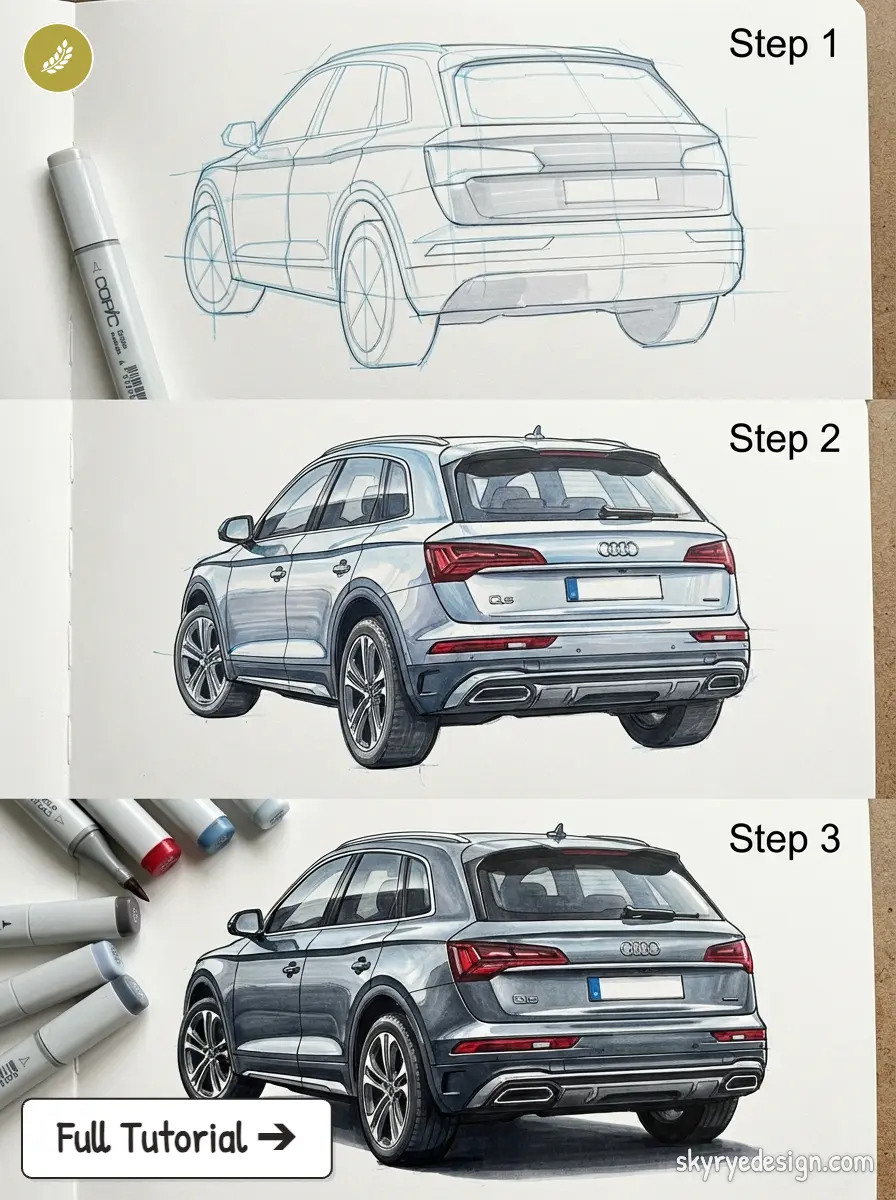
Drawing tip: The Q5’s greenhouse is wider relative to the door height than any A-Series Audi — the taller body means the glass area reads as more generous. Maintain this taller, more upright greenhouse proportion in your drawing; if you try to make the Q5 look sporty by lowering the roofline, it stops reading as an SUV and looks like a strangely proportioned estate.
07 — Audi Q8 (4M) (2018–present)
Difficulty: Intermediate — dominant Singleframe requires confident front face construction
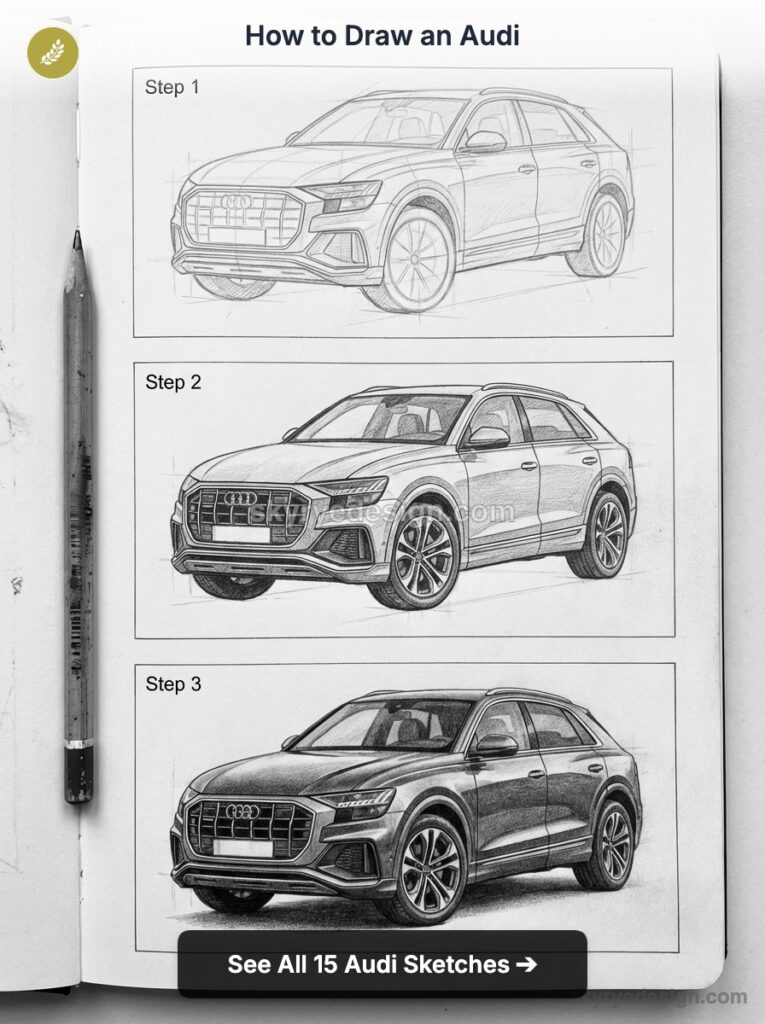
Design DNA: The Q8 takes Audi’s SUV proportion language to its most assertive expression. The Singleframe grille is the largest, widest, and most visually dominant of any current Audi production model — it occupies approximately 45% of the front face width and connects to lower intakes in a way that makes the entire front face feel like one large statement. The roofline sweeps in a coupé profile despite the SUV body height.
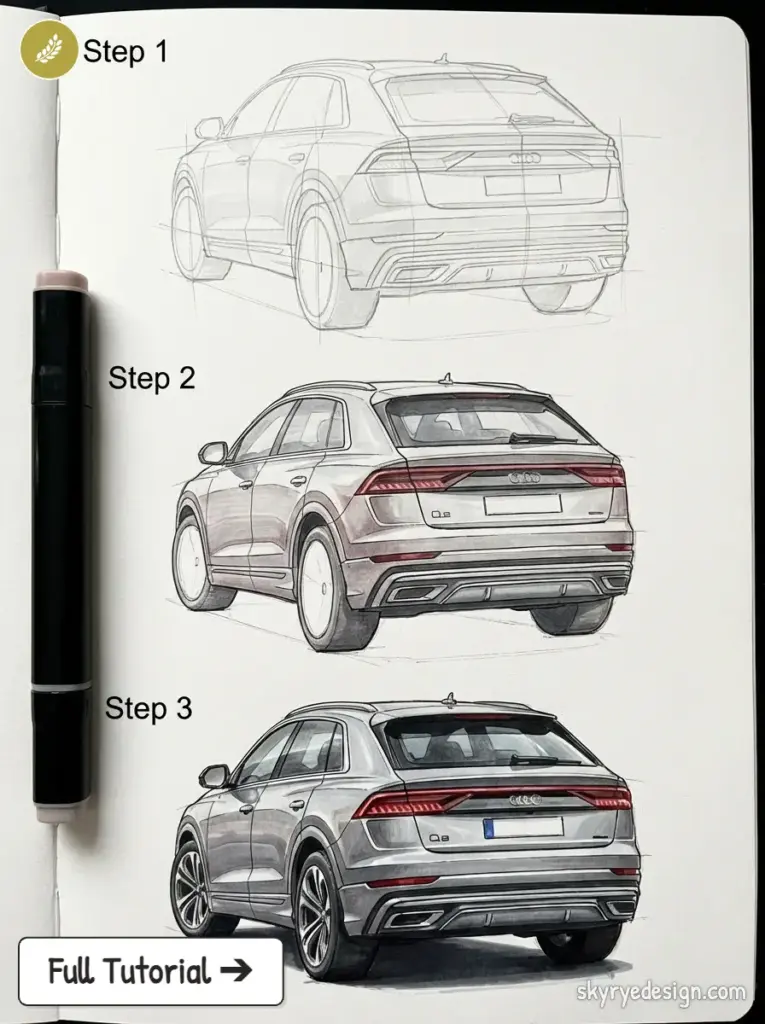
Drawing tip: Draw the Q8 front face before the side profile. The grille’s width relative to the total car width sets the visual character of the entire drawing. On the Q8, the grille should feel almost too wide — more dominant than any sedan Singleframe. This assertiveness is intentional and must be preserved in the drawing to capture the Q8’s specific character.
08 — Audi E-Tron GT (2021–present)
Difficulty: Advanced — low, wide electric GT proportions are the most demanding in the range
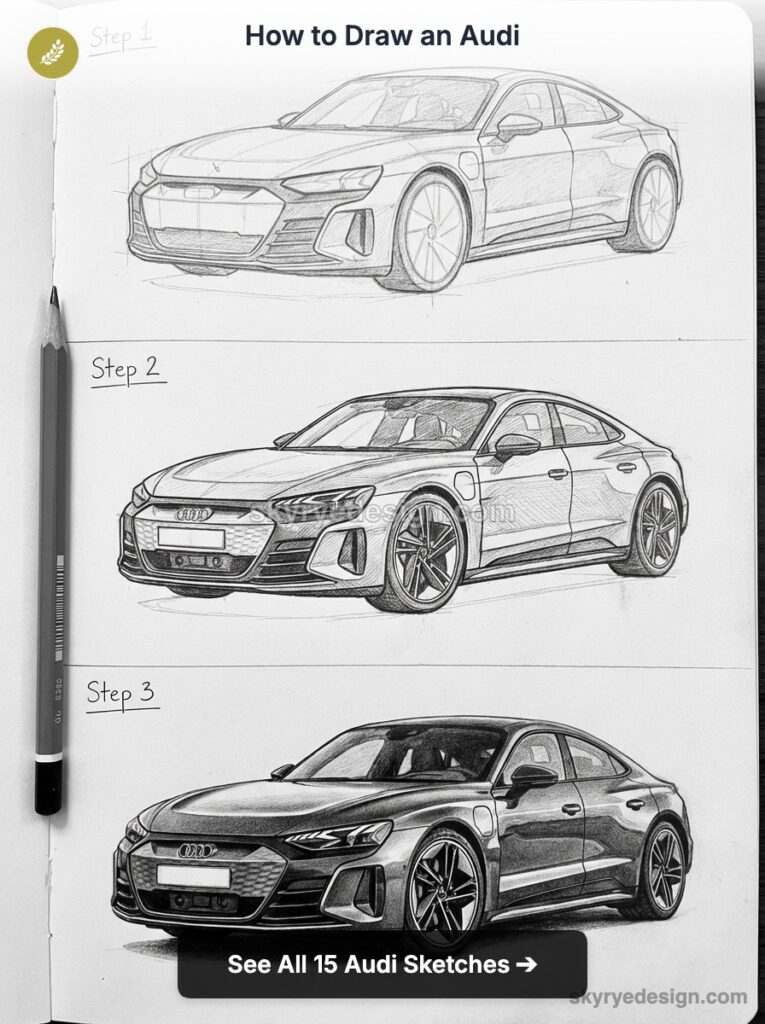
Design DNA: The E-Tron GT is Audi’s purest design statement — a fully electric gran turismo with the lowest roofline in the Audi range, an extremely wide stance, and surface sculpting that references the original quattro’s muscular fender treatment. The front face integrates the Singleframe as a nearly closed panel (referencing the lack of a conventional cooling grille) with horizontal light signatures running its full width.
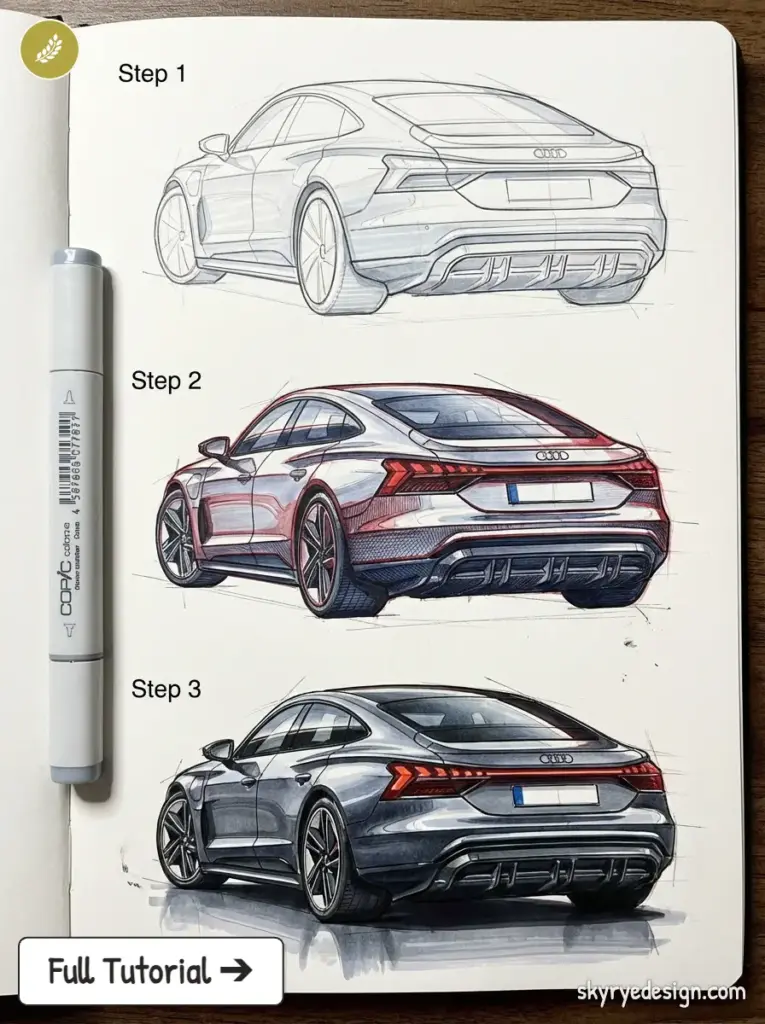
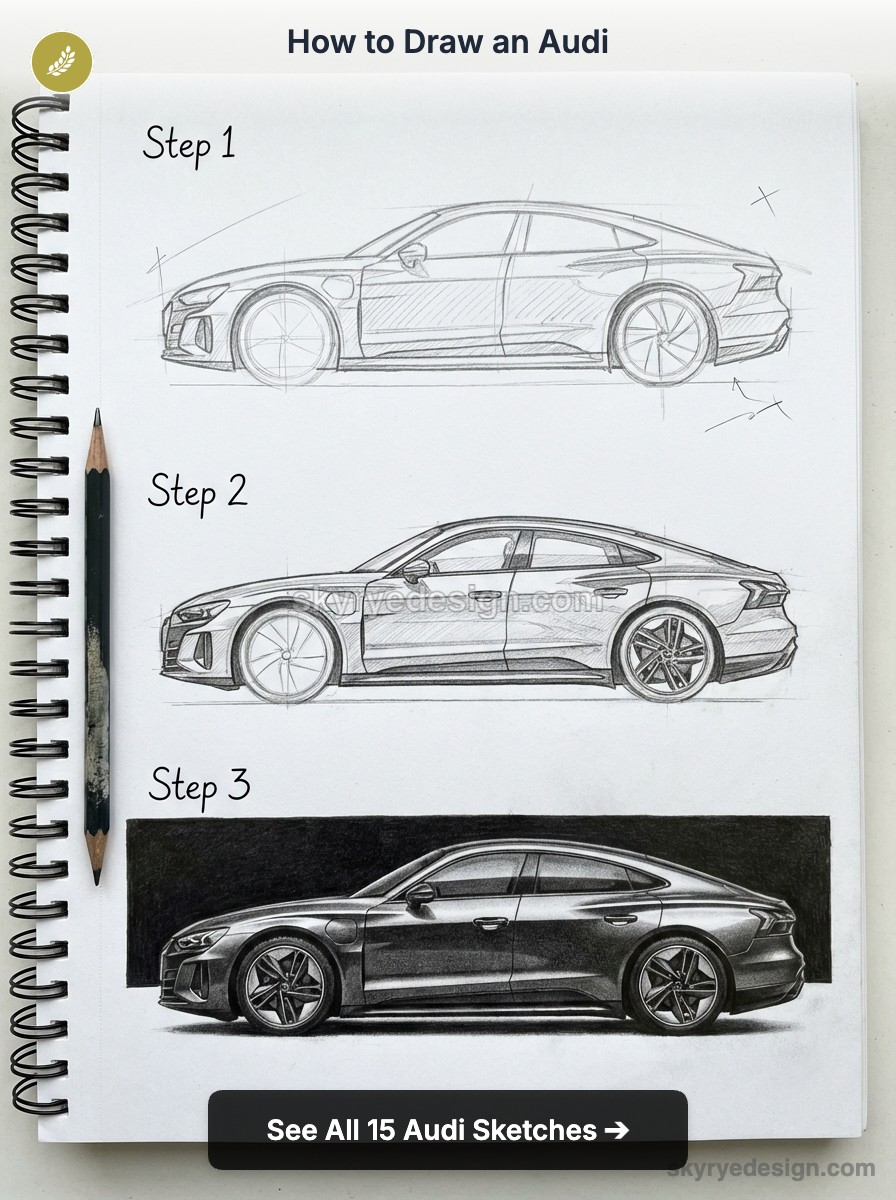
Drawing tip: The E-Tron GT’s roof height is lower than most sports cars — the greenhouse occupies only about 36% of total car height. If you draw the roofline at normal sedan height, the E-Tron GT looks like an ordinary saloon. Commit to the very low, flowing roofline early in construction: it should feel almost too low before it reads correctly as an E-Tron GT.
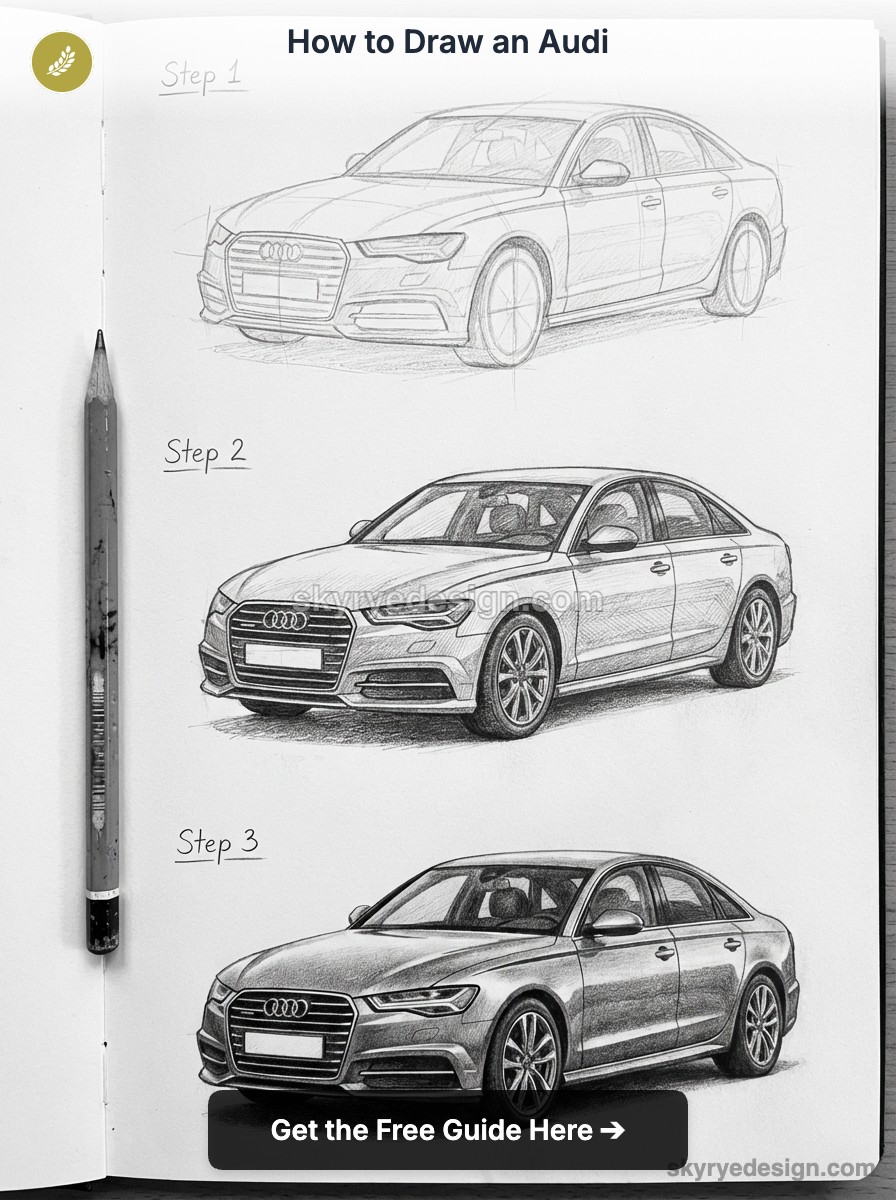
How to Draw an Audi: Step-by-Step Construction
This process uses the Audi A6 as the construction model — its proportions and character lines are clearly readable without the complexity of the R8 or the simplicity of the TT. The same sequence applies to every model with proportion adjustments.
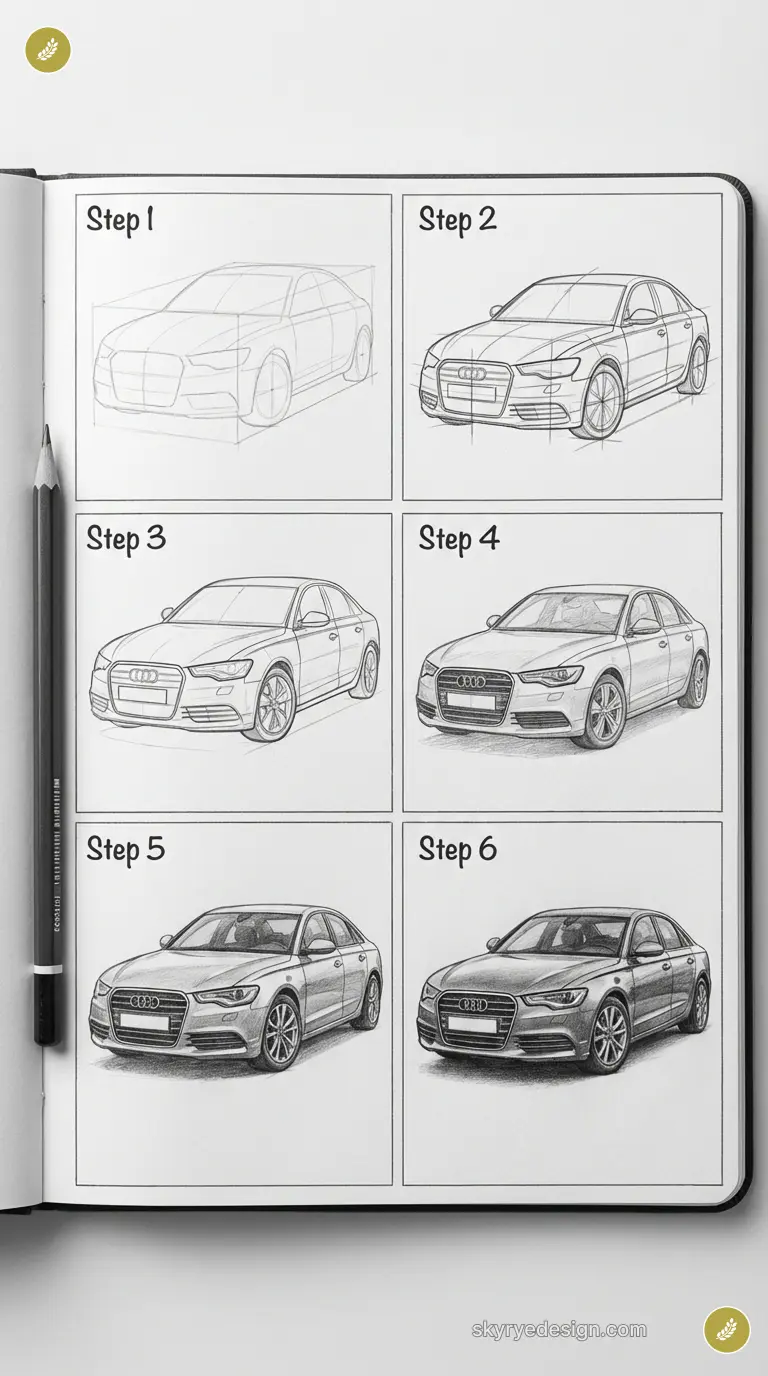
Step 1: Bounding Box and Proportion Markers
Draw a horizontal rectangle 2.4 times as wide as it is tall — this is your total Audi A6 envelope. Mark the vertical centre line. Mark 22% from the left (front wheel centre) and 76% from the left (rear wheel centre). Mark 52% from the left (roofline peak). Mark 65% of the height from the bottom (tornado line position). These five marks govern every subsequent decision.
Step 2: Wheel Circles and Ground Plane
Draw circles at your 22% and 76% marks. Wheel diameter on the A6 is approximately 28% of total car height — larger than most cars at this proportion. These circles establish the ground plane: the bottom of both circles sits on the same horizontal baseline. If the circles are different sizes or at different heights, all subsequent proportions will compound the error.
Step 3: Roofline and Greenhouse
From the 52% peak point, draw the roofline: steeply raked windscreen (approximately 55 degrees from vertical on the A6), a relatively flat roof section, then the fastback rear slope descending at approximately 25-30 degrees to the bootlid. The greenhouse occupies 42% of total car height — keep this compact, it’s one of Audi’s key visual signatures.
Step 4: Body Profile and Bonnet
Draw the body lower surfaces: a bonnet that rises very slightly from the front of the car toward the windscreen base (Audi bonnets have a subtle wedge quality — not flat), a sill line running nearly horizontally from the front arch base to the rear arch base, and the front and rear overhangs (approximately equal at 12-14% of total length each).
Step 5: The Singleframe Grille
On the front face (which rakes rearward slightly at the top — Audi fronts are not vertical), draw the hexagonal Singleframe: flat top edge at approximately 70% of bumper height, wider middle section, narrowing slightly at the bottom. The chrome surround extends downward and outward to connect with the lower front intake area. Draw the four Audi rings badge above the grille mesh, centred on the grille top edge.
Step 6: The Tornado Line — Critical
Draw a single line from the top edge of the front wheel arch, running to the rear of the car with a very slight upward angle (3-5 degrees). This line sits at 65-70% of door height — well above the visual midpoint of the door surface. Confirm by checking: the tornado line should be clearly in the upper third of the door area. This is the most important single mark in the drawing for establishing Audi identity.

Materials for Audi Sketching
- Pencils: Faber-Castell 9000 set (HB, 2B, 4B) — ~$15. HB for all construction lines and bounding box, 2B for confirmed body outline and tornado line, 4B for wheel arch interiors, window glass, and under-car shadow.
- Paper: Strathmore 300 Bristol smooth, 9×12 inch — ~$18. The smooth surface supports clean line erasure (essential for construction lines) and crisp ink work over pencil.
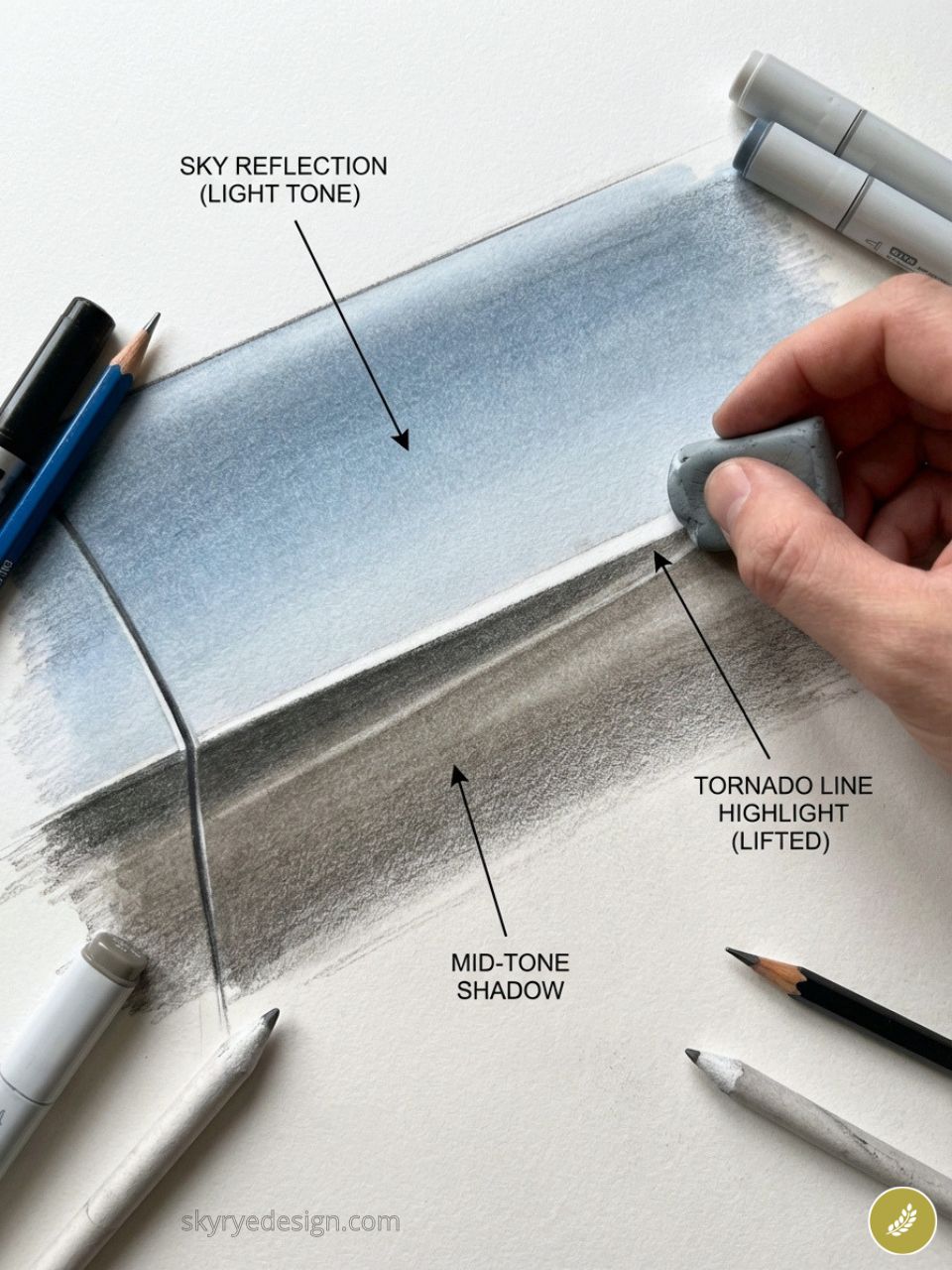
- Eraser: Faber-Castell kneaded eraser — ~$3. For construction line removal and for lifting the tornado line highlight after rendering. Shape to a thin edge for precise line lifting.
- Ink liners: Staedtler Pigment Liner 0.3mm for grille detail and interior lines; 0.5mm for body outline. The line weight difference — thinner interior detail, heavier outline — gives the drawing its graphic clarity.
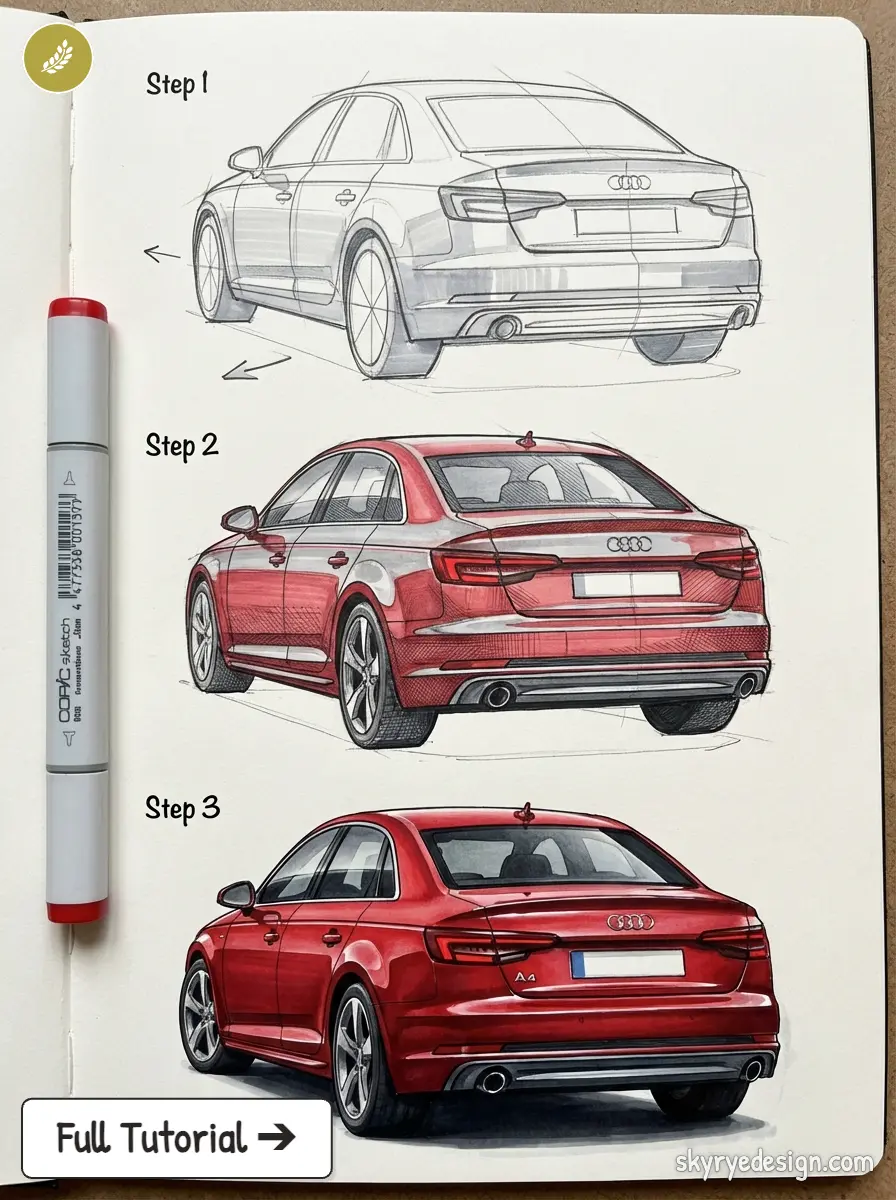
- Colour markers (optional): Prismacolor Cool Grey set (10%, 30%, 50%, 70%) for Floret Silver or Glacier White metallic. Copic B45 Smoky Blue for Navarra Blue. The four-grey cool set handles most Audi silver and grey body colours when layered with consistent directional strokes.
- Reference: Audi MediaCenter (media.audi.com) — official press photography with consistent studio lighting, available free at high resolution. Press photographs are taken at standardised distance and focal length that shows correct proportions; showroom photographs taken with wide-angle lenses distort proportions significantly.
FAQ: How to Draw an Audi
Q: How do you draw an Audi for beginners?
Start with the Audi A4 B9. Draw a bounding box 2.4:1. Mark wheel centres at 22% and 76% of length. The tornado line sits at 65-70% of door height — well above the midpoint. The Singleframe grille is a flattened hexagon with a chrome surround connecting to lower intakes. Get these three elements correct before any surface detail and the drawing reads as an Audi immediately.
Q: What makes Audi design distinctive to draw?
Three elements: the Singleframe grille (hexagonal, with chrome surround connecting to lower intakes), the tornado line (high-placed in the upper third of the door, with slight upward tension), and the quattro blisters (subtle muscular flares at the wheel arches). Missing the tornado line’s height is the single most common Audi drawing error.
Q: What is the best Audi model to draw first?
The Audi A4 B9 (2016-present). The clearest expression of current Audi design language — the Singleframe is well-defined, the tornado line is clearly readable, and the body surfaces are relatively smooth. The A4 teaches the Audi design grammar that transfers directly to A6, Q8, and R8 drawings.
Q: How do you draw the Audi Singleframe grille?
Draw a flattened hexagon — wider than tall, flat top edge, gently angled upper corners, slightly narrower at the bottom than the top. NOT a rectangle or oval. The chrome surround connects the grille to the lower bumper intakes as one continuous statement. The four Audi rings badge sits above the grille mesh at the top centre. Interior is vertical parallel slat lines (8-12 visible in three-quarter view).
Q: What pencils should I use for Audi car sketching?
HB for construction, 2B for confirmed body outline and tornado line, 4B for deepest shadows. Strathmore 300 Bristol smooth (~$18) for paper. Staedtler Pigment Liner 0.3mm for grille detail, 0.5mm for body outline. Kneaded eraser essential for lifting the tornado line highlight after rendering — the crisp highlight along the tornado line is the rendering detail that most convincingly suggests Audi’s metallic surface quality.
- 13shares
- Facebook0
- Pinterest13
- Twitter0
- Reddit0