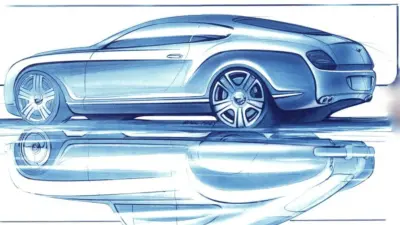
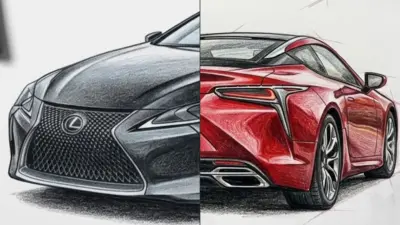
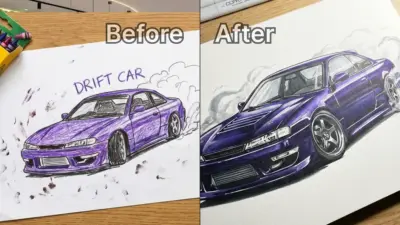
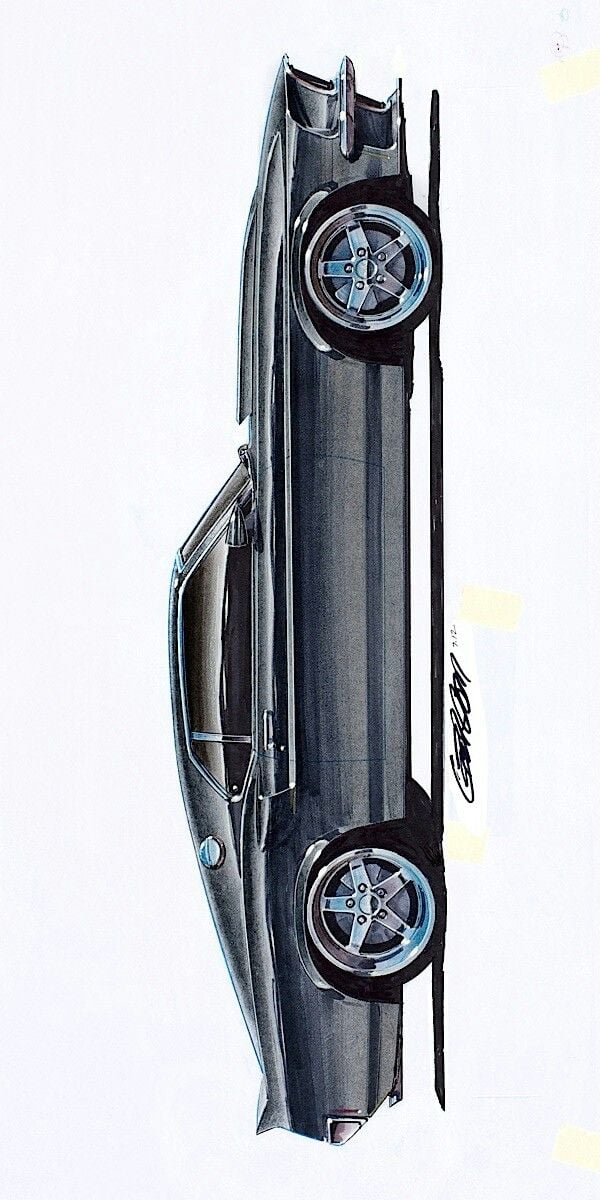
Ford Mustang drawing combines the thrill of automotive art with the challenge of capturing one of the most recognizable muscle car designs in the world. Whether you’re sketching the sweeping curves of a classic Mustang from the 1960s or rendering the aggressive stance of a modern GT, this guide provides the foundational techniques every artist needs to create compelling Ford illustrations.
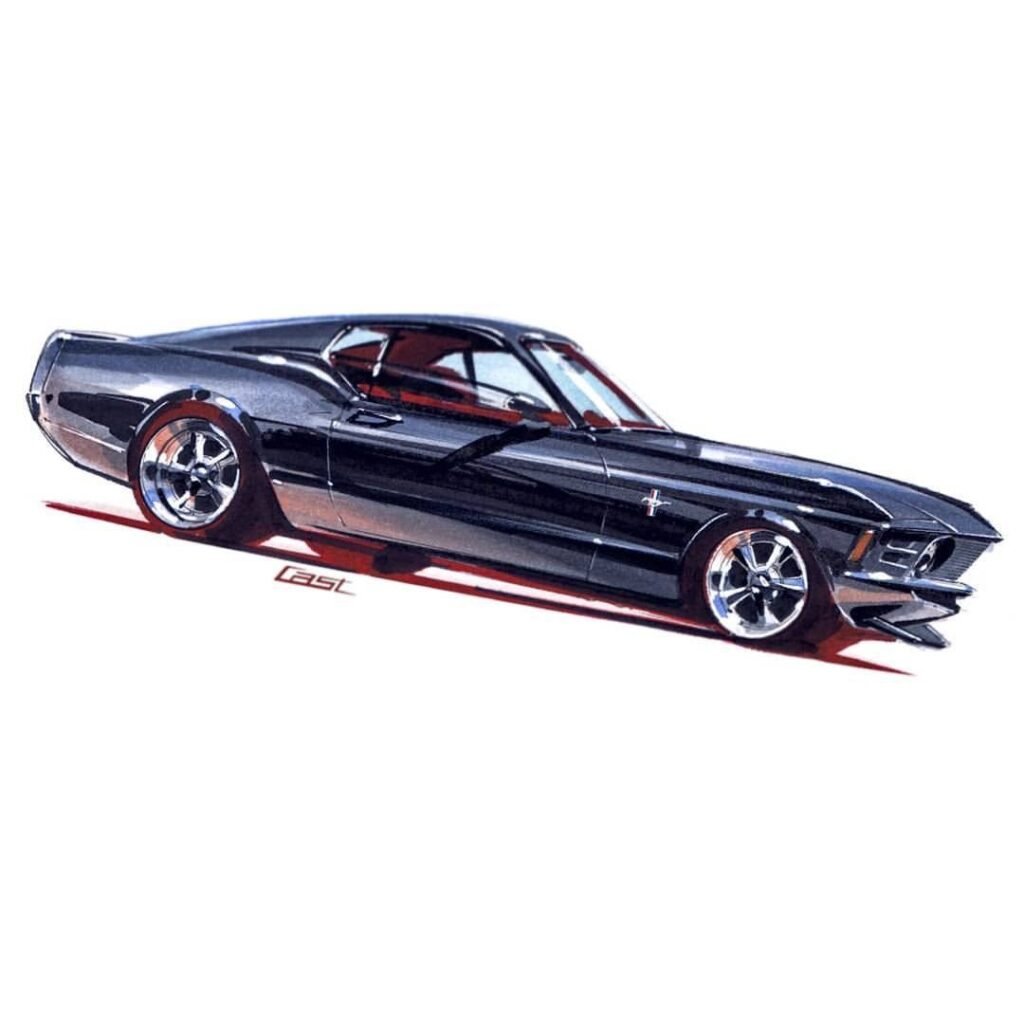
This comprehensive guide covers everything from basic proportions and sketching fundamentals to advanced rendering techniques for both classic car and contemporary Mustang designs. We focus on pencil and paper methods suitable for traditional drawing—digital painting and professional automotive design workflows fall outside this scope. If you’re a beginner to intermediate artist, car enthusiast looking to capture your favorite muscle car on paper, or an art student exploring automotive illustration, you’ll find actionable techniques tailored to your skill level.
Ford Mustang drawing involves translating the iconic long hood, short deck proportions and distinctive design elements of this legendary pony car into two-dimensional art. The Mustang’s bold lines and instantly recognizable silhouette make it both an exciting subject and an excellent teaching vehicle for mastering automotive illustration fundamentals.
By following this guide, you will:
- Master the essential proportions that define the Mustang’s unmistakable silhouette
- Learn generation-specific details from 1964 classics to current models
- Develop systematic drawing procedures that produce consistent results
- Overcome common challenges with wheels, perspective, and reflective surfaces
- Build a foundation for continued development in automotive art
Understanding Ford Mustang Drawing Fundamentals
Automotive illustration is the art of translating three-dimensional vehicle forms onto a flat surface while preserving their dynamic presence and unique character. When drawing cars, particularly muscle car subjects like the Ford Mustang, understanding the interplay between structural accuracy and stylistic expression determines whether your work captures the vehicle’s spirit or falls flat.
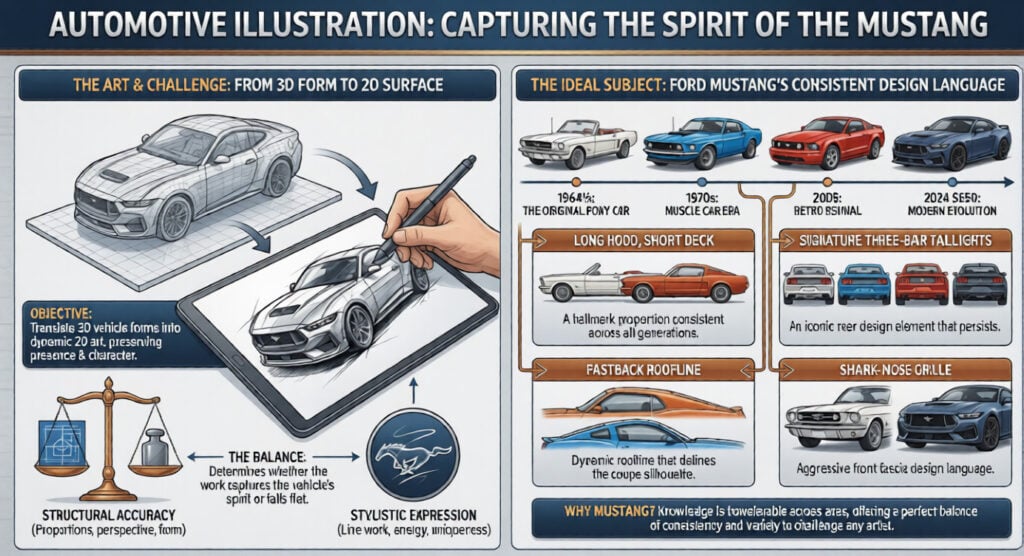
The Mustang stands as an ideal subject for learning car drawing techniques because its design language has remained remarkably consistent across six decades. From the original 1964½ production model to today’s S650 platform, certain proportional relationships and design elements persist, making knowledge transferable across eras while offering enough variety to challenge any artist.
Essential Proportions and Structure
The Ford Mustang’s distinctive proportions follow what designers call the “long hood, short deck” formula—a configuration that became the defining characteristic of the entire pony car segment. This proportion creates visual power by suggesting a large engine compartment and athletic rear stance, conveying speed even when the car sits stationary.
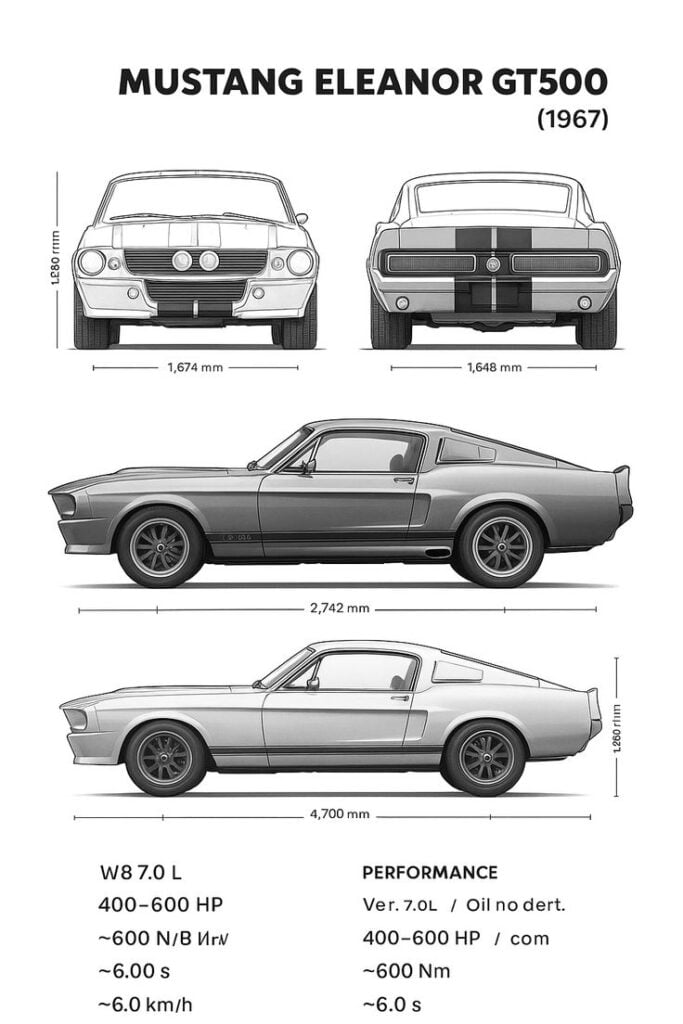
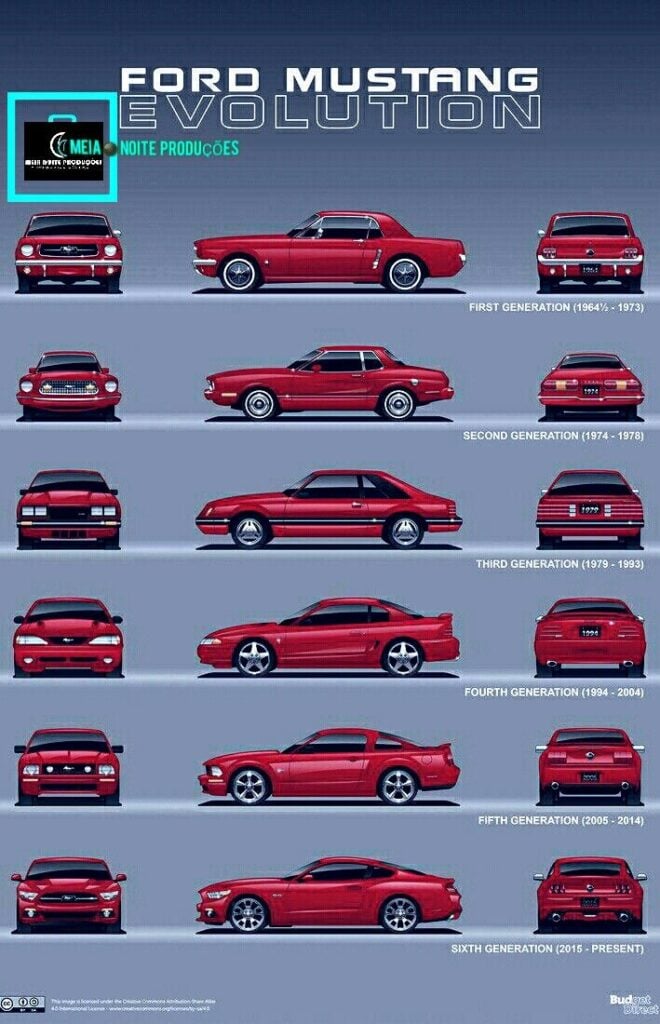
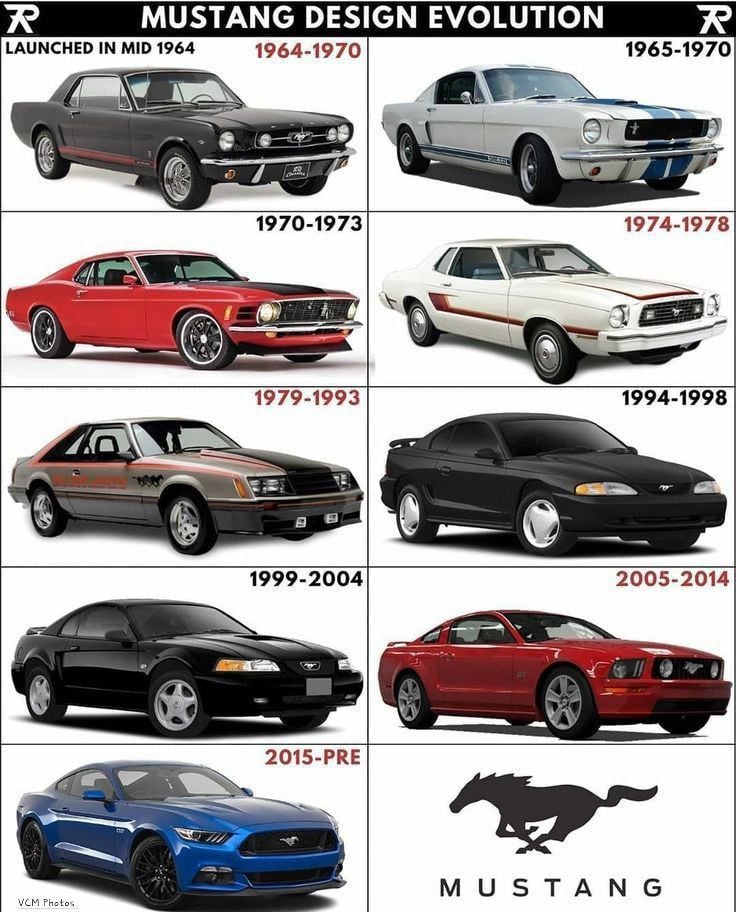
When approaching your Mustang drawing, establish this fundamental relationship first: the hood typically occupies roughly 40% of the vehicle’s total length, with the passenger compartment and trunk sharing the remainder. Getting this proportion correct is crucial because it creates the recognizable Mustang silhouette that viewers identify in a moment, even without seeing specific details.
Iconic Design Elements
Beyond overall proportions, specific design features define the Mustang’s identity across generations. The signature tri-bar taillights, aggressive front grille with the running horse emblem, sculpted body-side “hockey stick” indentations, and muscular fender bulges all contribute to the unique visual language you’ll need to capture.
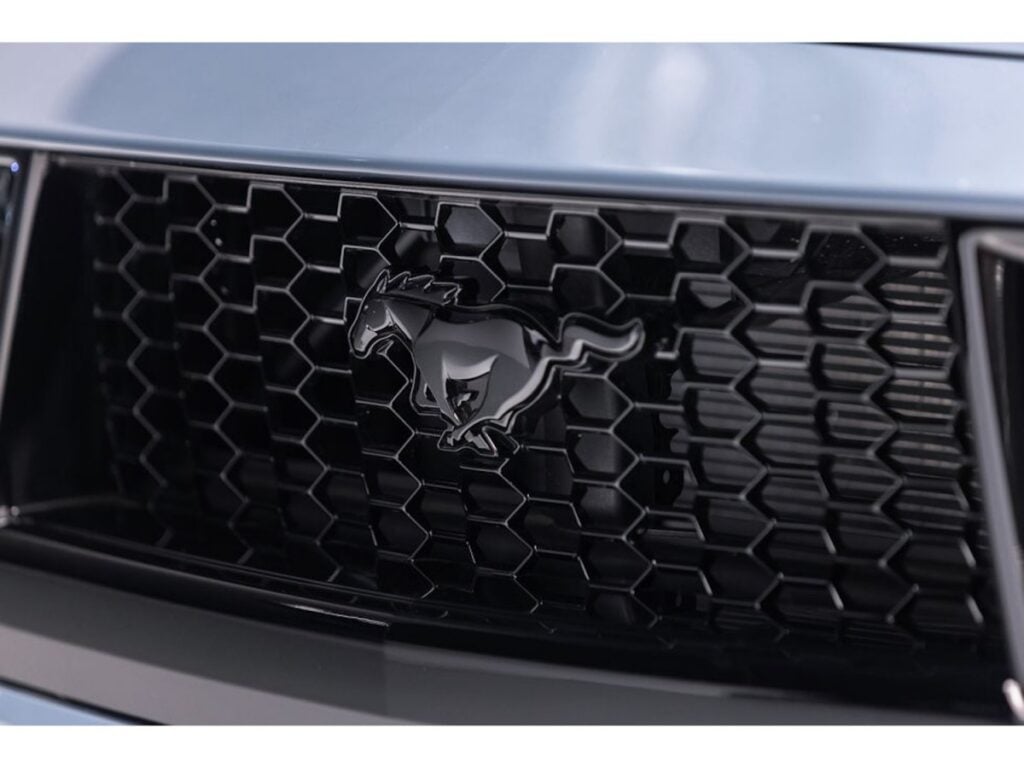
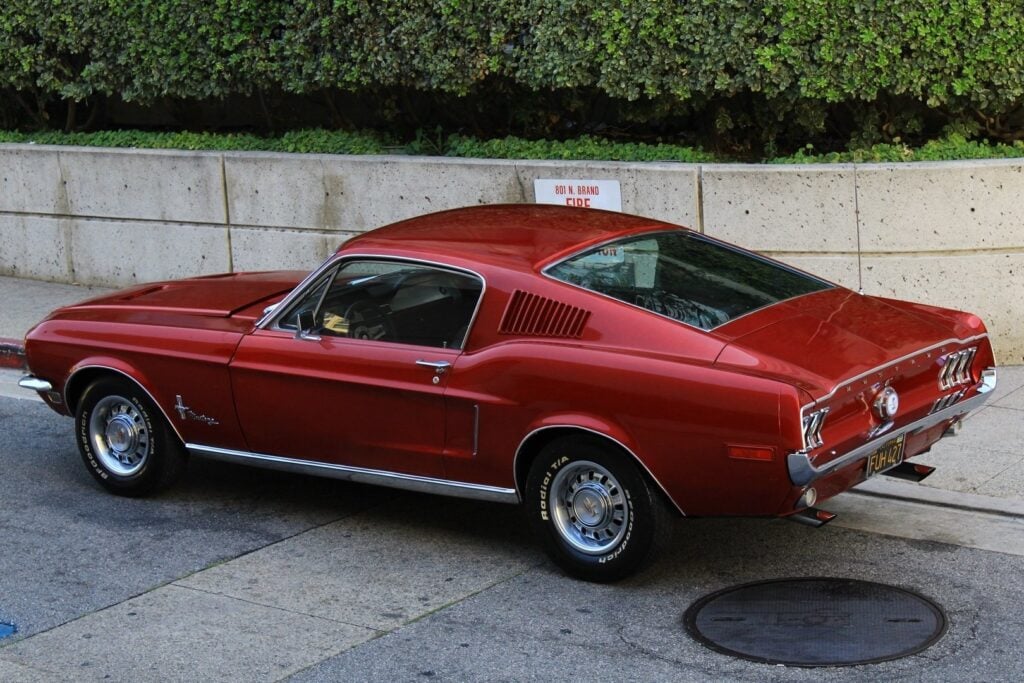
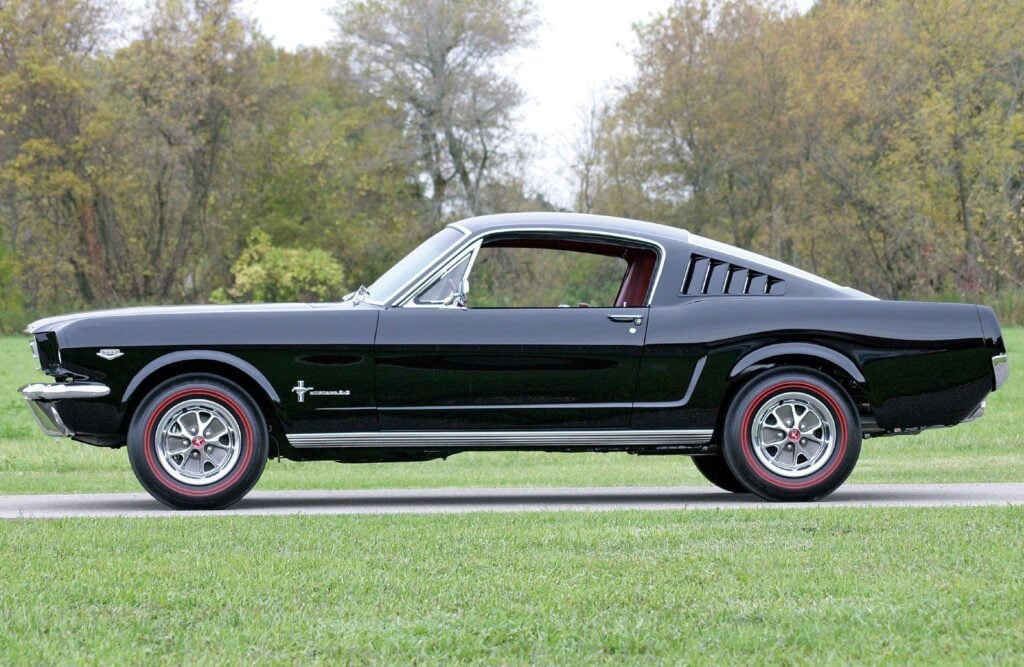
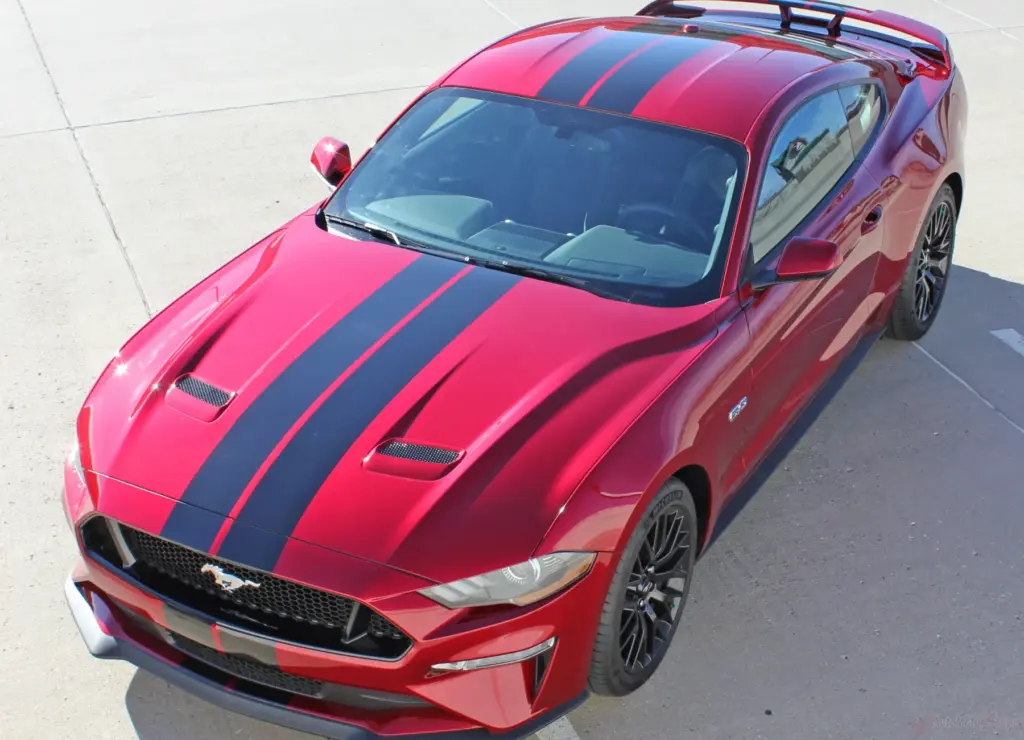
These details connect directly to structural accuracy—the grille sits within the hood’s forward sweep, headlight shapes follow the fender contours, and body lines flow from front wheels to rear quarters in carefully designed curves. Understanding these relationships helps you add convincing details that integrate naturally with your foundational sketch.
With proportions and key features understood, you’re ready to explore how these elements vary across different Mustang generations, each presenting distinct drawing challenges and opportunities.
Drawing Techniques for Different Mustang Generations
Building on the fundamentals of Mustang proportions and design elements, each generation presents unique characteristics that require adapted drawing approaches. The evolution from chrome-laden classics to modern aerodynamic muscle cars means your technique must shift accordingly.
Classic 1960s Mustang Drawing
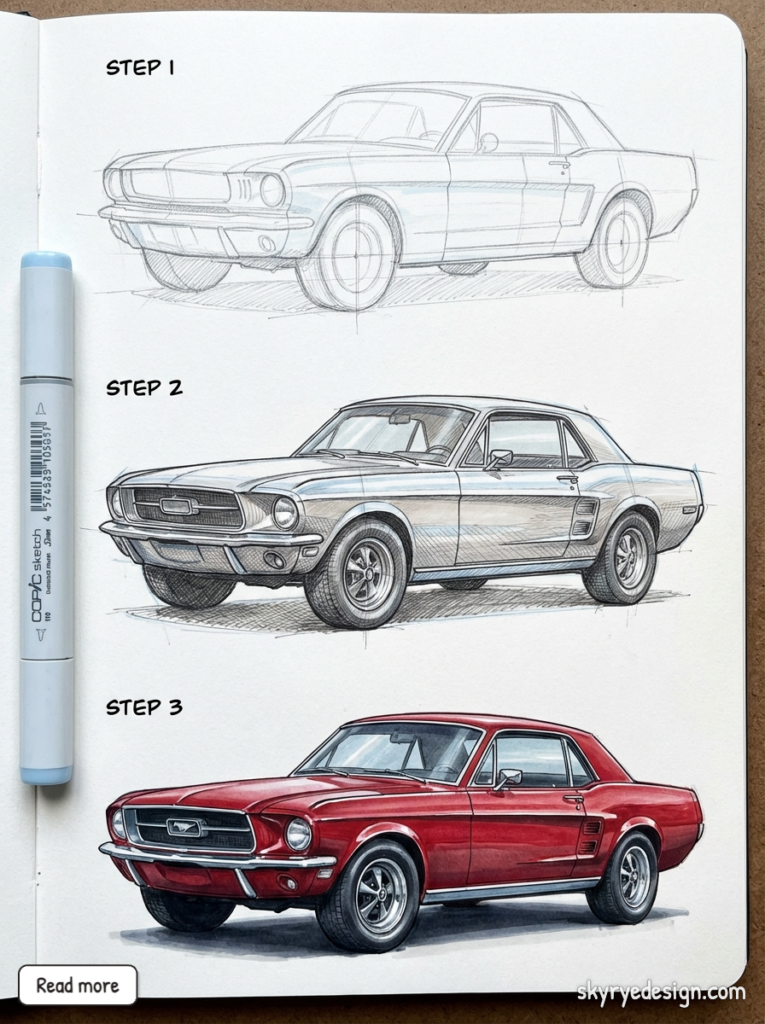
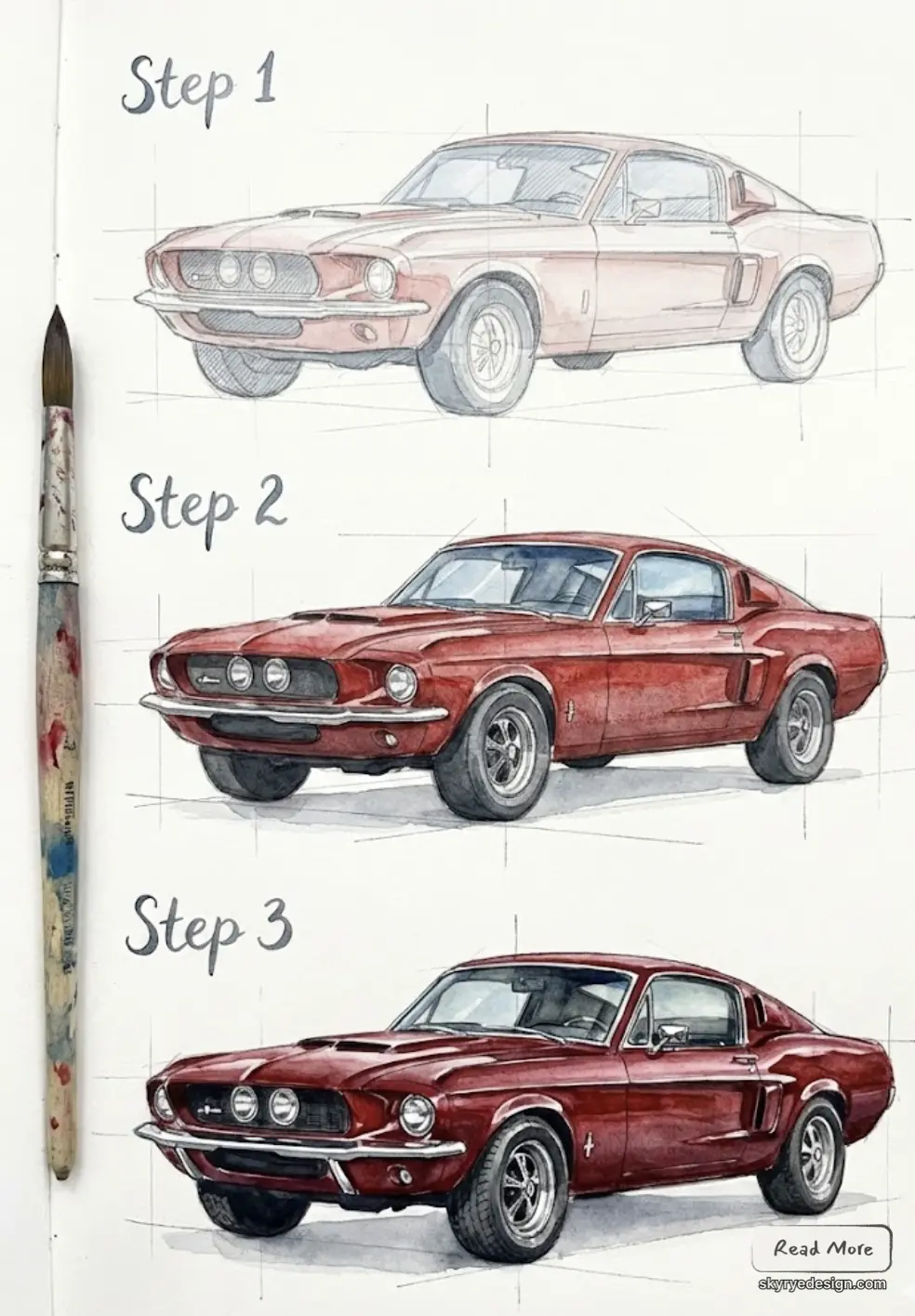
The classic Mustang from 1964-1970 features softer curves, prominent chrome trim, and more upright glass angles compared to modern interpretations. When drawing these vintage cars, pay special attention to the delicate brightwork surrounding windows and grilles—these reflective details demand careful hatching to suggest their metallic quality.
The original models sat higher with smaller wheels relative to body size, creating a lighter, more nimble appearance than the aggressive stance of later muscle car variants.
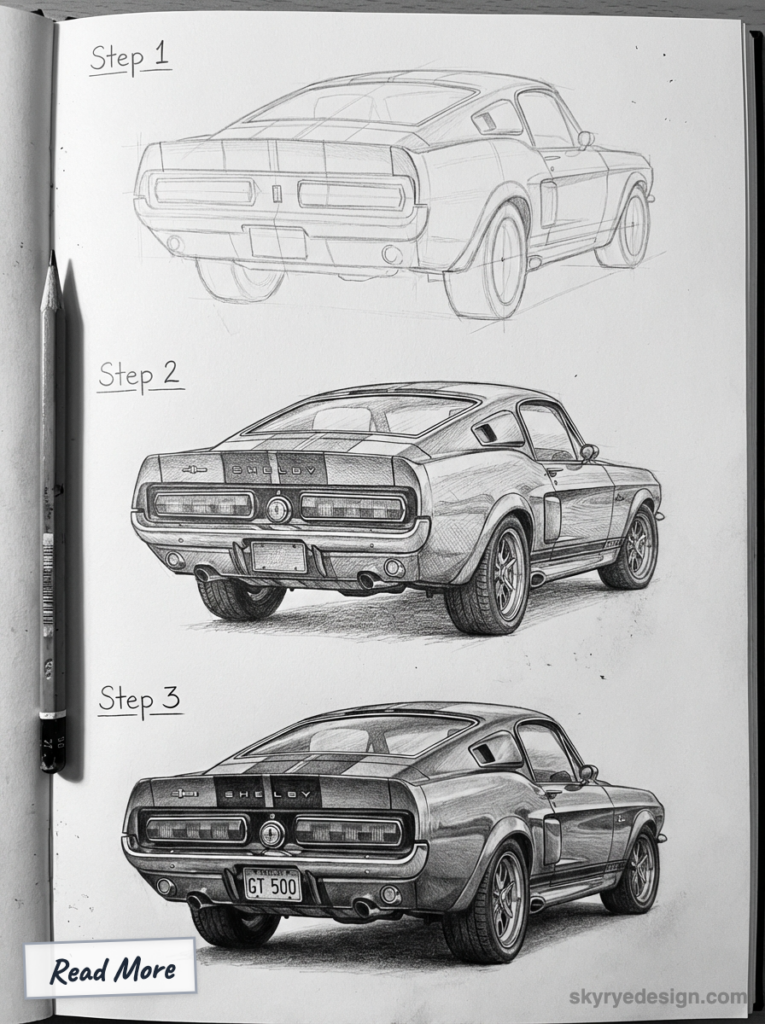
Modern Mustang Interpretation
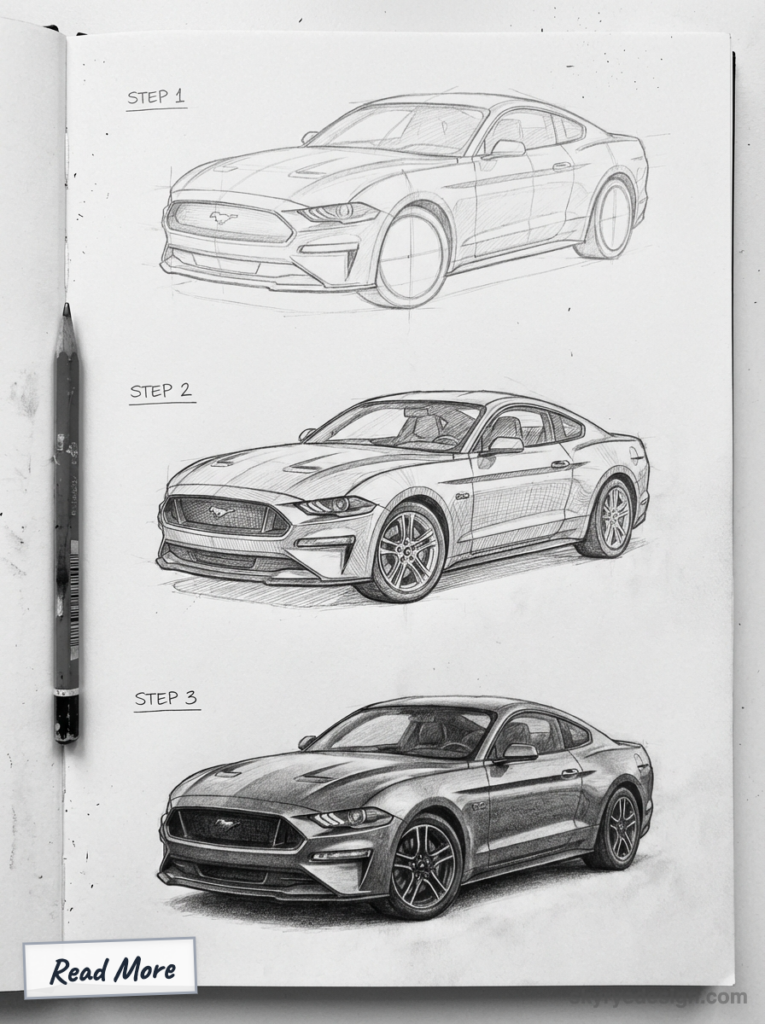
Contemporary Mustangs feature dramatically lower beltlines, larger wheels filling muscular fender openings, and sharply creased body panels that catch light differently than classic car surfaces. Your drawing approach should emphasize these hard edges through confident line weight variation rather than the gradual transitions appropriate for 1960s models. The modern Ford maintains design DNA from its predecessors while incorporating aerodynamic elements that create new shadow patterns across the hood and body sides.
Stylized vs. Realistic Approaches
Artists working with Mustang subjects can follow two primary paths: stylized illustration that emphasizes the car’s personality through exaggerated proportions, or photorealistic rendering that captures every detail precisely. Stylized art often enlarges wheels, lowers the body, and emphasizes aggressive lines to heighten the muscle car attitude.
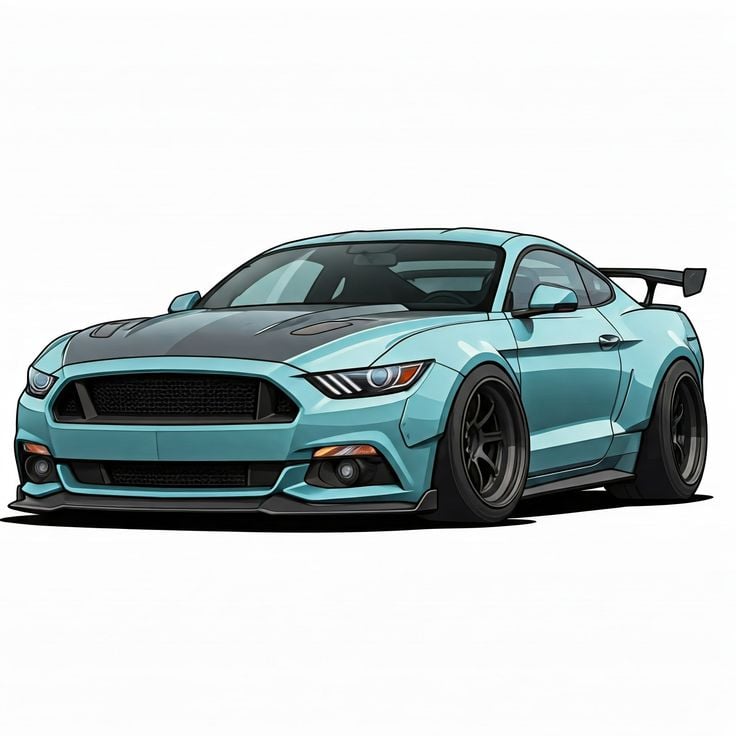
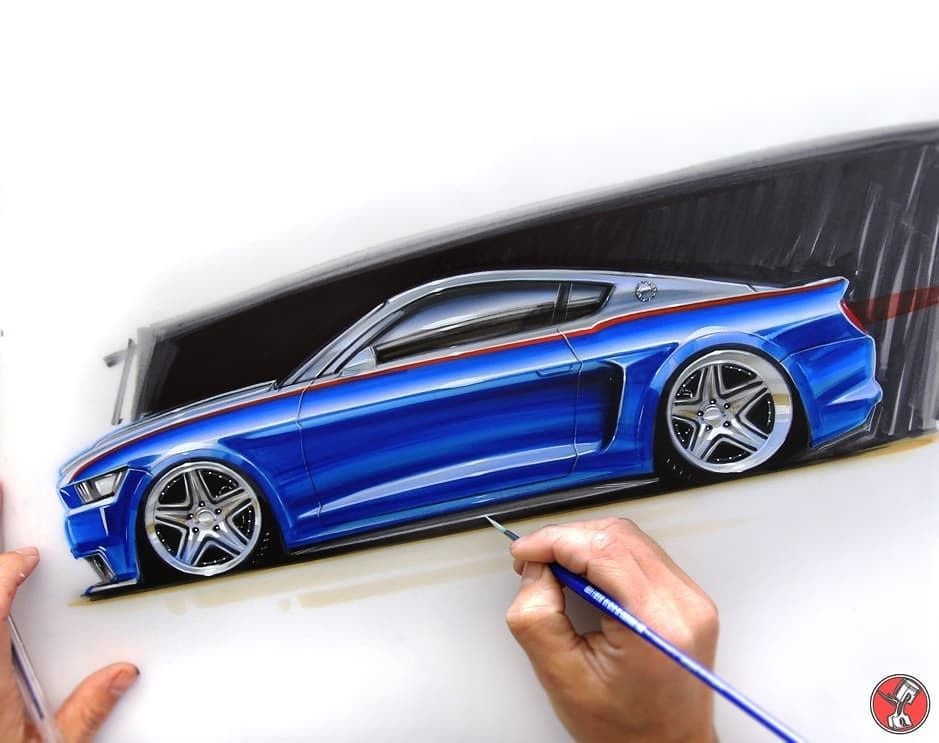
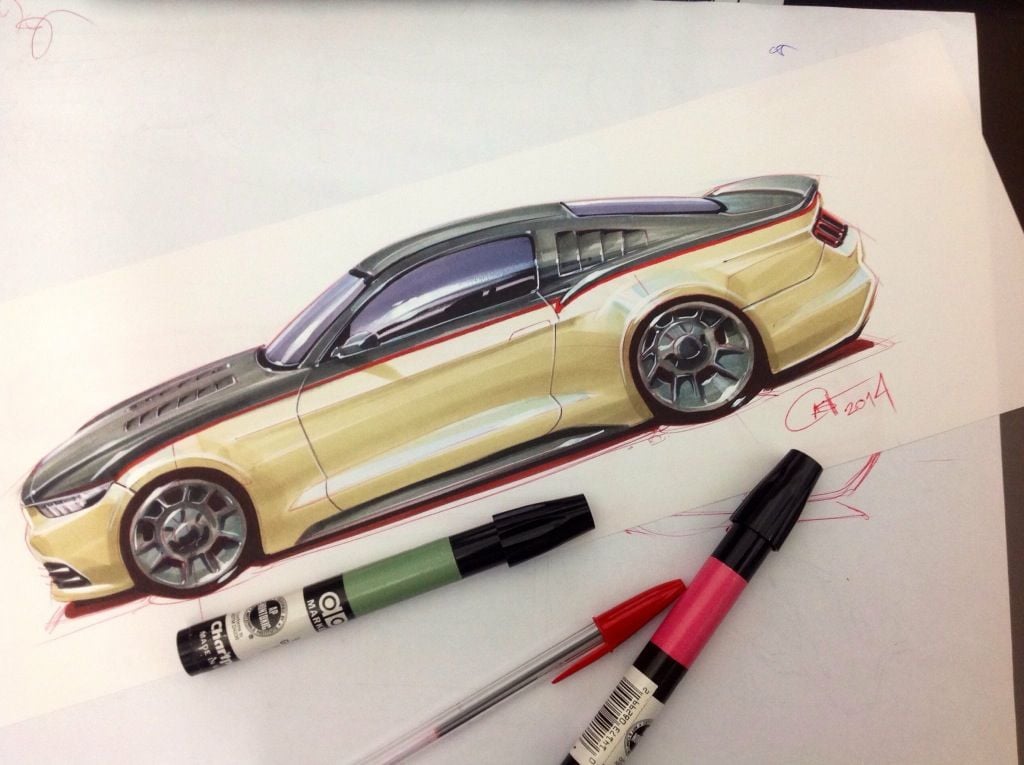
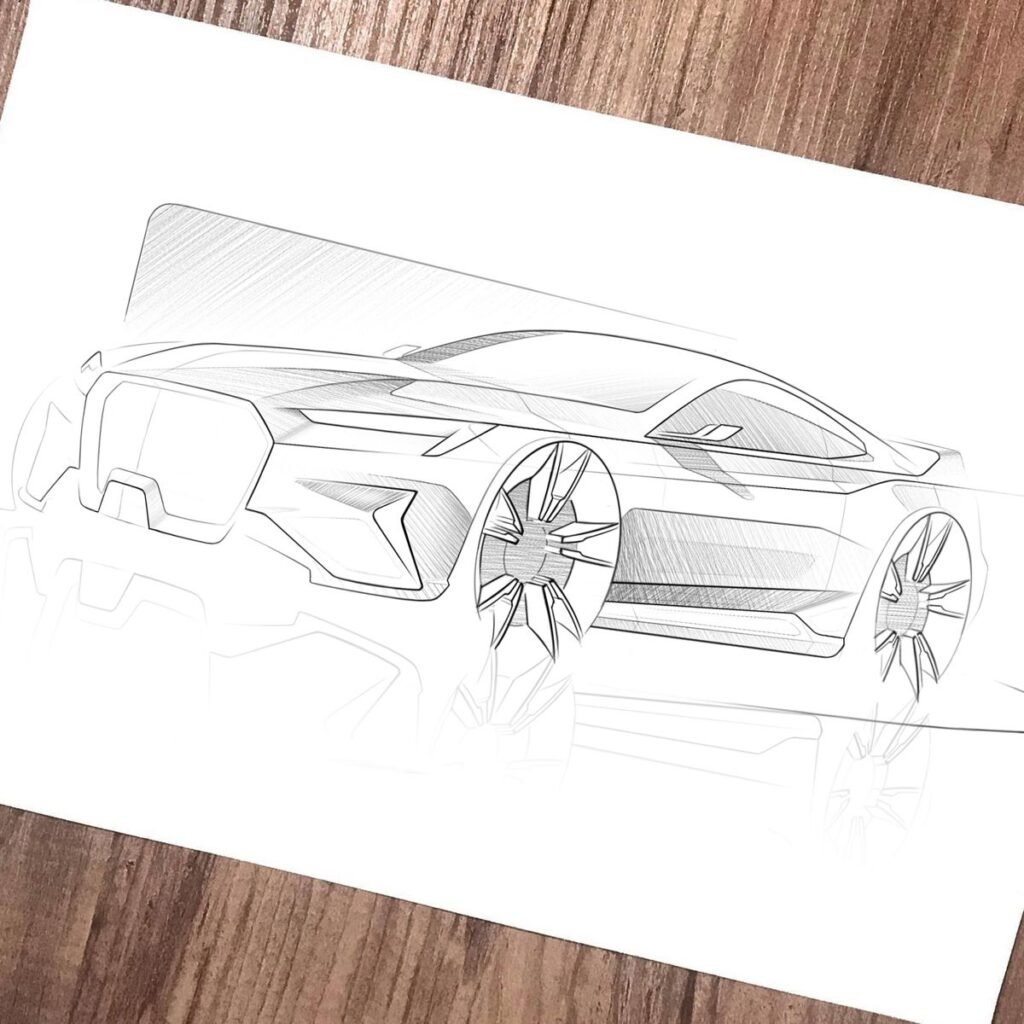
Realistic approaches demand careful attention to accurate perspective, surface reflections, and proportional fidelity. Both methods share the same foundational requirements—understanding the vehicle’s essential character—but diverge in execution.
These generation-specific considerations prepare you for the systematic drawing process that transforms blank paper into a complete Mustang illustration.
Step-by-Step Ford Mustang Drawing Process
With technique fundamentals established for various Mustang generations, applying a systematic procedure ensures consistent results regardless of which era you’re illustrating. This methodical approach builds your drawing in logical stages, preventing common errors that occur when artists jump directly to details.
Complete Drawing Procedure
This step-by-step method works for any Mustang from the original pony car to current models. Use this sequence whenever you begin a new automotive illustration:
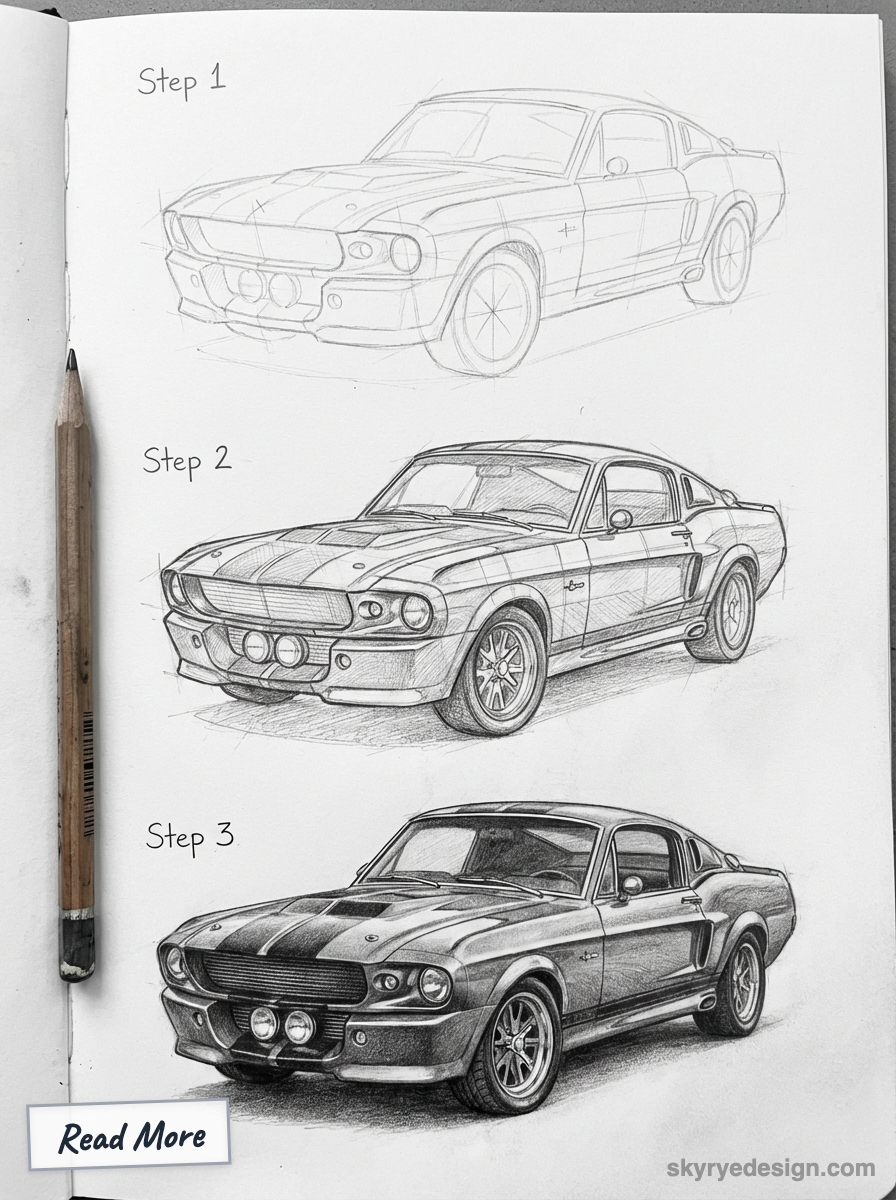
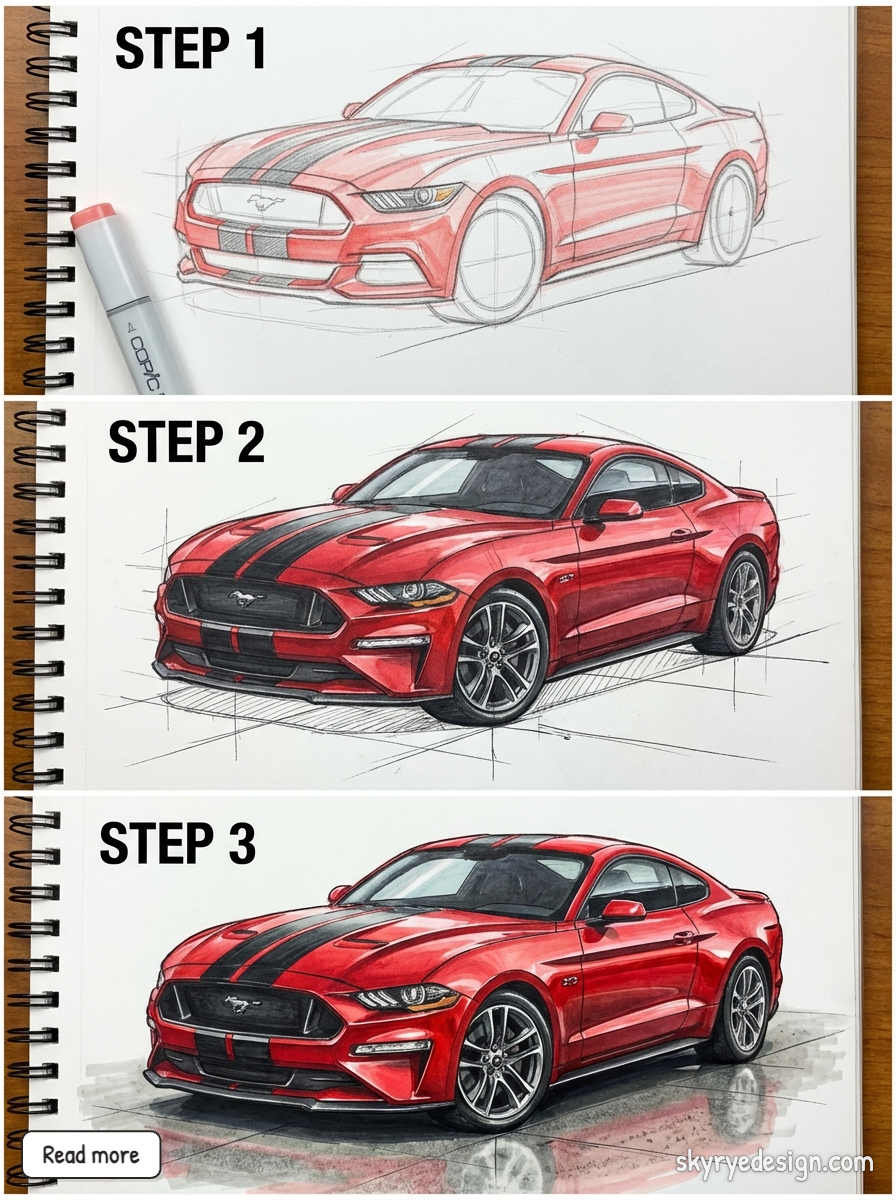
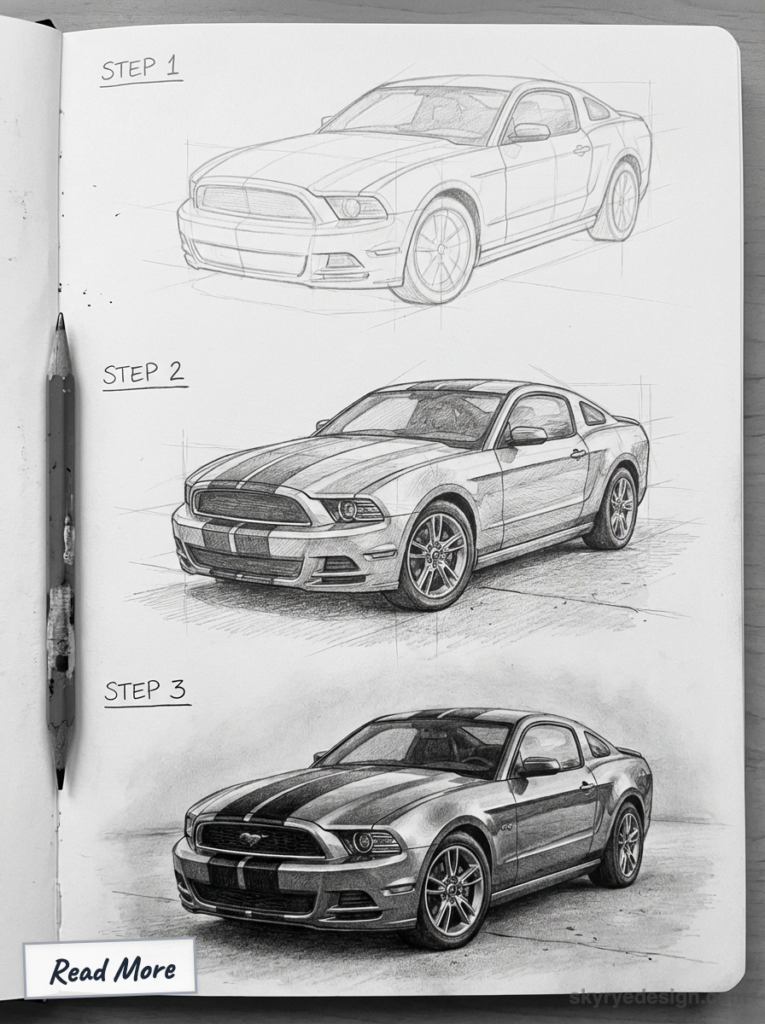
Step 1: Basic Construction
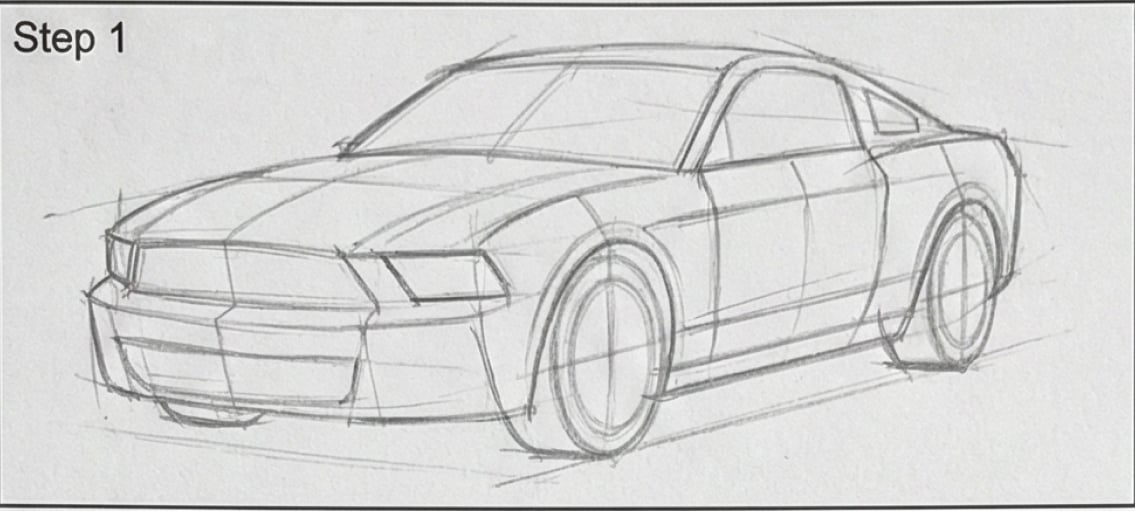
Block in the overall shape using light construction lines. Establish the perspective with a horizon line, then sketch the main volumes: the cabin, hood, and wheel arches. Keep everything loose—these are guides, not final lines.
Step 2: Refine the Silhouette
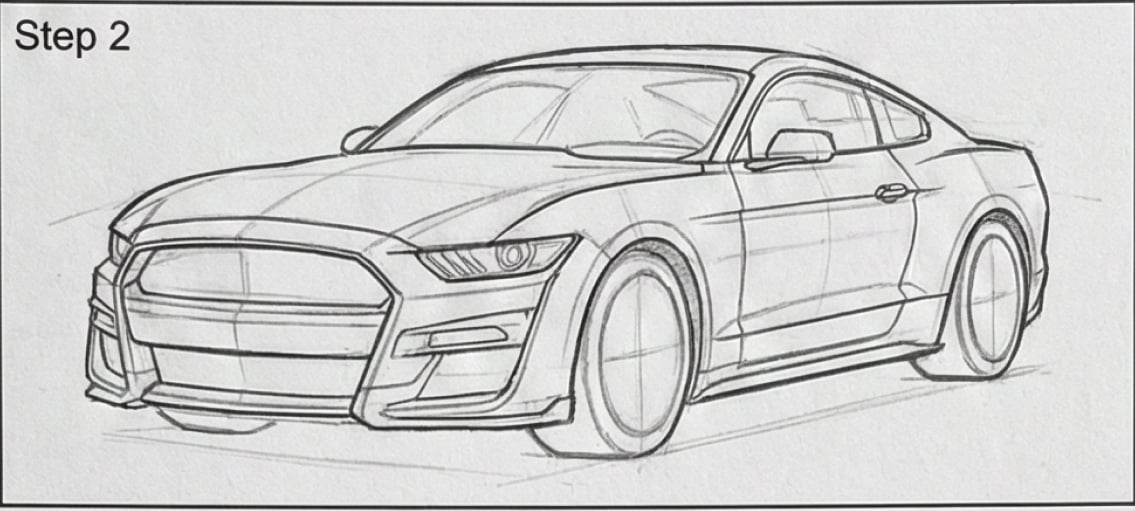
Define the body panels and clean up the outline. Add the wheels as ellipses, sketch the headlights, grille opening, and window frames. The Shelby’s aggressive stance starts to emerge here.
Step 3: Details and Character Lines
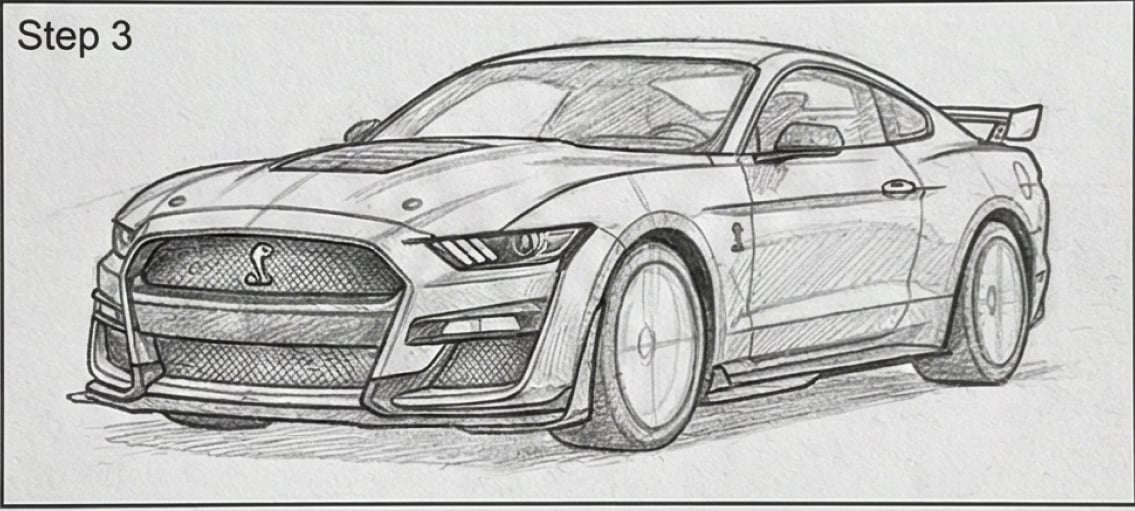
Add the signature elements: Cobra badge, hood vents, side stripes, GT500 grille mesh, and headlight internals. Start introducing light shading to separate surfaces. Define the wheel spokes.
Step 4: Value Building
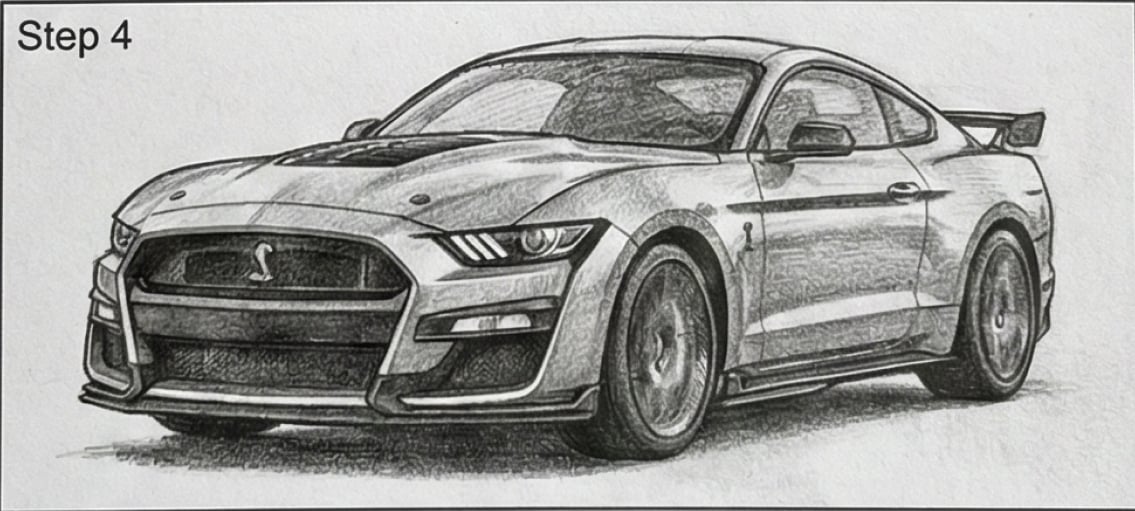
Establish the full value range. Darken the grille, wheel wells, and shadow areas under the body. Add mid-tones to the body panels following the surface direction. The car begins to look three-dimensional.
Step 5: Final Rendering
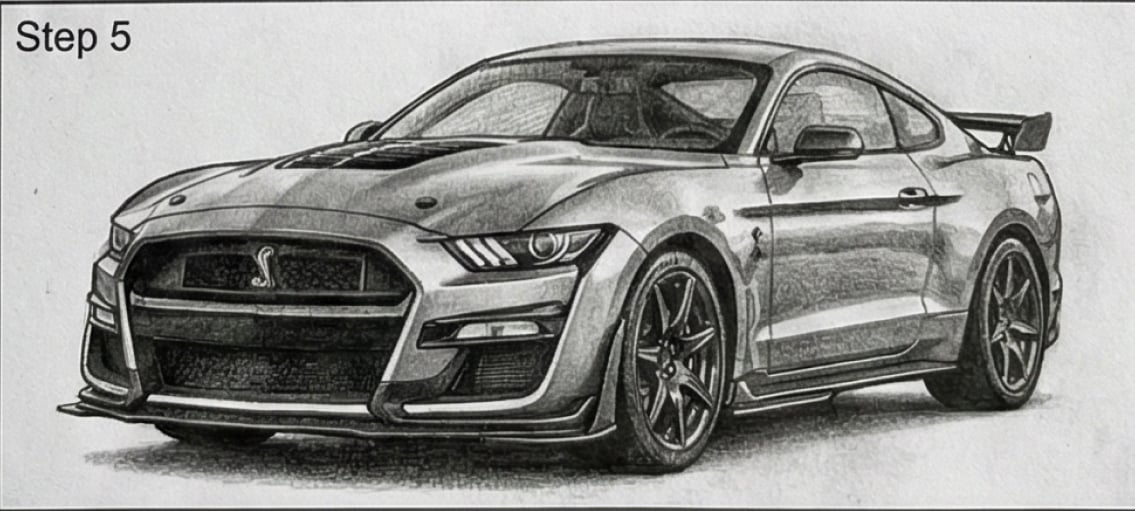
Push the contrast and refine details. Smooth the gradients on body panels, add reflected light in shadow areas, sharpen highlights on edges and chrome. Ground shadow anchors the car. Done.
Drawing Tools and Materials Comparison
Selecting appropriate tools significantly impacts your final results. This comparison helps you match materials to your skill level and intended outcome:
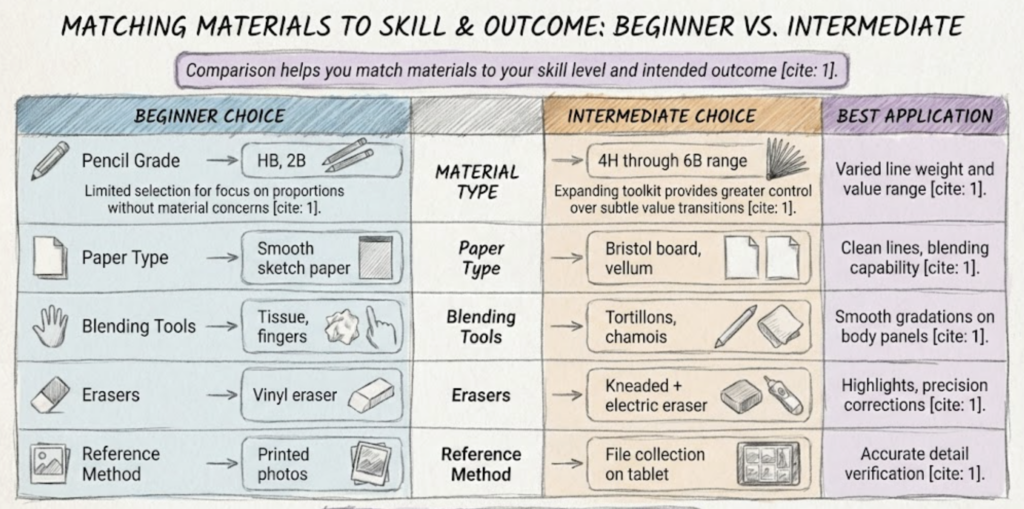
| Material Type | Beginner Choice | Intermediate Choice | Best Application |
|---|---|---|---|
| Pencil Grade | HB, 2B | 4H through 6B range | Varied line weight and value range |
| Paper Type | Smooth sketch paper | Bristol board, vellum | Clean lines, blending capability |
| Blending Tools | Tissue, fingers | Tortillons, chamois | Smooth gradations on body panels |
| Erasers | Vinyl eraser | Kneaded + electric eraser | Highlights, precision corrections |
| Reference Method | Printed photos | File collection on tablet | Accurate detail verification |
For beginners, starting with a limited pencil selection on affordable paper allows focus on proportions without material concerns. As skills develop, expanding your toolkit provides greater control over the subtle value transitions that make muscle car drawings convincing.
Understanding these tools and methods prepares you to address the specific challenges that arise when drawing complex automotive subjects.
Common Drawing Challenges and Solutions
Even experienced artists encounter difficulties when drawing the Ford Mustang’s complex forms. These solutions address the most frequent problems, helping you achieve professional results without frustration.
Perspective and Foreshortening Issues
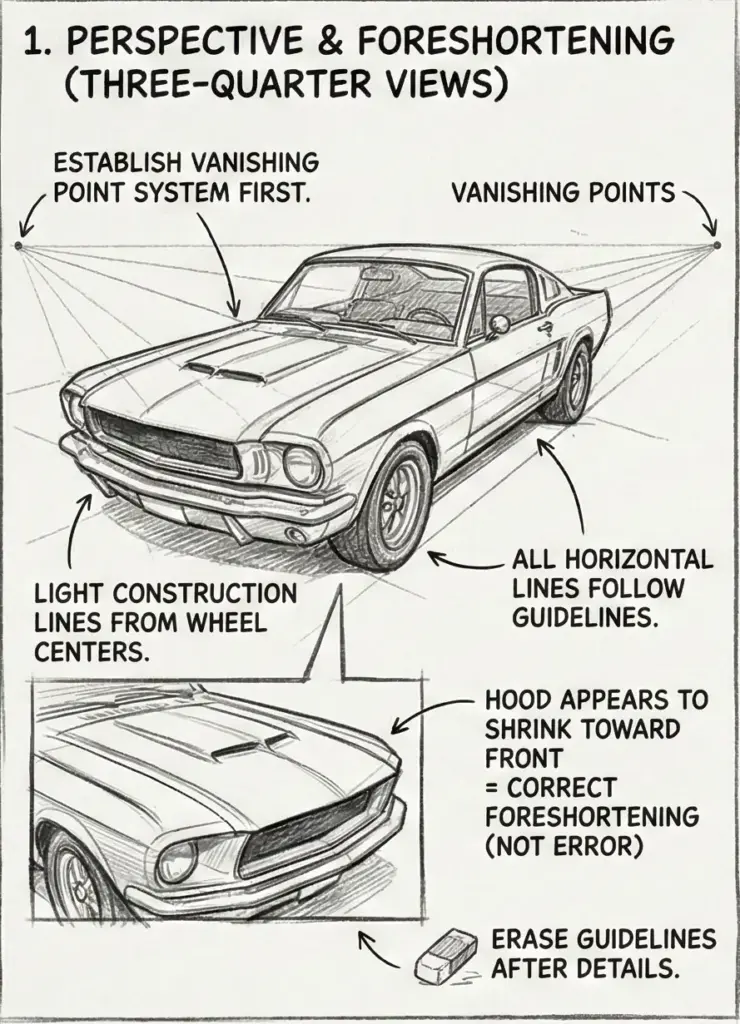
Three-quarter views—the most dynamic angle for automotive art—create foreshortening that distorts visible proportions. Solve this by establishing a proper vanishing point system before drawing any details. Use light construction lines extending from both front and rear wheel centers toward your vanishing points. All horizontal body lines should follow these guidelines. When the hood appears to shrink toward the front, you’ve achieved correct foreshortening rather than making a proportional error.
Wheel and Tire Proportions
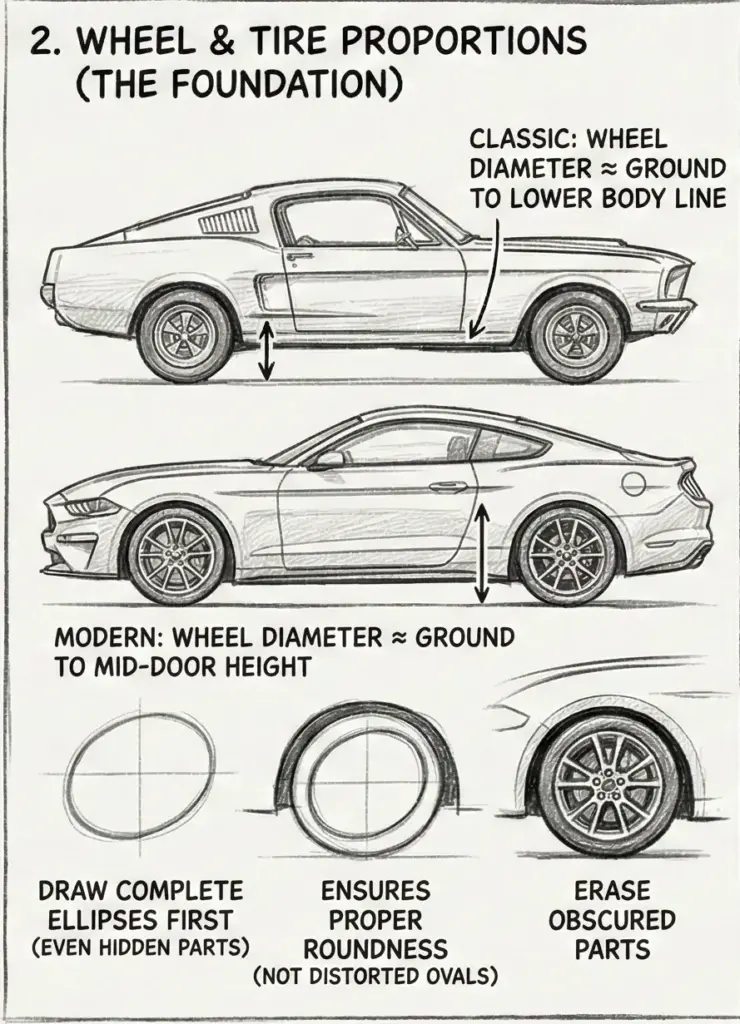
Wheels are often drawn too small or positioned incorrectly within wheel wells. The solution: on classic Mustangs, wheel diameter typically equals the distance from ground to the lower body line; on modern cars, this increases to nearly mid-door height. Draw wheels as complete ellipses first (even the hidden portions), then erase what’s obscured by fenders. This ensures proper roundness—a common failure point where wheels become distorted ovals.
Body Panel Curves and Reflections
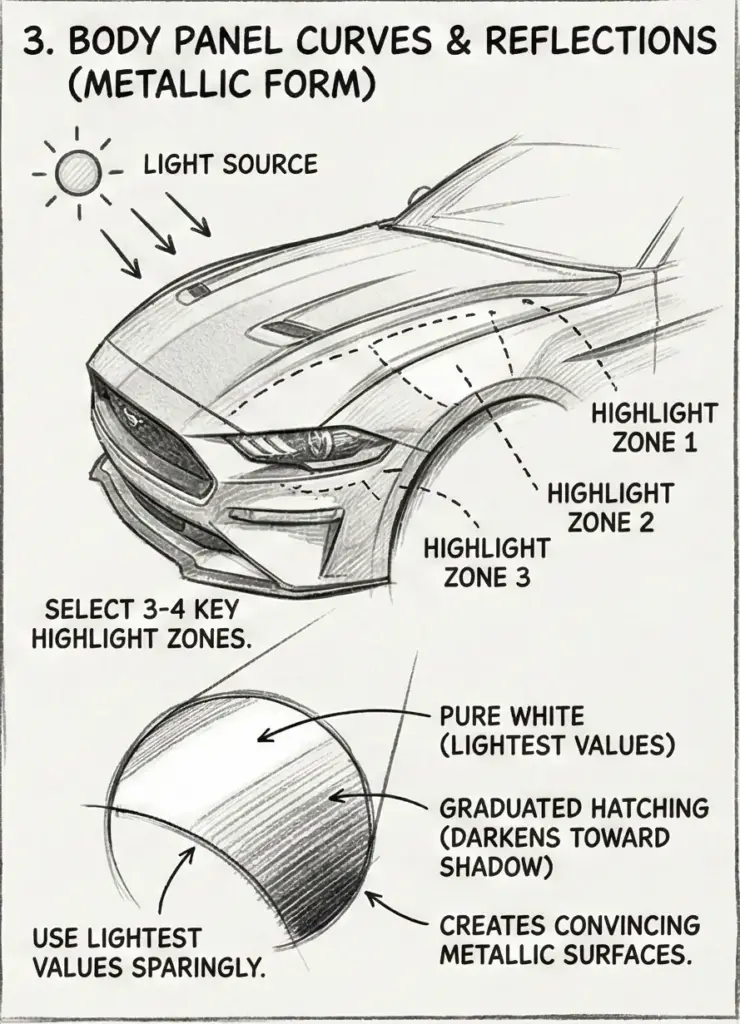
The Mustang’s sculpted surfaces catch light in complex patterns that suggest metallic paint and three-dimensional form. Rather than attempting to draw every reflection, select three to four key highlight zones based on your light source. Use your lightest values sparingly—pure white paper or carefully erased areas—surrounded by graduated hatching that darkens toward shadow zones. This restraint creates more convincing metallic surfaces than covering your drawing with multiple highlights.
These solutions address the technical challenges; consistent practice develops the intuitive understanding that elevates your Ford Mustang drawings from competent to compelling.
Conclusion and Next Steps
A Mustang drawing will reward the artists who combine some serious technical know-how with a genuine affection for this iconic muscle car’s design roots – none more so than its distinctive long hood, short deck proportions. But to get to that point, you’ll need to master the generation-specific details and sort out those pesky perspective problems you’re going to come across. And that’s exactly what this exercise is about – building up your skills gradually until you can tackle just about any automotive illustration.
Your next step – the one that’s going to keep you moving forward – is this:
- Start collecting some decent reference pics – factory press shots and enthusiast photos are great for getting the details right\
- Knock out three drawings using the step-by-step guide we’ve laid out, each one focusing on a different generation of Mustang\
- Don’t stop until you get your wheel studies down – and when you do, practice, practice, practice until it becomes second nature to get those ellipses just right\
- Experiment a bit and find out what pencils and paper combinations work best for you\
- Get yourself out there and join up with some online automotive art forums – you can get some valuable feedback and check out what other artists are up to
While you’re at it, you might want to have a look at how to do a proper engine bay render, or how to bring some colour into your work – either for cutaway illustrations or for full-on presentation pieces. And of course, there’s nothing to stop you experimenting with other classic cars that share the Mustang’s design ethos – maybe even trying your hand at some of the other American greats.
As for the business side of things – well, there’s a steady demand for quality car art out there, from shops to enthusiast mags, so with some hard work and dedication, there’s definitely a career to be made.
Additional Resources
Reference Sources
- Ford Heritage Vault (official archive with historical photography)
- Enthusiast forums with owner-submitted photography from every angle
- Classic car auction sites featuring detailed condition documentation
Recommended Materials
- Staedtler Mars Lumograph pencils (full range from 4H to 8B)
- Strathmore 400 Series Bristol, smooth surface
- Faber-Castell kneaded erasers for highlight development
- Printed reference images at 8×10 minimum for detail visibility
Learning Communities
- Automotive illustration groups on major art platforms
- Independent artist channels focusing on car drawing tutorials
- Local car shows for direct reference and contact with enthusiasts who appreciate automotive art
- 1.2Kshares
- Facebook0
- Pinterest1.2K
- Twitter0
- Reddit0